

Individual Therapy for Relationship Stress After a Baby in California
Feeling disconnected or resentful after a baby? Explore individual online therapy in California and check Blue Shield of California benefits through Headway.
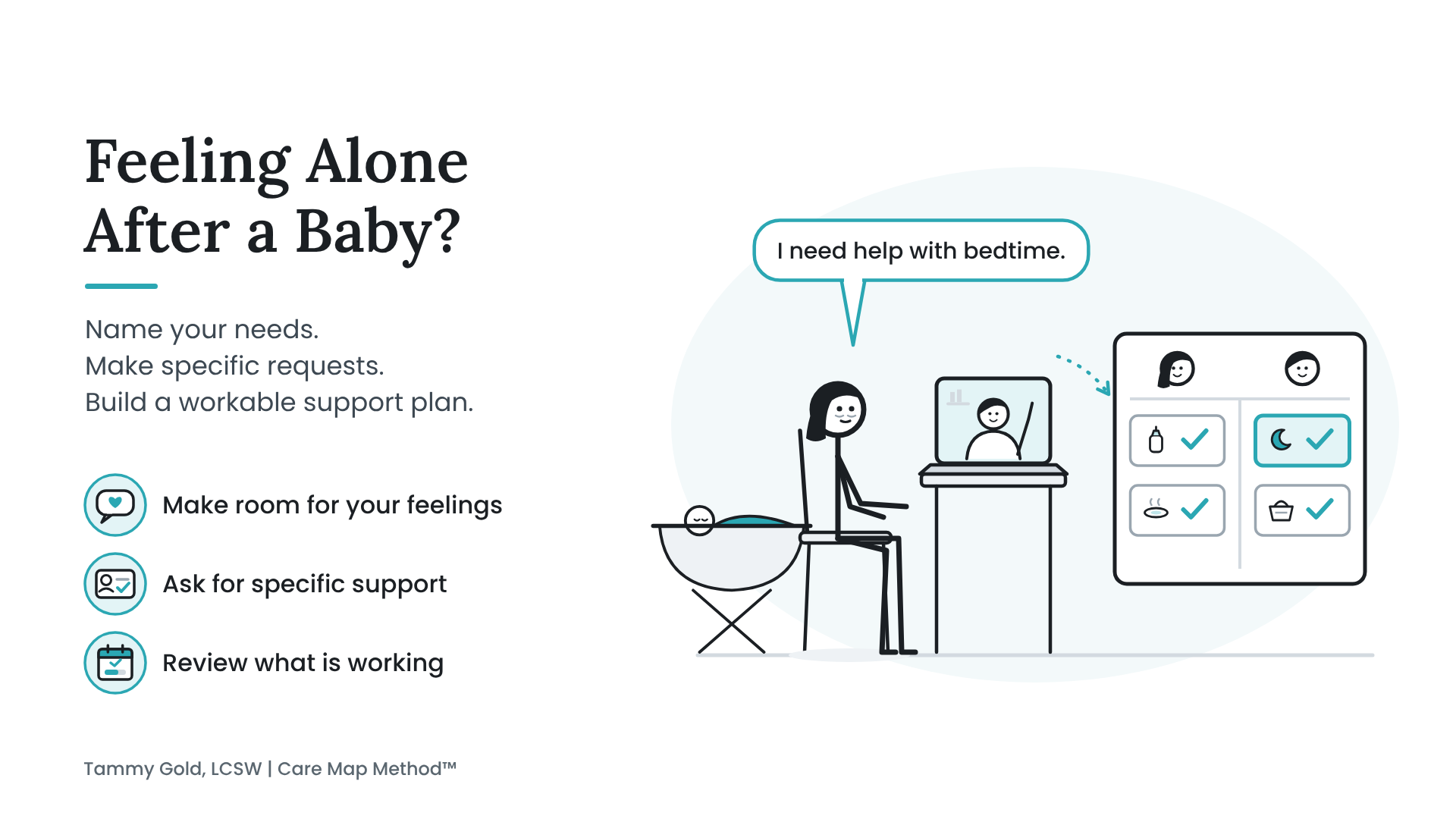
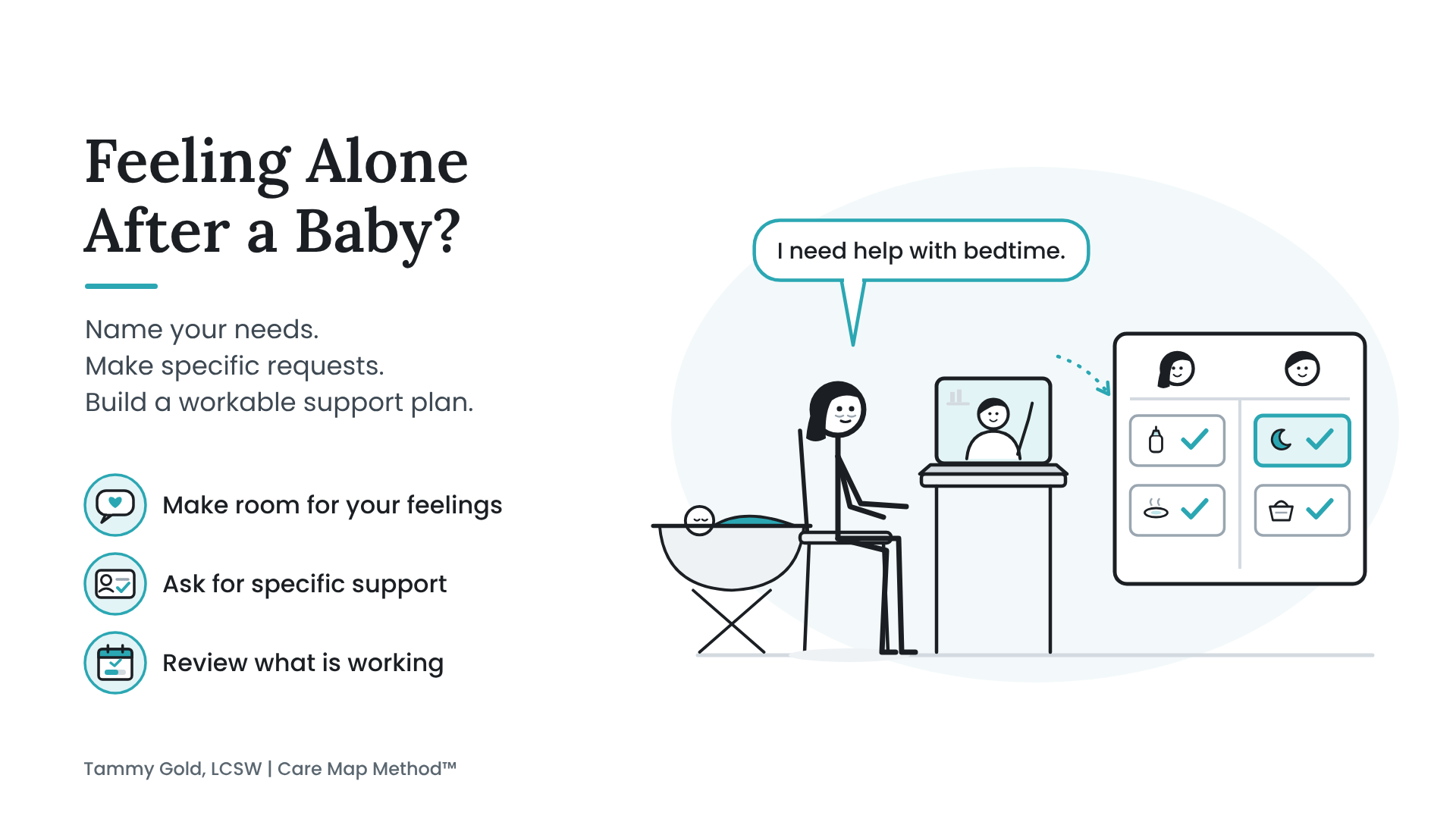
Illustration of new parents discussing support and shared responsibilities after a baby.
You expected life to change after a baby. You may not have expected to feel so alone beside your partner. Small disagreements about feeding, chores, visitors, or sleep can become arguments about whether you matter.
I am Tammy Gold, LCSW. I offer individual online therapy for adults located in California. Blue Shield of California appears on my Headway profile; please check your exact plan and eligibility before booking.
Check insurance and book through Headway
Make room for your own experience
You can love your baby and feel angry, lonely, or overwhelmed. Therapy gives you space to talk about changes in your relationship and identity without having to reassure everyone else first. We can assess your emotional symptoms and how they are affecting daily life, then decide what kind of support fits.
Move from a running argument to a specific request
“You never help” may express a real hurt, but it does not tell the other person what needs to change tonight. We can work on naming the task, the responsibility, and the follow-through you need. A starting sentence might be: “I need you to handle the bedtime routine on these two nights, including getting everything ready.” We can also explore what it means if clear requests repeatedly go unanswered.
Look at the whole picture
The Care Map Method™ helps us Map the emotional and practical strain, Match needs with realistic support, Merge that support into routines and conversations, and Manage adjustments. Biological, Emotional, Social, and Environmental needs all matter: your rest, feelings, support network, and household demands deserve attention.
What we would explore in your first session
We can begin with the moment that feels hardest: evenings, overnight responsibilities, returning to work, or watching your partner relax while you keep track of everything. We would discuss your emotional symptoms, relevant history, and how life has changed since the baby arrived. Your goal might be making a clear request, having space to process resentment, or feeling more like yourself. We can also discuss whether additional medical or mental health support is appropriate for your needs.
Make the invisible work easier to name
It can be difficult to explain why one household task feels exhausting when you are also remembering appointments, tracking supplies, and anticipating the next need. We can identify which parts of a task you carry: noticing it, planning it, doing it, and checking that it happened. In a session, we might practice asking another adult to take responsibility for the whole task. That conversation can make the request more specific and help us understand what happens when responsibility remains uneven.
A practical conversation to bring to therapy
Choose one repeated point of friction and write down what actually happens. For example: “At bedtime I prepare the supplies, do the routine, and clean up afterward. I want to discuss who owns this routine on particular nights.” Add how the situation affects you and what support you would like. We can use this as a starting point, explore your partner’s response, and adapt the request to your circumstances. You do not need to solve the entire division of labor in one conversation.
How we review progress
We can track whether you identify your feelings earlier, ask for support more directly, or recover from disagreements with less rumination. We may also revisit expectations that leave you feeling guilty about resting. If communication tools do not change an ongoing pattern, we can explore your options and support needs. Therapy cannot promise another person’s cooperation, but it can help you understand your experience and choose your next steps.
About Tammy Gold
I am Tamara “Tammy” Gold, MSW, LCSW, CEC, a licensed therapist and certified coach with a clinical MSW from Columbia University. I founded the Care Map Method™ and have more than 20 years of direct work with families. These sessions focus on your individual mental health and treatment goals.
Take the next step
If this concern is affecting your daily life, view my profile to explore fit and current booking options. Check your exact plan and estimated costs before scheduling. You can also read the online therapy booking guide for help choosing a platform.
Check insurance and booking through Headway
Is this therapy for me or for my baby?
This page describes individual therapy for an adult parent. Sessions focus on your mental health, relationships, and adjustment.
Can Blue Shield of California cover these sessions?
Your plan, provider eligibility, and clinical requirements determine coverage. Verify your exact benefits through my Headway profile before booking.
Is this the same as couples counseling?
No. Individual therapy focuses on your treatment. If you want joint sessions, we can discuss fit and check their coverage separately.
Can I attend if my partner does not want therapy?
Yes. These sessions focus on your individual mental health, decisions, and responses. We can explore relationship stress even if your partner is not participating.
Do I need to be a first-time parent?
No. You can seek support after another baby or during a later adjustment in parenting. We would assess your current needs and whether my approach is a good fit.
How do we know whether therapy is helping?
We can choose specific goals together and review changes in your daily experience, communication, and coping. We can adjust the plan when a strategy feels unrealistic or unhelpful.
Therapy for In-Law Conflict in California
Online therapy with Tammy Gold, LCSW for in-law conflict and relationship stress in California. Check Anthem Blue Cross eligibility through Headway.
When the disagreement follows you home
In-law conflict can involve holidays, parenting advice, money, privacy, or how much access relatives have to your daily life. You may feel caught between protecting your relationship and keeping the peace. In individual therapy, we can look at how this strain affects your mood, sleep, self-confidence, and ability to communicate.
A boundary you can actually use
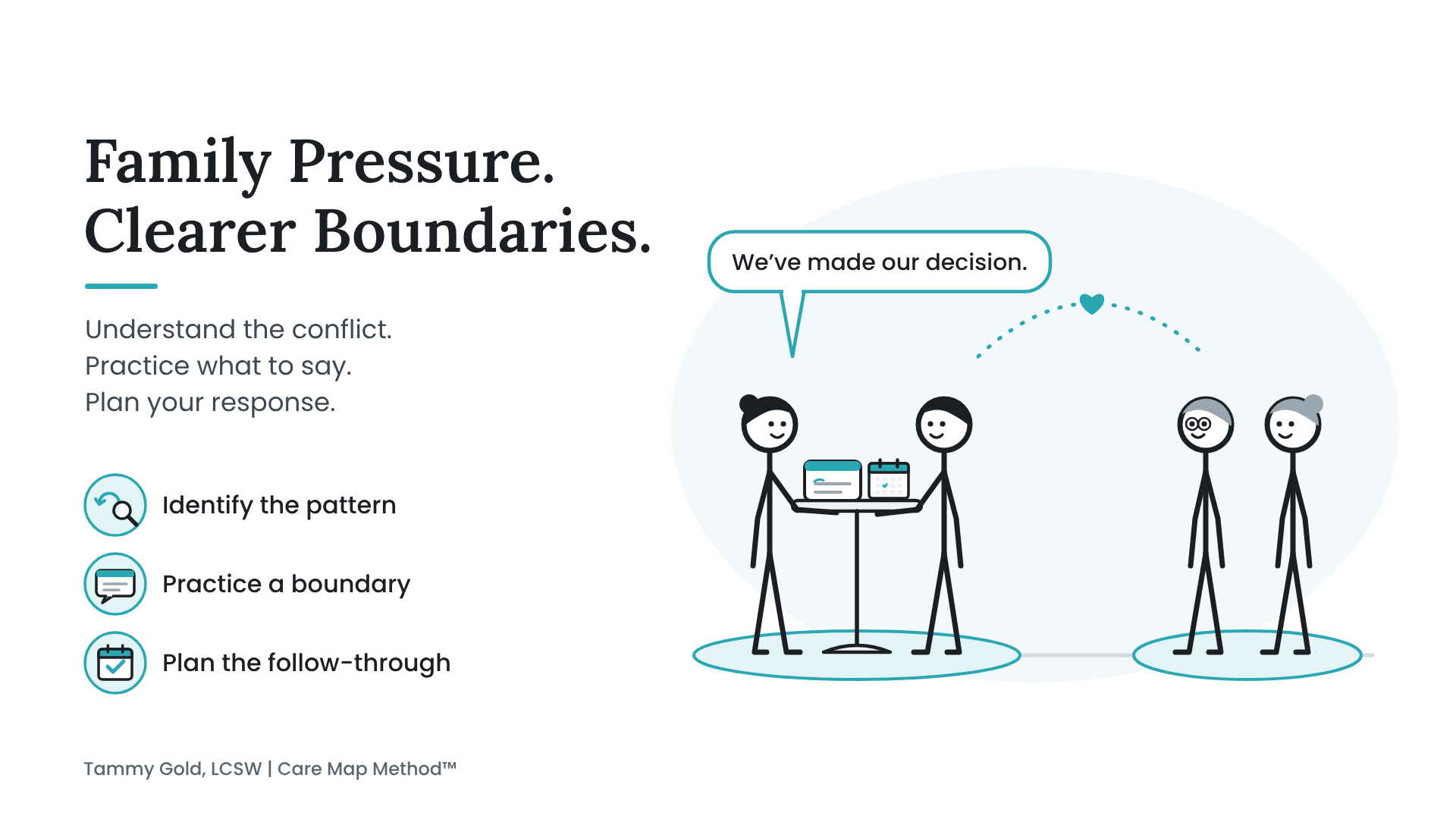
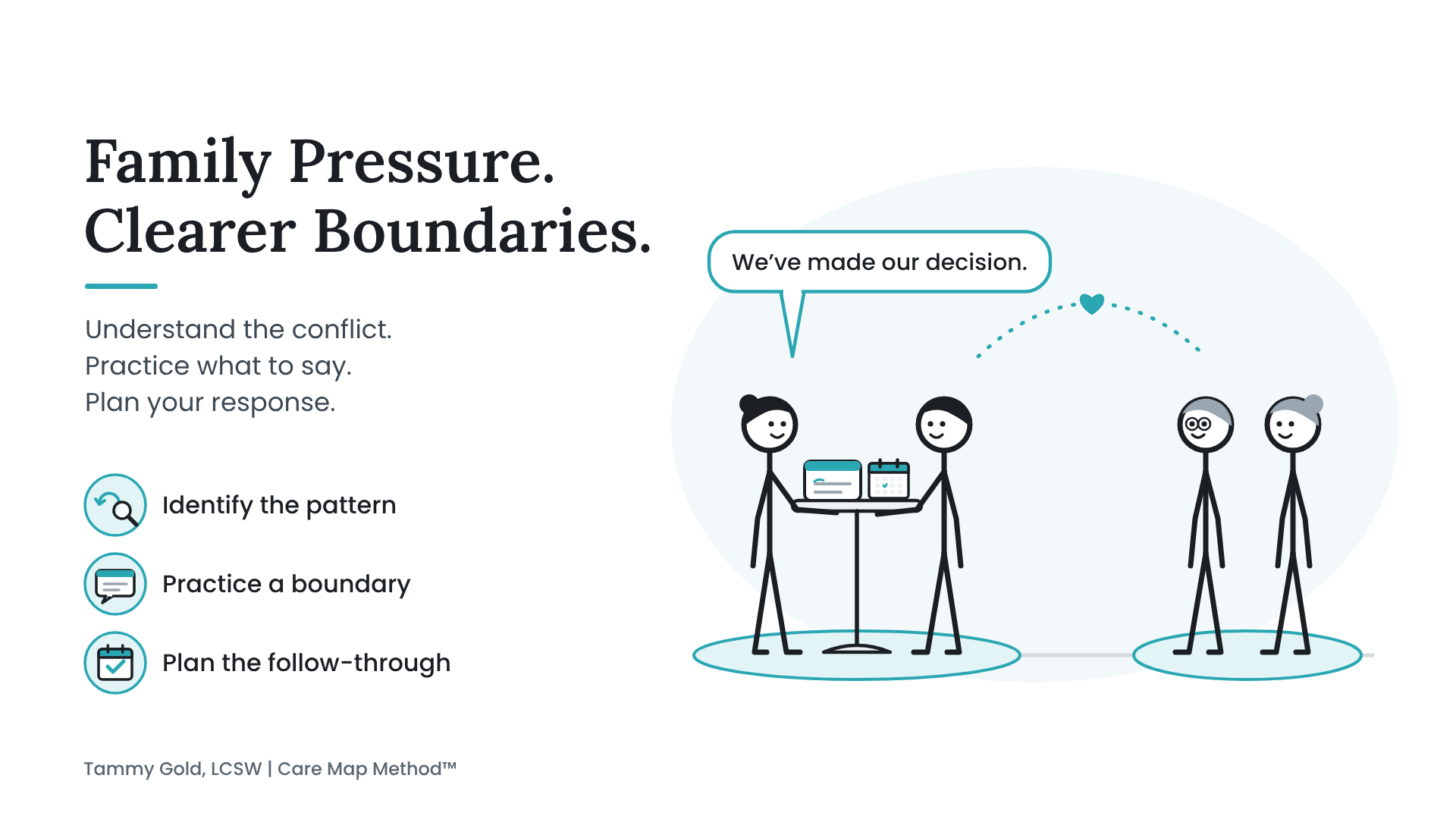
We can identify the specific interaction that overwhelms you, what you want to protect, and a response you can realistically maintain. That might mean agreeing with your partner before a visit, shortening a conversation, or choosing which topics you will discuss. For example: “I know you see it differently. We have made our decision, and I am not going to debate it today.”
How I approach the pattern
With the Care Map Method™, we Map the conflict and its impact; Match your needs with coping and communication strategies; Merge those strategies into a conversation or boundary; and Manage what happens afterward. We also consider Biological, Emotional, Social, and Environmental factors, including exhaustion, family expectations, and the setting in which conflict happens.
What we would explore in your first session
We can start with one recent incident instead of trying to explain your entire family history. Who was there? What was said? When did you begin to feel tense, dismissed, or responsible for keeping everyone happy? We would also discuss your symptoms, relevant history, and what you want therapy to change. Perhaps you want to sleep after a visit without replaying it, express a preference without apologizing, or talk with your partner before resentment builds. Those goals help us decide where to begin.
An example of working through a family visit
Imagine that a relative repeatedly questions your parenting while your partner stays quiet. We might unpack the criticism, the meaning you attach to your partner’s silence, and the response you wish you had made. Then we can practice a private conversation: “When the advice continued and we did not respond, I felt alone. Can we agree on how to handle that next time?” This is an illustrative example, not a client story. The wording would change to fit your relationship, safety, and values.
A small step before the next gathering
Write down the topic that tends to start the conflict, the earliest sign that you are becoming overwhelmed, and one action within your control. Your action might be taking a break, changing the subject once, or leaving at an agreed time. Bring that note to therapy so we can consider what feels realistic. You do not have to deliver a perfect speech. We can work on making your response clearer and understanding why following through feels difficult.
How we review progress
We can look at whether you recover more easily after contact, feel clearer about your choices, or spend less time rehearsing arguments. If a boundary creates new tension, we can examine what happened and adjust it. Progress does not require everyone in the family to agree. It can include recognizing your limits sooner and making decisions with less self-doubt.
About Tammy Gold
I am Tamara “Tammy” Gold, MSW, LCSW, CEC, a licensed therapist and certified coach with a clinical MSW from Columbia University. I founded the Care Map Method™ and have more than 20 years of direct work with families. These sessions focus on your individual mental health and treatment goals.
Take the next step
If this concern is affecting your daily life, view my profile to explore fit and current booking options. Check your exact plan and estimated costs before scheduling. You can also read the online therapy booking guide for help choosing a platform.
Check insurance and booking through Headway
Can I come alone if my partner will not attend?
Yes. Individual therapy can focus on your distress, responses, boundaries, and relationship decisions without requiring your partner or relatives to participate.
Does Anthem cover therapy for in-law conflict?
Coverage depends on your exact plan and whether treatment meets its clinical requirements. Relationship conflict alone does not guarantee coverage. Check your benefits through my Headway profile.
Will you tell me to stop seeing my in-laws?
We can explore your options and their consequences. The aim is to help you make an informed choice that fits your needs and circumstances.
What if my partner says I am overreacting?
We can examine the specific interaction and its impact without requiring your partner to validate your feelings first. We can also explore how you want to respond when your experience is dismissed.
How many sessions will I need?
The number depends on your needs, goals, and response to treatment. We can discuss a starting plan after assessment and revisit it as we learn what is helping.
Can we practice what to say before a visit?
Yes. When appropriate to your treatment goals, we can rehearse a conversation or boundary and discuss how you might respond if the other person pushes back.
Check insurance and booking through Headway: https://care.headway.co/providers/tamara-gold-2
Explore my Alma profile: https://secure.helloalma.com/providers/tamara-gold/
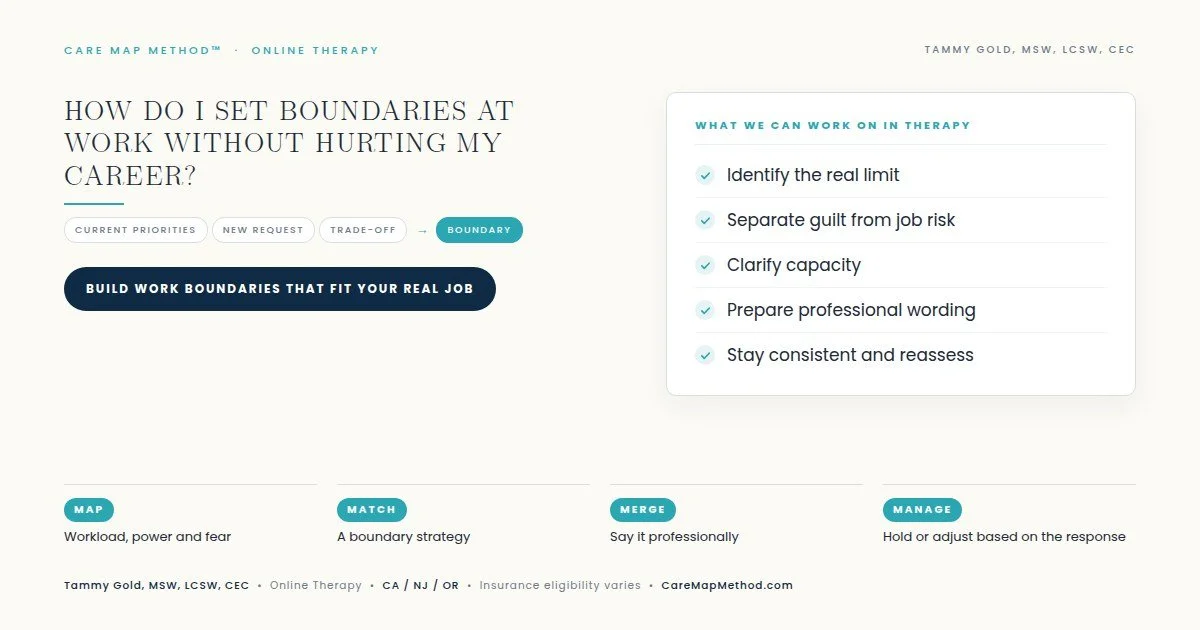
How Do I Set Boundaries at Work Without Hurting My Career?
Work boundaries are harder when the person asking for more work may also evaluate you. Therapy can help you replace vague resentment with clear capacity, priorities and professional language that fits the realities of your job.
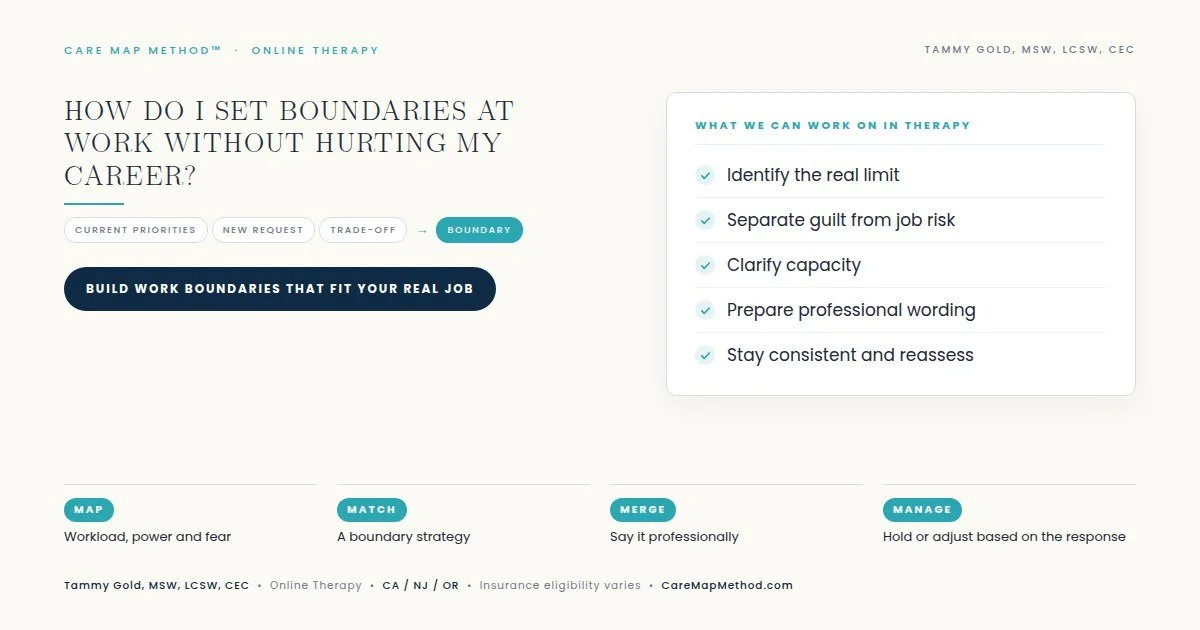
Care Map Method therapy for setting work boundaries, workload limits and professional communication
HOW DO I SET BOUNDARIES AT WORK WITHOUT HURTING MY CAREER?
The goal is not to become less committed. It is to make capacity, priorities and expectations clearer.
What therapy can help you work on:
• Identify where your limits are actually being crossed
• Separate fear of disapproval from realistic career risk
• Turn “no” into capacity and priority language
• Prepare for pushback from a boss or coworker
• Stay consistent without becoming rigid or overexplaining
BUILD WORK BOUNDARIES THAT FIT YOUR REAL JOB
Work boundaries are not simple because work has stakes
Your livelihood, reputation and advancement may be involved. Advice that works in a friendship may be inappropriate with a supervisor. Good workplace boundaries therefore need to be specific, professional and grounded in your actual role.
People-pleasing can make every request feel mandatory
If being dependable is central to your identity, you may volunteer before checking capacity, answer instantly or absorb work that was never clearly yours. The resentment arrives later.
Care Map Method™
MAP the request, power dynamic, workload and feared consequence.
MATCH the issue with the right boundary or prioritization conversation.
MERGE it into professional language.
MANAGE reactions and maintain the boundary consistently enough to learn whether it works.
A boundary is not a guarantee that everyone will like it
The purpose is clarity. We can work on tolerating discomfort while staying mindful of real job expectations and consequences.
What We Can Work On
Identify where your limits are actually being crossed
Separate fear of disapproval from realistic career risk
Turn “no” into capacity and priority language
Prepare for pushback from a boss or coworker
Stay consistent without becoming rigid or overexplaining
Care Map Method™
MAP the problem and pattern. MATCH the needs with the right clinical strategies. MERGE insight into real conversations, boundaries and behavior. MANAGE what happens next and adjust as the situation changes.
How do I say no to more work without looking unhelpful?
Often the most professional approach is to make capacity and trade-offs visible: clarify current priorities, ask what should move and avoid promising work that cannot realistically be completed.
Can boundaries hurt my career?
Workplace context matters, and no therapist can guarantee how an employer will respond. We can help you think through the power dynamics, job expectations and wording so the boundary is deliberate rather than reactive.
Why do I feel guilty setting work boundaries?
You may equate availability with competence, loyalty or safety. Therapy can help separate healthy commitment from over-responsibility and fear-driven people pleasing.
What if my boss ignores my boundary?
Repeatedly ignored limits provide information. We can reassess the wording, organizational expectations, documentation, escalation options and whether the environment is sustainable.
How do I set boundaries with coworkers who constantly need help?
Clarify what support is appropriate, when you are available and what work you are responsible for. A boundary can include redirecting requests or scheduling help rather than responding immediately.
Can therapy help me practice the actual conversation?
Yes. We can write and rehearse concise language, anticipate objections and work on the emotional response that makes it hard to follow through.
BUILD WORK BOUNDARIES THAT FIT YOUR REAL JOB
Check insurance eligibility and request an online therapy appointment. Therapy is available to eligible clients in California, New Jersey and Oregon; coverage and benefits vary by plan.
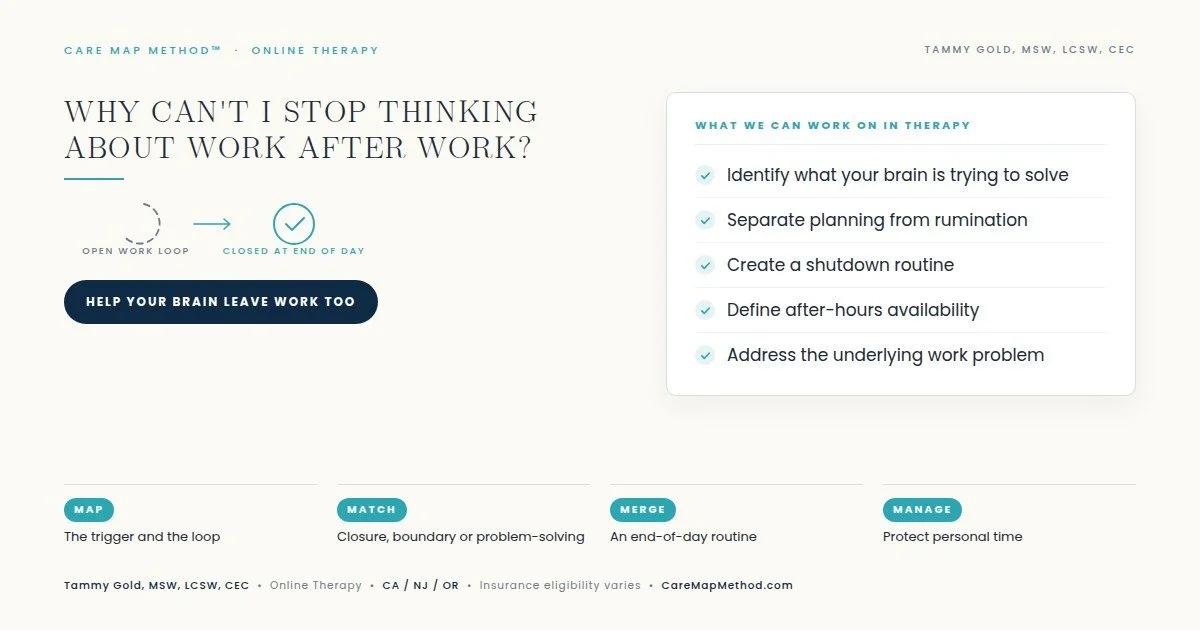
Why Can’t I Stop Thinking About Work After Work? Therapy for Work Rumination
Your laptop can be closed while your brain is still at work. If you replay conversations, anticipate tomorrow or check messages compulsively, therapy can help identify what keeps the workday psychologically open.
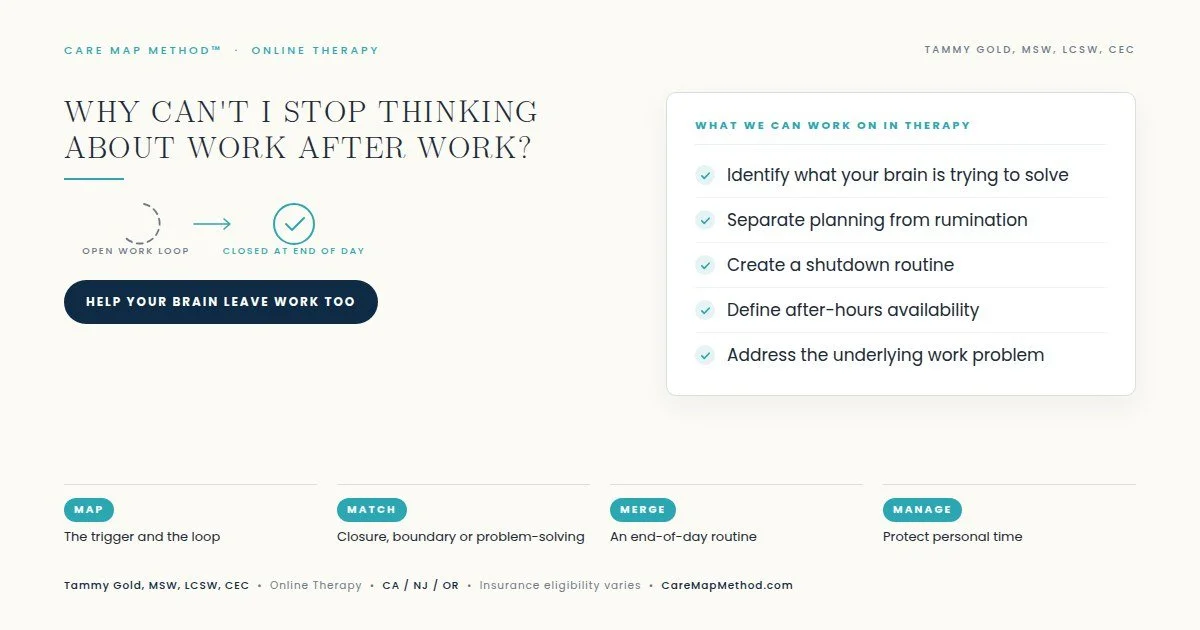
Care Map Method therapy for work rumination, after-hours anxiety and work-life boundaries
WHY CAN’T I STOP THINKING ABOUT WORK AFTER WORK?
Closing the laptop is not the same as closing the stress loop.
What therapy can help you work on:
• Identify what your brain is still trying to solve
• Separate useful planning from repetitive rumination
• Create an end-of-work closure routine
• Set realistic after-hours communication boundaries
• Address the boss, coworker or workload problem underneath the thoughts
HELP YOUR BRAIN LEAVE WORK TOO
Work can stay psychologically open
Unfinished tasks, ambiguous feedback, conflict and fear of forgetting something can keep your mind scanning long after the workday ends.
Rumination feels productive but often is not
Thinking about a problem repeatedly can create the feeling that you are preparing, even when you are cycling through the same material without reaching a new decision.
Sometimes the thought loop is pointing to a real workplace problem
The answer is not always relaxation. If the real issue is an unreasonable workload, unclear boss, conflict or boundary violation, we need to address that too.
Care Map Method™
MAP when the rumination starts, what triggers it and what problem it is attached to.
MATCH the trigger with closure, communication, boundary or problem-solving.
MERGE the strategy into the end of the workday.
MANAGE what returns and refine the plan.
Your evening needs somewhere else to go
The goal is not to never think about work. It is to regain choice over when work receives your attention and when your personal life gets to be fully present.
What We Can Work On In Our Session Together:
Identify what your brain is still trying to solve
Separate useful planning from repetitive rumination
Create an end-of-work closure routine
Set realistic after-hours communication boundaries
Address the boss, coworker or workload problem underneath the thoughts
Care Map Method™
MAP the problem and pattern. MATCH the needs with the right clinical strategies. MERGE insight into real conversations, boundaries and behavior. MANAGE what happens next and adjust as the situation changes.
Why do I keep thinking about work after hours?
Common drivers include unfinished tasks, uncertainty, conflict, high responsibility, anxiety and weak boundaries between work and personal time. Therapy can help identify which pattern is operating for you.
Is work rumination the same as anxiety?
They can overlap, but repetitive work thoughts are not automatically an anxiety disorder. A clinician can assess the broader pattern, severity and impact.
Can therapy help with Sunday scaries?
Yes. We can identify what Sunday dread predicts—workload, a person, performance fears, lack of recovery or a job-fit problem—and build a response around the actual trigger.
Should I stop checking email after work?
That depends on your role and legitimate job expectations. The goal is to define realistic availability rather than impose a boundary that does not fit your circumstances.
What if I need to be reachable for work?
We can distinguish true on-call requirements from habitual checking and create a plan that protects as much off-duty time as your role realistically allows.
What if the thoughts keep me from sleeping?
Persistent sleep disruption deserves attention. Therapy can address rumination and stress, while medical evaluation may also be appropriate for ongoing sleep problems.
HELP YOUR BRAIN LEAVE WORK TOO Text: 818.308.1538
Check insurance eligibility and request an online therapy appointment. Therapy is available to eligible clients in California, New Jersey and Oregon; coverage and benefits vary by plan.
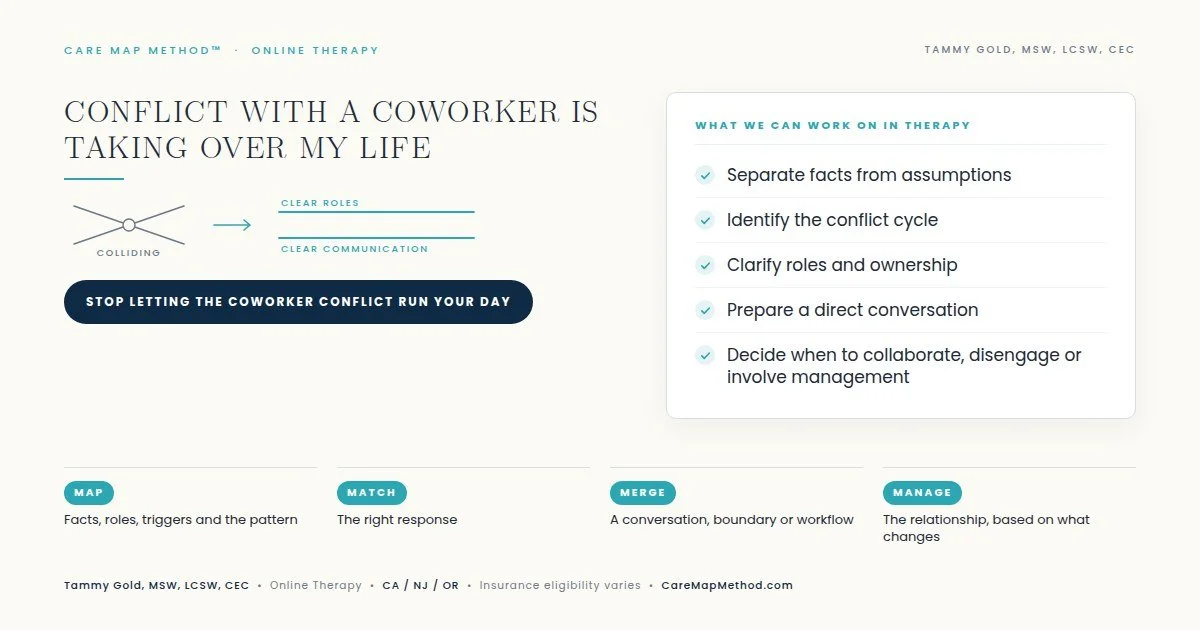
Conflict With a Coworker Is Taking Over My Life: Workplace Relationship Therapy
A coworker conflict can become disproportionately consuming when you still have to collaborate every day. Therapy can help you stop replaying the conflict, communicate more strategically and decide what belongs to you versus the workplace system.
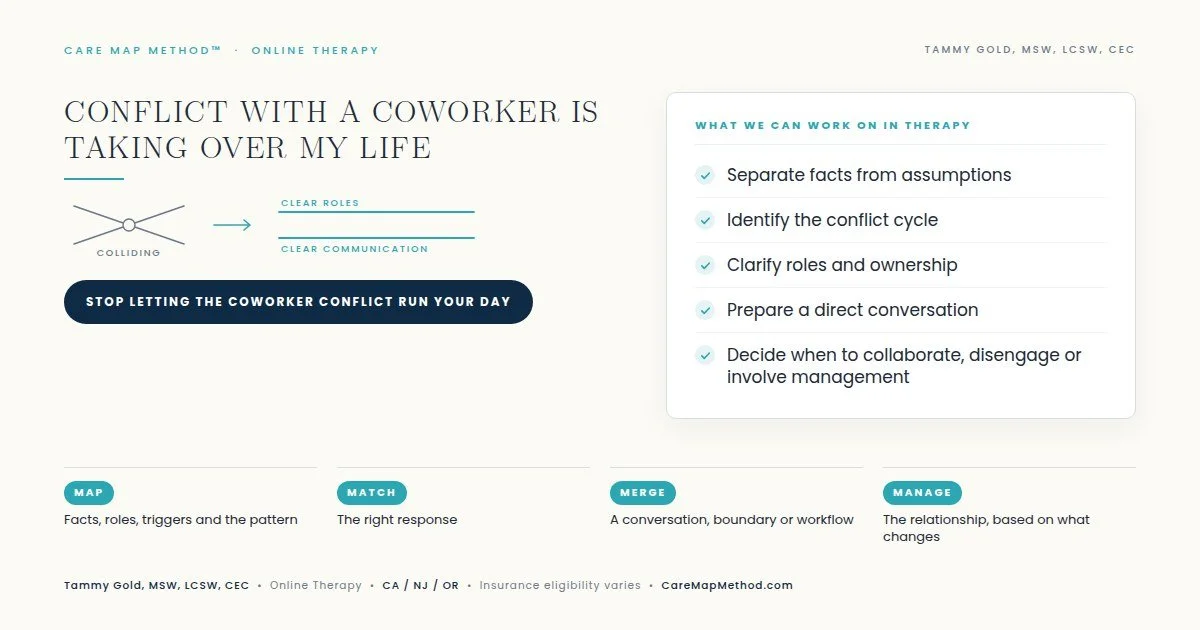
Care Map Method therapy for coworker conflict, workplace communication and stress
CONFLICT WITH A COWORKER IS TAKING OVER MY WORKDAY
When you cannot simply avoid the person, you need a plan for the relationship—not another night replaying the argument.
What therapy can help you work on:
• Separate facts from assumptions and office narratives
• Identify the interaction pattern between you
• Prepare a direct, professional conversation
• Set role and communication boundaries
• Decide what needs collaboration, management support or disengagement
STOP LETTING THE COWORKER CONFLICT RUN YOUR DAY
Peer conflict is uniquely frustrating
With a boss, authority is clear. With a coworker, you may depend on one another without having authority to resolve the problem. That can create repeated friction, triangulation and uncertainty about who should address what.
Rumination keeps the conflict alive after work
You may rehearse what you should have said, interpret Slack messages, ask colleagues for reassurance or dread the next meeting. Therapy can help interrupt that loop while still taking the workplace problem seriously.
We map the interaction
What does the coworker do? What do you do next? What happens after that? Which part is task conflict, communication style, competition, unclear ownership or a larger organizational issue?
Care Map Method™
MAP the facts, roles, triggers and communication pattern. MATCH the conflict with the right response. MERGE that response into a conversation, boundary or workflow. MANAGE the relationship based on what actually changes.
The goal is functional, not necessarily friendly
You do not need to become close. Often the goal is a workable professional relationship that protects your ability to do your job and go home without carrying the conflict with you.
What We Can Work On In Our Session:
Separate facts from assumptions and office narratives
Identify the interaction pattern between you
Prepare a direct, professional conversation
Set role and communication boundaries
Decide what needs collaboration, management support or disengagement
Care Map Method™
MAP the problem and pattern.
MATCH the needs with the right clinical strategies.
MERGE insight into real conversations, boundaries and behavior.
MANAGE what happens next and adjust as the situation changes.
Can therapy help with coworker conflict?
Yes. Therapy can help with rumination, communication, boundaries, emotional triggers and decision-making around a workplace relationship.
What if I have to keep working closely with the person?
Then the goal may be a functional professional relationship rather than avoidance. We can clarify roles, communication channels and specific conversations that reduce unnecessary friction.
Should I confront my coworker?
Not every conflict requires a confrontation. We can determine the goal, the facts, the power dynamics and whether direct communication, a workflow change or management involvement makes more sense.
How do I stop replaying work conflict at home?
We can work on rumination, uncertainty, emotional regulation and a concrete plan for the next work step so your brain does not have to keep trying to solve the problem all night.
What if coworkers are gossiping about me?
We can focus on verified information, your response and appropriate workplace channels rather than amplifying assumptions. Serious harassment or employment concerns may also require HR or legal guidance.
Can therapy help me communicate without getting defensive?
Yes. We can identify triggers, practice concise language and plan how to stay focused on the work issue when the conversation becomes uncomfortable.
STOP LETTING THE COWORKER CONFLICT RUN YOUR DAY
Text: 818.308.1538
Check insurance eligibility and request an online therapy appointment. Therapy is available to eligible clients in California, New Jersey and Oregon; coverage and benefits vary by plan.
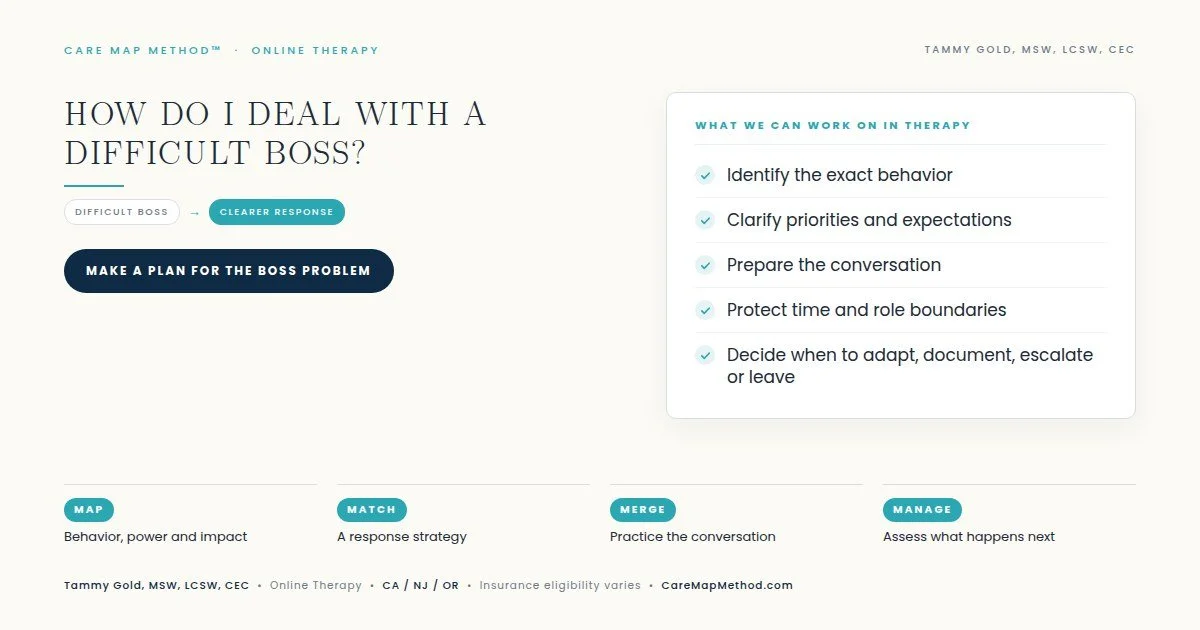
How Do I Deal With a Difficult Boss? Therapy for Workplace Stress
When your boss changes priorities, micromanages, criticizes or keeps you constantly on edge, the problem can follow you home. Therapy can help you respond strategically without pretending the power imbalance is not real.
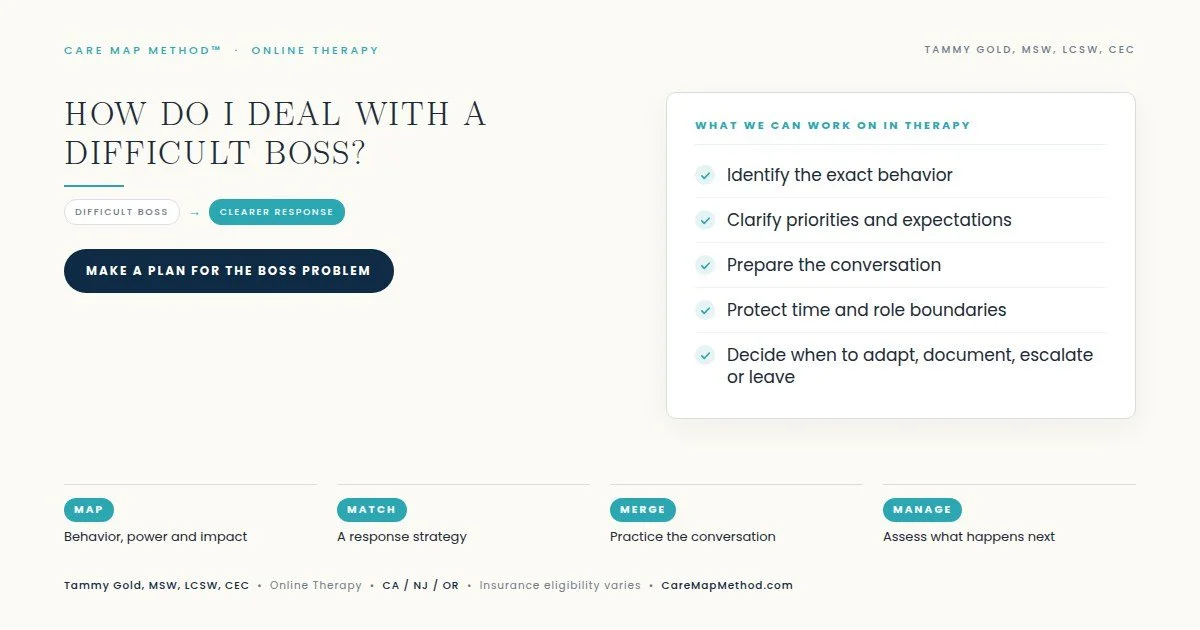
Care Map Method therapy for difficult boss stress, workplace communication and boundaries
MY BOSS IS MAKING ME MISERABLE. WHAT CAN THERAPY HELP ME DO?
You may not control your boss. You can become clearer about the pattern, your response and your options.
What therapy can help you work on:
• Identify the specific boss behavior—not just “toxic”
• Separate what is uncomfortable from what is unsustainable
• Prepare concise conversations about priorities and expectations
• Build boundaries that account for the power difference
• Decide when to adapt, escalate, document or consider leaving
A difficult boss can take up far more than eight hours
You may replay meetings, anticipate criticism, check messages late at night or spend weekends preparing for Monday. The relationship becomes psychologically present even when the boss is not.
Specificity gives you more options
“My boss is terrible” may be true to your experience, but it is hard to act on. Micromanagement, changing priorities, public criticism, unclear expectations and after-hours demands each require different responses.
Power matters
Workplace boundaries are not identical to boundaries with friends or family. Your manager may control assignments, evaluation or advancement. Therapy can help you plan communication that acknowledges those realities instead of relying on simplistic advice to “just say no.” Current workplace guidance likewise emphasizes clear expectations, capacity and specific communication around boundaries. citeturn0search0turn0search7
Care Map Method™
MAP the behavior, trigger, power dynamic and impact. MATCH the problem with communication, boundary, documentation, support or decision-making. MERGE the strategy into a specific conversation. MANAGE what happens next and adjust based on evidence.
The work is about protecting both your wellbeing and your judgment
Chronic stress can make every interaction feel urgent. Slowing the pattern down can help you respond professionally while deciding what is and is not workable.
What We Can Work On In Our Sessions:
Identify the specific boss behavior—not just “toxic”
Separate what is uncomfortable from what is unsustainable
Prepare concise conversations about priorities and expectations
Build boundaries that account for the power difference
Decide when to adapt, escalate, document or consider leaving
Care Map Method™
MAP the problem and pattern.
MATCH the needs with the right clinical strategies.
MERGE insight into real conversations, boundaries and behavior.
MANAGE what happens next and adjust as the situation changes.
Can therapy help with a difficult boss if my boss will not change?
Yes. The work can focus on your stress response, communication, boundaries, decision-making and options even when the other person does not change.
How do I set boundaries with someone who controls my job?
Workplace boundaries need to account for power and job expectations. We can clarify the specific issue and prepare professional language around priorities, capacity, availability or communication.
What if my boss is a micromanager?
We can identify what triggers the micromanagement, what information or structure may reduce it, how you respond to repeated checking and what limits or larger decisions may be necessary.
Should I tell HR about my boss?
That is a context-specific employment decision. Therapy can help you organize what has happened and think through goals and risks, but legal or HR advice should come from the appropriate qualified source.
What if I am afraid of retaliation?
That concern should be taken seriously rather than dismissed. We can work on emotional support and decision-making while you seek appropriate employment or legal guidance for rights and risks.
Can you help me prepare what to say to my boss?
Yes. We can clarify the goal of the conversation, reduce emotionally loaded language, practice concise wording and anticipate likely responses.
MAKE A PLAN FOR THE BOSS PROBLEM. 818.308.1538
Check insurance eligibility and request an online therapy appointment. Therapy is available to eligible clients in California, New Jersey and Oregon; coverage and benefits vary by plan.
My Job Is Burning Me Out: Therapy for Work Stress and Burnout
Burnout can make every workday feel like something to survive. Therapy can help you distinguish workload, workplace dynamics, perfectionism, boundaries and larger career questions so you can respond with a plan rather than only pushing harder.
Care Map Method therapy for job burnout, work stress, boundaries and career decisions
Burnout can make everything look like a personal failure
When you are exhausted, it is easy to conclude that you need to become more efficient, resilient or disciplined. Sometimes the real problem is chronic overload, unclear priorities, a difficult manager, weak boundaries or a role that no longer fits.
We map the stress instead of calling all of it burnout
What happens on Sunday night? Which meetings create dread? When do you work beyond your capacity? What are you afraid will happen if you say no? The answers point toward different interventions.
Therapy can address both the workplace and your response to it
You may not control organizational decisions, but you can work on communication, perfectionism, over-responsibility, conflict, recovery time and decision-making.
Care Map Method™
MAP the workload, relationships, triggers and costs. MATCH each problem with the right strategy—boundary, communication, prioritization, coping or career decision. MERGE the strategy into actual work conversations and routines. MANAGE the results and reassess what remains unsustainable.
The goal is not to teach you to tolerate an intolerable situation
Sometimes therapy helps people stay differently; sometimes it helps them recognize that the environment is not changing. Either way, clarity is more useful than simply trying harder.
What We Can Work On In Our Session:
Identify what is actually draining you
Separate workload from people and boundary problems
Reduce all-or-nothing overfunctioning
Prepare conversations about priorities and capacity
Clarify whether the job needs adjustment—or a larger change
Care Map Method™
MAP the problem and pattern. MATCH the needs with the right clinical strategies. MERGE insight into real conversations, boundaries and behavior. MANAGE what happens next and adjust as the situation changes.
How do I know if I am burned out or just tired?
Burnout is commonly associated with sustained work stress, exhaustion and reduced effectiveness or detachment. Because fatigue can also have medical and psychiatric causes, persistent or severe symptoms deserve appropriate professional evaluation.
Can therapy help if the job itself is the problem?
Yes. Therapy can help you identify what is controllable, prepare workplace conversations, set boundaries, manage stress and make clearer decisions about staying or leaving.
What if I cannot afford to quit?
Therapy does not require an immediate career exit. We can work on reducing harm and increasing clarity while respecting financial and practical realities.
Can therapy help me stop thinking about work at night?
We can address the triggers, unfinished-task loops, anxiety, boundaries and routines that keep work mentally active after hours.
What if I am the person everyone relies on?
That role can become rewarding and exhausting at the same time. We can examine over-responsibility, delegation, guilt and what happens when you are not immediately available.
Will you tell me to quit my job?
No. The purpose is to help you understand the situation, your needs and your options so that you can make your own informed decision.
BUILD A PLAN FOR WORK BURNOUT 818.308.1538
Check insurance eligibility and request an online therapy appointment. Therapy is available to eligible clients in California, New Jersey and Oregon; coverage and benefits vary by plan.
Why Am I Doing Everything for My Aging Parent? Caregiver Burnout & Sibling Conflict Therapy
Caring for an aging parent can become overwhelming when one sibling becomes the default organizer, decision-maker and emotional container. Therapy can help you separate what truly needs to be done from what you can realistically carry.
Care Map Method therapy for caregiver burnout, aging parent responsibilities and sibling conflict
WHY AM I THE ONE DOING EVERYTHING FOR MOM OR DAD?
Caregiving stress becomes even heavier when responsibility, guilt and sibling conflict get mixed together.
What therapy can help you work on:
• Map what your parent actually needs
• Separate essential care from tasks you absorbed by default
• Make each sibling’s current role visible
• Prepare a family conversation about capacity and responsibility
• Set limits when other people still do not participate
Caregiving can quietly become a full second job
Appointments, medications, transportation, finances, calls, emergencies and emotional support often accumulate one task at a time. The most reliable family member can become the default caregiver before anyone explicitly decides that should happen.
Sibling conflict often brings old family roles back
The responsible child, the distant child, the peacemaker or the sibling who “cannot handle it” may reappear under pressure. The current eldercare problem can become entangled with decades of family history.
We separate the care problem from the family pattern
Your parent’s actual needs deserve a clear assessment. So does your capacity. Therapy can help distinguish urgent care tasks from guilt-driven overfunctioning and clarify what needs to be requested from siblings or outside resources.
Care Map Method™
MAP the biological, emotional, social and environmental needs surrounding the parent and caregiver. MATCH needs with people, services and realistic responsibilities. MERGE family communication and outside support into a workable plan. MANAGE changes as health, capacity and family participation shift.
You cannot force siblings to become different people
But you can become clearer about what you will carry, what you are asking for and what happens when others decline. That can reduce the cycle of resentment, rescuing and explosion.
What We Can Work On
Map what your parent actually needs
Separate essential care from tasks you absorbed by default
Make each sibling’s current role visible
Prepare a family conversation about capacity and responsibility
Set limits when other people still do not participate
Care Map Method™
MAP the problem and pattern. MATCH the needs with the right clinical strategies. MERGE insight into real conversations, boundaries and behavior. MANAGE what happens next and adjust as the situation changes.
What if my siblings refuse to help with our aging parent?
Therapy cannot force participation, but it can help you clarify requests, communicate responsibilities, set limits on what you will carry and consider outside supports when family capacity is insufficient.
How do I stop resenting my siblings?
We can work on the unfairness you are experiencing while also identifying what you can change. Resentment often becomes more manageable when responsibilities, requests and boundaries become more explicit.
How do I know if I have caregiver burnout?
Persistent exhaustion, irritability, dread, isolation, sleep disruption and feeling that you can never step away can be signs that caregiving stress needs attention. A medical professional should evaluate physical or psychiatric symptoms when appropriate.
Can therapy help with an aging parent who refuses help?
Yes. We can work on communication, limits, your own emotional response and the distinction between respecting an adult’s autonomy and responding to genuine safety concerns.
Should all siblings come to therapy?
Not necessarily. Individual therapy can help the person carrying the burden. Family sessions may be appropriate in some circumstances when participants are willing and the treatment arrangement supports it.
What does the Care Map add to caregiver therapy?
It organizes the problem across biological, emotional, social and environmental needs, then connects those needs to realistic people, services, boundaries and follow-up rather than treating burnout as only an individual coping problem.
GET HELP WITH CAREGIVER OVERLOAD. BOOK A SUPPORT SESSION TODAY 818.308.1538
Check insurance eligibility and request an online therapy appointment. Therapy is available to eligible clients in California, New Jersey and Oregon; coverage and benefits vary by plan.
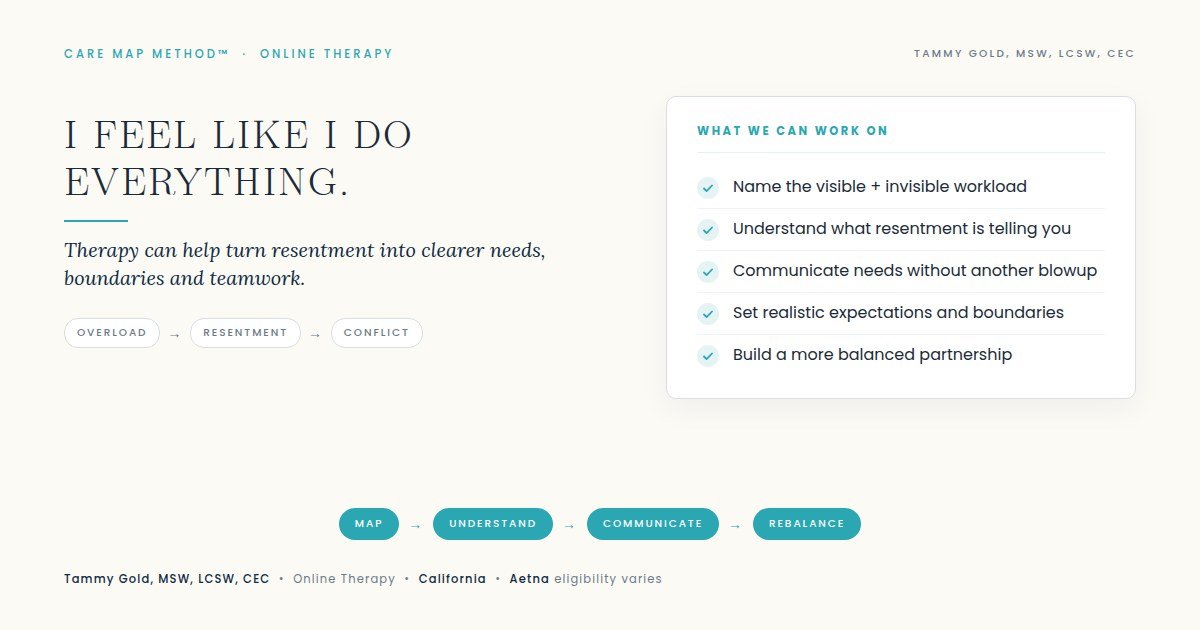
Why Do I Feel Guilty When I Set Boundaries With My Family?
Knowing you need a boundary and being able to hold one are different skills. If saying no to family immediately creates guilt, fear or pressure to reverse yourself, therapy can help you understand why and build a more sustainable response.
WHY DOES SETTING ONE BOUNDARY MAKE ME FEEL SO GUILTY?
A boundary can be appropriate and still feel uncomfortable. Therapy can help you hold both truths.
What therapy can help you work on:
• Identify the family rule behind the guilt
• Separate responsibility from over-responsibility
• Create language that is clear without overexplaining
• Prepare for pushback without immediately giving in
• Practice tolerating guilt while maintaining the limit
BUILD BOUNDARIES YOU CAN ACTUALLY HOLD
Guilt does not automatically mean you did something wrong
In some families, being helpful, available or agreeable becomes part of your identity. Saying no can therefore feel like betrayal even when the request is unreasonable.
Boundaries change systems
When one person changes a familiar role, other people may push for the old arrangement to return. Their discomfort does not automatically mean the new boundary is unhealthy.
Therapy can help with the moment after you say no
Many people know what boundary they want. The harder part is the text message afterward, the disappointed parent, the angry sibling or the urge to explain until the boundary disappears.
Care Map Method™
MAP the request, family role, guilt and feared consequence. MATCH the situation with a specific limit and communication approach. MERGE the boundary into real relationships with language you can actually use. MANAGE the emotional aftermath and adjust when necessary.
Boundaries are not the same as punishment
A useful boundary describes what you will do, what you can offer or what you cannot continue. Therapy can help you distinguish protection and clarity from retaliation or control.
What We Can Work On In Our Session Together:
Identify the family rule behind the guilt
Separate responsibility from over-responsibility
Create language that is clear without overexplaining
Prepare for pushback without immediately giving in
Practice tolerating guilt while maintaining the limit
Care Map Method™
MAP the problem and pattern. MATCH the needs with the right clinical strategies. MERGE insight into real conversations, boundaries and behavior. MANAGE what happens next and adjust as the situation changes.
Why do I feel guilty after saying no to family?
Guilt can come from family roles, learned expectations, fear of disappointing others or a belief that love requires constant availability. Feeling guilty does not by itself prove the boundary is wrong.
How do I set a boundary without being mean?
Use clear, specific language focused on what you can and cannot do. You can be respectful without offering unlimited explanations or negotiating against yourself.
What if my family gets angry when I set boundaries?
We can prepare for predictable reactions and decide in advance how you will respond. Another person’s anger is information, but it does not automatically determine your limit.
Are boundaries selfish?
Healthy boundaries can protect time, energy, privacy and relationships. Whether a particular boundary is appropriate depends on context; therapy can help you evaluate it rather than relying only on guilt.
Why do I keep giving in after I set a boundary?
The emotional consequence may feel harder than the original request. We can work on the guilt, fear and relationship patterns that make consistency difficult.
Can therapy help me with scripts for difficult family conversations?
Yes. We can prepare language, anticipate likely responses and practice staying clear when the conversation becomes emotional.
BUILD BOUNDARIES YOU CAN ACTUALLY HOLD 818.308.1538
Check insurance eligibility and request an online therapy appointment. Therapy is available to eligible clients in California, New Jersey and Oregon; coverage and benefits vary by plan.
I Resent My Husband or Partner: Therapy for Relationship Resentment
Resentment often sounds like anger, but underneath it may be exhaustion, disappointment, unfairness or years of needs that never became a workable conversation. Therapy can help you unpack the pattern and decide what needs to change.
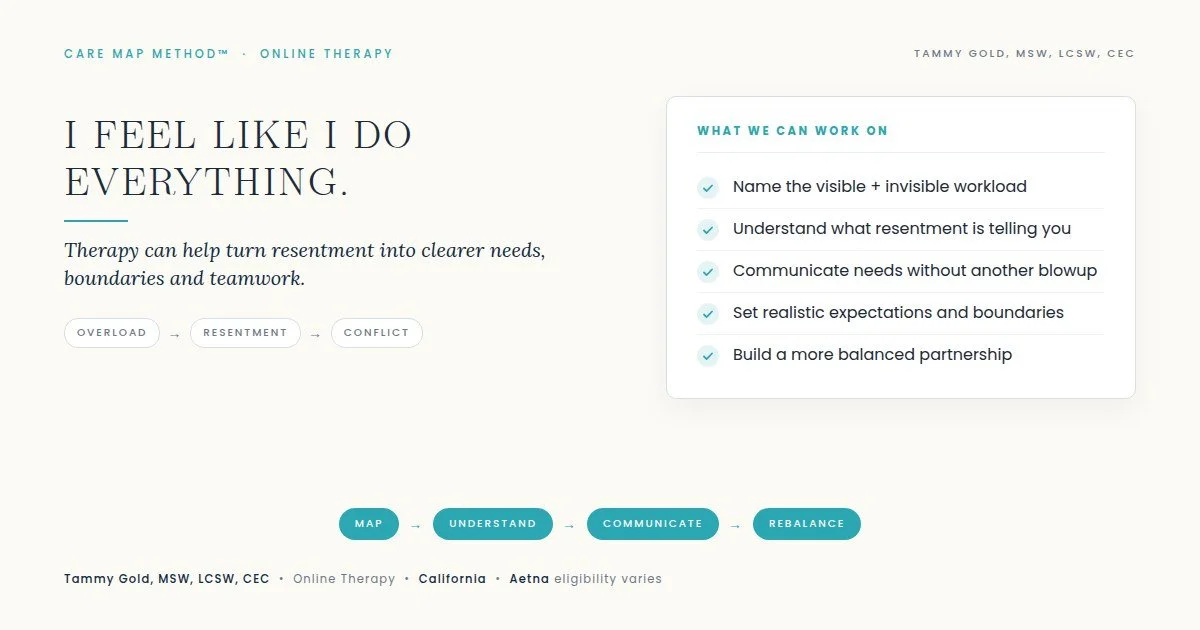
LOVE MY PARTNER. SO WHY AM I SO RESENTFUL?
Resentment is often a signal that something important has remained unspoken, unequal or unresolved.
What therapy can help you work on:
• Identify what the resentment is protecting
• Separate current problems from accumulated history
• Make invisible labor and expectations visible
• Turn criticism into specific requests and boundaries
• Clarify what repair and shared responsibility would require
Resentment rarely starts as resentment
It often starts as helping, accommodating, waiting or telling yourself something is not worth an argument. Over time, the gap between what you give and what you feel you receive can become anger.
The argument may not be about the dishes
Housework, parenting, money, intimacy or schedules can become symbols for larger questions: Do you see what I carry? Can I rely on you? Do my needs matter too?
Therapy helps translate resentment
Instead of treating anger as the entire problem, we can identify the unmet need, injury, expectation or boundary underneath it. That creates something concrete to work with.
Care Map Method™
MAP where resentment appears and what it represents. MATCH each problem with a realistic request, boundary or repair conversation. MERGE those changes into daily life rather than one dramatic discussion. MANAGE setbacks, accountability and changing needs.
The goal is clarity, not forced forgiveness
You do not have to minimize what happened or manufacture warmth. We can work toward understanding, direct communication and decisions based on what actually changes.
What We Can Work On In Our Session:
Identify what the resentment is protecting
Separate current problems from accumulated history
Make invisible labor and expectations visible
Turn criticism into specific requests and boundaries
Clarify what repair and shared responsibility would require
Care Map Method™
MAP the problem and pattern. MATCH the needs with the right clinical strategies. MERGE insight into real conversations, boundaries and behavior. MANAGE what happens next and adjust as the situation changes.
Is resentment normal in a long-term relationship?
Resentment can occur in long-term relationships, especially when hurt, workload or unmet expectations accumulate. The clinically useful question is what the resentment is signaling and whether the underlying problem can be addressed.
Can resentment go away?
There is no guaranteed outcome, but resentment can change when the underlying issue is named, responsibility is clearer and behavior changes consistently enough to rebuild trust.
What if my partner says I am too critical?
We can examine both the content and delivery of what you are trying to communicate. Sometimes criticism is an ineffective expression of a legitimate need; sometimes both partners are caught in a defensive cycle.
Can I work on resentment in individual therapy?
Yes. Individual therapy can help you identify your needs, boundaries and communication patterns even if your partner does not attend.
What if the resentment is about unequal parenting or household labor?
We can make the workload visible, identify assumptions and define specific responsibilities rather than relying on vague promises to “help more.”
Does therapy mean I have to forgive my partner?
No. Therapy can help you understand what happened and decide what you need. Forgiveness is not a requirement for treatment or for making a clear decision about the relationship.
TURN RESENTMENT INTO A CLEARER PLAN BOOK YOUR SESSION TODAY Info@CareMapMethod.com 818.3081538
Check insurance eligibility and request an online therapy appointment. Therapy is available to eligible clients in California, New Jersey and Oregon; coverage and benefits vary by plan.
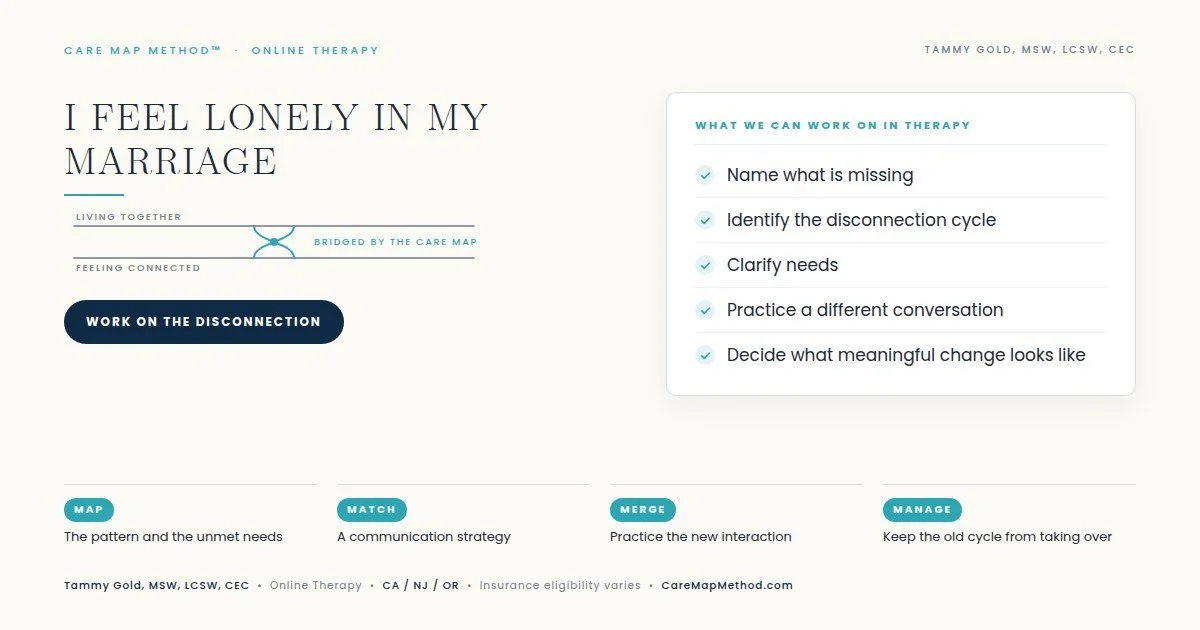
I Feel Lonely in My Marriage: Therapy for Emotional Disconnection
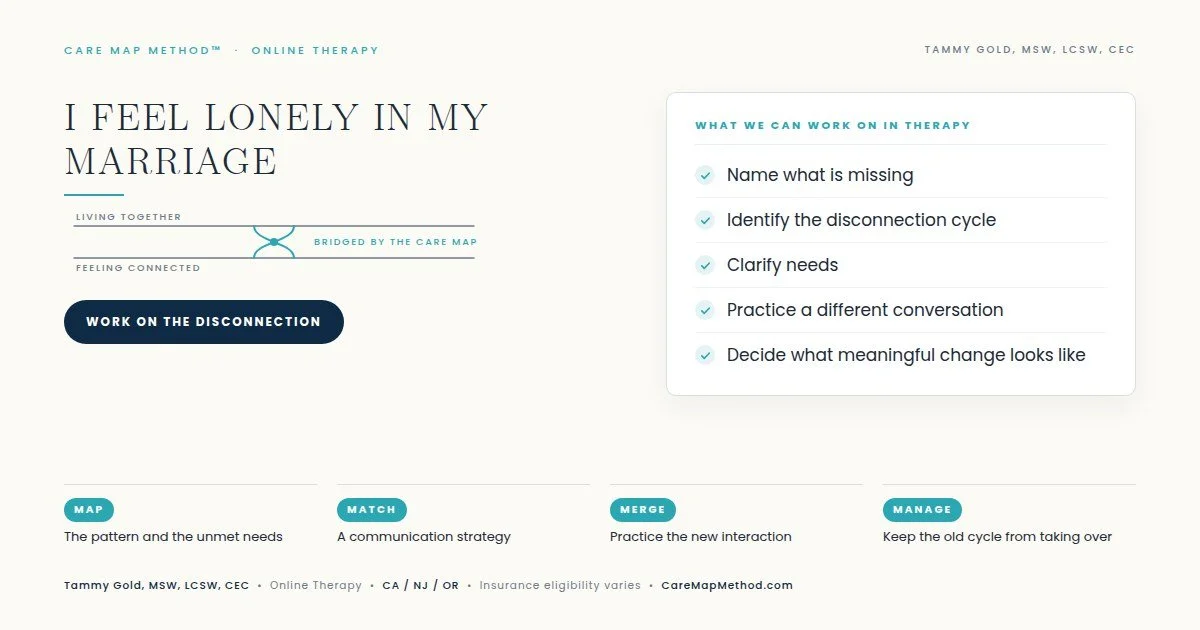
YOU CAN BE MARRIED AND STILL FEEL COMPLETELY ALONE
Therapy can help you understand where the connection broke down and what would need to change for the relationship to feel different.
What therapy can help you work on:
• Name the kind of connection you are missing
• Identify the pursue–withdraw or shutdown pattern
• Turn resentment into clearer needs and requests
• Practice conversations that are less defensive
• Clarify what change would actually feel meaningful
Loneliness inside a relationship can be confusing
You may still function well as parents, roommates or partners in logistics while feeling unseen emotionally. That can create a painful question: if we are together, why do I feel so alone?
Disconnection is often a pattern, not one bad conversation
One person may reach for reassurance through criticism or repeated questions while the other retreats, shuts down or focuses on tasks. Both can end up protecting themselves in ways that deepen the distance.
Therapy makes the invisible pattern visible
We can map when you feel most disconnected, what you ask for, what you receive, what you stop saying and what you have come to expect. That allows us to work on the interaction rather than simply repeating the content of the latest argument.
Care Map Method™
MAP the disconnection and unmet needs. MATCH those needs with communication, boundaries and realistic relationship goals. MERGE new language into actual conversations. MANAGE the pattern when old reactions return.
You do not have to decide the future before understanding the present
Therapy does not require you to arrive knowing whether you will stay, leave or change the relationship. The first task is clarity: what is happening, what you need, what has been tried and what would constitute meaningful change.
What We Can Work On In Our Session
Name the kind of connection you are missing
Identify the pursue–withdraw or shutdown pattern
Turn resentment into clearer needs and requests
Practice conversations that are less defensive
Clarify what change would actually feel meaningful
Care Map Method™
MAP the problem and pattern. MATCH the needs with the right clinical strategies. MERGE insight into real conversations, boundaries and behavior. MANAGE what happens next and adjust as the situation changes.
Can I come alone if my spouse will not attend therapy?
Yes. Individual therapy can help you understand the relationship pattern, communicate more clearly, set boundaries and make decisions even if your partner does not participate.
Does feeling lonely mean my marriage is over?
Not necessarily. Loneliness is important information, but it does not by itself determine the future of a relationship. We can examine what is creating the distance and whether meaningful change is possible.
What if we never fight—we just do not connect?
Disconnection can exist without frequent conflict. Avoidance, parallel lives, exhaustion, parenting demands or fear of difficult conversations can all leave a relationship emotionally thin.
Can therapy help me ask for more without sounding critical?
Yes. We can work on identifying the underlying need and communicating it more directly, while reducing patterns such as accusation, mind-reading or global statements.
What if I have already tried talking about it?
We can look at how those conversations unfold, what happens immediately before they fail, and whether the request, timing, expectations or interaction pattern need to change.
Is this couples therapy or individual therapy?
It can be either, depending on who is seeking treatment and what is clinically appropriate. The page should direct prospective clients to verify the type of care and insurance eligibility when booking.
WORK ON THE DISCONNECTION
Check insurance eligibility and request an online therapy appointment. Therapy is available to eligible clients in California, New Jersey and Oregon; coverage and benefits vary by plan. Email: Tammy@CareMapMethod.com Text: 818.308.1538
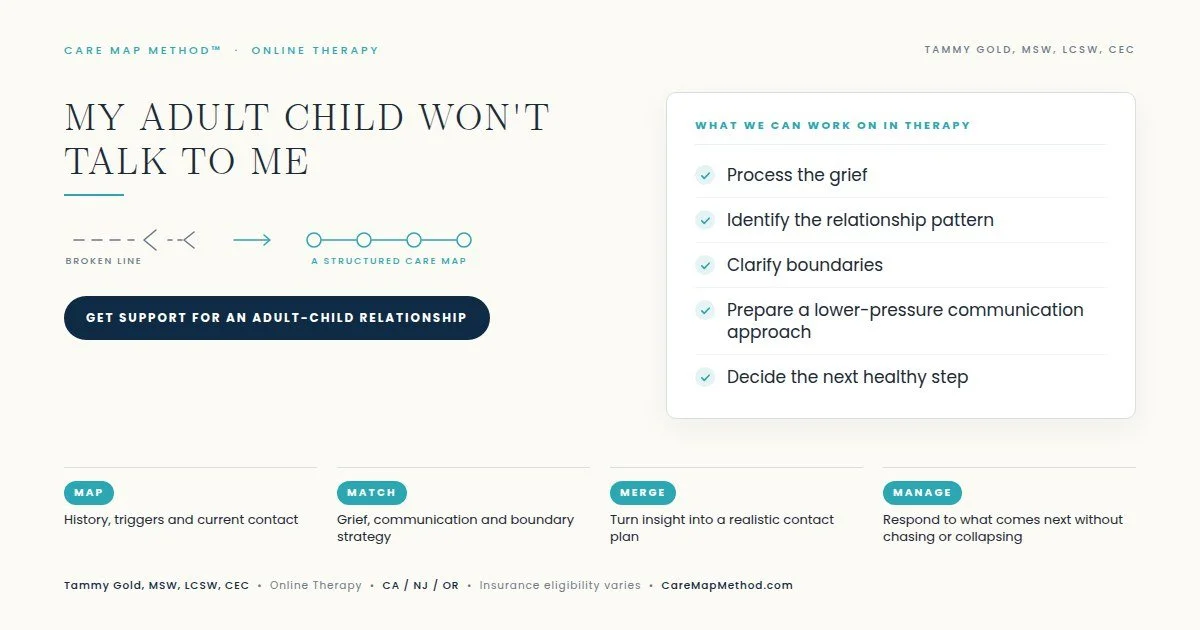
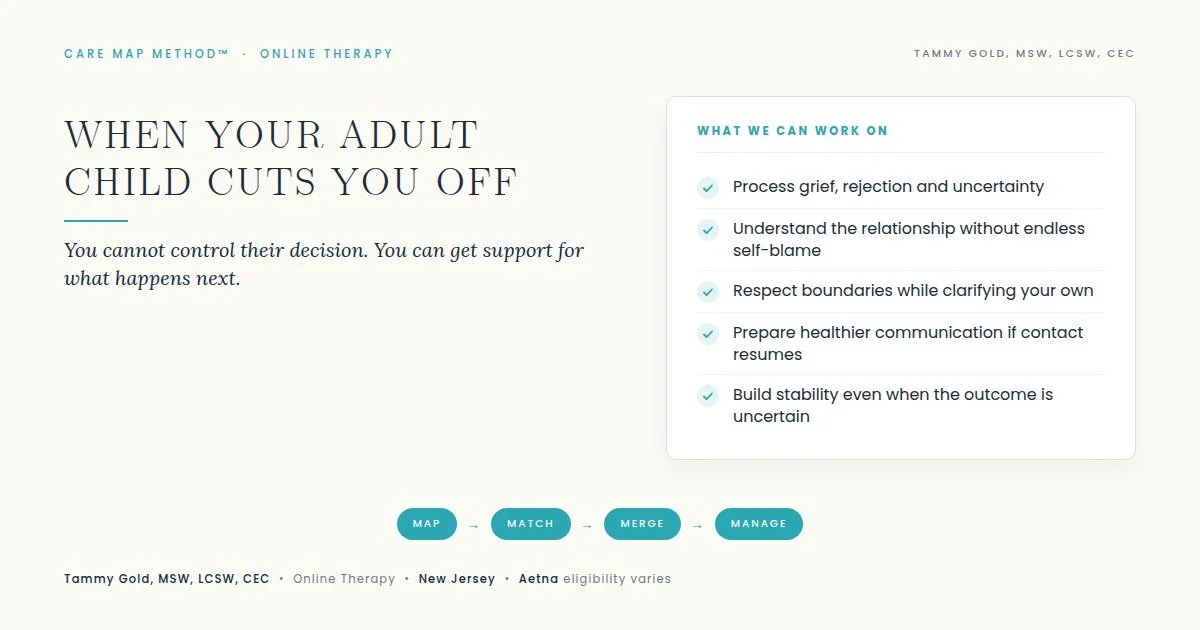
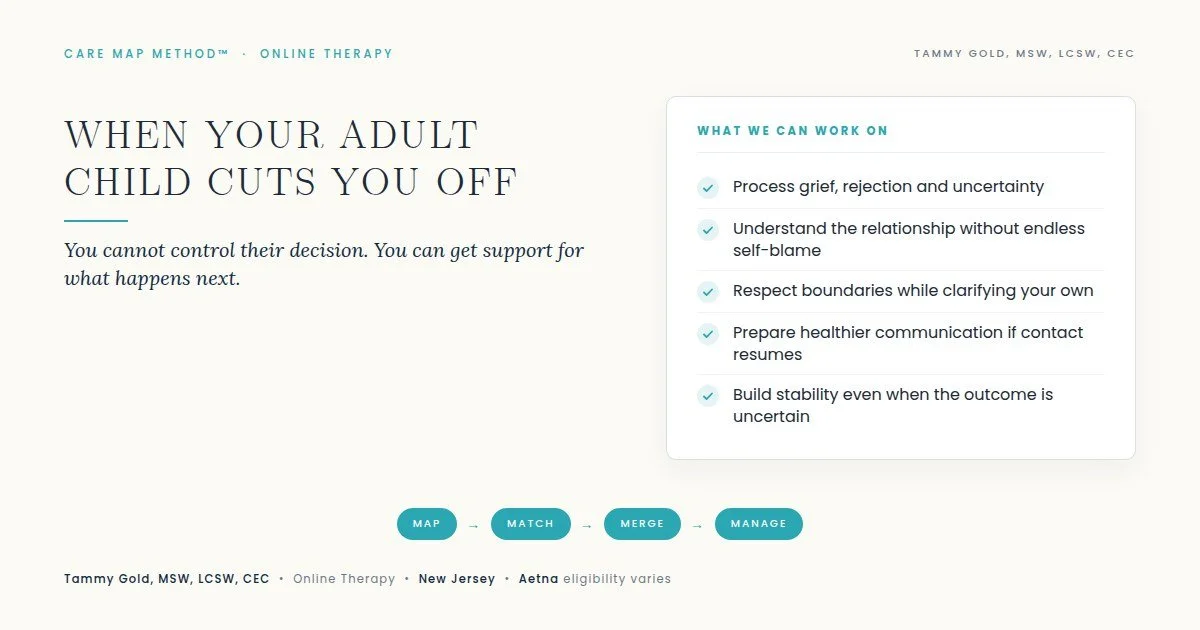
My Adult Child Won’t Talk to Me: Therapy for Parent–Adult Child Estrangement
When an adult child pulls away, parents can feel grief, confusion, guilt and urgency. Therapy can help you slow the cycle down, understand what is happening and choose a thoughtful next step without forcing reconciliation.
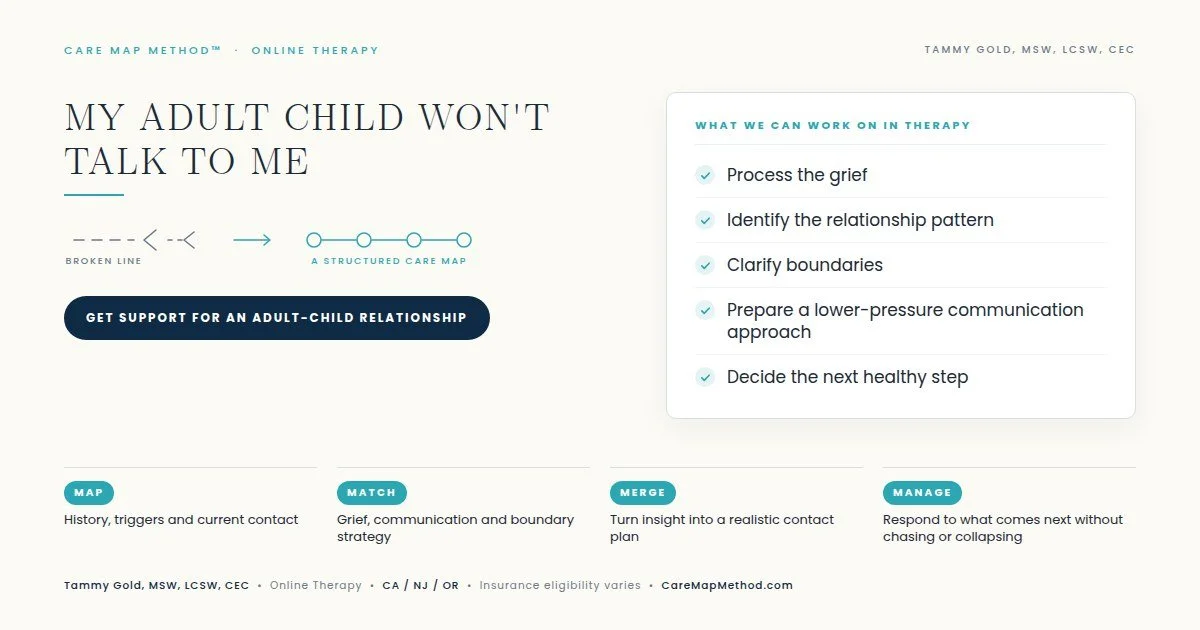
MY ADULT CHILD WON’T TALK TO ME
You cannot control another adult’s decision. You can understand the relationship, your response and your next step.
What therapy can help you work on:
• Separate grief, fear, anger and guilt
• Identify recurring parent–adult child patterns
• Understand boundaries without chasing or withdrawing
• Prepare communication that reduces pressure and defensiveness
• Decide what healthy contact—or healthy distance—looks like now
When silence becomes the whole relationship
An adult child pulling away can create a particular kind of grief: the person is still alive, yet the relationship you knew may feel unavailable. Parents often replay conversations, search for the moment everything changed, send another message, or become afraid that doing nothing means giving up. Therapy gives that urgency somewhere constructive to go.
The goal is not to assign a villain
Estrangement can involve years of misunderstandings, unresolved injuries, family roles, boundaries, partners, grandchildren, differing expectations or a single rupture that became larger over time. I do not begin by deciding who is right. We map the relationship as it actually exists now and identify the parts you can influence.
What we can work on in therapy
We can look at what happens before contact breaks down, what you tend to do when you feel rejected, what your adult child has communicated directly, and what remains assumption. We can also work on tolerating uncertainty so that fear does not drive repeated contact, defensiveness or self-blame.
A Care Map for the relationship
MAP the history, present pattern, emotional triggers and current boundaries. MATCH the problem with the right response—grief work, communication, boundary work, repair attempts or acceptance. MERGE insight with a realistic communication plan. MANAGE what happens next without making your wellbeing dependent on another person’s immediate response.
Therapy can help even if your adult child never joins
You do not need the other person in the room to understand your part of a relationship. Individual therapy can help you become clearer, less reactive and more intentional. If contact becomes possible, you can enter it differently. If it does not, therapy can help you build a life that is not organized entirely around waiting.
What We Can Work On During Our Call:
Separate grief, fear, anger and guilt
Identify recurring parent–adult child patterns
Understand boundaries without chasing or withdrawing
Prepare communication that reduces pressure and defensiveness
Decide what healthy contact—or healthy distance—looks like now
Care Map Method™
MAP the problem and pattern. MATCH the needs with the right clinical strategies. MERGE insight into real conversations, boundaries and behavior. MANAGE what happens next and adjust as the situation changes.
Can therapy make my adult child speak to me again?
Therapy cannot control another adult or guarantee reconciliation. It can help you understand the relationship, process the loss, examine your own patterns, respect stated boundaries and decide whether and how to make a thoughtful repair attempt.
Should I keep contacting an estranged adult child?
That depends on what your adult child has communicated, the history of the relationship and any boundaries they have set. Therapy can help you distinguish a respectful invitation to connect from repeated contact that may increase pressure.
Can I come to therapy alone for a family relationship problem?
Yes. Many relationship problems are addressed in individual therapy. We can work on your reactions, communication, boundaries, grief and decisions even when the other person does not participate.
What if I do not understand why my adult child is angry?
We can separate what you know from what you are guessing, review what has actually been communicated, and identify questions or responses that may create more clarity without turning the conversation into a debate.
Is estrangement always permanent?
No one can predict a particular family relationship. Some relationships reconnect, some change form and some remain distant. Therapy focuses on what is healthiest and most realistic now rather than promising a specific outcome.
Will you tell me whether my adult child is wrong?
The work is more useful when we move beyond deciding who wins the argument. We can examine behavior, impact, boundaries and responsibility while helping you make choices that align with the relationship you want and the reality you face.
Check insurance eligibility and request an online therapy appointment. Therapy is available to eligible clients in California, New Jersey and Oregon; coverage and benefits vary by plan.

My Aging Parent Refuses Help and I Am Overwhelmed
Therapy for Oregon adults overwhelmed when an aging parent refuses help. Support for guilt, boundaries, family conflict and caregiver stress.
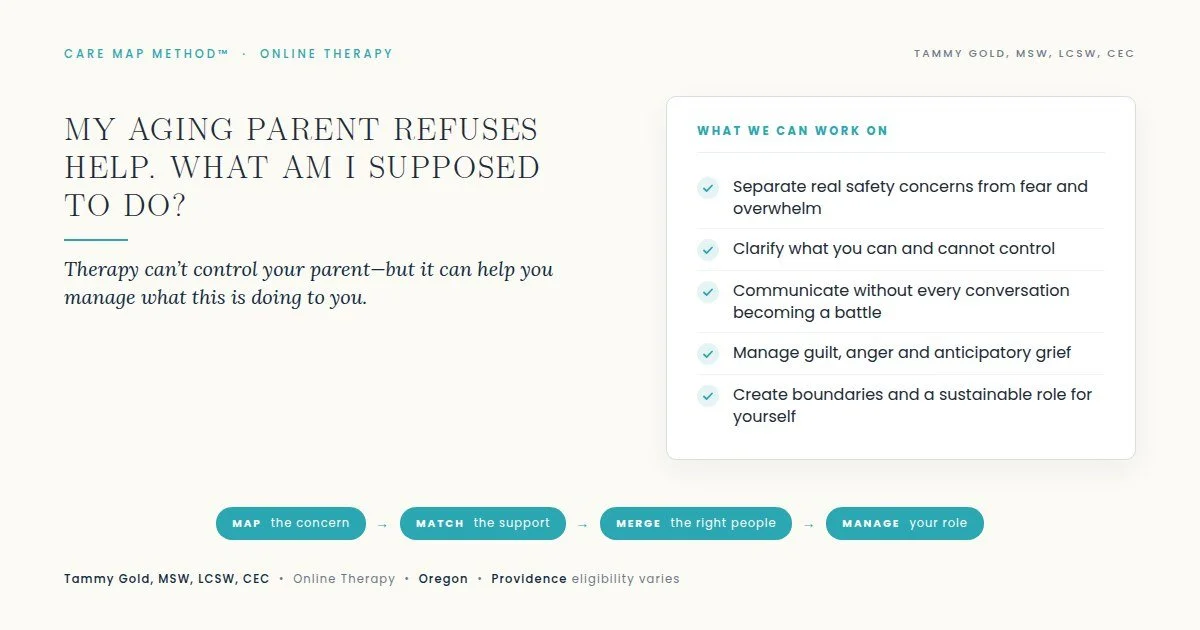
When Love, Safety and Autonomy Pull in Different Directions
You see the problems. Your parent says they are fine. You worry about falls, driving, medications, memory, isolation, finances or the next emergency. You suggest help. They refuse. You push harder because you are frightened, and they become angry because they feel controlled.
This dynamic is painful because both safety and autonomy matter. Therapy can help you separate what is urgent from what is frightening, and what is within your control from what is not.
What Therapy Can Help You Carry Differently
We can work on fear about your parent's safety, guilt about not doing enough, anger when help is rejected, sibling disagreements, anticipatory grief and the pressure to solve every possible future problem now.
We can also prepare language for difficult conversations and clarify what role you are realistically willing and able to play.
A Care Map for the Situation
MAP the actual concerns and the biological, emotional, social and environmental factors around them.
MATCH each concern to the right kind of support: emotional, medical, practical, legal or family.
MERGE the right people where possible.
MANAGE your role without assuming you can control every outcome.
Know When Therapy Is Not the Only Resource
Therapy is not a substitute for medical, legal, emergency or protective services when those are needed. Part of good planning is recognizing which problem belongs in which system.
Providence Online Therapy in Oregon
Providence may be available for eligible Oregon clients depending on the specific plan and current participation. Verify benefits before scheduling.
About Tammy Gold, MSW, LCSW, CEC
I am a licensed clinical social worker, certified coach, author and creator of the Care Map Method™. I have worked with families and relationships for more than two decades. My therapy style is warm, nonjudgmental, active and practical: one safe place to feel heard and supported while also developing language, boundaries and next steps you can use in real life.
Frequently Asked Questions
What do I do when an elderly parent refuses help?
Start by clarifying the specific concern, the level of risk and what is within your control. Medical, legal or emergency input may also be needed depending on the situation.
Can therapy help with caregiver guilt?
Yes. Therapy can help examine expectations, responsibility, grief and boundaries while respecting real caregiving needs.
What if my siblings disagree about our parent?
Therapy can help you clarify your role, prepare conversations and set limits around what you can realistically provide.
Does Providence cover online therapy in Oregon?
Eligibility varies by plan and current participation. Verify benefits before scheduling.
Check insurance eligibility and request an online therapy session. Therapy is available for eligible clients physically located in Oregon. Insurance eligibility, benefits and platform availability vary by plan.

How to Deal With a Difficult Family Member Without Losing Yourself
Online Oregon therapy for difficult family relationships, recurring conflict, boundaries, guilt and communication. Regence BCBS may be available.
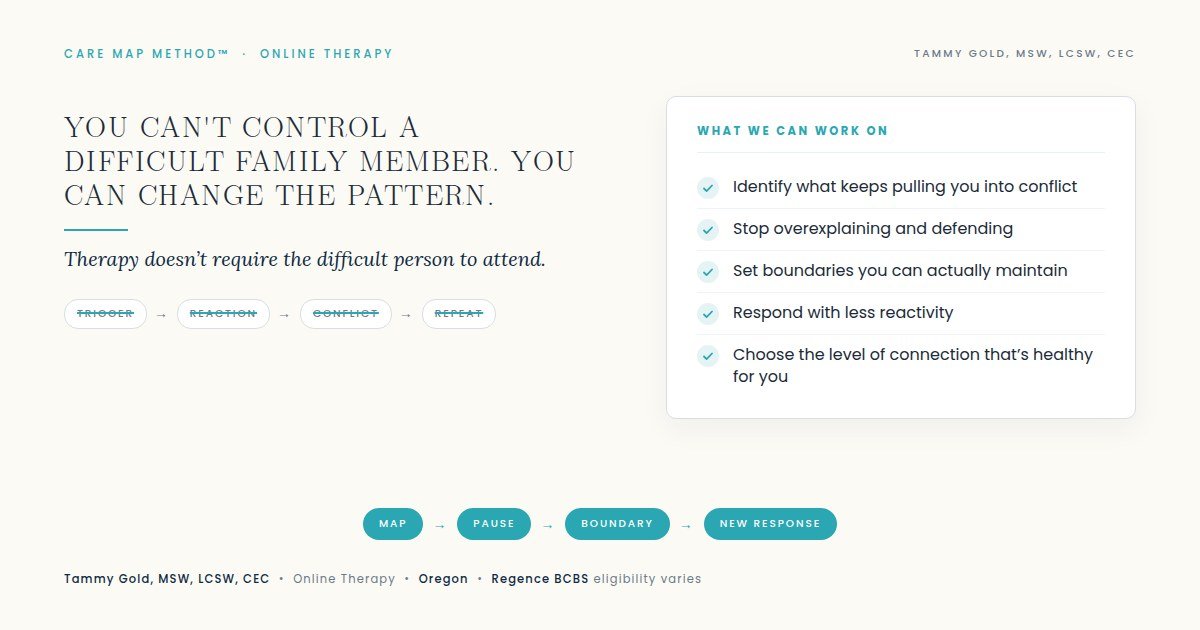
When Understanding Them Has Not Changed the Relationship
Some relationships do not become easier simply because you understand the other person. You may have tried explaining, being patient, giving another chance, avoiding conflict, setting a boundary and then giving in. Somehow you end up back in the same pattern.
Therapy does not require the difficult family member to attend. We can work on your side of the relationship system.
Identify the Hook
Most recurring family conflicts have a predictable hook: criticism, guilt, disrespect, pressure, comparison, intrusion or the feeling that you must defend yourself. When you know the hook, you can begin to notice the moment before your usual reaction takes over.
Boundaries That You Can Maintain
A boundary is most useful when it describes your action rather than trying to force another person to behave differently. We can develop boundaries around contact, topics, money, visits, communication style or what you will do when a conversation becomes disrespectful.
MAP the Pattern, Then Change Your Response
MAP the trigger-reaction-conflict loop.
MATCH a response to your goal and values.
MERGE the new response into real interactions.
MANAGE guilt and pushback without immediately abandoning the boundary.
A successful outcome may not be changing the other person. It may be changing how much control the relationship has over your mood, choices and sense of self.
Regence BCBS Online Therapy in Oregon
Regence BCBS eligibility and benefits vary by plan and current participation. Verify benefits before scheduling online therapy in Oregon.
About Tammy Gold, MSW, LCSW, CEC
I am a licensed clinical social worker, certified coach, author and creator of the Care Map Method™. I have worked with families and relationships for more than two decades. My therapy style is warm, nonjudgmental, active and practical: one safe place to feel heard and supported while also developing language, boundaries and next steps you can use in real life.
Frequently Asked Questions
Can therapy help if the difficult family member will not attend?
Yes. You can work on your own reactions, boundaries and choices without their participation.
What is a healthy boundary with family?
A useful boundary is specific, focused on your own actions and realistic enough to maintain.
Do I have to cut off a difficult family member?
No. Therapy can help you consider a range of contact and boundary options rather than assuming estrangement is the only solution.
Does Regence BCBS cover online therapy in Oregon?
Coverage depends on your plan and eligibility. Verify benefits before scheduling.
Booking CTA
Check insurance eligibility and request an online therapy session. Therapy is available for eligible clients physically located in Oregon. Insurance eligibility, benefits and platform availability vary by plan.

Therapy for Women Who Feel Responsible for Everyone
Online Oregon therapy for women overwhelmed by family responsibilities, emotional labor, guilt, boundaries and caregiving demands.

The Person Everyone Depends On
You may be the person everyone calls: children, parents, partner, friends and coworkers. You notice what needs to happen before anyone asks. You anticipate problems, remember details, absorb other people's emotions and keep moving because you are capable.
Being capable does not mean you have unlimited capacity. At some point, the role of being the reliable one can become so constant that you lose track of your own needs.
Responsibility Versus Emotional Responsibility
Therapy can help separate what is genuinely your responsibility from the belief that you must also prevent everyone else's disappointment, discomfort or mistakes. Those are not the same job.
We can explore guilt, perfectionism, overfunctioning, fear of conflict and the family roles that taught you to stay useful, agreeable or indispensable.
Putting Your Needs Back on the Map
The Care Map Method™ looks at biological, emotional, social and environmental demands. Your sleep, health, emotional bandwidth, relationships, work and environment all matter. Your needs are not an inconvenience to the system; they are part of whether the system is sustainable.
Practical Boundary Work
We can practice asking for help more specifically, saying no without a long defense, tolerating other people's disappointment and deciding what support you can offer without disappearing inside everyone else's needs.
Aetna Online Therapy in Oregon
Aetna may be available for eligible Oregon clients depending on plan details and current network participation through Headway or Alma. Verify benefits before scheduling.
About Tammy Gold, MSW, LCSW, CEC
I am a licensed clinical social worker, certified coach, author and creator of the Care Map Method™. I have worked with families and relationships for more than two decades. My therapy style is warm, nonjudgmental, active and practical: one safe place to feel heard and supported while also developing language, boundaries and next steps you can use in real life.
What is overfunctioning?
Overfunctioning can describe taking excessive responsibility for tasks, decisions or other people’s emotions, often while neglecting your own needs.
Why do I feel guilty when I say no?
Guilt can be connected to family roles, beliefs about responsibility, fear of rejection or long-standing patterns. Therapy can help identify your specific drivers.
Can therapy help me set boundaries without becoming selfish?
Therapy can help you distinguish healthy limits from abandonment and develop boundaries consistent with your values.
Can I use Aetna in Oregon?
Aetna eligibility varies by plan and current network participation. Verify benefits before scheduling.
Check insurance eligibility and request an online therapy session. Therapy is available for eligible clients physically located in Oregon. Insurance eligibility, benefits and platform availability vary by plan.

My Partner and I Disagree About Parenting
Online Oregon therapy for couples who disagree about parenting, discipline, boundaries and family responsibilities. Providence may be available.
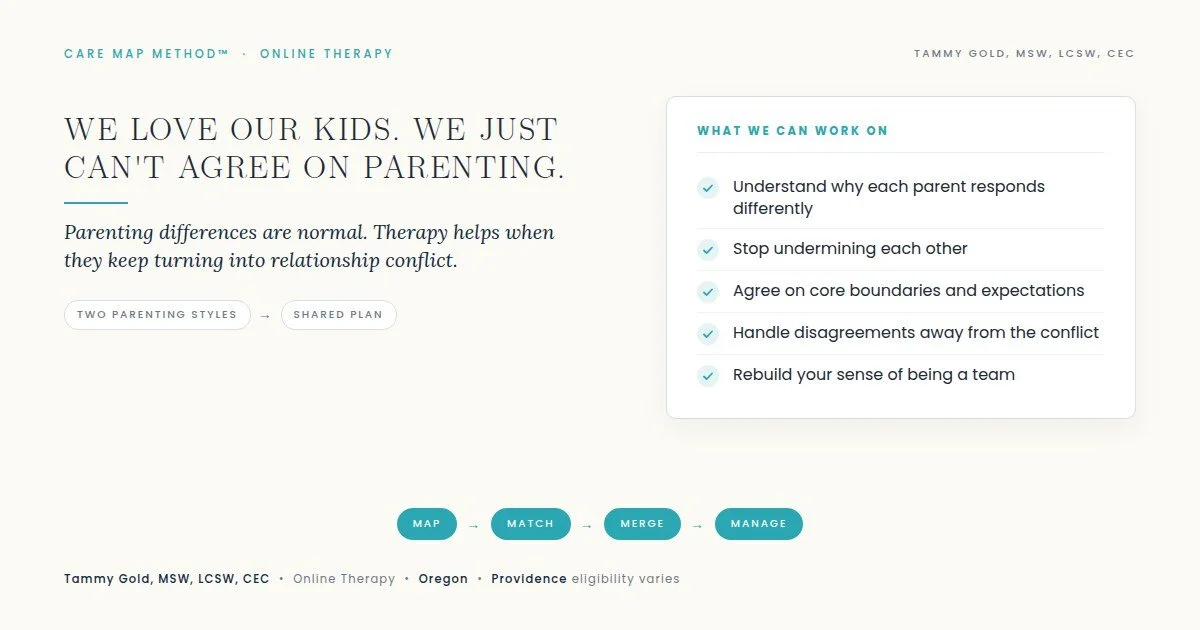
When Parenting Differences Become Marriage Problems
One parent thinks the other is too strict. The other thinks their partner is too permissive. One steps in, the other feels undermined, and soon the disagreement is no longer only about the child. It becomes about trust, respect and whether you still feel like a team.
Parenting differences are common. The problem is when those differences repeatedly create hostility, inconsistency or emotional distance between partners.
Where Different Parenting Styles Come From
Each parent brings a history into the room: how they were disciplined, what made them feel safe, what they never want to repeat, cultural expectations, temperament and beliefs about responsibility. Understanding those differences can reduce the assumption that your partner is simply wrong or uncaring.
What We Can Work On
Therapy can help you identify core parenting values, distinguish nonnegotiable safety issues from style differences, decide how to disagree away from children, create shared boundaries and address the emotional injuries that have developed around parenting conflict.
MAP → MATCH → MERGE → MANAGE
MAP each parent's triggers, history and current family stress.
MATCH strategies to the child's needs and the family's values.
MERGE shared expectations into a workable parenting plan.
MANAGE inevitable disagreements without turning them into attacks on the relationship.
Providence Online Therapy in Oregon
Providence may be available for eligible Oregon clients depending on the specific plan and current participation. Verify benefits before scheduling.
About Tammy Gold, MSW, LCSW, CEC
I am a licensed clinical social worker, certified coach, author and creator of the Care Map Method™. I have worked with families and relationships for more than two decades. My therapy style is warm, nonjudgmental, active and practical: one safe place to feel heard and supported while also developing language, boundaries and next steps you can use in real life.
Frequently Asked Questions
Is it normal for couples to disagree about parenting?
Yes. Different histories and values often produce different parenting instincts. The key issue is how disagreements are handled.
Can therapy help us create consistent rules?
Therapy can help clarify shared values, core boundaries and a process for handling differences.
Should we argue about parenting in front of our children?
Therapy can help couples develop a plan for discussing disagreements in ways that reduce triangulation and undermining.
Does Providence cover Oregon therapy?
Eligibility varies by plan and current network participation. Verify benefits before scheduling.
Check insurance eligibility and request an online therapy session. Therapy is available for eligible clients physically located in Oregon. Insurance eligibility, benefits and platform availability vary by plan.
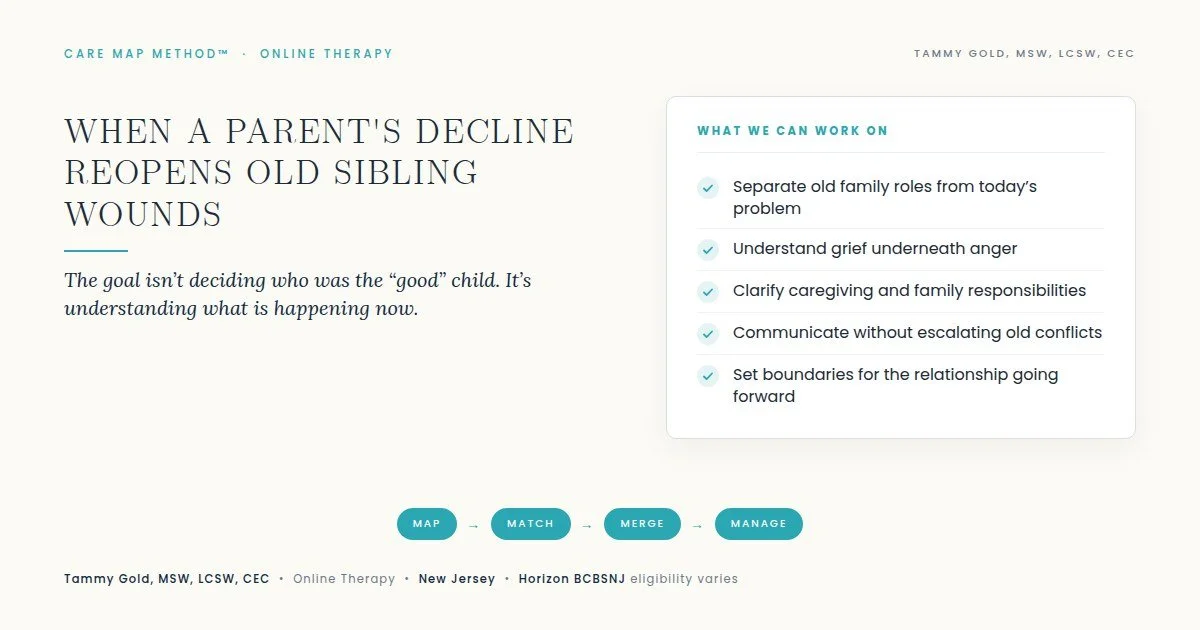
Family Conflict After the Decline or Death of a Parent
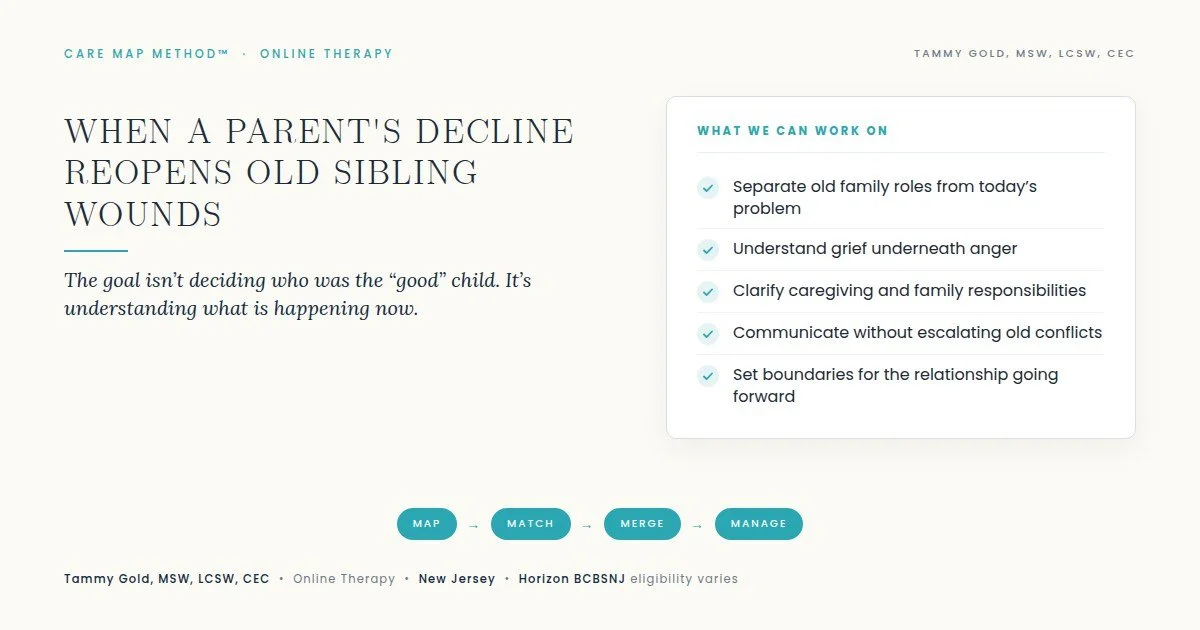
A Family Crisis Can Reactivate Old Roles
A parent's illness, decline or death can bring siblings together. It can also expose every unresolved family conflict. Who did the caregiving? Who did not? Who made decisions? Who handled money? Who visited? Who now gets to decide what happens next?
A current disagreement can quickly become attached to decades of family history: who was favored, who was responsible, who left, who stayed and who has always been expected to keep the peace.
Grief Can Look Like Anger
Family members do not always grieve in the same way or on the same timeline. One sibling may become controlling, another avoidant, another intensely practical. Therapy can help you understand what belongs to grief, what belongs to the current decision and what belongs to the older family system.
What You Can Control
You may not be able to make your siblings agree with you. You can clarify what you are responsible for, prepare for difficult conversations, set limits on disrespectful interactions and decide what kind of sibling relationship you want going forward.
Care Map Method™
MAP the current decisions, family roles and emotional triggers. MATCH responsibilities and support to what is actually needed. MERGE clearer communication and role agreements where possible. MANAGE your own boundaries when agreement is not possible.
Horizon BCBSNJ Online Therapy
Horizon BCBSNJ eligibility and benefits vary by plan and current network participation. Verify coverage before scheduling online therapy in New Jersey.
About Tammy Gold, MSW, LCSW, CEC
I am a licensed clinical social worker, certified coach, author and creator of the Care Map Method™. I have worked with families and relationships for more than two decades. My therapy style is warm, nonjudgmental, active and practical: one safe place to feel heard and supported while also developing language, boundaries and next steps you can use in real life.
Why do siblings fight more when a parent is ill?
Caregiving pressure, grief, unequal roles and old family dynamics can all intensify conflict.
Can I come to therapy without my siblings?
Yes. Individual therapy can help you clarify your role, boundaries and communication even if siblings do not attend.
Can therapy help after a parent dies?
Therapy can support grief and help address family conflict that continues or intensifies after a loss.
Does Horizon BCBSNJ cover online therapy?
Coverage depends on the individual plan and eligibility. Verify benefits before scheduling.
Check insurance eligibility and request an online therapy session. Therapy is available for eligible clients physically located in New Jersey. Insurance eligibility, benefits and platform availability vary by plan.

How to Onboard a New Nanny: The First 30 Days
A strong nanny hire can still struggle without clear onboarding. Use the first 30 days to teach routines, establish communication and turn expectations into a workable family-caregiver system
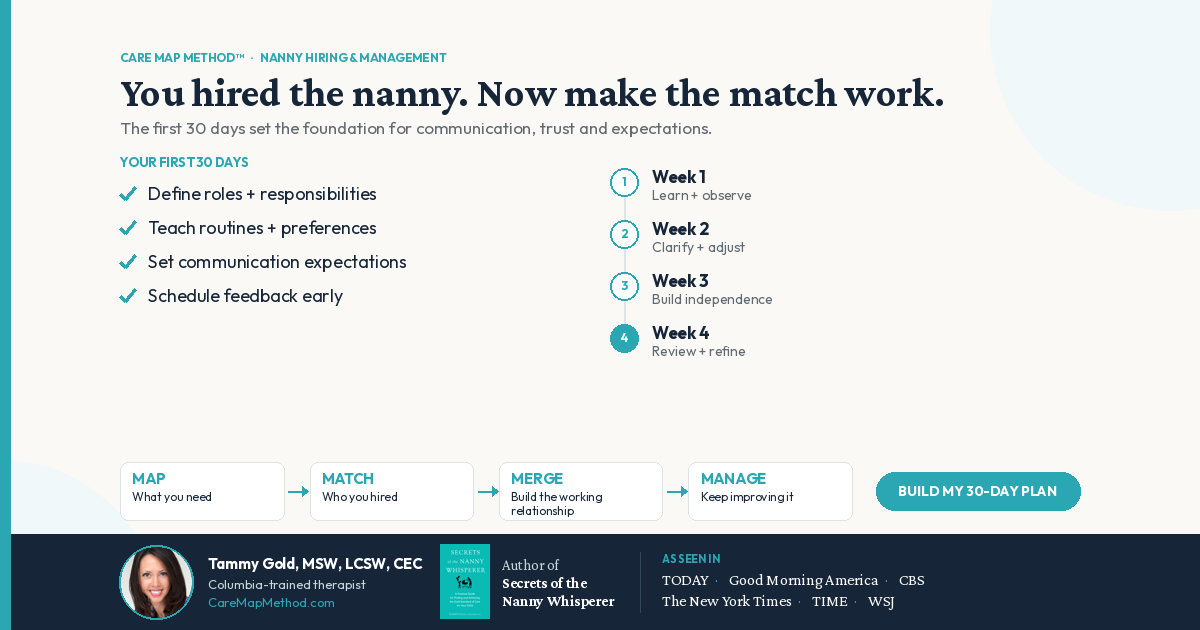
Hiring is only the beginning
Families sometimes invest weeks finding a nanny and then treat the first day as if the new caregiver should already know how everything works. Even experienced nannies need to learn your child, home, routines, preferences and communication style.
Week one: orient
Review emergency information, household access, routines, food, sleep, transportation, activities, supplies, discipline approach and the practical details of the role. Explain what the nanny can decide independently and what requires parent approval.
Create a communication rhythm
Decide what you want communicated during the day, what belongs in an end-of-day update and what requires an immediate call. Too little communication creates anxiety; constant messaging can make it difficult for the nanny to work independently.
Give feedback early and specifically
If something matters, address it while it is still small. Describe the behavior or expectation clearly rather than assuming the nanny understands a vague comment such as “be more proactive.” Also identify what is going well.
Expect adjustment
A new nanny and child may need time to learn each other. Parents also need to adjust to sharing caregiving responsibility. Not every awkward moment is evidence of a bad match.
MERGE → MANAGE
The first month is the transition from MERGE to MANAGE. You are integrating the caregiver into the family system and then building sustainable routines for communication, feedback and changing needs.
The 30-day Care Map review
At the end of the first month, revisit the original needs map. What is working? What is unclear? What needs to change? This keeps the employment relationship responsive instead of waiting for frustration to accumulate.
How the Care Map Method™ Helps
MAP → MATCH → MERGE → MANAGE gives parents a repeatable decision system instead of relying on urgency, charisma or guesswork.
MAP: Define the child, family, role, routines, values, expectations and non-negotiables.
MATCH: Compare the candidate’s demonstrated experience, temperament, judgment and working style with the mapped needs.
MERGE: Use the trial and onboarding period to integrate nanny, child and parents into one functioning care system.
MANAGE: Create clear communication, feedback, boundaries and periodic reassessment as the child and job evolve.
Already found candidates—or not sure where to begin? I can help you prepare the interview, evaluate fit, structure screening and references, plan the trial, onboard your nanny and create a practical management system.
Book Nanny Expert Call Today So I Can Help Answer→
What should I teach a nanny on the first day?
How much should I check in during the first week?
When should I give a new nanny feedback?
What should a 30-day nanny review cover?
How long does it take a child to adjust to a new nanny?
What if the nanny is good but our communication is not working?


First Time Hiring a Nanny: A Step-by-Step Guide for Parents
Hiring your first nanny can feel overwhelming because parents are simultaneously choosing a caregiver and becoming an employer. This step-by-step guide organizes the process.
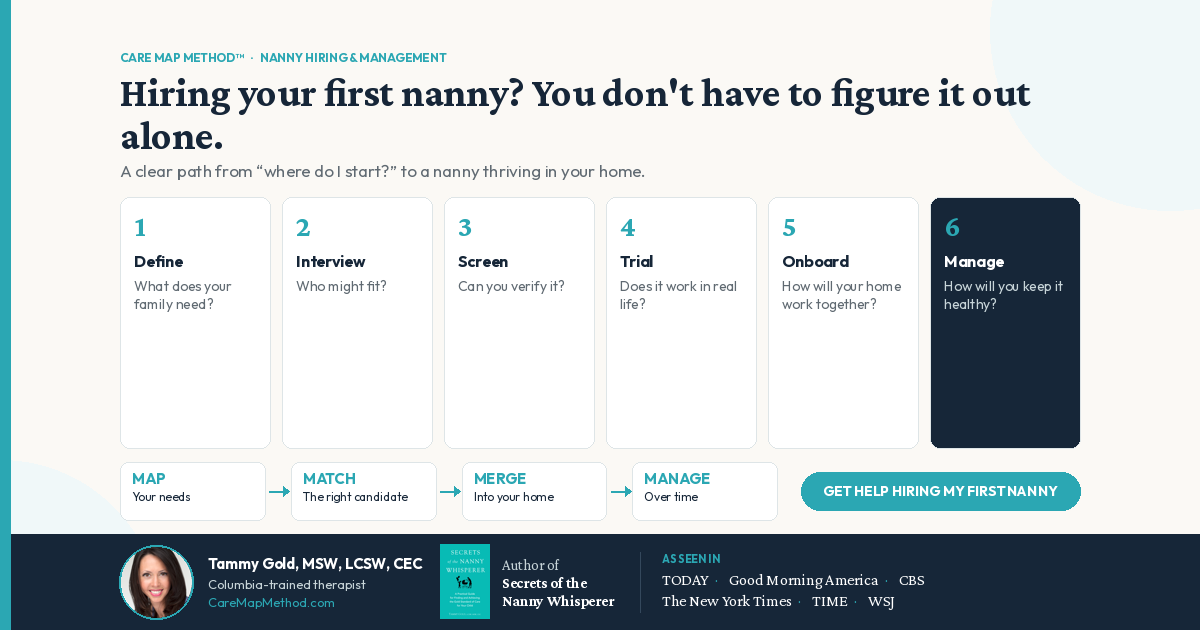
First time hiring a nanny step-by-step process from family needs through interview, screening, trial, onboarding and management.
The first nanny hire can feel much bigger than parents expect
You are not only deciding who will care for your child. You are defining a job, evaluating applicants, checking information, setting compensation and expectations, and preparing to manage someone inside your home. A system makes the process less reactive.
Step 1: MAP the job
Write down schedule, ages, responsibilities, transportation, child-related household tasks, routines, parenting approach, communication preferences and what success would look like after 30 days.
Step 2: Find and interview candidates
Whether candidates come from an agency, referral or online platform, use the same core criteria. Structured questions make comparison easier and reduce the temptation to hire solely because someone feels immediately likable.
Step 3: Screen
Verify references, credentials and background information using appropriate resources. In California, families should understand TrustLine and its role in screening in-home caregivers.
Step 4: Trial
Use a paid trial to observe how the nanny interacts with your child and functions within your real routines.
Step 5: Put expectations in writing
A written work agreement can clarify duties, schedule, compensation, guaranteed hours, time off, driving, communication and other terms. Families should obtain appropriate payroll, tax and legal guidance for their circumstances.
Step 6: Onboard
Do not hand over a list and disappear. Orient the nanny to the child, home, routines, safety information, preferences and decision-making boundaries.
Step 7: MANAGE
Schedule feedback rather than waiting until something is wrong. The nanny-family relationship needs maintenance as children develop and household needs change.
A guide beside you
I help first-time nanny employers turn an unfamiliar process into a clear sequence using MAP → MATCH → MERGE → MANAGE.
How the Care Map Method™ Helps
MAP → MATCH → MERGE → MANAGE gives parents a repeatable decision system instead of relying on urgency, charisma or guesswork.
MAP: Define the child, family, role, routines, values, expectations and non-negotiables.
MATCH: Compare the candidate’s demonstrated experience, temperament, judgment and working style with the mapped needs.
MERGE: Use the trial and onboarding period to integrate nanny, child and parents into one functioning care system.
MANAGE: Create clear communication, feedback, boundaries and periodic reassessment as the child and job evolve.
Expert CTA
Already found candidates—or not sure where to begin? I can help you prepare the interview, evaluate fit, structure screening and references, plan the trial, onboard your nanny and create a practical management system.
Book A Call So I Can Help You Answer:
Where should I start when hiring my first nanny?
Do I need a nanny contract?
What background checks should I consider?
Should I use a nanny agency?
How do I compare two strong candidates?
What should happen during the first week?
Email: Info@CareMapMethod.com Text: 818.308.1358

Nanny Trial Day: What to Watch Before You Hire
A nanny trial day lets you see what an interview cannot: how a caregiver enters your child’s world, handles routines, communicates and responds in real time.
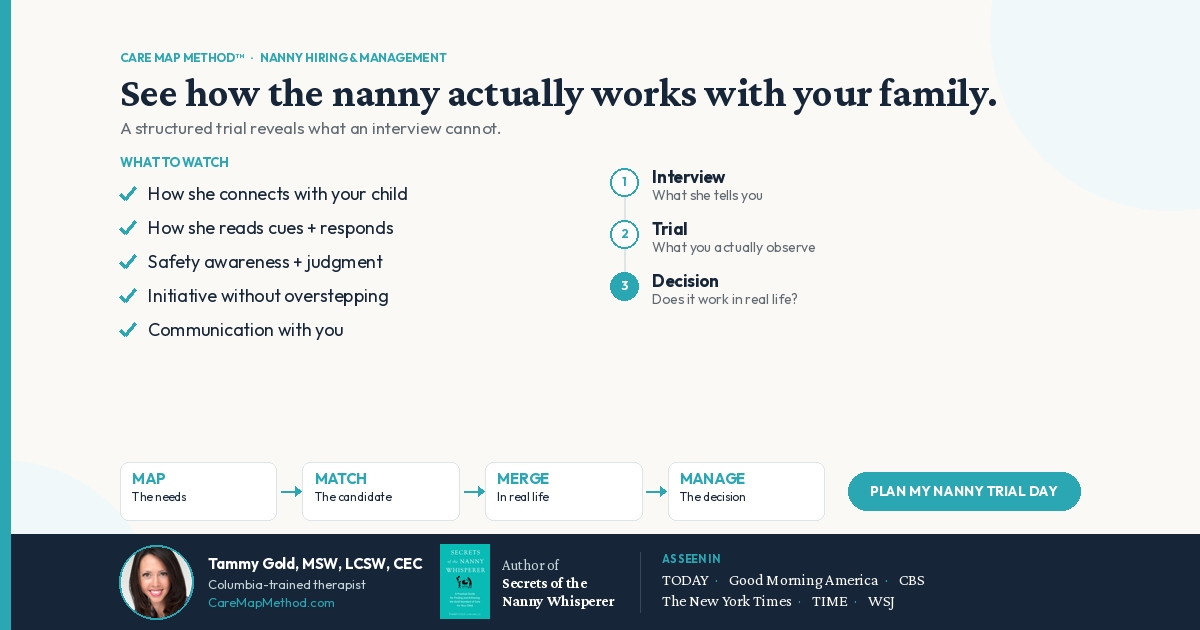
An interview tells you what a nanny says; a trial shows you how they work
A trial period can reveal how a caregiver approaches your child, follows routines, handles uncertainty, communicates with parents and adapts when the day does not go exactly as planned.
Make the trial realistic
Include ordinary parts of the job: play, meals, transitions, school pickup, nap preparation or getting out the door, depending on your child’s age. You do not need to manufacture a crisis. Real family life provides enough information.
Observe connection without demanding instant attachment
Some excellent caregivers build relationships gradually. Watch whether the nanny gets down to the child’s level, notices cues, follows the child’s interests, sets appropriate boundaries and stays emotionally steady.
Watch how the nanny handles the spaces between instructions
Does the candidate notice what needs doing? Ask appropriate questions? Respect household boundaries? Adapt when a plan changes? Initiative matters, but the right amount of initiative depends on what your family wants.
Evaluate your own reactions too
Parents can become so focused on whether the child “likes” the nanny that they miss their own concerns—or reject a strong candidate because the first hour was awkward. Use structured criteria alongside intuition.
MERGE begins during the trial
In the Care Map Method™, the trial is the beginning of MERGE: bringing caregiver, child and parents into one working system. The trial helps identify what will need to be clarified during onboarding if you move forward.
Expert trial-day planning
I help families decide what to observe, build a trial-day scorecard and debrief afterward. The goal is to convert a vague feeling of “I think she was good” into a more informed hiring decision.
How the Care Map Method™ Helps
MAP → MATCH → MERGE → MANAGE gives parents a repeatable decision system instead of relying on urgency, charisma or guesswork.
MAP: Define the child, family, role, routines, values, expectations and non-negotiables.
MATCH: Compare the candidate’s demonstrated experience, temperament, judgment and working style with the mapped needs.
MERGE: Use the trial and onboarding period to integrate nanny, child and parents into one functioning care system.
MANAGE: Create clear communication, feedback, boundaries and periodic reassessment as the child and job evolve.
Already found candidates—or not sure where to begin? I can help you prepare the interview, evaluate fit, structure screening and references, plan the trial, onboard your nanny and create a practical management system.
$195 Book Your Nanny Call Today So I Can Help Answer→
Should a nanny trial day be paid?
How long should a nanny trial be?
Should parents stay home during the trial?
What should I watch during a nanny trial?
What if my child is shy with the candidate?
Can I trial more than one nanny?