

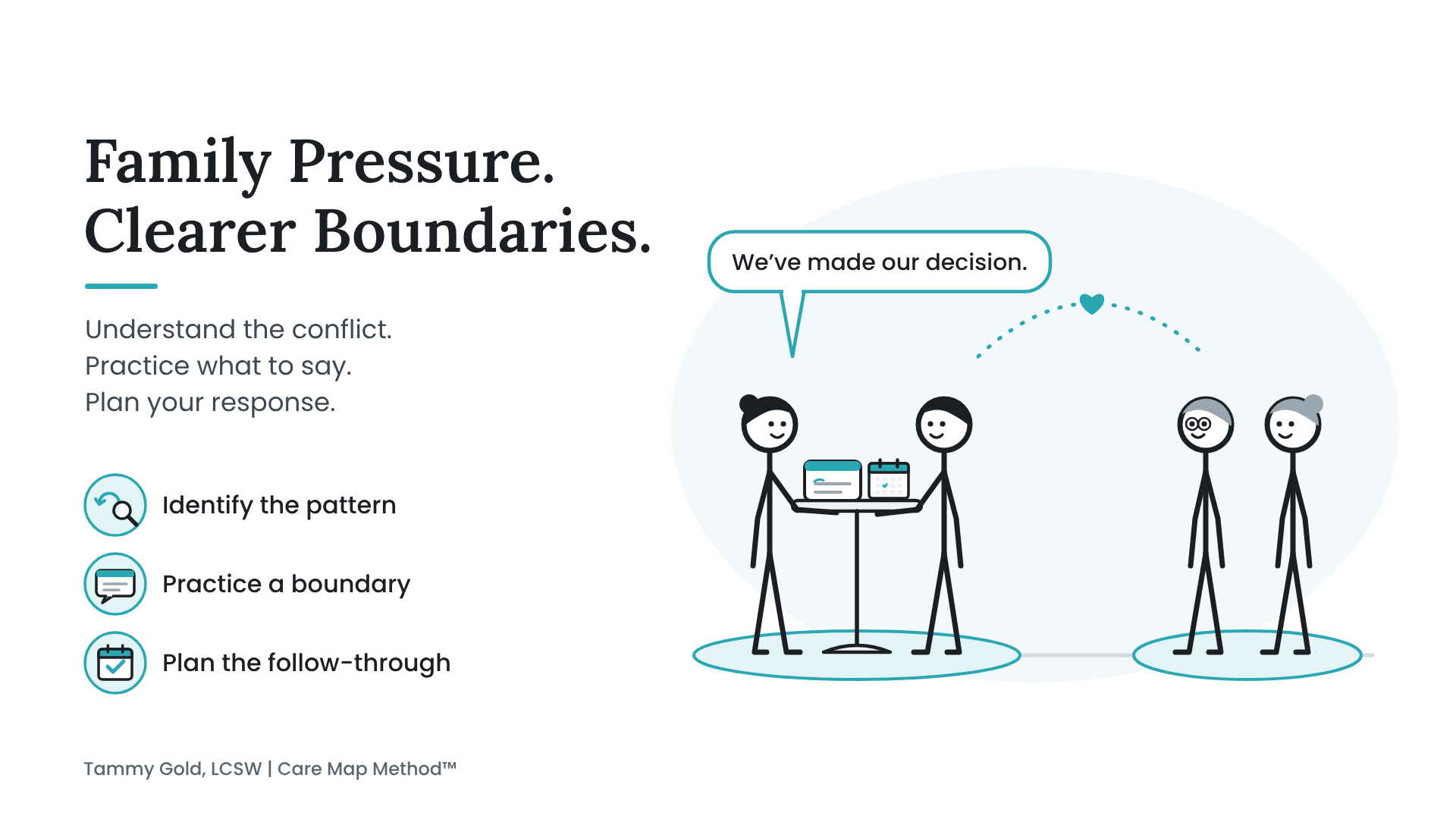
Therapy for In-Law Conflict in California
Online therapy with Tammy Gold, LCSW for in-law conflict and relationship stress in California. Check Anthem Blue Cross eligibility through Headway.
When the disagreement follows you home
In-law conflict can involve holidays, parenting advice, money, privacy, or how much access relatives have to your daily life. You may feel caught between protecting your relationship and keeping the peace. In individual therapy, we can look at how this strain affects your mood, sleep, self-confidence, and ability to communicate.
A boundary you can actually use
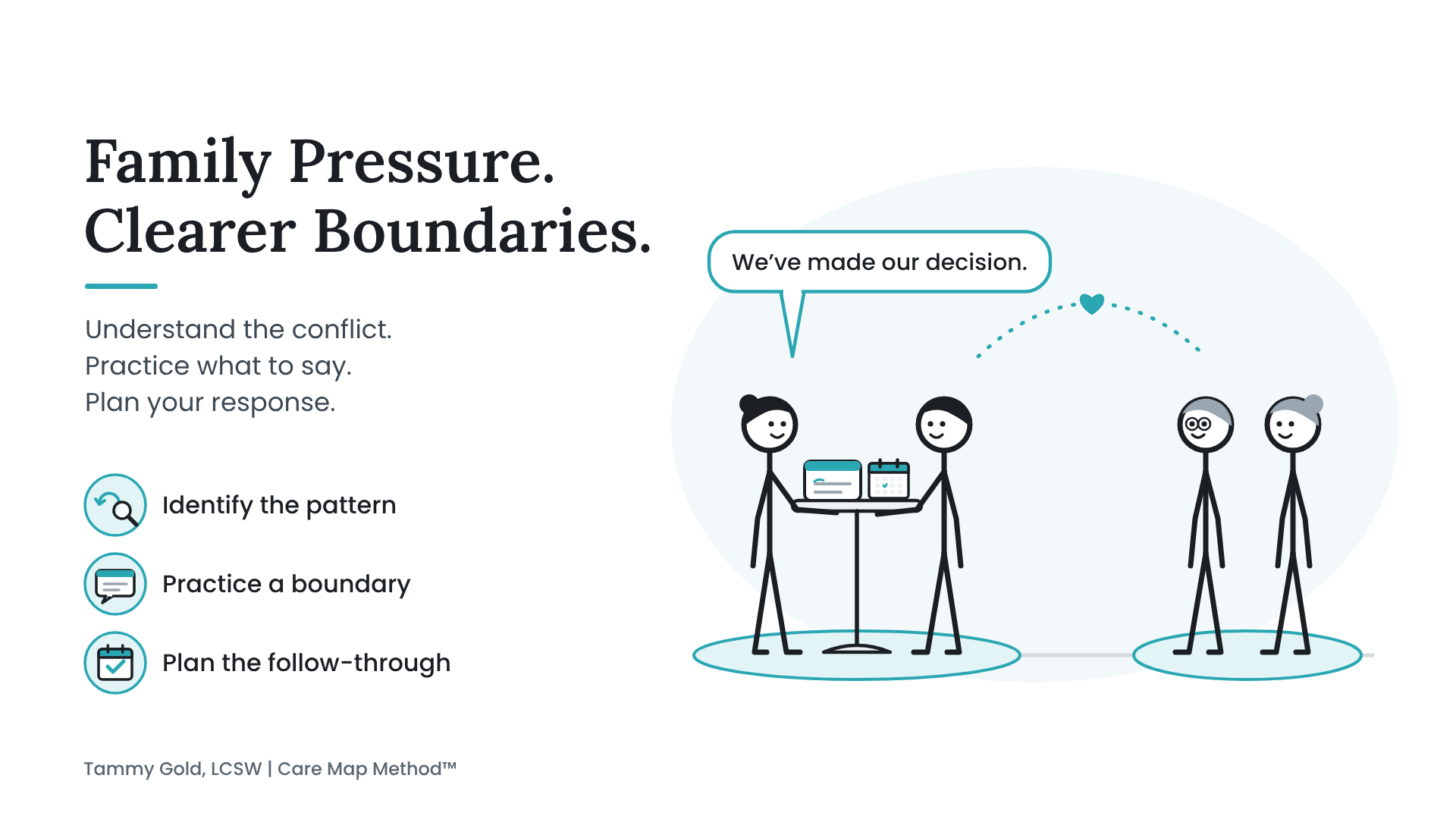
We can identify the specific interaction that overwhelms you, what you want to protect, and a response you can realistically maintain. That might mean agreeing with your partner before a visit, shortening a conversation, or choosing which topics you will discuss. For example: “I know you see it differently. We have made our decision, and I am not going to debate it today.”
How I approach the pattern
With the Care Map Method™, we Map the conflict and its impact; Match your needs with coping and communication strategies; Merge those strategies into a conversation or boundary; and Manage what happens afterward. We also consider Biological, Emotional, Social, and Environmental factors, including exhaustion, family expectations, and the setting in which conflict happens.
What we would explore in your first session
We can start with one recent incident instead of trying to explain your entire family history. Who was there? What was said? When did you begin to feel tense, dismissed, or responsible for keeping everyone happy? We would also discuss your symptoms, relevant history, and what you want therapy to change. Perhaps you want to sleep after a visit without replaying it, express a preference without apologizing, or talk with your partner before resentment builds. Those goals help us decide where to begin.
An example of working through a family visit
Imagine that a relative repeatedly questions your parenting while your partner stays quiet. We might unpack the criticism, the meaning you attach to your partner’s silence, and the response you wish you had made. Then we can practice a private conversation: “When the advice continued and we did not respond, I felt alone. Can we agree on how to handle that next time?” This is an illustrative example, not a client story. The wording would change to fit your relationship, safety, and values.
A small step before the next gathering
Write down the topic that tends to start the conflict, the earliest sign that you are becoming overwhelmed, and one action within your control. Your action might be taking a break, changing the subject once, or leaving at an agreed time. Bring that note to therapy so we can consider what feels realistic. You do not have to deliver a perfect speech. We can work on making your response clearer and understanding why following through feels difficult.
How we review progress
We can look at whether you recover more easily after contact, feel clearer about your choices, or spend less time rehearsing arguments. If a boundary creates new tension, we can examine what happened and adjust it. Progress does not require everyone in the family to agree. It can include recognizing your limits sooner and making decisions with less self-doubt.
About Tammy Gold
I am Tamara “Tammy” Gold, MSW, LCSW, CEC, a licensed therapist and certified coach with a clinical MSW from Columbia University. I founded the Care Map Method™ and have more than 20 years of direct work with families. These sessions focus on your individual mental health and treatment goals.
Take the next step
If this concern is affecting your daily life, view my profile to explore fit and current booking options. Check your exact plan and estimated costs before scheduling. You can also read the online therapy booking guide for help choosing a platform.
Check insurance and booking through Headway
Can I come alone if my partner will not attend?
Yes. Individual therapy can focus on your distress, responses, boundaries, and relationship decisions without requiring your partner or relatives to participate.
Does Anthem cover therapy for in-law conflict?
Coverage depends on your exact plan and whether treatment meets its clinical requirements. Relationship conflict alone does not guarantee coverage. Check your benefits through my Headway profile.
Will you tell me to stop seeing my in-laws?
We can explore your options and their consequences. The aim is to help you make an informed choice that fits your needs and circumstances.
What if my partner says I am overreacting?
We can examine the specific interaction and its impact without requiring your partner to validate your feelings first. We can also explore how you want to respond when your experience is dismissed.
How many sessions will I need?
The number depends on your needs, goals, and response to treatment. We can discuss a starting plan after assessment and revisit it as we learn what is helping.
Can we practice what to say before a visit?
Yes. When appropriate to your treatment goals, we can rehearse a conversation or boundary and discuss how you might respond if the other person pushes back.
Check insurance and booking through Headway: https://care.headway.co/providers/tamara-gold-2
Explore my Alma profile: https://secure.helloalma.com/providers/tamara-gold/

Why Is My Relationship With My Adult Daughter So Hard?
Online therapy in New Jersey for mother and adult daughter conflict, boundaries and family communication; Aetna eligibility varies.
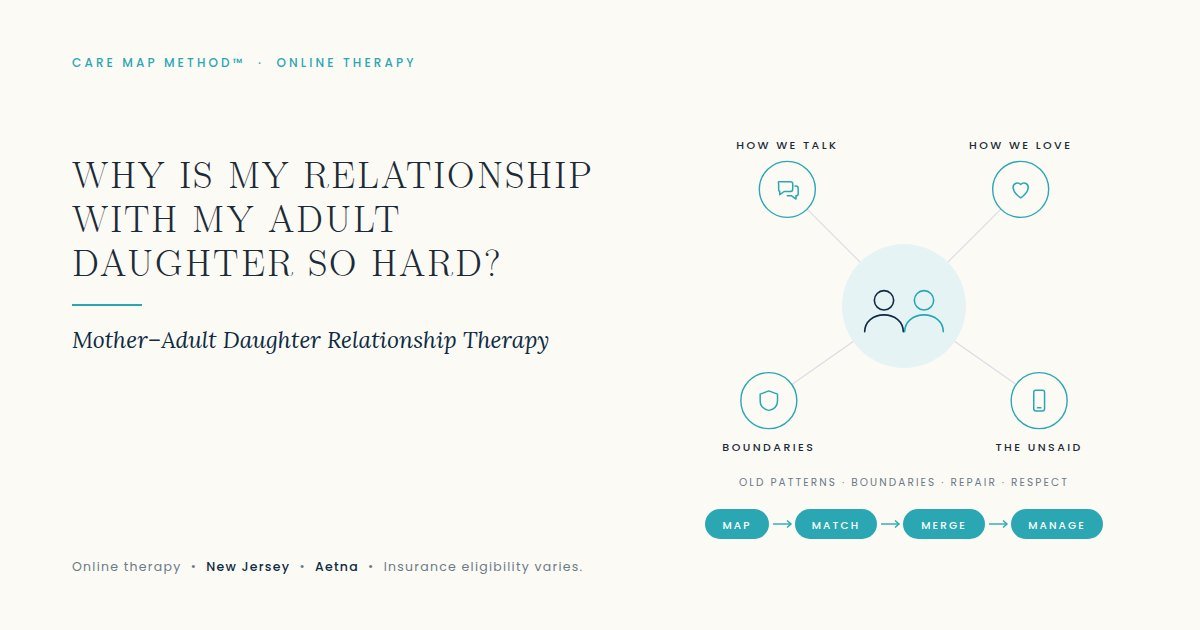
Online therapy in New Jersey for mother and adult daughter conflict, boundaries and family communication; Aetna eligibility varies.
Love Does Not Prevent Conflict
Adult mother-daughter relationships can be deeply loving and deeply activating. Old family roles can reappear quickly. Advice can feel like criticism. Independence can feel like rejection. Silence can feel punishing. One conversation can carry decades of history.
How Therapy Can Help
Individual therapy can help you understand your side of the pattern, identify the boundaries and communication you want, prepare difficult conversations and decide how to stay connected without repeatedly sacrificing your own emotional stability.
The Care Map Method™: Map • Match • Merge • Manage
MAP — Understand the pattern. Identify triggers, recurring interactions, stressors, beliefs and roles that keep the problem going.
MATCH — Identify needs and goals. Clarify what matters most, what you can influence and what a healthier outcome would look like.
MERGE — Improve communication and connection. Practice clearer language, boundaries, listening and responses that reduce reactivity and support healthier relationships.
MANAGE — Create practical next steps. Build realistic strategies, routines, agreements and coping tools you can use outside the session.
Online therapy and insurance
I provide online therapy for clients located in New Jersey. I may participate with Aetna through Headway, depending on the specific plan and my current network participation. Insurance eligibility, benefits, copays, deductibles and coverage vary. Please verify your benefits through Headway before your appointment.
A safe place to unload—and a plan to move forward
My style is warm, supportive, practical and nonjudgmental. There is room to say the things you are embarrassed, angry, confused or exhausted about without shame or blame. We will make space for the feelings and also work toward tangible changes, clearer decisions and concrete next steps.
Ready for support?
If this issue is affecting your mood, relationships, work, sleep or sense of stability, you do not have to wait until it becomes a crisis. Use my Headway profile to check insurance eligibility and available appointment times.
FAQ
Can therapy help even if the other person does not attend?
Yes. Individual therapy can help you understand patterns, regulate your responses, clarify boundaries, prepare conversations and make decisions about how you want to participate in the relationship.
Do you accept Aetna in New Jersey?
I may participate with Aetna through Headway for clients located in New Jersey. Your specific plan and benefits must be verified because eligibility and costs vary.
Is this only a place to talk about the problem?
No. Emotional support matters, but my approach is also structured and solution-focused. We identify what is happening, what you need, what can change and what concrete steps you can take next.
What happens in the first session?
We focus on what is bringing you in, the relevant relationships and stressors, the patterns you are noticing and the outcome you want. We begin creating a Care Map so you leave with clearer direction.
Is online therapy nonjudgmental?
My approach emphasizes warmth, respect and understanding rather than shame, blame or judgment, within the normal confidentiality and clinical limits of psychotherapy.

We Built a Life Together. Why Do We Feel So Far Apart?
Online therapy in California for midlife marriage stress, emotional distance and recurring relationship conflict; Providence eligibility varies.
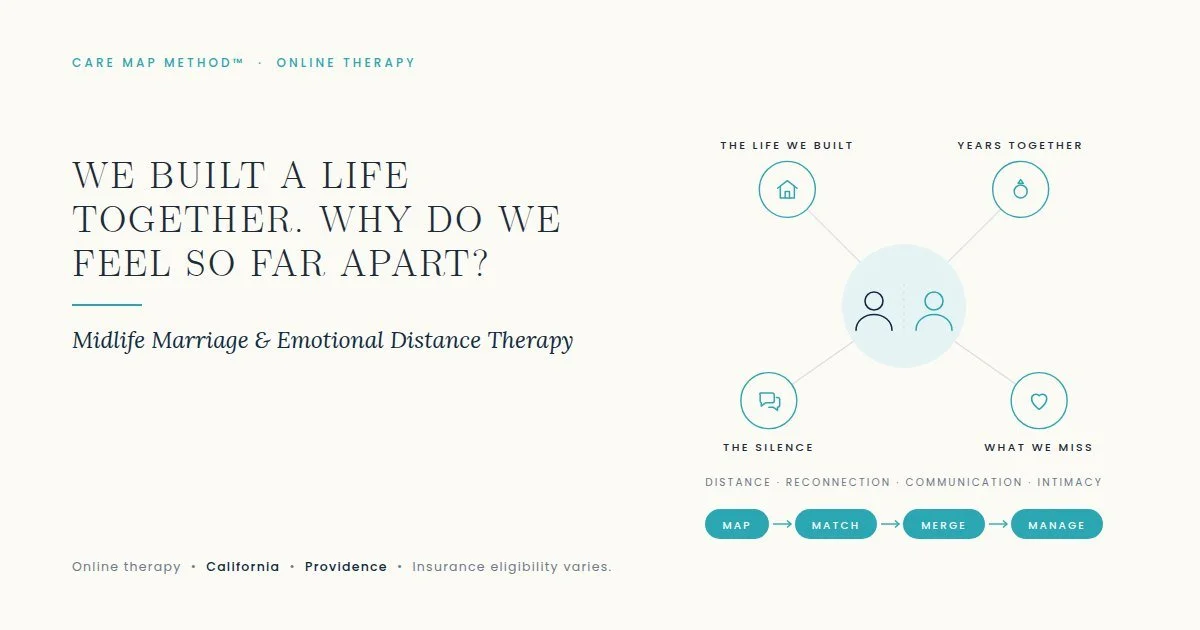
Online therapy in California for midlife marriage stress, emotional distance and recurring relationship conflict; Providence eligibility varies.
When the Relationship Starts Feeling Like Logistics
Years of parenting, work, caregiving and responsibility can turn a relationship into a system for getting through the week. You may still love each other but feel more like co-managers than partners. Small disappointments accumulate, intimacy changes, and conversations become practical rather than connected.
How Therapy Can Help
Therapy can help you slow down the pattern, identify the injuries or unmet needs underneath the distance, clarify what each person wants now, and build new ways of communicating and reconnecting that fit this stage of life.
The Care Map Method™: Map • Match • Merge • Manage
MAP — Understand the pattern. Identify triggers, recurring interactions, stressors, beliefs and roles that keep the problem going.
MATCH — Identify needs and goals. Clarify what matters most, what you can influence and what a healthier outcome would look like.
MERGE — Improve communication and connection. Practice clearer language, boundaries, listening and responses that reduce reactivity and support healthier relationships.
MANAGE — Create practical next steps. Build realistic strategies, routines, agreements and coping tools you can use outside the session.
Online therapy and insurance
I provide online therapy for clients located in California. I may participate with Providence through Headway, depending on the specific plan and my current network participation. Insurance eligibility, benefits, copays, deductibles and coverage vary. Please verify your benefits through Headway before your appointment.
A safe place to unload—and a plan to move forward
My style is warm, supportive, practical and nonjudgmental. There is room to say the things you are embarrassed, angry, confused or exhausted about without shame or blame. We will make space for the feelings and also work toward tangible changes, clearer decisions and concrete next steps.
Ready for support?
If this issue is affecting your mood, relationships, work, sleep or sense of stability, you do not have to wait until it becomes a crisis. Use my Headway profile to check insurance eligibility and available appointment times.
FAQ
Can therapy help even if the other person does not attend?
Yes. Individual therapy can help you understand patterns, regulate your responses, clarify boundaries, prepare conversations and make decisions about how you want to participate in the relationship.
Do you accept Providence in California?
I may participate with Providence through Headway for clients located in California. Your specific plan and benefits must be verified because eligibility and costs vary.
Is this only a place to talk about the problem?
No. Emotional support matters, but my approach is also structured and solution-focused. We identify what is happening, what you need, what can change and what concrete steps you can take next.
What happens in the first session?
We focus on what is bringing you in, the relevant relationships and stressors, the patterns you are noticing and the outcome you want. We begin creating a Care Map so you leave with clearer direction.
Is online therapy nonjudgmental?
My approach emphasizes warmth, respect and understanding rather than shame, blame or judgment, within the normal confidentiality and clinical limits of psychotherapy.

I'm Carrying the Mental Load for Everyone
If you are managing everyone, remembering everything and quietly resenting it, therapy can help you clarify needs, boundaries, communication and practical changes.
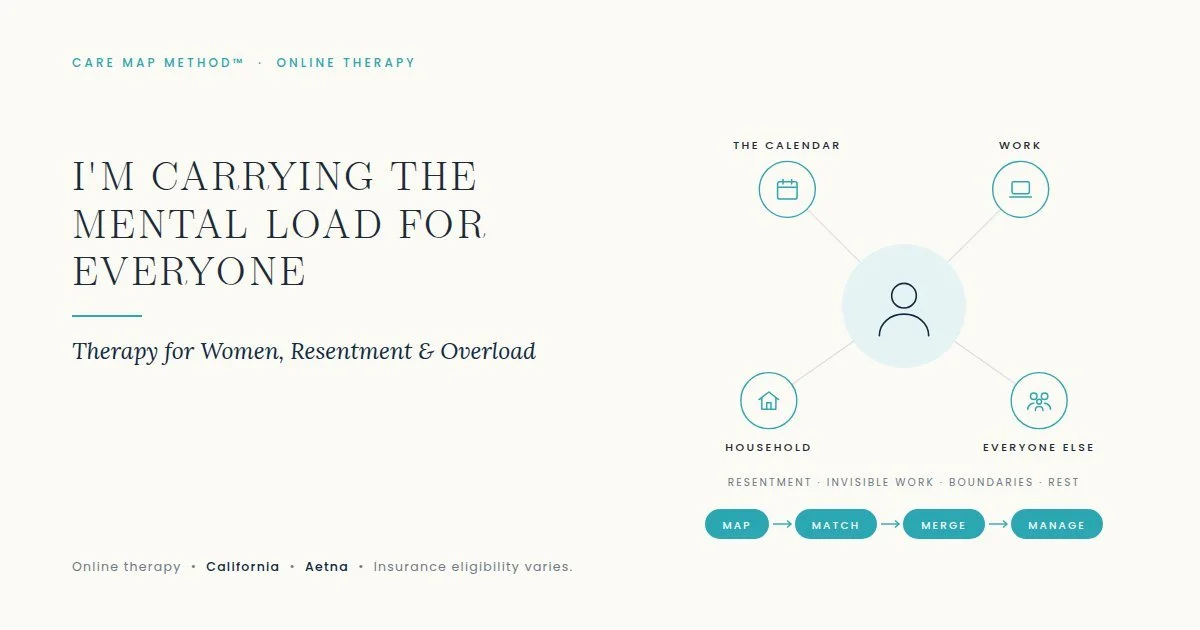
Online therapy in California for mental load, family resentment, overwhelm and boundary stress; Aetna eligibility varies.
When Competence Turns Into Exhaustion
Many people become the default planner, worrier, scheduler and problem-solver for everyone around them. The outside can look highly functional while the inside feels resentful, invisible and depleted. You may love your family and still feel angry that you are carrying too much.
How Therapy Can Help
We can identify where responsibility has become over-responsibility, clarify what you need from the people around you, practice language for asking directly, and create boundaries that reduce resentment without requiring you to abandon relationships you value.
The Care Map Method™: Map • Match • Merge • Manage
MAP — Understand the pattern. Identify triggers, recurring interactions, stressors, beliefs and roles that keep the problem going.
MATCH — Identify needs and goals. Clarify what matters most, what you can influence and what a healthier outcome would look like.
MERGE — Improve communication and connection. Practice clearer language, boundaries, listening and responses that reduce reactivity and support healthier relationships.
MANAGE — Create practical next steps. Build realistic strategies, routines, agreements and coping tools you can use outside the session.
Online therapy and insurance
I provide online therapy for clients located in California. I may be able to participate with Aetna through Headway, depending on the specific plan and my current network participation. Insurance eligibility, benefits, copays, deductibles and coverage vary. Please verify your benefits through Headway before your appointment.
A safe place to unload—and a plan to move forward
My style is warm, supportive, practical and nonjudgmental. There is room to say the things you are embarrassed, angry, confused or exhausted about without shame or blame. We will make space for the feelings and also work toward tangible changes, clearer decisions and concrete next steps.
Ready for support?
If this issue is affecting your mood, relationships, work, sleep or sense of stability, you do not have to wait until it becomes a crisis. Use my Headway profile to check insurance eligibility and available appointment times.
FAQ
Can therapy help even if the other person does not attend?
Yes. Individual therapy can help you understand patterns, regulate your responses, clarify boundaries, prepare conversations and make decisions about how you want to participate in the relationship.
Do you accept Aetna in California?
I may participate with Aetna through Headway for clients located in California. Your specific plan and benefits must be verified because eligibility and costs vary.
Is this only a place to talk about the problem?
No. Emotional support matters, but my approach is also structured and solution-focused. We identify what is happening, what you need, what can change and what concrete steps you can take next.
What happens in the first session?
We focus on what is bringing you in, the relevant relationships and stressors, the patterns you are noticing and the outcome you want. We begin creating a Care Map so you leave with clearer direction.
Is online therapy nonjudgmental?
My approach emphasizes warmth, respect and understanding rather than shame, blame or judgment, within the normal confidentiality and clinical limits of psychotherapy.

Back-to-School Stress Is Affecting Our Whole Family
School transitions can affect the whole family. Therapy can help with parent stress, conflict, routines, expectations and communication during the back-to-school season.
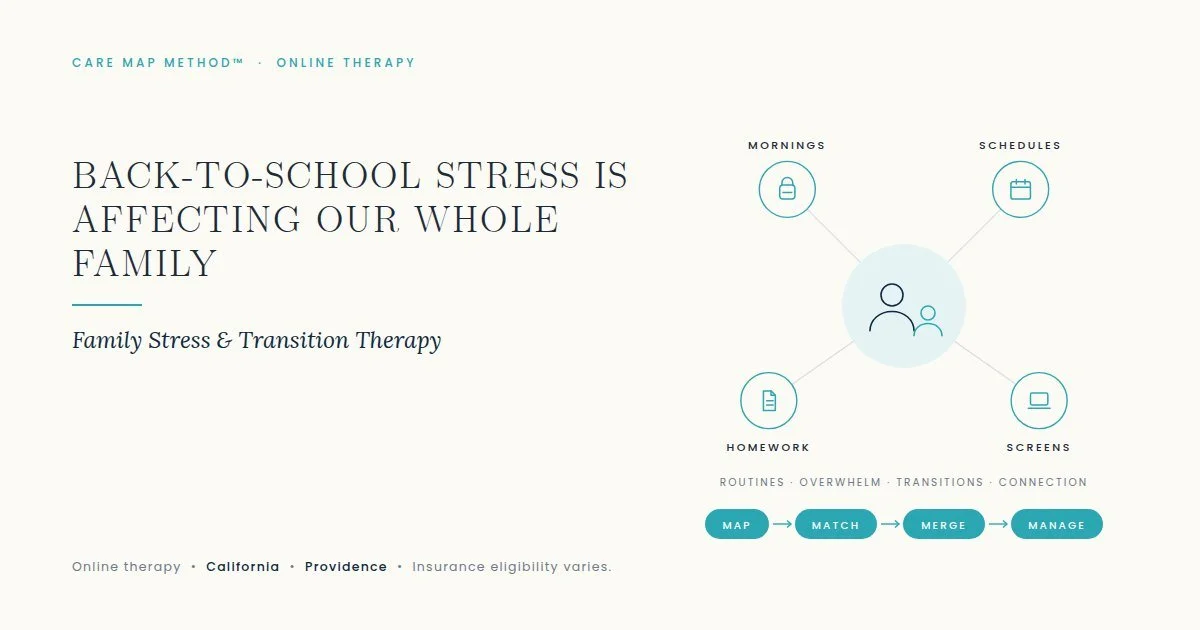
Online therapy in California for back-to-school family stress, parenting overwhelm and family communication; Providence eligibility varies.
When School Stress Comes Home
Back-to-school pressure is rarely only about homework. It can involve morning battles, sports schedules, academic expectations, social worries, screen-time conflict, sleep problems and parents feeling responsible for keeping everything moving. Even capable families can become reactive when everyone is overloaded.
How Therapy Can Help
Therapy can help you identify the actual pressure points, reduce parent guilt, improve communication, set more realistic expectations and create routines that fit your family instead of fighting the same battles every day.
The Care Map Method™: Map • Match • Merge • Manage
MAP — Understand the pattern. Identify triggers, recurring interactions, stressors, beliefs and roles that keep the problem going.
MATCH — Identify needs and goals. Clarify what matters most, what you can influence and what a healthier outcome would look like.
MERGE — Improve communication and connection. Practice clearer language, boundaries, listening and responses that reduce reactivity and support healthier relationships.
MANAGE — Create practical next steps. Build realistic strategies, routines, agreements and coping tools you can use outside the session.
Online therapy and insurance
I provide online therapy for clients located in California. I may participate with Providence through Headway, depending on the specific plan and my current network participation. Insurance eligibility, benefits, copays, deductibles and coverage vary. Please verify your benefits through Headway before your appointment.
A safe place to unload—and a plan to move forward
My style is warm, supportive, practical and nonjudgmental. There is room to say the things you are embarrassed, angry, confused or exhausted about without shame or blame. We will make space for the feelings and also work toward tangible changes, clearer decisions and concrete next steps.
Ready for support?
If this issue is affecting your mood, relationships, work, sleep or sense of stability, you do not have to wait until it becomes a crisis. Use my Headway profile to check insurance eligibility and available appointment times.
FAQ
Can therapy help even if the other person does not attend?
Yes. Individual therapy can help you understand patterns, regulate your responses, clarify boundaries, prepare conversations and make decisions about how you want to participate in the relationship.
Do you accept Providence in California?
I may participate with Providence through Headway for clients located in California. Your specific plan and benefits must be verified because eligibility and costs vary.
Is this only a place to talk about the problem?
No. Emotional support matters, but my approach is also structured and solution-focused. We identify what is happening, what you need, what can change and what concrete steps you can take next.
What happens in the first session?
We focus on what is bringing you in, the relevant relationships and stressors, the patterns you are noticing and the outcome you want. We begin creating a Care Map so you leave with clearer direction.
Is online therapy nonjudgmental?
My approach emphasizes warmth, respect and understanding rather than shame, blame or judgment, within the normal confidentiality and clinical limits of psychotherapy.

I Do Everything for Everyone: Therapy for Family Resentment and Overload
Being the dependable person in a family can become an identity. You solve problems, remember appointments, manage emotions, help children, support parents and keep everyone moving. Eventually care can turn into resentment, exhaustion or the feeling that nobody notices what you carry.

An overwhelmed adult carrying family responsibilities and needing time for support and self-care.
I Do Everything for Everyone: Therapy for Family Resentment and Overload
Being the dependable person in a family can become an identity. You solve problems, remember appointments, manage emotions, help children, support parents and keep everyone moving. Eventually care can turn into resentment, exhaustion or the feeling that nobody notices what you carry.
You may be functioning well in many areas of life and still feel consumed by this one relationship or transition. When the same thoughts and conversations repeat, it can become difficult to know what is a reasonable reaction, what needs to change, and where to begin.
You may be experiencing
family resentment
emotional overload
people pleasing
family boundaries
caregiver stress
doing everything for everyone
A safe place for support and practical solutions
Therapy can help you identify which responsibilities are truly yours and which have accumulated because saying no feels uncomfortable. We can work on boundaries, guilt, communication and asking for support without waiting until you are at a breaking point.
My approach is warm, relational and solution-focused. I want therapy to feel like one completely safe place with no judgment, stress, shame or blame. You can unload what you are carrying, better understand yourself and the people around you, name emotions more clearly, and leave with practical ways to move forward. My sole goal is for clients to leave each session feeling better, less alone and more supported.
How I use the Care Map Method™
MAP — Understand the pattern, pressure points, emotions and needs underneath the problem.
MATCH — Identify the support, boundaries, communication and goals that fit your situation.
MERGE — Improve communication and connection among the people and competing needs involved.
MANAGE — Create practical next steps you can use between sessions and adjust as circumstances change.
Using Aetna for online therapy in New Jersey
I provide online therapy for clients who are physically located in New Jersey at the time of the session. Eligible Aetna members may be able to use insurance for therapy through Headway. Network participation, benefits, deductibles, copays and eligibility vary by individual plan. Please verify your benefits through Headway before booking.
Frequently asked questions
Can therapy help with this even if the other person does not attend?
Yes. Individual therapy can help you understand patterns, regulate reactions, clarify boundaries and change how you respond even when another person is not participating.
Will therapy just be talking about the problem?
No. There is room to talk and feel fully heard, but my approach also emphasizes clinical insight, communication tools, boundaries and practical next steps.
Do you provide online therapy in New Jersey?
Yes. I provide telehealth therapy to appropriate clients located in New Jersey, subject to scheduling, clinical fit and applicable requirements.
Can I use Aetna for therapy?
Eligible Aetna members may be able to use benefits through Headway. Coverage and out-of-pocket costs vary, so benefits should be verified before booking.
What if I am not sure whether my problem is serious enough for therapy?
You do not need to wait for a crisis. Therapy can be useful when a relationship, transition or recurring stress is taking up too much emotional space or affecting daily life.