

Individual Therapy for Co Parenting Stress in California
Difficult co-parenting messages taking over your day? Explore individual online therapy in California with Tammy Gold, LCSW, and check insurance eligibility.
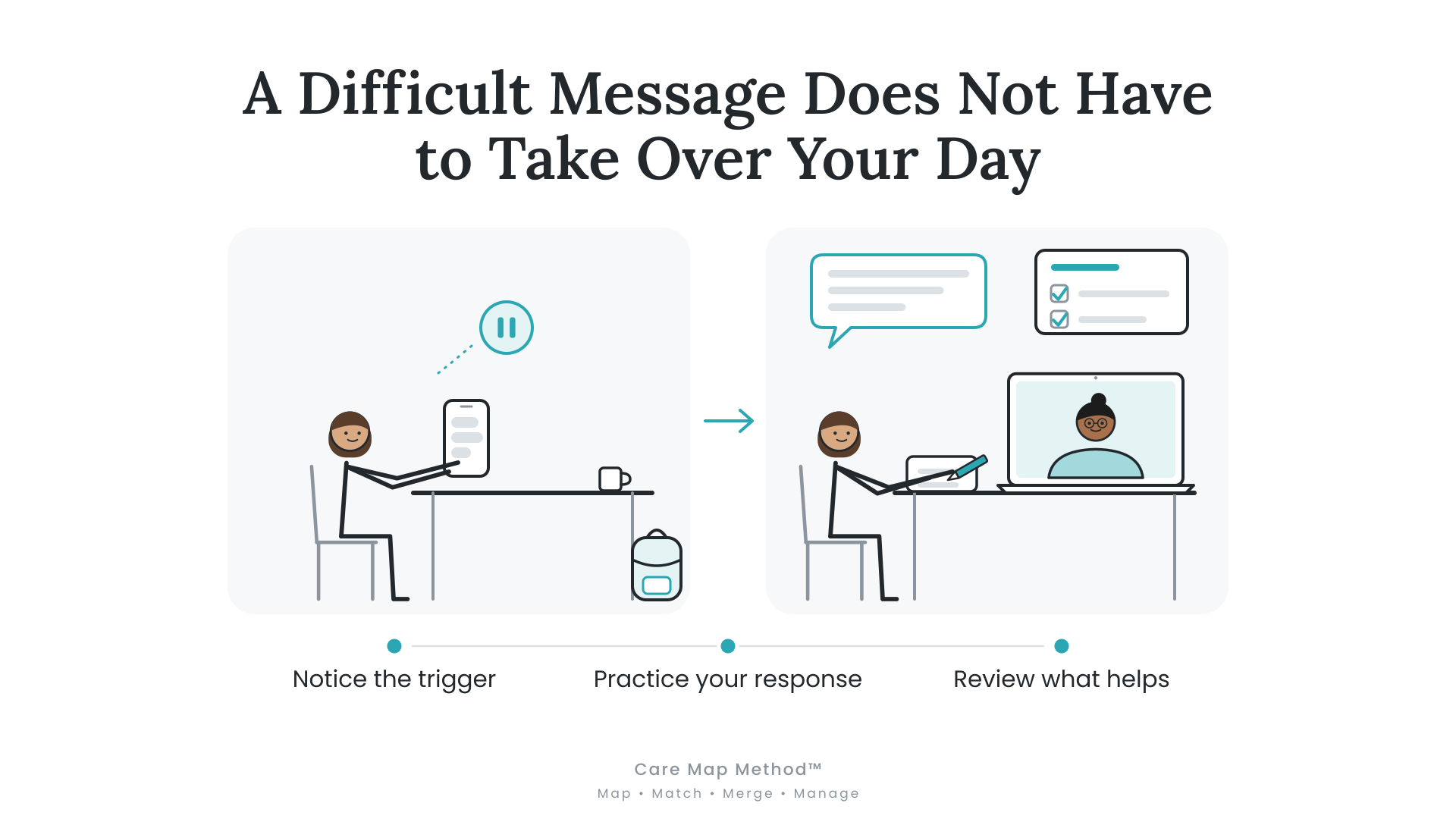
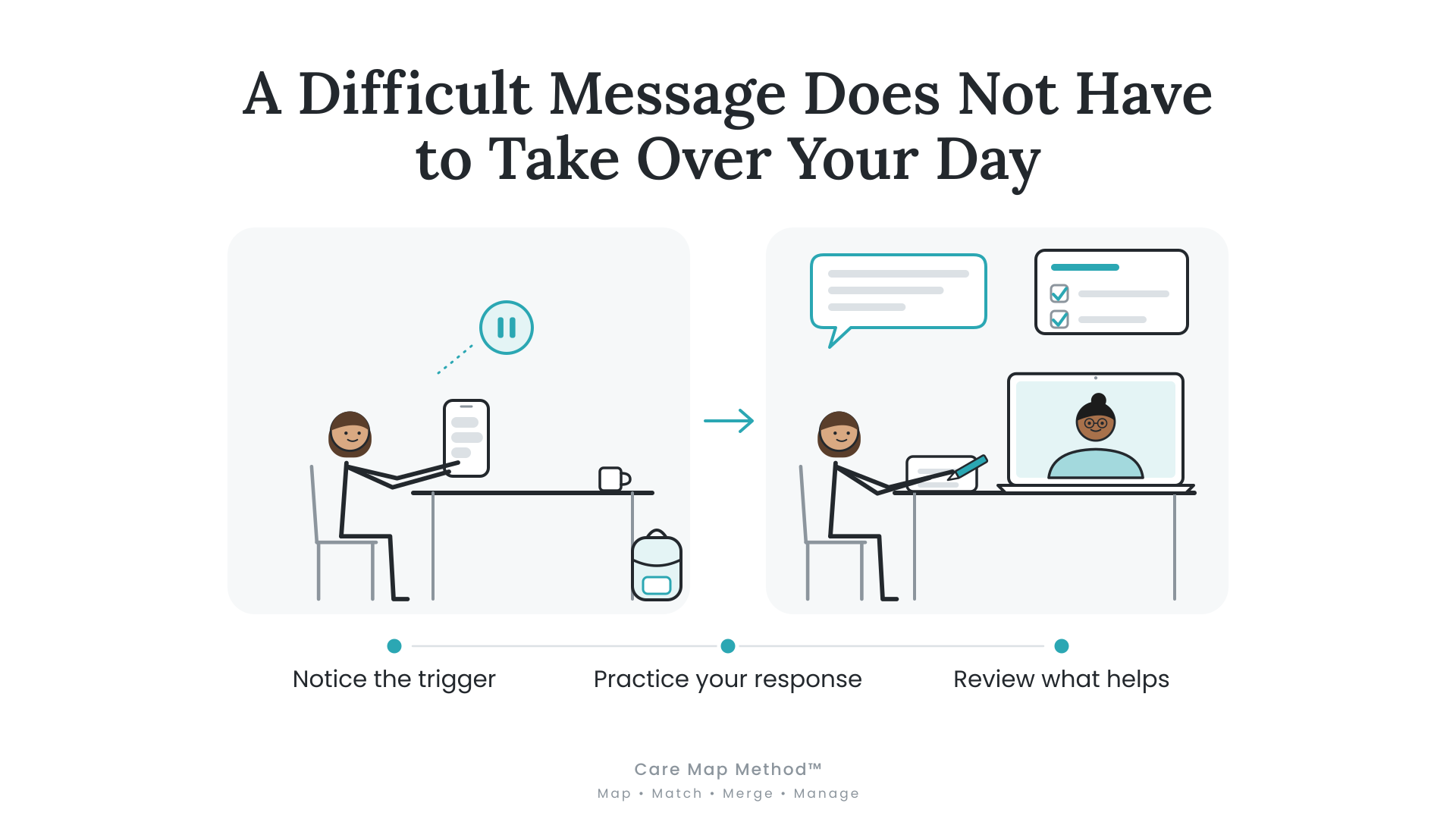
You are getting through an ordinary day when a message from your co-parent arrives. Before you have finished reading it, you are tense. You draft a response, delete it, and start again. A practical question about pickup becomes an argument in your head that follows you into work or time with your child. Individual online therapy in California can give you space to work on the emotional impact of these exchanges and how you want to respond.
Check availability and insurance through Headway
Understand the part that hurts
Co-parenting stress can involve much more than scheduling. A short message may touch a familiar fear of being blamed, ignored, or treated unfairly. You may feel pressure to explain yourself thoroughly so that nobody misunderstands you. We can examine one exchange at a time and identify the feeling, thought, and urge that follow it. Understanding that sequence can help us choose a useful treatment goal rather than trying to resolve the entire relationship in one session.
What we can work on in a session
We might start with a recent message and ask what practical information it contains, what meaning you attach to it, and what you want your reply to accomplish. We can practice language and explore what makes a pause feel difficult. An illustrative response might be: “I can confirm the pickup details by this evening.” Any timing or communication plan must fit your parenting arrangements, legal obligations, and safety. Therapy does not change a court order or replace legal advice.
Use Map Match Merge and Manage
With the Care Map Method™, we Map the exchange and its effect on you. We Match coping and communication strategies to your needs. We Merge the chosen strategy into a real situation, then Manage what happens by reviewing it together. Biological, Emotional, Social, and Environmental factors matter: exhaustion, hurt, available support, and interruptions at work can all shape your capacity. This framework organizes our work alongside clinical assessment and a treatment plan tailored to you.
Prepare one exchange for your appointment
If it feels useful, choose one recent exchange and write a brief summary in your own words. Note what you felt, what you wanted to say, and how the interaction affected the rest of your day. You do not need to bring an entire message history. We can work from the pattern you describe, discuss what felt most difficult, and choose one response to explore. The goal is to make therapy relevant to your daily experience.
What progress could look like
Progress might mean spending less time rehearsing an argument, recognizing when you need support, or making a decision with more clarity. It does not depend on your co-parent agreeing with your interpretation. We can also examine what happens after you send a reply: whether you keep checking the phone, criticize yourself, or struggle to return to another activity. If an approach is not helping, we can adjust it and reconsider what support fits.
Insurance and booking in California
I offer individual therapy for adults located in California. Use my Headway or Alma profile to check current availability, provider participation, and your exact plan. Coverage depends on clinical treatment needs and plan rules; co-parenting conflict alone does not establish eligibility. These sessions are your individual treatment. Joint sessions, mediation, and custody evaluations have different purposes and arrangements. If you are unsure which service you need, ask before booking so we can clarify fit.
About Tammy Gold
I am Tamara “Tammy” Gold, MSW, LCSW, CEC, a licensed therapist, certified coach, and founder of the Care Map Method™. I earned my clinical MSW at Columbia University and have more than 20 years of direct work with families. These sessions focus on your individual mental health and treatment goals.
Take the next step
If this concern is affecting your daily life, view my profile to explore fit, availability, and insurance eligibility. You can choose a starting point without having every detail of the situation figured out.
Frequently asked questions
Can I attend without my co-parent?
Yes. Individual therapy focuses on your symptoms, responses, and decisions. Your co-parent does not have to participate for you to seek support.
Will you help me write a message?
When relevant to your treatment goals, we can practice wording and explore your response to the exchange. I do not act as your attorney or provide court-directed communication advice.
Is this co-parenting mediation?
This page describes individual psychotherapy. Mediation involves a different service and agreement; a therapy appointment should not be assumed to include it.
Can I use insurance?
Check your exact plan through my profile before booking. Coverage and your cost depend on provider participation, eligibility, and whether the treatment meets the plan’s clinical requirements.
How many appointments will I need?
We can discuss an initial plan after assessment and review it as we learn what is helping. There is no single number of sessions that fits everyone.
What if the communication feels threatening?
Tell me when discussing fit so we can consider your safety and appropriate support. A routine communication exercise may not fit a situation involving threats or coercion.
Therapy for Caregiver Guilt in Oregon
Feeling guilty about limits or senior-care decisions? Explore individual online therapy in Oregon and check Providence Health Plan eligibility through Headway.
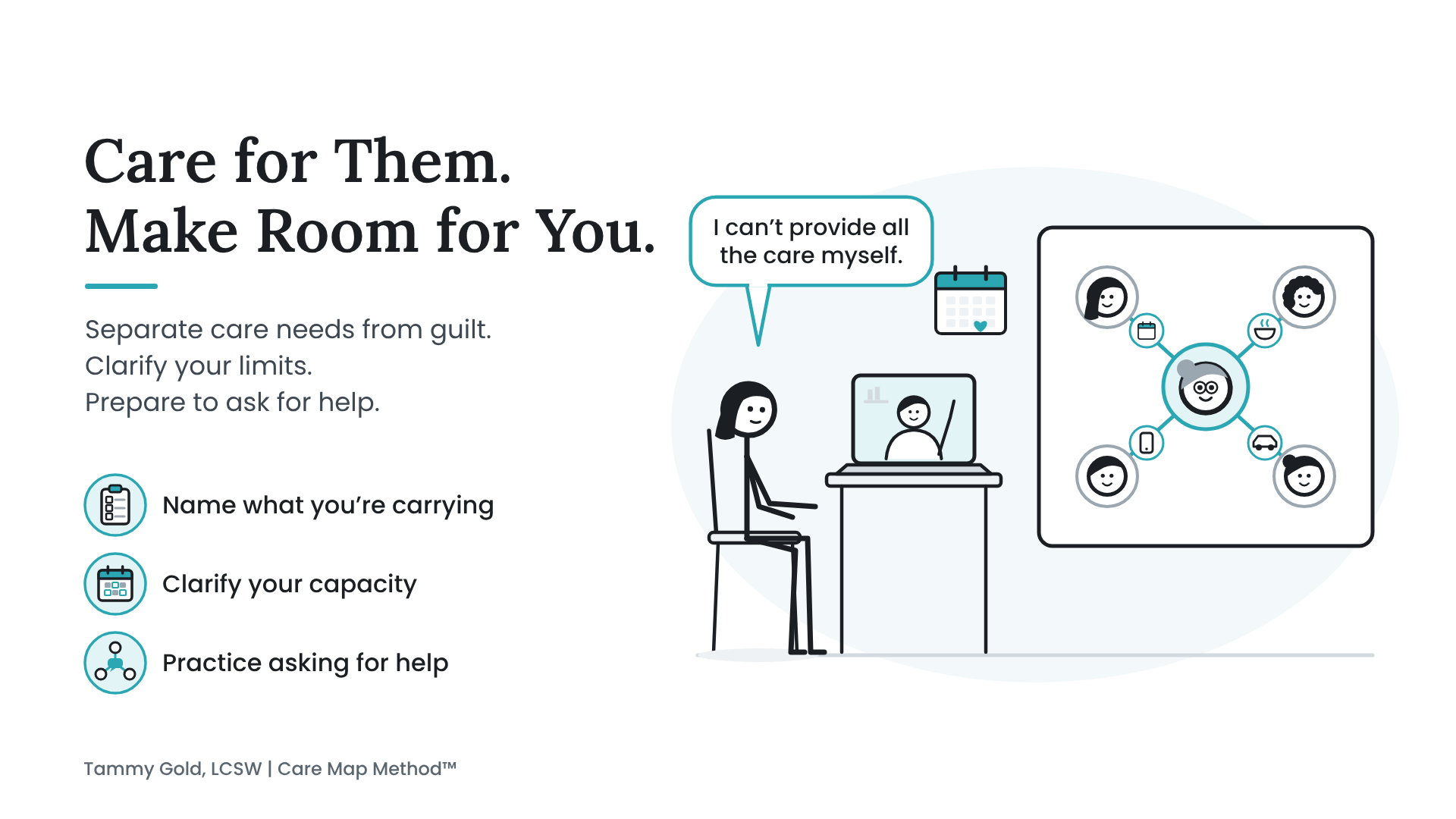
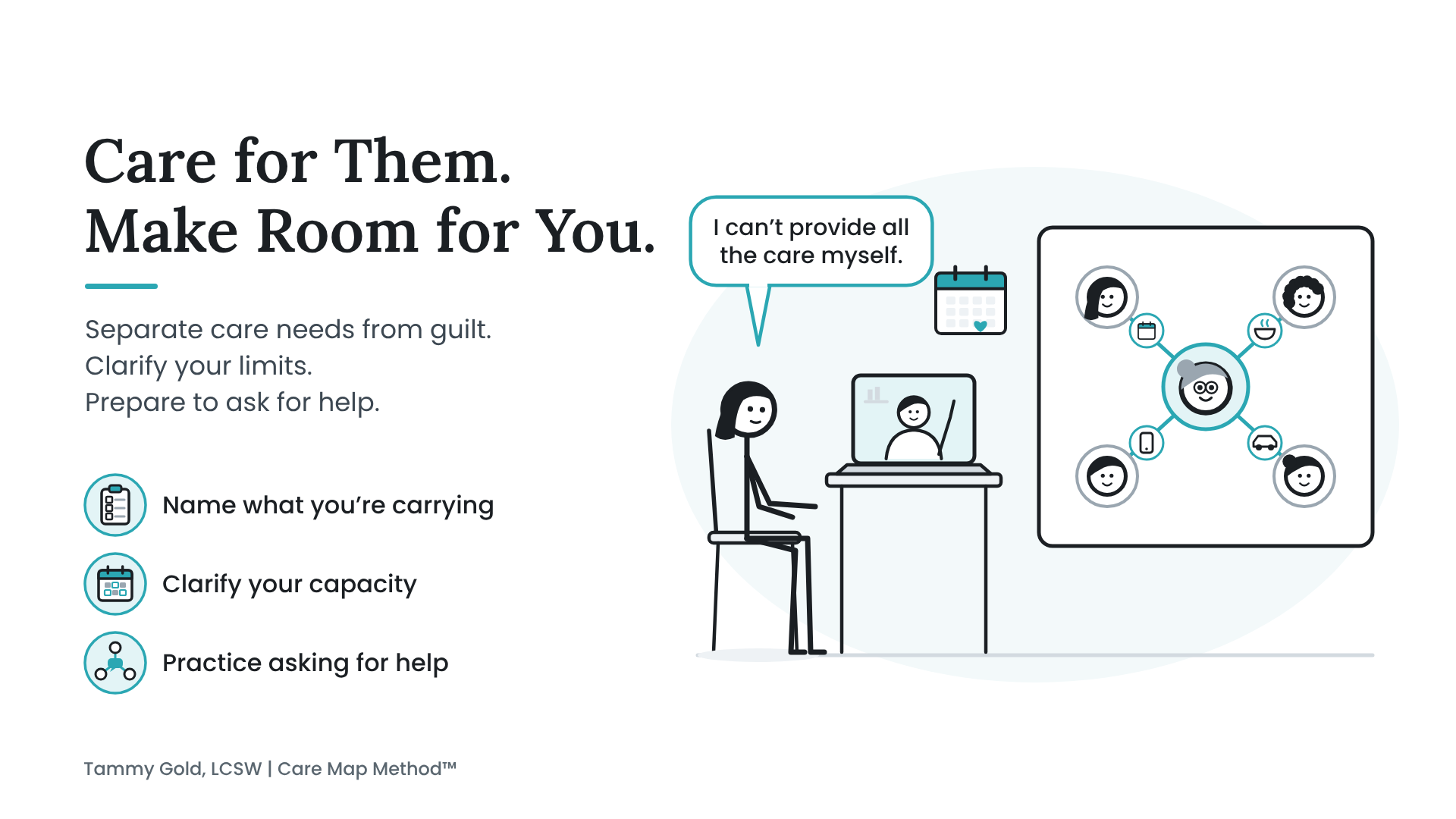
You know you cannot do everything your parent needs. Still, saying no, hiring help, or considering a different care setting can feel like a betrayal. You may be judging yourself for limits that are necessary.
I am Tammy Gold, LCSW. I offer individual online therapy for adults located in Oregon. Providence Health Plan appears on my Headway profile; please check your exact plan and eligibility before booking.
Check insurance and booking through Headway
Separate the care need from the guilt
Guilt can sound like a clear instruction: “A good daughter would do more.” In therapy, we can slow that thought down. What does your parent need? What can you provide safely and sustainably? What support is missing? We can explore the emotional distress around caregiving without assuming every request must become your responsibility.
Make room for a difficult decision
You may be balancing your parent’s wishes with your health, children, work, and finances. We can help you prepare conversations, tolerate disagreement, and recognize the grief that sometimes comes with changing a care arrangement. A useful starting point is: “I want you to have reliable care, and I cannot provide all of that care myself.”
Use the map to make your capacity visible
The Care Map Method™ helps us Map Biological, Emotional, Social, and Environmental needs for you and the care situation, Match those needs with realistic support, Merge clearer communication into the plan, and Manage your emotional response as circumstances change. Psychotherapy addresses your mental health; medical and care-placement decisions may also require other professionals.
What we would explore in your first session
We can start with the decision or request you keep replaying. Perhaps your parent wants daily visits, a sibling expects you to coordinate everything, or you feel guilty about considering assisted living. We would discuss your emotional symptoms, relevant history, and the effect of caregiving on your own life. It helps to understand your actual responsibilities and support network before deciding what to work on. You can attend even if other family members disagree about the care plan.
An example of separating love from capacity
Imagine that you are handling appointments and evening calls while also managing work and your household. We might list the responsibilities you carry and identify what happens when you reach your limit. A conversation could begin: “I can coordinate this appointment, but I cannot also provide every evening visit. We need another arrangement for that.” This is an illustrative exercise, not a client story. We would also work on the guilt or fear that appears after you state the limit.
Try a brief responsibility inventory
On a piece of paper, list what you currently do, how often it happens, and which tasks require another person’s help or professional input. Include the time spent worrying and organizing, not only hands-on care. Then circle the responsibility that feels least sustainable. Bring the list to therapy so we can explore the emotional pressure around it and identify a realistic next conversation. A therapist can support your decision-making without replacing your parent’s medical team or a qualified care coordinator.
How we review progress
We can look at whether you recognize overload earlier, accept appropriate help, or feel more able to rest without immediately criticizing yourself. We can also make room for sadness about your parent’s changing needs. A revised care arrangement may still feel painful even when it is necessary. Therapy gives you a place to process that experience and revisit boundaries as circumstances change.
About Tammy Gold
I am Tamara “Tammy” Gold, MSW, LCSW, CEC, a licensed therapist and certified coach with a clinical MSW from Columbia University. I founded the Care Map Method™ and have more than 20 years of direct work with families. These sessions focus on your individual mental health and treatment goals.
Take the next step
If this concern is affecting your daily life, view my profile to explore fit and current booking options. Check your exact plan and estimated costs before scheduling. You can also read the online therapy booking guide for help choosing a platform.
Check insurance and booking through Headway
Read the online therapy booking guide
Frequently asked questions
Can therapy help if my parent refuses outside help?
We can work on your distress, boundaries, communication, and decisions even when your parent does not agree with you.
Does Providence cover caregiver support?
Coverage depends on your plan and the clinical purpose of treatment. Individual psychotherapy for a caregiver is different from nonclinical care coordination or placement services. Verify benefits through Headway.
Do you choose a facility or arrange staffing during therapy?
This page offers individual psychotherapy. Care selection, staffing, and coaching are separate services and should not be assumed to be covered by therapy insurance.
Is it okay to seek therapy if my parent is the person who is ill?
Yes. The effect of caregiving on your own mental health deserves attention. We would assess your symptoms and treatment needs rather than assume your parent must attend.
Can we discuss conflict with siblings about care?
Yes. We can explore your distress and responses, practice a clearer request, and identify responsibilities you can realistically take on. Individual therapy does not require your siblings to participate.
Will therapy make the guilt disappear?
No particular outcome is guaranteed. We can work on understanding the guilt, responding to it more thoughtfully, and making decisions that take your own capacity into account.
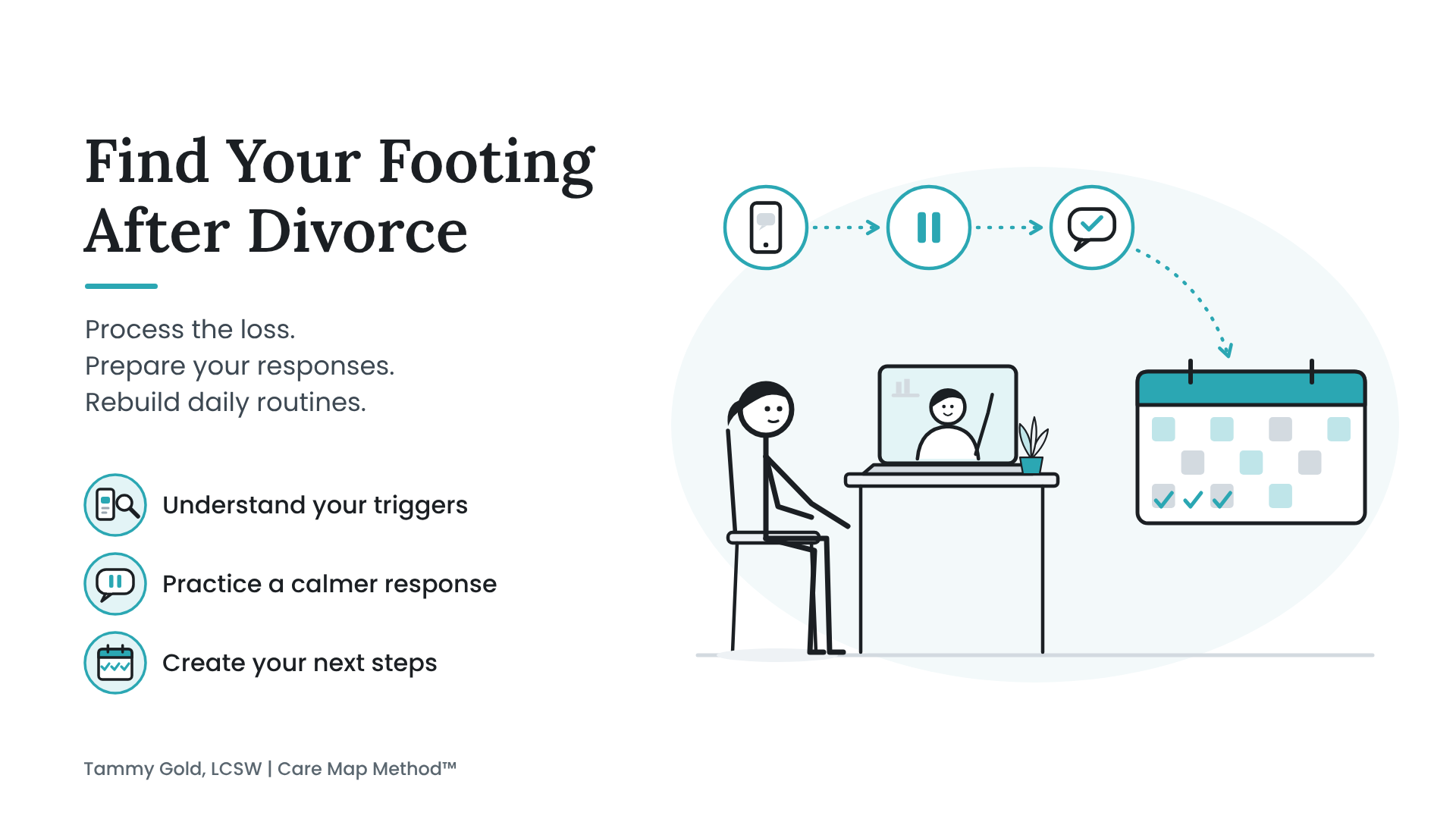
Therapy for Divorce Adjustment in New Jersey
Online therapy with Tammy Gold, LCSW for the emotional strain of separation and divorce in New Jersey. Check Horizon plan eligibility through Headway.
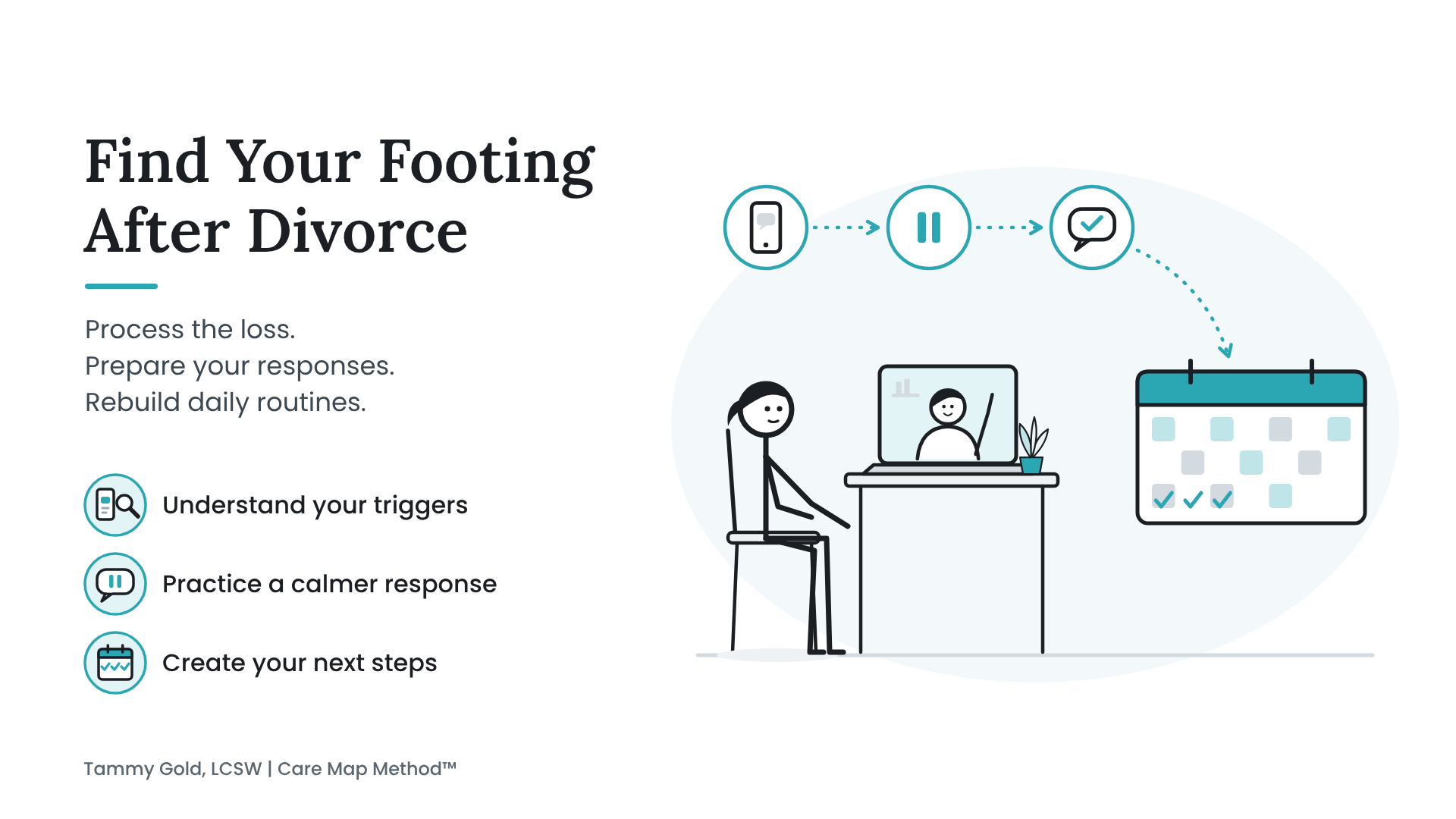
The paperwork may be moving forward while your feelings are still catching up. Separation can change your home, routines, finances, friendships, and sense of who you are. You may feel relief one day and grief the next.
I am Tammy Gold, LCSW. I offer individual online therapy for adults located in New Jersey. Horizon Blue Cross and Blue Shield of New Jersey appears on my Headway profile; please check your exact plan and eligibility before booking.
Check insurance and booking through Headway
You do not need to have your feelings sorted out
Individual therapy offers room to process loss, anger, uncertainty, and the pressure to make decisions while emotionally stretched. We can identify what is affecting your sleep, concentration, parenting, and relationships, then choose treatment goals that fit your current circumstances.
Create space between the message and your response
An unexpected text from a former partner can take over the rest of your day. We can examine what the message triggers, distinguish a practical question from a familiar conflict, and plan how you want to respond. Sometimes the work is a short reply. Sometimes it is learning to pause while you settle enough to think clearly.
Build a life around your current needs
Using the Care Map Method™, we Map the strain and the changes you are facing, Match needs with emotional support and practical coping strategies, Merge those strategies into daily routines, and Manage setbacks. We consider Biological, Emotional, Social, and Environmental needs as you rebuild. Therapy can support your emotional adjustment; legal and financial questions belong with qualified advisers.
What we would explore in your first session
You can begin wherever the separation feels most present: the quiet house, exchanges with a former partner, a changed parenting schedule, or the fear of starting over. We would discuss your symptoms, relevant history, current supports, and the decisions that feel emotionally difficult. You do not need a complete timeline ready. We can choose one immediate treatment goal, such as settling after a difficult message or rebuilding a routine that helps you get through the week.
An example of a calmer communication plan
Suppose a message about a pickup time includes a personal accusation. In therapy, we might separate the scheduling question from the part that draws you toward an argument. We can practice a reply that addresses the practical issue, then discuss what you need after sending it. This is an illustrative exercise rather than a client story. Any communication plan must fit your safety and existing arrangements; questions about court orders or legal obligations need your attorney’s guidance.
Build one dependable routine
When much of life feels unsettled, a small routine can give the day a clearer shape. Choose one manageable action, such as eating lunch away from divorce paperwork, arranging a regular check-in with someone supportive, or setting aside a defined period for administrative tasks. We can discuss why that action matters, what might get in the way, and how to make it realistic. The purpose is to create some room for your needs while you process the larger change.
How we review progress
We can notice whether difficult contact takes over less of your day, whether you feel more able to concentrate, or whether you are reconnecting with people and activities you value. Grief may return around anniversaries, family events, or changes in parenting time. That gives us something specific to work through. Your goals can change as the practical circumstances of the divorce change.
About Tammy Gold
I am Tamara “Tammy” Gold, MSW, LCSW, CEC, a licensed therapist and certified coach with a clinical MSW from Columbia University. I founded the Care Map Method™ and have more than 20 years of direct work with families. These sessions focus on your individual mental health and treatment goals.
Take the next step
If this concern is affecting your daily life, view my profile to explore fit and current booking options. Check your exact plan and estimated costs before scheduling. You can also read the online therapy booking guide for help choosing a platform.
Check insurance and booking through Headway
Read the online therapy booking guide
Frequently asked questions
Do I need a diagnosis before contacting you?
You do not need to diagnose yourself. An initial clinical assessment helps determine treatment needs and whether insurance-funded care is appropriate.
Can I use Horizon insurance?
Horizon appears on my Headway profile, but acceptance and cost depend on your specific plan and eligibility. Check your benefits before scheduling.
Can you mediate my divorce or write a custody evaluation?
This service is individual psychotherapy for emotional adjustment. It does not include legal mediation, custody evaluation, or legal advice.
Can I start before the divorce is final?
Yes. Separation and the period before a final agreement can bring distress worth addressing. Treatment focuses on your mental health and adjustment at your current stage.
Can we work on co-parenting stress in individual therapy?
We can explore your emotional responses, communication, and boundaries around co-parenting. These sessions are your individual treatment; joint work and legal questions require separate arrangements.
Will you tell me whether to reconcile?
We can explore your feelings, needs, and the consequences of different choices. The decision is yours, and therapy can help you think it through with more clarity.
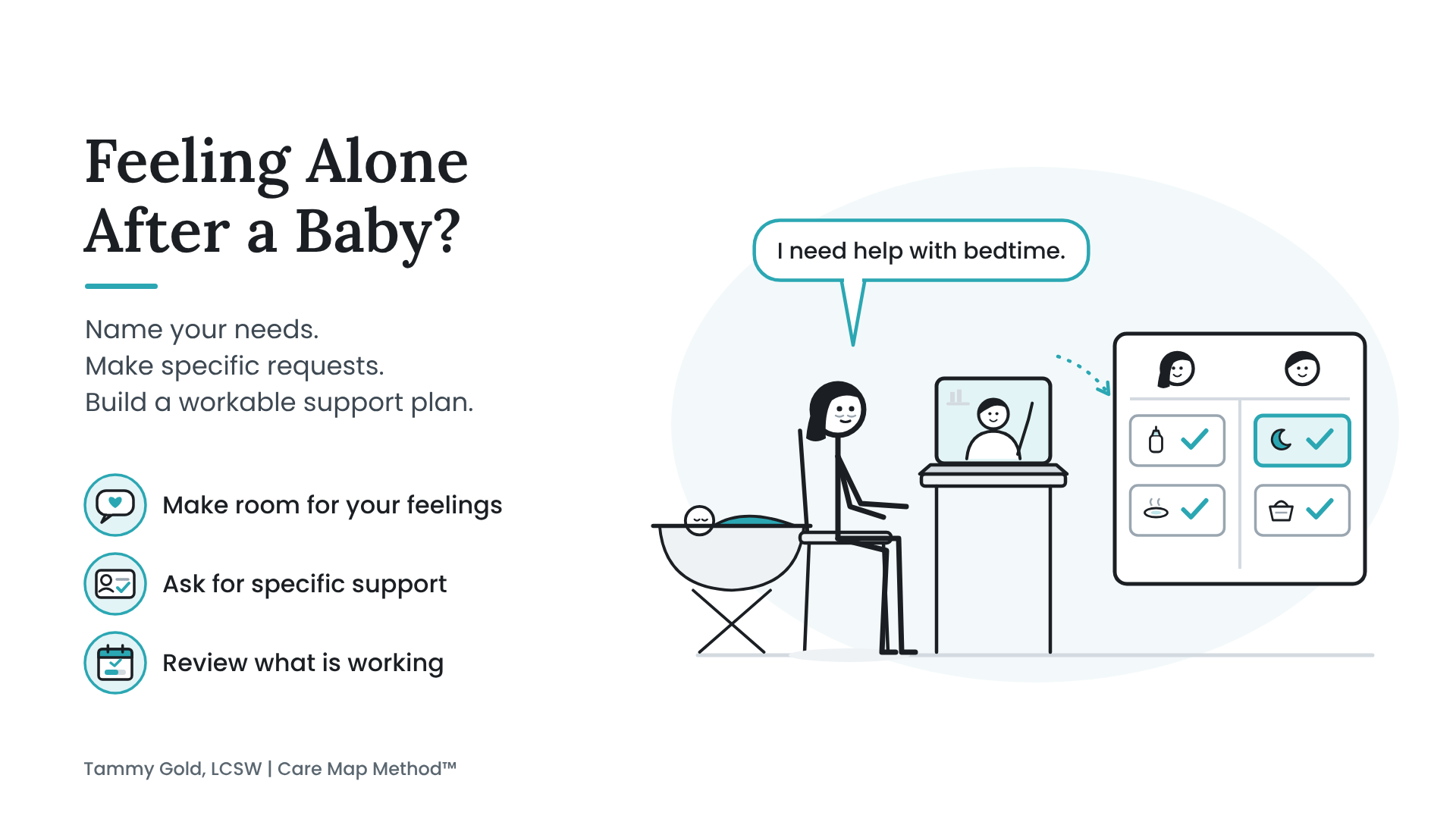
Individual Therapy for Relationship Stress After a Baby in California
Feeling disconnected or resentful after a baby? Explore individual online therapy in California and check Blue Shield of California benefits through Headway.
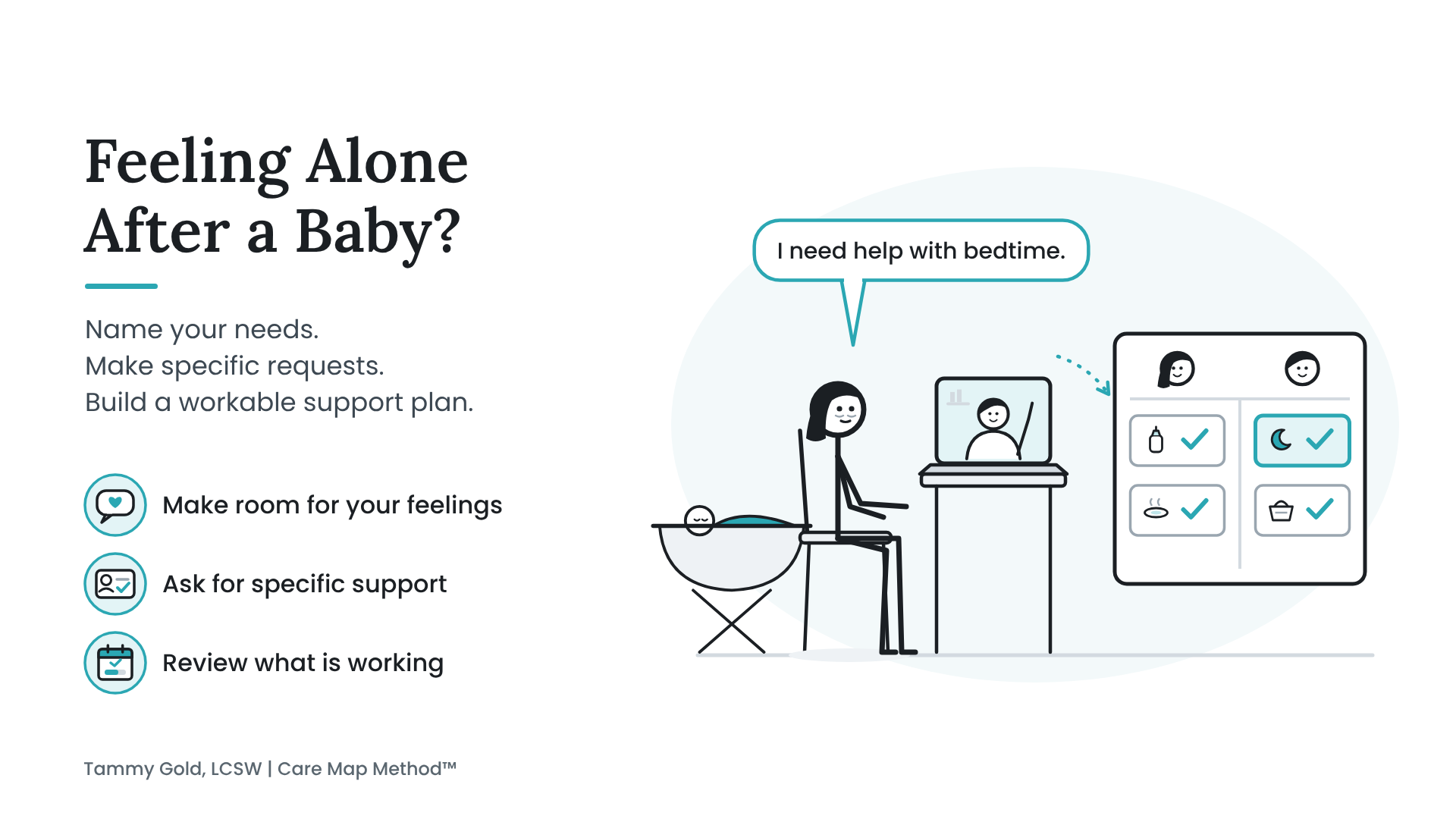
Illustration of new parents discussing support and shared responsibilities after a baby.
You expected life to change after a baby. You may not have expected to feel so alone beside your partner. Small disagreements about feeding, chores, visitors, or sleep can become arguments about whether you matter.
I am Tammy Gold, LCSW. I offer individual online therapy for adults located in California. Blue Shield of California appears on my Headway profile; please check your exact plan and eligibility before booking.
Check insurance and book through Headway
Make room for your own experience
You can love your baby and feel angry, lonely, or overwhelmed. Therapy gives you space to talk about changes in your relationship and identity without having to reassure everyone else first. We can assess your emotional symptoms and how they are affecting daily life, then decide what kind of support fits.
Move from a running argument to a specific request
“You never help” may express a real hurt, but it does not tell the other person what needs to change tonight. We can work on naming the task, the responsibility, and the follow-through you need. A starting sentence might be: “I need you to handle the bedtime routine on these two nights, including getting everything ready.” We can also explore what it means if clear requests repeatedly go unanswered.
Look at the whole picture
The Care Map Method™ helps us Map the emotional and practical strain, Match needs with realistic support, Merge that support into routines and conversations, and Manage adjustments. Biological, Emotional, Social, and Environmental needs all matter: your rest, feelings, support network, and household demands deserve attention.
What we would explore in your first session
We can begin with the moment that feels hardest: evenings, overnight responsibilities, returning to work, or watching your partner relax while you keep track of everything. We would discuss your emotional symptoms, relevant history, and how life has changed since the baby arrived. Your goal might be making a clear request, having space to process resentment, or feeling more like yourself. We can also discuss whether additional medical or mental health support is appropriate for your needs.
Make the invisible work easier to name
It can be difficult to explain why one household task feels exhausting when you are also remembering appointments, tracking supplies, and anticipating the next need. We can identify which parts of a task you carry: noticing it, planning it, doing it, and checking that it happened. In a session, we might practice asking another adult to take responsibility for the whole task. That conversation can make the request more specific and help us understand what happens when responsibility remains uneven.
A practical conversation to bring to therapy
Choose one repeated point of friction and write down what actually happens. For example: “At bedtime I prepare the supplies, do the routine, and clean up afterward. I want to discuss who owns this routine on particular nights.” Add how the situation affects you and what support you would like. We can use this as a starting point, explore your partner’s response, and adapt the request to your circumstances. You do not need to solve the entire division of labor in one conversation.
How we review progress
We can track whether you identify your feelings earlier, ask for support more directly, or recover from disagreements with less rumination. We may also revisit expectations that leave you feeling guilty about resting. If communication tools do not change an ongoing pattern, we can explore your options and support needs. Therapy cannot promise another person’s cooperation, but it can help you understand your experience and choose your next steps.
About Tammy Gold
I am Tamara “Tammy” Gold, MSW, LCSW, CEC, a licensed therapist and certified coach with a clinical MSW from Columbia University. I founded the Care Map Method™ and have more than 20 years of direct work with families. These sessions focus on your individual mental health and treatment goals.
Take the next step
If this concern is affecting your daily life, view my profile to explore fit and current booking options. Check your exact plan and estimated costs before scheduling. You can also read the online therapy booking guide for help choosing a platform.
Check insurance and booking through Headway
Is this therapy for me or for my baby?
This page describes individual therapy for an adult parent. Sessions focus on your mental health, relationships, and adjustment.
Can Blue Shield of California cover these sessions?
Your plan, provider eligibility, and clinical requirements determine coverage. Verify your exact benefits through my Headway profile before booking.
Is this the same as couples counseling?
No. Individual therapy focuses on your treatment. If you want joint sessions, we can discuss fit and check their coverage separately.
Can I attend if my partner does not want therapy?
Yes. These sessions focus on your individual mental health, decisions, and responses. We can explore relationship stress even if your partner is not participating.
Do I need to be a first-time parent?
No. You can seek support after another baby or during a later adjustment in parenting. We would assess your current needs and whether my approach is a good fit.
How do we know whether therapy is helping?
We can choose specific goals together and review changes in your daily experience, communication, and coping. We can adjust the plan when a strategy feels unrealistic or unhelpful.
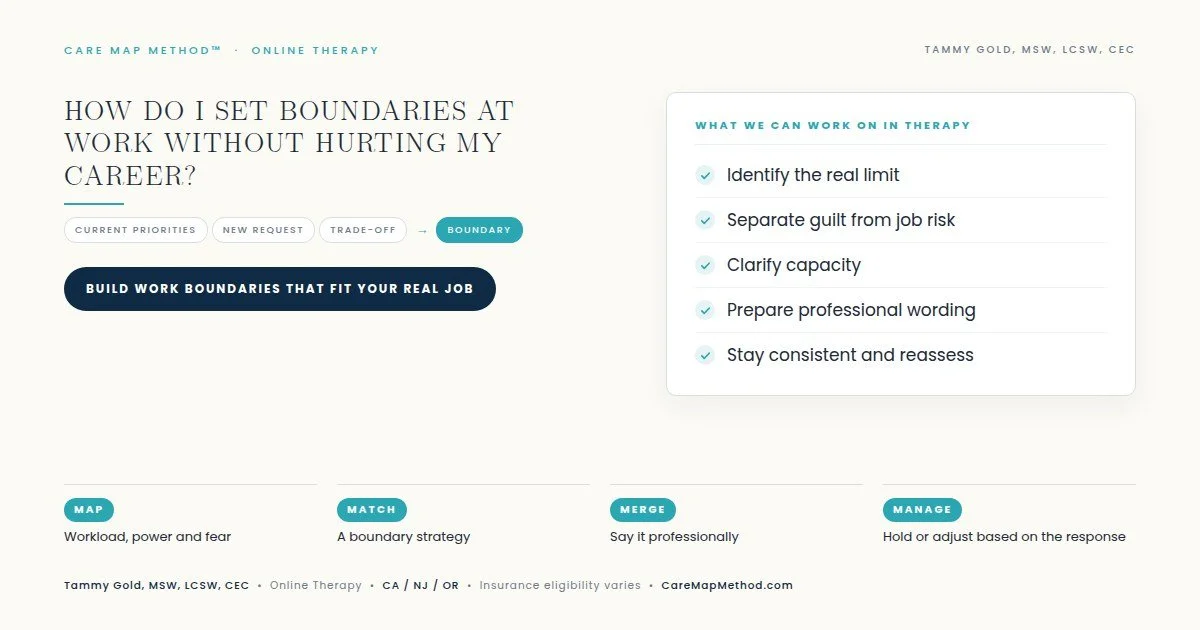
How Do I Set Boundaries at Work Without Hurting My Career?
Work boundaries are harder when the person asking for more work may also evaluate you. Therapy can help you replace vague resentment with clear capacity, priorities and professional language that fits the realities of your job.
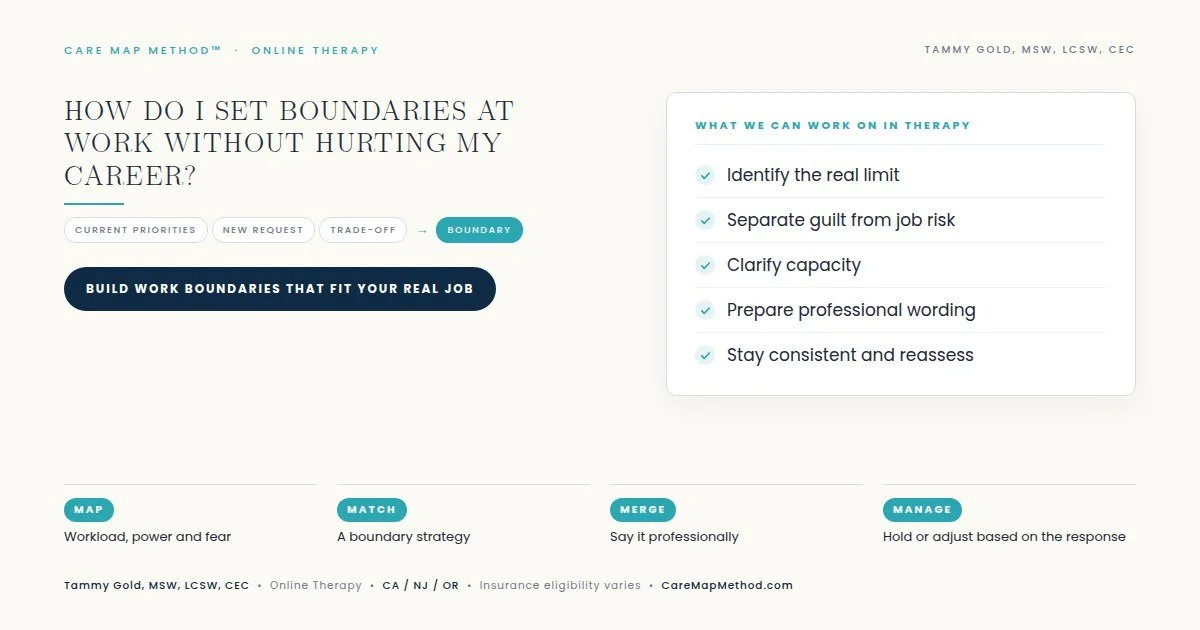
Care Map Method therapy for setting work boundaries, workload limits and professional communication
HOW DO I SET BOUNDARIES AT WORK WITHOUT HURTING MY CAREER?
The goal is not to become less committed. It is to make capacity, priorities and expectations clearer.
What therapy can help you work on:
• Identify where your limits are actually being crossed
• Separate fear of disapproval from realistic career risk
• Turn “no” into capacity and priority language
• Prepare for pushback from a boss or coworker
• Stay consistent without becoming rigid or overexplaining
BUILD WORK BOUNDARIES THAT FIT YOUR REAL JOB
Work boundaries are not simple because work has stakes
Your livelihood, reputation and advancement may be involved. Advice that works in a friendship may be inappropriate with a supervisor. Good workplace boundaries therefore need to be specific, professional and grounded in your actual role.
People-pleasing can make every request feel mandatory
If being dependable is central to your identity, you may volunteer before checking capacity, answer instantly or absorb work that was never clearly yours. The resentment arrives later.
Care Map Method™
MAP the request, power dynamic, workload and feared consequence.
MATCH the issue with the right boundary or prioritization conversation.
MERGE it into professional language.
MANAGE reactions and maintain the boundary consistently enough to learn whether it works.
A boundary is not a guarantee that everyone will like it
The purpose is clarity. We can work on tolerating discomfort while staying mindful of real job expectations and consequences.
What We Can Work On
Identify where your limits are actually being crossed
Separate fear of disapproval from realistic career risk
Turn “no” into capacity and priority language
Prepare for pushback from a boss or coworker
Stay consistent without becoming rigid or overexplaining
Care Map Method™
MAP the problem and pattern. MATCH the needs with the right clinical strategies. MERGE insight into real conversations, boundaries and behavior. MANAGE what happens next and adjust as the situation changes.
How do I say no to more work without looking unhelpful?
Often the most professional approach is to make capacity and trade-offs visible: clarify current priorities, ask what should move and avoid promising work that cannot realistically be completed.
Can boundaries hurt my career?
Workplace context matters, and no therapist can guarantee how an employer will respond. We can help you think through the power dynamics, job expectations and wording so the boundary is deliberate rather than reactive.
Why do I feel guilty setting work boundaries?
You may equate availability with competence, loyalty or safety. Therapy can help separate healthy commitment from over-responsibility and fear-driven people pleasing.
What if my boss ignores my boundary?
Repeatedly ignored limits provide information. We can reassess the wording, organizational expectations, documentation, escalation options and whether the environment is sustainable.
How do I set boundaries with coworkers who constantly need help?
Clarify what support is appropriate, when you are available and what work you are responsible for. A boundary can include redirecting requests or scheduling help rather than responding immediately.
Can therapy help me practice the actual conversation?
Yes. We can write and rehearse concise language, anticipate objections and work on the emotional response that makes it hard to follow through.
BUILD WORK BOUNDARIES THAT FIT YOUR REAL JOB
Check insurance eligibility and request an online therapy appointment. Therapy is available to eligible clients in California, New Jersey and Oregon; coverage and benefits vary by plan.
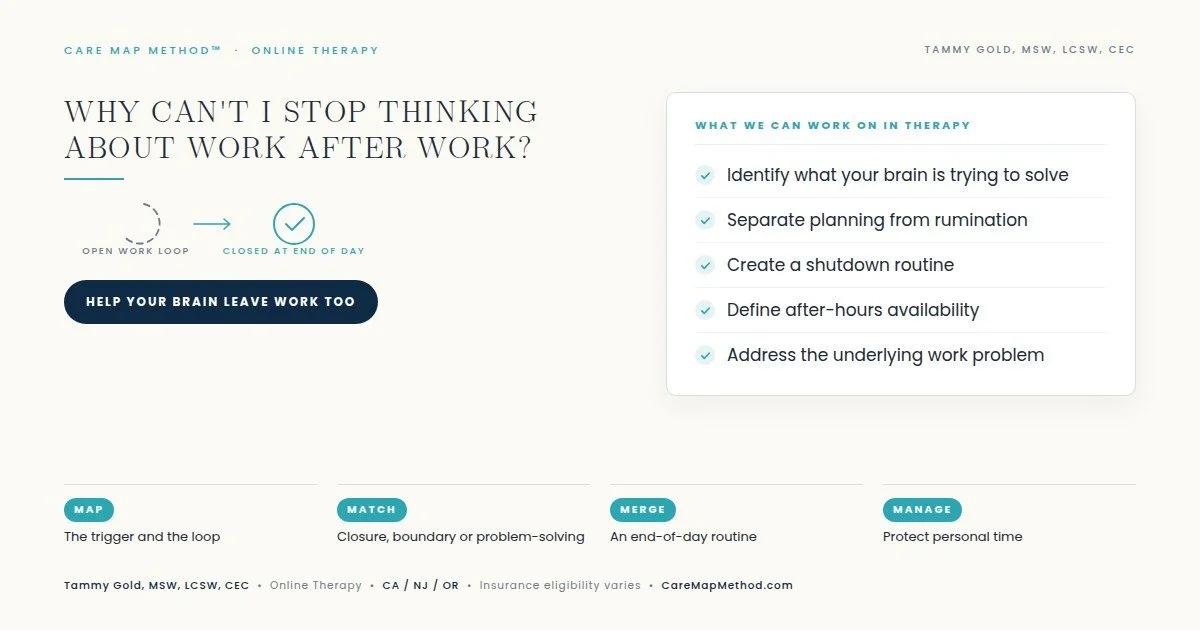
Why Can’t I Stop Thinking About Work After Work? Therapy for Work Rumination
Your laptop can be closed while your brain is still at work. If you replay conversations, anticipate tomorrow or check messages compulsively, therapy can help identify what keeps the workday psychologically open.
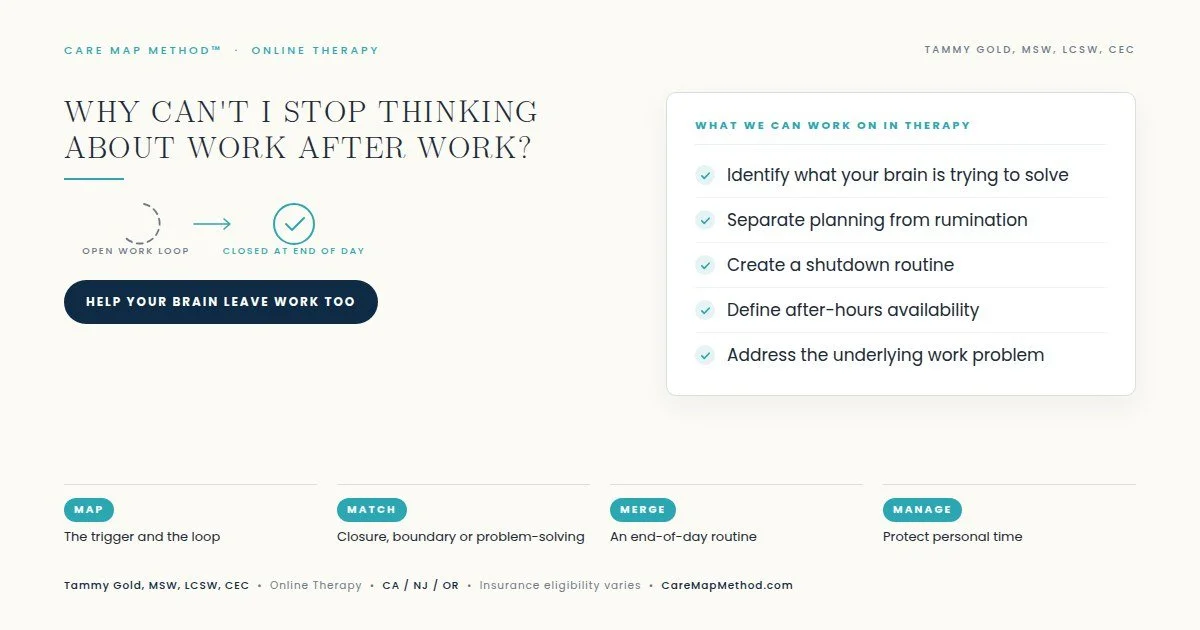
Care Map Method therapy for work rumination, after-hours anxiety and work-life boundaries
WHY CAN’T I STOP THINKING ABOUT WORK AFTER WORK?
Closing the laptop is not the same as closing the stress loop.
What therapy can help you work on:
• Identify what your brain is still trying to solve
• Separate useful planning from repetitive rumination
• Create an end-of-work closure routine
• Set realistic after-hours communication boundaries
• Address the boss, coworker or workload problem underneath the thoughts
HELP YOUR BRAIN LEAVE WORK TOO
Work can stay psychologically open
Unfinished tasks, ambiguous feedback, conflict and fear of forgetting something can keep your mind scanning long after the workday ends.
Rumination feels productive but often is not
Thinking about a problem repeatedly can create the feeling that you are preparing, even when you are cycling through the same material without reaching a new decision.
Sometimes the thought loop is pointing to a real workplace problem
The answer is not always relaxation. If the real issue is an unreasonable workload, unclear boss, conflict or boundary violation, we need to address that too.
Care Map Method™
MAP when the rumination starts, what triggers it and what problem it is attached to.
MATCH the trigger with closure, communication, boundary or problem-solving.
MERGE the strategy into the end of the workday.
MANAGE what returns and refine the plan.
Your evening needs somewhere else to go
The goal is not to never think about work. It is to regain choice over when work receives your attention and when your personal life gets to be fully present.
What We Can Work On In Our Session Together:
Identify what your brain is still trying to solve
Separate useful planning from repetitive rumination
Create an end-of-work closure routine
Set realistic after-hours communication boundaries
Address the boss, coworker or workload problem underneath the thoughts
Care Map Method™
MAP the problem and pattern. MATCH the needs with the right clinical strategies. MERGE insight into real conversations, boundaries and behavior. MANAGE what happens next and adjust as the situation changes.
Why do I keep thinking about work after hours?
Common drivers include unfinished tasks, uncertainty, conflict, high responsibility, anxiety and weak boundaries between work and personal time. Therapy can help identify which pattern is operating for you.
Is work rumination the same as anxiety?
They can overlap, but repetitive work thoughts are not automatically an anxiety disorder. A clinician can assess the broader pattern, severity and impact.
Can therapy help with Sunday scaries?
Yes. We can identify what Sunday dread predicts—workload, a person, performance fears, lack of recovery or a job-fit problem—and build a response around the actual trigger.
Should I stop checking email after work?
That depends on your role and legitimate job expectations. The goal is to define realistic availability rather than impose a boundary that does not fit your circumstances.
What if I need to be reachable for work?
We can distinguish true on-call requirements from habitual checking and create a plan that protects as much off-duty time as your role realistically allows.
What if the thoughts keep me from sleeping?
Persistent sleep disruption deserves attention. Therapy can address rumination and stress, while medical evaluation may also be appropriate for ongoing sleep problems.
HELP YOUR BRAIN LEAVE WORK TOO Text: 818.308.1538
Check insurance eligibility and request an online therapy appointment. Therapy is available to eligible clients in California, New Jersey and Oregon; coverage and benefits vary by plan.
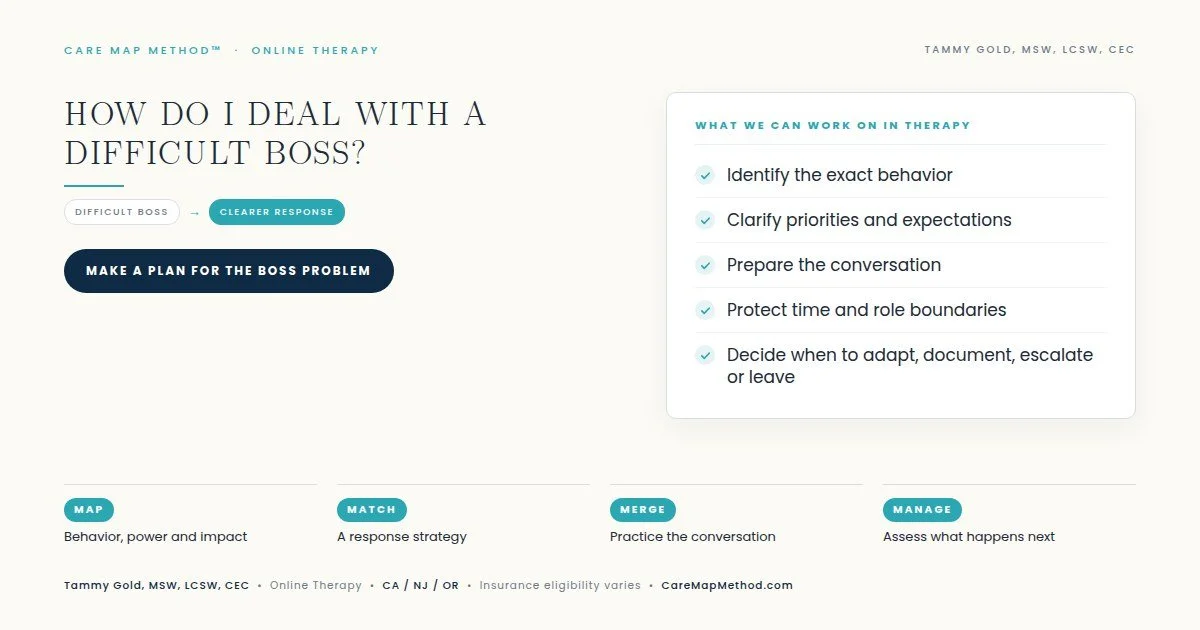
How Do I Deal With a Difficult Boss? Therapy for Workplace Stress
When your boss changes priorities, micromanages, criticizes or keeps you constantly on edge, the problem can follow you home. Therapy can help you respond strategically without pretending the power imbalance is not real.
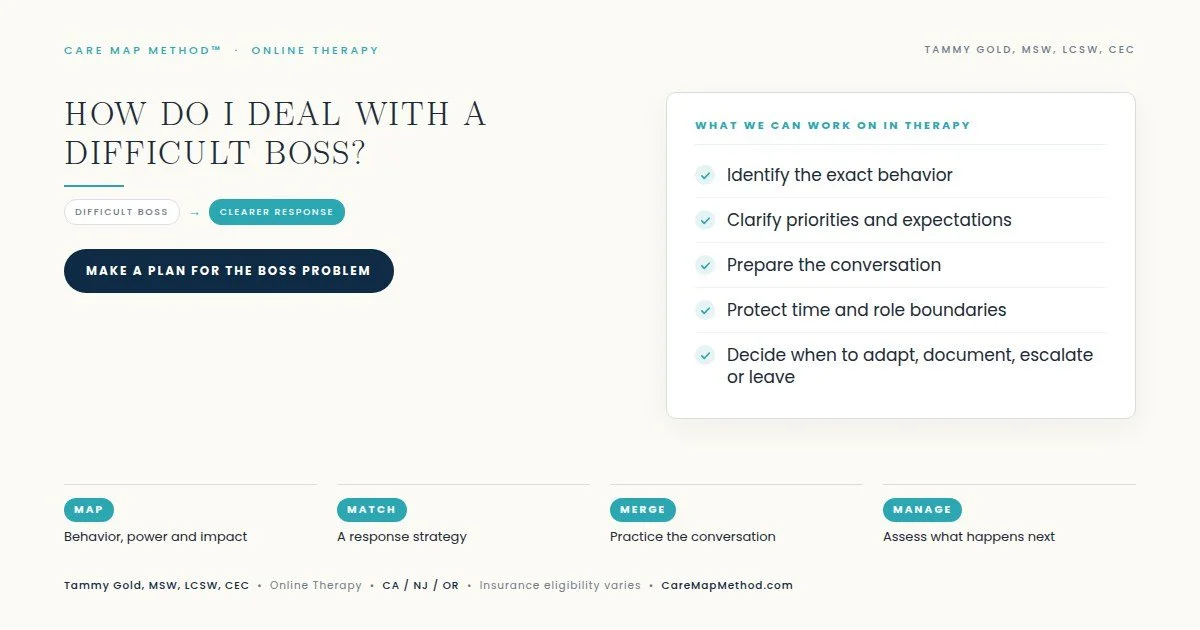
Care Map Method therapy for difficult boss stress, workplace communication and boundaries
MY BOSS IS MAKING ME MISERABLE. WHAT CAN THERAPY HELP ME DO?
You may not control your boss. You can become clearer about the pattern, your response and your options.
What therapy can help you work on:
• Identify the specific boss behavior—not just “toxic”
• Separate what is uncomfortable from what is unsustainable
• Prepare concise conversations about priorities and expectations
• Build boundaries that account for the power difference
• Decide when to adapt, escalate, document or consider leaving
A difficult boss can take up far more than eight hours
You may replay meetings, anticipate criticism, check messages late at night or spend weekends preparing for Monday. The relationship becomes psychologically present even when the boss is not.
Specificity gives you more options
“My boss is terrible” may be true to your experience, but it is hard to act on. Micromanagement, changing priorities, public criticism, unclear expectations and after-hours demands each require different responses.
Power matters
Workplace boundaries are not identical to boundaries with friends or family. Your manager may control assignments, evaluation or advancement. Therapy can help you plan communication that acknowledges those realities instead of relying on simplistic advice to “just say no.” Current workplace guidance likewise emphasizes clear expectations, capacity and specific communication around boundaries. citeturn0search0turn0search7
Care Map Method™
MAP the behavior, trigger, power dynamic and impact. MATCH the problem with communication, boundary, documentation, support or decision-making. MERGE the strategy into a specific conversation. MANAGE what happens next and adjust based on evidence.
The work is about protecting both your wellbeing and your judgment
Chronic stress can make every interaction feel urgent. Slowing the pattern down can help you respond professionally while deciding what is and is not workable.
What We Can Work On In Our Sessions:
Identify the specific boss behavior—not just “toxic”
Separate what is uncomfortable from what is unsustainable
Prepare concise conversations about priorities and expectations
Build boundaries that account for the power difference
Decide when to adapt, escalate, document or consider leaving
Care Map Method™
MAP the problem and pattern.
MATCH the needs with the right clinical strategies.
MERGE insight into real conversations, boundaries and behavior.
MANAGE what happens next and adjust as the situation changes.
Can therapy help with a difficult boss if my boss will not change?
Yes. The work can focus on your stress response, communication, boundaries, decision-making and options even when the other person does not change.
How do I set boundaries with someone who controls my job?
Workplace boundaries need to account for power and job expectations. We can clarify the specific issue and prepare professional language around priorities, capacity, availability or communication.
What if my boss is a micromanager?
We can identify what triggers the micromanagement, what information or structure may reduce it, how you respond to repeated checking and what limits or larger decisions may be necessary.
Should I tell HR about my boss?
That is a context-specific employment decision. Therapy can help you organize what has happened and think through goals and risks, but legal or HR advice should come from the appropriate qualified source.
What if I am afraid of retaliation?
That concern should be taken seriously rather than dismissed. We can work on emotional support and decision-making while you seek appropriate employment or legal guidance for rights and risks.
Can you help me prepare what to say to my boss?
Yes. We can clarify the goal of the conversation, reduce emotionally loaded language, practice concise wording and anticipate likely responses.
MAKE A PLAN FOR THE BOSS PROBLEM. 818.308.1538
Check insurance eligibility and request an online therapy appointment. Therapy is available to eligible clients in California, New Jersey and Oregon; coverage and benefits vary by plan.
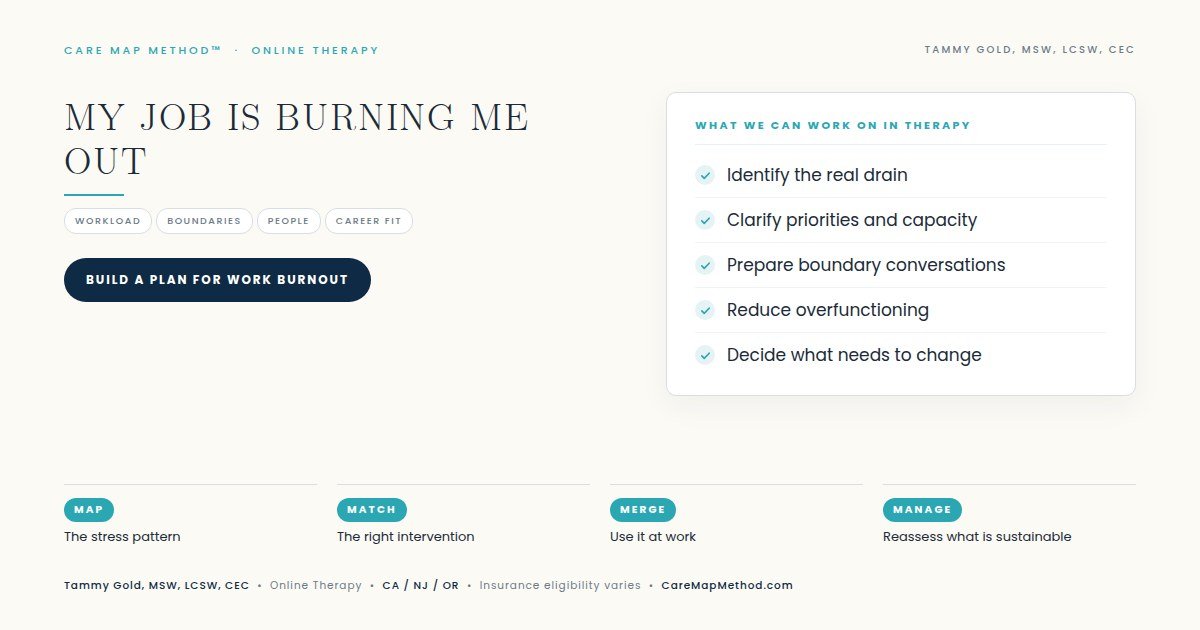
My Job Is Burning Me Out: Therapy for Work Stress and Burnout
Burnout can make every workday feel like something to survive. Therapy can help you distinguish workload, workplace dynamics, perfectionism, boundaries and larger career questions so you can respond with a plan rather than only pushing harder.
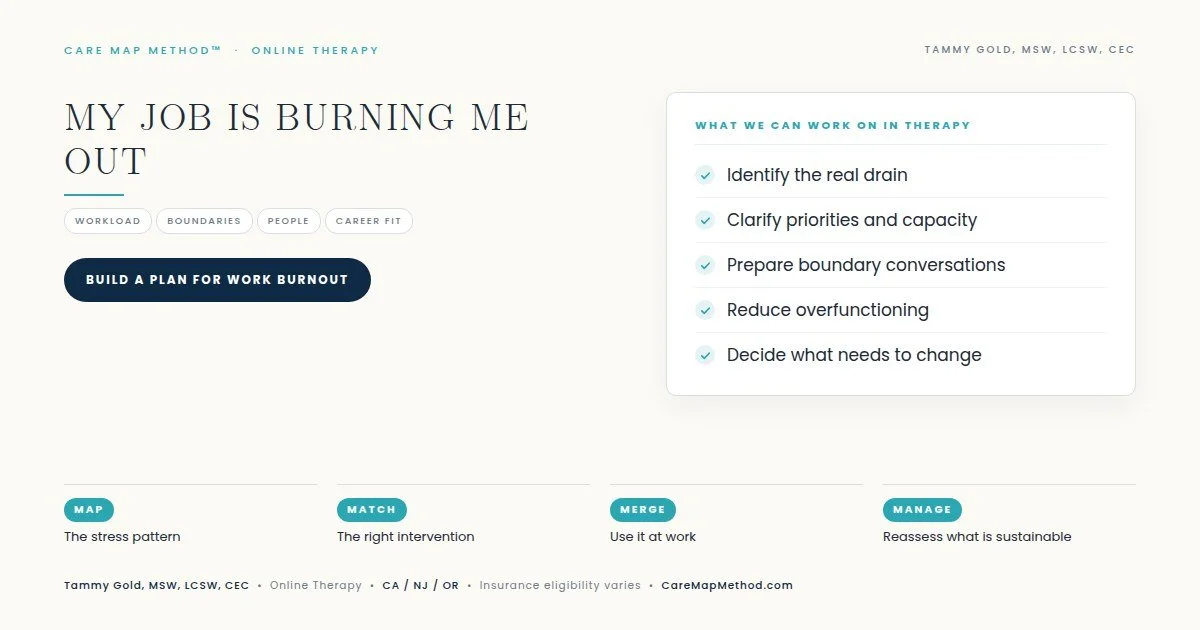
Care Map Method therapy for job burnout, work stress, boundaries and career decisions
Burnout can make everything look like a personal failure
When you are exhausted, it is easy to conclude that you need to become more efficient, resilient or disciplined. Sometimes the real problem is chronic overload, unclear priorities, a difficult manager, weak boundaries or a role that no longer fits.
We map the stress instead of calling all of it burnout
What happens on Sunday night? Which meetings create dread? When do you work beyond your capacity? What are you afraid will happen if you say no? The answers point toward different interventions.
Therapy can address both the workplace and your response to it
You may not control organizational decisions, but you can work on communication, perfectionism, over-responsibility, conflict, recovery time and decision-making.
Care Map Method™
MAP the workload, relationships, triggers and costs. MATCH each problem with the right strategy—boundary, communication, prioritization, coping or career decision. MERGE the strategy into actual work conversations and routines. MANAGE the results and reassess what remains unsustainable.
The goal is not to teach you to tolerate an intolerable situation
Sometimes therapy helps people stay differently; sometimes it helps them recognize that the environment is not changing. Either way, clarity is more useful than simply trying harder.
What We Can Work On In Our Session:
Identify what is actually draining you
Separate workload from people and boundary problems
Reduce all-or-nothing overfunctioning
Prepare conversations about priorities and capacity
Clarify whether the job needs adjustment—or a larger change
Care Map Method™
MAP the problem and pattern. MATCH the needs with the right clinical strategies. MERGE insight into real conversations, boundaries and behavior. MANAGE what happens next and adjust as the situation changes.
How do I know if I am burned out or just tired?
Burnout is commonly associated with sustained work stress, exhaustion and reduced effectiveness or detachment. Because fatigue can also have medical and psychiatric causes, persistent or severe symptoms deserve appropriate professional evaluation.
Can therapy help if the job itself is the problem?
Yes. Therapy can help you identify what is controllable, prepare workplace conversations, set boundaries, manage stress and make clearer decisions about staying or leaving.
What if I cannot afford to quit?
Therapy does not require an immediate career exit. We can work on reducing harm and increasing clarity while respecting financial and practical realities.
Can therapy help me stop thinking about work at night?
We can address the triggers, unfinished-task loops, anxiety, boundaries and routines that keep work mentally active after hours.
What if I am the person everyone relies on?
That role can become rewarding and exhausting at the same time. We can examine over-responsibility, delegation, guilt and what happens when you are not immediately available.
Will you tell me to quit my job?
No. The purpose is to help you understand the situation, your needs and your options so that you can make your own informed decision.
BUILD A PLAN FOR WORK BURNOUT 818.308.1538
Check insurance eligibility and request an online therapy appointment. Therapy is available to eligible clients in California, New Jersey and Oregon; coverage and benefits vary by plan.
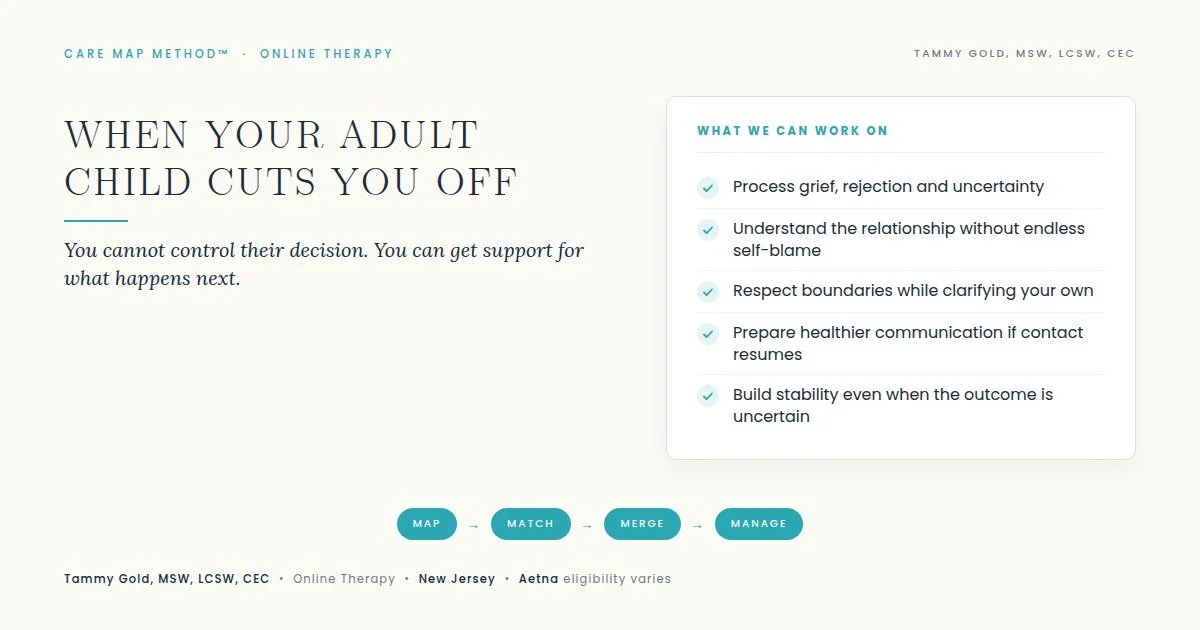
Why Do I Feel Guilty When I Set Boundaries With My Family?
Knowing you need a boundary and being able to hold one are different skills. If saying no to family immediately creates guilt, fear or pressure to reverse yourself, therapy can help you understand why and build a more sustainable response.
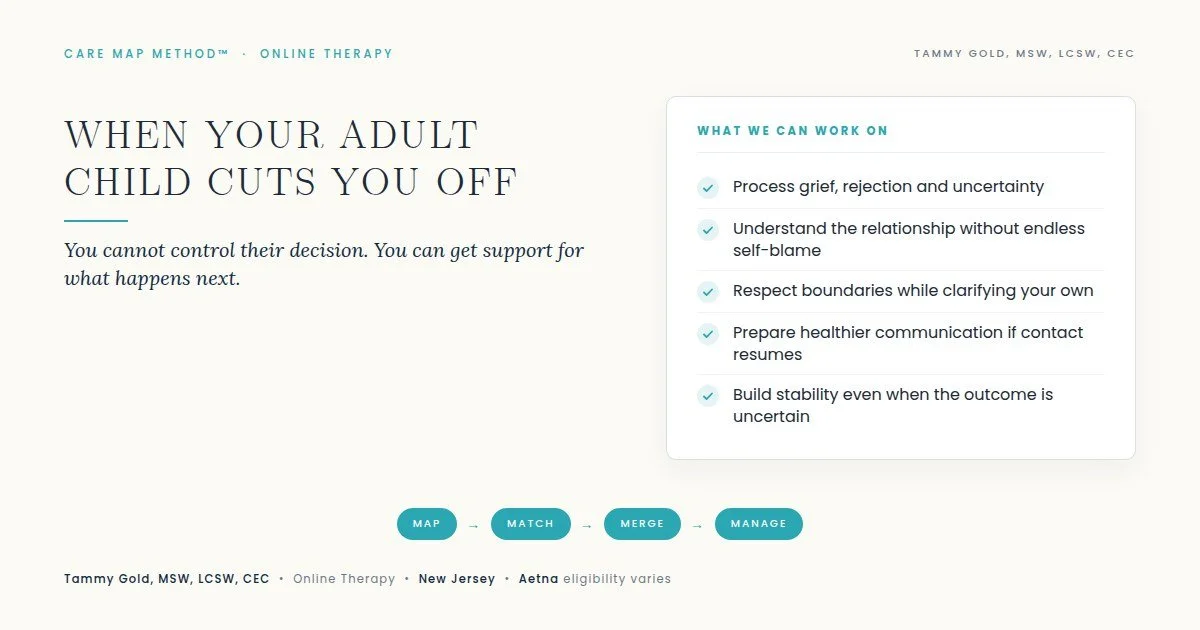
WHY DOES SETTING ONE BOUNDARY MAKE ME FEEL SO GUILTY?
A boundary can be appropriate and still feel uncomfortable. Therapy can help you hold both truths.
What therapy can help you work on:
• Identify the family rule behind the guilt
• Separate responsibility from over-responsibility
• Create language that is clear without overexplaining
• Prepare for pushback without immediately giving in
• Practice tolerating guilt while maintaining the limit
BUILD BOUNDARIES YOU CAN ACTUALLY HOLD
Guilt does not automatically mean you did something wrong
In some families, being helpful, available or agreeable becomes part of your identity. Saying no can therefore feel like betrayal even when the request is unreasonable.
Boundaries change systems
When one person changes a familiar role, other people may push for the old arrangement to return. Their discomfort does not automatically mean the new boundary is unhealthy.
Therapy can help with the moment after you say no
Many people know what boundary they want. The harder part is the text message afterward, the disappointed parent, the angry sibling or the urge to explain until the boundary disappears.
Care Map Method™
MAP the request, family role, guilt and feared consequence. MATCH the situation with a specific limit and communication approach. MERGE the boundary into real relationships with language you can actually use. MANAGE the emotional aftermath and adjust when necessary.
Boundaries are not the same as punishment
A useful boundary describes what you will do, what you can offer or what you cannot continue. Therapy can help you distinguish protection and clarity from retaliation or control.
What We Can Work On In Our Session Together:
Identify the family rule behind the guilt
Separate responsibility from over-responsibility
Create language that is clear without overexplaining
Prepare for pushback without immediately giving in
Practice tolerating guilt while maintaining the limit
Care Map Method™
MAP the problem and pattern. MATCH the needs with the right clinical strategies. MERGE insight into real conversations, boundaries and behavior. MANAGE what happens next and adjust as the situation changes.
Why do I feel guilty after saying no to family?
Guilt can come from family roles, learned expectations, fear of disappointing others or a belief that love requires constant availability. Feeling guilty does not by itself prove the boundary is wrong.
How do I set a boundary without being mean?
Use clear, specific language focused on what you can and cannot do. You can be respectful without offering unlimited explanations or negotiating against yourself.
What if my family gets angry when I set boundaries?
We can prepare for predictable reactions and decide in advance how you will respond. Another person’s anger is information, but it does not automatically determine your limit.
Are boundaries selfish?
Healthy boundaries can protect time, energy, privacy and relationships. Whether a particular boundary is appropriate depends on context; therapy can help you evaluate it rather than relying only on guilt.
Why do I keep giving in after I set a boundary?
The emotional consequence may feel harder than the original request. We can work on the guilt, fear and relationship patterns that make consistency difficult.
Can therapy help me with scripts for difficult family conversations?
Yes. We can prepare language, anticipate likely responses and practice staying clear when the conversation becomes emotional.
BUILD BOUNDARIES YOU CAN ACTUALLY HOLD 818.308.1538
Check insurance eligibility and request an online therapy appointment. Therapy is available to eligible clients in California, New Jersey and Oregon; coverage and benefits vary by plan.
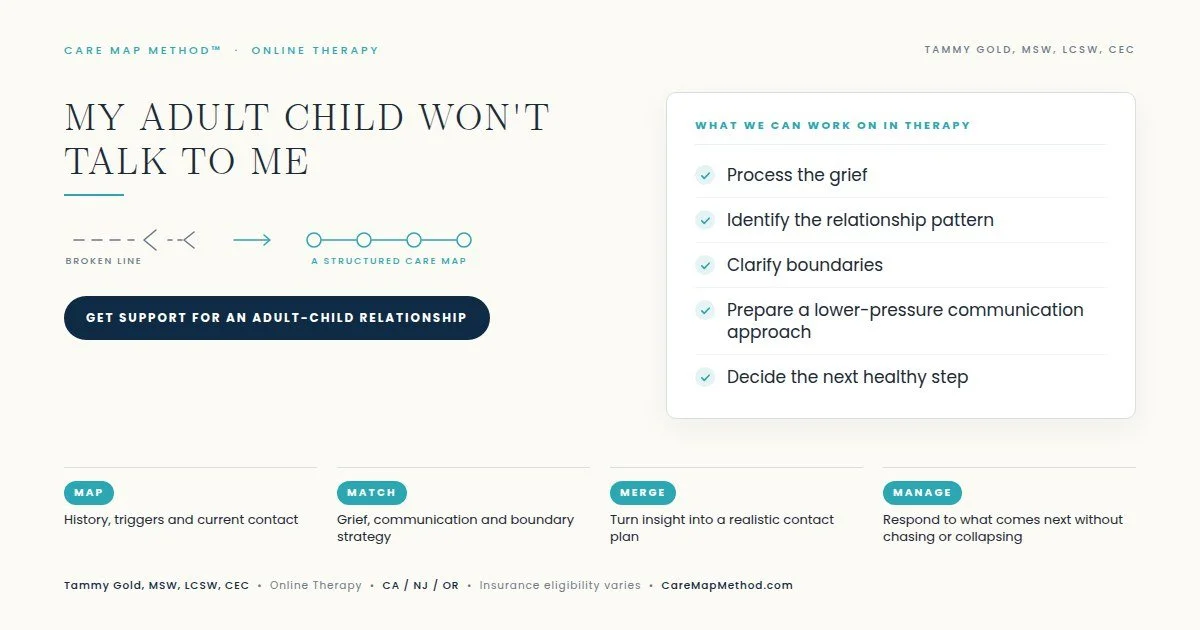
My Adult Child Won’t Talk to Me: Therapy for Parent–Adult Child Estrangement
When an adult child pulls away, parents can feel grief, confusion, guilt and urgency. Therapy can help you slow the cycle down, understand what is happening and choose a thoughtful next step without forcing reconciliation.
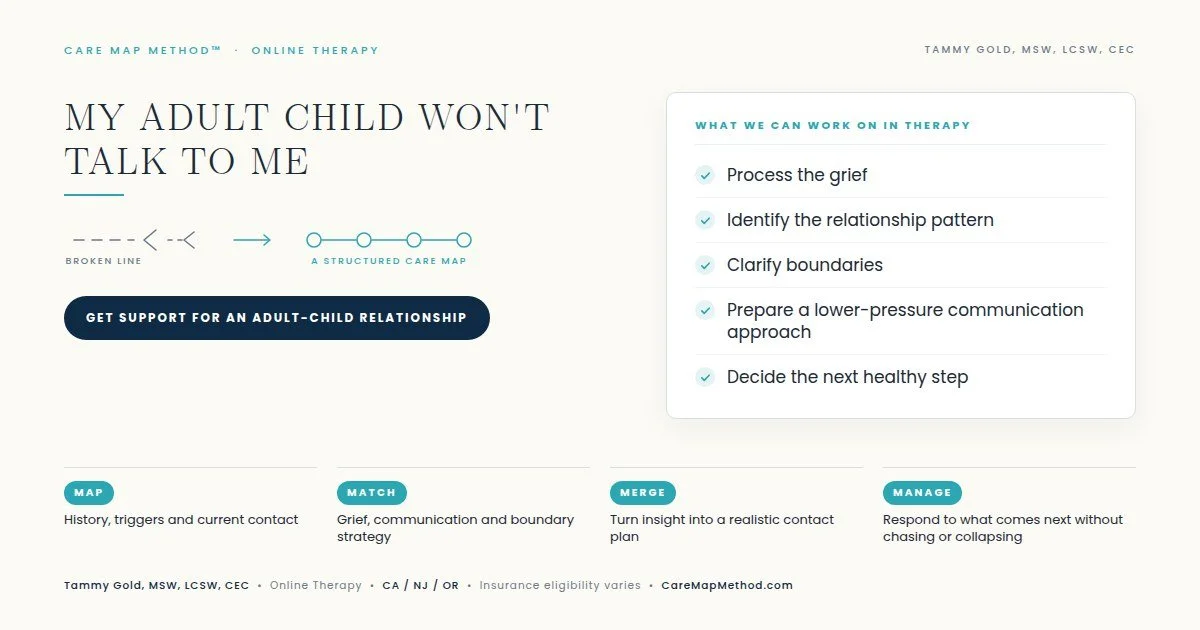
MY ADULT CHILD WON’T TALK TO ME
You cannot control another adult’s decision. You can understand the relationship, your response and your next step.
What therapy can help you work on:
• Separate grief, fear, anger and guilt
• Identify recurring parent–adult child patterns
• Understand boundaries without chasing or withdrawing
• Prepare communication that reduces pressure and defensiveness
• Decide what healthy contact—or healthy distance—looks like now
When silence becomes the whole relationship
An adult child pulling away can create a particular kind of grief: the person is still alive, yet the relationship you knew may feel unavailable. Parents often replay conversations, search for the moment everything changed, send another message, or become afraid that doing nothing means giving up. Therapy gives that urgency somewhere constructive to go.
The goal is not to assign a villain
Estrangement can involve years of misunderstandings, unresolved injuries, family roles, boundaries, partners, grandchildren, differing expectations or a single rupture that became larger over time. I do not begin by deciding who is right. We map the relationship as it actually exists now and identify the parts you can influence.
What we can work on in therapy
We can look at what happens before contact breaks down, what you tend to do when you feel rejected, what your adult child has communicated directly, and what remains assumption. We can also work on tolerating uncertainty so that fear does not drive repeated contact, defensiveness or self-blame.
A Care Map for the relationship
MAP the history, present pattern, emotional triggers and current boundaries. MATCH the problem with the right response—grief work, communication, boundary work, repair attempts or acceptance. MERGE insight with a realistic communication plan. MANAGE what happens next without making your wellbeing dependent on another person’s immediate response.
Therapy can help even if your adult child never joins
You do not need the other person in the room to understand your part of a relationship. Individual therapy can help you become clearer, less reactive and more intentional. If contact becomes possible, you can enter it differently. If it does not, therapy can help you build a life that is not organized entirely around waiting.
What We Can Work On During Our Call:
Separate grief, fear, anger and guilt
Identify recurring parent–adult child patterns
Understand boundaries without chasing or withdrawing
Prepare communication that reduces pressure and defensiveness
Decide what healthy contact—or healthy distance—looks like now
Care Map Method™
MAP the problem and pattern. MATCH the needs with the right clinical strategies. MERGE insight into real conversations, boundaries and behavior. MANAGE what happens next and adjust as the situation changes.
Can therapy make my adult child speak to me again?
Therapy cannot control another adult or guarantee reconciliation. It can help you understand the relationship, process the loss, examine your own patterns, respect stated boundaries and decide whether and how to make a thoughtful repair attempt.
Should I keep contacting an estranged adult child?
That depends on what your adult child has communicated, the history of the relationship and any boundaries they have set. Therapy can help you distinguish a respectful invitation to connect from repeated contact that may increase pressure.
Can I come to therapy alone for a family relationship problem?
Yes. Many relationship problems are addressed in individual therapy. We can work on your reactions, communication, boundaries, grief and decisions even when the other person does not participate.
What if I do not understand why my adult child is angry?
We can separate what you know from what you are guessing, review what has actually been communicated, and identify questions or responses that may create more clarity without turning the conversation into a debate.
Is estrangement always permanent?
No one can predict a particular family relationship. Some relationships reconnect, some change form and some remain distant. Therapy focuses on what is healthiest and most realistic now rather than promising a specific outcome.
Will you tell me whether my adult child is wrong?
The work is more useful when we move beyond deciding who wins the argument. We can examine behavior, impact, boundaries and responsibility while helping you make choices that align with the relationship you want and the reality you face.
Check insurance eligibility and request an online therapy appointment. Therapy is available to eligible clients in California, New Jersey and Oregon; coverage and benefits vary by plan.

How to Deal With a Difficult Family Member Without Losing Yourself
Online Oregon therapy for difficult family relationships, recurring conflict, boundaries, guilt and communication. Regence BCBS may be available.
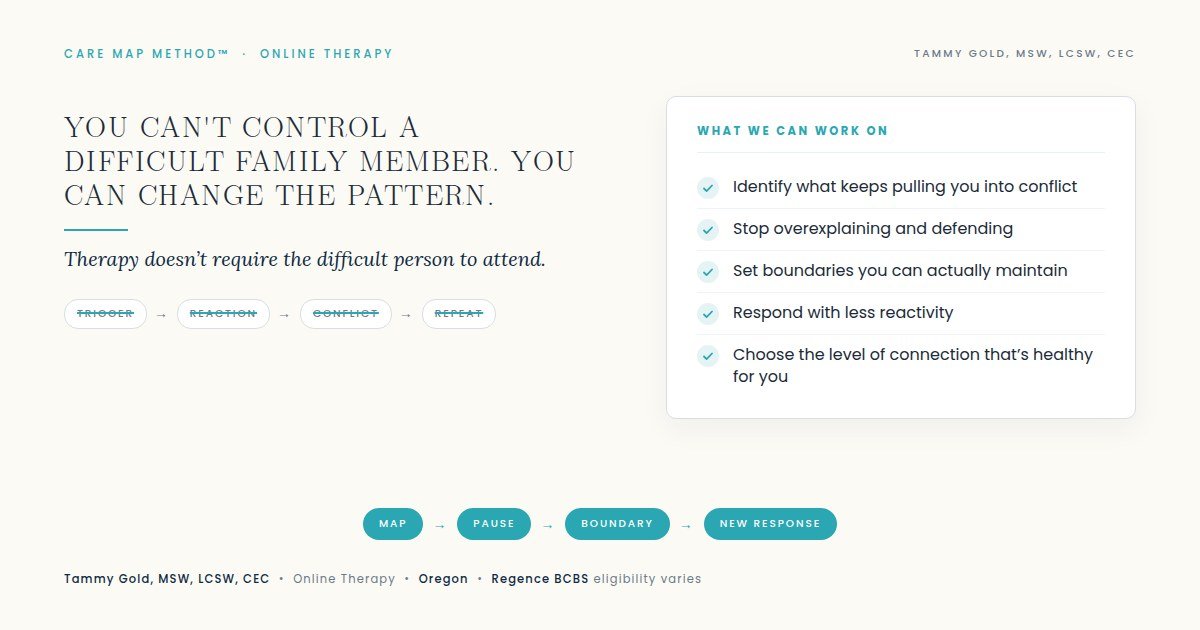
When Understanding Them Has Not Changed the Relationship
Some relationships do not become easier simply because you understand the other person. You may have tried explaining, being patient, giving another chance, avoiding conflict, setting a boundary and then giving in. Somehow you end up back in the same pattern.
Therapy does not require the difficult family member to attend. We can work on your side of the relationship system.
Identify the Hook
Most recurring family conflicts have a predictable hook: criticism, guilt, disrespect, pressure, comparison, intrusion or the feeling that you must defend yourself. When you know the hook, you can begin to notice the moment before your usual reaction takes over.
Boundaries That You Can Maintain
A boundary is most useful when it describes your action rather than trying to force another person to behave differently. We can develop boundaries around contact, topics, money, visits, communication style or what you will do when a conversation becomes disrespectful.
MAP the Pattern, Then Change Your Response
MAP the trigger-reaction-conflict loop.
MATCH a response to your goal and values.
MERGE the new response into real interactions.
MANAGE guilt and pushback without immediately abandoning the boundary.
A successful outcome may not be changing the other person. It may be changing how much control the relationship has over your mood, choices and sense of self.
Regence BCBS Online Therapy in Oregon
Regence BCBS eligibility and benefits vary by plan and current participation. Verify benefits before scheduling online therapy in Oregon.
About Tammy Gold, MSW, LCSW, CEC
I am a licensed clinical social worker, certified coach, author and creator of the Care Map Method™. I have worked with families and relationships for more than two decades. My therapy style is warm, nonjudgmental, active and practical: one safe place to feel heard and supported while also developing language, boundaries and next steps you can use in real life.
Frequently Asked Questions
Can therapy help if the difficult family member will not attend?
Yes. You can work on your own reactions, boundaries and choices without their participation.
What is a healthy boundary with family?
A useful boundary is specific, focused on your own actions and realistic enough to maintain.
Do I have to cut off a difficult family member?
No. Therapy can help you consider a range of contact and boundary options rather than assuming estrangement is the only solution.
Does Regence BCBS cover online therapy in Oregon?
Coverage depends on your plan and eligibility. Verify benefits before scheduling.
Booking CTA
Check insurance eligibility and request an online therapy session. Therapy is available for eligible clients physically located in Oregon. Insurance eligibility, benefits and platform availability vary by plan.

Therapy for Women Who Feel Responsible for Everyone
Online Oregon therapy for women overwhelmed by family responsibilities, emotional labor, guilt, boundaries and caregiving demands.
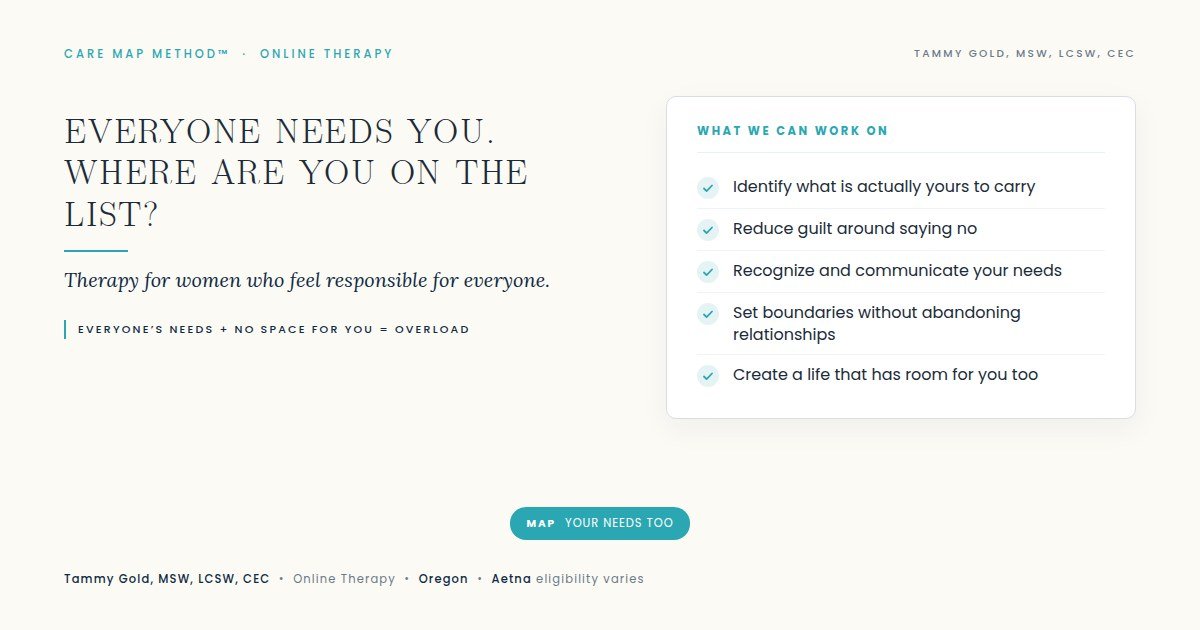
The Person Everyone Depends On
You may be the person everyone calls: children, parents, partner, friends and coworkers. You notice what needs to happen before anyone asks. You anticipate problems, remember details, absorb other people's emotions and keep moving because you are capable.
Being capable does not mean you have unlimited capacity. At some point, the role of being the reliable one can become so constant that you lose track of your own needs.
Responsibility Versus Emotional Responsibility
Therapy can help separate what is genuinely your responsibility from the belief that you must also prevent everyone else's disappointment, discomfort or mistakes. Those are not the same job.
We can explore guilt, perfectionism, overfunctioning, fear of conflict and the family roles that taught you to stay useful, agreeable or indispensable.
Putting Your Needs Back on the Map
The Care Map Method™ looks at biological, emotional, social and environmental demands. Your sleep, health, emotional bandwidth, relationships, work and environment all matter. Your needs are not an inconvenience to the system; they are part of whether the system is sustainable.
Practical Boundary Work
We can practice asking for help more specifically, saying no without a long defense, tolerating other people's disappointment and deciding what support you can offer without disappearing inside everyone else's needs.
Aetna Online Therapy in Oregon
Aetna may be available for eligible Oregon clients depending on plan details and current network participation through Headway or Alma. Verify benefits before scheduling.
About Tammy Gold, MSW, LCSW, CEC
I am a licensed clinical social worker, certified coach, author and creator of the Care Map Method™. I have worked with families and relationships for more than two decades. My therapy style is warm, nonjudgmental, active and practical: one safe place to feel heard and supported while also developing language, boundaries and next steps you can use in real life.
What is overfunctioning?
Overfunctioning can describe taking excessive responsibility for tasks, decisions or other people’s emotions, often while neglecting your own needs.
Why do I feel guilty when I say no?
Guilt can be connected to family roles, beliefs about responsibility, fear of rejection or long-standing patterns. Therapy can help identify your specific drivers.
Can therapy help me set boundaries without becoming selfish?
Therapy can help you distinguish healthy limits from abandonment and develop boundaries consistent with your values.
Can I use Aetna in Oregon?
Aetna eligibility varies by plan and current network participation. Verify benefits before scheduling.
Check insurance eligibility and request an online therapy session. Therapy is available for eligible clients physically located in Oregon. Insurance eligibility, benefits and platform availability vary by plan.

Providence Therapy for Sandwich Generation Stress in Oregon
Online Oregon therapy for sandwich-generation stress, caregiving, parenting and family overload with Tammy Gold, LCSW. Eligibility varies.

Providence Health Plan online therapy in Oregon with Tammy Gold, LCSW for sandwich generation stress.
Providence Therapy for Sandwich Generation Stress in Oregon
Your children need you. Your parents need you. Work needs you. Your partner may need you too. When you are in the sandwich generation, there can be almost no part of the day when somebody is not asking for your time, attention or emotional energy.
Therapy can become the place where your needs finally make it onto the map—not because the people you love matter less, but because a system that depends on you also has to account for your capacity.
I am Tammy Gold, MSW, LCSW, CEC, a licensed therapist, author and creator of the Care Map Method™. I provide online psychotherapy to eligible clients located in Oregon, including adults dealing with relationship stress, family conflict, caregiving and major life transitions.
Depending on your specific plan, eligibility and current network participation, Providence Health Plan may be available for psychotherapy. Coverage, copays, deductibles and benefits vary and should be verified before scheduling.
Does this sound familiar?
· You are supporting children while coordinating care for aging parents.
· Work and relationships are squeezed between competing responsibilities.
· You feel guilty no matter which person gets your attention.
· There is little time to notice your own emotional or physical needs.
Your Children Need You. Your Parents Need You. Where Do You Fit?
Why the surface problem may not be the whole problem
Families and couples often begin by trying to solve the most visible problem. But the visible problem may be only one part of the Care Map. Stress, health, expectations, attachment needs, changing roles, communication habits, family history and the surrounding environment can all affect what happens next.
Looking at the broader pattern can reduce shame and blame. Instead of asking only, “Who caused this?” we can ask, “What is happening, what does each person need, what is within my control, and what response is most likely to be useful?”
How I use the Care Map Method™ in therapy
MAP — Understand what is actually happening
We identify the problem, the repeating pattern and the needs underneath it. I look at biological, emotional, social and environmental factors rather than reducing a complicated relationship to one argument or one person’s behavior.
MATCH — Match the right support or strategy
Once the pattern is clearer, we identify approaches that fit the actual need. That may involve communication, boundaries, coping strategies, emotional regulation, role changes, additional support or a different way of responding.
MERGE — Bring understanding into the relationship
Insight matters most when it can be used. We translate what you are learning into conversations, decisions, requests and boundaries that are realistic for your life and relationships.
MANAGE — Adjust as life changes
Relationships and caregiving systems are dynamic. We notice what is helping, what is not, and what needs to be adjusted rather than expecting one conversation or technique to solve everything permanently.
A safe place without shame or blame
My approach is warm, active, practical and nonjudgmental. Therapy can be one completely safe place to say what you are actually thinking and feeling without having to protect everyone else, perform competence or decide immediately what you are going to do.
My goal is not simply to have you talk about the problem. I want you to better understand yourself and the people around you, name emotions and needs more clearly, reduce unnecessary shame and blame, and leave with practical next steps.
Online therapy in Oregon
I provide telehealth psychotherapy to eligible clients who are physically located in Oregon at the time of service. Providence Health Plan may be available depending on your individual plan, eligibility and current network participation. Please verify your benefits before scheduling.
Relationship and family problems can also be addressed in individual therapy. Another person does not necessarily need to participate for you to work on your own communication, boundaries, emotions and responses.
About Tammy Gold, MSW, LCSW, CEC
Tammy Gold is a licensed clinical social worker, therapist, author and creator of the Care Map Method™. For more than 20 years, her work has focused on the relationships and care systems surrounding families—from marriage and parenting to adult children, caregiving and aging parents.
She earned her MSW from Columbia University and her undergraduate degree from the University of Pennsylvania. Her family and caregiving expertise has been featured in national media. Add the approved press-logo strip here to reinforce authority without interrupting the clinical message.
What is sandwich-generation stress?
Therapy can help you identify overload, grief, resentment, guilt and family patterns, then develop more sustainable boundaries and coping strategies. Practical care decisions may also require medical, legal or care-management professionals.
Can therapy help when my responsibilities cannot be reduced?
Therapy can help you slow down the pattern, understand the needs and emotions underneath it, and identify practical changes within your control. The work is individualized to your situation and does not promise a particular outcome.
How do I set limits with both children and parents?
Therapy can help you slow down the pattern, understand the needs and emotions underneath it, and identify practical changes within your control. The work is individualized to your situation and does not promise a particular outcome.
Can caregiver stress affect marriage and work?
Therapy can help you identify overload, grief, resentment, guilt and family patterns, then develop more sustainable boundaries and coping strategies. Practical care decisions may also require medical, legal or care-management professionals.
Does Providence cover online therapy in Oregon?
Providence Health Plan may be available depending on your specific plan, eligibility, clinical circumstances and current network participation. Benefits, copays and deductibles vary, so verify coverage before scheduling.
You do not have to solve the whole relationship today
A useful first step is often understanding the pattern more clearly. Therapy can help you slow down, identify what you need, distinguish what is within your control from what is not, and decide what a healthier next response could look like.
Insurance note: Providence Health Plan eligibility and benefits vary. Verify your individual coverage before scheduling.
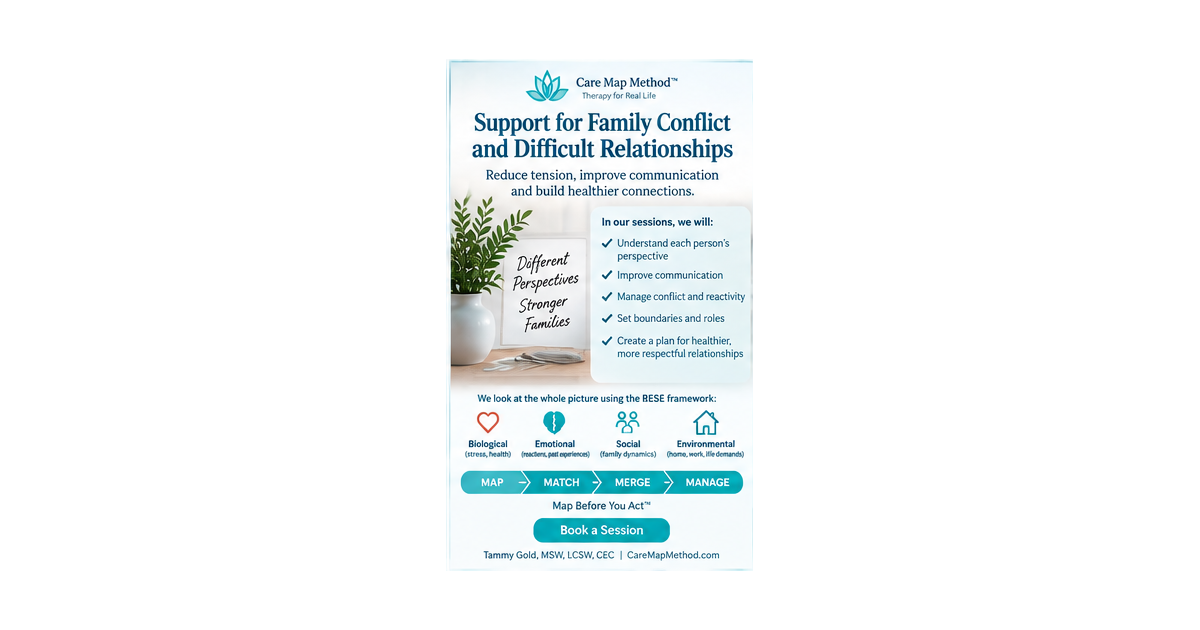
Regence BCBS Therapy for Family Conflict & Difficult Relationships in Oregon
Online Oregon therapy for family conflict, difficult relationships, communication and boundaries with Tammy Gold, LCSW. Eligibility varies.
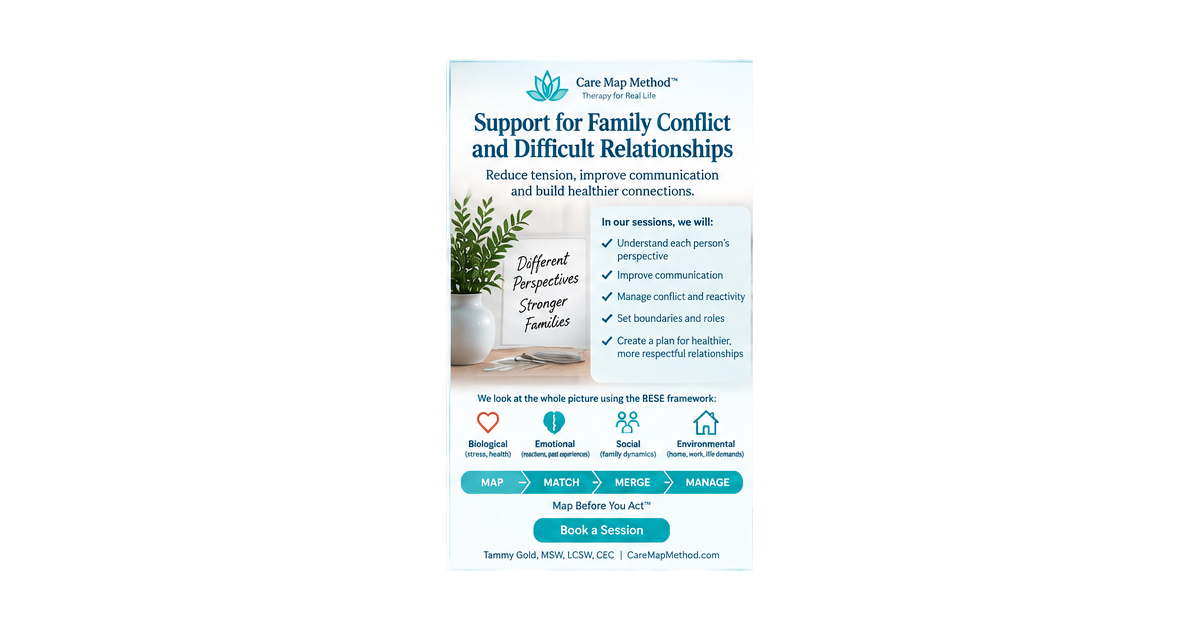
Regence BlueCross BlueShield online therapy in Oregon with Tammy Gold, LCSW for family conflict & difficult relationships.
Regence BCBS Therapy for Family Conflict & Difficult Relationships in Oregon
Some family conflicts repeat for years because everyone keeps responding from familiar roles. One person pushes, another withdraws, someone mediates, and someone absorbs the emotional cost. Even when everyone wants things to improve, the same pattern can reappear under stress.
You may not be able to change your family members, but you can understand the pattern, clarify your boundaries and change how you participate in it.
I am Tammy Gold, MSW, LCSW, CEC, a licensed therapist, author and creator of the Care Map Method™. I provide online psychotherapy to eligible clients located in Oregon, including adults dealing with relationship stress, family conflict, caregiving and major life transitions.
Depending on your specific plan, eligibility and current network participation, Regence BlueCross BlueShield may be available for psychotherapy. Coverage, copays, deductibles and benefits vary and should be verified before scheduling.
Does this sound familiar?
· One family member can change the emotional temperature of every gathering.
· You are caught between keeping the peace and protecting yourself.
· Old roles reappear whenever the family is under stress.
· You want to respond differently even if other people do not change.
What Can You Change When You Cannot Change Your Family?
Why the surface problem may not be the whole problem
Families and couples often begin by trying to solve the most visible problem. But the visible problem may be only one part of the Care Map. Stress, health, expectations, attachment needs, changing roles, communication habits, family history and the surrounding environment can all affect what happens next.
Looking at the broader pattern can reduce shame and blame. Instead of asking only, “Who caused this?” we can ask, “What is happening, what does each person need, what is within my control, and what response is most likely to be useful?”
How I use the Care Map Method™ in therapy
MAP — Understand what is actually happening
We identify the problem, the repeating pattern and the needs underneath it. I look at biological, emotional, social and environmental factors rather than reducing a complicated relationship to one argument or one person’s behavior.
MATCH — Match the right support or strategy
Once the pattern is clearer, we identify approaches that fit the actual need. That may involve communication, boundaries, coping strategies, emotional regulation, role changes, additional support or a different way of responding.
MERGE — Bring understanding into the relationship
Insight matters most when it can be used. We translate what you are learning into conversations, decisions, requests and boundaries that are realistic for your life and relationships.
MANAGE — Adjust as life changes
Relationships and caregiving systems are dynamic. We notice what is helping, what is not, and what needs to be adjusted rather than expecting one conversation or technique to solve everything permanently.
A safe place without shame or blame
My approach is warm, active, practical and nonjudgmental. Therapy can be one completely safe place to say what you are actually thinking and feeling without having to protect everyone else, perform competence or decide immediately what you are going to do.
My goal is not simply to have you talk about the problem. I want you to better understand yourself and the people around you, name emotions and needs more clearly, reduce unnecessary shame and blame, and leave with practical next steps.
Online therapy in Oregon
I provide telehealth psychotherapy to eligible clients who are physically located in Oregon at the time of service. Regence BlueCross BlueShield may be available depending on your individual plan, eligibility and current network participation. Please verify your benefits before scheduling.
Relationship and family problems can also be addressed in individual therapy. Another person does not necessarily need to participate for you to work on your own communication, boundaries, emotions and responses.
About Tammy Gold, MSW, LCSW, CEC
Tammy Gold is a licensed clinical social worker, therapist, author and creator of the Care Map Method™. For more than 20 years, her work has focused on the relationships and care systems surrounding families—from marriage and parenting to adult children, caregiving and aging parents.
She earned her MSW from Columbia University and her undergraduate degree from the University of Pennsylvania. Her family and caregiving expertise has been featured in national media. Add the approved press-logo strip here to reinforce authority without interrupting the clinical message.
Can therapy help if my family will not participate?
Yes. Individual therapy can focus on your emotions, communication, boundaries and responses even when another family member or partner does not participate. Therapy cannot guarantee that another person will change.
How do I stop getting pulled into the same conflict?
Therapy can help you slow down the pattern, understand the needs and emotions underneath it, and identify practical changes within your control. The work is individualized to your situation and does not promise a particular outcome.
Can I set boundaries without ending a relationship?
A useful boundary clarifies what you will do, accept or participate in. Therapy can help you make boundaries more specific, communicate them without unnecessary escalation and manage the guilt or anxiety that may follow.
What does Care Map Method look at in family conflict?
Therapy can help you slow down the pattern, understand the needs and emotions underneath it, and identify practical changes within your control. The work is individualized to your situation and does not promise a particular outcome.
Does Regence cover online therapy in Oregon?
Regence BlueCross BlueShield may be available depending on your specific plan, eligibility, clinical circumstances and current network participation. Benefits, copays and deductibles vary, so verify coverage before scheduling.
You do not have to solve the whole relationship today
A useful first step is often understanding the pattern more clearly. Therapy can help you slow down, identify what you need, distinguish what is within your control from what is not, and decide what a healthier next response could look like.
Insurance note: Regence BlueCross BlueShield eligibility and benefits vary. Verify your individual coverage before scheduling.
Email: Info@CareMapMethod.com Text: 818.308.1358

Providence Therapy for Marriage & Relationship Problems in New Jersey
Online relationship therapy in New Jersey with Tammy Gold, LCSW for recurring conflict, disconnection and communication problems. Eligibility varies.
Providence Health Plan online therapy in New Jersey with Tammy Gold, LCSW for marriage & relationship problems.
Providence Therapy for Marriage & Relationship Problems in New Jersey
Some relationship problems are loud. Others are quiet: fewer meaningful conversations, less affection, more logistics, and the feeling that you are living beside someone rather than truly with them. You may still love each other and still feel profoundly disconnected.
Therapy can help you look beneath the latest argument or period of distance and understand the emotional needs, expectations and patterns that keep the relationship stuck.
I am Tammy Gold, MSW, LCSW, CEC, a licensed therapist, author and creator of the Care Map Method™. I provide online psychotherapy to eligible clients located in New Jersey, including adults dealing with relationship stress, family conflict, caregiving and major life transitions.
Depending on your specific plan, eligibility and current network participation, Providence Health Plan may be available for psychotherapy. Coverage, copays, deductibles and benefits vary and should be verified before scheduling.
Does this sound familiar?
· Arguments about chores, money, parenting or phones keep repeating.
· You feel unheard, criticized, dismissed or alone.
· One person pursues a conversation while the other avoids it.
· You want practical change, not another circular discussion.
What Is Underneath the Argument?
Why the surface problem may not be the whole problem
Families and couples often begin by trying to solve the most visible problem. But the visible problem may be only one part of the Care Map. Stress, health, expectations, attachment needs, changing roles, communication habits, family history and the surrounding environment can all affect what happens next.
Looking at the broader pattern can reduce shame and blame. Instead of asking only, “Who caused this?” we can ask, “What is happening, what does each person need, what is within my control, and what response is most likely to be useful?”
How I use the Care Map Method™ in therapy
MAP — Understand what is actually happening
We identify the problem, the repeating pattern and the needs underneath it. I look at biological, emotional, social and environmental factors rather than reducing a complicated relationship to one argument or one person’s behavior.
MATCH — Match the right support or strategy
Once the pattern is clearer, we identify approaches that fit the actual need. That may involve communication, boundaries, coping strategies, emotional regulation, role changes, additional support or a different way of responding.
MERGE — Bring understanding into the relationship
Insight matters most when it can be used. We translate what you are learning into conversations, decisions, requests and boundaries that are realistic for your life and relationships.
MANAGE — Adjust as life changes
Relationships and caregiving systems are dynamic. We notice what is helping, what is not, and what needs to be adjusted rather than expecting one conversation or technique to solve everything permanently.
A safe place without shame or blame
My approach is warm, active, practical and nonjudgmental. Therapy can be one completely safe place to say what you are actually thinking and feeling without having to protect everyone else, perform competence or decide immediately what you are going to do.
My goal is not simply to have you talk about the problem. I want you to better understand yourself and the people around you, name emotions and needs more clearly, reduce unnecessary shame and blame, and leave with practical next steps.
Online therapy in New Jersey
I provide telehealth psychotherapy to eligible clients who are physically located in New Jersey at the time of service. Providence Health Plan may be available depending on your individual plan, eligibility and current network participation. Please verify your benefits before scheduling.
Relationship and family problems can also be addressed in individual therapy. Another person does not necessarily need to participate for you to work on your own communication, boundaries, emotions and responses.
About Tammy Gold, MSW, LCSW, CEC
Tammy Gold is a licensed clinical social worker, therapist, author and creator of the Care Map Method™. For more than 20 years, her work has focused on the relationships and care systems surrounding families—from marriage and parenting to adult children, caregiving and aging parents.
She earned her MSW from Columbia University and her undergraduate degree from the University of Pennsylvania. Her family and caregiving expertise has been featured in national media. Add the approved press-logo strip here to reinforce authority without interrupting the clinical message.
Frequently asked questions
What happens in relationship-focused therapy?
Therapy can help you slow down the pattern, understand the needs and emotions underneath it, and identify practical changes within your control. The work is individualized to your situation and does not promise a particular outcome.
Can I attend without my partner?
Yes. Individual therapy can focus on your emotions, communication, boundaries and responses even when another family member or partner does not participate. Therapy cannot guarantee that another person will change.
What if we are considering separation?
Therapy can help you slow down the pattern, understand the needs and emotions underneath it, and identify practical changes within your control. The work is individualized to your situation and does not promise a particular outcome.
Does Providence cover teletherapy in New Jersey?
Providence Health Plan may be available depending on your specific plan, eligibility, clinical circumstances and current network participation. Benefits, copays and deductibles vary, so verify coverage before scheduling.
How does Care Map Method address recurring conflict?
Therapy can help you slow down the pattern, understand the needs and emotions underneath it, and identify practical changes within your control. The work is individualized to your situation and does not promise a particular outcome.
You do not have to solve the whole relationship today
A useful first step is often understanding the pattern more clearly. Therapy can help you slow down, identify what you need, distinguish what is within your control from what is not, and decide what a healthier next response could look like.
Check Insurance Eligibility & Book Online Therapy
Insurance note: Providence Health Plan eligibility and benefits vary. Verify your individual coverage before scheduling.

Aetna Therapy in California When You Love Each Other but Don’t Feel Connected
Online Aetna therapy in California with Tammy Gold, LCSW for emotional disconnection, recurring relationship conflict and marriage stress. Eligibility varies.

Aetna online therapy in California with Tammy Gold, LCSW for emotionally disconnected marriage.
Aetna Therapy in California When You Love Each Other but Don’t Feel Connected
Some relationship problems are loud. Others are quiet: fewer meaningful conversations, less affection, more logistics, and the feeling that you are living beside someone rather than truly with them. You may still love each other and still feel profoundly disconnected.
Therapy can help you look beneath the latest argument or period of distance and understand the emotional needs, expectations and patterns that keep the relationship stuck.
I am Tammy Gold, MSW, LCSW, CEC, a licensed therapist, author and creator of the Care Map Method™. I provide online psychotherapy to eligible clients located in California, including adults dealing with relationship stress, family conflict, caregiving and major life transitions.
Depending on your specific plan, eligibility and current network participation, Aetna may be available for psychotherapy. Coverage, copays, deductibles and benefits vary and should be verified before scheduling.
Does this sound familiar?
You still care about each other, but most conversations are about logistics.
One person reaches for connection while the other withdraws.
Affection, intimacy, curiosity or playfulness has faded.
The same disagreements return without creating more understanding.
Why the surface problem may not be the whole problem
Families and couples often begin by trying to solve the most visible problem. But the visible problem may be only one part of the Care Map. Stress, health, expectations, attachment needs, changing roles, communication habits, family history and the surrounding environment can all affect what happens next.
Looking at the broader pattern can reduce shame and blame. Instead of asking only, “Who caused this?” we can ask, “What is happening, what does each person need, what is within my control, and what response is most likely to be useful?”
How I use the Care Map Method™ in therapy
MAP — Understand what is actually happening
We identify the problem, the repeating pattern and the needs underneath it. I look at biological, emotional, social and environmental factors rather than reducing a complicated relationship to one argument or one person’s behavior.
MATCH — Match the right support or strategy
Once the pattern is clearer, we identify approaches that fit the actual need. That may involve communication, boundaries, coping strategies, emotional regulation, role changes, additional support or a different way of responding.
MERGE — Bring understanding into the relationship
Insight matters most when it can be used. We translate what you are learning into conversations, decisions, requests and boundaries that are realistic for your life and relationships.
MANAGE — Adjust as life changes
Relationships and caregiving systems are dynamic. We notice what is helping, what is not, and what needs to be adjusted rather than expecting one conversation or technique to solve everything permanently.
A safe place without shame or blame
My approach is warm, active, practical and nonjudgmental. Therapy can be one completely safe place to say what you are actually thinking and feeling without having to protect everyone else, perform competence or decide immediately what you are going to do.
My goal is not simply to have you talk about the problem. I want you to better understand yourself and the people around you, name emotions and needs more clearly, reduce unnecessary shame and blame, and leave with practical next steps.
Online therapy in California
I provide telehealth psychotherapy to eligible clients who are physically located in California at the time of service. Aetna may be available depending on your individual plan, eligibility and current network participation. Please verify your benefits before scheduling.
Relationship and family problems can also be addressed in individual therapy. Another person does not necessarily need to participate for you to work on your own communication, boundaries, emotions and responses.
About Tammy Gold, MSW, LCSW, CEC
Tammy Gold is a licensed clinical social worker, therapist, author and creator of the Care Map Method™. For more than 20 years, her work has focused on the relationships and care systems surrounding families—from marriage and parenting to adult children, caregiving and aging parents.
She earned her MSW from Columbia University and her undergraduate degree from the University of Pennsylvania. Her family and caregiving expertise has been featured in national media. Add the approved press-logo strip here to reinforce authority without interrupting the clinical message.
Frequently asked questions
Can therapy help if my partner will not attend?
Yes. Individual therapy can focus on your emotions, communication, boundaries and responses even when another family member or partner does not participate. Therapy cannot guarantee that another person will change.
Does Aetna cover online therapy in California?
Aetna may be available depending on your specific plan, eligibility, clinical circumstances and current network participation. Benefits, copays and deductibles vary, so verify coverage before scheduling.
Does emotional disconnection mean a marriage is over?
Therapy can help you slow down the pattern, understand the needs and emotions underneath it, and identify practical changes within your control. The work is individualized to your situation and does not promise a particular outcome.
What if we keep having the same argument?
Therapy can help you slow down the pattern, understand the needs and emotions underneath it, and identify practical changes within your control. The work is individualized to your situation and does not promise a particular outcome.
Can individual therapy help relationship problems?
Therapy can help you slow down the pattern, understand the needs and emotions underneath it, and identify practical changes within your control. The work is individualized to your situation and does not promise a particular outcome.
You do not have to solve the whole relationship today
A useful first step is often understanding the pattern more clearly. Therapy can help you slow down, identify what you need, distinguish what is within your control from what is not, and decide what a healthier next response could look like.
Insurance note: Aetna eligibility and benefits vary. Verify your individual coverage before scheduling.

My Adult Child Isn't Moving Forward
When an adult child is stuck, parents can become trapped between helping and enabling. Therapy can help with money, expectations, boundaries, motivation and family conflict.
Online therapy in Oregon for failure to launch, adult-child boundaries, money conflict and family stress; Aetna eligibility varies. Oregon Aetna
When an adult child is stuck, parents can become trapped between helping and enabling. Therapy can help with money, expectations, boundaries, motivation and family conflict.
When Helping Starts to Feel Like Holding Everything Up
Parents of struggling adult children often feel caught between compassion and fear. You may be paying bills, managing appointments, tolerating broken agreements or avoiding limits because you are afraid your child will fall apart. At the same time, resentment and worry can take over the household.
How Therapy Can Help
Therapy can help you distinguish support from rescue, clarify expectations, set realistic financial and household boundaries, prepare conversations and decide what you can control while preserving as much connection as possible.
The Care Map Method™: Map • Match • Merge • Manage
MAP — Understand the pattern. Identify triggers, recurring interactions, stressors, beliefs and roles that keep the problem going.
MATCH — Identify needs and goals. Clarify what matters most, what you can influence and what a healthier outcome would look like.
MERGE — Improve communication and connection. Practice clearer language, boundaries, listening and responses that reduce reactivity and support healthier relationships.
MANAGE — Create practical next steps. Build realistic strategies, routines, agreements and coping tools you can use outside the session.
Online therapy and insurance
I provide online therapy for clients located in Oregon. I may participate with Aetna through Headway, depending on the specific plan and my current network participation. Insurance eligibility, benefits, copays, deductibles and coverage vary. Please verify your benefits through Headway before your appointment.
A safe place to unload—and a plan to move forward
My style is warm, supportive, practical and nonjudgmental. There is room to say the things you are embarrassed, angry, confused or exhausted about without shame or blame. We will make space for the feelings and also work toward tangible changes, clearer decisions and concrete next steps.
Ready for support?
If this issue is affecting your mood, relationships, work, sleep or sense of stability, you do not have to wait until it becomes a crisis. Use my Headway profile to check insurance eligibility and available appointment times.
FAQ
Can therapy help even if the other person does not attend?
Yes. Individual therapy can help you understand patterns, regulate your responses, clarify boundaries, prepare conversations and make decisions about how you want to participate in the relationship.
Do you accept Aetna in Oregon?
I may participate with Aetna through Headway for clients located in Oregon. Your specific plan and benefits must be verified because eligibility and costs vary.
Is this only a place to talk about the problem?
No. Emotional support matters, but my approach is also structured and solution-focused. We identify what is happening, what you need, what can change and what concrete steps you can take next.
What happens in the first session?
We focus on what is bringing you in, the relevant relationships and stressors, the patterns you are noticing and the outcome you want. We begin creating a Care Map so you leave with clearer direction.
Is online therapy nonjudgmental?
My approach emphasizes warmth, respect and understanding rather than shame, blame or judgment, within the normal confidentiality and clinical limits of psychotherapy.
Email: Info@CareMapMethod.com Text:818.308.1358

I'm Exhausted From Work and Have Nothing Left at Home
When work drains everything you have, relationships and family life often absorb the cost. Therapy can help with burnout, boundaries, conflict and clearer decisions.
Online therapy in Oregon for burnout, work-life stress, difficult workplace relationships and boundaries; Regence BCBS eligibility varies.
Oregon Regence BCBS
When work drains everything you have, relationships and family life often absorb the cost. Therapy can help with burnout, boundaries, conflict and clearer decisions.
When Work Takes All of You
Burnout can look like irritability, numbness, dread, poor sleep, procrastination, constant rumination or having no emotional energy left for the people you care about. Sometimes the problem is workload; sometimes it is a boss, coworker, culture or role that keeps you activated long after work ends.
How Therapy Can Help
Therapy can help you map the sources of stress, identify what can change, strengthen boundaries and communication, and make clearer decisions about staying, leaving, asking for change or protecting your life outside work.
The Care Map Method™: Map • Match • Merge • Manage
MAP — Understand the pattern. Identify triggers, recurring interactions, stressors, beliefs and roles that keep the problem going.
MATCH — Identify needs and goals. Clarify what matters most, what you can influence and what a healthier outcome would look like.
MERGE — Improve communication and connection. Practice clearer language, boundaries, listening and responses that reduce reactivity and support healthier relationships.
MANAGE — Create practical next steps. Build realistic strategies, routines, agreements and coping tools you can use outside the session.
Online therapy and insurance
I provide online therapy for clients located in Oregon. I may participate with Regence BCBS through Headway, depending on the specific plan and my current network participation. Insurance eligibility, benefits, copays, deductibles and coverage vary. Please verify your benefits through Headway before your appointment.
A safe place to unload—and a plan to move forward
My style is warm, supportive, practical and nonjudgmental. There is room to say the things you are embarrassed, angry, confused or exhausted about without shame or blame. We will make space for the feelings and also work toward tangible changes, clearer decisions and concrete next steps.
Ready for support?
If this issue is affecting your mood, relationships, work, sleep or sense of stability, you do not have to wait until it becomes a crisis. Use my Headway profile to check insurance eligibility and available appointment times.
FAQ
Can therapy help even if the other person does not attend?
Yes. Individual therapy can help you understand patterns, regulate your responses, clarify boundaries, prepare conversations and make decisions about how you want to participate in the relationship.
Do you accept Regence BCBS in Oregon?
I may participate with Regence BCBS through Headway for clients located in Oregon. Your specific plan and benefits must be verified because eligibility and costs vary.
Is this only a place to talk about the problem?
No. Emotional support matters, but my approach is also structured and solution-focused. We identify what is happening, what you need, what can change and what concrete steps you can take next.
What happens in the first session?
We focus on what is bringing you in, the relevant relationships and stressors, the patterns you are noticing and the outcome you want. We begin creating a Care Map so you leave with clearer direction.
Is online therapy nonjudgmental?
My approach emphasizes warmth, respect and understanding rather than shame, blame or judgment, within the normal confidentiality and clinical limits of psychotherapy.
Email: Info@CareMapmethod.com Text: 818.308.1358

Am I Doing Enough for My Aging Parent?
Online therapy in Oregon for caregiver guilt, aging-parent stress, anticipatory grief and family conflict; Providence eligibility varies.
Online therapy in Oregon for caregiver guilt, aging-parent stress, anticipatory grief and family conflict; Providence eligibility varies.
Caregiver guilt can persist no matter how much you do. Therapy can help with worry, anticipatory grief, family conflict, boundaries and the emotional burden of aging-parent care.
The Impossible Standard of Doing Enough
OREGON • PROVIDENCE
Caring for an aging parent can create a constant feeling that you should be doing more. You may be managing appointments, finances, siblings, emergencies, and your own household while still feeling guilty when you rest, say no, or make a decision your parent dislikes.
How Therapy Can Help
Therapy can help distinguish love from over-responsibility, process grief and fear, set realistic limits, communicate with siblings and make difficult decisions without using guilt as the only measure of whether you are a good son or daughter.
The Care Map Method™: Map • Match • Merge • Manage
MAP — Understand the pattern. Identify triggers, recurring interactions, stressors, beliefs and roles that keep the problem going.
MATCH — Identify needs and goals. Clarify what matters most, what you can influence and what a healthier outcome would look like.
MERGE — Improve communication and connection. Practice clearer language, boundaries, listening and responses that reduce reactivity and support healthier relationships.
MANAGE — Create practical next steps. Build realistic strategies, routines, agreements and coping tools you can use outside the session.
Online therapy and insurance
I provide online therapy for clients located in Oregon. I may participate with Providence through Headway, depending on the specific plan and my current network participation. Insurance eligibility, benefits, copays, deductibles and coverage vary. Please verify your benefits through Headway before your appointment.
A safe place to unload—and a plan to move forward
My style is warm, supportive, practical and nonjudgmental. There is room to say the things you are embarrassed, angry, confused or exhausted about without shame or blame. We will make space for the feelings and also work toward tangible changes, clearer decisions and concrete next steps.
Ready for support?
If this issue is affecting your mood, relationships, work, sleep or sense of stability, you do not have to wait until it becomes a crisis. Use my Headway profile to check insurance eligibility and available appointment times.
FAQ
Can therapy help even if the other person does not attend?
Yes. Individual therapy can help you understand patterns, regulate your responses, clarify boundaries, prepare conversations and make decisions about how you want to participate in the relationship.
Do you accept Providence in Oregon?
I may participate with Providence through Headway for clients located in Oregon. Your specific plan and benefits must be verified because eligibility and costs vary.
Is this only a place to talk about the problem?
No. Emotional support matters, but my approach is also structured and solution-focused. We identify what is happening, what you need, what can change and what concrete steps you can take next.
What happens in the first session?
We focus on what is bringing you in, the relevant relationships and stressors, the patterns you are noticing and the outcome you want. We begin creating a Care Map so you leave with clearer direction.
Is online therapy nonjudgmental?
My approach emphasizes warmth, respect and understanding rather than shame, blame or judgment, within the normal confidentiality and clinical limits of psychotherapy.
Info@CareMapMethod.com TEXT: 818.308.1358

College Applications Are Taking Over Our Family
College application season can amplify anxiety, conflict and pressure for the entire family. Therapy can help parents stay supportive without becoming consumed by the process.
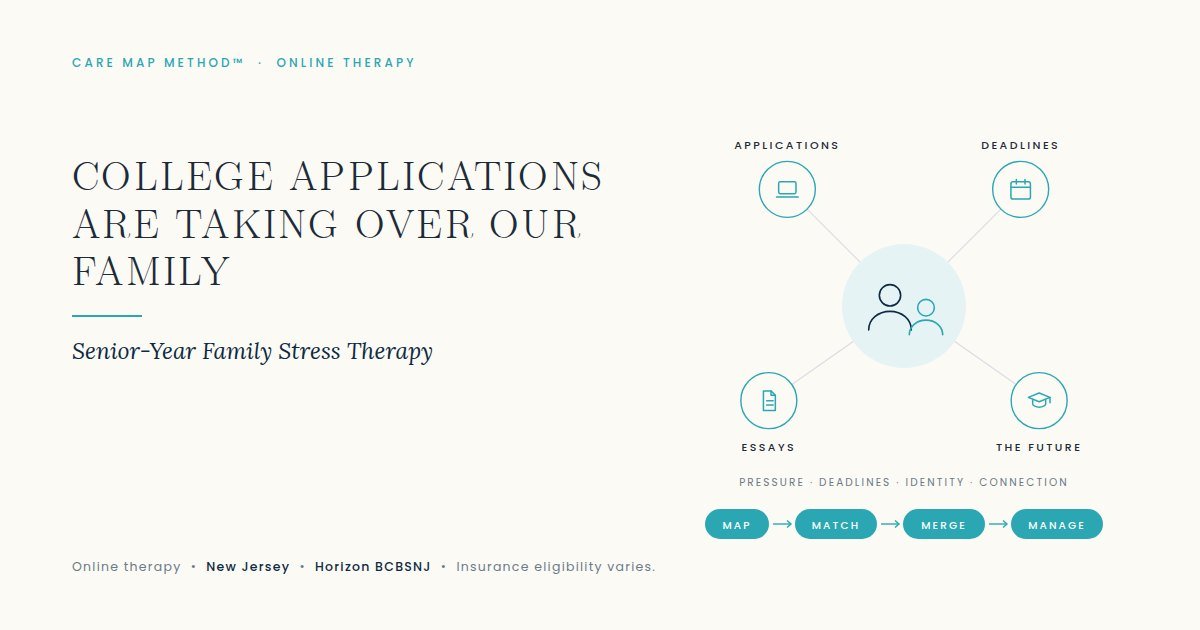
Online therapy in New Jersey for college application stress, parent-teen conflict and senior-year family pressure; Horizon BCBSNJ eligibility varies.
NEW JERSEY • HORIZON BCBSNJ
College application season can amplify anxiety, conflict and pressure for the entire family. Therapy can help parents stay supportive without becoming consumed by the process.
When Every Conversation Becomes About College
Senior year can turn ordinary family life into deadlines, test scores, essays, money, rankings and uncertainty. Parents may feel responsible for preventing a mistake while teenagers may feel watched, judged or pushed. The relationship can start to disappear underneath the process.
How Therapy Can Help
Therapy can help parents manage their own anxiety, communicate expectations more effectively, separate support from control, and protect the relationship while the family moves through an unusually high-pressure transition.
The Care Map Method™: Map • Match • Merge • Manage
MAP — Understand the pattern. Identify triggers, recurring interactions, stressors, beliefs and roles that keep the problem going.
MATCH — Identify needs and goals. Clarify what matters most, what you can influence and what a healthier outcome would look like.
MERGE — Improve communication and connection. Practice clearer language, boundaries, listening and responses that reduce reactivity and support healthier relationships.
MANAGE — Create practical next steps. Build realistic strategies, routines, agreements and coping tools you can use outside the session.
Online therapy and insurance
I provide online therapy for clients located in New Jersey. I may participate with Horizon BCBSNJ through Headway, depending on the specific plan and my current network participation. Insurance eligibility, benefits, copays, deductibles and coverage vary. Please verify your benefits through Headway before your appointment.
A safe place to unload—and a plan to move forward
My style is warm, supportive, practical and nonjudgmental. There is room to say the things you are embarrassed, angry, confused or exhausted about without shame or blame. We will make space for the feelings and also work toward tangible changes, clearer decisions and concrete next steps.
Ready for support?
If this issue is affecting your mood, relationships, work, sleep or sense of stability, you do not have to wait until it becomes a crisis. Use my Headway profile to check insurance eligibility and available appointment times.
FAQ
Can therapy help even if the other person does not attend?
Yes. Individual therapy can help you understand patterns, regulate your responses, clarify boundaries, prepare conversations and make decisions about how you want to participate in the relationship.
Do you accept Horizon BCBSNJ in New Jersey?
I may participate with Horizon BCBSNJ through Headway for clients located in New Jersey. Your specific plan and benefits must be verified because eligibility and costs vary.
Is this only a place to talk about the problem?
No. Emotional support matters, but my approach is also structured and solution-focused. We identify what is happening, what you need, what can change and what concrete steps you can take next.
What happens in the first session?
We focus on what is bringing you in, the relevant relationships and stressors, the patterns you are noticing and the outcome you want. We begin creating a Care Map so you leave with clearer direction.
Is online therapy nonjudgmental?
My approach emphasizes warmth, respect and understanding rather than shame, blame or judgment, within the normal confidentiality and clinical limits of psychotherapy.