

Care Map Method therapy for work rumination, after-hours anxiety and work-life boundaries
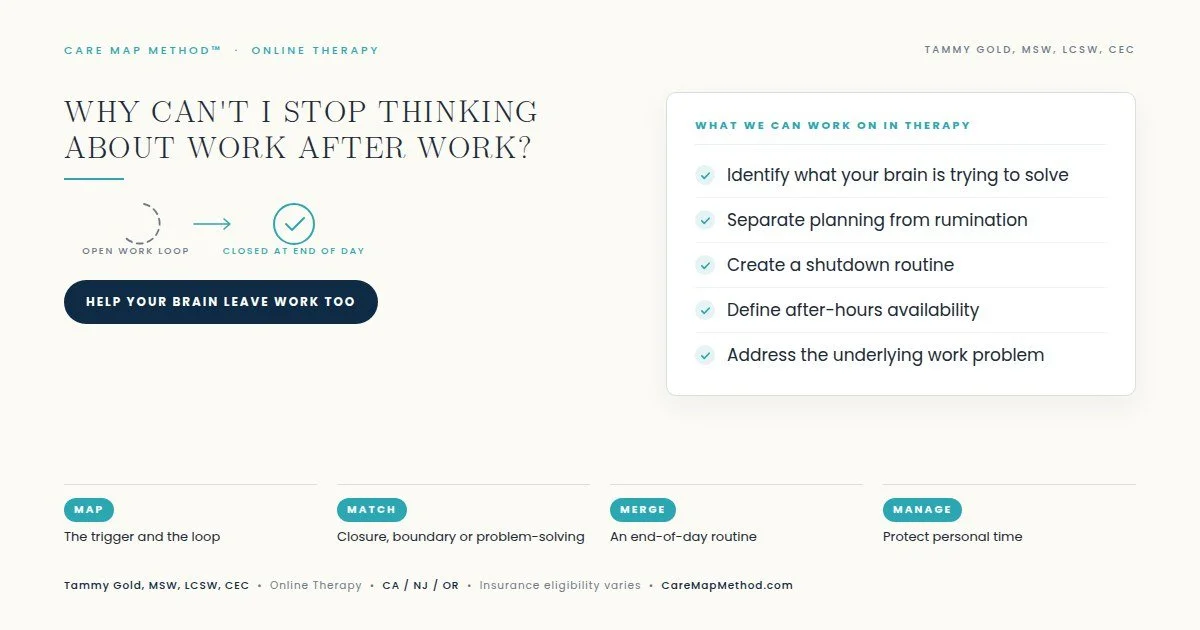
WHY CAN’T I STOP THINKING ABOUT WORK AFTER WORK?
Closing the laptop is not the same as closing the stress loop.
What therapy can help you work on:
• Identify what your brain is still trying to solve
• Separate useful planning from repetitive rumination
• Create an end-of-work closure routine
• Set realistic after-hours communication boundaries
• Address the boss, coworker or workload problem underneath the thoughts
HELP YOUR BRAIN LEAVE WORK TOO
Work can stay psychologically open
Unfinished tasks, ambiguous feedback, conflict and fear of forgetting something can keep your mind scanning long after the workday ends.
Rumination feels productive but often is not
Thinking about a problem repeatedly can create the feeling that you are preparing, even when you are cycling through the same material without reaching a new decision.
Sometimes the thought loop is pointing to a real workplace problem
The answer is not always relaxation. If the real issue is an unreasonable workload, unclear boss, conflict or boundary violation, we need to address that too.
Care Map Method™
MAP when the rumination starts, what triggers it and what problem it is attached to.
MATCH the trigger with closure, communication, boundary or problem-solving.
MERGE the strategy into the end of the workday.
MANAGE what returns and refine the plan.
Your evening needs somewhere else to go
The goal is not to never think about work. It is to regain choice over when work receives your attention and when your personal life gets to be fully present.
What We Can Work On In Our Session Together:
Identify what your brain is still trying to solve
Separate useful planning from repetitive rumination
Create an end-of-work closure routine
Set realistic after-hours communication boundaries
Address the boss, coworker or workload problem underneath the thoughts
Care Map Method™
MAP the problem and pattern. MATCH the needs with the right clinical strategies. MERGE insight into real conversations, boundaries and behavior. MANAGE what happens next and adjust as the situation changes.
Why do I keep thinking about work after hours?
Common drivers include unfinished tasks, uncertainty, conflict, high responsibility, anxiety and weak boundaries between work and personal time. Therapy can help identify which pattern is operating for you.
Is work rumination the same as anxiety?
They can overlap, but repetitive work thoughts are not automatically an anxiety disorder. A clinician can assess the broader pattern, severity and impact.
Can therapy help with Sunday scaries?
Yes. We can identify what Sunday dread predicts—workload, a person, performance fears, lack of recovery or a job-fit problem—and build a response around the actual trigger.
Should I stop checking email after work?
That depends on your role and legitimate job expectations. The goal is to define realistic availability rather than impose a boundary that does not fit your circumstances.
What if I need to be reachable for work?
We can distinguish true on-call requirements from habitual checking and create a plan that protects as much off-duty time as your role realistically allows.
What if the thoughts keep me from sleeping?
Persistent sleep disruption deserves attention. Therapy can address rumination and stress, while medical evaluation may also be appropriate for ongoing sleep problems.
HELP YOUR BRAIN LEAVE WORK TOO Text: 818.308.1538
Check insurance eligibility and request an online therapy appointment. Therapy is available to eligible clients in California, New Jersey and Oregon; coverage and benefits vary by plan.