
Toddler Parenting Support: Create a Personalized Care Map for Your Growing Child
Toddler behavior is communication. The Care Map Method™ Toddler Coaching Session helps parents understand their child’s biological, emotional, social, and environmental needs and create practical strategies for tantrums, sleep, eating, routines, development, childcare, and family life.
The toddler years can be delightful, exhausting, funny, and confusing—sometimes within the same five minutes.
Your toddler may want to do everything independently while still needing help with almost everything. They may understand far more than they can communicate. They can move quickly from excitement to frustration, resist ordinary routines, and have powerful reactions to seemingly small changes.
Parents are often left wondering:
Is this typical toddler behavior?
Why are the tantrums getting worse?
Should my child be talking more?
Why is bedtime suddenly so difficult?
How do I set limits without constantly battling?
Is my child ready for preschool or daycare?
How can all caregivers respond consistently?
Generic parenting advice rarely accounts for the whole child. A strategy that works for one toddler may overwhelm another because children differ in temperament, language, sensory processing, developmental pace, routines, and family circumstances.
The Care Map Method™ Toddler Care Map Coaching Session helps parents understand what is happening beneath the behavior and create a practical plan for their individual child and family.
What is toddler parent coaching?
Toddler parent coaching is a structured, personalized service that helps parents understand their child’s development, behavior, routines, and care needs.
During a Care Map Method™ Toddler Coaching Session, we may address:
Tantrums and emotional regulation
Biting, hitting, throwing, or yelling
Sleep and bedtime struggles
Picky eating and mealtime stress
Toilet-learning readiness
Language and communication
Separation anxiety
Transitions and resistance
Boundaries and discipline
Toddler safety and childproofing
Nanny, babysitter, daycare, or preschool concerns
Parent and caregiver consistency
Sibling adjustment
Parent exhaustion and family stress
The goal is not to eliminate every difficult behavior. Toddlers are still learning how to communicate, wait, transition, tolerate frustration, and manage strong feelings.
The goal is to understand what the behavior may be communicating and teach the child the skills they are developmentally ready to learn.
Toddler behavior is communication
Toddlers do not usually have the language, impulse control, or emotional regulation skills to explain exactly what they need.
A toddler who screams at bedtime may be overtired, frightened by separation, overstimulated, resisting a transition, or reacting to an inconsistent routine.
A child who hits another child may be overwhelmed, frustrated, seeking space, imitating behavior, or unable to say, “I was using that.”
A child who refuses to get dressed may want control, dislike how the clothing feels, struggle with transitions, or simply need more time.
Understanding the reason behind a behavior does not mean allowing unsafe or inappropriate behavior. It helps parents choose a response that addresses both the behavior and the unmet need or developing skill underneath it.
Start with the B/E/S/E Toddler Care Map
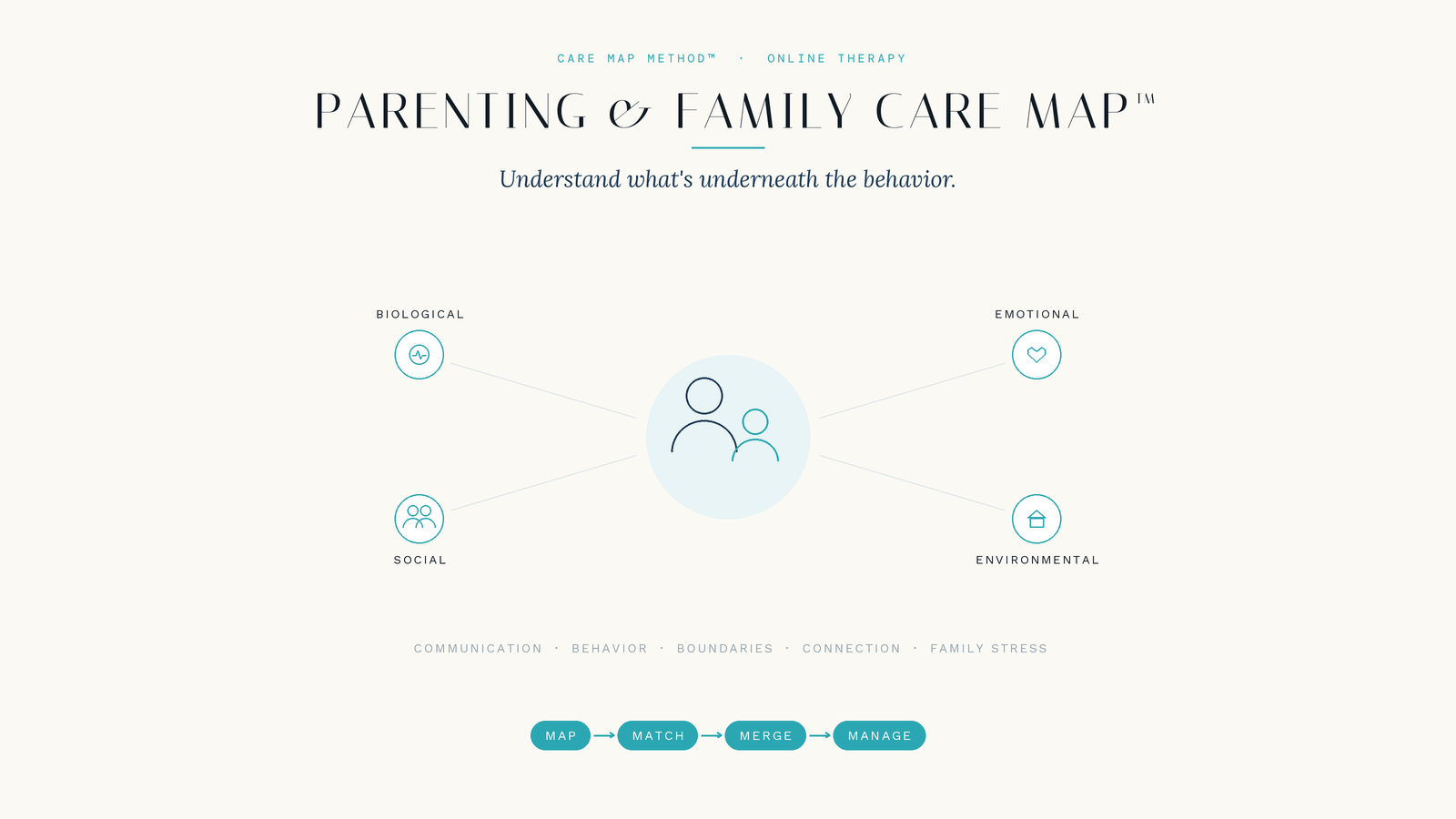
The Care Map Method™ looks at four connected areas of a toddler’s life: Biological, Emotional, Social, and Environmental needs.
Biological needs
A toddler’s physical state has a major influence on behavior.
Biological needs may include:
Sleep and nap patterns
Hunger and eating
Growth and nutrition
Physical activity
Illness, pain, or discomfort
Digestion and toileting
Speech, motor, and developmental progress
Sensory preferences and sensitivities
Medical and dental care
Before labeling a child as “difficult” or “defiant,” it is helpful to consider whether the child is tired, hungry, uncomfortable, overstimulated, or being asked to do something beyond their current developmental ability.
Persistent concerns about feeding, sleep, hearing, speech, movement, growth, toileting, or development should be discussed with the child’s pediatric healthcare provider.
Emotional needs
Toddlers experience strong feelings before they have the skills to manage them.
Emotional care may include:
Helping the child identify feelings
Offering comfort without removing every limit
Creating predictable responses
Supporting secure attachment
Preparing for separations and transitions
Teaching simple calming strategies
Understanding the child’s temperament
Providing choices within appropriate boundaries
Toddlers borrow regulation from the adults around them. This is called co-regulation. A calm, clear adult response helps the child gradually learn how to manage frustration, disappointment, and change.
Social needs
Toddlers are beginning to learn how relationships work.
They may be practicing how to:
Share space and toys
Take turns
Ask for help
Join play
Use words instead of hitting
Separate from a parent
Adapt to different caregivers
Interact with siblings
Follow simple group routines
Recover after conflict
Young toddlers often engage in parallel play—playing near other children rather than cooperatively with them. Social skills develop gradually and require patient teaching, modeling, and repetition.
Environmental needs
The environment can either support toddler success or create unnecessary conflict.
Environmental factors include:
Home safety and childproofing
Toy and activity organization
Noise, lighting, and stimulation
Daily routines
Visual schedules
Transition warnings
Child-accessible choices
Sleep spaces
Mealtime arrangements
Consistency between home and childcare
Sometimes changing the environment is more effective than repeatedly correcting the child.
For example, placing a visual routine near the front door may help with leaving the house. Offering two weather-appropriate outfits may reduce dressing battles. Creating a calm-down space may provide a safe place to recover from overwhelming feelings.
Use MAP, MATCH, MERGE, and MANAGE for toddler care
Once we understand the child’s full care picture, the Care Map Method™ provides a clear path forward.
MAP the Need
We identify the toddler’s biological, emotional, social, and environmental needs while also considering family stress, schedules, caregiver arrangements, and parent concerns.
The care map helps parents look for patterns:
Do tantrums happen before meals?
Is behavior harder after missed naps?
Does the child struggle during rushed transitions?
Is the same behavior happening at home and daycare?
Are different caregivers using different limits?
Does the child have the words needed to express the problem?
A behavior tracker can help parents identify what happens before, during, and after a difficult moment.
MATCH the Care
Next, we determine what kind of support fits each need.
Support may include:
A pediatrician
A speech-language pathologist
An occupational therapist
A developmental specialist
A feeding professional
A licensed mental health professional
A parent coach
A nanny or babysitter
A daycare or preschool program
Early-intervention services
Trusted family support
Not every toddler challenge requires a specialist. Coaching can help parents determine what can be addressed through changes in routines and responses—and what should be evaluated further.
MERGE the Support
Toddlers benefit when the important adults in their lives communicate clearly.
A shared toddler care plan may include:
Daily routines
Sleep and nap expectations
Food preferences and restrictions
Toilet-learning language
Approved discipline and redirection strategies
Comfort and calming methods
Safety expectations
Screen-time boundaries
Medication or health information
Communication between parents and caregivers
Responses to hitting, biting, tantrums, or separation distress
Parents, grandparents, nannies, babysitters, and daycare teachers do not need to respond identically in every situation. However, they should understand the child’s essential needs and the family’s central expectations.
MANAGE the Plan
Toddlers develop quickly. Their language, mobility, interests, sleep, emotions, and social needs can change within months.
Families should regularly ask:
What is improving?
What continues to be difficult?
Has the child developed new skills?
Are our expectations age-appropriate?
Are all caregivers communicating?
Is the environment still safe and supportive?
Do we need additional professional guidance?
Is this care arrangement still the right fit?
A Toddler Care Map is not a permanent set of rules. It is a flexible plan that grows with the child.
Understanding toddler tantrums
Tantrums are a common part of early development. They often occur when a toddler is tired, hungry, overstimulated, frustrated, or unable to communicate a need.
During a tantrum, the child’s thinking and language abilities may be temporarily less available. Long explanations and repeated questions are unlikely to help in the peak of the moment.
A helpful response may include:
Make sure the child and others are safe.
Lower your voice and reduce stimulation.
Use a short statement: “You are upset. I’m here.”
Hold the boundary: “I won’t let you hit.”
Allow time for the child’s body to settle.
Reconnect and teach after the child is calmer.
Parents do not need to fix every feeling. A child can be disappointed and still be safe, supported, and loved.
Discipline should teach—not frighten
Effective toddler discipline focuses on safety, connection, repetition, and skill-building.
Helpful strategies may include:
Clear and brief limits
Consistent follow-through
Redirection
Age-appropriate choices
Predictable routines
Transition warnings
Positive attention for helpful behavior
Modeling the desired behavior
Teaching simple replacement phrases
Repairing the relationship after difficult moments
Instead of only saying, “Stop hitting,” a parent might say:
“I won’t let you hit. Say, ‘My turn,’ or ask me for help.”
The limit remains firm, but the child also learns what to do next time.
Preparing for daycare, preschool, or a new caregiver
Starting daycare, preschool, or care with a nanny can be a major transition for a toddler.
A thoughtful transition plan may include:
Short introductory visits
A simple goodbye ritual
A familiar comfort object when permitted
Consistent pickup and drop-off language
A written description of routines and calming strategies
Gradually increasing care hours when possible
Clear communication between parents and caregivers
Patience with temporary changes in sleep or behavior
A child’s distress during separation does not automatically mean the placement is wrong. What matters is how the child is comforted, how the caregiver responds, and whether the child gradually begins to feel secure.
When might toddler coaching help?
A Care Map Method™ Toddler Coaching Session may be helpful if:
Tantrums are affecting daily family life
You are dealing with hitting, biting, or throwing
Bedtime or naps have become difficult
Meals feel like a constant battle
You are unsure how to set effective boundaries
You and your partner disagree about discipline
Your child is having difficulty separating
You are preparing for daycare or preschool
You are hiring or onboarding a nanny
Different caregivers use conflicting approaches
Your toddler is adjusting to a new sibling, home, or family routine
You want to understand whether a concern may require additional evaluation
You do not have to wait until family life feels unmanageable. Parent coaching can help you create a plan before ordinary toddler challenges become ongoing patterns of stress.
What happens during a CMM Toddler Care Map Coaching Session?
The session is personalized to the child, the family, and the current concerns.
Together, we can:
Complete a B/E/S/E Toddler Care Map
Identify possible triggers behind difficult behavior
Review sleep, eating, play, toileting, and daily routines
Explore temperament and sensory needs
Create age-appropriate behavior strategies
Develop scripts for tantrums, transitions, and limit-setting
Clarify responsibilities between parents and caregivers
Prepare for a nanny, daycare, preschool, or other transition
Identify areas that may need professional evaluation
Create a practical family action plan
Parents leave with clear priorities, personalized scripts, and concrete next steps they can begin using at home.
Frequently asked questions about toddler coaching
Is toddler coaching only for serious behavior problems?
No. Many parents use coaching for common developmental challenges such as tantrums, sleep, picky eating, separation anxiety, transitions, and limit-setting.
Can toddler coaching help with tantrums?
Yes. Coaching can help parents identify possible triggers, create a consistent response, teach replacement skills, and adjust routines or environments that may be contributing to the tantrums.
Can you help us prepare our toddler for preschool?
Yes. A Toddler Care Map can help parents evaluate readiness, prepare for separation, communicate with teachers, and create consistent routines between home and school.
Can both parents or caregivers participate?
Yes. Including both parents or other central caregivers can help create clearer expectations and more consistent responses.
Does toddler coaching replace medical or developmental evaluation?
No. Coaching provides education, planning, and parenting support. Medical, speech, feeding, hearing, sensory, or developmental concerns should be evaluated by an appropriately qualified professional.
Your toddler does not need a perfect parent
Toddlers need adults who are curious, responsive, consistent, and willing to adjust as the child grows.
You do not have to stop every tantrum or have the perfect routine. You need a clearer understanding of your child and a practical plan that your family can actually follow.
Map before you act.
Care Map Method™ Toddler Care Map Coaching Session
The Care Map Method™ Toddler Care Map Coaching Session helps parents understand what may be driving their toddler’s behavior and develop an individualized plan for home, childcare, and family life.
Your session may include:
A personalized B/E/S/E Toddler Care Map
Tantrum and behavior-trigger assessment
Sleep, mealtime, toileting, and routine review
Toddler communication and regulation strategies
Parent scripts for limits and transitions
Daycare, preschool, or nanny preparation
Parent and caregiver communication tools
A personalized action plan and next steps
Built by a therapist. Backed by science. Designed for real family life.
Schedule a Care Map Method™ Toddler Coaching Session
Care Map Method™ coaching provides education, care planning, and parenting support. It does not replace pediatric, medical, developmental, feeding, speech, occupational-therapy, or mental-health evaluation and treatment.
Divorce and Co-Parenting Therapy with Insurance
Divorce and co-parenting can create emotional stress, communication challenges, and family strain. Tammy Gold, LCSW offers online therapy for clients in CA, NJ, and OR seeking safe, supportive, solution-focused help.
Divorce and Co-Parenting Therapy with Insurance
Divorce and co-parenting can be emotionally exhausting. Even when separation is necessary, the process can bring stress, grief, anger, fear, guilt, confusion, and conflict. When children are involved, the emotional weight can feel even heavier.
I am Tammy Gold, LCSW, a therapist, author, parenting and family therapy expert, and creator of the Care Map Method™. I support adults, parents, and families navigating divorce, separation, co-parenting stress, parenting conflict, family transitions, relationship strain, and communication challenges.
I offer online therapy for clients in California, New Jersey, and Oregon. Depending on your plan and eligibility, you may be able to use insurance through Headway or Alma.
View My Psychology Today Profile
My Psychology Today profile links to booking and insurance options through Headway.
When divorce and co-parenting feel overwhelming
Divorce is not only a legal or logistical process. It is also an emotional and relational transition. You may be trying to manage your own feelings while also protecting your children, communicating with a co-parent, handling conflict, rebuilding routines, and making major decisions.
Co-parenting conflict
Communication breakdowns
Parenting stress during divorce
Emotional overwhelm
Anger, grief, guilt, or resentment
Difficulty setting boundaries
Conflict with an ex-partner
Stress about how children are coping
New family routines
Blended family or extended family pressure
A safe place without shame or blame
My goal is to make therapy feel like one safe place where you do not have to censor yourself, apologize for your feelings, or worry about being judged. Divorce and co-parenting can bring up intense emotions. Therapy gives you room to name those emotions, understand them, and decide how you want to respond.
The goal is not to blame one person or create more conflict. The goal is to help you feel supported, understand what is happening, communicate more clearly, and protect emotional safety for yourself and your children.
My approach
Through the Care Map Method™, we look at emotional, biological, social, and environmental needs. This helps create a fuller picture of what life feels like during divorce or co-parenting stress.
What is triggering conflict
What emotions are hardest to manage
What communication patterns repeat
What boundaries are needed
What your children may need
What support systems are missing
What practical next steps can reduce stress
My sessions combine emotional support, education, and practical solutions. I want clients to leave feeling less alone, clearer, more grounded, and better equipped to advocate for their needs.
Insurance and booking
Insurance availability depends on your specific plan, state, eligibility, and platform availability. Clients can review booking and insurance options through my Psychology Today and Headway profiles.
View My Psychology Today Profile
Online divorce and co-parenting therapy
I offer online therapy for clients in California, New Jersey, and Oregon. If you are navigating divorce, separation, co-parenting conflict, parenting stress, or family transition, you can request a session through my Psychology Today profile.
Parenting Stress Therapy with Insurance in CA, NJ & OR
Parenting stress can affect your mood, marriage, communication, patience, and sense of self. Tammy Gold, LCSW offers online therapy for parents in CA, NJ, and OR who are feeling overwhelmed, unsupported, or emotionally exhausted.
Parenting Stress Therapy with Insurance in CA, NJ & OR
Parenting stress can affect every part of life: your mood, your marriage, your patience, your work, your sleep, and the way you feel about yourself. Many parents are not struggling because they are doing something wrong. They are struggling because they are carrying too much with too little support.
I am Tammy Gold, LCSW, a therapist, author, parenting and family therapy expert, and creator of the Care Map Method™. I support parents in California, New Jersey, and Oregon who are navigating parenting stress, relationship strain, divorce, co-parenting, family conflict, caregiving responsibilities, and emotional overwhelm.
Depending on your plan and eligibility, you may be able to use insurance through Headway or Alma.
View My Psychology Today Profile
My Psychology Today profile links to booking and insurance options through Headway.
When parenting stress becomes too much
Parenting stress often builds slowly. You may notice that you are more reactive than you want to be, more resentful than you expected, or more emotionally exhausted than you can explain.
Constant conflict with your child
Feeling disconnected from your partner
Carrying the emotional labor of the family
Parenting through divorce or separation
Co-parenting stress
Disagreements about discipline, routines, or boundaries
Feeling judged, unsupported, or alone
Balancing work, children, aging parents, and your own needs
Therapy gives you a safe place to be honest about what you are feeling without shame or judgment.
Therapy for parents, couples, and family stress
Parenting does not happen in isolation. Stress with children often affects couples, co-parents, siblings, extended family, school relationships, nanny relationships, daycare decisions, and eldercare responsibilities.
My work is relational. I help clients better understand what is driving behavior, conflict, stress, and communication breakdowns. The goal is not to blame yourself or anyone else. The goal is to understand what is happening and find better ways forward.
My approach
Through the Care Map Method™, we look at emotional, biological, social, and environmental needs. This helps us understand what may be underneath parenting stress and family conflict.
What emotions are being triggered
What needs are not being named
What patterns repeat in the family
What communication breaks down
What support is missing
What practical next steps can reduce stress
My sessions are safe, positive, supportive, and solution-focused. I want clients to feel heard, understood, and less alone while gaining tools they can use at home.
Insurance and booking
Insurance coverage depends on your state, specific plan, eligibility, and platform availability. Clients can review booking and insurance options through my Psychology Today and Headway profiles.
View My Psychology Today Profile
Online parenting stress therapy
I offer online therapy for clients in California, New Jersey, and Oregon. If you are a parent feeling overwhelmed, unsupported, anxious, resentful, or emotionally exhausted, you can request a session through my Psychology Today profile.
Online Therapy in Oregon Accepting Aetna, Regence BCBS, Providence & Carelon
Tammy Gold, LCSW offers online therapy in Oregon for adults, couples, parents, and caregivers navigating relationship stress, parenting strain, divorce, co-parenting, caregiver burnout, and major life transitions. Insurance may be available through Headway or Alma.
Online Therapy in Oregon Accepting Aetna, Regence BCBS, Providence & Carelon
If you are looking for online therapy in Oregon and are feeling overwhelmed by relationship stress, parenting responsibilities, divorce, co-parenting, family conflict, work stress, or caregiving demands, therapy can provide a safe place to feel heard and supported.
I am Tammy Gold, LCSW, a therapist, author, parenting and family therapy expert, and creator of the Care Map Method™. I help adults, couples, parents, and caregivers better understand themselves, the people around them, and the emotional patterns that may be creating stress or disconnection.
Depending on your plan and eligibility, you may be able to use insurance through Headway or Alma, including plans such as Aetna, Providence Health Plan, Regence BlueCross BlueShield of Oregon, and Carelon.
View My Psychology Today Profile
My Psychology Today profile links to booking and insurance options through Headway.
Support for people carrying too much
Many clients come to therapy because they feel like they are the person everyone depends on. They may be trying to manage parenting, work, marriage, divorce, caregiving, aging parents, childcare issues, family expectations, or relationship conflict while feeling anxious, resentful, exhausted, or alone.
Therapy can help you slow down and understand what is happening underneath the stress.
Common areas of focus
Relationship stress
Parenting stress
Divorce and co-parenting
Family conflict
Caregiver burnout
Work stress and professional relationship stress
Childcare and senior care decisions
Emotional overwhelm
Communication issues
Life transitions
My approach
I use the Care Map Method™ to help clients understand what may be happening emotionally, biologically, socially, and environmentally. This gives us a fuller picture of what life feels like and what may be driving stress, behavior, conflict, or disconnection.
Therapy with me is designed to be both emotionally supportive and practical. My goal is for clients to feel safe, heard, and less alone while also gaining tools, language, and solutions that help them move forward.
Insurance and booking
Insurance coverage depends on your specific plan, state, eligibility, and platform availability. Clients can review booking and insurance options through my Psychology Today and Headway profiles.
View My Psychology Today Profile
Online therapy in Oregon
I offer online therapy for clients located in Oregon. If you are looking for therapy for relationship stress, parenting stress, divorce, co-parenting, caregiver burnout, work stress, or family conflict, you can request a session through my Psychology Today profile.
Online Therapy in New Jersey Accepting Aetna, Horizon BCBS & Providence
Tammy Gold, LCSW offers online therapy in Oregon for adults, couples, parents, and caregivers navigating relationship stress, parenting strain, divorce, co-parenting, caregiver burnout, and major life transitions. Insurance may be available through Headway or Alma
If you are looking for online therapy in New Jersey and feel overwhelmed by relationship stress, parenting demands, divorce, co-parenting, work stress, caregiving responsibilities, or family conflict, therapy can help you feel less alone and more supported.
I am Tammy Gold, LCSW, a therapist, author, parenting and family therapy expert, and creator of the Care Map Method™. I support adults, couples, parents, and caregivers who are trying to understand themselves, their relationships, and the patterns creating stress in daily life.
Depending on your plan and eligibility, you may be able to use insurance through Headway or Alma, including plans such as Aetna, Horizon Blue Cross Blue Shield of New Jersey, Providence Health Plan, and Carelon.
View My Psychology Today Profile
My Psychology Today profile links to booking and insurance options through Headway.
Therapy for adults, couples, parents, and caregivers in New Jersey
Many people come to therapy because they are carrying too much. They may be managing parenting, marriage stress, divorce, co-parenting, work pressure, aging parents, childcare decisions, eldercare responsibilities, or complicated family dynamics.
You may feel anxious, resentful, disconnected, emotionally exhausted, or unsure how to communicate your needs without creating more conflict. Therapy gives you one safe, positive, supportive space to talk honestly without judgment, shame, or pressure.
What therapy can help with
Relationship conflict
Parenting stress
Divorce or separation
Co-parenting challenges
Family conflict
Work stress or boss/coworker stress
Caregiver burnout
Childcare or eldercare decision stress
Communication difficulties
Feeling emotionally overloaded or unsupported
My approach
Through the Care Map Method™, we look at emotional, biological, social, and environmental needs to get a clearer picture of what is happening in your life and relationships.
This approach helps us move beyond blame and shame. Instead of asking, “What is wrong with me?” or “What is wrong with them?” we look at what may be driving emotions, behavior, communication patterns, and stress.
My sessions are supportive and solution-focused. Clients can feel, process, release, understand, and also leave with practical language and tools for real life.
Insurance and booking
Insurance coverage depends on your specific plan, location, eligibility, and platform availability. Clients can review booking and insurance options through my Psychology Today and Headway profiles.
View My Psychology Today Profile
Online therapy in New Jersey
I offer online therapy for clients located in New Jersey. If you are looking for therapy for relationship stress, parenting stress, divorce, co-parenting, caregiver burnout, work stress, or family conflict, you can request a session through my Psychology Today profile.
Online Therapy in California Accepting Aetna, Anthem, Providence & Carelon
Tammy Gold, LCSW offers online therapy in California for adults, couples, parents, and caregivers navigating relationship stress, parenting strain, divorce, co-parenting, caregiver burnout, work stress, and family conflict. Insurance may be available through Headway or Alma.
If you are looking for online therapy in California and are feeling overwhelmed by relationship stress, parenting challenges, divorce, co-parenting, caregiver burnout, or family responsibilities, therapy can offer one safe place to feel heard, supported, and understood.
I am Tammy Gold, LCSW, a therapist, author, parenting and family therapy expert, and creator of the Care Map Method™. I work with adults, couples, parents, and caregivers who are trying to manage the emotional weight of modern family life, relationship stress, work/family strain, caregiving demands, and major life transitions.
Depending on your plan and eligibility, you may be able to use insurance through Headway or Alma, including plans such as Aetna, Anthem Blue Cross California, Providence Health Plan, and Carelon Behavioral Health.
[Button: View My Psychology Today Profile]
My Psychology Today profile links to booking and insurance options through Headway.
Therapy for relationship, parenting, and family stress in California
Many clients come to therapy because they are functioning on the outside but feeling anxious, resentful, disconnected, exhausted, or emotionally overloaded inside. They may be struggling with a partner, child, parent, sibling, co-parent, friend, coworker, boss, nanny, daycare provider, caregiver, or senior care professional.
Therapy gives you space to slow down, understand what is happening, and find language for emotions and needs that may feel difficult to express.
Common reasons clients reach out
Clients often seek therapy for:
Relationship stress and communication problems
Parenting stress and family conflict
Divorce and co-parenting challenges
Caregiver burnout
Work stress and boss or coworker stress
Childcare or eldercare decision stress
Feeling unsupported or emotionally exhausted
Difficulty naming needs or setting boundaries
Major life transitions
My approach
I created the Care Map Method™ to help people better understand themselves and the people around them. In therapy, we look at what may be happening emotionally, biologically, socially, and environmentally so we can understand what is driving stress, behavior, conflict, and disconnection.
My sessions are designed to feel safe, supportive, and solution-focused. There is no judgment, shame, or blame. My goal is to help you feel less alone, understand what is happening, communicate more clearly, and leave with practical tools you can use in real life.
Insurance and booking
Insurance coverage depends on your specific plan, state, eligibility, and platform availability. Clients can review booking and insurance options through my Psychology Today and Headway profiles.
[Button: View My Psychology Today Profile]
Online therapy in California
I offer online therapy for clients located in California. If you are looking for therapy for relationship stress, parenting stress, divorce, co-parenting, caregiver burnout, family conflict, or work/family overwhelm, you can request a session through my Psychology Today profile.
Why Every Relationship Needs a Care Map: Improving Communication Before Small Problems Become Big Ones
Relationship problems rarely begin with one dramatic event. Learn how mapping the whole relationship system can reveal what is driving conflict and what can change.
Relationship problems rarely begin with one dramatic event. More often, two people slowly become trapped in a pattern: one pushes for an answer, the other withdraws; one carries the practical load, the other feels criticized; both feel unheard, and each new disagreement confirms an increasingly painful story about the relationship.
Communication advice can sound simple from the outside. Listen better. Stay calm. Use “I” statements. Those tools matter, but they are difficult to use when exhaustion, old injuries, parenting pressure, work stress, money concerns, or fear of rejection are operating beneath the conversation. The argument may be about dishes, a text message, or a late arrival, while the deeper issue is trust, recognition, safety, or unequal responsibility.
MAP → MATCH → MERGE → MANAGE
A structured, individualized framework for understanding the problem, selecting the right supports, integrating practical changes, and adjusting the plan over time.
Why small problems become recurring conflicts
Relationship conflict becomes chronic when the couple keeps trying to solve the visible disagreement without understanding the system that produces it. A partner who asks for more help may not only be requesting a completed task; they may be asking to feel less alone. A partner who becomes defensive may hear the request as proof that nothing they do is good enough.
Once this cycle is established, both people begin reacting to the pattern rather than the present moment. Tone becomes more important than content. Neutral comments are interpreted through accumulated hurt. Repair attempts are missed because each person is protecting against the next disappointment.
Signs that communication has become a system problem
You do not need to be in constant crisis to benefit from relationship therapy. Persistent patterns deserve attention, particularly when you notice several of the following:
The same argument returns without meaningful resolution
One person pursues while the other shuts down or leaves
Conversations quickly become criticism, defensiveness, contempt, or blame
Practical responsibilities feel chronically unequal
Affection and friendship have been replaced by logistics
You avoid important topics because conflict feels inevitable
External pressures such as parenting, caregiving, work, or finances dominate the relationship
One or both partners feel lonely while still together
The Care Map Method™: from argument to actionable understanding
In Care Map Method™ therapy, the goal is not simply to decide who is right. We organize the situation so that the couple can see what is happening, what each person needs, and which changes are realistic. The framework is structured but individualized.
MAP: identify what is driving the pattern
The MAP stage examines the whole relationship through biological, emotional, social, and environmental factors. Biological factors may include sleep deprivation, menopause, chronic illness, medication effects, or nervous-system activation. Emotional factors include fear, resentment, grief, shame, and unmet attachment needs. Social factors include family-of-origin patterns, parenting roles, friendships, and cultural expectations. Environmental factors include work schedules, finances, housing, technology, and the distribution of household labor.
This broader map often reduces blame. A couple may discover that a “communication problem” is being intensified by untreated exhaustion, unclear roles, or a transition they never consciously discussed.
MATCH: identify what each person and the relationship need
After the pattern is clear, therapy helps match the problem with the right supports and skills. One couple may need a reliable process for difficult conversations. Another may need stronger boundaries with extended family. Another may need to rebalance labor, rebuild trust after secrecy, or learn how to regulate before attempting resolution.
The match is specific. Generic advice is less useful than identifying the exact intervention that fits the couple’s needs, strengths, history, and current capacity.
MERGE: turn insight into new relationship practices
Insight matters only when it can be brought into daily life. During MERGE, the couple practices concrete changes: how to begin a conversation without accusation, how to request help clearly, how to pause without abandoning the discussion, and how to create agreements that are measurable rather than vague.
This may include a weekly planning conversation, a division-of-labor agreement, conflict-repair language, technology boundaries, or a plan for handling recurring family stress. The purpose is not to make the relationship mechanical. It is to create enough structure that connection is not repeatedly sacrificed to chaos.
MANAGE: maintain progress when life becomes stressful again
Every relationship encounters new stress. The MANAGE stage focuses on recognizing early warning signs, reviewing agreements, and adjusting the plan before old patterns fully return. Couples learn to ask: What has changed? Which support is no longer working? What needs to be renegotiated?
This turns therapy into a transferable process rather than a temporary improvement that depends on everything remaining calm.
What solution-focused relationship therapy can produce
Therapy cannot guarantee that every relationship will continue, and it should not pressure anyone to remain in an unsafe situation. It can, however, help people understand their patterns, communicate more accurately, make decisions with greater clarity, and develop practical tools for the relationship they are trying to build.
For many couples and family members, the most meaningful change is moving from “We keep having the same fight” to “We understand the cycle, know what each of us needs, and have a plan for what to do next.”
When to seek support
Consider reaching out when conflict is repetitive, emotional distance is increasing, major transitions are exposing unresolved differences, or attempts to solve the problem independently keep producing the same outcome. Early support is often more effective than waiting until resentment has hardened into hopelessness.
Ready to talk?
If this issue is affecting your emotional health, relationships, work, or daily functioning, support is available. Tammy Gold provides virtual therapy for adults in California, New Jersey, and Oregon. Schedule through Tammy Gold’s Psychology Today profile
About Tammy Gold
Tammy Gold, MSW, LCSW, CEC, is the founder of Care Map Method™, a licensed clinical social worker in California, New Jersey, and Oregon, a certified coach, and the author of Secrets of the Nanny Whisperer. She helps adults and families navigate relationships, caregiving, burnout, parenting, work stress, and major life transitions through a structured, practical, relationship-centered approach.
Educational notice: This article is for general educational purposes and is not a substitute for individualized medical, legal, or mental health care. If you are experiencing an emergency or immediate safety concern, contact local emergency services or an appropriate crisis resource.
Empty Nest Syndrome: Finding Purpose During Life’s Next Chapter
When children leave home, parents may experience grief, identity changes, relationship strain, and uncertainty about what comes next. Therapy can help make this transition meaningful.
When a child leaves for college, moves out, marries, or becomes more independent, parents often feel proud and relieved. They may also feel grief, loneliness, anxiety, or a surprising loss of direction.
These reactions can coexist. Loving your child's independence does not prevent you from missing the daily relationship, familiar routines, and identity that active parenting provided.
Why the empty nest can feel like a real loss
Parenting structures time, attention, relationships, and the physical home for many years. School calendars, meals, activities, transportation, and emotional support create a daily rhythm. When that rhythm changes, the absence can be felt in ordinary moments: a quiet kitchen, an unused bedroom, or a weekend with no one to drive anywhere.
The loss is not only of proximity. It may include the loss of a role in which you felt needed and competent. Even when the transition is developmentally healthy, it can require genuine grieving.
Common empty-nest experiences
Parents may notice:
Sadness or tearfulness that seems disproportionate to the event
Anxiety about the child’s safety, choices, or adjustment
Compulsive checking, texting, or monitoring
Difficulty sleeping or concentrating
A sense that the home or marriage feels unfamiliar
Uncertainty about personal goals or identity
Resentment when the adult child appears distant
Conflict with a partner who is adjusting differently
Relief followed by guilt for feeling relieved
When partners experience the transition differently
One partner may feel devastated while the other feels energized by new freedom. One may want frequent contact with the child; the other may emphasize independence. These differences can create conflict if each person interprets the other's response as uncaring or excessive.
Couples may also discover that years of child-centered routines allowed them to avoid unresolved issues. The quieter home can expose emotional distance, unequal labor, or uncertainty about what they enjoy together. This does not necessarily mean the relationship is failing. It means the couple may need to build a new version of the relationship rather than waiting for the old one to return.
Letting the parent-child relationship evolve
Adult children still need connection, but the form of support changes. The parent's task gradually shifts from direct management to availability, consultation, and respect for autonomy.
This transition can be difficult when worry is high. Frequent advice or checking may feel like love to the parent but like mistrust to the adult child. Therapy can help parents tolerate uncertainty while maintaining a warm, appropriate connection.
The empty nest and women’s identity
Women are often encouraged to invest deeply in caregiving and then expected to transition smoothly when daily caregiving decreases. The resulting identity questions can be significant: Who am I when I am not organizing everyone else's life? What do I want beyond being needed?
These questions are not selfish. They are part of constructing a fuller identity that can include parenting without being limited to it.
When aging parents enter the picture
For many adults, the empty nest is not an uncomplicated release from caregiving. As children become independent, aging parents may begin to need more support.
This can create a rapid shift from one caregiving system to another, leaving little time to recover or consider personal goals. It is important to avoid automatically filling every newly available hour with eldercare. A sustainable plan should account for the adult child's independence, the older parent's needs, and the midlife adult's own health and future.
Rebuilding purpose without forcing a reinvention
You do not need to identify a dramatic new purpose immediately. Purpose can be rebuilt gradually through relationships, work, creativity, learning, service, health, travel, or simple routines that belong to you.
Start by noticing what was postponed during intensive parenting. Some interests will still matter; others will not. The goal is not to recreate your pre-parenting self but to discover what fits now.
A practical transition map
Consider mapping four areas:
Biological: sleep, health, movement, and energy during the transition
Emotional: grief, relief, anxiety, pride, regret, and changing identity
Social: friendships, partnership, community, and the evolving relationship with the adult child
Environmental: changes to the home, schedule, finances, work, and caregiving responsibilities
How therapy can help
Therapy can provide support when the transition brings persistent sadness, anxiety, relationship conflict, or a sense of emptiness. It can help parents process grief, adjust communication with adult children, strengthen a partnership, and clarify what they want from the next stage of life.
The work is not about erasing attachment. It is about allowing the relationship with your child to mature while expanding your own life.
The next chapter can hold more than one truth
You can miss the version of family life that has ended and still welcome what comes next. You can be proud of your child and feel lonely. You can appreciate new freedom and feel uncertain about how to use it.
A healthy transition does not require choosing one emotion. It requires making room for the full experience while gradually building a life that remains connected, purposeful, and your own.
Ready for support?
If the empty-nest transition has brought grief, anxiety, relationship strain, or uncertainty about your identity, therapy can help you move into the next chapter with greater clarity. Tammy Gold, MSW, LCSW, CEC, provides confidential virtual therapy for adults located in California, New Jersey, and Oregon.
Book through Psychology Today: https://www.psychologytoday.com/us/therapists/tamara-jill-gold-los-angeles-ca/1713403
Learn more: CareMapMethod.com
About Tammy Gold
Tammy Gold, MSW, LCSW, CEC, is the founder of Care Map Method™, a licensed clinical social worker in California, New Jersey, and Oregon, a certified coach, and the author of Secrets of the Nanny Whisperer. Her work centers on relationships, caregiving, burnout, parenting transitions, workplace stress, women’s midlife concerns, and practical support during major life changes.
Educational notice: This article is for general educational purposes and is not a substitute for individualized medical or mental health care. If you are experiencing an emergency or immediate safety concern, contact emergency services or an appropriate crisis resource in your area.
Workplace Burnout or Just Too Much? How to Know When It Is Time for Therapy
Workplace burnout can affect sleep, health, confidence, and relationships. Learn how it differs from ordinary stress and when therapy may help.
A demanding job can produce temporary periods of stress. Burnout is different. It develops when high demands, low control, inadequate recovery, conflict, or misalignment continue long enough that your emotional and physical resources begin to erode.
You may still be performing well. In fact, many people seek therapy only after months of compensating through longer hours, perfectionism, and constant availability. Outward competence can hide significant internal depletion.
Burnout versus ordinary work stress
Ordinary stress usually has a clear endpoint. A project ends, a deadline passes, or a busy season settles down. Burnout is more persistent and often includes emotional exhaustion, cynicism or detachment, and a reduced sense of effectiveness.
You may notice that weekends no longer restore you, small requests feel intolerable, or achievements produce little satisfaction. The issue is not simply that work is difficult. It is that the current relationship between you and the work has become unsustainable.
Signs that work stress is affecting your health
Common signs include:
Difficulty falling asleep because your mind continues rehearsing work problems
Waking with dread or physical tension
Headaches, gastrointestinal symptoms, muscle pain, or persistent fatigue
Increased reliance on alcohol, food, screens, or other numbing behaviors
Trouble concentrating or making decisions
Feeling emotionally flat with family and friends
Frequent irritability or conflict at home
Checking messages compulsively or feeling unable to disconnect
Believing that one mistake could expose you as inadequate
The relationship side of workplace burnout
Burnout is not only about workload. It can be driven by relationships: an unpredictable manager, unclear expectations, a hostile coworker, chronic lack of recognition, pressure to absorb other people's responsibilities, or a culture in which boundaries are punished.
People who are highly attuned to others may spend enormous energy managing a boss's mood, preventing conflict, or compensating for a disorganized team. This emotional labor is real work, even when it is not listed in the job description.
Perfectionism and overfunctioning
Perfectionism can initially look like a professional advantage. You anticipate problems, produce careful work, and become the person others rely on. Over time, however, the standard may become impossible to maintain.
Overfunctioning occurs when you repeatedly do more than your role requires because you fear what will happen if you stop. The workplace then adapts around your extra labor. Therapy can help you distinguish professional responsibility from anxiety-driven overresponsibility.
When the problem follows you home
Workplace burnout often enters personal relationships. You may be physically present but mentally preoccupied, too depleted for intimacy, or impatient with ordinary family needs. A partner may experience your withdrawal as disinterest, while you feel that there is simply nothing left to give.
This is an important signal. A job does not have to be objectively terrible to be incompatible with your current health, family responsibilities, or values.
A practical workplace stress map
Before making a major decision, map the problem specifically:
Demands: What tasks, hours, or expectations are creating the greatest strain?
Control: Which parts of the role can you influence, and which are fixed?
Relationships: Which interactions consistently increase stress?
Recovery: Do you have genuine periods when you are not working or anticipating work?
Values: Is the job asking you to act in ways that conflict with your priorities?
Consequences: What is the current arrangement costing your health and relationships?
Boundaries that are more useful than “work-life balance”
The phrase work-life balance can feel unrealistic when work demands fluctuate. More useful boundaries are concrete and observable.
Examples include setting a time after which nonurgent messages wait until morning, requesting written priorities when assignments conflict, limiting how often you rescue a colleague, or protecting one recurring block of personal time. A boundary is not merely what you ask another person to do. It is the action you will take to protect a limit.
Should you leave the job?
Therapy should not automatically persuade you to stay or leave. It can help you evaluate the situation with greater clarity.
Some workplace problems improve through communication, role clarification, leave, a schedule change, or stronger boundaries. Others reflect a culture or leadership structure that is unlikely to change. The task is to assess whether the environment can become workable and what risks accompany each option.
How therapy can help
Therapy for workplace burnout can address stress regulation, conflict patterns, perfectionism, imposter feelings, decision-making, and the effect of work on relationships.
It can also help you prepare for difficult conversations, understand why certain authority dynamics feel especially activating, and build a transition plan if leaving becomes the healthiest choice. The aim is not to help you tolerate unlimited stress. It is to help you respond strategically rather than from panic or depletion.
You do not have to wait for collapse
Many professionals assume they should seek help only when they can no longer function. Earlier support is often more effective. If work is consistently affecting sleep, health, confidence, or relationships, that is enough reason to take the problem seriously.
Burnout is not proof that you are incapable. It may be evidence that your current workload, workplace relationships, or coping structure needs to change.
Ready for support?
If workplace stress is affecting your sleep, health, confidence, or relationships, therapy can help you assess the situation, set clearer boundaries, and make informed decisions. Tammy Gold, MSW, LCSW, CEC, provides confidential virtual therapy for adults located in California, New Jersey, and Oregon.
Book through Psychology Today: https://www.psychologytoday.com/us/therapists/tamara-jill-gold-los-angeles-ca/1713403
Learn more: CareMapMethod.com
About Tammy Gold
Tammy Gold, MSW, LCSW, CEC, is the founder of Care Map Method™, a licensed clinical social worker in California, New Jersey, and Oregon, a certified coach, and the author of Secrets of the Nanny Whisperer. Her work centers on relationships, caregiving, burnout, parenting transitions, workplace stress, women’s midlife concerns, and practical support during major life changes.
Educational notice: This article is for general educational purposes and is not a substitute for individualized medical or mental health care. If you are experiencing an emergency or immediate safety concern, contact emergency services or an appropriate crisis resource in your area.
Menopause, Mood Changes and Relationships: Why Everything Suddenly Feels Harder
Midlife may bring hormonal changes, relationship strain, caregiving, work pressure, and identity shifts at once. Therapy can help women understand the full picture and respond with greater clarity.
Many women enter perimenopause or menopause expecting physical changes such as hot flashes or disrupted sleep. They may be less prepared for the emotional and relational changes: feeling less patient, more reactive, unusually anxious, disconnected from a partner, uncertain about identity, or overwhelmed by responsibilities that were previously manageable.
It is tempting to reduce the entire experience to hormones or, in the opposite direction, to dismiss hormones and assume the problem is purely psychological. In practice, midlife distress is often created by several interacting factors.
Why midlife can feel emotionally crowded
Menopause often arrives during a period of intense relational and practical demands. A woman may be parenting teenagers, launching young adults, caring for aging parents, reassessing a marriage, managing workplace pressure, and noticing changes in her own health at the same time.
Sleep disruption can lower emotional tolerance. Physical symptoms may affect confidence and intimacy. Longstanding relationship patterns may become harder to ignore. A role that once provided meaning, such as active parenting, may be changing. The question is rarely only, “Are my hormones changing?” It is also, “What else in my life can no longer continue in the same way?”
Mood changes deserve a full assessment
Emotional changes during midlife can include irritability, anxiety, sadness, reduced motivation, difficulty concentrating, emotional sensitivity, or a sense of not feeling like oneself.
These experiences should not be minimized. They also should not automatically be attributed to one cause. A thoughtful evaluation considers physical health, sleep, medication, stress, relationships, caregiving responsibilities, work demands, previous mental health history, and major life transitions. Therapy can be one part of that broader support plan.
How menopause can affect relationships
Partners may misinterpret changes in energy, desire, patience, or emotional responsiveness. One person may feel rejected while the other feels pressured and misunderstood. Minor disagreements can begin to carry the weight of years of unresolved labor, unequal responsibility, or poor communication.
The goal is not to blame menopause for every relationship problem. Instead, it is to recognize that a biological transition can reduce the capacity to keep compensating for patterns that were already difficult. What appears to be a sudden relationship crisis may partly be the point at which an old system stops working.
Parenting during perimenopause and menopause
Parenting adolescents or young adults can be emotionally demanding. Children may be separating, challenging limits, or preparing to leave home just as a mother is experiencing her own changes in identity and regulation.
This combination can intensify conflict. A teenager's normal push for independence may feel more personal. A college departure may evoke grief, relief, pride, and uncertainty. Therapy can help distinguish the child's developmental task from the parent's emotional transition so that each can be addressed more clearly.
Caring for aging parents at the same time
Many midlife women become the default organizers of care for aging parents. They may manage appointments, communicate with siblings, and respond to crises while also working and parenting.
This is one reason a menopause-related emotional complaint should be understood in context. A woman may not need to become better at tolerating an unreasonable load. She may need help changing the load, setting boundaries, or obtaining additional care.
Identity after years of caring for others
Midlife can raise questions that were postponed during the busiest parenting and career years: What do I want now? Which relationships are reciprocal? What parts of my identity have been neglected? What do I want the next decade to look like?
These questions can feel destabilizing, but they can also mark a healthy developmental transition. Therapy provides space to explore them without requiring an immediate, dramatic life decision.
A relationship-centered approach
A relationship-centered therapy approach looks at symptoms within the systems surrounding the woman. It considers the relationship with a partner, children, parents, work, the body, and the self.
Using the Care Map Method™ lens, it can be helpful to map biological needs such as sleep and medical care; emotional needs such as grief, anger, or self-compassion; social needs such as partnership and friendship; and environmental needs such as workload, household roles, and privacy. This broader map often reveals practical changes that symptom-focused advice misses.
Practical ways to reduce pressure
The following steps may help create more stability:
Track mood, sleep, physical symptoms, and major stressors so patterns are easier to identify.
Discuss significant physical or mood changes with an appropriate medical professional.
Name the specific relationship pattern that is causing distress rather than describing the entire relationship as failing.
Reevaluate household and caregiving labor instead of assuming you must continue carrying the same responsibilities.
Protect time for friendships, movement, creativity, or interests that are not organized around serving others.
Delay major decisions made at the peak of exhaustion, while still taking persistent dissatisfaction seriously.
How therapy can help
Therapy can help women understand emotional changes without shame, improve communication, address burnout, grieve changing roles, and reconnect with a sense of agency.
It can be especially useful when midlife concerns are tied to relationships rather than a single isolated symptom. The work is not simply about reducing distress; it is about building a life structure and relationship pattern that fit the person you are becoming.
Midlife is not a personal failure
Feeling unsettled during menopause does not mean you are weak, ungrateful, or becoming someone unrecognizable. It may mean that your body, roles, and relationships are changing faster than your existing support system.
With thoughtful medical and psychological support, midlife can become a period of clearer boundaries, more honest relationships, and renewed direction.
Ready for support?
If menopause or midlife changes are affecting your mood, relationships, caregiving role, or sense of identity, therapy can help you understand the full picture and decide what needs to change. Tammy Gold, MSW, LCSW, CEC, provides confidential virtual therapy for adults located in California, New Jersey, and Oregon.
Book through Psychology Today: https://www.psychologytoday.com/us/therapists/tamara-jill-gold-los-angeles-ca/1713403
Learn more: CareMapMethod.com
About Tammy Gold
Tammy Gold, MSW, LCSW, CEC, is the founder of Care Map Method™, a licensed clinical social worker in California, New Jersey, and Oregon, a certified coach, and the author of Secrets of the Nanny Whisperer. Her work centers on relationships, caregiving, burnout, parenting transitions, workplace stress, women’s midlife concerns, and practical support during major life changes.
Educational notice: This article is for general educational purposes and is not a substitute for individualized medical or mental health care. If you are experiencing an emergency or immediate safety concern, contact emergency services or an appropriate crisis resource in your area.
Caring for Children and Aging Parents at the Same Time
Adults caring for children and aging parents often face competing needs, financial pressure, guilt, and relationship strain. Learn how to create a more workable family care plan.
The sandwich generation describes adults who are supporting children while also helping aging parents or other older relatives. The term sounds simple, but the lived experience can involve dozens of competing responsibilities: school schedules, college planning, work deadlines, medical appointments, insurance questions, sibling disagreements, household needs, and unpredictable emergencies.
The central problem is often not a lack of love. It is that several people legitimately need you at the same time, while your own needs remain last on the list.
Why this stage is uniquely demanding
Middle adulthood was once imagined as a relatively stable period. In reality, it may involve parenting teenagers or young adults, caring for parents with increasing medical or cognitive needs, maintaining a career, managing a household, and navigating changes in marriage, health, and identity.
Each role has different emotional expectations. Children may need encouragement and independence. Aging parents may need protection while resisting loss of control. Employers may expect consistent performance regardless of what is happening at home. You may feel pulled in opposite directions all day.
The invisible mental load
The sandwich generation often carries a large amount of cognitive labor: remembering who needs what, anticipating problems, researching options, following up with professionals, and managing communication among family members.
This mental load can be exhausting even when the visible tasks seem manageable. You may sit at work while thinking about a parent's fall risk, then attend a child's event while worrying about an unanswered medical message. Your body is in one place while your mind is coordinating several systems.
Common emotional patterns
Several emotional experiences are especially common:
Guilt that someone is always receiving less attention than they need
Resentment followed by shame for feeling resentful
Anxiety about a parent’s safety or decline
Fear that caregiving will interfere with work or financial stability
Conflict with a spouse about time, money, privacy, or unequal labor
Anger toward siblings who appear less involved
Sadness about a child leaving home while a parent becomes more dependent
Loss of identity outside the roles of employee, parent, partner, and caregiver
How the pressure affects couples
Sandwich-generation stress can expose existing differences in how partners define responsibility. One partner may feel morally obligated to provide extensive hands-on care. The other may worry about finances, the children, or the impact on the household.
These disagreements are not always evidence that one partner is caring and the other is selfish. They may reflect different fears, family histories, and thresholds for risk. Productive conversations focus on specific capacities and consequences rather than accusations about character.
Mapping competing needs instead of reacting to emergencies
A useful first step is to stop treating every demand as equally urgent. The Care Map Method™ organizes needs across biological, emotional, social, and environmental domains and then separates immediate safety issues from important but nonurgent concerns.
For an aging parent, an immediate issue may be medication confusion or unsafe driving. For a teenager, it may be a mental health concern or school crisis. Other needs may be important but schedulable. A written map allows the family to see where professional support, shared responsibility, or a change in expectations is required.
A practical family capacity assessment
Ask these questions before agreeing to a new responsibility:
What exactly is being requested?
How often will it occur, and for how long?
What will I have to stop doing in order to take this on?
Could another person, service, or professional complete part of it?
Is this a true emergency, or has the family delayed planning until the issue feels urgent?
What boundary would make this responsibility manageable?
Reducing guilt through clearer roles
Guilt often grows in vague situations. When no one has defined who is responsible for what, the most responsive person may feel accountable for everything.
Clear roles do not eliminate sadness or difficult decisions, but they reduce confusion. A family care plan might specify who attends medical appointments, who manages finances, who handles weekly calls, and what will trigger a move to more professional support. Parenting responsibilities can be mapped in the same way so that one system does not silently consume all available energy.
Protecting your work and financial stability
Many adults underestimate the professional cost of ongoing caregiving. Missed work, reduced concentration, unplanned travel, and frequent interruptions can affect income and career progression.
Protecting your employment is not a sign that you care less. Your financial stability may be essential to your children, your future, and your ability to assist an aging parent. Therapy can help you make decisions that account for long-term consequences rather than responding solely to immediate guilt.
How therapy can help
Therapy can help sandwich-generation adults clarify priorities, communicate with spouses and siblings, set limits, process anticipatory grief, and recognize when they have moved from healthy responsibility into chronic overfunctioning.
It can also provide a consistent space in which you are not required to care for anyone else. That alone can be meaningful when nearly every relationship has become organized around another person's needs.
Creating a sustainable next step
You do not need to solve every future problem today. Begin by identifying the most unstable part of the system. It may be a parent's home safety, a sibling communication problem, a teenager's needs, or your own exhaustion.
Addressing one clearly defined pressure point is often more effective than attempting to become more efficient at carrying an impossible load.
Ready for support?
If you are caring for children and aging parents while trying to preserve your work, health, and relationships, therapy can help you clarify priorities and reduce the strain. Tammy Gold, MSW, LCSW, CEC, provides confidential virtual therapy for adults located in California, New Jersey, and Oregon.
Book through Psychology Today: https://www.psychologytoday.com/us/therapists/tamara-jill-gold-los-angeles-ca/17
Learn more: CareMapMethod.com
About Tammy Gold
Tammy Gold, MSW, LCSW, CEC, is the founder of Care Map Method™, a licensed clinical social worker in California, New Jersey, and Oregon, a certified coach, and the author of Secrets of the Nanny Whisperer. Her work centers on relationships, caregiving, burnout, parenting transitions, workplace stress, women’s midlife concerns, and practical support during major life changes.
Educational notice: This article is for general educational purposes and is not a substitute for individualized medical or mental health care. If you are experiencing an emergency or immediate safety concern, contact emergency services or an appropriate crisis resource in your area.
Caregiver Burnout: When Caring for Everyone Else Is Costing You Your Health
Caregiver burnout can affect your health, relationships, concentration, and ability to provide care. Learn the warning signs and how therapy can help you create a more sustainable plan.
Caregiving often begins with love, urgency, or a sense of responsibility. You may start by attending one medical appointment, arranging groceries, or checking in more often. Over time, the role can quietly expand until you are coordinating medications, managing family conflict, handling emergencies, and trying to keep your own household and work life functioning at the same time.
Many caregivers do not recognize burnout until they are already depleted. They may tell themselves that their loved one has it worse, that no one else can help, or that resting would be selfish. Yet caregiving is not sustainable when the caregiver's physical health, emotional stability, and relationships are deteriorating.
What caregiver burnout actually looks like
Caregiver burnout is more than feeling tired after a difficult week. It is a state of ongoing physical, emotional, and mental depletion related to prolonged caregiving demands and insufficient recovery, support, or control.
Burnout may develop gradually. Because the caregiver keeps adapting to each new demand, the level of strain can begin to feel normal. The most important question is not whether you are managing to complete the tasks. It is whether the current arrangement is costing you more than you can continue to give.
Common warning signs
You may be approaching or experiencing caregiver burnout when several of the following patterns persist:
Constant fatigue that does not improve with one good night of sleep
Irritability, resentment, anger, or emotional numbness
Difficulty concentrating, making decisions, or completing ordinary tasks
Withdrawing from friends, activities, or relationships
Feeling trapped, guilty, or convinced that no one else can do the job correctly
Changes in appetite, sleep, headaches, muscle tension, or other stress-related symptoms
Frequent conflict with siblings, a spouse, paid caregivers, or the person receiving care
Losing patience and then feeling ashamed about it
Neglecting your own medical appointments, finances, work, or household needs
Why responsible caregivers are especially vulnerable
The people most likely to become overextended are often the most conscientious. They notice what needs to be done, anticipate problems, and step in before others ask. Those strengths are valuable, but without limits they can produce a role in which one person becomes the default manager of everyone else's needs.
Family systems can reinforce this pattern. One sibling may live farther away. Another may minimize the parent's decline. A spouse may assume you have the situation handled. The aging parent may resist outside help. You can end up carrying both the practical labor and the emotional burden of convincing everyone that change is necessary.
How burnout affects relationships
Caregiving stress rarely stays confined to the caregiving relationship. It can enter a marriage through arguments about time, money, privacy, and competing responsibilities. It can affect parenting when patience is low. It can create resentment between siblings when contributions feel unequal.
Burnout can also distort your relationship with the person receiving care. Love may still be present, but it becomes mixed with frustration, grief, obligation, and anticipatory loss. Therapy can provide a place to speak honestly about those mixed feelings without being judged.
A Care Map Method™ perspective
The Care Map Method™ begins by mapping the whole situation rather than reacting to the loudest immediate problem. For caregivers, that means assessing not only the loved one's needs but also the caregiver's capacity.
A useful map includes four areas: biological needs such as sleep, health, medication, and physical stamina; emotional needs such as grief, fear, anger, and guilt; social needs such as family cooperation, friendship, and respite; and environmental needs such as the home, transportation, safety, finances, and access to professional care.
When one area is ignored, the entire care plan becomes less stable. A plan that keeps an older adult safe but causes the primary caregiver to become ill is not a successful long-term plan.
Practical steps that reduce strain
Burnout rarely resolves through positive thinking alone. It usually requires changing the structure around the caregiver.
Write down every recurring caregiving task, including invisible tasks such as reminders, research, and emotional reassurance.
Separate tasks that only you can do from tasks another relative, professional, or service could handle.
Create one shared place for schedules, medical information, contacts, and updates.
Set a specific boundary rather than making a vague request. For example: “I can attend one appointment each week, but I cannot remain the only transportation plan.”
Schedule recovery time before you feel you have earned it. Recovery is part of maintaining the care system.
Ask the medical team, social worker, agency, or community program what respite and caregiver resources are available.
How therapy can help
Therapy for caregiver burnout is not simply a place to vent. It can help you examine the beliefs and relationship patterns that keep you overfunctioning, practice clearer boundaries, manage guilt, communicate with family members, and make decisions under stress.
It can also help you process grief. Caregivers often grieve many losses before a death: a parent's independence, a spouse's personality, the future they expected, or the relationship they once had. Naming those losses can reduce the pressure to pretend that everything is fine.
The goal is not to make you care less. It is to help you care in a way that is emotionally and practically sustainable.
When it is time to seek support
Consider reaching out when stress is persistent, your health or relationships are being affected, you feel unable to set limits, or you are making major care decisions while emotionally depleted. You do not have to wait until you are in crisis to deserve support.
A healthier care plan includes the caregiver. Your needs are not separate from the system; they are one of the conditions that determine whether the system can continue.
Ready for support?
If caregiving has left you depleted, resentful, anxious, or unsure how to set limits, therapy can help you build a more sustainable plan. Tammy Gold, MSW, LCSW, CEC, provides confidential virtual therapy for adults located in California, New Jersey, and Oregon.
Book through Psychology Today: https://www.psychologytoday.com/us/therapists/tamara-jill-gold-los-angeles-ca/1713403
Learn more: CareMapMethod.com
About Tammy Gold
Tammy Gold, MSW, LCSW, CEC, is the founder of Care Map Method™, a licensed clinical social worker in California, New Jersey, and Oregon, a certified coach, and the author of Secrets of the Nanny Whisperer. Her work centers on relationships, caregiving, burnout, parenting transitions, workplace stress, women’s midlife concerns, and practical support during major life changes.
Educational notice: This article is for general educational purposes and is not a substitute for individualized medical or mental health care. If you are experiencing an emergency or immediate safety concern, contact emergency services or an appropriate crisis resource in your area.
Therapy for Caregiver Burnout: When Caring for Others Is Affecting Your Mental Health
Caregiving can be an act of love and still become emotionally, physically, and relationally overwhelming. Learn the signs of caregiver burnout, why guilt and resentment develop, and how therapy can help you build a more sustainable plan.
Caregiving Can Be an Act of Love—and Still Become Too Much
Caregiving rarely begins with a formal job description. It may start with one medical appointment, a few groceries, or a promise to “keep an eye on things.” Gradually, you become the person who coordinates medications, answers late-night calls, communicates with physicians, manages family disagreements, researches services, handles emergencies, or worries about what might happen next.
You may love the person you are caring for deeply. You may also feel exhausted, resentful, frightened, irritable, lonely, or trapped. Those feelings can coexist. They do not mean you are uncaring, selfish, or failing. They often mean that your responsibilities have exceeded the emotional, physical, relational, or practical resources available to you.
Caregiver burnout is not simply being tired after a demanding week. It is a pattern of depletion that can affect your mood, sleep, concentration, body, relationships, work, and ability to make decisions. The National Institute on Aging notes that caregivers may be at increased risk for physical and mental health problems, sleep disruption, and chronic health conditions when their own needs repeatedly go unattended.
For many caregivers, therapy becomes the only place where they do not have to be the organizer, problem-solver, peacekeeper, or “strong one.” It can provide room to understand what is happening, reduce guilt, improve boundaries, make clearer decisions, and build a sustainable plan for caring without disappearing inside the role.
What Is Caregiver Burnout?
Caregiver burnout is a state of emotional, mental, and physical exhaustion associated with prolonged caregiving demands and insufficient recovery, support, control, or relief. It can arise while caring for an aging parent, a spouse with chronic illness, a child with medical or behavioral needs, a family member with dementia, or several people across generations.
Burnout does not require round-the-clock hands-on care. A long-distance caregiver may carry constant worry, logistical responsibility, travel demands, financial strain, or guilt. A family member who is not the primary caregiver may still be managing medical decisions, sibling conflict, paperwork, or crises. The burden is not measured only by hours. It is also shaped by unpredictability, emotional intensity, family dynamics, and the sense that there is no safe point at which to step away.
Signs Caregiving May Be Affecting Your Mental Health
Caregiver stress can look different from one person to another. You may be functioning well on the outside while feeling increasingly depleted internally. Common warning signs include:
Feeling emotionally exhausted, overwhelmed, anxious, or constantly “on alert.”
Becoming more impatient, irritable, reactive, or angry than usual.
Having difficulty sleeping, staying asleep, or resting even when you have the opportunity.
Losing interest in activities, friendships, exercise, or routines that once helped you feel like yourself.
Feeling guilty whenever you rest, say no, ask for help, or spend money or time on your own needs.
Experiencing resentment toward the person receiving care, other relatives, professionals, or a partner who seems less involved.
Having trouble concentrating, remembering details, organizing tasks, or making decisions.
Feeling lonely or misunderstood because other people do not see the full extent of what you carry.
Noticing headaches, muscle tension, digestive problems, appetite changes, fatigue, or other stress-related physical symptoms.
Using alcohol, food, work, screens, shopping, or other behaviors to numb or escape the pressure.
Feeling hopeless, emotionally detached, or as though nothing you do will ever be enough.
Important
Burnout is not a moral diagnosis. It is information. Your mind and body may be signaling that the current care system is asking more of you than one person can sustainably provide.
Why Caregivers Often Wait Too Long to Seek Help
Many caregivers normalize a level of distress they would immediately recognize as serious in someone else. They may tell themselves, “This is just what family does,” “Other people have it worse,” or “I can deal with myself after the crisis passes.” But caregiving crises often do not end cleanly. One decision leads to another, and the temporary emergency becomes a long-term way of life.
Caregivers also face practical barriers. Appointments, work demands, childcare, transportation, privacy concerns, and financial pressure can make it difficult to obtain support. Some fear that admitting distress will be interpreted as abandoning the person they love. Others have built an identity around competence and find it uncomfortable to be the one who needs care.
Therapy does not require you to reject your responsibilities. It can help you carry them differently—and decide which responsibilities were never yours alone.
The Care Map Method™ Perspective: Look at the Whole System
Caregiver distress is rarely caused by one thought, one relationship, or one task. I use the Care Map Method™ to examine the whole system through four interconnected areas: Biological, Emotional, Social, and Environmental needs. This helps us identify what is actually driving the overload rather than treating every problem as a personal failure.
BIOLOGICAL
Sleep, health conditions, hormonal changes, pain, nutrition, medication effects, fatigue, and the physical demands of care.
EMOTIONAL
Grief, anxiety, guilt, anger, resentment, anticipatory loss, helplessness, perfectionism, and fear of making the wrong decision.
SOCIAL
Family roles, sibling conflict, marriage stress, isolation, cultural expectations, work demands, and unequal distribution of responsibility.
ENVIRONMENTAL
The home setting, safety risks, finances, transportation, care availability, medical systems, schedules, paperwork, and geographic distance.
Mapping these areas can reveal an important truth: the caregiver may not need to become more resilient; the care system may need more support, clearer expectations, different communication, or a different plan.
The Hidden Emotional Experiences of Caregiving
Anticipatory grief
You may be grieving changes in a parent, spouse, child, or relationship before a death has occurred. You may miss who the person was, the future you expected, or the version of yourself that existed before caregiving became central.
Ambiguous loss
The person you love may still be physically present while memory, personality, independence, communication, or reciprocity has changed. This type of loss can be difficult to explain and difficult for others to recognize.
Guilt
Caregivers often feel guilty for being tired, wanting time away, living at a distance, feeling angry, considering paid care, or being unable to meet every need. Guilt can become a substitute for realistic decision-making.
Resentment
Resentment often signals chronic imbalance, not lack of love. It may point to unsupported labor, unspoken expectations, sibling inequality, financial strain, or boundaries that have repeatedly been crossed.
Identity loss
You may no longer know where caregiving ends and your own life begins. Personal goals, friendships, work, intimacy, and health can gradually move to the margins.
Decision fatigue
Repeated medical, financial, logistical, and family decisions can reduce your ability to think clearly. Even small choices may begin to feel impossible.
How Caregiver Stress Can Affect Relationships
Caregiving does not occur in isolation. It enters marriages, sibling relationships, parent-child dynamics, friendships, and workplaces. Partners may argue about time, money, boundaries, or whose family receives priority. Siblings may revert to old roles: the responsible one, the distant one, the critic, the rescuer, or the person who avoids conflict until a crisis.
Even supportive relationships can become strained when every conversation centers on appointments, emergencies, or difficult decisions. Intimacy may decline. Friends may stop asking because they do not know what to say. Caregivers may withdraw because explaining everything feels exhausting.
Therapy can help distinguish the caregiving problem from the relationship pattern surrounding it. The goal is not to eliminate every disagreement. It is to create clearer roles, more direct communication, realistic expectations, and greater protection for the relationships you want to preserve.
How Therapy Can Help With Caregiver Burnout
Therapy for caregiver burnout is not limited to relaxation techniques. While stress-reduction skills can be useful, caregivers often need a combination of emotional support, practical problem-solving, boundary work, grief processing, communication planning, and decision support.
Name what is happening. Burnout becomes harder to address when everything is described only as “stress.” Therapy helps separate grief, anxiety, anger, guilt, relationship conflict, overload, and practical care problems.
Identify the highest-pressure points. Rather than trying to fix your entire life at once, we can determine which one or two demands are creating the greatest risk or depletion.
Challenge impossible standards. Many caregivers operate under beliefs such as “I should be able to do this alone” or “A good daughter would never place a parent in care.” Therapy can examine whether those standards are humane, accurate, or sustainable.
Build boundaries that fit the situation. A boundary may involve time, money, communication, availability, transportation, living arrangements, or which tasks you can and cannot provide.
Prepare for difficult conversations. Therapy can help you plan what to say to siblings, partners, parents, adult children, employers, physicians, or paid caregivers—especially when emotions are high.
Process grief and mixed emotions. Love, resentment, sadness, relief, fear, and anger may all be present. Therapy offers a place to hold complexity without judgment.
Reconnect with your identity. Caregiving may be an important role, but it does not have to become your entire identity. Therapy can help you protect health, relationships, work, meaning, and future goals.
Create a more sustainable care plan. Emotional insight is important, but caregivers also need concrete next steps. We can map needs, match appropriate support, merge that support into family life, and manage the plan as conditions change.
Practical Steps You Can Begin This Week
These steps are not a substitute for professional or medical care, but they can help you move from vague overwhelm toward clearer action.
1. Write down everything you are carrying
Include visible tasks and invisible mental labor: reminders, research, worry, scheduling, follow-up, conflict management, emotional support, and contingency planning.
2. Circle what only you can do
Some tasks require your legal authority, knowledge, or relationship. Many others may be delegated, shared, automated, delayed, or stopped.
3. Choose one specific request
“I need more help” often produces vague responses. Try: “Can you handle Tuesday transportation for the next four weeks?” or “Can you call these three agencies and compare availability?”
4. Protect one non-caregiving appointment
Schedule one recurring block for your health, therapy, movement, rest, friendship, spiritual life, or another activity that supports your identity.
5. Create a communication rhythm
Instead of responding to multiple family messages all day, consider one weekly update, a shared document, or a designated family call.
6. Plan relief before collapse
The CDC emphasizes consistent breaks and respite. Relief is not something caregivers must earn after becoming ill. It is part of a functional care plan.
7. Tell a healthcare professional that you are a caregiver
Your physician or therapist needs to understand the context affecting your sleep, mood, concentration, and physical symptoms.
When Is It Time to Seek Therapy?
You do not need to wait until you are in crisis. Consider speaking with a therapist when caregiving is consistently affecting your sleep, health, mood, concentration, work, relationship, parenting, or ability to function. Therapy may also be helpful when you are facing a major care decision, recurring family conflict, anticipatory grief, or a transition such as bringing a parent into your home, hiring help, moving a loved one to a facility, or preparing for end-of-life care.
Seek more immediate support if you are experiencing persistent hopelessness, panic, substance misuse, thoughts of self-harm, inability to safely care for yourself or another person, or a situation involving abuse, neglect, or imminent danger. In an emergency, call 911. In the United States, call or text 988 for crisis support.
Online Therapy for Caregiver Burnout in California, New Jersey, and Oregon
I provide virtual therapy to adults, couples, and families located in California, New Jersey, and Oregon. My work is warm, structured, practical, and solution-focused. I help clients navigate caregiver burnout, aging-parent stress, chronic illness, relationship strain, family conflict, parenting pressure, grief, and major life transitions.
Using the Care Map Method™, we look beyond the immediate crisis to understand the biological, emotional, social, and environmental needs affecting the whole family system. Together, we identify what is not working, clarify priorities, develop communication strategies, and create realistic next steps.
Ready to Begin?
View availability, insurance participation, and appointment options through my secure Headway profile. Therapy is available virtually for eligible clients physically located in California, New Jersey, or Oregon.
Book online therapy with Tamara Gold through Headway
Frequently Asked Questions About Caregiver Burnout Therapy
Is caregiver burnout the same as depression?
Not necessarily. Caregiver burnout may involve exhaustion, irritability, emotional detachment, guilt, sleep problems, and reduced functioning. Depression can include persistent sadness, loss of interest, hopelessness, and other symptoms that extend beyond caregiving. They can overlap, and a licensed professional can help assess what you are experiencing.
Can I attend therapy if the person I care for is not in therapy?
Yes. Individual therapy can focus on your stress, grief, boundaries, decisions, relationships, and well-being. The person receiving care does not need to participate.
Can therapy help with sibling conflict over an aging parent?
Yes. Therapy can help you clarify roles, prepare conversations, identify old family patterns, set boundaries, and decide what you are realistically willing and able to do. Family therapy may be appropriate when multiple relatives are willing to participate and are located where the therapist is licensed.
What if I feel guilty taking time for therapy?
Guilt is common among caregivers, but support is not a diversion from caregiving. Protecting your health can improve judgment, communication, and the sustainability of the care you provide.
Does online therapy work for caregiver stress?
Online therapy can be particularly practical for caregivers because it reduces travel and can be accessed privately from an appropriate location. Suitability depends on your needs, safety, technology, and state location at the time of the session.
Do you accept insurance?
Insurance participation and eligibility vary by state and plan. The Headway booking page can show current participating plans and help clients verify benefits and estimated costs before scheduling.
What is the difference between therapy and caregiver coaching?
Therapy addresses mental health symptoms, emotional patterns, grief, relationships, functioning, and clinical concerns. Coaching is generally more focused on planning, education, and implementation. The appropriate service depends on your goals, location, clinical needs, and whether you want to use insurance.
You Are Allowed to Need Care, Too
Caregiving can be meaningful, intimate, and deeply important. It can also be relentless. You do not have to deny the love in order to acknowledge the cost. You do not have to reach complete exhaustion before asking for support. And you do not have to solve every problem alone to be a good caregiver.
A sustainable care plan includes the caregiver. Therapy can help you understand what you are carrying, protect your mental health, communicate more clearly, and make decisions from a place of greater steadiness rather than constant crisis.
Sources and Further Reading
National Institute on Aging — Taking Care of Yourself: Tips for Caregivers
Centers for Disease Control and Prevention — Caring for Yourself When Caring for Another
Centers for Disease Control and Prevention — Steps for Creating and Maintaining a Care Plan
The First 30 Days Matter: How to Successfully Onboard a New Caregiver
Successful caregiving doesn't happen by chance.
It happens when families intentionally prepare caregivers for success.
A thoughtful onboarding process transforms a new caregiver into a trusted member of the care team.
At Care Map Method™, our MERGE Coaching Session provides the tools, structure, and guidance to help families create confident, collaborative caregiving relationships.
Finding the right caregiver is a tremendous accomplishment—but hiring someone is only half of the process.
Many families assume that once the caregiver starts, everything will naturally fall into place. In reality, the first month often determines whether a caregiving relationship becomes successful or stressful.
At Care Map Method™, we call this the MERGE phase.
MERGE is where families and caregivers build trust, establish expectations, and create a plan for working together before misunderstandings develop.
Without a thoughtful onboarding process, even an exceptional caregiver can struggle.
Why Caregiver Onboarding Matters
Every family has its own routines.
Every senior has unique preferences.
Every caregiver arrives with different experiences.
If these expectations are never discussed, problems quickly emerge.
Common issues include:
Different expectations about responsibilities
Communication breakdowns
Family disagreements
Missed medications or appointments
Confusion over schedules
Burnout for both caregiver and family
A structured onboarding process dramatically reduces these risks.
The MERGE Process
During a Care Map Method™ MERGE Session, we help families create a smooth transition using seven essential components.
First Day Checklist
Before the caregiver arrives, families prepare:
Emergency contacts
Medication lists
Home safety information
Daily routines
House rules
Important phone numbers
Everyone begins with the same information.
Caregiver Orientation
Rather than expecting caregivers to "figure it out," we provide a clear orientation that covers:
Medical needs
Mobility assistance
Meal preferences
Communication style
Personal routines
Family expectations
This builds confidence from day one.
Family Meetings
Caregiving works best when everyone communicates openly.
We facilitate conversations that align:
Adult children
Spouses
Paid caregivers
Physicians
Other family members
Everyone understands the care plan and their role.
Communication Scripts
Many families avoid difficult conversations until frustration builds.
We provide respectful scripts for discussing:
Performance concerns
Schedule changes
Requests
Appreciation
Feedback
Difficult situations
Clear communication prevents resentment.
Expectations & Roles
One of the biggest causes of caregiver turnover is unclear expectations.
Together we define:
Daily responsibilities
Weekly responsibilities
Transportation
Meal preparation
Personal care
Household duties
Documentation
Clarity creates consistency.
Healthy Boundaries
Professional caregiving requires compassion and boundaries.
We help families establish guidelines for:
Work hours
Personal privacy
Financial requests
Family involvement
Time off
Decision-making
Healthy boundaries protect everyone.
Work Agreements
A written agreement minimizes confusion.
Topics include:
Schedule
Compensation
Duties
Communication
Emergencies
Time off
Performance reviews
Everyone knows what success looks like.
The Benefits of a Structured MERGE Process
Families often report:
Less stress
Better communication
Fewer conflicts
More caregiver confidence
Greater consistency
Improved quality of care
Longer caregiver retention
When expectations are clear, relationships become stronger.
Caregiving Is a Partnership
Successful caregiving doesn't happen by chance.
It happens when families intentionally prepare caregivers for success.
A thoughtful onboarding process transforms a new caregiver into a trusted member of the care team.
At Care Map Method™, our MERGE Coaching Session provides the tools, structure, and guidance to help families create confident, collaborative caregiving relationships.
School-Aged Child Support: Create a Personalized Care Map for Home, School, and Everyday Life
The school-aged years bring increasing expectations.
Children are expected to manage longer school days, academic work, friendships, activities, household responsibilities, technology, and stronger emotions. At the same time, the skills needed to meet those expectations—planning, organization, flexibility, impulse control, and emotional regulation—are still developing.
A child may be bright and capable but forget assignments. Another may behave well at school and fall apart at home. A social child may suddenly feel excluded. A child who once enjoyed learning may begin complaining of headaches or refusing school.
Parents may wonder:
Why does my child resist homework every night?
Is this behavior, anxiety, ADHD, a learning issue, or exhaustion?
Why can my child follow directions at school but not at home?
How much should I help without doing everything for them?
Should I contact the teacher or request an evaluation?
How do we set appropriate limits around screens?
What support does my child actually need?
These questions cannot always be answered by looking at one symptom.
The Care Map Method™ School-Aged Coaching Session helps parents understand the whole child—their biological, emotional, social, and environmental needs—and create a coordinated plan for home, school, caregivers, and everyday life.
What is school-aged parent coaching?
School-aged parent coaching is a structured, personalized service that helps families understand a child’s behavior, development, routines, relationships, and learning needs.
A Care Map Method™ School-Aged Coaching Session may address:
Homework battles
School avoidance
Anxiety and perfectionism
Emotional outbursts
Difficulty following directions
ADHD or executive-function challenges
Organization and time management
Learning or developmental concerns
Friendship problems or bullying
Sibling conflict
Sleep and morning routines
Screen-time boundaries
After-school meltdowns
Parent-child communication
Coordination between parents, teachers, tutors, and caregivers
The goal is not to blame the child, the parent, or the school. The goal is to understand what is happening, identify what may be contributing to it, and determine the next useful step.
Behavior is information
School-aged children usually have more language than younger children, but they may still be unable to explain why something feels difficult.
A child who refuses homework may be mentally exhausted, confused by the material, afraid of making mistakes, distracted, overwhelmed by the number of steps, or seeking connection after a long day.
A child who argues every morning may be anxious about school, struggling with transitions, missing sleep, or lacking a predictable routine.
A child who says, “I don’t care,” may actually feel embarrassed, discouraged, excluded, or afraid of failing.
Understanding what is driving a behavior does not mean removing expectations. It helps parents choose an intervention that addresses the cause instead of repeatedly reacting to the symptom.
Start with the B/E/S/E School-Aged Care Map
The Care Map Method™ examines four interconnected areas: Biological, Emotional, Social, and Environmental needs.
Biological needs
A child’s physical well-being affects attention, learning, mood, and behavior.
Biological factors may include:
Sleep quality and duration
Hunger and nutrition
Physical activity
Illness, pain, or discomfort
Vision and hearing
Medication and medical care
Sensory sensitivities
Growth and puberty
Attention and energy
Learning or developmental differences
Before assuming that a child is lazy or oppositional, consider whether the child is tired, hungry, anxious, physically uncomfortable, overstimulated, or unable to complete the task independently.
Persistent concerns about health, sleep, attention, learning, hearing, vision, development, or physical symptoms should be discussed with the child’s pediatric healthcare provider or another qualified professional.
Emotional needs
School-aged children are developing greater self-awareness, but they still need adult support to manage strong emotions.
Emotional needs may include:
Feeling safe and understood
Identifying and naming emotions
Managing anxiety or frustration
Building confidence
Recovering from mistakes
Coping with disappointment
Developing flexible thinking
Practicing calming strategies
Receiving connection before correction
Having appropriate choices and autonomy
Children do not need adults to remove every difficult feeling. They need help learning that uncomfortable emotions can be tolerated and managed.
A child who says, “I’m stupid,” may not need an immediate lecture about positive thinking. The child may first need to hear:
“That assignment felt really hard, and I can see how discouraged you are. Let’s figure out which part is getting you stuck.”
Social needs
Friendships and peer acceptance become increasingly important during the school-aged years.
Social needs may include:
Making and maintaining friendships
Joining groups
Handling teasing or exclusion
Understanding social cues
Resolving conflict
Setting boundaries
Managing competition
Asking adults for help
Coping with friendship changes
Developing a sense of belonging
Parents should avoid treating every friendship problem as either a crisis or something the child must handle alone. Some situations require coaching, some need school involvement, and others require time and practice.
Bullying, threats, discrimination, harassment, or ongoing social exclusion should be addressed directly with the appropriate adults and school personnel.
Environmental needs
Children function differently depending on the demands and support within their environment.
Environmental factors may include:
Classroom structure
Teacher-child fit
Academic expectations
Homework volume
Noise and distractions
Family schedules
Transportation
After-school activities
Technology access
Workspace organization
Transitions between two homes
Consistency among parents and caregivers
Sometimes the child needs to build a skill. Other times, the environment needs to change.
A child who cannot begin homework in a noisy kitchen may need a quieter workspace. A child overwhelmed by a long verbal instruction may benefit from a written checklist. A child melting down after school may need food, movement, and decompression before beginning homework.
Use MAP, MATCH, MERGE, and MANAGE for school-aged support
The Care Map Method™ turns scattered concerns into a coordinated plan.
MAP the Need
We begin by identifying what is happening across the child’s biological, emotional, social, and environmental life.
Questions may include:
When did the difficulty begin?
Does it happen at home, school, activities, or everywhere?
What happens before and after the behavior?
What does the child say about the problem?
Have sleep, health, family circumstances, or school demands changed?
What is the child able to do independently?
Where does the child consistently become stuck?
What strategies have already been attempted?
This whole-child assessment helps families separate the visible behavior from the needs or missing skills beneath it.
MATCH the Care
Next, we determine what kind of support fits each identified need.
Support may include:
A pediatrician
A classroom teacher
A school counselor
A tutor
A speech-language pathologist
An occupational therapist
A psychologist or neuropsychologist
A licensed mental health professional
An educational specialist
A parent coach
An after-school caregiver
School-based accommodations or services
Not every difficulty requires every professional. The goal is to match the child with the right level and type of support.
MERGE the Support
Families often receive separate recommendations from teachers, therapists, doctors, tutors, and caregivers. Without coordination, parents may be left managing several disconnected plans.
A shared School-Aged Care Map may include:
Home and school priorities
Homework routines
Emotional-regulation strategies
Communication scripts
Screen-time expectations
Morning and bedtime routines
School accommodations
Responsibilities for each adult
Approved behavior strategies
A home-school communication plan
Steps for responding to social concerns
Emergency and safety information
The child should also have an age-appropriate voice in the plan. Children are more likely to participate when they understand the purpose and help select realistic strategies.
MANAGE the Plan
Children’s needs change as school demands, friendships, family circumstances, and developmental stages change.
Families can regularly review:
What is improving?
What remains difficult?
Is the current support producing meaningful change?
Are expectations realistic?
Is the child becoming more independent?
Are home and school communicating effectively?
Does the plan need to be simplified?
Is a new evaluation or referral appropriate?
Is the child’s own perspective being heard?
The goal is not to manage the child. It is to manage the plan surrounding the child.
Why children may fall apart after school
Some children use enormous energy holding themselves together during the school day.
They may spend hours:
Sitting still
Following instructions
Managing distractions
Navigating friendships
Coping with noise and stimulation
Moving between subjects and teachers
Trying not to make mistakes
Hiding confusion or worry
Once home, the child may release the tension they have been carrying.
This can look like irritability, crying, arguing, sibling conflict, hyperactivity, withdrawal, or refusal to complete homework.
Before beginning questions and demands, consider offering:
Food and water
A warm greeting
Quiet time
Physical movement
Limited conversation
Time outdoors
A predictable transition routine
A decompression period is not a reward for poor behavior. It can be a preventive strategy that helps the child regain the capacity to participate in family routines.
Reducing homework battles
Homework struggles are not always about motivation. The child may have difficulty with attention, planning, transitions, understanding the assignment, tolerating mistakes, or knowing how to begin.
A more effective homework plan may include:
Provide a clear transition from school to home.
Address hunger, movement, and rest first.
Choose a predictable homework time and location.
Break assignments into smaller steps.
Use a written or visual checklist.
Allow brief movement breaks.
Help the child begin without completing the work for them.
Contact the teacher when the workload or difficulty appears consistently unmanageable.
Instead of saying, “You have to finish all your homework,” try:
“Let’s look at what you have, choose what comes first, and make a plan for each step.”
The long-term goal is greater independence—not immediate perfection.
Supporting executive-function skills
Executive functions help children start tasks, remember instructions, organize materials, manage time, shift attention, control impulses, and complete multistep activities.
Children are not born with fully developed executive-function skills. They build these abilities gradually with structure and practice.
Helpful supports may include:
One consistent place for school materials
Morning and evening checklists
Timers and visual reminders
Breaking tasks into smaller parts
Preparing bags and clothing the night before
Limiting the number of verbal directions
Teaching the child how to estimate time
Reviewing completed work without shaming mistakes
Gradually transferring responsibility to the child
A support is not “babying” a child when it helps them practice a skill they cannot yet manage independently.
Friendship concerns, exclusion, and bullying
Friendship problems can be deeply painful for school-aged children.
Parents can begin by listening before immediately contacting another parent or telling the child what to do.
Try asking:
“What happened from the beginning?”
“Has this happened before?”
“How did you respond?”
“What would you like to happen next?”
“Do you feel safe?”
“Would you like help thinking through what to say?”
Ordinary peer conflict may provide an opportunity to practice communication and repair. Repeated targeting, threats, humiliation, physical aggression, or coordinated exclusion requires adult intervention.
A care plan can clarify when the child should use a script, when a parent should contact the teacher, and when school administrators or outside professionals need to become involved.
Creating healthier screen-time boundaries
Screens can support learning, connection, creativity, and entertainment. They can also interfere with sleep, homework, physical activity, and family communication when boundaries are unclear.
A workable technology plan should define:
When screens may be used
Which devices and platforms are allowed
Where devices are stored overnight
What must happen before recreational use
How adults will supervise online activity
What happens when a limit is ignored
How parents will model technology boundaries
Whenever possible, establish expectations during a calm moment—not in the middle of a conflict.
When might school-aged coaching help?
A Care Map Method™ School-Aged Coaching Session may help if:
Homework creates nightly conflict
Your child struggles with organization or routines
Your child is anxious, perfectionistic, or easily overwhelmed
School avoidance or frequent physical complaints have developed
Your child has friendship problems or is being bullied
Your child behaves differently at home and school
You are concerned about attention, learning, or executive functioning
Screens are causing ongoing family conflict
Parents disagree about discipline or expectations
Teachers, tutors, therapists, and caregivers need better coordination
Your child is navigating divorce, relocation, loss, or another family transition
You are unsure which professional or school support to pursue
You do not need to wait until a child is failing academically or the entire family is in crisis.
What happens during a CMM School-Aged Coaching Session?
The session is personalized to the child’s age, strengths, needs, school experience, and family circumstances.
Together, we can:
Complete a B/E/S/E School-Aged Care Map
Identify patterns behind behavior or school struggles
Review sleep, routines, homework, activities, and technology use
Explore emotional-regulation and executive-function needs
Develop parent-child communication scripts
Create practical home and school strategies
Improve coordination among parents, teachers, tutors, and caregivers
Identify questions for the school or healthcare professionals
Determine whether additional evaluation may be appropriate
Build a personalized family action plan
Parents leave with clearer priorities, useful tools, and next steps based on their actual child—not a generic parenting formula.
Frequently asked questions about school-aged coaching
What ages are appropriate for school-aged coaching?
School-aged coaching is generally designed for families with children in elementary and early middle school. The session is tailored to the child’s developmental level rather than relying on age alone.
Can coaching help with homework and school refusal?
Yes. Coaching can help identify patterns contributing to homework battles or school resistance and create a plan for routines, communication, school collaboration, and appropriate professional support.
Can coaching help if my child has ADHD?
Parent coaching can help families create structure, routines, communication strategies, and executive-function supports. It does not diagnose or treat ADHD. Diagnosis and clinical treatment require appropriately licensed healthcare professionals.
Can you communicate with my child’s teacher?
The session can help parents prepare questions, organize concerns, and develop a home-school communication plan. Any direct coordination would require appropriate consent and a clearly defined service arrangement.
Should my child participate in the session?
That depends on the child’s age, concerns, and goals. Parents may begin independently, while older children may benefit from contributing their perspective to appropriate parts of the plan.
Does school-aged coaching replace therapy or an educational evaluation?
No. Coaching provides education, planning, and parenting support. Mental health, medical, learning, developmental, and educational concerns should be evaluated by the appropriate qualified professionals.
Children need coordinated support—not another label
When a child is struggling, it is tempting to focus on the most visible behavior. But homework refusal, emotional outbursts, school anxiety, and family conflict often reflect several connected factors.
A clear care map helps families understand those connections, prioritize what matters, and put the right support in place.
Map before you act.
Care Map Method™ School-Aged Coaching Session
The Care Map Method™ School-Aged Coaching Session helps parents understand their child’s behavior, emotions, learning needs, friendships, routines, and environment—and turn that understanding into a practical plan.
Your personalized session may include:
A complete B/E/S/E School-Aged Care Map
Behavior and pattern assessment
Homework and executive-function strategies
Emotional-regulation and communication tools
Morning, bedtime, and after-school routine planning
Friendship, bullying, or school-adjustment support
Screen-time and family-boundary planning
Home, school, and caregiver coordination
Questions for teachers or other professionals
A personalized action plan and next steps
Virtual School-Aged Care Map Coaching Sessions are available to parents and families nationwide. Tamara Gold also provides virtual therapy to clients located in California, New Jersey, and Oregon.
Built by a therapist. Backed by science. Designed for real family life.
Schedule a Care Map Method™ School-Aged Coaching Session
Care Map Method™ coaching provides education, care planning, and parenting support. It does not replace medical, mental health, developmental, educational, or emergency services.
Preschool Parenting Support: Create a Personalized Care Map for Your Child
Preschoolers are developing independence, emotional regulation, communication, friendships, and school-readiness skills. The Care Map Method™ Preschool Coaching Session helps parents understand their child’s biological, emotional, social, and environmental needs and create a practical plan for behavior, routines, development, preschool, and family life.
The preschool years bring enormous growth.
Between approximately ages three and five, children develop more language, imagination, independence, physical ability, and interest in friendships. They may appear remarkably grown-up one moment and become completely overwhelmed the next.
A preschooler might tell an elaborate story but struggle to explain why they hit a friend. They may insist on doing everything independently but become upset when a task feels difficult. They may follow routines at school while resisting those same routines at home.
Parents often wonder:
Is this behavior developmentally typical?
Is my child ready for preschool or kindergarten?
How should I respond to meltdowns, defiance, or aggression?
Why does my child behave well at school but fall apart at home?
Should I be concerned about language, sensory needs, or social skills?
How can teachers, parents, and caregivers respond consistently?
The Care Map Method™ Preschool Care Map Coaching Session helps parents look beyond a single behavior and understand the whole child.
Instead of asking only, “How do I stop this behavior?” we explore a more helpful question:
What is this behavior communicating, and what skill or support does this child need?
What is preschool parent coaching?
Preschool parent coaching is a personalized service that helps parents understand their child’s behavior, development, routines, relationships, and learning environment.
A Care Map Method™ Preschool Coaching Session may address:
Meltdowns and emotional regulation
Defiance and power struggles
Hitting, yelling, grabbing, or impulsive behavior
Separation anxiety
Preschool adjustment
Kindergarten readiness
Friendship and social difficulties
Sleep and bedtime
Picky eating and mealtime stress
Toilet-learning challenges or regression
Language and communication
Sensory sensitivities
Sibling conflict
Parent and caregiver consistency
Choosing a preschool, nanny, or after-school caregiver
Coaching does not begin with the assumption that the child is misbehaving intentionally. We look at developmental ability, temperament, stress, routines, relationships, and environmental demands before creating a plan.
Preschool behavior is often a clue
A preschooler’s behavior can tell us something important—even when the behavior itself needs to be stopped.
A child who refuses to get dressed may be seeking control, struggling with a transition, disliking the clothing’s texture, or feeling anxious about school.
A child who pushes classmates may lack the language or impulse control to protect their space appropriately.
A child who behaves well at preschool but melts down after returning home may have spent the day working hard to follow directions, manage sensory stimulation, and navigate social demands.
Understanding what is beneath a behavior does not mean removing boundaries. It allows parents to respond with both firmness and insight.
The child still needs a clear limit—but may also need rest, practice, visual support, simpler directions, sensory accommodation, or help learning a replacement skill.
Start with the B/E/S/E Preschool Care Map
The Care Map Method™ examines four connected areas of a child’s life: Biological, Emotional, Social, and Environmental needs.
Biological needs
A preschooler’s physical condition can strongly influence behavior, attention, learning, and emotional regulation.
Biological needs may include:
Sleep and rest
Hunger and nutrition
Physical activity
Toileting
Hearing and vision
Speech and language development
Fine- and gross-motor development
Sensory needs
Illness, pain, or discomfort
Medical and dental care
A child who appears oppositional may be tired, hungry, uncomfortable, overstimulated, or unable to complete the task being requested.
Persistent concerns involving sleep, feeding, hearing, speech, movement, toileting, growth, or development should be discussed with the child’s pediatric healthcare provider or an appropriately qualified specialist.
Emotional needs
Preschoolers have strong feelings but are still developing the ability to understand and manage them.
Emotional support may include:
Naming feelings
Recognizing early signs of overwhelm
Practicing calming strategies
Creating predictable routines
Preparing for transitions
Offering appropriate choices
Setting calm and consistent limits
Supporting confidence and independence
Reconnecting after difficult moments
Understanding the child’s temperament
Children gradually learn regulation through repeated experiences of co-regulation with trusted adults. The goal is not to prevent every difficult feeling. It is to help the child experience feelings safely and build skills for handling them.
Social needs
Preschoolers are learning how to participate in relationships outside the family.
Developing social skills may include:
Joining play
Sharing space and materials
Waiting and taking turns
Expressing preferences
Respecting personal space
Asking for help
Handling disappointment
Repairing after conflict
Understanding simple group expectations
Developing friendships
A child may be social and confident in one setting but quiet or overwhelmed in another. Social development should be considered in the context of temperament, language, sensory needs, familiarity, and the demands of the environment.
Environmental needs
The environment can either support a preschooler’s developing abilities or repeatedly ask for more than the child can manage.
Environmental factors include:
Household routines
Preschool classroom size and structure
Noise, lighting, and activity level
Transition warnings
Visual schedules
Child-accessible organization
Opportunities for movement
Quiet recovery spaces
Screen use
Family schedules
Consistency between home, school, and caregivers
Sometimes the most effective intervention is an environmental adjustment.
A visual morning routine may reduce repeated reminders. A quiet decompression period after preschool may prevent an afternoon meltdown. Fewer toys available at once may improve play and reduce overwhelm.
Use MAP, MATCH, MERGE, and MANAGE for preschool care
The Care Map Method™ turns information about the child into an organized, practical plan.
MAP the Need
We assess the child’s biological, emotional, social, and environmental needs while considering family routines, school expectations, caregiver arrangements, and parent concerns.
We may look for patterns such as:
When and where does the behavior occur?
What happens immediately before it?
Is the child tired, hungry, rushed, or overstimulated?
Does the behavior happen at home, school, or both?
Are expectations appropriate for the child’s age and current skills?
Are different adults responding in different ways?
What helps the child recover?
This prevents families from treating every behavior as a separate problem when several behaviors may share the same underlying trigger.
MATCH the Care
Next, we identify the right type of support for each need.
Support might include:
A pediatrician
A preschool teacher
A speech-language pathologist
An occupational therapist
A developmental specialist
A feeding professional
A child mental health professional
An educational consultant
A parent coach
A nanny or babysitter
Early-childhood or school-district services
Not every challenge requires professional treatment. Coaching helps families determine what may improve with new strategies or routines and what warrants additional evaluation.
MERGE the Support
Parents, teachers, nannies, grandparents, and other caregivers should understand the child’s essential needs and the family’s central expectations.
A shared Preschool Care Map may include:
Daily routines
Sleep and mealtime information
Toileting language and expectations
Transition strategies
Calming and regulation tools
Responses to aggression or unsafe behavior
Social-development goals
Sensory preferences
Medical and safety information
Communication between home and school
Approved discipline and redirection approaches
Every adult will have an individual style. The goal is not rigid uniformity. It is enough consistency to help the child feel safe and understand what to expect.
MANAGE the Plan
Preschoolers change quickly. As their language, confidence, friendships, routines, and school expectations develop, their care plans should develop too.
Families can regularly review:
What is working?
What remains difficult?
Has the child gained new skills?
Are expectations still developmentally appropriate?
Are home and school communicating effectively?
Does the environment support the child?
Is the current school or care arrangement still a good fit?
Is additional professional guidance needed?
A Preschool Care Map is a living plan, not a permanent label.
Why preschoolers sometimes fall apart at home
Some children hold themselves together throughout the preschool day and release their accumulated emotions when they return to the safety of home.
This can look like:
Crying over a small request
Refusing ordinary routines
Fighting with siblings
Becoming unusually controlling
Increased clinginess
Hyperactive or silly behavior
Difficulty deciding what they want
A sudden meltdown
This does not necessarily mean the child is manipulative or that something is wrong at school. The child may simply be tired from managing transitions, noise, instructions, peer interactions, and separation.
A gentle after-school routine may include:
A warm greeting without many questions
Food and water
Physical connection or quiet companionship
Free movement or outdoor play
Reduced demands
A predictable transition into the evening
Parents can remain consistent with limits while acknowledging that the child’s capacity may be lower after a demanding day.
Teaching emotional regulation before the meltdown
Preschoolers cannot learn complex coping skills while they are completely overwhelmed. Regulation strategies should be practiced during calm moments.
Helpful skills may include:
Naming feelings
Taking slow breaths
Asking for help
Using a quiet space
Pushing against a wall
Squeezing a pillow
Getting a drink of water
Choosing between two solutions
Using a phrase such as “I need a break”
Practicing what to do when another child says no
During a meltdown, parents can use short, steady language:
“You’re upset. I’m here.”
“I won’t let you hit.”
“It’s okay to be angry. It’s not okay to hurt.”
“We can talk when your body is calmer.”
“You wanted more time. It is still time to leave.”
The adult’s job is to keep everyone safe, maintain the limit, and help the child return to regulation.
Is my child ready for preschool or kindergarten?
School readiness involves more than recognizing letters, numbers, shapes, and colors.
A child’s readiness may also include the ability to:
Separate from a parent with support
Communicate basic needs
Follow simple directions
Participate in a group for short periods
Manage toileting at the level expected by the program
Move between activities
Recover from disappointment with adult help
Interact safely with peers
Ask for assistance
Handle the sensory demands of the classroom
Children develop unevenly. A child may have advanced academic skills while needing more support with regulation or social interaction. Another child may be highly social but need help with language or fine-motor tasks.
The right question is not simply, “Is my child smart enough?” It is:
What setting and support will help this child function, learn, and feel secure?
Choosing the right preschool or caregiver
A preschool should be matched to the child—not selected only because it is popular, academically impressive, or convenient.
Parents may want to consider:
Classroom size
Child-to-teacher ratio
Teaching style
Daily schedule
Expectations for sitting and group participation
Opportunities for movement and outdoor play
Discipline practices
Communication with parents
Support for separation
Experience with sensory, language, or developmental differences
Teacher warmth and responsiveness
How the program handles conflict and strong emotions
Similarly, a nanny or babysitter should understand the child’s temperament, routines, communication style, and regulation needs.
The best placement is one in which the caregiver can respond to the whole child.
When might preschool coaching help?
A Care Map Method™ Preschool Coaching Session may be helpful when:
Meltdowns or power struggles are affecting family life
Your child is hitting, yelling, grabbing, or acting impulsively
You are concerned about social skills or friendships
Your child resists preschool or separation
Your child behaves differently at home and school
You are deciding between preschool programs
You are preparing for kindergarten
You and your partner disagree about discipline
Sleep, meals, or toileting have become stressful
Your child is adjusting to a sibling, move, divorce, or family change
Parents, teachers, and caregivers need a more consistent approach
You are unsure whether a concern requires professional evaluation
You do not have to wait for a crisis. A care map can help organize concerns and identify the next appropriate step.
What happens during a CMM Preschool Care Map Coaching Session?
The session is personalized to your child’s age, temperament, routines, school experience, and family needs.
Together, we can:
Complete a B/E/S/E Preschool Care Map
Identify possible triggers behind behavior
Review sleep, eating, toileting, play, and routines
Explore emotional regulation and sensory needs
Develop age-appropriate behavior strategies
Create scripts for limits, transitions, and social conflicts
Evaluate preschool or caregiver fit
Improve communication between home, school, and caregivers
Identify areas that may need professional evaluation
Develop a personalized family action plan
Parents leave with organized priorities, usable language, and practical next steps.
Frequently asked questions about preschool coaching
Is preschool coaching only for children with behavior problems?
No. Families may use coaching for ordinary developmental challenges, school transitions, routine difficulties, discipline questions, caregiver communication, or preschool selection.
Can coaching help with preschool meltdowns?
Yes. Coaching can help identify triggers, determine which skills the child needs, adjust routines or environmental demands, and create a consistent adult response.
Can you help us decide whether our child is ready for kindergarten?
Coaching can help parents organize observations about regulation, communication, social functioning, independence, routines, and classroom participation. Formal developmental or educational assessments should be completed by appropriately qualified professionals.
Can you help us choose a preschool?
Yes. The Care Map Method™ helps parents define what their individual child needs and use that profile to evaluate programs, teachers, classroom environments, and transition plans.
Can teachers, nannies, or other caregivers participate?
Yes. Including central caregivers can improve communication and create a more consistent plan across settings.
Does preschool coaching replace developmental or mental health care?
No. Coaching provides education, care planning, and parenting support. Medical, developmental, speech, sensory, educational, or mental health concerns should be evaluated by the appropriate professional.
Your child needs understanding and structure—not perfection
Preschoolers are learning how to function in a much larger world. They need room to develop while also receiving safe limits, predictable routines, and patient teaching.
Parents do not need a perfect response to every difficult moment. They need a clearer understanding of their child and a practical plan that can grow as the child does.
Map before you act.
Care Map Method™ Preschool Care Map Coaching Session
The Care Map Method™ Preschool Care Map Coaching Session helps parents understand their child’s behavior, development, emotional regulation, social needs, routines, and learning environment.
Your personalized session may include:
A complete B/E/S/E Preschool Care Map
Behavior and trigger assessment
Emotional-regulation and communication strategies
Sleep, mealtime, toileting, and routine review
Parent scripts for boundaries and transitions
Preschool selection or adjustment support
Kindergarten-readiness planning
Parent, teacher, and caregiver communication tools
A personalized action plan and next steps
Built by a therapist. Backed by science. Designed for real family life.
Schedule a Care Map Method™ Preschool Coaching Session
Care Map Method™ coaching provides education, care planning, and parenting support. It does not replace pediatric, medical, developmental, educational, speech, occupational-therapy, or mental-health evaluation and treatment.
Infant Care Coaching: Create a Personalized Care Plan for Your Baby and Family
Every baby—and every family—is different. The Care Map Method™ Infant Coaching Session helps parents understand their baby’s biological, emotional, social, and environmental needs and create a practical plan for feeding, sleep, soothing, development, childcare, and family support.
Bringing home a baby can be joyful, exhausting, and overwhelming—all at the same time.
New parents are often surrounded by advice about feeding, sleep, schedules, soothing, development, childcare, and what they “should” be doing. But much of that advice is generic, conflicting, or disconnected from the realities of the individual baby and family.
One baby may settle easily but struggle with feeding. Another may feed well but wake frequently. A parent may understand what the baby needs but lack enough practical support to meet those needs consistently.
The Care Map Method™ Infant Coaching Session helps parents step away from one-size-fits-all advice and look at the whole picture.
Instead of beginning with, “What schedule should my baby follow?” we begin with a more useful question:
What does this baby—and this family—need right now?
What is infant care coaching?
Infant care coaching is a structured, personalized service that helps parents understand their baby’s needs, organize daily care, identify areas of stress, and create practical routines and support systems.
During a Care Map Method™ Infant Coaching Session, we explore:
Feeding and sleeping patterns
Crying, soothing, and regulation
Infant temperament and sensory preferences
Bonding and attachment
Age-appropriate development and play
Parent exhaustion and emotional well-being
Family routines and division of responsibilities
Childcare and caregiver support
Home organization and infant safety
Communication between parents and caregivers
Infant coaching does not replace pediatric medical care. It provides education, planning, problem-solving, and family support around the day-to-day experience of caring for a baby.
Why generic infant advice does not always work
Parents are frequently told to follow a particular schedule, sleep approach, feeding system, or parenting philosophy. But a plan that works beautifully for one baby may be completely wrong for another.
Babies differ in their:
Temperament
Feeding needs
Sleep patterns
Sensory sensitivity
Ability to transition between activities
Response to noise, light, touch, and movement
Need for physical closeness
Developmental pace
Medical history
Adaptability to different caregivers
Families also differ. Work schedules, culture, finances, living arrangements, parental health, sibling needs, and available support all influence what is realistic.
A useful infant-care plan must consider both the baby and the family caring for that baby.
Start with the Care Map Method™ B/E/S/E assessment
The Care Map Method™ examines four connected areas of care: Biological, Emotional, Social, and Environmental needs.
Biological needs
A baby’s biological care includes the physical foundations of well-being:
Feeding patterns and concerns
Sleep and wake windows
Diapering and digestion
Growth and pediatric care
Physical comfort
Motor development
Signs of illness or discomfort
Age-appropriate routines
Parents may benefit from keeping simple records of feeding, sleep, crying, and other patterns. These observations can help the family—and the baby’s pediatrician—understand what may be contributing to a concern.
Questions that involve feeding difficulties, poor weight gain, illness, breathing, persistent pain, unusual lethargy, or developmental concerns should always be discussed with the baby’s pediatric healthcare provider.
Emotional needs
Babies communicate their emotional and regulatory needs through facial expressions, body movement, sounds, crying, and changes in alertness.
Emotional care includes:
Responsive caregiving
Comfort and soothing
Secure attachment
Recognizing hunger, fatigue, and overstimulation
Supporting co-regulation
Creating predictable responses
Understanding the baby’s individual temperament
Responsive care does not require parents to prevent every cry. It means becoming curious about what the baby may be communicating and responding as consistently and sensitively as possible.
Parents’ emotional health matters too. Exhaustion, anxiety, postpartum depression, birth trauma, and lack of support can make caregiving much harder. Supporting the parent is part of supporting the baby.
Social needs
Even very young babies benefit from warm and responsive social interaction.
An infant’s social world may include:
Parents
Siblings
Grandparents
Extended family
Nannies or babysitters
Daycare teachers
Healthcare professionals
Family friends and community support
The goal is not to surround the baby with constant activity. It is to build a small, safe network of caregivers who understand the baby’s cues, routines, and needs.
Social care also includes helping parents decide how to manage visitors, family expectations, differing parenting opinions, and transitions between caregivers.
Environmental needs
A baby’s environment can influence sleep, feeding, regulation, development, and safety.
Environmental factors include:
Safe sleep arrangements
Noise and light
Room temperature
Feeding and changing areas
Developmentally appropriate play spaces
Household routines
Travel and transportation
Pets and siblings
Childproofing as mobility develops
Consistency between home and childcare
The goal is not to create a perfect home. It is to create an environment that is safe, manageable, and responsive to the family’s real needs.
Apply MAP, MATCH, MERGE, and MANAGE to infant care
Once we understand the full care picture, the Care Map Method™ provides a practical path forward.
MAP the Need
We identify the baby’s biological, emotional, social, and environmental needs while also considering the parents’ capacity, concerns, schedules, and support.
The care map may uncover patterns that are easy to miss when everyone is tired. For example, a “sleep problem” may be connected to feeding, overstimulation, inconsistent routines, caregiver transitions, or an environmental factor.
MATCH the Care
Next, we determine what type of support fits each need.
Depending on the family, support may include:
A pediatrician
A lactation consultant
A postpartum mental health professional
A sleep specialist
A developmental professional
A postpartum doula
A nanny or babysitter
A daycare program
Trusted family assistance
Parent coaching
The goal is not to hire every possible professional. It is to match the right support to the actual need.
MERGE the Support
When several adults care for a baby, they need clear and consistent communication.
A practical infant care plan may include:
Feeding instructions
Sleep and soothing routines
Safe sleep expectations
Medication or health information
Emergency contacts
Preferred communication methods
Daily caregiver notes
Responsibilities for each parent or caregiver
A transition plan for returning to work or beginning childcare
Consistency does not mean that every caregiver must do everything identically. It means that everyone understands the essential expectations for the baby’s safety, comfort, and care.
MANAGE the Plan
Babies change quickly. A plan that works at eight weeks may need to be adjusted at four months.
Families can review:
What is working?
What continues to feel difficult?
Has the baby’s feeding or sleep pattern changed?
Are the parents receiving enough rest and support?
Is the childcare arrangement meeting the baby’s needs?
Are all caregivers communicating effectively?
Does the home environment need to change as the baby develops?
The infant care plan should grow along with the baby.
Common reasons parents seek infant coaching
A Care Map Method™ Infant Coaching Session may be helpful when:
You feel overwhelmed by conflicting infant-care advice
Your baby’s routines feel unpredictable
Feeding, sleep, or soothing is creating family stress
You are unsure how to recognize your baby’s cues
You and your partner disagree about infant care
You need help dividing responsibilities
You are returning to work
You are choosing a nanny, babysitter, or daycare
You need to prepare a caregiver for your baby
Your family has limited support
You want a practical care plan before the baby arrives
Your first months of parenthood feel harder than expected
Parents do not need to be in crisis to benefit from coaching. Planning early can prevent confusion and help the entire family feel more confident.
What happens during a Care Map Method™ Infant Coaching Session?
The session is tailored to the baby’s age, needs, family structure, and current challenges.
Together, we can:
Complete a Biological, Emotional, Social, and Environmental care assessment
Identify the family’s most urgent concerns
Review feeding, sleep, soothing, development, and daily routines
Explore infant temperament and individual cues
Identify appropriate professional or caregiving support
Prepare for a nanny, daycare, babysitter, or return-to-work transition
Develop caregiver instructions and communication tools
Clarify responsibilities between parents and other caregivers
Create a personalized Infant Care Map and next-step plan
Families leave with organized priorities and practical tools—not another overwhelming list of parenting rules.
Frequently asked questions about infant coaching
Is infant coaching the same as medical care?
No. Infant coaching supports parents with education, planning, routines, caregiver communication, and family decision-making. Medical, feeding, growth, or developmental concerns should be evaluated by the appropriate licensed healthcare professional.
Can infant coaching help us choose childcare?
Yes. The Care Map Method™ can help parents identify what their baby needs from a nanny, babysitter, postpartum caregiver, or daycare program. Families can then use those needs to guide interviews, trials, reference checks, onboarding, and caregiver communication.
Can both parents attend the session?
Yes. Including both parents or other central caregivers can help clarify expectations, reduce conflict, and create a more consistent plan.
Is the session only for first-time parents?
No. Infant coaching can help first-time parents, experienced parents, families with multiple children, grandparents providing care, and parents managing new or complex caregiving arrangements.
Can we have a session before our baby is born?
Yes. A prenatal infant-planning session can help families prepare feeding and sleep areas, divide responsibilities, anticipate support needs, select caregivers, and create a flexible plan for the early weeks.
You do not need a perfect routine—you need the right plan
Caring for an infant involves constant learning and adjustment. The goal is not to follow every piece of advice or create a flawless schedule.
The goal is to understand your baby, support the people providing care, and build a plan that works for your actual family.
Map before you act.
Care Map Method™ Infant Coaching Session
The Care Map Method™ Infant Coaching Session gives parents a personalized, therapist-developed framework for understanding their baby and organizing care.
Your session may include:
A complete B/E/S/E Infant Care Map
Feeding, sleep, soothing, and routine review
Infant temperament and cue guidance
Parent and family support planning
Nanny, babysitter, or daycare preparation
Caregiver communication tools
A personalized list of priorities and next steps
Built by a therapist. Backed by science. Designed for real family life.
Schedule a Care Map Method™ Infant Coaching Session
Care Map Method™ coaching provides education, planning, and family support. It does not diagnose or treat medical, developmental, feeding, sleep, or mental health conditions.
Suddenly Widowed: How to Find Your Footing When Everything Changes
The death of a spouse changes far more than relationship status. It can affect your routines, identity, home, health, finances, and sense of security. The Care Map Method™ helps newly widowed adults organize what needs attention now—without expecting them to solve everything at once.
The sudden death of a spouse can make life feel unfamiliar overnight.
Along with the emotional shock, you may be facing decisions about finances, medical care, household responsibilities, transportation, legal documents, family communication, and where—or how—you want to live. Even ordinary tasks can feel difficult when the person who shared them is no longer there.
Friends and family may offer advice, but their suggestions can quickly become another source of pressure:
“You shouldn’t stay in that house alone.”
“You need to speak with an attorney.”
“You should move closer to us.”
“You have to start getting out more.”
Some of these suggestions may eventually be helpful. But immediately after losing a spouse, the goal is not to make every major decision. The goal is to understand what needs attention, identify reliable support, and create enough stability to take the next manageable step.
That is where a care map can help.
Grief affects more than emotions
Widowhood is often discussed as an emotional experience—and it certainly is. But losing a spouse can affect almost every part of daily life.
You may experience:
Difficulty sleeping or concentrating
Changes in appetite or energy
Forgetfulness and decision fatigue
Anxiety about living alone
Confusion about bills or financial accounts
Loss of familiar routines and social connections
Concern about transportation, home safety, or medical needs
Pressure from family members who disagree about what should happen next
Uncertainty about your identity and future
These responses do not mean that you are incapable. Grief places an enormous demand on the brain and body. Tasks that once felt automatic may temporarily require much more effort.
You do not have to rebuild your entire life at once.
Begin by mapping what has changed
The Care Map Method™ uses four areas—Biological, Emotional, Social, and Environmental—to help you see the whole picture.
Biological needs
Grief can affect sleep, appetite, energy, memory, medication routines, and existing health conditions.
Questions to consider include:
Are you eating and drinking regularly?
Are you taking your medications as prescribed?
Have you missed medical appointments?
Are you sleeping enough to function safely?
Do you have someone who can accompany you to important appointments?
Have you noticed new or worsening physical symptoms?
A primary care provider should be contacted when there are concerning changes in health, sleep, appetite, medication use, or functioning.
Emotional needs
There is no correct schedule for grief. You may feel sadness, numbness, anger, fear, relief, guilt, or several emotions at once.
You may also feel emotionally steady one day and overwhelmed the next. This does not mean that you are moving backward. Grief is rarely linear.
Consider:
Do you have a safe person with whom you can speak honestly?
Would individual therapy or a grief-support group be helpful?
Are family members allowing you to make decisions at your own pace?
Are you being pressured to appear “better” before you feel ready?
What helps you feel grounded during especially difficult moments?
If grief begins to feel unbearable, you cannot function safely, or you are having thoughts of harming yourself, contact a licensed mental health professional, call or text 988, or seek emergency help.
Social needs
The death of a spouse can change friendships, family roles, traditions, and everyday companionship.
Support is most effective when it is specific. Instead of telling others, “Let me know if you need anything,” family members can offer concrete help:
“I can bring dinner on Tuesday.”
“I can drive you to your appointment.”
“I can sit with you while you review the mail.”
“I can help you create a list of accounts without making decisions for you.”
“Would you like company, or would you prefer quiet time today?”
A newly widowed person needs support without losing independence or authority over personal decisions.
Environmental needs
The home may feel different after a spouse dies. It can hold comforting memories while also presenting practical challenges.
Questions may include:
Do you feel physically safe at home?
Did your spouse manage repairs, transportation, technology, finances, or medications?
Are there fall risks or maintenance concerns?
Do you need temporary household assistance?
Is there a trusted emergency contact nearby?
Would small modifications make the home easier to manage?
It is usually unnecessary to decide immediately whether to sell the home or move. Unless there is an urgent safety or financial problem, it may be helpful to stabilize daily life before making an irreversible decision.
Map before you act
Following a loss, people are often pushed toward major choices while they are still in shock. A care map helps separate urgent matters from decisions that can wait.
Needs that may require immediate attention
Personal safety
Food, hydration, sleep, and medication
Care for pets or dependents
Funeral or memorial arrangements
Access to money for immediate expenses
Time-sensitive legal or insurance notifications
Transportation and essential appointments
Decisions that may be able to wait
Selling the home
Giving away personal belongings
Moving to a new community
Making major investments
Changing long-term living arrangements
Allowing someone else to take permanent control of finances
Making decisions primarily to relieve another person’s anxiety
Pausing is not the same as avoiding. It can be a protective and thoughtful choice.
Use the Care Map Method™ to build support
Once your needs are visible, the next steps become easier to organize.
MAP the Need
Identify what has changed across your biological, emotional, social, and environmental life. Separate urgent needs from longer-term concerns.
MATCH the Care
Determine what kind of support fits each need. This might include a physician, therapist, grief group, financial professional, attorney, home-care provider, family member, companion, or household assistant.
Not every problem should be handed to the same person. Matching the right support to the right need reduces confusion and helps protect your independence.
MERGE the Support
Create a clear plan for how family members and professionals will work together.
This may include:
Who will help with appointments
Who can be contacted in an emergency
Which family member will help with paperwork
How financial and legal professionals will communicate with you
What information may be shared—and with whom
Which decisions remain entirely yours
Support should be coordinated around you, not around the preferences of everyone offering advice.
MANAGE the Plan
Your needs may change as the initial shock subsides. Review the plan regularly and adjust it.
Ask:
What is working?
What still feels overwhelming?
Where am I receiving too much help—or not enough?
Are other people respecting my choices?
What decision feels manageable now?
What can still wait?
A care plan is not a permanent declaration about your future. It is a living guide that can change as you do.
How adult children and family members can help
Family members may want to take immediate action because they are grieving and frightened too. But taking over can unintentionally make a widowed parent feel even more powerless.
The most supportive approach is to:
Ask before organizing, discarding, or moving belongings
Avoid pressuring the person to sell or leave the home
Offer two or three manageable choices instead of an overwhelming list
Put important information in writing
Repeat information patiently when needed
Distinguish temporary grief-related difficulty from permanent incapacity
Include the widowed person in every decision affecting their life
Seek professional guidance when family members disagree
The goal is not to remove every responsibility. It is to provide the right amount of support while preserving dignity, choice, and control.
You do not have to know what comes next
After losing a spouse, the future may feel impossible to picture. You do not need to create a new life plan immediately.
Start smaller:
What needs attention today?
What can wait until next week?
Who is one safe person you can contact?
What would make tomorrow feel slightly more manageable?
A compassionate plan does not rush grief. It creates structure around it.
Care Map Method™ Suddenly Widowed Senior Support Session
The Care Map Method™ Suddenly Widowed Senior Support Session helps newly widowed adults and their families organize immediate needs, reduce decision overload, and create a personalized support plan.
During the session, we can:
Map biological, emotional, social, and environmental needs
Separate urgent concerns from decisions that can wait
Identify gaps in daily and professional support
Clarify family roles and communication
Create questions for medical, legal, financial, or care professionals
Develop a practical next-step plan
Protect the widowed adult’s independence and voice
Map before you act. You do not have to navigate the next chapter alone.
Schedule a Care Map Method™ Senior Support Coaching Session
Care Map Method™ coaching provides education, planning, and support. It does not replace medical, mental health, legal, or financial advice.
Why Couples Keep Having the Same Fight (And How to Finally Break the Cycle)
Learn why couples repeat the same arguments and discover a therapist-developed framework to improve communication, rebuild trust, and strengthen relationships.
Every couple argues.
The healthiest couples are not the ones who never experience conflict—they're the ones who understand why conflict happens and know how to repair it before resentment begins to grow.
Many couples tell me:
"We keep having the exact same argument."
The topic changes.
Money.
Parenting.
Household responsibilities.
Intimacy.
In-laws.
Work.
Yet somehow the conversation always ends in the same place:
Someone feels unheard.
Someone shuts down.
Someone becomes defensive.
Both partners leave feeling misunderstood.
If this sounds familiar, you're not alone.
You're Probably Arguing About Something Deeper
Most disagreements aren't really about dishes or text messages.
Those topics simply activate something much deeper underneath.
For example:
One partner hears criticism.
The other partner feels ignored.
One worries about abandonment.
The other worries about never being "good enough."
Without understanding those deeper emotional drivers, couples unknowingly repeat the same pattern over and over.
Changing the topic rarely changes the outcome.
Understanding the pattern does.
The Four Areas Every Couple Should Map Before Trying to Fix the Problem
One of the biggest mistakes couples make is trying to solve the disagreement before understanding what each partner actually needs.
At Care Map Method™, we begin by helping couples Map Before They Act™.
Instead of asking,
"Who's right?"
we ask,
"What is each person's experience?"
We organize those experiences using four interconnected areas.
Biological
Stress affects communication.
Sleep deprivation, chronic illness, ADHD, hormones, menopause, medications, chronic pain, and nervous system overload all influence how people react during conflict.
A partner who feels emotionally reactive may actually be physiologically overwhelmed.
Emotional
Every person carries different attachment experiences, fears, insecurities, and expectations into a relationship.
Questions include:
What emotions are showing up?
What feels threatening?
What emotional needs are not being met?
What assumptions are being made?
Social
Relationships never exist in isolation.
Work demands.
Children.
Caregiving.
Financial stress.
Friendships.
Extended family.
These external pressures influence how couples interact long before an argument begins.
Environmental
The environment shapes communication more than most people realize.
Do conversations happen only when everyone is exhausted?
Is there privacy?
Is one partner constantly multitasking?
Does the home feel calm—or chaotic?
Changing the environment often changes the conversation.
Once You Map the Problem, You Can Actually Solve It
Most couples skip directly to solutions.
Instead, our relationship coaching follows four simple steps.
MAP
Understand each partner's Biological, Emotional, Social and Environmental profile.
MATCH
Identify communication strategies that work for both people—not just one.
MERGE
Create shared agreements about expectations, responsibilities, conflict repair, parenting, finances, and emotional support.
MANAGE
Practice communication tools consistently until healthier patterns become automatic.
Healthy relationships are built through repetition—not perfection.
The Goal Isn't Winning
Many couples unknowingly approach conflict as though someone has to lose.
Healthy relationships work differently.
The goal isn't proving who is correct.
The goal is understanding one another well enough to solve the problem together.
When couples shift from:
Me vs. You
to
Us vs. The Problem
everything changes.
Small Changes Create Big Results
Research consistently shows that relationships improve through many small positive interactions rather than one dramatic breakthrough.
Small habits matter.
Listening before responding.
Expressing appreciation.
Repairing conflict quickly.
Checking assumptions.
Asking curious questions.
Choosing empathy over defensiveness.
These daily moments gradually rebuild trust.
When It Might Be Time to Seek Professional Support
Sometimes communication patterns become so deeply established that couples benefit from a structured, neutral process.
Seeking support doesn't mean your relationship has failed.
It often means you're choosing to invest in your future together before problems become harder to repair.
Therapy or relationship coaching can help couples:
Improve communication
Reduce recurring conflict
Navigate parenting challenges
Strengthen emotional intimacy
Rebuild trust
Prepare for marriage
Navigate separation respectfully
Co-parent more effectively after divorce
The Care Map Method™ Difference
Traditional couples counseling often begins with the conflict itself.
The Care Map Method™ begins with understanding the people experiencing the conflict.
By mapping each partner's Biological, Emotional, Social, and Environmental influences first, couples gain greater insight into why conflicts develop and how to create solutions that fit their unique relationship.
Because healthier relationships don't happen by accident.
They happen when you Map Before You Act™.
Ready to Strengthen Your Relationship?
Whether you're preparing for marriage, navigating parenting, rebuilding after betrayal, considering separation, or simply feeling disconnected, relationship therapy and coaching can provide practical tools that create lasting change.
Care Map Therapy & Coaching
✓ Couples Therapy
✓ Marriage Counseling
✓ Relationship Coaching
✓ Divorce & Co-Parenting Support
✓ Communication Skills
✓ Parenting Partnerships
Map Before You Act™
When Is a Relationship Worth Saving? 10 Signs to Consider Before Divorce
Not every struggling relationship is beyond repair—but love alone is not enough. Learn 10 signs that a relationship may still have a healthy foundation, what meaningful repair requires, and when separation may be the safer choice.
Deciding whether to stay in a relationship or leave it is rarely simple.
Most couples do not reach this question because of one disagreement. They arrive there after months—or years—of feeling disconnected, resentful, disappointed, lonely, or emotionally exhausted.
You may still love your partner but no longer feel close to them. You may function well as parents or household managers while feeling more like coworkers than a couple. You may wonder whether the relationship is going through a difficult season or whether something essential has been lost.
The question is often not simply:
“Do I still love this person?”
A more useful question is:
“Is there enough safety, respect, honesty, and willingness here to build something healthier?”
Some relationships can recover from significant disconnection. Others become healthier only after separation. The goal is not to preserve every relationship at any cost. The goal is to understand what is happening clearly enough to make a thoughtful decision rather than reacting only from fear, anger, guilt, or exhaustion.
First: Safety Comes Before Saving the Relationship
Before considering whether a relationship can be repaired, it is important to distinguish ordinary relationship distress from abuse, coercive control, intimidation, or ongoing danger.
Couples counseling may not be appropriate when one partner is afraid to speak honestly, fears retaliation, or is being threatened, monitored, financially controlled, physically harmed, sexually coerced, or isolated from support.
In those circumstances, the priority is not improving communication. The priority is safety, individual support, and informed professional or legal guidance.
A relationship should never be “saved” by requiring one person to tolerate fear, degradation, or harm.
For relationships that are distressed but not unsafe, the following signs can help you evaluate whether meaningful repair may still be possible.
1. Both Partners Are Willing to Look at Their Own Behavior
A relationship has a better chance of healing when both people can ask:
What am I contributing to this pattern?
What do I need to change?
How does my behavior affect my partner?
Am I willing to do something differently?
This does not mean both people are equally responsible for every problem. One partner may have caused greater harm or disengaged more deeply. But repair becomes possible only when each person is willing to take honest responsibility for their own actions.
A relationship tends to remain stuck when one partner believes:
“Everything would be fine if you changed.”
“I have nothing to work on.”
“Your reaction is the real problem, not what I did.”
“You are too sensitive.”
Accountability does not require perfection. It requires the ability to acknowledge impact without immediately becoming defensive, dismissive, or blaming.
A useful question
Can each of you identify at least one meaningful change you personally need to make?
When the answer is yes, there may be something workable to build upon.
2. Respect Still Exists Beneath the Conflict
Couples can disagree intensely and still maintain respect.
Respect means that even during conflict, neither partner regularly humiliates, mocks, threatens, degrades, or intentionally destabilizes the other.
It may look like:
allowing the other person to finish speaking
avoiding insults and character attacks
respecting privacy and boundaries
taking concerns seriously
acknowledging each other’s effort
resisting the urge to punish or retaliate
When respect is present, even inconsistently, it can provide a foundation for repair.
When contempt becomes the dominant tone of the relationship, healing becomes more difficult. Contempt includes eye-rolling, ridicule, sarcasm meant to wound, disgust, superiority, and repeated messages that the other person is fundamentally inadequate.
A relationship may still be repairable if both partners recognize this pattern and are willing to stop it. But if contempt is entrenched and one partner sees no reason to change, the relationship is likely to remain emotionally damaging.
3. You Can Still Remember What Brought You Together
When couples are deeply distressed, the current pain can overshadow the entire history of the relationship.
You may begin to believe:
“We were never happy.”
“Nothing between us was real.”
“We have always been incompatible.”
Sometimes that is true. But often, chronic resentment rewrites the story.
A sign that the relationship may be worth examining more carefully is that both partners can still identify something meaningful that once connected them.
Perhaps you shared:
genuine friendship
affection
humor
physical chemistry
similar values
a strong sense of teamwork
emotional safety
shared dreams
mutual admiration
Past connection alone is not enough to justify staying. However, it can indicate that the relationship once had healthy elements that may not be completely gone.
The more important question is whether those qualities can be rebuilt in the present—not whether they existed years ago.
4. The Main Problems Are Patterns, Not Fundamental Incompatibilities
Many couples become trapped in repetitive interaction cycles.
One partner pursues; the other withdraws.
One criticizes; the other becomes defensive.
One carries the mental load; the other waits to be told what to do.
One seeks emotional closeness; the other focuses on fixing the problem.
Over time, both partners may believe the other person is the problem when the deeper issue is the cycle between them.
For example:
The more one partner demands reassurance, the more the other retreats.
The more the other retreats, the more anxious and demanding the first becomes.
Both feel misunderstood.
Both behave in ways that reinforce the other person’s fear.
Patterns can often be changed when couples learn to identify them early and respond differently.
Fundamental incompatibilities may be harder to resolve. These can include major differences involving:
whether to have children
monogamy
addiction and recovery
financial values
religion
where to live
basic lifestyle expectations
willingness to participate in family life
definitions of commitment
Couples do not need to agree on everything. But some differences require more than improved communication. They require honest decisions about whether both people can live with the reality of the relationship.
5. There Is Still Emotional Responsiveness
Emotional responsiveness means that your partner can recognize when you are hurt, overwhelmed, afraid, or lonely—and responds with some degree of concern.
They may not always respond perfectly. They may become defensive at first. They may need time to regulate themselves. But eventually, they can return and say:
“I understand why that hurt you.”
“I did not realize how alone you felt.”
“I want to do better.”
“I can see why this matters.”
“I am sorry.”
This ability to care about each other’s internal experience is one of the strongest signs that repair may be possible.
A relationship becomes far more difficult to save when one partner consistently responds to vulnerability with:
indifference
ridicule
blame
punishment
avoidance
manipulation
emotional shutdown
Couples do not need to anticipate every need. They do need to care when the other person is suffering.
6. Apologies Lead to Changed Behavior
An apology is meaningful only when it becomes part of a larger repair process.
Healthy repair usually includes:
acknowledging what happened
understanding the impact
taking responsibility
making amends where possible
changing future behavior
Many distressed relationships become trapped in apology cycles:
conflict occurs
one partner apologizes
tension temporarily decreases
nothing changes
the same conflict returns
Repeated apologies without behavioral change can gradually destroy trust.
A relationship may be worth saving when apologies are followed by observable effort.
For example:
A partner who repeatedly failed to communicate begins providing updates consistently.
A partner who dismissed emotional concerns learns to stay present during difficult conversations.
A partner who avoided household responsibilities takes ownership without needing reminders.
A partner who broke trust becomes more transparent and accountable.
Trust is rarely rebuilt through words alone. It is rebuilt through repeated experiences of reliability.
7. Both Partners Are Willing to Be Uncomfortable
Repair is uncomfortable.
It may require discussing betrayal, loneliness, resentment, sex, parenting, money, family boundaries, unequal labor, or years of emotional disconnection.
It may require hearing things you do not want to hear.
It may require tolerating your partner’s pain without immediately explaining your intentions.
It may require changing habits that have protected you emotionally but damaged the relationship.
Couples who recover are not those who avoid discomfort. They are those who learn how to move through it without becoming cruel, controlling, or emotionally absent.
A partner may say they want to save the relationship while refusing to:
attend therapy
discuss the problem
change routines
set boundaries with family
address substance use
examine financial behavior
rebuild trust
make time for the relationship
Wanting the relationship to continue is not the same as being willing to repair it.
8. The Relationship Has More Than One Identity
Some couples become defined entirely by one role:
parents
caregivers
providers
crisis managers
household administrators
business partners
They may function efficiently while losing their identity as a couple.
A relationship may still have potential when both partners want to rebuild parts of the bond that have been neglected.
That may include:
friendship
affection
shared interests
sexuality
humor
emotional intimacy
time without children or caregiving responsibilities
future planning
This does not require recreating the early stage of the relationship. Long-term relationships naturally change. The goal is to build a version of partnership that fits who you are now.
Sometimes couples are not incompatible. They are depleted.
Parenting, work stress, illness, caregiving, grief, financial pressure, and chronic sleep deprivation can make a relationship feel empty even when the underlying bond remains.
Before concluding that love is gone, it can be useful to ask whether the relationship has had enough time, energy, and protection to remain emotionally alive.
9. You Can Imagine a Better Relationship With This Person
Some people remain in relationships because they are afraid to leave, not because they believe the relationship can improve.
Others consider leaving because they want relief from the current pattern, even though they can still imagine a healthier future with their partner.
Try separating these questions:
Do I want this relationship exactly as it is?
Do I believe a healthier version of this relationship is possible?
Is my partner willing and able to help create it?
Am I willing to participate in that work?
What evidence supports my hope?
Hope should be grounded in behavior, not only promises.
If you can imagine a better relationship but your partner repeatedly refuses every opportunity for change, your hope may be attached to potential rather than reality.
If both of you can describe the relationship you want and take concrete steps toward it, that is more meaningful.
10. You Are Seeking Clarity, Not Permission
When people ask whether they should stay or leave, they are sometimes asking someone else to make the decision for them.
A therapist should not simply tell you whether to divorce. The role of therapy is to help you think more clearly, recognize patterns, understand your needs, evaluate risk, communicate honestly, and make a decision that aligns with your values and circumstances.
Discernment-focused work can help couples who are uncertain about the future of the relationship.
The goal may be to decide among three general paths:
continue the relationship as it is
separate or divorce
commit to a defined period of serious repair work
A structured period of repair might include:
individual or couples therapy
communication agreements
specific behavioral changes
transparent expectations
measurable goals
regular check-ins
a timeframe for reassessment
Clarity often comes more easily when the question changes from:
“Should I stay forever?”
to:
“Is there enough here to justify a sincere, structured attempt at repair?”
Signs That Staying May Be Causing More Harm
It is equally important to recognize when the relationship may not be repairable—or when remaining in it may be damaging.
These signs include:
ongoing fear or intimidation
physical, sexual, emotional, or financial abuse
repeated betrayal without accountability
addiction without willingness to seek treatment
chronic lying
coercive control
refusal to participate in repair
repeated humiliation or contempt
manipulation involving children
punishment for expressing needs or boundaries
one partner doing all the emotional work
promises that are never followed by change
No relationship is healthy simply because it remains intact.
Children are not automatically protected by parents staying together. They are more strongly protected by stable, emotionally safe, predictable caregiving environments.
In some families, that is created through reconciliation. In others, it is created through separation.
What Couples Therapy Can—and Cannot—Do
Couples therapy can help partners:
understand destructive patterns
communicate more clearly
rebuild emotional connection
repair trust
negotiate parenting and household responsibilities
address resentment
strengthen boundaries
make thoughtful decisions about the future
Therapy cannot force someone to care, change, tell the truth, or remain committed.
It also cannot erase harm without accountability.
The most productive couples therapy does not focus only on preventing divorce. It helps couples determine whether they can create a relationship that is emotionally sustainable for both people.
Sometimes the outcome is reconciliation.
Sometimes the outcome is a more respectful separation.
Both can represent meaningful progress.
A Relationship Check-In Using the Care Map Method™
When couples feel overwhelmed, it can help to examine the relationship through four interconnected areas.
Biological
Consider how the relationship is affecting sleep, appetite, energy, physical tension, health symptoms, and your overall stress response.
Ask:
Do I feel constantly activated or depleted?
Is relationship stress affecting my physical health?
Are illness, hormones, sleep loss, medication, or substance use affecting our connection?
Emotional
Consider whether you feel seen, heard, respected, and emotionally safe.
Ask:
Can I express my feelings without being punished?
Do we repair after conflict?
Is there affection, empathy, or warmth left between us?
Social
Consider the relationship’s effect on parenting, friendships, extended family, and community.
Ask:
Have we become isolated?
Are family members or children being pulled into our conflict?
Do we have healthy support outside the relationship?
Environmental
Consider daily life, finances, workload, schedules, caregiving, and the home environment.
Ask:
Is one person carrying most of the mental or practical load?
Do we have any protected time as a couple?
Are external pressures driving much of our disconnection?
Looking at all four areas helps couples avoid reducing a complex relationship problem to a single explanation.
Before Making a Final Decision
You do not need to decide the future of your relationship in the middle of your worst argument.
Whenever possible, create enough emotional and practical stability to think clearly.
That may mean:
pausing repetitive conflict
getting individual support
beginning couples therapy
clarifying immediate boundaries
gathering financial information
addressing urgent health or substance concerns
reducing children’s exposure to conflict
defining what would need to change
You may ultimately decide to stay.
You may decide to leave.
You may decide to spend a specific period of time evaluating whether repair is possible.
The healthiest decision is rarely the one made from panic. It is the one made with the clearest understanding of the relationship as it truly is—not only as it once was or as you wish it could become.
When to Seek Support
You may benefit from therapy when:
you feel emotionally stuck
the same arguments repeat without resolution
you are unsure whether to stay or leave
trust has been damaged
parenting stress is affecting the relationship
caregiving responsibilities are creating resentment
communication has become defensive or hostile
you feel lonely inside the relationship
you want to make a thoughtful decision rather than an impulsive one
Therapy can provide a structured space to understand what is happening, identify what can change, and decide what direction is healthiest.
Tamara Gold, MSW, LCSW, CEC, provides online therapy for adults in California, New Jersey, and Oregon. Her work focuses on relationships, parenting stress, caregiving, anxiety, major life transitions, and family dynamics.