

Why Do I Shut Down During Arguments
You want to explain yourself, but the words disappear. Your mind goes blank, your body feels tense, or you need to leave the conversation. Later, you may feel guilty, misunderstood, or afraid of starting again. Shutting down during arguments can have different causes, and therapy begins with understanding your experience rather than assuming a label. In online individual therapy for adults in California, we can explore triggers, recognize earlier signs of overwhelm, and practice a pause that includes a plan for returning. Eligible Anthem Blue Cross or Aetna members can check insurance options through my Headway profile.
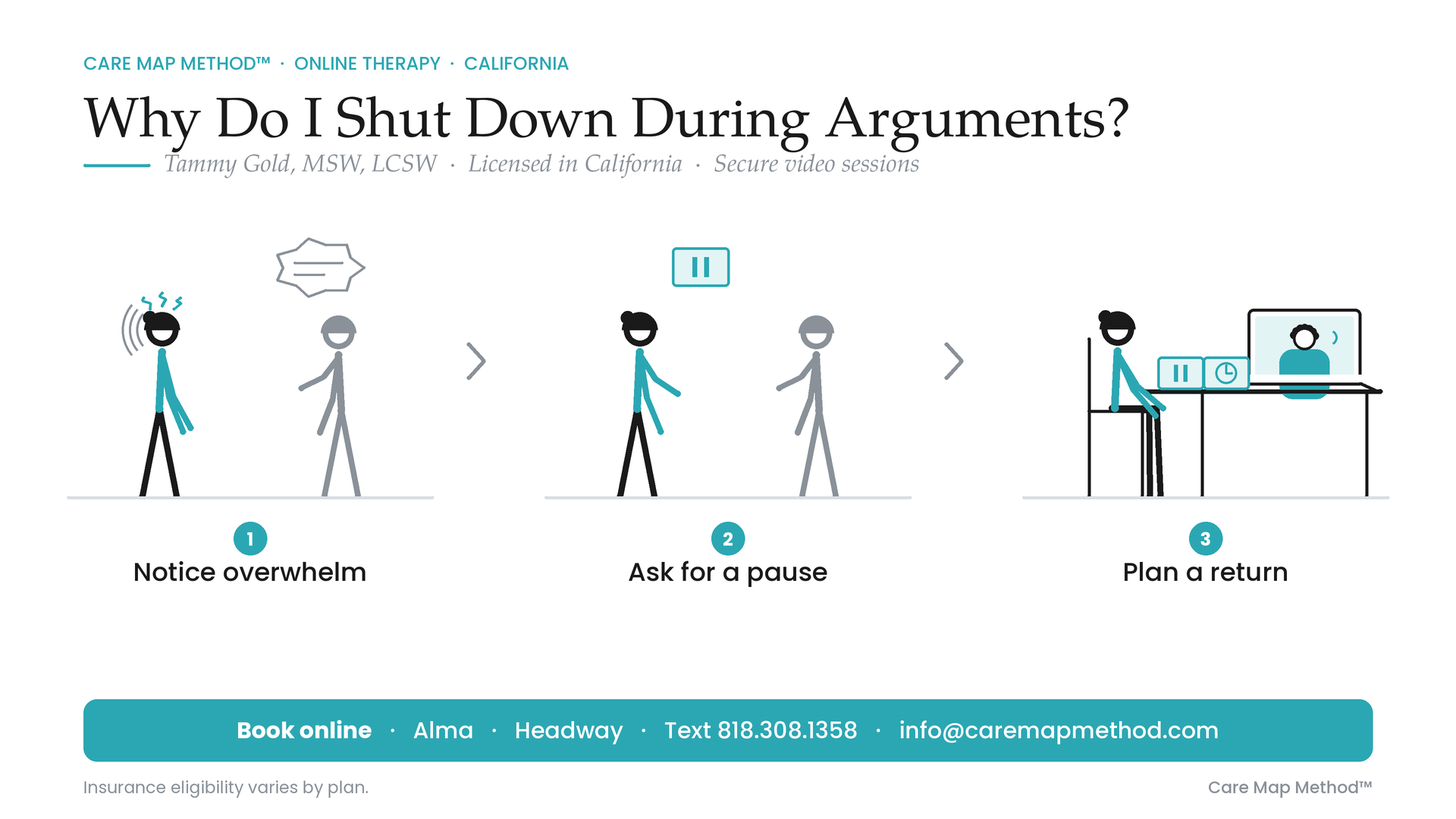
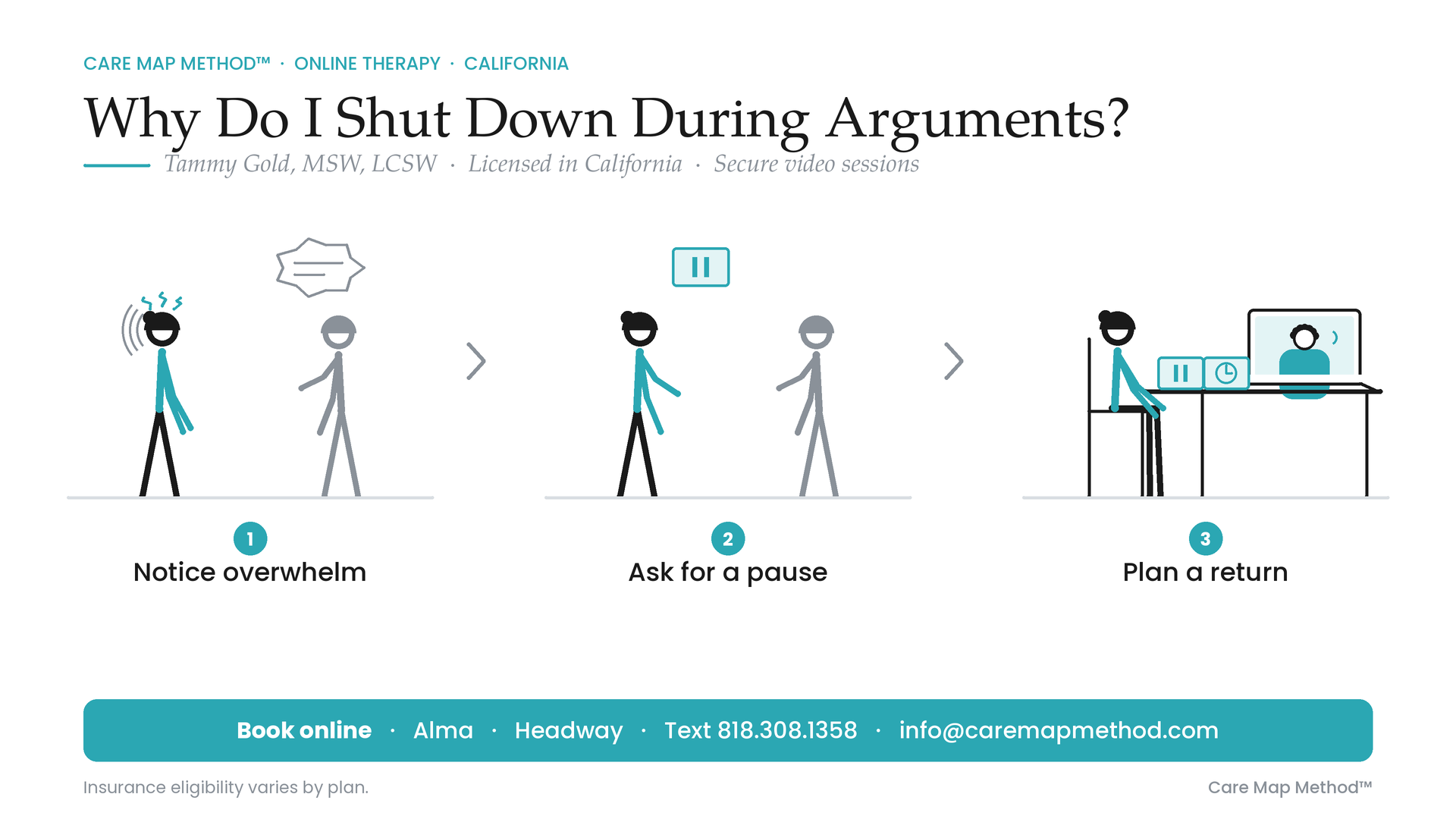
An adult recognizing tension during a conversation, then writing a short pause request and a return time with a therapist on a laptop.
When going quiet does not feel like a choice
An argument starts, and suddenly you cannot think clearly. You might become silent, struggle to speak, or agree just to make the conversation stop. Your partner may read this as indifference while you feel overwhelmed inside. Afterward, the original issue remains unresolved.
I am Tammy Gold, LCSW, and I offer online individual therapy in California. We can explore what happens for you during conflict, including feelings, physical sensations, thoughts, and relationship context. Going quiet does not tell us the cause on its own. Assessment helps us understand what support fits.
Understand what happens before the silence
We might look at a recent argument in detail. Was there a change in tone, a particular phrase, fear of saying the wrong thing, or a sense that there was no way to respond safely? Were you exhausted before the conversation began? What happened when you tried to pause?
We can work on noticing earlier signs of overload, putting words to your experience, and distinguishing a useful break from withdrawing without explanation. Your needs matter, and so does what happens after the break. The goal is to develop more options for responding, not force you to continue a conversation when you cannot participate safely or thoughtfully.
Map the trigger and prepare a different response
Care Map Method™ helps organize our work alongside clinical assessment. Biological factors may include fatigue or physical tension. Emotional factors might include fear, shame, or hurt. Social and Environmental factors include relationship history, expectations, timing, and privacy.
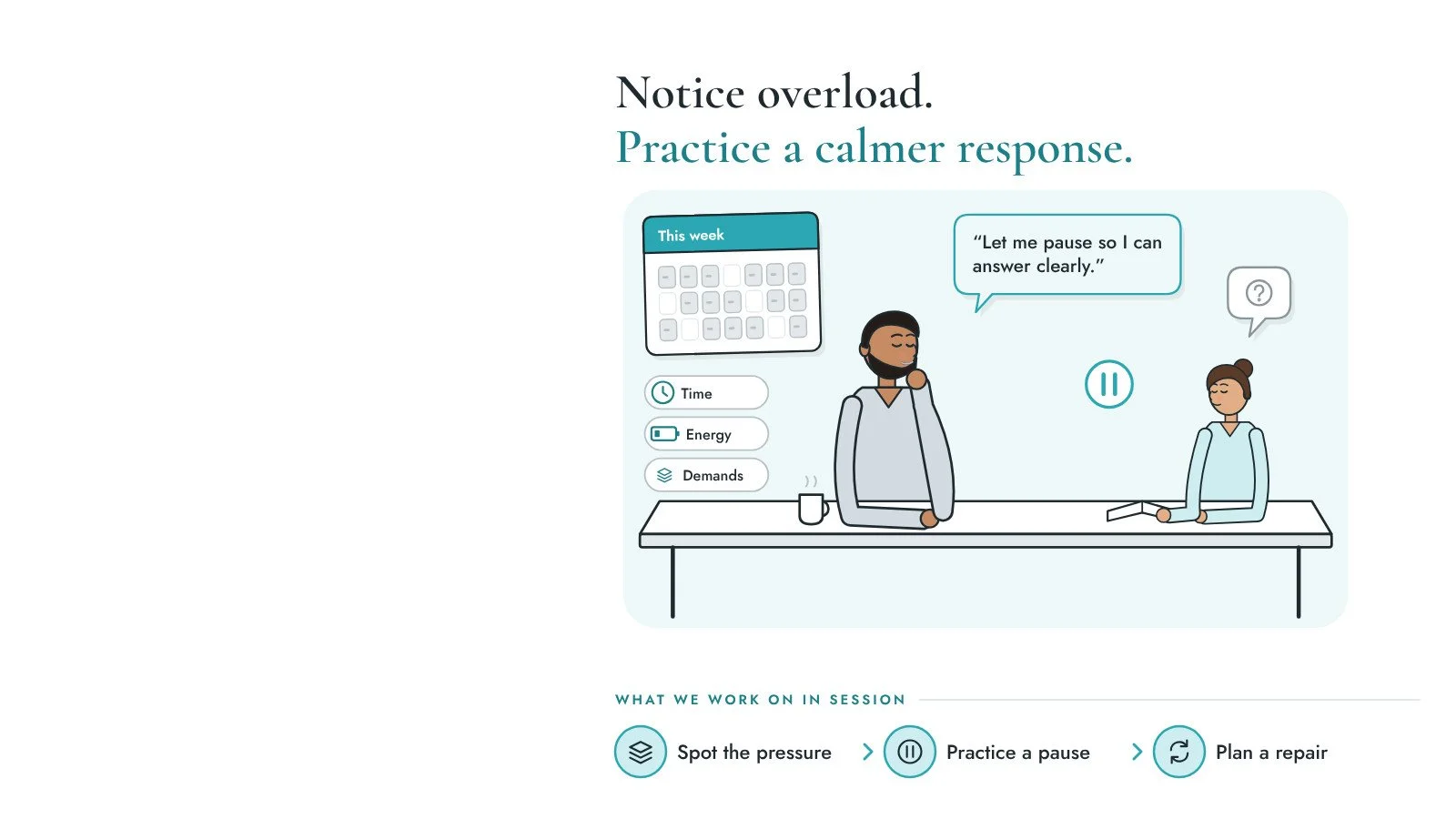
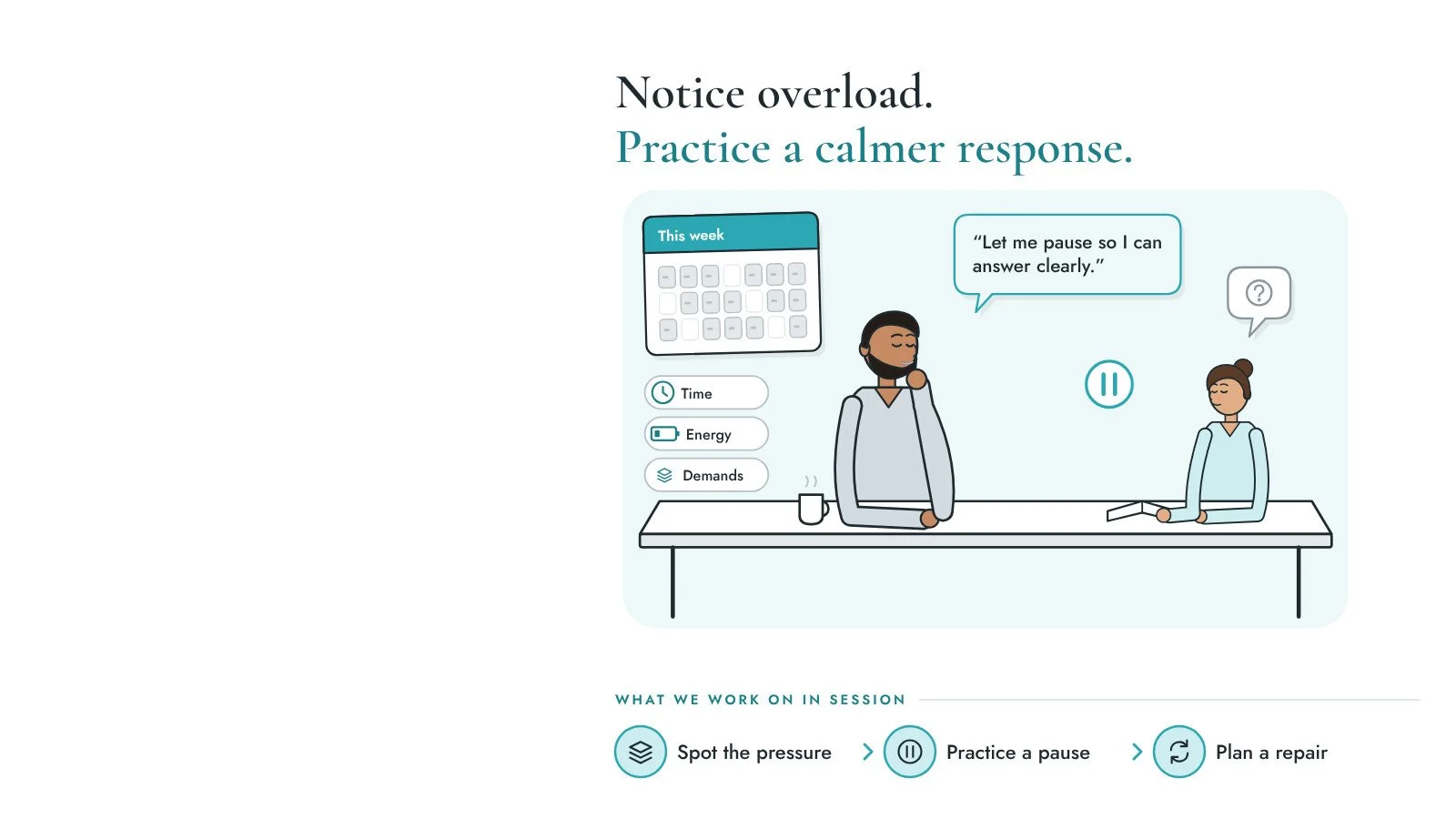
MAP the point where you begin to lose your words. MATCH the need with a strategy, such as grounding, a clear pause, or writing down one sentence. MERGE the strategy by practicing it before a difficult moment. MANAGE communication and responses by reviewing whether the plan helped and what made it difficult. We can adjust the pace and explore the history behind the reaction.
Practice a pause with a return plan
One possible phrase is: “I want to talk about this, and I am having trouble thinking clearly. Can we pause and choose a time to return?” In therapy, we can make that wording more natural for you and discuss what a workable return looks like. A pause should not become a way to avoid every difficult topic.
When conflict involves intimidation or fear, communication practice alone may not be appropriate; we will consider safety and the kind of help needed. We can review progress through earlier recognition of overload, increased ability to express a need, and follow-through on returning to conversations. Progress is individual, and setbacks give us information to work with.
Insurance and next steps
Eligible Anthem Blue Cross or Aetna members in California can use my Headway profile to check their specific plan, estimated costs, and appointment options. Benefits and network participation vary. Coverage depends on clinical assessment and the service provided. This page describes individual psychotherapy; couples sessions, coaching, mediation, and other services require separate confirmation.
You do not need to have the whole situation figured out before reaching out. We can begin by understanding what is most difficult and deciding whether this service is a good fit.
Does shutting down mean I have trauma?
Not necessarily. Silence or overwhelm during conflict can have different explanations. We consider your history, current circumstances, symptoms, and safety without assigning a diagnosis based on one behavior.
Can I work on this without my partner?
Yes. Individual therapy can help you understand your responses and practice coping and communication skills. Changes in a relationship also depend on the other person’s behavior, which individual therapy cannot control.
What will we discuss at the first session?
We explore your concern, relevant history, symptoms, supports, and goals. You can describe a recent argument if you feel comfortable. You do not need to relive every painful experience or find the perfect words immediately.
Can Anthem Blue Cross or Aetna cover sessions?
Headway can check your exact California plan and estimate costs. Coverage depends on benefits, network participation, clinical assessment, and the service. This page describes individual psychotherapy, not a guarantee of couples counseling coverage.
Should I force myself to stay in the argument?
No single rule fits every situation. We can consider what happens during the interaction and develop an appropriate pause or response. If you feel threatened, safety takes priority over completing a conversation.
How do I start?
Use “Check Insurance and Availability on Headway” to explore an appointment for California individual therapy. Bring a general sense of what is happening. We can clarify the pattern together rather than expect you to explain it perfectly.
About Tammy Gold
Tamara “Tammy” Gold, MSW, LCSW, CEC, is a Columbia University–trained clinical social worker, University of Pennsylvania graduate, certified coach, and founder of Care Map Method™. She is the author of Secrets of the Nanny Whisperer and brings more than 20 years of direct family work. Her therapy style is warm, collaborative, and practical, with attention to emotions, history, and everyday functioning.
My Adult Child Will Not Speak to Me
When an adult child stops communicating, grief can mix with confusion, anger, shame, and hope. You may reread messages, wonder whether to reach out again, or feel unable to talk openly with friends. Individual therapy gives you space to process the loss and examine your own experience without assuming either person is entirely to blame. I offer online therapy for adults located in Maine. We can explore accountability, boundaries, daily coping, and what respectful contact might look like if it is appropriate. Therapy cannot promise reconciliation. Use my Alma profile to check availability and your specific insurance benefits.
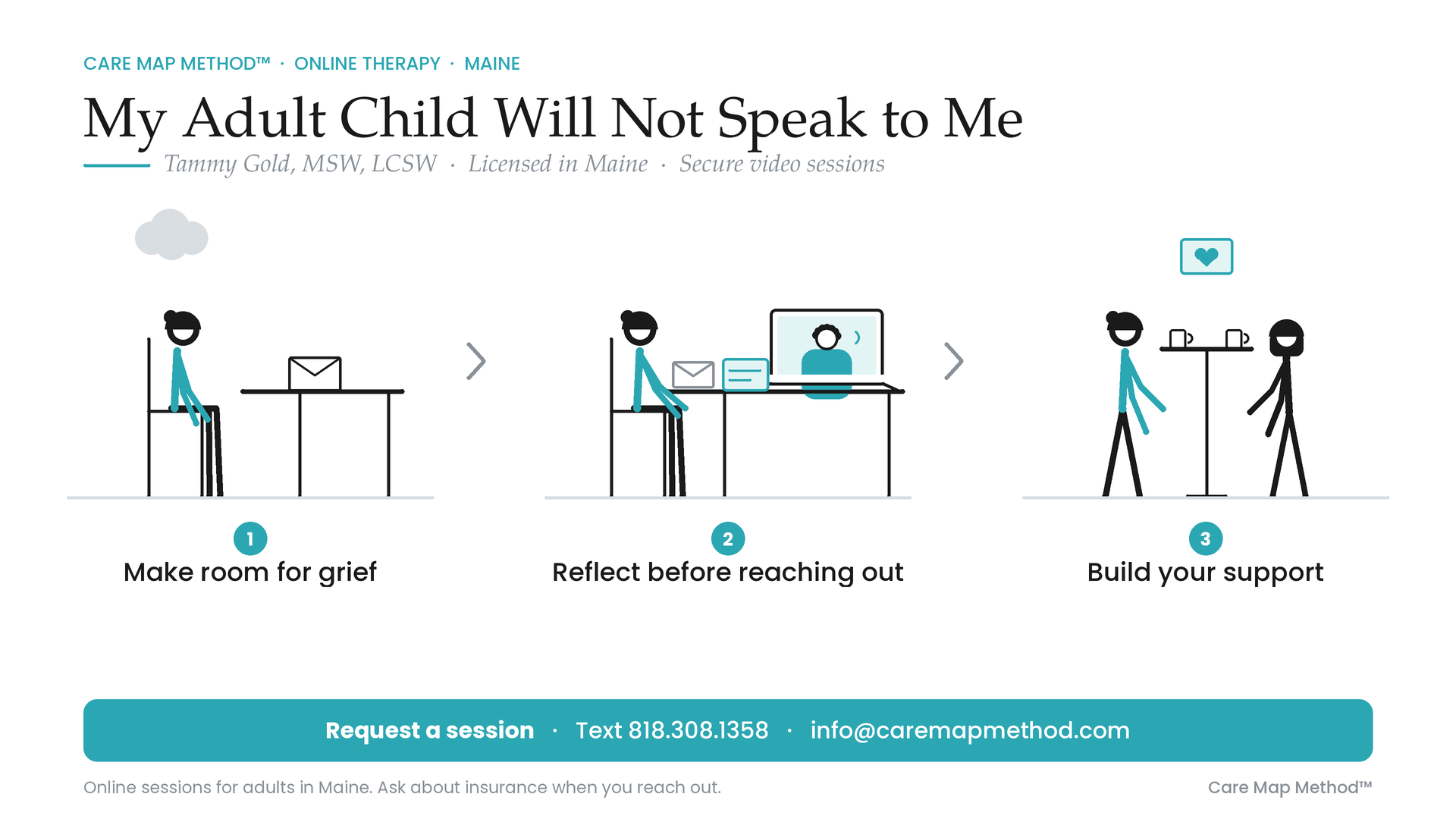
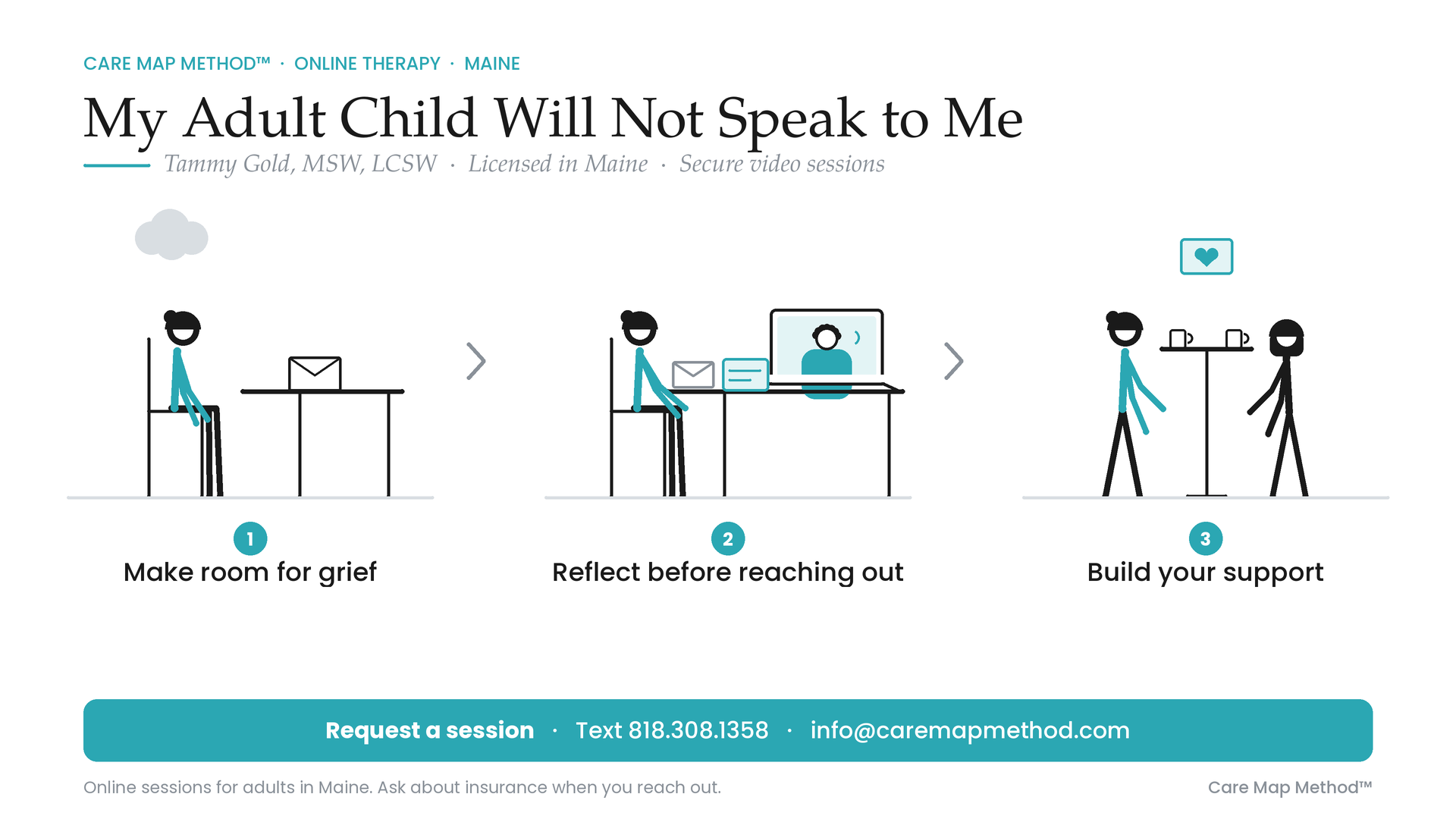
An adult setting aside an unsent letter while talking with a therapist on a laptop; another small scene shows the adult reconnecting with a supportive friend.
When there is no clear ending and no clear way forward
You may still think of your adult child throughout the day while having little or no contact. Holidays, photographs, or an ordinary family question can bring a fresh wave of sadness. You might alternate between wanting to explain yourself and feeling afraid that any message will make things worse.
I am Tammy Gold, LCSW. I offer online individual therapy for adults physically located in Maine. We can make room for the grief, uncertainty, and complicated feelings without rushing you toward forgiveness, repeated contact, or a particular family outcome.
Explore your experience without deciding the whole story
We can discuss how the estrangement affects mood, sleep, concentration, relationships, and daily life. We can also explore the history you bring, what your child has communicated, what you understand, and what remains unclear. Taking your pain seriously does not require dismissing their perspective.
Depending on your needs, sessions may involve grief, responsibility, limits, or the urge to keep seeking an answer. We can distinguish reflection that helps you learn from repetitive self-blame that keeps you stuck. We will not diagnose an absent family member or assume that a particular message will bring them back.
Use Care Map Method to organize what needs attention
Alongside clinical assessment, the Biological, Emotional, Social, and Environmental lens helps us consider how you are sleeping and functioning, the feelings involved, your support system, and situations such as holidays or social media that intensify distress.
MAP the trigger, such as seeing a photograph or receiving no reply. MATCH the need with a strategy for grief, support, accountability, or a boundary. MERGE that strategy into daily life, perhaps by preparing for a holiday or changing a checking habit. MANAGE communication and responses by reviewing what supports you and respects the other person’s limits. The framework is not a reconciliation protocol.
Consider contact carefully and rebuild support
Before sending a message, try writing an unsent version. What is its purpose? Does it acknowledge anything you can take responsibility for? Does it ask your child to manage your distress? Has your child requested no contact? We can examine these questions without assuming sending the message is the right next step.
Progress may involve fewer hours spent checking for a reply, more support outside the relationship, or greater ability to tolerate uncertainty. You can grieve and still participate in your own life. We will review what is helping you function and cope, while recognizing that renewed contact depends on more than your individual therapy work.
Insurance and next steps
I offer online individual therapy through Alma for eligible clients located in Maine. Use my profile to check your specific insurance plan, estimated cost, and appointment options. Network participation and benefits vary. Insurance coverage depends on assessment and the service provided; a concern named on this page does not automatically establish a covered diagnosis.
You do not need to have the whole situation figured out before reaching out. We can begin by understanding what is most difficult and deciding whether this service is a good fit.
Frequently asked questions
Can therapy make my adult child reconnect?
No. Therapy cannot guarantee contact or reconciliation. It can support your coping, reflection, accountability, boundaries, and choices about communication. Your adult child’s decisions and stated limits remain outside your control.
Do you take the parent’s side?
I work with you as the client while remaining open to complexity and missing information. We can take your pain seriously and explore responsibility without treating therapy as a judgment about who is entirely right or wrong.
What will we discuss first?
We begin with what is happening now, how it affects you, relevant history, supports, symptoms, and safety. You do not need to bring every message or prove your account. We can decide together what information is useful.
Can I use my insurance?
My Alma profile can check your exact Maine plan and estimated costs. Coverage depends on benefits, participation, clinical assessment, and the psychotherapy service. Support for estrangement does not automatically mean family mediation or reunification services are covered.
Can my adult child join later?
Any involvement would need a separate discussion of consent, goals, confidentiality, and suitability. We do not assume that inviting them is appropriate or that individual therapy automatically becomes family therapy.
How do I start individual support?
Use “View Maine Availability on Alma” to explore an appointment. A general description of your concern is enough for an initial inquiry. You can begin even if you are unsure what you want to do about the relationship.
About Tammy Gold
Tamara “Tammy” Gold, MSW, LCSW, CEC, is a Columbia University–trained clinical social worker, University of Pennsylvania graduate, certified coach, and founder of Care Map Method™. She is the author of Secrets of the Nanny Whisperer and brings more than 20 years of direct family work. Her therapy style is warm, collaborative, and practical, with attention to emotions, history, and everyday functioning.
Online Therapy in Maine for Parenting and Relationship Stress
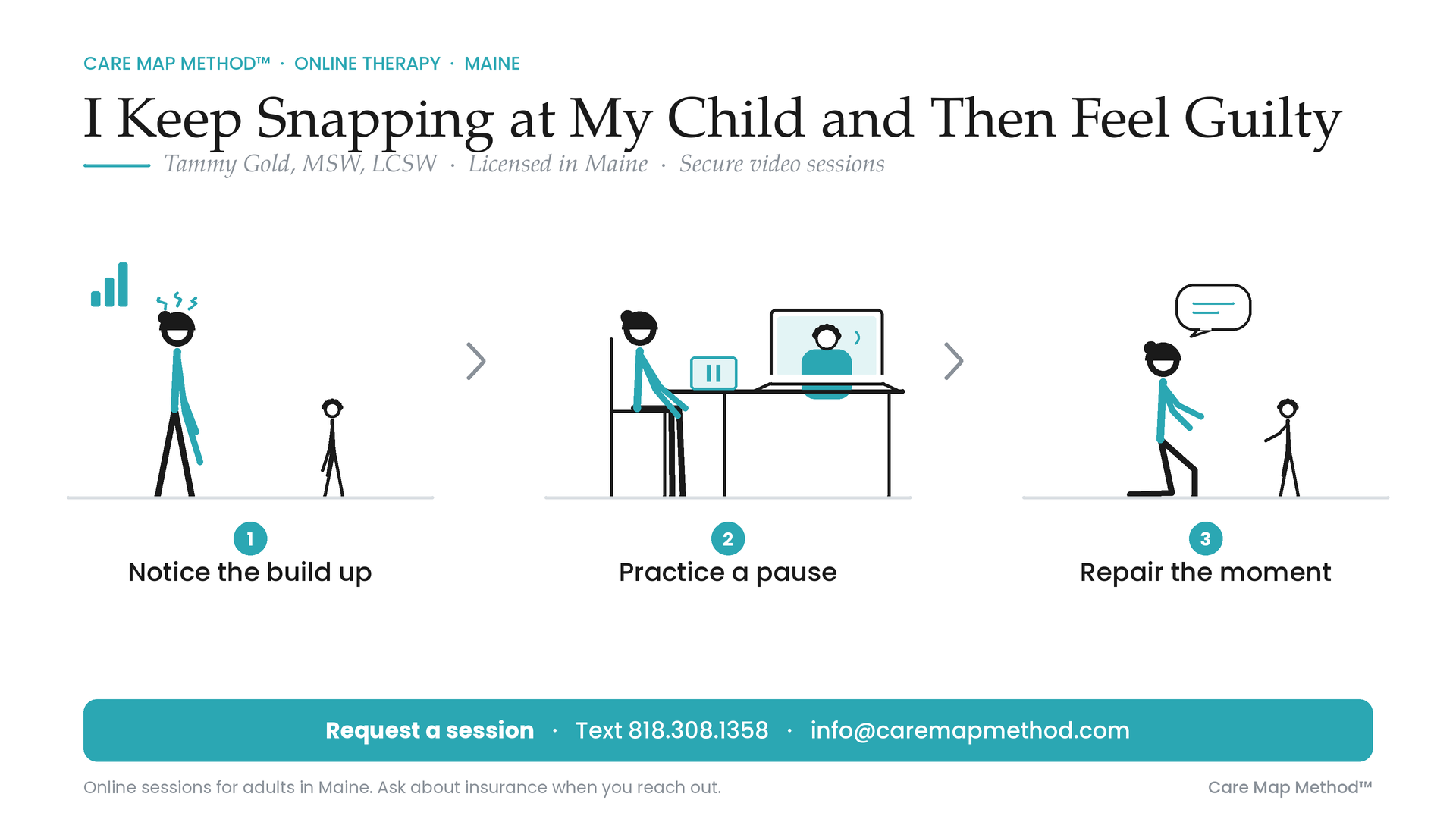
You promise yourself you will be more patient, then a rushed morning or repeated request ends in snapping. Later, guilt takes over. You may care deeply about your child and still need support with the pressures affecting your reactions. In online individual therapy for parents in Maine, we can explore what builds up before these moments, identify the feelings and needs underneath them, and practice responding and repairing. This is therapy for the parent’s well-being, with room for your history, stress, and relationships. View my Alma profile to check availability and your specific insurance eligibility.
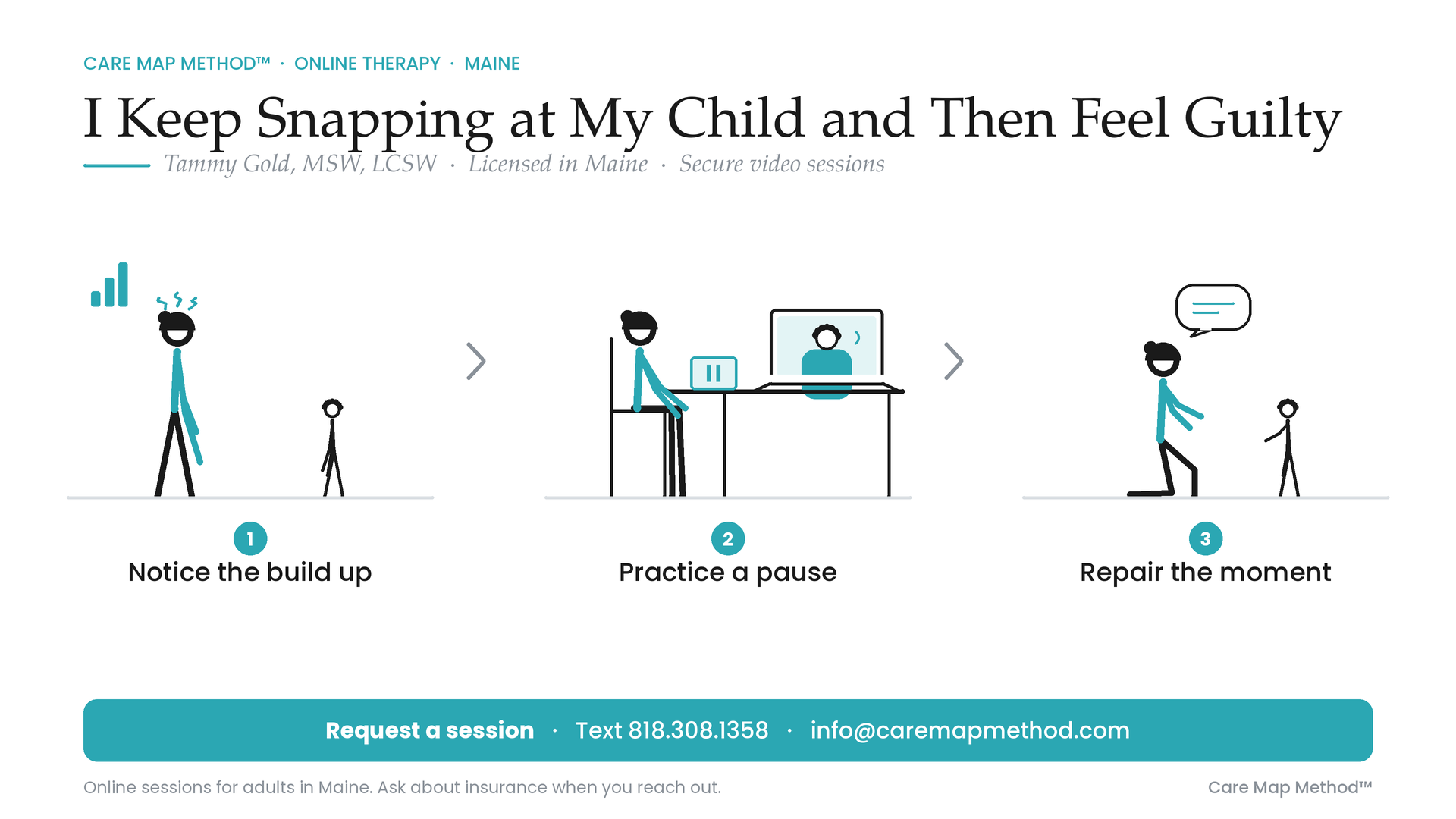
A parent pausing before responding, then sitting at a child’s level for a brief repair conversation; a separate small therapy scene shows the parent rehearsing words.
You care about your child and want a different response
You hear yourself raising your voice, and it is not how you wanted the morning to go. Perhaps everyone is late, you barely slept, and the same request has been ignored again. Afterward, you replay the interaction and worry about what it says about you as a parent.
I am Tammy Gold, LCSW. I offer online individual therapy for parents physically located in Maine. We can make room for the guilt without using it to define you. We also take the interaction seriously and work on what could help you respond differently.
Look at what builds before the moment
Parenting stress can involve competing demands, relationship tension, worry about your child, limited support, and expectations you place on yourself. We will also consider symptoms, health concerns, and relevant history rather than assume the problem is simply a lack of parenting techniques.
In sessions, we might review the hour before an outburst. What demands were arriving? What did you tell yourself about the behavior? Were you feeling ignored, unsupported, or afraid of losing control? Understanding that sequence can help us identify an earlier point to intervene. We can also explore the family patterns you hope to change and the support you need to do that.
Use the map to choose a manageable skill
Care Map Method™ organizes the concern alongside clinical assessment. Biological, Emotional, Social, and Environmental pressures include sleep and energy, guilt or frustration, family roles, and the daily setting in which difficult moments happen.
MAP the trigger and emotion before snapping. MATCH the need with a strategy, such as a pause, a shorter instruction, or a request for support. MERGE the strategy into one predictable situation, like leaving for school. MANAGE your responses by reviewing what happened and adjusting. We can explore deeper feelings as well as practical changes. The aim is not to expect perfect patience.
Practice repair and review realistic change
A repair might sound like: “I raised my voice. That was my responsibility. The limit still matters, and I want to say it differently.” We can adapt the language to your child’s age and the situation. Repair includes taking responsibility without making the child manage your guilt.
For a starting reflection, note one early sign that you are overloaded and one person or resource you might ask for help. We can review whether reactions become less intense or frequent, whether you notice overload sooner, and whether you recover and repair more effectively. If anger is becoming unsafe, we will address safety and appropriate support directly.
Insurance and next steps
I offer online individual therapy through Alma for eligible clients located in Maine. Use my profile to check your specific insurance plan, estimated cost, and appointment options. Network participation and benefits vary. Insurance coverage depends on assessment and the service provided; a concern named on this page does not automatically establish a covered diagnosis.
You do not need to have the whole situation figured out before reaching out. We can begin by understanding what is most difficult and deciding whether this service is a good fit.
Frequently asked questions
Does snapping mean I am a bad parent?
A difficult interaction does not define your whole relationship. It still deserves attention, especially if it repeats or feels out of control. We can explore your distress, accountability, and the support and skills you need.
Is this therapy for me or my child?
This page describes individual psychotherapy for the adult parent. We can discuss your parenting experiences and emotional responses. Assessment or treatment of your child would be a separate service and is not included automatically.
What happens during the first session?
We discuss current stress, symptoms, relevant history, family context, supports, and safety. You can share a recent parenting moment without preparing a complete explanation. We begin agreeing on priorities and whether the service fits.
Can I use insurance through Alma?
Check your specific Maine plan through my Alma profile. Coverage depends on active network participation, benefits, assessment, and the service provided. Parenting stress alone does not automatically establish an insurance-covered diagnosis or service.
Do you give parenting advice or explore emotions?
Our psychotherapy work can include emotional exploration, assessment, coping, and practical rehearsal. The balance depends on your needs. Standalone parenting coaching or childcare consulting is a different service with separate arrangements.
How do I request an appointment?
Use “View Maine Availability on Alma” to explore scheduling and benefits. If you need another time, use the profile’s contact option. Please keep detailed clinical information out of an initial general inquiry.
About Tammy Gold
Tamara “Tammy” Gold, MSW, LCSW, CEC, is a Columbia University–trained clinical social worker, University of Pennsylvania graduate, certified coach, and founder of Care Map Method™. She is the author of Secrets of the Nanny Whisperer and brings more than 20 years of direct family work. Her therapy style is warm, collaborative, and practical, with attention to emotions, history, and everyday functioning.
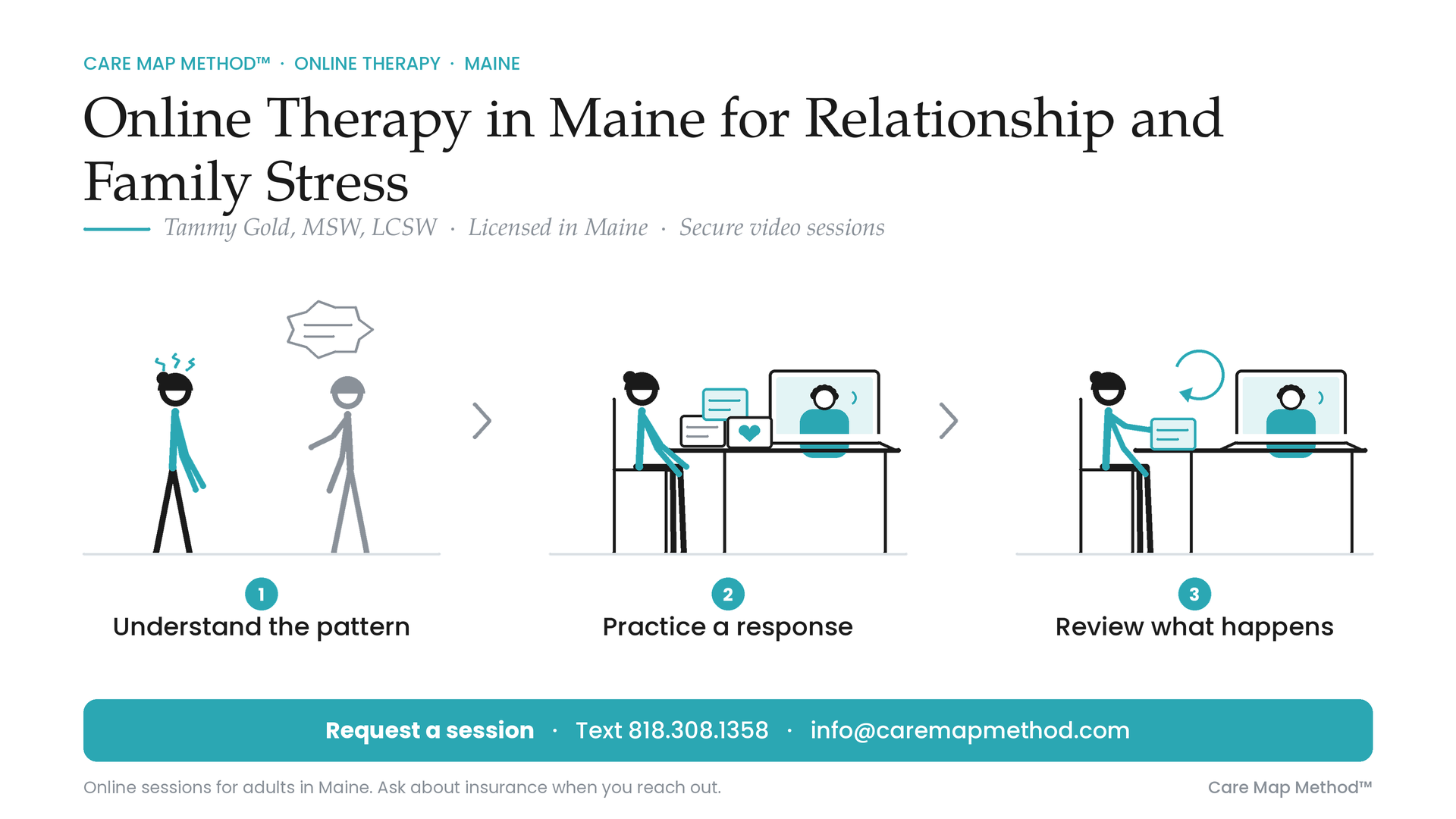
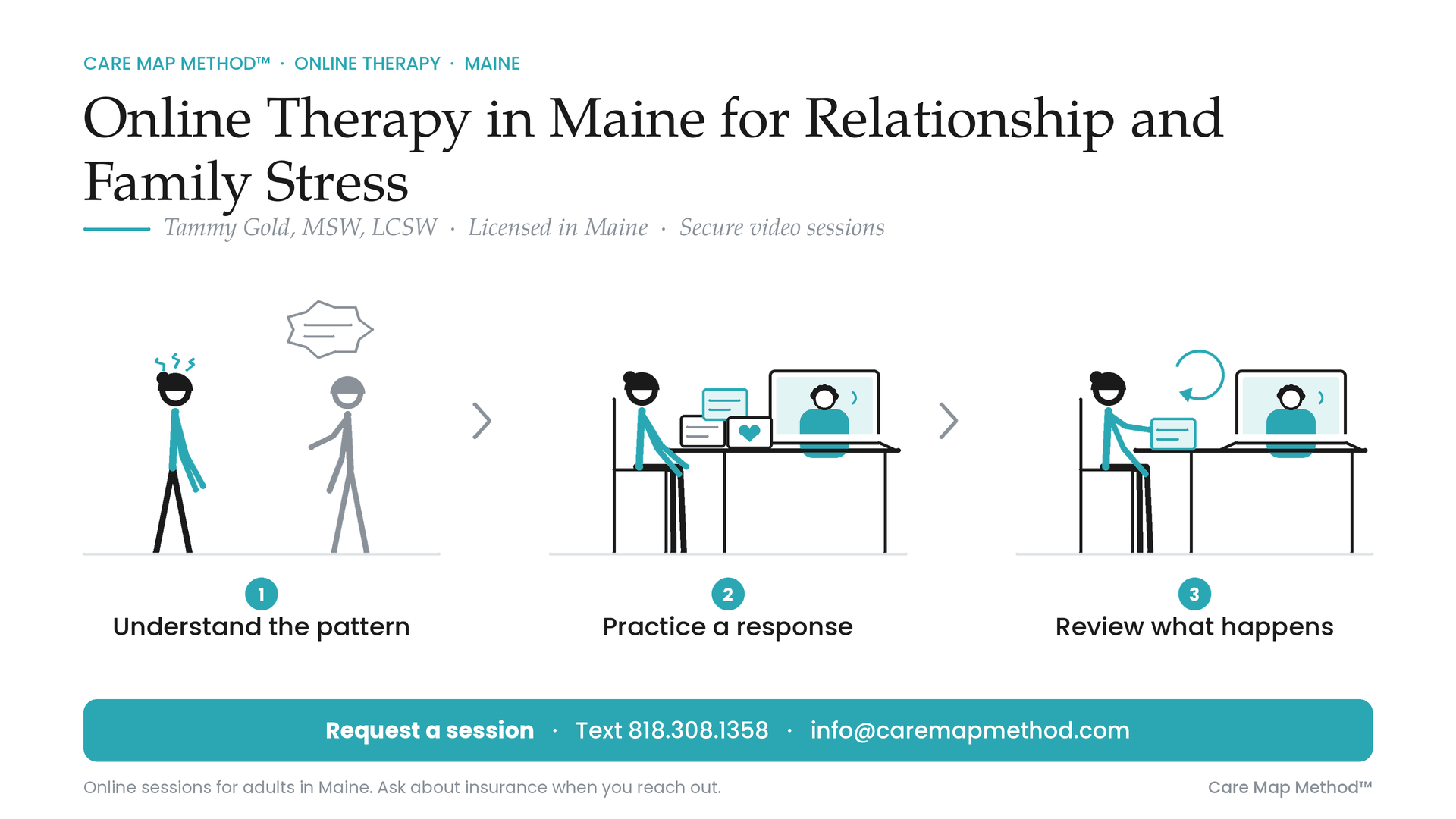
Online Therapy in Maine for Relationship and Family Stress
You may be keeping everything moving while feeling increasingly overwhelmed inside. Perhaps the same argument keeps returning, parenting takes more patience than you have left, or caring for a parent leaves little time for your own needs. I offer online individual therapy for adults located in Maine. Together, we can understand the pressures behind difficult moments and practice communication, boundaries, and coping skills that fit your life. My approach combines room for your emotions and history with practical work you can try between sessions. View my Alma profile to explore availability and check your specific insurance benefits.
When your responsibilities leave little room for you
You finish the day, but your mind is still running. You replay a conversation, worry about someone you love, or wonder why a small request brought such a strong reaction. You may look capable to everyone else while feeling worn down, resentful, or disconnected.
I am Tamara “Tammy” Gold, MSW, LCSW, CEC. I provide online individual therapy for adults physically located in Maine. You can come for support with your own distress even when the problem involves a partner, child, sibling, parent, or coworker. We begin with your experience and what you would like to change.
What we can work on together
Our work may focus on recurring arguments, parenting overwhelm, caregiver guilt, difficulty saying no, divorce adjustment, or stress during a major family transition. We can explore how these concerns affect your mood, sleep, concentration, relationships, and daily functioning.
In a session, we might examine one recent interaction rather than trying to solve your entire family situation at once. What did you hear? What did it mean to you? What did you need? We can practice turning “Nobody helps me” into a specific request, or prepare a boundary you have been avoiding. Your history and emotions matter throughout this work.
A practical framework for understanding the pattern
I use Care Map Method™ as an organizing framework alongside clinical assessment and individualized psychotherapy. Biological, Emotional, Social, and Environmental factors help us consider the whole situation, including sleep, health pressures, feelings, relationships, routines, and available support.
MAP the emotion and trigger: identify what happened and the meaning you attached to it. MATCH the need with a strategy: choose a coping skill, request, or boundary that addresses the concern. MERGE the strategy into daily life: rehearse the words and decide when to use them. MANAGE communication and responses: review what happened and adjust. The framework supports our work; it is not a guarantee or a separately validated treatment.
A place to begin and a way to review progress
Before your first session, consider finishing this sentence: “One situation I would like to handle differently is…” Choose a recent example and describe what happens before, during, and after it. You do not need a polished explanation or a diagnosis to reach out.
We will agree on priorities and revisit whether therapy is helping. Progress might include recovering sooner after an argument, communicating a need more directly, or noticing overwhelm before it becomes snapping. We can also review symptoms and daily functioning. If something is not helping, I want us to discuss it and change the approach.
Insurance and next steps
I offer online individual therapy through Alma for eligible clients located in Maine. Use my profile to check your specific insurance plan, estimated cost, and appointment options. Network participation and benefits vary. Insurance coverage depends on assessment and the service provided; a concern named on this page does not automatically establish a covered diagnosis.
You do not need to have the whole situation figured out before reaching out. We can begin by understanding what is most difficult and deciding whether this service is a good fit.
Do I need a major crisis to start therapy?
No. Ongoing worry, resentment, relationship strain, or difficulty coping can be reasons to seek an assessment. We will discuss what is happening, how it affects your life, and whether individual psychotherapy is a suitable service.
Can I attend without my partner or family?
Yes. Individual therapy can address your emotions, coping, communication, and decisions even when another person is not attending. We cannot control that person’s behavior or promise family agreement.
What happens in the first session?
We discuss your concerns, relevant history, current supports, symptoms, safety, and goals. You can ask questions about my approach. We begin deciding what to focus on and whether we are a good fit.
Can I use insurance through Alma?
Visit my Alma profile and enter your specific plan to check eligibility and estimated cost. State participation, network status, benefits, and the service provided matter. A carrier’s name alone does not establish coverage.
Do I need to live in a particular Maine city?
Sessions are online for eligible adults physically located in Maine at the time of the appointment. You need a private setting and a reliable connection. Tell me about travel before a session so we can check whether care can continue.
How do I request an appointment?
Use the “View Maine Availability on Alma” button to explore scheduling and insurance options. If the available times do not work, use the contact option on my profile to ask about availability. Avoid sending sensitive clinical details in a general inquiry.
About Tammy Gold
Tamara “Tammy” Gold, MSW, LCSW, CEC, is a Columbia University–trained clinical social worker, University of Pennsylvania graduate, certified coach, and founder of Care Map Method™. She is the author of Secrets of the Nanny Whisperer and brings more than 20 years of direct family work. Her therapy style is warm, collaborative, and practical, with attention to emotions, history, and everyday functioning.
Caregiver Guilt and Boundaries Therapy in Oregon
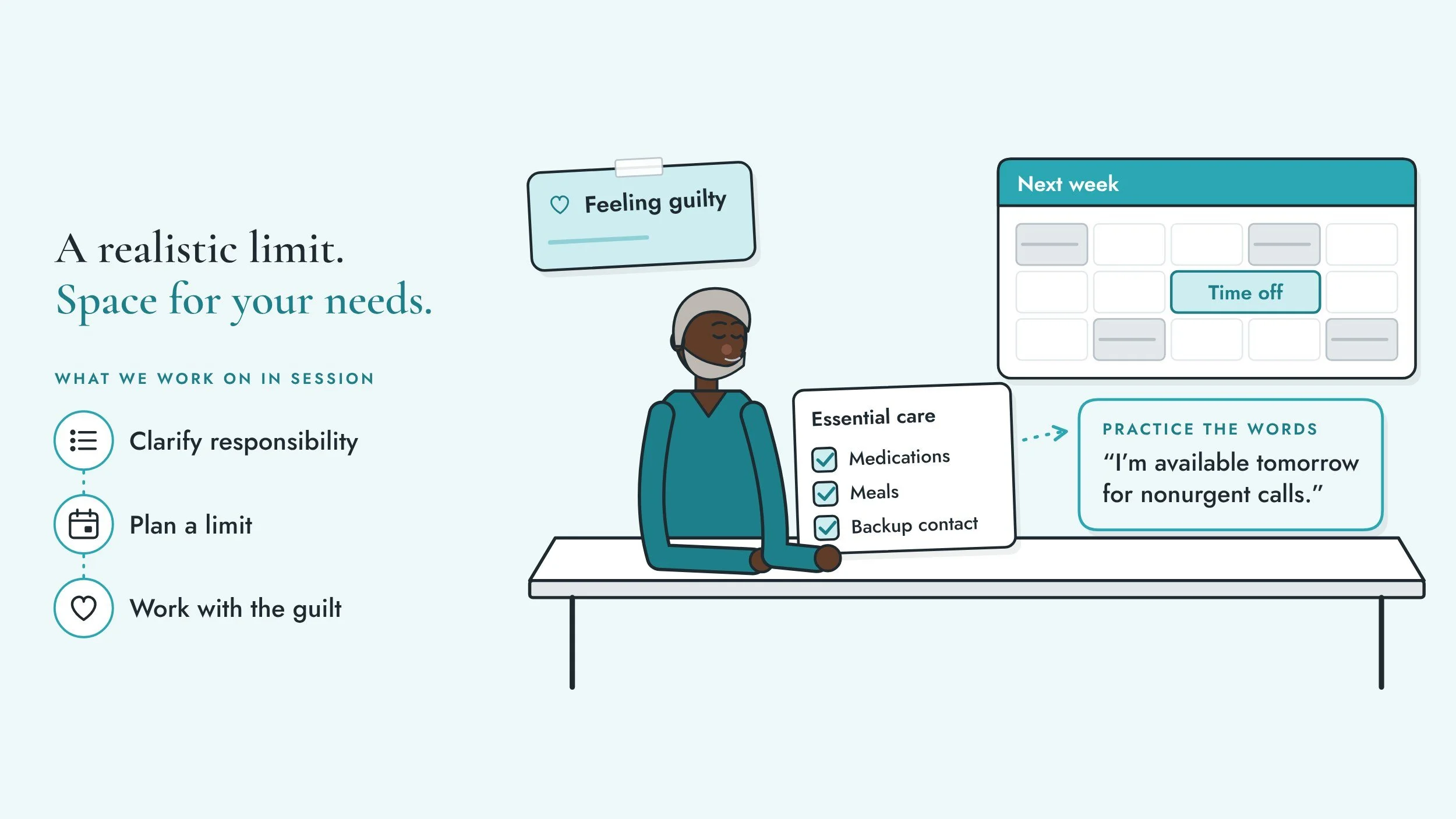
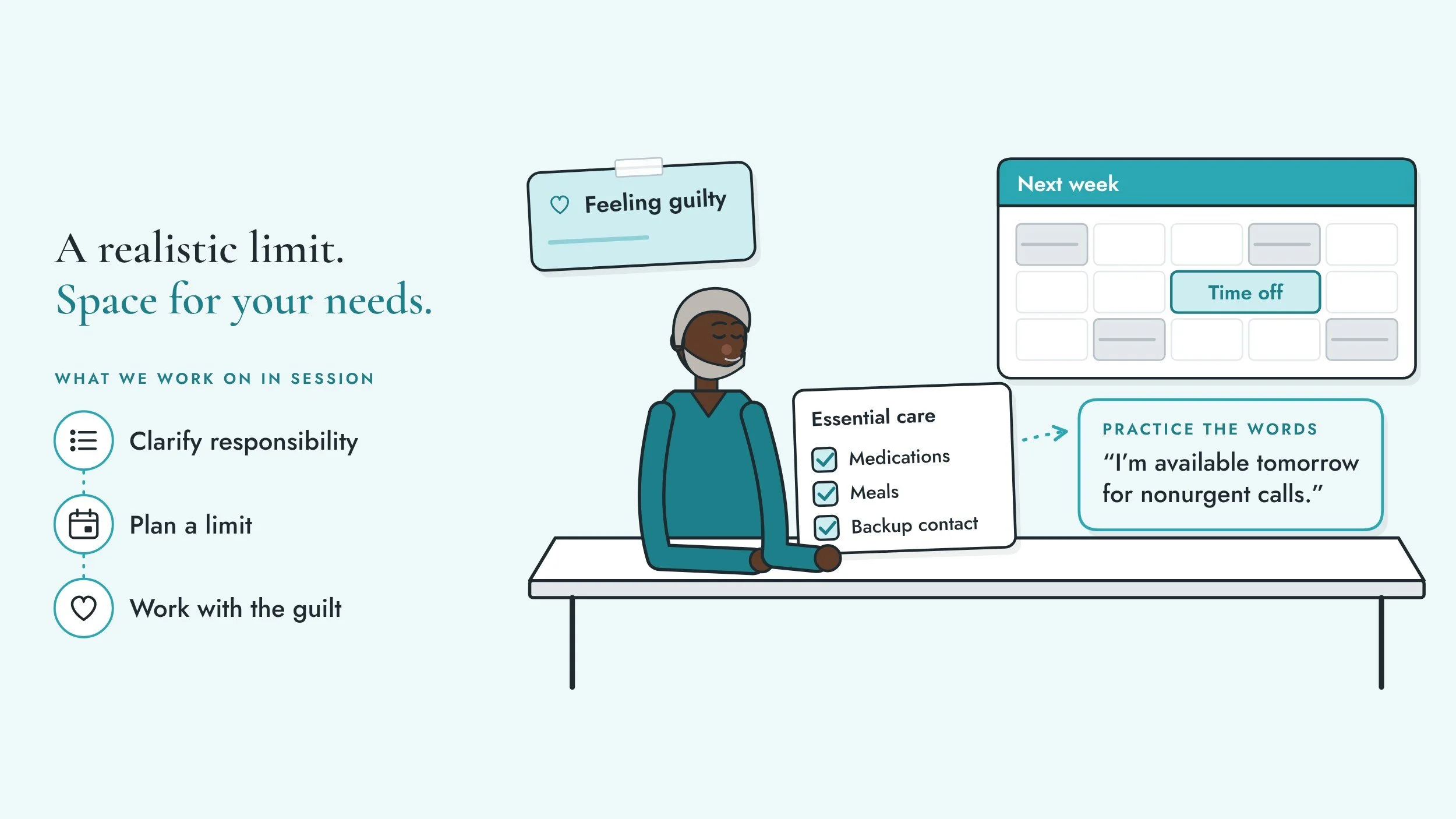
Do you feel guilty as soon as you plan a break from caring for your parent? Perhaps you cancel your own plans, check repeatedly when care is already arranged, or feel responsible for preventing every uncomfortable moment. In online caregiver guilt and boundaries therapy in Oregon, we can explore what you are responsible for and the standards you expect yourself to meet. Together, we can consider essential care needs, practice communicating your availability, and prepare for the urge to take a reasonable limit back. Care Map Method helps us connect the feelings underneath guilt with a plan that respects your circumstances. I’m Tammy Gold, LCSW. We can work toward decisions that include your needs while making room for grief, family expectations, and the difficult choices that caregiving sometimes requires.
Care about your parent while making room for your own needs
You plan a break, then start wondering whether you should cancel it. You set a limit, then worry that something will happen while you are unavailable. Caregiver guilt can keep you working long after you have reached your limit. Therapy gives us space to understand that guilt and consider what responsibility looks like in the situation you actually face.
Perhaps you compare yourself with a sibling, feel responsible for a parent’s loneliness, or believe that needing rest means you are not doing enough. A parent’s disappointment may feel harder to tolerate than your own exhaustion. We can focus on the emotional meaning of those moments and the choices that remain available to you.
Check benefits and availability
Distinguish a real obligation from an impossible standard
We can examine what your parent needs, what you have agreed to provide, and the expectations you place on yourself. Some responsibilities require a practical plan; others may reflect a belief that you should prevent every difficulty or uncomfortable feeling. Understanding that difference can help us address guilt without dismissing the real demands of caregiving.
Prepare a boundary with a practical plan
A useful limit needs to account for genuine care needs and available support. We can practice how to communicate a time you are unavailable, identify what counts as urgent, and consider who or what resource can address essential needs. We will avoid suggesting a break that depends on leaving a necessary responsibility unattended. The emotional work and the practical circumstances need to fit together.
Work through the urge to reverse the decision
After setting a limit, you may want to call repeatedly, apologize, or give up your plans. We can explore the fear behind that urge and choose how to respond to it. We can also make room for sadness about what your parent can no longer do and for the discomfort of accepting that care sometimes involves difficult choices rather than a solution everyone likes.
An example of the work
For example, you might want one evening each week without nonurgent calls. We could explore the guilt this brings up, discuss essential care arrangements, and rehearse a message about your availability. After trying it, we could review whether the plan was workable and how you handled the feelings afterward.
What progress can look like
Progress might mean distinguishing urgency from guilt, maintaining a realistic commitment, checking less often when care is arranged, or speaking more honestly about what you can offer. Your parent’s needs and your limits may change, and the plan can change with them.
How Care Map Method supports our work
Map the emotion and trigger. We look at a recent moment and the biological, emotional, social, and environmental pressures around it. The aim is to understand your experience before choosing a response.
Match the need with a strategy. We identify what matters in that moment and select a skill or next step that fits. That might be a clearer request, a pause, a boundary, or space to process a loss.
Merge the skill into daily life. We can rehearse the words and decide when you might use them. Any practice between sessions is chosen together and adjusted to your circumstances.
Manage responses over time. We review what happened, what was difficult, and what needs to change. Therapy includes room for feelings and history as well as practical work.
About Tammy Gold
I’m Tamara “Tammy” Gold, MSW, LCSW, founder of Care Map Method™ and author of Secrets of the Nanny Whisperer. I earned my MSW at Columbia University and my BA at the University of Pennsylvania. My work with families informs a warm, active approach to therapy that makes room for your emotional experience and practical concerns.
Common questions
Is this different from general caregiver burnout therapy? This page focuses specifically on guilt, responsibility, and maintaining limits. If your main concern is overall exhaustion or grief, we can discuss that too and choose the most useful focus.
Does a boundary mean I care less? A limit does not measure the depth of your care. We can examine the meaning you attach to it and whether the plan accounts for real needs and your available capacity.
What if my parent says I am selfish? We can work on how that affects you, practice a response, and consider the history of the relationship. We cannot guarantee your parent will agree with or welcome your limit.
Do you arrange replacement caregivers? This page describes psychotherapy. Staffing, placement, and care coordination are separate services. Therapy can help you address the emotions and communication involved in seeking practical help.
Can I use BCBS of Massachusetts while in Oregon? Your exact product and Oregon network eligibility must be checked through my Alma profile. The carrier name alone does not establish coverage, and your location and benefits both matter.
Can I start even if I cannot change the workload yet? Yes. We can address guilt, grief, expectations, and coping while acknowledging the limits on practical change. We will develop goals that fit the resources you actually have.
Take the next step
If this sounds familiar, you can explore online therapy with me while located in Oregon. Open my Alma profile to check your exact insurance benefits and appointment options. We will discuss your concerns, clinical needs, and goals to determine fit.
Therapy for Parents of Teens in Oregon
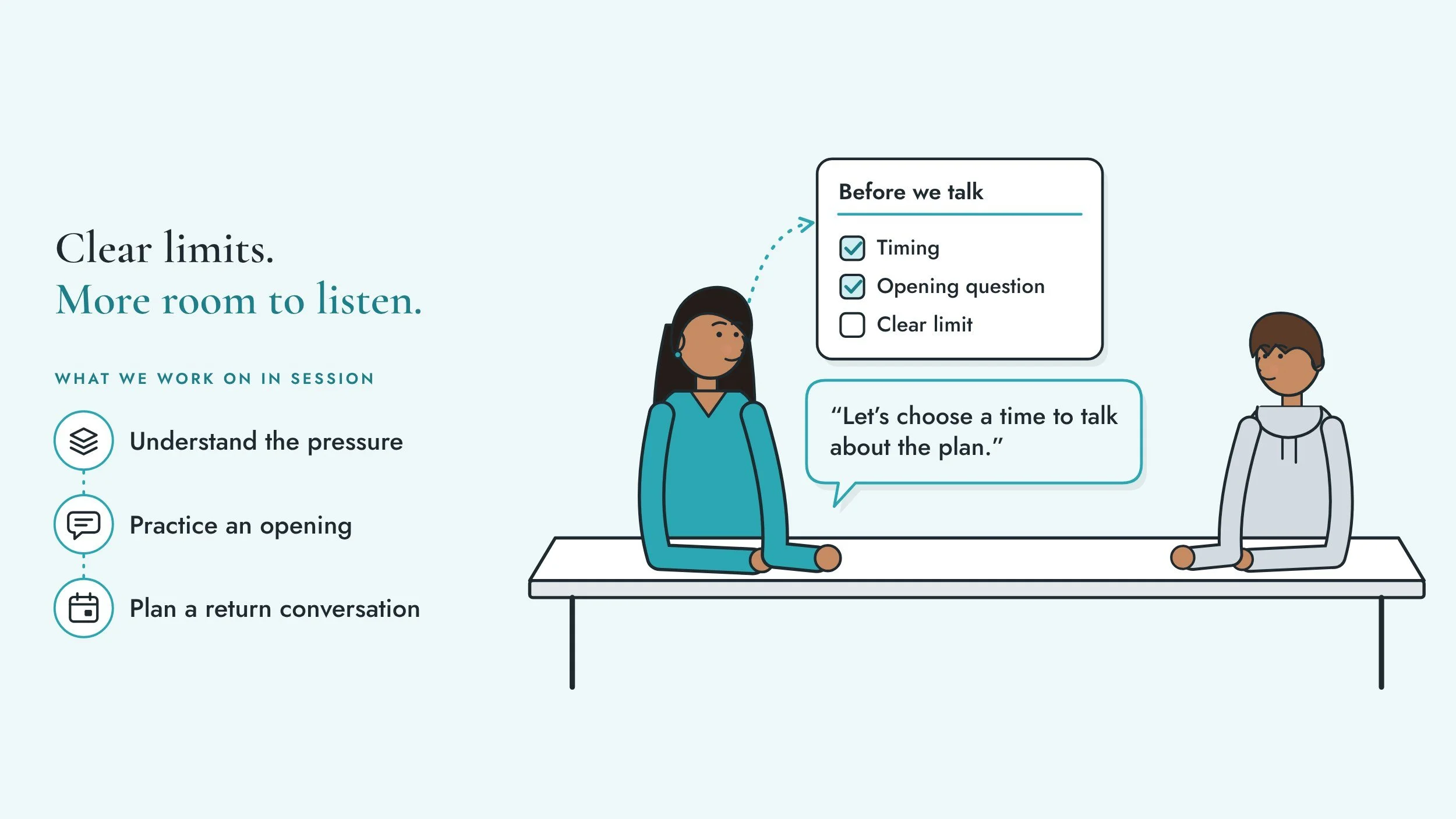
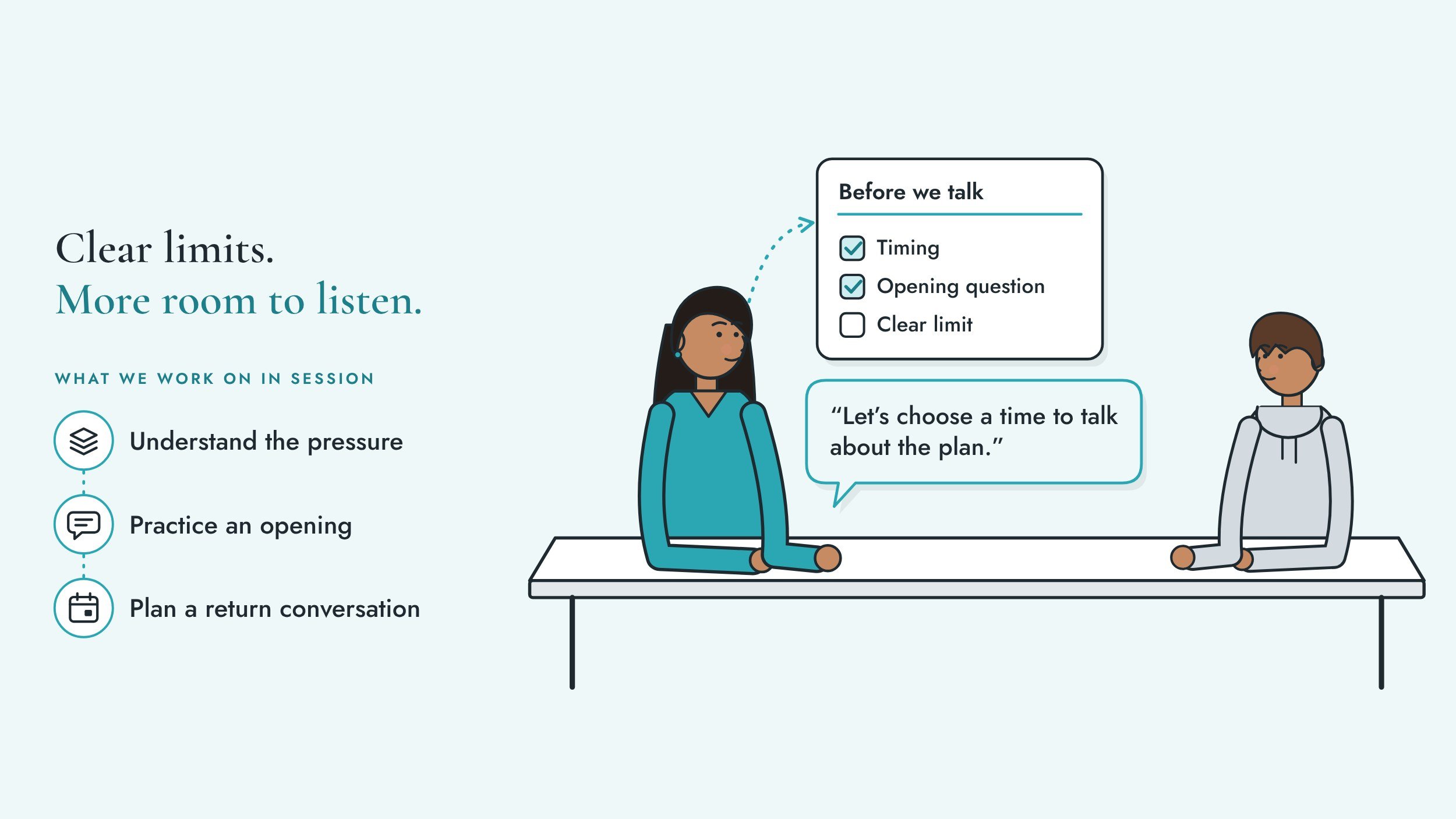
Does a question about school, homework, or weekend plans quickly turn into an argument with your teenager? You may want to stay connected while feeling unsure how to handle withdrawal, disagreement, or growing independence. Online therapy for parents of teens in Oregon focuses on your emotional health and the responses available to you. We can look at what happens before the conflict, what you are worried about, and how timing or repeated questions affect the exchange. Using Care Map Method, we consider biological, emotional, social, and environmental pressures, then practice an opening, a clear limit, or a way to return to the discussion after a pause. I’m Tammy Gold, LCSW. These sessions give you space to work through your own reactions while developing communication that fits your family and respects your teenager’s changing needs.
Stay connected while you work through difficult conversations
You ask about school, a phone, or a plan for the weekend, and suddenly you are arguing. You want to keep your teenager safe, but the conversation leaves both of you upset. Therapy for you as the parent can help you understand the pattern, manage your own reactions, and practice a way to be clear without turning every concern into a prolonged conflict.
You may alternate between being very firm and giving in because you are tired. Perhaps your teen’s withdrawal feels personal, or worry makes you ask the same question repeatedly. You might disagree with another caregiver about rules. We can look at what is happening in your family and choose one interaction to work on first.
Check benefits and availability
Map what happens around the conflict
We can consider biological, emotional, social, and environmental pressures: fatigue, your own stress, peer changes, the timing of a conversation, and the demands of the day. These questions help us understand context without excusing harmful behavior or assuming we know what your teen feels. We can identify what you have observed and what may need further assessment.
Practice an opening and a limit
We can rehearse a question that invites information and a limit you can explain briefly. For example, a discussion about getting home on time may work better when it addresses one agreement rather than every concern about independence. We can explore what to do if your teen disagrees and how to keep your response consistent with your priorities.
Work on repair and parental worry
A hard interaction does not have to determine the rest of the day. We can practice acknowledging your part, returning to the practical issue, and choosing when to listen. We also make room for fear, grief about a changing relationship, and experiences from your own adolescence that may affect how you respond. Your emotional needs deserve attention alongside parenting strategies.
An example of the work
For example, if questions about homework lead to yelling, we could examine when you ask, what you are afraid will happen, and how the exchange escalates. You might practice a different opening and a brief return plan if either person needs a pause. We would review what actually happens at home.
What progress can look like
Progress may include fewer repeated questions, a clearer limit, a shorter recovery after disagreement, or a conversation in which you learn something new. The goal is to strengthen your choices and communication while recognizing your teen’s growing independence.
How Care Map Method supports our work
Map the emotion and trigger. We look at a recent moment and the biological, emotional, social, and environmental pressures around it. The aim is to understand your experience before choosing a response.
Match the need with a strategy. We identify what matters in that moment and select a skill or next step that fits. That might be a clearer request, a pause, a boundary, or space to process a loss.
Merge the skill into daily life. We can rehearse the words and decide when you might use them. Any practice between sessions is chosen together and adjusted to your circumstances.
Manage responses over time. We review what happened, what was difficult, and what needs to change. Therapy includes room for feelings and history as well as practical work.
About Tammy Gold
I’m Tammy Gold, MSW, LCSW, founder of Care Map Method™ and author of Secrets of the Nanny Whisperer. I earned my MSW at Columbia University and my BA at the University of Pennsylvania. My work with families informs a warm, active approach to therapy that makes room for your emotional experience and practical concerns.
Common questions
Does my teen have to attend? No. This page describes individual therapy for the parent. We focus on your emotional health, communication, and responses. Treatment for your teen would require a separate assessment and arrangement.
Can this help if my teen will not talk? We can explore how you approach contact, what you do when worried, and how to leave room for communication. Therapy cannot require or guarantee that your teen will open up.
Will you tell me which rules to use? We can consider your values, the concern involved, and what you can reasonably follow through on. Strategies should fit your family and any relevant clinical or safety needs.
What if another caregiver disagrees? We can work on your response and prepare a discussion about one shared priority. Sessions with multiple caregivers would require a separate conversation about the purpose and format of care.
Can I use Regence insurance? Check your exact Regence BlueCross BlueShield of Oregon product through my Headway profile. Network participation, clinical eligibility, and your financial responsibility need to be confirmed.
What is a useful first goal? Choose a recurring situation, such as homework reminders or curfew discussions, and describe what you would like to do differently. We can begin with a goal focused on your own response.
Take the next step
If this sounds familiar, you can explore online therapy with me while located in Oregon. Open my Headway profile to check your exact insurance benefits and appointment options. We will discuss your concerns, clinical needs, and goals to determine fit.
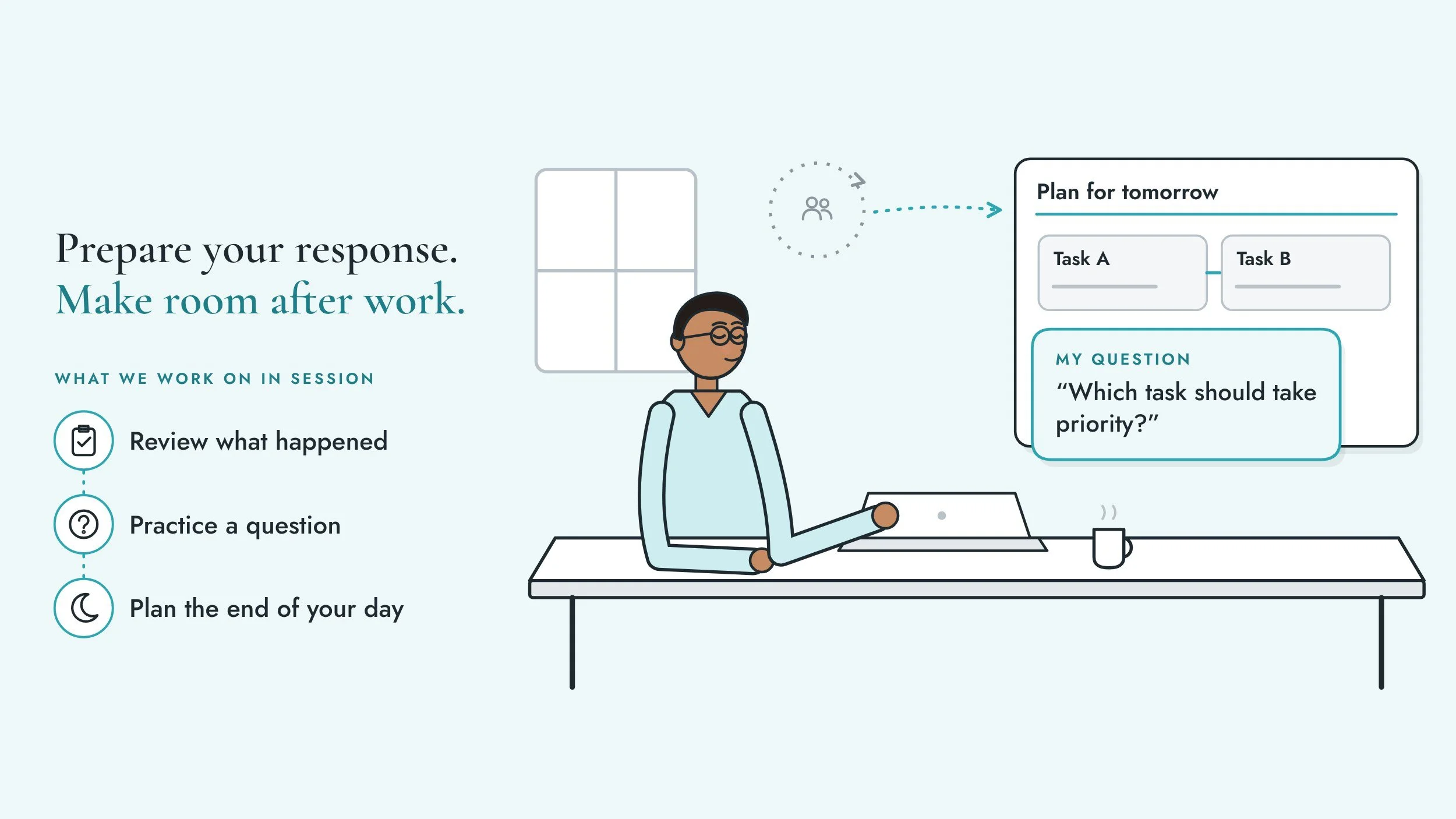
Workplace Stress Therapy in New Jersey
The meeting ended hours ago, but you are still replaying what your boss said. You may rewrite messages, avoid asking questions, or check notifications because you are worried about being misunderstood. In online workplace stress therapy in New Jersey, we can explore what happened, what you fear it means, and how the reaction follows you home. Together, we can practice asking for clarification, discussing competing priorities, or responding to feedback in words that fit your role and circumstances. Care Map Method helps us connect the emotional pattern with a practical next step, while making room to consider whether the environment is meeting your needs. I’m Tammy Gold, LCSW. We can work on your confidence, boundaries, and transition out of work without assuming you can simply change jobs or ignore what is happening.
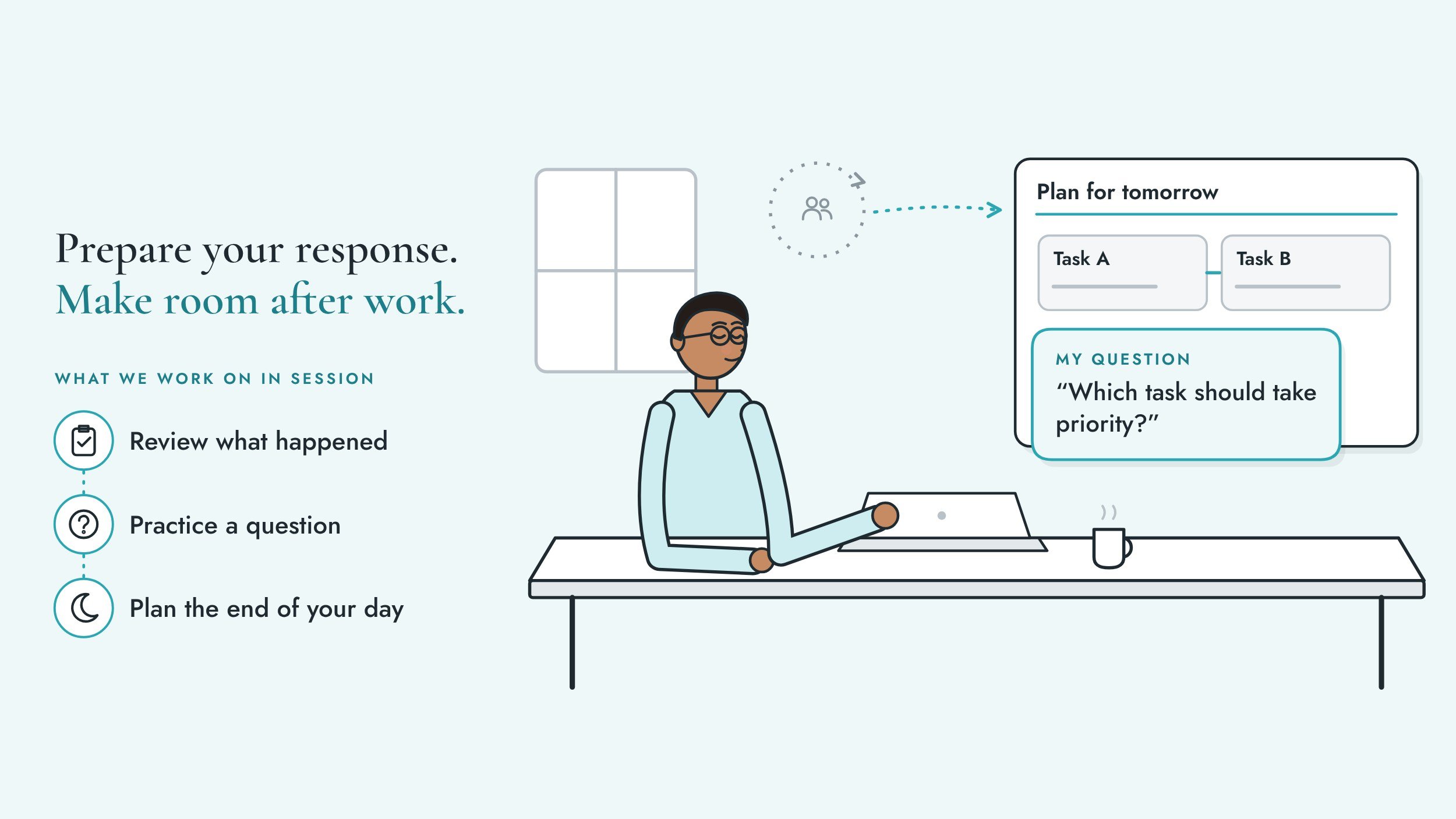
When the workday ends but the conversation keeps going in your head
You replay a meeting on the drive home, rewrite a message several times, or check work notifications because you are worried about what you missed. Conflict with a boss or coworker can affect sleep, confidence, and relationships outside work. Therapy can help you understand the emotional pattern and prepare a response that takes your circumstances seriously.
You may avoid asking a question, agree to work you cannot reasonably complete, or spend hours wondering how someone interpreted your words. Perhaps feedback feels crushing, or you are unsure whether the problem is a difficult environment, your own reactions, or both. We can examine specific events without jumping to a conclusion about you or your workplace.
Check benefits and availability
Separate the event from what you fear it means
We can review one interaction and distinguish what was said from the meaning you attached to it. That helps us identify uncertainty, past experiences, and actual workplace concerns. We may explore how your body responds to evaluation or conflict and what keeps you checking, avoiding, or mentally rehearsing long after the conversation ends.
Prepare a clear workplace conversation
We can practice asking for clarification, discussing priorities, or responding to feedback. For example, you might rehearse, “I can complete the report or the presentation by Friday. Which should take priority?” We can consider tone, timing, power differences, and possible consequences so that the plan fits your role and does not assume every workplace welcomes directness.
Work on the transition out of work
If work concerns occupy the entire evening, we can explore what keeps them active and choose a realistic way to close the day. That might include writing down a next action, setting a feasible notification limit, or examining a belief that constant availability protects you. We also make room for decisions about whether the role or environment continues to fit your needs.
An example of the work
For example, after a difficult performance conversation, we could identify the concrete feedback, explore the fear it triggered, and prepare two questions for your next meeting. You might also practice a way to pause the evening’s replay without expecting yourself to stop caring about your work.
What progress can look like
Progress may mean asking a question sooner, spending less time drafting messages, making a clearer decision about workload, or protecting part of your evening. Therapy can support your emotional health as you evaluate practical choices.
How Care Map Method supports our work
Map the emotion and trigger. We look at a recent moment and the biological, emotional, social, and environmental pressures around it. The aim is to understand your experience before choosing a response.
Match the need with a strategy. We identify what matters in that moment and select a skill or next step that fits. That might be a clearer request, a pause, a boundary, or space to process a loss.
Merge the skill into daily life. We can rehearse the words and decide when you might use them. Any practice between sessions is chosen together and adjusted to your circumstances.
Manage responses over time. We review what happened, what was difficult, and what needs to change. Therapy includes room for feelings and history as well as practical work.
About Tammy Gold
I’m Tammy Gold, MSW, LCSW, founder of Care Map Method™ and author of Secrets of the Nanny Whisperer. I earned my MSW at Columbia University and my BA at the University of Pennsylvania. My work with families informs a warm, active approach to therapy that makes room for your emotional experience and practical concerns.
Common questions
Is this career coaching? This page describes psychotherapy addressing the emotional effects of work stress. Resume services, business consulting, and career placement are separate from the therapy offered here.
Can we discuss a difficult boss? Yes. We can examine specific interactions, your reactions, and possible responses. We cannot diagnose someone we have not assessed or guarantee how an employer will respond.
Will therapy tell me to quit? We can explore your health, finances, needs, and options without assuming leaving is possible or necessary. Decisions should account for your actual circumstances.
Can you advise on discrimination or employment law? Therapy can support you emotionally while you consider next steps. Legal advice, workplace investigations, and human resources determinations require the appropriate professionals.
Can I use Quest Behavioral Health? A listed reimbursement rate does not establish that your exact network is available through my profile. Contact the practice and check Headway eligibility before scheduling with Quest coverage.
What should I bring? A recent example, the effect it had on you, and what you wish you could do differently are useful. You can discuss the situation without sharing confidential employer documents.
Take the next step
If this sounds familiar, you can explore online therapy with me while located in New Jersey. Open my Headway profile to check your exact insurance benefits and appointment options. We will discuss your concerns, clinical needs, and goals to determine fit.
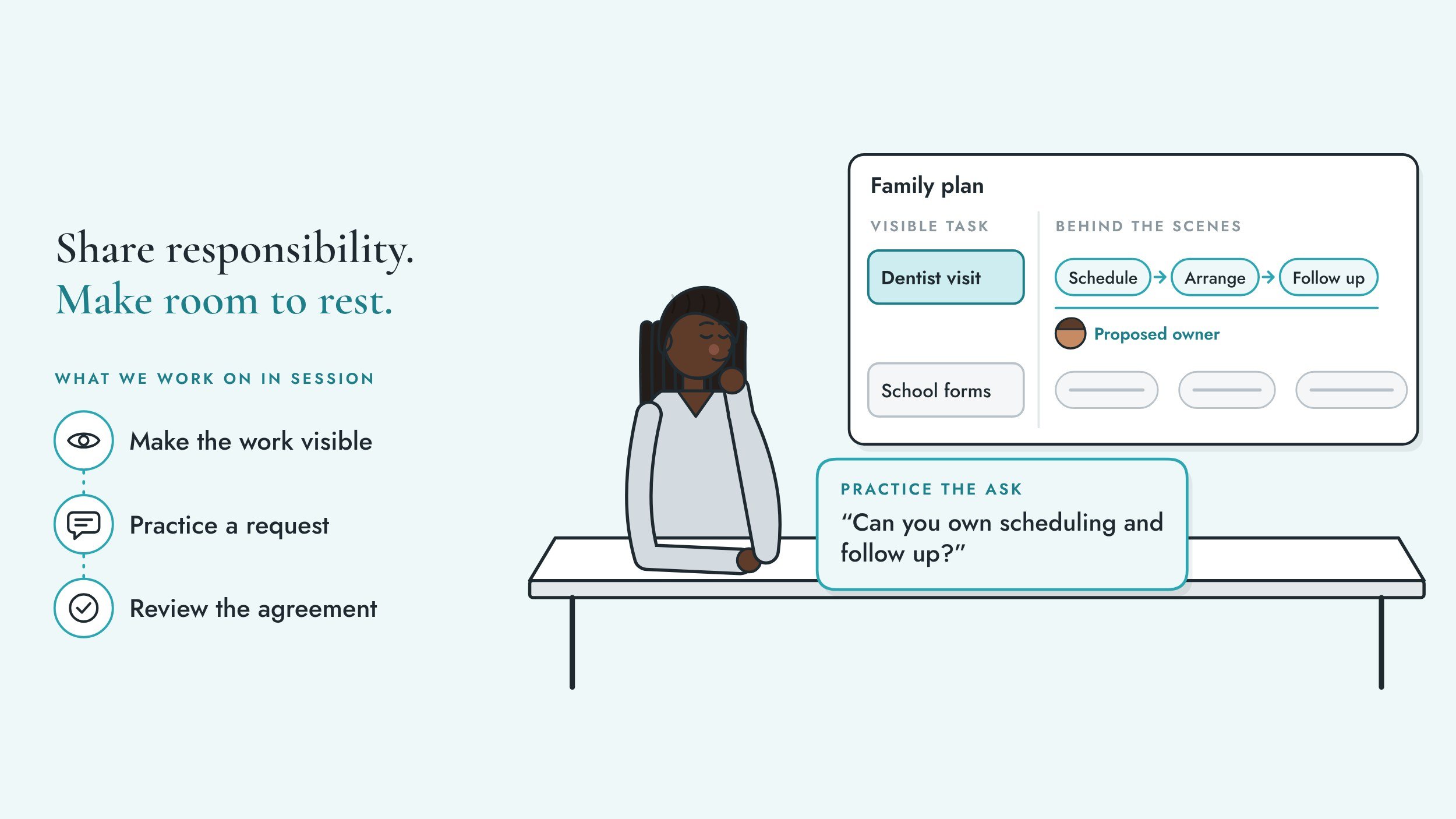
Divorce Adjustment Therapy in New Jersey
Are you the person who remembers the forms, notices what is running out, and follows up even when somebody else agrees to help? Carrying the family’s mental load can leave you feeling constantly on duty. Online individual therapy in New Jersey offers space to explore the resentment, worry, and exhaustion underneath that experience. We can make the planning work visible, examine what keeps responsibilities falling back on you, and practice a request about ownership of one task from beginning to end. Using Care Map Method, we can also work with perfectionism, difficulty letting go, or guilt about protecting time for yourself. I’m Tammy Gold, LCSW. Together, we can develop goals that fit the support you actually have and review whether the changes you try make a meaningful difference in your daily life.
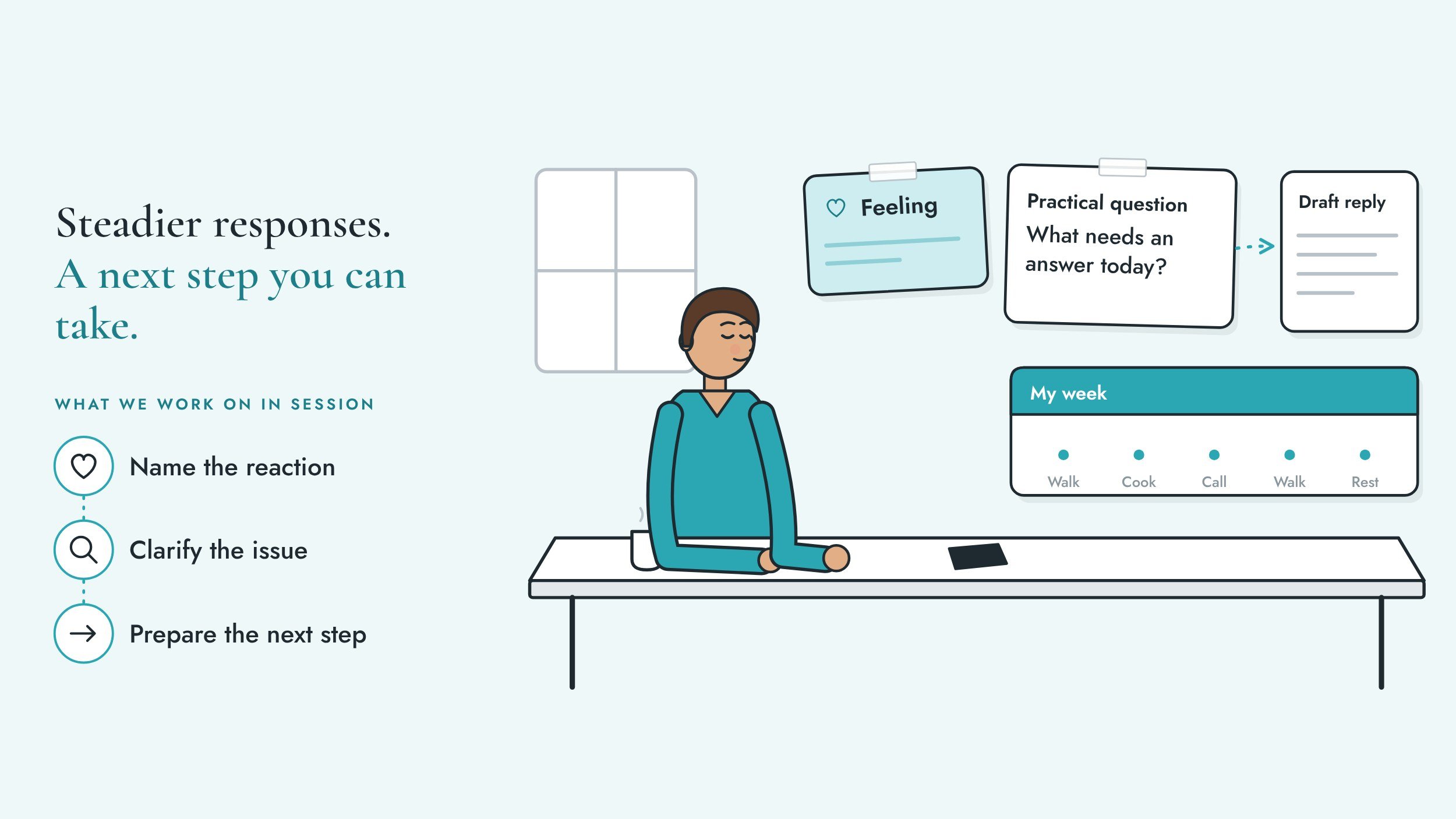
Find your footing while your relationships and routines change
Separation can change the shape of an ordinary day. A message from your former partner disrupts your concentration. A quiet house feels unfamiliar. You may be relieved about one part of the decision and grieving another. Therapy offers a place to work through those reactions while making the next week feel more manageable.
You may be struggling with uncertainty, anger, loneliness, changes in parenting time, or the feeling that your life is being defined by the conflict. Perhaps you want to stop replaying conversations or feel steadier before responding to messages. We can begin with the issue that is affecting you most now, even while larger questions remain unresolved.
Check benefits and availability
Give the losses and mixed feelings room
We can explore what has changed beyond the relationship itself: identity, routines, friendships, expectations, or your sense of security. You do not have to choose between feeling relieved and feeling sad. Understanding those reactions can help us identify the support you need and notice when self-criticism is making an already difficult adjustment harder.
Prepare for communication that affects your day
If contact with a former partner leaves you flooded or distracted, we can examine one exchange and practice how you want to respond. That may include pausing before answering a nonurgent message, keeping a practical request focused, or deciding when a discussion needs a different channel. Any communication plan needs to account for your real responsibilities and applicable arrangements.
Build routines around the life you have now
We can work on transitions that feel especially hard, such as evenings alone, parenting handoffs, or returning to work after a difficult call. A useful plan may involve one source of support, a routine that helps you settle, and a realistic expectation for that day. We can also explore your values and what you want to rebuild as circumstances become clearer.
An example of the work
For example, you might bring a message that you have rewritten several times without sending. We could separate the practical question from the hurt it brings up, decide whether a response is needed, and rehearse a short reply. We would also make space for the emotions that the message stirred up.
What progress can look like
Progress may include responding more deliberately, recovering sooner after contact, feeling more comfortable with a new routine, or having room for interests beyond the separation. The pace depends on your situation and what you need from therapy.
How Care Map Method supports our work
Map the emotion and trigger. We look at a recent moment and the biological, emotional, social, and environmental pressures around it. The aim is to understand your experience before choosing a response.
Match the need with a strategy. We identify what matters in that moment and select a skill or next step that fits. That might be a clearer request, a pause, a boundary, or space to process a loss.
Merge the skill into daily life. We can rehearse the words and decide when you might use them. Any practice between sessions is chosen together and adjusted to your circumstances.
Manage responses over time. We review what happened, what was difficult, and what needs to change. Therapy includes room for feelings and history as well as practical work.
About Tammy Gold
I’m Tammy Gold, MSW, LCSW, founder of Care Map Method™ and author of Secrets of the Nanny Whisperer. I earned my MSW at Columbia University and my BA at the University of Pennsylvania. My work with families informs a warm, active approach to therapy that makes room for your emotional experience and practical concerns.
Common questions
Can I start before the divorce is final? Yes. Therapy can address the emotional effects of separation while practical or legal decisions are still underway. We can focus on what is affecting your daily functioning now.
Is this mediation or legal advice? No. These sessions are psychotherapy for your emotional health. Legal advice, custody recommendations, mediation, and court evaluations are different services with different roles.
Can we work on co-parenting messages? We can explore your emotional reactions and practice focused communication. We do not replace legal advice or change court orders, and we cannot guarantee the other parent’s cooperation.
What if I am unsure about separating? You can use therapy to explore your needs, concerns, and options. You do not have to arrive having made a final decision about the relationship.
Does Aetna cover divorce therapy? Coverage depends on your benefits and clinical assessment, not the topic alone. Check your specific New Jersey Aetna plan through my Headway profile before beginning treatment.
Will my former partner attend? This page describes individual therapy for you. Sessions involving another person require a separate discussion of clinical purpose, consent, and payment arrangements.
Take the next step
If this sounds familiar, you can explore online therapy with me while located in New Jersey. Open my Headway profile to check your exact insurance benefits and appointment options. We will discuss your concerns, clinical needs, and goals to determine fit.
Mental Load Therapy in New Jersey
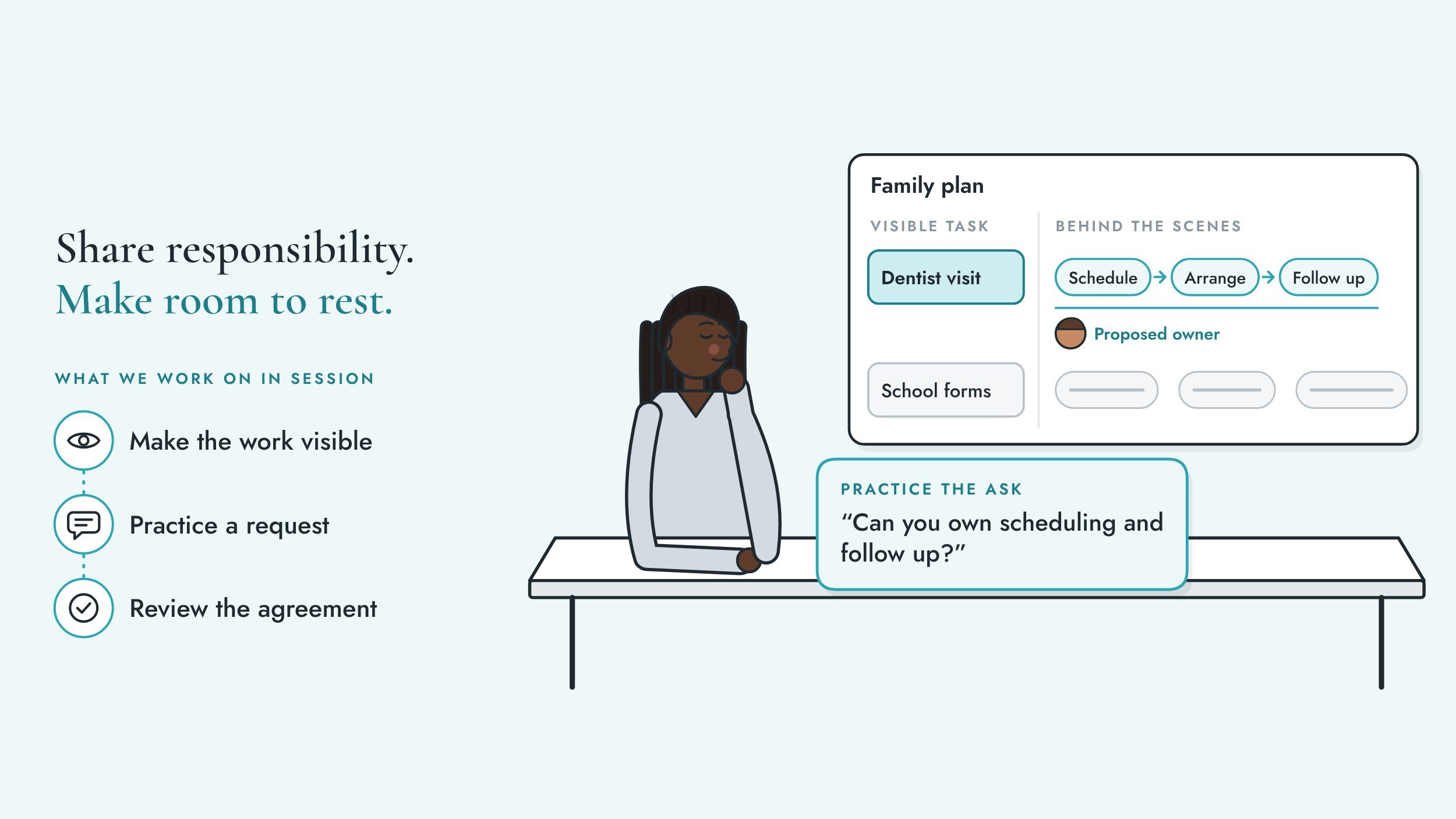
Are you the person who remembers the forms, notices what is running out, and follows up even when somebody else agrees to help? Carrying the family’s mental load can leave you feeling constantly on duty. Online individual therapy in New Jersey offers space to explore the resentment, worry, and exhaustion underneath that experience. We can make the planning work visible, examine what keeps responsibilities falling back on you, and practice a request about ownership of one task from beginning to end. Using Care Map Method, we can also work with perfectionism, difficulty letting go, or guilt about protecting time for yourself. I’m Tammy Gold, LCSW. Together, we can develop goals that fit the support you actually have and review whether the changes you try make a meaningful difference in your daily life.
When everyone relies on you to remember everything
You know which forms are due, what is running out, and who needs a reminder. Even when somebody helps, you are still the one noticing and assigning the work. That constant planning can leave little room to rest. Therapy can help you understand the emotional strain, clarify what needs to change, and practice asking for a different kind of support.
You may feel irritated by “just tell me what to do,” stay awake reviewing tomorrow, or struggle to enjoy time off because you are still monitoring everything. Perhaps you feel guilty for resenting people you love. We can make room for that experience and explore what the current arrangement is doing to your health and relationships.
Check benefits and availability
Name the responsibility beneath the task
We can distinguish doing a task from noticing, planning, arranging, and following up on it. This helps explain why occasional help may not relieve the pressure. We can look at which responsibilities you hold, which are shared, and where expectations remain unspoken. We also consider whether worry or perfectionism keeps you monitoring tasks even after someone else takes them on.
Practice a request about ownership
A useful conversation may be more specific than “I need more help.” We can rehearse a request about one responsibility from beginning to end. For example, another adult might take ownership of a recurring appointment, including scheduling and follow up. We can consider what a workable agreement looks like and how to discuss differences without turning the conversation into a list of every past disappointment.
Explore resentment and the difficulty of letting go
Resentment may point to an unfair arrangement, an unmet need, or limits you have struggled to express. We can explore those possibilities and what happens when someone does a task differently from you. The work may include tolerating a reasonable difference, renegotiating a responsibility, or recognizing that the support available is not enough and considering your options.
An example of the work
For example, you might bring the recurring conflict over children’s activities. We could identify all the planning involved, separate essential steps from preferences, and prepare a request for one person to own one activity. Afterward, we could review the agreement, your feelings, and any practical barriers.
What progress can look like
Progress might mean making the workload discussable, checking less often, protecting a period of rest, or recognizing an agreement that is not being honored. We work toward changes you can assess in daily life rather than simply asking you to become better at carrying everything.
How Care Map Method supports our work
Map the emotion and trigger. We look at a recent moment and the biological, emotional, social, and environmental pressures around it. The aim is to understand your experience before choosing a response.
Match the need with a strategy. We identify what matters in that moment and select a skill or next step that fits. That might be a clearer request, a pause, a boundary, or space to process a loss.
Merge the skill into daily life. We can rehearse the words and decide when you might use them. Any practice between sessions is chosen together and adjusted to your circumstances.
Manage responses over time. We review what happened, what was difficult, and what needs to change. Therapy includes room for feelings and history as well as practical work.
About Tammy Gold
I’m Tamara “Tammy” Gold, MSW, LCSW, founder of Care Map Method™ and author of Secrets of the Nanny Whisperer. I earned my MSW at Columbia University and my BA at the University of Pennsylvania. My work with families informs a warm, active approach to therapy that makes room for your emotional experience and practical concerns.
Common questions
Is mental load a diagnosis? Mental load describes an experience of ongoing planning and responsibility. It is not by itself a diagnosis. Assessment helps determine your clinical needs and whether insurance-covered psychotherapy is appropriate.
Can I attend if my partner thinks the division is fair? Yes. We can explore your experience and prepare a specific conversation. Individual therapy can support your choices without deciding the full relationship story from one person’s account.
What if I am a single parent? We can work within your actual support network and responsibilities. That may include limits, realistic expectations, emotional support, and requests to people who are available to help.
Will you just tell me to delegate? We will explore what makes change difficult, including unequal participation, limited resources, worry, and practical barriers. Delegation is useful only when there is someone able and willing to take responsibility.
Can I use Aetna in New Jersey? Use my Headway profile to check your exact Aetna plan and estimated costs. Coverage depends on your benefits, network eligibility, and the clinically appropriate service.
How do we choose a starting point? We can begin with the part of the week that drains you most. One recurring responsibility often provides enough detail to understand both the practical problem and its emotional impact.
Take the next step
If this sounds familiar, you can explore online therapy with me while located in New Jersey. Open my Headway profile to check your exact insurance benefits and appointment options. We will discuss your concerns, clinical needs, and goals to determine fit.
Family Conflict Therapy in Oregon
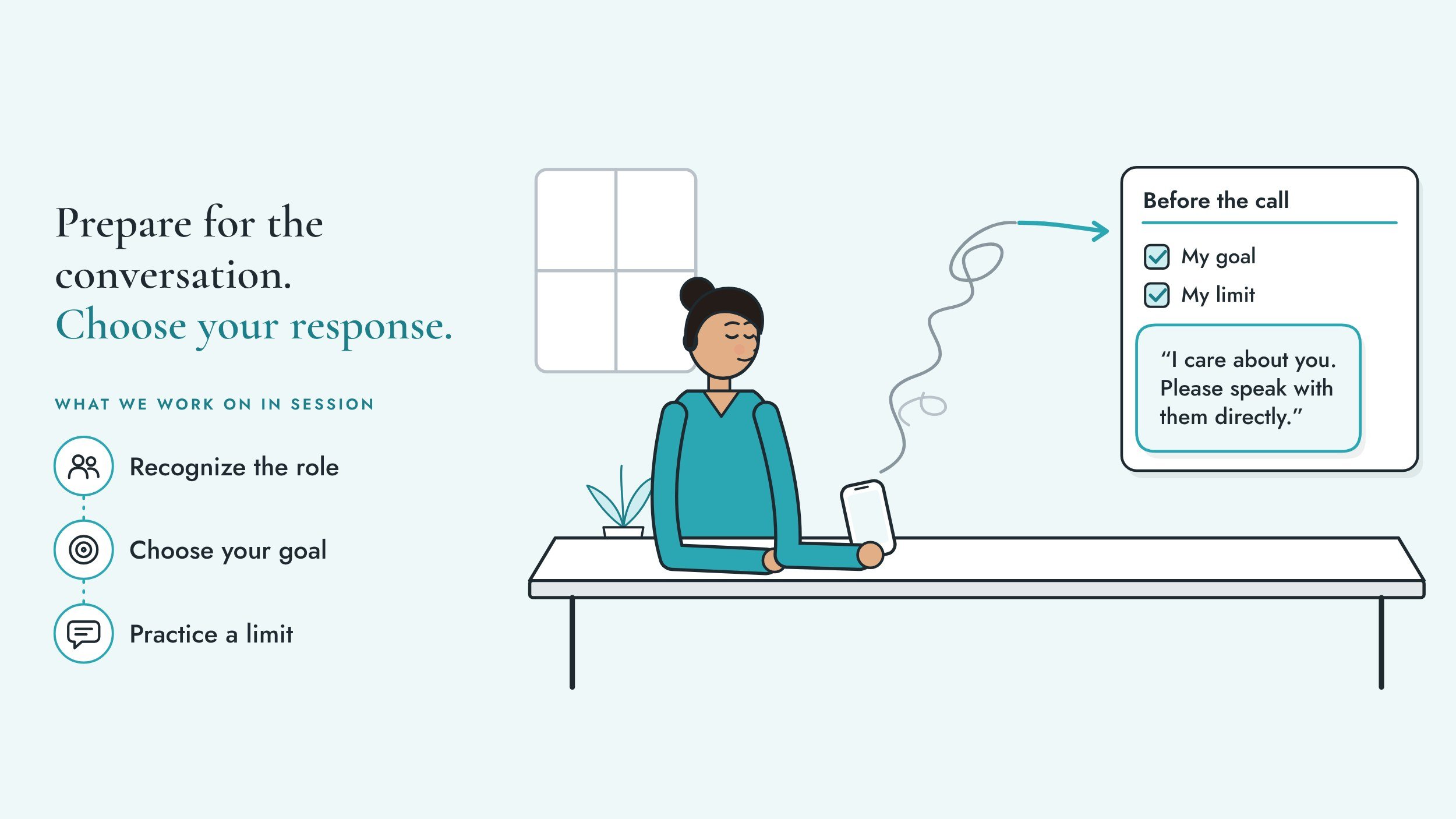
Does one family phone call leave you upset for the rest of the day? A familiar comment may pull you into defending yourself, keeping the peace, or agreeing to something you do not want. In online individual therapy for family conflict in Oregon, we can explore why these exchanges have such an effect and the role you keep finding yourself in. Together, we can clarify what you want from a conversation, practice a response to criticism, or prepare a boundary around a topic that repeatedly causes hurt. Care Map Method helps us connect the emotion and history behind the pattern with choices you can make now. I’m Tammy Gold, LCSW. Your relatives do not need to attend for us to work on your concerns, your decisions about contact, and the expectations you bring to these relationships.
Find a way to respond when old family patterns take over
A phone call starts normally, then one comment leaves you feeling like the same person you were years ago. You defend yourself, agree to something you do not want, or leave angry and replay the exchange afterward. Individual therapy can help you understand what happens in these conversations and decide how you want to participate in family relationships now.
The conflict may involve a parent, sibling, in law, or adult child. You might feel caught between relatives, pressured to take a side, or responsible for smoothing things over. You may want more connection while also needing less criticism or intrusion. We can work with those competing needs without assuming there is one correct level of family contact.
Check benefits and availability
Recognize the role you keep getting pulled into
We can examine a recent interaction and the history that gives it weight. Perhaps you become the peacemaker, the person who explains everyone else, or the one who is expected to adapt. Naming that role helps us understand why a small comment can have a large effect and where you might have room to respond differently.
Decide what the conversation is for
Some conversations need a practical agreement. Others involve hurt, a request for acknowledgment, or a limit on a topic you no longer want to debate. We can clarify your goal before choosing your words. That may mean asking one direct question, declining to carry a message between relatives, or ending a discussion that has stopped being useful.
Plan for the relationship after you set a limit
Family boundaries can affect holidays, childcare, caregiving, and other shared responsibilities. We can think through those consequences and practice a response that fits your values and circumstances. We can also work with disappointment when a relative cannot offer the understanding you want, and consider what connection is possible without repeatedly asking for the same change.
An example of the work
For example, if a sibling repeatedly draws you into arguments with a parent, we could explore why you feel responsible for resolving them. You might practice saying, “I care about both of you, and I am not going to carry messages between you.” We would consider when that wording is appropriate and what follow through means.
What progress can look like
Progress may include less time recovering from calls, clearer choices about contact, fewer commitments made under pressure, or a better understanding of what you want from a relationship. Reconciliation is not a required outcome.
How Care Map Method supports our work
Map the emotion and trigger. We look at a recent moment and the biological, emotional, social, and environmental pressures around it. The aim is to understand your experience before choosing a response.
Match the need with a strategy. We identify what matters in that moment and select a skill or next step that fits. That might be a clearer request, a pause, a boundary, or space to process a loss.
Merge the skill into daily life. We can rehearse the words and decide when you might use them. Any practice between sessions is chosen together and adjusted to your circumstances.
Manage responses over time. We review what happened, what was difficult, and what needs to change. Therapy includes room for feelings and history as well as practical work.
About Tammy Gold
I’m Tamara “Tammy” Gold, MSW, LCSW, founder of Care Map Method™ and author of Secrets of the Nanny Whisperer. I earned my MSW at Columbia University and my BA at the University of Pennsylvania. My work with families informs a warm, active approach to therapy that makes room for your emotional experience and practical concerns.
Common questions
Can I start if my family will not attend? Yes. Individual therapy can focus on your experience, choices, boundaries, and grief. We can work on your part without assuming we know another family member’s intentions or diagnosis.
Will you tell me to cut off contact? We can explore a range of options, including changes in topics, timing, availability, and contact. Your circumstances, values, and safety guide those decisions.
Can we discuss conflict with an adult child? Yes. We can explore your feelings, expectations, communication, and possible repair attempts. We cannot guarantee a response or reconciliation from another person.
What if family obligations make boundaries difficult? We can consider shared responsibilities, finances, culture, and practical dependence. The aim is a limit you can realistically use rather than advice that ignores your situation.
Is family therapy covered by Providence? This page describes individual therapy. Check your exact plan and the proposed service through Headway. Coverage for sessions with multiple family members requires a separate review of benefits and clinical appropriateness.
What happens at the first appointment? We will discuss the conflict, its effect on your life, relevant history, and your goals. One recent example can help us identify a useful starting point.
Take the next step
If this sounds familiar, you can explore online therapy with me while located in Oregon. Open my Headway profile to check your exact insurance benefits and appointment options. We will discuss your concerns, clinical needs, and goals to determine fit.
Caregiver Burnout Therapy in Oregon
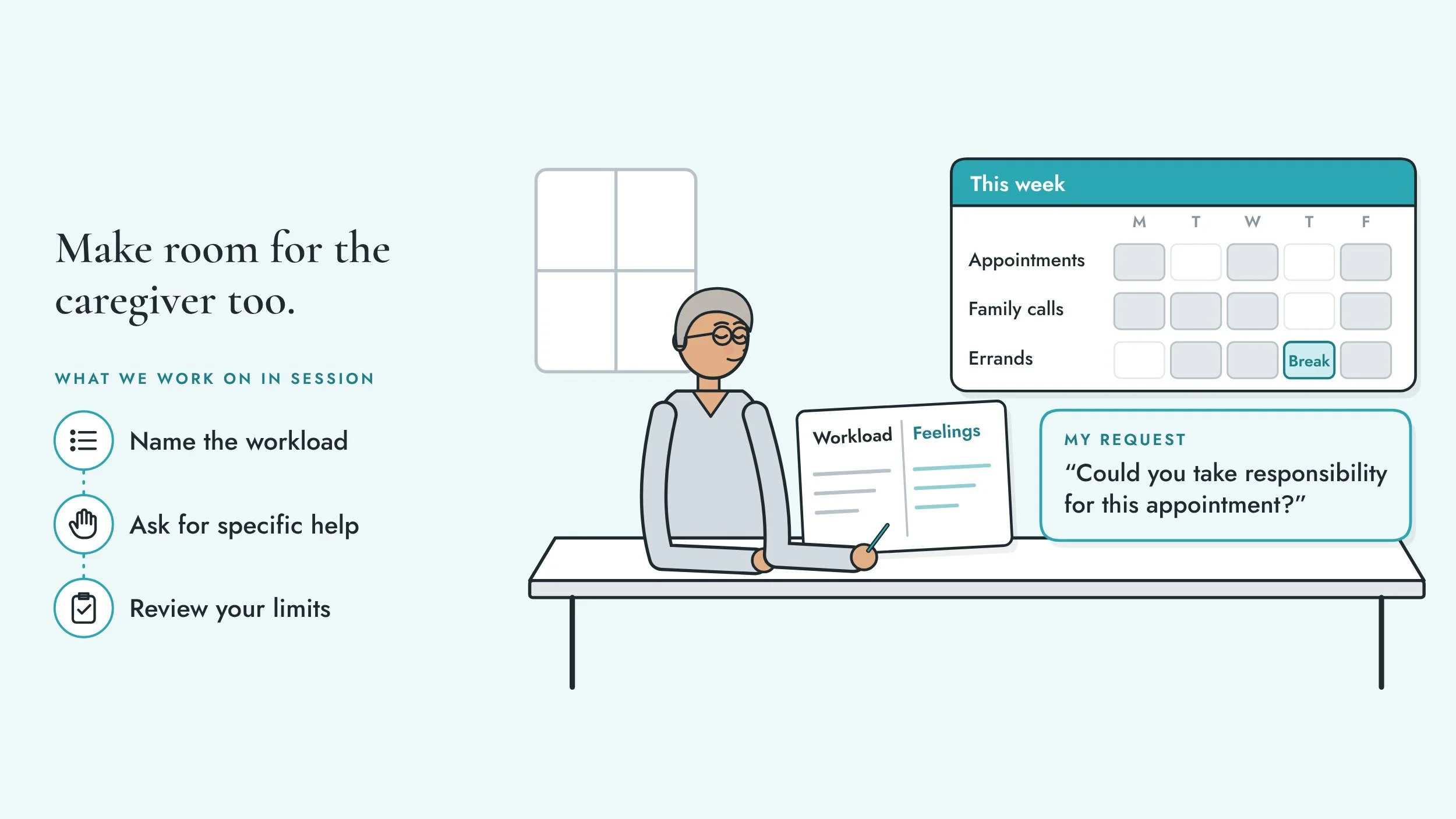
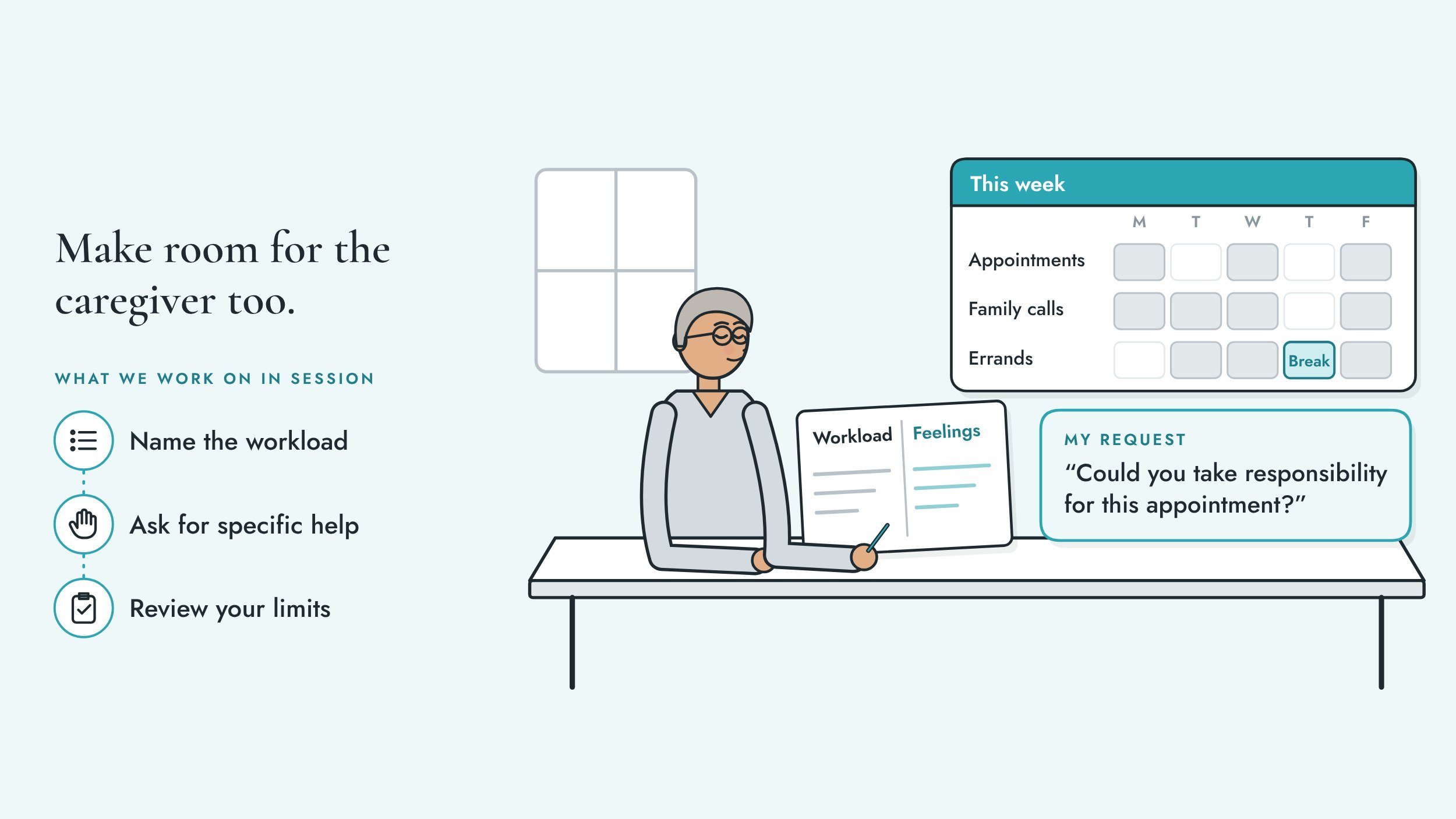
Caring for an aging parent can become a responsibility you carry even when you are supposed to be resting. You may be tracking appointments, anticipating problems, managing family messages, and feeling guilty whenever you need time away. In online caregiver burnout therapy in Oregon, we can make that workload visible and explore the worry, grief, frustration, or resentment that comes with it. Together, we can identify what is becoming unsustainable, prepare a specific request for help, and consider limits that account for your parent’s needs and your own capacity. Care Map Method gives us a way to organize the pressures around caregiving while making room for your emotional experience. I’m Tammy Gold, LCSW. These individual therapy sessions support your mental health as you navigate a role that may keep changing, often without much warning.
Support for the person everyone depends on
You keep track of appointments, answer the calls, and think about what could go wrong even when you are trying to rest. Caring for an aging parent may bring love, worry, grief, and resentment into the same day. Therapy offers a place to work through what this role is costing you and consider changes that make room for your own health.
Perhaps you are short with people you care about, feel guilty taking a break, or dread a call because it might mean another problem. You may be balancing children, work, and a parent’s needs while wondering why you cannot manage it better. We can examine the demands themselves as well as your reactions to them.
Check benefits and availability
Make the invisible responsibilities visible
We can walk through a typical week and name the work you carry: coordinating care, anticipating problems, handling family messages, or being constantly available. This can help us identify where exhaustion is coming from and which responsibilities are yours by choice, agreement, or default. We also consider sleep, support, finances, and the environment around caregiving.
Work with guilt and resentment
Feeling angry or wishing for time away can be difficult to admit. We can explore those feelings without treating them as a measure of how much you love your parent. We may examine beliefs such as “a good daughter should always be available” and consider what a realistic responsibility looks like in your circumstances. Grief and changes in the relationship also have a place in the work.
Practice a specific request or limit
Instead of a general wish for more help, we can prepare one request that another person can understand and answer. That might involve a sibling taking responsibility for one recurring task or a limit around nonurgent calls. We can rehearse what you want to say, consider likely responses, and plan what you will do if the help you hope for is unavailable.
An example of the work
For example, you might bring the recurring Sunday night worry about the week ahead. We could separate practical decisions from fears, identify one task to delegate, and develop a short routine for ending the evening. We would then review what helped and what still needs attention.
What progress can look like
Your goals might include taking a break with less guilt, making a clear request, recognizing when you are overextended, or having space to grieve. Therapy can support your emotional health while practical care needs continue to change.
How Care Map Method supports our work
Map the emotion and trigger. We look at a recent moment and the biological, emotional, social, and environmental pressures around it. The aim is to understand your experience before choosing a response.
Match the need with a strategy. We identify what matters in that moment and select a skill or next step that fits. That might be a clearer request, a pause, a boundary, or space to process a loss.
Merge the skill into daily life. We can rehearse the words and decide when you might use them. Any practice between sessions is chosen together and adjusted to your circumstances.
Manage responses over time. We review what happened, what was difficult, and what needs to change. Therapy includes room for feelings and history as well as practical work.
About Tammy Gold
I’m Tamara “Tammy” Gold, MSW, LCSW, founder of Care Map Method™ and author of Secrets of the Nanny Whisperer. I earned my MSW at Columbia University and my BA at the University of Pennsylvania. My work with families informs a warm, active approach to therapy that makes room for your emotional experience and practical concerns.
Common questions
Is this therapy or care management? This page describes psychotherapy for your emotional health. Arranging staff, selecting facilities, and coordinating care are separate practical services and are not automatically included in therapy or covered by insurance.
Can I feel resentful and still love my parent? Yes. We can explore mixed feelings and the circumstances behind them. You do not need to present yourself as endlessly patient to talk honestly about caregiving.
What if there is nobody else to help? We can work within that reality, looking at limits, coping, expectations, and possible sources of support. We will avoid building a plan that depends on resources you do not have.
Can we discuss grief before a parent dies? Yes. Changes in health, independence, personality, and family roles can involve grief. We can make room for those losses while you are still actively caring for your parent.
Can I use Providence insurance? Check the exact Providence plan on my Headway profile. Commercial and Medicare Advantage products can have different networks and benefits. Coverage and your costs need to be confirmed before treatment.
Does my parent attend? These are individual sessions for you. Your parent does not need to attend. If another type of service becomes appropriate, we can discuss it separately.
Take the next step
If this sounds familiar, you can explore online therapy with me while located in Oregon. Open my Headway profile to check your exact insurance benefits and appointment options. We will discuss your concerns, clinical needs, and goals to determine fit.
Boundaries Therapy in California
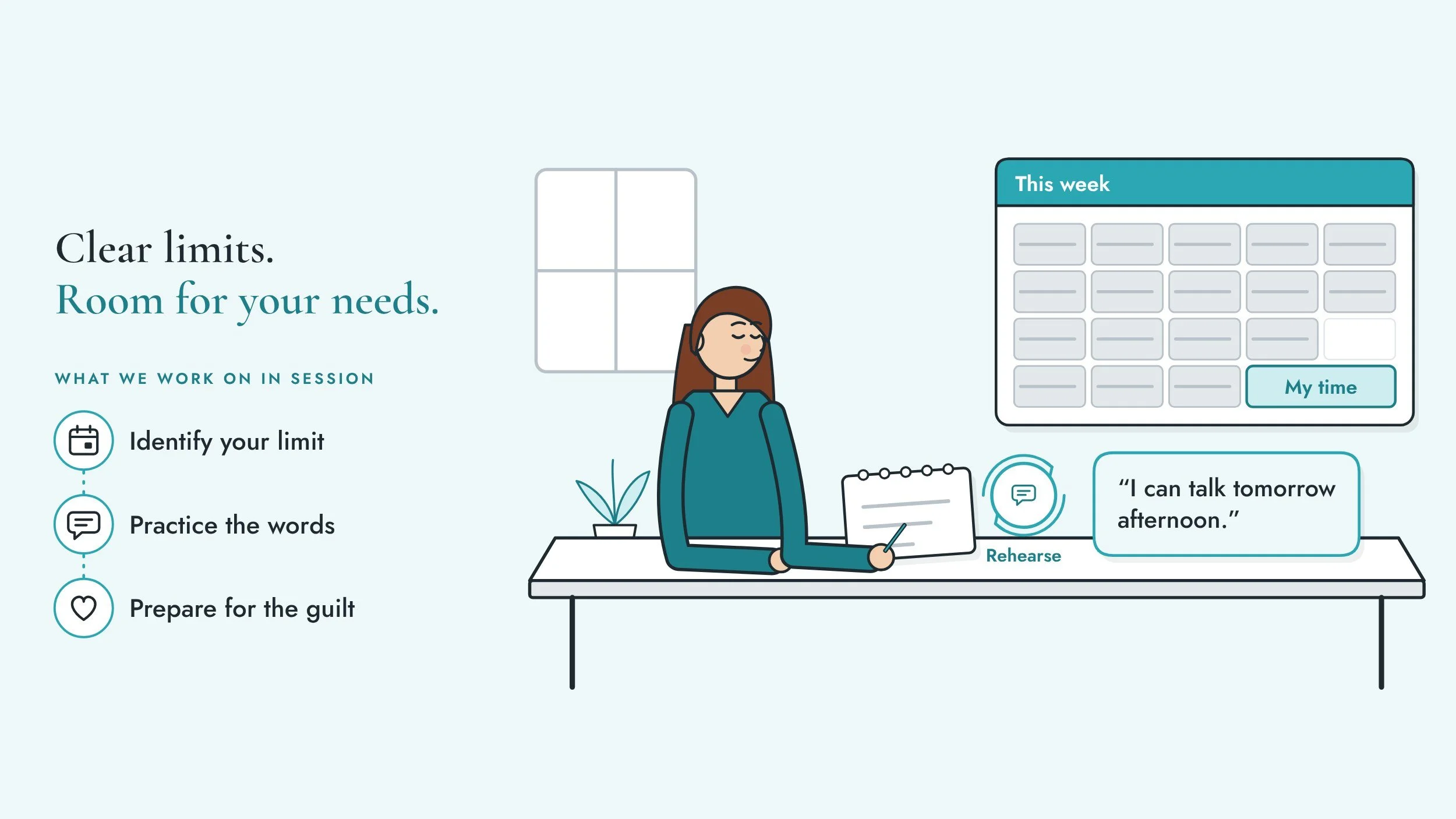
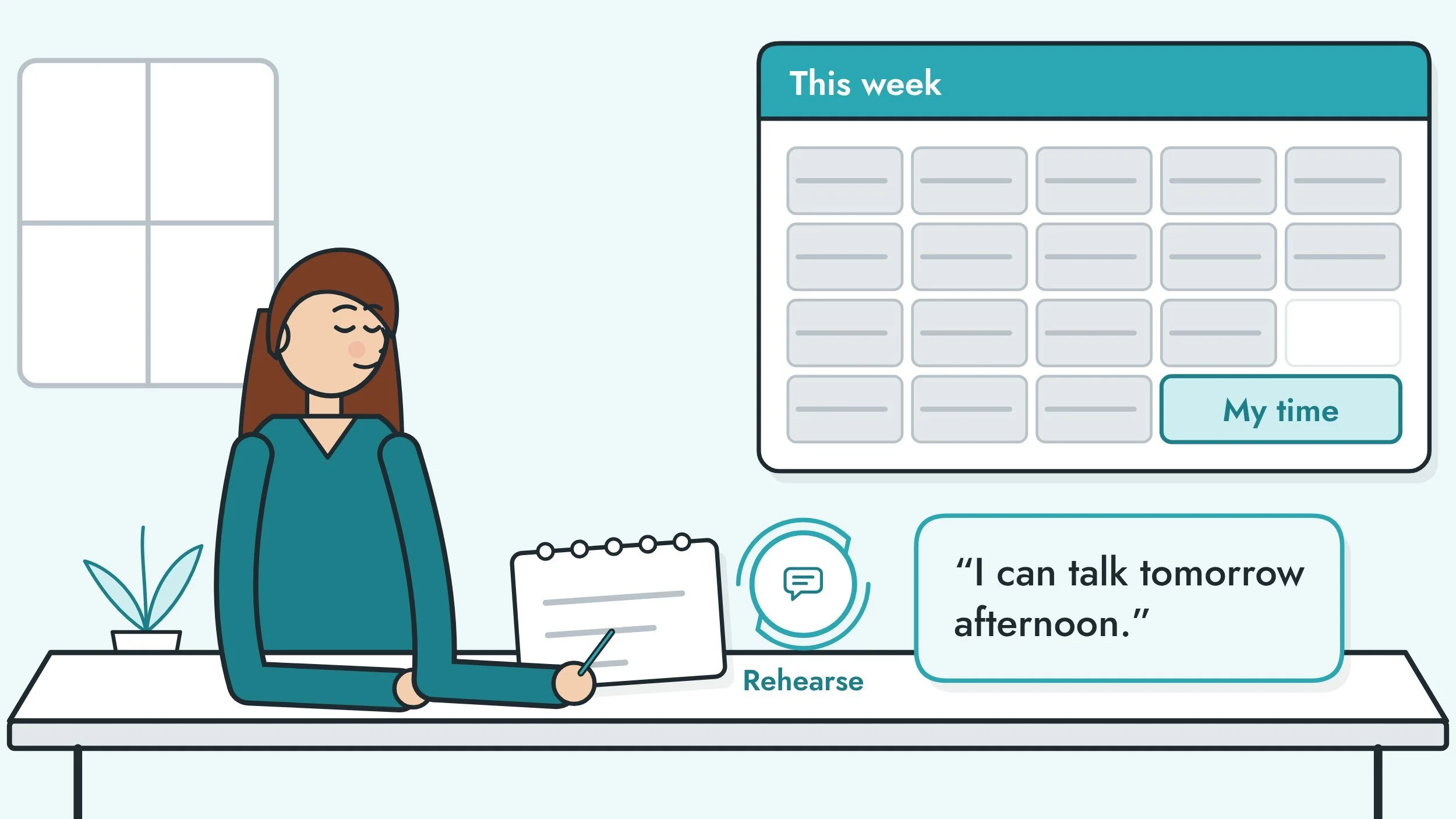
Do you agree to help before checking what you have the energy to offer? Perhaps you finally say no, then worry that you sounded selfish or spend hours explaining your decision. In online boundaries therapy in California, we can explore what makes another person’s disappointment feel so difficult and what you fear might happen if you change your response. Together, we can turn a vague wish for more space into a specific limit, rehearse the words, and prepare for the guilt or anxiety that may follow. Using Care Map Method, we connect your emotional needs with practical choices about time, availability, and responsibility. I’m Tammy Gold, LCSW. We can work toward relationships that make room for your needs while respecting your values, responsibilities, and the realities of each situation.
Say what you can offer without losing sight of what you need
You agree to help, rearrange your day, and later feel resentful. Or you finally say no and spend hours worrying that you were selfish. Boundaries can be difficult when keeping other people comfortable has become your way of protecting a relationship. Therapy gives us room to understand that pattern and practice a limit that fits your situation.
You may apologize before making a request, overexplain a simple decision, or take another person’s disappointment as proof that you did something wrong. Perhaps the boundary is clear in your head but disappears in the conversation. We can work on both the words you use and the feelings that make them hard to hold.
Check benefits and availability
Understand what saying no seems to risk
We can explore what you expect will happen if you disappoint someone. You may fear rejection, conflict, being seen as unkind, or losing a role that has made you feel needed. Understanding where those expectations come from helps us choose an approach that respects your history and your current circumstances, including relationships where directness has consequences.
Turn a vague limit into a clear decision
A boundary becomes easier to practice when it describes what you will do. We might change “I need everyone to respect my time” into “I can talk for fifteen minutes tonight, and then I need to finish my work.” We can rehearse wording that sounds like you and decide how much explanation is useful in that relationship.
Prepare for the discomfort afterward
Even a reasonable limit may leave you anxious or guilty. We can plan for the urge to send another explanation, reverse your decision, or check repeatedly for reassurance. Together, we can distinguish discomfort from evidence that you acted against your values. If a boundary needs revision, we can revise it thoughtfully rather than abandoning it in a moment of panic.
An example of the work
For example, you might want to stop answering nonurgent family calls during work. We could explore what makes that feel disloyal, practice a message about when you are available, and decide how to respond to repeated calls. We would also discuss genuine emergencies and practical responsibilities.
What progress can look like
Progress may look like taking time before agreeing, making a smaller commitment, giving a shorter explanation, or tolerating someone’s disappointment without immediately changing your answer. The aim is a way of relating that includes your needs.
How Care Map Method supports our work
Map the emotion and trigger. We look at a recent moment and the biological, emotional, social, and environmental pressures around it. The aim is to understand your experience before choosing a response.
Match the need with a strategy. We identify what matters in that moment and select a skill or next step that fits. That might be a clearer request, a pause, a boundary, or space to process a loss.
Merge the skill into daily life. We can rehearse the words and decide when you might use them. Any practice between sessions is chosen together and adjusted to your circumstances.
Manage responses over time. We review what happened, what was difficult, and what needs to change. Therapy includes room for feelings and history as well as practical work.
About Tammy Gold
I’m Tamara “Tammy” Gold, MSW, LCSW, founder of Care Map Method™ and author of Secrets of the Nanny Whisperer. I earned my MSW at Columbia University and my BA at the University of Pennsylvania. My work with families informs a warm, active approach to therapy that makes room for your emotional experience and practical concerns.
Common questions
Is setting a boundary the same as cutting someone off? No. A boundary can define time, topics, money, or availability while preserving contact. We can discuss different options and what is appropriate for the relationship.
Can therapy help with people-pleasing? We can explore when accommodating others becomes costly, what you fear about changing it, and how to practice choices that reflect your needs and values.
What if they get upset? We can prepare for likely reactions and identify what you can control. Another person’s response matters, but it does not by itself tell us whether your limit is reasonable or safe.
Can we practice the actual conversation? Yes. We can rehearse your words, consider possible responses, and adjust the message so it sounds natural. You decide whether and when to use it.
Can I use Aetna or Anthem? Check your specific California plan on my Headway profile before scheduling. Participation and coverage vary by network and service, and your deductible or copay may apply.
What if I cannot identify my own needs? That can be part of the work. We can start with recent moments of resentment, exhaustion, or hesitation and explore what they tell you about your limits.
Take the next step
If this sounds familiar, you can explore online therapy with me while located in California. Open my Headway profile to check your exact insurance benefits and appointment options. We will discuss your concerns, clinical needs, and goals to determine fit.
Parenting Stress Therapy in California
You love your child, but some days one more question, reminder, or bedtime request feels like more than you can handle. Then you snap and spend the evening feeling guilty. Online therapy for parenting stress in California offers a place to understand what builds up before those moments. We can explore exhaustion, competing demands, worry, and the support you may be missing. Together, we can choose one difficult part of your day and practice a clearer limit, a pause, or a way to reconnect after a hard interaction. Care Map Method helps us consider biological, emotional, social, and environmental pressures as we develop strategies that fit your circumstances. I’m Tammy Gold, LCSW. These individual sessions focus on your emotional health and parenting responses, with room to work through guilt and expectations that have become difficult to carry.
When you love your child and still feel overwhelmed by the day
You get through work, meals, reminders, and one more bedtime request. Then a small moment becomes the one where you snap. Afterward, you feel guilty and promise yourself tomorrow will be different. Therapy can help you understand what is building up and practice responses that account for the demands you are actually carrying.
You may be more irritable than you used to be, resent the endless decisions, or feel as though everyone needs something from you. Perhaps you have read the parenting advice but struggle to use it when you are exhausted. We can focus on your emotional health and the patterns making everyday parenting harder.
Check benefits and availability
Find the pressure points in your day
We can map a recent difficult moment from the beginning. Were you hungry, rushed, worried about work, or already managing several requests? What was happening around you? Understanding the biological, emotional, social, and environmental pressures gives us a more useful starting point than expecting unlimited patience. It also helps us separate what you can change from what requires more support.
Practice the response before you need it
We can choose one situation, such as leaving the house or handling repeated bedtime requests, and rehearse what you want to say. That may include a short limit, a pause before answering, or a plan with another caregiver. We can make the response small enough to remember when you are tired, then review whether it fits your family.
Work on guilt and repair after a hard moment
You may need help with what happens after you lose patience as much as with the reaction itself. We can practice an age appropriate repair that takes responsibility without asking your child to comfort you. We can also explore perfectionism, fears about your parenting, or experiences from your own childhood that make a difficult day feel like a judgment about who you are.
An example of the work
For example, if homework regularly ends in yelling, we could examine the timing, your expectations, and the first signs of frustration. You might practice a brief pause and a clear return plan, then try a more realistic homework routine. We would review both your feelings and what changed.
What progress can look like
Useful changes might include noticing overload earlier, using a limit you can follow through on, recovering sooner after a hard interaction, or asking another adult for specific help. Your goals can change as your family’s needs change.
CARE MAP METHOD™ | THERAPY LANDING PAGE COPY
How Care Map Method supports our work
Map the emotion and trigger. We look at a recent moment and the biological, emotional, social, and environmental pressures around it. The aim is to understand your experience before choosing a response.
Match the need with a strategy. We identify what matters in that moment and select a skill or next step that fits. That might be a clearer request, a pause, a boundary, or space to process a loss.
Merge the skill into daily life. We can rehearse the words and decide when you might use them. Any practice between sessions is chosen together and adjusted to your circumstances.
Manage responses over time. We review what happened, what was difficult, and what needs to change. Therapy includes room for feelings and history as well as practical work.
About Tammy Gold
I’m Tamara “Tammy” Gold, MSW, LCSW, founder of Care Map Method™ and author of Secrets of the Nanny Whisperer. I earned my MSW at Columbia University and my BA at the University of Pennsylvania. My work with families informs a warm, active approach to therapy that makes room for your emotional experience and practical concerns.
Common questions
Is therapy for my child or me? This page describes therapy for the adult parent. We focus on your emotional health, reactions, relationships, and coping. Your child does not need to attend these individual sessions.
Do I have to be in crisis to start? No. You can seek support when stress, guilt, resentment, or irritability is affecting daily life. The first session helps us understand your needs and the appropriate type of care.
Can we talk about different parenting styles? Yes. We can explore how disagreements affect you, identify shared priorities, and practice a conversation about one specific routine or responsibility. Individual therapy cannot guarantee another caregiver will change.
Will you give me parenting rules? We will develop strategies around your needs, values, and circumstances. We also make room for the emotional concerns beneath the daily problem rather than treating every difficulty as a discipline issue.
Can I check Anthem coverage? My Headway profile lets you check your specific plan, network eligibility, and estimated costs. Parenting concerns alone do not automatically establish insurance coverage; clinical assessment and benefits determine eligibility.
What can we begin with? Choose one moment you dread, such as mornings, homework, or bedtime. We can use that example to understand the larger pattern and decide where support may be most useful.
Take the next step
If this sounds familiar, you can explore online therapy with me while located in California. Open my Headway profile to check your exact insurance benefits and appointment options. We will discuss your concerns, clinical needs, and goals to determine fit.
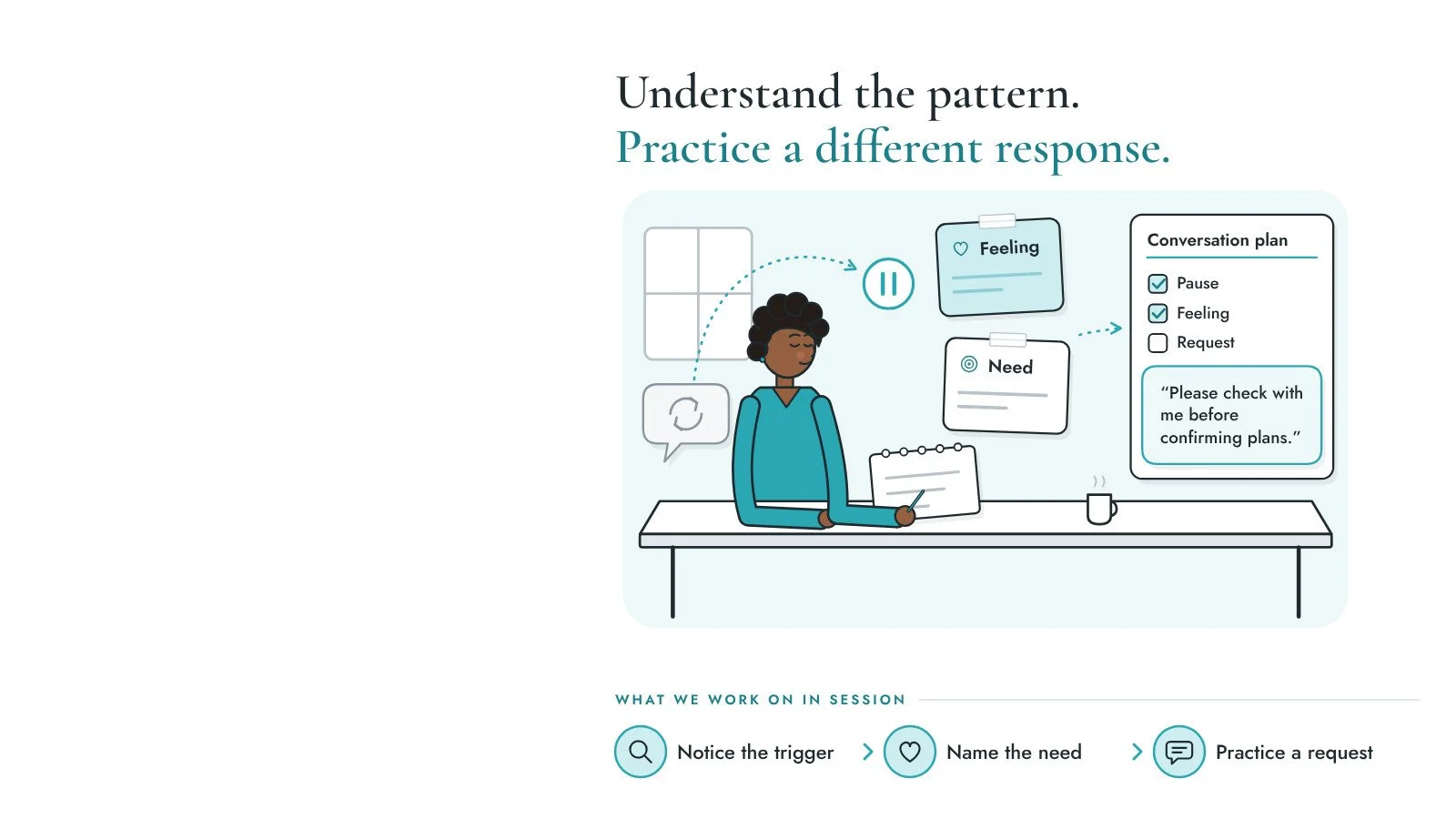
Relationship Stress Therapy in California
Do you keep having the same argument, even when you promise yourself you will handle it differently? You may leave conversations feeling unheard, replay what you said, or stay quiet because another disagreement feels exhausting. In online individual therapy in California, we can look closely at one of those moments and understand what makes the pattern difficult to change. Together, we can identify the emotion underneath your reaction, clarify what you need, and practice a request that sounds like you. Using Care Map Method, we can also prepare for defensiveness, plan a pause, and explore boundaries you can follow through on. I’m Tammy Gold, LCSW. My approach makes room for the hurt behind the conflict while helping you develop responses you can use in everyday conversations. Your partner does not have to attend for us to begin working on your concerns.
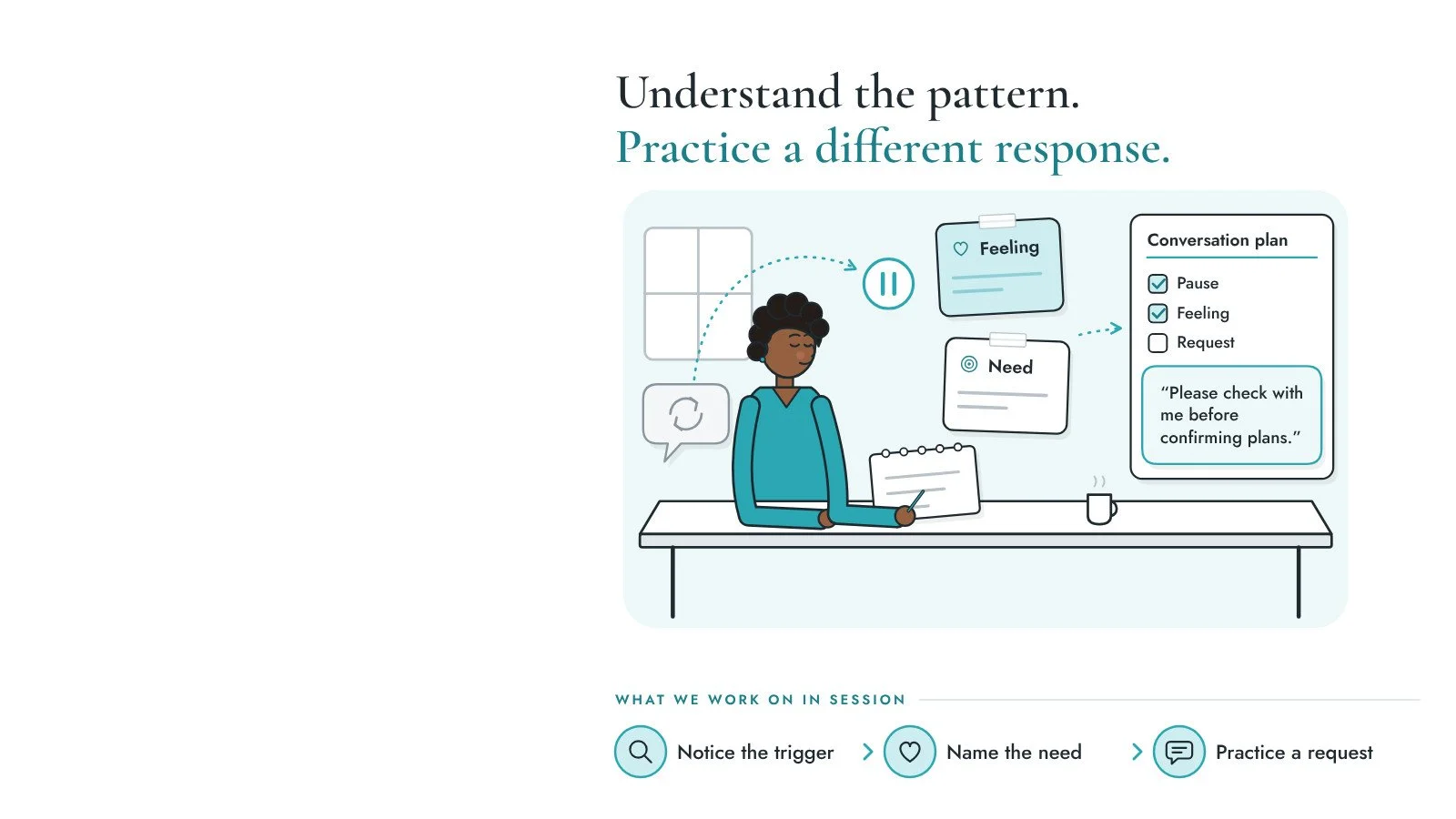
Keep having the same argument and wishing you had handled it differently
You bring up something that matters, and the conversation quickly changes. You explain more. Your partner gets defensive or goes quiet. By the end, you feel farther apart and keep replaying what happened. Online individual therapy offers a place to understand that pattern and practice a response you can use when the next difficult moment arrives.
Maybe you rehearse conversations in your head, avoid asking for what you need, or feel responsible for keeping the peace. You may want to stay in the relationship while changing how you participate in it. We can work on your concerns even if your partner is not attending therapy with you.
Check benefits and availability
Understand what happens before the argument
We can take one recent disagreement and slow it down. What was said? What did you hear it as meaning? What did you feel in your body, and what did you do next? This helps us identify the point where you become defensive, raise your voice, withdraw, or start trying harder to be understood. We also make room for hurt and experiences that may shape those reactions.
Practice a request that says what you need
Instead of stopping at “communicate better,” we can work on your actual words. You might practice describing one behavior, naming its effect, and making a specific request. For example: “When plans change without telling me, I feel left out. Please check with me before confirming.” We can explore how that wording feels and what makes it difficult to say.
Prepare for the response you cannot control
A clear request does not guarantee agreement. We can plan how you want to respond to defensiveness, decide when to pause, and consider what boundary you can follow through on. We can also explore whether the relationship is meeting your needs. Your goals and safety guide the work; responsibility for another person’s behavior does not fall on you.
An example of the work
For example, you might bring in a disagreement about household responsibilities. We could identify the hurt underneath “you never help,” practice a request about a specific task, and plan a time to revisit the conversation. Between sessions, you may choose to try that request and notice what happens.
What progress can look like
Progress might mean recognizing a trigger sooner, making a clear request, spending less time replaying an exchange, or understanding a boundary you need. We review what changes and adjust the approach together.
How Care Map Method supports our work
Map the emotion and trigger. We look at a recent moment and the biological, emotional, social, and environmental pressures around it. The aim is to understand your experience before choosing a response.
Match the need with a strategy. We identify what matters in that moment and select a skill or next step that fits. That might be a clearer request, a pause, a boundary, or space to process a loss.
Merge the skill into daily life. We can rehearse the words and decide when you might use them. Any practice between sessions is chosen together and adjusted to your circumstances.
Manage responses over time. We review what happened, what was difficult, and what needs to change. Therapy includes room for feelings and history as well as practical work.
About Tammy Gold
I’m Tamara “Tammy” Gold, MSW, LCSW, founder of Care Map Method™ and author of Secrets of the Nanny Whisperer. I earned my MSW at Columbia University and my BA at the University of Pennsylvania. My work with families informs a warm, active approach to therapy that makes room for your emotional experience and practical concerns.
Common questions
Can I attend without my partner? Yes. Individual therapy can focus on your feelings, choices, communication, and boundaries. We can work with your experience while recognizing that your partner has a perspective we have not assessed.
Is this couples counseling? This page describes individual therapy for relationship stress. If you want sessions together, ask about couples services, clinical fit, and payment arrangements before scheduling.
What if I shut down during arguments? We can explore what happens before you withdraw and practice ways to ask for a pause, settle enough to think, and return to a conversation when appropriate.
Will you tell me whether to leave? We can examine your needs, patterns, options, and concerns so you can make an informed decision. Therapy does not require you to arrive with a decision already made.
Can I use Anthem Blue Cross? Use my Headway profile to check your specific Anthem Blue Cross plan and California network eligibility. Coverage, deductible, and cost sharing depend on your benefits and the service provided.
What should I bring to the first session? Bring one recent example and what you wish had gone differently. We will also discuss your history, current concerns, goals, and whether this approach is a good fit.
Take the next step
If this sounds familiar, you can explore online therapy with me while located in California. Open my Headway profile to check your exact insurance benefits and appointment options. We will discuss your concerns, clinical needs, and goals to determine fit.
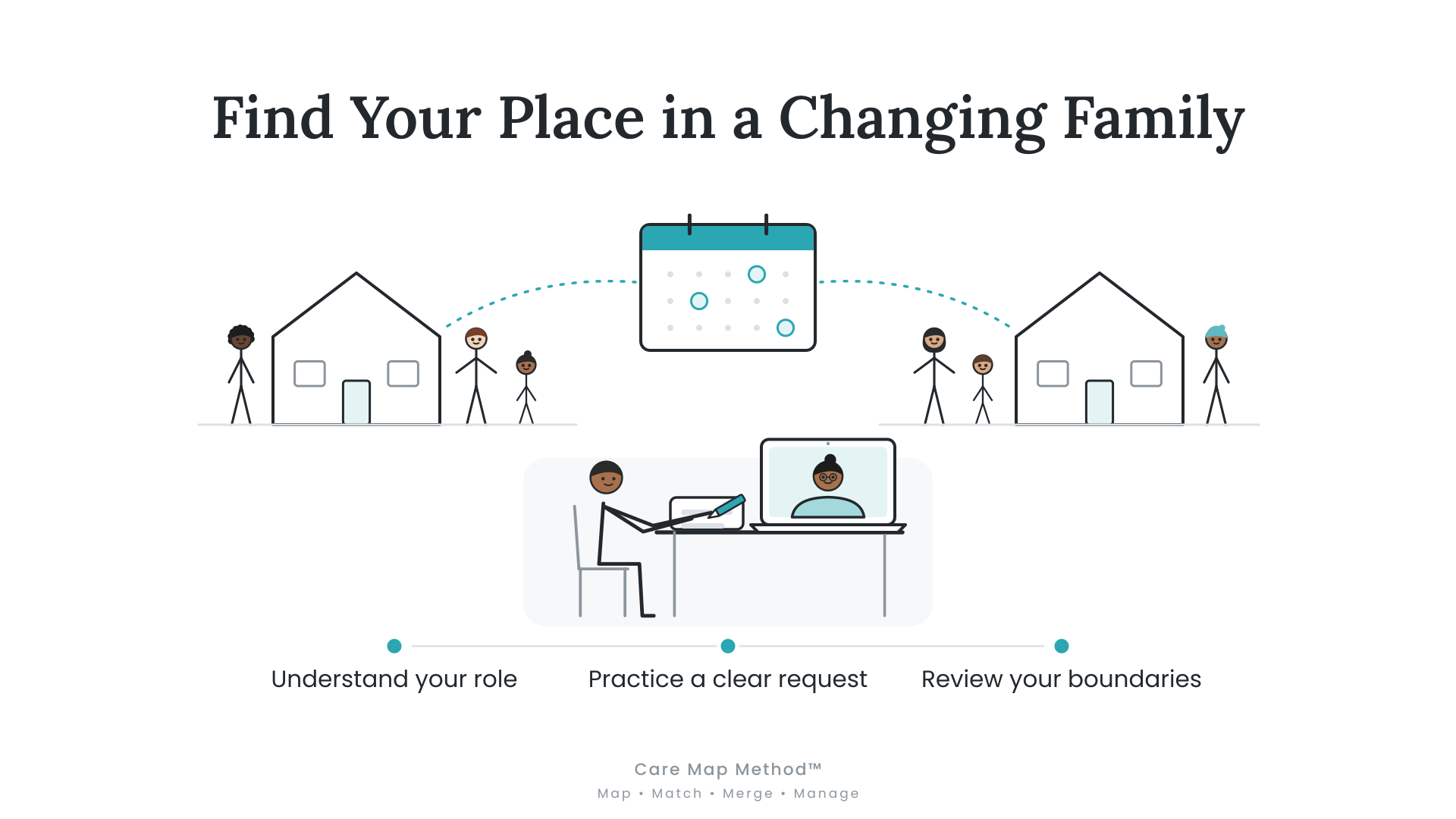
Individual Therapy for Blended Family Stress in New Jersey
Feeling caught between your partner and family expectations? Explore individual therapy for blended-family stress in New Jersey with Tammy Gold, LCSW.
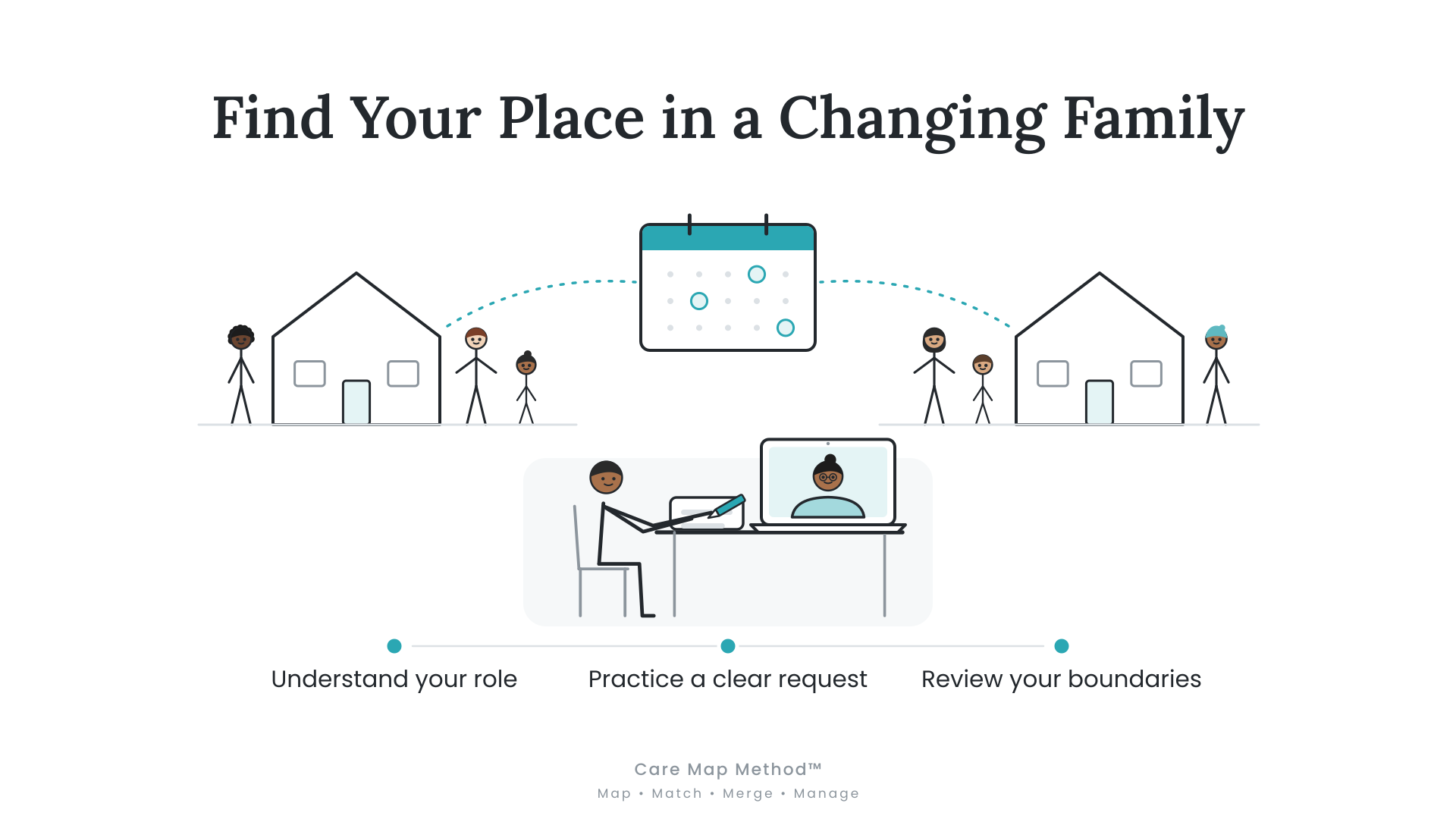
You care about your partner, but you may feel uncertain about your place in the household. A change in plans, a disagreement about rules, or a request from a former partner can leave you feeling overlooked. Perhaps you hold back until frustration spills out, then feel guilty afterward. Individual therapy for blended-family stress in New Jersey offers space to understand your experience and work on the part of the pattern that affects your mental health.
Check availability and insurance through Headway
Name the expectation that has stayed unspoken
Family roles are not always discussed as clearly as daily responsibilities. You may be expected to help with transport, meals, expenses, or emotional support while feeling excluded from decisions. Another person may be carrying a different expectation entirely. We can identify what you believe your role should be, what you have agreed to, and where the mismatch occurs. That gives us a concrete starting point for discussing resentment, disappointment, and the choices available to you.
What a session might address?
Imagine that you are regularly asked to rearrange your workday for a change in the family schedule. In therapy, we might explore why you say yes, how you feel afterward, and what request you want to make. An illustrative opening could be: “I want to help, and I need us to discuss changes before we assume I am available.” We would adapt the wording to your circumstances. This example describes possible work, not a client story or promised result.
Use Map Match Merge and Manage
We Map a recurring interaction and its emotional impact, then Match treatment strategies to your needs. We Merge insight into a specific conversation or boundary and Manage the plan through review. The Care Map Method™ also considers Biological, Emotional, Social, and Environmental needs. Your rest, sense of belonging, relationships outside the household, and living arrangements can all matter. Clinical assessment helps us decide what to address and whether my approach fits the support you need.
Make one request more specific
Before an appointment, you might finish this sentence: “I feel most uncertain about my role when…” Then choose one example. You do not need to prove who is right. We can explore the event, your interpretation, and the request it points toward. Perhaps you need advance notice, time with your partner, or a clearer discussion of responsibilities. We can also consider what you want to do if a reasonable request is repeatedly dismissed.
Review what changes outside therapy
We can look at whether you communicate a preference earlier, recognize a limit before resentment grows, or recover more easily after a disagreement. Family change can also involve grief for the household you imagined. That deserves space even when you remain committed to the relationship. Therapy cannot guarantee agreement from your partner or other family members. It can help you understand your needs, assess your options, and make choices that fit your circumstances.
Insurance and booking in New Jersey
I offer individual online therapy for adults located in New Jersey. Check my Headway or Alma profile for current availability and your exact plan’s eligibility. A familiar carrier name does not establish that every plan is accepted or that every service is covered. These sessions focus on your individual treatment. If you want couples or family sessions, ask about fit, participation, and coverage separately. Questions about custody or legal responsibilities belong with a qualified legal adviser.
About Tammy Gold
I am Tamara “Tammy” Gold, MSW, LCSW, CEC, a licensed therapist, certified coach, and founder of the Care Map Method™. I earned my clinical MSW at Columbia University and have more than 20 years of direct work with families. These sessions focus on your individual mental health and treatment goals.
Take the next step
If this concern is affecting your daily life, view my profile to explore fit, availability, and insurance eligibility. You can choose a starting point without having every detail of the situation figured out.
Frequently asked questions
Can I seek help as a stepparent?
Yes. We can explore your emotional experience, role expectations, and decisions in individual therapy. We would assess your needs and agree on treatment goals together.
Does my partner need to attend?
No. This page describes individual therapy. You can work on your own distress and communication without requiring your partner or a child to participate.
Will therapy help me decide which rules to set?
We can explore what matters to you and practice discussing expectations. Household decisions also involve the relevant caregivers and any applicable arrangements; therapy does not issue a family ruling.
Is this the same as family therapy?
Individual therapy is your treatment. Family therapy involves a different participant structure and requires a separate discussion of goals, fit, and practical arrangements.
Can I use Horizon or another insurance plan?
Check current participation and benefits through my profile for your exact plan. Coverage depends on clinical requirements and eligibility; family conflict alone does not guarantee insurance coverage.
What should I bring to the first appointment?
A recent example and a sense of what feels hardest are enough to begin. We can discuss your symptoms, history, current support, and what you hope will change.
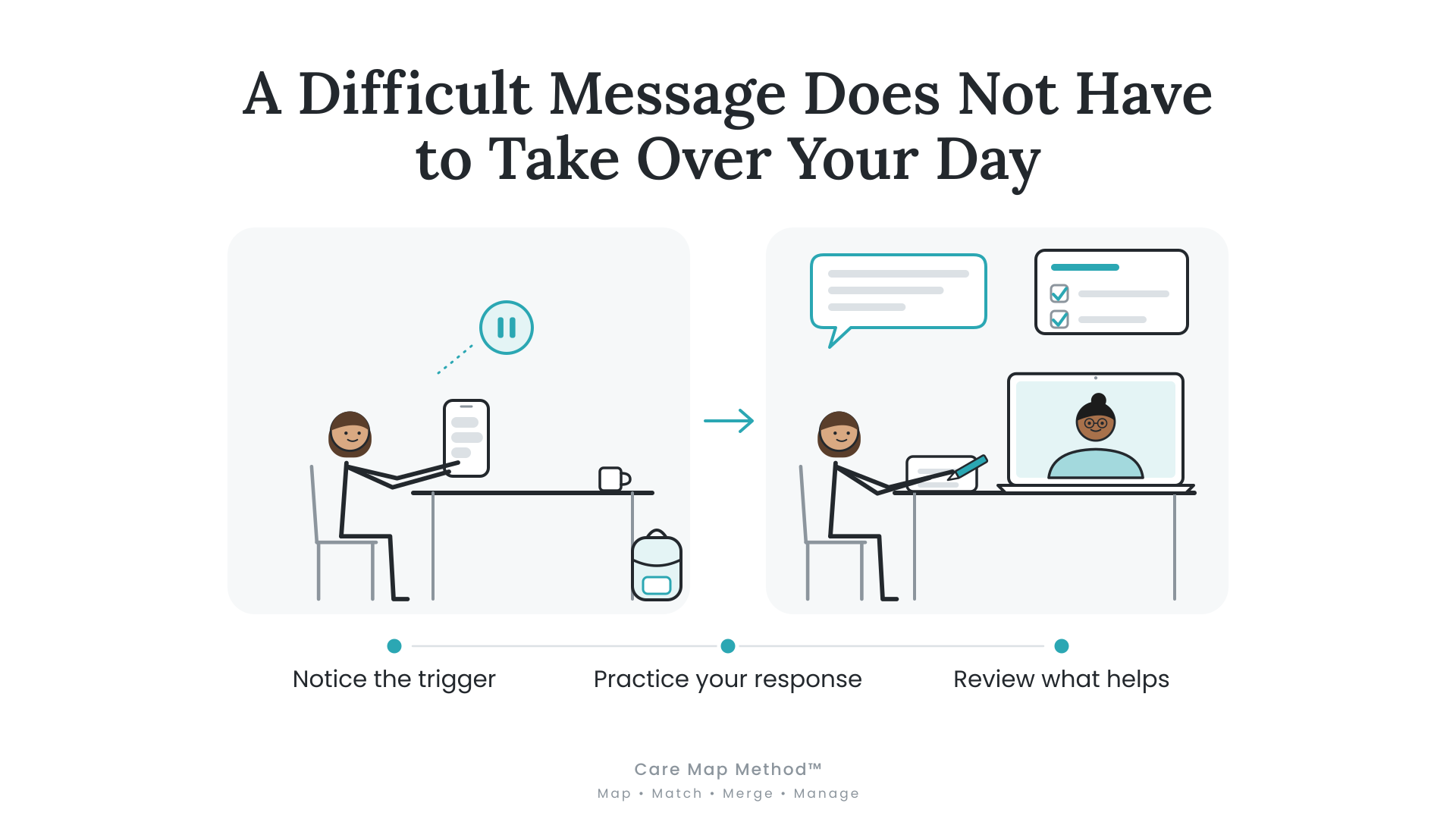
Individual Therapy for Co Parenting Stress in California
Difficult co-parenting messages taking over your day? Explore individual online therapy in California with Tammy Gold, LCSW, and check insurance eligibility.
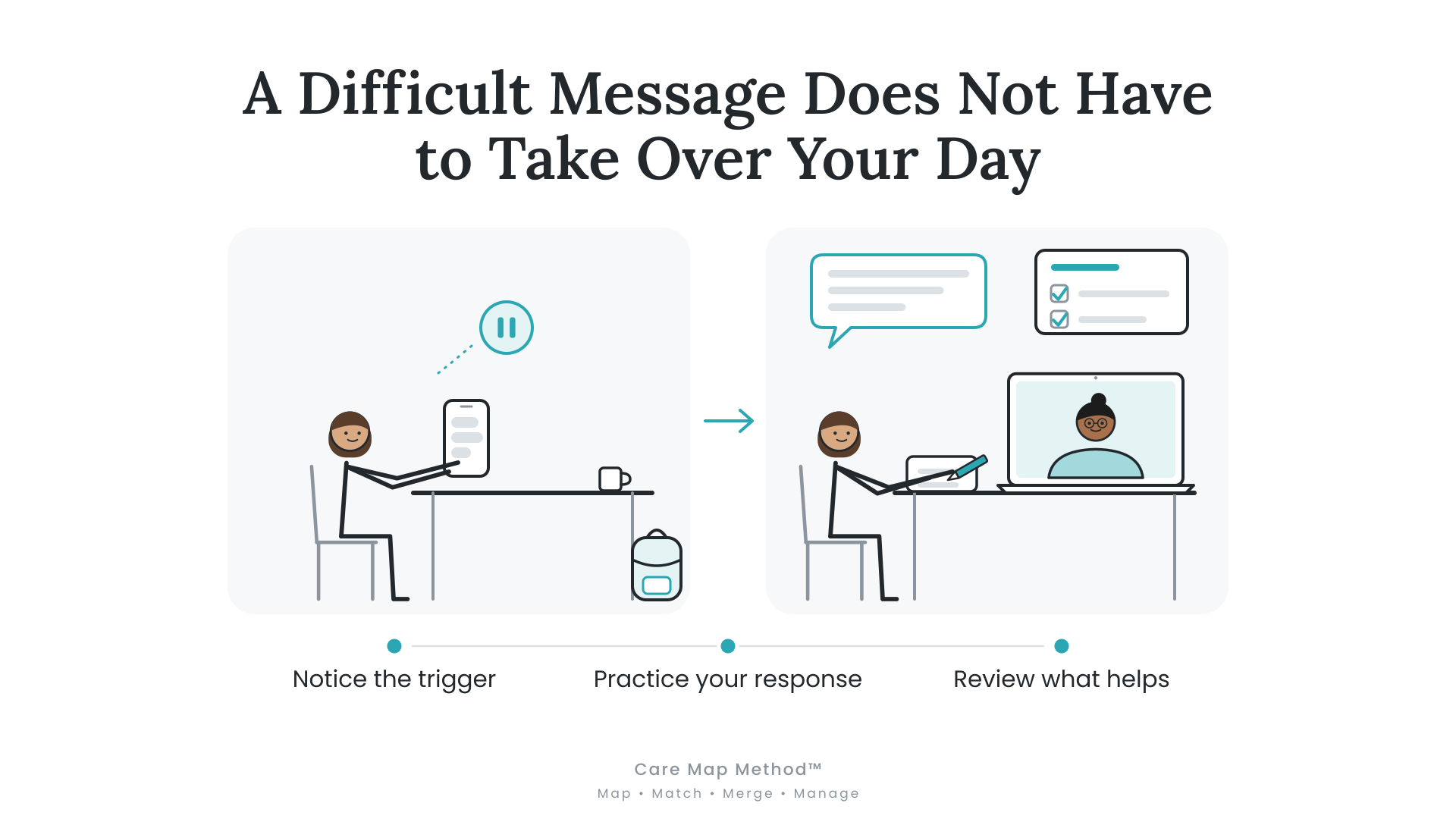
You are getting through an ordinary day when a message from your co-parent arrives. Before you have finished reading it, you are tense. You draft a response, delete it, and start again. A practical question about pickup becomes an argument in your head that follows you into work or time with your child. Individual online therapy in California can give you space to work on the emotional impact of these exchanges and how you want to respond.
Check availability and insurance through Headway
Understand the part that hurts
Co-parenting stress can involve much more than scheduling. A short message may touch a familiar fear of being blamed, ignored, or treated unfairly. You may feel pressure to explain yourself thoroughly so that nobody misunderstands you. We can examine one exchange at a time and identify the feeling, thought, and urge that follow it. Understanding that sequence can help us choose a useful treatment goal rather than trying to resolve the entire relationship in one session.
What we can work on in a session
We might start with a recent message and ask what practical information it contains, what meaning you attach to it, and what you want your reply to accomplish. We can practice language and explore what makes a pause feel difficult. An illustrative response might be: “I can confirm the pickup details by this evening.” Any timing or communication plan must fit your parenting arrangements, legal obligations, and safety. Therapy does not change a court order or replace legal advice.
Use Map Match Merge and Manage
With the Care Map Method™, we Map the exchange and its effect on you. We Match coping and communication strategies to your needs. We Merge the chosen strategy into a real situation, then Manage what happens by reviewing it together. Biological, Emotional, Social, and Environmental factors matter: exhaustion, hurt, available support, and interruptions at work can all shape your capacity. This framework organizes our work alongside clinical assessment and a treatment plan tailored to you.
Prepare one exchange for your appointment
If it feels useful, choose one recent exchange and write a brief summary in your own words. Note what you felt, what you wanted to say, and how the interaction affected the rest of your day. You do not need to bring an entire message history. We can work from the pattern you describe, discuss what felt most difficult, and choose one response to explore. The goal is to make therapy relevant to your daily experience.
What progress could look like
Progress might mean spending less time rehearsing an argument, recognizing when you need support, or making a decision with more clarity. It does not depend on your co-parent agreeing with your interpretation. We can also examine what happens after you send a reply: whether you keep checking the phone, criticize yourself, or struggle to return to another activity. If an approach is not helping, we can adjust it and reconsider what support fits.
Insurance and booking in California
I offer individual therapy for adults located in California. Use my Headway or Alma profile to check current availability, provider participation, and your exact plan. Coverage depends on clinical treatment needs and plan rules; co-parenting conflict alone does not establish eligibility. These sessions are your individual treatment. Joint sessions, mediation, and custody evaluations have different purposes and arrangements. If you are unsure which service you need, ask before booking so we can clarify fit.
About Tammy Gold
I am Tamara “Tammy” Gold, MSW, LCSW, CEC, a licensed therapist, certified coach, and founder of the Care Map Method™. I earned my clinical MSW at Columbia University and have more than 20 years of direct work with families. These sessions focus on your individual mental health and treatment goals.
Take the next step
If this concern is affecting your daily life, view my profile to explore fit, availability, and insurance eligibility. You can choose a starting point without having every detail of the situation figured out.
Frequently asked questions
Can I attend without my co-parent?
Yes. Individual therapy focuses on your symptoms, responses, and decisions. Your co-parent does not have to participate for you to seek support.
Will you help me write a message?
When relevant to your treatment goals, we can practice wording and explore your response to the exchange. I do not act as your attorney or provide court-directed communication advice.
Is this co-parenting mediation?
This page describes individual psychotherapy. Mediation involves a different service and agreement; a therapy appointment should not be assumed to include it.
Can I use insurance?
Check your exact plan through my profile before booking. Coverage and your cost depend on provider participation, eligibility, and whether the treatment meets the plan’s clinical requirements.
How many appointments will I need?
We can discuss an initial plan after assessment and review it as we learn what is helping. There is no single number of sessions that fits everyone.
What if the communication feels threatening?
Tell me when discussing fit so we can consider your safety and appropriate support. A routine communication exercise may not fit a situation involving threats or coercion.
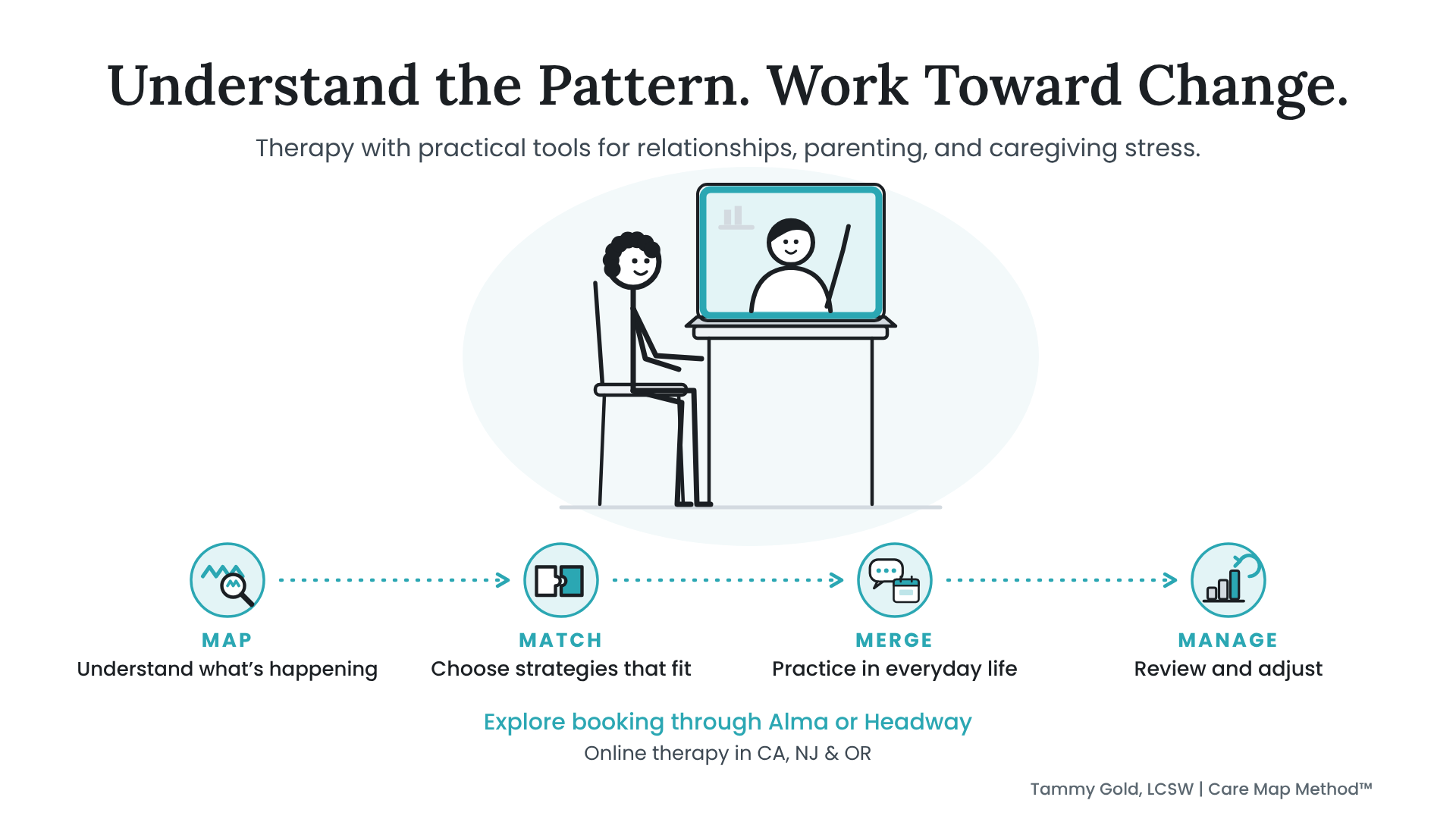
Book Online Therapy With Tammy Gold Through Alma or Headway
Find Tammy Gold, LCSW on Alma or Headway for online therapy in California, New Jersey, and Oregon. Review fit, insurance eligibility, and booking options.
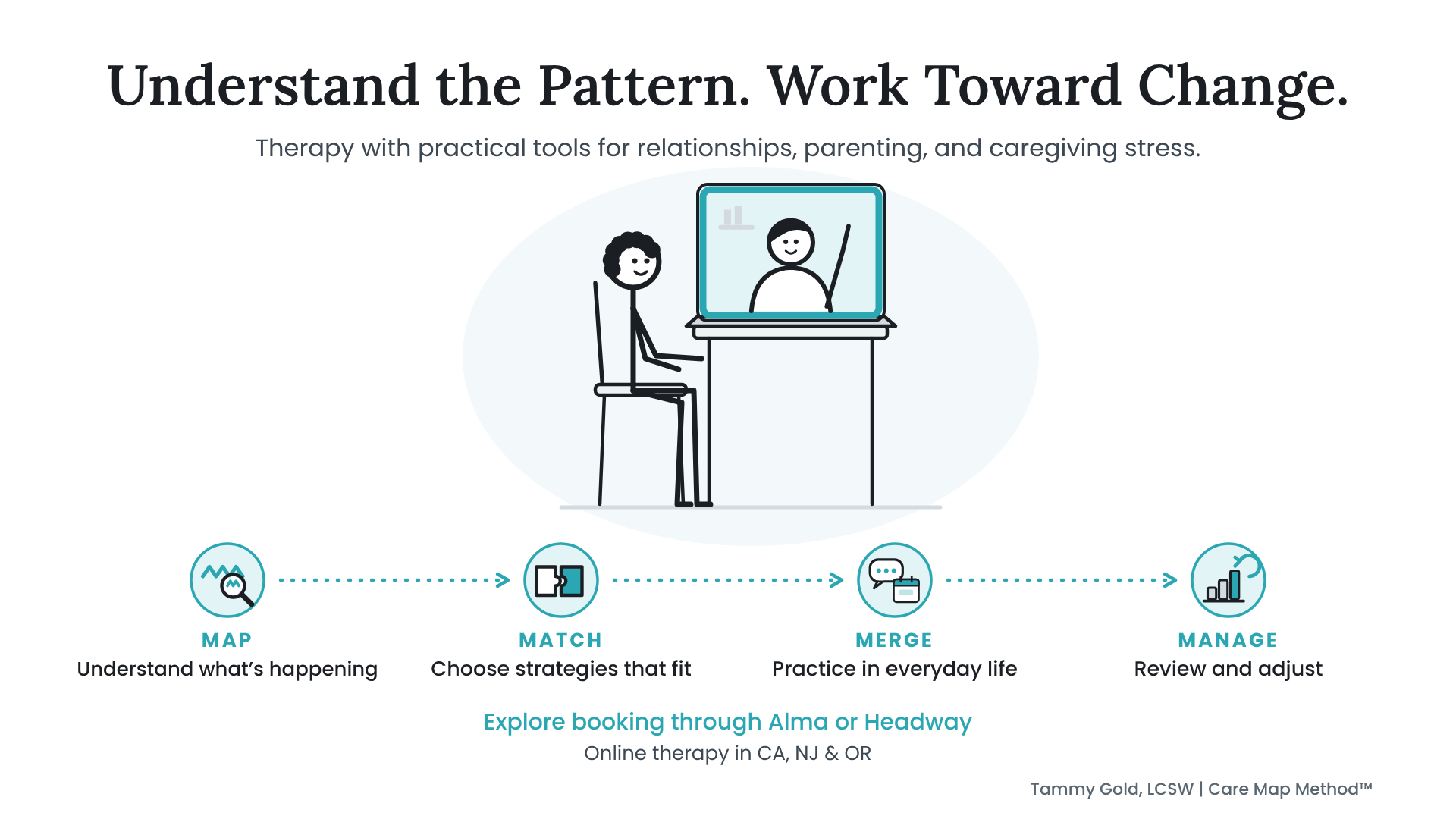
Finding a therapist should not require guessing which link to use. I am Tammy Gold, LCSW, and I offer online therapy for adults located in California, New Jersey, and Oregon. You can view my profiles on Alma and Headway to explore fit and insurance options.
What we can work on
My work focuses on relationship stress, parenting strain, divorce adjustment, family conflict, caregiver distress, and the emotional impact of work and life transitions. In individual therapy, we can explore what you are experiencing, assess treatment needs, and turn your goals into concrete steps. Couples services require a separate discussion of fit and coverage.
Choose a platform that fits your plan
Open my Alma or Headway profile and select the state where you will be during sessions. Review the insurance options for your exact plan. A carrier appearing on a platform does not mean every plan or every provider participates. If both platforms appear to support your plan, confirm the appropriate booking route before scheduling the same care in two places.
Know what to check before booking
Review current availability, estimated cost, deductible or copay information, and whether the service you want is covered. Have your insurance card ready for the platform’s secure intake process. For a general booking question, you can email tammy@caremapmethod.com; please use the platform’s secure process for insurance details and sensitive health information.
A practical approach to therapy
The Care Map Method™ gives us a structure to Map what is happening, Match treatment strategies to your needs, Merge insight into everyday conversations and routines, and Manage progress. It considers Biological, Emotional, Social, and Environmental needs alongside clinical assessment and your treatment goals.
What your first therapy session can include
You do not need a polished explanation of why you are seeking help. We can discuss the situation that brought you here, your emotional symptoms, relevant history, and the changes you would like to see. You might want help with a difficult family relationship, adjusting after divorce, or feeling overwhelmed by caregiving. We can consider whether my approach fits your needs and agree on an initial focus. The assessment also helps determine whether insurance-funded treatment is appropriate.
What practical work can look like
For relationship stress, we might examine one recurring interaction and practice language for a clearer request. For caregiver distress, we might explore guilt around a limit and prepare a conversation about support. For divorce adjustment, we might work on what happens emotionally before and after contact with a former partner. These are examples of possible work, not promised results. Your treatment plan should reflect your circumstances, clinical needs, and the pace at which you feel able to work.
Prepare your questions before choosing a booking link
Write down where you will be physically located during sessions, the exact name of your insurance plan, and whether you want individual therapy or another service. Review the relevant profile and its current scheduling options. If the platform cannot confirm your plan, ask for clarification before treating an estimate as settled. For general booking questions, email tammy@caremapmethod.com or call 310-721-1584. Share member numbers and sensitive health information through the secure intake process rather than ordinary email.
How we decide what is helping
We can revisit your goals and ask what is changing outside sessions. Perhaps you are making a decision with more clarity, recovering more easily after conflict, or recognizing when you need support. If an approach does not fit, we can discuss what to adjust. The structure of Map, Match, Merge, and Manage helps organize that conversation, while clinical assessment guides the treatment. You are welcome to ask how an exercise connects to your goals.
About Tammy Gold
I am Tamara “Tammy” Gold, MSW, LCSW, CEC, a licensed therapist and certified coach with a clinical MSW from Columbia University. I founded the Care Map Method™ and have more than 20 years of direct work with families. These sessions focus on your individual mental health and treatment goals.
Take the next step
If this concern is affecting your daily life, view my profile to explore fit and current booking options. Check your exact plan and estimated costs before scheduling. You can also read the online therapy booking guide for help choosing a platform.
Check insurance and booking through Headway
Frequently asked questions
Is Alma or Headway my therapist?
I provide your therapy. Alma and Headway support provider discovery and administrative processes such as insurance verification and billing.
Which platform costs less?
There is no single answer for every client. Your exact plan, benefits, and provider participation determine the estimate and final responsibility. Check the relevant platform before booking.
Can I use these links while visiting another state?
Please confirm your physical location before scheduling. This page offers care for clients located in California, New Jersey, or Oregon; another state requires separate confirmation of authorization.
Can I book couples therapy using the same insurance assumptions?
Please ask about joint-session availability and coverage separately. These pages describe individual psychotherapy; couples services may have different clinical, billing, and coverage requirements.
Do I need to book on both platforms?
Please confirm one appropriate booking route for your care. If you already have an appointment or existing treatment relationship, clarify any platform change before creating another booking.
What should I prepare for an online session?
Plan to join from a private place in an authorized state with a dependable connection. Review the intake instructions and ask about any technology or accessibility needs before your appointment.
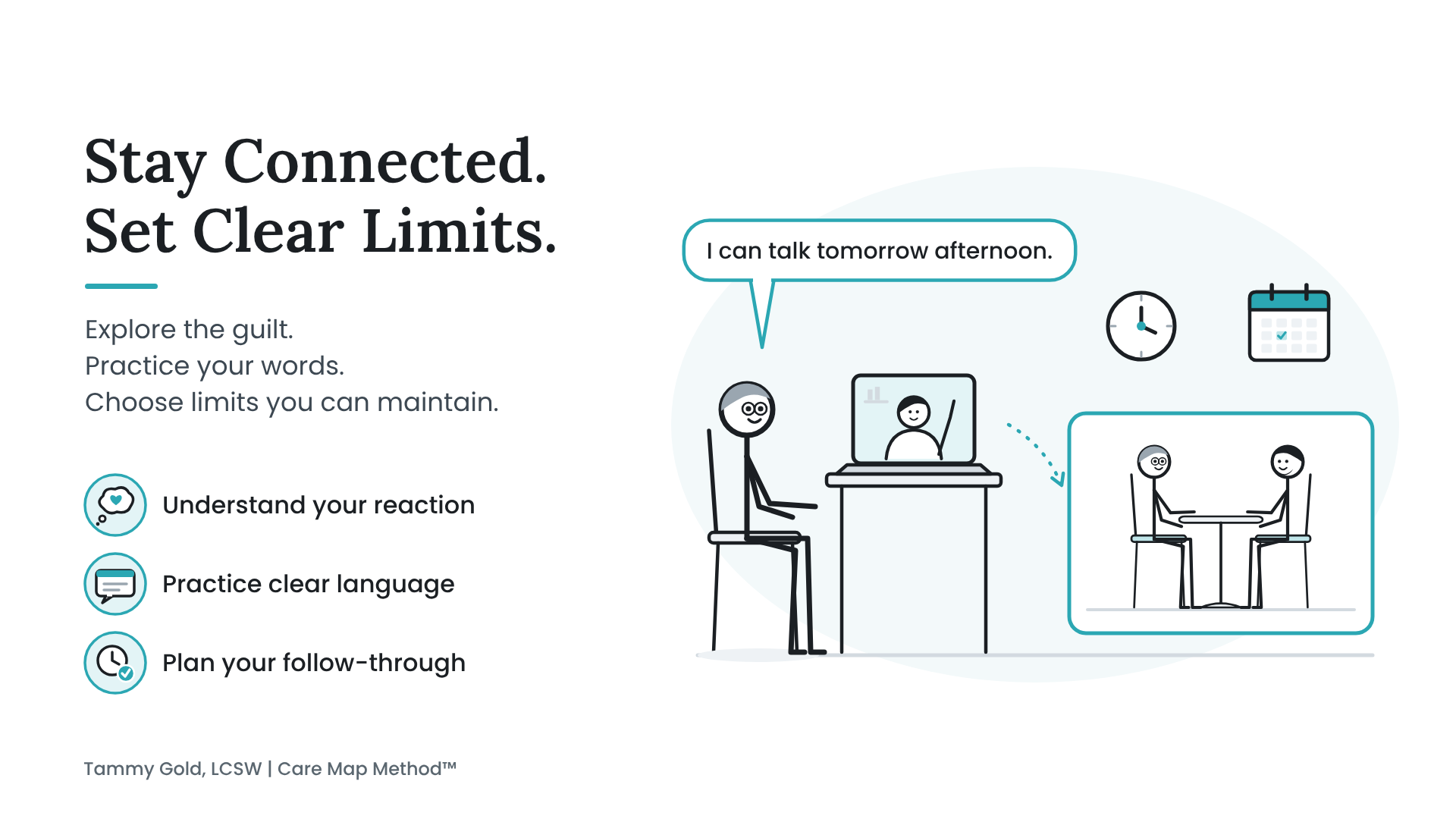
Therapy for Boundaries With Adult Children in Oregon
Online therapy for Oregon parents struggling with guilt, conflict, or boundaries with adult children. Check Regence BCBS eligibility through Headway.
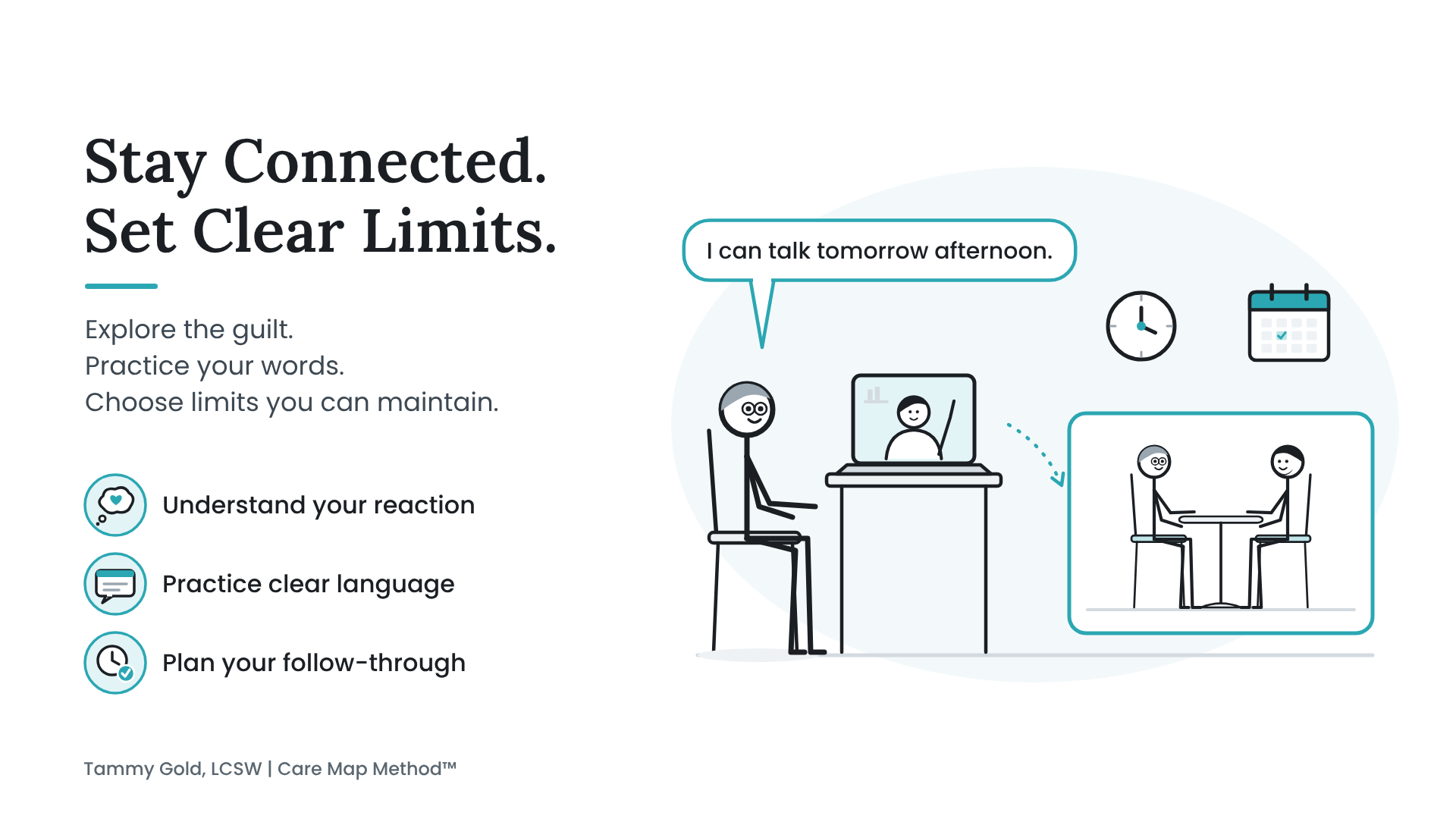
You want to stay close to your adult child, but every call seems to bring another crisis, request, or disagreement. You may be afraid that setting a limit will cost you the relationship.
I am Tammy Gold, LCSW. I offer individual online therapy for adults located in Oregon. Regence BlueCross BlueShield of Oregon appears on my Headway profile; please check your exact plan and eligibility before booking.
Check insurance and booking through Headway
Love and availability are different questions
Individual therapy can help you explore the fear, guilt, sadness, or resentment around family boundaries. We can look at what happens before you agree to something, how you feel afterward, and which patterns leave you exhausted. The goal is to make thoughtful choices about your own behavior while respecting that your adult child makes theirs.
Choose a limit you can maintain
A boundary is more usable when it states what you will do. Instead of repeatedly asking someone to stop calling late at night, you might decide: “I can talk tomorrow afternoon. I am not available for this conversation tonight.” We can practice the wording, prepare for your emotional reaction, and reconsider the plan when circumstances genuinely change.
Understand the family pattern
Using the Care Map Method™, we Map the interaction and its effects, Match your needs with coping skills and realistic limits, Merge those limits into communication, and Manage what follows. Biological, Emotional, Social, and Environmental factors help us understand your capacity and the pressures on the relationship without reducing either person to a label.
What we would explore in your first session
We can begin with a recent request or conversation that left you upset. What did your adult child ask for? What did you agree to? What did you fear would happen if you said no? We would discuss your symptoms, relevant history, and the effect on your daily life. Your goal might be responding more thoughtfully to financial requests, reducing arguments, or deciding when you are available to talk. You do not need your adult child’s agreement to work on your own responses.
An example of setting a financial limit
Suppose you have agreed to several expenses and now feel anxious whenever your phone rings. We can explore what you can realistically offer and practice wording that states the limit: “I can contribute this amount toward this expense. I cannot take on the additional payment.” This is an illustrative exercise, not a client story or financial advice. We would also discuss what happens after you speak, including guilt, repeated requests, or the temptation to change your answer just to end the discomfort.
Prepare for the feeling after the boundary
A useful boundary plan includes what you will do when the conversation ends. You might wait before replying to another request, write down what made your limit necessary, or bring the exchange to your next session. Choose an action that fits the situation and your responsibilities. We can distinguish an ordinary disagreement from a circumstance that needs urgent attention. The aim is to help you stay thoughtful about your choices when emotions make immediate agreement feel easier.
How we review progress
We can review whether your limits are clearer, whether you follow through more consistently, and whether you spend less time caught in the same argument. We can also explore grief about how the relationship has changed. Staying connected may involve a different level of contact or support than you once imagined. Your treatment goals can reflect both your wish for closeness and your need for a sustainable life.
About Tammy Gold
I am Tamara “Tammy” Gold, MSW, LCSW, CEC, a licensed therapist and certified coach with a clinical MSW from Columbia University. I founded the Care Map Method™ and have more than 20 years of direct work with families. These sessions focus on your individual mental health and treatment goals.
Take the next step
If this concern is affecting your daily life, view my profile to explore fit and current booking options. Check your exact plan and estimated costs before scheduling. You can also read the online therapy booking guide for help choosing a platform.
Check insurance and book through Headway
Read the online therapy booking guide
Frequently asked questions
Can I attend without my adult child?
Yes. Individual therapy focuses on your mental health and choices. Your adult child does not need to participate.
Does Regence BCBS Oregon cover this therapy?
Coverage depends on your specific plan, provider eligibility, and clinical requirements. Family conflict alone does not guarantee coverage; check your benefits through Headway.
Will you decide who is right?
We can examine the interaction, its impact on you, and your options. The work focuses on understanding and change rather than issuing a verdict about a family member.
Can I seek help if we are currently estranged?
Yes. We can explore grief, uncertainty, and your choices around contact. Individual therapy cannot promise reconciliation, but it can support you as you consider what is possible.
Does a boundary mean ending the relationship?
A boundary can address time, money, communication, or what you will participate in. We can explore a range of options and what each would mean in your circumstances.
Can I change a boundary later?
Yes. We can review what changed and whether a different limit makes sense. A thoughtful revision can reflect new information, while still taking your needs seriously.
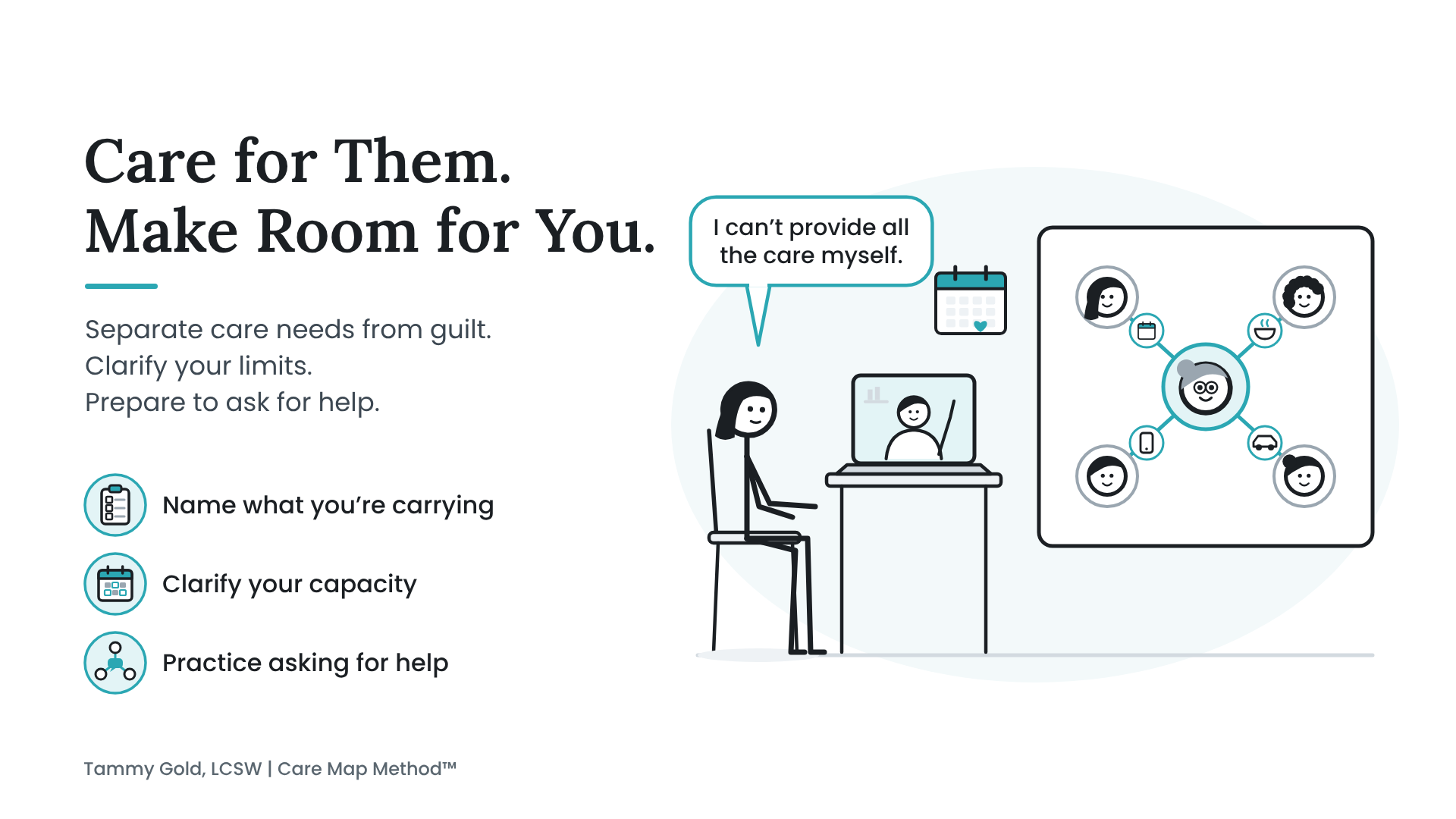
Therapy for Caregiver Guilt in Oregon
Feeling guilty about limits or senior-care decisions? Explore individual online therapy in Oregon and check Providence Health Plan eligibility through Headway.
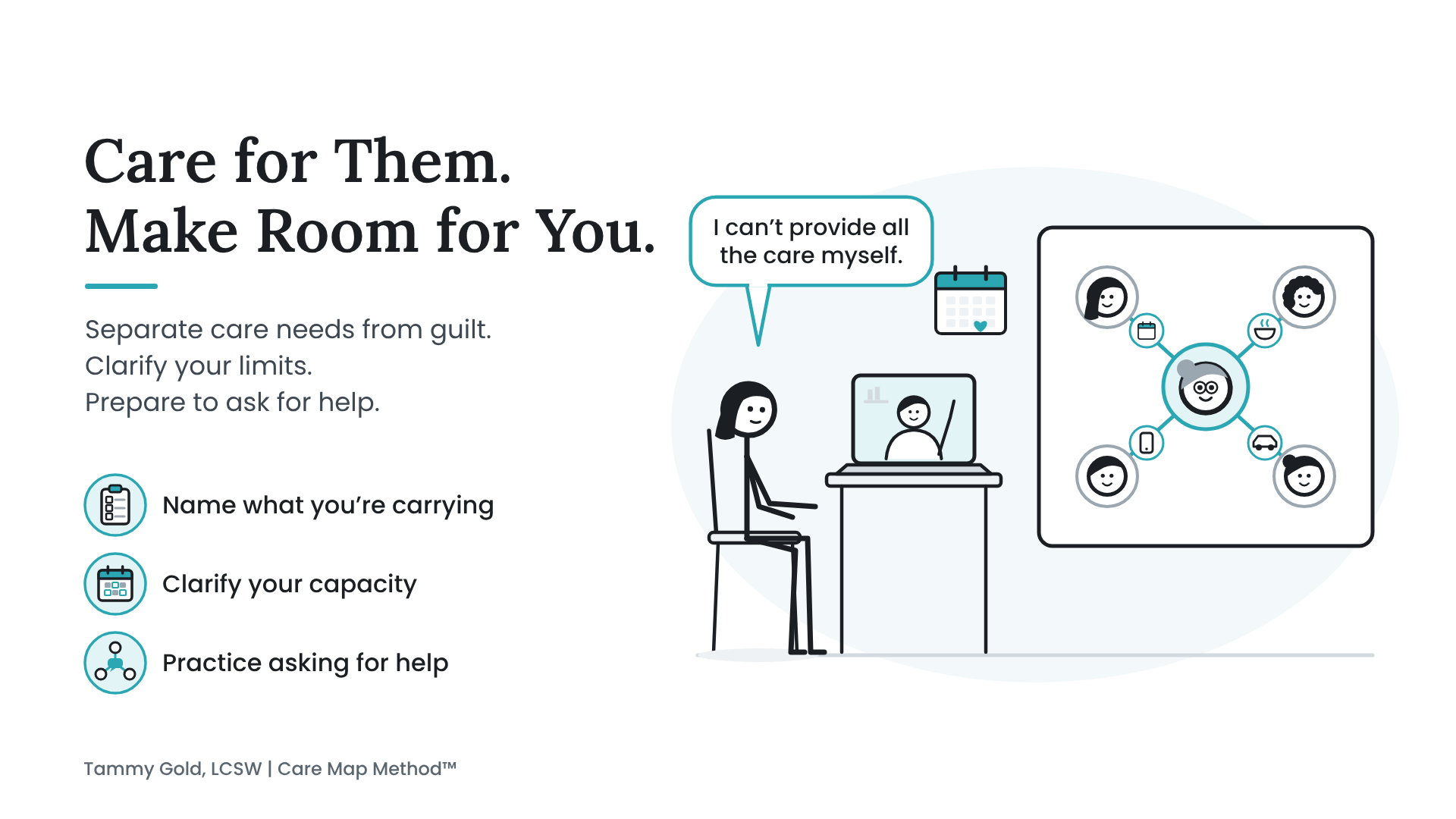
You know you cannot do everything your parent needs. Still, saying no, hiring help, or considering a different care setting can feel like a betrayal. You may be judging yourself for limits that are necessary.
I am Tammy Gold, LCSW. I offer individual online therapy for adults located in Oregon. Providence Health Plan appears on my Headway profile; please check your exact plan and eligibility before booking.
Check insurance and booking through Headway
Separate the care need from the guilt
Guilt can sound like a clear instruction: “A good daughter would do more.” In therapy, we can slow that thought down. What does your parent need? What can you provide safely and sustainably? What support is missing? We can explore the emotional distress around caregiving without assuming every request must become your responsibility.
Make room for a difficult decision
You may be balancing your parent’s wishes with your health, children, work, and finances. We can help you prepare conversations, tolerate disagreement, and recognize the grief that sometimes comes with changing a care arrangement. A useful starting point is: “I want you to have reliable care, and I cannot provide all of that care myself.”
Use the map to make your capacity visible
The Care Map Method™ helps us Map Biological, Emotional, Social, and Environmental needs for you and the care situation, Match those needs with realistic support, Merge clearer communication into the plan, and Manage your emotional response as circumstances change. Psychotherapy addresses your mental health; medical and care-placement decisions may also require other professionals.
What we would explore in your first session
We can start with the decision or request you keep replaying. Perhaps your parent wants daily visits, a sibling expects you to coordinate everything, or you feel guilty about considering assisted living. We would discuss your emotional symptoms, relevant history, and the effect of caregiving on your own life. It helps to understand your actual responsibilities and support network before deciding what to work on. You can attend even if other family members disagree about the care plan.
An example of separating love from capacity
Imagine that you are handling appointments and evening calls while also managing work and your household. We might list the responsibilities you carry and identify what happens when you reach your limit. A conversation could begin: “I can coordinate this appointment, but I cannot also provide every evening visit. We need another arrangement for that.” This is an illustrative exercise, not a client story. We would also work on the guilt or fear that appears after you state the limit.
Try a brief responsibility inventory
On a piece of paper, list what you currently do, how often it happens, and which tasks require another person’s help or professional input. Include the time spent worrying and organizing, not only hands-on care. Then circle the responsibility that feels least sustainable. Bring the list to therapy so we can explore the emotional pressure around it and identify a realistic next conversation. A therapist can support your decision-making without replacing your parent’s medical team or a qualified care coordinator.
How we review progress
We can look at whether you recognize overload earlier, accept appropriate help, or feel more able to rest without immediately criticizing yourself. We can also make room for sadness about your parent’s changing needs. A revised care arrangement may still feel painful even when it is necessary. Therapy gives you a place to process that experience and revisit boundaries as circumstances change.
About Tammy Gold
I am Tamara “Tammy” Gold, MSW, LCSW, CEC, a licensed therapist and certified coach with a clinical MSW from Columbia University. I founded the Care Map Method™ and have more than 20 years of direct work with families. These sessions focus on your individual mental health and treatment goals.
Take the next step
If this concern is affecting your daily life, view my profile to explore fit and current booking options. Check your exact plan and estimated costs before scheduling. You can also read the online therapy booking guide for help choosing a platform.
Check insurance and booking through Headway
Read the online therapy booking guide
Frequently asked questions
Can therapy help if my parent refuses outside help?
We can work on your distress, boundaries, communication, and decisions even when your parent does not agree with you.
Does Providence cover caregiver support?
Coverage depends on your plan and the clinical purpose of treatment. Individual psychotherapy for a caregiver is different from nonclinical care coordination or placement services. Verify benefits through Headway.
Do you choose a facility or arrange staffing during therapy?
This page offers individual psychotherapy. Care selection, staffing, and coaching are separate services and should not be assumed to be covered by therapy insurance.
Is it okay to seek therapy if my parent is the person who is ill?
Yes. The effect of caregiving on your own mental health deserves attention. We would assess your symptoms and treatment needs rather than assume your parent must attend.
Can we discuss conflict with siblings about care?
Yes. We can explore your distress and responses, practice a clearer request, and identify responsibilities you can realistically take on. Individual therapy does not require your siblings to participate.
Will therapy make the guilt disappear?
No particular outcome is guaranteed. We can work on understanding the guilt, responding to it more thoughtfully, and making decisions that take your own capacity into account.
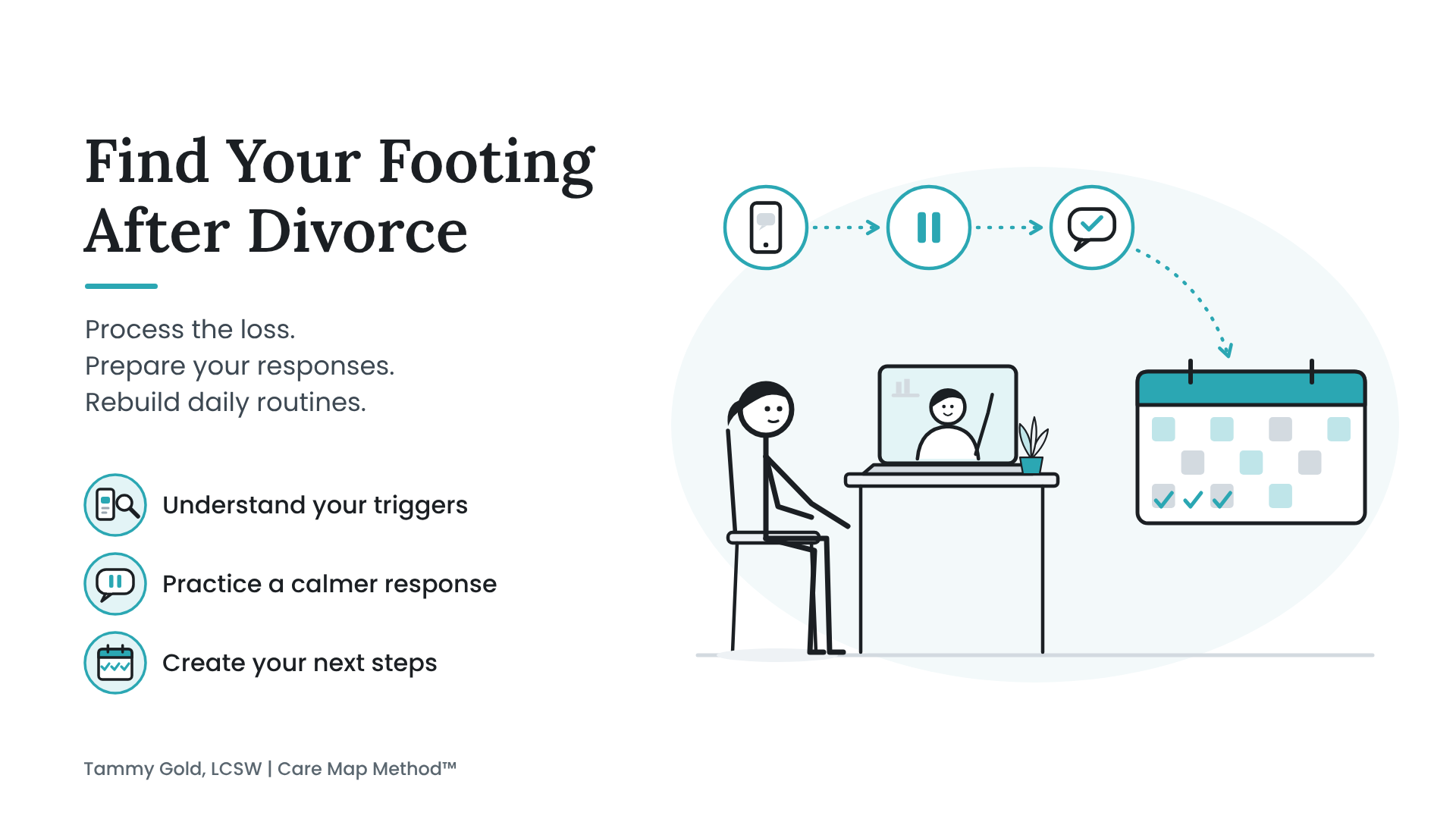
Therapy for Divorce Adjustment in New Jersey
Online therapy with Tammy Gold, LCSW for the emotional strain of separation and divorce in New Jersey. Check Horizon plan eligibility through Headway.
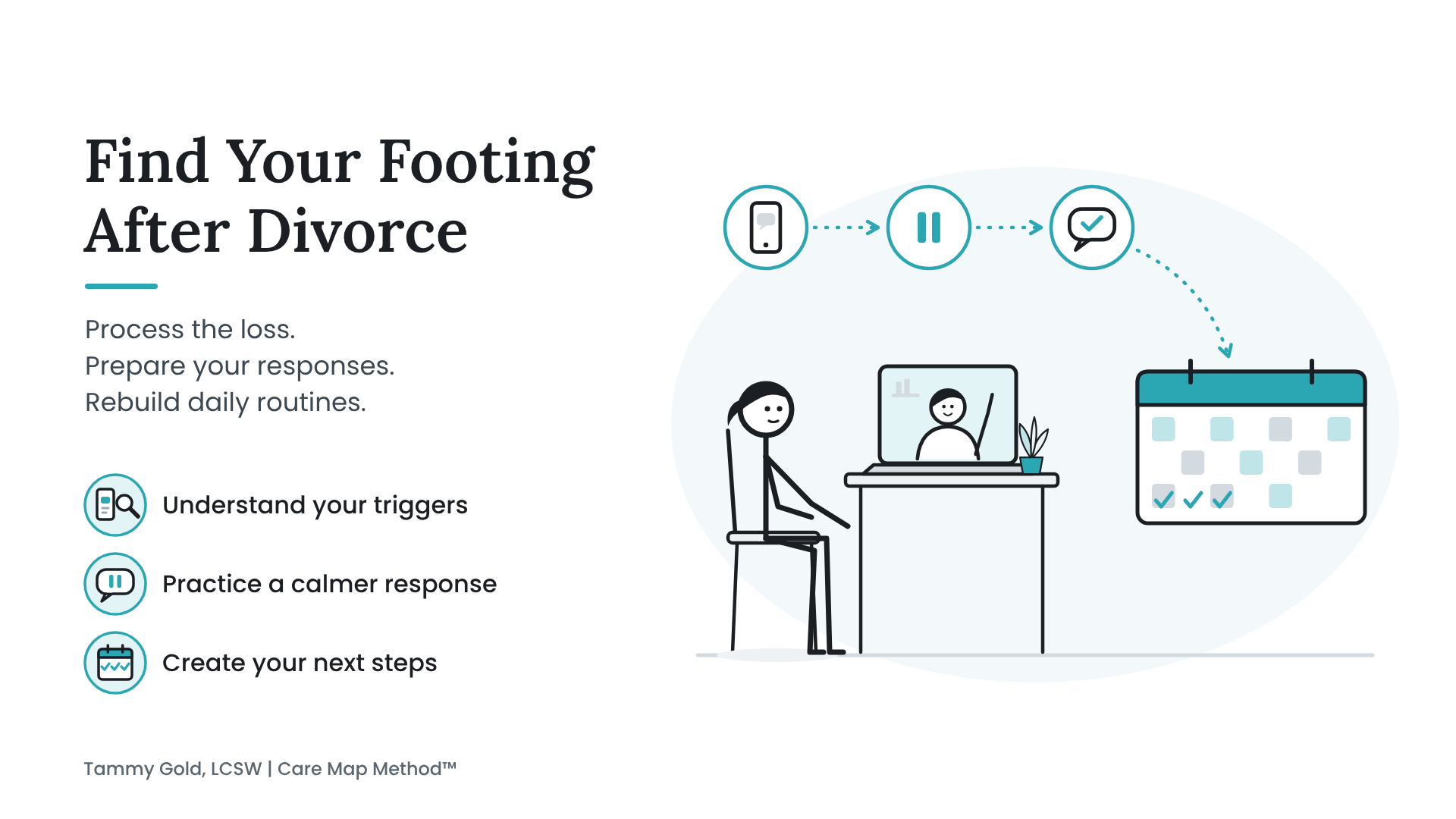
The paperwork may be moving forward while your feelings are still catching up. Separation can change your home, routines, finances, friendships, and sense of who you are. You may feel relief one day and grief the next.
I am Tammy Gold, LCSW. I offer individual online therapy for adults located in New Jersey. Horizon Blue Cross and Blue Shield of New Jersey appears on my Headway profile; please check your exact plan and eligibility before booking.
Check insurance and booking through Headway
You do not need to have your feelings sorted out
Individual therapy offers room to process loss, anger, uncertainty, and the pressure to make decisions while emotionally stretched. We can identify what is affecting your sleep, concentration, parenting, and relationships, then choose treatment goals that fit your current circumstances.
Create space between the message and your response
An unexpected text from a former partner can take over the rest of your day. We can examine what the message triggers, distinguish a practical question from a familiar conflict, and plan how you want to respond. Sometimes the work is a short reply. Sometimes it is learning to pause while you settle enough to think clearly.
Build a life around your current needs
Using the Care Map Method™, we Map the strain and the changes you are facing, Match needs with emotional support and practical coping strategies, Merge those strategies into daily routines, and Manage setbacks. We consider Biological, Emotional, Social, and Environmental needs as you rebuild. Therapy can support your emotional adjustment; legal and financial questions belong with qualified advisers.
What we would explore in your first session
You can begin wherever the separation feels most present: the quiet house, exchanges with a former partner, a changed parenting schedule, or the fear of starting over. We would discuss your symptoms, relevant history, current supports, and the decisions that feel emotionally difficult. You do not need a complete timeline ready. We can choose one immediate treatment goal, such as settling after a difficult message or rebuilding a routine that helps you get through the week.
An example of a calmer communication plan
Suppose a message about a pickup time includes a personal accusation. In therapy, we might separate the scheduling question from the part that draws you toward an argument. We can practice a reply that addresses the practical issue, then discuss what you need after sending it. This is an illustrative exercise rather than a client story. Any communication plan must fit your safety and existing arrangements; questions about court orders or legal obligations need your attorney’s guidance.
Build one dependable routine
When much of life feels unsettled, a small routine can give the day a clearer shape. Choose one manageable action, such as eating lunch away from divorce paperwork, arranging a regular check-in with someone supportive, or setting aside a defined period for administrative tasks. We can discuss why that action matters, what might get in the way, and how to make it realistic. The purpose is to create some room for your needs while you process the larger change.
How we review progress
We can notice whether difficult contact takes over less of your day, whether you feel more able to concentrate, or whether you are reconnecting with people and activities you value. Grief may return around anniversaries, family events, or changes in parenting time. That gives us something specific to work through. Your goals can change as the practical circumstances of the divorce change.
About Tammy Gold
I am Tamara “Tammy” Gold, MSW, LCSW, CEC, a licensed therapist and certified coach with a clinical MSW from Columbia University. I founded the Care Map Method™ and have more than 20 years of direct work with families. These sessions focus on your individual mental health and treatment goals.
Take the next step
If this concern is affecting your daily life, view my profile to explore fit and current booking options. Check your exact plan and estimated costs before scheduling. You can also read the online therapy booking guide for help choosing a platform.
Check insurance and booking through Headway
Read the online therapy booking guide
Frequently asked questions
Do I need a diagnosis before contacting you?
You do not need to diagnose yourself. An initial clinical assessment helps determine treatment needs and whether insurance-funded care is appropriate.
Can I use Horizon insurance?
Horizon appears on my Headway profile, but acceptance and cost depend on your specific plan and eligibility. Check your benefits before scheduling.
Can you mediate my divorce or write a custody evaluation?
This service is individual psychotherapy for emotional adjustment. It does not include legal mediation, custody evaluation, or legal advice.
Can I start before the divorce is final?
Yes. Separation and the period before a final agreement can bring distress worth addressing. Treatment focuses on your mental health and adjustment at your current stage.
Can we work on co-parenting stress in individual therapy?
We can explore your emotional responses, communication, and boundaries around co-parenting. These sessions are your individual treatment; joint work and legal questions require separate arrangements.
Will you tell me whether to reconcile?
We can explore your feelings, needs, and the consequences of different choices. The decision is yours, and therapy can help you think it through with more clarity.