

Say what you can offer without losing sight of what you need
You agree to help, rearrange your day, and later feel resentful. Or you finally say no and spend hours worrying that you were selfish. Boundaries can be difficult when keeping other people comfortable has become your way of protecting a relationship. Therapy gives us room to understand that pattern and practice a limit that fits your situation.
You may apologize before making a request, overexplain a simple decision, or take another person’s disappointment as proof that you did something wrong. Perhaps the boundary is clear in your head but disappears in the conversation. We can work on both the words you use and the feelings that make them hard to hold.
Check benefits and availability
Understand what saying no seems to risk
We can explore what you expect will happen if you disappoint someone. You may fear rejection, conflict, being seen as unkind, or losing a role that has made you feel needed. Understanding where those expectations come from helps us choose an approach that respects your history and your current circumstances, including relationships where directness has consequences.
Turn a vague limit into a clear decision
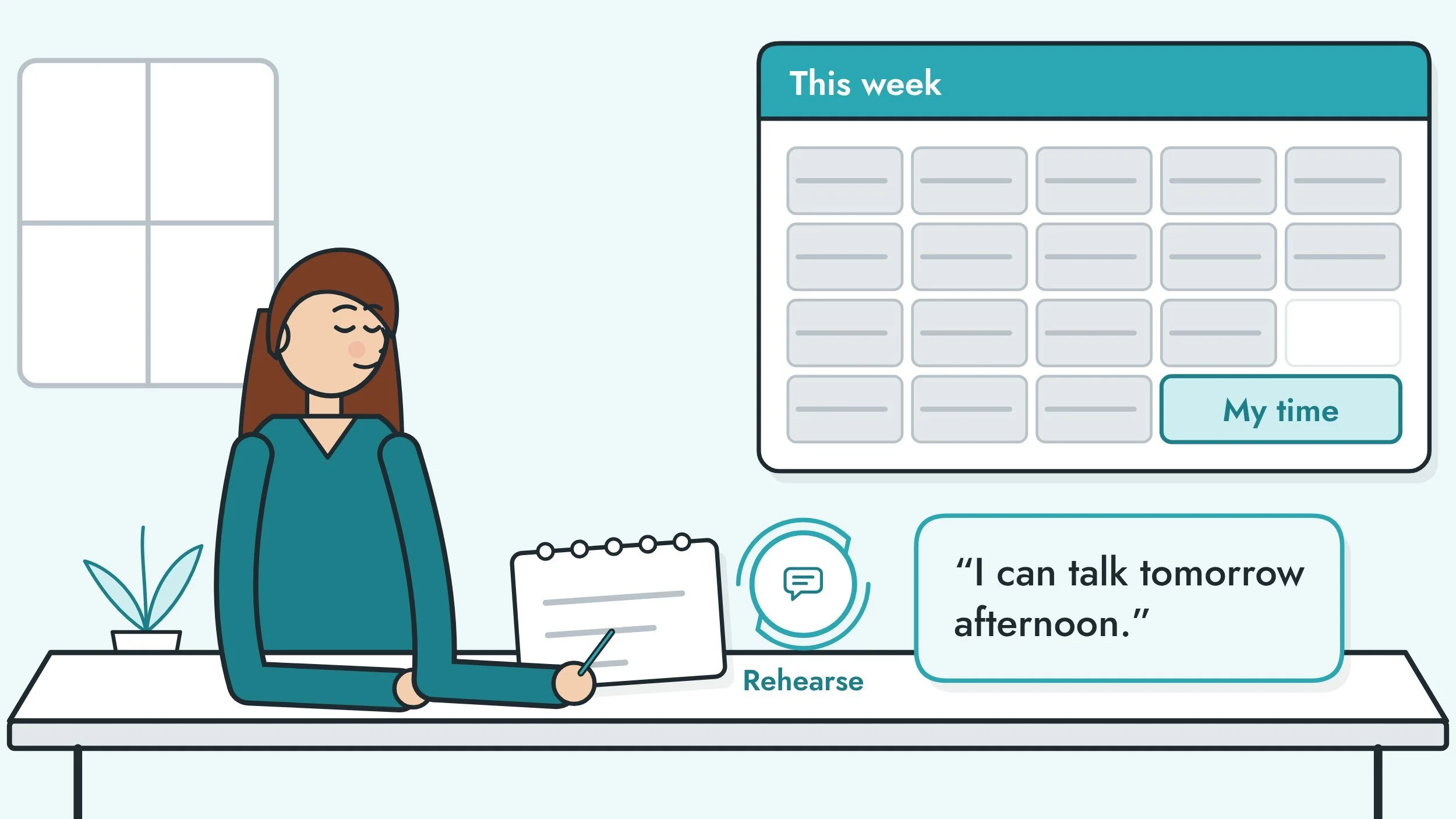
A boundary becomes easier to practice when it describes what you will do. We might change “I need everyone to respect my time” into “I can talk for fifteen minutes tonight, and then I need to finish my work.” We can rehearse wording that sounds like you and decide how much explanation is useful in that relationship.
Prepare for the discomfort afterward
Even a reasonable limit may leave you anxious or guilty. We can plan for the urge to send another explanation, reverse your decision, or check repeatedly for reassurance. Together, we can distinguish discomfort from evidence that you acted against your values. If a boundary needs revision, we can revise it thoughtfully rather than abandoning it in a moment of panic.
An example of the work
For example, you might want to stop answering nonurgent family calls during work. We could explore what makes that feel disloyal, practice a message about when you are available, and decide how to respond to repeated calls. We would also discuss genuine emergencies and practical responsibilities.
What progress can look like
Progress may look like taking time before agreeing, making a smaller commitment, giving a shorter explanation, or tolerating someone’s disappointment without immediately changing your answer. The aim is a way of relating that includes your needs.
How Care Map Method supports our work
Map the emotion and trigger. We look at a recent moment and the biological, emotional, social, and environmental pressures around it. The aim is to understand your experience before choosing a response.
Match the need with a strategy. We identify what matters in that moment and select a skill or next step that fits. That might be a clearer request, a pause, a boundary, or space to process a loss.
Merge the skill into daily life. We can rehearse the words and decide when you might use them. Any practice between sessions is chosen together and adjusted to your circumstances.
Manage responses over time. We review what happened, what was difficult, and what needs to change. Therapy includes room for feelings and history as well as practical work.
About Tammy Gold
I’m Tamara “Tammy” Gold, MSW, LCSW, founder of Care Map Method™ and author of Secrets of the Nanny Whisperer. I earned my MSW at Columbia University and my BA at the University of Pennsylvania. My work with families informs a warm, active approach to therapy that makes room for your emotional experience and practical concerns.
Common questions
Is setting a boundary the same as cutting someone off? No. A boundary can define time, topics, money, or availability while preserving contact. We can discuss different options and what is appropriate for the relationship.
Can therapy help with people-pleasing? We can explore when accommodating others becomes costly, what you fear about changing it, and how to practice choices that reflect your needs and values.
What if they get upset? We can prepare for likely reactions and identify what you can control. Another person’s response matters, but it does not by itself tell us whether your limit is reasonable or safe.
Can we practice the actual conversation? Yes. We can rehearse your words, consider possible responses, and adjust the message so it sounds natural. You decide whether and when to use it.
Can I use Aetna or Anthem? Check your specific California plan on my Headway profile before scheduling. Participation and coverage vary by network and service, and your deductible or copay may apply.
What if I cannot identify my own needs? That can be part of the work. We can start with recent moments of resentment, exhaustion, or hesitation and explore what they tell you about your limits.
Take the next step
If this sounds familiar, you can explore online therapy with me while located in California. Open my Headway profile to check your exact insurance benefits and appointment options. We will discuss your concerns, clinical needs, and goals to determine fit.