

Support for the person everyone depends on
You keep track of appointments, answer the calls, and think about what could go wrong even when you are trying to rest. Caring for an aging parent may bring love, worry, grief, and resentment into the same day. Therapy offers a place to work through what this role is costing you and consider changes that make room for your own health.
Perhaps you are short with people you care about, feel guilty taking a break, or dread a call because it might mean another problem. You may be balancing children, work, and a parent’s needs while wondering why you cannot manage it better. We can examine the demands themselves as well as your reactions to them.
Check benefits and availability
Make the invisible responsibilities visible
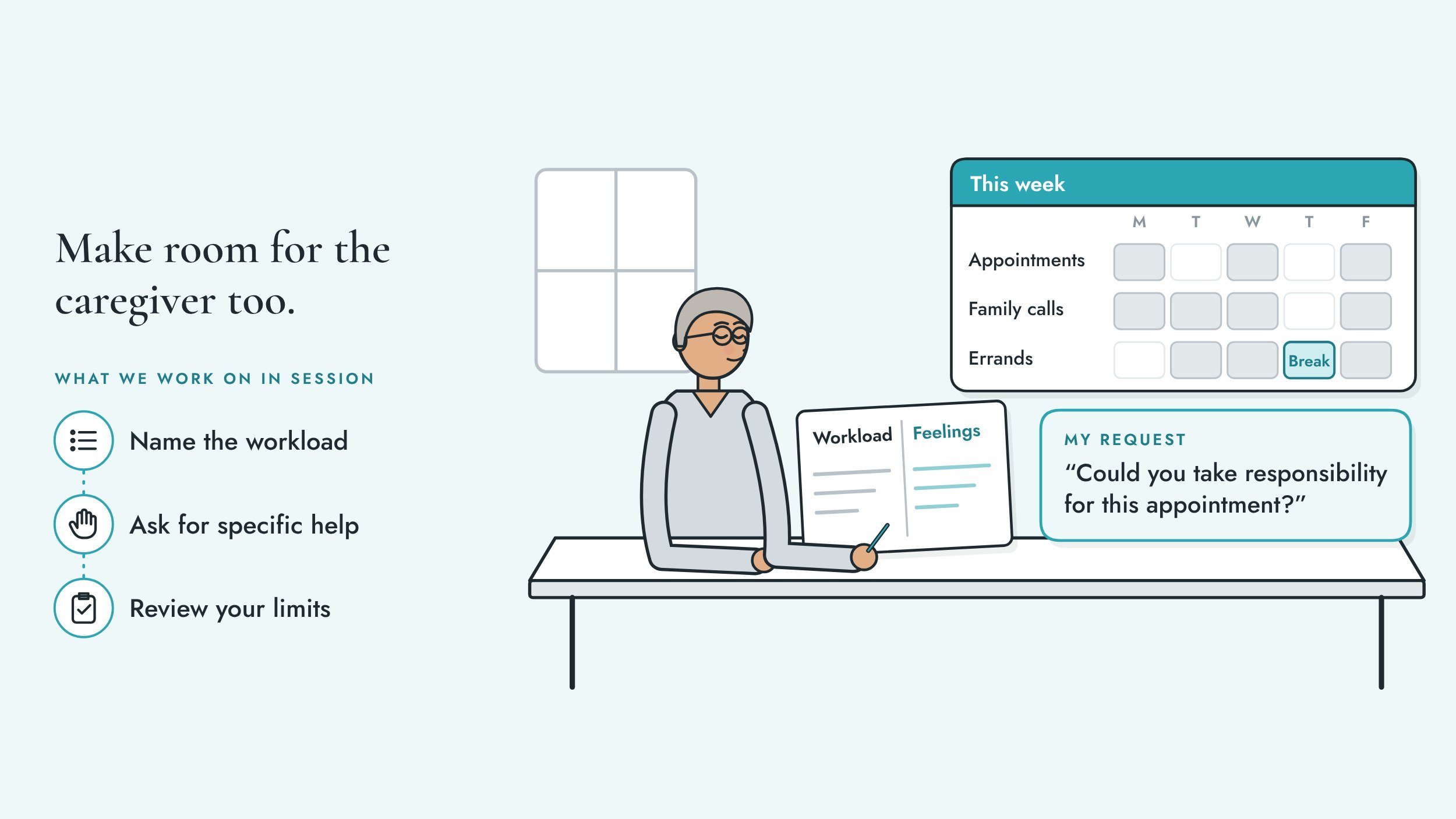
We can walk through a typical week and name the work you carry: coordinating care, anticipating problems, handling family messages, or being constantly available. This can help us identify where exhaustion is coming from and which responsibilities are yours by choice, agreement, or default. We also consider sleep, support, finances, and the environment around caregiving.
Work with guilt and resentment
Feeling angry or wishing for time away can be difficult to admit. We can explore those feelings without treating them as a measure of how much you love your parent. We may examine beliefs such as “a good daughter should always be available” and consider what a realistic responsibility looks like in your circumstances. Grief and changes in the relationship also have a place in the work.
Practice a specific request or limit
Instead of a general wish for more help, we can prepare one request that another person can understand and answer. That might involve a sibling taking responsibility for one recurring task or a limit around nonurgent calls. We can rehearse what you want to say, consider likely responses, and plan what you will do if the help you hope for is unavailable.
An example of the work
For example, you might bring the recurring Sunday night worry about the week ahead. We could separate practical decisions from fears, identify one task to delegate, and develop a short routine for ending the evening. We would then review what helped and what still needs attention.
What progress can look like
Your goals might include taking a break with less guilt, making a clear request, recognizing when you are overextended, or having space to grieve. Therapy can support your emotional health while practical care needs continue to change.
How Care Map Method supports our work
Map the emotion and trigger. We look at a recent moment and the biological, emotional, social, and environmental pressures around it. The aim is to understand your experience before choosing a response.
Match the need with a strategy. We identify what matters in that moment and select a skill or next step that fits. That might be a clearer request, a pause, a boundary, or space to process a loss.
Merge the skill into daily life. We can rehearse the words and decide when you might use them. Any practice between sessions is chosen together and adjusted to your circumstances.
Manage responses over time. We review what happened, what was difficult, and what needs to change. Therapy includes room for feelings and history as well as practical work.
About Tammy Gold
I’m Tamara “Tammy” Gold, MSW, LCSW, founder of Care Map Method™ and author of Secrets of the Nanny Whisperer. I earned my MSW at Columbia University and my BA at the University of Pennsylvania. My work with families informs a warm, active approach to therapy that makes room for your emotional experience and practical concerns.
Common questions
Is this therapy or care management? This page describes psychotherapy for your emotional health. Arranging staff, selecting facilities, and coordinating care are separate practical services and are not automatically included in therapy or covered by insurance.
Can I feel resentful and still love my parent? Yes. We can explore mixed feelings and the circumstances behind them. You do not need to present yourself as endlessly patient to talk honestly about caregiving.
What if there is nobody else to help? We can work within that reality, looking at limits, coping, expectations, and possible sources of support. We will avoid building a plan that depends on resources you do not have.
Can we discuss grief before a parent dies? Yes. Changes in health, independence, personality, and family roles can involve grief. We can make room for those losses while you are still actively caring for your parent.
Can I use Providence insurance? Check the exact Providence plan on my Headway profile. Commercial and Medicare Advantage products can have different networks and benefits. Coverage and your costs need to be confirmed before treatment.
Does my parent attend? These are individual sessions for you. Your parent does not need to attend. If another type of service becomes appropriate, we can discuss it separately.
Take the next step
If this sounds familiar, you can explore online therapy with me while located in Oregon. Open my Headway profile to check your exact insurance benefits and appointment options. We will discuss your concerns, clinical needs, and goals to determine fit.