
Family Conflict Therapy in Oregon
Does one family phone call leave you upset for the rest of the day? A familiar comment may pull you into defending yourself, keeping the peace, or agreeing to something you do not want. In online individual therapy for family conflict in Oregon, we can explore why these exchanges have such an effect and the role you keep finding yourself in. Together, we can clarify what you want from a conversation, practice a response to criticism, or prepare a boundary around a topic that repeatedly causes hurt. Care Map Method helps us connect the emotion and history behind the pattern with choices you can make now. I’m Tammy Gold, LCSW. Your relatives do not need to attend for us to work on your concerns, your decisions about contact, and the expectations you bring to these relationships.
Find a way to respond when old family patterns take over
A phone call starts normally, then one comment leaves you feeling like the same person you were years ago. You defend yourself, agree to something you do not want, or leave angry and replay the exchange afterward. Individual therapy can help you understand what happens in these conversations and decide how you want to participate in family relationships now.
The conflict may involve a parent, sibling, in law, or adult child. You might feel caught between relatives, pressured to take a side, or responsible for smoothing things over. You may want more connection while also needing less criticism or intrusion. We can work with those competing needs without assuming there is one correct level of family contact.
Check benefits and availability
Recognize the role you keep getting pulled into
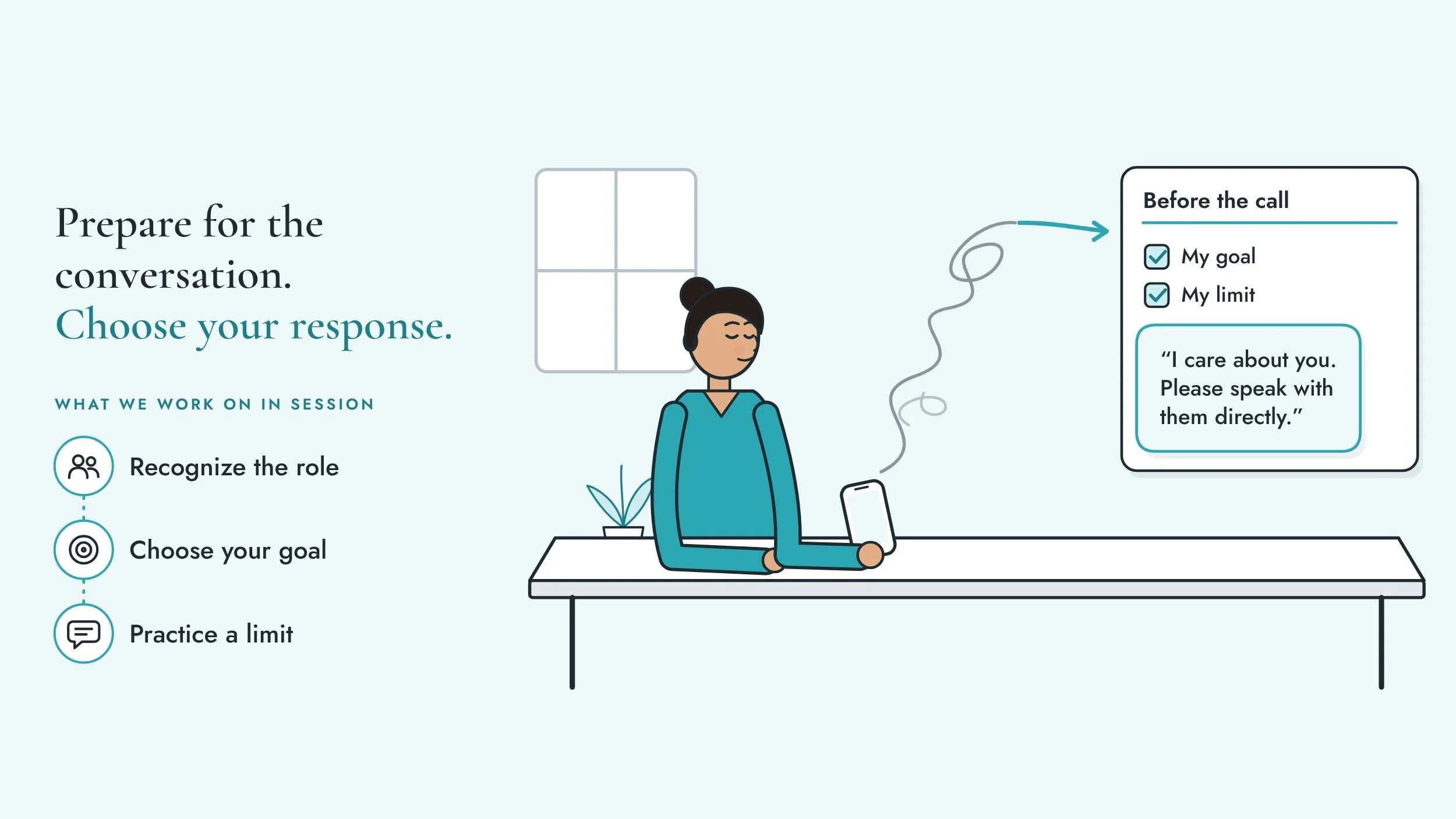
We can examine a recent interaction and the history that gives it weight. Perhaps you become the peacemaker, the person who explains everyone else, or the one who is expected to adapt. Naming that role helps us understand why a small comment can have a large effect and where you might have room to respond differently.
Decide what the conversation is for
Some conversations need a practical agreement. Others involve hurt, a request for acknowledgment, or a limit on a topic you no longer want to debate. We can clarify your goal before choosing your words. That may mean asking one direct question, declining to carry a message between relatives, or ending a discussion that has stopped being useful.
Plan for the relationship after you set a limit
Family boundaries can affect holidays, childcare, caregiving, and other shared responsibilities. We can think through those consequences and practice a response that fits your values and circumstances. We can also work with disappointment when a relative cannot offer the understanding you want, and consider what connection is possible without repeatedly asking for the same change.
An example of the work
For example, if a sibling repeatedly draws you into arguments with a parent, we could explore why you feel responsible for resolving them. You might practice saying, “I care about both of you, and I am not going to carry messages between you.” We would consider when that wording is appropriate and what follow through means.
What progress can look like
Progress may include less time recovering from calls, clearer choices about contact, fewer commitments made under pressure, or a better understanding of what you want from a relationship. Reconciliation is not a required outcome.
How Care Map Method supports our work
Map the emotion and trigger. We look at a recent moment and the biological, emotional, social, and environmental pressures around it. The aim is to understand your experience before choosing a response.
Match the need with a strategy. We identify what matters in that moment and select a skill or next step that fits. That might be a clearer request, a pause, a boundary, or space to process a loss.
Merge the skill into daily life. We can rehearse the words and decide when you might use them. Any practice between sessions is chosen together and adjusted to your circumstances.
Manage responses over time. We review what happened, what was difficult, and what needs to change. Therapy includes room for feelings and history as well as practical work.
About Tammy Gold
I’m Tamara “Tammy” Gold, MSW, LCSW, founder of Care Map Method™ and author of Secrets of the Nanny Whisperer. I earned my MSW at Columbia University and my BA at the University of Pennsylvania. My work with families informs a warm, active approach to therapy that makes room for your emotional experience and practical concerns.
Common questions
Can I start if my family will not attend? Yes. Individual therapy can focus on your experience, choices, boundaries, and grief. We can work on your part without assuming we know another family member’s intentions or diagnosis.
Will you tell me to cut off contact? We can explore a range of options, including changes in topics, timing, availability, and contact. Your circumstances, values, and safety guide those decisions.
Can we discuss conflict with an adult child? Yes. We can explore your feelings, expectations, communication, and possible repair attempts. We cannot guarantee a response or reconciliation from another person.
What if family obligations make boundaries difficult? We can consider shared responsibilities, finances, culture, and practical dependence. The aim is a limit you can realistically use rather than advice that ignores your situation.
Is family therapy covered by Providence? This page describes individual therapy. Check your exact plan and the proposed service through Headway. Coverage for sessions with multiple family members requires a separate review of benefits and clinical appropriateness.
What happens at the first appointment? We will discuss the conflict, its effect on your life, relevant history, and your goals. One recent example can help us identify a useful starting point.
Take the next step
If this sounds familiar, you can explore online therapy with me while located in Oregon. Open my Headway profile to check your exact insurance benefits and appointment options. We will discuss your concerns, clinical needs, and goals to determine fit.
Caregiver Burnout Therapy in Oregon
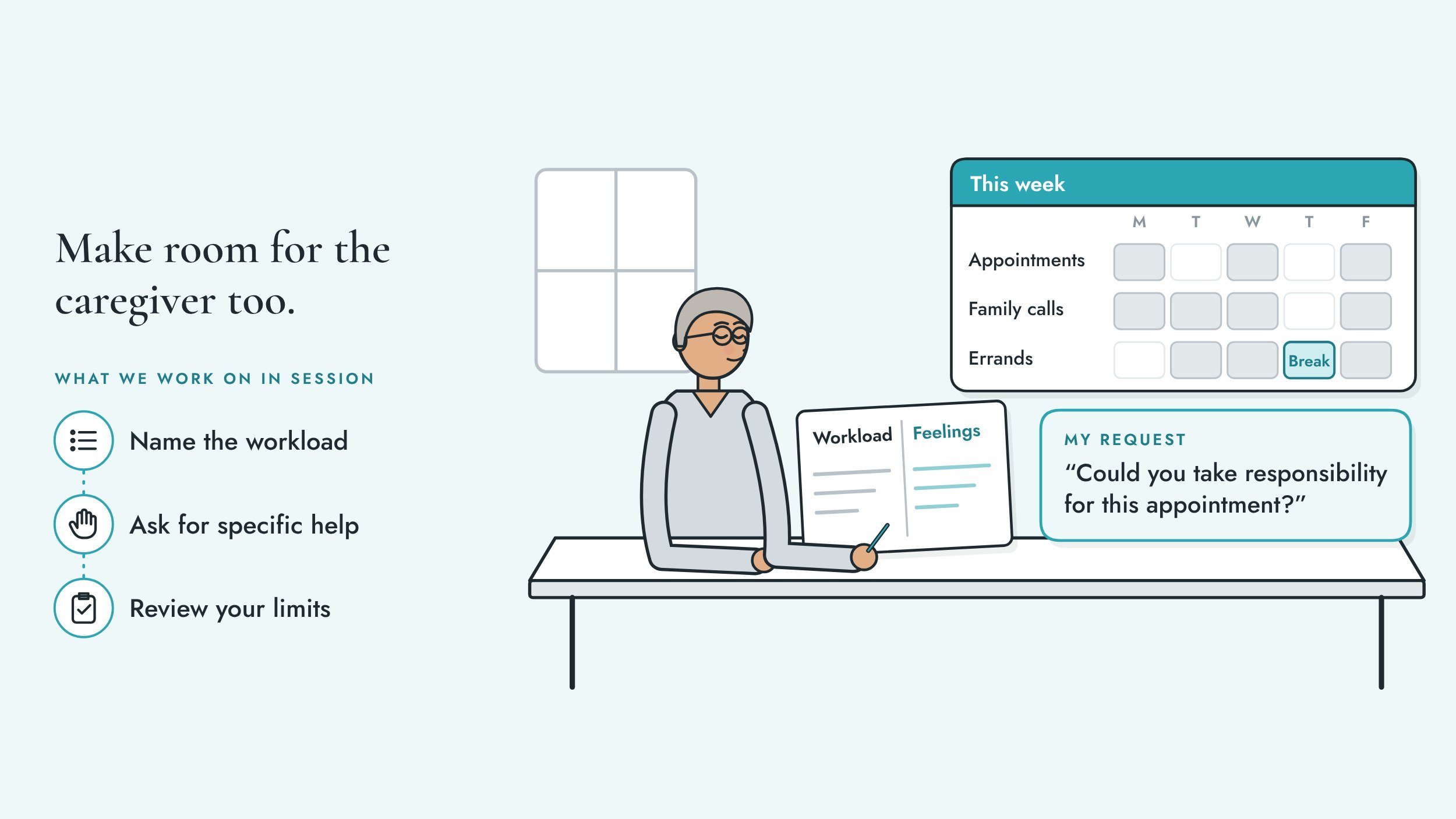
Caring for an aging parent can become a responsibility you carry even when you are supposed to be resting. You may be tracking appointments, anticipating problems, managing family messages, and feeling guilty whenever you need time away. In online caregiver burnout therapy in Oregon, we can make that workload visible and explore the worry, grief, frustration, or resentment that comes with it. Together, we can identify what is becoming unsustainable, prepare a specific request for help, and consider limits that account for your parent’s needs and your own capacity. Care Map Method gives us a way to organize the pressures around caregiving while making room for your emotional experience. I’m Tammy Gold, LCSW. These individual therapy sessions support your mental health as you navigate a role that may keep changing, often without much warning.
Support for the person everyone depends on
You keep track of appointments, answer the calls, and think about what could go wrong even when you are trying to rest. Caring for an aging parent may bring love, worry, grief, and resentment into the same day. Therapy offers a place to work through what this role is costing you and consider changes that make room for your own health.
Perhaps you are short with people you care about, feel guilty taking a break, or dread a call because it might mean another problem. You may be balancing children, work, and a parent’s needs while wondering why you cannot manage it better. We can examine the demands themselves as well as your reactions to them.
Check benefits and availability
Make the invisible responsibilities visible
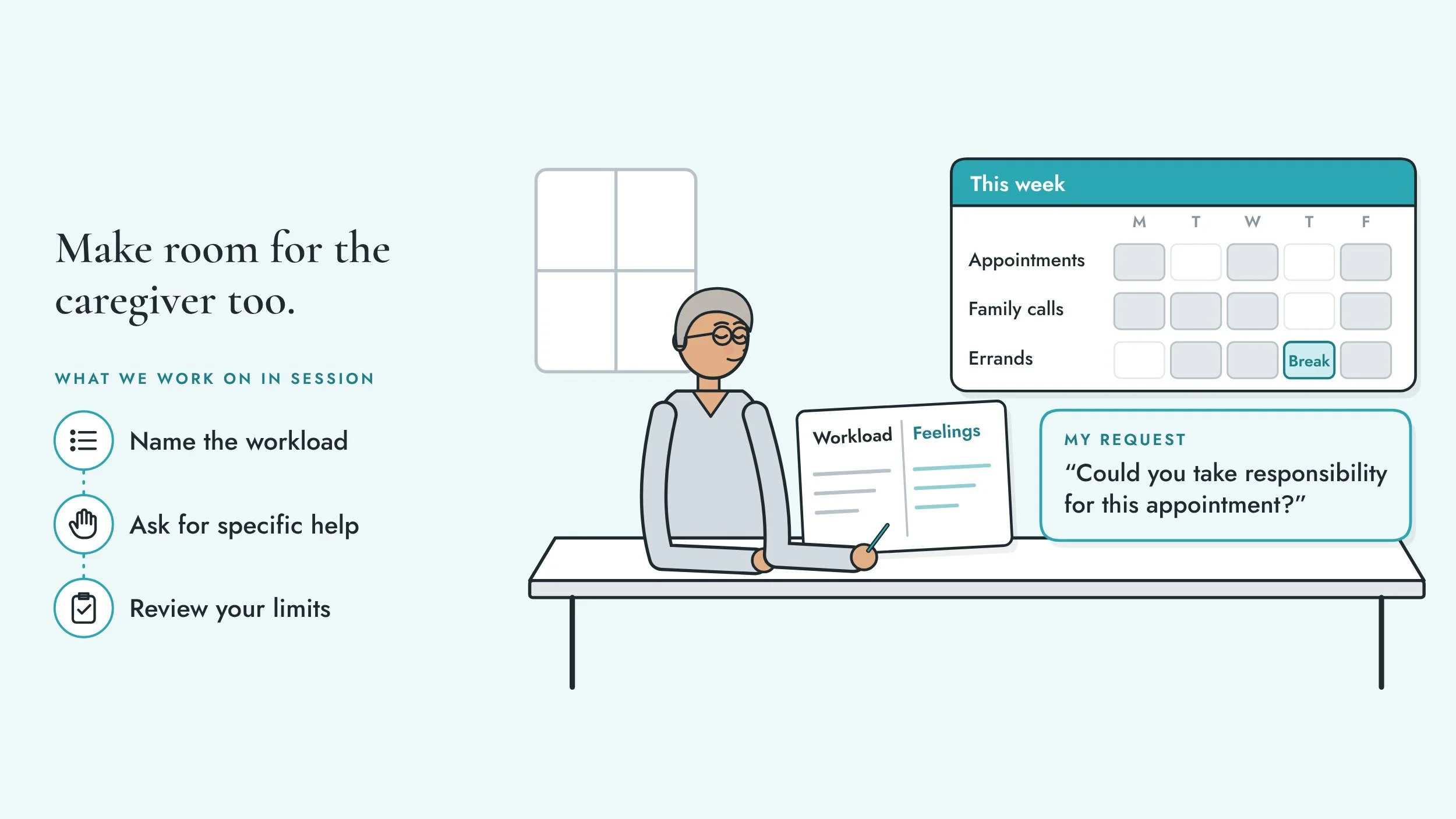
We can walk through a typical week and name the work you carry: coordinating care, anticipating problems, handling family messages, or being constantly available. This can help us identify where exhaustion is coming from and which responsibilities are yours by choice, agreement, or default. We also consider sleep, support, finances, and the environment around caregiving.
Work with guilt and resentment
Feeling angry or wishing for time away can be difficult to admit. We can explore those feelings without treating them as a measure of how much you love your parent. We may examine beliefs such as “a good daughter should always be available” and consider what a realistic responsibility looks like in your circumstances. Grief and changes in the relationship also have a place in the work.
Practice a specific request or limit
Instead of a general wish for more help, we can prepare one request that another person can understand and answer. That might involve a sibling taking responsibility for one recurring task or a limit around nonurgent calls. We can rehearse what you want to say, consider likely responses, and plan what you will do if the help you hope for is unavailable.
An example of the work
For example, you might bring the recurring Sunday night worry about the week ahead. We could separate practical decisions from fears, identify one task to delegate, and develop a short routine for ending the evening. We would then review what helped and what still needs attention.
What progress can look like
Your goals might include taking a break with less guilt, making a clear request, recognizing when you are overextended, or having space to grieve. Therapy can support your emotional health while practical care needs continue to change.
How Care Map Method supports our work
Map the emotion and trigger. We look at a recent moment and the biological, emotional, social, and environmental pressures around it. The aim is to understand your experience before choosing a response.
Match the need with a strategy. We identify what matters in that moment and select a skill or next step that fits. That might be a clearer request, a pause, a boundary, or space to process a loss.
Merge the skill into daily life. We can rehearse the words and decide when you might use them. Any practice between sessions is chosen together and adjusted to your circumstances.
Manage responses over time. We review what happened, what was difficult, and what needs to change. Therapy includes room for feelings and history as well as practical work.
About Tammy Gold
I’m Tamara “Tammy” Gold, MSW, LCSW, founder of Care Map Method™ and author of Secrets of the Nanny Whisperer. I earned my MSW at Columbia University and my BA at the University of Pennsylvania. My work with families informs a warm, active approach to therapy that makes room for your emotional experience and practical concerns.
Common questions
Is this therapy or care management? This page describes psychotherapy for your emotional health. Arranging staff, selecting facilities, and coordinating care are separate practical services and are not automatically included in therapy or covered by insurance.
Can I feel resentful and still love my parent? Yes. We can explore mixed feelings and the circumstances behind them. You do not need to present yourself as endlessly patient to talk honestly about caregiving.
What if there is nobody else to help? We can work within that reality, looking at limits, coping, expectations, and possible sources of support. We will avoid building a plan that depends on resources you do not have.
Can we discuss grief before a parent dies? Yes. Changes in health, independence, personality, and family roles can involve grief. We can make room for those losses while you are still actively caring for your parent.
Can I use Providence insurance? Check the exact Providence plan on my Headway profile. Commercial and Medicare Advantage products can have different networks and benefits. Coverage and your costs need to be confirmed before treatment.
Does my parent attend? These are individual sessions for you. Your parent does not need to attend. If another type of service becomes appropriate, we can discuss it separately.
Take the next step
If this sounds familiar, you can explore online therapy with me while located in Oregon. Open my Headway profile to check your exact insurance benefits and appointment options. We will discuss your concerns, clinical needs, and goals to determine fit.