

When you love your child and still feel overwhelmed by the day
You get through work, meals, reminders, and one more bedtime request. Then a small moment becomes the one where you snap. Afterward, you feel guilty and promise yourself tomorrow will be different. Therapy can help you understand what is building up and practice responses that account for the demands you are actually carrying.
You may be more irritable than you used to be, resent the endless decisions, or feel as though everyone needs something from you. Perhaps you have read the parenting advice but struggle to use it when you are exhausted. We can focus on your emotional health and the patterns making everyday parenting harder.
Check benefits and availability
Find the pressure points in your day
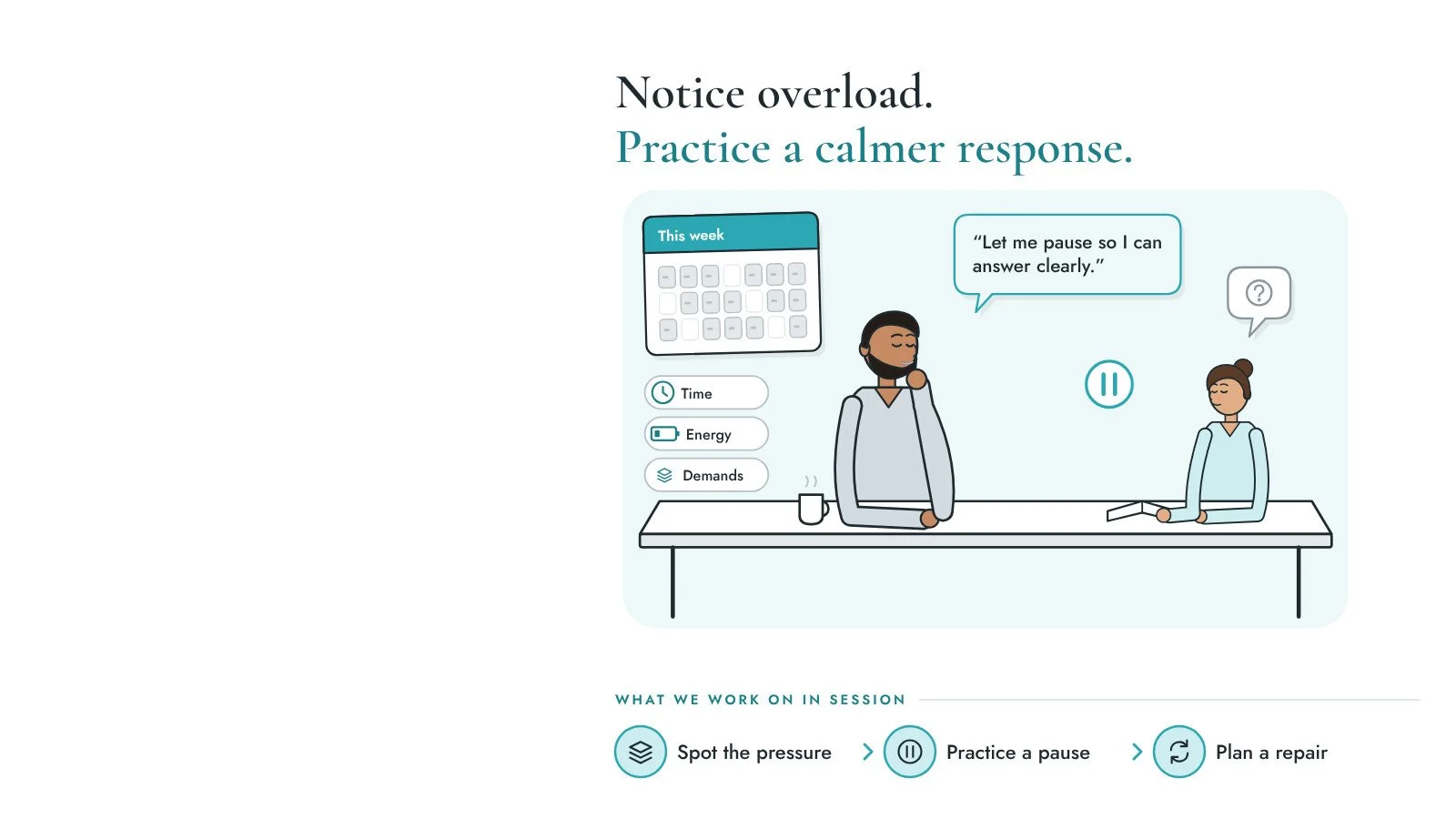
We can map a recent difficult moment from the beginning. Were you hungry, rushed, worried about work, or already managing several requests? What was happening around you? Understanding the biological, emotional, social, and environmental pressures gives us a more useful starting point than expecting unlimited patience. It also helps us separate what you can change from what requires more support.
Practice the response before you need it
We can choose one situation, such as leaving the house or handling repeated bedtime requests, and rehearse what you want to say. That may include a short limit, a pause before answering, or a plan with another caregiver. We can make the response small enough to remember when you are tired, then review whether it fits your family.
Work on guilt and repair after a hard moment
You may need help with what happens after you lose patience as much as with the reaction itself. We can practice an age appropriate repair that takes responsibility without asking your child to comfort you. We can also explore perfectionism, fears about your parenting, or experiences from your own childhood that make a difficult day feel like a judgment about who you are.
An example of the work
For example, if homework regularly ends in yelling, we could examine the timing, your expectations, and the first signs of frustration. You might practice a brief pause and a clear return plan, then try a more realistic homework routine. We would review both your feelings and what changed.
What progress can look like
Useful changes might include noticing overload earlier, using a limit you can follow through on, recovering sooner after a hard interaction, or asking another adult for specific help. Your goals can change as your family’s needs change.
CARE MAP METHOD™ | THERAPY LANDING PAGE COPY
How Care Map Method supports our work
Map the emotion and trigger. We look at a recent moment and the biological, emotional, social, and environmental pressures around it. The aim is to understand your experience before choosing a response.
Match the need with a strategy. We identify what matters in that moment and select a skill or next step that fits. That might be a clearer request, a pause, a boundary, or space to process a loss.
Merge the skill into daily life. We can rehearse the words and decide when you might use them. Any practice between sessions is chosen together and adjusted to your circumstances.
Manage responses over time. We review what happened, what was difficult, and what needs to change. Therapy includes room for feelings and history as well as practical work.
About Tammy Gold
I’m Tamara “Tammy” Gold, MSW, LCSW, founder of Care Map Method™ and author of Secrets of the Nanny Whisperer. I earned my MSW at Columbia University and my BA at the University of Pennsylvania. My work with families informs a warm, active approach to therapy that makes room for your emotional experience and practical concerns.
Common questions
Is therapy for my child or me? This page describes therapy for the adult parent. We focus on your emotional health, reactions, relationships, and coping. Your child does not need to attend these individual sessions.
Do I have to be in crisis to start? No. You can seek support when stress, guilt, resentment, or irritability is affecting daily life. The first session helps us understand your needs and the appropriate type of care.
Can we talk about different parenting styles? Yes. We can explore how disagreements affect you, identify shared priorities, and practice a conversation about one specific routine or responsibility. Individual therapy cannot guarantee another caregiver will change.
Will you give me parenting rules? We will develop strategies around your needs, values, and circumstances. We also make room for the emotional concerns beneath the daily problem rather than treating every difficulty as a discipline issue.
Can I check Anthem coverage? My Headway profile lets you check your specific plan, network eligibility, and estimated costs. Parenting concerns alone do not automatically establish insurance coverage; clinical assessment and benefits determine eligibility.
What can we begin with? Choose one moment you dread, such as mornings, homework, or bedtime. We can use that example to understand the larger pattern and decide where support may be most useful.
Take the next step
If this sounds familiar, you can explore online therapy with me while located in California. Open my Headway profile to check your exact insurance benefits and appointment options. We will discuss your concerns, clinical needs, and goals to determine fit.