

When the workday ends but the conversation keeps going in your head
You replay a meeting on the drive home, rewrite a message several times, or check work notifications because you are worried about what you missed. Conflict with a boss or coworker can affect sleep, confidence, and relationships outside work. Therapy can help you understand the emotional pattern and prepare a response that takes your circumstances seriously.
You may avoid asking a question, agree to work you cannot reasonably complete, or spend hours wondering how someone interpreted your words. Perhaps feedback feels crushing, or you are unsure whether the problem is a difficult environment, your own reactions, or both. We can examine specific events without jumping to a conclusion about you or your workplace.
Check benefits and availability
Separate the event from what you fear it means
We can review one interaction and distinguish what was said from the meaning you attached to it. That helps us identify uncertainty, past experiences, and actual workplace concerns. We may explore how your body responds to evaluation or conflict and what keeps you checking, avoiding, or mentally rehearsing long after the conversation ends.
Prepare a clear workplace conversation
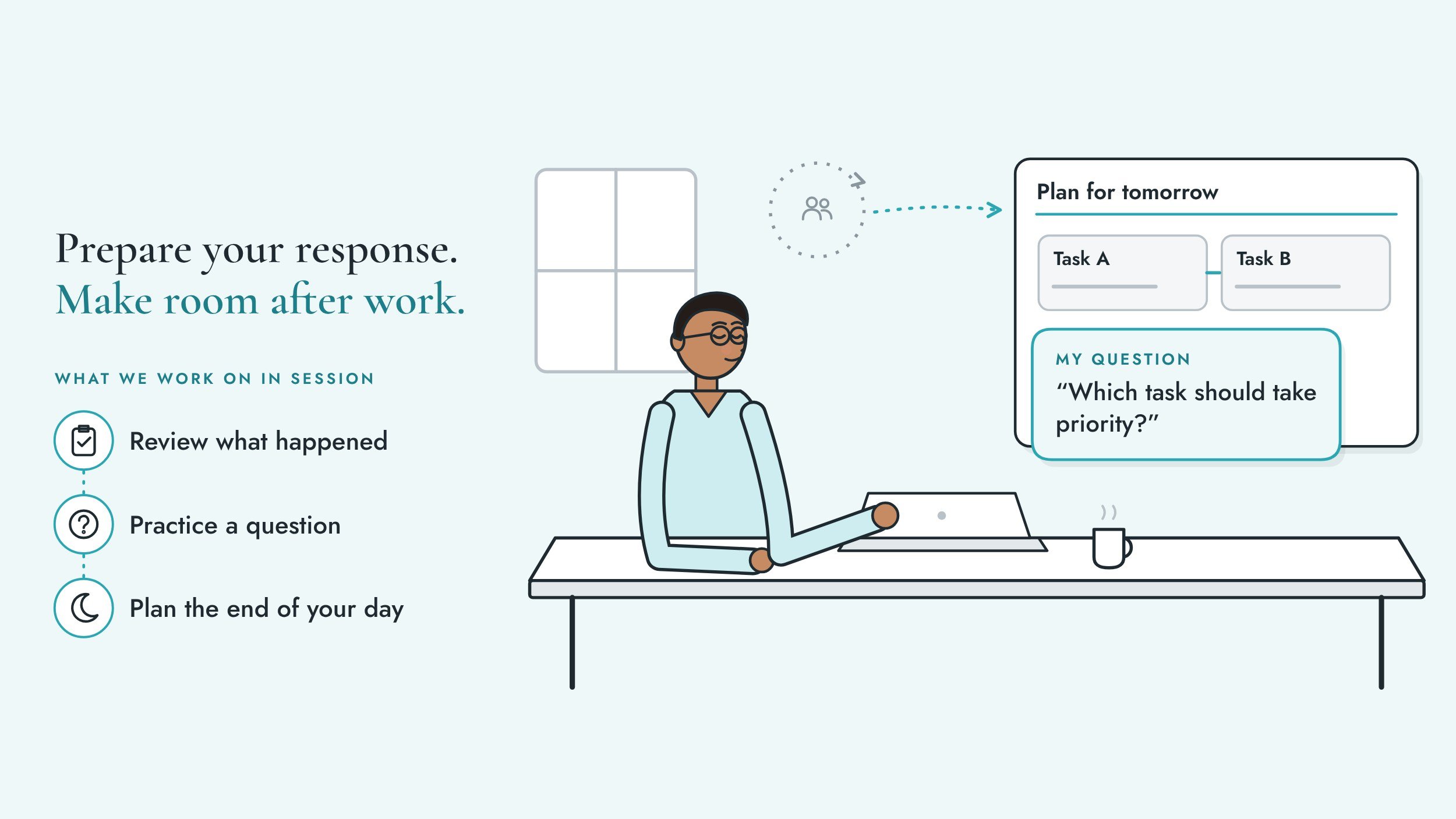
We can practice asking for clarification, discussing priorities, or responding to feedback. For example, you might rehearse, “I can complete the report or the presentation by Friday. Which should take priority?” We can consider tone, timing, power differences, and possible consequences so that the plan fits your role and does not assume every workplace welcomes directness.
Work on the transition out of work
If work concerns occupy the entire evening, we can explore what keeps them active and choose a realistic way to close the day. That might include writing down a next action, setting a feasible notification limit, or examining a belief that constant availability protects you. We also make room for decisions about whether the role or environment continues to fit your needs.
An example of the work
For example, after a difficult performance conversation, we could identify the concrete feedback, explore the fear it triggered, and prepare two questions for your next meeting. You might also practice a way to pause the evening’s replay without expecting yourself to stop caring about your work.
What progress can look like
Progress may mean asking a question sooner, spending less time drafting messages, making a clearer decision about workload, or protecting part of your evening. Therapy can support your emotional health as you evaluate practical choices.
How Care Map Method supports our work
Map the emotion and trigger. We look at a recent moment and the biological, emotional, social, and environmental pressures around it. The aim is to understand your experience before choosing a response.
Match the need with a strategy. We identify what matters in that moment and select a skill or next step that fits. That might be a clearer request, a pause, a boundary, or space to process a loss.
Merge the skill into daily life. We can rehearse the words and decide when you might use them. Any practice between sessions is chosen together and adjusted to your circumstances.
Manage responses over time. We review what happened, what was difficult, and what needs to change. Therapy includes room for feelings and history as well as practical work.
About Tammy Gold
I’m Tammy Gold, MSW, LCSW, founder of Care Map Method™ and author of Secrets of the Nanny Whisperer. I earned my MSW at Columbia University and my BA at the University of Pennsylvania. My work with families informs a warm, active approach to therapy that makes room for your emotional experience and practical concerns.
Common questions
Is this career coaching? This page describes psychotherapy addressing the emotional effects of work stress. Resume services, business consulting, and career placement are separate from the therapy offered here.
Can we discuss a difficult boss? Yes. We can examine specific interactions, your reactions, and possible responses. We cannot diagnose someone we have not assessed or guarantee how an employer will respond.
Will therapy tell me to quit? We can explore your health, finances, needs, and options without assuming leaving is possible or necessary. Decisions should account for your actual circumstances.
Can you advise on discrimination or employment law? Therapy can support you emotionally while you consider next steps. Legal advice, workplace investigations, and human resources determinations require the appropriate professionals.
Can I use Quest Behavioral Health? A listed reimbursement rate does not establish that your exact network is available through my profile. Contact the practice and check Headway eligibility before scheduling with Quest coverage.
What should I bring? A recent example, the effect it had on you, and what you wish you could do differently are useful. You can discuss the situation without sharing confidential employer documents.
Take the next step
If this sounds familiar, you can explore online therapy with me while located in New Jersey. Open my Headway profile to check your exact insurance benefits and appointment options. We will discuss your concerns, clinical needs, and goals to determine fit.