

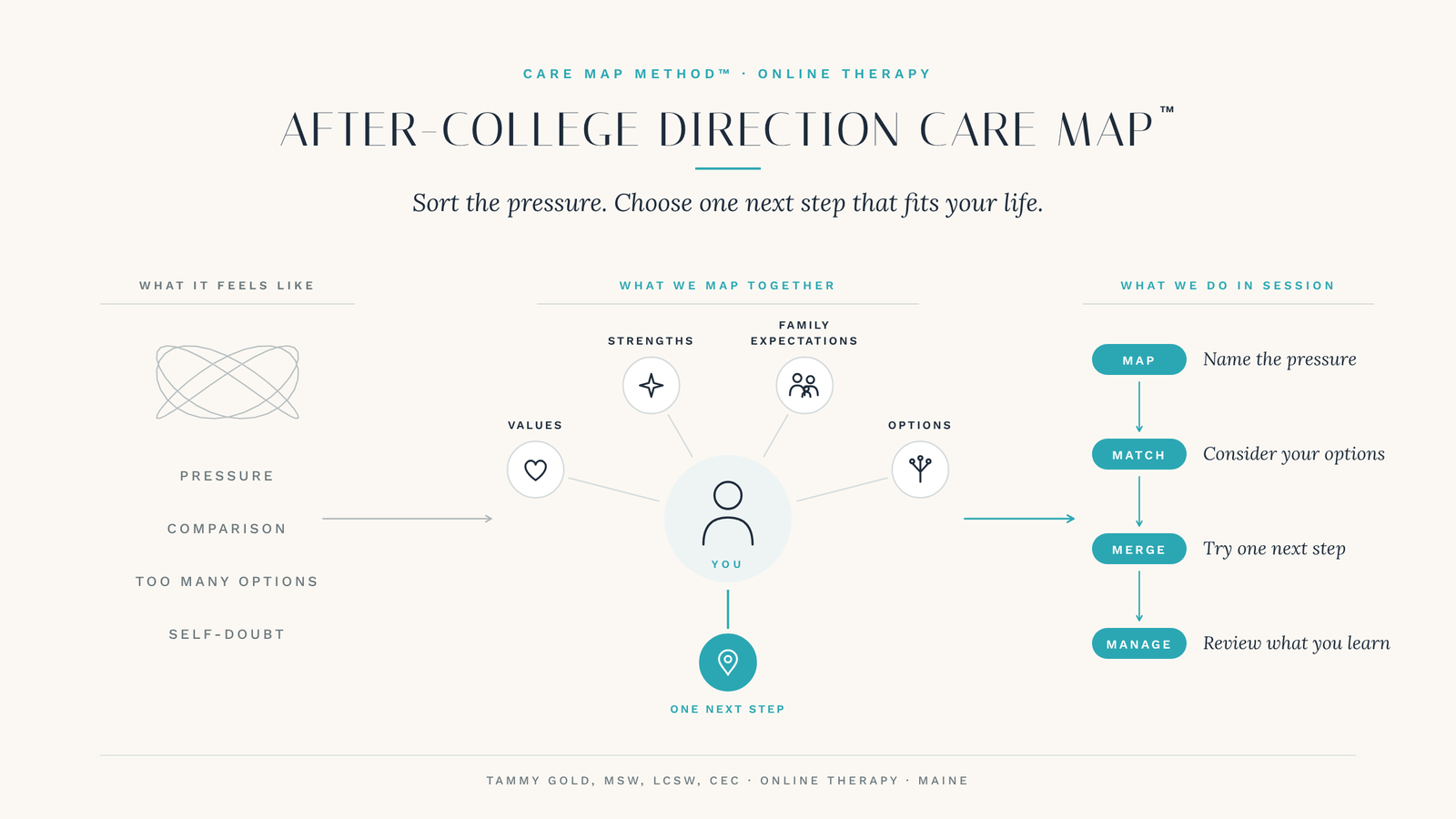
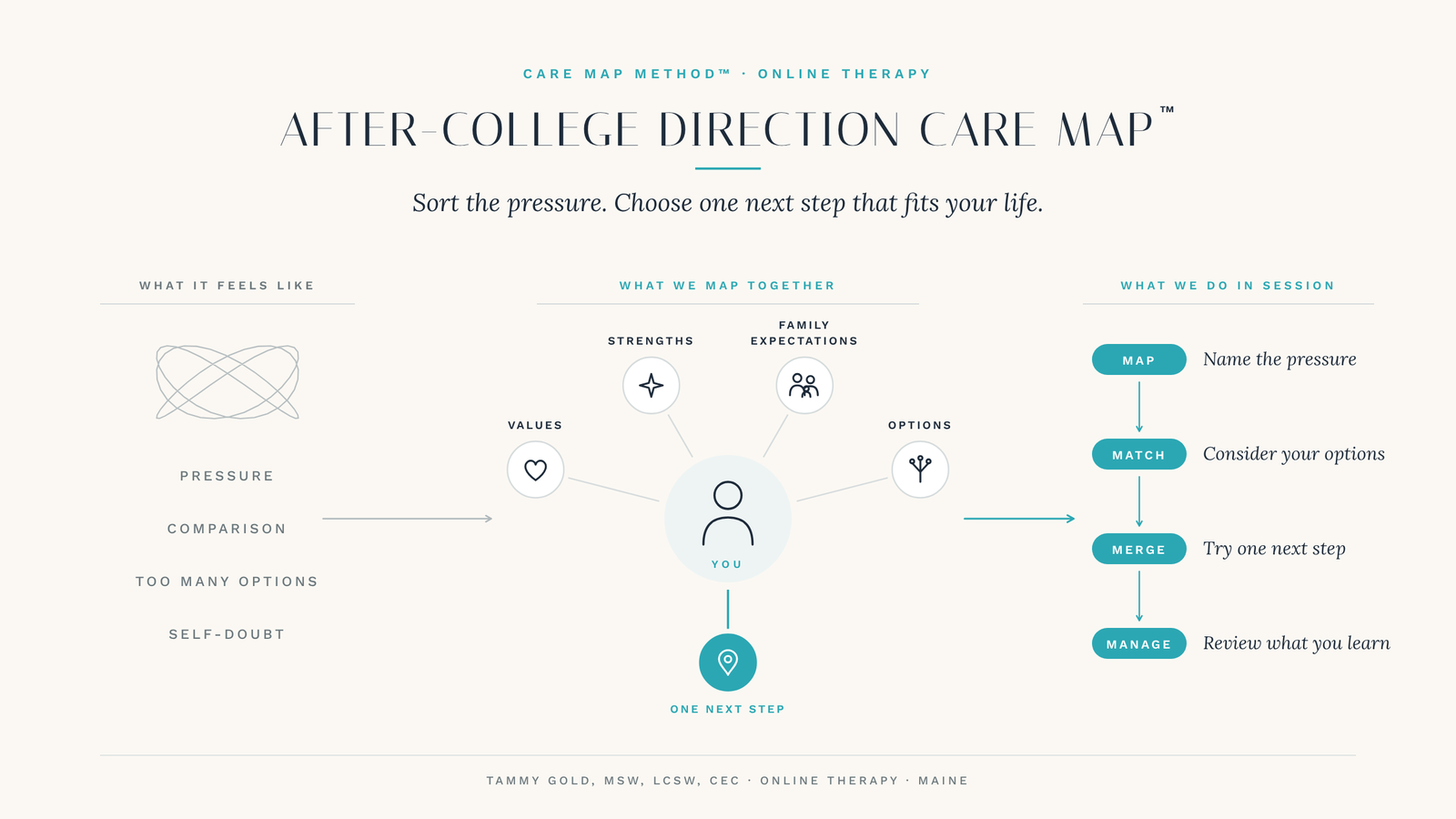
Young Adult Therapy in Maine After College
Graduation may have given you a degree without giving you a clear next step. Your friends seem to be moving into careers, relationships or new cities while you are still deciding what you want. Even a reasonable choice can feel like a permanent test of whether you are succeeding.
An adult in their twenties reviewing a notebook beside a closed laptop in a private room. Revise to match the actual asset; remove this instruction before publishing.
Graduation may have given you a degree without giving you a clear next step. Your friends seem to be moving into careers, relationships or new cities while you are still deciding what you want. Even a reasonable choice can feel like a permanent test of whether you are succeeding.
I’m Tammy Gold. I offer individual online therapy for adults physically located in Maine, including younger adults navigating independence, relationships and life changes. We can explore what feels uncertain and how that uncertainty is affecting your daily life.
When every option feels like a judgment
You may be living with family, working outside your field, searching for a job or reconsidering a path you once wanted. Financial limits and the opportunities around you matter. We will take those circumstances seriously rather than treat confidence as the only missing ingredient.
In therapy, we can examine the meaning behind thoughts such as “I should be further along” or “Choosing wrong will ruin everything.” We can also discuss sleep, motivation, concentration and connection to others to understand the support you need.
Start with one decision you keep avoiding
Perhaps you are postponing an application because it does not fit the career you imagined. We might separate your interest in the job from your fear of how others will interpret it. Then we can identify a next step small enough to evaluate rather than a promise about the rest of your life.
We can practice explaining a decision to your parents, asking for support without giving up ownership, or making room for friendships after school has ended. These are examples of possible work, not promises about your outcome.
A framework for sorting the pressures
My Care Map Method™ helps organize Biological, Emotional, Social and Environmental factors alongside clinical assessment. We map the concern, match strategies to your needs, merge practice into ordinary routines and manage the plan as circumstances change.
For this transition, that might mean noticing how comparison affects you, choosing one manageable experiment and reviewing what you learned. We can make space for grief about the life you expected while you develop a clearer sense of what matters now.
What the first session can cover
Bring one concern you would like help understanding. We will discuss its impact, your history and supports, and what you want from therapy. We will also decide whether my approach fits your needs and agree on initial goals.
Questions about starting therapy
Do I need to be a college graduate? No. This work can also fit adults navigating a gap year, leaving a program or beginning work without attending college.
What ages do you see on this page? This service is for adults 18 and older. The concern matters more than a rigid age cutoff.
Will you tell me which career to choose? We can explore your emotions, values and decisions. Therapy does not provide job placement or guarantee a career outcome.
Can my parents arrange therapy for me? An adult client participates in their own treatment and consent process. We can discuss any family involvement you want.
Can I attend while away at school? Your physical location at each session must be a state where I am authorized to practice; confirm it before scheduling.
Can I use insurance? We will confirm current Maine participation, your specific plan, estimated costs and whether the assessed clinical service meets coverage requirements.
Ask about current availability, clinical fit and payment options. Confirm the state where you will be located before scheduling.

Aetna Therapy in New Jersey When Your Adult Child Won’t Talk to You
Online New Jersey therapy for parents coping with adult-child estrangement, communication breakdown and family boundaries. Aetna eligibility varies.
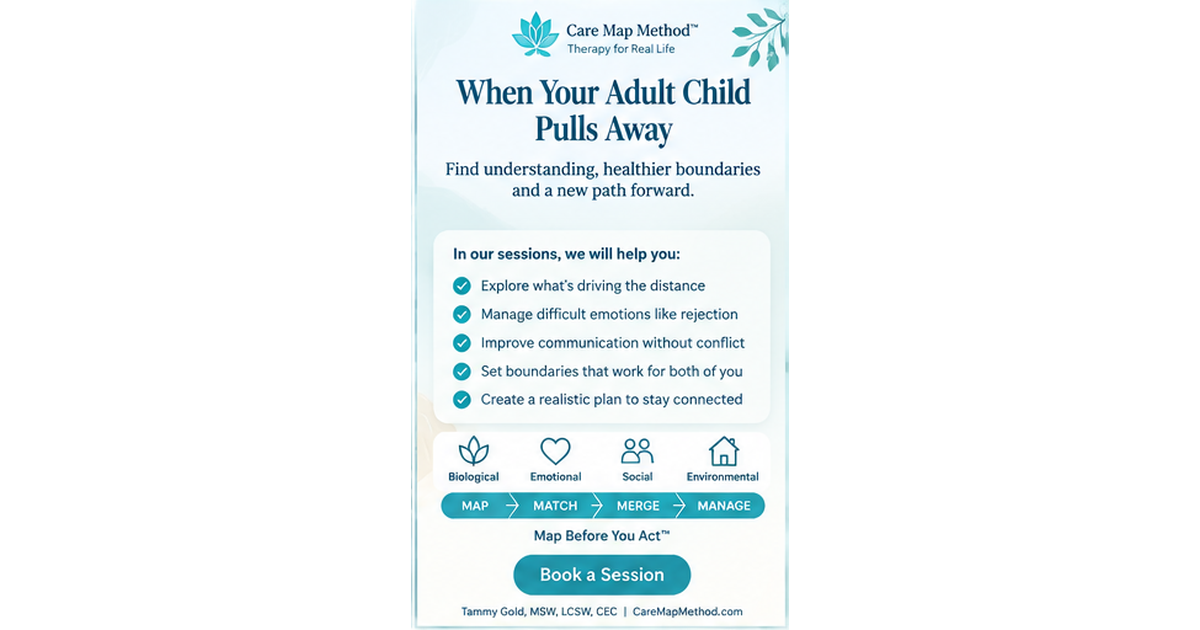
Aetna online therapy in New Jersey with Tammy Gold, LCSW for adult child estrangement & communication breakdown.
Aetna Therapy in New Jersey: When Your Adult Child Won’t Talk to You
When an adult child pulls away or stops communicating, the uncertainty can be as painful as the distance itself. You may replay conversations, question what you should have done differently, or feel torn between reaching out and respecting the space they have requested.
Therapy does not begin with an assumption that reconciliation is the goal. It can give you a private place to understand the relationship, process grief and anger, clarify what is within your control, and decide how you want to respond.
I am Tammy Gold, MSW, LCSW, CEC, a licensed therapist, author and creator of the Care Map Method™. I provide online psychotherapy to eligible clients located in New Jersey, including adults dealing with relationship stress, family conflict, caregiving and major life transitions.
Depending on your specific plan, eligibility and current network participation, Aetna may be available for psychotherapy. Coverage, copays, deductibles and benefits vary and should be verified before scheduling.
Check Insurance & Book Therapy On HEADWAY
Does this sound familiar?
· Contact has become limited, tense or nonexistent.
· You replay conversations trying to understand what happened.
· You are torn between reaching out and respecting distance.
· Grief, shame, anger and uncertainty are affecting the rest of your life.
Why the surface problem may not be the whole problem
Families and couples often begin by trying to solve the most visible problem. But the visible problem may be only one part of the Care Map. Stress, health, expectations, attachment needs, changing roles, communication habits, family history and the surrounding environment can all affect what happens next.
Looking at the broader pattern can reduce shame and blame. Instead of asking only, “Who caused this?” we can ask, “What is happening, what does each person need, what is within my control, and what response is most likely to be useful?”
How I use the Care Map Method™ in therapy
MAP — Understand what is actually happening
We identify the problem, the repeating pattern and the needs underneath it. I look at biological, emotional, social and environmental factors rather than reducing a complicated relationship to one argument or one person’s behavior.
MATCH — Match the right support or strategy
Once the pattern is clearer, we identify approaches that fit the actual need. That may involve communication, boundaries, coping strategies, emotional regulation, role changes, additional support or a different way of responding.
MERGE — Bring understanding into the relationship
Insight matters most when it can be used. We translate what you are learning into conversations, decisions, requests and boundaries that are realistic for your life and relationships.
MANAGE — Adjust as life changes
Relationships and caregiving systems are dynamic. We notice what is helping, what is not, and what needs to be adjusted rather than expecting one conversation or technique to solve everything permanently.
A safe place without shame or blame
My approach is warm, active, practical and nonjudgmental. Therapy can be one completely safe place to say what you are actually thinking and feeling without having to protect everyone else, perform competence or decide immediately what you are going to do.
My goal is not simply to have you talk about the problem. I want you to better understand yourself and the people around you, name emotions and needs more clearly, reduce unnecessary shame and blame, and leave with practical next steps.
Online therapy in New Jersey
I provide telehealth psychotherapy to eligible clients who are physically located in New Jersey at the time of service. Aetna may be available depending on your individual plan, eligibility and current network participation. Please verify your benefits before scheduling.
Relationship and family problems can also be addressed in individual therapy. Another person does not necessarily need to participate for you to work on your own communication, boundaries, emotions and responses.
About Tammy Gold, MSW, LCSW, CEC
Tammy Gold is a licensed clinical social worker, therapist, author and creator of the Care Map Method™. For more than 20 years, her work has focused on the relationships and care systems surrounding families—from marriage and parenting to adult children, caregiving and aging parents.
She earned her MSW from Columbia University and her undergraduate degree from the University of Pennsylvania. Her family and caregiving expertise has been featured in national media. Add the approved press-logo strip here to reinforce authority without interrupting the clinical message.
Frequently asked questions
Can therapy help with adult-child estrangement?
Therapy can help you understand the relationship, process grief and uncertainty, clarify boundaries and consider how you want to communicate. It does not require reconciliation or a particular relationship outcome.
Will therapy tell me to cut off or reconcile?
Therapy can help you understand the relationship, process grief and uncertainty, clarify boundaries and consider how you want to communicate. It does not require reconciliation or a particular relationship outcome.
Can I come alone?
Yes. Individual therapy can focus on your emotions, communication, boundaries and responses even when another family member or partner does not participate. Therapy cannot guarantee that another person will change.
How do I respect a boundary while leaving the door open?
A useful boundary clarifies what you will do, accept or participate in. Therapy can help you make boundaries more specific, communicate them without unnecessary escalation and manage the guilt or anxiety that may follow.
Does Aetna cover online therapy in New Jersey?
Aetna may be available depending on your specific plan, eligibility, clinical circumstances and current network participation. Benefits, copays and deductibles vary, so verify coverage before scheduling.
You do not have to solve the whole relationship today
A useful first step is often understanding the pattern more clearly. Therapy can help you slow down, identify what you need, distinguish what is within your control from what is not, and decide what a healthier next response could look like.
Insurance note: Aetna eligibility and benefits vary. Verify your individual coverage before scheduling.