
MY ADULT CHILD WON’T TALK TO ME
You cannot control another adult’s decision. You can understand the relationship, your response and your next step.
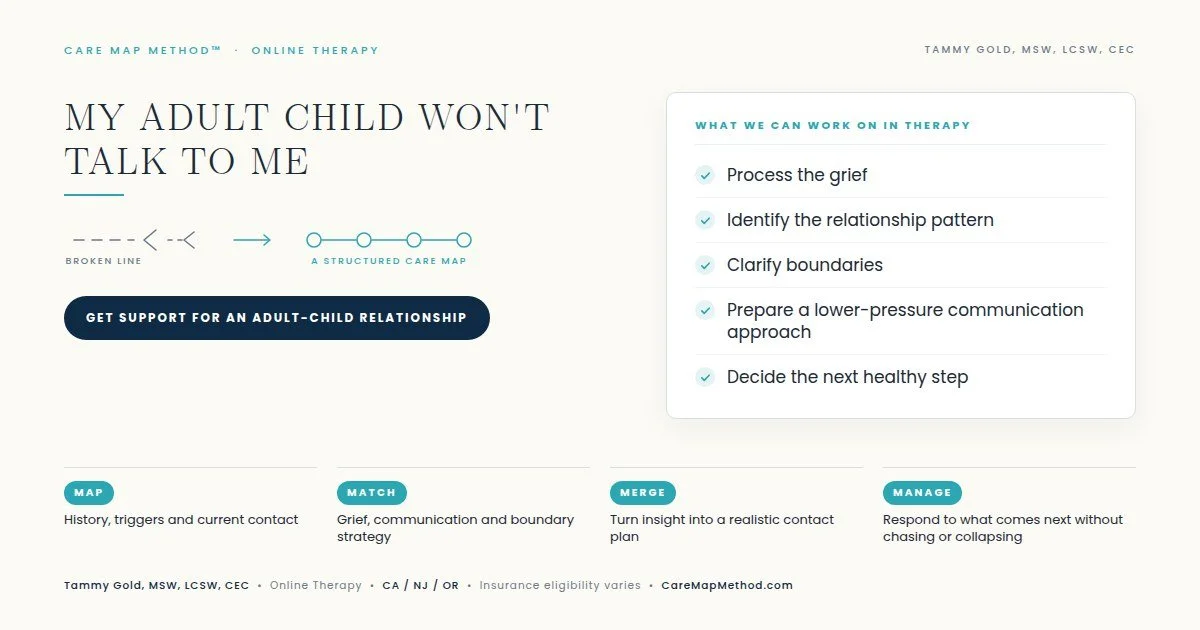
What therapy can help you work on:
• Separate grief, fear, anger and guilt
• Identify recurring parent–adult child patterns
• Understand boundaries without chasing or withdrawing
• Prepare communication that reduces pressure and defensiveness
• Decide what healthy contact—or healthy distance—looks like now
When silence becomes the whole relationship
An adult child pulling away can create a particular kind of grief: the person is still alive, yet the relationship you knew may feel unavailable. Parents often replay conversations, search for the moment everything changed, send another message, or become afraid that doing nothing means giving up. Therapy gives that urgency somewhere constructive to go.
The goal is not to assign a villain
Estrangement can involve years of misunderstandings, unresolved injuries, family roles, boundaries, partners, grandchildren, differing expectations or a single rupture that became larger over time. I do not begin by deciding who is right. We map the relationship as it actually exists now and identify the parts you can influence.
What we can work on in therapy
We can look at what happens before contact breaks down, what you tend to do when you feel rejected, what your adult child has communicated directly, and what remains assumption. We can also work on tolerating uncertainty so that fear does not drive repeated contact, defensiveness or self-blame.
A Care Map for the relationship
MAP the history, present pattern, emotional triggers and current boundaries. MATCH the problem with the right response—grief work, communication, boundary work, repair attempts or acceptance. MERGE insight with a realistic communication plan. MANAGE what happens next without making your wellbeing dependent on another person’s immediate response.
Therapy can help even if your adult child never joins
You do not need the other person in the room to understand your part of a relationship. Individual therapy can help you become clearer, less reactive and more intentional. If contact becomes possible, you can enter it differently. If it does not, therapy can help you build a life that is not organized entirely around waiting.
What We Can Work On During Our Call:
Separate grief, fear, anger and guilt
Identify recurring parent–adult child patterns
Understand boundaries without chasing or withdrawing
Prepare communication that reduces pressure and defensiveness
Decide what healthy contact—or healthy distance—looks like now
Care Map Method™
MAP the problem and pattern. MATCH the needs with the right clinical strategies. MERGE insight into real conversations, boundaries and behavior. MANAGE what happens next and adjust as the situation changes.
Can therapy make my adult child speak to me again?
Therapy cannot control another adult or guarantee reconciliation. It can help you understand the relationship, process the loss, examine your own patterns, respect stated boundaries and decide whether and how to make a thoughtful repair attempt.
Should I keep contacting an estranged adult child?
That depends on what your adult child has communicated, the history of the relationship and any boundaries they have set. Therapy can help you distinguish a respectful invitation to connect from repeated contact that may increase pressure.
Can I come to therapy alone for a family relationship problem?
Yes. Many relationship problems are addressed in individual therapy. We can work on your reactions, communication, boundaries, grief and decisions even when the other person does not participate.
What if I do not understand why my adult child is angry?
We can separate what you know from what you are guessing, review what has actually been communicated, and identify questions or responses that may create more clarity without turning the conversation into a debate.
Is estrangement always permanent?
No one can predict a particular family relationship. Some relationships reconnect, some change form and some remain distant. Therapy focuses on what is healthiest and most realistic now rather than promising a specific outcome.
Will you tell me whether my adult child is wrong?
The work is more useful when we move beyond deciding who wins the argument. We can examine behavior, impact, boundaries and responsibility while helping you make choices that align with the relationship you want and the reality you face.
Check insurance eligibility and request an online therapy appointment. Therapy is available to eligible clients in California, New Jersey and Oregon; coverage and benefits vary by plan.