

Why Do My Siblings and I Fight Every Time We Discuss Our Parents?
Aging-parent decisions can reactivate sibling roles that have existed for decades. One person may feel they do everything. Another may feel criticized or excluded. Old resentments can become attached to new questions about medical care, money, driving, housing or who should take responsibility.

Adult siblings in a tense family discussion about an aging parent's care.
Why Do My Siblings and I Fight Every Time We Discuss Our Parents?
Aging-parent decisions can reactivate sibling roles that have existed for decades. One person may feel they do everything. Another may feel criticized or excluded. Old resentments can become attached to new questions about medical care, money, driving, housing or who should take responsibility.
You may be functioning well in many areas of life and still feel consumed by this one relationship or transition. When the same thoughts and conversations repeat, it can become difficult to know what is a reasonable reaction, what needs to change, and where to begin.
You may be experiencing
sibling conflict
aging parent stress
siblings fighting over elder care
family caregiving conflict
resentment between siblings
care decisions for parents
A safe place for support and practical solutions
Therapy can help separate the current care problem from the family history surrounding it. We can clarify responsibilities, communication and boundaries while making space for different perspectives. The goal is not to prove which sibling is right; it is to reduce destructive conflict and make the situation more manageable.
My approach is warm, relational and solution-focused. I want therapy to feel like one completely safe place with no judgment, stress, shame or blame. You can unload what you are carrying, better understand yourself and the people around you, name emotions more clearly, and leave with practical ways to move forward. My sole goal is for clients to leave each session feeling better, less alone and more supported.
How I use the Care Map Method™
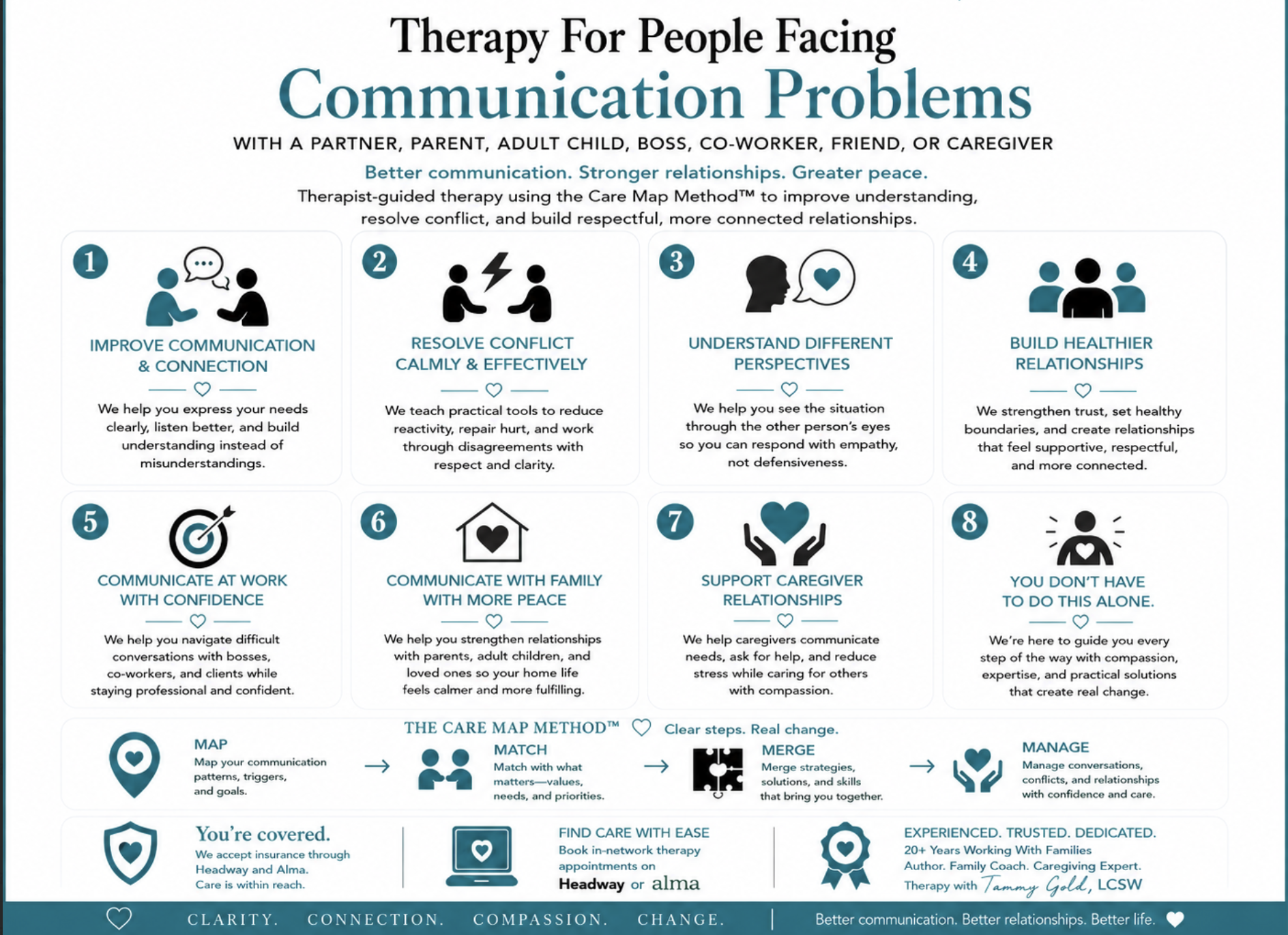
MAP — Understand the pattern, pressure points, emotions and needs underneath the problem.
MATCH — Identify the support, boundaries, communication and goals that fit your situation.
MERGE — Improve communication and connection among the people and competing needs involved.
MANAGE — Create practical next steps you can use between sessions and adjust as circumstances change.
Using Horizon BCBSNJ for online therapy in New Jersey
I provide online therapy for clients who are physically located in New Jersey at the time of the session. Eligible Horizon BCBSNJ members may be able to use insurance for therapy through Headway. Network participation, benefits, deductibles, copays and eligibility vary by individual plan. Please verify your benefits through Headway before booking.
Frequently asked questions
Can therapy help with this even if the other person does not attend?
Yes. Individual therapy can help you understand patterns, regulate reactions, clarify boundaries and change how you respond even when another person is not participating.
Will therapy just be talking about the problem?
No. There is room to talk and feel fully heard, but my approach also emphasizes clinical insight, communication tools, boundaries and practical next steps.
Do you provide online therapy in New Jersey?
Yes. I provide telehealth therapy to appropriate clients located in New Jersey, subject to scheduling, clinical fit and applicable requirements.
Can I use Horizon BCBSNJ for therapy?
Eligible Horizon BCBSNJ members may be able to use benefits through Headway. Coverage and out-of-pocket costs vary, so benefits should be verified before booking.
What if I am not sure whether my problem is serious enough for therapy?
You do not need to wait for a crisis. Therapy can be useful when a relationship, transition or recurring stress is taking up too much emotional space or affecting daily life.
Therapy for Communication Problems With a Partner, Parent, Adult Child, Boss or Caregiver
Therapy for clients struggling to communicate with a partner, parent, adult child, sibling, boss, coworker, nanny, daycare provider, caregiver or senior care professional.
Therapy for Communication Problems With Important People in Your Life
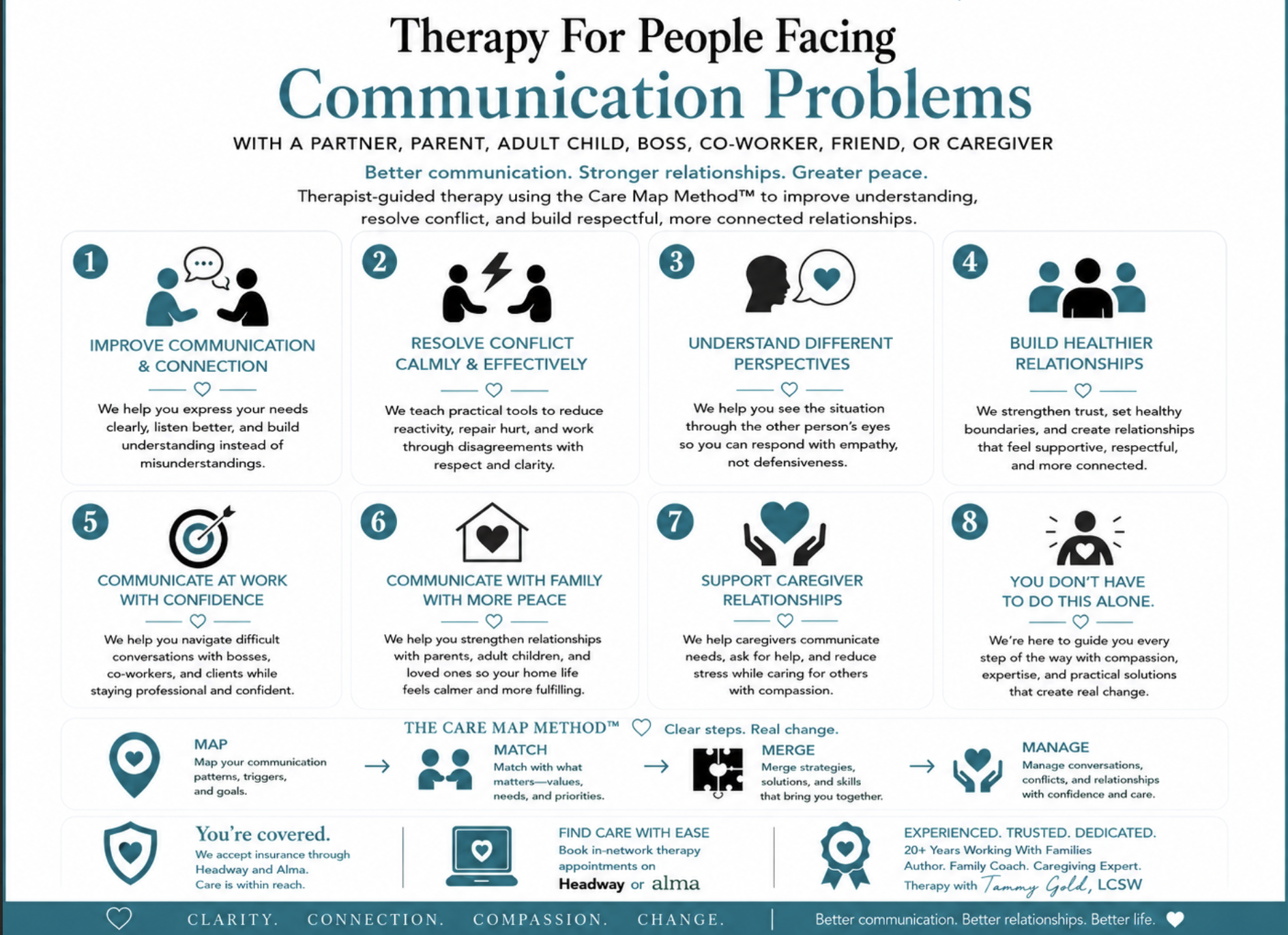
Communication problems can happen in any important relationship: with a partner, child, adult child, parent, sibling, friend, boss, coworker, neighbor, co-parent, nanny, daycare provider, caregiver or senior care professional. When communication breaks down, people often feel misunderstood, defensive, resentful, anxious or emotionally exhausted.
I am Tammy Gold, LCSW. I offer online therapy for clients in California, New Jersey and Oregon. Depending on your plan and eligibility, insurance may be available through Headway or Alma.
My Psychology Today profile links to booking and insurance options through Headway.
When communication becomes stressful
You may know what you feel but not how to say it. You may worry that speaking honestly will create conflict. You may shut down, over-explain, apologize, become reactive or avoid the conversation altogether. Therapy can help you understand the pattern and find more effective words.
The goal is not to make you perfect. The goal is to help you communicate with more clarity, compassion and confidence.
How sessions help
Using the Care Map Method™, we Map what is causing the communication breakdown, Match the needs and triggers underneath it, Merge better language and listening, and Manage boundaries or next steps.
This approach is especially helpful for clients dealing with family conflict, parenting stress, divorce, co-parenting, work stress, caregiver management, childcare situations or eldercare decisions.
Request a session
If you are struggling with communication in an important relationship, visit my Psychology Today profile to request a session. My profile links to booking and insurance options through Headway.
What types of relationship concerns do you help with?
I help clients with couples and marriage concerns, communication problems, parenting stress, family conflict, divorce, co-parenting, adult children, sibling relationships, caregiver stress, workplace relationships, boundaries, and major life transitions.
What makes your approach to relationship therapy different?
My approach combines a warm, supportive, nonjudgmental therapeutic space with a structured process. We use the Care Map Method™ to understand what is driving the problem, identify needs and patterns, strengthen communication, and create practical next steps.
Will therapy be a safe and nonjudgmental space?
Yes. My goal is to provide one place where clients can speak honestly without shame, blame, criticism, or pressure. Clients can unpack feelings, understand patterns, and receive compassionate support and practical guidance.
Is therapy only for couples?
No. Individual therapy can help improve relationships with a spouse, partner, child, parent, sibling, adult child, friend, coworker, boss, caregiver, or other important person—even when that person does not attend therapy.
Do you provide couples counseling?
Yes. Couples work may address repeated arguments, communication problems, emotional disconnection, parenting disagreements, trust, boundaries, divorce decisions, and co-parenting. Insurance coverage for couples or family sessions varies by plan.
What happens during the first therapy session?
We discuss what is bringing you to therapy, what feels most important, what you want to change, and what has or has not helped before. We begin mapping the biological, emotional, social, and environmental factors affecting the situation and identify initial priorities.
Do you only listen, or will I receive practical tools?
Therapy includes emotional support and space to process feelings, but it is also solution-focused. Clients may receive communication tools, scripts, boundary language, reflection questions, relationship strategies, and practical next steps.
Do you offer online therapy?
Yes. Online therapy is available to clients physically located in California, New Jersey, or Oregon at the time of the session.
What insurance plans do you accept?
Insurance availability varies by state, plan, eligibility, and booking platform. Prospective clients should use the booking or insurance-verification link to confirm current coverage before scheduling.
How do I schedule therapy?
Use the Psychology Today or designated booking link on the page to view availability, confirm insurance eligibility, and request a therapy appointment.