


How to Onboard a New Nanny: The First 30 Days
A strong nanny hire can still struggle without clear onboarding. Use the first 30 days to teach routines, establish communication and turn expectations into a workable family-caregiver system
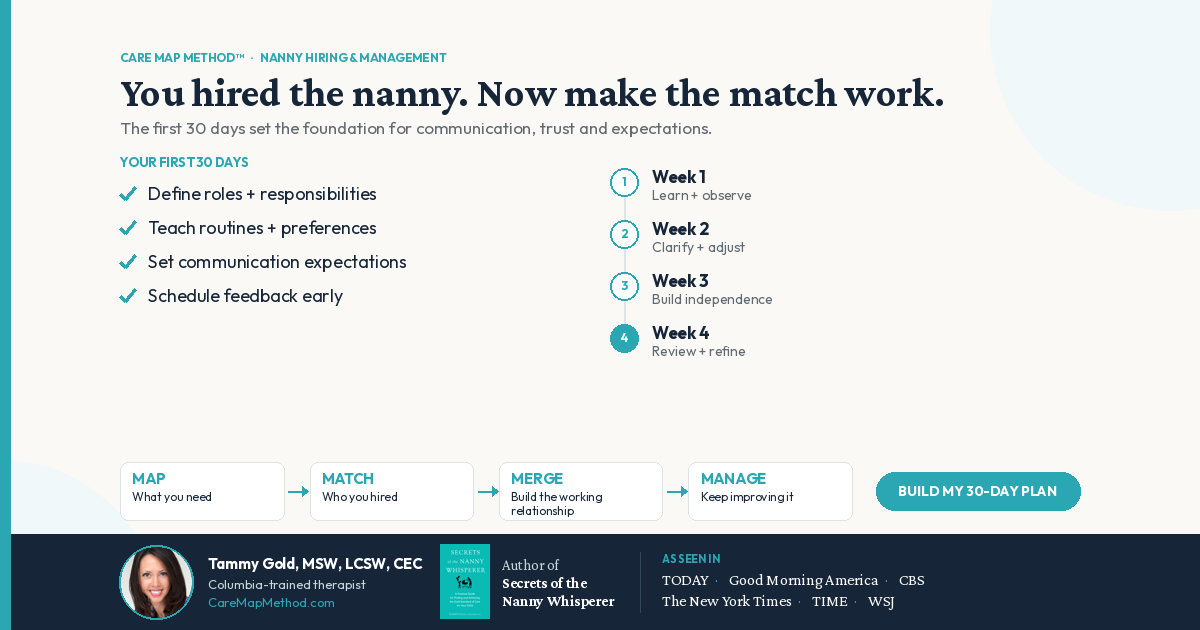
Hiring is only the beginning
Families sometimes invest weeks finding a nanny and then treat the first day as if the new caregiver should already know how everything works. Even experienced nannies need to learn your child, home, routines, preferences and communication style.
Week one: orient
Review emergency information, household access, routines, food, sleep, transportation, activities, supplies, discipline approach and the practical details of the role. Explain what the nanny can decide independently and what requires parent approval.
Create a communication rhythm
Decide what you want communicated during the day, what belongs in an end-of-day update and what requires an immediate call. Too little communication creates anxiety; constant messaging can make it difficult for the nanny to work independently.
Give feedback early and specifically
If something matters, address it while it is still small. Describe the behavior or expectation clearly rather than assuming the nanny understands a vague comment such as “be more proactive.” Also identify what is going well.
Expect adjustment
A new nanny and child may need time to learn each other. Parents also need to adjust to sharing caregiving responsibility. Not every awkward moment is evidence of a bad match.
MERGE → MANAGE
The first month is the transition from MERGE to MANAGE. You are integrating the caregiver into the family system and then building sustainable routines for communication, feedback and changing needs.
The 30-day Care Map review
At the end of the first month, revisit the original needs map. What is working? What is unclear? What needs to change? This keeps the employment relationship responsive instead of waiting for frustration to accumulate.
How the Care Map Method™ Helps
MAP → MATCH → MERGE → MANAGE gives parents a repeatable decision system instead of relying on urgency, charisma or guesswork.
MAP: Define the child, family, role, routines, values, expectations and non-negotiables.
MATCH: Compare the candidate’s demonstrated experience, temperament, judgment and working style with the mapped needs.
MERGE: Use the trial and onboarding period to integrate nanny, child and parents into one functioning care system.
MANAGE: Create clear communication, feedback, boundaries and periodic reassessment as the child and job evolve.
Already found candidates—or not sure where to begin? I can help you prepare the interview, evaluate fit, structure screening and references, plan the trial, onboard your nanny and create a practical management system.
Book Nanny Expert Call Today So I Can Help Answer→
What should I teach a nanny on the first day?
How much should I check in during the first week?
When should I give a new nanny feedback?
What should a 30-day nanny review cover?
How long does it take a child to adjust to a new nanny?
What if the nanny is good but our communication is not working?


First Time Hiring a Nanny: A Step-by-Step Guide for Parents
Hiring your first nanny can feel overwhelming because parents are simultaneously choosing a caregiver and becoming an employer. This step-by-step guide organizes the process.
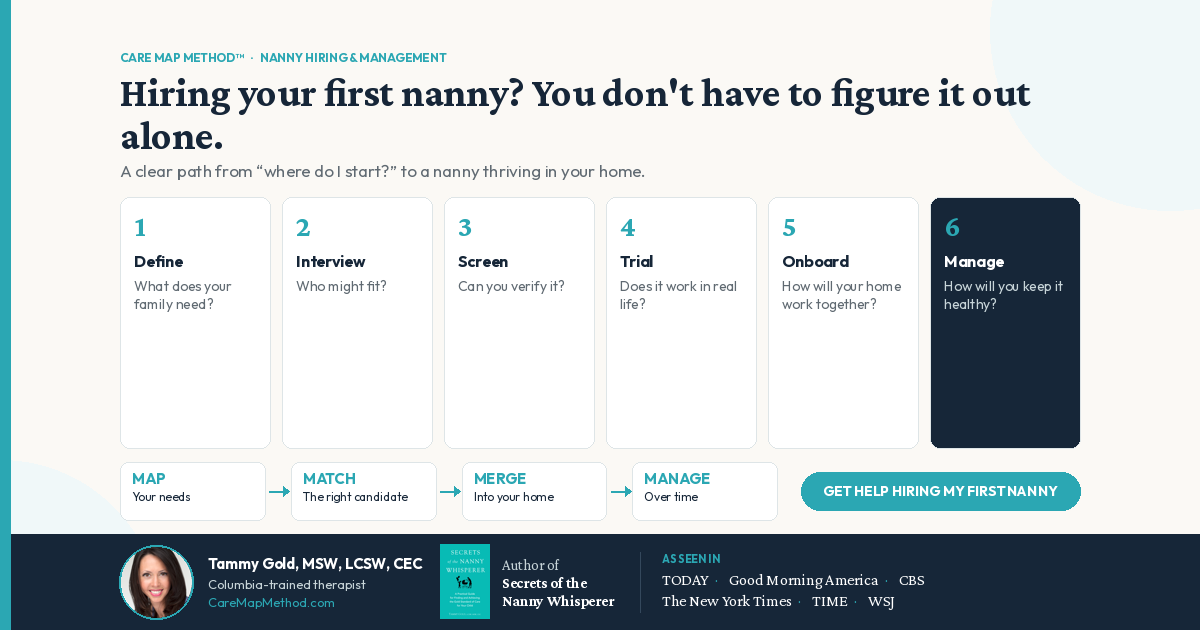
First time hiring a nanny step-by-step process from family needs through interview, screening, trial, onboarding and management.
The first nanny hire can feel much bigger than parents expect
You are not only deciding who will care for your child. You are defining a job, evaluating applicants, checking information, setting compensation and expectations, and preparing to manage someone inside your home. A system makes the process less reactive.
Step 1: MAP the job
Write down schedule, ages, responsibilities, transportation, child-related household tasks, routines, parenting approach, communication preferences and what success would look like after 30 days.
Step 2: Find and interview candidates
Whether candidates come from an agency, referral or online platform, use the same core criteria. Structured questions make comparison easier and reduce the temptation to hire solely because someone feels immediately likable.
Step 3: Screen
Verify references, credentials and background information using appropriate resources. In California, families should understand TrustLine and its role in screening in-home caregivers.
Step 4: Trial
Use a paid trial to observe how the nanny interacts with your child and functions within your real routines.
Step 5: Put expectations in writing
A written work agreement can clarify duties, schedule, compensation, guaranteed hours, time off, driving, communication and other terms. Families should obtain appropriate payroll, tax and legal guidance for their circumstances.
Step 6: Onboard
Do not hand over a list and disappear. Orient the nanny to the child, home, routines, safety information, preferences and decision-making boundaries.
Step 7: MANAGE
Schedule feedback rather than waiting until something is wrong. The nanny-family relationship needs maintenance as children develop and household needs change.
A guide beside you
I help first-time nanny employers turn an unfamiliar process into a clear sequence using MAP → MATCH → MERGE → MANAGE.
How the Care Map Method™ Helps
MAP → MATCH → MERGE → MANAGE gives parents a repeatable decision system instead of relying on urgency, charisma or guesswork.
MAP: Define the child, family, role, routines, values, expectations and non-negotiables.
MATCH: Compare the candidate’s demonstrated experience, temperament, judgment and working style with the mapped needs.
MERGE: Use the trial and onboarding period to integrate nanny, child and parents into one functioning care system.
MANAGE: Create clear communication, feedback, boundaries and periodic reassessment as the child and job evolve.
Expert CTA
Already found candidates—or not sure where to begin? I can help you prepare the interview, evaluate fit, structure screening and references, plan the trial, onboard your nanny and create a practical management system.
Book A Call So I Can Help You Answer:
Where should I start when hiring my first nanny?
Do I need a nanny contract?
What background checks should I consider?
Should I use a nanny agency?
How do I compare two strong candidates?
What should happen during the first week?
Email: Info@CareMapMethod.com Text: 818.308.1358

Nanny Trial Day: What to Watch Before You Hire
A nanny trial day lets you see what an interview cannot: how a caregiver enters your child’s world, handles routines, communicates and responds in real time.
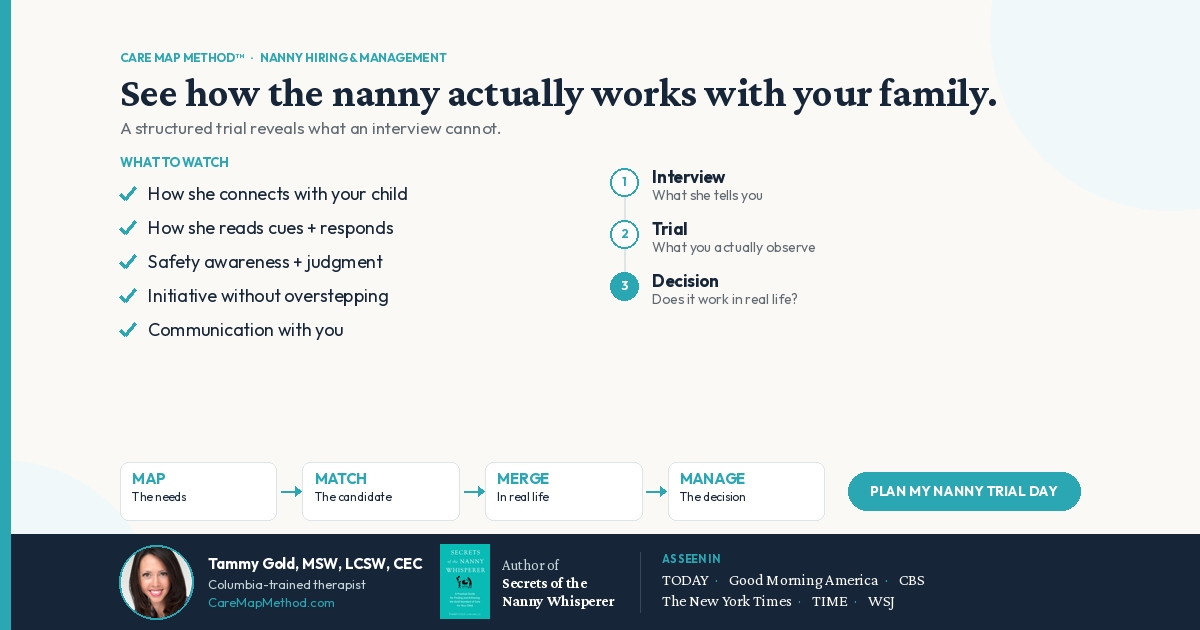
An interview tells you what a nanny says; a trial shows you how they work
A trial period can reveal how a caregiver approaches your child, follows routines, handles uncertainty, communicates with parents and adapts when the day does not go exactly as planned.
Make the trial realistic
Include ordinary parts of the job: play, meals, transitions, school pickup, nap preparation or getting out the door, depending on your child’s age. You do not need to manufacture a crisis. Real family life provides enough information.
Observe connection without demanding instant attachment
Some excellent caregivers build relationships gradually. Watch whether the nanny gets down to the child’s level, notices cues, follows the child’s interests, sets appropriate boundaries and stays emotionally steady.
Watch how the nanny handles the spaces between instructions
Does the candidate notice what needs doing? Ask appropriate questions? Respect household boundaries? Adapt when a plan changes? Initiative matters, but the right amount of initiative depends on what your family wants.
Evaluate your own reactions too
Parents can become so focused on whether the child “likes” the nanny that they miss their own concerns—or reject a strong candidate because the first hour was awkward. Use structured criteria alongside intuition.
MERGE begins during the trial
In the Care Map Method™, the trial is the beginning of MERGE: bringing caregiver, child and parents into one working system. The trial helps identify what will need to be clarified during onboarding if you move forward.
Expert trial-day planning
I help families decide what to observe, build a trial-day scorecard and debrief afterward. The goal is to convert a vague feeling of “I think she was good” into a more informed hiring decision.
How the Care Map Method™ Helps
MAP → MATCH → MERGE → MANAGE gives parents a repeatable decision system instead of relying on urgency, charisma or guesswork.
MAP: Define the child, family, role, routines, values, expectations and non-negotiables.
MATCH: Compare the candidate’s demonstrated experience, temperament, judgment and working style with the mapped needs.
MERGE: Use the trial and onboarding period to integrate nanny, child and parents into one functioning care system.
MANAGE: Create clear communication, feedback, boundaries and periodic reassessment as the child and job evolve.
Already found candidates—or not sure where to begin? I can help you prepare the interview, evaluate fit, structure screening and references, plan the trial, onboard your nanny and create a practical management system.
$195 Book Your Nanny Call Today So I Can Help Answer→
Should a nanny trial day be paid?
How long should a nanny trial be?
Should parents stay home during the trial?
What should I watch during a nanny trial?
What if my child is shy with the candidate?
Can I trial more than one nanny?

Nanny Reference Check Questions: What to Ask Former Families
A nanny reference call should verify more than employment dates. Learn what to ask former families about reliability, responsibilities, judgment, feedback and performance.
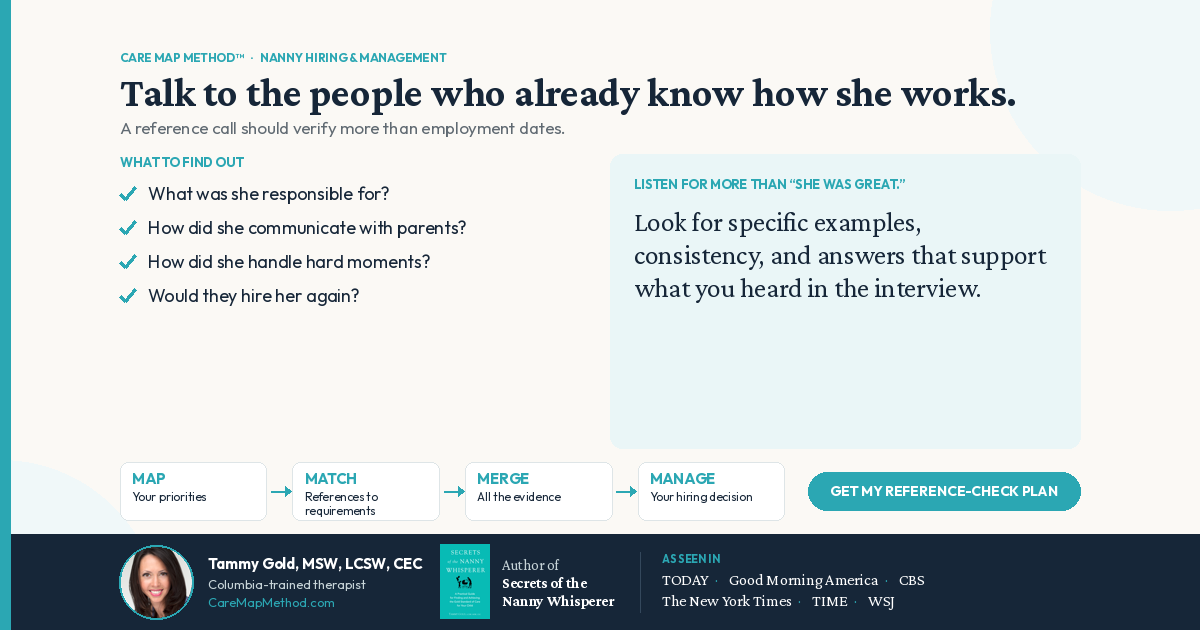
A reference check is not a formality
Parents sometimes call a reference only to ask, “Did you like her?” That leaves valuable information on the table. A former employer can help you understand what the nanny was responsible for, how reliably they performed, how they communicated and how they responded when the job became difficult.
Start by verifying the basics
Confirm how the reference knows the candidate, dates of employment, children’s ages and core responsibilities. This helps establish whether the experience described by the nanny aligns with the employer’s account.
Ask about performance in concrete terms
Explore strengths, areas for growth, reliability, initiative, interaction with children and adults, response to feedback and whether the family would hire the nanny again. TrustLine’s parent resources recommend asking these kinds of performance-focused questions.
Describe your job
Tell the reference enough about your own position to ask whether they believe the candidate would fit it. A nanny who thrived with two school-age children may need different skills for newborn twins, extensive travel or a household requiring a high level of independent planning.
Listen for substance, not just enthusiasm
A glowing reference is useful, but specific examples are more informative than generic praise. Notice whether the reference can describe what the nanny did well and how they handled challenges.
Use reference information in MATCH
MAP your family’s needs first. Then use references to MATCH the candidate’s demonstrated strengths and working style to those needs. References are one data source—not the whole decision.
How I can help
Families can bring candidate résumés, interview notes and reference information into a Care Map consultation. We can identify what still needs verification and what to observe in the next stage of the hiring process.
How the Care Map Method™ Helps
MAP → MATCH → MERGE → MANAGE gives parents a repeatable decision system instead of relying on urgency, charisma or guesswork.
MAP: Define the child, family, role, routines, values, expectations and non-negotiables.
MATCH: Compare the candidate’s demonstrated experience, temperament, judgment and working style with the mapped needs.
MERGE: Use the trial and onboarding period to integrate nanny, child and parents into one functioning care system.
MANAGE: Create clear communication, feedback, boundaries and periodic reassessment as the child and job evolve.
Already found candidates—or not sure where to begin? I can help you prepare the interview, evaluate fit, structure screening and references, plan the trial, onboard your nanny and create a practical management system.
Book Your Call Today So I Can Help You →
How many nanny references should I call?
What should I ask a nanny’s former employer?
Should references be former employers or personal references?
What if a reference gives only basic information?
Should I ask whether they would rehire the nanny?
What do I do if interview and reference information conflict?

How to Screen a Nanny Before You Hire
Screening a nanny should combine safety verification with a careful assessment of experience, reliability, judgment and fit. Here is a structured process for families.
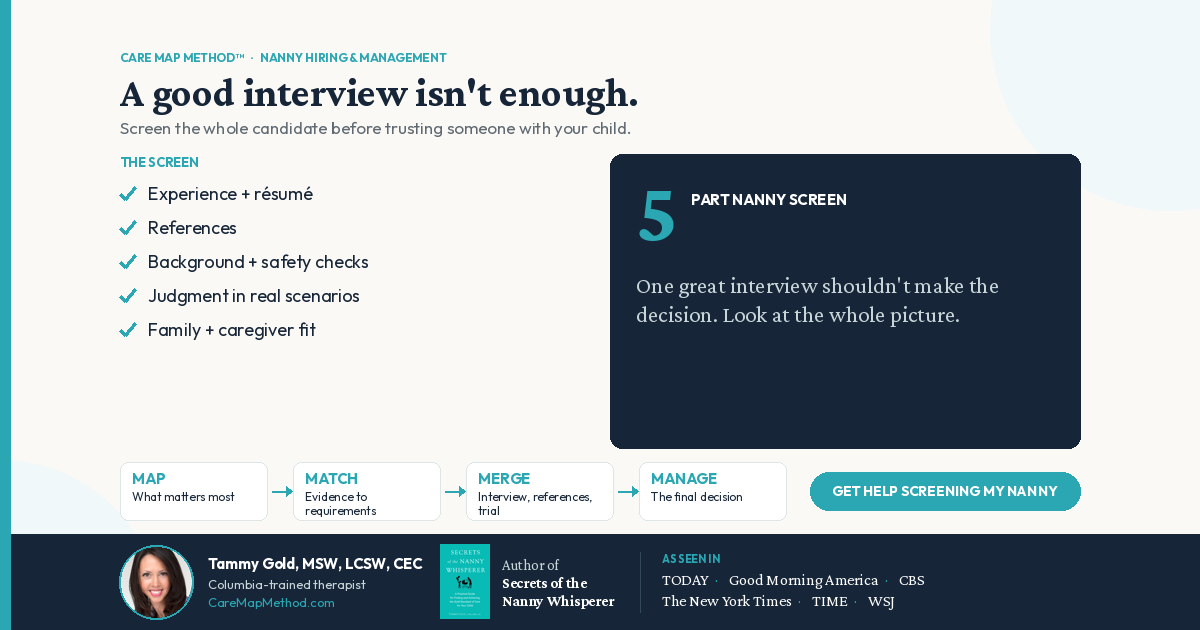
Screening is more than running a background check
A background check can be an important safety tool, but it cannot tell you whether a nanny communicates well, follows through, accepts feedback or is the right fit for your child. Good screening combines verification with human assessment.
Verify what can be verified
Confirm identity, prior employment details, relevant certifications and driving information when driving is part of the job. If something important on the résumé is unclear, ask directly rather than filling in the gap yourself.
Call references yourself
Reference conversations can help verify responsibilities, reliability, initiative, interaction with children and adults, response to feedback and whether a former employer would hire the candidate again. Ask consistent questions so you can compare candidates fairly.
Use the appropriate background-check process
California families should understand TrustLine, the state’s background-check registry for in-home and license-exempt child care providers. TrustLine checks records that ordinary private searches may not access. Families outside California should identify the screening tools and legal requirements relevant to their jurisdiction.
Screen for the job you actually have
A candidate can clear every formal screening step and still be poorly matched to the role. A family with an infant has different needs from a household with three school-age children and extensive driving. MAP the role, then MATCH the evidence you have about the candidate against it.
Do not ignore discrepancies
If dates, responsibilities or explanations change, slow down and clarify. A discrepancy does not automatically mean someone is unsuitable, but an important unresolved inconsistency should not be brushed aside because you are eager to hire.
My role as a nanny hiring expert
I help families organize the screening process, prepare reference questions, evaluate information and distinguish between a safety issue, a skills gap and a simple mismatch. The goal is a thoughtful decision—not false certainty.
How the Care Map Method™ Helps
MAP → MATCH → MERGE → MANAGE gives parents a repeatable decision system instead of relying on urgency, charisma or guesswork.
MAP: Define the child, family, role, routines, values, expectations and non-negotiables.
MATCH: Compare the candidate’s demonstrated experience, temperament, judgment and working style with the mapped needs.
MERGE: Use the trial and onboarding period to integrate nanny, child and parents into one functioning care system.
MANAGE: Create clear communication, feedback, boundaries and periodic reassessment as the child and job evolve.
Already found candidates—or not sure where to begin? I can help you prepare the interview, evaluate fit, structure screening and references, plan the trial, onboard your nanny and create a practical management system. I can also help screen the nanny with you.
Book A Call With Me To Get Expert Nanny Hiring Help To Answer→
What background check should I run on a nanny?
What is TrustLine in California?
How many nanny references should I check?
Should I verify CPR and First Aid?
What if a nanny has limited professional references?
Is a background check enough to know a nanny is safe?

Nanny Interview Questions: What Parents Should Really Ask
The best nanny interview questions do more than confirm experience. Learn how to ask questions that reveal judgment, caregiving style, communication and whether a candidate fits your child and family.
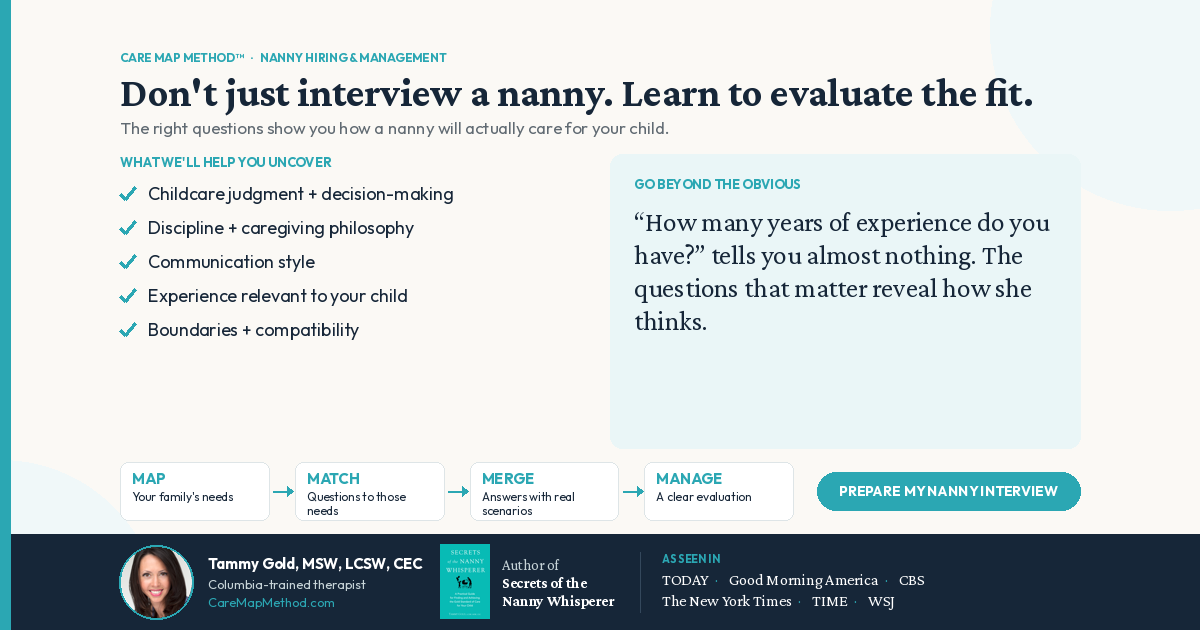
A nanny interview is not a conversation you should improvise
Parents often leave an interview knowing that a candidate seems nice and has experience, but still not knowing how that person would care for their child on an ordinary, difficult Tuesday. The purpose of the interview is not to find the candidate with the most polished answers. It is to understand how the person thinks, communicates, responds under stress and approaches children.
Begin with your own Care Map
Before writing questions, identify the realities of the job. What situations happen repeatedly in your home? What does your child need when upset? How structured are your routines? How much initiative do you want? What household tasks truly belong to the nanny role? The interview becomes more useful when your questions come from your actual needs.
Ask for examples, not adjectives
Instead of asking “Are you patient?” ask for a time a child had a prolonged tantrum and what the nanny did. Instead of “Are you organized?” ask how the candidate managed schedules, supplies and transitions in a prior job. Past examples and realistic scenarios reveal more than yes/no questions.
Cover the domains that matter
Ask about age-specific experience, safety and emergencies, routines, feeding and sleep where relevant, discipline and boundaries, activities and development, communication with parents, transportation, reliability, household expectations, feedback and conflict. For California candidates, ask about TrustLine status and appropriate CPR/First Aid preparation.
Notice the questions the nanny asks you
Strong candidates should also be evaluating the job. Their questions can reveal what they prioritize: the child’s routines, parenting philosophy, expectations, schedule, communication, compensation, boundaries or professional development. A nanny who asks thoughtful questions is gathering the information needed to determine whether the job fits them too.
Use MAP → MATCH rather than intuition alone
MAP the job and child first. Then MATCH each candidate against the same criteria. This reduces the risk of being overly influenced by charisma, urgency or one impressive credential. You can still value your instincts, but place them alongside observable information.
What I help families do
I help parents build interview questions around their actual child and household, prepare follow-up questions, interpret answers and compare candidates. The goal is not to turn parents into professional recruiters. It is to give them a disciplined way to make a very personal decision.
How the Care Map Method™ Helps
MAP → MATCH → MERGE → MANAGE gives parents a repeatable decision system instead of relying on urgency, charisma or guesswork.
MAP: Define the child, family, role, routines, values, expectations and non-negotiables.
MATCH: Compare the candidate’s demonstrated experience, temperament, judgment and working style with the mapped needs.
MERGE: Use the trial and onboarding period to integrate nanny, child and parents into one functioning care system.
MANAGE: Create clear communication, feedback, boundaries and periodic reassessment as the child and job evolve.
Already found candidates—or not sure where to begin? I can help you prepare the interview, evaluate fit, structure screening and references, plan the trial, onboard your nanny and create a practical management system.
Get Expert Nanny Hiring Help $195 Nanny Expert Call To Answer →
What are the most important questions to ask a nanny? .
Should both parents attend the nanny interview?
What nanny interview questions reveal red flags?
Should I ask hypothetical scenario questions?
Can I ask about CPR and background screening?
How long should a nanny interview be?
Nanny Booking Session Link

How to Hire the Right Nanny: Interview, Screen, Trial, Onboard & Manage
Hiring a nanny is not just about finding someone with experience. It is about finding the caregiver who fits your child, family, parenting style and everyday needs. Tammy Gold helps families interview, screen, evaluate, trial, onboard and manage nannies using the Care Map Method™.
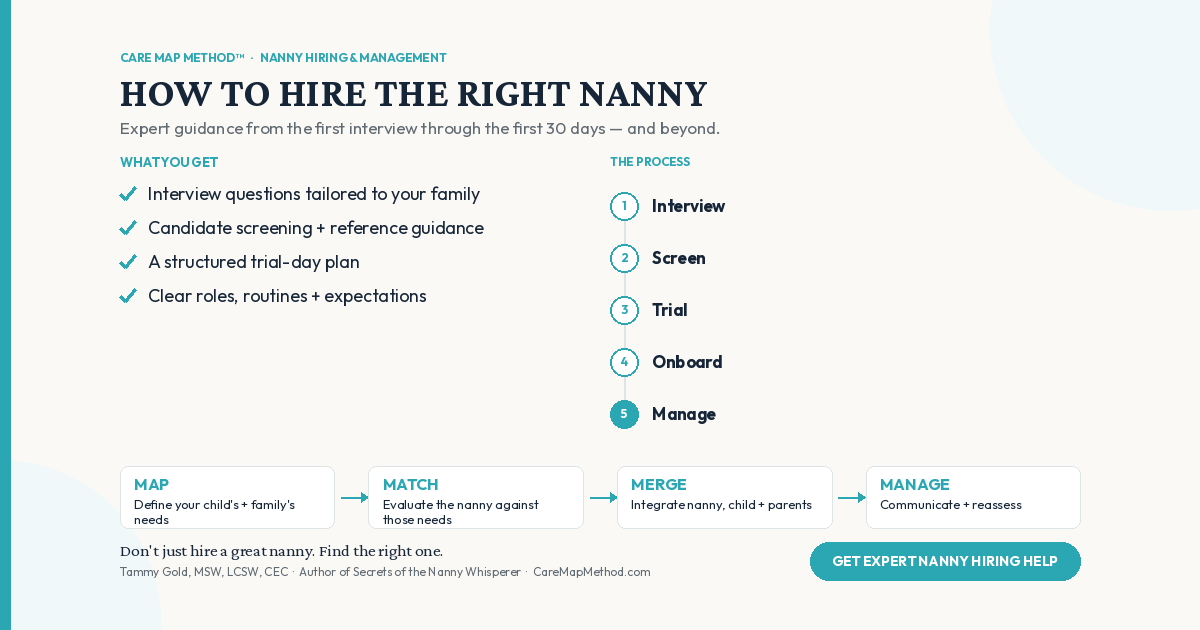
Hiring a nanny is one of the most personal hiring decisions a family makes
A nanny works inside your home, participates in your child’s daily routines and becomes part of the emotional and practical system of family life. Yet many parents are asked to make this decision using the same tools they would use for an ordinary job hire: a résumé, a short interview and a few references. Those pieces matter, but they do not answer the most important question: Is this the right caregiver for this child and this family?
Start with the family, not the candidate
Before you interview anyone, define what the job actually requires. Consider your child’s age and temperament, schedule, transitions, sleep and feeding routines, activity level, parenting approach, household expectations, transportation needs and the amount of initiative you want a nanny to take. A highly experienced nanny can still be the wrong match if the family and caregiver have incompatible expectations.
Interview for real-life fit
A strong nanny interview goes beyond “How many years have you worked with children?” Ask candidates to describe what they would do in situations that resemble your real life: a toddler refusing to leave the park, an infant who will not settle, siblings fighting, a parent running late, or a disagreement about a household rule. You are listening for judgment, flexibility, warmth, communication and whether the nanny’s instincts align with your family.
Screen carefully and verify
References and background screening are separate parts of the process. References help you understand how someone actually performed in prior jobs; background checks verify different kinds of safety information. For California families, TrustLine is an important state-run screening resource for in-home and license-exempt child care providers. Screening should complement—not replace—interviews, references and assessment of fit.
Use a trial to observe, not to stage a performance
A paid trial gives you information an interview cannot. Watch how the nanny enters your child’s world, responds to cues, handles transitions, communicates with you, takes initiative and recovers when something does not go perfectly. The goal is not perfection. The goal is to see the caregiver’s natural style and how it fits your family.
Onboarding is part of hiring
The hiring decision is not finished when the nanny says yes. The first days and weeks establish expectations around routines, communication, safety, household responsibilities, decision-making, privacy, schedule changes and feedback. A thoughtful onboarding process reduces ambiguity and gives both the family and nanny a clearer path to success.
The Care Map Method™: MAP → MATCH → MERGE → MANAGE
MAP your child, family and job needs.
MATCH those needs to the caregiver’s experience, temperament and working style.
MERGE the nanny into the family system through a structured trial, orientation and communication plan.
MANAGE the relationship through feedback, clear expectations and reassessment as your child and family change.
Expert guidance when the decision feels too important to guess
I am Tammy Gold, MSW, LCSW, CEC, author of Secrets of the Nanny Whisperer and creator of the Care Map Method™. For more than two decades, my work with families has focused on understanding children, parents, caregivers and the relationships between them. Families can work with me to prepare for interviews, evaluate candidates, structure trials, onboard a new nanny and create a practical management plan.
How the Care Map Method™ Helps
MAP → MATCH → MERGE → MANAGE gives parents a repeatable decision system instead of relying on urgency, charisma or guesswork.
MAP: Define the child, family, role, routines, values, expectations and non-negotiables.
MATCH: Compare the candidate’s demonstrated experience, temperament, judgment and working style with the mapped needs.
MERGE: Use the trial and onboarding period to integrate nanny, child and parents into one functioning care system.
MANAGE: Create clear communication, feedback, boundaries and periodic reassessment as the child and job evolve.
Already found candidates—or not sure where to begin? I can help you prepare the interview, evaluate fit, structure screening and references, plan the trial, onboard your nanny and create a practical management system.
Get $195 Expert Nanny Hiring Help Call To Answer →
What should I look for when hiring a nanny?
How many nanny candidates should I interview?
Should I do a paid nanny trial day?
What is the difference between a reference check and a background check?
How do I know whether a nanny is the right personality fit?
What should be included in nanny onboarding?
Can you help if I already found my own candidates?
Book Your Nanny Session Today

Finding the right nanny is only the beginning.
Hiring a nanny is only the beginning. These five first-week steps help parents and professional nannies establish clearer routines, expectations, communication and trust from the start.
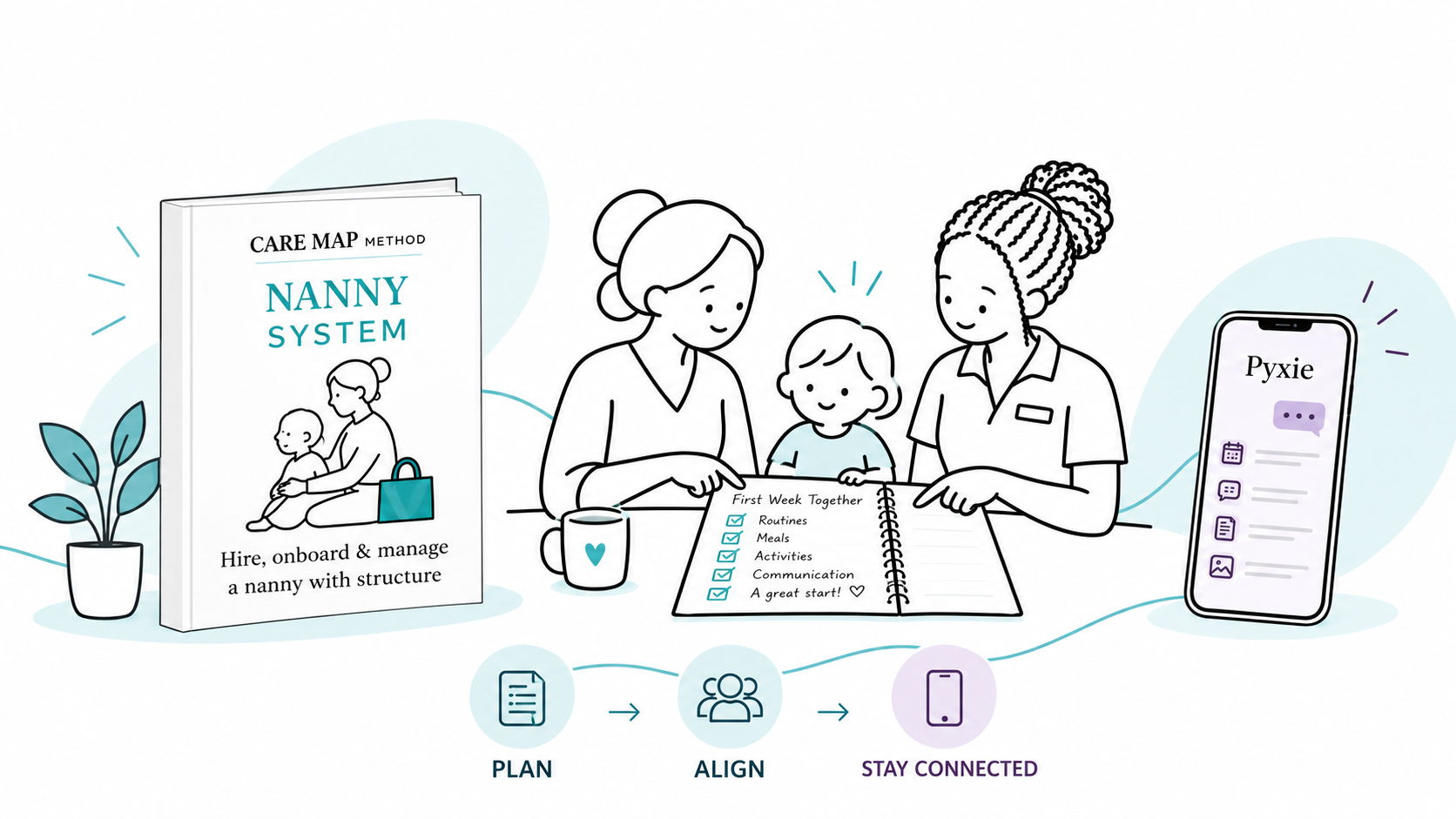
Parent and professional nanny use the CMM Nanny System and Pyxie app to plan routines, expectations and communication for their first week together.
Five Things to Do After You Hire a Nanny
Hiring the right nanny is an important first step—but the relationship still needs a thoughtful beginning. These five Care Map Method™ steps can help your family and nanny create clarity, trust, and a stronger first week together.
1. Map your child’s real needs
Before creating a list of tasks, consider your child’s complete needs: biological, emotional, social, and environmental. Share important information about routines, temperament, comfort, sleep, meals, transitions, activities, and the home environment.
A nanny needs to understand not only what to do, but what helps your child feel secure and function well.
2. Clarify expectations before the first day
Discuss the practical details that are often left unspoken: schedule, responsibilities, household boundaries, transportation, phone use, outings, meals, visitors, photos, safety procedures, and what should happen when plans change.
Clear expectations are not micromanagement. They give both adults a dependable starting point.
3. Build the first-week plan together
Parents know their child and household. Experienced nannies bring professional observations, judgment, and ideas. Invite your nanny to ask questions and contribute to the plan.
The goal is not to hand over a long instruction manual. It is to create shared context that both adults understand and can realistically use.
4. Agree on how you will communicate
Decide what should be shared immediately, what belongs in the daily handoff, and what can wait for a scheduled conversation. Choose one dependable place for routines, updates, questions, and changes so important information is not scattered across texts, notes, and memory.
Good communication should keep everyone informed without making the nanny feel constantly monitored.
5. Schedule a seven-day check-in
Do not let small misunderstandings become recurring frustrations. At the end of the first week, ask:
What is working well?
What has been different from what we expected?
What does the nanny need from the family?
What does the family need clarified?
What should we change for the following week?
The first plan does not have to be perfect. It needs to be clear enough to use—and flexible enough to improve.
Turn These Five Steps Into a Working System
The CMM Nanny System helps you plan the relationship. Pyxie helps your family and nanny keep that shared plan organized and useful in daily life.
Practical guidance from Tammy Gold, MSW, LCSW, CEC
Tammy Gold is a licensed therapist, certified coach, caregiving author, and author of Secrets of the Nanny Whisperer. For more than 20 years, she has helped families understand caregiving relationships, clarify expectations, and navigate the human side of care.
Her independently developed CMM Nanny System is being made available as a limited complimentary resource for eligible participants in this Pyxie trial.
Eligibility
This free trial may be right for you if:
you have already hired a professional nanny;
you are willing to complete Pyxie onboarding;
you want clearer routines, communication, and expectations; and
you agree to provide brief feedback about the experience.
This trial is not a nanny-placement service, background-check service, payroll service, monitoring service, emergency service, or substitute for legal, employment, medical, or mental-health advice.
Give your new caregiving relationship a clearer start.
Download Pyxie free and receive the CMM Nanny System as your complimentary trial bonus.

How to Choose a Childcare Provider: 4 Simple Steps to Choosing the Best Childcare
There comes a time when every family must choose childcare — and for many parents, this decision feels overwhelming.
What works beautifully for one family may feel completely wrong for another. A neighbor may rave about a daycare center, while a friend swears by having a nanny. With so many opinions and options, parents often feel pressured to decide quickly rather than thoughtfully.
As a licensed therapist and childcare expert, I encourage parents to slow the process down and evaluate childcare through a whole-child lens — one that considers not just logistics, but your child’s emotional safety, development, biology, and environment.
This guide will walk you through four clear steps to help you choose childcare with confidence, using the Care Map Method™.
Choosing Childcare: Understanding the Needs of Both You and Your Child
Step #1: Questions to Ask Yourself
Step #2: Questions About the Type of Care You Want
Step #3: Questions for Daycare Centers
Step #4: Questions for Nannies
Prioritize and Research
Choosing Childcare: Understanding the Needs of Both You and Your Child
Before touring daycare centers or interviewing nannies, it’s essential to understand what your family truly needs.
Consider what daily life will look like once childcare begins:
Will structure and routine help your child feel secure?
Does your child thrive with one-on-one attention?
How does your child handle transitions, noise, or new caregivers?
The Care Map Method™ helps parents evaluate childcare decisions through four essential areas:
Emotional: Attachment, separation, comfort, responsiveness
Developmental: Age, temperament, learning style
Biological: Sleep, feeding, health, sensory needs
Environmental: Group size, consistency, physical space
When childcare aligns across these four areas, children adjust more smoothly — and parents feel more confident.
Step #1: Questions to Ask Yourself Before Choosing Childcare
Choosing childcare requires more thought than most parents expect. Before evaluating any provider, start by asking yourself:
How many hours and which days do I need childcare?
How much flexibility do I need if work schedules change?
Will my needs shift between part-time and full-time care?
What is my realistic budget?
How important is proximity to home or work?
These questions create the foundation for your search and help narrow your options before emotions take over.
Step #2: Questions About the Type of Care You Want
Once logistics are clear, it’s time to consider the kind of care that best supports your child.
Ask yourself:
Is my child ready for group socialization?
Do I value formal childcare education or lived experience more?
What developmental experiences matter most at this age?
Would my child benefit from mixed-age or same-age peers?
Do I want structure, flexibility, or a blend of both?
These answers guide whether daycare, nanny care, or a hybrid option is the best fit.
Feeling unsure how to objectively compare your options?
👉 Download How to Choose Childcare: A Therapist’s Step-by-Step Guide Using the Care Map Method™
This guide walks parents through daycare, nanny, and hybrid care decisions using a calm, structured framework — so you don’t rely on guesswork or guilt.
https://caremaptammy.gumroad.com/l/jlxxie
Step #3: Questions for Daycare Centers
If daycare feels like the right direction, touring centers with intention matters.
When evaluating a daycare, consider asking:
How much individual attention does each child receive?
What are the group sizes?
Is there a balance between structure and free play?
Does the environment feel more like a home or a school?
Are meals provided, and how are nutrition needs handled?
Is the location convenient for daily routines?
Your goal isn’t to find the “best” daycare — it’s to find the one that aligns most closely with your child’s emotional, developmental, and biological needs.
Step #4: Questions for Nannies
For families considering nanny care, the questions extend beyond childcare philosophy into household dynamics.
Important considerations include:
Will the nanny assist with meals or light household tasks?
What training or experience does the nanny have?
How will backup care be handled during illness?
Is the position live-in or live-out?
How will the nanny support socialization?
Will educational support or homework help be included?
Because a nanny works independently in your home, background checks and reference checks are essential. Many families choose to work with reputable placement agencies to add an extra layer of confidence.
Prioritize and Research
After gathering information, create a short list of your top priorities.
No childcare option is perfect — but the right fit will support your child’s needs while allowing your family to function with less stress.
The more intentionally you approach this process, the more confident you’ll feel in your final decision.
Want the Exact Interview Questions and Trial Checklists?
Once you narrow down options, clarity often comes from what you observe during interviews and trial periods.
👉 Get the Childcare Interview, Reference Check & Trial Toolkit
Includes therapist-designed interview questions, reference scripts, trial-week observation logs, and red-flag checklists — all aligned with the Care Map Method™.
https://caremaptammy.gumroad.com/l/fnogts
What Is the Care Map Method™?
The Care Map Method™ was developed by licensed therapist and parenting expert Tammy Gold, LCSW, and is based on over 20 years of clinical experience working with families.
The method integrates four essential pillars:
Emotional
Developmental
Biological
Environmental
By applying this framework, parents move from fear-based decision-making to calm, informed advocacy for their children.
Learn more at www.CareMapMethod.com