

Relationship Stress Therapy in California
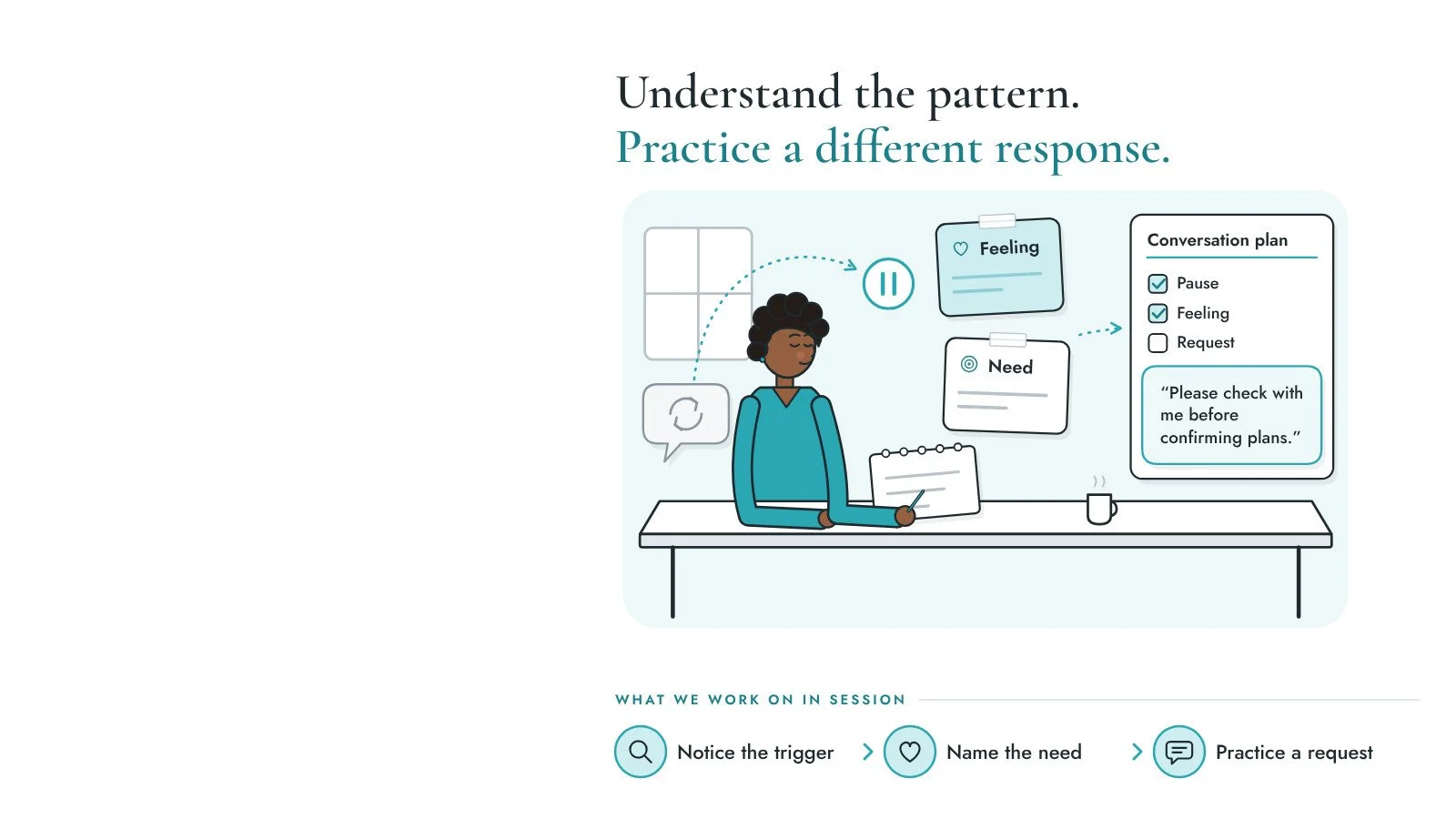
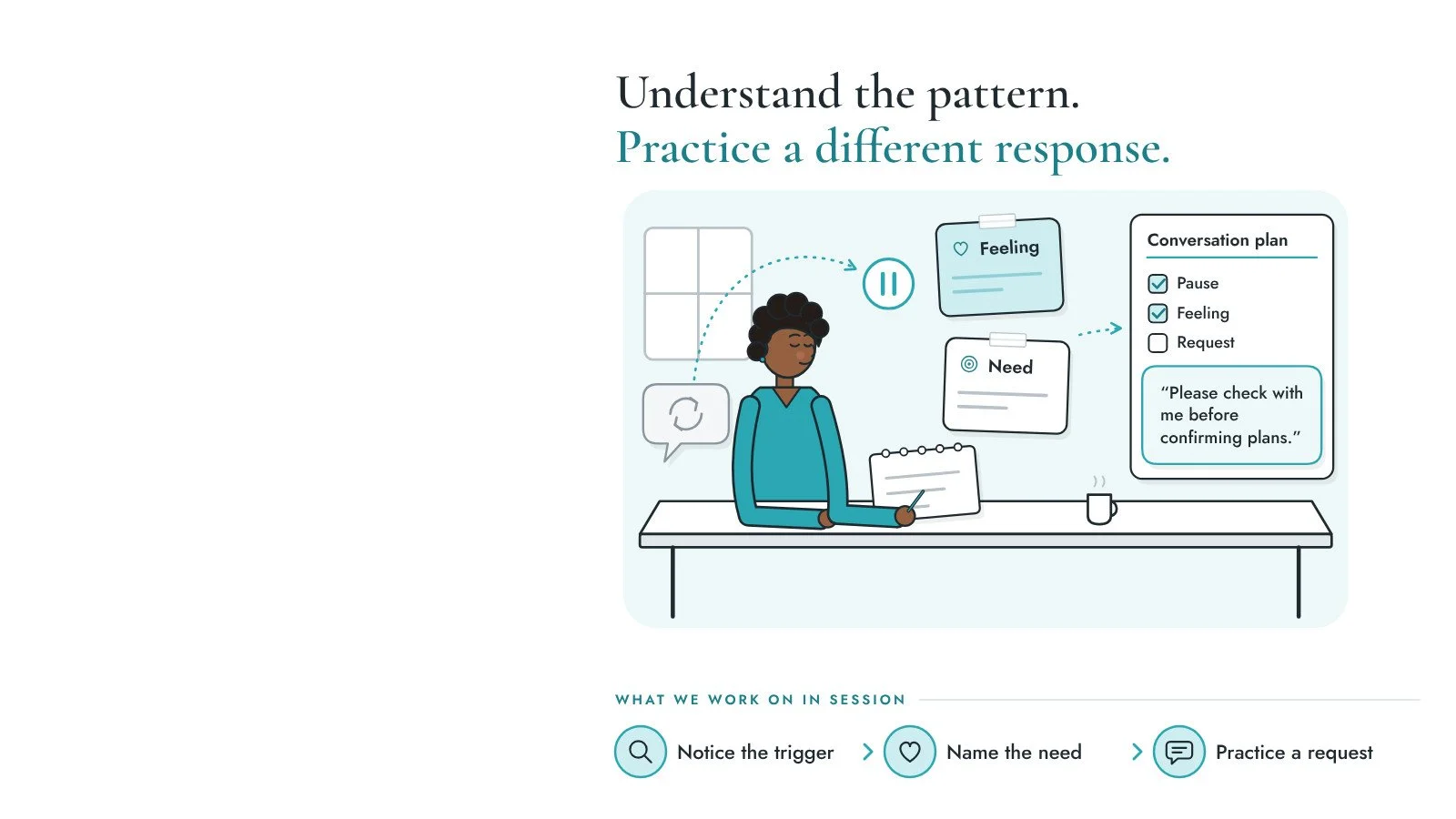
Do you keep having the same argument, even when you promise yourself you will handle it differently? You may leave conversations feeling unheard, replay what you said, or stay quiet because another disagreement feels exhausting. In online individual therapy in California, we can look closely at one of those moments and understand what makes the pattern difficult to change. Together, we can identify the emotion underneath your reaction, clarify what you need, and practice a request that sounds like you. Using Care Map Method, we can also prepare for defensiveness, plan a pause, and explore boundaries you can follow through on. I’m Tammy Gold, LCSW. My approach makes room for the hurt behind the conflict while helping you develop responses you can use in everyday conversations. Your partner does not have to attend for us to begin working on your concerns.
Keep having the same argument and wishing you had handled it differently
You bring up something that matters, and the conversation quickly changes. You explain more. Your partner gets defensive or goes quiet. By the end, you feel farther apart and keep replaying what happened. Online individual therapy offers a place to understand that pattern and practice a response you can use when the next difficult moment arrives.
Maybe you rehearse conversations in your head, avoid asking for what you need, or feel responsible for keeping the peace. You may want to stay in the relationship while changing how you participate in it. We can work on your concerns even if your partner is not attending therapy with you.
Check benefits and availability
Understand what happens before the argument
We can take one recent disagreement and slow it down. What was said? What did you hear it as meaning? What did you feel in your body, and what did you do next? This helps us identify the point where you become defensive, raise your voice, withdraw, or start trying harder to be understood. We also make room for hurt and experiences that may shape those reactions.
Practice a request that says what you need
Instead of stopping at “communicate better,” we can work on your actual words. You might practice describing one behavior, naming its effect, and making a specific request. For example: “When plans change without telling me, I feel left out. Please check with me before confirming.” We can explore how that wording feels and what makes it difficult to say.
Prepare for the response you cannot control
A clear request does not guarantee agreement. We can plan how you want to respond to defensiveness, decide when to pause, and consider what boundary you can follow through on. We can also explore whether the relationship is meeting your needs. Your goals and safety guide the work; responsibility for another person’s behavior does not fall on you.
An example of the work
For example, you might bring in a disagreement about household responsibilities. We could identify the hurt underneath “you never help,” practice a request about a specific task, and plan a time to revisit the conversation. Between sessions, you may choose to try that request and notice what happens.
What progress can look like
Progress might mean recognizing a trigger sooner, making a clear request, spending less time replaying an exchange, or understanding a boundary you need. We review what changes and adjust the approach together.
How Care Map Method supports our work
Map the emotion and trigger. We look at a recent moment and the biological, emotional, social, and environmental pressures around it. The aim is to understand your experience before choosing a response.
Match the need with a strategy. We identify what matters in that moment and select a skill or next step that fits. That might be a clearer request, a pause, a boundary, or space to process a loss.
Merge the skill into daily life. We can rehearse the words and decide when you might use them. Any practice between sessions is chosen together and adjusted to your circumstances.
Manage responses over time. We review what happened, what was difficult, and what needs to change. Therapy includes room for feelings and history as well as practical work.
About Tammy Gold
I’m Tamara “Tammy” Gold, MSW, LCSW, founder of Care Map Method™ and author of Secrets of the Nanny Whisperer. I earned my MSW at Columbia University and my BA at the University of Pennsylvania. My work with families informs a warm, active approach to therapy that makes room for your emotional experience and practical concerns.
Common questions
Can I attend without my partner? Yes. Individual therapy can focus on your feelings, choices, communication, and boundaries. We can work with your experience while recognizing that your partner has a perspective we have not assessed.
Is this couples counseling? This page describes individual therapy for relationship stress. If you want sessions together, ask about couples services, clinical fit, and payment arrangements before scheduling.
What if I shut down during arguments? We can explore what happens before you withdraw and practice ways to ask for a pause, settle enough to think, and return to a conversation when appropriate.
Will you tell me whether to leave? We can examine your needs, patterns, options, and concerns so you can make an informed decision. Therapy does not require you to arrive with a decision already made.
Can I use Anthem Blue Cross? Use my Headway profile to check your specific Anthem Blue Cross plan and California network eligibility. Coverage, deductible, and cost sharing depend on your benefits and the service provided.
What should I bring to the first session? Bring one recent example and what you wish had gone differently. We will also discuss your history, current concerns, goals, and whether this approach is a good fit.
Take the next step
If this sounds familiar, you can explore online therapy with me while located in California. Open my Headway profile to check your exact insurance benefits and appointment options. We will discuss your concerns, clinical needs, and goals to determine fit.
Individual Therapy for Blended Family Stress in New Jersey
Feeling caught between your partner and family expectations? Explore individual therapy for blended-family stress in New Jersey with Tammy Gold, LCSW.
You care about your partner, but you may feel uncertain about your place in the household. A change in plans, a disagreement about rules, or a request from a former partner can leave you feeling overlooked. Perhaps you hold back until frustration spills out, then feel guilty afterward. Individual therapy for blended-family stress in New Jersey offers space to understand your experience and work on the part of the pattern that affects your mental health.
Check availability and insurance through Headway
Name the expectation that has stayed unspoken
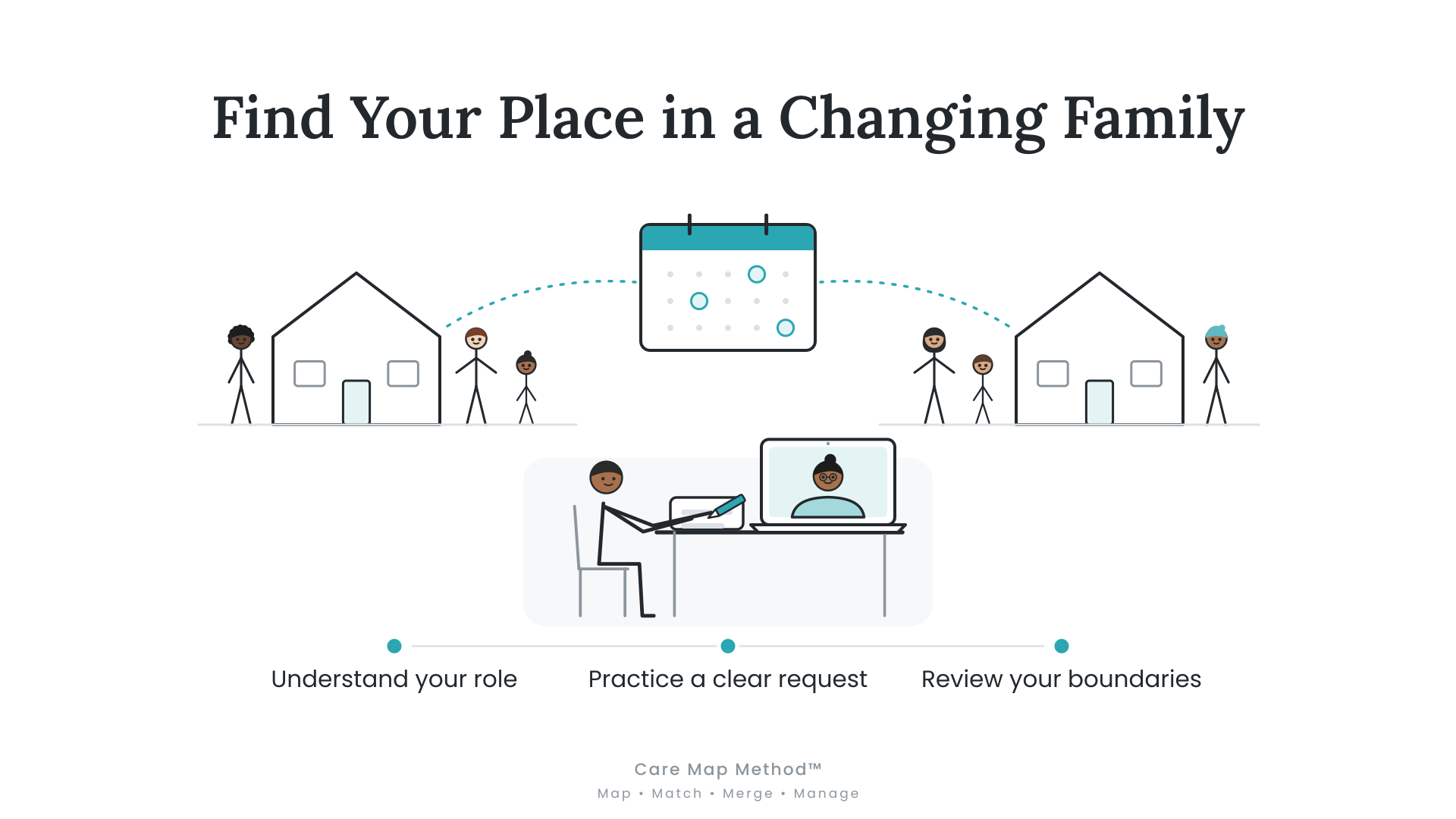
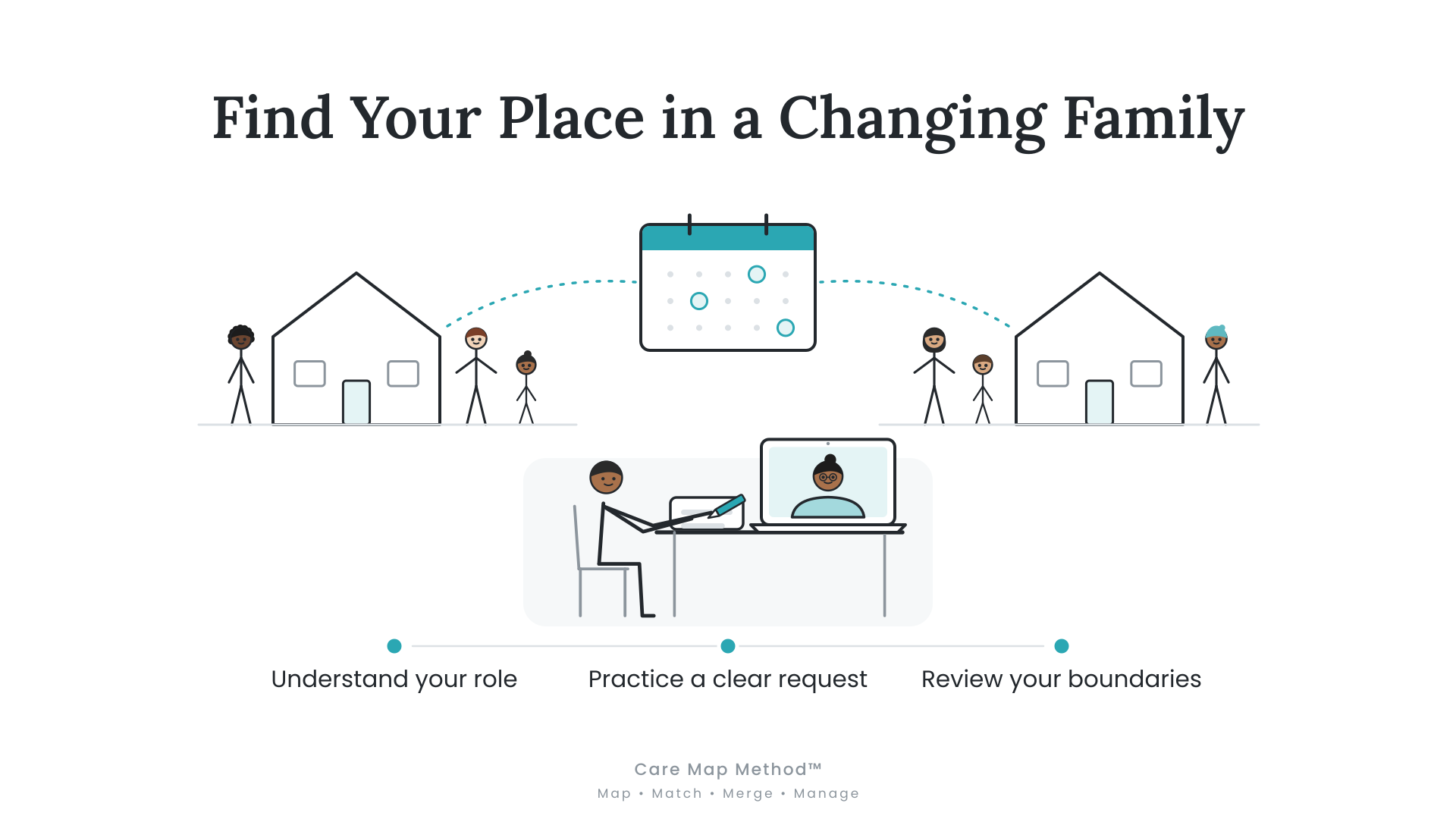
Family roles are not always discussed as clearly as daily responsibilities. You may be expected to help with transport, meals, expenses, or emotional support while feeling excluded from decisions. Another person may be carrying a different expectation entirely. We can identify what you believe your role should be, what you have agreed to, and where the mismatch occurs. That gives us a concrete starting point for discussing resentment, disappointment, and the choices available to you.
What a session might address?
Imagine that you are regularly asked to rearrange your workday for a change in the family schedule. In therapy, we might explore why you say yes, how you feel afterward, and what request you want to make. An illustrative opening could be: “I want to help, and I need us to discuss changes before we assume I am available.” We would adapt the wording to your circumstances. This example describes possible work, not a client story or promised result.
Use Map Match Merge and Manage
We Map a recurring interaction and its emotional impact, then Match treatment strategies to your needs. We Merge insight into a specific conversation or boundary and Manage the plan through review. The Care Map Method™ also considers Biological, Emotional, Social, and Environmental needs. Your rest, sense of belonging, relationships outside the household, and living arrangements can all matter. Clinical assessment helps us decide what to address and whether my approach fits the support you need.
Make one request more specific
Before an appointment, you might finish this sentence: “I feel most uncertain about my role when…” Then choose one example. You do not need to prove who is right. We can explore the event, your interpretation, and the request it points toward. Perhaps you need advance notice, time with your partner, or a clearer discussion of responsibilities. We can also consider what you want to do if a reasonable request is repeatedly dismissed.
Review what changes outside therapy
We can look at whether you communicate a preference earlier, recognize a limit before resentment grows, or recover more easily after a disagreement. Family change can also involve grief for the household you imagined. That deserves space even when you remain committed to the relationship. Therapy cannot guarantee agreement from your partner or other family members. It can help you understand your needs, assess your options, and make choices that fit your circumstances.
Insurance and booking in New Jersey
I offer individual online therapy for adults located in New Jersey. Check my Headway or Alma profile for current availability and your exact plan’s eligibility. A familiar carrier name does not establish that every plan is accepted or that every service is covered. These sessions focus on your individual treatment. If you want couples or family sessions, ask about fit, participation, and coverage separately. Questions about custody or legal responsibilities belong with a qualified legal adviser.
About Tammy Gold
I am Tamara “Tammy” Gold, MSW, LCSW, CEC, a licensed therapist, certified coach, and founder of the Care Map Method™. I earned my clinical MSW at Columbia University and have more than 20 years of direct work with families. These sessions focus on your individual mental health and treatment goals.
Take the next step
If this concern is affecting your daily life, view my profile to explore fit, availability, and insurance eligibility. You can choose a starting point without having every detail of the situation figured out.
Frequently asked questions
Can I seek help as a stepparent?
Yes. We can explore your emotional experience, role expectations, and decisions in individual therapy. We would assess your needs and agree on treatment goals together.
Does my partner need to attend?
No. This page describes individual therapy. You can work on your own distress and communication without requiring your partner or a child to participate.
Will therapy help me decide which rules to set?
We can explore what matters to you and practice discussing expectations. Household decisions also involve the relevant caregivers and any applicable arrangements; therapy does not issue a family ruling.
Is this the same as family therapy?
Individual therapy is your treatment. Family therapy involves a different participant structure and requires a separate discussion of goals, fit, and practical arrangements.
Can I use Horizon or another insurance plan?
Check current participation and benefits through my profile for your exact plan. Coverage depends on clinical requirements and eligibility; family conflict alone does not guarantee insurance coverage.
What should I bring to the first appointment?
A recent example and a sense of what feels hardest are enough to begin. We can discuss your symptoms, history, current support, and what you hope will change.
Individual Therapy for Co Parenting Stress in California
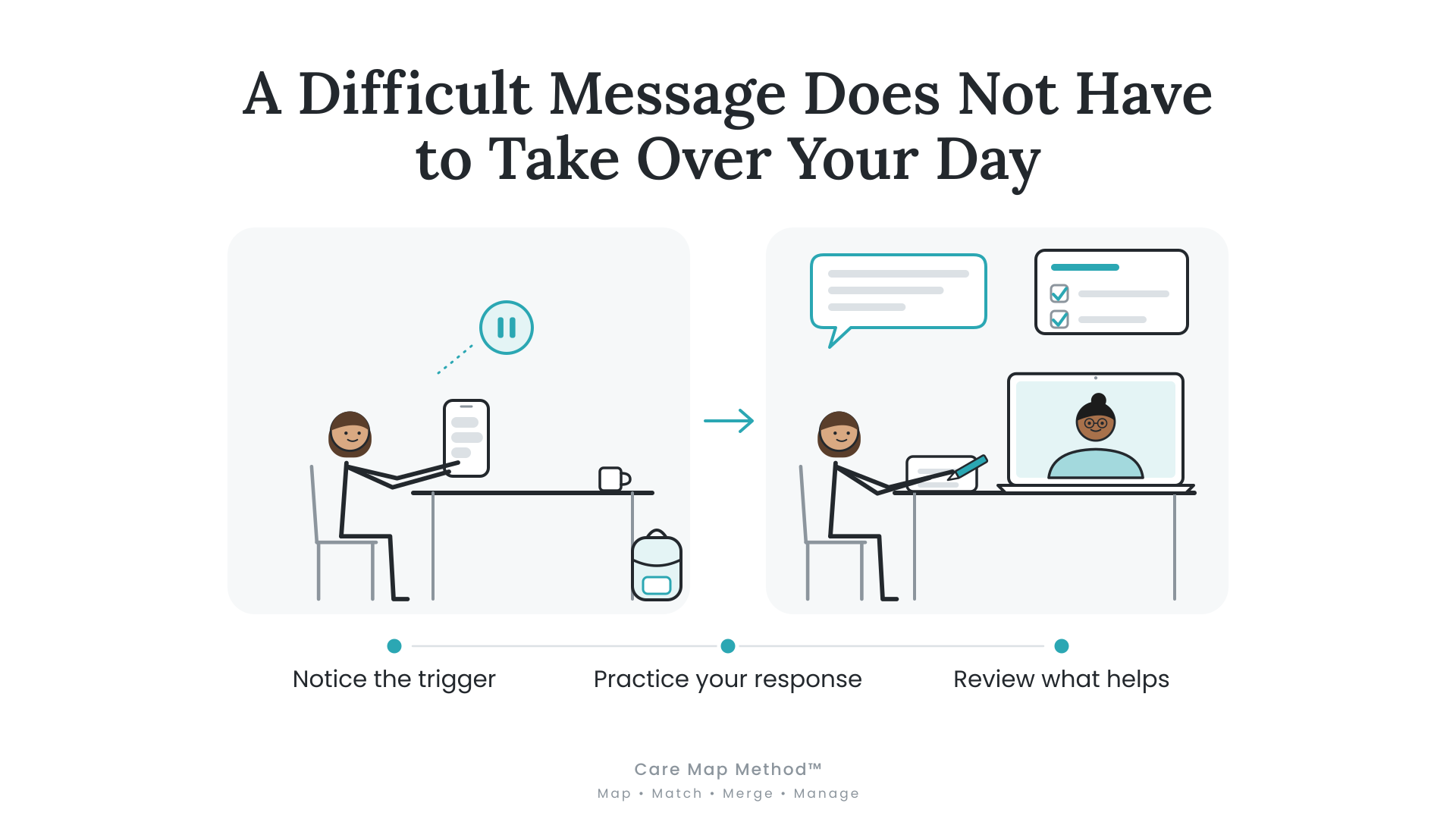
Difficult co-parenting messages taking over your day? Explore individual online therapy in California with Tammy Gold, LCSW, and check insurance eligibility.
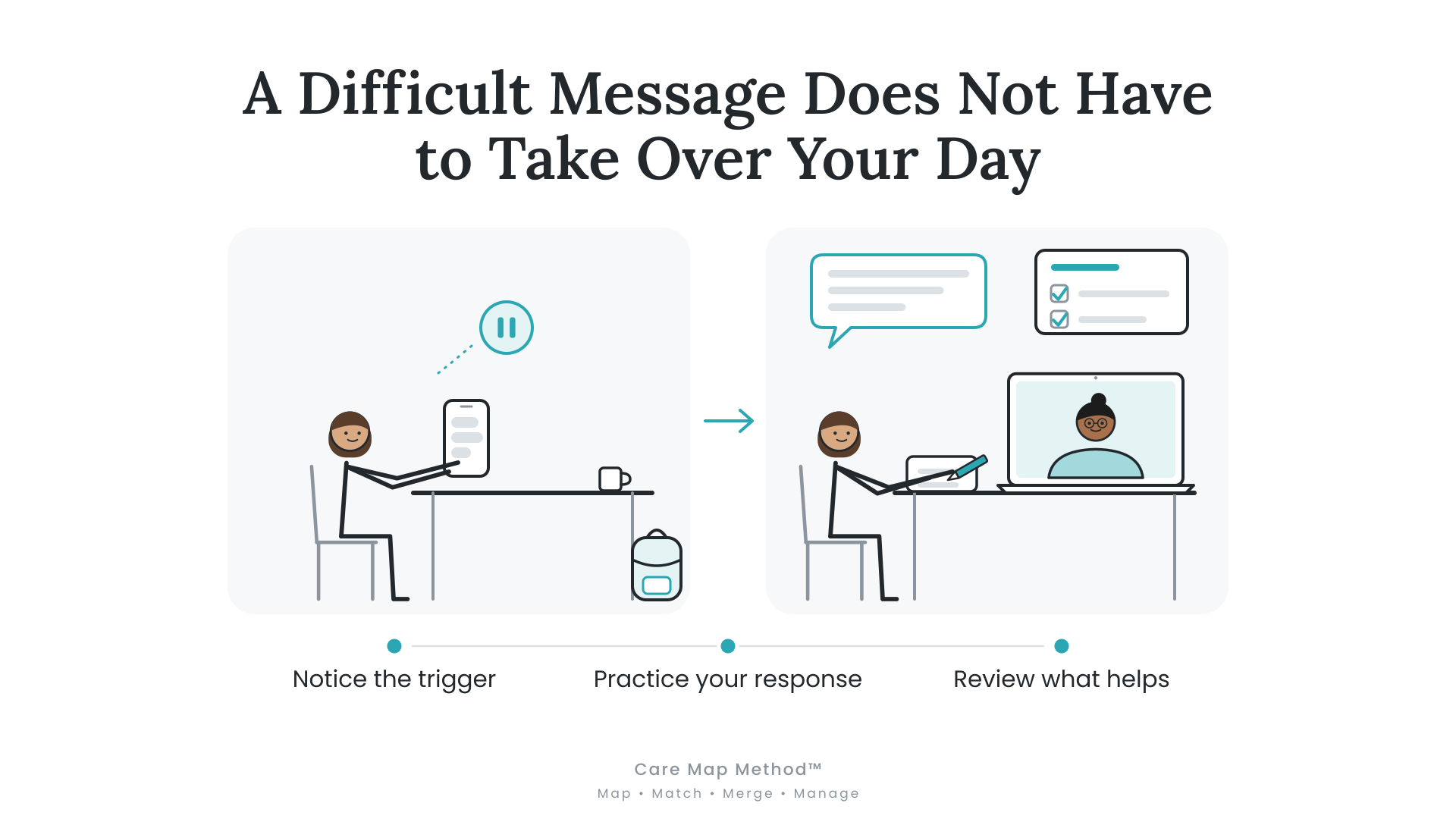
You are getting through an ordinary day when a message from your co-parent arrives. Before you have finished reading it, you are tense. You draft a response, delete it, and start again. A practical question about pickup becomes an argument in your head that follows you into work or time with your child. Individual online therapy in California can give you space to work on the emotional impact of these exchanges and how you want to respond.
Check availability and insurance through Headway
Understand the part that hurts
Co-parenting stress can involve much more than scheduling. A short message may touch a familiar fear of being blamed, ignored, or treated unfairly. You may feel pressure to explain yourself thoroughly so that nobody misunderstands you. We can examine one exchange at a time and identify the feeling, thought, and urge that follow it. Understanding that sequence can help us choose a useful treatment goal rather than trying to resolve the entire relationship in one session.
What we can work on in a session
We might start with a recent message and ask what practical information it contains, what meaning you attach to it, and what you want your reply to accomplish. We can practice language and explore what makes a pause feel difficult. An illustrative response might be: “I can confirm the pickup details by this evening.” Any timing or communication plan must fit your parenting arrangements, legal obligations, and safety. Therapy does not change a court order or replace legal advice.
Use Map Match Merge and Manage
With the Care Map Method™, we Map the exchange and its effect on you. We Match coping and communication strategies to your needs. We Merge the chosen strategy into a real situation, then Manage what happens by reviewing it together. Biological, Emotional, Social, and Environmental factors matter: exhaustion, hurt, available support, and interruptions at work can all shape your capacity. This framework organizes our work alongside clinical assessment and a treatment plan tailored to you.
Prepare one exchange for your appointment
If it feels useful, choose one recent exchange and write a brief summary in your own words. Note what you felt, what you wanted to say, and how the interaction affected the rest of your day. You do not need to bring an entire message history. We can work from the pattern you describe, discuss what felt most difficult, and choose one response to explore. The goal is to make therapy relevant to your daily experience.
What progress could look like
Progress might mean spending less time rehearsing an argument, recognizing when you need support, or making a decision with more clarity. It does not depend on your co-parent agreeing with your interpretation. We can also examine what happens after you send a reply: whether you keep checking the phone, criticize yourself, or struggle to return to another activity. If an approach is not helping, we can adjust it and reconsider what support fits.
Insurance and booking in California
I offer individual therapy for adults located in California. Use my Headway or Alma profile to check current availability, provider participation, and your exact plan. Coverage depends on clinical treatment needs and plan rules; co-parenting conflict alone does not establish eligibility. These sessions are your individual treatment. Joint sessions, mediation, and custody evaluations have different purposes and arrangements. If you are unsure which service you need, ask before booking so we can clarify fit.
About Tammy Gold
I am Tamara “Tammy” Gold, MSW, LCSW, CEC, a licensed therapist, certified coach, and founder of the Care Map Method™. I earned my clinical MSW at Columbia University and have more than 20 years of direct work with families. These sessions focus on your individual mental health and treatment goals.
Take the next step
If this concern is affecting your daily life, view my profile to explore fit, availability, and insurance eligibility. You can choose a starting point without having every detail of the situation figured out.
Frequently asked questions
Can I attend without my co-parent?
Yes. Individual therapy focuses on your symptoms, responses, and decisions. Your co-parent does not have to participate for you to seek support.
Will you help me write a message?
When relevant to your treatment goals, we can practice wording and explore your response to the exchange. I do not act as your attorney or provide court-directed communication advice.
Is this co-parenting mediation?
This page describes individual psychotherapy. Mediation involves a different service and agreement; a therapy appointment should not be assumed to include it.
Can I use insurance?
Check your exact plan through my profile before booking. Coverage and your cost depend on provider participation, eligibility, and whether the treatment meets the plan’s clinical requirements.
How many appointments will I need?
We can discuss an initial plan after assessment and review it as we learn what is helping. There is no single number of sessions that fits everyone.
What if the communication feels threatening?
Tell me when discussing fit so we can consider your safety and appropriate support. A routine communication exercise may not fit a situation involving threats or coercion.
Book Online Therapy With Tammy Gold Through Alma or Headway
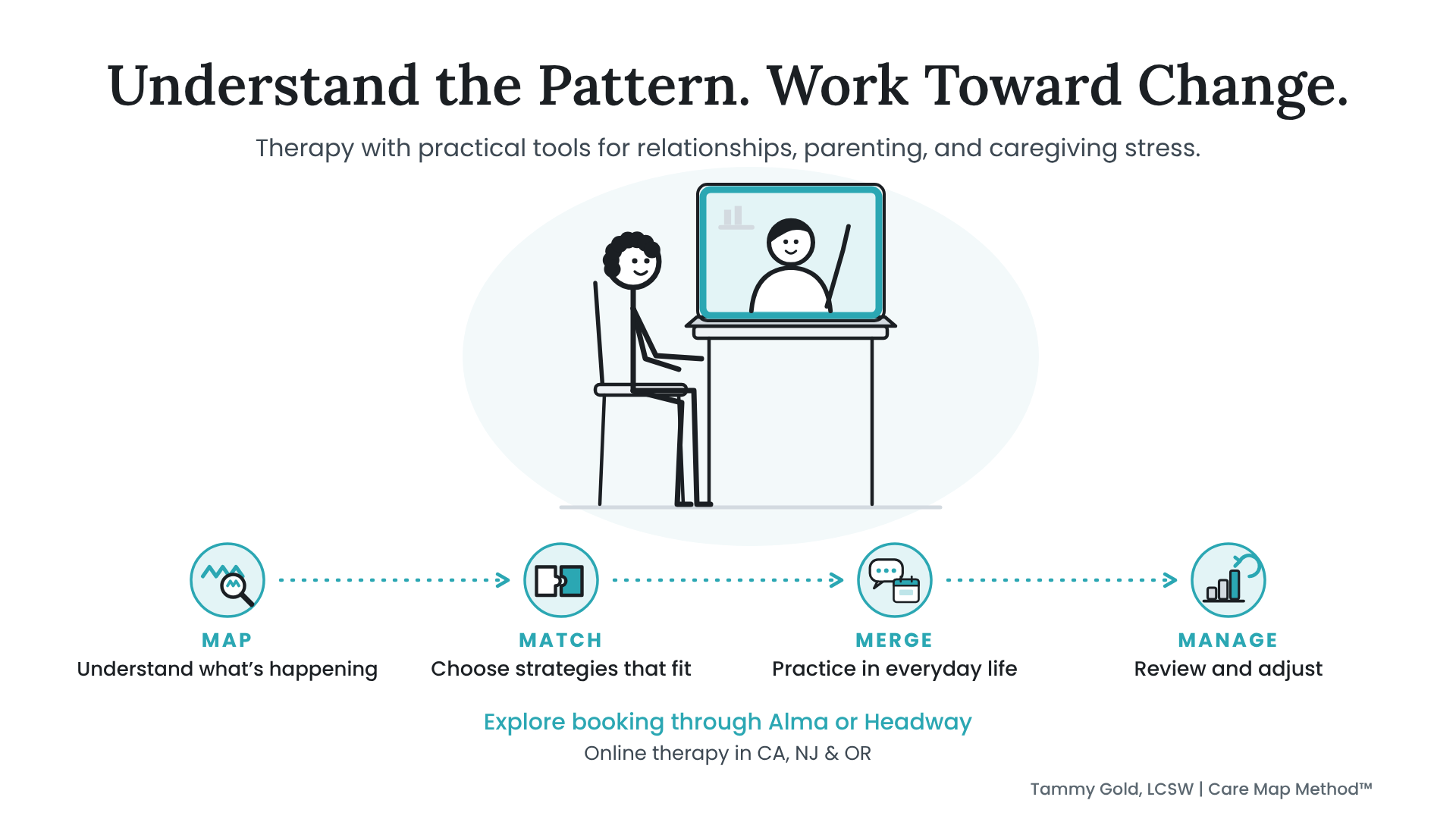
Find Tammy Gold, LCSW on Alma or Headway for online therapy in California, New Jersey, and Oregon. Review fit, insurance eligibility, and booking options.
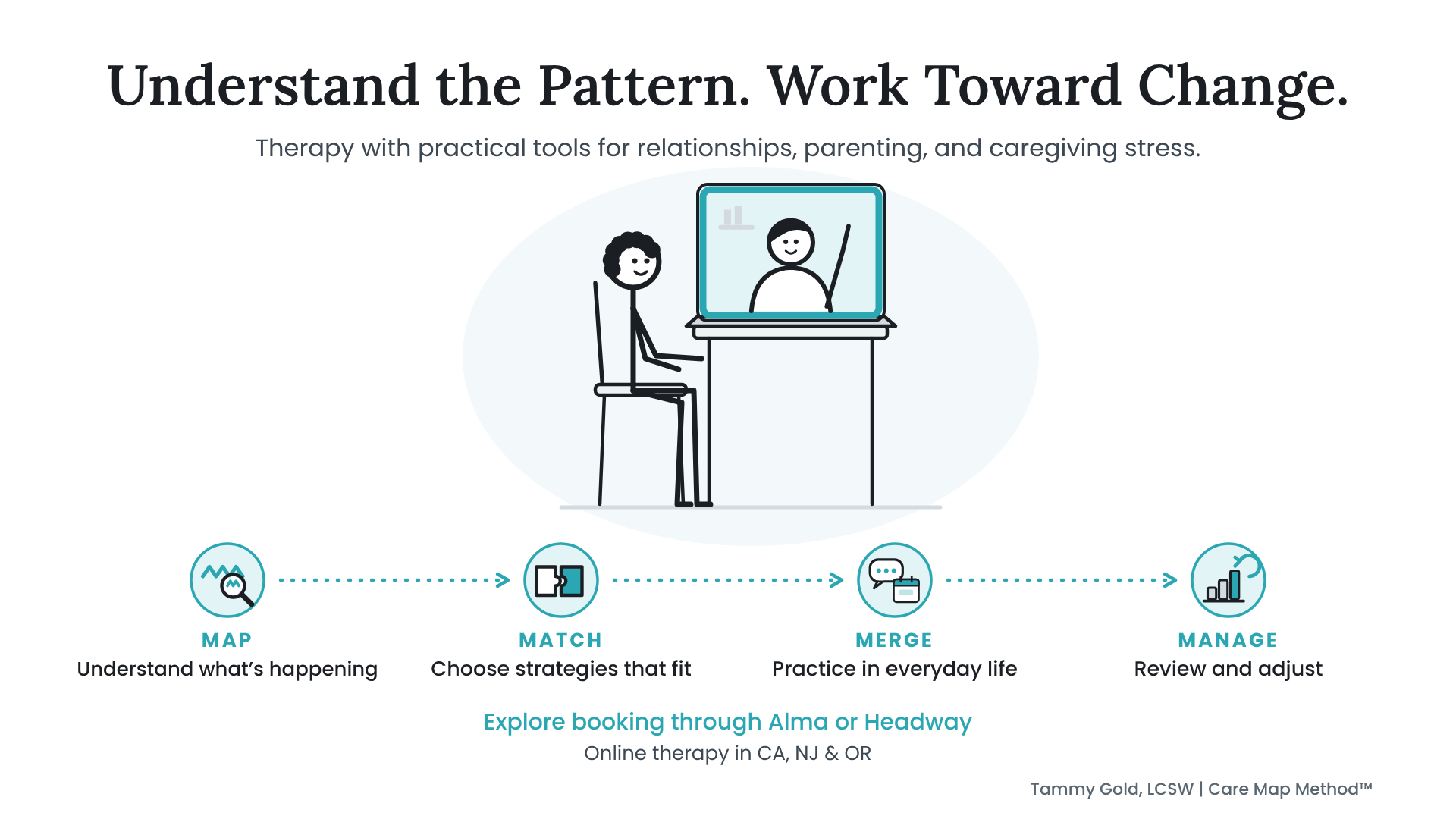
Finding a therapist should not require guessing which link to use. I am Tammy Gold, LCSW, and I offer online therapy for adults located in California, New Jersey, and Oregon. You can view my profiles on Alma and Headway to explore fit and insurance options.
What we can work on
My work focuses on relationship stress, parenting strain, divorce adjustment, family conflict, caregiver distress, and the emotional impact of work and life transitions. In individual therapy, we can explore what you are experiencing, assess treatment needs, and turn your goals into concrete steps. Couples services require a separate discussion of fit and coverage.
Choose a platform that fits your plan
Open my Alma or Headway profile and select the state where you will be during sessions. Review the insurance options for your exact plan. A carrier appearing on a platform does not mean every plan or every provider participates. If both platforms appear to support your plan, confirm the appropriate booking route before scheduling the same care in two places.
Know what to check before booking
Review current availability, estimated cost, deductible or copay information, and whether the service you want is covered. Have your insurance card ready for the platform’s secure intake process. For a general booking question, you can email tammy@caremapmethod.com; please use the platform’s secure process for insurance details and sensitive health information.
A practical approach to therapy
The Care Map Method™ gives us a structure to Map what is happening, Match treatment strategies to your needs, Merge insight into everyday conversations and routines, and Manage progress. It considers Biological, Emotional, Social, and Environmental needs alongside clinical assessment and your treatment goals.
What your first therapy session can include
You do not need a polished explanation of why you are seeking help. We can discuss the situation that brought you here, your emotional symptoms, relevant history, and the changes you would like to see. You might want help with a difficult family relationship, adjusting after divorce, or feeling overwhelmed by caregiving. We can consider whether my approach fits your needs and agree on an initial focus. The assessment also helps determine whether insurance-funded treatment is appropriate.
What practical work can look like
For relationship stress, we might examine one recurring interaction and practice language for a clearer request. For caregiver distress, we might explore guilt around a limit and prepare a conversation about support. For divorce adjustment, we might work on what happens emotionally before and after contact with a former partner. These are examples of possible work, not promised results. Your treatment plan should reflect your circumstances, clinical needs, and the pace at which you feel able to work.
Prepare your questions before choosing a booking link
Write down where you will be physically located during sessions, the exact name of your insurance plan, and whether you want individual therapy or another service. Review the relevant profile and its current scheduling options. If the platform cannot confirm your plan, ask for clarification before treating an estimate as settled. For general booking questions, email tammy@caremapmethod.com or call 310-721-1584. Share member numbers and sensitive health information through the secure intake process rather than ordinary email.
How we decide what is helping
We can revisit your goals and ask what is changing outside sessions. Perhaps you are making a decision with more clarity, recovering more easily after conflict, or recognizing when you need support. If an approach does not fit, we can discuss what to adjust. The structure of Map, Match, Merge, and Manage helps organize that conversation, while clinical assessment guides the treatment. You are welcome to ask how an exercise connects to your goals.
About Tammy Gold
I am Tamara “Tammy” Gold, MSW, LCSW, CEC, a licensed therapist and certified coach with a clinical MSW from Columbia University. I founded the Care Map Method™ and have more than 20 years of direct work with families. These sessions focus on your individual mental health and treatment goals.
Take the next step
If this concern is affecting your daily life, view my profile to explore fit and current booking options. Check your exact plan and estimated costs before scheduling. You can also read the online therapy booking guide for help choosing a platform.
Check insurance and booking through Headway
Frequently asked questions
Is Alma or Headway my therapist?
I provide your therapy. Alma and Headway support provider discovery and administrative processes such as insurance verification and billing.
Which platform costs less?
There is no single answer for every client. Your exact plan, benefits, and provider participation determine the estimate and final responsibility. Check the relevant platform before booking.
Can I use these links while visiting another state?
Please confirm your physical location before scheduling. This page offers care for clients located in California, New Jersey, or Oregon; another state requires separate confirmation of authorization.
Can I book couples therapy using the same insurance assumptions?
Please ask about joint-session availability and coverage separately. These pages describe individual psychotherapy; couples services may have different clinical, billing, and coverage requirements.
Do I need to book on both platforms?
Please confirm one appropriate booking route for your care. If you already have an appointment or existing treatment relationship, clarify any platform change before creating another booking.
What should I prepare for an online session?
Plan to join from a private place in an authorized state with a dependable connection. Review the intake instructions and ask about any technology or accessibility needs before your appointment.
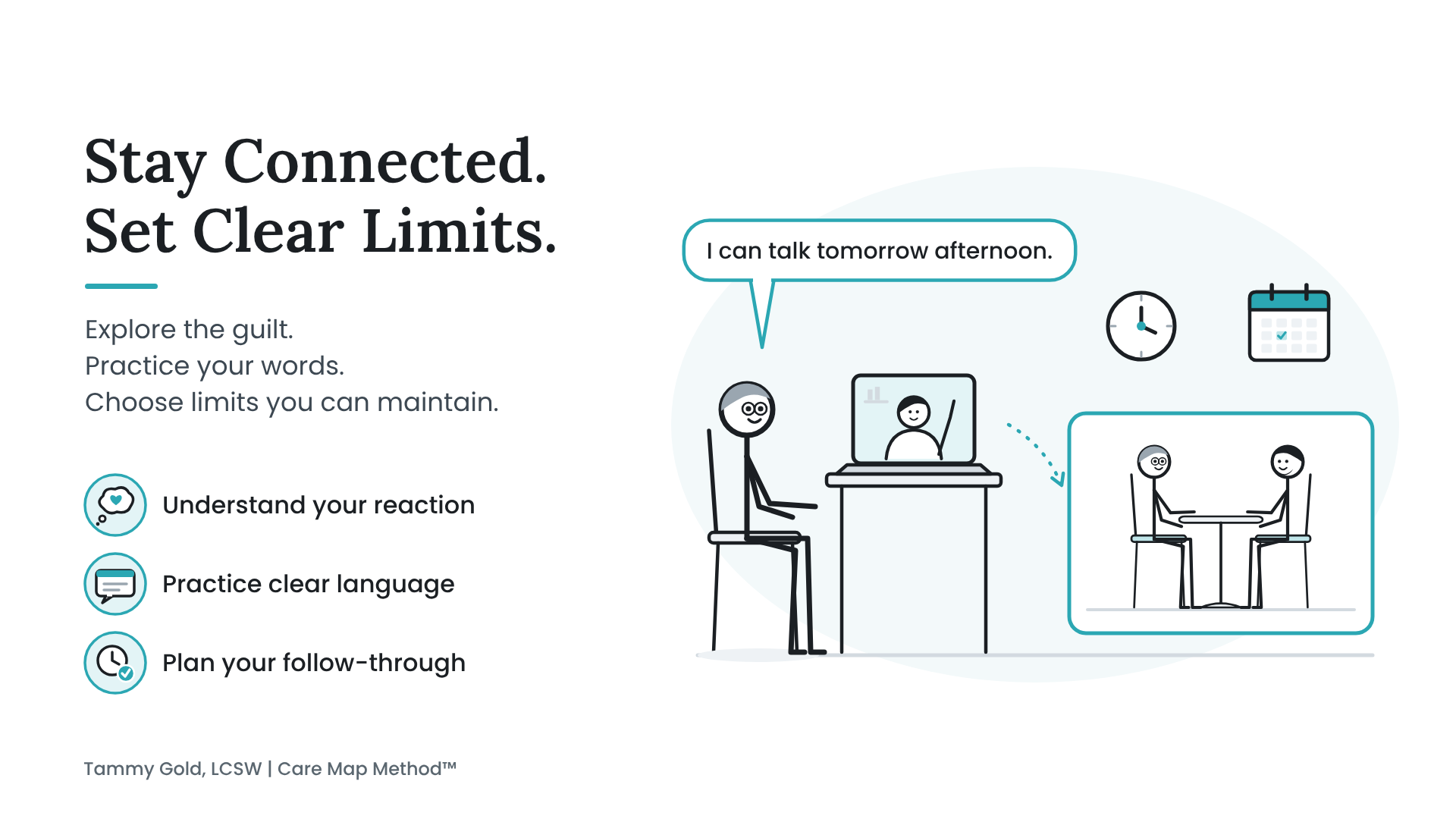
Therapy for Boundaries With Adult Children in Oregon
Online therapy for Oregon parents struggling with guilt, conflict, or boundaries with adult children. Check Regence BCBS eligibility through Headway.
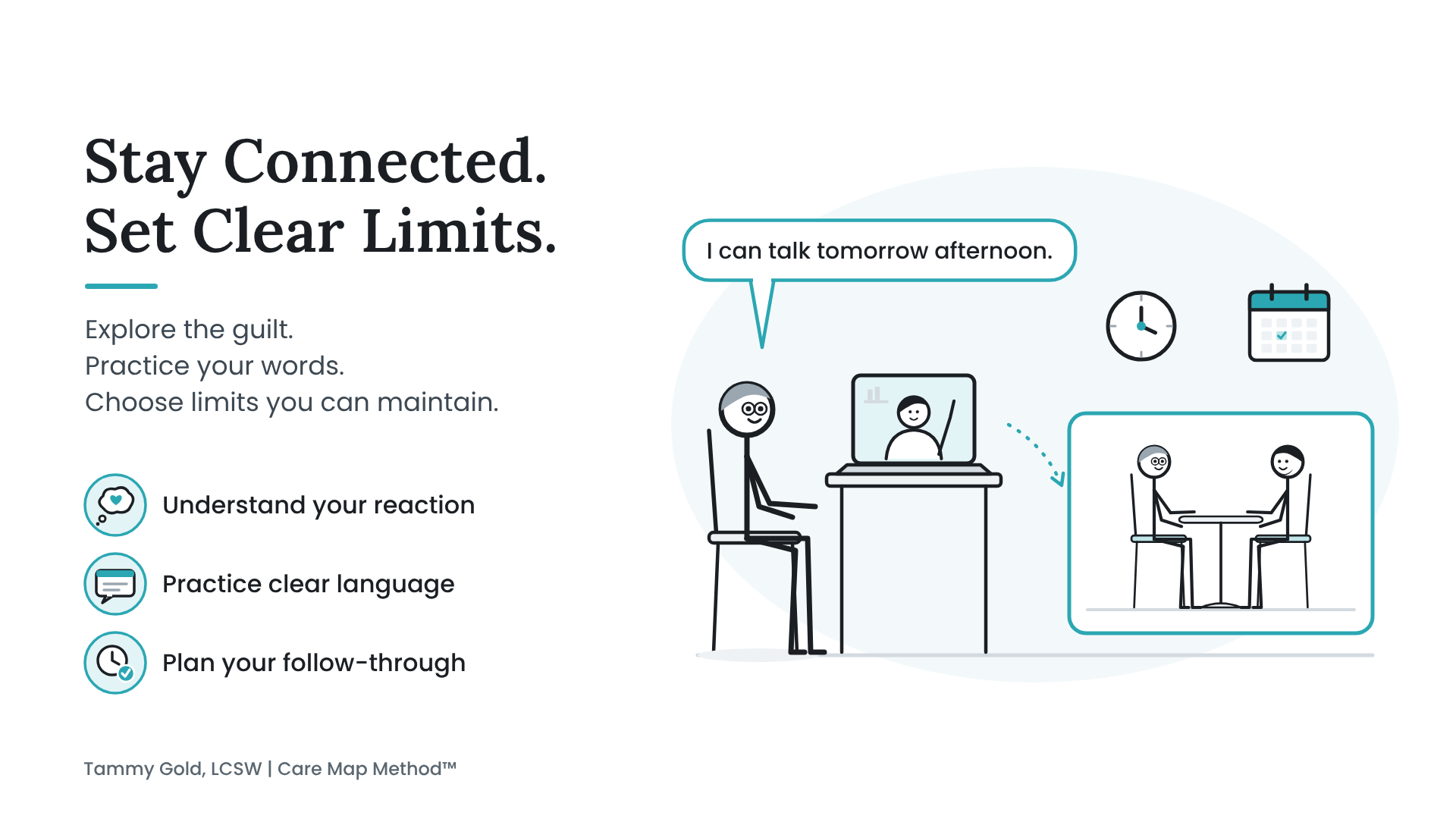
You want to stay close to your adult child, but every call seems to bring another crisis, request, or disagreement. You may be afraid that setting a limit will cost you the relationship.
I am Tammy Gold, LCSW. I offer individual online therapy for adults located in Oregon. Regence BlueCross BlueShield of Oregon appears on my Headway profile; please check your exact plan and eligibility before booking.
Check insurance and booking through Headway
Love and availability are different questions
Individual therapy can help you explore the fear, guilt, sadness, or resentment around family boundaries. We can look at what happens before you agree to something, how you feel afterward, and which patterns leave you exhausted. The goal is to make thoughtful choices about your own behavior while respecting that your adult child makes theirs.
Choose a limit you can maintain
A boundary is more usable when it states what you will do. Instead of repeatedly asking someone to stop calling late at night, you might decide: “I can talk tomorrow afternoon. I am not available for this conversation tonight.” We can practice the wording, prepare for your emotional reaction, and reconsider the plan when circumstances genuinely change.
Understand the family pattern
Using the Care Map Method™, we Map the interaction and its effects, Match your needs with coping skills and realistic limits, Merge those limits into communication, and Manage what follows. Biological, Emotional, Social, and Environmental factors help us understand your capacity and the pressures on the relationship without reducing either person to a label.
What we would explore in your first session
We can begin with a recent request or conversation that left you upset. What did your adult child ask for? What did you agree to? What did you fear would happen if you said no? We would discuss your symptoms, relevant history, and the effect on your daily life. Your goal might be responding more thoughtfully to financial requests, reducing arguments, or deciding when you are available to talk. You do not need your adult child’s agreement to work on your own responses.
An example of setting a financial limit
Suppose you have agreed to several expenses and now feel anxious whenever your phone rings. We can explore what you can realistically offer and practice wording that states the limit: “I can contribute this amount toward this expense. I cannot take on the additional payment.” This is an illustrative exercise, not a client story or financial advice. We would also discuss what happens after you speak, including guilt, repeated requests, or the temptation to change your answer just to end the discomfort.
Prepare for the feeling after the boundary
A useful boundary plan includes what you will do when the conversation ends. You might wait before replying to another request, write down what made your limit necessary, or bring the exchange to your next session. Choose an action that fits the situation and your responsibilities. We can distinguish an ordinary disagreement from a circumstance that needs urgent attention. The aim is to help you stay thoughtful about your choices when emotions make immediate agreement feel easier.
How we review progress
We can review whether your limits are clearer, whether you follow through more consistently, and whether you spend less time caught in the same argument. We can also explore grief about how the relationship has changed. Staying connected may involve a different level of contact or support than you once imagined. Your treatment goals can reflect both your wish for closeness and your need for a sustainable life.
About Tammy Gold
I am Tamara “Tammy” Gold, MSW, LCSW, CEC, a licensed therapist and certified coach with a clinical MSW from Columbia University. I founded the Care Map Method™ and have more than 20 years of direct work with families. These sessions focus on your individual mental health and treatment goals.
Take the next step
If this concern is affecting your daily life, view my profile to explore fit and current booking options. Check your exact plan and estimated costs before scheduling. You can also read the online therapy booking guide for help choosing a platform.
Check insurance and book through Headway
Read the online therapy booking guide
Frequently asked questions
Can I attend without my adult child?
Yes. Individual therapy focuses on your mental health and choices. Your adult child does not need to participate.
Does Regence BCBS Oregon cover this therapy?
Coverage depends on your specific plan, provider eligibility, and clinical requirements. Family conflict alone does not guarantee coverage; check your benefits through Headway.
Will you decide who is right?
We can examine the interaction, its impact on you, and your options. The work focuses on understanding and change rather than issuing a verdict about a family member.
Can I seek help if we are currently estranged?
Yes. We can explore grief, uncertainty, and your choices around contact. Individual therapy cannot promise reconciliation, but it can support you as you consider what is possible.
Does a boundary mean ending the relationship?
A boundary can address time, money, communication, or what you will participate in. We can explore a range of options and what each would mean in your circumstances.
Can I change a boundary later?
Yes. We can review what changed and whether a different limit makes sense. A thoughtful revision can reflect new information, while still taking your needs seriously.
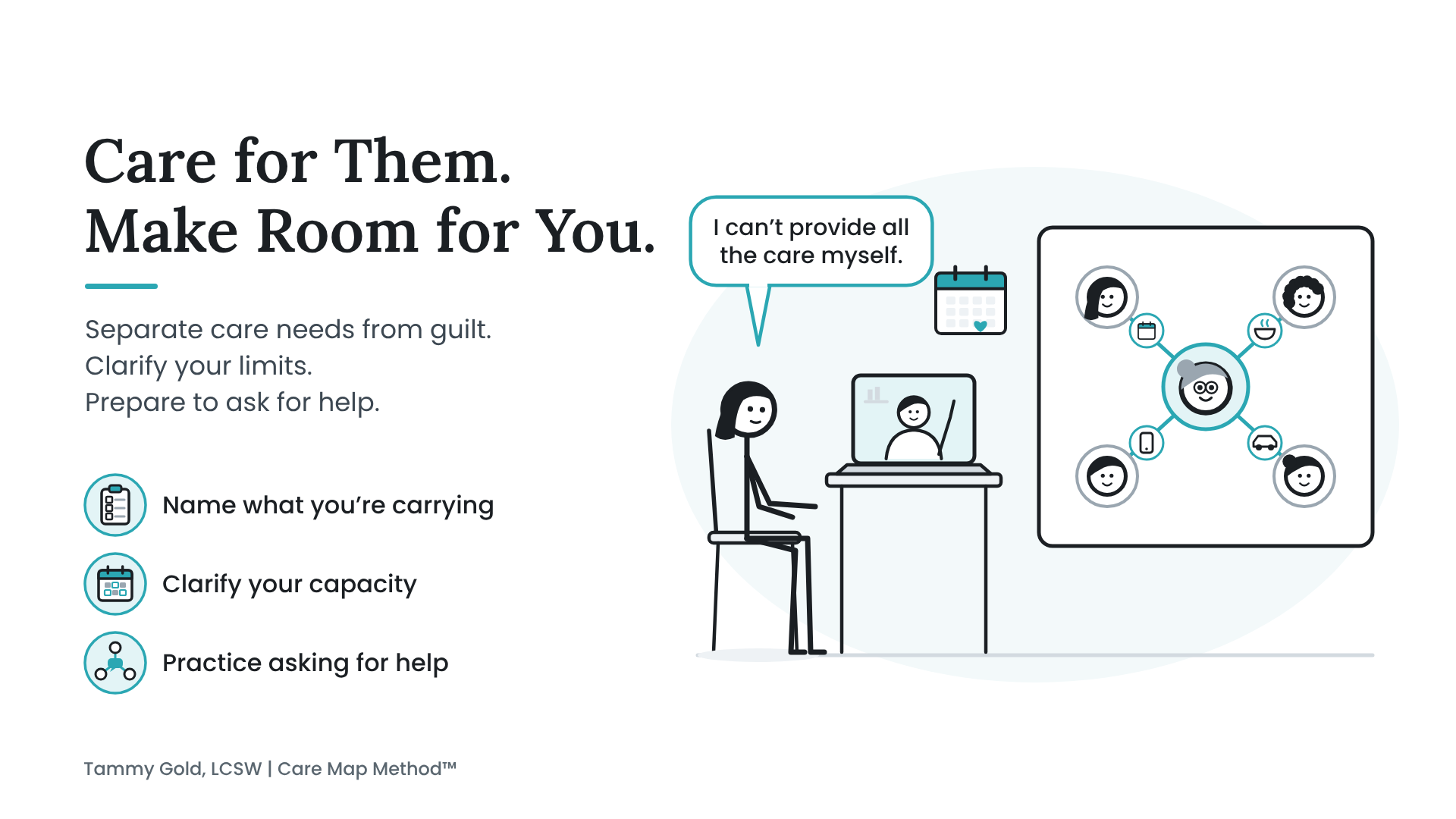
Therapy for Caregiver Guilt in Oregon
Feeling guilty about limits or senior-care decisions? Explore individual online therapy in Oregon and check Providence Health Plan eligibility through Headway.
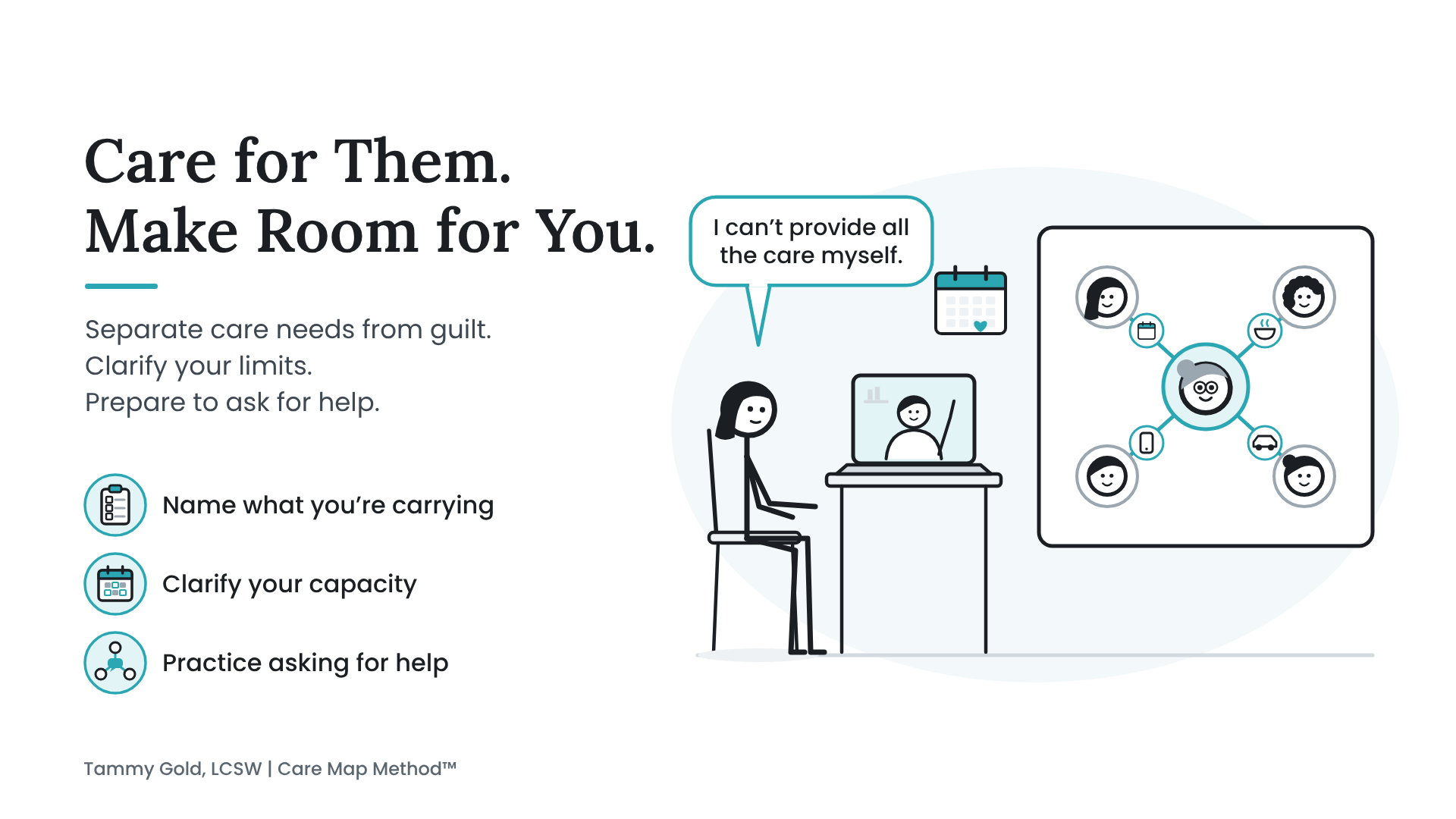
You know you cannot do everything your parent needs. Still, saying no, hiring help, or considering a different care setting can feel like a betrayal. You may be judging yourself for limits that are necessary.
I am Tammy Gold, LCSW. I offer individual online therapy for adults located in Oregon. Providence Health Plan appears on my Headway profile; please check your exact plan and eligibility before booking.
Check insurance and booking through Headway
Separate the care need from the guilt
Guilt can sound like a clear instruction: “A good daughter would do more.” In therapy, we can slow that thought down. What does your parent need? What can you provide safely and sustainably? What support is missing? We can explore the emotional distress around caregiving without assuming every request must become your responsibility.
Make room for a difficult decision
You may be balancing your parent’s wishes with your health, children, work, and finances. We can help you prepare conversations, tolerate disagreement, and recognize the grief that sometimes comes with changing a care arrangement. A useful starting point is: “I want you to have reliable care, and I cannot provide all of that care myself.”
Use the map to make your capacity visible
The Care Map Method™ helps us Map Biological, Emotional, Social, and Environmental needs for you and the care situation, Match those needs with realistic support, Merge clearer communication into the plan, and Manage your emotional response as circumstances change. Psychotherapy addresses your mental health; medical and care-placement decisions may also require other professionals.
What we would explore in your first session
We can start with the decision or request you keep replaying. Perhaps your parent wants daily visits, a sibling expects you to coordinate everything, or you feel guilty about considering assisted living. We would discuss your emotional symptoms, relevant history, and the effect of caregiving on your own life. It helps to understand your actual responsibilities and support network before deciding what to work on. You can attend even if other family members disagree about the care plan.
An example of separating love from capacity
Imagine that you are handling appointments and evening calls while also managing work and your household. We might list the responsibilities you carry and identify what happens when you reach your limit. A conversation could begin: “I can coordinate this appointment, but I cannot also provide every evening visit. We need another arrangement for that.” This is an illustrative exercise, not a client story. We would also work on the guilt or fear that appears after you state the limit.
Try a brief responsibility inventory
On a piece of paper, list what you currently do, how often it happens, and which tasks require another person’s help or professional input. Include the time spent worrying and organizing, not only hands-on care. Then circle the responsibility that feels least sustainable. Bring the list to therapy so we can explore the emotional pressure around it and identify a realistic next conversation. A therapist can support your decision-making without replacing your parent’s medical team or a qualified care coordinator.
How we review progress
We can look at whether you recognize overload earlier, accept appropriate help, or feel more able to rest without immediately criticizing yourself. We can also make room for sadness about your parent’s changing needs. A revised care arrangement may still feel painful even when it is necessary. Therapy gives you a place to process that experience and revisit boundaries as circumstances change.
About Tammy Gold
I am Tamara “Tammy” Gold, MSW, LCSW, CEC, a licensed therapist and certified coach with a clinical MSW from Columbia University. I founded the Care Map Method™ and have more than 20 years of direct work with families. These sessions focus on your individual mental health and treatment goals.
Take the next step
If this concern is affecting your daily life, view my profile to explore fit and current booking options. Check your exact plan and estimated costs before scheduling. You can also read the online therapy booking guide for help choosing a platform.
Check insurance and booking through Headway
Read the online therapy booking guide
Frequently asked questions
Can therapy help if my parent refuses outside help?
We can work on your distress, boundaries, communication, and decisions even when your parent does not agree with you.
Does Providence cover caregiver support?
Coverage depends on your plan and the clinical purpose of treatment. Individual psychotherapy for a caregiver is different from nonclinical care coordination or placement services. Verify benefits through Headway.
Do you choose a facility or arrange staffing during therapy?
This page offers individual psychotherapy. Care selection, staffing, and coaching are separate services and should not be assumed to be covered by therapy insurance.
Is it okay to seek therapy if my parent is the person who is ill?
Yes. The effect of caregiving on your own mental health deserves attention. We would assess your symptoms and treatment needs rather than assume your parent must attend.
Can we discuss conflict with siblings about care?
Yes. We can explore your distress and responses, practice a clearer request, and identify responsibilities you can realistically take on. Individual therapy does not require your siblings to participate.
Will therapy make the guilt disappear?
No particular outcome is guaranteed. We can work on understanding the guilt, responding to it more thoughtfully, and making decisions that take your own capacity into account.
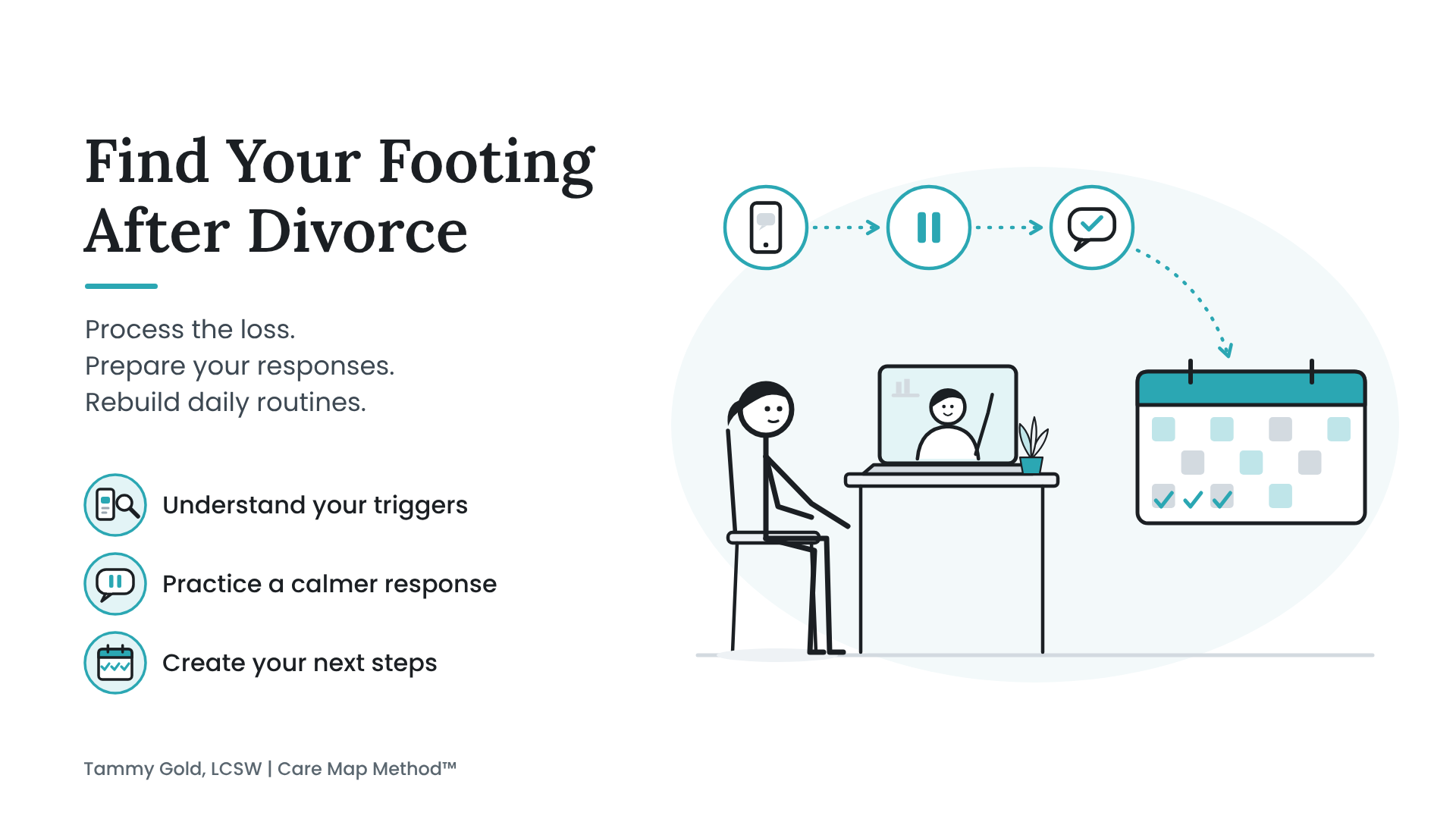
Therapy for Divorce Adjustment in New Jersey
Online therapy with Tammy Gold, LCSW for the emotional strain of separation and divorce in New Jersey. Check Horizon plan eligibility through Headway.
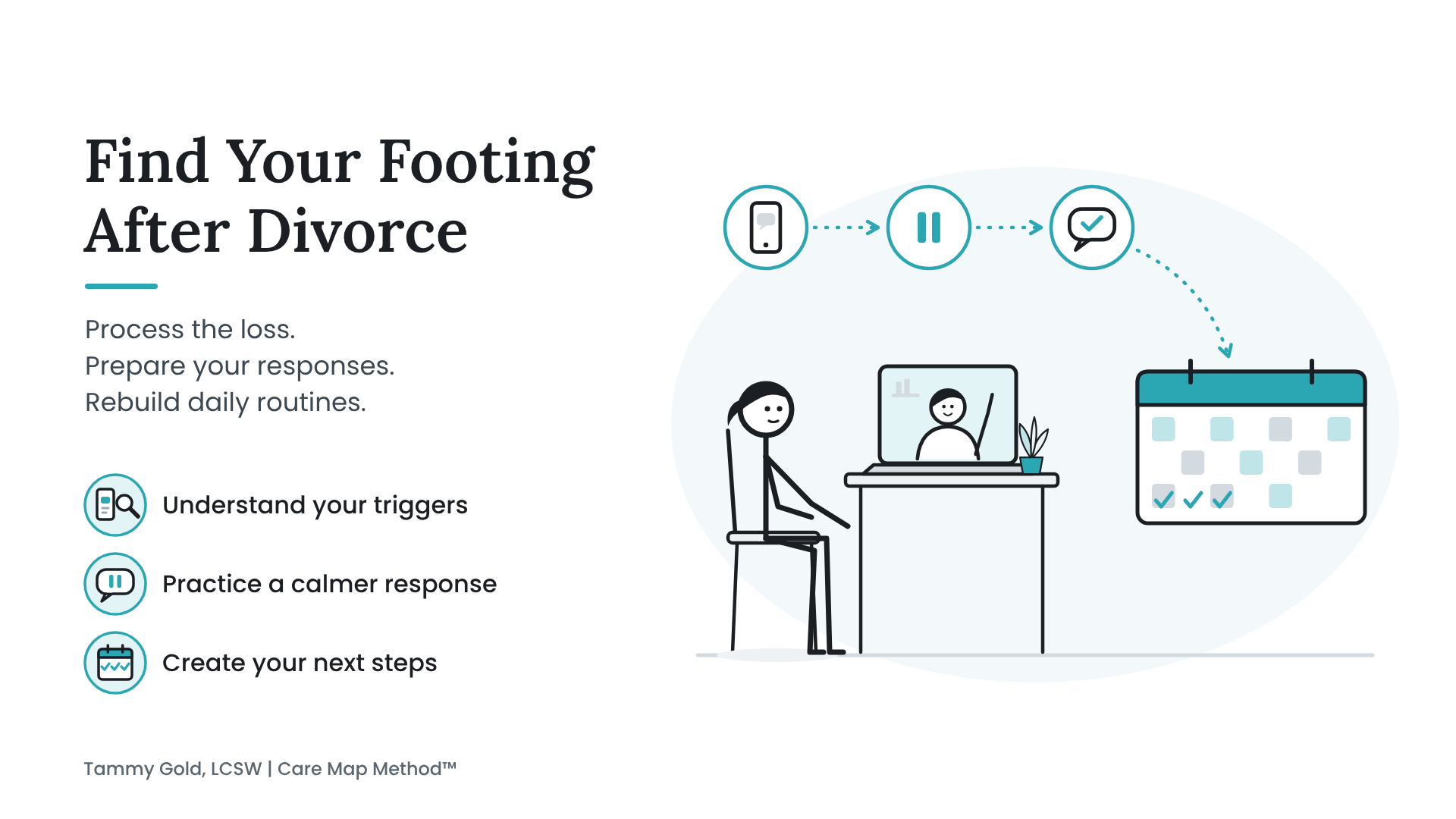
The paperwork may be moving forward while your feelings are still catching up. Separation can change your home, routines, finances, friendships, and sense of who you are. You may feel relief one day and grief the next.
I am Tammy Gold, LCSW. I offer individual online therapy for adults located in New Jersey. Horizon Blue Cross and Blue Shield of New Jersey appears on my Headway profile; please check your exact plan and eligibility before booking.
Check insurance and booking through Headway
You do not need to have your feelings sorted out
Individual therapy offers room to process loss, anger, uncertainty, and the pressure to make decisions while emotionally stretched. We can identify what is affecting your sleep, concentration, parenting, and relationships, then choose treatment goals that fit your current circumstances.
Create space between the message and your response
An unexpected text from a former partner can take over the rest of your day. We can examine what the message triggers, distinguish a practical question from a familiar conflict, and plan how you want to respond. Sometimes the work is a short reply. Sometimes it is learning to pause while you settle enough to think clearly.
Build a life around your current needs
Using the Care Map Method™, we Map the strain and the changes you are facing, Match needs with emotional support and practical coping strategies, Merge those strategies into daily routines, and Manage setbacks. We consider Biological, Emotional, Social, and Environmental needs as you rebuild. Therapy can support your emotional adjustment; legal and financial questions belong with qualified advisers.
What we would explore in your first session
You can begin wherever the separation feels most present: the quiet house, exchanges with a former partner, a changed parenting schedule, or the fear of starting over. We would discuss your symptoms, relevant history, current supports, and the decisions that feel emotionally difficult. You do not need a complete timeline ready. We can choose one immediate treatment goal, such as settling after a difficult message or rebuilding a routine that helps you get through the week.
An example of a calmer communication plan
Suppose a message about a pickup time includes a personal accusation. In therapy, we might separate the scheduling question from the part that draws you toward an argument. We can practice a reply that addresses the practical issue, then discuss what you need after sending it. This is an illustrative exercise rather than a client story. Any communication plan must fit your safety and existing arrangements; questions about court orders or legal obligations need your attorney’s guidance.
Build one dependable routine
When much of life feels unsettled, a small routine can give the day a clearer shape. Choose one manageable action, such as eating lunch away from divorce paperwork, arranging a regular check-in with someone supportive, or setting aside a defined period for administrative tasks. We can discuss why that action matters, what might get in the way, and how to make it realistic. The purpose is to create some room for your needs while you process the larger change.
How we review progress
We can notice whether difficult contact takes over less of your day, whether you feel more able to concentrate, or whether you are reconnecting with people and activities you value. Grief may return around anniversaries, family events, or changes in parenting time. That gives us something specific to work through. Your goals can change as the practical circumstances of the divorce change.
About Tammy Gold
I am Tamara “Tammy” Gold, MSW, LCSW, CEC, a licensed therapist and certified coach with a clinical MSW from Columbia University. I founded the Care Map Method™ and have more than 20 years of direct work with families. These sessions focus on your individual mental health and treatment goals.
Take the next step
If this concern is affecting your daily life, view my profile to explore fit and current booking options. Check your exact plan and estimated costs before scheduling. You can also read the online therapy booking guide for help choosing a platform.
Check insurance and booking through Headway
Read the online therapy booking guide
Frequently asked questions
Do I need a diagnosis before contacting you?
You do not need to diagnose yourself. An initial clinical assessment helps determine treatment needs and whether insurance-funded care is appropriate.
Can I use Horizon insurance?
Horizon appears on my Headway profile, but acceptance and cost depend on your specific plan and eligibility. Check your benefits before scheduling.
Can you mediate my divorce or write a custody evaluation?
This service is individual psychotherapy for emotional adjustment. It does not include legal mediation, custody evaluation, or legal advice.
Can I start before the divorce is final?
Yes. Separation and the period before a final agreement can bring distress worth addressing. Treatment focuses on your mental health and adjustment at your current stage.
Can we work on co-parenting stress in individual therapy?
We can explore your emotional responses, communication, and boundaries around co-parenting. These sessions are your individual treatment; joint work and legal questions require separate arrangements.
Will you tell me whether to reconcile?
We can explore your feelings, needs, and the consequences of different choices. The decision is yours, and therapy can help you think it through with more clarity.
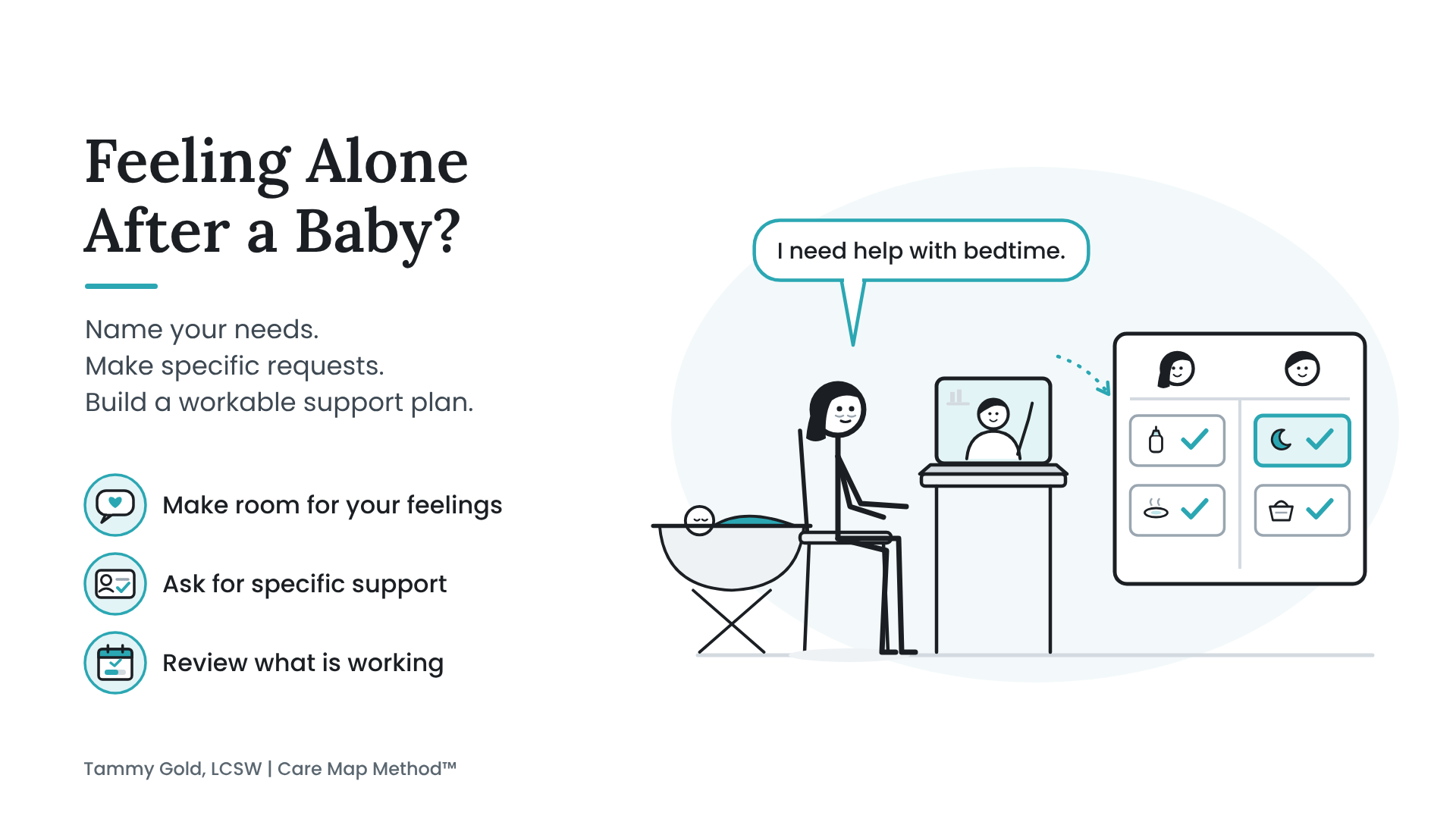
Individual Therapy for Relationship Stress After a Baby in California
Feeling disconnected or resentful after a baby? Explore individual online therapy in California and check Blue Shield of California benefits through Headway.
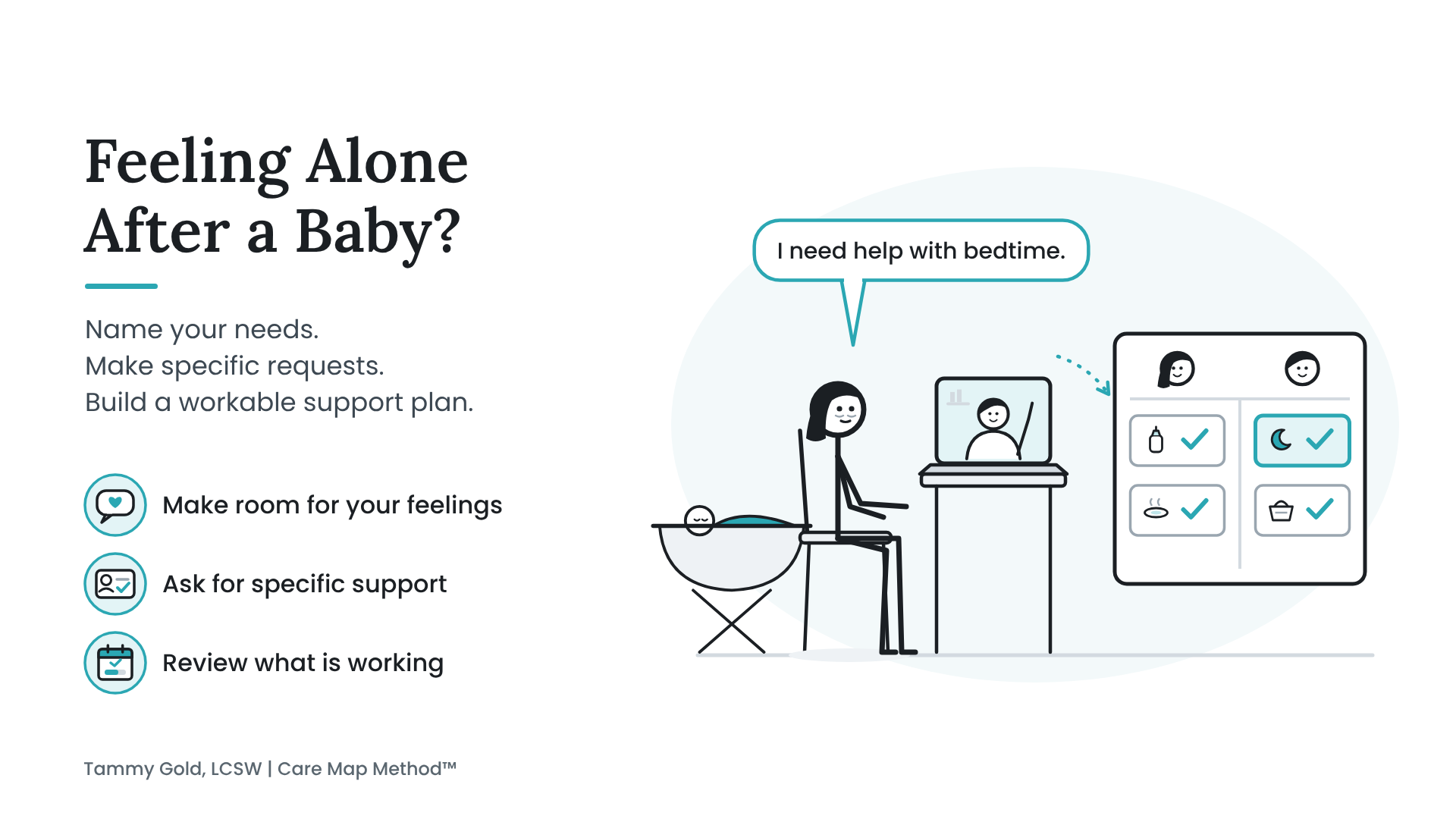
Illustration of new parents discussing support and shared responsibilities after a baby.
You expected life to change after a baby. You may not have expected to feel so alone beside your partner. Small disagreements about feeding, chores, visitors, or sleep can become arguments about whether you matter.
I am Tammy Gold, LCSW. I offer individual online therapy for adults located in California. Blue Shield of California appears on my Headway profile; please check your exact plan and eligibility before booking.
Check insurance and book through Headway
Make room for your own experience
You can love your baby and feel angry, lonely, or overwhelmed. Therapy gives you space to talk about changes in your relationship and identity without having to reassure everyone else first. We can assess your emotional symptoms and how they are affecting daily life, then decide what kind of support fits.
Move from a running argument to a specific request
“You never help” may express a real hurt, but it does not tell the other person what needs to change tonight. We can work on naming the task, the responsibility, and the follow-through you need. A starting sentence might be: “I need you to handle the bedtime routine on these two nights, including getting everything ready.” We can also explore what it means if clear requests repeatedly go unanswered.
Look at the whole picture
The Care Map Method™ helps us Map the emotional and practical strain, Match needs with realistic support, Merge that support into routines and conversations, and Manage adjustments. Biological, Emotional, Social, and Environmental needs all matter: your rest, feelings, support network, and household demands deserve attention.
What we would explore in your first session
We can begin with the moment that feels hardest: evenings, overnight responsibilities, returning to work, or watching your partner relax while you keep track of everything. We would discuss your emotional symptoms, relevant history, and how life has changed since the baby arrived. Your goal might be making a clear request, having space to process resentment, or feeling more like yourself. We can also discuss whether additional medical or mental health support is appropriate for your needs.
Make the invisible work easier to name
It can be difficult to explain why one household task feels exhausting when you are also remembering appointments, tracking supplies, and anticipating the next need. We can identify which parts of a task you carry: noticing it, planning it, doing it, and checking that it happened. In a session, we might practice asking another adult to take responsibility for the whole task. That conversation can make the request more specific and help us understand what happens when responsibility remains uneven.
A practical conversation to bring to therapy
Choose one repeated point of friction and write down what actually happens. For example: “At bedtime I prepare the supplies, do the routine, and clean up afterward. I want to discuss who owns this routine on particular nights.” Add how the situation affects you and what support you would like. We can use this as a starting point, explore your partner’s response, and adapt the request to your circumstances. You do not need to solve the entire division of labor in one conversation.
How we review progress
We can track whether you identify your feelings earlier, ask for support more directly, or recover from disagreements with less rumination. We may also revisit expectations that leave you feeling guilty about resting. If communication tools do not change an ongoing pattern, we can explore your options and support needs. Therapy cannot promise another person’s cooperation, but it can help you understand your experience and choose your next steps.
About Tammy Gold
I am Tamara “Tammy” Gold, MSW, LCSW, CEC, a licensed therapist and certified coach with a clinical MSW from Columbia University. I founded the Care Map Method™ and have more than 20 years of direct work with families. These sessions focus on your individual mental health and treatment goals.
Take the next step
If this concern is affecting your daily life, view my profile to explore fit and current booking options. Check your exact plan and estimated costs before scheduling. You can also read the online therapy booking guide for help choosing a platform.
Check insurance and booking through Headway
Is this therapy for me or for my baby?
This page describes individual therapy for an adult parent. Sessions focus on your mental health, relationships, and adjustment.
Can Blue Shield of California cover these sessions?
Your plan, provider eligibility, and clinical requirements determine coverage. Verify your exact benefits through my Headway profile before booking.
Is this the same as couples counseling?
No. Individual therapy focuses on your treatment. If you want joint sessions, we can discuss fit and check their coverage separately.
Can I attend if my partner does not want therapy?
Yes. These sessions focus on your individual mental health, decisions, and responses. We can explore relationship stress even if your partner is not participating.
Do I need to be a first-time parent?
No. You can seek support after another baby or during a later adjustment in parenting. We would assess your current needs and whether my approach is a good fit.
How do we know whether therapy is helping?
We can choose specific goals together and review changes in your daily experience, communication, and coping. We can adjust the plan when a strategy feels unrealistic or unhelpful.
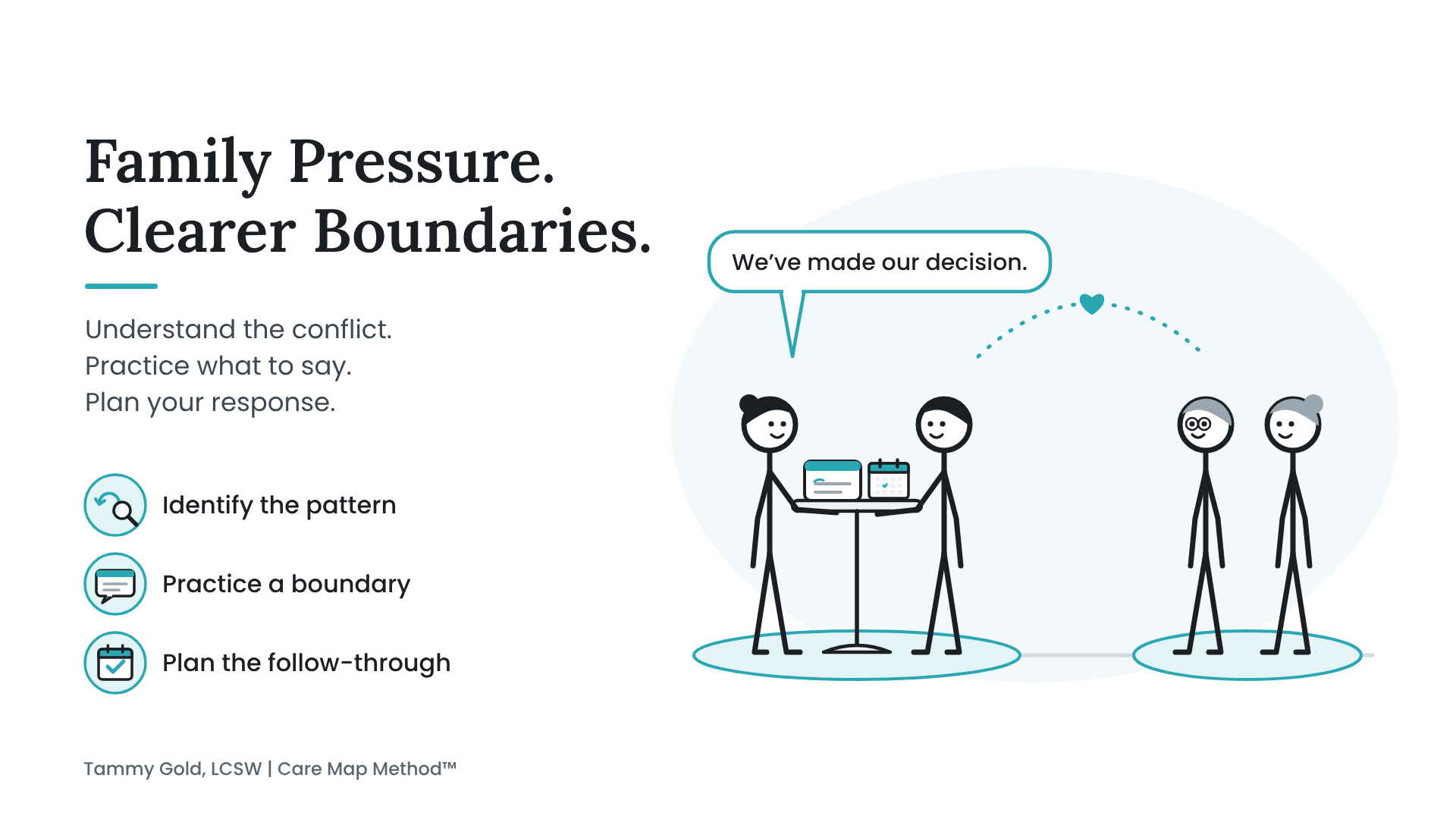
Therapy for In-Law Conflict in California
Online therapy with Tammy Gold, LCSW for in-law conflict and relationship stress in California. Check Anthem Blue Cross eligibility through Headway.
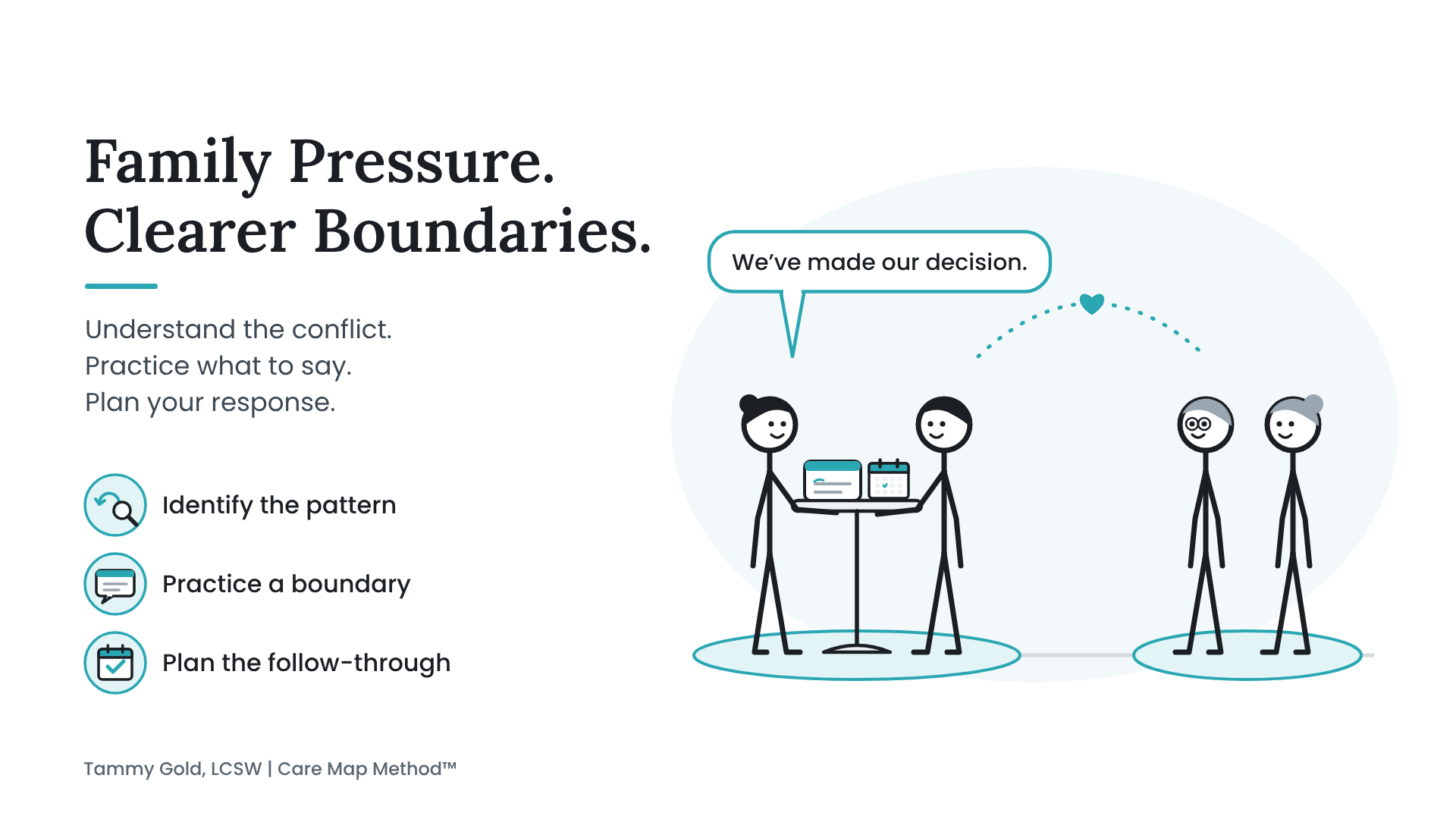
When the disagreement follows you home
In-law conflict can involve holidays, parenting advice, money, privacy, or how much access relatives have to your daily life. You may feel caught between protecting your relationship and keeping the peace. In individual therapy, we can look at how this strain affects your mood, sleep, self-confidence, and ability to communicate.
A boundary you can actually use
We can identify the specific interaction that overwhelms you, what you want to protect, and a response you can realistically maintain. That might mean agreeing with your partner before a visit, shortening a conversation, or choosing which topics you will discuss. For example: “I know you see it differently. We have made our decision, and I am not going to debate it today.”
How I approach the pattern
With the Care Map Method™, we Map the conflict and its impact; Match your needs with coping and communication strategies; Merge those strategies into a conversation or boundary; and Manage what happens afterward. We also consider Biological, Emotional, Social, and Environmental factors, including exhaustion, family expectations, and the setting in which conflict happens.
What we would explore in your first session
We can start with one recent incident instead of trying to explain your entire family history. Who was there? What was said? When did you begin to feel tense, dismissed, or responsible for keeping everyone happy? We would also discuss your symptoms, relevant history, and what you want therapy to change. Perhaps you want to sleep after a visit without replaying it, express a preference without apologizing, or talk with your partner before resentment builds. Those goals help us decide where to begin.
An example of working through a family visit
Imagine that a relative repeatedly questions your parenting while your partner stays quiet. We might unpack the criticism, the meaning you attach to your partner’s silence, and the response you wish you had made. Then we can practice a private conversation: “When the advice continued and we did not respond, I felt alone. Can we agree on how to handle that next time?” This is an illustrative example, not a client story. The wording would change to fit your relationship, safety, and values.
A small step before the next gathering
Write down the topic that tends to start the conflict, the earliest sign that you are becoming overwhelmed, and one action within your control. Your action might be taking a break, changing the subject once, or leaving at an agreed time. Bring that note to therapy so we can consider what feels realistic. You do not have to deliver a perfect speech. We can work on making your response clearer and understanding why following through feels difficult.
How we review progress
We can look at whether you recover more easily after contact, feel clearer about your choices, or spend less time rehearsing arguments. If a boundary creates new tension, we can examine what happened and adjust it. Progress does not require everyone in the family to agree. It can include recognizing your limits sooner and making decisions with less self-doubt.
About Tammy Gold
I am Tamara “Tammy” Gold, MSW, LCSW, CEC, a licensed therapist and certified coach with a clinical MSW from Columbia University. I founded the Care Map Method™ and have more than 20 years of direct work with families. These sessions focus on your individual mental health and treatment goals.
Take the next step
If this concern is affecting your daily life, view my profile to explore fit and current booking options. Check your exact plan and estimated costs before scheduling. You can also read the online therapy booking guide for help choosing a platform.
Check insurance and booking through Headway
Can I come alone if my partner will not attend?
Yes. Individual therapy can focus on your distress, responses, boundaries, and relationship decisions without requiring your partner or relatives to participate.
Does Anthem cover therapy for in-law conflict?
Coverage depends on your exact plan and whether treatment meets its clinical requirements. Relationship conflict alone does not guarantee coverage. Check your benefits through my Headway profile.
Will you tell me to stop seeing my in-laws?
We can explore your options and their consequences. The aim is to help you make an informed choice that fits your needs and circumstances.
What if my partner says I am overreacting?
We can examine the specific interaction and its impact without requiring your partner to validate your feelings first. We can also explore how you want to respond when your experience is dismissed.
How many sessions will I need?
The number depends on your needs, goals, and response to treatment. We can discuss a starting plan after assessment and revisit it as we learn what is helping.
Can we practice what to say before a visit?
Yes. When appropriate to your treatment goals, we can rehearse a conversation or boundary and discuss how you might respond if the other person pushes back.
Check insurance and booking through Headway: https://care.headway.co/providers/tamara-gold-2
Explore my Alma profile: https://secure.helloalma.com/providers/tamara-gold/
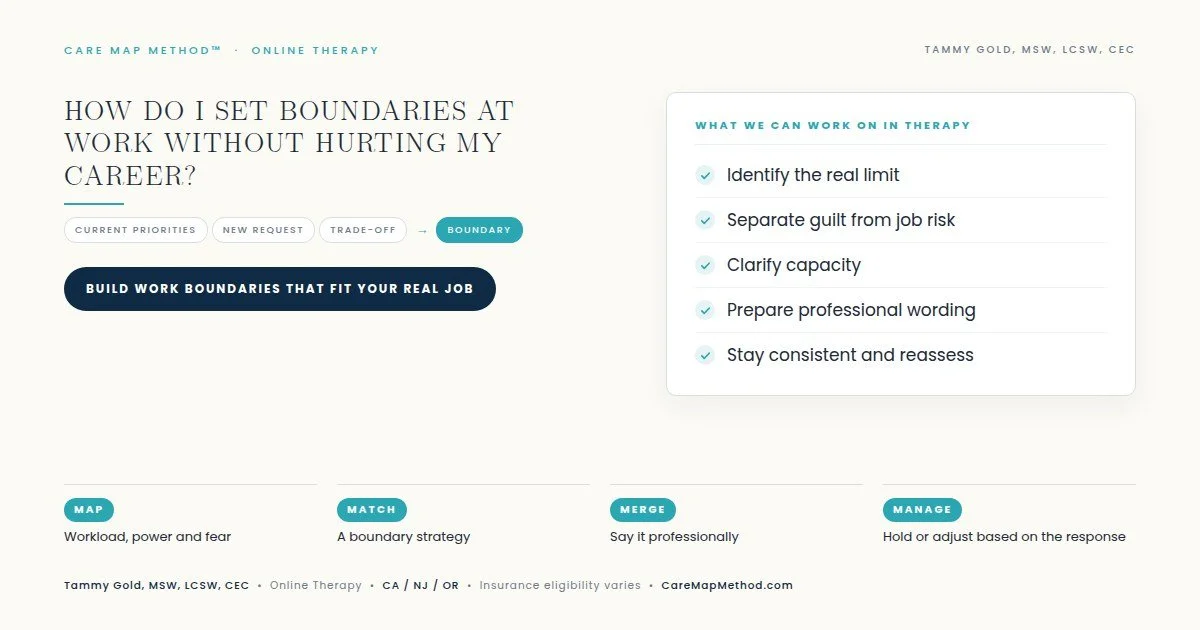
How Do I Set Boundaries at Work Without Hurting My Career?
Work boundaries are harder when the person asking for more work may also evaluate you. Therapy can help you replace vague resentment with clear capacity, priorities and professional language that fits the realities of your job.
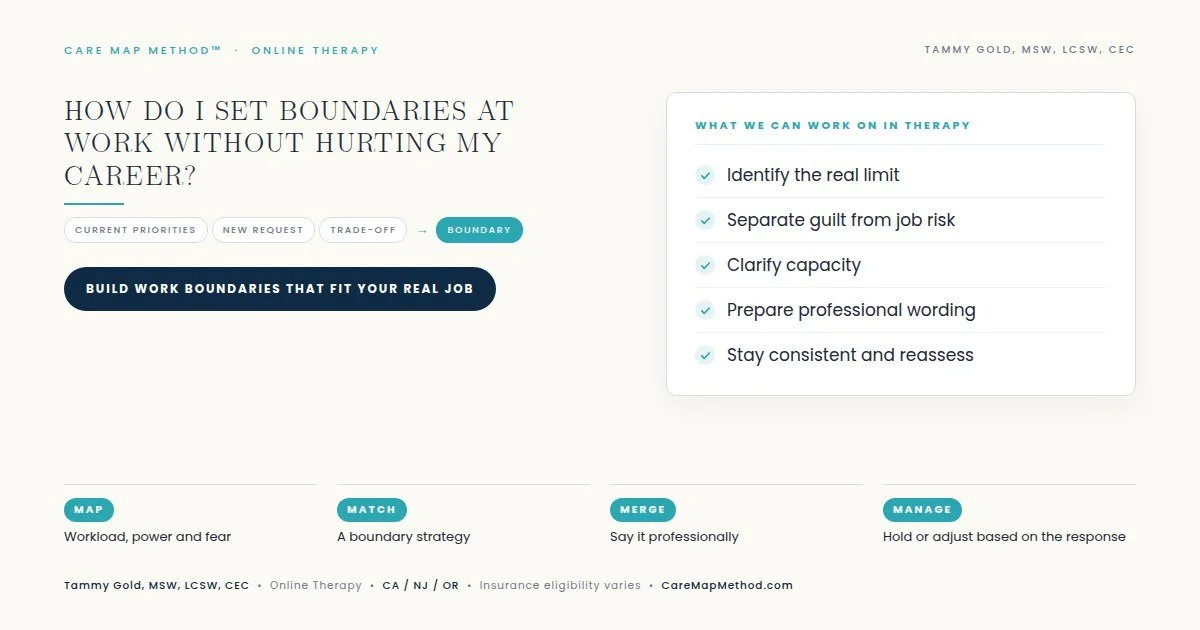
Care Map Method therapy for setting work boundaries, workload limits and professional communication
HOW DO I SET BOUNDARIES AT WORK WITHOUT HURTING MY CAREER?
The goal is not to become less committed. It is to make capacity, priorities and expectations clearer.
What therapy can help you work on:
• Identify where your limits are actually being crossed
• Separate fear of disapproval from realistic career risk
• Turn “no” into capacity and priority language
• Prepare for pushback from a boss or coworker
• Stay consistent without becoming rigid or overexplaining
BUILD WORK BOUNDARIES THAT FIT YOUR REAL JOB
Work boundaries are not simple because work has stakes
Your livelihood, reputation and advancement may be involved. Advice that works in a friendship may be inappropriate with a supervisor. Good workplace boundaries therefore need to be specific, professional and grounded in your actual role.
People-pleasing can make every request feel mandatory
If being dependable is central to your identity, you may volunteer before checking capacity, answer instantly or absorb work that was never clearly yours. The resentment arrives later.
Care Map Method™
MAP the request, power dynamic, workload and feared consequence.
MATCH the issue with the right boundary or prioritization conversation.
MERGE it into professional language.
MANAGE reactions and maintain the boundary consistently enough to learn whether it works.
A boundary is not a guarantee that everyone will like it
The purpose is clarity. We can work on tolerating discomfort while staying mindful of real job expectations and consequences.
What We Can Work On
Identify where your limits are actually being crossed
Separate fear of disapproval from realistic career risk
Turn “no” into capacity and priority language
Prepare for pushback from a boss or coworker
Stay consistent without becoming rigid or overexplaining
Care Map Method™
MAP the problem and pattern. MATCH the needs with the right clinical strategies. MERGE insight into real conversations, boundaries and behavior. MANAGE what happens next and adjust as the situation changes.
How do I say no to more work without looking unhelpful?
Often the most professional approach is to make capacity and trade-offs visible: clarify current priorities, ask what should move and avoid promising work that cannot realistically be completed.
Can boundaries hurt my career?
Workplace context matters, and no therapist can guarantee how an employer will respond. We can help you think through the power dynamics, job expectations and wording so the boundary is deliberate rather than reactive.
Why do I feel guilty setting work boundaries?
You may equate availability with competence, loyalty or safety. Therapy can help separate healthy commitment from over-responsibility and fear-driven people pleasing.
What if my boss ignores my boundary?
Repeatedly ignored limits provide information. We can reassess the wording, organizational expectations, documentation, escalation options and whether the environment is sustainable.
How do I set boundaries with coworkers who constantly need help?
Clarify what support is appropriate, when you are available and what work you are responsible for. A boundary can include redirecting requests or scheduling help rather than responding immediately.
Can therapy help me practice the actual conversation?
Yes. We can write and rehearse concise language, anticipate objections and work on the emotional response that makes it hard to follow through.
BUILD WORK BOUNDARIES THAT FIT YOUR REAL JOB
Check insurance eligibility and request an online therapy appointment. Therapy is available to eligible clients in California, New Jersey and Oregon; coverage and benefits vary by plan.
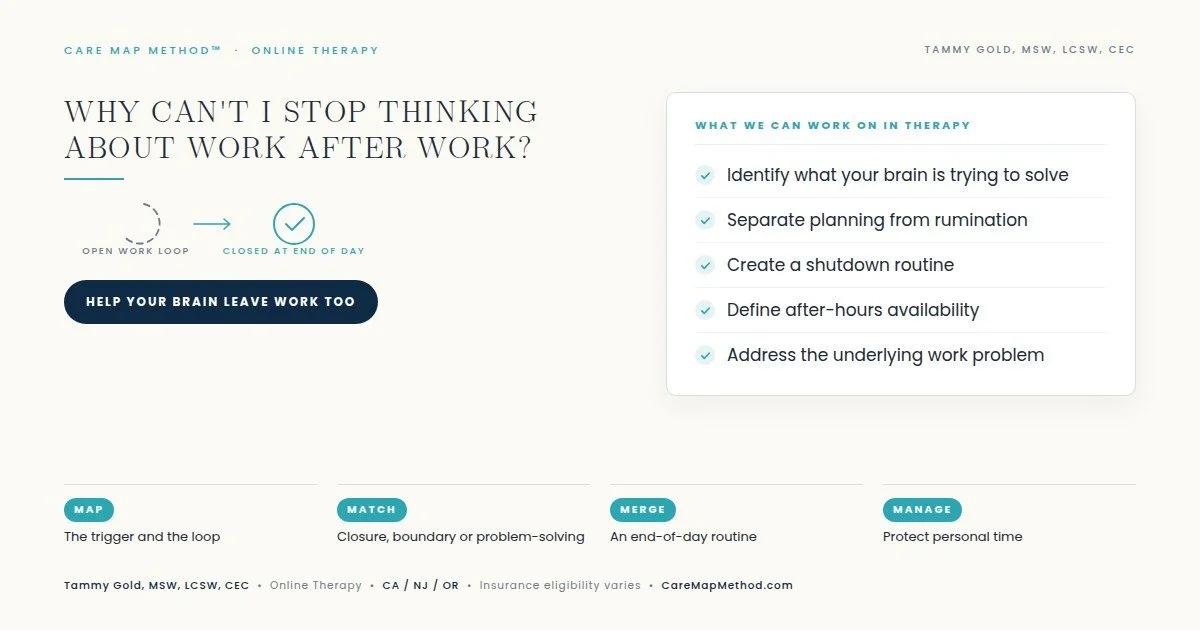
Why Can’t I Stop Thinking About Work After Work? Therapy for Work Rumination
Your laptop can be closed while your brain is still at work. If you replay conversations, anticipate tomorrow or check messages compulsively, therapy can help identify what keeps the workday psychologically open.
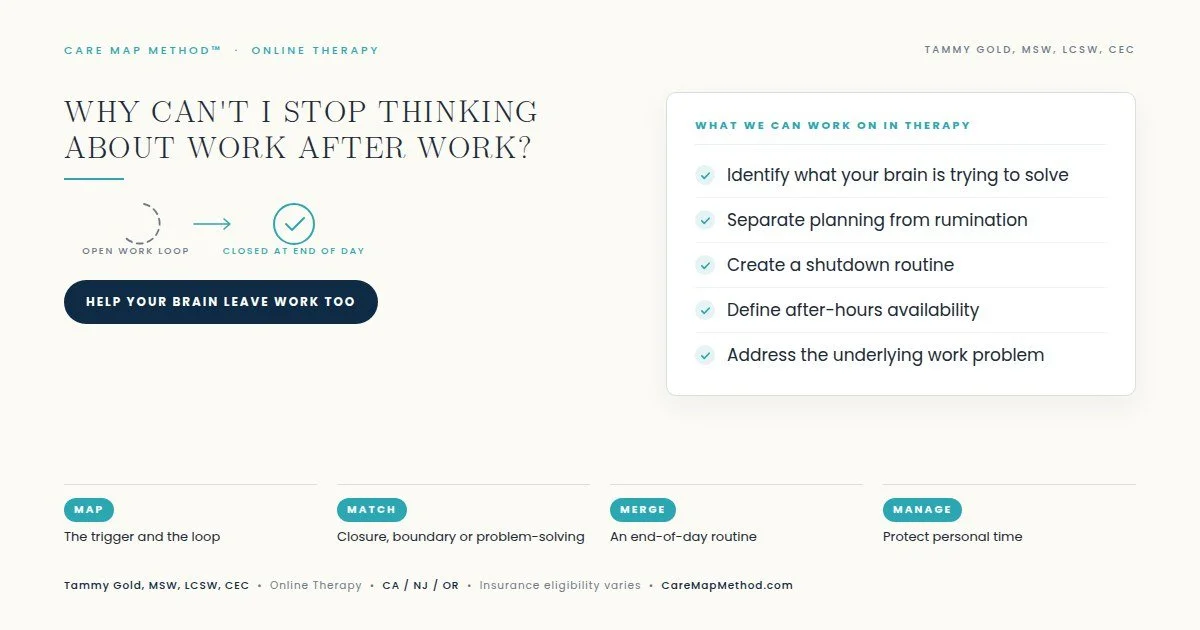
Care Map Method therapy for work rumination, after-hours anxiety and work-life boundaries
WHY CAN’T I STOP THINKING ABOUT WORK AFTER WORK?
Closing the laptop is not the same as closing the stress loop.
What therapy can help you work on:
• Identify what your brain is still trying to solve
• Separate useful planning from repetitive rumination
• Create an end-of-work closure routine
• Set realistic after-hours communication boundaries
• Address the boss, coworker or workload problem underneath the thoughts
HELP YOUR BRAIN LEAVE WORK TOO
Work can stay psychologically open
Unfinished tasks, ambiguous feedback, conflict and fear of forgetting something can keep your mind scanning long after the workday ends.
Rumination feels productive but often is not
Thinking about a problem repeatedly can create the feeling that you are preparing, even when you are cycling through the same material without reaching a new decision.
Sometimes the thought loop is pointing to a real workplace problem
The answer is not always relaxation. If the real issue is an unreasonable workload, unclear boss, conflict or boundary violation, we need to address that too.
Care Map Method™
MAP when the rumination starts, what triggers it and what problem it is attached to.
MATCH the trigger with closure, communication, boundary or problem-solving.
MERGE the strategy into the end of the workday.
MANAGE what returns and refine the plan.
Your evening needs somewhere else to go
The goal is not to never think about work. It is to regain choice over when work receives your attention and when your personal life gets to be fully present.
What We Can Work On In Our Session Together:
Identify what your brain is still trying to solve
Separate useful planning from repetitive rumination
Create an end-of-work closure routine
Set realistic after-hours communication boundaries
Address the boss, coworker or workload problem underneath the thoughts
Care Map Method™
MAP the problem and pattern. MATCH the needs with the right clinical strategies. MERGE insight into real conversations, boundaries and behavior. MANAGE what happens next and adjust as the situation changes.
Why do I keep thinking about work after hours?
Common drivers include unfinished tasks, uncertainty, conflict, high responsibility, anxiety and weak boundaries between work and personal time. Therapy can help identify which pattern is operating for you.
Is work rumination the same as anxiety?
They can overlap, but repetitive work thoughts are not automatically an anxiety disorder. A clinician can assess the broader pattern, severity and impact.
Can therapy help with Sunday scaries?
Yes. We can identify what Sunday dread predicts—workload, a person, performance fears, lack of recovery or a job-fit problem—and build a response around the actual trigger.
Should I stop checking email after work?
That depends on your role and legitimate job expectations. The goal is to define realistic availability rather than impose a boundary that does not fit your circumstances.
What if I need to be reachable for work?
We can distinguish true on-call requirements from habitual checking and create a plan that protects as much off-duty time as your role realistically allows.
What if the thoughts keep me from sleeping?
Persistent sleep disruption deserves attention. Therapy can address rumination and stress, while medical evaluation may also be appropriate for ongoing sleep problems.
HELP YOUR BRAIN LEAVE WORK TOO Text: 818.308.1538
Check insurance eligibility and request an online therapy appointment. Therapy is available to eligible clients in California, New Jersey and Oregon; coverage and benefits vary by plan.
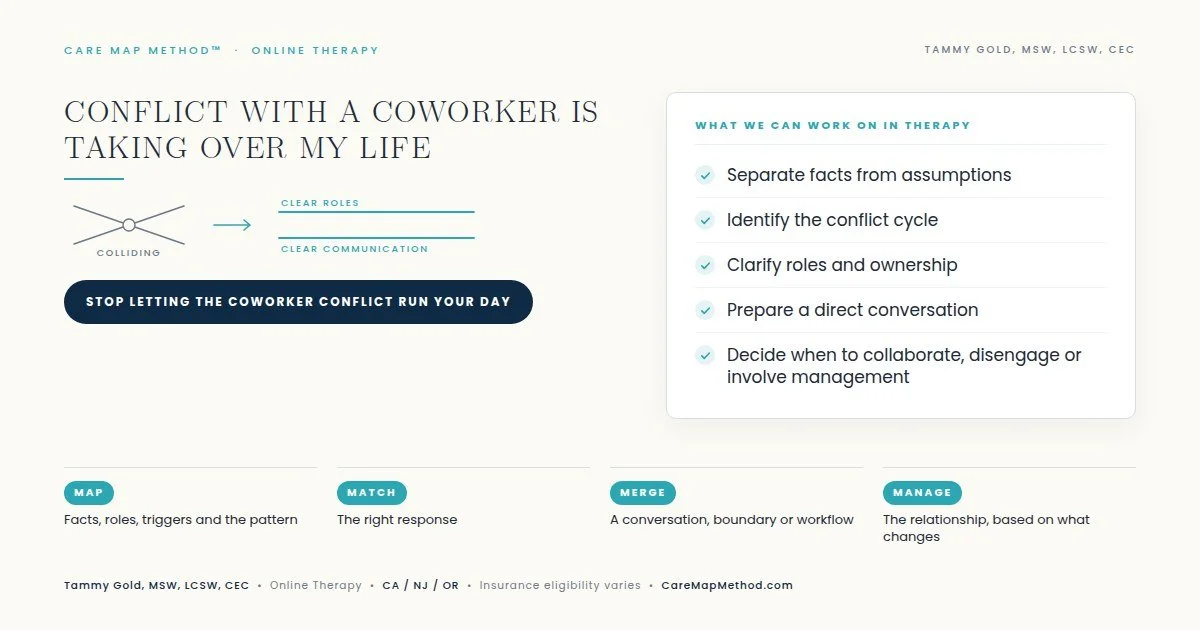
Conflict With a Coworker Is Taking Over My Life: Workplace Relationship Therapy
A coworker conflict can become disproportionately consuming when you still have to collaborate every day. Therapy can help you stop replaying the conflict, communicate more strategically and decide what belongs to you versus the workplace system.
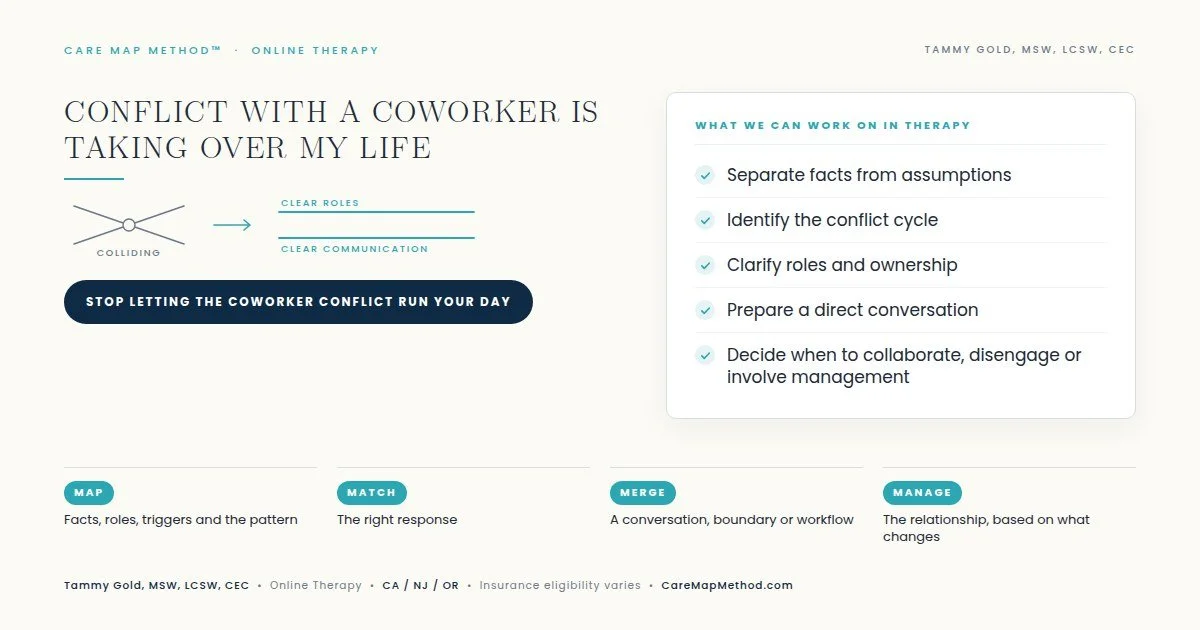
Care Map Method therapy for coworker conflict, workplace communication and stress
CONFLICT WITH A COWORKER IS TAKING OVER MY WORKDAY
When you cannot simply avoid the person, you need a plan for the relationship—not another night replaying the argument.
What therapy can help you work on:
• Separate facts from assumptions and office narratives
• Identify the interaction pattern between you
• Prepare a direct, professional conversation
• Set role and communication boundaries
• Decide what needs collaboration, management support or disengagement
STOP LETTING THE COWORKER CONFLICT RUN YOUR DAY
Peer conflict is uniquely frustrating
With a boss, authority is clear. With a coworker, you may depend on one another without having authority to resolve the problem. That can create repeated friction, triangulation and uncertainty about who should address what.
Rumination keeps the conflict alive after work
You may rehearse what you should have said, interpret Slack messages, ask colleagues for reassurance or dread the next meeting. Therapy can help interrupt that loop while still taking the workplace problem seriously.
We map the interaction
What does the coworker do? What do you do next? What happens after that? Which part is task conflict, communication style, competition, unclear ownership or a larger organizational issue?
Care Map Method™
MAP the facts, roles, triggers and communication pattern. MATCH the conflict with the right response. MERGE that response into a conversation, boundary or workflow. MANAGE the relationship based on what actually changes.
The goal is functional, not necessarily friendly
You do not need to become close. Often the goal is a workable professional relationship that protects your ability to do your job and go home without carrying the conflict with you.
What We Can Work On In Our Session:
Separate facts from assumptions and office narratives
Identify the interaction pattern between you
Prepare a direct, professional conversation
Set role and communication boundaries
Decide what needs collaboration, management support or disengagement
Care Map Method™
MAP the problem and pattern.
MATCH the needs with the right clinical strategies.
MERGE insight into real conversations, boundaries and behavior.
MANAGE what happens next and adjust as the situation changes.
Can therapy help with coworker conflict?
Yes. Therapy can help with rumination, communication, boundaries, emotional triggers and decision-making around a workplace relationship.
What if I have to keep working closely with the person?
Then the goal may be a functional professional relationship rather than avoidance. We can clarify roles, communication channels and specific conversations that reduce unnecessary friction.
Should I confront my coworker?
Not every conflict requires a confrontation. We can determine the goal, the facts, the power dynamics and whether direct communication, a workflow change or management involvement makes more sense.
How do I stop replaying work conflict at home?
We can work on rumination, uncertainty, emotional regulation and a concrete plan for the next work step so your brain does not have to keep trying to solve the problem all night.
What if coworkers are gossiping about me?
We can focus on verified information, your response and appropriate workplace channels rather than amplifying assumptions. Serious harassment or employment concerns may also require HR or legal guidance.
Can therapy help me communicate without getting defensive?
Yes. We can identify triggers, practice concise language and plan how to stay focused on the work issue when the conversation becomes uncomfortable.
STOP LETTING THE COWORKER CONFLICT RUN YOUR DAY
Text: 818.308.1538
Check insurance eligibility and request an online therapy appointment. Therapy is available to eligible clients in California, New Jersey and Oregon; coverage and benefits vary by plan.
How Do I Deal With a Difficult Boss? Therapy for Workplace Stress
When your boss changes priorities, micromanages, criticizes or keeps you constantly on edge, the problem can follow you home. Therapy can help you respond strategically without pretending the power imbalance is not real.
Care Map Method therapy for difficult boss stress, workplace communication and boundaries
MY BOSS IS MAKING ME MISERABLE. WHAT CAN THERAPY HELP ME DO?
You may not control your boss. You can become clearer about the pattern, your response and your options.
What therapy can help you work on:
• Identify the specific boss behavior—not just “toxic”
• Separate what is uncomfortable from what is unsustainable
• Prepare concise conversations about priorities and expectations
• Build boundaries that account for the power difference
• Decide when to adapt, escalate, document or consider leaving
A difficult boss can take up far more than eight hours
You may replay meetings, anticipate criticism, check messages late at night or spend weekends preparing for Monday. The relationship becomes psychologically present even when the boss is not.
Specificity gives you more options
“My boss is terrible” may be true to your experience, but it is hard to act on. Micromanagement, changing priorities, public criticism, unclear expectations and after-hours demands each require different responses.
Power matters
Workplace boundaries are not identical to boundaries with friends or family. Your manager may control assignments, evaluation or advancement. Therapy can help you plan communication that acknowledges those realities instead of relying on simplistic advice to “just say no.” Current workplace guidance likewise emphasizes clear expectations, capacity and specific communication around boundaries. citeturn0search0turn0search7
Care Map Method™
MAP the behavior, trigger, power dynamic and impact. MATCH the problem with communication, boundary, documentation, support or decision-making. MERGE the strategy into a specific conversation. MANAGE what happens next and adjust based on evidence.
The work is about protecting both your wellbeing and your judgment
Chronic stress can make every interaction feel urgent. Slowing the pattern down can help you respond professionally while deciding what is and is not workable.
What We Can Work On In Our Sessions:
Identify the specific boss behavior—not just “toxic”
Separate what is uncomfortable from what is unsustainable
Prepare concise conversations about priorities and expectations
Build boundaries that account for the power difference
Decide when to adapt, escalate, document or consider leaving
Care Map Method™
MAP the problem and pattern.
MATCH the needs with the right clinical strategies.
MERGE insight into real conversations, boundaries and behavior.
MANAGE what happens next and adjust as the situation changes.
Can therapy help with a difficult boss if my boss will not change?
Yes. The work can focus on your stress response, communication, boundaries, decision-making and options even when the other person does not change.
How do I set boundaries with someone who controls my job?
Workplace boundaries need to account for power and job expectations. We can clarify the specific issue and prepare professional language around priorities, capacity, availability or communication.
What if my boss is a micromanager?
We can identify what triggers the micromanagement, what information or structure may reduce it, how you respond to repeated checking and what limits or larger decisions may be necessary.
Should I tell HR about my boss?
That is a context-specific employment decision. Therapy can help you organize what has happened and think through goals and risks, but legal or HR advice should come from the appropriate qualified source.
What if I am afraid of retaliation?
That concern should be taken seriously rather than dismissed. We can work on emotional support and decision-making while you seek appropriate employment or legal guidance for rights and risks.
Can you help me prepare what to say to my boss?
Yes. We can clarify the goal of the conversation, reduce emotionally loaded language, practice concise wording and anticipate likely responses.
MAKE A PLAN FOR THE BOSS PROBLEM. 818.308.1538
Check insurance eligibility and request an online therapy appointment. Therapy is available to eligible clients in California, New Jersey and Oregon; coverage and benefits vary by plan.
My Job Is Burning Me Out: Therapy for Work Stress and Burnout
Burnout can make every workday feel like something to survive. Therapy can help you distinguish workload, workplace dynamics, perfectionism, boundaries and larger career questions so you can respond with a plan rather than only pushing harder.
Care Map Method therapy for job burnout, work stress, boundaries and career decisions
Burnout can make everything look like a personal failure
When you are exhausted, it is easy to conclude that you need to become more efficient, resilient or disciplined. Sometimes the real problem is chronic overload, unclear priorities, a difficult manager, weak boundaries or a role that no longer fits.
We map the stress instead of calling all of it burnout
What happens on Sunday night? Which meetings create dread? When do you work beyond your capacity? What are you afraid will happen if you say no? The answers point toward different interventions.
Therapy can address both the workplace and your response to it
You may not control organizational decisions, but you can work on communication, perfectionism, over-responsibility, conflict, recovery time and decision-making.
Care Map Method™
MAP the workload, relationships, triggers and costs. MATCH each problem with the right strategy—boundary, communication, prioritization, coping or career decision. MERGE the strategy into actual work conversations and routines. MANAGE the results and reassess what remains unsustainable.
The goal is not to teach you to tolerate an intolerable situation
Sometimes therapy helps people stay differently; sometimes it helps them recognize that the environment is not changing. Either way, clarity is more useful than simply trying harder.
What We Can Work On In Our Session:
Identify what is actually draining you
Separate workload from people and boundary problems
Reduce all-or-nothing overfunctioning
Prepare conversations about priorities and capacity
Clarify whether the job needs adjustment—or a larger change
Care Map Method™
MAP the problem and pattern. MATCH the needs with the right clinical strategies. MERGE insight into real conversations, boundaries and behavior. MANAGE what happens next and adjust as the situation changes.
How do I know if I am burned out or just tired?
Burnout is commonly associated with sustained work stress, exhaustion and reduced effectiveness or detachment. Because fatigue can also have medical and psychiatric causes, persistent or severe symptoms deserve appropriate professional evaluation.
Can therapy help if the job itself is the problem?
Yes. Therapy can help you identify what is controllable, prepare workplace conversations, set boundaries, manage stress and make clearer decisions about staying or leaving.
What if I cannot afford to quit?
Therapy does not require an immediate career exit. We can work on reducing harm and increasing clarity while respecting financial and practical realities.
Can therapy help me stop thinking about work at night?
We can address the triggers, unfinished-task loops, anxiety, boundaries and routines that keep work mentally active after hours.
What if I am the person everyone relies on?
That role can become rewarding and exhausting at the same time. We can examine over-responsibility, delegation, guilt and what happens when you are not immediately available.
Will you tell me to quit my job?
No. The purpose is to help you understand the situation, your needs and your options so that you can make your own informed decision.
BUILD A PLAN FOR WORK BURNOUT 818.308.1538
Check insurance eligibility and request an online therapy appointment. Therapy is available to eligible clients in California, New Jersey and Oregon; coverage and benefits vary by plan.
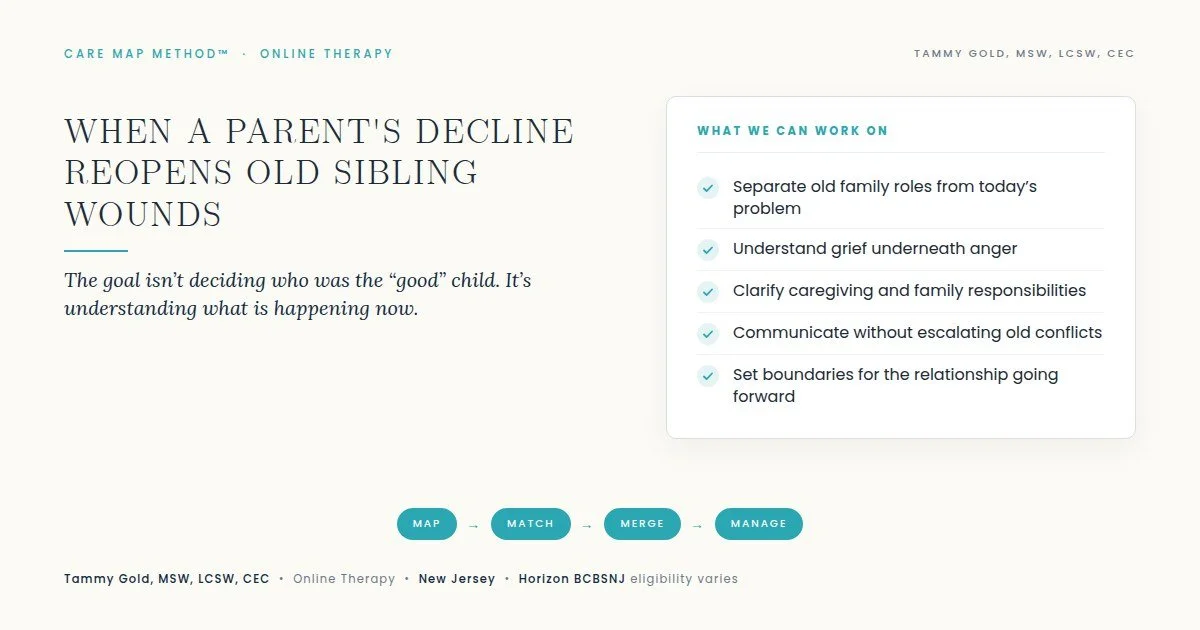
Why Am I Doing Everything for My Aging Parent? Caregiver Burnout & Sibling Conflict Therapy
Caring for an aging parent can become overwhelming when one sibling becomes the default organizer, decision-maker and emotional container. Therapy can help you separate what truly needs to be done from what you can realistically carry.
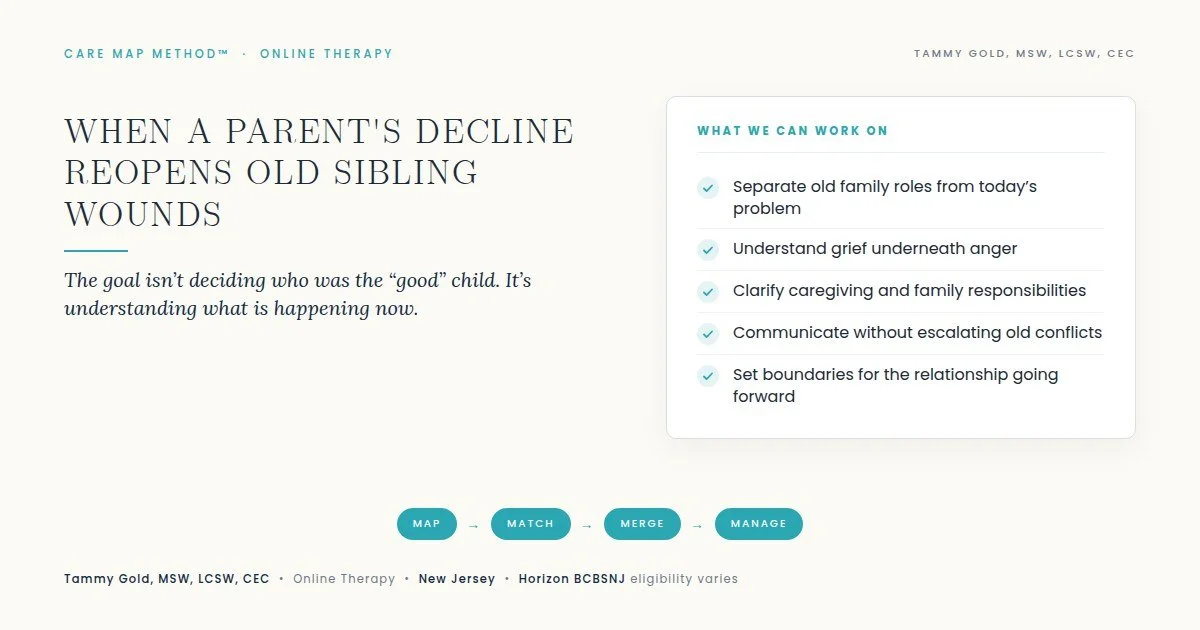
Care Map Method therapy for caregiver burnout, aging parent responsibilities and sibling conflict
WHY AM I THE ONE DOING EVERYTHING FOR MOM OR DAD?
Caregiving stress becomes even heavier when responsibility, guilt and sibling conflict get mixed together.
What therapy can help you work on:
• Map what your parent actually needs
• Separate essential care from tasks you absorbed by default
• Make each sibling’s current role visible
• Prepare a family conversation about capacity and responsibility
• Set limits when other people still do not participate
Caregiving can quietly become a full second job
Appointments, medications, transportation, finances, calls, emergencies and emotional support often accumulate one task at a time. The most reliable family member can become the default caregiver before anyone explicitly decides that should happen.
Sibling conflict often brings old family roles back
The responsible child, the distant child, the peacemaker or the sibling who “cannot handle it” may reappear under pressure. The current eldercare problem can become entangled with decades of family history.
We separate the care problem from the family pattern
Your parent’s actual needs deserve a clear assessment. So does your capacity. Therapy can help distinguish urgent care tasks from guilt-driven overfunctioning and clarify what needs to be requested from siblings or outside resources.
Care Map Method™
MAP the biological, emotional, social and environmental needs surrounding the parent and caregiver. MATCH needs with people, services and realistic responsibilities. MERGE family communication and outside support into a workable plan. MANAGE changes as health, capacity and family participation shift.
You cannot force siblings to become different people
But you can become clearer about what you will carry, what you are asking for and what happens when others decline. That can reduce the cycle of resentment, rescuing and explosion.
What We Can Work On
Map what your parent actually needs
Separate essential care from tasks you absorbed by default
Make each sibling’s current role visible
Prepare a family conversation about capacity and responsibility
Set limits when other people still do not participate
Care Map Method™
MAP the problem and pattern. MATCH the needs with the right clinical strategies. MERGE insight into real conversations, boundaries and behavior. MANAGE what happens next and adjust as the situation changes.
What if my siblings refuse to help with our aging parent?
Therapy cannot force participation, but it can help you clarify requests, communicate responsibilities, set limits on what you will carry and consider outside supports when family capacity is insufficient.
How do I stop resenting my siblings?
We can work on the unfairness you are experiencing while also identifying what you can change. Resentment often becomes more manageable when responsibilities, requests and boundaries become more explicit.
How do I know if I have caregiver burnout?
Persistent exhaustion, irritability, dread, isolation, sleep disruption and feeling that you can never step away can be signs that caregiving stress needs attention. A medical professional should evaluate physical or psychiatric symptoms when appropriate.
Can therapy help with an aging parent who refuses help?
Yes. We can work on communication, limits, your own emotional response and the distinction between respecting an adult’s autonomy and responding to genuine safety concerns.
Should all siblings come to therapy?
Not necessarily. Individual therapy can help the person carrying the burden. Family sessions may be appropriate in some circumstances when participants are willing and the treatment arrangement supports it.
What does the Care Map add to caregiver therapy?
It organizes the problem across biological, emotional, social and environmental needs, then connects those needs to realistic people, services, boundaries and follow-up rather than treating burnout as only an individual coping problem.
GET HELP WITH CAREGIVER OVERLOAD. BOOK A SUPPORT SESSION TODAY 818.308.1538
Check insurance eligibility and request an online therapy appointment. Therapy is available to eligible clients in California, New Jersey and Oregon; coverage and benefits vary by plan.
Why Do I Feel Guilty When I Set Boundaries With My Family?
Knowing you need a boundary and being able to hold one are different skills. If saying no to family immediately creates guilt, fear or pressure to reverse yourself, therapy can help you understand why and build a more sustainable response.
WHY DOES SETTING ONE BOUNDARY MAKE ME FEEL SO GUILTY?
A boundary can be appropriate and still feel uncomfortable. Therapy can help you hold both truths.
What therapy can help you work on:
• Identify the family rule behind the guilt
• Separate responsibility from over-responsibility
• Create language that is clear without overexplaining
• Prepare for pushback without immediately giving in
• Practice tolerating guilt while maintaining the limit
BUILD BOUNDARIES YOU CAN ACTUALLY HOLD
Guilt does not automatically mean you did something wrong
In some families, being helpful, available or agreeable becomes part of your identity. Saying no can therefore feel like betrayal even when the request is unreasonable.
Boundaries change systems
When one person changes a familiar role, other people may push for the old arrangement to return. Their discomfort does not automatically mean the new boundary is unhealthy.
Therapy can help with the moment after you say no
Many people know what boundary they want. The harder part is the text message afterward, the disappointed parent, the angry sibling or the urge to explain until the boundary disappears.
Care Map Method™
MAP the request, family role, guilt and feared consequence. MATCH the situation with a specific limit and communication approach. MERGE the boundary into real relationships with language you can actually use. MANAGE the emotional aftermath and adjust when necessary.
Boundaries are not the same as punishment
A useful boundary describes what you will do, what you can offer or what you cannot continue. Therapy can help you distinguish protection and clarity from retaliation or control.
What We Can Work On In Our Session Together:
Identify the family rule behind the guilt
Separate responsibility from over-responsibility
Create language that is clear without overexplaining
Prepare for pushback without immediately giving in
Practice tolerating guilt while maintaining the limit
Care Map Method™
MAP the problem and pattern. MATCH the needs with the right clinical strategies. MERGE insight into real conversations, boundaries and behavior. MANAGE what happens next and adjust as the situation changes.
Why do I feel guilty after saying no to family?
Guilt can come from family roles, learned expectations, fear of disappointing others or a belief that love requires constant availability. Feeling guilty does not by itself prove the boundary is wrong.
How do I set a boundary without being mean?
Use clear, specific language focused on what you can and cannot do. You can be respectful without offering unlimited explanations or negotiating against yourself.
What if my family gets angry when I set boundaries?
We can prepare for predictable reactions and decide in advance how you will respond. Another person’s anger is information, but it does not automatically determine your limit.
Are boundaries selfish?
Healthy boundaries can protect time, energy, privacy and relationships. Whether a particular boundary is appropriate depends on context; therapy can help you evaluate it rather than relying only on guilt.
Why do I keep giving in after I set a boundary?
The emotional consequence may feel harder than the original request. We can work on the guilt, fear and relationship patterns that make consistency difficult.
Can therapy help me with scripts for difficult family conversations?
Yes. We can prepare language, anticipate likely responses and practice staying clear when the conversation becomes emotional.
BUILD BOUNDARIES YOU CAN ACTUALLY HOLD 818.308.1538
Check insurance eligibility and request an online therapy appointment. Therapy is available to eligible clients in California, New Jersey and Oregon; coverage and benefits vary by plan.
I Resent My Husband or Partner: Therapy for Relationship Resentment
Resentment often sounds like anger, but underneath it may be exhaustion, disappointment, unfairness or years of needs that never became a workable conversation. Therapy can help you unpack the pattern and decide what needs to change.
LOVE MY PARTNER. SO WHY AM I SO RESENTFUL?
Resentment is often a signal that something important has remained unspoken, unequal or unresolved.
What therapy can help you work on:
• Identify what the resentment is protecting
• Separate current problems from accumulated history
• Make invisible labor and expectations visible
• Turn criticism into specific requests and boundaries
• Clarify what repair and shared responsibility would require
Resentment rarely starts as resentment
It often starts as helping, accommodating, waiting or telling yourself something is not worth an argument. Over time, the gap between what you give and what you feel you receive can become anger.
The argument may not be about the dishes
Housework, parenting, money, intimacy or schedules can become symbols for larger questions: Do you see what I carry? Can I rely on you? Do my needs matter too?
Therapy helps translate resentment
Instead of treating anger as the entire problem, we can identify the unmet need, injury, expectation or boundary underneath it. That creates something concrete to work with.
Care Map Method™
MAP where resentment appears and what it represents. MATCH each problem with a realistic request, boundary or repair conversation. MERGE those changes into daily life rather than one dramatic discussion. MANAGE setbacks, accountability and changing needs.
The goal is clarity, not forced forgiveness
You do not have to minimize what happened or manufacture warmth. We can work toward understanding, direct communication and decisions based on what actually changes.
What We Can Work On In Our Session:
Identify what the resentment is protecting
Separate current problems from accumulated history
Make invisible labor and expectations visible
Turn criticism into specific requests and boundaries
Clarify what repair and shared responsibility would require
Care Map Method™
MAP the problem and pattern. MATCH the needs with the right clinical strategies. MERGE insight into real conversations, boundaries and behavior. MANAGE what happens next and adjust as the situation changes.
Is resentment normal in a long-term relationship?
Resentment can occur in long-term relationships, especially when hurt, workload or unmet expectations accumulate. The clinically useful question is what the resentment is signaling and whether the underlying problem can be addressed.
Can resentment go away?
There is no guaranteed outcome, but resentment can change when the underlying issue is named, responsibility is clearer and behavior changes consistently enough to rebuild trust.
What if my partner says I am too critical?
We can examine both the content and delivery of what you are trying to communicate. Sometimes criticism is an ineffective expression of a legitimate need; sometimes both partners are caught in a defensive cycle.
Can I work on resentment in individual therapy?
Yes. Individual therapy can help you identify your needs, boundaries and communication patterns even if your partner does not attend.
What if the resentment is about unequal parenting or household labor?
We can make the workload visible, identify assumptions and define specific responsibilities rather than relying on vague promises to “help more.”
Does therapy mean I have to forgive my partner?
No. Therapy can help you understand what happened and decide what you need. Forgiveness is not a requirement for treatment or for making a clear decision about the relationship.
TURN RESENTMENT INTO A CLEARER PLAN BOOK YOUR SESSION TODAY Info@CareMapMethod.com 818.3081538
Check insurance eligibility and request an online therapy appointment. Therapy is available to eligible clients in California, New Jersey and Oregon; coverage and benefits vary by plan.
I Feel Lonely in My Marriage: Therapy for Emotional Disconnection
YOU CAN BE MARRIED AND STILL FEEL COMPLETELY ALONE
Therapy can help you understand where the connection broke down and what would need to change for the relationship to feel different.
What therapy can help you work on:
• Name the kind of connection you are missing
• Identify the pursue–withdraw or shutdown pattern
• Turn resentment into clearer needs and requests
• Practice conversations that are less defensive
• Clarify what change would actually feel meaningful
Loneliness inside a relationship can be confusing
You may still function well as parents, roommates or partners in logistics while feeling unseen emotionally. That can create a painful question: if we are together, why do I feel so alone?
Disconnection is often a pattern, not one bad conversation
One person may reach for reassurance through criticism or repeated questions while the other retreats, shuts down or focuses on tasks. Both can end up protecting themselves in ways that deepen the distance.
Therapy makes the invisible pattern visible
We can map when you feel most disconnected, what you ask for, what you receive, what you stop saying and what you have come to expect. That allows us to work on the interaction rather than simply repeating the content of the latest argument.
Care Map Method™
MAP the disconnection and unmet needs. MATCH those needs with communication, boundaries and realistic relationship goals. MERGE new language into actual conversations. MANAGE the pattern when old reactions return.
You do not have to decide the future before understanding the present
Therapy does not require you to arrive knowing whether you will stay, leave or change the relationship. The first task is clarity: what is happening, what you need, what has been tried and what would constitute meaningful change.
What We Can Work On In Our Session
Name the kind of connection you are missing
Identify the pursue–withdraw or shutdown pattern
Turn resentment into clearer needs and requests
Practice conversations that are less defensive
Clarify what change would actually feel meaningful
Care Map Method™
MAP the problem and pattern. MATCH the needs with the right clinical strategies. MERGE insight into real conversations, boundaries and behavior. MANAGE what happens next and adjust as the situation changes.
Can I come alone if my spouse will not attend therapy?
Yes. Individual therapy can help you understand the relationship pattern, communicate more clearly, set boundaries and make decisions even if your partner does not participate.
Does feeling lonely mean my marriage is over?
Not necessarily. Loneliness is important information, but it does not by itself determine the future of a relationship. We can examine what is creating the distance and whether meaningful change is possible.
What if we never fight—we just do not connect?
Disconnection can exist without frequent conflict. Avoidance, parallel lives, exhaustion, parenting demands or fear of difficult conversations can all leave a relationship emotionally thin.
Can therapy help me ask for more without sounding critical?
Yes. We can work on identifying the underlying need and communicating it more directly, while reducing patterns such as accusation, mind-reading or global statements.
What if I have already tried talking about it?
We can look at how those conversations unfold, what happens immediately before they fail, and whether the request, timing, expectations or interaction pattern need to change.
Is this couples therapy or individual therapy?
It can be either, depending on who is seeking treatment and what is clinically appropriate. The page should direct prospective clients to verify the type of care and insurance eligibility when booking.
WORK ON THE DISCONNECTION
Check insurance eligibility and request an online therapy appointment. Therapy is available to eligible clients in California, New Jersey and Oregon; coverage and benefits vary by plan. Email: Tammy@CareMapMethod.com Text: 818.308.1538
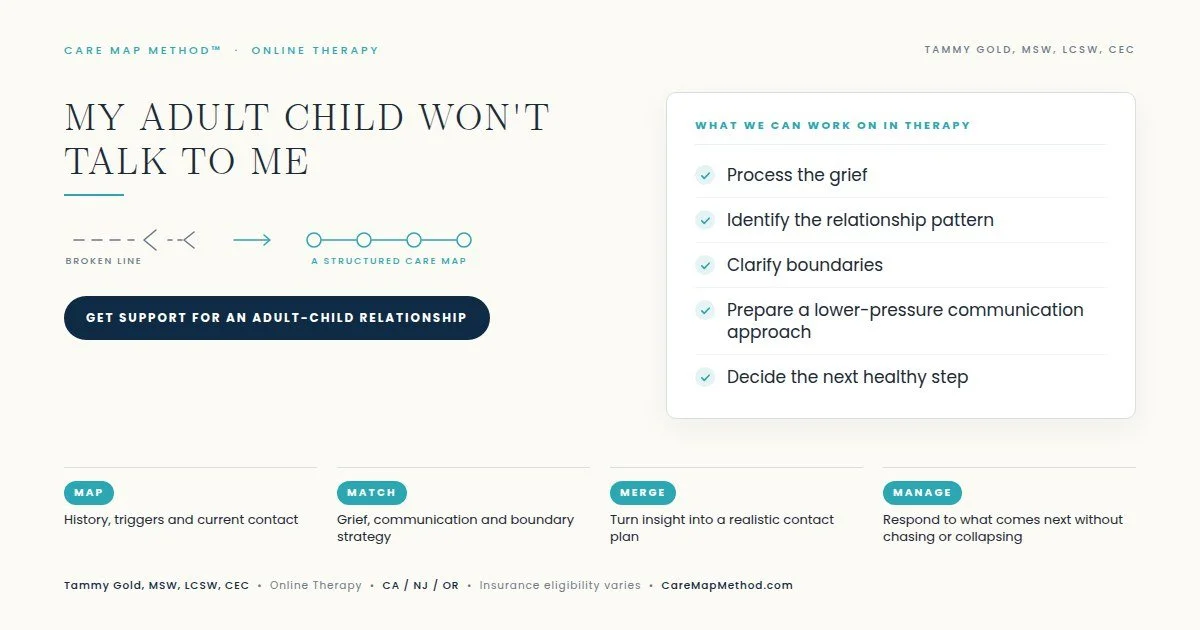
My Adult Child Won’t Talk to Me: Therapy for Parent–Adult Child Estrangement
When an adult child pulls away, parents can feel grief, confusion, guilt and urgency. Therapy can help you slow the cycle down, understand what is happening and choose a thoughtful next step without forcing reconciliation.
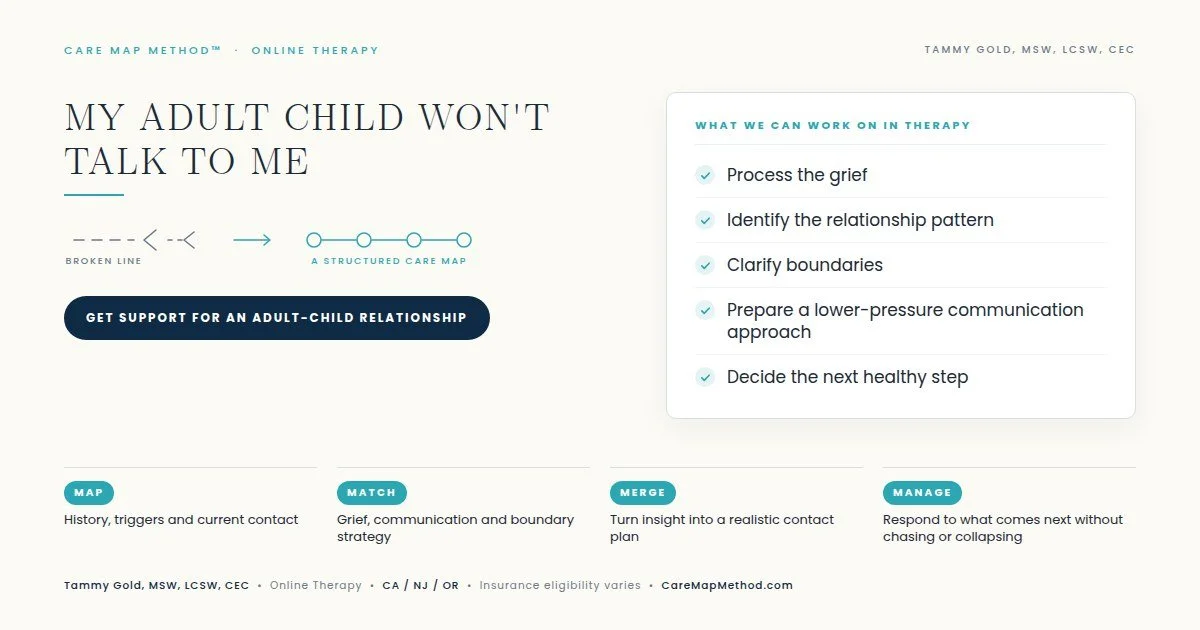
MY ADULT CHILD WON’T TALK TO ME
You cannot control another adult’s decision. You can understand the relationship, your response and your next step.
What therapy can help you work on:
• Separate grief, fear, anger and guilt
• Identify recurring parent–adult child patterns
• Understand boundaries without chasing or withdrawing
• Prepare communication that reduces pressure and defensiveness
• Decide what healthy contact—or healthy distance—looks like now
When silence becomes the whole relationship
An adult child pulling away can create a particular kind of grief: the person is still alive, yet the relationship you knew may feel unavailable. Parents often replay conversations, search for the moment everything changed, send another message, or become afraid that doing nothing means giving up. Therapy gives that urgency somewhere constructive to go.
The goal is not to assign a villain
Estrangement can involve years of misunderstandings, unresolved injuries, family roles, boundaries, partners, grandchildren, differing expectations or a single rupture that became larger over time. I do not begin by deciding who is right. We map the relationship as it actually exists now and identify the parts you can influence.
What we can work on in therapy
We can look at what happens before contact breaks down, what you tend to do when you feel rejected, what your adult child has communicated directly, and what remains assumption. We can also work on tolerating uncertainty so that fear does not drive repeated contact, defensiveness or self-blame.
A Care Map for the relationship
MAP the history, present pattern, emotional triggers and current boundaries. MATCH the problem with the right response—grief work, communication, boundary work, repair attempts or acceptance. MERGE insight with a realistic communication plan. MANAGE what happens next without making your wellbeing dependent on another person’s immediate response.
Therapy can help even if your adult child never joins
You do not need the other person in the room to understand your part of a relationship. Individual therapy can help you become clearer, less reactive and more intentional. If contact becomes possible, you can enter it differently. If it does not, therapy can help you build a life that is not organized entirely around waiting.
What We Can Work On During Our Call:
Separate grief, fear, anger and guilt
Identify recurring parent–adult child patterns
Understand boundaries without chasing or withdrawing
Prepare communication that reduces pressure and defensiveness
Decide what healthy contact—or healthy distance—looks like now
Care Map Method™
MAP the problem and pattern. MATCH the needs with the right clinical strategies. MERGE insight into real conversations, boundaries and behavior. MANAGE what happens next and adjust as the situation changes.
Can therapy make my adult child speak to me again?
Therapy cannot control another adult or guarantee reconciliation. It can help you understand the relationship, process the loss, examine your own patterns, respect stated boundaries and decide whether and how to make a thoughtful repair attempt.
Should I keep contacting an estranged adult child?
That depends on what your adult child has communicated, the history of the relationship and any boundaries they have set. Therapy can help you distinguish a respectful invitation to connect from repeated contact that may increase pressure.
Can I come to therapy alone for a family relationship problem?
Yes. Many relationship problems are addressed in individual therapy. We can work on your reactions, communication, boundaries, grief and decisions even when the other person does not participate.
What if I do not understand why my adult child is angry?
We can separate what you know from what you are guessing, review what has actually been communicated, and identify questions or responses that may create more clarity without turning the conversation into a debate.
Is estrangement always permanent?
No one can predict a particular family relationship. Some relationships reconnect, some change form and some remain distant. Therapy focuses on what is healthiest and most realistic now rather than promising a specific outcome.
Will you tell me whether my adult child is wrong?
The work is more useful when we move beyond deciding who wins the argument. We can examine behavior, impact, boundaries and responsibility while helping you make choices that align with the relationship you want and the reality you face.
Check insurance eligibility and request an online therapy appointment. Therapy is available to eligible clients in California, New Jersey and Oregon; coverage and benefits vary by plan.

My Aging Parent Refuses Help and I Am Overwhelmed
Therapy for Oregon adults overwhelmed when an aging parent refuses help. Support for guilt, boundaries, family conflict and caregiver stress.
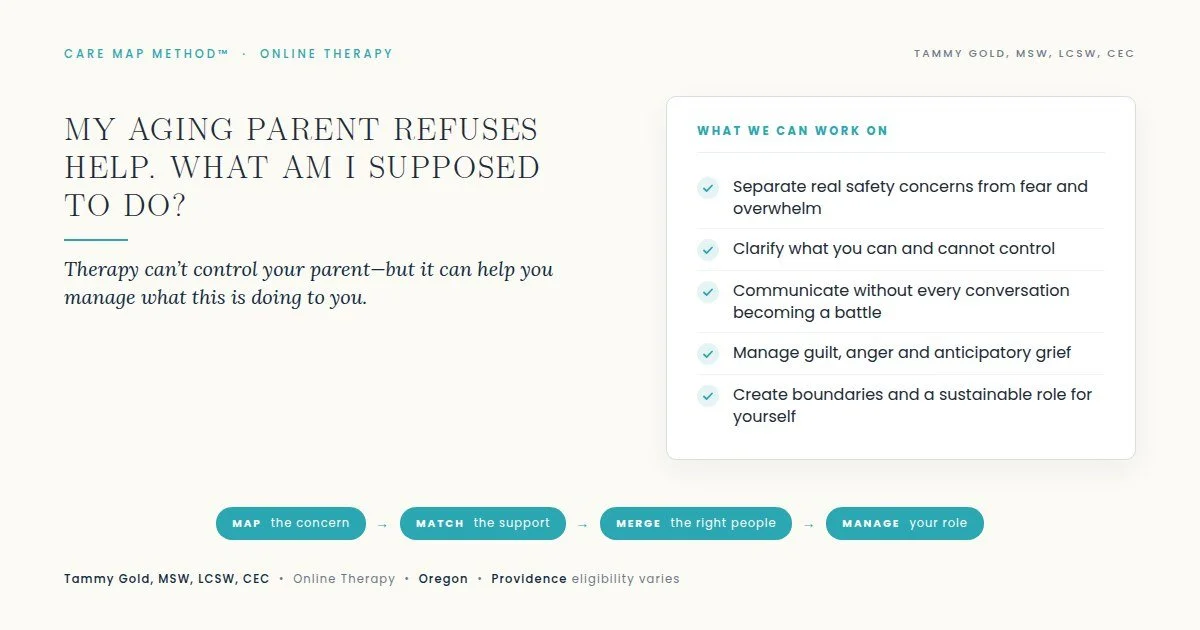
When Love, Safety and Autonomy Pull in Different Directions
You see the problems. Your parent says they are fine. You worry about falls, driving, medications, memory, isolation, finances or the next emergency. You suggest help. They refuse. You push harder because you are frightened, and they become angry because they feel controlled.
This dynamic is painful because both safety and autonomy matter. Therapy can help you separate what is urgent from what is frightening, and what is within your control from what is not.
What Therapy Can Help You Carry Differently
We can work on fear about your parent's safety, guilt about not doing enough, anger when help is rejected, sibling disagreements, anticipatory grief and the pressure to solve every possible future problem now.
We can also prepare language for difficult conversations and clarify what role you are realistically willing and able to play.
A Care Map for the Situation
MAP the actual concerns and the biological, emotional, social and environmental factors around them.
MATCH each concern to the right kind of support: emotional, medical, practical, legal or family.
MERGE the right people where possible.
MANAGE your role without assuming you can control every outcome.
Know When Therapy Is Not the Only Resource
Therapy is not a substitute for medical, legal, emergency or protective services when those are needed. Part of good planning is recognizing which problem belongs in which system.
Providence Online Therapy in Oregon
Providence may be available for eligible Oregon clients depending on the specific plan and current participation. Verify benefits before scheduling.
About Tammy Gold, MSW, LCSW, CEC
I am a licensed clinical social worker, certified coach, author and creator of the Care Map Method™. I have worked with families and relationships for more than two decades. My therapy style is warm, nonjudgmental, active and practical: one safe place to feel heard and supported while also developing language, boundaries and next steps you can use in real life.
Frequently Asked Questions
What do I do when an elderly parent refuses help?
Start by clarifying the specific concern, the level of risk and what is within your control. Medical, legal or emergency input may also be needed depending on the situation.
Can therapy help with caregiver guilt?
Yes. Therapy can help examine expectations, responsibility, grief and boundaries while respecting real caregiving needs.
What if my siblings disagree about our parent?
Therapy can help you clarify your role, prepare conversations and set limits around what you can realistically provide.
Does Providence cover online therapy in Oregon?
Eligibility varies by plan and current participation. Verify benefits before scheduling.
Check insurance eligibility and request an online therapy session. Therapy is available for eligible clients physically located in Oregon. Insurance eligibility, benefits and platform availability vary by plan.