
How to Deal With a Difficult Family Member Without Losing Yourself
Online Oregon therapy for difficult family relationships, recurring conflict, boundaries, guilt and communication. Regence BCBS may be available.
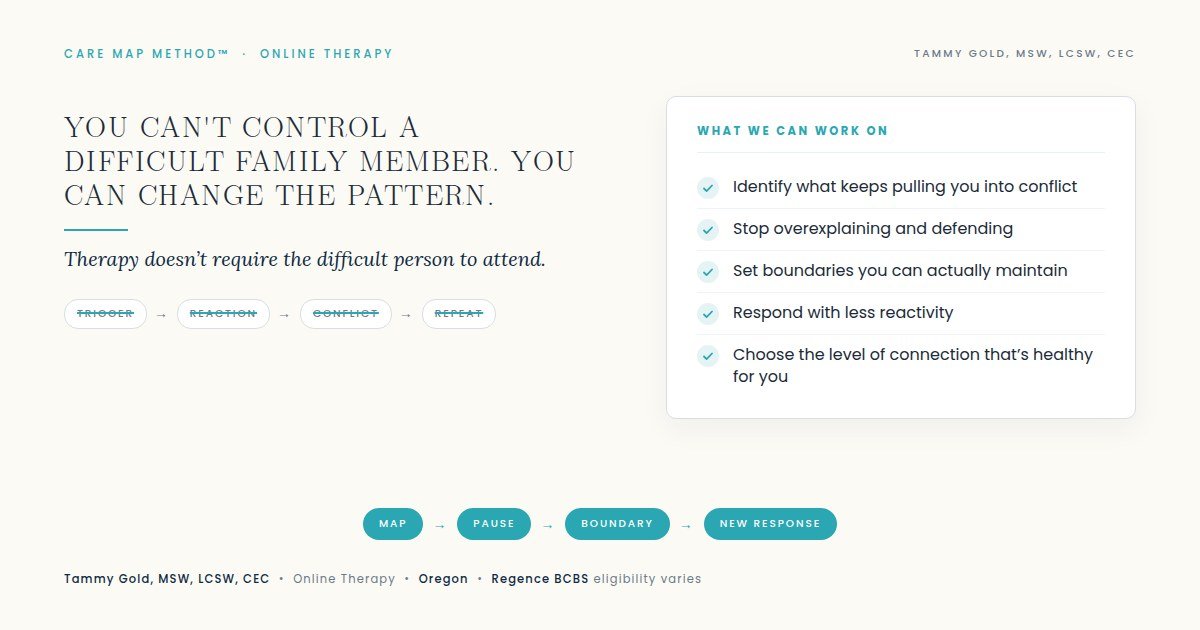
When Understanding Them Has Not Changed the Relationship
Some relationships do not become easier simply because you understand the other person. You may have tried explaining, being patient, giving another chance, avoiding conflict, setting a boundary and then giving in. Somehow you end up back in the same pattern.
Therapy does not require the difficult family member to attend. We can work on your side of the relationship system.
Identify the Hook
Most recurring family conflicts have a predictable hook: criticism, guilt, disrespect, pressure, comparison, intrusion or the feeling that you must defend yourself. When you know the hook, you can begin to notice the moment before your usual reaction takes over.
Boundaries That You Can Maintain
A boundary is most useful when it describes your action rather than trying to force another person to behave differently. We can develop boundaries around contact, topics, money, visits, communication style or what you will do when a conversation becomes disrespectful.
MAP the Pattern, Then Change Your Response
MAP the trigger-reaction-conflict loop.
MATCH a response to your goal and values.
MERGE the new response into real interactions.
MANAGE guilt and pushback without immediately abandoning the boundary.
A successful outcome may not be changing the other person. It may be changing how much control the relationship has over your mood, choices and sense of self.
Regence BCBS Online Therapy in Oregon
Regence BCBS eligibility and benefits vary by plan and current participation. Verify benefits before scheduling online therapy in Oregon.
About Tammy Gold, MSW, LCSW, CEC
I am a licensed clinical social worker, certified coach, author and creator of the Care Map Method™. I have worked with families and relationships for more than two decades. My therapy style is warm, nonjudgmental, active and practical: one safe place to feel heard and supported while also developing language, boundaries and next steps you can use in real life.
Frequently Asked Questions
Can therapy help if the difficult family member will not attend?
Yes. You can work on your own reactions, boundaries and choices without their participation.
What is a healthy boundary with family?
A useful boundary is specific, focused on your own actions and realistic enough to maintain.
Do I have to cut off a difficult family member?
No. Therapy can help you consider a range of contact and boundary options rather than assuming estrangement is the only solution.
Does Regence BCBS cover online therapy in Oregon?
Coverage depends on your plan and eligibility. Verify benefits before scheduling.
Booking CTA
Check insurance eligibility and request an online therapy session. Therapy is available for eligible clients physically located in Oregon. Insurance eligibility, benefits and platform availability vary by plan.

Therapy for Women Who Feel Responsible for Everyone
Online Oregon therapy for women overwhelmed by family responsibilities, emotional labor, guilt, boundaries and caregiving demands.
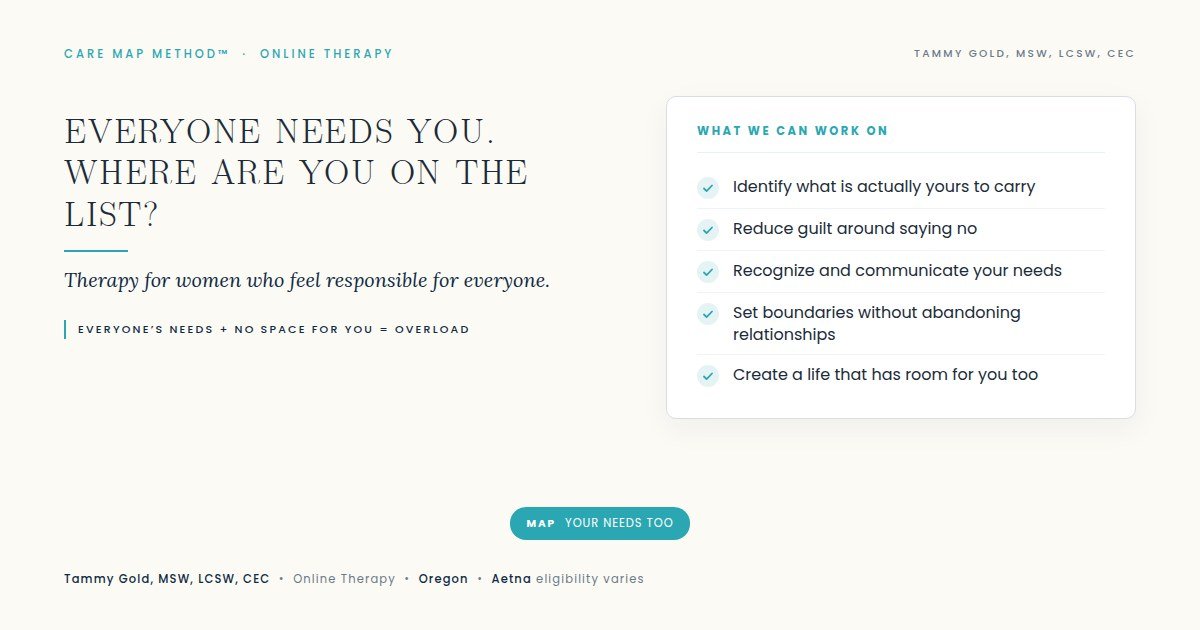
The Person Everyone Depends On
You may be the person everyone calls: children, parents, partner, friends and coworkers. You notice what needs to happen before anyone asks. You anticipate problems, remember details, absorb other people's emotions and keep moving because you are capable.
Being capable does not mean you have unlimited capacity. At some point, the role of being the reliable one can become so constant that you lose track of your own needs.
Responsibility Versus Emotional Responsibility
Therapy can help separate what is genuinely your responsibility from the belief that you must also prevent everyone else's disappointment, discomfort or mistakes. Those are not the same job.
We can explore guilt, perfectionism, overfunctioning, fear of conflict and the family roles that taught you to stay useful, agreeable or indispensable.
Putting Your Needs Back on the Map
The Care Map Method™ looks at biological, emotional, social and environmental demands. Your sleep, health, emotional bandwidth, relationships, work and environment all matter. Your needs are not an inconvenience to the system; they are part of whether the system is sustainable.
Practical Boundary Work
We can practice asking for help more specifically, saying no without a long defense, tolerating other people's disappointment and deciding what support you can offer without disappearing inside everyone else's needs.
Aetna Online Therapy in Oregon
Aetna may be available for eligible Oregon clients depending on plan details and current network participation through Headway or Alma. Verify benefits before scheduling.
About Tammy Gold, MSW, LCSW, CEC
I am a licensed clinical social worker, certified coach, author and creator of the Care Map Method™. I have worked with families and relationships for more than two decades. My therapy style is warm, nonjudgmental, active and practical: one safe place to feel heard and supported while also developing language, boundaries and next steps you can use in real life.
What is overfunctioning?
Overfunctioning can describe taking excessive responsibility for tasks, decisions or other people’s emotions, often while neglecting your own needs.
Why do I feel guilty when I say no?
Guilt can be connected to family roles, beliefs about responsibility, fear of rejection or long-standing patterns. Therapy can help identify your specific drivers.
Can therapy help me set boundaries without becoming selfish?
Therapy can help you distinguish healthy limits from abandonment and develop boundaries consistent with your values.
Can I use Aetna in Oregon?
Aetna eligibility varies by plan and current network participation. Verify benefits before scheduling.
Check insurance eligibility and request an online therapy session. Therapy is available for eligible clients physically located in Oregon. Insurance eligibility, benefits and platform availability vary by plan.

My Partner and I Disagree About Parenting
Online Oregon therapy for couples who disagree about parenting, discipline, boundaries and family responsibilities. Providence may be available.
When Parenting Differences Become Marriage Problems
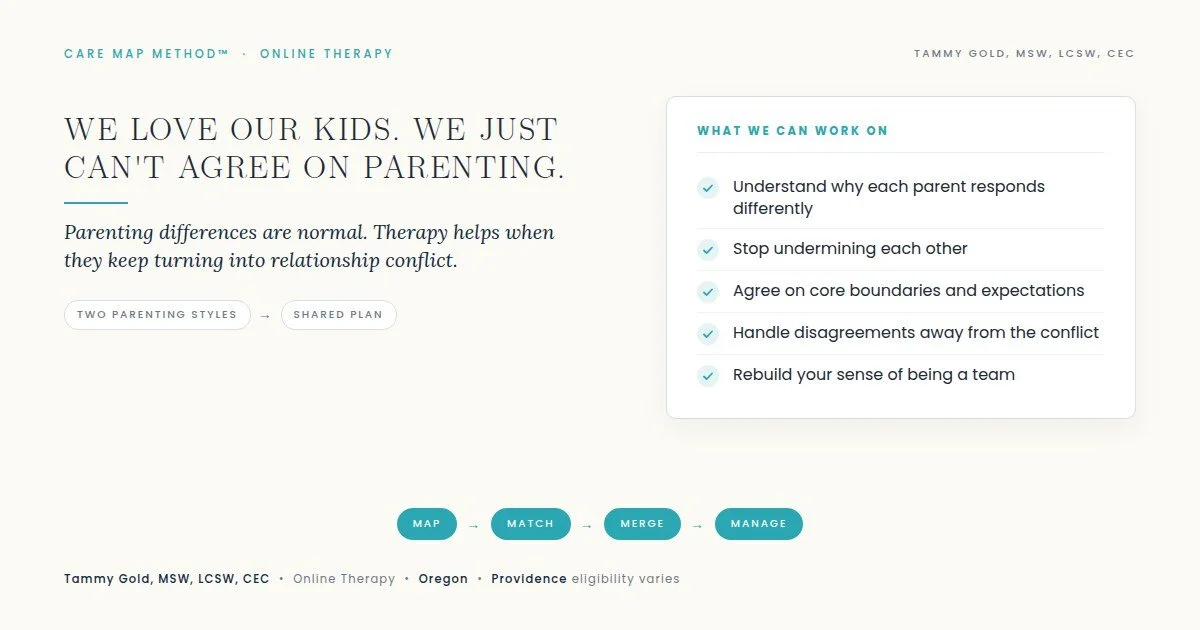
One parent thinks the other is too strict. The other thinks their partner is too permissive. One steps in, the other feels undermined, and soon the disagreement is no longer only about the child. It becomes about trust, respect and whether you still feel like a team.
Parenting differences are common. The problem is when those differences repeatedly create hostility, inconsistency or emotional distance between partners.
Where Different Parenting Styles Come From
Each parent brings a history into the room: how they were disciplined, what made them feel safe, what they never want to repeat, cultural expectations, temperament and beliefs about responsibility. Understanding those differences can reduce the assumption that your partner is simply wrong or uncaring.
What We Can Work On
Therapy can help you identify core parenting values, distinguish nonnegotiable safety issues from style differences, decide how to disagree away from children, create shared boundaries and address the emotional injuries that have developed around parenting conflict.
MAP → MATCH → MERGE → MANAGE
MAP each parent's triggers, history and current family stress.
MATCH strategies to the child's needs and the family's values.
MERGE shared expectations into a workable parenting plan.
MANAGE inevitable disagreements without turning them into attacks on the relationship.
Providence Online Therapy in Oregon
Providence may be available for eligible Oregon clients depending on the specific plan and current participation. Verify benefits before scheduling.
About Tammy Gold, MSW, LCSW, CEC
I am a licensed clinical social worker, certified coach, author and creator of the Care Map Method™. I have worked with families and relationships for more than two decades. My therapy style is warm, nonjudgmental, active and practical: one safe place to feel heard and supported while also developing language, boundaries and next steps you can use in real life.
Frequently Asked Questions
Is it normal for couples to disagree about parenting?
Yes. Different histories and values often produce different parenting instincts. The key issue is how disagreements are handled.
Can therapy help us create consistent rules?
Therapy can help clarify shared values, core boundaries and a process for handling differences.
Should we argue about parenting in front of our children?
Therapy can help couples develop a plan for discussing disagreements in ways that reduce triangulation and undermining.
Does Providence cover Oregon therapy?
Eligibility varies by plan and current network participation. Verify benefits before scheduling.
Check insurance eligibility and request an online therapy session. Therapy is available for eligible clients physically located in Oregon. Insurance eligibility, benefits and platform availability vary by plan.
Family Conflict After the Decline or Death of a Parent
A Family Crisis Can Reactivate Old Roles
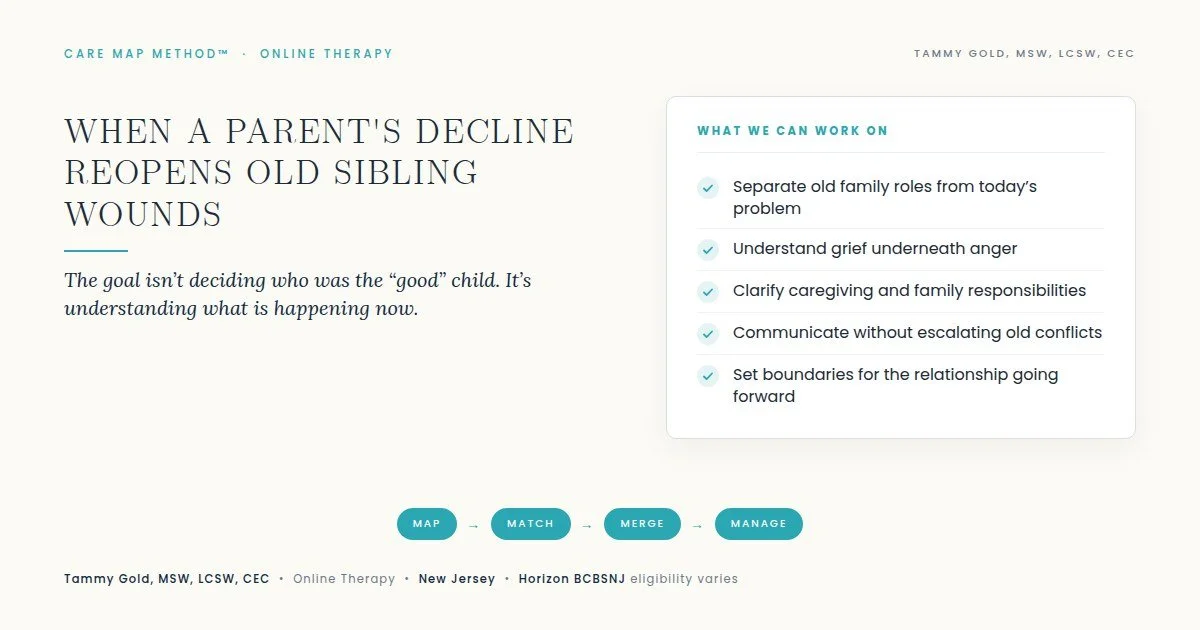
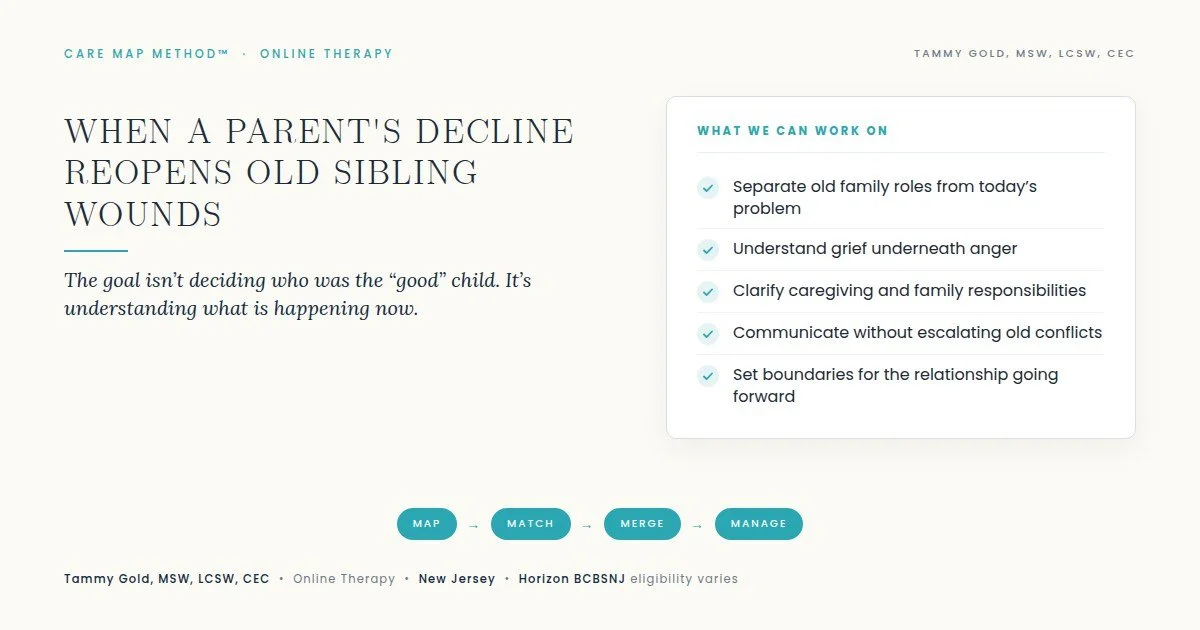
A parent's illness, decline or death can bring siblings together. It can also expose every unresolved family conflict. Who did the caregiving? Who did not? Who made decisions? Who handled money? Who visited? Who now gets to decide what happens next?
A current disagreement can quickly become attached to decades of family history: who was favored, who was responsible, who left, who stayed and who has always been expected to keep the peace.
Grief Can Look Like Anger
Family members do not always grieve in the same way or on the same timeline. One sibling may become controlling, another avoidant, another intensely practical. Therapy can help you understand what belongs to grief, what belongs to the current decision and what belongs to the older family system.
What You Can Control
You may not be able to make your siblings agree with you. You can clarify what you are responsible for, prepare for difficult conversations, set limits on disrespectful interactions and decide what kind of sibling relationship you want going forward.
Care Map Method™
MAP the current decisions, family roles and emotional triggers. MATCH responsibilities and support to what is actually needed. MERGE clearer communication and role agreements where possible. MANAGE your own boundaries when agreement is not possible.
Horizon BCBSNJ Online Therapy
Horizon BCBSNJ eligibility and benefits vary by plan and current network participation. Verify coverage before scheduling online therapy in New Jersey.
About Tammy Gold, MSW, LCSW, CEC
I am a licensed clinical social worker, certified coach, author and creator of the Care Map Method™. I have worked with families and relationships for more than two decades. My therapy style is warm, nonjudgmental, active and practical: one safe place to feel heard and supported while also developing language, boundaries and next steps you can use in real life.
Why do siblings fight more when a parent is ill?
Caregiving pressure, grief, unequal roles and old family dynamics can all intensify conflict.
Can I come to therapy without my siblings?
Yes. Individual therapy can help you clarify your role, boundaries and communication even if siblings do not attend.
Can therapy help after a parent dies?
Therapy can support grief and help address family conflict that continues or intensifies after a loss.
Does Horizon BCBSNJ cover online therapy?
Coverage depends on the individual plan and eligibility. Verify benefits before scheduling.
Check insurance eligibility and request an online therapy session. Therapy is available for eligible clients physically located in New Jersey. Insurance eligibility, benefits and platform availability vary by plan.

How to Onboard a New Nanny: The First 30 Days
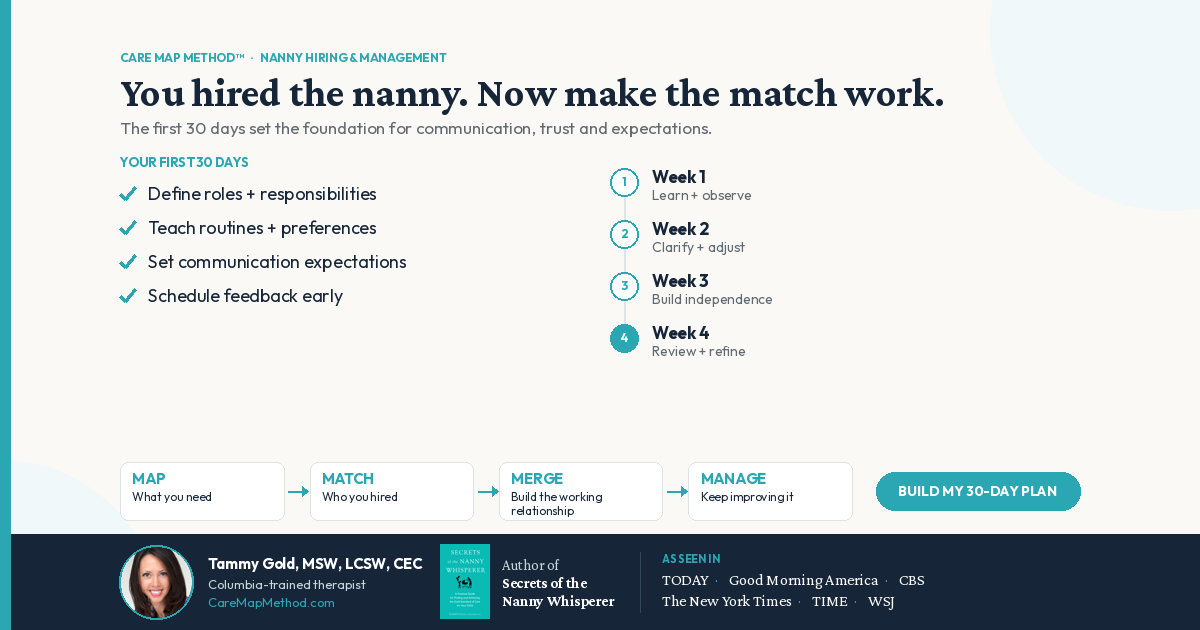
A strong nanny hire can still struggle without clear onboarding. Use the first 30 days to teach routines, establish communication and turn expectations into a workable family-caregiver system
Hiring is only the beginning
Families sometimes invest weeks finding a nanny and then treat the first day as if the new caregiver should already know how everything works. Even experienced nannies need to learn your child, home, routines, preferences and communication style.
Week one: orient
Review emergency information, household access, routines, food, sleep, transportation, activities, supplies, discipline approach and the practical details of the role. Explain what the nanny can decide independently and what requires parent approval.
Create a communication rhythm
Decide what you want communicated during the day, what belongs in an end-of-day update and what requires an immediate call. Too little communication creates anxiety; constant messaging can make it difficult for the nanny to work independently.
Give feedback early and specifically
If something matters, address it while it is still small. Describe the behavior or expectation clearly rather than assuming the nanny understands a vague comment such as “be more proactive.” Also identify what is going well.
Expect adjustment
A new nanny and child may need time to learn each other. Parents also need to adjust to sharing caregiving responsibility. Not every awkward moment is evidence of a bad match.
MERGE → MANAGE
The first month is the transition from MERGE to MANAGE. You are integrating the caregiver into the family system and then building sustainable routines for communication, feedback and changing needs.
The 30-day Care Map review
At the end of the first month, revisit the original needs map. What is working? What is unclear? What needs to change? This keeps the employment relationship responsive instead of waiting for frustration to accumulate.
How the Care Map Method™ Helps
MAP → MATCH → MERGE → MANAGE gives parents a repeatable decision system instead of relying on urgency, charisma or guesswork.
MAP: Define the child, family, role, routines, values, expectations and non-negotiables.
MATCH: Compare the candidate’s demonstrated experience, temperament, judgment and working style with the mapped needs.
MERGE: Use the trial and onboarding period to integrate nanny, child and parents into one functioning care system.
MANAGE: Create clear communication, feedback, boundaries and periodic reassessment as the child and job evolve.
Already found candidates—or not sure where to begin? I can help you prepare the interview, evaluate fit, structure screening and references, plan the trial, onboard your nanny and create a practical management system.
Book Nanny Expert Call Today So I Can Help Answer→
What should I teach a nanny on the first day?
How much should I check in during the first week?
When should I give a new nanny feedback?
What should a 30-day nanny review cover?
How long does it take a child to adjust to a new nanny?
What if the nanny is good but our communication is not working?


First Time Hiring a Nanny: A Step-by-Step Guide for Parents
Hiring your first nanny can feel overwhelming because parents are simultaneously choosing a caregiver and becoming an employer. This step-by-step guide organizes the process.
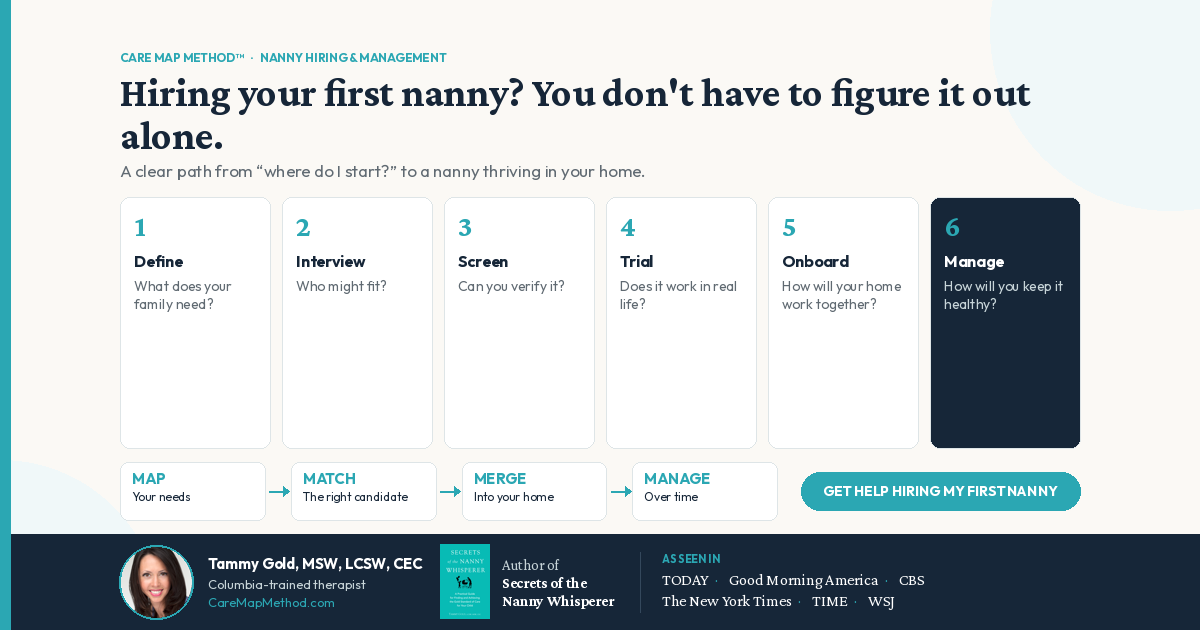
First time hiring a nanny step-by-step process from family needs through interview, screening, trial, onboarding and management.
The first nanny hire can feel much bigger than parents expect
You are not only deciding who will care for your child. You are defining a job, evaluating applicants, checking information, setting compensation and expectations, and preparing to manage someone inside your home. A system makes the process less reactive.
Step 1: MAP the job
Write down schedule, ages, responsibilities, transportation, child-related household tasks, routines, parenting approach, communication preferences and what success would look like after 30 days.
Step 2: Find and interview candidates
Whether candidates come from an agency, referral or online platform, use the same core criteria. Structured questions make comparison easier and reduce the temptation to hire solely because someone feels immediately likable.
Step 3: Screen
Verify references, credentials and background information using appropriate resources. In California, families should understand TrustLine and its role in screening in-home caregivers.
Step 4: Trial
Use a paid trial to observe how the nanny interacts with your child and functions within your real routines.
Step 5: Put expectations in writing
A written work agreement can clarify duties, schedule, compensation, guaranteed hours, time off, driving, communication and other terms. Families should obtain appropriate payroll, tax and legal guidance for their circumstances.
Step 6: Onboard
Do not hand over a list and disappear. Orient the nanny to the child, home, routines, safety information, preferences and decision-making boundaries.
Step 7: MANAGE
Schedule feedback rather than waiting until something is wrong. The nanny-family relationship needs maintenance as children develop and household needs change.
A guide beside you
I help first-time nanny employers turn an unfamiliar process into a clear sequence using MAP → MATCH → MERGE → MANAGE.
How the Care Map Method™ Helps
MAP → MATCH → MERGE → MANAGE gives parents a repeatable decision system instead of relying on urgency, charisma or guesswork.
MAP: Define the child, family, role, routines, values, expectations and non-negotiables.
MATCH: Compare the candidate’s demonstrated experience, temperament, judgment and working style with the mapped needs.
MERGE: Use the trial and onboarding period to integrate nanny, child and parents into one functioning care system.
MANAGE: Create clear communication, feedback, boundaries and periodic reassessment as the child and job evolve.
Expert CTA
Already found candidates—or not sure where to begin? I can help you prepare the interview, evaluate fit, structure screening and references, plan the trial, onboard your nanny and create a practical management system.
Book A Call So I Can Help You Answer:
Where should I start when hiring my first nanny?
Do I need a nanny contract?
What background checks should I consider?
Should I use a nanny agency?
How do I compare two strong candidates?
What should happen during the first week?
Email: Info@CareMapMethod.com Text: 818.308.1358

Nanny Trial Day: What to Watch Before You Hire
A nanny trial day lets you see what an interview cannot: how a caregiver enters your child’s world, handles routines, communicates and responds in real time.
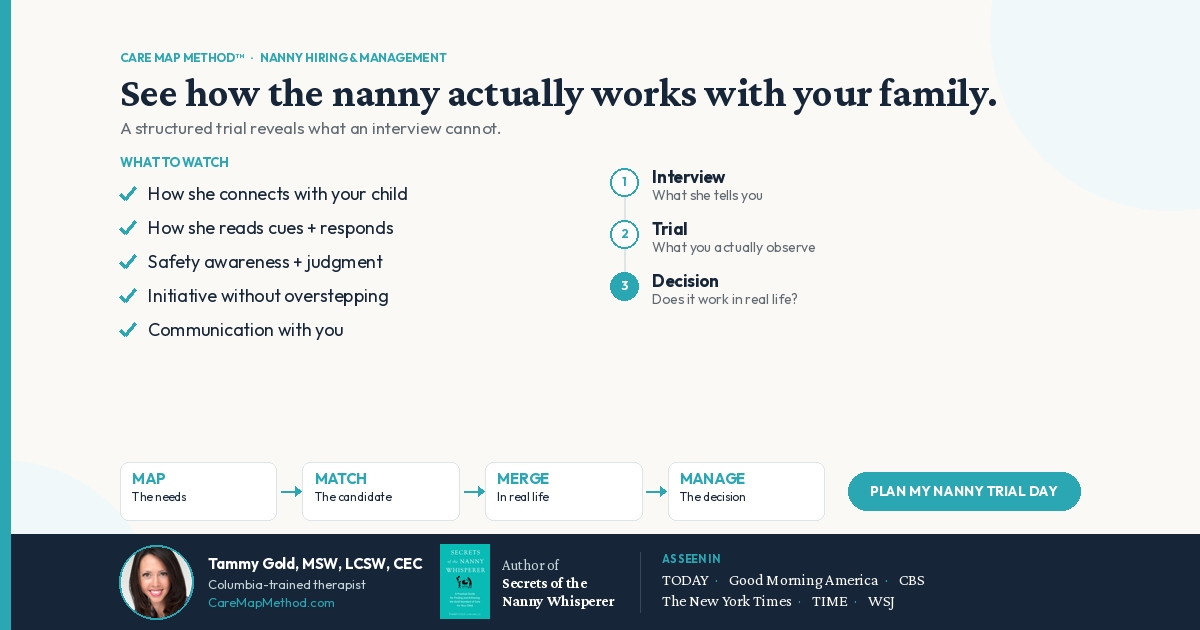
An interview tells you what a nanny says; a trial shows you how they work
A trial period can reveal how a caregiver approaches your child, follows routines, handles uncertainty, communicates with parents and adapts when the day does not go exactly as planned.
Make the trial realistic
Include ordinary parts of the job: play, meals, transitions, school pickup, nap preparation or getting out the door, depending on your child’s age. You do not need to manufacture a crisis. Real family life provides enough information.
Observe connection without demanding instant attachment
Some excellent caregivers build relationships gradually. Watch whether the nanny gets down to the child’s level, notices cues, follows the child’s interests, sets appropriate boundaries and stays emotionally steady.
Watch how the nanny handles the spaces between instructions
Does the candidate notice what needs doing? Ask appropriate questions? Respect household boundaries? Adapt when a plan changes? Initiative matters, but the right amount of initiative depends on what your family wants.
Evaluate your own reactions too
Parents can become so focused on whether the child “likes” the nanny that they miss their own concerns—or reject a strong candidate because the first hour was awkward. Use structured criteria alongside intuition.
MERGE begins during the trial
In the Care Map Method™, the trial is the beginning of MERGE: bringing caregiver, child and parents into one working system. The trial helps identify what will need to be clarified during onboarding if you move forward.
Expert trial-day planning
I help families decide what to observe, build a trial-day scorecard and debrief afterward. The goal is to convert a vague feeling of “I think she was good” into a more informed hiring decision.
How the Care Map Method™ Helps
MAP → MATCH → MERGE → MANAGE gives parents a repeatable decision system instead of relying on urgency, charisma or guesswork.
MAP: Define the child, family, role, routines, values, expectations and non-negotiables.
MATCH: Compare the candidate’s demonstrated experience, temperament, judgment and working style with the mapped needs.
MERGE: Use the trial and onboarding period to integrate nanny, child and parents into one functioning care system.
MANAGE: Create clear communication, feedback, boundaries and periodic reassessment as the child and job evolve.
Already found candidates—or not sure where to begin? I can help you prepare the interview, evaluate fit, structure screening and references, plan the trial, onboard your nanny and create a practical management system.
$195 Book Your Nanny Call Today So I Can Help Answer→
Should a nanny trial day be paid?
How long should a nanny trial be?
Should parents stay home during the trial?
What should I watch during a nanny trial?
What if my child is shy with the candidate?
Can I trial more than one nanny?

Nanny Reference Check Questions: What to Ask Former Families
A nanny reference call should verify more than employment dates. Learn what to ask former families about reliability, responsibilities, judgment, feedback and performance.
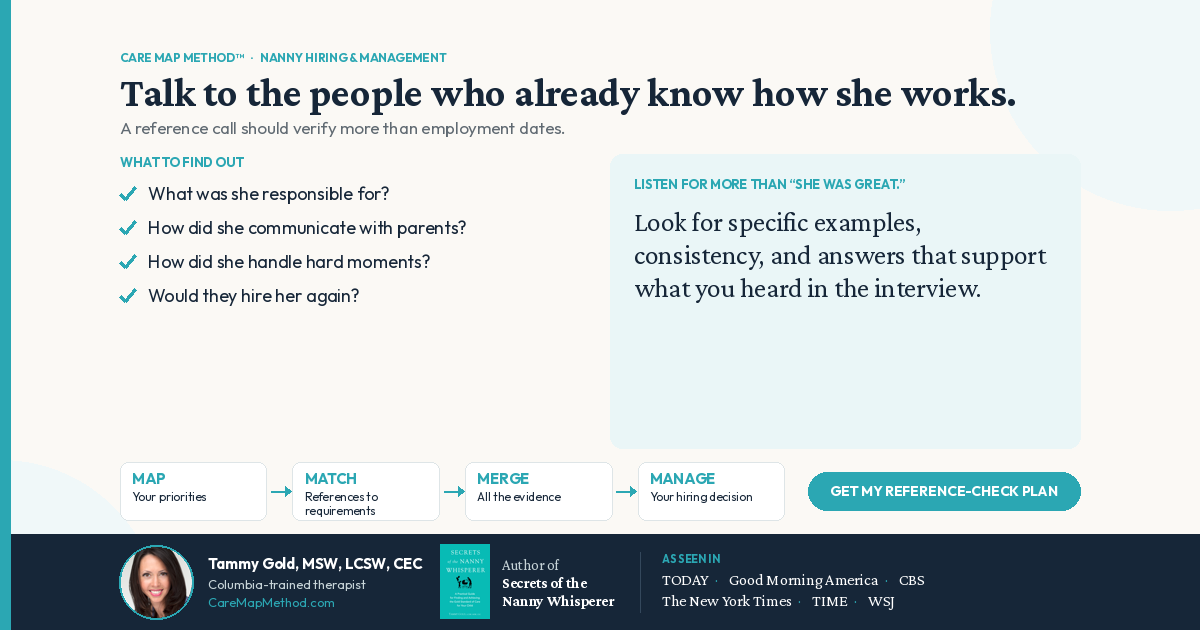
A reference check is not a formality
Parents sometimes call a reference only to ask, “Did you like her?” That leaves valuable information on the table. A former employer can help you understand what the nanny was responsible for, how reliably they performed, how they communicated and how they responded when the job became difficult.
Start by verifying the basics
Confirm how the reference knows the candidate, dates of employment, children’s ages and core responsibilities. This helps establish whether the experience described by the nanny aligns with the employer’s account.
Ask about performance in concrete terms
Explore strengths, areas for growth, reliability, initiative, interaction with children and adults, response to feedback and whether the family would hire the nanny again. TrustLine’s parent resources recommend asking these kinds of performance-focused questions.
Describe your job
Tell the reference enough about your own position to ask whether they believe the candidate would fit it. A nanny who thrived with two school-age children may need different skills for newborn twins, extensive travel or a household requiring a high level of independent planning.
Listen for substance, not just enthusiasm
A glowing reference is useful, but specific examples are more informative than generic praise. Notice whether the reference can describe what the nanny did well and how they handled challenges.
Use reference information in MATCH
MAP your family’s needs first. Then use references to MATCH the candidate’s demonstrated strengths and working style to those needs. References are one data source—not the whole decision.
How I can help
Families can bring candidate résumés, interview notes and reference information into a Care Map consultation. We can identify what still needs verification and what to observe in the next stage of the hiring process.
How the Care Map Method™ Helps
MAP → MATCH → MERGE → MANAGE gives parents a repeatable decision system instead of relying on urgency, charisma or guesswork.
MAP: Define the child, family, role, routines, values, expectations and non-negotiables.
MATCH: Compare the candidate’s demonstrated experience, temperament, judgment and working style with the mapped needs.
MERGE: Use the trial and onboarding period to integrate nanny, child and parents into one functioning care system.
MANAGE: Create clear communication, feedback, boundaries and periodic reassessment as the child and job evolve.
Already found candidates—or not sure where to begin? I can help you prepare the interview, evaluate fit, structure screening and references, plan the trial, onboard your nanny and create a practical management system.
Book Your Call Today So I Can Help You →
How many nanny references should I call?
What should I ask a nanny’s former employer?
Should references be former employers or personal references?
What if a reference gives only basic information?
Should I ask whether they would rehire the nanny?
What do I do if interview and reference information conflict?

How to Screen a Nanny Before You Hire
Screening a nanny should combine safety verification with a careful assessment of experience, reliability, judgment and fit. Here is a structured process for families.
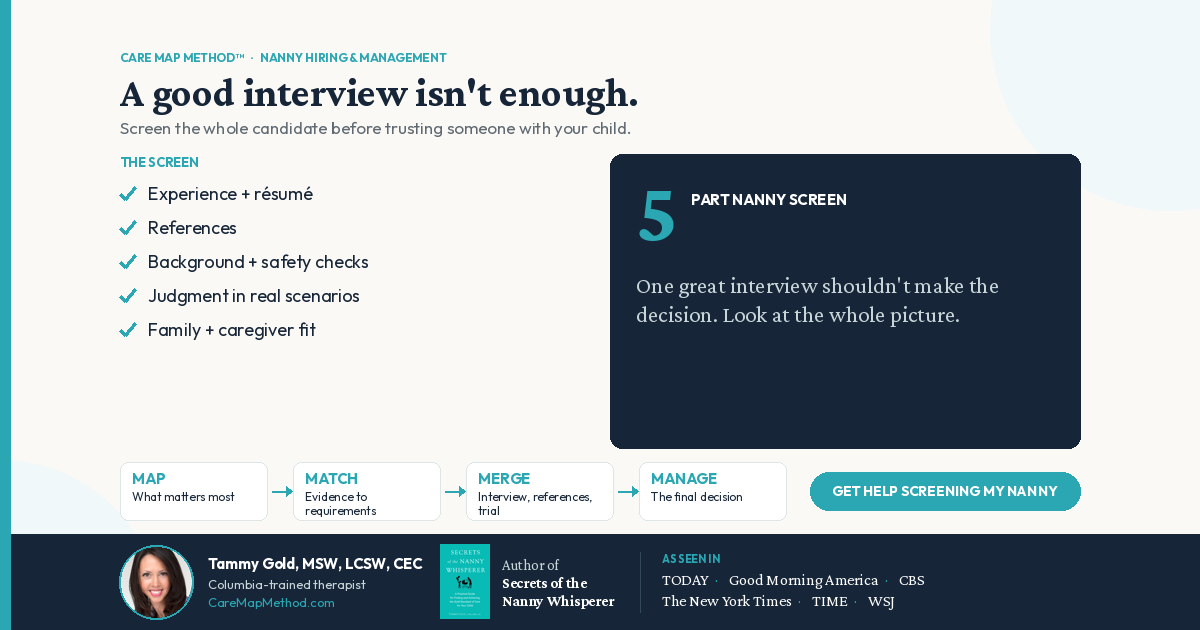
Screening is more than running a background check
A background check can be an important safety tool, but it cannot tell you whether a nanny communicates well, follows through, accepts feedback or is the right fit for your child. Good screening combines verification with human assessment.
Verify what can be verified
Confirm identity, prior employment details, relevant certifications and driving information when driving is part of the job. If something important on the résumé is unclear, ask directly rather than filling in the gap yourself.
Call references yourself
Reference conversations can help verify responsibilities, reliability, initiative, interaction with children and adults, response to feedback and whether a former employer would hire the candidate again. Ask consistent questions so you can compare candidates fairly.
Use the appropriate background-check process
California families should understand TrustLine, the state’s background-check registry for in-home and license-exempt child care providers. TrustLine checks records that ordinary private searches may not access. Families outside California should identify the screening tools and legal requirements relevant to their jurisdiction.
Screen for the job you actually have
A candidate can clear every formal screening step and still be poorly matched to the role. A family with an infant has different needs from a household with three school-age children and extensive driving. MAP the role, then MATCH the evidence you have about the candidate against it.
Do not ignore discrepancies
If dates, responsibilities or explanations change, slow down and clarify. A discrepancy does not automatically mean someone is unsuitable, but an important unresolved inconsistency should not be brushed aside because you are eager to hire.
My role as a nanny hiring expert
I help families organize the screening process, prepare reference questions, evaluate information and distinguish between a safety issue, a skills gap and a simple mismatch. The goal is a thoughtful decision—not false certainty.
How the Care Map Method™ Helps
MAP → MATCH → MERGE → MANAGE gives parents a repeatable decision system instead of relying on urgency, charisma or guesswork.
MAP: Define the child, family, role, routines, values, expectations and non-negotiables.
MATCH: Compare the candidate’s demonstrated experience, temperament, judgment and working style with the mapped needs.
MERGE: Use the trial and onboarding period to integrate nanny, child and parents into one functioning care system.
MANAGE: Create clear communication, feedback, boundaries and periodic reassessment as the child and job evolve.
Already found candidates—or not sure where to begin? I can help you prepare the interview, evaluate fit, structure screening and references, plan the trial, onboard your nanny and create a practical management system. I can also help screen the nanny with you.
Book A Call With Me To Get Expert Nanny Hiring Help To Answer→
What background check should I run on a nanny?
What is TrustLine in California?
How many nanny references should I check?
Should I verify CPR and First Aid?
What if a nanny has limited professional references?
Is a background check enough to know a nanny is safe?

Nanny Interview Questions: What Parents Should Really Ask
The best nanny interview questions do more than confirm experience. Learn how to ask questions that reveal judgment, caregiving style, communication and whether a candidate fits your child and family.
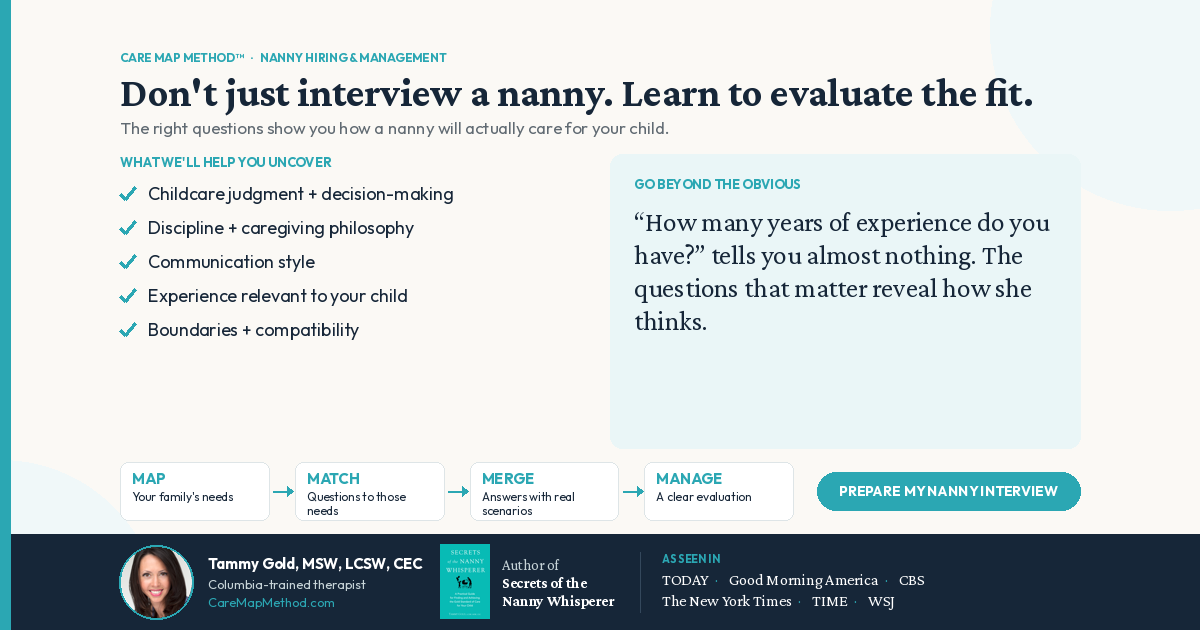
A nanny interview is not a conversation you should improvise
Parents often leave an interview knowing that a candidate seems nice and has experience, but still not knowing how that person would care for their child on an ordinary, difficult Tuesday. The purpose of the interview is not to find the candidate with the most polished answers. It is to understand how the person thinks, communicates, responds under stress and approaches children.
Begin with your own Care Map
Before writing questions, identify the realities of the job. What situations happen repeatedly in your home? What does your child need when upset? How structured are your routines? How much initiative do you want? What household tasks truly belong to the nanny role? The interview becomes more useful when your questions come from your actual needs.
Ask for examples, not adjectives
Instead of asking “Are you patient?” ask for a time a child had a prolonged tantrum and what the nanny did. Instead of “Are you organized?” ask how the candidate managed schedules, supplies and transitions in a prior job. Past examples and realistic scenarios reveal more than yes/no questions.
Cover the domains that matter
Ask about age-specific experience, safety and emergencies, routines, feeding and sleep where relevant, discipline and boundaries, activities and development, communication with parents, transportation, reliability, household expectations, feedback and conflict. For California candidates, ask about TrustLine status and appropriate CPR/First Aid preparation.
Notice the questions the nanny asks you
Strong candidates should also be evaluating the job. Their questions can reveal what they prioritize: the child’s routines, parenting philosophy, expectations, schedule, communication, compensation, boundaries or professional development. A nanny who asks thoughtful questions is gathering the information needed to determine whether the job fits them too.
Use MAP → MATCH rather than intuition alone
MAP the job and child first. Then MATCH each candidate against the same criteria. This reduces the risk of being overly influenced by charisma, urgency or one impressive credential. You can still value your instincts, but place them alongside observable information.
What I help families do
I help parents build interview questions around their actual child and household, prepare follow-up questions, interpret answers and compare candidates. The goal is not to turn parents into professional recruiters. It is to give them a disciplined way to make a very personal decision.
How the Care Map Method™ Helps
MAP → MATCH → MERGE → MANAGE gives parents a repeatable decision system instead of relying on urgency, charisma or guesswork.
MAP: Define the child, family, role, routines, values, expectations and non-negotiables.
MATCH: Compare the candidate’s demonstrated experience, temperament, judgment and working style with the mapped needs.
MERGE: Use the trial and onboarding period to integrate nanny, child and parents into one functioning care system.
MANAGE: Create clear communication, feedback, boundaries and periodic reassessment as the child and job evolve.
Already found candidates—or not sure where to begin? I can help you prepare the interview, evaluate fit, structure screening and references, plan the trial, onboard your nanny and create a practical management system.
Get Expert Nanny Hiring Help $195 Nanny Expert Call To Answer →
What are the most important questions to ask a nanny? .
Should both parents attend the nanny interview?
What nanny interview questions reveal red flags?
Should I ask hypothetical scenario questions?
Can I ask about CPR and background screening?
How long should a nanny interview be?
Nanny Booking Session Link

How to Hire the Right Nanny: Interview, Screen, Trial, Onboard & Manage
Hiring a nanny is not just about finding someone with experience. It is about finding the caregiver who fits your child, family, parenting style and everyday needs. Tammy Gold helps families interview, screen, evaluate, trial, onboard and manage nannies using the Care Map Method™.
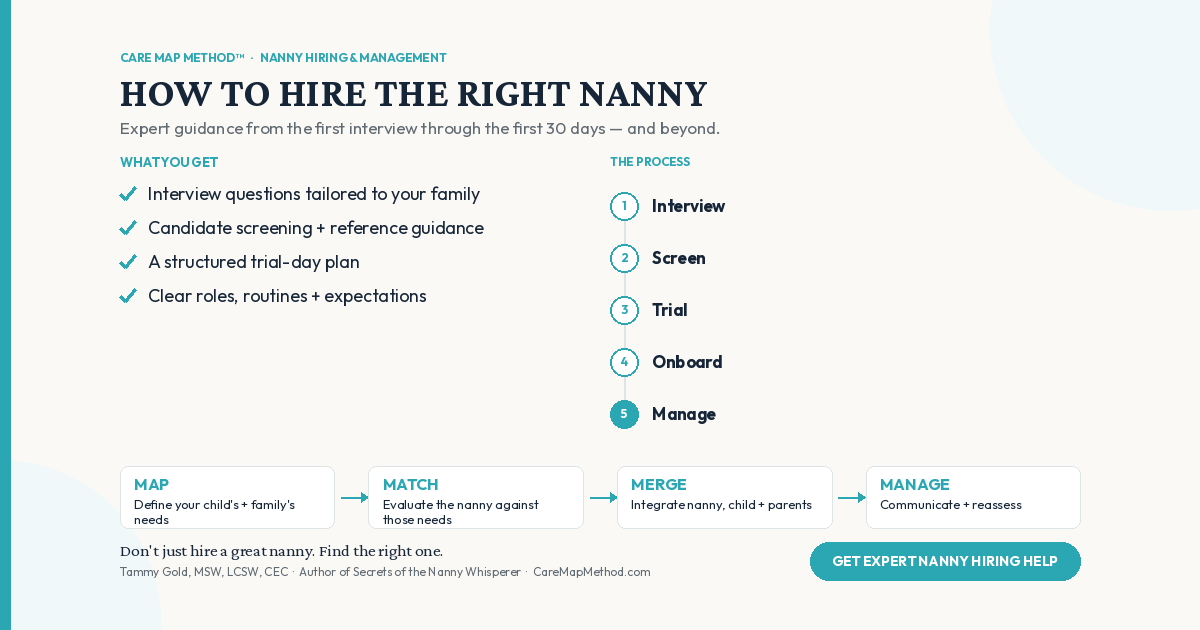
Hiring a nanny is one of the most personal hiring decisions a family makes
A nanny works inside your home, participates in your child’s daily routines and becomes part of the emotional and practical system of family life. Yet many parents are asked to make this decision using the same tools they would use for an ordinary job hire: a résumé, a short interview and a few references. Those pieces matter, but they do not answer the most important question: Is this the right caregiver for this child and this family?
Start with the family, not the candidate
Before you interview anyone, define what the job actually requires. Consider your child’s age and temperament, schedule, transitions, sleep and feeding routines, activity level, parenting approach, household expectations, transportation needs and the amount of initiative you want a nanny to take. A highly experienced nanny can still be the wrong match if the family and caregiver have incompatible expectations.
Interview for real-life fit
A strong nanny interview goes beyond “How many years have you worked with children?” Ask candidates to describe what they would do in situations that resemble your real life: a toddler refusing to leave the park, an infant who will not settle, siblings fighting, a parent running late, or a disagreement about a household rule. You are listening for judgment, flexibility, warmth, communication and whether the nanny’s instincts align with your family.
Screen carefully and verify
References and background screening are separate parts of the process. References help you understand how someone actually performed in prior jobs; background checks verify different kinds of safety information. For California families, TrustLine is an important state-run screening resource for in-home and license-exempt child care providers. Screening should complement—not replace—interviews, references and assessment of fit.
Use a trial to observe, not to stage a performance
A paid trial gives you information an interview cannot. Watch how the nanny enters your child’s world, responds to cues, handles transitions, communicates with you, takes initiative and recovers when something does not go perfectly. The goal is not perfection. The goal is to see the caregiver’s natural style and how it fits your family.
Onboarding is part of hiring
The hiring decision is not finished when the nanny says yes. The first days and weeks establish expectations around routines, communication, safety, household responsibilities, decision-making, privacy, schedule changes and feedback. A thoughtful onboarding process reduces ambiguity and gives both the family and nanny a clearer path to success.
The Care Map Method™: MAP → MATCH → MERGE → MANAGE
MAP your child, family and job needs.
MATCH those needs to the caregiver’s experience, temperament and working style.
MERGE the nanny into the family system through a structured trial, orientation and communication plan.
MANAGE the relationship through feedback, clear expectations and reassessment as your child and family change.
Expert guidance when the decision feels too important to guess
I am Tammy Gold, MSW, LCSW, CEC, author of Secrets of the Nanny Whisperer and creator of the Care Map Method™. For more than two decades, my work with families has focused on understanding children, parents, caregivers and the relationships between them. Families can work with me to prepare for interviews, evaluate candidates, structure trials, onboard a new nanny and create a practical management plan.
How the Care Map Method™ Helps
MAP → MATCH → MERGE → MANAGE gives parents a repeatable decision system instead of relying on urgency, charisma or guesswork.
MAP: Define the child, family, role, routines, values, expectations and non-negotiables.
MATCH: Compare the candidate’s demonstrated experience, temperament, judgment and working style with the mapped needs.
MERGE: Use the trial and onboarding period to integrate nanny, child and parents into one functioning care system.
MANAGE: Create clear communication, feedback, boundaries and periodic reassessment as the child and job evolve.
Already found candidates—or not sure where to begin? I can help you prepare the interview, evaluate fit, structure screening and references, plan the trial, onboard your nanny and create a practical management system.
Get $195 Expert Nanny Hiring Help Call To Answer →
What should I look for when hiring a nanny?
How many nanny candidates should I interview?
Should I do a paid nanny trial day?
What is the difference between a reference check and a background check?
How do I know whether a nanny is the right personality fit?
What should be included in nanny onboarding?
Can you help if I already found my own candidates?
Book Your Nanny Session Today

My Adult Child Only Calls When They Need Something
Therapy for parents struggling with adult-child boundaries, resentment, guilt and one-sided relationships in New Jersey.
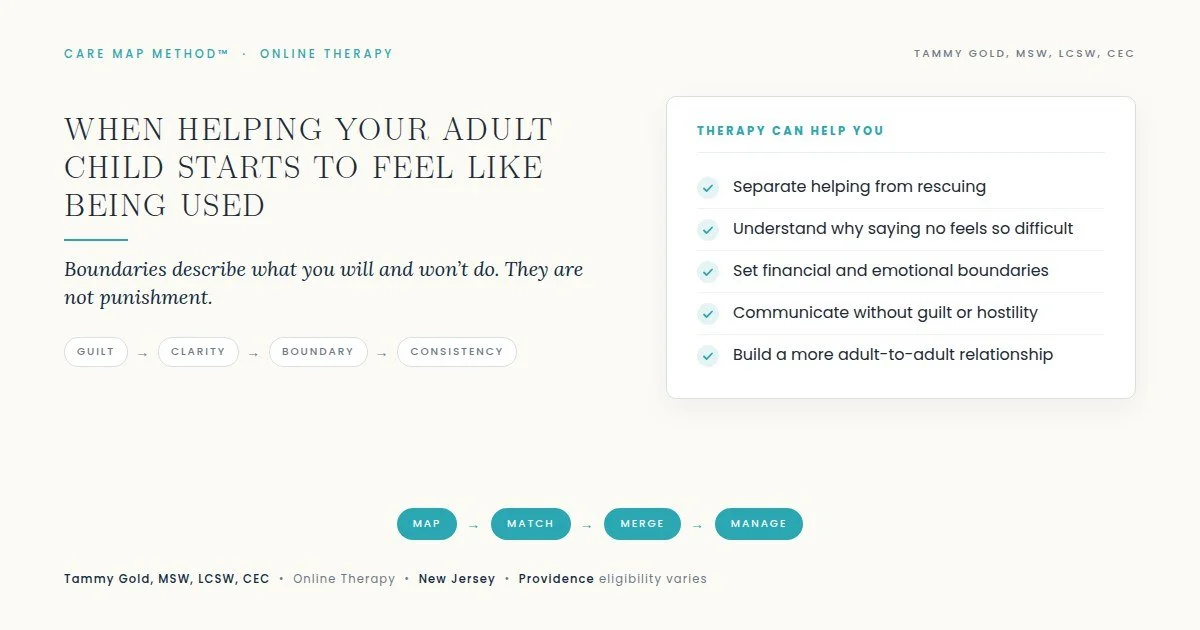
Therapy for parents struggling with adult-child boundaries, resentment, guilt and one-sided relationships in New Jersey.
When Helping Stops Feeling Like a Choice
You love your adult child and want to help. But perhaps the calls increasingly come when money is needed, childcare falls through, a crisis needs solving or something has gone wrong. When you want closeness, consideration or simple connection, the relationship may feel very different.
It can be painful to admit that helping has begun to feel one-sided. Many parents then feel guilty for having resentment at all.
Helping, Rescuing and Boundaries
Therapy can help you separate generosity from obligation and support from rescuing. We can examine what you fear will happen if you say no, what expectations have developed over time and whether your current pattern is sustainable.
A boundary is not a punishment. It describes what you will and will not do. It can involve money, availability, childcare, crisis calls, housing, transportation or the way you are spoken to.
Building an Adult-to-Adult Relationship
The parent-child relationship changes when a child becomes an adult. Therapy can help you identify where old roles are still operating and practice language that respects your adult child's autonomy while also protecting your own needs.
MAP → MATCH → MERGE → MANAGE
MAP the current exchange and emotional pattern. MATCH your support to what you are genuinely willing and able to provide. MERGE boundaries into clear communication. MANAGE the boundary consistently even when guilt or pushback appears.
Providence and Online Therapy in New Jersey
Providence eligibility depends on the individual plan and current network participation. Verify benefits and availability before scheduling online therapy in New Jersey.
About Tammy Gold, MSW, LCSW, CEC
I am a licensed clinical social worker, certified coach, author and creator of the Care Map Method™. I have worked with families and relationships for more than two decades. My therapy style is warm, nonjudgmental, active and practical: one safe place to feel heard and supported while also developing language, boundaries and next steps you can use in real life.
Frequently Asked Questions
How do I set a boundary with an adult child without losing them?
A boundary can focus on what you will do rather than controlling them. Therapy can help you make it specific, respectful and sustainable.
Is it wrong to stop giving my adult child money?
Financial support is a personal and family decision. Therapy can help you clarify your limits, fears and goals.
What if my child becomes angry when I say no?
Therapy can help you prepare for pushback and remain consistent without escalating the conflict.
Does Providence cover this therapy?
Eligibility varies by plan and current participation. Verify benefits before scheduling.
Check insurance eligibility and request an online therapy session. Therapy is available for eligible clients physically located in New Jersey. Insurance eligibility, benefits and platform availability vary by plan.
Therapy on Headway, Grow & Alma Email: Info@caremapmethod.com Text: 818.308.1358

Therapy After Your Adult Child Cuts You Off
Support for parents coping with adult-child estrangement, grief, rejection and boundaries. Online New Jersey therapy with Tammy Gold, LCSW.
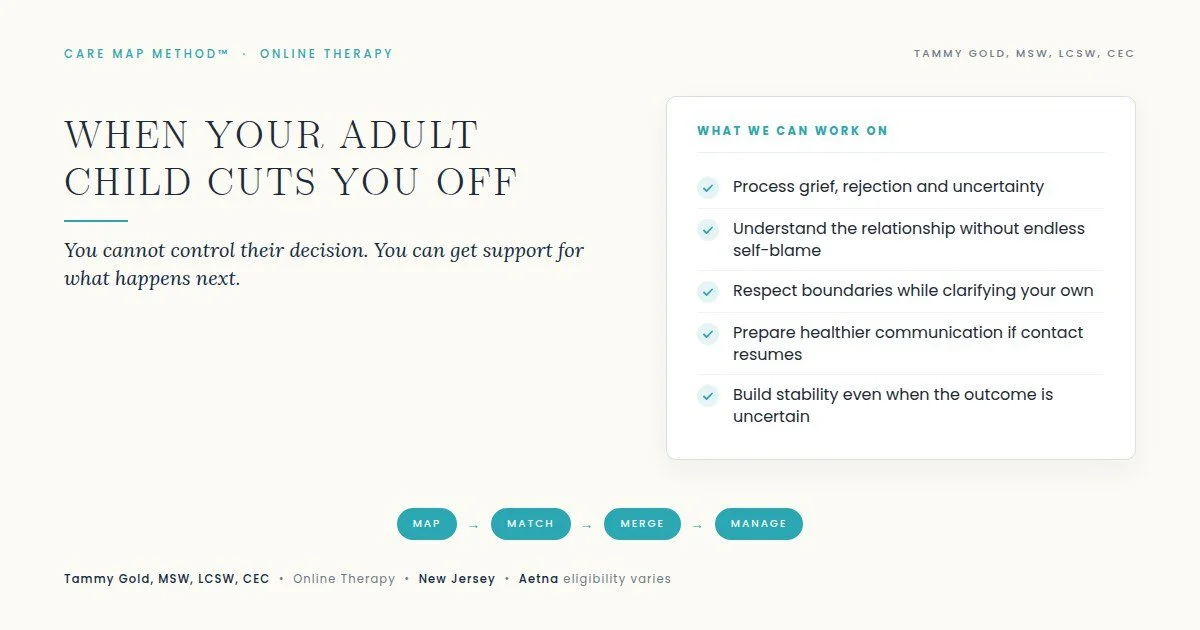
upport for parents coping with adult-child estrangement, grief, rejection and boundaries. Online New Jersey therapy with Tammy Gold, LCSW.
Estrangement Creates a Particular Kind of Grief
When your adult child stops speaking to you, there may be no clear ending and no clear way to grieve. Your child is still alive and you still love them, but the relationship you knew may be gone or radically changed.
You may replay every conversation, search for the moment everything changed, alternate between anger and guilt, or feel an urgent need to fix the relationship immediately. Therapy can give you somewhere to process the loss without pretending the uncertainty is easy.
Therapy Cannot Promise Reconciliation
No therapist can guarantee that an adult child will resume contact. Therapy can help you understand the relationship history, separate accountability from endless self-blame, manage the urge to repeatedly reach out, and decide what respectful communication and boundaries look like for you.
What We Can Work On
We can address grief, rejection, shame, anger, confusion, family roles and the fear that accepting the current reality means giving up hope. We can also prepare for future communication if contact resumes, while helping you build a life that is not entirely organized around waiting.
Care Map Method™ for Estrangement
MAP what happened and what you are experiencing now.
MATCH the support to the emotional and relational needs involved.
MERGE healthier communication only where contact is appropriate and possible.
MANAGE your wellbeing and boundaries while the outcome remains uncertain.
Aetna Online Therapy in New Jersey
I provide online therapy for eligible clients physically located in New Jersey. Aetna may be available depending on your plan, eligibility and current network participation through Headway or Alma. Verify benefits before scheduling.
About Tammy Gold, MSW, LCSW, CEC
I am a licensed clinical social worker, certified coach, author and creator of the Care Map Method™. I have worked with families and relationships for more than two decades. My therapy style is warm, nonjudgmental, active and practical: one safe place to feel heard and supported while also developing language, boundaries and next steps you can use in real life.
Frequently Asked Questions
Should I keep contacting an estranged adult child?
There is no universal answer. Therapy can help you consider boundaries, prior requests, your goals and the likely impact of different choices.
Can therapy reunite me with my adult child?
Therapy cannot guarantee reconciliation. It can support grief, accountability, boundaries and healthier communication if contact is possible.
Is estrangement grief normal?
Many parents experience grief, rejection, uncertainty, anger and shame during estrangement. Therapy can provide support for these reactions.
Does Aetna cover online therapy in New Jersey?
Coverage varies by plan and eligibility. Verify benefits before scheduling.
EMAIL: Info@CareMapMethod.com. TEXT: 818.308.1358
Check insurance eligibility and request an online therapy session. Therapy is available for eligible clients physically located in New Jersey. Insurance eligibility, benefits and platform availability vary by plan.

I Feel Like I Do Everything in My Marriage
Feeling like you carry everything in your marriage? Online California therapy for resentment, emotional labor, communication and relationship stress.
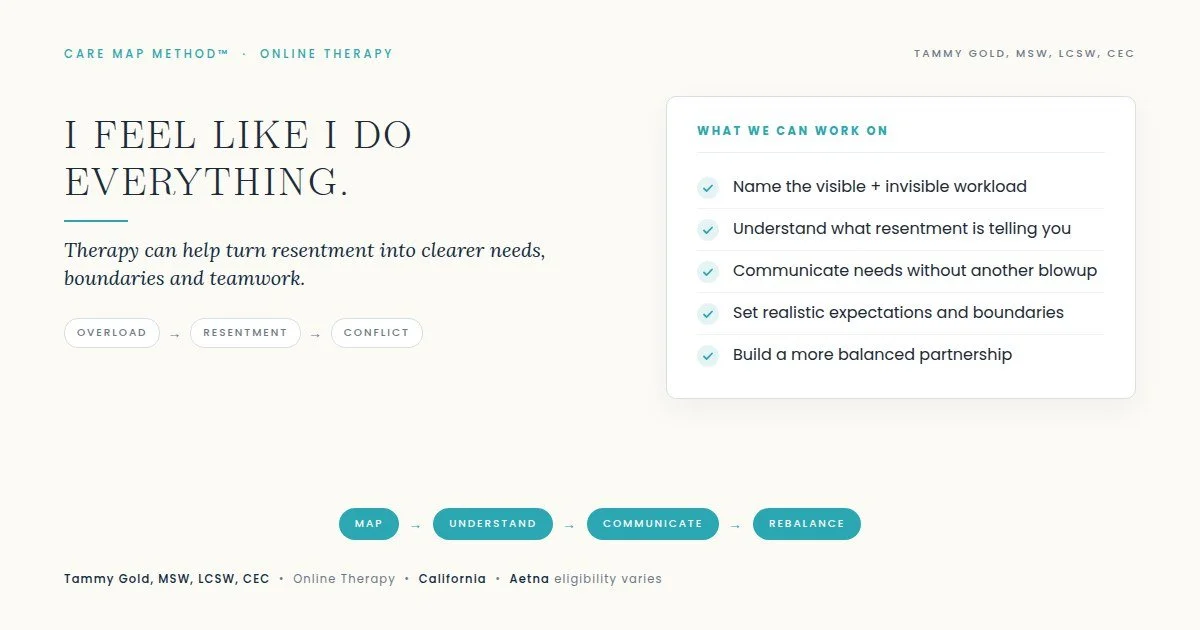
emotional labor marriage; unequal marriage responsibilities; resent husband; overwhelmed wife therapy; Aetna therapy California
When the Invisible Work Becomes Too Heavy
You remember the appointments, manage the calendar, anticipate what the children need, notice what is running out and keep track of what has to happen next. The practical workload matters, but the emotional meaning of carrying it can hurt even more.
You may begin to feel invisible, unsupported or more like the manager of the household than a partner in it. Resentment often grows when responsibility and appreciation feel chronically out of balance.
Therapy Can Separate Workload From Meaning
We can map what you are actually carrying, including invisible mental labor. Then we can look at what the imbalance means to you: unsupported, unimportant, alone, controlled, taken for granted or afraid that everything will fall apart if you stop managing it.
We can also examine whether overfunctioning, perfectionism, difficulty asking directly, or a partner's avoidance contributes to the pattern without turning the work into blame.
From Resentment to a More Useful Conversation
The goal is not to keep score. It is to make the workload and emotional impact visible enough to discuss. Therapy can help you turn 'You never help' into more specific conversations about responsibility, expectations, follow-through and appreciation.
Care Map Method™
MAP the visible tasks, invisible labor and emotional pattern. MATCH responsibilities and support to the real needs of the household. MERGE clearer agreements into daily life. MANAGE the plan as work, children, health and family demands change.
Aetna Online Therapy in California
Aetna may be available for eligible California clients through Headway or Alma depending on current participation and the specific plan. Verify benefits before scheduling.
About Tammy Gold, MSW, LCSW, CEC
I am a licensed clinical social worker, certified coach, author and creator of the Care Map Method™. I have worked with families and relationships for more than two decades. My therapy style is warm, nonjudgmental, active and practical: one safe place to feel heard and supported while also developing language, boundaries and next steps you can use in real life.
Frequently Asked Questions
What is emotional labor in a marriage?
It can include the planning, remembering, anticipating and emotional coordination that keeps a household and family functioning.
Can therapy help with resentment toward my spouse?
Therapy can help identify what resentment is communicating, clarify needs and develop more specific conversations and boundaries.
What if my spouse thinks the workload is already equal?
Therapy can help make visible and invisible responsibilities more concrete and explore how each person experiences the division.
Can I use Aetna?
Aetna eligibility varies by plan and current network participation. Verify benefits before booking.
Check insurance eligibility and request an online therapy session. Therapy is available for eligible clients physically located in California. Insurance eligibility, benefits and platform availability vary by plan.

Finding the right nanny is only the beginning.
Hiring a nanny is only the beginning. These five first-week steps help parents and professional nannies establish clearer routines, expectations, communication and trust from the start.
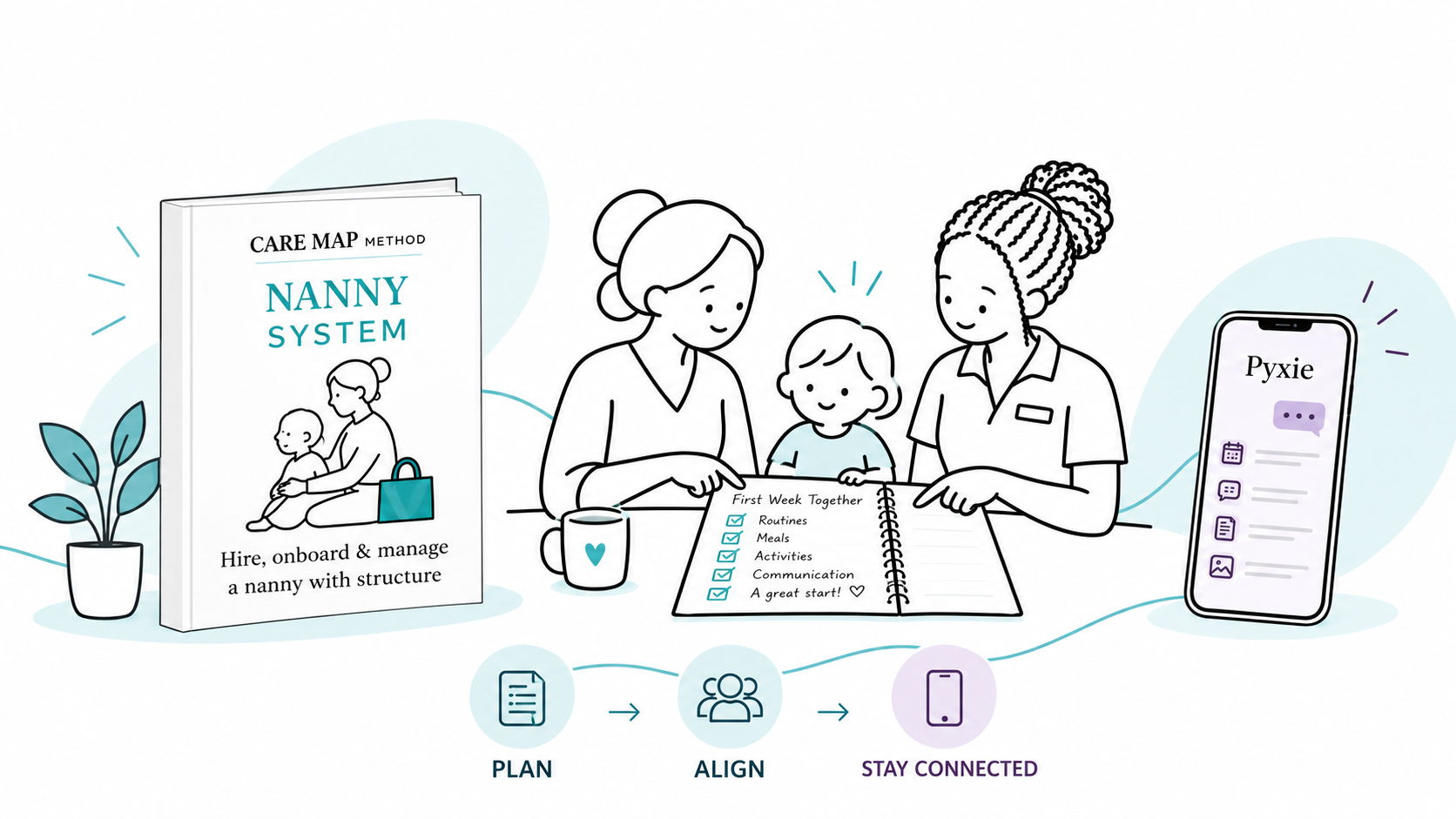
Parent and professional nanny use the CMM Nanny System and Pyxie app to plan routines, expectations and communication for their first week together.
Five Things to Do After You Hire a Nanny
Hiring the right nanny is an important first step—but the relationship still needs a thoughtful beginning. These five Care Map Method™ steps can help your family and nanny create clarity, trust, and a stronger first week together.
1. Map your child’s real needs
Before creating a list of tasks, consider your child’s complete needs: biological, emotional, social, and environmental. Share important information about routines, temperament, comfort, sleep, meals, transitions, activities, and the home environment.
A nanny needs to understand not only what to do, but what helps your child feel secure and function well.
2. Clarify expectations before the first day
Discuss the practical details that are often left unspoken: schedule, responsibilities, household boundaries, transportation, phone use, outings, meals, visitors, photos, safety procedures, and what should happen when plans change.
Clear expectations are not micromanagement. They give both adults a dependable starting point.
3. Build the first-week plan together
Parents know their child and household. Experienced nannies bring professional observations, judgment, and ideas. Invite your nanny to ask questions and contribute to the plan.
The goal is not to hand over a long instruction manual. It is to create shared context that both adults understand and can realistically use.
4. Agree on how you will communicate
Decide what should be shared immediately, what belongs in the daily handoff, and what can wait for a scheduled conversation. Choose one dependable place for routines, updates, questions, and changes so important information is not scattered across texts, notes, and memory.
Good communication should keep everyone informed without making the nanny feel constantly monitored.
5. Schedule a seven-day check-in
Do not let small misunderstandings become recurring frustrations. At the end of the first week, ask:
What is working well?
What has been different from what we expected?
What does the nanny need from the family?
What does the family need clarified?
What should we change for the following week?
The first plan does not have to be perfect. It needs to be clear enough to use—and flexible enough to improve.
Turn These Five Steps Into a Working System
The CMM Nanny System helps you plan the relationship. Pyxie helps your family and nanny keep that shared plan organized and useful in daily life.
Practical guidance from Tammy Gold, MSW, LCSW, CEC
Tammy Gold is a licensed therapist, certified coach, caregiving author, and author of Secrets of the Nanny Whisperer. For more than 20 years, she has helped families understand caregiving relationships, clarify expectations, and navigate the human side of care.
Her independently developed CMM Nanny System is being made available as a limited complimentary resource for eligible participants in this Pyxie trial.
Eligibility
This free trial may be right for you if:
you have already hired a professional nanny;
you are willing to complete Pyxie onboarding;
you want clearer routines, communication, and expectations; and
you agree to provide brief feedback about the experience.
This trial is not a nanny-placement service, background-check service, payroll service, monitoring service, emergency service, or substitute for legal, employment, medical, or mental-health advice.
Give your new caregiving relationship a clearer start.
Download Pyxie free and receive the CMM Nanny System as your complimentary trial bonus.

When Your Partner Won't Communicate
Online California therapy for relationship withdrawal, communication breakdown and emotional distance with Tammy Gold, LCSW. Providence may be available.

partner will not communicate therapy California
When Every Conversation Ends in Silence or Defensiveness
You try to talk. Your partner says nothing is wrong, changes the subject, becomes defensive or leaves the room. You may start pushing harder because you need a response, while your partner withdraws even further. Over time, the communication problem can become the relationship problem.
Therapy can help you understand the cycle rather than simply telling you to communicate better. The important questions are what happens before the shutdown, what each person experiences during it, and what keeps the pattern going.
What Therapy Can Help You Change
We can identify emotional triggers, clarify what you are actually trying to communicate, practice language that is direct without escalating the conflict, and establish boundaries around disrespectful or unproductive communication.
You can also learn when to continue a conversation, when to pause, and how to return to difficult topics without restarting the same fight.
If Your Partner Will Not Come to Therapy
You can still come. Individual therapy can help you understand your side of the pursue-withdraw pattern, reduce reactivity, clarify your needs and decide what you want from the relationship. Progress does not require controlling another person's behavior.
Using MAP → MATCH → MERGE → MANAGE
MAP the sequence of the communication breakdown.
MATCH the strategy to what is actually happening.
MERGE new language, timing and boundaries into real interactions.
MANAGE the plan by noticing what helps and adjusting what does not.
Providence Online Therapy in California
I provide online therapy for eligible California clients. Providence participation and benefits vary by plan and should be verified through the appropriate booking platform before scheduling.
About Tammy Gold, MSW, LCSW, CEC
I am a licensed clinical social worker, certified coach, author and creator of the Care Map Method™. I have worked with families and relationships for more than two decades. My therapy style is warm, nonjudgmental, active and practical: one safe place to feel heard and supported while also developing language, boundaries and next steps you can use in real life.
Frequently Asked Questions
Can therapy help if my partner refuses to attend?
Yes. Individual therapy can help you change your own responses, clarify needs and boundaries, and decide what you want.
Why does my partner shut down during conflict?
There can be many reasons, including overwhelm, fear, learned communication patterns or defensiveness. Therapy can help you understand your specific pattern without assuming one cause.
Can communication improve without couples therapy?
One person changing a recurring interaction can affect the pattern, though no specific outcome can be guaranteed.
Does Providence cover therapy in California?
Eligibility varies by plan and current network participation. Verify benefits before scheduling.
Check insurance eligibility and request an online therapy session. Therapy is available for eligible clients physically located in California. Insurance eligibility, benefits and platform availability vary by plan.

My Marriage Is Falling Apart, but I Don't Want a Divorce
Marriage struggling but you don't want a divorce? Online California therapy with Tammy Gold, LCSW for conflict, disconnection and relationship uncertainty. Aetna may be available.
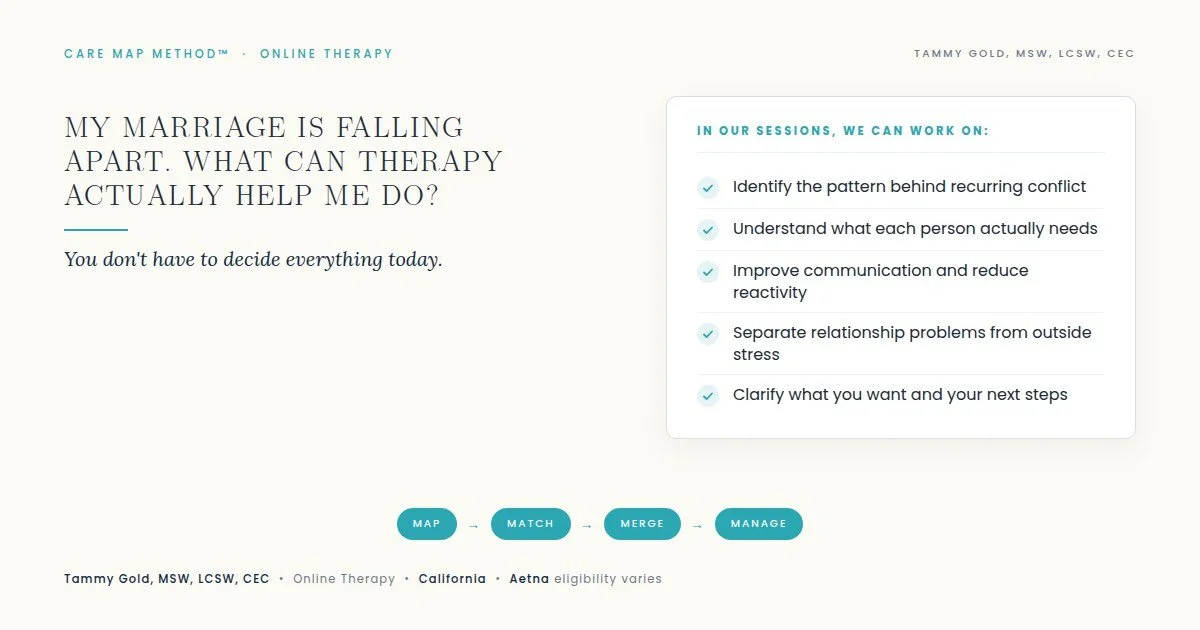
marriage falling apart; do not want divorce; relationship crisis therapist; emotionally disconnected marriage; Aetna therapist California
My Marriage Is Falling Apart, but I Don't Want a Divorce | Aetna Therapy in California
You Don't Have to Decide Everything Before Starting Therapy
You may know that your marriage cannot keep going exactly as it is without knowing whether you want it to end. You may still love your spouse and also feel exhausted, lonely, angry or unsure how much longer you can keep repeating the same pattern.
Some people arrive in therapy asking, 'Can this get better?' Others are asking, 'How do I know whether I have tried enough?' You do not need to answer either question before you begin. Therapy can be a place to slow the situation down, understand what is actually happening and make decisions with more clarity and less pressure.
What We Can Work On
We can look at what repeatedly triggers conflict, what each person may be trying to communicate underneath the argument, where resentment has accumulated, and how work, parenting, money, caregiving or other pressures are affecting the relationship.
Individual therapy can also be useful when your spouse does not attend. You can examine your own responses, needs, boundaries and choices without making the entire process dependent on another person's participation.
The Care Map Method™
MAP: We identify the relationship pattern and the biological, emotional, social and environmental pressures affecting it. MATCH: We clarify the support, communication and boundaries that may fit the actual problem. MERGE: We practice how to bring those changes into real conversations and daily life. MANAGE: We evaluate what is changing, what is not, and what your next steps need to be.
Therapy cannot guarantee reconciliation or prevent divorce. It can help you understand the relationship, your own needs and the choices in front of you more clearly.
A Safe Place Without Shame or Blame
My approach is warm, active and practical. The goal is not to turn therapy into a courtroom or decide which person is the villain. We can acknowledge hurt and accountability while also identifying the pattern that keeps both people stuck.
You deserve one place where you can say the complicated parts out loud without being rushed into a decision.
Online Therapy and Aetna in California
I provide online psychotherapy for eligible clients physically located in California. Depending on your specific plan, eligibility and current network participation, Aetna may be available through Headway or Alma. Benefits, deductibles, copays and eligibility should be verified before scheduling.
About Tammy Gold, MSW, LCSW, CEC
I am a licensed clinical social worker, certified coach, author and creator of the Care Map Method™. I have worked with families and relationships for more than two decades. My therapy style is warm, nonjudgmental, active and practical: one safe place to feel heard and supported while also developing language, boundaries and next steps you can use in real life.
Frequently Asked Questions
Can I come without my spouse?
Yes. Individual therapy can help you understand your relationship, responses, needs and choices even if your spouse does not attend.
Will you tell me whether I should divorce?
No. Therapy can help you evaluate the relationship and your needs; the decision remains yours.
Can therapy help if we have been unhappy for years?
Therapy can help identify patterns and possible areas for change, although outcomes cannot be guaranteed.
Does Aetna cover online therapy in California?
Coverage depends on your individual plan, eligibility and current network participation. Verify benefits before scheduling.

Providence Therapy for Sandwich Generation Stress in Oregon
Online Oregon therapy for sandwich-generation stress, caregiving, parenting and family overload with Tammy Gold, LCSW. Eligibility varies.

Providence Health Plan online therapy in Oregon with Tammy Gold, LCSW for sandwich generation stress.
Providence Therapy for Sandwich Generation Stress in Oregon
Your children need you. Your parents need you. Work needs you. Your partner may need you too. When you are in the sandwich generation, there can be almost no part of the day when somebody is not asking for your time, attention or emotional energy.
Therapy can become the place where your needs finally make it onto the map—not because the people you love matter less, but because a system that depends on you also has to account for your capacity.
I am Tammy Gold, MSW, LCSW, CEC, a licensed therapist, author and creator of the Care Map Method™. I provide online psychotherapy to eligible clients located in Oregon, including adults dealing with relationship stress, family conflict, caregiving and major life transitions.
Depending on your specific plan, eligibility and current network participation, Providence Health Plan may be available for psychotherapy. Coverage, copays, deductibles and benefits vary and should be verified before scheduling.
Does this sound familiar?
· You are supporting children while coordinating care for aging parents.
· Work and relationships are squeezed between competing responsibilities.
· You feel guilty no matter which person gets your attention.
· There is little time to notice your own emotional or physical needs.
Your Children Need You. Your Parents Need You. Where Do You Fit?
Why the surface problem may not be the whole problem
Families and couples often begin by trying to solve the most visible problem. But the visible problem may be only one part of the Care Map. Stress, health, expectations, attachment needs, changing roles, communication habits, family history and the surrounding environment can all affect what happens next.
Looking at the broader pattern can reduce shame and blame. Instead of asking only, “Who caused this?” we can ask, “What is happening, what does each person need, what is within my control, and what response is most likely to be useful?”
How I use the Care Map Method™ in therapy
MAP — Understand what is actually happening
We identify the problem, the repeating pattern and the needs underneath it. I look at biological, emotional, social and environmental factors rather than reducing a complicated relationship to one argument or one person’s behavior.
MATCH — Match the right support or strategy
Once the pattern is clearer, we identify approaches that fit the actual need. That may involve communication, boundaries, coping strategies, emotional regulation, role changes, additional support or a different way of responding.
MERGE — Bring understanding into the relationship
Insight matters most when it can be used. We translate what you are learning into conversations, decisions, requests and boundaries that are realistic for your life and relationships.
MANAGE — Adjust as life changes
Relationships and caregiving systems are dynamic. We notice what is helping, what is not, and what needs to be adjusted rather than expecting one conversation or technique to solve everything permanently.
A safe place without shame or blame
My approach is warm, active, practical and nonjudgmental. Therapy can be one completely safe place to say what you are actually thinking and feeling without having to protect everyone else, perform competence or decide immediately what you are going to do.
My goal is not simply to have you talk about the problem. I want you to better understand yourself and the people around you, name emotions and needs more clearly, reduce unnecessary shame and blame, and leave with practical next steps.
Online therapy in Oregon
I provide telehealth psychotherapy to eligible clients who are physically located in Oregon at the time of service. Providence Health Plan may be available depending on your individual plan, eligibility and current network participation. Please verify your benefits before scheduling.
Relationship and family problems can also be addressed in individual therapy. Another person does not necessarily need to participate for you to work on your own communication, boundaries, emotions and responses.
About Tammy Gold, MSW, LCSW, CEC
Tammy Gold is a licensed clinical social worker, therapist, author and creator of the Care Map Method™. For more than 20 years, her work has focused on the relationships and care systems surrounding families—from marriage and parenting to adult children, caregiving and aging parents.
She earned her MSW from Columbia University and her undergraduate degree from the University of Pennsylvania. Her family and caregiving expertise has been featured in national media. Add the approved press-logo strip here to reinforce authority without interrupting the clinical message.
What is sandwich-generation stress?
Therapy can help you identify overload, grief, resentment, guilt and family patterns, then develop more sustainable boundaries and coping strategies. Practical care decisions may also require medical, legal or care-management professionals.
Can therapy help when my responsibilities cannot be reduced?
Therapy can help you slow down the pattern, understand the needs and emotions underneath it, and identify practical changes within your control. The work is individualized to your situation and does not promise a particular outcome.
How do I set limits with both children and parents?
Therapy can help you slow down the pattern, understand the needs and emotions underneath it, and identify practical changes within your control. The work is individualized to your situation and does not promise a particular outcome.
Can caregiver stress affect marriage and work?
Therapy can help you identify overload, grief, resentment, guilt and family patterns, then develop more sustainable boundaries and coping strategies. Practical care decisions may also require medical, legal or care-management professionals.
Does Providence cover online therapy in Oregon?
Providence Health Plan may be available depending on your specific plan, eligibility, clinical circumstances and current network participation. Benefits, copays and deductibles vary, so verify coverage before scheduling.
You do not have to solve the whole relationship today
A useful first step is often understanding the pattern more clearly. Therapy can help you slow down, identify what you need, distinguish what is within your control from what is not, and decide what a healthier next response could look like.
Insurance note: Providence Health Plan eligibility and benefits vary. Verify your individual coverage before scheduling.

Regence BCBS Therapy for Family Conflict & Difficult Relationships in Oregon
Online Oregon therapy for family conflict, difficult relationships, communication and boundaries with Tammy Gold, LCSW. Eligibility varies.

Regence BlueCross BlueShield online therapy in Oregon with Tammy Gold, LCSW for family conflict & difficult relationships.
Regence BCBS Therapy for Family Conflict & Difficult Relationships in Oregon
Some family conflicts repeat for years because everyone keeps responding from familiar roles. One person pushes, another withdraws, someone mediates, and someone absorbs the emotional cost. Even when everyone wants things to improve, the same pattern can reappear under stress.
You may not be able to change your family members, but you can understand the pattern, clarify your boundaries and change how you participate in it.
I am Tammy Gold, MSW, LCSW, CEC, a licensed therapist, author and creator of the Care Map Method™. I provide online psychotherapy to eligible clients located in Oregon, including adults dealing with relationship stress, family conflict, caregiving and major life transitions.
Depending on your specific plan, eligibility and current network participation, Regence BlueCross BlueShield may be available for psychotherapy. Coverage, copays, deductibles and benefits vary and should be verified before scheduling.
Does this sound familiar?
· One family member can change the emotional temperature of every gathering.
· You are caught between keeping the peace and protecting yourself.
· Old roles reappear whenever the family is under stress.
· You want to respond differently even if other people do not change.
What Can You Change When You Cannot Change Your Family?
Why the surface problem may not be the whole problem
Families and couples often begin by trying to solve the most visible problem. But the visible problem may be only one part of the Care Map. Stress, health, expectations, attachment needs, changing roles, communication habits, family history and the surrounding environment can all affect what happens next.
Looking at the broader pattern can reduce shame and blame. Instead of asking only, “Who caused this?” we can ask, “What is happening, what does each person need, what is within my control, and what response is most likely to be useful?”
How I use the Care Map Method™ in therapy
MAP — Understand what is actually happening
We identify the problem, the repeating pattern and the needs underneath it. I look at biological, emotional, social and environmental factors rather than reducing a complicated relationship to one argument or one person’s behavior.
MATCH — Match the right support or strategy
Once the pattern is clearer, we identify approaches that fit the actual need. That may involve communication, boundaries, coping strategies, emotional regulation, role changes, additional support or a different way of responding.
MERGE — Bring understanding into the relationship
Insight matters most when it can be used. We translate what you are learning into conversations, decisions, requests and boundaries that are realistic for your life and relationships.
MANAGE — Adjust as life changes
Relationships and caregiving systems are dynamic. We notice what is helping, what is not, and what needs to be adjusted rather than expecting one conversation or technique to solve everything permanently.
A safe place without shame or blame
My approach is warm, active, practical and nonjudgmental. Therapy can be one completely safe place to say what you are actually thinking and feeling without having to protect everyone else, perform competence or decide immediately what you are going to do.
My goal is not simply to have you talk about the problem. I want you to better understand yourself and the people around you, name emotions and needs more clearly, reduce unnecessary shame and blame, and leave with practical next steps.
Online therapy in Oregon
I provide telehealth psychotherapy to eligible clients who are physically located in Oregon at the time of service. Regence BlueCross BlueShield may be available depending on your individual plan, eligibility and current network participation. Please verify your benefits before scheduling.
Relationship and family problems can also be addressed in individual therapy. Another person does not necessarily need to participate for you to work on your own communication, boundaries, emotions and responses.
About Tammy Gold, MSW, LCSW, CEC
Tammy Gold is a licensed clinical social worker, therapist, author and creator of the Care Map Method™. For more than 20 years, her work has focused on the relationships and care systems surrounding families—from marriage and parenting to adult children, caregiving and aging parents.
She earned her MSW from Columbia University and her undergraduate degree from the University of Pennsylvania. Her family and caregiving expertise has been featured in national media. Add the approved press-logo strip here to reinforce authority without interrupting the clinical message.
Can therapy help if my family will not participate?
Yes. Individual therapy can focus on your emotions, communication, boundaries and responses even when another family member or partner does not participate. Therapy cannot guarantee that another person will change.
How do I stop getting pulled into the same conflict?
Therapy can help you slow down the pattern, understand the needs and emotions underneath it, and identify practical changes within your control. The work is individualized to your situation and does not promise a particular outcome.
Can I set boundaries without ending a relationship?
A useful boundary clarifies what you will do, accept or participate in. Therapy can help you make boundaries more specific, communicate them without unnecessary escalation and manage the guilt or anxiety that may follow.
What does Care Map Method look at in family conflict?
Therapy can help you slow down the pattern, understand the needs and emotions underneath it, and identify practical changes within your control. The work is individualized to your situation and does not promise a particular outcome.
Does Regence cover online therapy in Oregon?
Regence BlueCross BlueShield may be available depending on your specific plan, eligibility, clinical circumstances and current network participation. Benefits, copays and deductibles vary, so verify coverage before scheduling.
You do not have to solve the whole relationship today
A useful first step is often understanding the pattern more clearly. Therapy can help you slow down, identify what you need, distinguish what is within your control from what is not, and decide what a healthier next response could look like.
Insurance note: Regence BlueCross BlueShield eligibility and benefits vary. Verify your individual coverage before scheduling.
Email: Info@CareMapMethod.com Text: 818.308.1358

Aetna Therapy for Parent–Adult Child Conflict in Oregon
Online Oregon therapy for parent-adult child conflict, communication, autonomy and boundaries with Tammy Gold, LCSW. Eligibility varies.

Aetna online therapy in Oregon with Tammy Gold, LCSW for parent–adult child conflict.
Aetna Therapy for Parent–Adult Child Conflict in Oregon
Parenting does not end when a child becomes an adult, but the relationship changes. Advice that once felt protective can now feel like pressure. Help can be interpreted as control. A parent may feel rejected while an adult child may feel that there is not enough room to make independent choices.
The goal is not to decide who is right. It is to understand the pattern clearly enough to communicate with more intention and create a relationship that fits this stage of life.
I am Tammy Gold, MSW, LCSW, CEC, a licensed therapist, author and creator of the Care Map Method™. I provide online psychotherapy to eligible clients located in Oregon, including adults dealing with relationship stress, family conflict, caregiving and major life transitions.
Depending on your specific plan, eligibility and current network participation, Aetna may be available for psychotherapy. Coverage, copays, deductibles and benefits vary and should be verified before scheduling.
Does this sound familiar?
· Your role as a parent is changing, but old patterns remain.
· Attempts to help are interpreted as pressure or intrusion.
· You disagree about money, partners, career, parenting or lifestyle.
· You want connection while respecting that your child is now an adult.
Why the surface problem may not be the whole problem
Families and couples often begin by trying to solve the most visible problem. But the visible problem may be only one part of the Care Map. Stress, health, expectations, attachment needs, changing roles, communication habits, family history and the surrounding environment can all affect what happens next.
Looking at the broader pattern can reduce shame and blame. Instead of asking only, “Who caused this?” we can ask, “What is happening, what does each person need, what is within my control, and what response is most likely to be useful?”
How I use the Care Map Method™ in therapy
MAP — Understand what is actually happening
We identify the problem, the repeating pattern and the needs underneath it. I look at biological, emotional, social and environmental factors rather than reducing a complicated relationship to one argument or one person’s behavior.
MATCH — Match the right support or strategy
Once the pattern is clearer, we identify approaches that fit the actual need. That may involve communication, boundaries, coping strategies, emotional regulation, role changes, additional support or a different way of responding.
MERGE — Bring understanding into the relationship
Insight matters most when it can be used. We translate what you are learning into conversations, decisions, requests and boundaries that are realistic for your life and relationships.
MANAGE — Adjust as life changes
Relationships and caregiving systems are dynamic. We notice what is helping, what is not, and what needs to be adjusted rather than expecting one conversation or technique to solve everything permanently.
A safe place without shame or blame
My approach is warm, active, practical and nonjudgmental. Therapy can be one completely safe place to say what you are actually thinking and feeling without having to protect everyone else, perform competence or decide immediately what you are going to do.
My goal is not simply to have you talk about the problem. I want you to better understand yourself and the people around you, name emotions and needs more clearly, reduce unnecessary shame and blame, and leave with practical next steps.
Online therapy in Oregon
I provide telehealth psychotherapy to eligible clients who are physically located in Oregon at the time of service. Aetna may be available depending on your individual plan, eligibility and current network participation. Please verify your benefits before scheduling.
Relationship and family problems can also be addressed in individual therapy. Another person does not necessarily need to participate for you to work on your own communication, boundaries, emotions and responses.
About Tammy Gold, MSW, LCSW, CEC
Tammy Gold is a licensed clinical social worker, therapist, author and creator of the Care Map Method™. For more than 20 years, her work has focused on the relationships and care systems surrounding families—from marriage and parenting to adult children, caregiving and aging parents.
She earned her MSW from Columbia University and her undergraduate degree from the University of Pennsylvania. Her family and caregiving expertise has been featured in national media. Add the approved press-logo strip here to reinforce authority without interrupting the clinical message.
How does a parent’s role change with an adult child?
Therapy can help you slow down the pattern, understand the needs and emotions underneath it, and identify practical changes within your control. The work is individualized to your situation and does not promise a particular outcome.
Can therapy help if only the parent attends?
Yes. Individual therapy can focus on your emotions, communication, boundaries and responses even when another family member or partner does not participate. Therapy cannot guarantee that another person will change.
What if my adult child wants more distance?
Therapy can help you slow down the pattern, understand the needs and emotions underneath it, and identify practical changes within your control. The work is individualized to your situation and does not promise a particular outcome.
How can I communicate without overstepping?
Therapy can help you slow down the pattern, understand the needs and emotions underneath it, and identify practical changes within your control. The work is individualized to your situation and does not promise a particular outcome.
Does Aetna cover teletherapy in Oregon?
Aetna may be available depending on your specific plan, eligibility, clinical circumstances and current network participation. Benefits, copays and deductibles vary, so verify coverage before scheduling.
You do not have to solve the whole relationship today
A useful first step is often understanding the pattern more clearly. Therapy can help you slow down, identify what you need, distinguish what is within your control from what is not, and decide what a healthier next response could look like.
Insurance note: Aetna eligibility and benefits vary. Verify your individual coverage before scheduling