

Holiday In Law Stress Therapy in Maine
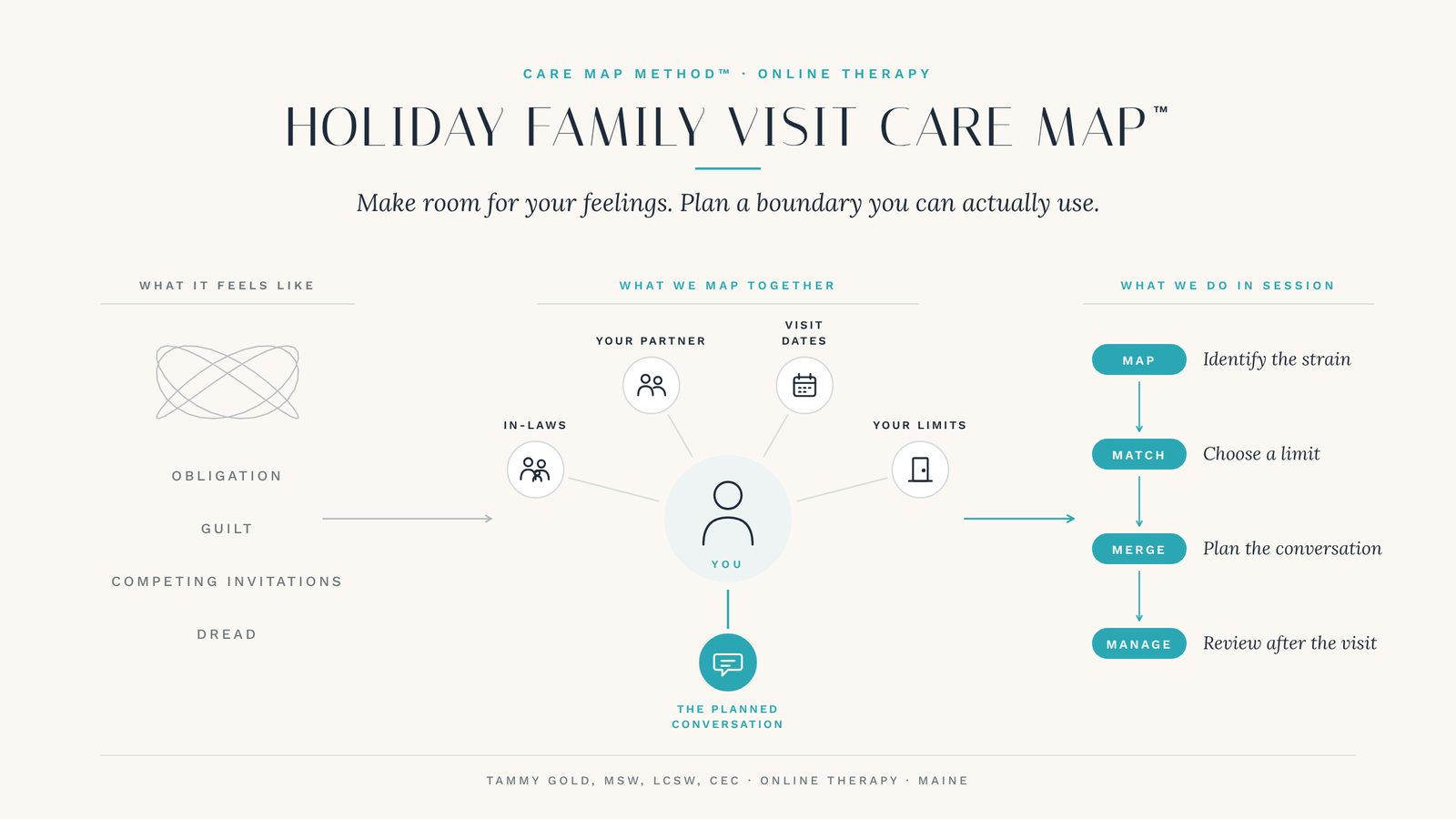
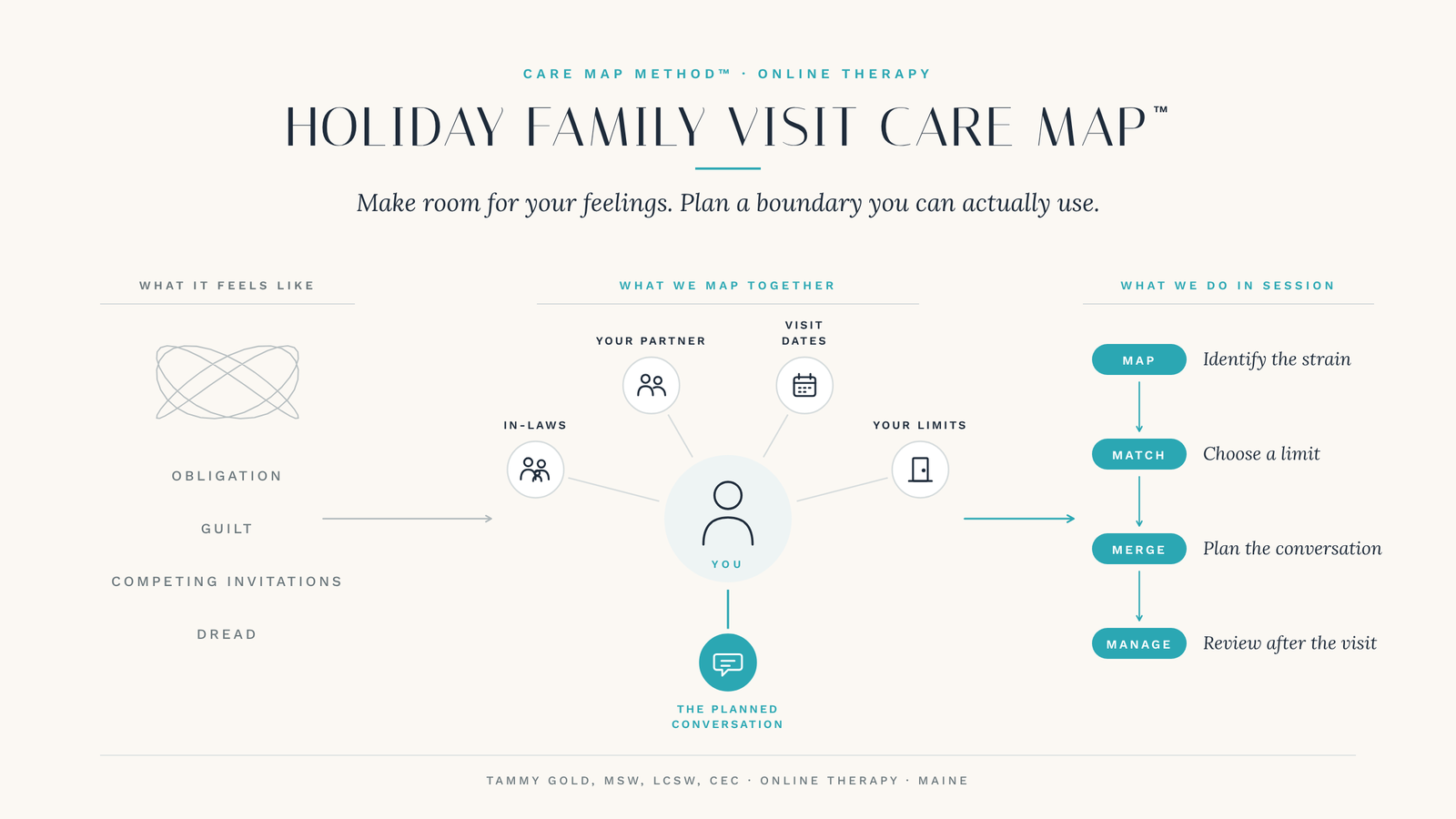
The holiday invitation arrives and you are already calculating travel, expectations and who will be disappointed. You may be worried about a relative’s comments or about another argument with your partner over whose family comes first.
An adult and partner calmly reviewing a calendar at a table without visible personal information. Revise to match the actual asset; remove this instruction before publishing.
Dreading the next family visit in Maine
The holiday invitation arrives and you are already calculating travel, expectations and who will be disappointed. You may be worried about a relative’s comments or about another argument with your partner over whose family comes first.
I’m Tammy Gold. In individual online therapy for adults in Maine, we can explore the emotional strain surrounding family visits and prepare choices you can realistically carry out.
Understand what you are anticipating
The invitation may bring up more than a scheduling problem. You might feel responsible for preventing disappointment, fear being judged as selfish, or expect to defend choices that relatives repeatedly question.
We can identify what you are expecting, what has happened before and how those experiences affect you now. Cultural traditions, distance, finances and a relative’s health can all influence what is possible. Therapy can help you consider those factors without losing sight of your own limits.
Make the agreement before the visit
Rather than rehearsing every possible conflict, we might begin with a private conversation with your partner: “I want us to agree on how long we will stay and how we will respond if the comments start.”
We can explore what makes that request difficult, how to state your concern and what you can do if the conversation does not produce agreement. A boundary describes your participation; it does not guarantee another person’s approval.
Plan for what happens afterward
You may be able to get through a visit and still spend the next day replaying it. We can work on the meaning you attach to a comment, decide whether follow-up is useful and consider how much time you want to devote to reviewing the event.
My Care Map Method™ organizes Biological, Emotional, Social and Environmental pressures. We map the interaction, match a response to your needs, merge it into an actual visit plan and manage what you learn afterward. That may include rest and privacy as well as words to use.
Begin with the visit that worries you most
In a first session, we will discuss the concern, its effect on your mental health and relevant relationship history. You do not need relatives to participate in order to begin individual therapy. Our goals will concern your well-being and choices, rather than diagnosing or changing family members who are not clients.
Questions about starting therapy
Can I attend without my partner? Yes. Individual therapy can focus on your distress and decisions without requiring your partner to participate.
Will you tell me to stop seeing my in-laws? There is no preset outcome. We can explore options consistent with your circumstances, values and safety.
What if I feel guilty about saying no? We can explore the guilt and what it means to you, while considering the responsibilities you actually want to accept.
What if there are threats or intimidation? Tell your therapist. Safety and appropriate support take priority over practicing a standard boundary script.
Is this family mediation? No. This page describes individual psychotherapy, not mediation or a process for making agreements among relatives.
Does insurance cover holiday stress? A holiday concern alone does not establish coverage. Eligibility depends on assessed clinical needs, your plan and active provider participation.
Ask about current availability, clinical fit and payment options. Confirm the state where you will be located before scheduling.
Young Adult Therapy in Maine After College
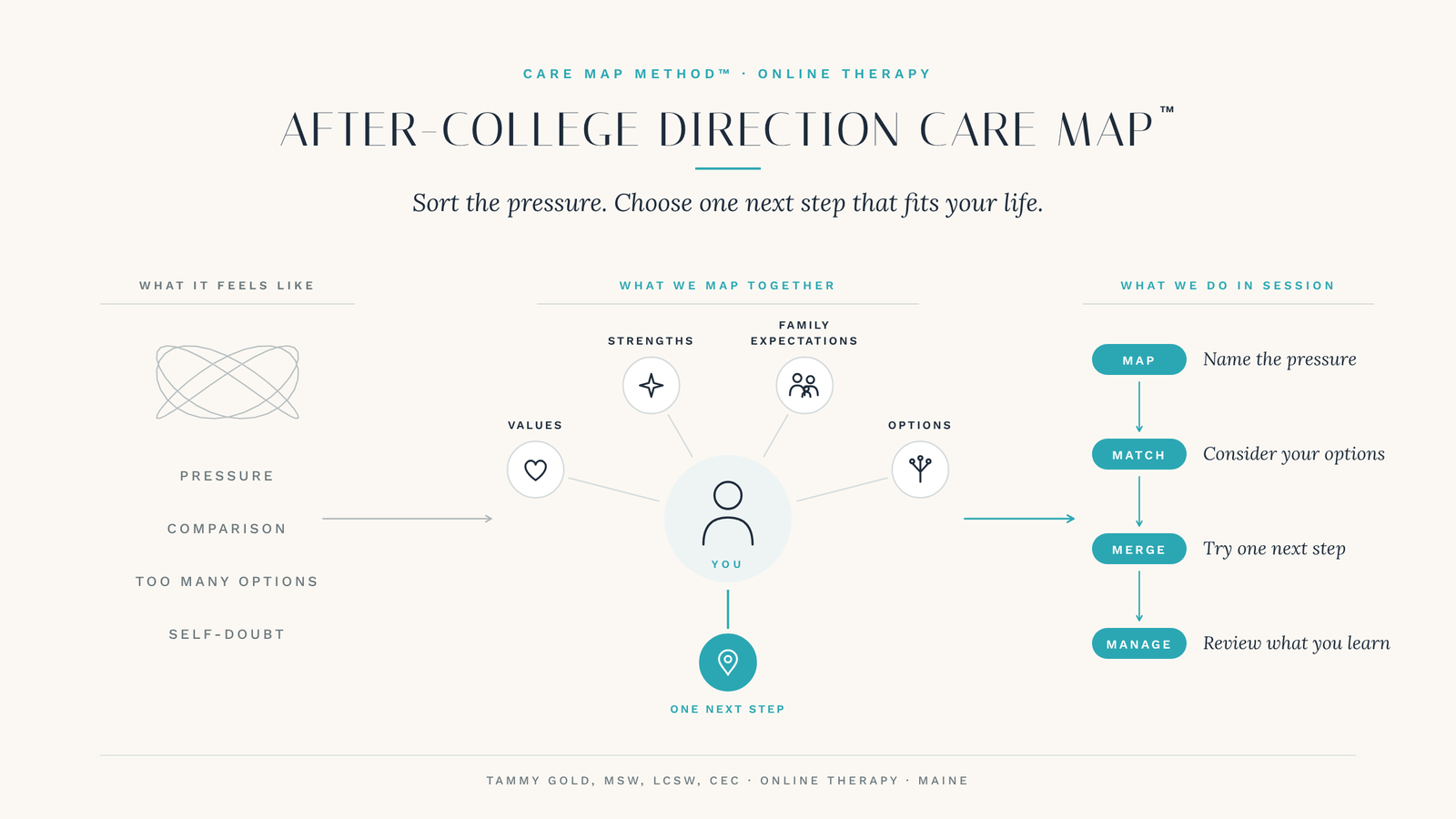
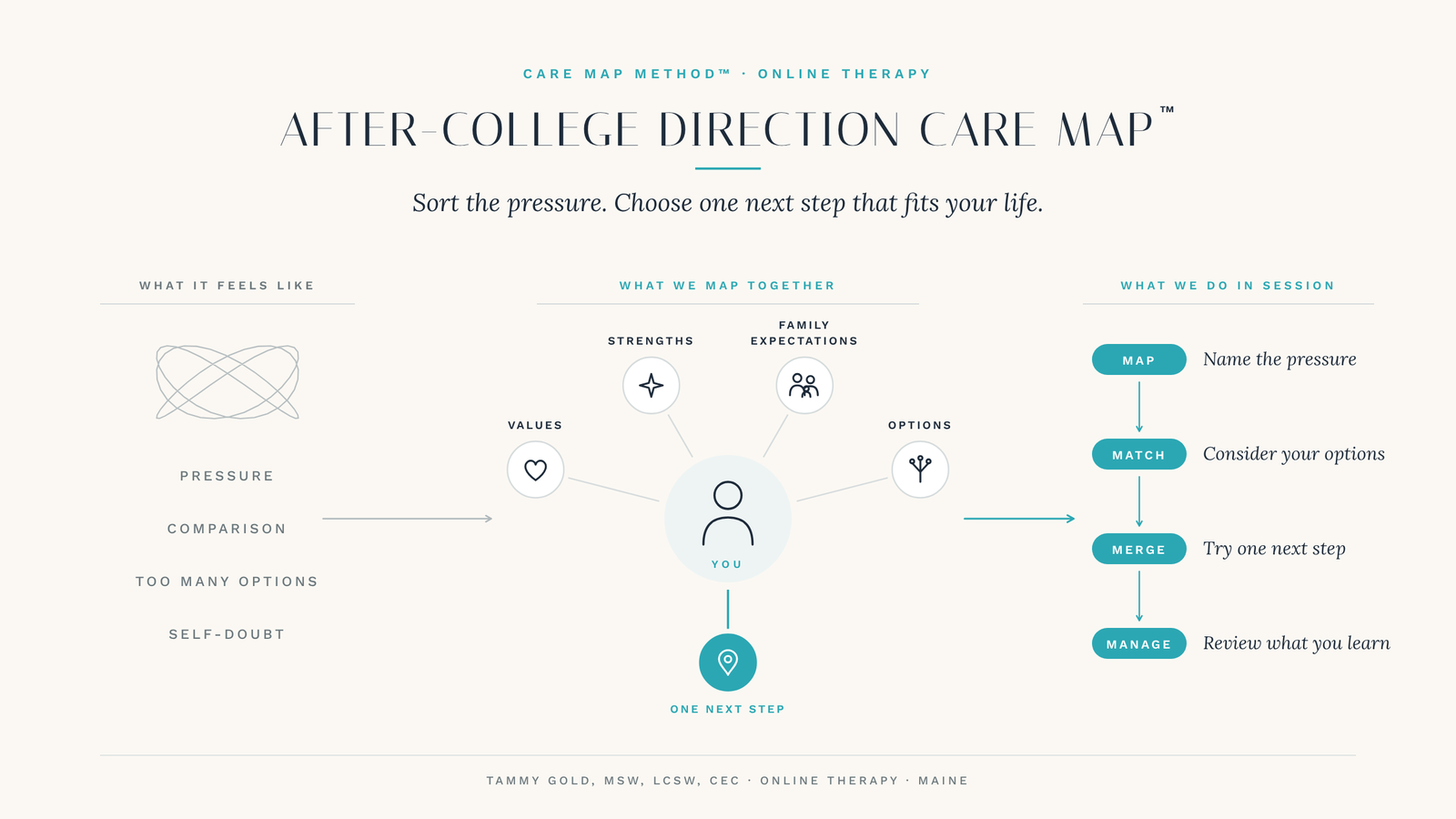
Graduation may have given you a degree without giving you a clear next step. Your friends seem to be moving into careers, relationships or new cities while you are still deciding what you want. Even a reasonable choice can feel like a permanent test of whether you are succeeding.
An adult in their twenties reviewing a notebook beside a closed laptop in a private room. Revise to match the actual asset; remove this instruction before publishing.
Graduation may have given you a degree without giving you a clear next step. Your friends seem to be moving into careers, relationships or new cities while you are still deciding what you want. Even a reasonable choice can feel like a permanent test of whether you are succeeding.
I’m Tammy Gold. I offer individual online therapy for adults physically located in Maine, including younger adults navigating independence, relationships and life changes. We can explore what feels uncertain and how that uncertainty is affecting your daily life.
When every option feels like a judgment
You may be living with family, working outside your field, searching for a job or reconsidering a path you once wanted. Financial limits and the opportunities around you matter. We will take those circumstances seriously rather than treat confidence as the only missing ingredient.
In therapy, we can examine the meaning behind thoughts such as “I should be further along” or “Choosing wrong will ruin everything.” We can also discuss sleep, motivation, concentration and connection to others to understand the support you need.
Start with one decision you keep avoiding
Perhaps you are postponing an application because it does not fit the career you imagined. We might separate your interest in the job from your fear of how others will interpret it. Then we can identify a next step small enough to evaluate rather than a promise about the rest of your life.
We can practice explaining a decision to your parents, asking for support without giving up ownership, or making room for friendships after school has ended. These are examples of possible work, not promises about your outcome.
A framework for sorting the pressures
My Care Map Method™ helps organize Biological, Emotional, Social and Environmental factors alongside clinical assessment. We map the concern, match strategies to your needs, merge practice into ordinary routines and manage the plan as circumstances change.
For this transition, that might mean noticing how comparison affects you, choosing one manageable experiment and reviewing what you learned. We can make space for grief about the life you expected while you develop a clearer sense of what matters now.
What the first session can cover
Bring one concern you would like help understanding. We will discuss its impact, your history and supports, and what you want from therapy. We will also decide whether my approach fits your needs and agree on initial goals.
Questions about starting therapy
Do I need to be a college graduate? No. This work can also fit adults navigating a gap year, leaving a program or beginning work without attending college.
What ages do you see on this page? This service is for adults 18 and older. The concern matters more than a rigid age cutoff.
Will you tell me which career to choose? We can explore your emotions, values and decisions. Therapy does not provide job placement or guarantee a career outcome.
Can my parents arrange therapy for me? An adult client participates in their own treatment and consent process. We can discuss any family involvement you want.
Can I attend while away at school? Your physical location at each session must be a state where I am authorized to practice; confirm it before scheduling.
Can I use insurance? We will confirm current Maine participation, your specific plan, estimated costs and whether the assessed clinical service meets coverage requirements.
Ask about current availability, clinical fit and payment options. Confirm the state where you will be located before scheduling.
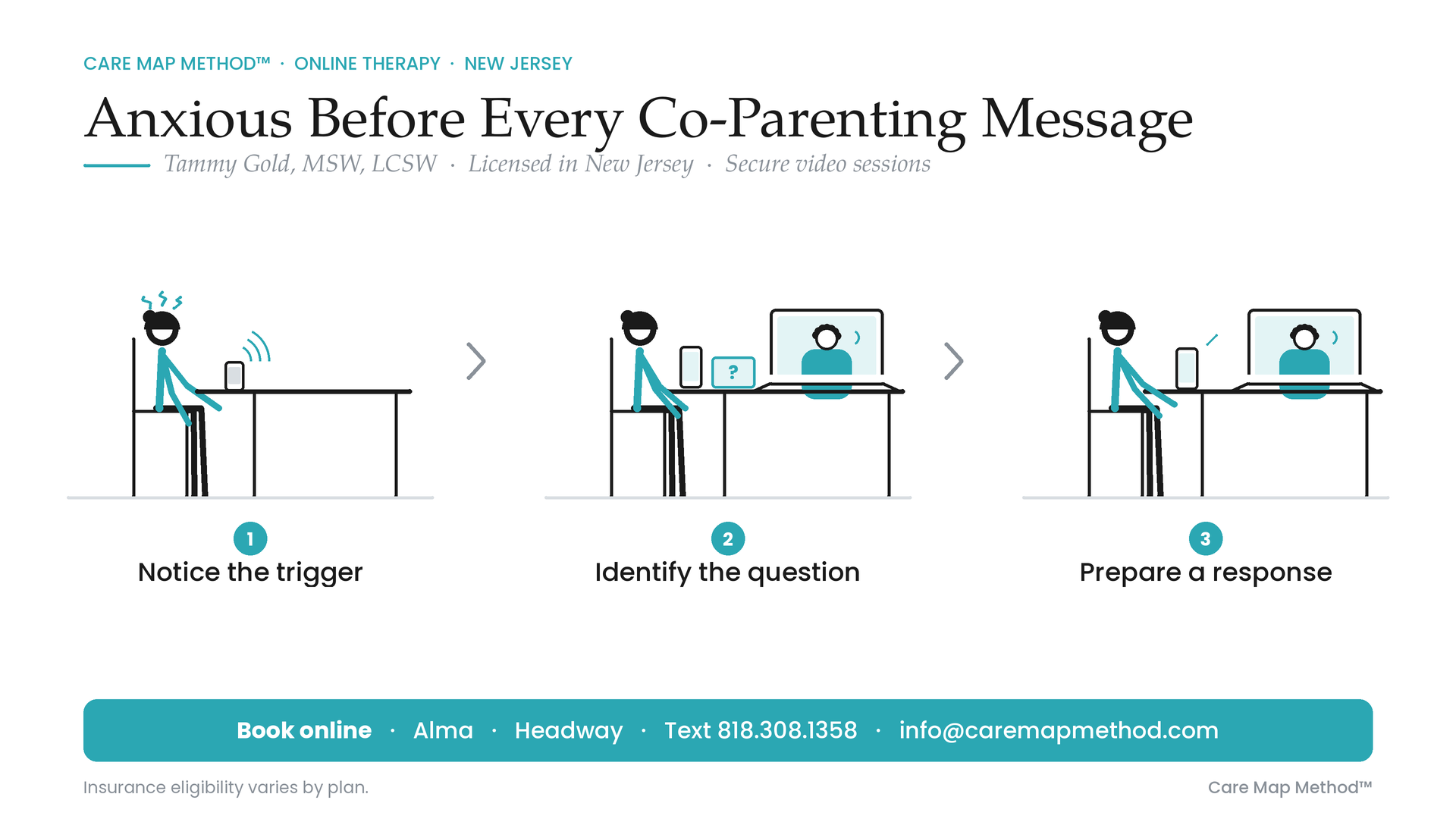
Anxious Before Every Co Parenting Message
A notification appears, and your body reacts before you read the message. You may spend hours drafting a reply, defending yourself, or replaying the exchange afterward. In online individual therapy for adults in New Jersey, we can explore what these interactions activate and practice responding more deliberately. That may involve recognizing a trigger, separating practical information from emotional reactions, and developing boundaries around communication where appropriate. This is psychotherapy for your own distress, not mediation or legal guidance about custody. Eligible Aetna members can check their specific benefits and appointment options through my Headway profile.
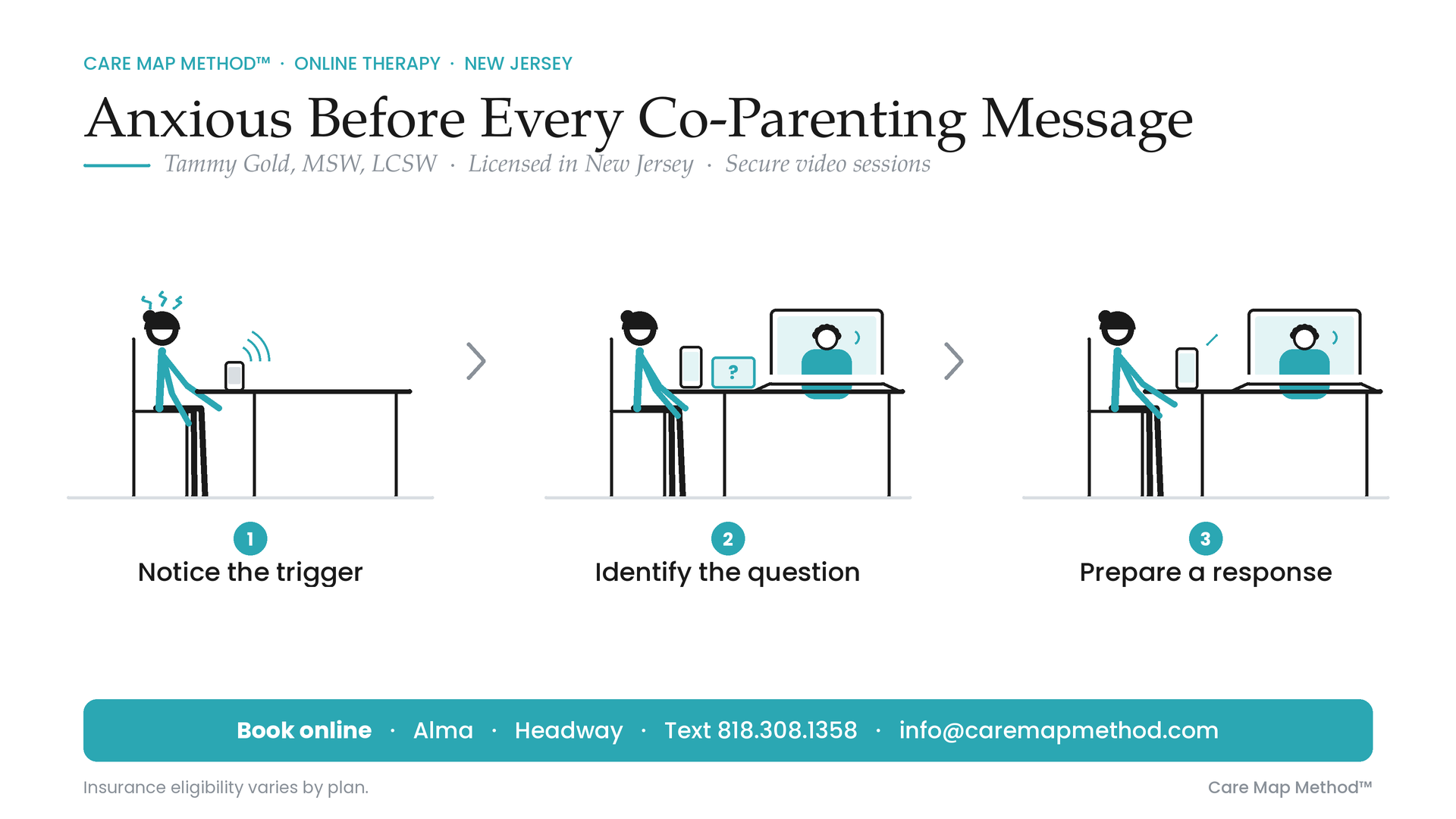
An adult setting a phone down, identifying the practical question in a message, and rehearsing a short reply with a therapist on a laptop; no actual message text or client data.
When one notification changes the rest of your day
You see your co-parent’s name and feel your stomach tighten. Even an ordinary question can carry the weight of earlier conflict. You may want to respond immediately, avoid opening the message, or spend hours trying to find words that cannot be criticized.
I am Tammy Gold, LCSW. I offer online individual therapy for adults physically located in New Jersey. We can explore how co-parenting interactions affect your emotional health and daily life, and practice responses that fit your circumstances. We do not need your co-parent to attend to begin working on your distress.
Separate the practical request from what it activates
We might review a recent exchange and identify the factual question, the feelings it brought up, and the meaning you attached to it. A schedule change may activate fear of losing control, anger about unequal responsibility, or grief about the family transition.
Sessions can involve emotional processing, recognizing the urge to defend every point, preparing a focused reply, and recovering after the interaction. We can also examine the impact on sleep, concentration, parenting, and other relationships. The goal is not to make you accept disrespect or ignore important information; it is to support considered responses and your well-being.
Use a map before replying
Care Map Method™ organizes the concern alongside clinical assessment. Biological, Emotional, Social, and Environmental pressures may include poor sleep, anger or fear, relationship history, parenting responsibilities, and the communication setting.
MAP the trigger and emotion when the message arrives. MATCH the need with a strategy, such as grounding or identifying the question that needs an answer. MERGE the strategy into your routine by practicing a response process. MANAGE communication and responses by reviewing the outcome and adjusting. Any practical strategy must fit existing obligations, urgent child-related needs, and appropriate professional guidance.
Try drafting without sending immediately
When timing and obligations allow, write two versions: one private draft that expresses everything you feel, and one possible reply limited to the practical issue. In therapy, we can examine what each version reveals and whether a reply is clear, appropriate, and necessary.
For example, a practical response might confirm a time without arguing about the entire relationship history. We can also work on what happens after you send it, including repeated checking or rehearsing the next conflict. Progress may include less time consumed by messages, improved recovery, or more consistent boundaries. Therapy does not change court orders, determine custody, or guarantee a cooperative co-parent.
Insurance and next steps
Eligible Aetna members in New Jersey can use my Headway profile to check their specific plan, estimated costs, and appointment options. Benefits and network participation vary. Coverage depends on clinical assessment and the service provided. This page describes individual psychotherapy; couples sessions, coaching, mediation, and other services require separate confirmation.
You do not need to have the whole situation figured out before reaching out. We can begin by understanding what is most difficult and deciding whether this service is a good fit.
Frequently asked questions
Can I attend if my co-parent refuses?
Yes. This page describes individual psychotherapy for your emotional health. We can work on your coping, communication, boundaries, and adjustment without the other person attending. We cannot control their responses or make agreements on their behalf.
Will you review messages or give legal advice?
A recent message may help us understand your reaction, but psychotherapy is not legal review or custody strategy. Questions about orders, evidence, deadlines, or legal obligations belong with an appropriately qualified legal professional.
What happens during the first session?
We discuss the current situation, symptoms, relevant history, supports, safety, and goals. You can describe a typical interaction without bringing every exchange. We begin assessing whether my services fit and what to focus on.
Can I use Aetna insurance?
Eligible New Jersey members can check their exact Aetna plan through Headway. Benefits, network participation, assessment, and the service determine coverage. Individual psychotherapy should not be confused with mediation, parenting coordination, or custody evaluation.
Will you tell me to delay every response?
No. Timing depends on the issue, child-related needs, safety, agreements, and any applicable obligations. We can work on the emotional response while respecting those circumstances. A generic communication rule is not appropriate for every situation.
How do I request an appointment?
Select “Check Insurance and Availability on Headway” for New Jersey individual therapy. If you need mediation, a custody evaluation, or legal guidance, clarify that need before booking so we can distinguish the services.
About Tammy Gold
Tamara “Tammy” Gold, MSW, LCSW, CEC, is a Columbia University–trained clinical social worker, University of Pennsylvania graduate, certified coach, and founder of Care Map Method™. She is the author of Secrets of the Nanny Whisperer and brings more than 20 years of direct family work. Her therapy style is warm, collaborative, and practical, with attention to emotions, history, and everyday functioning.
Book A Session Today & Get The Support You Deserve!
For clients using insurance, I use the platforms below:
Alma Therapy https://secure.helloalma.com/providers/tamara-gold/
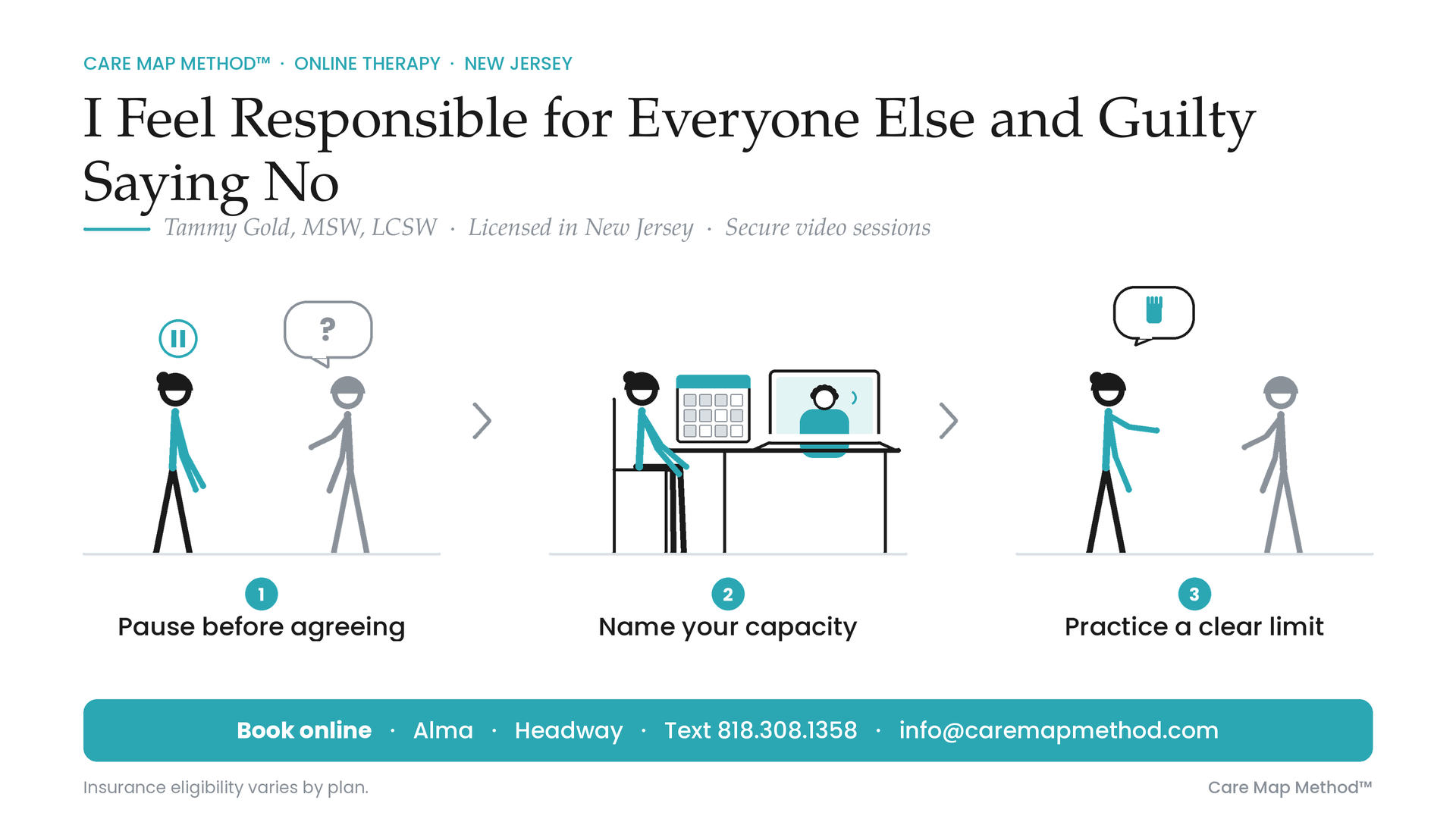
I Feel Responsible for Everyone Else and Guilty Saying No
You agree before checking whether you have the time or energy. Later, resentment builds, but disappointing someone feels even harder. People pleasing can involve genuine care, fear of conflict, relationship history, and uncertainty about your right to have needs. In online individual therapy for adults in New Jersey, we can explore what makes saying no difficult and practice clearer requests and limits. We will also work on coping with the discomfort that may follow, rather than expecting the right words to remove every feeling of guilt. Check Aetna eligibility and availability through my Headway profile.
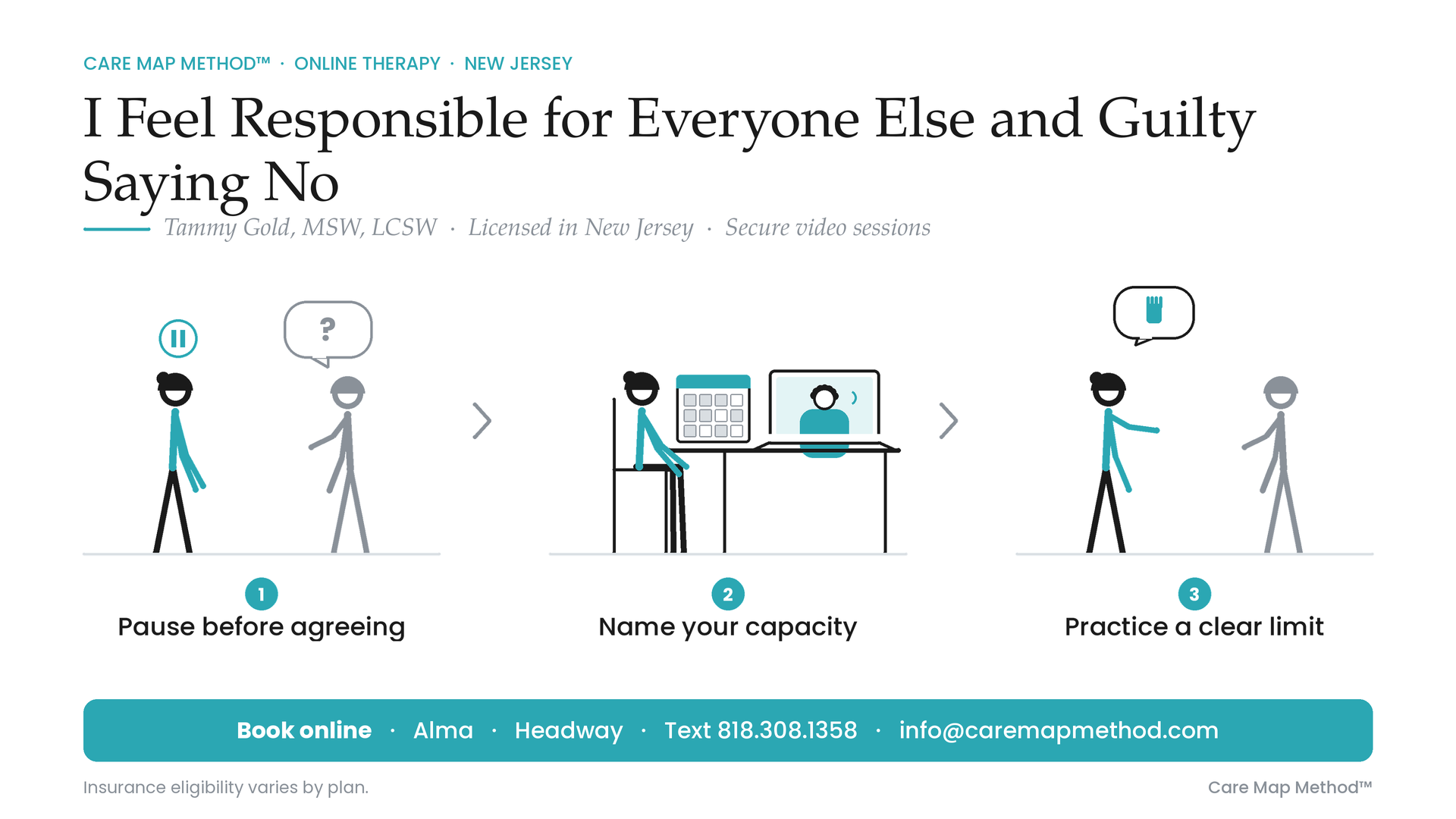
An adult receiving a request, pausing to check a calendar, and rehearsing a brief response with a therapist; the final scene shows a clear but calm limit.
When keeping everyone happy leaves you overwhelmed
You notice the change in someone’s tone and immediately wonder what you did wrong. You rearrange your plans, soften your request, or say yes to prevent disappointment. By the end of the day, there may be little energy left for your own needs.
I am Tammy Gold, LCSW. I offer online individual therapy for adults physically located in New Jersey. We can explore the distress behind people-pleasing, including worry, resentment, self-doubt, and difficulty tolerating conflict. Being considerate and having needs of your own can exist together.
Button: Check Insurance and Availability on Headway
Understand what saying no seems to threaten
We might examine what you expect will happen if you disappoint someone. Will they withdraw, become angry, think you are selfish, or stop relying on you? We can consider where those expectations came from and how they operate in current relationships.
Sessions may involve separating another person’s feelings from your responsibility, identifying preferences before agreeing, or exploring why a simple request feels dangerous. We can practice a boundary while also addressing the fear underneath it. The work is not to become indifferent to others, but to make choices with more awareness of your own capacity and values.
Map the moment you automatically agree
Care Map Method™ helps organize the pattern alongside clinical assessment. Biological, Emotional, Social, and Environmental factors can include exhaustion, fear or guilt, learned family roles, and demands at work or home.
MAP the request and the reaction that follows. MATCH the need with a strategy, such as delaying your answer, making a clear request, or setting a limit. MERGE the strategy by practicing it in a situation that feels manageable. MANAGE communication and responses by reviewing the discomfort, the outcome, and any adjustments needed. We can begin with a small change rather than your hardest relationship.
Practice making space before you answer
Try a sentence such as: “Let me check what I can manage and get back to you.” That pause can give you time to notice what you want and what you can realistically do. We can then practice the actual answer, including a brief no that does not become a long defense.
Guilt may still appear. We can work on tolerating it, examining the beliefs behind it, and deciding whether your boundary fits the circumstances. Progress may include fewer automatic commitments, more direct requests, and less time trying to repair ordinary disappointment. If setting a boundary could expose you to retaliation, we will consider safety and context before recommending a conversation.
Insurance and next steps
Eligible Aetna members in New Jersey can use my Headway profile to check their specific plan, estimated costs, and appointment options. Benefits and network participation vary. Coverage depends on clinical assessment and the service provided. This page describes individual psychotherapy; couples sessions, coaching, mediation, and other services require separate confirmation.
You do not need to have the whole situation figured out before reaching out. We can begin by understanding what is most difficult and deciding whether this service is a good fit.
Is people pleasing a diagnosis?
People pleasing describes a pattern, not a diagnosis by itself. We assess symptoms, history, functioning, and context to understand what is happening and whether psychotherapy is appropriate. We do not assume a label based only on saying yes often.
Can I work on boundaries without my family attending?
Yes. Individual therapy can focus on your emotions, decisions, communication, and coping. We cannot guarantee the other person will respond well, but we can prepare for possible reactions and consider what is within your control.
What happens at the first session?
We discuss the situations that are difficult, relevant history, symptoms, relationships, supports, safety, and goals. You can ask about my style and confidentiality. We begin deciding what you would like to work on first.
Does Aetna cover this therapy?
Eligible New Jersey members can check their exact Aetna plan through Headway. Coverage depends on network participation, benefits, clinical assessment, and the service. A pattern such as people-pleasing alone does not guarantee an insurance-covered diagnosis.
Will I stop feeling guilty if I learn the right words?
A script may help you communicate, but it may not remove the emotion. We can explore the guilt and practice responding to it while evaluating whether the limit is realistic, respectful, and appropriate to your circumstances.
How do I get started?
Use “Check Insurance and Availability on Headway” and select New Jersey. You can bring one recent example of agreeing when you wanted to say no. We can use it as a starting point without expecting a perfect explanation.
About Tammy Gold
Tamara “Tammy” Gold, MSW, LCSW, CEC, is a Columbia University–trained clinical social worker, University of Pennsylvania graduate, certified coach, and founder of Care Map Method™. She is the author of Secrets of the Nanny Whisperer and brings more than 20 years of direct family work. Her therapy style is warm, collaborative, and practical, with attention to emotions, history, and everyday functioning.
Book A Session Today & Get The Support You Deserve!
For clients using insurance, I use the platforms below:
Alma Therapy https://secure.helloalma.com/providers/tamara-gold/
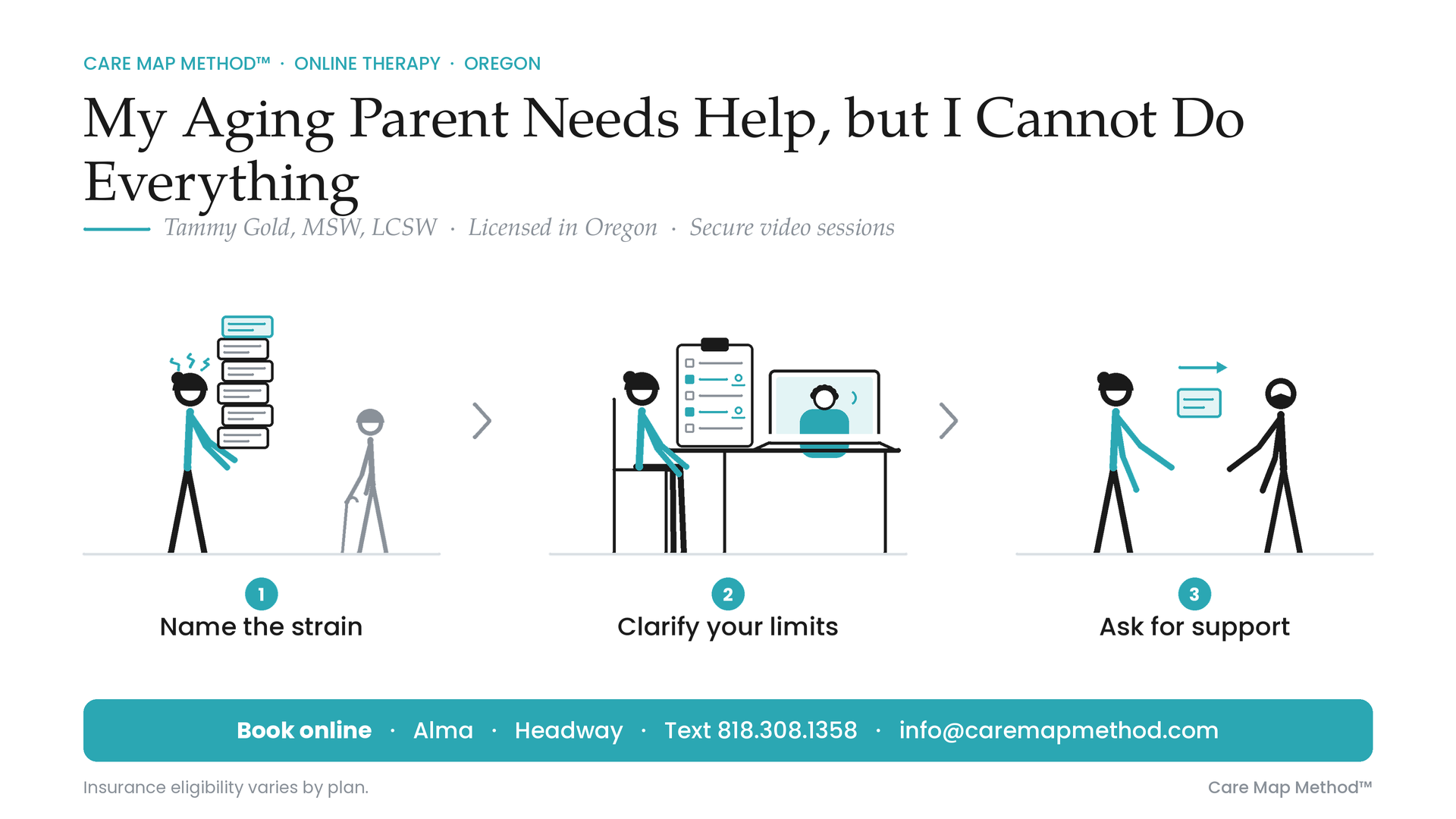
My Aging Parent Needs Help but I Cannot Do Everything
Your parent needs more help, and each new request seems to become your responsibility. You may be balancing work, children, medical calls, and worry while feeling guilty for wanting a break. In online individual therapy for adults in Oregon, we can explore the emotional weight of caregiving, clarify what you can sustain, and practice communicating limits and requests for support. The work addresses your well-being; it does not replace a medical or care-needs assessment for your parent. Eligible Providence Health Plan and Regence members can check their exact benefits and appointment options through my Headway profile.
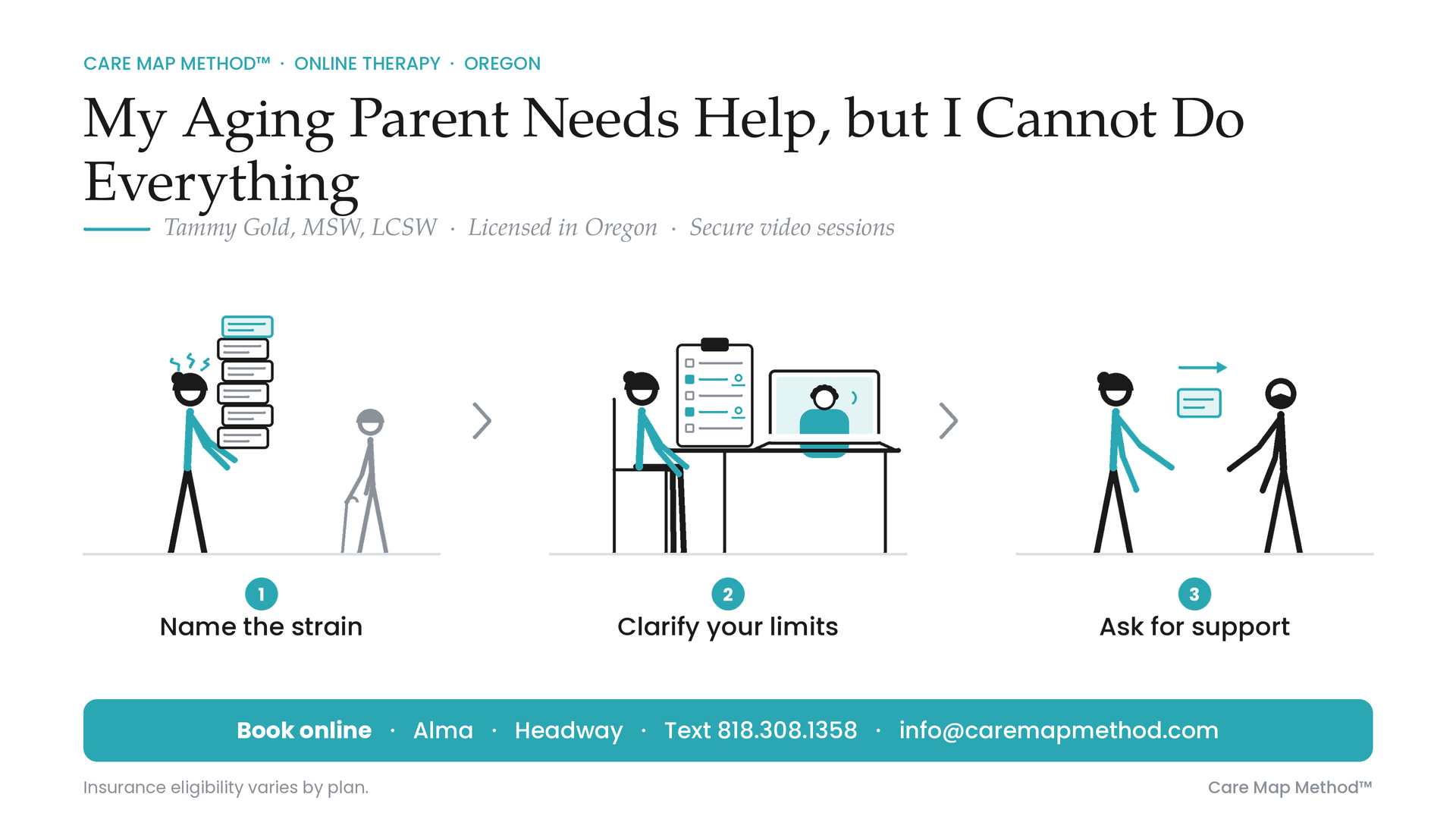
An adult caregiver reviewing a manageable responsibility list with a therapist on a laptop; some tasks are clearly marked as needing additional support.
When love and responsibility become difficult to separate
You answer one call and leave with five more tasks. If you help, you feel exhausted. If you say no, you feel guilty. You may worry that nobody else will notice what your parent needs, or that setting a limit makes you uncaring.
I am Tammy Gold, LCSW, and I provide online individual therapy for adults physically located in Oregon. We can explore the distress that comes with caregiving, including grief, resentment, anxiety, and family expectations. You do not have to wait until you feel completely depleted to seek support.
Understand what is yours to carry
We might separate practical responsibilities from the emotional meanings attached to them. Does saying no feel like abandonment? Does asking a sibling for help bring up years of unequal responsibility? Are you trying to preserve the relationship you had before your parent’s needs changed?
Sessions can involve preparing a request, clarifying a limit, grieving changes, or coping with uncertainty. We can also discuss the difference between a task that needs an immediate response and a pattern that needs a wider support plan. Psychotherapy focuses on your mental health and functioning; medical decisions, care placement, and legal authority require the appropriate professionals.
Use a map to make the strain more understandable
Care Map Method™ organizes the work alongside clinical assessment. Biological pressures can include your fatigue and health. Emotional pressures include guilt, grief, and fear. Social and Environmental pressures include family roles, available help, work schedules, distance, and financial constraints.
MAP the request that activates guilt or panic. MATCH the need with a coping strategy, boundary, or request for support. MERGE it into daily life by rehearsing the conversation and deciding what you can actually offer. MANAGE communication and responses by reviewing what happened and how your circumstances change. We cannot promise your parent or siblings will cooperate.
Practice a limit that describes what you can offer
A starting phrase might be: “I can make the calls on Tuesday. I cannot be the daily contact, so we need to identify another option.” We can explore whether this fits your circumstances, what responsibilities you already hold, and how you might respond to guilt or disagreement.
Before a session, consider listing what you are doing, what it costs you, and what help is missing. We can review progress through distress, rest, functioning, and your ability to communicate realistic limits. A sustainable plan may still involve sadness and difficult choices. Therapy gives those feelings a place while helping you make considered decisions.
Insurance and next steps
Eligible Providence Health Plan or Regence BlueCross BlueShield of Oregon members in Oregon can use my Headway profile to check their specific plan, estimated costs, and appointment options. Benefits and network participation vary. Coverage depends on clinical assessment and the service provided. This page describes individual psychotherapy; couples sessions, coaching, mediation, and other services require separate confirmation.
You do not need to have the whole situation figured out before reaching out. We can begin by understanding what is most difficult and deciding whether this service is a good fit.
Is it selfish to need a break from caregiving?
Needing rest or support does not mean you do not care. We can explore the feelings attached to taking a break and the practical realities involved. Any existing care responsibilities still need appropriate planning rather than being ignored.
Does my parent need to attend therapy?
No. This page describes individual psychotherapy for you as the adult caregiver. We focus on your distress, coping, relationships, and decisions. Assessment or treatment of your parent would be a separate service.
What happens at the first appointment?
We discuss your current responsibilities, symptoms, relevant history, supports, safety, and goals. You do not need complete medical records for your parent. We begin identifying what is most difficult for you and whether the service fits.
Can I use Providence or Regence insurance?
Eligible Oregon members can check their specific Providence Health Plan or Regence BlueCross BlueShield of Oregon coverage through Headway. Benefits, participation, clinical assessment, and the service matter. Private coaching and care-management consulting have separate payment arrangements.
Will you choose a caregiver or care facility?
Not as part of the psychotherapy described here. We can work on emotional distress and decision-related stress. Caregiver selection, placement, and organizational care planning are different services and should be discussed separately.
How do I book Oregon therapy?
Use “Check Insurance and Availability on Headway.” Confirm Oregon as the state where you will attend and enter your exact insurance details. If you want practical eldercare consulting instead, ask about that service before scheduling psychotherapy.
About Tammy Gold
Tamara “Tammy” Gold, MSW, LCSW, CEC, is a Columbia University–trained clinical social worker, University of Pennsylvania graduate, certified coach, and founder of Care Map Method™. She is the author of Secrets of the Nanny Whisperer and brings more than 20 years of direct family work. Her therapy style is warm, collaborative, and practical, with attention to emotions, history, and everyday functioning.
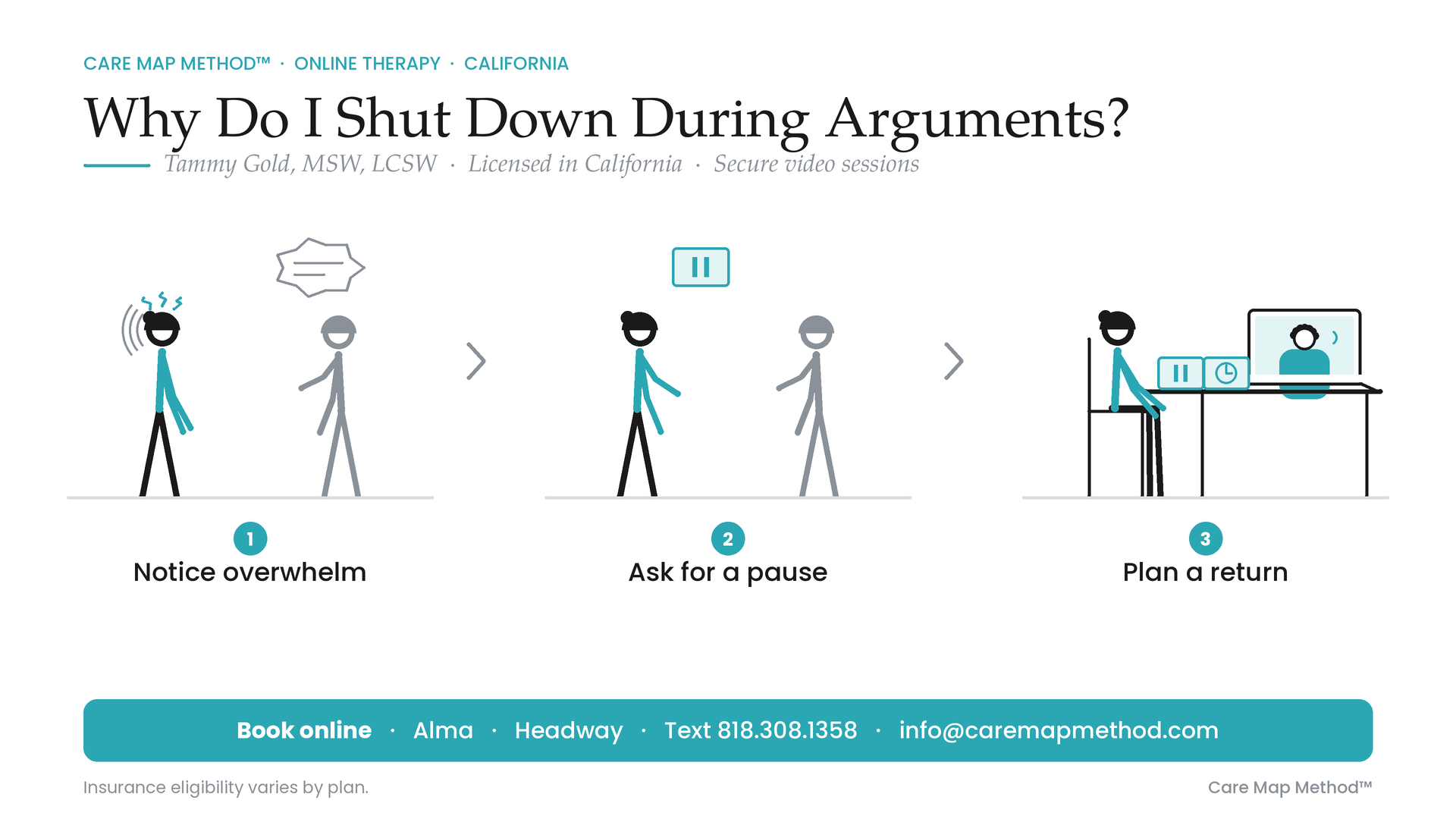
Why Do I Shut Down During Arguments
You want to explain yourself, but the words disappear. Your mind goes blank, your body feels tense, or you need to leave the conversation. Later, you may feel guilty, misunderstood, or afraid of starting again. Shutting down during arguments can have different causes, and therapy begins with understanding your experience rather than assuming a label. In online individual therapy for adults in California, we can explore triggers, recognize earlier signs of overwhelm, and practice a pause that includes a plan for returning. Eligible Anthem Blue Cross or Aetna members can check insurance options through my Headway profile.
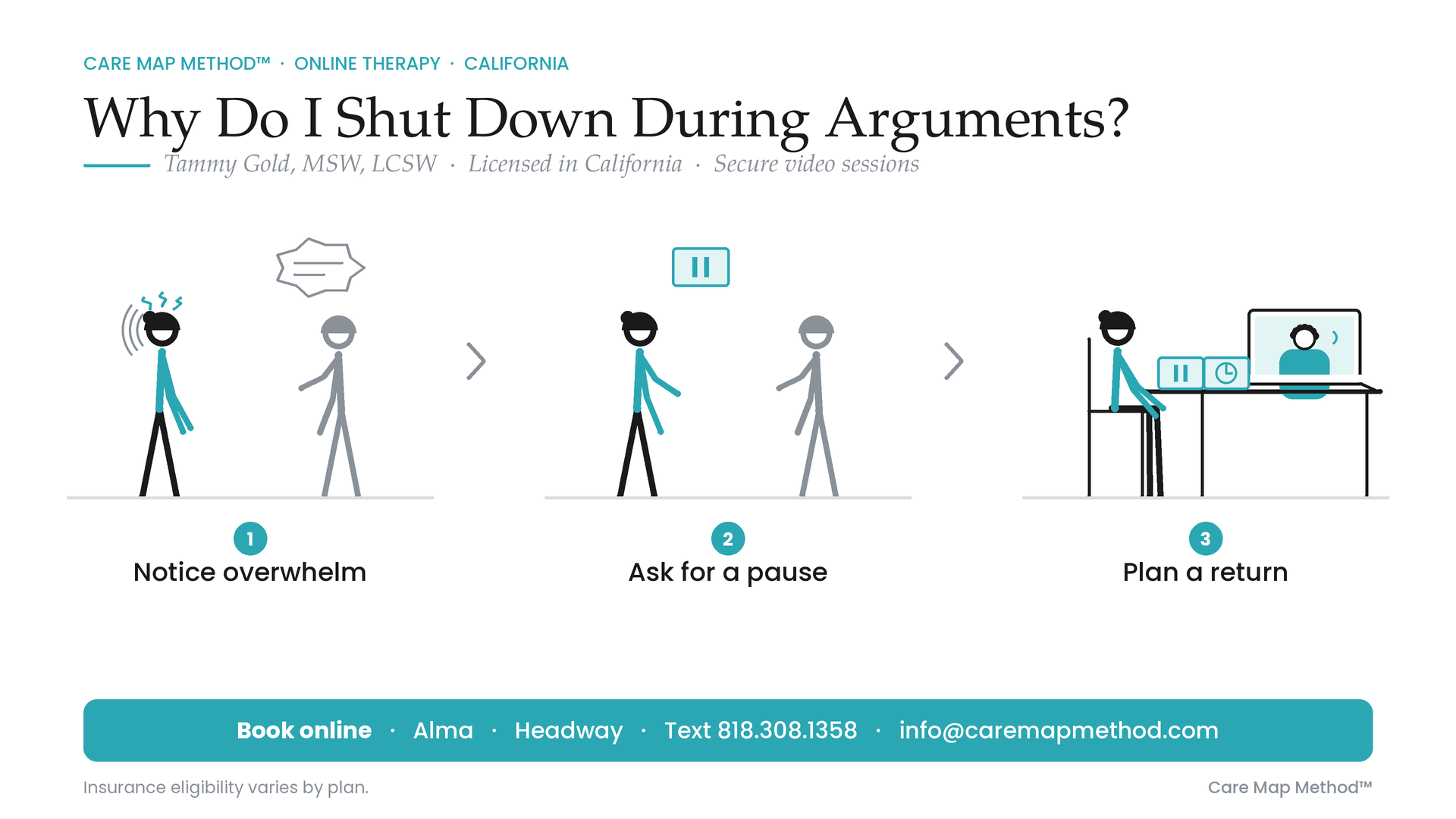
An adult recognizing tension during a conversation, then writing a short pause request and a return time with a therapist on a laptop.
When going quiet does not feel like a choice
An argument starts, and suddenly you cannot think clearly. You might become silent, struggle to speak, or agree just to make the conversation stop. Your partner may read this as indifference while you feel overwhelmed inside. Afterward, the original issue remains unresolved.
I am Tammy Gold, LCSW, and I offer online individual therapy in California. We can explore what happens for you during conflict, including feelings, physical sensations, thoughts, and relationship context. Going quiet does not tell us the cause on its own. Assessment helps us understand what support fits.
Button: Check Insurance and Availability on Headway
Understand what happens before the silence
We might look at a recent argument in detail. Was there a change in tone, a particular phrase, fear of saying the wrong thing, or a sense that there was no way to respond safely? Were you exhausted before the conversation began? What happened when you tried to pause?
We can work on noticing earlier signs of overload, putting words to your experience, and distinguishing a useful break from withdrawing without explanation. Your needs matter, and so does what happens after the break. The goal is to develop more options for responding, not force you to continue a conversation when you cannot participate safely or thoughtfully.
Map the trigger and prepare a different response
Care Map Method™ helps organize our work alongside clinical assessment. Biological factors may include fatigue or physical tension. Emotional factors might include fear, shame, or hurt. Social and Environmental factors include relationship history, expectations, timing, and privacy.
MAP the point where you begin to lose your words. MATCH the need with a strategy, such as grounding, a clear pause, or writing down one sentence. MERGE the strategy by practicing it before a difficult moment. MANAGE communication and responses by reviewing whether the plan helped and what made it difficult. We can adjust the pace and explore the history behind the reaction.
Practice a pause with a return plan
One possible phrase is: “I want to talk about this, and I am having trouble thinking clearly. Can we pause and choose a time to return?” In therapy, we can make that wording more natural for you and discuss what a workable return looks like. A pause should not become a way to avoid every difficult topic.
When conflict involves intimidation or fear, communication practice alone may not be appropriate; we will consider safety and the kind of help needed. We can review progress through earlier recognition of overload, increased ability to express a need, and follow-through on returning to conversations. Progress is individual, and setbacks give us information to work with.
Insurance and next steps
Eligible Anthem Blue Cross or Aetna members in California can use my Headway profile to check their specific plan, estimated costs, and appointment options. Benefits and network participation vary. Coverage depends on clinical assessment and the service provided. This page describes individual psychotherapy; couples sessions, coaching, mediation, and other services require separate confirmation.
You do not need to have the whole situation figured out before reaching out. We can begin by understanding what is most difficult and deciding whether this service is a good fit.
Frequently asked questions
Does shutting down mean I have trauma?
Not necessarily. Silence or overwhelm during conflict can have different explanations. We consider your history, current circumstances, symptoms, and safety without assigning a diagnosis based on one behavior.
Can I work on this without my partner?
Yes. Individual therapy can help you understand your responses and practice coping and communication skills. Changes in a relationship also depend on the other person’s behavior, which individual therapy cannot control.
What will we discuss at the first session?
We explore your concern, relevant history, symptoms, supports, and goals. You can describe a recent argument if you feel comfortable. You do not need to relive every painful experience or find the perfect words immediately.
Can Anthem Blue Cross or Aetna cover sessions?
Headway can check your exact California plan and estimate costs. Coverage depends on benefits, network participation, clinical assessment, and the service. This page describes individual psychotherapy, not a guarantee of couples counseling coverage.
Should I force myself to stay in the argument?
No single rule fits every situation. We can consider what happens during the interaction and develop an appropriate pause or response. If you feel threatened, safety takes priority over completing a conversation.
How do I start?
Use “Check Insurance and Availability on Headway” to explore an appointment for California individual therapy. Bring a general sense of what is happening. We can clarify the pattern together rather than expect you to explain it perfectly.
About Tammy Gold
Tamara “Tammy” Gold, MSW, LCSW, CEC, is a Columbia University–trained clinical social worker, University of Pennsylvania graduate, certified coach, and founder of Care Map Method™. She is the author of Secrets of the Nanny Whisperer and brings more than 20 years of direct family work. Her therapy style is warm, collaborative, and practical, with attention to emotions, history, and everyday functioning.
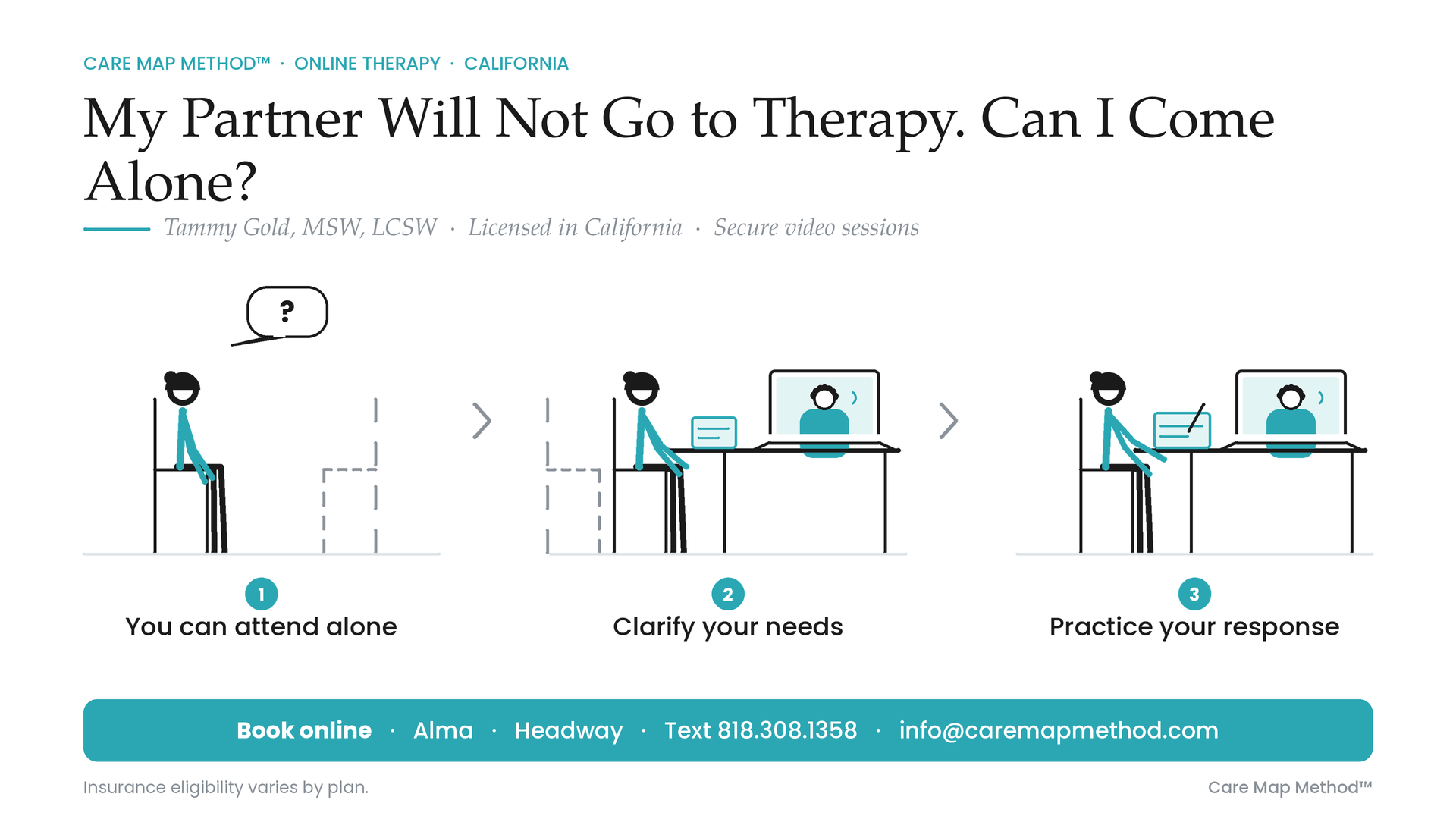
My Partner Will Not Go to Therapy Can I Come Alone
You want the relationship to feel different, but your partner will not attend therapy. You may be stuck between waiting for them to change and feeling unsure how to move forward alone. Individual therapy gives you a place to explore your own distress, understand recurring patterns, clarify needs, and prepare conversations or decisions. I offer online individual therapy for adults in California. We can practice what is within your control without making you responsible for repairing the relationship by yourself. Eligible Anthem Blue Cross and Aetna members can check their specific plan and estimated costs through my Headway profile.
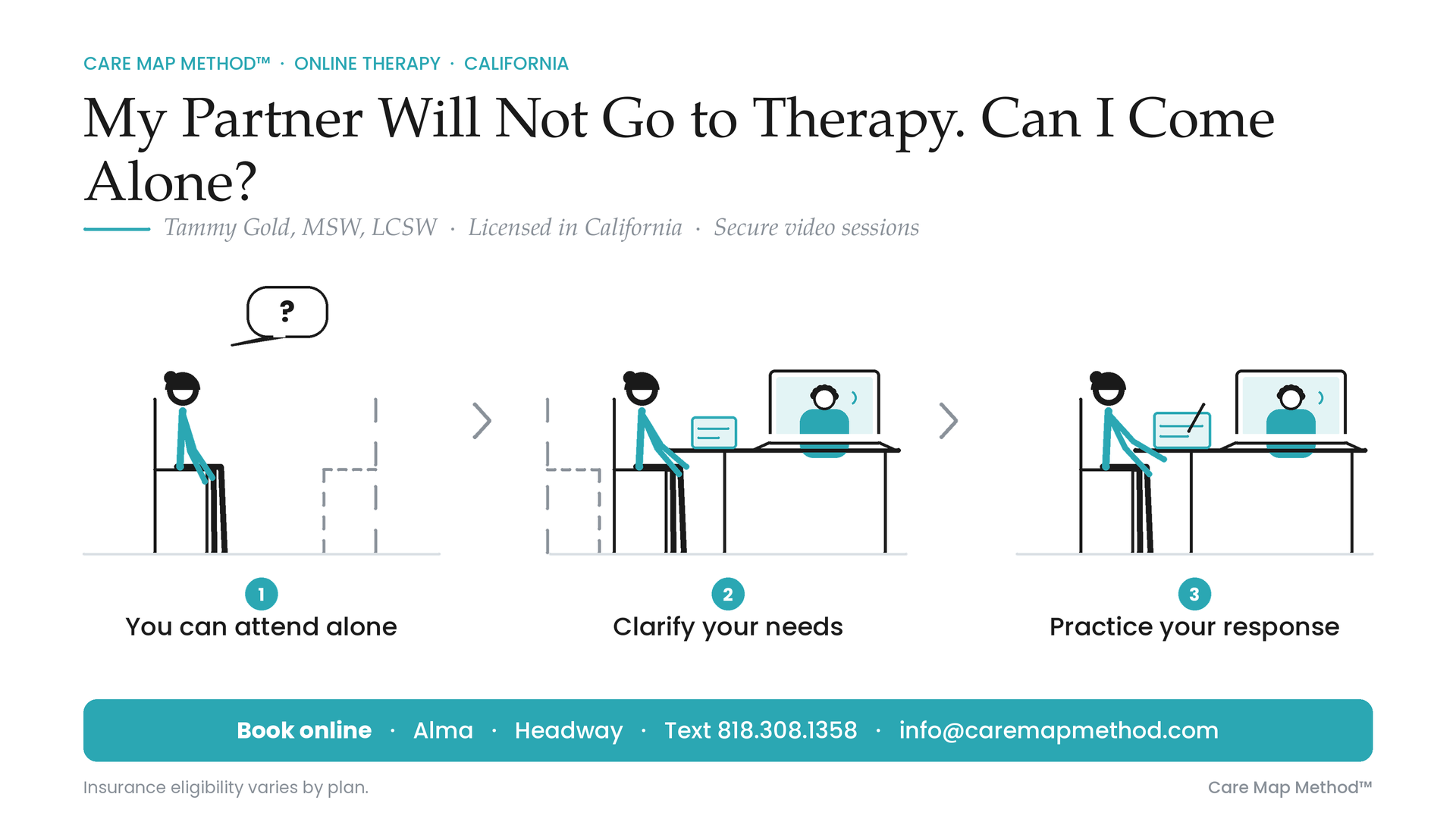
One adult meeting with a therapist on a laptop; an empty second chair is visible but the adult is engaged in their own work, writing a clear request.
You can begin without waiting for your partner
Yes, you can seek individual therapy for relationship concerns even if your partner does not attend. You might want support with anxiety after arguments, loneliness, resentment, difficulty expressing needs, or uncertainty about the future. Your well-being deserves attention in its own right.
I am Tammy Gold, LCSW. I provide online individual therapy for adults physically located in California. We can explore your experience without turning the session into a verdict about your partner or assuming you should stay or leave. We work toward understanding what you need and what choices are available.
What individual relationship work can include
We might slow down an interaction that keeps repeating. When did you begin feeling criticized, dismissed, or afraid of disconnection? What did you do next? How does the pattern affect your mood, concentration, sleep, or ability to be present elsewhere in your life?
From there, we can practice expressing a need without overexplaining, prepare a limit, or consider what evidence of change matters to you. We can also explore earlier experiences that make conflict especially painful. Individual therapy is not a way to make you better at tolerating harm or responsible for another person’s choices.
Using Care Map Method in individual therapy
Alongside clinical assessment, I use Care Map Method™ to organize the work. Biological, Emotional, Social, and Environmental factors help us consider fatigue, emotional injuries, relationship history, outside responsibilities, and the setting in which conflict happens.
MAP a recent trigger and your emotional response. MATCH the need with a strategy, such as a direct request or a boundary. MERGE the strategy into daily life by rehearsing words and considering timing. MANAGE your responses by reviewing what happened and what it tells you. We do not need your partner to participate to examine your experience, but we cannot guarantee the relationship will change.
Prepare one conversation without trying to solve everything
Try writing three sentences: “When this happens, I feel…” “What I need is…” “What I am asking for is…” Keep the request specific enough that you could recognize whether it happened. We can discuss whether the conversation is appropriate and how to respond if the answer is no.
If you fear retaliation or feel unsafe, we will consider safety and suitable support before encouraging a direct conversation. Over time, progress may include clearer decisions, less time replaying arguments, or improved ability to communicate and maintain limits. We review your distress and functioning, rather than judging therapy by whether your partner agrees.
Insurance and next steps
Eligible Anthem Blue Cross or Aetna members in California can use my Headway profile to check their specific plan, estimated costs, and appointment options. Benefits and network participation vary. Coverage depends on clinical assessment and the service provided. This page describes individual psychotherapy; couples sessions, coaching, mediation, and other services require separate confirmation.
You do not need to have the whole situation figured out before reaching out. We can begin by understanding what is most difficult and deciding whether this service is a good fit.
Frequently asked questions
Is this couples therapy if I attend alone?
No. This page describes individual psychotherapy with you as the client. A couples appointment is a different service requiring its own assessment and agreement. We can still discuss how relationship difficulties affect your emotional health.
Will you tell me to end the relationship?
We can explore your values, concerns, safety, and what you would need for the relationship to be workable. I do not begin with a predetermined answer. My role is to support informed reflection and decisions, not make the decision for you.
What happens in our first session?
We discuss the concern, symptoms, relevant relationship and personal history, current supports, safety, and your goals. You can ask about my approach. We will consider whether individual therapy fits what you need now.
Can I use Anthem Blue Cross or Aetna?
Eligible California members can check their exact plan through Headway. Coverage depends on participation, benefits, clinical assessment, and the service provided. A relationship concern does not automatically establish a covered diagnosis, and coverage is not guaranteed.
Will you contact my partner?
Individual treatment does not automatically involve your partner. We discuss confidentiality and any proposed involvement before taking that step, subject to applicable legal exceptions. We do not need to interview your partner to begin exploring your own experience.
How do I book?
Select “Check Insurance and Availability on Headway.” Enter the state where you will attend and your specific insurance details. If you are seeking couples therapy instead, ask about that service and its payment arrangements before booking.
About Tammy Gold
Tamara “Tammy” Gold, MSW, LCSW, CEC, is a Columbia University–trained clinical social worker, University of Pennsylvania graduate, certified coach, and founder of Care Map Method™. She is the author of Secrets of the Nanny Whisperer and brings more than 20 years of direct family work. Her therapy style is warm, collaborative, and practical, with attention to emotions, history, and everyday functioning.
Book A Session Today & Get The Support You Deserve!
For clients using insurance, I use the platforms below:
Alma Therapy https://secure.helloalma.com/providers/tamara-gold/
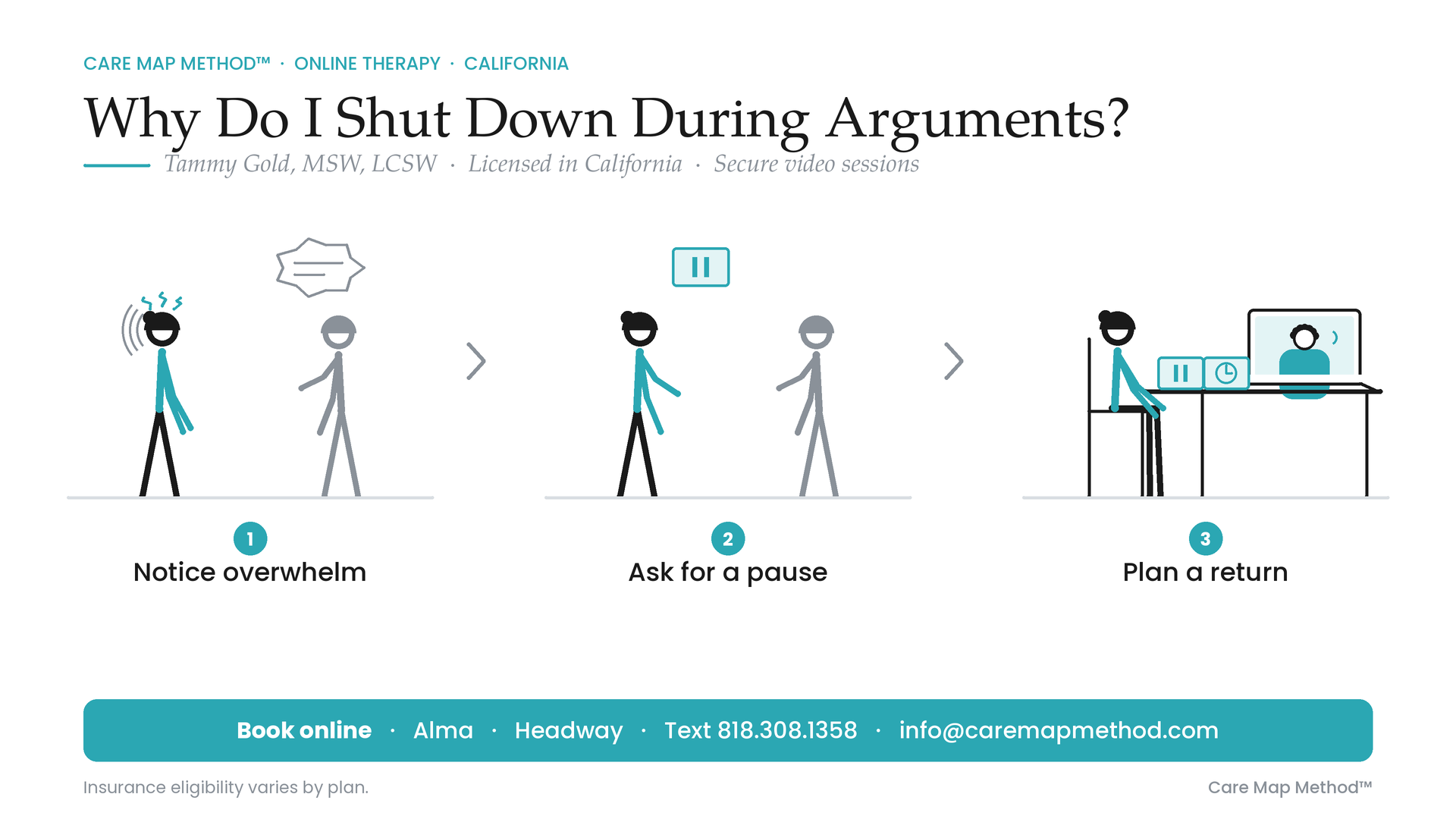
Why Do I Shut Down During Arguments
You want to explain yourself, but the words disappear. Your mind goes blank, your body feels tense, or you need to leave the conversation. Later, you may feel guilty, misunderstood, or afraid of starting again. Shutting down during arguments can have different causes, and therapy begins with understanding your experience rather than assuming a label. In online individual therapy for adults in California, we can explore triggers, recognize earlier signs of overwhelm, and practice a pause that includes a plan for returning. Eligible Anthem Blue Cross or Aetna members can check insurance options through my Headway profile.
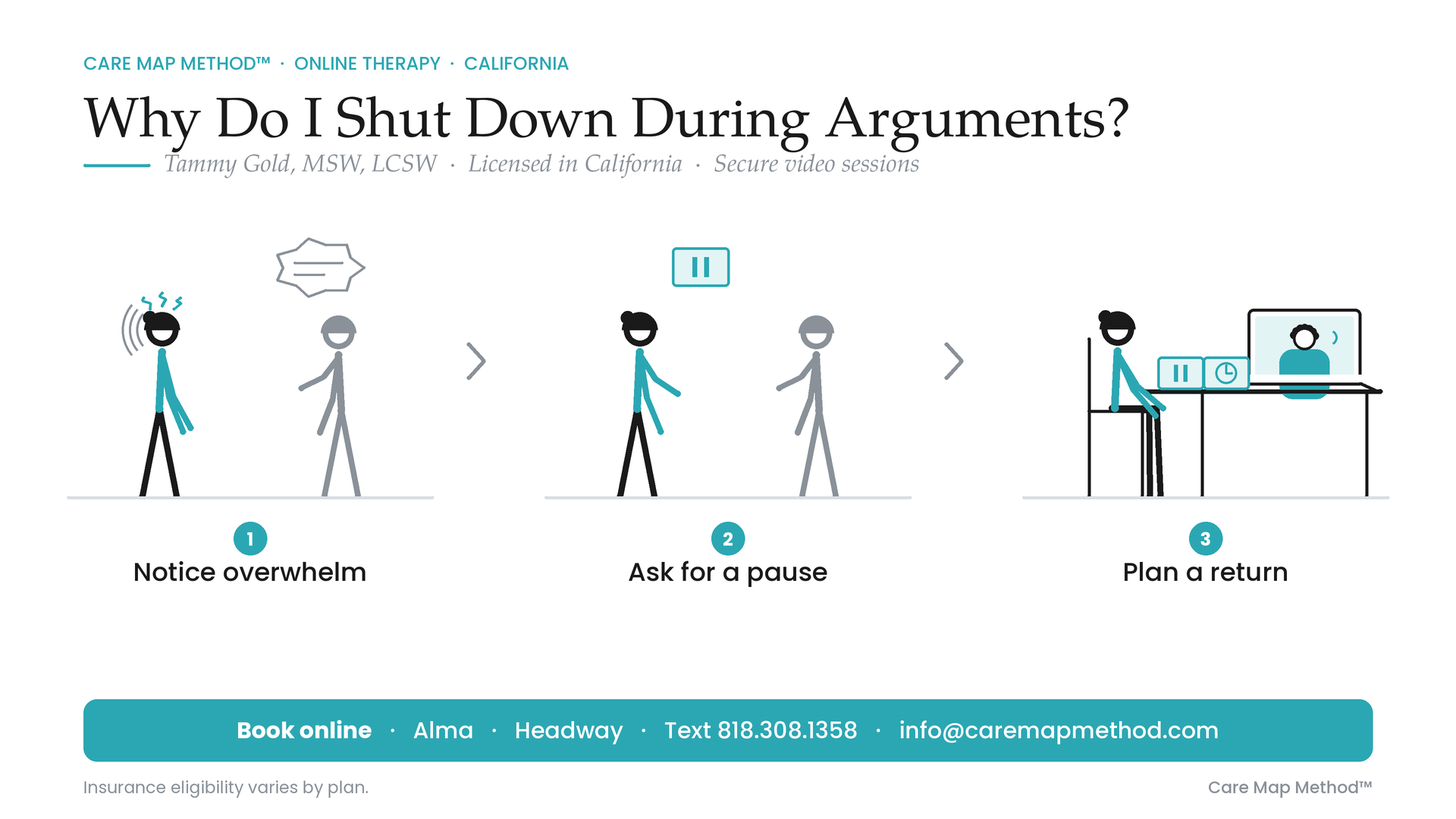
An adult recognizing tension during a conversation, then writing a short pause request and a return time with a therapist on a laptop.
When going quiet does not feel like a choice
An argument starts, and suddenly you cannot think clearly. You might become silent, struggle to speak, or agree just to make the conversation stop. Your partner may read this as indifference while you feel overwhelmed inside. Afterward, the original issue remains unresolved.
I am Tammy Gold, LCSW, and I offer online individual therapy in California. We can explore what happens for you during conflict, including feelings, physical sensations, thoughts, and relationship context. Going quiet does not tell us the cause on its own. Assessment helps us understand what support fits.
Understand what happens before the silence
We might look at a recent argument in detail. Was there a change in tone, a particular phrase, fear of saying the wrong thing, or a sense that there was no way to respond safely? Were you exhausted before the conversation began? What happened when you tried to pause?
We can work on noticing earlier signs of overload, putting words to your experience, and distinguishing a useful break from withdrawing without explanation. Your needs matter, and so does what happens after the break. The goal is to develop more options for responding, not force you to continue a conversation when you cannot participate safely or thoughtfully.
Map the trigger and prepare a different response
Care Map Method™ helps organize our work alongside clinical assessment. Biological factors may include fatigue or physical tension. Emotional factors might include fear, shame, or hurt. Social and Environmental factors include relationship history, expectations, timing, and privacy.
MAP the point where you begin to lose your words. MATCH the need with a strategy, such as grounding, a clear pause, or writing down one sentence. MERGE the strategy by practicing it before a difficult moment. MANAGE communication and responses by reviewing whether the plan helped and what made it difficult. We can adjust the pace and explore the history behind the reaction.
Practice a pause with a return plan
One possible phrase is: “I want to talk about this, and I am having trouble thinking clearly. Can we pause and choose a time to return?” In therapy, we can make that wording more natural for you and discuss what a workable return looks like. A pause should not become a way to avoid every difficult topic.
When conflict involves intimidation or fear, communication practice alone may not be appropriate; we will consider safety and the kind of help needed. We can review progress through earlier recognition of overload, increased ability to express a need, and follow-through on returning to conversations. Progress is individual, and setbacks give us information to work with.
Insurance and next steps
Eligible Anthem Blue Cross or Aetna members in California can use my Headway profile to check their specific plan, estimated costs, and appointment options. Benefits and network participation vary. Coverage depends on clinical assessment and the service provided. This page describes individual psychotherapy; couples sessions, coaching, mediation, and other services require separate confirmation.
You do not need to have the whole situation figured out before reaching out. We can begin by understanding what is most difficult and deciding whether this service is a good fit.
Does shutting down mean I have trauma?
Not necessarily. Silence or overwhelm during conflict can have different explanations. We consider your history, current circumstances, symptoms, and safety without assigning a diagnosis based on one behavior.
Can I work on this without my partner?
Yes. Individual therapy can help you understand your responses and practice coping and communication skills. Changes in a relationship also depend on the other person’s behavior, which individual therapy cannot control.
What will we discuss at the first session?
We explore your concern, relevant history, symptoms, supports, and goals. You can describe a recent argument if you feel comfortable. You do not need to relive every painful experience or find the perfect words immediately.
Can Anthem Blue Cross or Aetna cover sessions?
Headway can check your exact California plan and estimate costs. Coverage depends on benefits, network participation, clinical assessment, and the service. This page describes individual psychotherapy, not a guarantee of couples counseling coverage.
Should I force myself to stay in the argument?
No single rule fits every situation. We can consider what happens during the interaction and develop an appropriate pause or response. If you feel threatened, safety takes priority over completing a conversation.
How do I start?
Use “Check Insurance and Availability on Headway” to explore an appointment for California individual therapy. Bring a general sense of what is happening. We can clarify the pattern together rather than expect you to explain it perfectly.
About Tammy Gold
Tamara “Tammy” Gold, MSW, LCSW, CEC, is a Columbia University–trained clinical social worker, University of Pennsylvania graduate, certified coach, and founder of Care Map Method™. She is the author of Secrets of the Nanny Whisperer and brings more than 20 years of direct family work. Her therapy style is warm, collaborative, and practical, with attention to emotions, history, and everyday functioning.
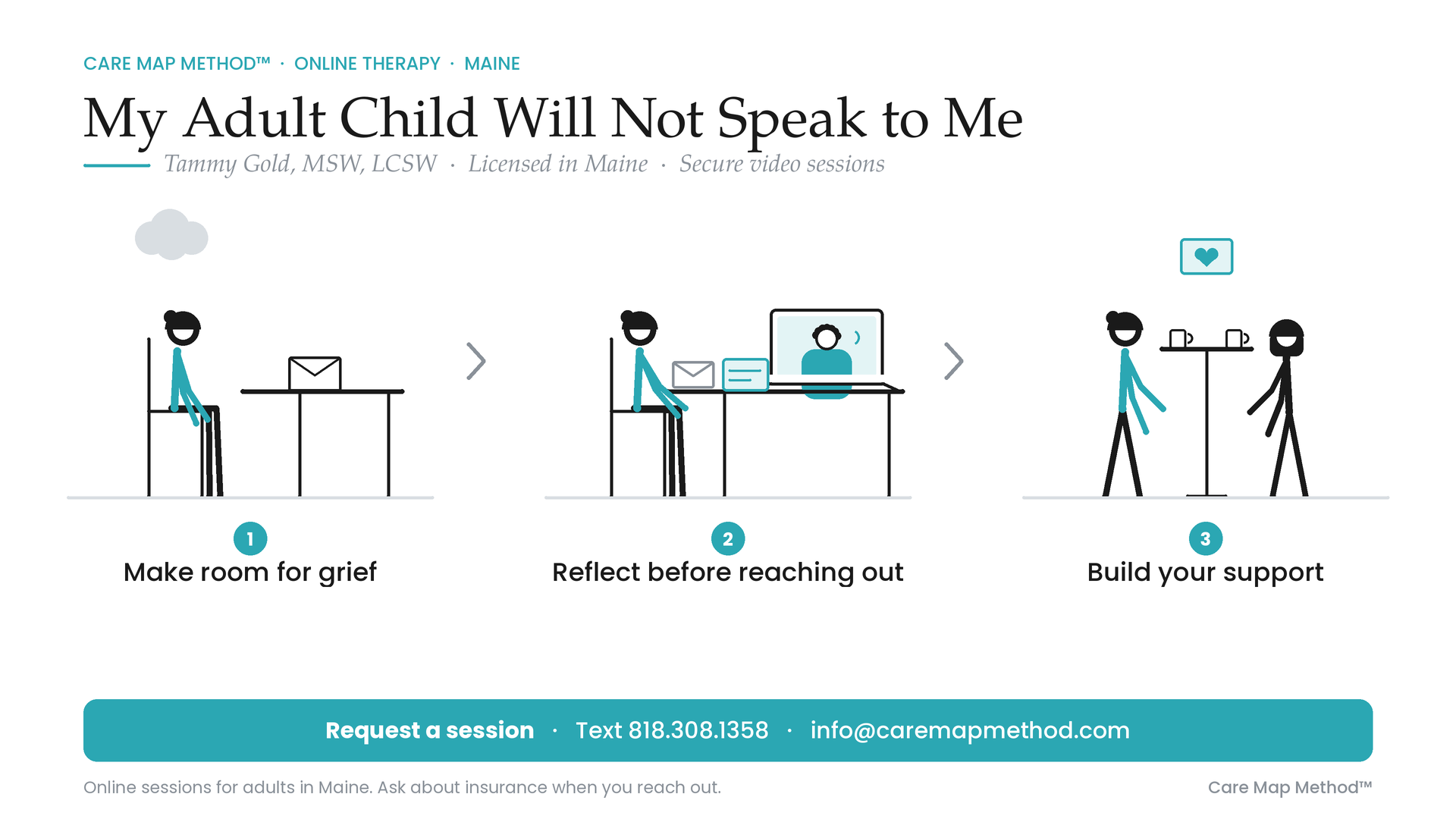
My Adult Child Will Not Speak to Me
When an adult child stops communicating, grief can mix with confusion, anger, shame, and hope. You may reread messages, wonder whether to reach out again, or feel unable to talk openly with friends. Individual therapy gives you space to process the loss and examine your own experience without assuming either person is entirely to blame. I offer online therapy for adults located in Maine. We can explore accountability, boundaries, daily coping, and what respectful contact might look like if it is appropriate. Therapy cannot promise reconciliation. Use my Alma profile to check availability and your specific insurance benefits.
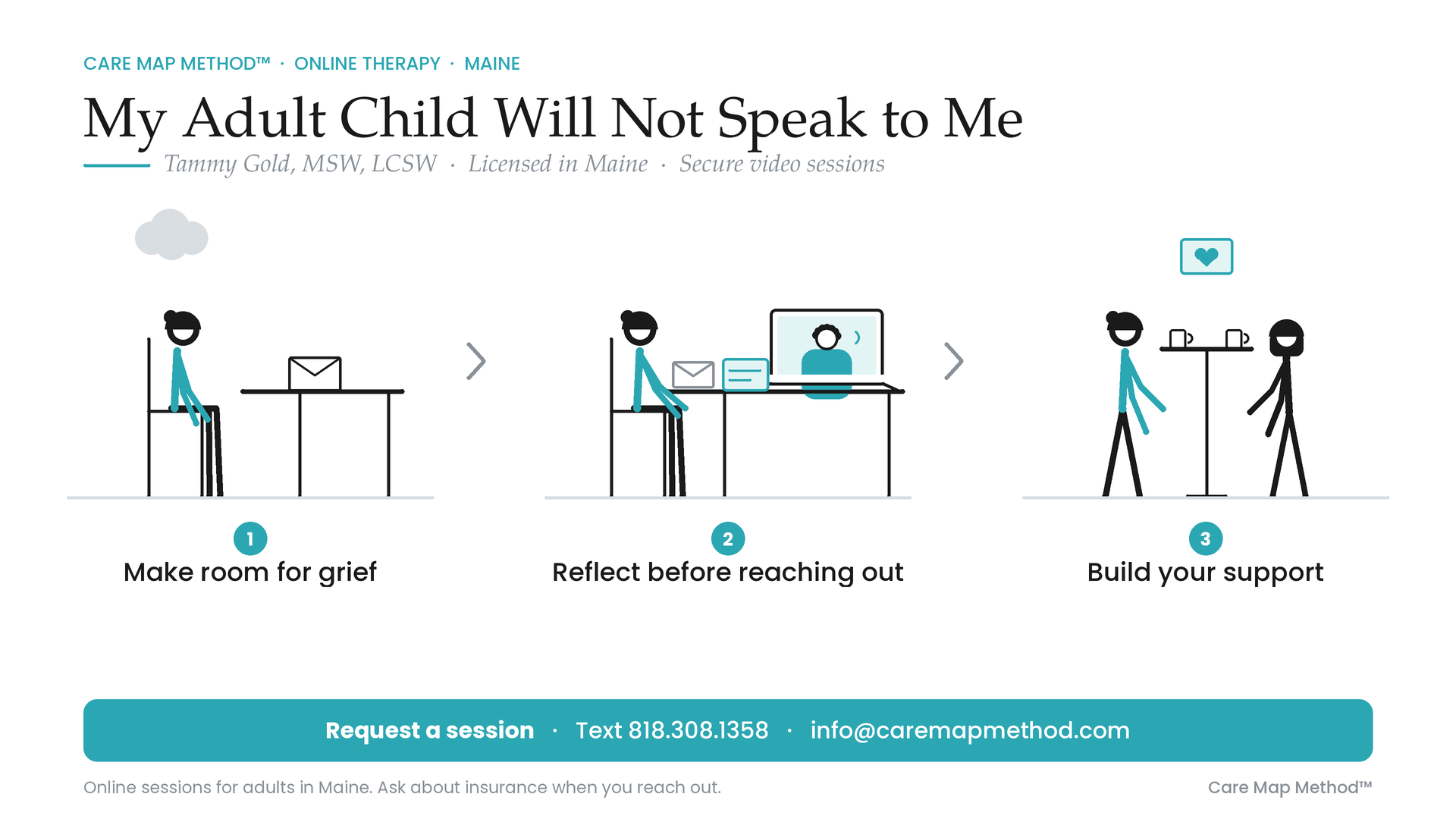
An adult setting aside an unsent letter while talking with a therapist on a laptop; another small scene shows the adult reconnecting with a supportive friend.
When there is no clear ending and no clear way forward
You may still think of your adult child throughout the day while having little or no contact. Holidays, photographs, or an ordinary family question can bring a fresh wave of sadness. You might alternate between wanting to explain yourself and feeling afraid that any message will make things worse.
I am Tammy Gold, LCSW. I offer online individual therapy for adults physically located in Maine. We can make room for the grief, uncertainty, and complicated feelings without rushing you toward forgiveness, repeated contact, or a particular family outcome.
Explore your experience without deciding the whole story
We can discuss how the estrangement affects mood, sleep, concentration, relationships, and daily life. We can also explore the history you bring, what your child has communicated, what you understand, and what remains unclear. Taking your pain seriously does not require dismissing their perspective.
Depending on your needs, sessions may involve grief, responsibility, limits, or the urge to keep seeking an answer. We can distinguish reflection that helps you learn from repetitive self-blame that keeps you stuck. We will not diagnose an absent family member or assume that a particular message will bring them back.
Use Care Map Method to organize what needs attention
Alongside clinical assessment, the Biological, Emotional, Social, and Environmental lens helps us consider how you are sleeping and functioning, the feelings involved, your support system, and situations such as holidays or social media that intensify distress.
MAP the trigger, such as seeing a photograph or receiving no reply. MATCH the need with a strategy for grief, support, accountability, or a boundary. MERGE that strategy into daily life, perhaps by preparing for a holiday or changing a checking habit. MANAGE communication and responses by reviewing what supports you and respects the other person’s limits. The framework is not a reconciliation protocol.
Consider contact carefully and rebuild support
Before sending a message, try writing an unsent version. What is its purpose? Does it acknowledge anything you can take responsibility for? Does it ask your child to manage your distress? Has your child requested no contact? We can examine these questions without assuming sending the message is the right next step.
Progress may involve fewer hours spent checking for a reply, more support outside the relationship, or greater ability to tolerate uncertainty. You can grieve and still participate in your own life. We will review what is helping you function and cope, while recognizing that renewed contact depends on more than your individual therapy work.
Insurance and next steps
I offer online individual therapy through Alma for eligible clients located in Maine. Use my profile to check your specific insurance plan, estimated cost, and appointment options. Network participation and benefits vary. Insurance coverage depends on assessment and the service provided; a concern named on this page does not automatically establish a covered diagnosis.
You do not need to have the whole situation figured out before reaching out. We can begin by understanding what is most difficult and deciding whether this service is a good fit.
Frequently asked questions
Can therapy make my adult child reconnect?
No. Therapy cannot guarantee contact or reconciliation. It can support your coping, reflection, accountability, boundaries, and choices about communication. Your adult child’s decisions and stated limits remain outside your control.
Do you take the parent’s side?
I work with you as the client while remaining open to complexity and missing information. We can take your pain seriously and explore responsibility without treating therapy as a judgment about who is entirely right or wrong.
What will we discuss first?
We begin with what is happening now, how it affects you, relevant history, supports, symptoms, and safety. You do not need to bring every message or prove your account. We can decide together what information is useful.
Can I use my insurance?
My Alma profile can check your exact Maine plan and estimated costs. Coverage depends on benefits, participation, clinical assessment, and the psychotherapy service. Support for estrangement does not automatically mean family mediation or reunification services are covered.
Can my adult child join later?
Any involvement would need a separate discussion of consent, goals, confidentiality, and suitability. We do not assume that inviting them is appropriate or that individual therapy automatically becomes family therapy.
How do I start individual support?
Use “View Maine Availability on Alma” to explore an appointment. A general description of your concern is enough for an initial inquiry. You can begin even if you are unsure what you want to do about the relationship.
About Tammy Gold
Tamara “Tammy” Gold, MSW, LCSW, CEC, is a Columbia University–trained clinical social worker, University of Pennsylvania graduate, certified coach, and founder of Care Map Method™. She is the author of Secrets of the Nanny Whisperer and brings more than 20 years of direct family work. Her therapy style is warm, collaborative, and practical, with attention to emotions, history, and everyday functioning.
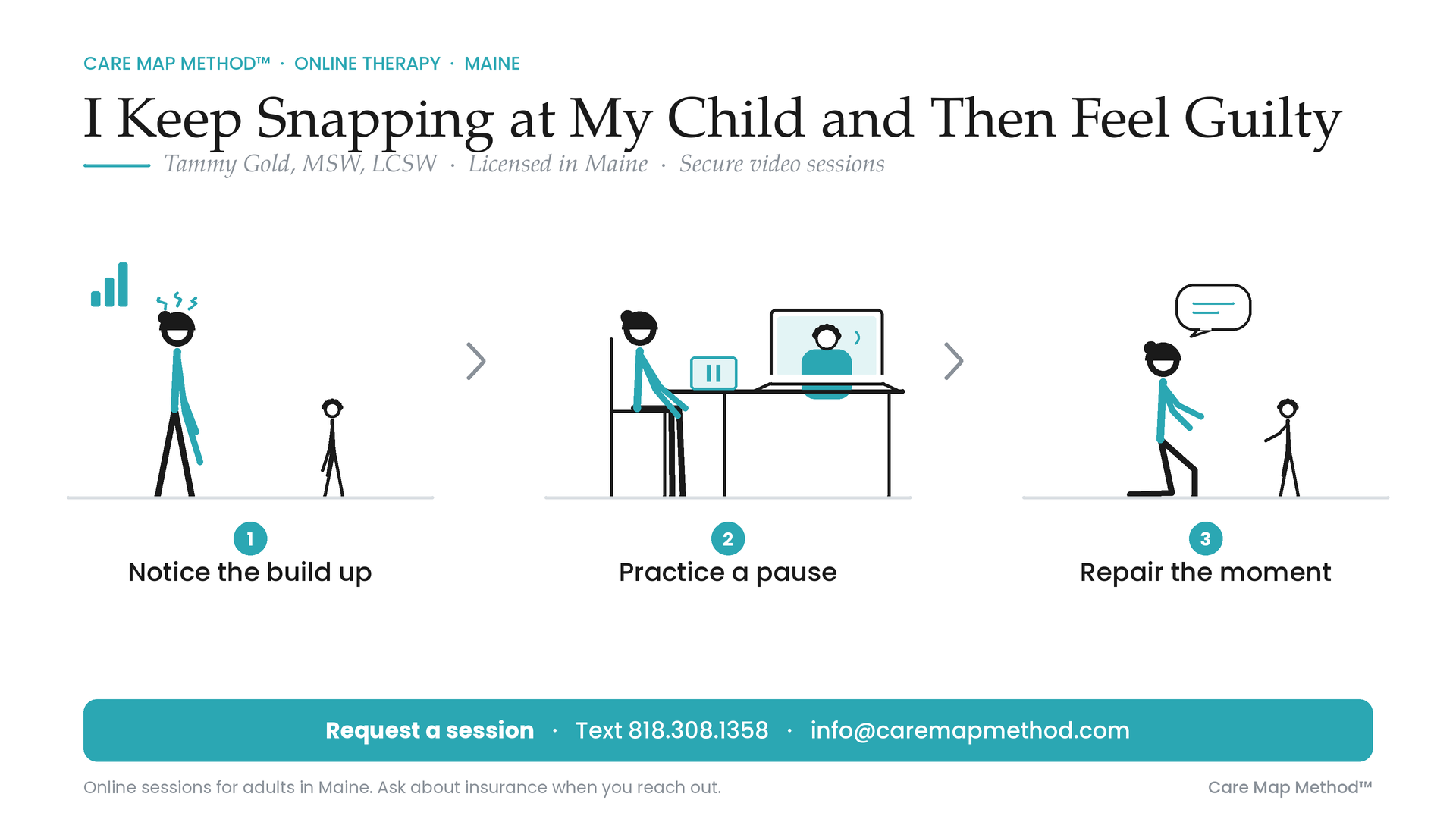
Online Therapy in Maine for Parenting and Relationship Stress
You promise yourself you will be more patient, then a rushed morning or repeated request ends in snapping. Later, guilt takes over. You may care deeply about your child and still need support with the pressures affecting your reactions. In online individual therapy for parents in Maine, we can explore what builds up before these moments, identify the feelings and needs underneath them, and practice responding and repairing. This is therapy for the parent’s well-being, with room for your history, stress, and relationships. View my Alma profile to check availability and your specific insurance eligibility.
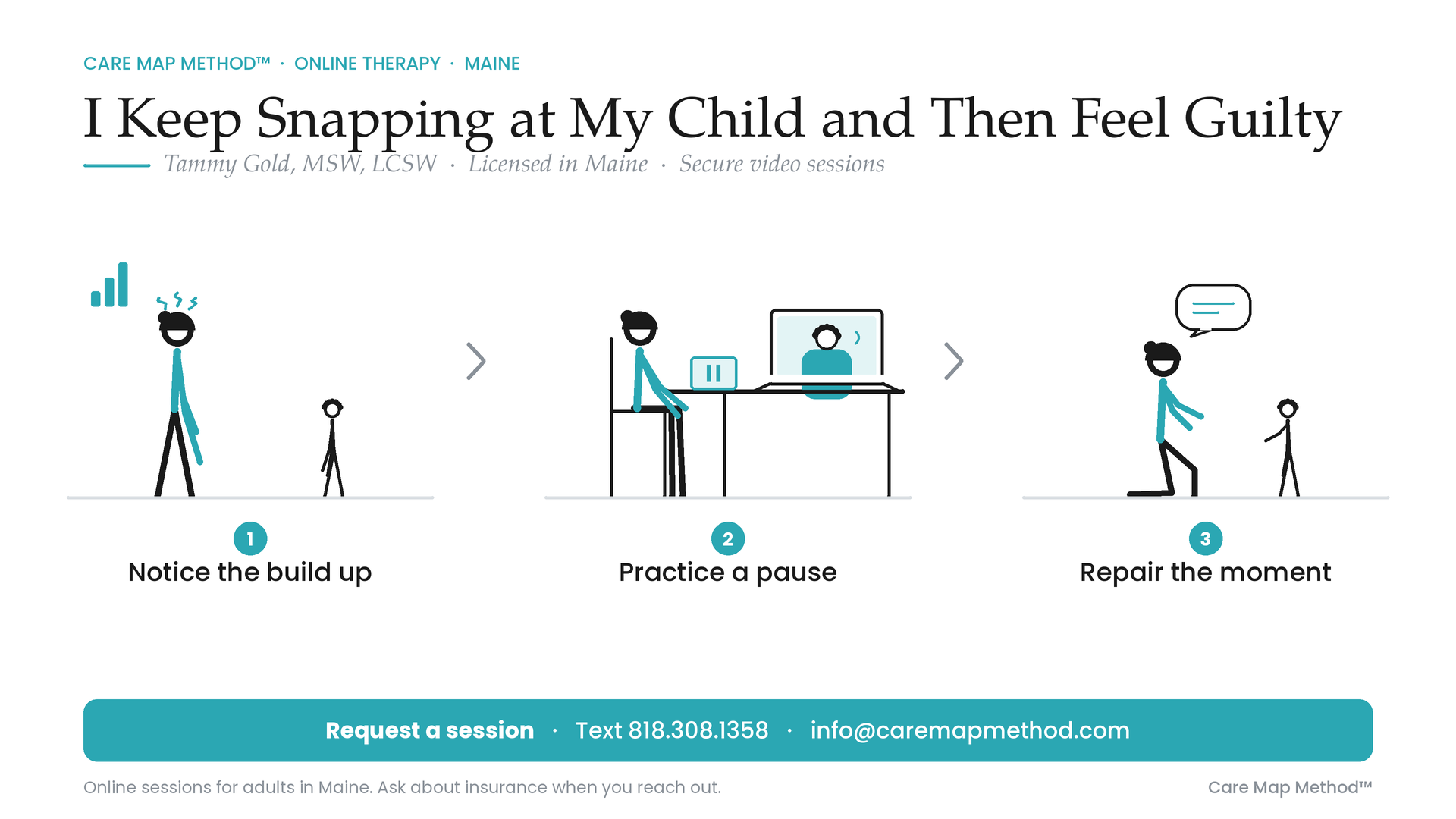
A parent pausing before responding, then sitting at a child’s level for a brief repair conversation; a separate small therapy scene shows the parent rehearsing words.
You care about your child and want a different response
You hear yourself raising your voice, and it is not how you wanted the morning to go. Perhaps everyone is late, you barely slept, and the same request has been ignored again. Afterward, you replay the interaction and worry about what it says about you as a parent.
I am Tammy Gold, LCSW. I offer online individual therapy for parents physically located in Maine. We can make room for the guilt without using it to define you. We also take the interaction seriously and work on what could help you respond differently.
Look at what builds before the moment
Parenting stress can involve competing demands, relationship tension, worry about your child, limited support, and expectations you place on yourself. We will also consider symptoms, health concerns, and relevant history rather than assume the problem is simply a lack of parenting techniques.
In sessions, we might review the hour before an outburst. What demands were arriving? What did you tell yourself about the behavior? Were you feeling ignored, unsupported, or afraid of losing control? Understanding that sequence can help us identify an earlier point to intervene. We can also explore the family patterns you hope to change and the support you need to do that.
Use the map to choose a manageable skill
Care Map Method™ organizes the concern alongside clinical assessment. Biological, Emotional, Social, and Environmental pressures include sleep and energy, guilt or frustration, family roles, and the daily setting in which difficult moments happen.
MAP the trigger and emotion before snapping.
MATCH the need with a strategy, such as a pause, a shorter instruction, or a request for support.
MERGE the strategy into one predictable situation, like leaving for school.
MANAGE your responses by reviewing what happened and adjusting.
We can explore deeper feelings as well as practical changes. The aim is not to expect perfect patience.
Practice repair and review realistic change
A repair might sound like: “I raised my voice. That was my responsibility. The limit still matters, and I want to say it differently.” We can adapt the language to your child’s age and the situation. Repair includes taking responsibility without making the child manage your guilt.
For a starting reflection, note one early sign that you are overloaded and one person or resource you might ask for help. We can review whether reactions become less intense or frequent, whether you notice overload sooner, and whether you recover and repair more effectively. If anger is becoming unsafe, we will address safety and appropriate support directly.
Insurance and next steps
I offer online individual therapy through Alma for eligible clients located in Maine. Use my profile to check your specific insurance plan, estimated cost, and appointment options. Network participation and benefits vary. Insurance coverage depends on assessment and the service provided; a concern named on this page does not automatically establish a covered diagnosis.
You do not need to have the whole situation figured out before reaching out. We can begin by understanding what is most difficult and deciding whether this service is a good fit.
Frequently asked questions
Does snapping mean I am a bad parent?
A difficult interaction does not define your whole relationship. It still deserves attention, especially if it repeats or feels out of control. We can explore your distress, accountability, and the support and skills you need.
Is this therapy for me or my child?
This page describes individual psychotherapy for the adult parent. We can discuss your parenting experiences and emotional responses. Assessment or treatment of your child would be a separate service and is not included automatically.
What happens during the first session?
We discuss current stress, symptoms, relevant history, family context, supports, and safety. You can share a recent parenting moment without preparing a complete explanation. We begin agreeing on priorities and whether the service fits.
Can I use insurance through Alma?
Check your specific Maine plan through my Alma profile. Coverage depends on active network participation, benefits, assessment, and the service provided. Parenting stress alone does not automatically establish an insurance-covered diagnosis or service.
Do you give parenting advice or explore emotions?
Our psychotherapy work can include emotional exploration, assessment, coping, and practical rehearsal. The balance depends on your needs. Standalone parenting coaching or childcare consulting is a different service with separate arrangements.
How do I request an appointment?
Use “View Maine Availability on Alma” to explore scheduling and benefits. If you need another time, use the profile’s contact option. Please keep detailed clinical information out of an initial general inquiry.
About Tammy Gold
Tamara “Tammy” Gold, MSW, LCSW, CEC, is a Columbia University–trained clinical social worker, University of Pennsylvania graduate, certified coach, and founder of Care Map Method™. She is the author of Secrets of the Nanny Whisperer and brings more than 20 years of direct family work. Her therapy style is warm, collaborative, and practical, with attention to emotions, history, and everyday functioning.
Book A Session Today & Get The Support You Deserve!
For clients using insurance, I use the platforms below:
Alma Therapy https://secure.helloalma.com/providers/tamara-gold/
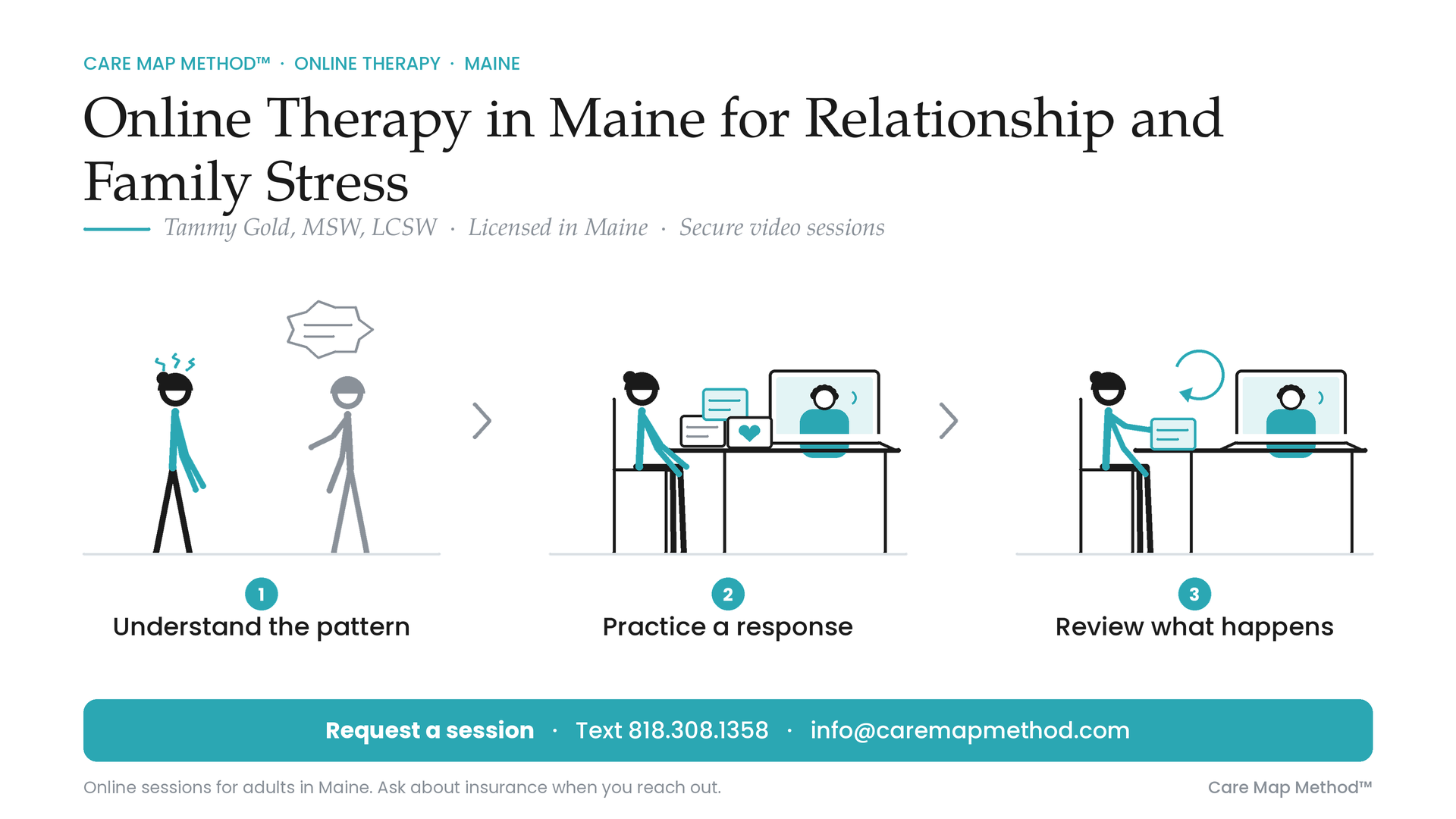
Online Therapy in Maine for Relationship and Family Stress
You may be keeping everything moving while feeling increasingly overwhelmed inside. Perhaps the same argument keeps returning, parenting takes more patience than you have left, or caring for a parent leaves little time for your own needs. I offer online individual therapy for adults located in Maine. Together, we can understand the pressures behind difficult moments and practice communication, boundaries, and coping skills that fit your life. My approach combines room for your emotions and history with practical work you can try between sessions. View my Alma profile to explore availability and check your specific insurance benefits.
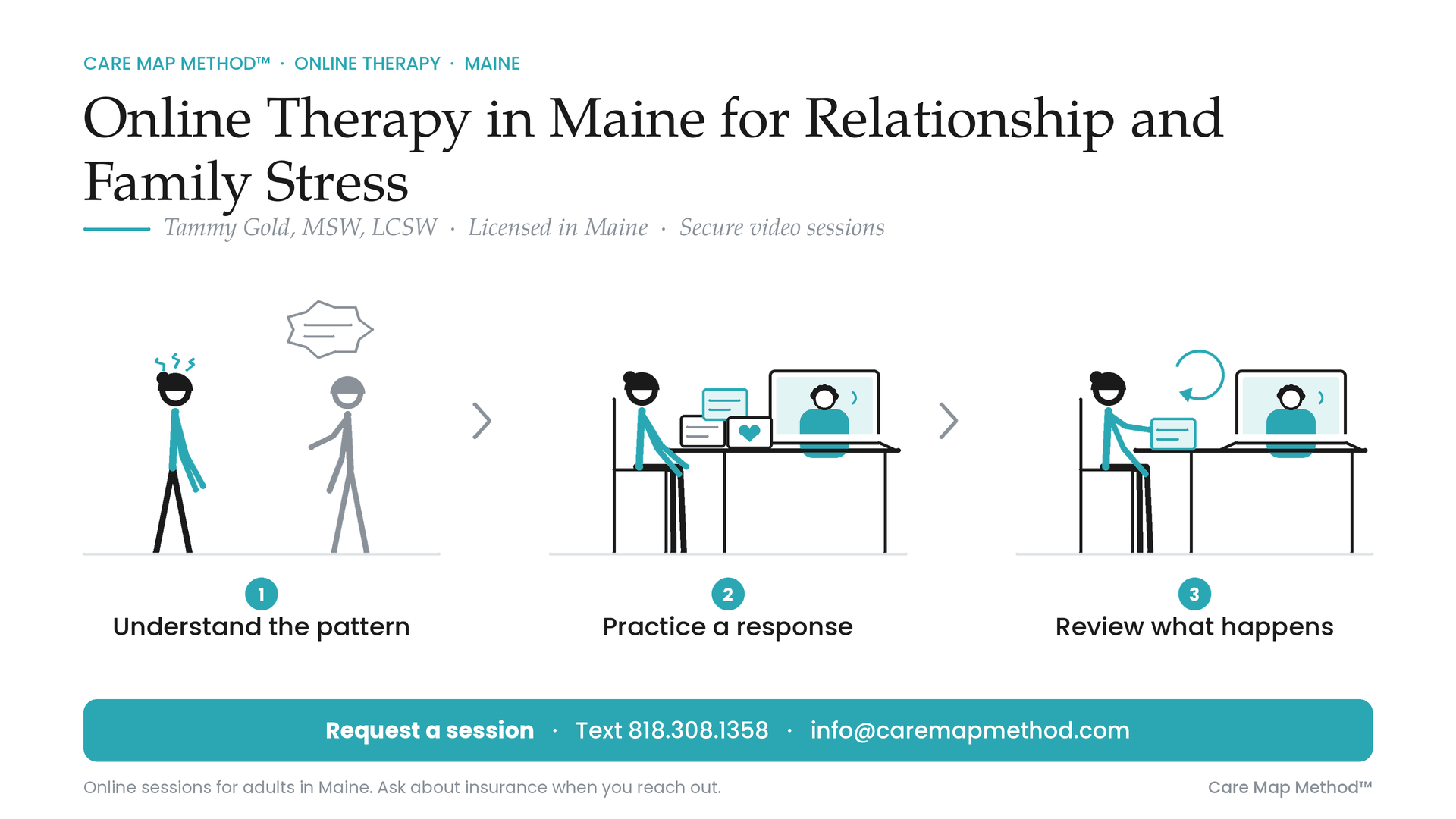
When your responsibilities leave little room for you
You finish the day, but your mind is still running. You replay a conversation, worry about someone you love, or wonder why a small request brought such a strong reaction. You may look capable to everyone else while feeling worn down, resentful, or disconnected.
I am Tamara “Tammy” Gold, MSW, LCSW, CEC. I provide online individual therapy for adults physically located in Maine. You can come for support with your own distress even when the problem involves a partner, child, sibling, parent, or coworker. We begin with your experience and what you would like to change.
What we can work on together
Our work may focus on recurring arguments, parenting overwhelm, caregiver guilt, difficulty saying no, divorce adjustment, or stress during a major family transition. We can explore how these concerns affect your mood, sleep, concentration, relationships, and daily functioning.
In a session, we might examine one recent interaction rather than trying to solve your entire family situation at once. What did you hear? What did it mean to you? What did you need? We can practice turning “Nobody helps me” into a specific request, or prepare a boundary you have been avoiding. Your history and emotions matter throughout this work.
A practical framework for understanding the pattern
I use Care Map Method™ as an organizing framework alongside clinical assessment and individualized psychotherapy. Biological, Emotional, Social, and Environmental factors help us consider the whole situation, including sleep, health pressures, feelings, relationships, routines, and available support.
MAP the emotion and trigger: identify what happened and the meaning you attached to it. MATCH the need with a strategy: choose a coping skill, request, or boundary that addresses the concern. MERGE the strategy into daily life: rehearse the words and decide when to use them. MANAGE communication and responses: review what happened and adjust. The framework supports our work; it is not a guarantee or a separately validated treatment.
A place to begin and a way to review progress
Before your first session, consider finishing this sentence: “One situation I would like to handle differently is…” Choose a recent example and describe what happens before, during, and after it. You do not need a polished explanation or a diagnosis to reach out.
We will agree on priorities and revisit whether therapy is helping. Progress might include recovering sooner after an argument, communicating a need more directly, or noticing overwhelm before it becomes snapping. We can also review symptoms and daily functioning. If something is not helping, I want us to discuss it and change the approach.
Insurance and next steps
I offer online individual therapy through Alma for eligible clients located in Maine. Use my profile to check your specific insurance plan, estimated cost, and appointment options. Network participation and benefits vary. Insurance coverage depends on assessment and the service provided; a concern named on this page does not automatically establish a covered diagnosis.
You do not need to have the whole situation figured out before reaching out. We can begin by understanding what is most difficult and deciding whether this service is a good fit.
Do I need a major crisis to start therapy?
No. Ongoing worry, resentment, relationship strain, or difficulty coping can be reasons to seek an assessment. We will discuss what is happening, how it affects your life, and whether individual psychotherapy is a suitable service.
Can I attend without my partner or family?
Yes. Individual therapy can address your emotions, coping, communication, and decisions even when another person is not attending. We cannot control that person’s behavior or promise family agreement.
What happens in the first session?
We discuss your concerns, relevant history, current supports, symptoms, safety, and goals. You can ask questions about my approach. We begin deciding what to focus on and whether we are a good fit.
Can I use insurance through Alma?
Visit my Alma profile and enter your specific plan to check eligibility and estimated cost. State participation, network status, benefits, and the service provided matter. A carrier’s name alone does not establish coverage.
Do I need to live in a particular Maine city?
Sessions are online for eligible adults physically located in Maine at the time of the appointment. You need a private setting and a reliable connection. Tell me about travel before a session so we can check whether care can continue.
How do I request an appointment?
Use the “View Maine Availability on Alma” button to explore scheduling and insurance options. If the available times do not work, use the contact option on my profile to ask about availability. Avoid sending sensitive clinical details in a general inquiry.
About Tammy Gold
Tamara “Tammy” Gold, MSW, LCSW, CEC, is a Columbia University–trained clinical social worker, University of Pennsylvania graduate, certified coach, and founder of Care Map Method™. She is the author of Secrets of the Nanny Whisperer and brings more than 20 years of direct family work. Her therapy style is warm, collaborative, and practical, with attention to emotions, history, and everyday functioning.
Book A Session Today & Get The Support You Deserve!
For clients using insurance, I use the platforms below:
Alma Therapy https://secure.helloalma.com/providers/tamara-gold/
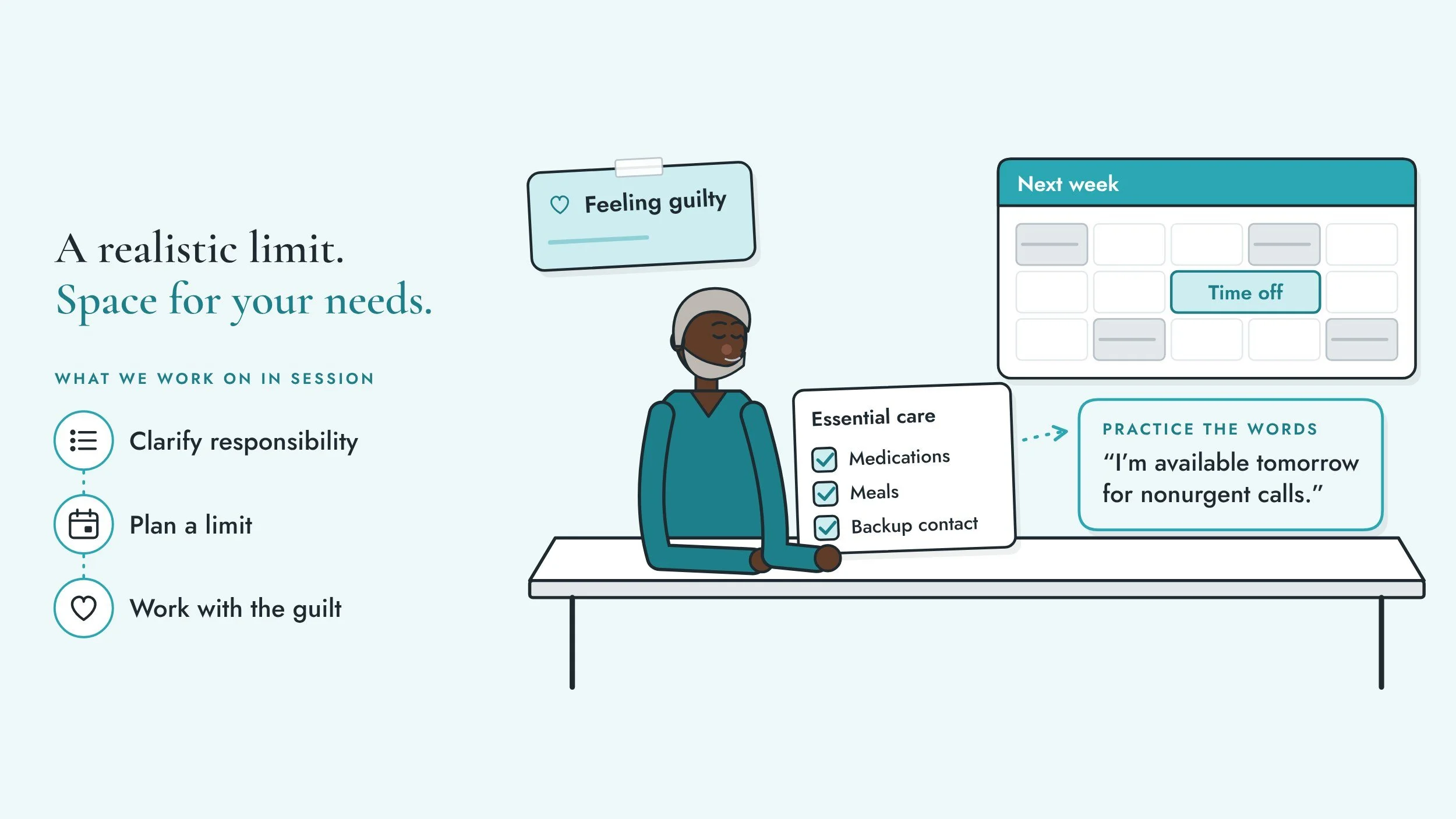
Caregiver Guilt and Boundaries Therapy in Oregon
Do you feel guilty as soon as you plan a break from caring for your parent? Perhaps you cancel your own plans, check repeatedly when care is already arranged, or feel responsible for preventing every uncomfortable moment. In online caregiver guilt and boundaries therapy in Oregon, we can explore what you are responsible for and the standards you expect yourself to meet. Together, we can consider essential care needs, practice communicating your availability, and prepare for the urge to take a reasonable limit back. Care Map Method helps us connect the feelings underneath guilt with a plan that respects your circumstances. I’m Tammy Gold, LCSW. We can work toward decisions that include your needs while making room for grief, family expectations, and the difficult choices that caregiving sometimes requires.
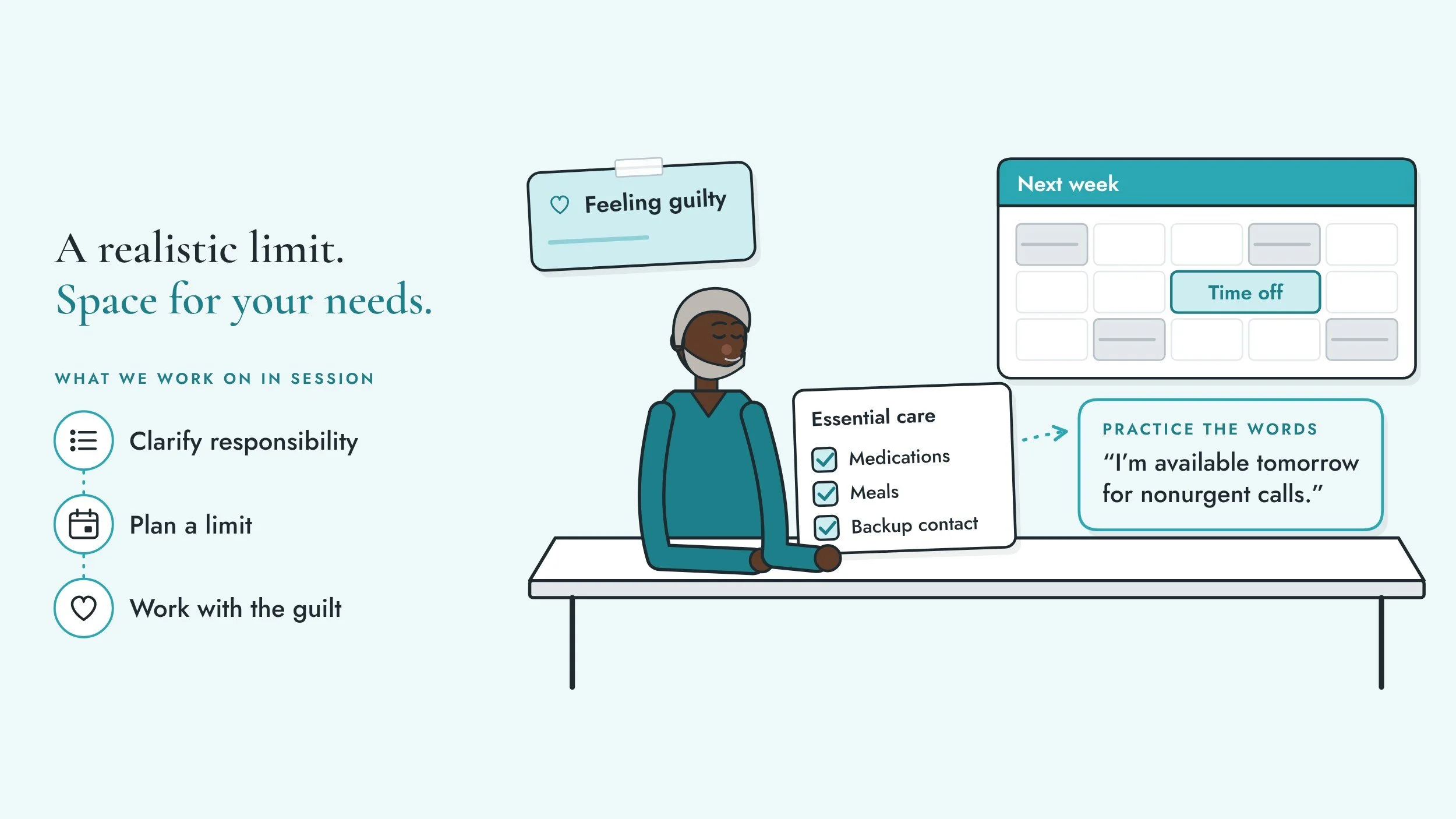
Care about your parent while making room for your own needs
You plan a break, then start wondering whether you should cancel it. You set a limit, then worry that something will happen while you are unavailable. Caregiver guilt can keep you working long after you have reached your limit. Therapy gives us space to understand that guilt and consider what responsibility looks like in the situation you actually face.
Perhaps you compare yourself with a sibling, feel responsible for a parent’s loneliness, or believe that needing rest means you are not doing enough. A parent’s disappointment may feel harder to tolerate than your own exhaustion. We can focus on the emotional meaning of those moments and the choices that remain available to you.
Check benefits and availability
Distinguish a real obligation from an impossible standard
We can examine what your parent needs, what you have agreed to provide, and the expectations you place on yourself. Some responsibilities require a practical plan; others may reflect a belief that you should prevent every difficulty or uncomfortable feeling. Understanding that difference can help us address guilt without dismissing the real demands of caregiving.
Prepare a boundary with a practical plan
A useful limit needs to account for genuine care needs and available support. We can practice how to communicate a time you are unavailable, identify what counts as urgent, and consider who or what resource can address essential needs. We will avoid suggesting a break that depends on leaving a necessary responsibility unattended. The emotional work and the practical circumstances need to fit together.
Work through the urge to reverse the decision
After setting a limit, you may want to call repeatedly, apologize, or give up your plans. We can explore the fear behind that urge and choose how to respond to it. We can also make room for sadness about what your parent can no longer do and for the discomfort of accepting that care sometimes involves difficult choices rather than a solution everyone likes.
An example of the work
For example, you might want one evening each week without nonurgent calls. We could explore the guilt this brings up, discuss essential care arrangements, and rehearse a message about your availability. After trying it, we could review whether the plan was workable and how you handled the feelings afterward.
What progress can look like
Progress might mean distinguishing urgency from guilt, maintaining a realistic commitment, checking less often when care is arranged, or speaking more honestly about what you can offer. Your parent’s needs and your limits may change, and the plan can change with them.
How Care Map Method supports our work
Map the emotion and trigger. We look at a recent moment and the biological, emotional, social, and environmental pressures around it. The aim is to understand your experience before choosing a response.
Match the need with a strategy. We identify what matters in that moment and select a skill or next step that fits. That might be a clearer request, a pause, a boundary, or space to process a loss.
Merge the skill into daily life. We can rehearse the words and decide when you might use them. Any practice between sessions is chosen together and adjusted to your circumstances.
Manage responses over time. We review what happened, what was difficult, and what needs to change. Therapy includes room for feelings and history as well as practical work.
About Tammy Gold
I’m Tamara “Tammy” Gold, MSW, LCSW, founder of Care Map Method™ and author of Secrets of the Nanny Whisperer. I earned my MSW at Columbia University and my BA at the University of Pennsylvania. My work with families informs a warm, active approach to therapy that makes room for your emotional experience and practical concerns.
Common questions
Is this different from general caregiver burnout therapy? This page focuses specifically on guilt, responsibility, and maintaining limits. If your main concern is overall exhaustion or grief, we can discuss that too and choose the most useful focus.
Does a boundary mean I care less? A limit does not measure the depth of your care. We can examine the meaning you attach to it and whether the plan accounts for real needs and your available capacity.
What if my parent says I am selfish? We can work on how that affects you, practice a response, and consider the history of the relationship. We cannot guarantee your parent will agree with or welcome your limit.
Do you arrange replacement caregivers? This page describes psychotherapy. Staffing, placement, and care coordination are separate services. Therapy can help you address the emotions and communication involved in seeking practical help.
Can I use BCBS of Massachusetts while in Oregon? Your exact product and Oregon network eligibility must be checked through my Alma profile. The carrier name alone does not establish coverage, and your location and benefits both matter.
Can I start even if I cannot change the workload yet? Yes. We can address guilt, grief, expectations, and coping while acknowledging the limits on practical change. We will develop goals that fit the resources you actually have.
Take the next step
If this sounds familiar, you can explore online therapy with me while located in Oregon. Open my Alma profile to check your exact insurance benefits and appointment options. We will discuss your concerns, clinical needs, and goals to determine fit.
Therapy for Parents of Teens in Oregon
Does a question about school, homework, or weekend plans quickly turn into an argument with your teenager? You may want to stay connected while feeling unsure how to handle withdrawal, disagreement, or growing independence. Online therapy for parents of teens in Oregon focuses on your emotional health and the responses available to you. We can look at what happens before the conflict, what you are worried about, and how timing or repeated questions affect the exchange. Using Care Map Method, we consider biological, emotional, social, and environmental pressures, then practice an opening, a clear limit, or a way to return to the discussion after a pause. I’m Tammy Gold, LCSW. These sessions give you space to work through your own reactions while developing communication that fits your family and respects your teenager’s changing needs.
Stay connected while you work through difficult conversations
You ask about school, a phone, or a plan for the weekend, and suddenly you are arguing. You want to keep your teenager safe, but the conversation leaves both of you upset. Therapy for you as the parent can help you understand the pattern, manage your own reactions, and practice a way to be clear without turning every concern into a prolonged conflict.
You may alternate between being very firm and giving in because you are tired. Perhaps your teen’s withdrawal feels personal, or worry makes you ask the same question repeatedly. You might disagree with another caregiver about rules. We can look at what is happening in your family and choose one interaction to work on first.
Check benefits and availability
Map what happens around the conflict
We can consider biological, emotional, social, and environmental pressures: fatigue, your own stress, peer changes, the timing of a conversation, and the demands of the day. These questions help us understand context without excusing harmful behavior or assuming we know what your teen feels. We can identify what you have observed and what may need further assessment.
Practice an opening and a limit
We can rehearse a question that invites information and a limit you can explain briefly. For example, a discussion about getting home on time may work better when it addresses one agreement rather than every concern about independence. We can explore what to do if your teen disagrees and how to keep your response consistent with your priorities.
Work on repair and parental worry
A hard interaction does not have to determine the rest of the day. We can practice acknowledging your part, returning to the practical issue, and choosing when to listen. We also make room for fear, grief about a changing relationship, and experiences from your own adolescence that may affect how you respond. Your emotional needs deserve attention alongside parenting strategies.
An example of the work
For example, if questions about homework lead to yelling, we could examine when you ask, what you are afraid will happen, and how the exchange escalates. You might practice a different opening and a brief return plan if either person needs a pause. We would review what actually happens at home.
What progress can look like
Progress may include fewer repeated questions, a clearer limit, a shorter recovery after disagreement, or a conversation in which you learn something new. The goal is to strengthen your choices and communication while recognizing your teen’s growing independence.
How Care Map Method supports our work
Map the emotion and trigger. We look at a recent moment and the biological, emotional, social, and environmental pressures around it. The aim is to understand your experience before choosing a response.
Match the need with a strategy. We identify what matters in that moment and select a skill or next step that fits. That might be a clearer request, a pause, a boundary, or space to process a loss.
Merge the skill into daily life. We can rehearse the words and decide when you might use them. Any practice between sessions is chosen together and adjusted to your circumstances.
Manage responses over time. We review what happened, what was difficult, and what needs to change. Therapy includes room for feelings and history as well as practical work.
About Tammy Gold
I’m Tammy Gold, MSW, LCSW, founder of Care Map Method™ and author of Secrets of the Nanny Whisperer. I earned my MSW at Columbia University and my BA at the University of Pennsylvania. My work with families informs a warm, active approach to therapy that makes room for your emotional experience and practical concerns.
Common questions
Does my teen have to attend? No. This page describes individual therapy for the parent. We focus on your emotional health, communication, and responses. Treatment for your teen would require a separate assessment and arrangement.
Can this help if my teen will not talk? We can explore how you approach contact, what you do when worried, and how to leave room for communication. Therapy cannot require or guarantee that your teen will open up.
Will you tell me which rules to use? We can consider your values, the concern involved, and what you can reasonably follow through on. Strategies should fit your family and any relevant clinical or safety needs.
What if another caregiver disagrees? We can work on your response and prepare a discussion about one shared priority. Sessions with multiple caregivers would require a separate conversation about the purpose and format of care.
Can I use Regence insurance? Check your exact Regence BlueCross BlueShield of Oregon product through my Headway profile. Network participation, clinical eligibility, and your financial responsibility need to be confirmed.
What is a useful first goal? Choose a recurring situation, such as homework reminders or curfew discussions, and describe what you would like to do differently. We can begin with a goal focused on your own response.
Take the next step
If this sounds familiar, you can explore online therapy with me while located in Oregon. Open my Headway profile to check your exact insurance benefits and appointment options. We will discuss your concerns, clinical needs, and goals to determine fit.
Workplace Stress Therapy in New Jersey
The meeting ended hours ago, but you are still replaying what your boss said. You may rewrite messages, avoid asking questions, or check notifications because you are worried about being misunderstood. In online workplace stress therapy in New Jersey, we can explore what happened, what you fear it means, and how the reaction follows you home. Together, we can practice asking for clarification, discussing competing priorities, or responding to feedback in words that fit your role and circumstances. Care Map Method helps us connect the emotional pattern with a practical next step, while making room to consider whether the environment is meeting your needs. I’m Tammy Gold, LCSW. We can work on your confidence, boundaries, and transition out of work without assuming you can simply change jobs or ignore what is happening.
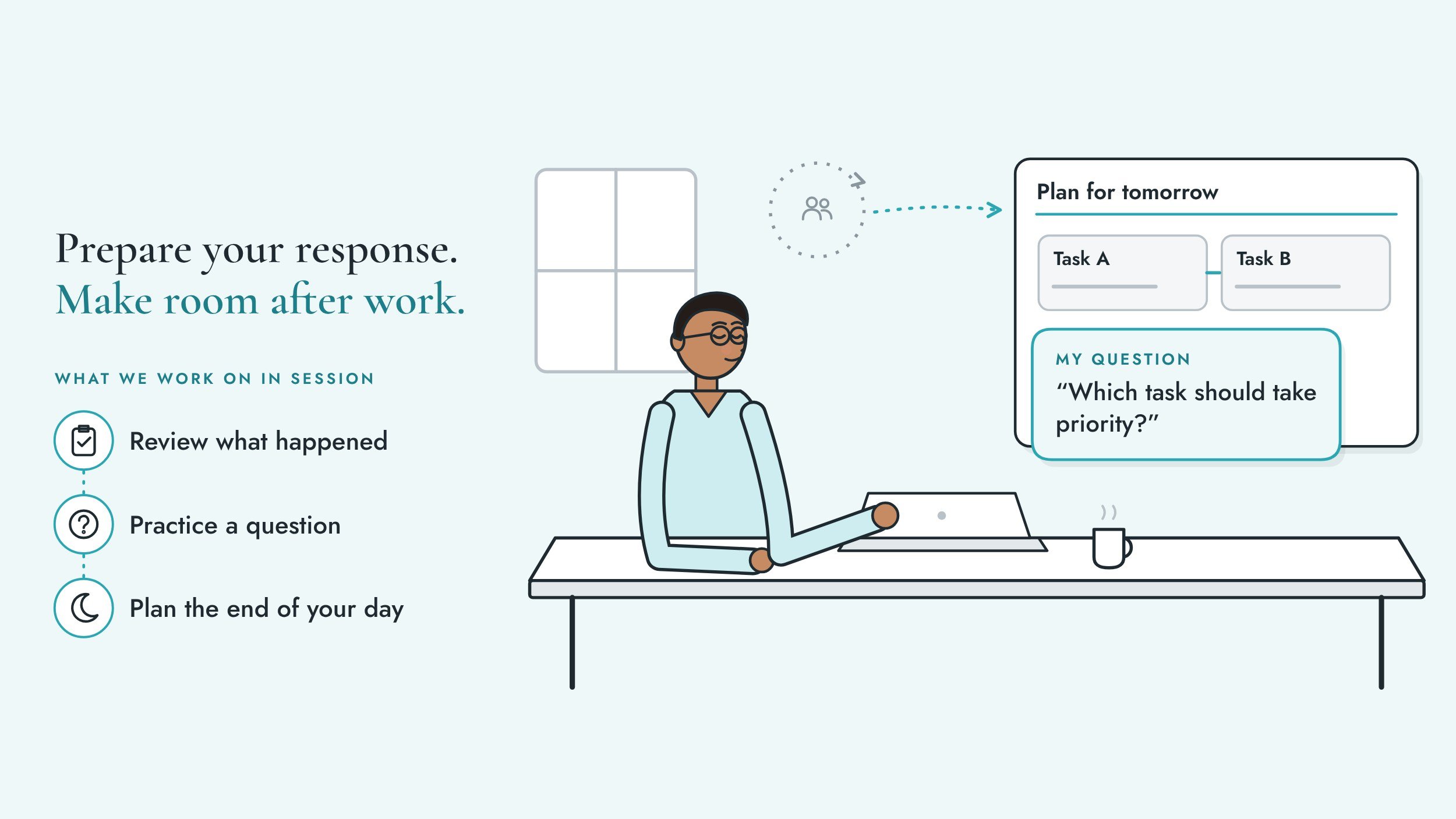
When the workday ends but the conversation keeps going in your head
You replay a meeting on the drive home, rewrite a message several times, or check work notifications because you are worried about what you missed. Conflict with a boss or coworker can affect sleep, confidence, and relationships outside work. Therapy can help you understand the emotional pattern and prepare a response that takes your circumstances seriously.
You may avoid asking a question, agree to work you cannot reasonably complete, or spend hours wondering how someone interpreted your words. Perhaps feedback feels crushing, or you are unsure whether the problem is a difficult environment, your own reactions, or both. We can examine specific events without jumping to a conclusion about you or your workplace.
Check benefits and availability
Separate the event from what you fear it means
We can review one interaction and distinguish what was said from the meaning you attached to it. That helps us identify uncertainty, past experiences, and actual workplace concerns. We may explore how your body responds to evaluation or conflict and what keeps you checking, avoiding, or mentally rehearsing long after the conversation ends.
Prepare a clear workplace conversation
We can practice asking for clarification, discussing priorities, or responding to feedback. For example, you might rehearse, “I can complete the report or the presentation by Friday. Which should take priority?” We can consider tone, timing, power differences, and possible consequences so that the plan fits your role and does not assume every workplace welcomes directness.
Work on the transition out of work
If work concerns occupy the entire evening, we can explore what keeps them active and choose a realistic way to close the day. That might include writing down a next action, setting a feasible notification limit, or examining a belief that constant availability protects you. We also make room for decisions about whether the role or environment continues to fit your needs.
An example of the work
For example, after a difficult performance conversation, we could identify the concrete feedback, explore the fear it triggered, and prepare two questions for your next meeting. You might also practice a way to pause the evening’s replay without expecting yourself to stop caring about your work.
What progress can look like
Progress may mean asking a question sooner, spending less time drafting messages, making a clearer decision about workload, or protecting part of your evening. Therapy can support your emotional health as you evaluate practical choices.
How Care Map Method supports our work
Map the emotion and trigger. We look at a recent moment and the biological, emotional, social, and environmental pressures around it. The aim is to understand your experience before choosing a response.
Match the need with a strategy. We identify what matters in that moment and select a skill or next step that fits. That might be a clearer request, a pause, a boundary, or space to process a loss.
Merge the skill into daily life. We can rehearse the words and decide when you might use them. Any practice between sessions is chosen together and adjusted to your circumstances.
Manage responses over time. We review what happened, what was difficult, and what needs to change. Therapy includes room for feelings and history as well as practical work.
About Tammy Gold
I’m Tammy Gold, MSW, LCSW, founder of Care Map Method™ and author of Secrets of the Nanny Whisperer. I earned my MSW at Columbia University and my BA at the University of Pennsylvania. My work with families informs a warm, active approach to therapy that makes room for your emotional experience and practical concerns.
Common questions
Is this career coaching? This page describes psychotherapy addressing the emotional effects of work stress. Resume services, business consulting, and career placement are separate from the therapy offered here.
Can we discuss a difficult boss? Yes. We can examine specific interactions, your reactions, and possible responses. We cannot diagnose someone we have not assessed or guarantee how an employer will respond.
Will therapy tell me to quit? We can explore your health, finances, needs, and options without assuming leaving is possible or necessary. Decisions should account for your actual circumstances.
Can you advise on discrimination or employment law? Therapy can support you emotionally while you consider next steps. Legal advice, workplace investigations, and human resources determinations require the appropriate professionals.
Can I use Quest Behavioral Health? A listed reimbursement rate does not establish that your exact network is available through my profile. Contact the practice and check Headway eligibility before scheduling with Quest coverage.
What should I bring? A recent example, the effect it had on you, and what you wish you could do differently are useful. You can discuss the situation without sharing confidential employer documents.
Take the next step
If this sounds familiar, you can explore online therapy with me while located in New Jersey. Open my Headway profile to check your exact insurance benefits and appointment options. We will discuss your concerns, clinical needs, and goals to determine fit.
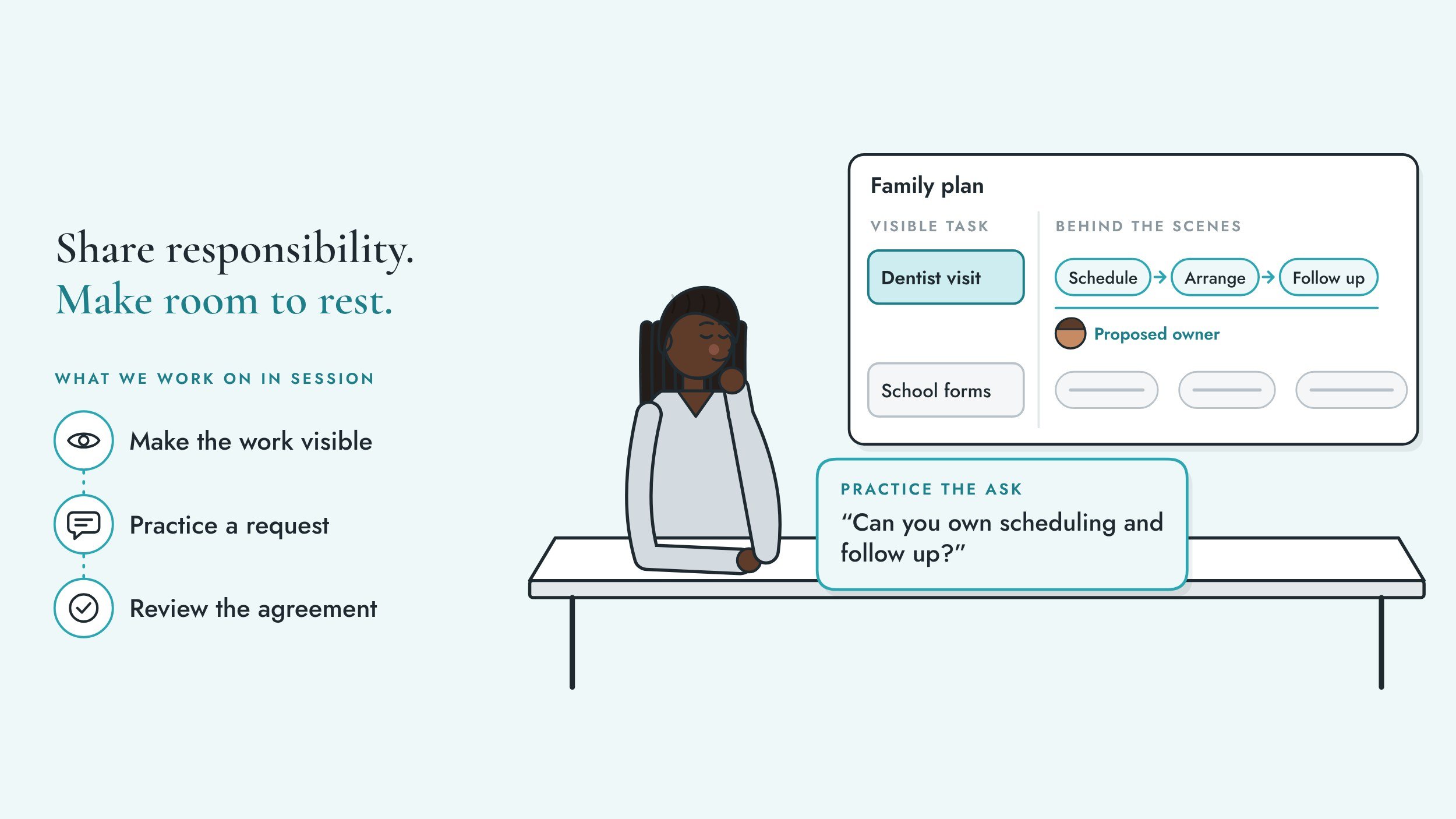
Divorce Adjustment Therapy in New Jersey
Are you the person who remembers the forms, notices what is running out, and follows up even when somebody else agrees to help? Carrying the family’s mental load can leave you feeling constantly on duty. Online individual therapy in New Jersey offers space to explore the resentment, worry, and exhaustion underneath that experience. We can make the planning work visible, examine what keeps responsibilities falling back on you, and practice a request about ownership of one task from beginning to end. Using Care Map Method, we can also work with perfectionism, difficulty letting go, or guilt about protecting time for yourself. I’m Tammy Gold, LCSW. Together, we can develop goals that fit the support you actually have and review whether the changes you try make a meaningful difference in your daily life.
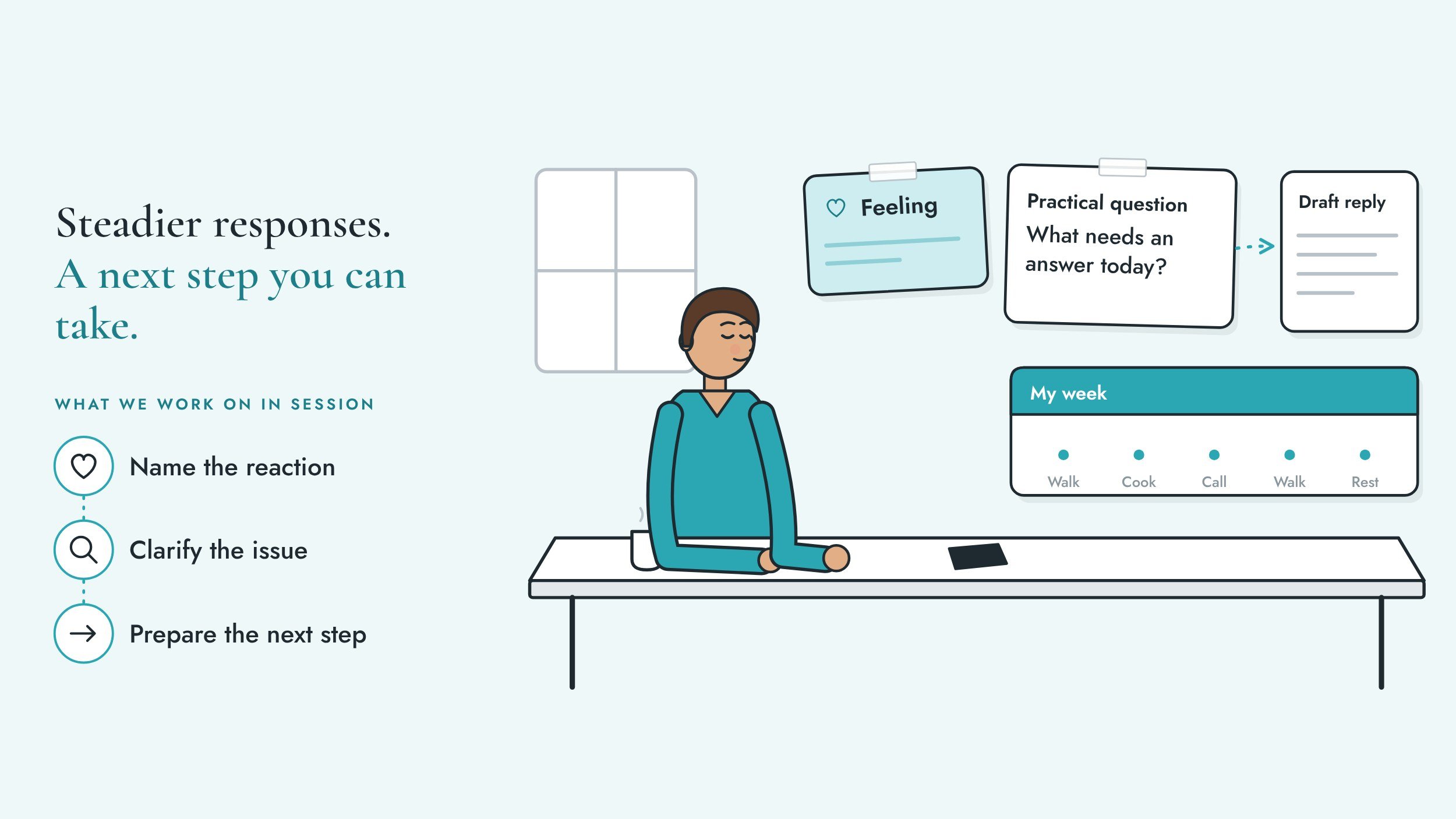
Find your footing while your relationships and routines change
Separation can change the shape of an ordinary day. A message from your former partner disrupts your concentration. A quiet house feels unfamiliar. You may be relieved about one part of the decision and grieving another. Therapy offers a place to work through those reactions while making the next week feel more manageable.
You may be struggling with uncertainty, anger, loneliness, changes in parenting time, or the feeling that your life is being defined by the conflict. Perhaps you want to stop replaying conversations or feel steadier before responding to messages. We can begin with the issue that is affecting you most now, even while larger questions remain unresolved.
Check benefits and availability
Give the losses and mixed feelings room
We can explore what has changed beyond the relationship itself: identity, routines, friendships, expectations, or your sense of security. You do not have to choose between feeling relieved and feeling sad. Understanding those reactions can help us identify the support you need and notice when self-criticism is making an already difficult adjustment harder.
Prepare for communication that affects your day
If contact with a former partner leaves you flooded or distracted, we can examine one exchange and practice how you want to respond. That may include pausing before answering a nonurgent message, keeping a practical request focused, or deciding when a discussion needs a different channel. Any communication plan needs to account for your real responsibilities and applicable arrangements.
Build routines around the life you have now
We can work on transitions that feel especially hard, such as evenings alone, parenting handoffs, or returning to work after a difficult call. A useful plan may involve one source of support, a routine that helps you settle, and a realistic expectation for that day. We can also explore your values and what you want to rebuild as circumstances become clearer.
An example of the work
For example, you might bring a message that you have rewritten several times without sending. We could separate the practical question from the hurt it brings up, decide whether a response is needed, and rehearse a short reply. We would also make space for the emotions that the message stirred up.
What progress can look like
Progress may include responding more deliberately, recovering sooner after contact, feeling more comfortable with a new routine, or having room for interests beyond the separation. The pace depends on your situation and what you need from therapy.
How Care Map Method supports our work
Map the emotion and trigger. We look at a recent moment and the biological, emotional, social, and environmental pressures around it. The aim is to understand your experience before choosing a response.
Match the need with a strategy. We identify what matters in that moment and select a skill or next step that fits. That might be a clearer request, a pause, a boundary, or space to process a loss.
Merge the skill into daily life. We can rehearse the words and decide when you might use them. Any practice between sessions is chosen together and adjusted to your circumstances.
Manage responses over time. We review what happened, what was difficult, and what needs to change. Therapy includes room for feelings and history as well as practical work.
About Tammy Gold
I’m Tammy Gold, MSW, LCSW, founder of Care Map Method™ and author of Secrets of the Nanny Whisperer. I earned my MSW at Columbia University and my BA at the University of Pennsylvania. My work with families informs a warm, active approach to therapy that makes room for your emotional experience and practical concerns.
Common questions
Can I start before the divorce is final? Yes. Therapy can address the emotional effects of separation while practical or legal decisions are still underway. We can focus on what is affecting your daily functioning now.
Is this mediation or legal advice? No. These sessions are psychotherapy for your emotional health. Legal advice, custody recommendations, mediation, and court evaluations are different services with different roles.
Can we work on co-parenting messages? We can explore your emotional reactions and practice focused communication. We do not replace legal advice or change court orders, and we cannot guarantee the other parent’s cooperation.
What if I am unsure about separating? You can use therapy to explore your needs, concerns, and options. You do not have to arrive having made a final decision about the relationship.
Does Aetna cover divorce therapy? Coverage depends on your benefits and clinical assessment, not the topic alone. Check your specific New Jersey Aetna plan through my Headway profile before beginning treatment.
Will my former partner attend? This page describes individual therapy for you. Sessions involving another person require a separate discussion of clinical purpose, consent, and payment arrangements.
Take the next step
If this sounds familiar, you can explore online therapy with me while located in New Jersey. Open my Headway profile to check your exact insurance benefits and appointment options. We will discuss your concerns, clinical needs, and goals to determine fit.
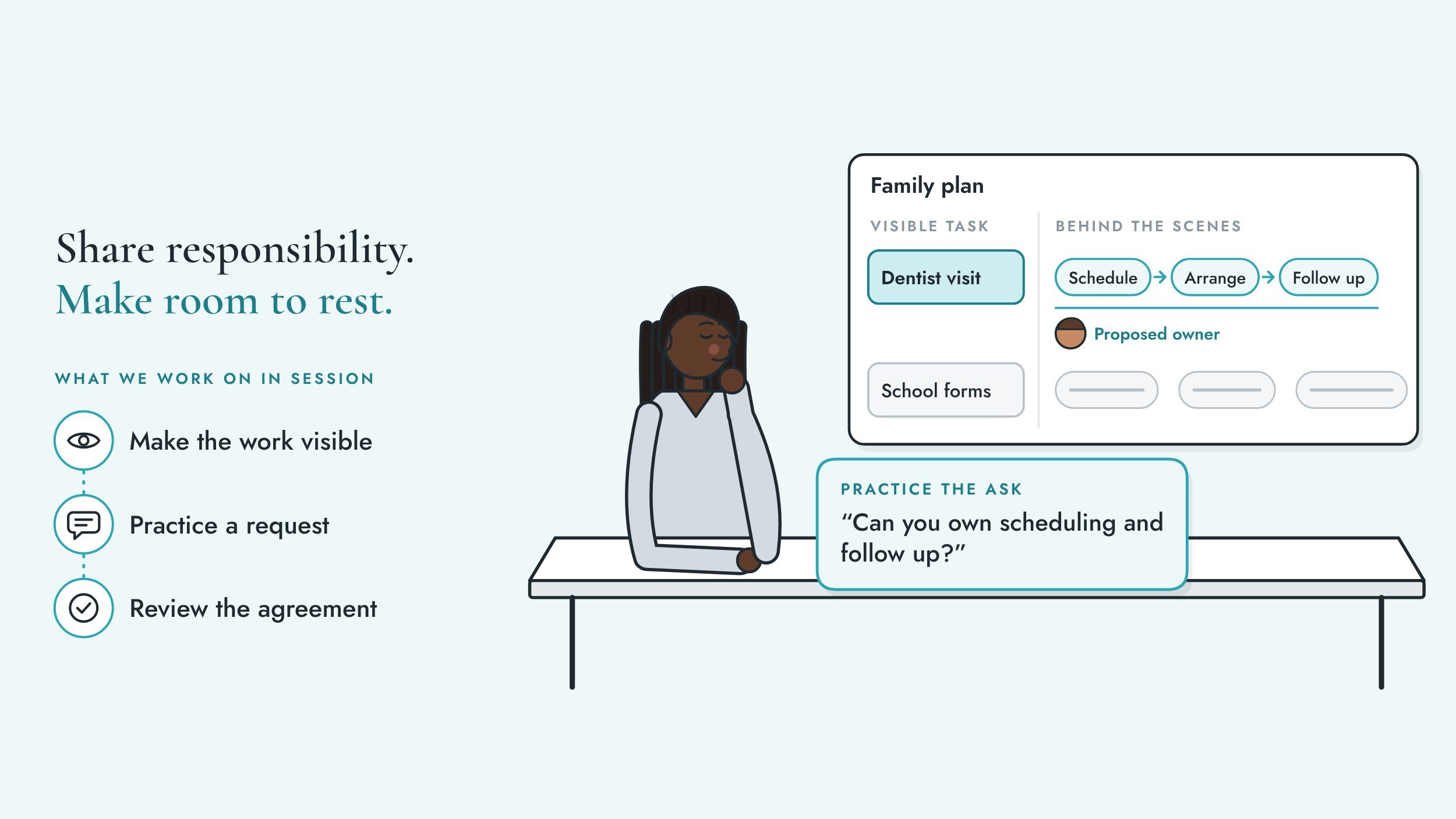
Mental Load Therapy in New Jersey
Are you the person who remembers the forms, notices what is running out, and follows up even when somebody else agrees to help? Carrying the family’s mental load can leave you feeling constantly on duty. Online individual therapy in New Jersey offers space to explore the resentment, worry, and exhaustion underneath that experience. We can make the planning work visible, examine what keeps responsibilities falling back on you, and practice a request about ownership of one task from beginning to end. Using Care Map Method, we can also work with perfectionism, difficulty letting go, or guilt about protecting time for yourself. I’m Tammy Gold, LCSW. Together, we can develop goals that fit the support you actually have and review whether the changes you try make a meaningful difference in your daily life.
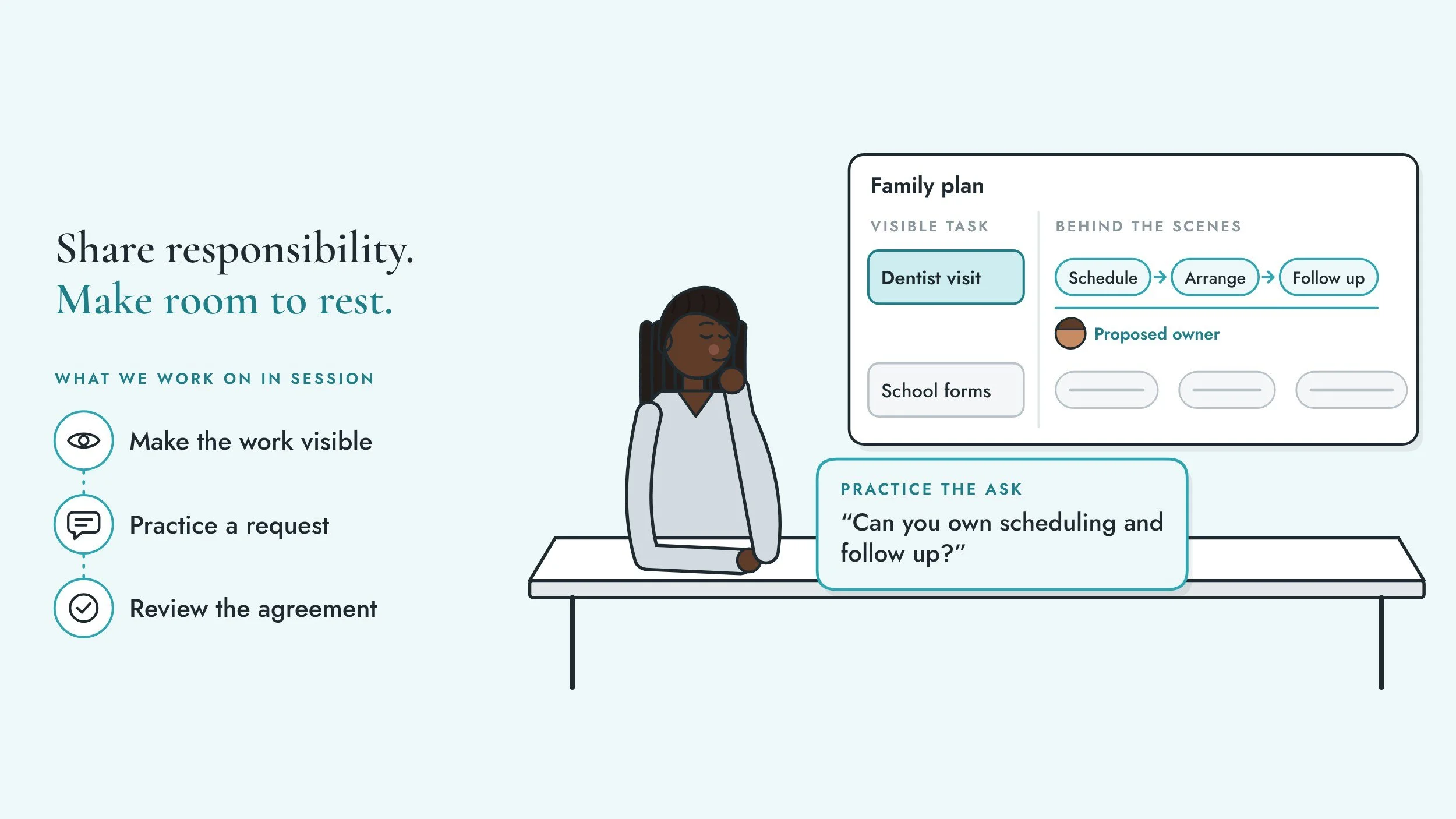
When everyone relies on you to remember everything
You know which forms are due, what is running out, and who needs a reminder. Even when somebody helps, you are still the one noticing and assigning the work. That constant planning can leave little room to rest. Therapy can help you understand the emotional strain, clarify what needs to change, and practice asking for a different kind of support.
You may feel irritated by “just tell me what to do,” stay awake reviewing tomorrow, or struggle to enjoy time off because you are still monitoring everything. Perhaps you feel guilty for resenting people you love. We can make room for that experience and explore what the current arrangement is doing to your health and relationships.
Check benefits and availability
Name the responsibility beneath the task
We can distinguish doing a task from noticing, planning, arranging, and following up on it. This helps explain why occasional help may not relieve the pressure. We can look at which responsibilities you hold, which are shared, and where expectations remain unspoken. We also consider whether worry or perfectionism keeps you monitoring tasks even after someone else takes them on.
Practice a request about ownership
A useful conversation may be more specific than “I need more help.” We can rehearse a request about one responsibility from beginning to end. For example, another adult might take ownership of a recurring appointment, including scheduling and follow up. We can consider what a workable agreement looks like and how to discuss differences without turning the conversation into a list of every past disappointment.
Explore resentment and the difficulty of letting go
Resentment may point to an unfair arrangement, an unmet need, or limits you have struggled to express. We can explore those possibilities and what happens when someone does a task differently from you. The work may include tolerating a reasonable difference, renegotiating a responsibility, or recognizing that the support available is not enough and considering your options.
An example of the work
For example, you might bring the recurring conflict over children’s activities. We could identify all the planning involved, separate essential steps from preferences, and prepare a request for one person to own one activity. Afterward, we could review the agreement, your feelings, and any practical barriers.
What progress can look like
Progress might mean making the workload discussable, checking less often, protecting a period of rest, or recognizing an agreement that is not being honored. We work toward changes you can assess in daily life rather than simply asking you to become better at carrying everything.
How Care Map Method supports our work
Map the emotion and trigger. We look at a recent moment and the biological, emotional, social, and environmental pressures around it. The aim is to understand your experience before choosing a response.
Match the need with a strategy. We identify what matters in that moment and select a skill or next step that fits. That might be a clearer request, a pause, a boundary, or space to process a loss.
Merge the skill into daily life. We can rehearse the words and decide when you might use them. Any practice between sessions is chosen together and adjusted to your circumstances.
Manage responses over time. We review what happened, what was difficult, and what needs to change. Therapy includes room for feelings and history as well as practical work.
About Tammy Gold
I’m Tamara “Tammy” Gold, MSW, LCSW, founder of Care Map Method™ and author of Secrets of the Nanny Whisperer. I earned my MSW at Columbia University and my BA at the University of Pennsylvania. My work with families informs a warm, active approach to therapy that makes room for your emotional experience and practical concerns.
Common questions
Is mental load a diagnosis? Mental load describes an experience of ongoing planning and responsibility. It is not by itself a diagnosis. Assessment helps determine your clinical needs and whether insurance-covered psychotherapy is appropriate.
Can I attend if my partner thinks the division is fair? Yes. We can explore your experience and prepare a specific conversation. Individual therapy can support your choices without deciding the full relationship story from one person’s account.
What if I am a single parent? We can work within your actual support network and responsibilities. That may include limits, realistic expectations, emotional support, and requests to people who are available to help.
Will you just tell me to delegate? We will explore what makes change difficult, including unequal participation, limited resources, worry, and practical barriers. Delegation is useful only when there is someone able and willing to take responsibility.
Can I use Aetna in New Jersey? Use my Headway profile to check your exact Aetna plan and estimated costs. Coverage depends on your benefits, network eligibility, and the clinically appropriate service.
How do we choose a starting point? We can begin with the part of the week that drains you most. One recurring responsibility often provides enough detail to understand both the practical problem and its emotional impact.
Take the next step
If this sounds familiar, you can explore online therapy with me while located in New Jersey. Open my Headway profile to check your exact insurance benefits and appointment options. We will discuss your concerns, clinical needs, and goals to determine fit.
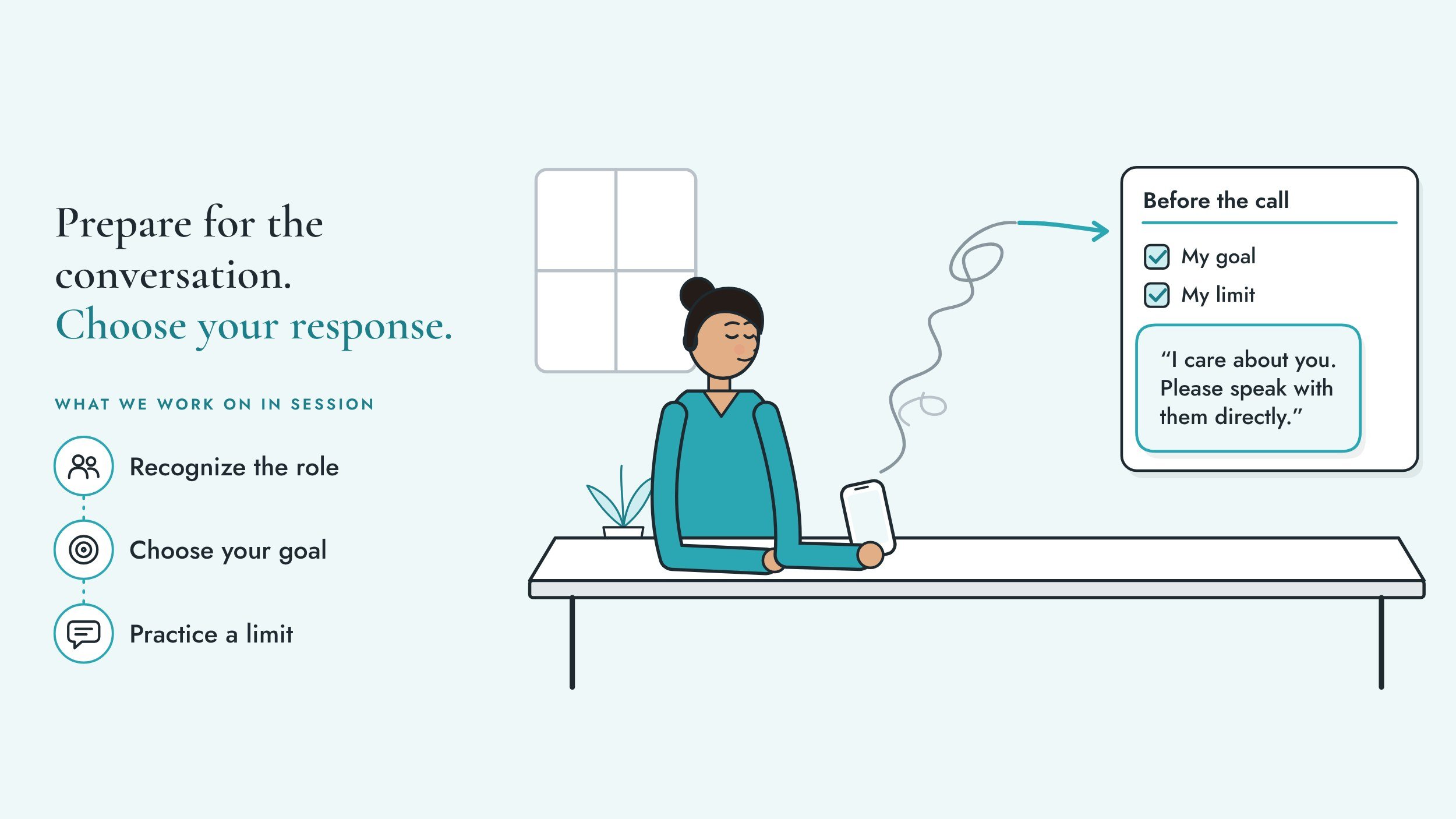
Family Conflict Therapy in Oregon
Does one family phone call leave you upset for the rest of the day? A familiar comment may pull you into defending yourself, keeping the peace, or agreeing to something you do not want. In online individual therapy for family conflict in Oregon, we can explore why these exchanges have such an effect and the role you keep finding yourself in. Together, we can clarify what you want from a conversation, practice a response to criticism, or prepare a boundary around a topic that repeatedly causes hurt. Care Map Method helps us connect the emotion and history behind the pattern with choices you can make now. I’m Tammy Gold, LCSW. Your relatives do not need to attend for us to work on your concerns, your decisions about contact, and the expectations you bring to these relationships.
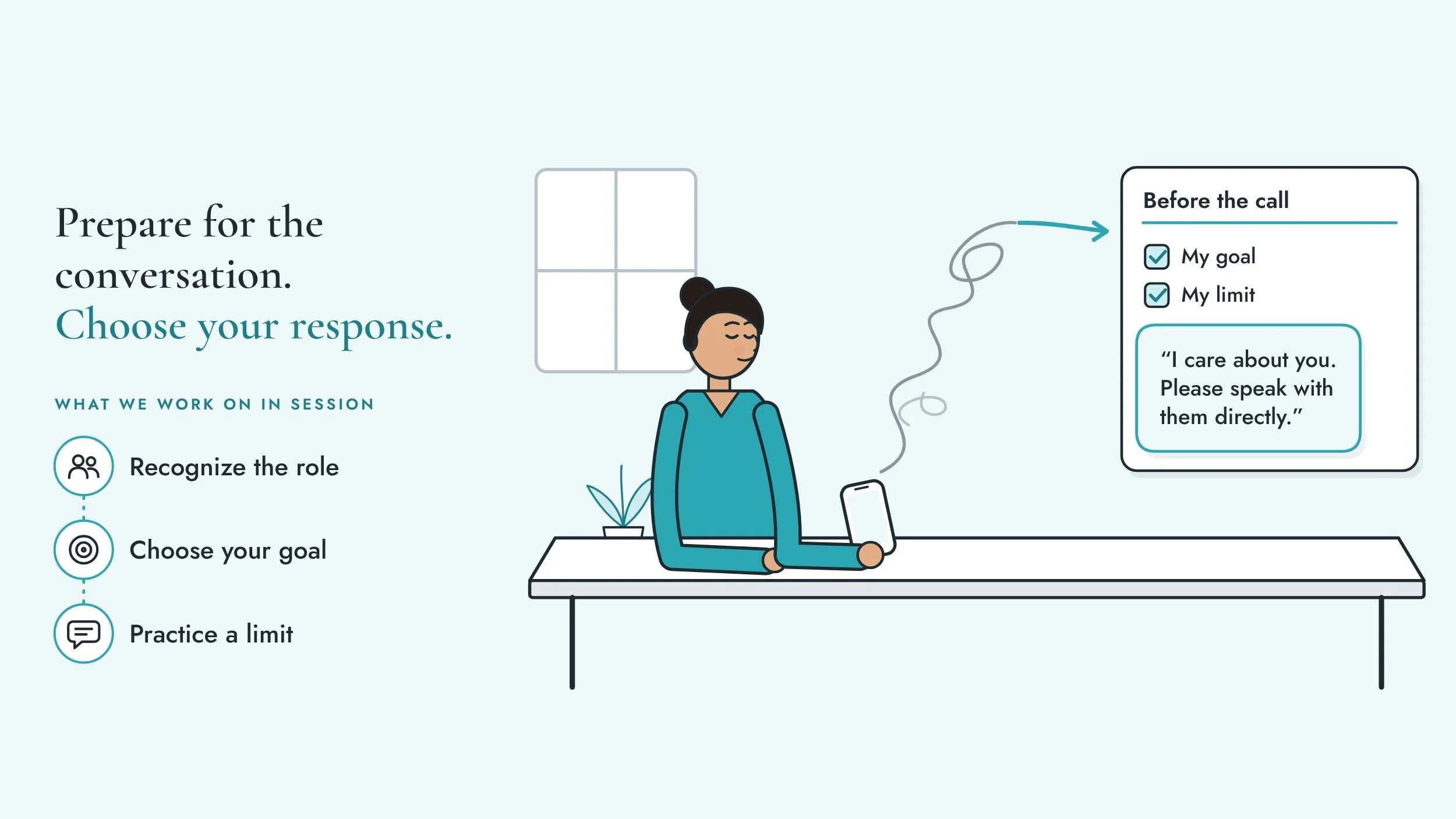
Find a way to respond when old family patterns take over
A phone call starts normally, then one comment leaves you feeling like the same person you were years ago. You defend yourself, agree to something you do not want, or leave angry and replay the exchange afterward. Individual therapy can help you understand what happens in these conversations and decide how you want to participate in family relationships now.
The conflict may involve a parent, sibling, in law, or adult child. You might feel caught between relatives, pressured to take a side, or responsible for smoothing things over. You may want more connection while also needing less criticism or intrusion. We can work with those competing needs without assuming there is one correct level of family contact.
Check benefits and availability
Recognize the role you keep getting pulled into
We can examine a recent interaction and the history that gives it weight. Perhaps you become the peacemaker, the person who explains everyone else, or the one who is expected to adapt. Naming that role helps us understand why a small comment can have a large effect and where you might have room to respond differently.
Decide what the conversation is for
Some conversations need a practical agreement. Others involve hurt, a request for acknowledgment, or a limit on a topic you no longer want to debate. We can clarify your goal before choosing your words. That may mean asking one direct question, declining to carry a message between relatives, or ending a discussion that has stopped being useful.
Plan for the relationship after you set a limit
Family boundaries can affect holidays, childcare, caregiving, and other shared responsibilities. We can think through those consequences and practice a response that fits your values and circumstances. We can also work with disappointment when a relative cannot offer the understanding you want, and consider what connection is possible without repeatedly asking for the same change.
An example of the work
For example, if a sibling repeatedly draws you into arguments with a parent, we could explore why you feel responsible for resolving them. You might practice saying, “I care about both of you, and I am not going to carry messages between you.” We would consider when that wording is appropriate and what follow through means.
What progress can look like
Progress may include less time recovering from calls, clearer choices about contact, fewer commitments made under pressure, or a better understanding of what you want from a relationship. Reconciliation is not a required outcome.
How Care Map Method supports our work
Map the emotion and trigger. We look at a recent moment and the biological, emotional, social, and environmental pressures around it. The aim is to understand your experience before choosing a response.
Match the need with a strategy. We identify what matters in that moment and select a skill or next step that fits. That might be a clearer request, a pause, a boundary, or space to process a loss.
Merge the skill into daily life. We can rehearse the words and decide when you might use them. Any practice between sessions is chosen together and adjusted to your circumstances.
Manage responses over time. We review what happened, what was difficult, and what needs to change. Therapy includes room for feelings and history as well as practical work.
About Tammy Gold
I’m Tamara “Tammy” Gold, MSW, LCSW, founder of Care Map Method™ and author of Secrets of the Nanny Whisperer. I earned my MSW at Columbia University and my BA at the University of Pennsylvania. My work with families informs a warm, active approach to therapy that makes room for your emotional experience and practical concerns.
Common questions
Can I start if my family will not attend? Yes. Individual therapy can focus on your experience, choices, boundaries, and grief. We can work on your part without assuming we know another family member’s intentions or diagnosis.
Will you tell me to cut off contact? We can explore a range of options, including changes in topics, timing, availability, and contact. Your circumstances, values, and safety guide those decisions.
Can we discuss conflict with an adult child? Yes. We can explore your feelings, expectations, communication, and possible repair attempts. We cannot guarantee a response or reconciliation from another person.
What if family obligations make boundaries difficult? We can consider shared responsibilities, finances, culture, and practical dependence. The aim is a limit you can realistically use rather than advice that ignores your situation.
Is family therapy covered by Providence? This page describes individual therapy. Check your exact plan and the proposed service through Headway. Coverage for sessions with multiple family members requires a separate review of benefits and clinical appropriateness.
What happens at the first appointment? We will discuss the conflict, its effect on your life, relevant history, and your goals. One recent example can help us identify a useful starting point.
Take the next step
If this sounds familiar, you can explore online therapy with me while located in Oregon. Open my Headway profile to check your exact insurance benefits and appointment options. We will discuss your concerns, clinical needs, and goals to determine fit.
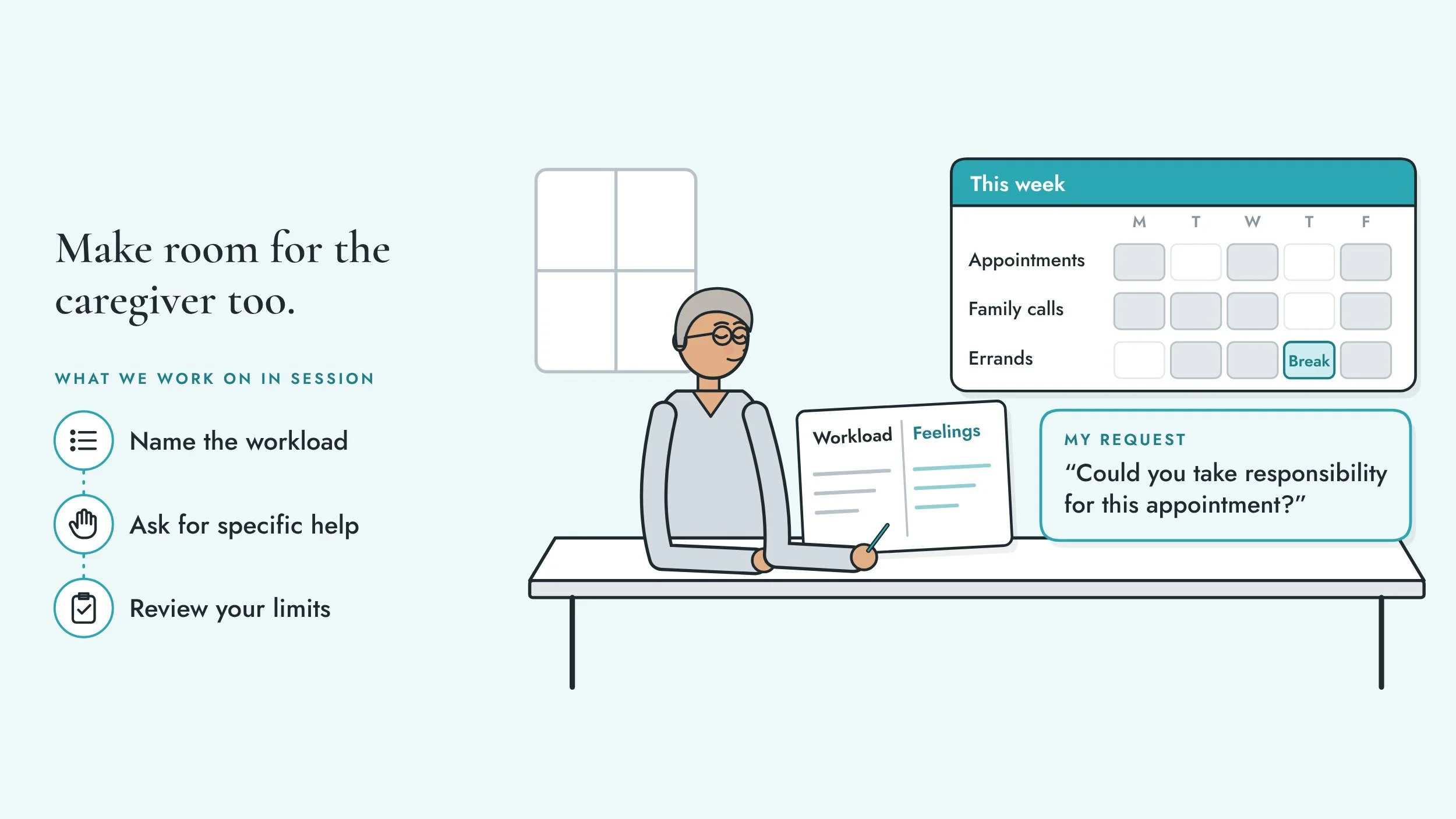
Caregiver Burnout Therapy in Oregon
Caring for an aging parent can become a responsibility you carry even when you are supposed to be resting. You may be tracking appointments, anticipating problems, managing family messages, and feeling guilty whenever you need time away. In online caregiver burnout therapy in Oregon, we can make that workload visible and explore the worry, grief, frustration, or resentment that comes with it. Together, we can identify what is becoming unsustainable, prepare a specific request for help, and consider limits that account for your parent’s needs and your own capacity. Care Map Method gives us a way to organize the pressures around caregiving while making room for your emotional experience. I’m Tammy Gold, LCSW. These individual therapy sessions support your mental health as you navigate a role that may keep changing, often without much warning.
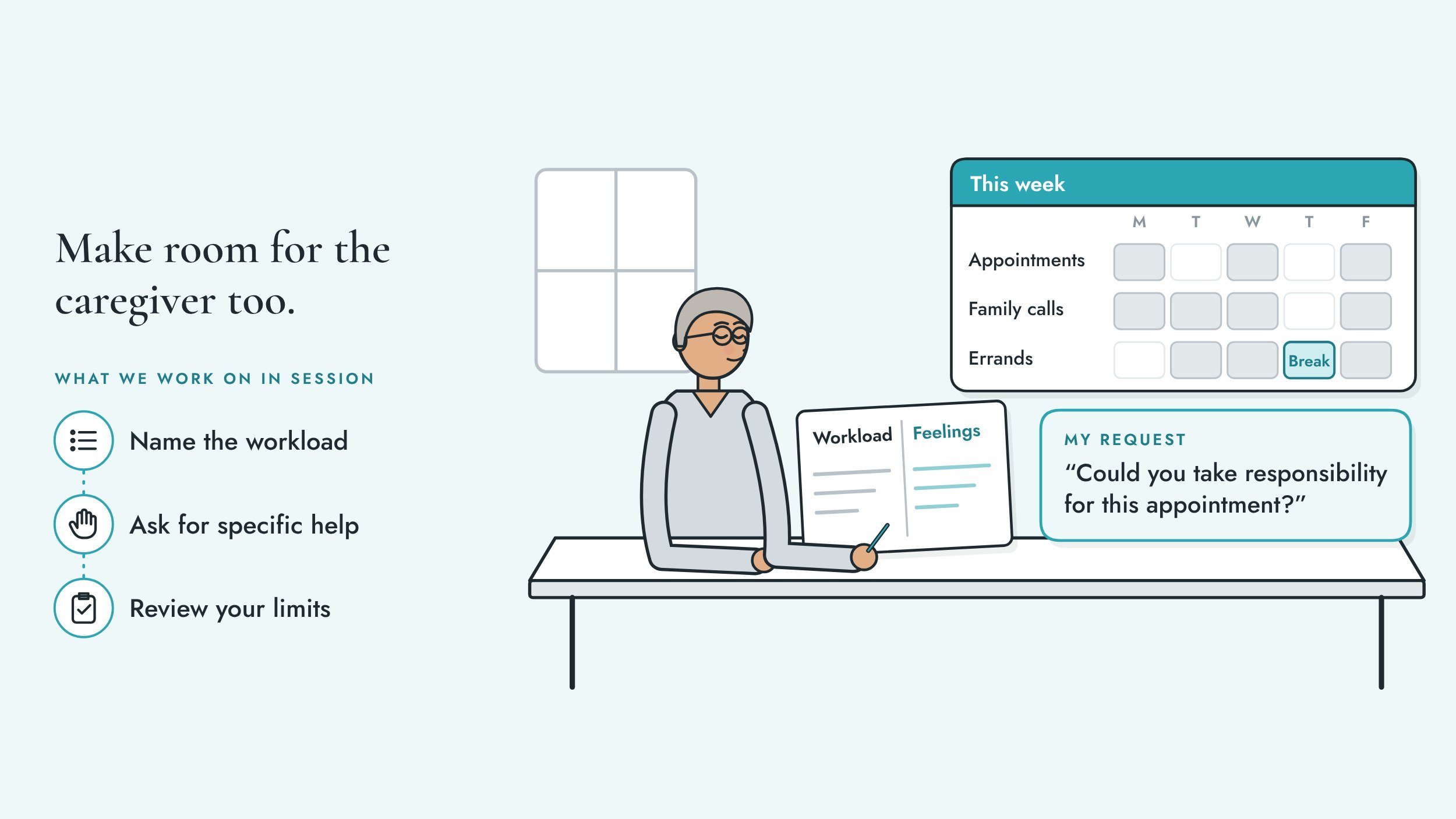
Support for the person everyone depends on
You keep track of appointments, answer the calls, and think about what could go wrong even when you are trying to rest. Caring for an aging parent may bring love, worry, grief, and resentment into the same day. Therapy offers a place to work through what this role is costing you and consider changes that make room for your own health.
Perhaps you are short with people you care about, feel guilty taking a break, or dread a call because it might mean another problem. You may be balancing children, work, and a parent’s needs while wondering why you cannot manage it better. We can examine the demands themselves as well as your reactions to them.
Check benefits and availability
Make the invisible responsibilities visible
We can walk through a typical week and name the work you carry: coordinating care, anticipating problems, handling family messages, or being constantly available. This can help us identify where exhaustion is coming from and which responsibilities are yours by choice, agreement, or default. We also consider sleep, support, finances, and the environment around caregiving.
Work with guilt and resentment
Feeling angry or wishing for time away can be difficult to admit. We can explore those feelings without treating them as a measure of how much you love your parent. We may examine beliefs such as “a good daughter should always be available” and consider what a realistic responsibility looks like in your circumstances. Grief and changes in the relationship also have a place in the work.
Practice a specific request or limit
Instead of a general wish for more help, we can prepare one request that another person can understand and answer. That might involve a sibling taking responsibility for one recurring task or a limit around nonurgent calls. We can rehearse what you want to say, consider likely responses, and plan what you will do if the help you hope for is unavailable.
An example of the work
For example, you might bring the recurring Sunday night worry about the week ahead. We could separate practical decisions from fears, identify one task to delegate, and develop a short routine for ending the evening. We would then review what helped and what still needs attention.
What progress can look like
Your goals might include taking a break with less guilt, making a clear request, recognizing when you are overextended, or having space to grieve. Therapy can support your emotional health while practical care needs continue to change.
How Care Map Method supports our work
Map the emotion and trigger. We look at a recent moment and the biological, emotional, social, and environmental pressures around it. The aim is to understand your experience before choosing a response.
Match the need with a strategy. We identify what matters in that moment and select a skill or next step that fits. That might be a clearer request, a pause, a boundary, or space to process a loss.
Merge the skill into daily life. We can rehearse the words and decide when you might use them. Any practice between sessions is chosen together and adjusted to your circumstances.
Manage responses over time. We review what happened, what was difficult, and what needs to change. Therapy includes room for feelings and history as well as practical work.
About Tammy Gold
I’m Tamara “Tammy” Gold, MSW, LCSW, founder of Care Map Method™ and author of Secrets of the Nanny Whisperer. I earned my MSW at Columbia University and my BA at the University of Pennsylvania. My work with families informs a warm, active approach to therapy that makes room for your emotional experience and practical concerns.
Common questions
Is this therapy or care management? This page describes psychotherapy for your emotional health. Arranging staff, selecting facilities, and coordinating care are separate practical services and are not automatically included in therapy or covered by insurance.
Can I feel resentful and still love my parent? Yes. We can explore mixed feelings and the circumstances behind them. You do not need to present yourself as endlessly patient to talk honestly about caregiving.
What if there is nobody else to help? We can work within that reality, looking at limits, coping, expectations, and possible sources of support. We will avoid building a plan that depends on resources you do not have.
Can we discuss grief before a parent dies? Yes. Changes in health, independence, personality, and family roles can involve grief. We can make room for those losses while you are still actively caring for your parent.
Can I use Providence insurance? Check the exact Providence plan on my Headway profile. Commercial and Medicare Advantage products can have different networks and benefits. Coverage and your costs need to be confirmed before treatment.
Does my parent attend? These are individual sessions for you. Your parent does not need to attend. If another type of service becomes appropriate, we can discuss it separately.
Take the next step
If this sounds familiar, you can explore online therapy with me while located in Oregon. Open my Headway profile to check your exact insurance benefits and appointment options. We will discuss your concerns, clinical needs, and goals to determine fit.
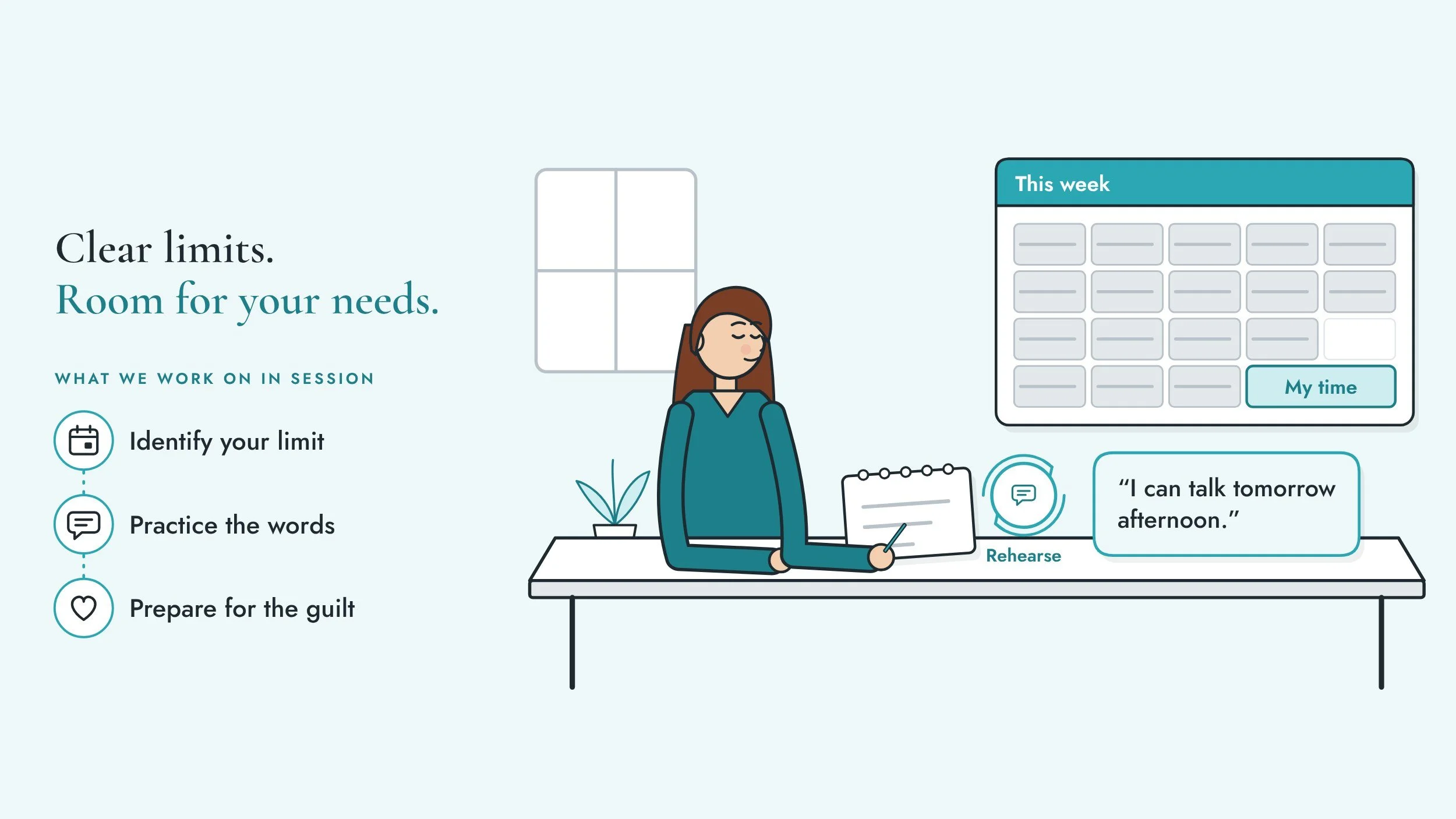
Boundaries Therapy in California
Do you agree to help before checking what you have the energy to offer? Perhaps you finally say no, then worry that you sounded selfish or spend hours explaining your decision. In online boundaries therapy in California, we can explore what makes another person’s disappointment feel so difficult and what you fear might happen if you change your response. Together, we can turn a vague wish for more space into a specific limit, rehearse the words, and prepare for the guilt or anxiety that may follow. Using Care Map Method, we connect your emotional needs with practical choices about time, availability, and responsibility. I’m Tammy Gold, LCSW. We can work toward relationships that make room for your needs while respecting your values, responsibilities, and the realities of each situation.
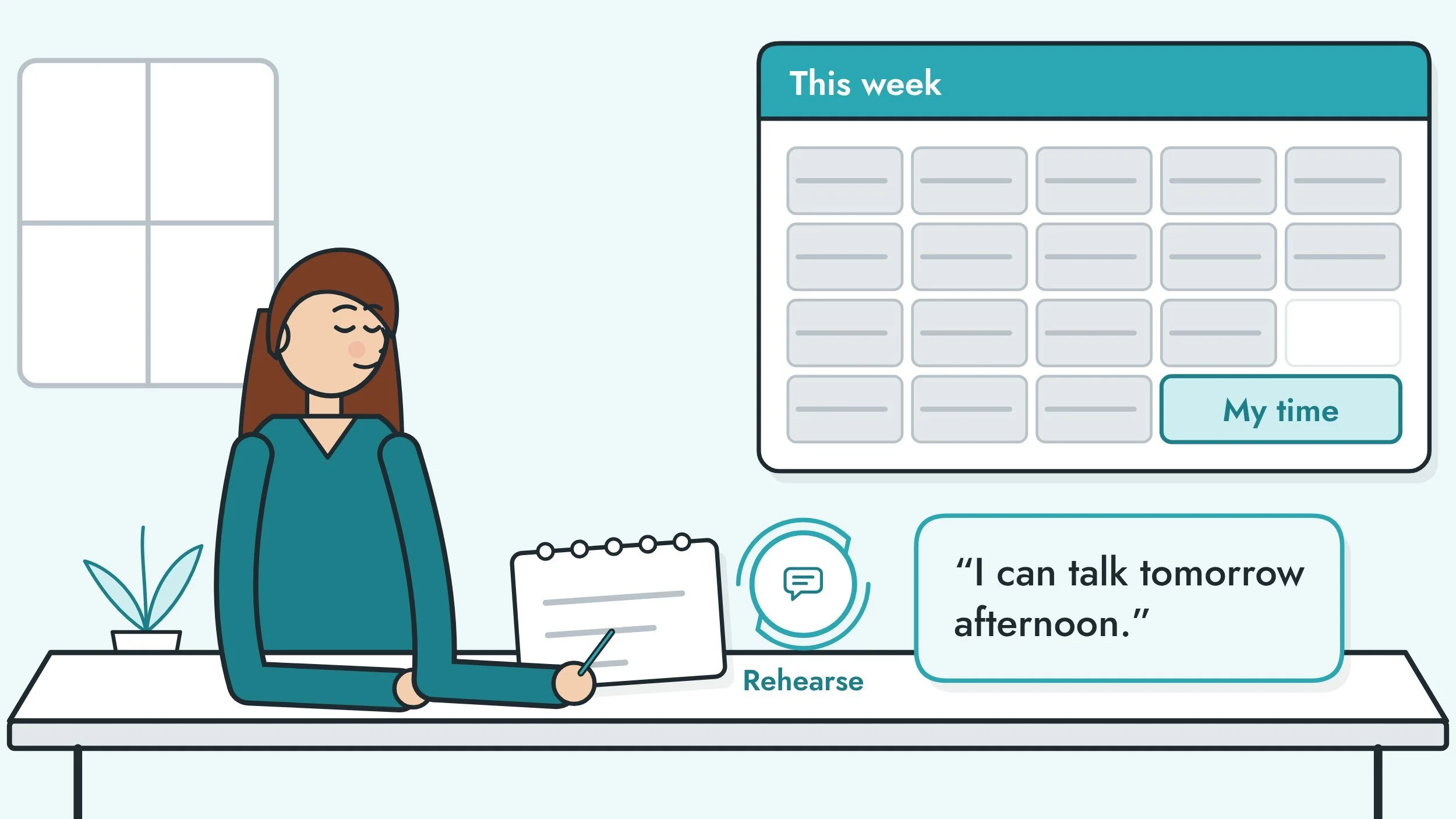
Say what you can offer without losing sight of what you need
You agree to help, rearrange your day, and later feel resentful. Or you finally say no and spend hours worrying that you were selfish. Boundaries can be difficult when keeping other people comfortable has become your way of protecting a relationship. Therapy gives us room to understand that pattern and practice a limit that fits your situation.
You may apologize before making a request, overexplain a simple decision, or take another person’s disappointment as proof that you did something wrong. Perhaps the boundary is clear in your head but disappears in the conversation. We can work on both the words you use and the feelings that make them hard to hold.
Check benefits and availability
Understand what saying no seems to risk
We can explore what you expect will happen if you disappoint someone. You may fear rejection, conflict, being seen as unkind, or losing a role that has made you feel needed. Understanding where those expectations come from helps us choose an approach that respects your history and your current circumstances, including relationships where directness has consequences.
Turn a vague limit into a clear decision
A boundary becomes easier to practice when it describes what you will do. We might change “I need everyone to respect my time” into “I can talk for fifteen minutes tonight, and then I need to finish my work.” We can rehearse wording that sounds like you and decide how much explanation is useful in that relationship.
Prepare for the discomfort afterward
Even a reasonable limit may leave you anxious or guilty. We can plan for the urge to send another explanation, reverse your decision, or check repeatedly for reassurance. Together, we can distinguish discomfort from evidence that you acted against your values. If a boundary needs revision, we can revise it thoughtfully rather than abandoning it in a moment of panic.
An example of the work
For example, you might want to stop answering nonurgent family calls during work. We could explore what makes that feel disloyal, practice a message about when you are available, and decide how to respond to repeated calls. We would also discuss genuine emergencies and practical responsibilities.
What progress can look like
Progress may look like taking time before agreeing, making a smaller commitment, giving a shorter explanation, or tolerating someone’s disappointment without immediately changing your answer. The aim is a way of relating that includes your needs.
How Care Map Method supports our work
Map the emotion and trigger. We look at a recent moment and the biological, emotional, social, and environmental pressures around it. The aim is to understand your experience before choosing a response.
Match the need with a strategy. We identify what matters in that moment and select a skill or next step that fits. That might be a clearer request, a pause, a boundary, or space to process a loss.
Merge the skill into daily life. We can rehearse the words and decide when you might use them. Any practice between sessions is chosen together and adjusted to your circumstances.
Manage responses over time. We review what happened, what was difficult, and what needs to change. Therapy includes room for feelings and history as well as practical work.
About Tammy Gold
I’m Tamara “Tammy” Gold, MSW, LCSW, founder of Care Map Method™ and author of Secrets of the Nanny Whisperer. I earned my MSW at Columbia University and my BA at the University of Pennsylvania. My work with families informs a warm, active approach to therapy that makes room for your emotional experience and practical concerns.
Common questions
Is setting a boundary the same as cutting someone off? No. A boundary can define time, topics, money, or availability while preserving contact. We can discuss different options and what is appropriate for the relationship.
Can therapy help with people-pleasing? We can explore when accommodating others becomes costly, what you fear about changing it, and how to practice choices that reflect your needs and values.
What if they get upset? We can prepare for likely reactions and identify what you can control. Another person’s response matters, but it does not by itself tell us whether your limit is reasonable or safe.
Can we practice the actual conversation? Yes. We can rehearse your words, consider possible responses, and adjust the message so it sounds natural. You decide whether and when to use it.
Can I use Aetna or Anthem? Check your specific California plan on my Headway profile before scheduling. Participation and coverage vary by network and service, and your deductible or copay may apply.
What if I cannot identify my own needs? That can be part of the work. We can start with recent moments of resentment, exhaustion, or hesitation and explore what they tell you about your limits.
Take the next step
If this sounds familiar, you can explore online therapy with me while located in California. Open my Headway profile to check your exact insurance benefits and appointment options. We will discuss your concerns, clinical needs, and goals to determine fit.
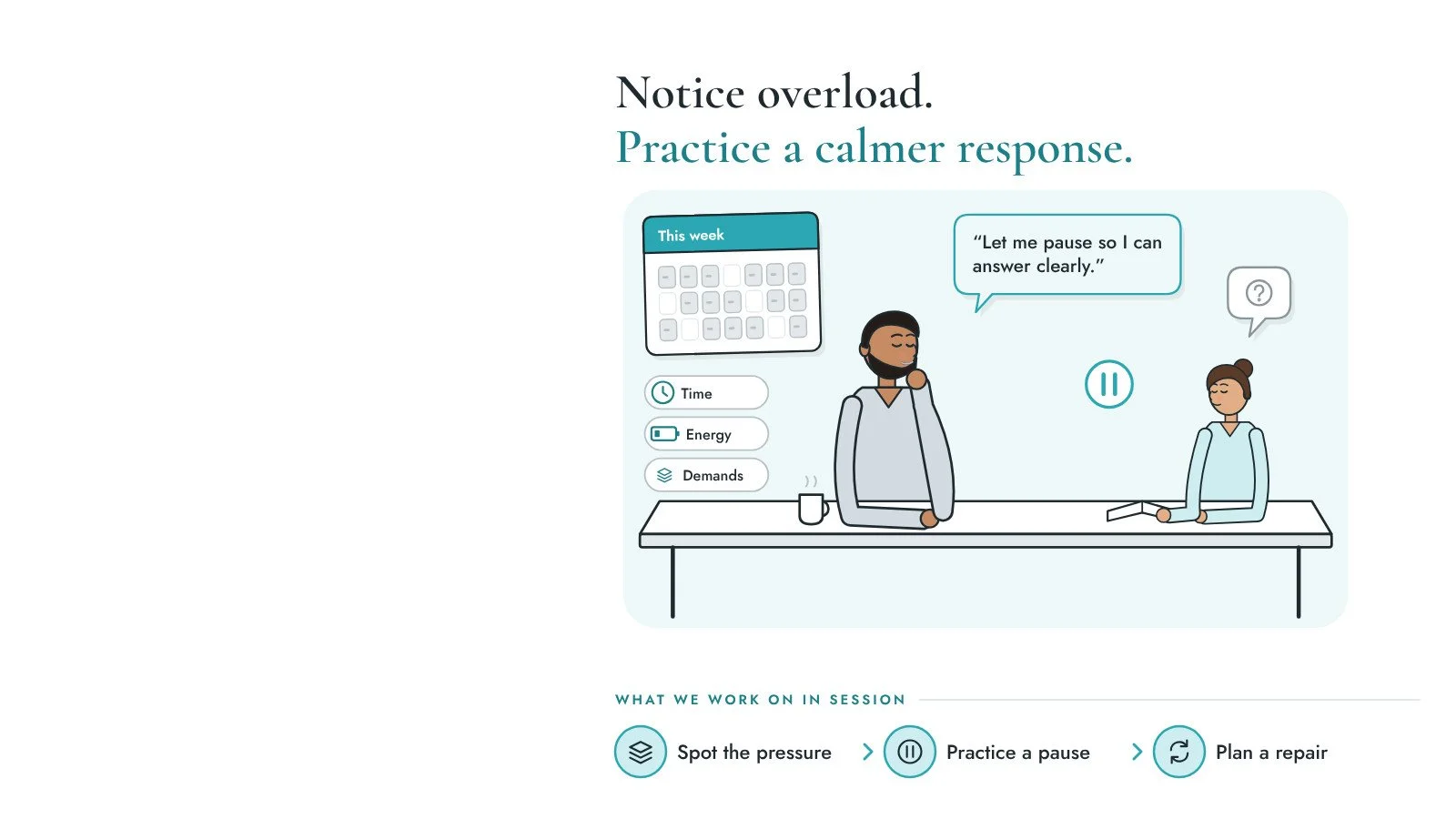
Parenting Stress Therapy in California
You love your child, but some days one more question, reminder, or bedtime request feels like more than you can handle. Then you snap and spend the evening feeling guilty. Online therapy for parenting stress in California offers a place to understand what builds up before those moments. We can explore exhaustion, competing demands, worry, and the support you may be missing. Together, we can choose one difficult part of your day and practice a clearer limit, a pause, or a way to reconnect after a hard interaction. Care Map Method helps us consider biological, emotional, social, and environmental pressures as we develop strategies that fit your circumstances. I’m Tammy Gold, LCSW. These individual sessions focus on your emotional health and parenting responses, with room to work through guilt and expectations that have become difficult to carry.
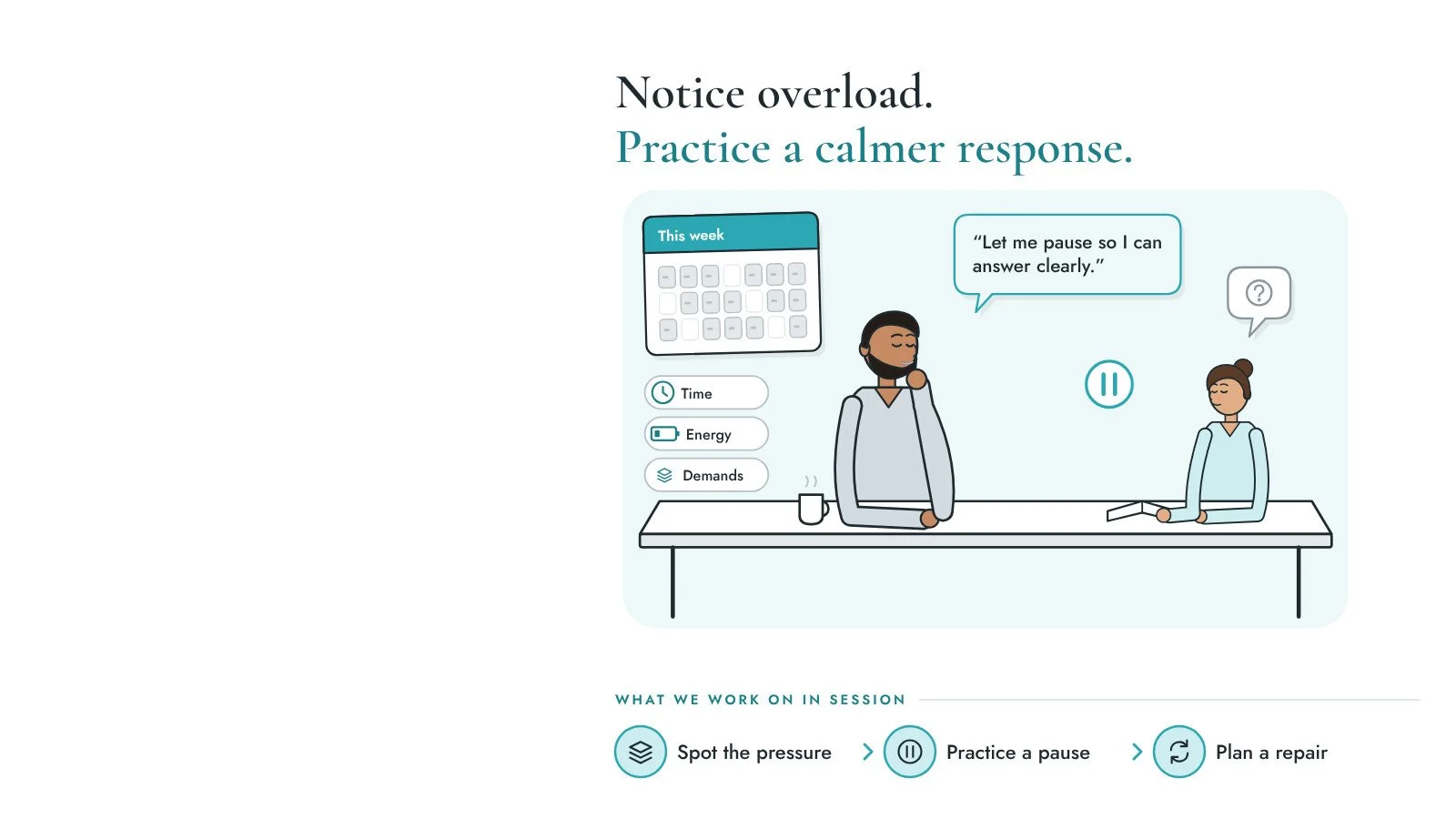
When you love your child and still feel overwhelmed by the day
You get through work, meals, reminders, and one more bedtime request. Then a small moment becomes the one where you snap. Afterward, you feel guilty and promise yourself tomorrow will be different. Therapy can help you understand what is building up and practice responses that account for the demands you are actually carrying.
You may be more irritable than you used to be, resent the endless decisions, or feel as though everyone needs something from you. Perhaps you have read the parenting advice but struggle to use it when you are exhausted. We can focus on your emotional health and the patterns making everyday parenting harder.
Check benefits and availability
Find the pressure points in your day
We can map a recent difficult moment from the beginning. Were you hungry, rushed, worried about work, or already managing several requests? What was happening around you? Understanding the biological, emotional, social, and environmental pressures gives us a more useful starting point than expecting unlimited patience. It also helps us separate what you can change from what requires more support.
Practice the response before you need it
We can choose one situation, such as leaving the house or handling repeated bedtime requests, and rehearse what you want to say. That may include a short limit, a pause before answering, or a plan with another caregiver. We can make the response small enough to remember when you are tired, then review whether it fits your family.
Work on guilt and repair after a hard moment
You may need help with what happens after you lose patience as much as with the reaction itself. We can practice an age appropriate repair that takes responsibility without asking your child to comfort you. We can also explore perfectionism, fears about your parenting, or experiences from your own childhood that make a difficult day feel like a judgment about who you are.
An example of the work
For example, if homework regularly ends in yelling, we could examine the timing, your expectations, and the first signs of frustration. You might practice a brief pause and a clear return plan, then try a more realistic homework routine. We would review both your feelings and what changed.
What progress can look like
Useful changes might include noticing overload earlier, using a limit you can follow through on, recovering sooner after a hard interaction, or asking another adult for specific help. Your goals can change as your family’s needs change.
CARE MAP METHOD™ | THERAPY LANDING PAGE COPY
How Care Map Method supports our work
Map the emotion and trigger. We look at a recent moment and the biological, emotional, social, and environmental pressures around it. The aim is to understand your experience before choosing a response.
Match the need with a strategy. We identify what matters in that moment and select a skill or next step that fits. That might be a clearer request, a pause, a boundary, or space to process a loss.
Merge the skill into daily life. We can rehearse the words and decide when you might use them. Any practice between sessions is chosen together and adjusted to your circumstances.
Manage responses over time. We review what happened, what was difficult, and what needs to change. Therapy includes room for feelings and history as well as practical work.
About Tammy Gold
I’m Tamara “Tammy” Gold, MSW, LCSW, founder of Care Map Method™ and author of Secrets of the Nanny Whisperer. I earned my MSW at Columbia University and my BA at the University of Pennsylvania. My work with families informs a warm, active approach to therapy that makes room for your emotional experience and practical concerns.
Common questions
Is therapy for my child or me? This page describes therapy for the adult parent. We focus on your emotional health, reactions, relationships, and coping. Your child does not need to attend these individual sessions.
Do I have to be in crisis to start? No. You can seek support when stress, guilt, resentment, or irritability is affecting daily life. The first session helps us understand your needs and the appropriate type of care.
Can we talk about different parenting styles? Yes. We can explore how disagreements affect you, identify shared priorities, and practice a conversation about one specific routine or responsibility. Individual therapy cannot guarantee another caregiver will change.
Will you give me parenting rules? We will develop strategies around your needs, values, and circumstances. We also make room for the emotional concerns beneath the daily problem rather than treating every difficulty as a discipline issue.
Can I check Anthem coverage? My Headway profile lets you check your specific plan, network eligibility, and estimated costs. Parenting concerns alone do not automatically establish insurance coverage; clinical assessment and benefits determine eligibility.
What can we begin with? Choose one moment you dread, such as mornings, homework, or bedtime. We can use that example to understand the larger pattern and decide where support may be most useful.
Take the next step
If this sounds familiar, you can explore online therapy with me while located in California. Open my Headway profile to check your exact insurance benefits and appointment options. We will discuss your concerns, clinical needs, and goals to determine fit.