

Online Therapy in New Jersey
Online therapy in New Jersey with Tammy Gold. Therapy for anxiety, relationship stress and parenting overwhelm. Learn what sessions involve and how to check appointment and payment options.
Tamara Tammy Gold, therapist offering online sessions in New Jersey.
Therapy for anxiety, relationship stress and parenting overwhelm.
The same conversation may keep turning into an argument. You might feel responsible for keeping the family together while privately feeling resentful, worried or alone. Or you may be facing a relationship change and want somewhere to think without being pressured toward a decision. Therapy can help you understand what is happening and consider what you want to do next.
I’m Tamara “Tammy” Gold, a Columbia University-trained therapist, certified coach and author of Secrets of the Nanny Whisperer. I offer a warm, nonjudgmental space to talk honestly and work on changes that fit your life.
Check Availability and Insurance on Headway, Alma and Grow Therapy
Virtual therapy for eligible adults physically located in New Jersey. Plan participation, costs and appointment availability vary.
When conversations leave you feeling unheard
You may want closeness but find yourself withdrawing, overexplaining or becoming defensive. Sometimes a disagreement about a small task carries a larger question: can I depend on this person, is my effort being recognized, or am I allowed to have a limit?
We can explore the interaction rather than assume one person is the whole problem. What do you notice first? What meaning do you give it? What response follows? Individual therapy can help you work on your emotional response and choices even when your partner or family member is not attending.
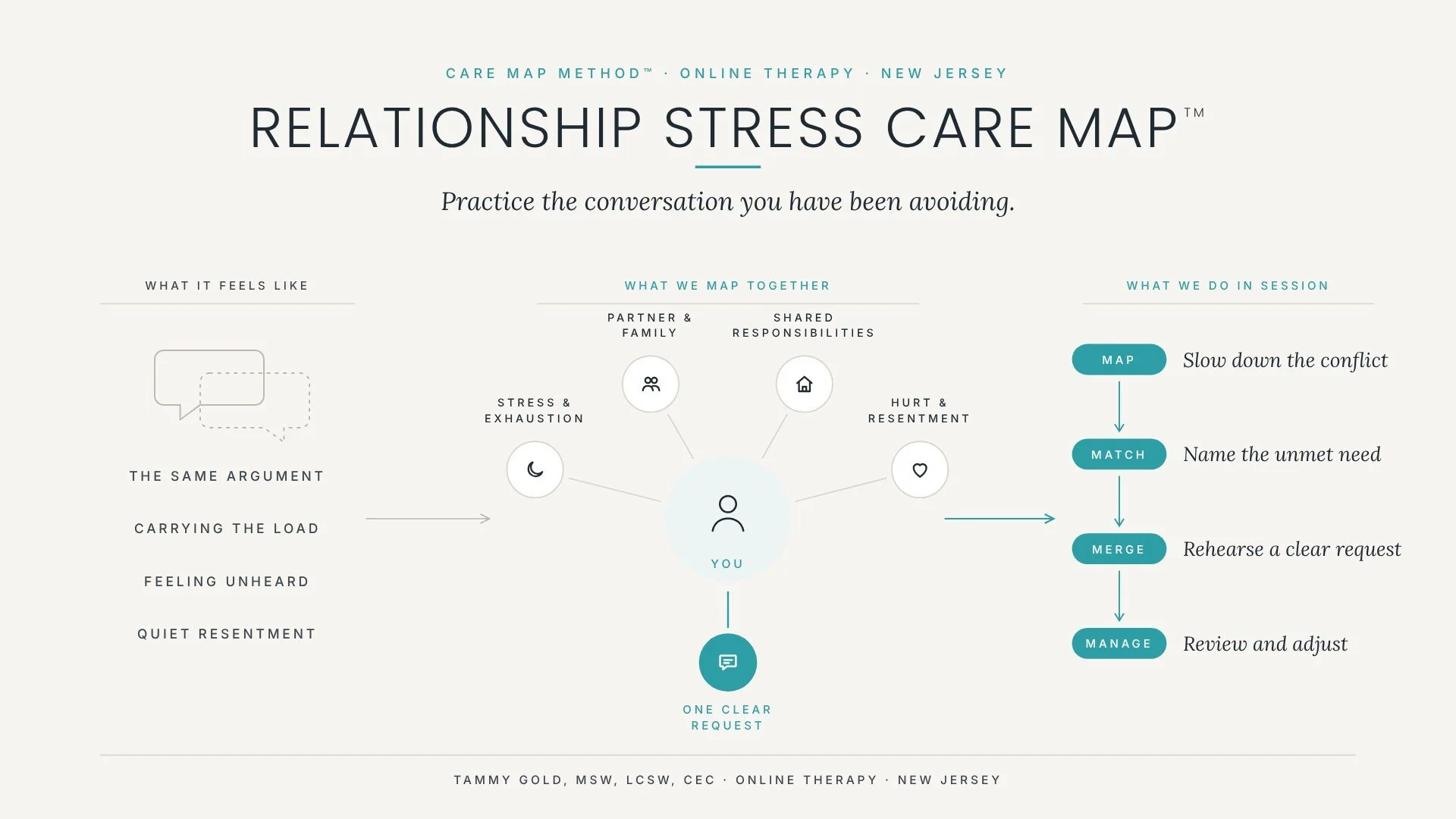
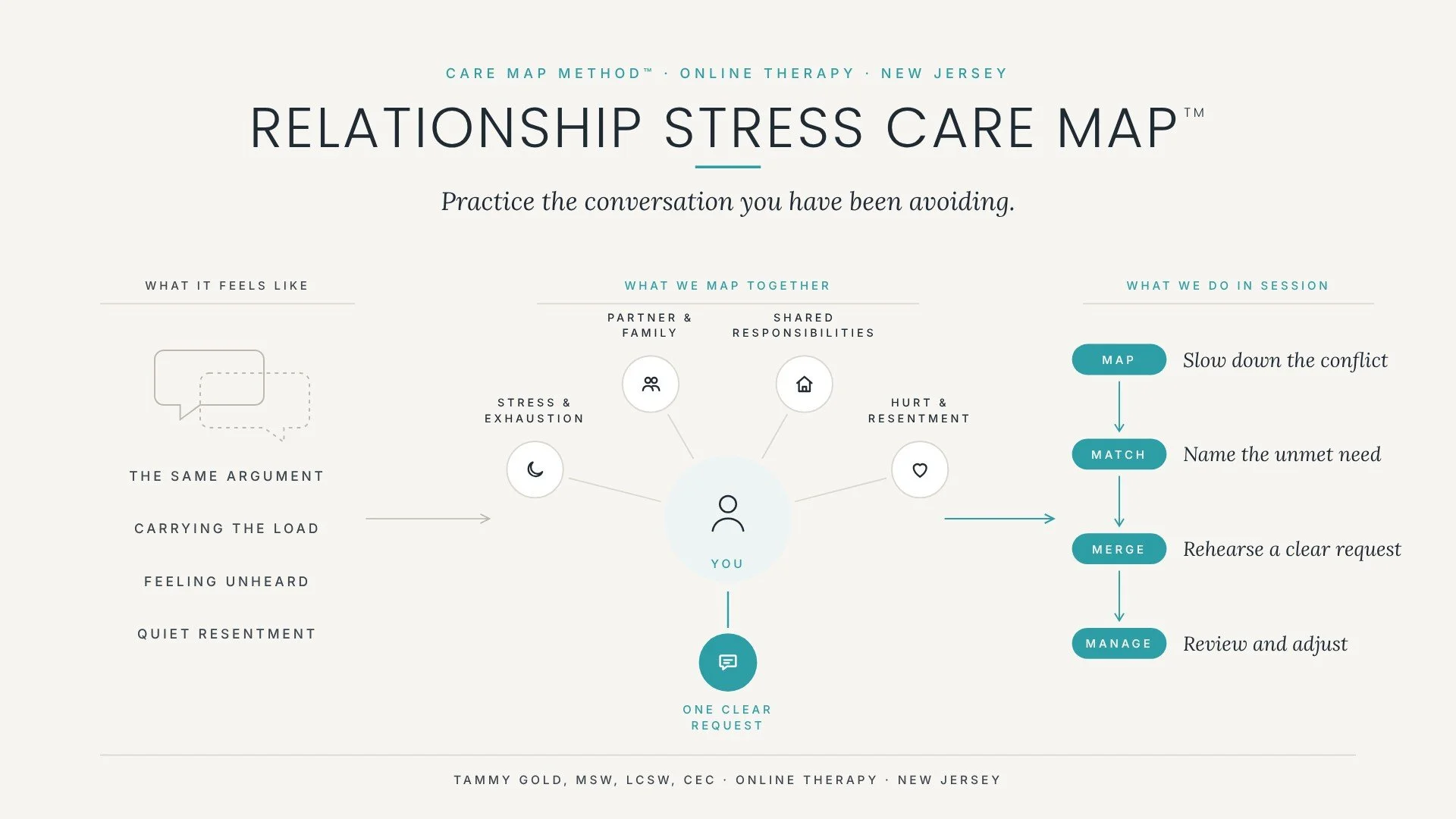
Practice the conversation you have been avoiding
If you are carrying most of the parenting load, we can identify the specific responsibilities involved and what you need to ask for. We may rehearse a request, consider the likely response and work on staying clear when guilt or frustration rises. A goal might be a more direct conversation, rather than another evening hoping the other person notices.
If divorce or co-parenting is part of your life, we can focus on the emotional strain, communication and boundaries within your control. Therapy does not determine legal rights or require reconciliation. We can discuss your priorities while keeping the work grounded in your wellbeing.
How we work together
You can tell me what has been hard to say elsewhere. I will ask questions, listen for patterns and work with you to identify what deserves attention first. Depending on your needs, sessions may include exploring emotions, practicing communication, examining assumptions or trying a coping strategy between visits. We review what helps and adjust the work over time.
My Care Map Method™ considers Biological, Social, Environmental and Emotional factors. We MAP the concern, MATCH support to the needs identified, MERGE useful changes into daily life and MANAGE what we learn. For example, a recurring argument may involve exhaustion, unspoken expectations and fear of conflict. The framework helps organize individualized therapy; your assessment and goals guide treatment.
Your first appointment
We will discuss what brought you in, how it affects your life and what you hope will change. You can ask about my approach, share what did or did not help in earlier therapy and tell me if you prefer more structure. We will begin considering a treatment focus together. You do not need to arrive with a polished story or a list of solutions. If another service or level of care would be more appropriate, we can discuss that.
Online sessions and insurance
Sessions take place by video while you are physically in New Jersey. Choose a private space where you can speak freely, and confirm the calendar’s time zone. Tell me before a visit if travel changes your location.
Check your exact plan and expected cost before booking. Your deductible, copay or coinsurance may affect what you pay. Coverage for individual psychotherapy does not automatically extend to couples counseling, coaching or care management. We can clarify which service you are seeking. A platform’s general insurance list does not establish coverage for every plan or state.
Frequently asked questions
What can online therapy help me work on
We can discuss anxiety, overthinking, relationship stress, parenting pressure, caregiver strain and major life changes. Assessment helps determine the treatment focus and whether my services fit your needs.
Can individual therapy help if my partner will not attend
Yes. We can work on your reactions, needs, communication and boundaries. Individual therapy cannot make another person change, but it can help you consider your choices with greater clarity.
Will sessions include practical tools
They can. We may rehearse a difficult conversation, identify a boundary, examine a worry pattern or choose a manageable step between visits. The work also makes space for feelings and understanding; your goals guide the balance.
Can I use insurance for therapy in New Jersey?
Coverage depends on your exact plan, the service and current participation for your state. Verify eligibility and expected costs through the current booking pathway before scheduling. Insurance is not guaranteed by this page.
How soon will I feel better?
People respond differently. We can agree on goals and review progress, but I cannot promise relief after one session or a set number of visits. You can raise concerns about how the work is going at any time.
How do I get started?
Check current appointment and insurance options, confirm your physical location for the visit and choose a time that works for you. If the information is unclear, ask about fit, fees or availability before scheduling.
Take the next step
You can begin with the concern taking up the most space right now. We can talk about what is happening and whether working together feels appropriate.
Book Therapy Today & Get The Support You Deserve Using Insurance On:
Grow Therapy https://growtherapy.com/invite/979uzxntqh0z
Alma Therapy https://secure.helloalma.com/providers/tamara-gold/
Online Therapy in California
Online therapy in California with Tammy Gold. Support for anxiety, overthinking and the pressure to keep everything going. Learn what sessions involve and how to check appointment and payment options.
Tammy Gold, therapist offering online sessions in California.
Support for anxiety, overthinking, and the pressure to keep everything going.
You can be getting through the day and still feel anxious, disconnected or worn down. Perhaps work follows you home, a conversation with your partner keeps replaying, or you are so busy responding to everyone else that you have lost track of what you need. You can bring that experience into therapy without having a perfect explanation for it.
I’m Tammy Gold, a Columbia University-trained therapist, certified coach and author of Secrets of the Nanny Whisperer. I offer a warm, nonjudgmental space to talk honestly and work on changes that fit your life.
Check Availability and Insurance
Virtual therapy for eligible adults physically located in California. Plan participation, costs and appointment availability vary.
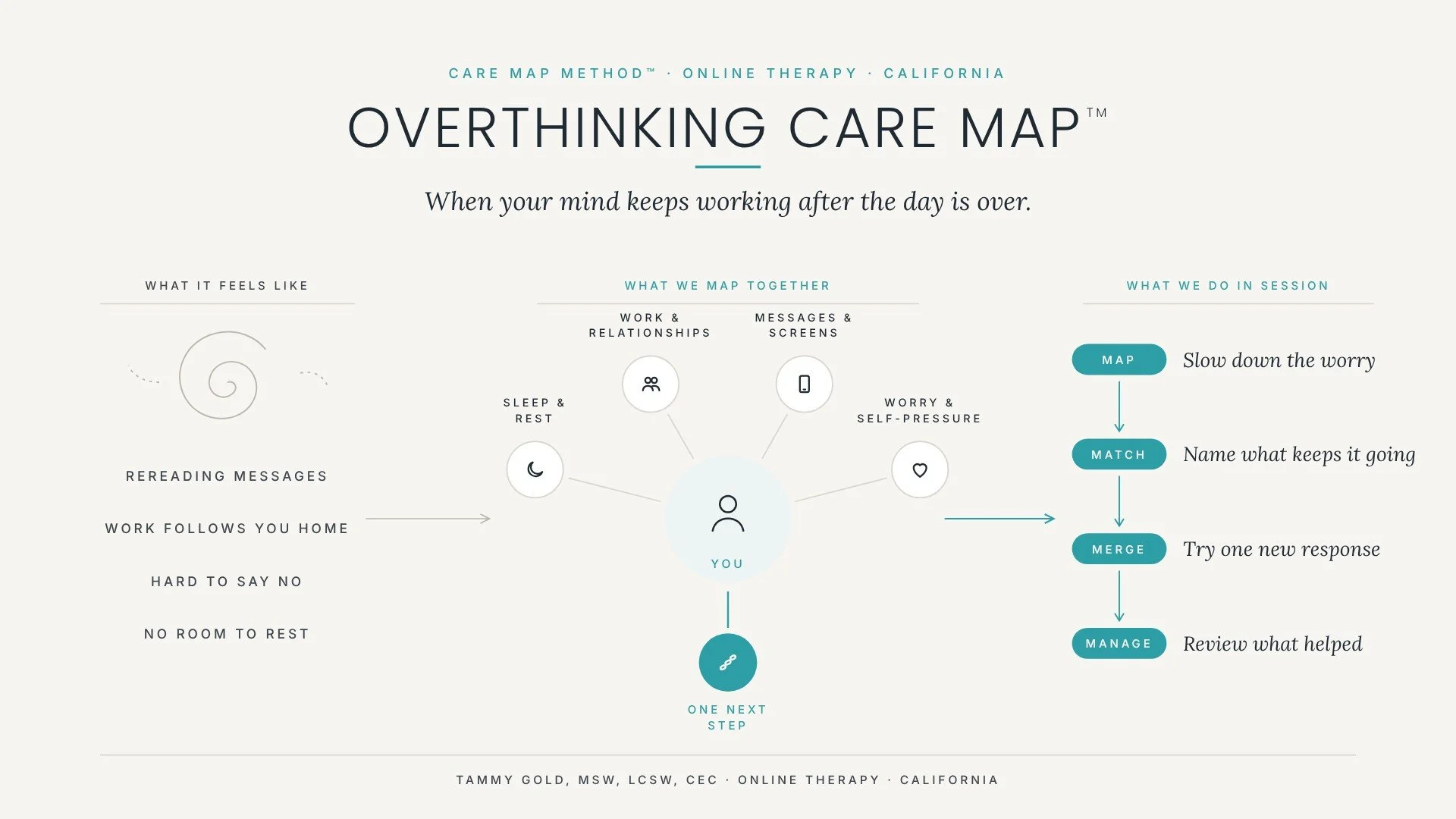
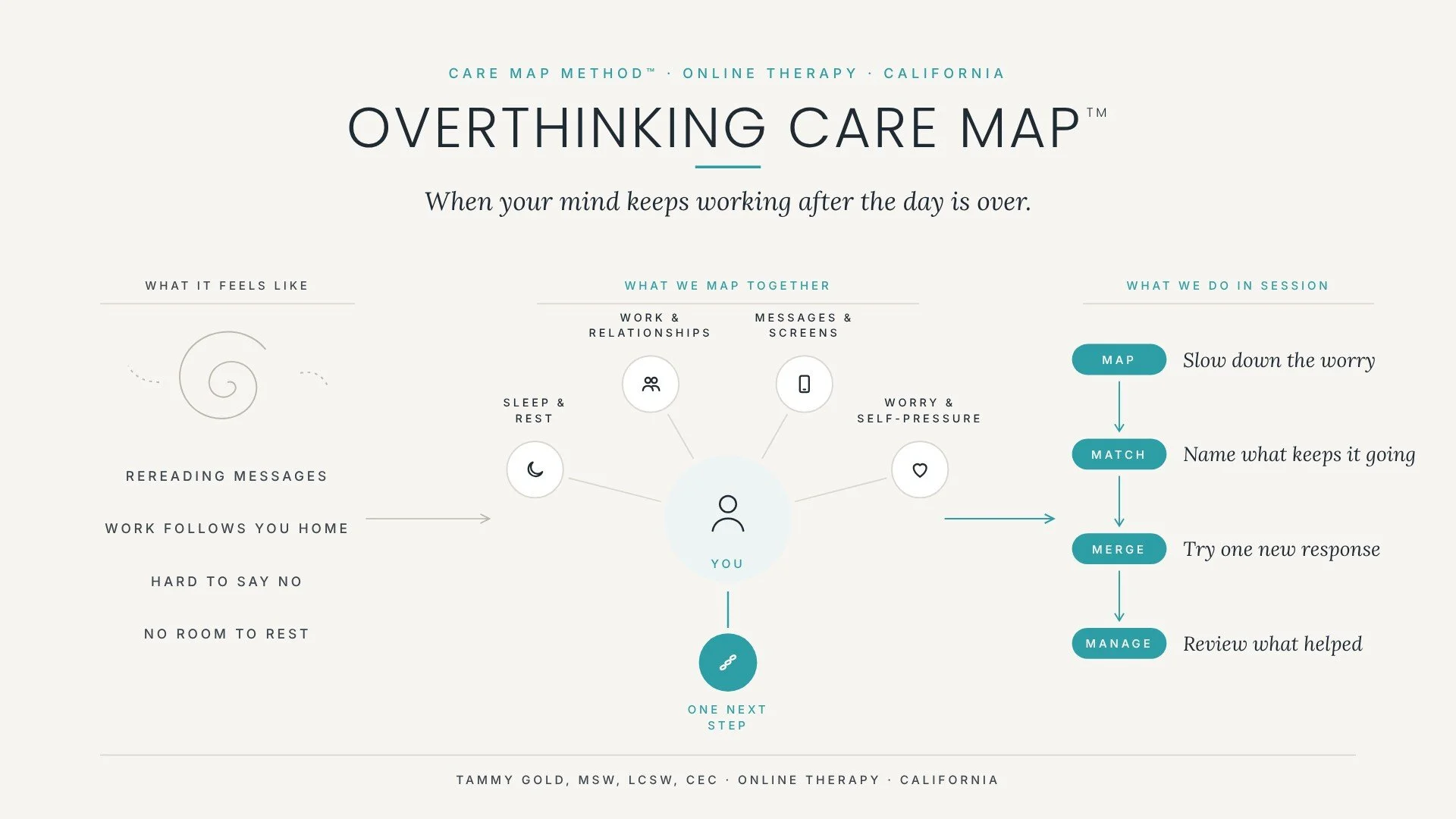
When your mind keeps working after the day is over
You might reread a message, worry about disappointing someone or spend the evening anticipating tomorrow. Trying harder to get everything right can leave little room for rest or connection. In our sessions, we can look at the worry itself and the situations that keep feeding it.
We might examine what you assume after receiving a short email, how you respond when a partner sounds frustrated, or why an ordinary request feels impossible to refuse. Understanding the pattern gives us a place to begin. Together we can choose coping tools, communication changes or boundaries that fit the actual concern.
Help with work pressure and relationship stress
Suppose a demanding workday ends with an argument at home. We can slow down the sequence: what happened at work, what you needed when you arrived home, what you said and how the conversation escalated. We may practice a clearer request or plan a different response to a familiar trigger.
For younger adults, the starting point may be dating, changing friendships or career uncertainty. For parents and caregivers, it may be the feeling that other people’s needs always come first. You do not have to decide which part of your life matters most before we meet.
How we work together
You can tell me what has been hard to say elsewhere. I will ask questions, listen for patterns and work with you to identify what deserves attention first. Depending on your needs, sessions may include exploring emotions, practicing communication, examining assumptions or trying a coping strategy between visits. We review what helps and adjust the work over time.
My Care Map Method™ considers Biological, Social, Environmental and Emotional factors.
We MAP the concern,
MATCH support to the needs identified,
MERGE useful changes into daily life and
MANAGE what we learn.
For example, a recurring argument may involve exhaustion, unspoken expectations and fear of conflict. The framework helps organize individualized therapy; your assessment and goals guide treatment.
Your first appointment
We will discuss what brought you in, how it affects your life and what you hope will change. You can ask about my approach, share what did or did not help in earlier therapy and tell me if you prefer more structure. We will begin considering a treatment focus together. You do not need to arrive with a polished story or a list of solutions. If another service or level of care would be more appropriate, we can discuss that.
Online sessions and insurance
Sessions take place by video while you are physically in California. Choose a private space where you can speak freely, and confirm the calendar’s time zone. Tell me before a visit if travel changes your location.
Check your exact plan and expected cost before booking. Your deductible, copay or coinsurance may affect what you pay. Coverage for individual psychotherapy does not automatically extend to couples counseling, coaching or care management. We can clarify which service you are seeking. A platform’s general insurance list does not establish coverage for every plan or state.
Frequently asked questions
What can online therapy help me work on
We can discuss anxiety, overthinking, relationship stress, parenting pressure, caregiver strain and major life changes. Assessment helps determine the treatment focus and whether my services fit your needs.
Can we work on overthinking even if I am still functioning well
Yes. You can seek support when worry, rumination or pressure affects your wellbeing, even if you continue meeting responsibilities. We will discuss its impact and what kind of care is appropriate.
Will sessions include practical tools
They can. We may rehearse a difficult conversation, identify a boundary, examine a worry pattern or choose a manageable step between visits. The work also makes space for feelings and understanding; your goals guide the balance.
Can I use insurance for therapy in California?
Coverage depends on your exact plan, the service and current participation for your state. Verify eligibility and expected costs through the current booking pathway before scheduling. Insurance is not guaranteed by this page.
How soon will I feel better?
People respond differently. We can agree on goals and review progress, but I cannot promise relief after one session or a set number of visits. You can raise concerns about how the work is going at any time.
How do I get started?
Check current appointment and insurance options, confirm your physical location for the visit and choose a time that works for you. If the information is unclear, ask about fit, fees or availability before scheduling.
Take the next step
You can begin with the concern taking up the most space right now. We can talk about what is happening and whether working together feels appropriate.
Book A Session Today & Get The Support You Deserve!
Using Insurance On:
Grow Therapy https://growtherapy.com/invite/979uzxntqh0z
Alma Therapy https://secure.helloalma.com/providers/tamara-gold/
Grief Therapy After the Death of a Parent or Loved One
Grief after a death can bring sadness, anger, numbness, relief, or mixed feelings, alongside changes in family roles and daily life. Explore grief therapy after the loss of a parent or loved one, at a pace that respects your experience.
Adult reflecting on a keepsake while considering support after a loss.
After someone dies, the world can look almost the same while your daily life feels changed. You may miss the person, the conversations you used to have, or the role they played in your family. Some days you may feel sad; on other days you may feel numb, busy, relieved, angry, or surprised by a moment of laughter.
I’m Tammy Gold, LCSW. I offer individual online therapy for adults navigating grief, caregiving, anxiety, family stress, and major life changes. We can make room for what this loss means to you and consider how you want to move through the days ahead.
There is no single way to grieve
Grief can come in waves. A familiar song, an empty chair, a medical appointment, or a family gathering may bring the loss close again. You may find yourself thinking about the person throughout the day, or feel as if you are functioning automatically. You might feel pressure to return to normal before you are ready.
People grieve differently, and the relationship itself may have been complicated. You may miss someone and also remember painful parts of the relationship. You may feel relief after a long period of caregiving and then feel guilty for being relieved. Mixed feelings do not cancel each other out.
Talk about the parts that are hardest to say out loud
You do not have to present a tidy story of the loss. In therapy, we can talk about a specific moment: the first holiday without the person, sorting belongings, answering other people’s questions, or feeling alone after the visitors have gone home.
We can explore what the moment brings up and what support you want. Maybe you want to talk about a memory. Maybe you want help telling a family member that you cannot take on every responsibility. Or maybe you need space to say that you do not know how you feel yet. The conversation can begin wherever you are.
When caregiving and grief overlap
If you cared for someone before they died, the loss may include a long period of worry, appointments, and decisions. You may miss the person and the role you had in caring for them. There may be memories of exhaustion, family disagreements, or questions about whether you did enough.
We can look at those experiences without turning therapy into a trial of your decisions. We may discuss what was within your control, what support you had, and what you want to remember about your relationship. If the person is still living and you are grieving changes related to illness or decline, that is anticipatory grief and may fit better with my existing page on that topic.
Consider the practical changes after a loss
A death can alter routines, roles, and relationships. You may be the person everyone calls, or the one who used to call the person who died. You may have to manage paperwork, family communication, or changes in your household while trying to understand what has happened.
Therapy can help you notice which tasks feel urgent, which can wait, and where you might ask for support. We can discuss a boundary, prepare for a difficult conversation, or choose one small routine that gives the day some structure. The goal is not to rush grief but to help you care for yourself while you live through it.
Use Care Map Method to make space for the whole experience
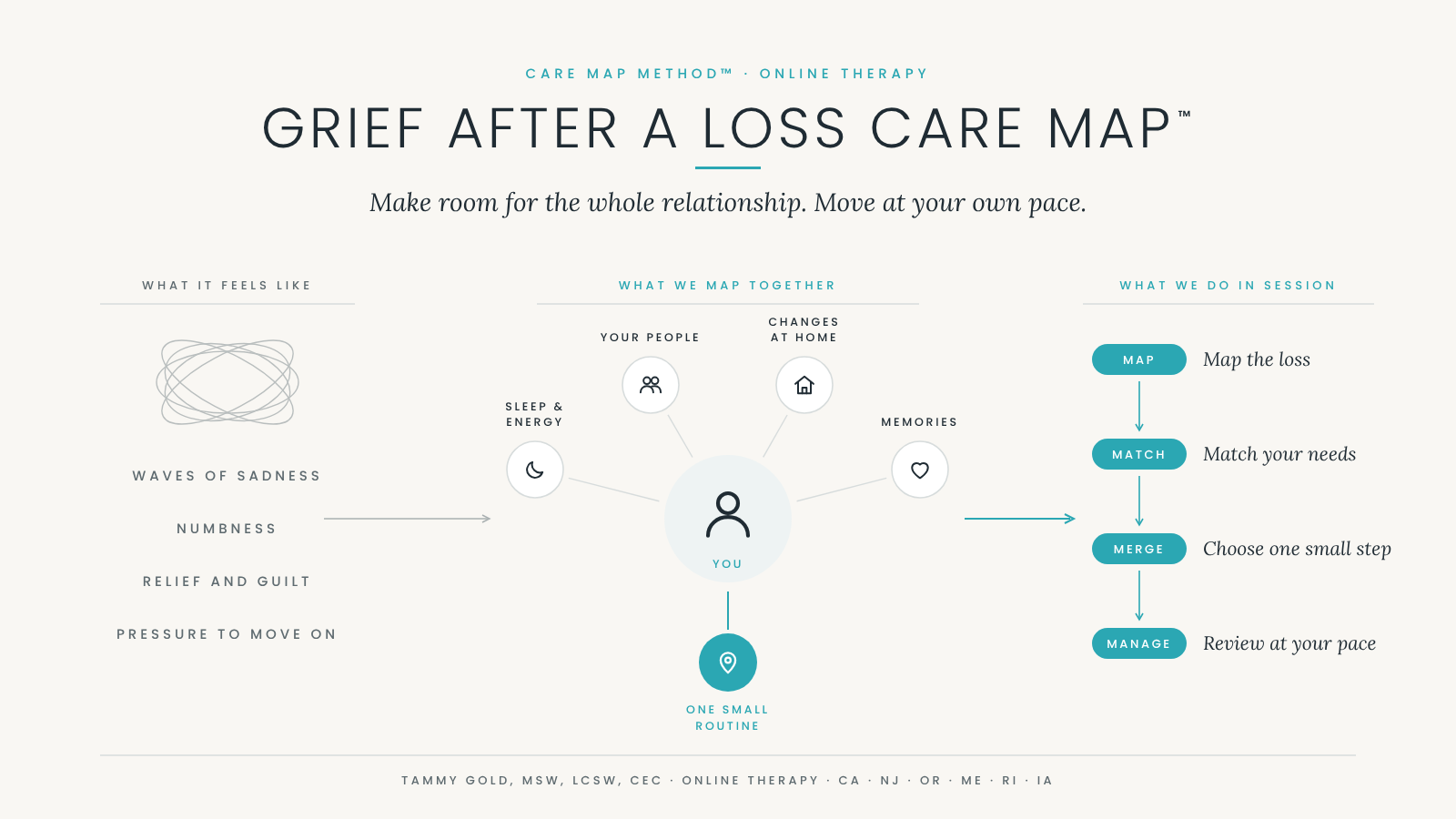
My Care Map Method considers Biological, Social, Environmental, and Emotional factors that may be relevant. During grief, that might include sleep and energy, the people who can offer support, practical changes at home, and the feelings connected to the person who died.
We MAP the loss and its effects,
MATCH support to your needs,
MERGE a small step into your day if it is useful, and
MANAGE the plan through review.
The framework helps us organize the conversation. It does not prescribe a timetable for grief or promise a particular outcome.
When grief feels hard to carry
You may want support if grief is affecting relationships, work, sleep, or daily responsibilities, or if you simply want a place where you do not have to manage other people’s reactions. A therapist can discuss your experience and help determine whether individual therapy fits your needs. If you have urgent safety concerns, contact emergency services or a crisis resource.
What the first session can include
We can talk about who died, what the relationship meant to you, what has been hardest lately, and what kind of support you want. You do not have to share every detail at once. You can ask questions and decide whether you feel comfortable continuing.
I offer online therapy to adults physically located in California, New Jersey, Oregon, Maine, Rhode Island, and Iowa, subject to current openings. Check Headway or Alma for your state, plan, and appointment options. Rhode Island is a current live practice state; use the appropriate active profile route when checking availability.
Frequently asked questions
How long does grief last?
There is no single timetable that applies to everyone. People may notice changes in their grief over time, and important dates or reminders can bring strong feelings back. Therapy can focus on your current experience rather than setting a deadline.
Is it normal to feel relief after a loved one dies?
Some people feel relief, especially after a long period of illness or caregiving. That feeling can exist alongside sadness or love. We can talk about what it means to you without judging it.
What if my relationship with the person was complicated?
You can bring the whole relationship into therapy, including closeness, conflict, unanswered questions, or mixed feelings. There is no requirement to describe the person or the loss in one simple way.
Can therapy help with guilt after caregiving?
We can explore what you were responsible for, what was outside your control, and what support you had. The work is not about putting you on trial; it is about understanding how the experience affects you now.
Is grief after a death different from anticipatory grief?
Anticipatory grief can arise while someone is still living, often in the context of illness or decline. Bereavement follows a death. The experiences may overlap, but the current page should speak to the loss that has occurred.
Can I use insurance for grief therapy?
Coverage depends on your plan, eligibility, clinical needs, and current provider participation. Check the exact plan and expected cost through Headway or Alma.
What if other people expect me to be over it?
We can discuss the pressure you are feeling, what you want others to understand, and how you want to respond. You do not need to follow another person’s timetable.
Do I need to know what I want from therapy?
No. You can begin by describing what feels hardest. We can work together to understand what support may fit.
If you want a place to talk about the loss, check current state availability and insurance through my Headway or Alma profile.
Book A Session Today & Get The Support You Deserve!
Using Insurance On:
Grow Therapy https://growtherapy.com/invite/979uzxntqh0z
Alma Therapy https://secure.helloalma.com/providers/tamara-gold/
Therapy for Panic Attacks and Fear of Having Another One
therapy for panic attacks; panic-related anxiety; fear of another panic attack; panic symptoms; anxiety therapy
Adult pausing during a stressful moment and considering a support plan.
The first time it happened, you may have wondered whether something was seriously wrong. Your heart raced, your breathing changed, or you felt unsteady and overwhelmed. Even after the moment passed, you might have worried about when it would happen again.
I’m Tammy Gold, LCSW. I provide individual online therapy for adults navigating anxiety, panic-related distress, relationship stress, parenting pressure, and major life changes. We can look at what happens before, during, and after a panic episode and discuss support that fits your needs.
When fear of another episode starts shaping the day
After a frightening episode, you might change your routine to avoid another one. You may stop driving on a certain road, avoid crowded spaces, sit near an exit, or check your body for signs that something is about to happen. These steps can feel protective in the moment, while also making your world smaller over time.
Everyone’s experience is different. You may feel embarrassed telling someone what happened, especially if they did not see it. Or you may be frustrated that reassurance helps only briefly. Therapy offers a space to discuss the experience without dismissing it or assuming its cause.
Begin with what happened and what changed afterward
We can discuss the episode itself, what you noticed, and what you did next. You might describe a moment when your breathing felt different in a grocery store, or when a sudden wave of fear made it difficult to stay in a meeting. We can explore what was happening around that time, what you thought the sensations meant, and what you have been doing to prevent another episode.
The goal is not to decide that every physical sensation is harmless. New, severe, or changing physical symptoms should be discussed with a medical professional. Therapy can focus on the distress, the fear of recurrence, and the ways the worry is affecting your choices.
Understand the cycle without blaming yourself
You may notice a sensation, interpret it as a sign that something bad is about to happen, and become more frightened. That fear can make it harder to think clearly in the moment. Afterward, you might replay what happened or look for certainty that it will not occur again.
In therapy, we can map your particular pattern. What was happening before the episode? What did you notice? What did you believe it meant? What did you do to feel safer? How did that response affect the next hour or the following week?
Understanding the sequence can help us decide what to work on. We might discuss a situation you have been avoiding, a plan for asking for support, or a way to respond when worry rises. Any step should be considered in light of your goals and safety, not assigned as a one-size-fits-all challenge.
Talk about the impact on relationships and work
Panic-related fear can be hard to explain. You may worry that a partner thinks you are overreacting or that a manager will question your reliability. Perhaps a family member has started planning around what you avoid, and you are unsure whether the support is helping or keeping the fear in charge.
We can work on how you want to describe your experience and what support you want from others. We can also consider practical boundaries, such as how to leave a conversation or what information you are comfortable sharing at work. Therapy remains focused on your needs and choices.
Care Map Method: consider the whole context
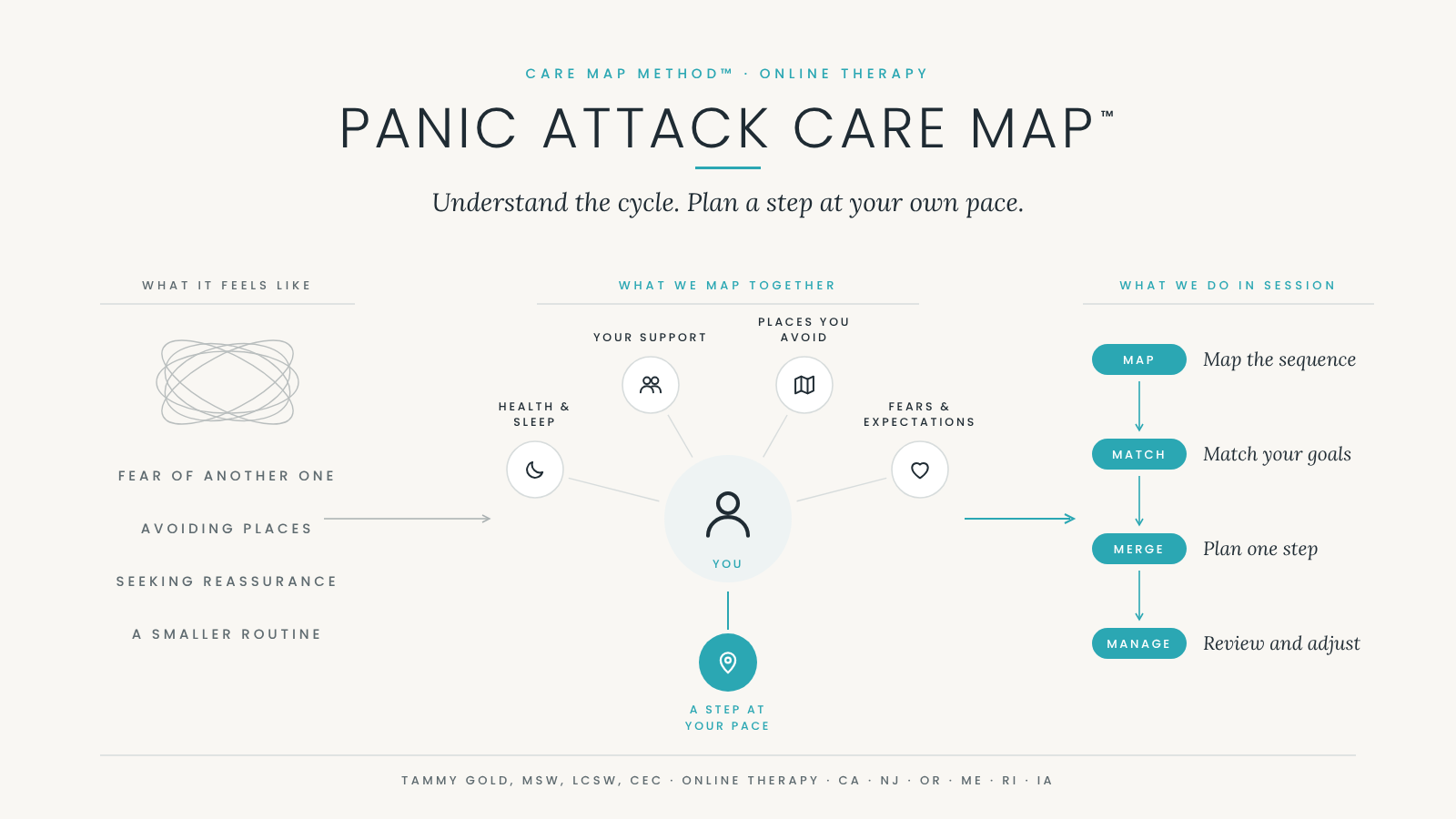
My Care Map Method helps organize Biological, Social, Environmental, and Emotional factors. When discussing panic, we may consider health and sleep, relationships and available support, the settings where episodes occur, and the fears or expectations that have developed around them.
We MAP what is happening,
MATCH support to your goals,
MERGE a manageable step into your daily routine, and
MANAGE the plan through review.
The method helps us structure the work; it is not a guarantee that panic will stop or a replacement for medical assessment.
When to seek medical or urgent support
If physical symptoms are new, severe, or changing, contact a medical professional or emergency service as appropriate. A therapist cannot rule out medical causes through a website or a routine psychotherapy session.
If you feel in immediate danger, are unable to stay safe, or believe you are experiencing a medical emergency, call 911 or go to an emergency department. This practice does not provide emergency response.
What the first session can include
We can discuss what happened, what you fear might happen next, and how the worry is affecting daily life. You can ask questions about therapy and decide whether the approach feels like a fit. You do not need to have a formal diagnosis before asking about care.
I offer telehealth to adults located in California, New Jersey, Oregon, Maine, Rhode Island, and Iowa, depending on current availability. You must be physically in a state where I am licensed during a session. Check my Headway or Alma profile for state, plan, and scheduling details.
Frequently asked questions
Can therapy help with panic attacks?
Therapy can help you explore the fear and behavior patterns connected with panic-related distress. An assessment can clarify your goals and whether the service is an appropriate fit.
Do I need to know whether the symptoms are panic before I book?
No. You can describe what happened and what concerns you. A mental health assessment can discuss the emotional and behavioral aspects, while physical symptoms may also need medical evaluation.
What if I am afraid to go places alone?
We can discuss how the fear developed, how it affects your routines, and what kind of support you want. Any changes should be planned thoughtfully and at a pace that fits your clinical needs.
Can panic affect work or relationships?
Yes, fear of another episode can affect plans, communication, concentration, and the settings you are willing to enter. We can focus on the parts of daily life that matter most to you.
Should I see a doctor about physical symptoms?
New, severe, or changing physical symptoms should be evaluated by a medical professional. Therapy is not a way to rule out medical causes.
Does insurance cover therapy for panic?
Coverage depends on your exact benefits, eligibility, assessment, and active provider participation. Check your plan and expected cost through my booking profile.
Is the first session a test?
No. It is a chance to discuss your concerns, history, goals, and questions. You can decide whether you feel comfortable continuing.
What if I have an emergency during a panic episode?
If you believe you are having a medical emergency or cannot stay safe, call 911 or go to an emergency department. This practice is not an emergency service.
If fear of another episode is limiting your choices, check current insurance and availability through my Headway or Alma profile.
Book A Session Today & Get The Support You Deserve!
Using Insurance On:
Grow Therapy https://growtherapy.com/invite/979uzxntqh0z
Alma Therapy https://secure.helloalma.com/providers/tamara-gold/
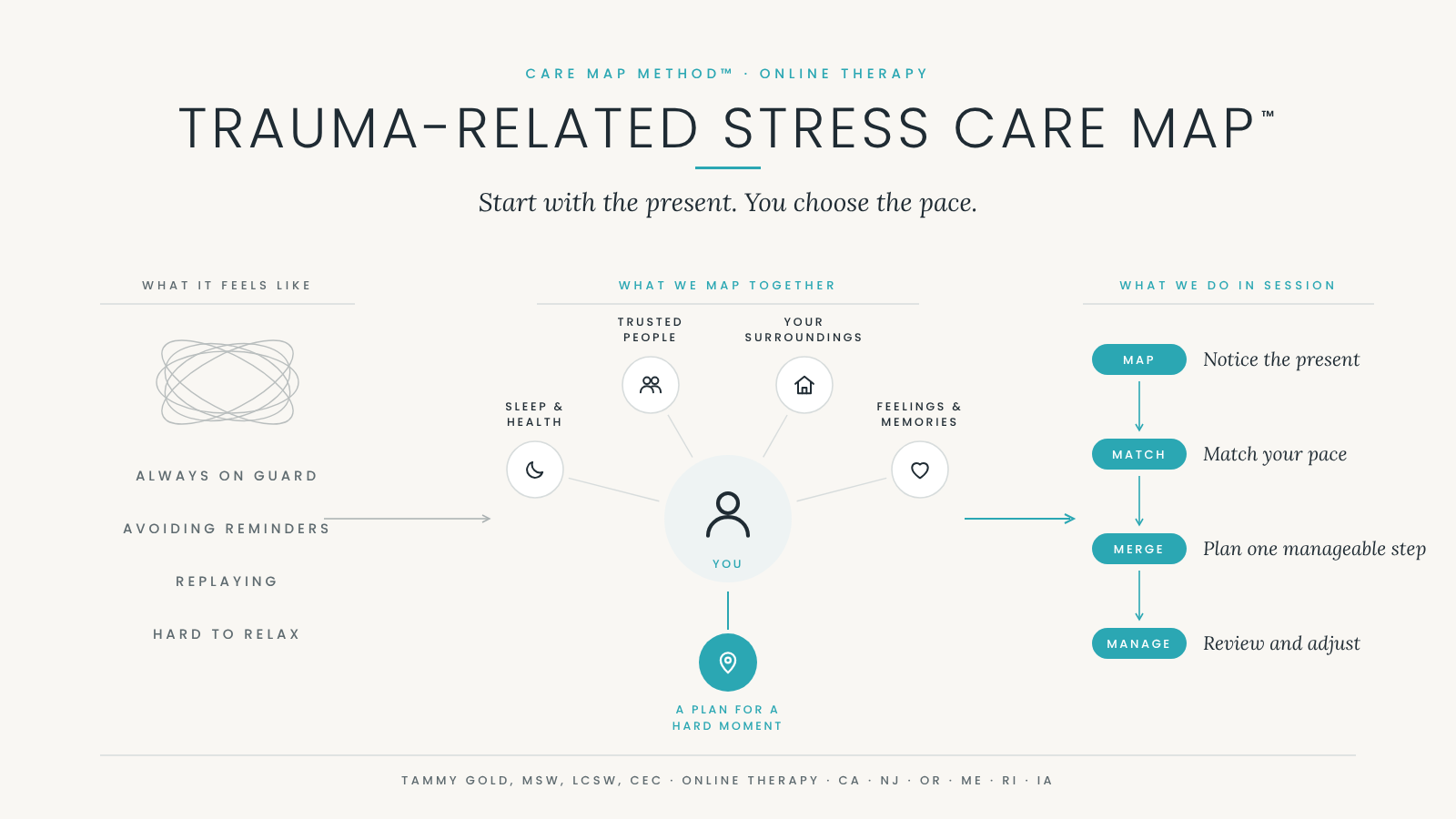
Therapy for Trauma-Related Stress and Feeling Constantly on Guard
After a frightening or deeply upsetting experience, reminders can bring tension, avoidance, or strong reactions long after the event. Explore trauma therapy that starts with what feels manageable, without pressure to retell everything at once.
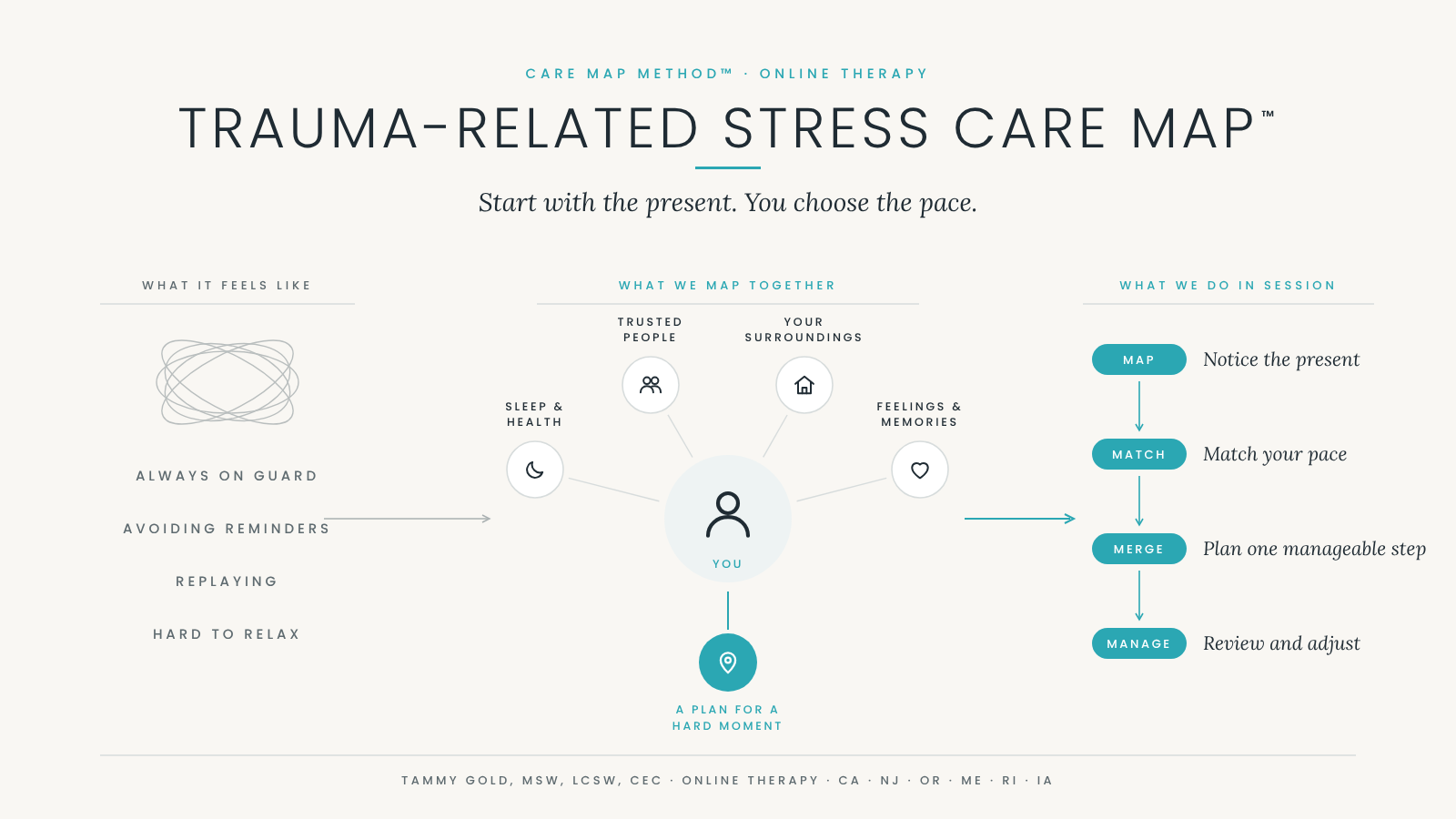
Adult pausing to notice a stress response and consider support.
After a frightening or deeply upsetting experience, life can look familiar while you feel different inside. You may find yourself scanning a room, avoiding reminders, replaying what happened, or reacting strongly to something that other people barely notice. You might tell yourself that enough time has passed and wonder why it still affects you.
I’m Tammy Gold, LCSW. I offer individual online therapy for adults navigating trauma-related stress, anxiety, relationship concerns, parenting stress, and life transitions. We can begin with how the experience is affecting you now and what kind of support feels manageable.
Reactions can continue after the event is over
People respond to frightening experiences in different ways. You may feel alert even in settings that used to feel ordinary. A sound, place, date, conversation, or conflict may bring back a strong reaction. You might avoid certain situations because they remind you of what happened, or find it hard to relax when nothing dangerous is happening.
Some people experience changes in trust, sleep, concentration, mood, or closeness with other people. Others feel detached or have trouble explaining why a particular moment is so difficult. None of these details alone establishes a diagnosis, and you do not need to compare your experience with anyone else’s to deserve support.
You control how much you share
You do not have to describe every detail of a painful event in the first appointment. We can start with what you notice in the present: what feels difficult, what you have been avoiding, and what would help you feel safer or more supported. You can tell me if a question feels like too much or if you need to slow down.
Our pace matters. Some people want help understanding a reaction at work or at home. Others want to explore how the experience affects relationships or parenting. We can discuss your goals and identify what kind of therapy approach may fit, based on your needs and my clinical scope.
Notice what happens around a trigger
Imagine that an unexpected message arrives from someone connected with a painful period in your life. You may feel your body tense, begin rereading the message, and decide you need to respond immediately. In therapy, we can slow down that sequence and ask what you noticed, what meaning came to mind, and what you needed in that moment.
The purpose is not to prove that your reaction is wrong. It is to understand it and explore your options. You might choose to wait before responding, reach out to a trusted person, make a plan for a difficult setting, or discuss a boundary. We can review what happened and adjust the plan if it did not fit.
Consider the effects on relationships and daily life
Trauma-related stress can affect how close you feel to people and how you respond during conflict. You may withdraw, become more watchful, or feel responsible for preventing every possible problem. Someone close to you may not understand why a reminder affects you so strongly.
We can focus on your experience and the choices available to you. That might include preparing to talk about a boundary, deciding what information you want to share, or identifying a support person who can help during a difficult moment. Individual therapy does not require another person to attend.
Use Care Map Method to organize the picture
My Care Map Method considers Biological, Social, Environmental, and Emotional factors that may be relevant. We might discuss sleep, health, supportive relationships, current surroundings, and the feelings or memories connected with a situation. The framework can help organize the conversation without reducing your experience to a checklist.
We MAP what is happening now,
MATCH appropriate therapeutic support,
MERGE manageable steps into daily routines, and
MANAGE the plan through review.
This is a framework for our work, not a promise of a specific outcome or a claim that one method fits every person.
Getting support for trauma-related symptoms
If symptoms are interfering with daily life, relationships, sleep, or your sense of safety, speaking with a licensed mental health professional may help. A therapist can discuss your history, current symptoms, and goals and consider whether the treatment is a good fit. If you need a specialized trauma treatment, we can discuss whether a referral is appropriate.
If there is an immediate threat to your safety, contact emergency services or go to an emergency department. A routine telehealth therapy appointment is not emergency care.
What the first session can include
We can discuss what brought you to therapy, what you want help with, and what would make the conversation feel manageable. You can ask how I work and share only what feels useful to begin. We can talk about current symptoms and support needs without requiring a full retelling of the event.
I offer online therapy to adults physically located in California, New Jersey, Oregon, Maine, Rhode Island, and Iowa, subject to current openings. Check my Headway or Alma profile for your state and exact insurance benefits.
Frequently asked questions
Do I have to tell the whole story in the first session?
No. We can begin with what is affecting you now and discuss what you want from therapy. You can decide how much detail to share and ask to slow down.
Does a strong reaction mean I have PTSD?
Not by itself. A diagnosis requires an assessment of symptoms, history, duration, and impact. We can discuss what you are experiencing and whether additional evaluation is appropriate.
Can therapy help if the event happened a long time ago?
People seek support at different points in life. We can focus on how the experience affects you now and what you would like to address.
Can I work on a trigger without discussing every detail?
We can start by talking about the present-day situation and your response. The approach and pace should be based on your goals, safety, and clinical fit.
Can trauma affect relationships?
It can affect trust, communication, closeness, or reactions during conflict. Individual therapy can help you understand your own patterns and consider what you want to communicate or change.
Do you offer EMDR or another specialized trauma treatment?
This page describes individual therapy and does not advertise a specialized modality. Ask during an initial conversation whether your goals fit the services I currently provide or whether a referral would be more appropriate.
Can I use insurance for trauma-related therapy?
Coverage depends on your exact plan, eligibility, clinical needs, and active provider participation. Verify benefits and expected costs through my provider profile.
What if I do not feel ready to start?
You can ask questions about the process and describe what would help you feel more comfortable. Starting with a consultation or a limited first conversation may help you decide whether the fit feels right.
You can begin with the part that feels manageable. Check current insurance and availability through my Headway or Alma profile.
Book A Session Today & Get The Support You Deserve!
Using Insurance On:
Grow Therapy https://growtherapy.com/invite/979uzxntqh0z
Alma Therapy https://secure.helloalma.com/providers/tamara-gold/
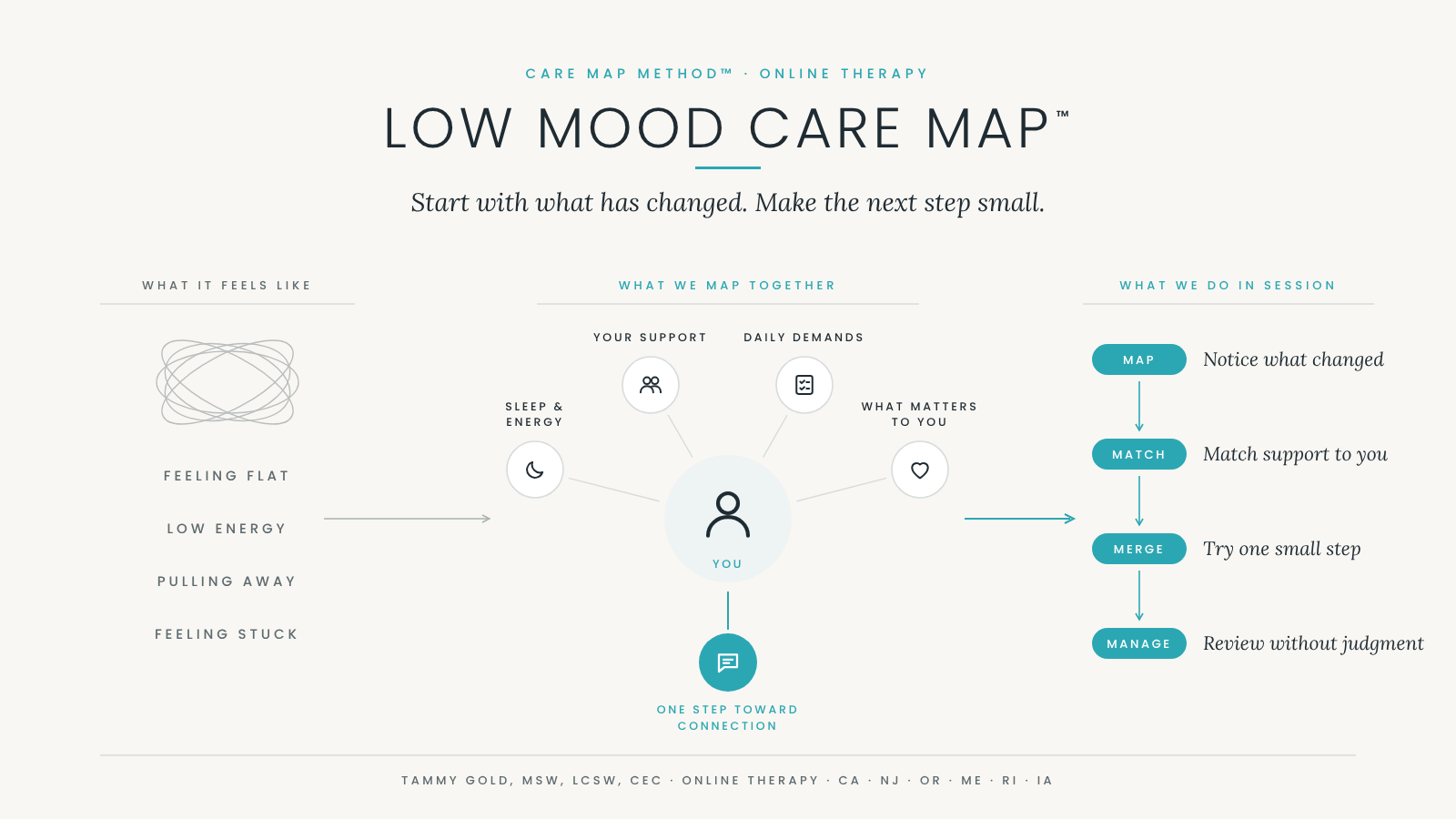
Therapy for Low Mood, Loss of Motivation, and Feeling Stuck
Low mood may show up as exhaustion, irritability, loss of interest, or feeling disconnected while you keep functioning. Explore therapy for depression and low mood to understand what has changed and choose a manageable next step.
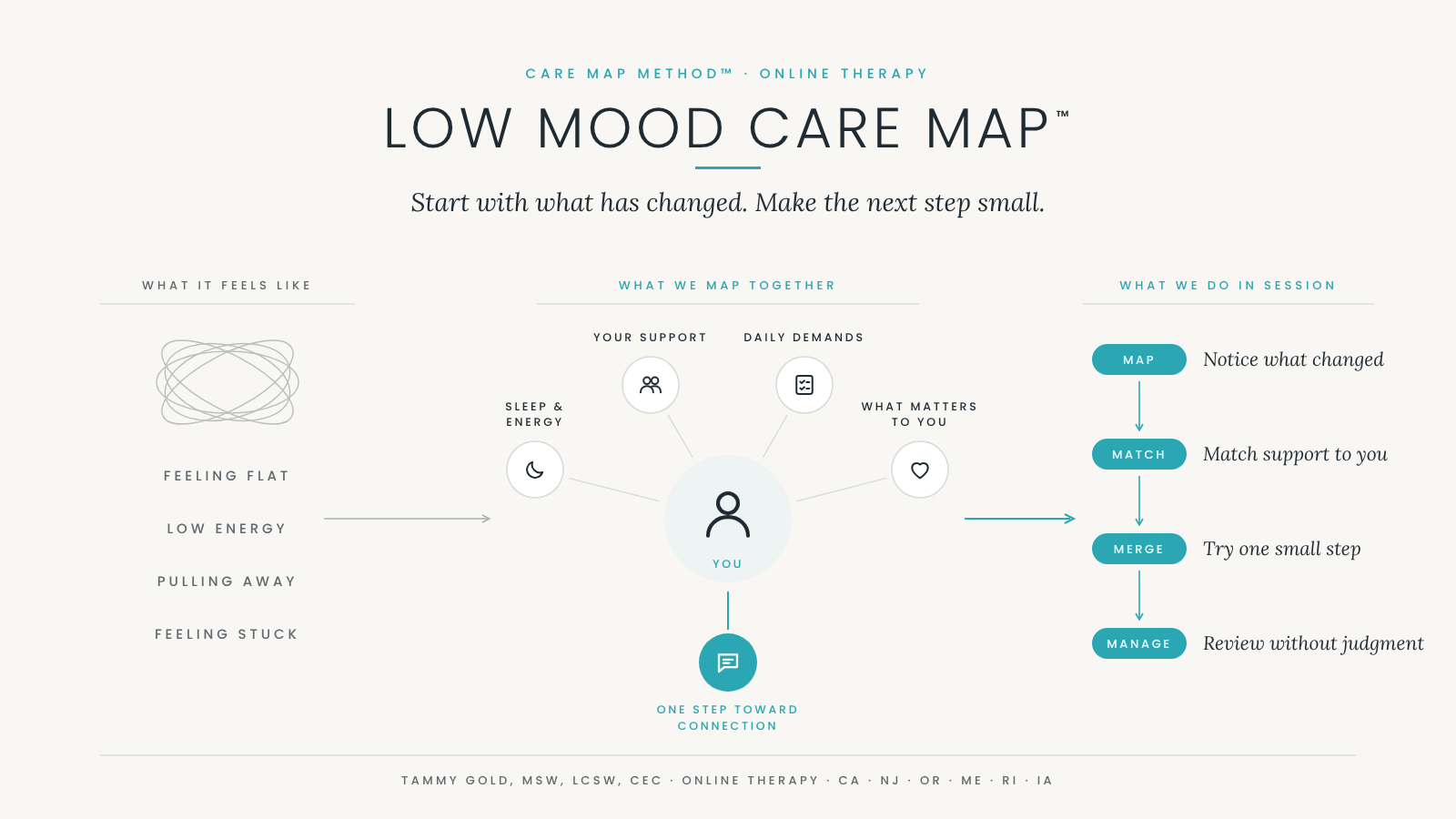
Some days, it takes effort to do things that used to feel ordinary. You may keep going to work, answer messages, or take care of other people, while feeling flat or disconnected inside. Maybe you are sleeping differently, losing interest, or wondering why you cannot just pull yourself out of it.
I’m Tammy Gold, LCSW. I provide individual online therapy for adults who want support with low mood, anxiety, relationships, parenting stress, and major life changes. We can start with what has shifted for you and explore what might help you feel more connected to your life.
Check current insurance and availability on Alma, Headway or Grow Therapy
Low mood does not always look the same
Depression can affect people in different ways. You might feel sad, irritable, numb, tired, or less interested in activities and relationships. Concentration may be harder. A small decision can feel draining. You may withdraw from people because explaining yourself takes more energy than you have.
Some people keep functioning on the outside and feel increasingly disconnected on the inside. Others notice the change most in their sleep, appetite, energy, or ability to manage daily responsibilities. The important question is not whether your experience looks like someone else’s. It is how you have been feeling, how long it has been going on, and how it affects your life.
Start with the change you have noticed
In a first conversation, we can talk about what feels different. You might say, “I used to look forward to seeing my friends, but now I cancel,” or “I get through the day and then I do not have anything left.” We can discuss when you first noticed the change, what else was happening, and what kind of support you have tried.
Therapy is not about blaming you for having a hard time. It is also not about assuming one cause or one solution. We can consider life events, relationships, health, stress, and past experiences as part of the wider picture. If medical or psychiatric care may be helpful, we can discuss coordination or referral to an appropriate professional.
Make the next step small enough to try
When motivation is low, a long list of goals can make the day feel even harder. We can identify one part of life that matters to you and consider a manageable way to approach it. That might mean replying to one message, taking a short walk, asking someone to sit with you while you handle a task, or talking through a difficult conversation before you have it.
We can also explore what makes the step hard. Perhaps you expect yourself to do it perfectly. Maybe you are worried that reaching out will burden someone. Or the activity reminds you of a loss or disappointment. Understanding the barrier helps us choose a response that fits, and we can review what happened without turning it into a pass-or-fail test.
Talk about relationships and responsibilities
Low mood can affect the way you relate to people. You may feel guilty that you are less patient with your children, partner, or friends. Someone close to you may interpret withdrawal as rejection. You may be carrying work or caregiving responsibilities while trying to conceal how much effort it takes to keep up.
In individual therapy, we can focus on your feelings and choices. We might clarify what you want another person to understand, practice how to ask for support, or explore a boundary that would make the week more manageable. You do not need to bring a family member or partner in order to work on your own goals.
Understand the whole situation with Care Map Method
My Care Map Method organizes Biological, Social, Environmental, and Emotional factors that may be affecting a person’s experience. With low mood, that could mean discussing sleep and energy, who is available for support, the demands in your home or workplace, and the emotions connected with a recent change.
We MAP what is happening,
MATCH therapeutic support to your needs,
MERGE a small step into daily life, and
MANAGE the plan through review. The framework helps us organize a conversation; it does not replace clinical assessment or medical care.
When to seek additional or urgent support
If low mood is affecting your ability to function, it may be useful to speak with a licensed mental health professional. Therapy can include an assessment of symptoms, history, and current stressors. A medical professional can help evaluate health concerns or medication questions.
If you are in immediate danger or think you may hurt yourself, call or text 988 in the United States, call 911, or go to an emergency department. A regular therapy appointment is not a crisis service.
What your first appointment can include
We will discuss what brought you to therapy, how you have been feeling, the effect on daily life, and what you would like help with. You can ask questions about how I work. You do not need to arrive with a diagnosis or a detailed plan.
I offer telehealth to adults located in California, New Jersey, Oregon, Maine, Rhode Island, and Iowa, subject to current availability. You must be physically located in a state where I am licensed during the session. Check my Headway or Alma profile for your state, insurance plan, and current openings.
Frequently asked questions
Does feeling low mean I have depression?
Not necessarily. Low mood can have many causes. A clinical assessment considers the symptoms, duration, history, circumstances, and effect on daily life before determining whether a diagnosis applies.
Can therapy help if I am still getting everything done?
Yes. You can seek support even if you are meeting some responsibilities. We can talk about the effort it takes, how you feel, and whether changes in sleep, interest, relationships, or concentration are affecting your life.
What if I do not know what to say in therapy?
You can start with a recent moment or a simple statement such as “I have not felt like myself.” We can take it from there together.
Can therapy help with numbness or irritability?
Those experiences are worth discussing. We can explore when they occur, what may be contributing, and how they affect your relationships and daily routines.
Should I see a doctor too?
If you have health concerns, medication questions, or a significant change in sleep, energy, or appetite, a medical professional can help assess those issues. Therapy and medical care can be complementary.
Can I use insurance for online therapy?
Coverage depends on your plan, eligibility, clinical needs, and current provider participation. Check the exact plan and estimated cost through my Headway or Alma profile.
What if I am having thoughts of suicide?
If you may act on those thoughts or are in immediate danger, call or text 988, call 911, or go to an emergency department. Do not wait for a scheduled therapy appointment for urgent help.
Do I need to be in California for a session?
No. I can provide telehealth to clients physically located in states where I am licensed and currently available, including Rhode Island. Confirm your location and appointment options through the booking profile.
Book A Session Today & Get The Support You Deserve!
Using Insurance On:
Grow Therapy https://growtherapy.com/invite/979uzxntqh0z
Alma Therapy https://secure.helloalma.com/providers/tamara-gold/
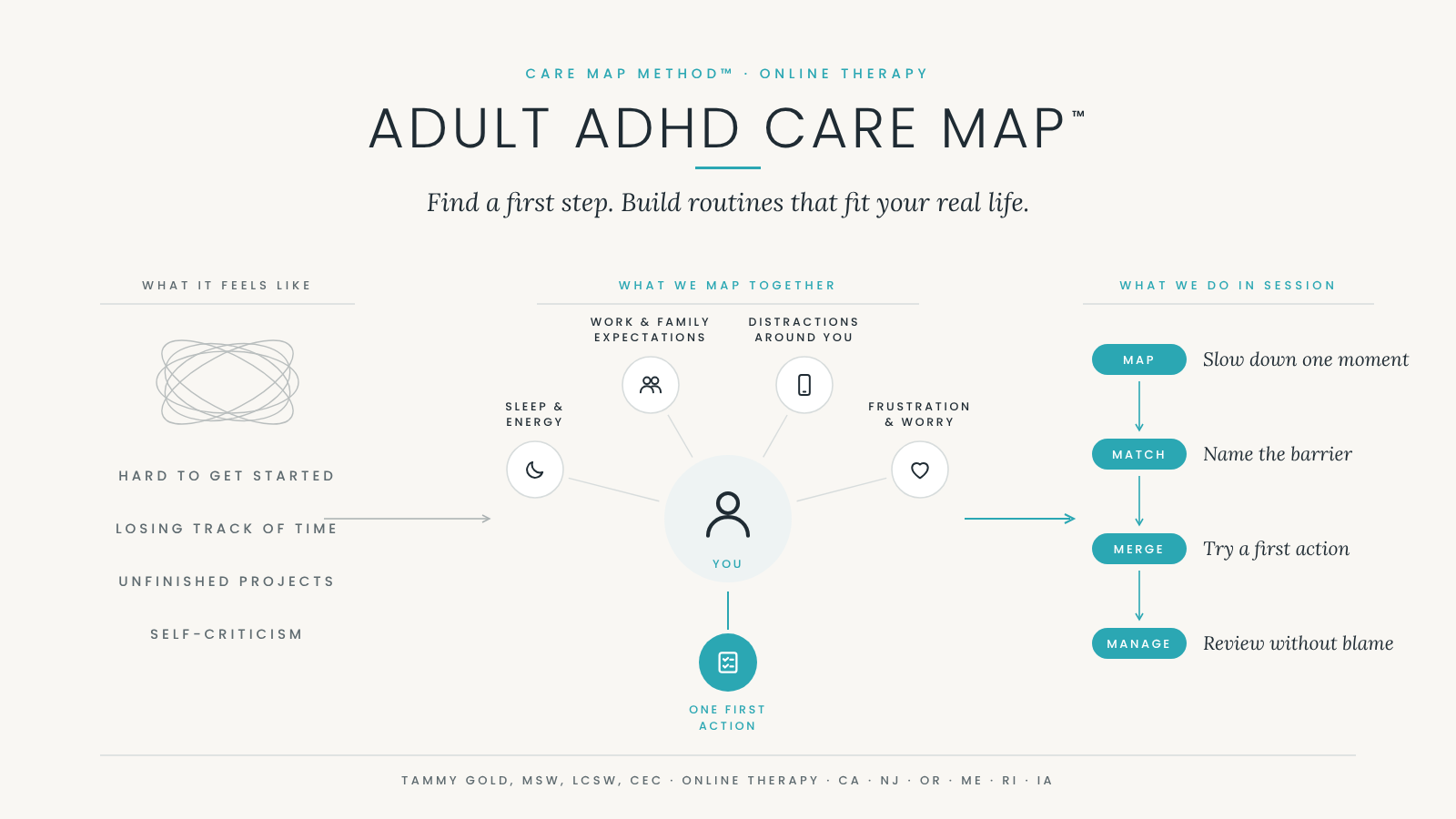
Adult ADHD Therapy for Overwhelm, Focus, and Getting Started
hen important tasks keep getting delayed, the stress can reach work, home, and relationships. Explore adult therapy for ADHD-related overwhelm and follow-through.
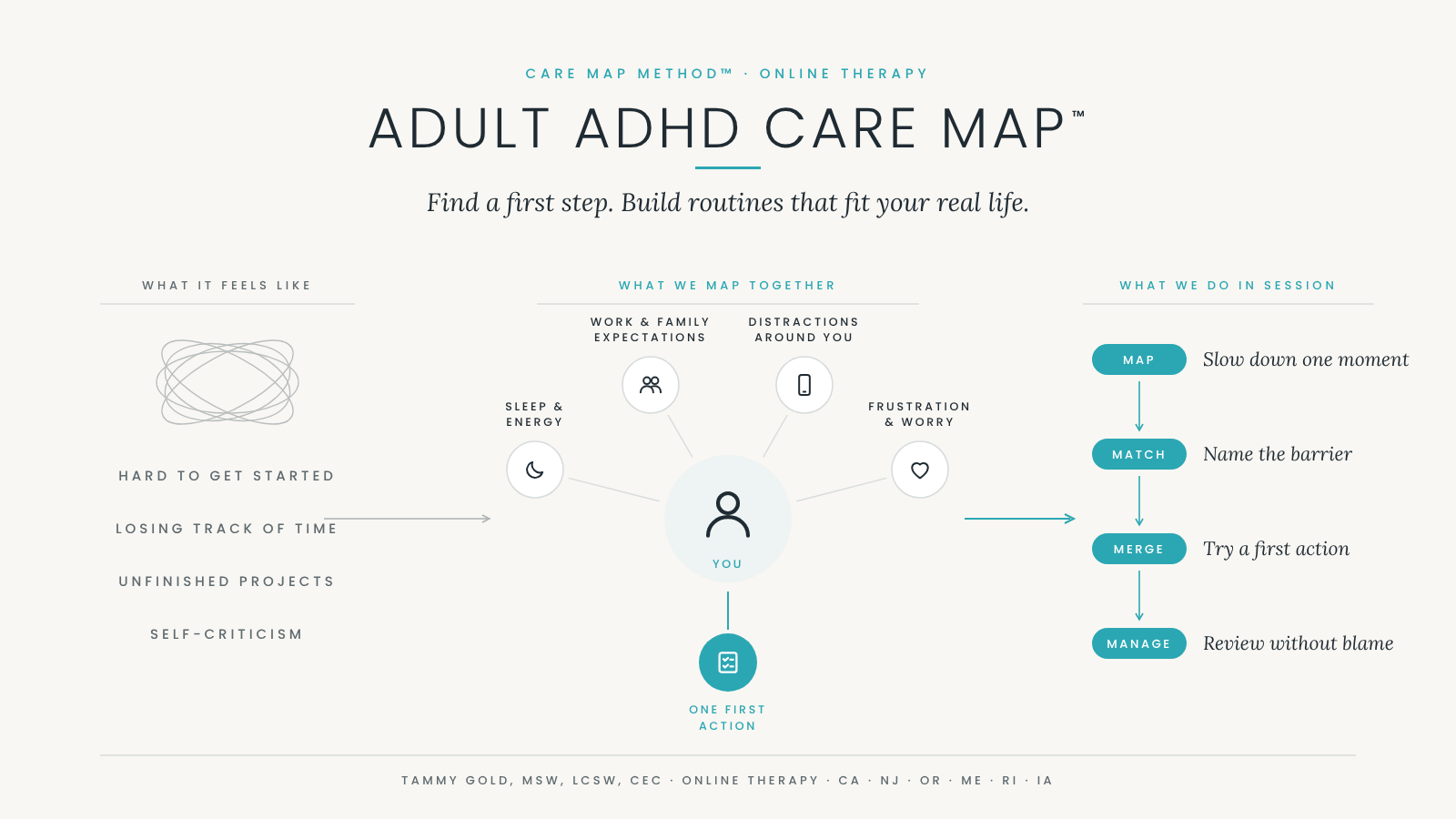
You know the task matters. You may have written it down, moved it to tomorrow, and thought about it throughout the day. Still, beginning can feel oddly difficult. Then the pressure builds, you rush to finish, and you wonder why something that looked manageable took so much out of you.
I’m Tammy Gold, LCSW. I provide individual online therapy for adults who want support with ADHD-related stress, overwhelm, relationships, and the emotional impact of feeling behind. Therapy can help you understand the patterns around a task, consider what gets in the way, and build responses that fit your actual life.
Check current insurance and availability via Alma, Headway or Grow Therapy
When knowing what to do is not the same as getting started
Adult ADHD can affect more than attention. You might lose track of time, underestimate how long a task will take, switch between several unfinished projects, or find it difficult to return to something after an interruption. You may be dependable at work and still struggle with household routines, paperwork, appointments, or keeping track of personal plans.
Sometimes the hardest part is not the task itself but what happens around it. You may delay because you expect to do it perfectly. You might avoid opening an email because you worry about what it will ask of you. A missed deadline can bring shame, which makes the next task feel even heavier. If that sounds familiar, you are not required to solve it by criticizing yourself harder.
Look at one real moment, not your whole life at once
In therapy, we can take a recent example and slow it down. What did you need to do? What did you notice when you sat down to begin? Were you tired, unsure where to start, worried about making a mistake, or pulled toward something more immediately rewarding? What happened after you put the task off?
This kind of discussion helps us distinguish different barriers. A task may feel too vague, too large, emotionally loaded, or difficult to fit into the time and energy you have. The next step should follow what we learn, rather than assume that one planner or productivity trick will work for everyone.
We might break a task into a first action small enough to begin, practice asking for clarification, or identify a reminder system you are willing to use. We can then review what happened without treating a difficult week as proof that you failed.
Make room for the feelings that come with ADHD stress
Many adults have spent years hearing that they are careless, lazy, scattered, or not trying. Even when you understand that ADHD affects how you manage attention and tasks, those messages can stay with you. You may hide how much effort ordinary responsibilities take or avoid asking for help because you expect to be judged.
Therapy can give you space to look at those experiences and how they affect your current choices. We can discuss self-criticism, frustration, anxiety, relationship strain, and the pressure to compensate by overworking. The goal is not to excuse every behavior or make another person responsible for your tasks. It is to understand the pattern and find a more workable way to respond.
When ADHD affects relationships or work
You may have a partner who feels they are carrying too much of the household planning. A coworker may interpret a missed detail as a lack of care. You might say yes to a commitment before checking your calendar, then feel trapped when the date arrives. These situations can become painful when the practical problem turns into a judgment about character.
We can identify what needs to be communicated, what routine could reduce friction, and what expectations need to be discussed. Therapy focuses on your own thoughts, feelings, behavior, and goals. It does not require your partner or coworker to participate for you to work on your side of a pattern.
Use the Care Map Method to understand the full picture
My Care Map Method helps organize Biological, Social, Environmental, and Emotional factors that may be relevant to a concern. With ADHD-related stress, we might consider sleep and energy, family or work expectations, distractions in your environment, and the frustration or worry that has built up around unfinished tasks.
We MAP the situation,
MATCH support to your goals,
MERGE a small change into your routines, and
MANAGE the plan through review. It is a practical framework for our conversations, not a promise of a particular result or a substitute for medical assessment.
What your first therapy session can include
You can bring one situation that has been difficult lately. We will discuss what prompted you to reach out, the effect on daily life, relevant history, and what you hope might change. You do not need to arrive with a perfect explanation or a confirmed diagnosis. If you are unsure whether ADHD is part of the picture, we can talk about what you are experiencing and whether an evaluation with an appropriate health professional may be useful.
I offer online therapy to adults located in California, New Jersey, Oregon, Maine, Rhode Island, and Iowa, subject to current availability. Please be physically located in a state where I am licensed for each session. Use my Headway or Alma profile to check your state, insurance plan, and appointment options.
Frequently asked questions
Can therapy help with adult ADHD even if I already have a diagnosis?
Yes. Therapy can focus on the emotional and relationship concerns connected with ADHD, including overwhelm, shame, planning stress, and follow-through. We can set goals based on your current needs.
Can you test me for ADHD?
This page describes psychotherapy, not neuropsychological testing. If you are seeking a formal evaluation, we can discuss whether referral to an appropriately qualified assessment provider makes sense.
What if I am not sure that I have ADHD?
You can still discuss attention, organization, motivation, and the impact on your daily life. We can explore your concerns without assuming a diagnosis and consider whether another professional assessment is appropriate.
Can therapy help if my partner is frustrated with me?
We can work on your experience of the conflict, your communication, and the routines or expectations you want to address. Individual therapy does not require your partner to attend.
Is online therapy available in my state?
I offer telehealth to clients located in states where I am licensed and currently available. Check my Headway or Alma profile for your state and appointment options.
Does insurance cover therapy for ADHD-related concerns?
Coverage depends on the plan, provider participation, eligibility, and clinical assessment. Use the booking profile to check your exact benefits and expected cost before scheduling.
What if I keep avoiding the same task?
We can examine what happens before, during, and after the avoidance. That can help us choose a more specific next step and understand what support may help you follow through.
Do I have to use a particular planner or system?
No. We can consider tools if they fit your needs, but therapy is not a test of whether you can maintain a particular productivity system. We will look for approaches you can realistically use.
Want to talk through what has been getting in the way? Check current insurance and availability through my Headway or Alma profile.
Book A Session Today & Get The Support You Deserve!
Using Insurance On:
Grow Therapy https://growtherapy.com/invite/979uzxntqh0z
Alma Therapy https://secure.helloalma.com/providers/tamara-gold/
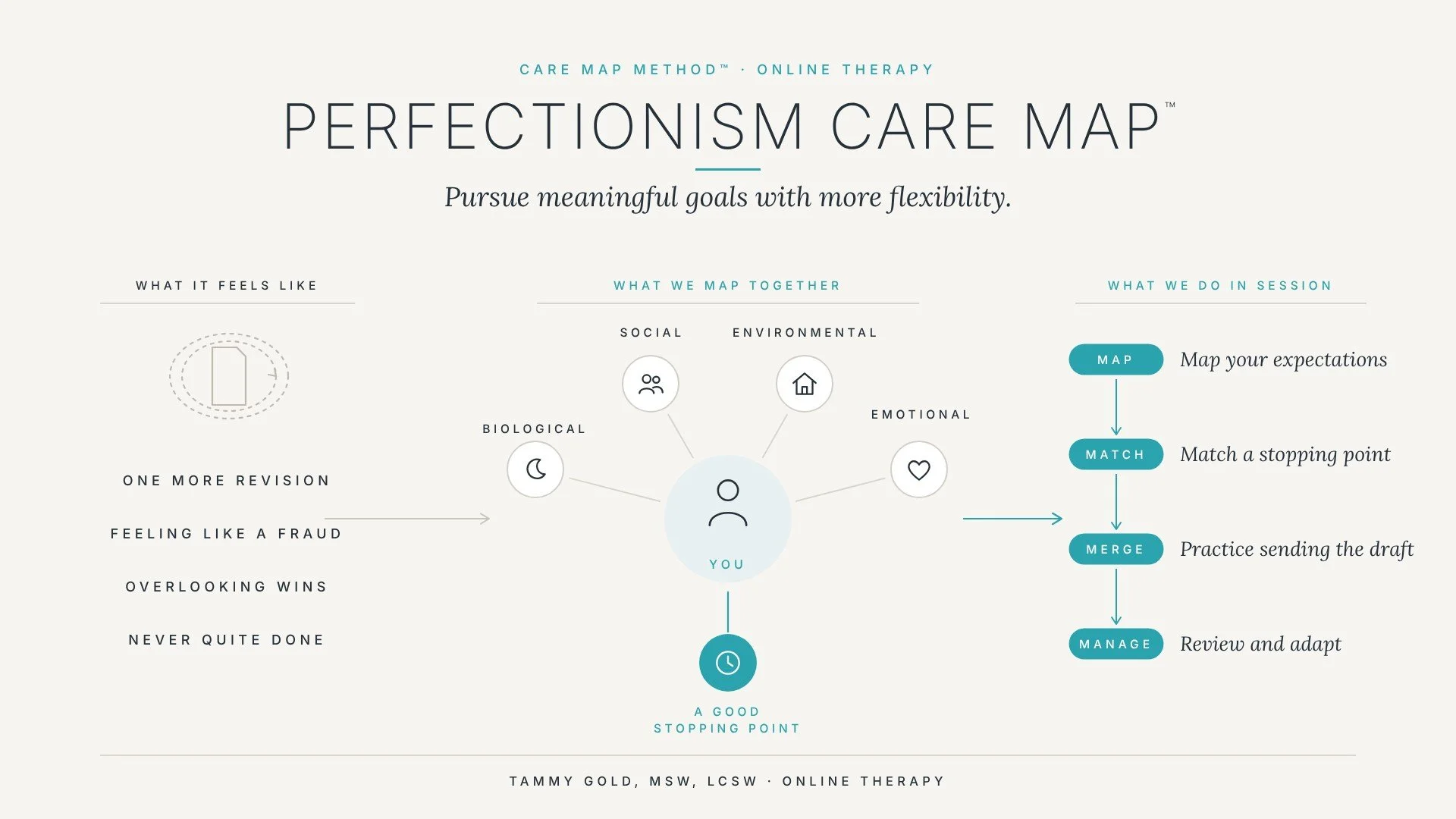
Therapy for Perfectionism and Imposter Syndrome
High standards can become exhausting when every mistake feels personal. Explore therapy for self-criticism, imposter feelings and the pressure to keep proving yourself.
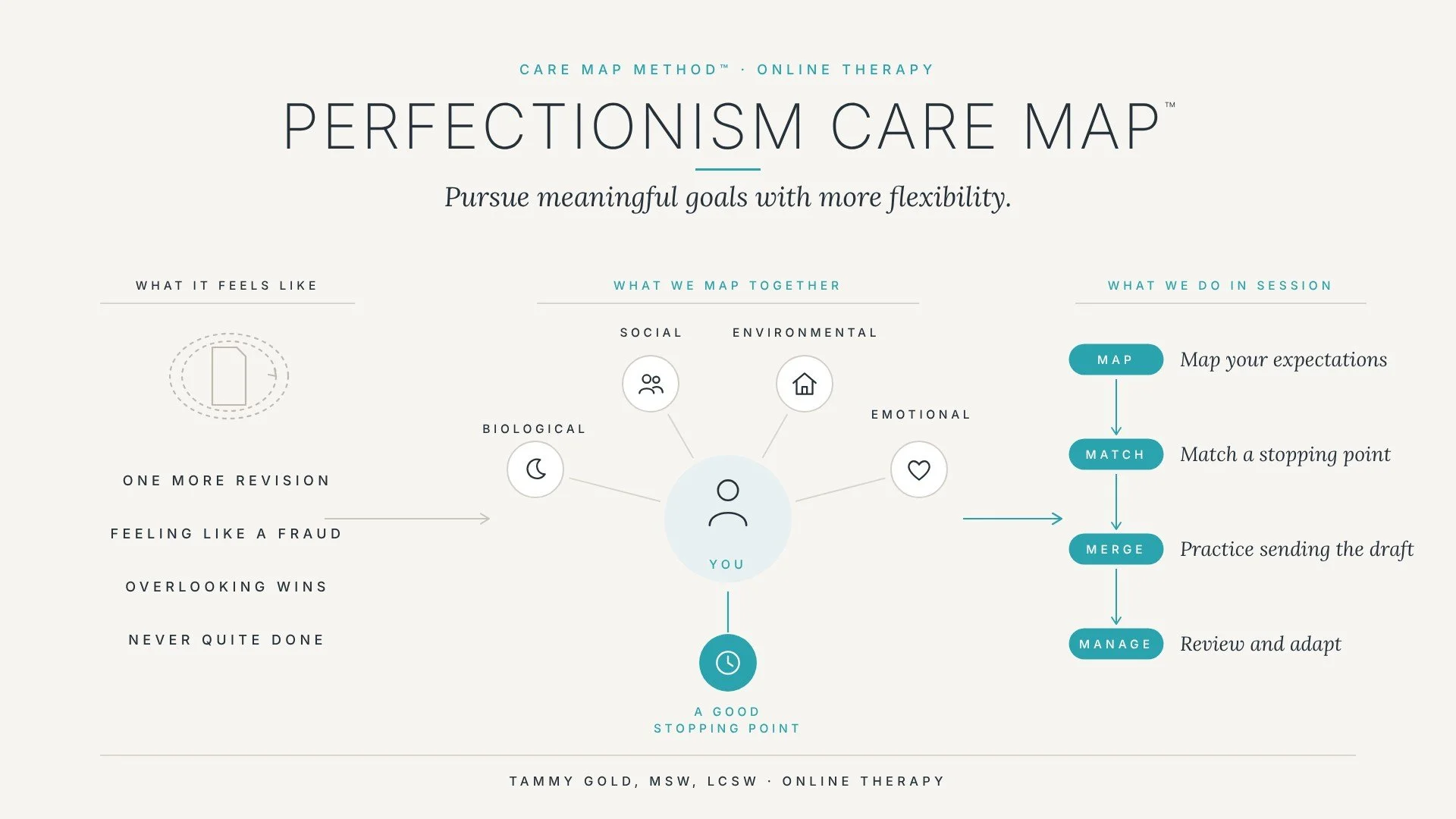
Young adult reviewing a draft and notebook during an online therapy conversation.
When doing well never feels like enough
You finish a project and immediately notice what could have been better. Praise feels temporary or hard to believe. A small mistake can overshadow months of competent work. You may worry that other people will discover you are less capable than they think, even when there is evidence that you are doing the job.
Therapy for perfectionism can help you understand the rules you use to evaluate yourself and the cost of trying to meet them. The aim is not to remove ambition or make you indifferent to quality. It is to explore whether your standards allow learning, rest and ordinary human limits.
How perfectionism can affect everyday life
Perfectionism does not always look organized. You may delay starting because the first attempt will not meet your expectations. You might check repeatedly, spend too long on minor decisions or avoid opportunities where you cannot be certain of success. Relationships can become strained when you apply the same rigid standards to yourself or other people.
We can look at how these patterns affect sleep, mood, work and connection. The important question is not simply whether you have high standards. It is whether the way you pursue them is narrowing your life, increasing distress or preventing you from acting on what matters.
Understanding imposter feelings without making them a diagnosis
Imposter syndrome is a familiar phrase for feeling fraudulent or undeserving despite achievements. It is not itself a formal diagnosis. The experience may also reflect an unfamiliar role, inconsistent feedback, exclusion or an environment in which your contributions are not recognized. We should not assume the problem exists only inside you.
In therapy we can examine what you believe competence should look like, how you interpret praise and what you do when you feel uncertain. We can also consider the effects of identity, culture, discrimination and earlier expectations. The work should make room for your actual context rather than ask you to think your way out of unfair conditions.
What we can work on together
We may explore self-critical thinking, fear of disappointment, repeated checking or difficulty accepting a result that is adequate for its purpose. We can practice responding to feedback, making decisions with incomplete information and separating responsibility from the belief that you must prevent every negative outcome.
The Care Map Method™ helps us MAP the pattern, MATCH the work to your clinical needs, MERGE useful changes into real situations and MANAGE what happens next. If the pattern suggests a need for more specialized assessment or treatment, we can discuss that rather than assume perfectionism is a complete explanation.
A practical example of changing the standard
Imagine that a short email takes forty minutes because you keep revising its tone. You worry that a slightly awkward sentence will make you look incompetent. In therapy we could explore the feared outcome, what level of care the task actually requires and what happens emotionally when you consider stopping.
A planned experiment might involve choosing a reasonable review limit for an appropriate low-stakes task. The point would not be proving that mistakes never happen. It would be learning how you respond to uncertainty and whether the extra checking is serving the purpose you believe it does. Any practice would be adapted to your situation and treatment plan.
Progress that includes being a person
You may continue to care deeply about your work while becoming less willing to sacrifice sleep, relationships or health to every detail. Progress might include finishing something sooner, asking for clarification without shame or recovering from criticism without turning it into a judgment about your entire worth.
We can also explore who you are outside achievement. Rest, enjoyment and connection do not have to be rewards you earn only after a perfect performance. Therapy can help you examine that belief while respecting the real responsibilities and ambitions in your life. We will review whether the work is helping and adjust the plan together.
About Tamara Gold
I am Tamara “Tammy” Gold, MSW, LCSW, CEC, a Columbia University-trained therapist, certified coach and author of Secrets of the Nanny Whisperer. My work with individuals and families informs a warm, collaborative approach that connects emotional understanding with practical next steps. Treatment is individualized to your needs; results and timelines vary.
Online appointments and insurance
Online appointments depend on your physical location at each session, clinical fit and current availability. Review my booking profiles to confirm whether I can serve you in your state. Selected insurance plans may be available through Headway or Alma. Coverage, medical-necessity requirements and your costs depend on your individual plan; a life problem alone does not establish insurance coverage.
Frequently asked questions
Will therapy make me less motivated?
The aim is not to remove meaningful goals. We can explore how to pursue them with more flexibility and less distress. Your own priorities help guide the work, including what you want to preserve about your ambition.
Is imposter syndrome a diagnosis?
No. It is an informal description of certain beliefs and feelings about competence or belonging. Assessment considers the broader symptoms and circumstances rather than using that phrase as a clinical diagnosis.
Can perfectionism lead to procrastination?
It can contribute when the fear of an imperfect result makes starting or finishing difficult. Other factors can also affect procrastination, so we will examine the pattern rather than assume a single cause.
Can we address overchecking at work?
Yes. We can assess what the checking accomplishes, how much it interferes and what clinical approach fits. Some patterns may call for specialized assessment or care, which we can discuss.
What if my job really requires accuracy?
Accuracy matters in many roles. We can distinguish required safeguards from extra reviewing driven by anxiety. Therapy should account for professional standards rather than encourage careless work.
Can I work on self-worth as well as work performance?
Yes. We can explore how you evaluate yourself across relationships, rest, achievements and setbacks. The work can include developing a broader sense of identity while addressing the concerns that brought you in.
Take the next step
If this sounds like the kind of support you need, review current appointment options and check insurance eligibility through my Headway or Alma profile. You can bring questions about fit, fees and the process before scheduling. You do not need a perfect explanation of the problem to begin.
Book A Session Today & Get The Support You Deserve!
Using Insurance On:
Grow Therapy https://growtherapy.com/invite/979uzxntqh0z
Alma Therapy https://secure.helloalma.com/providers/tamara-gold/
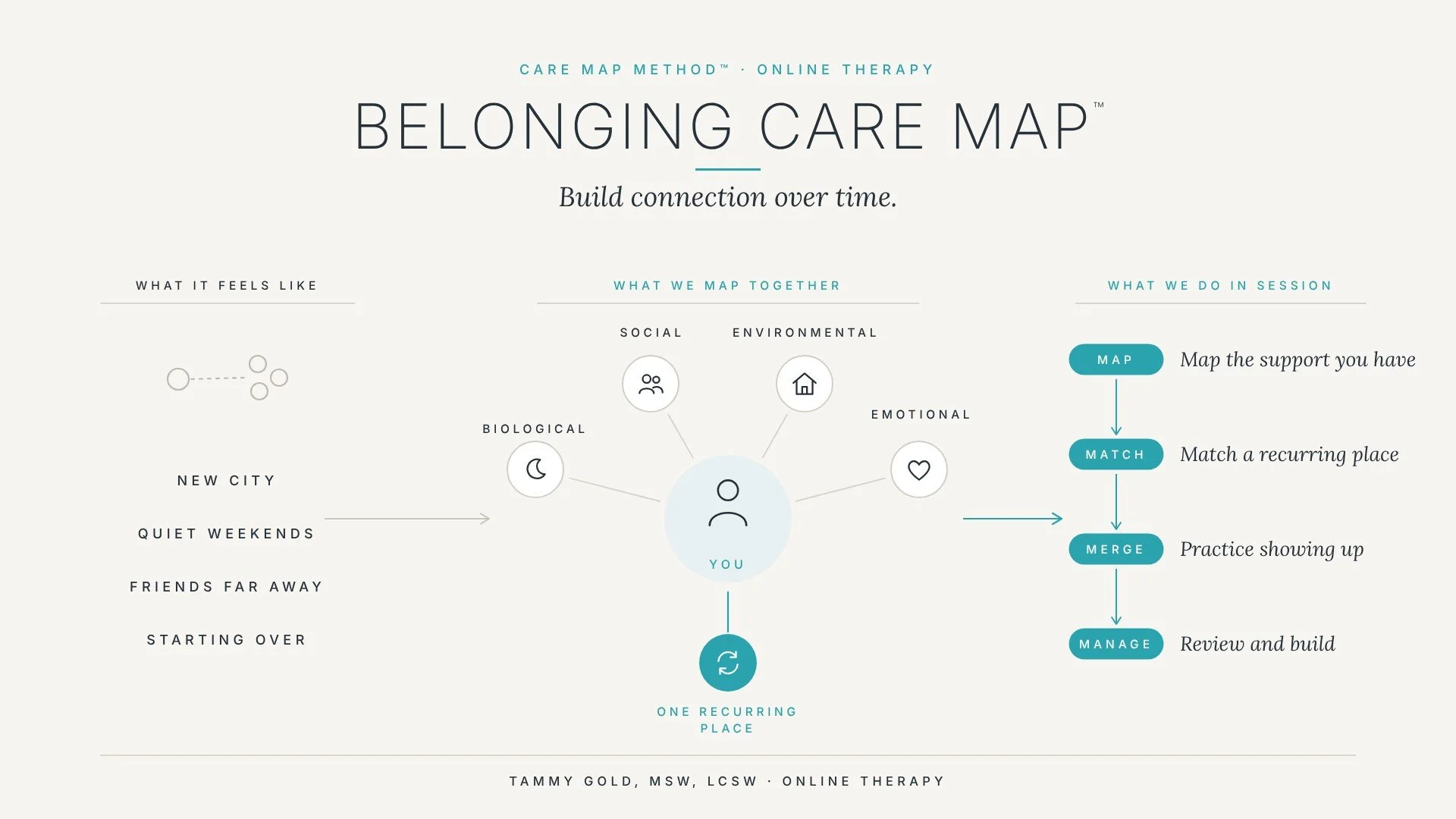
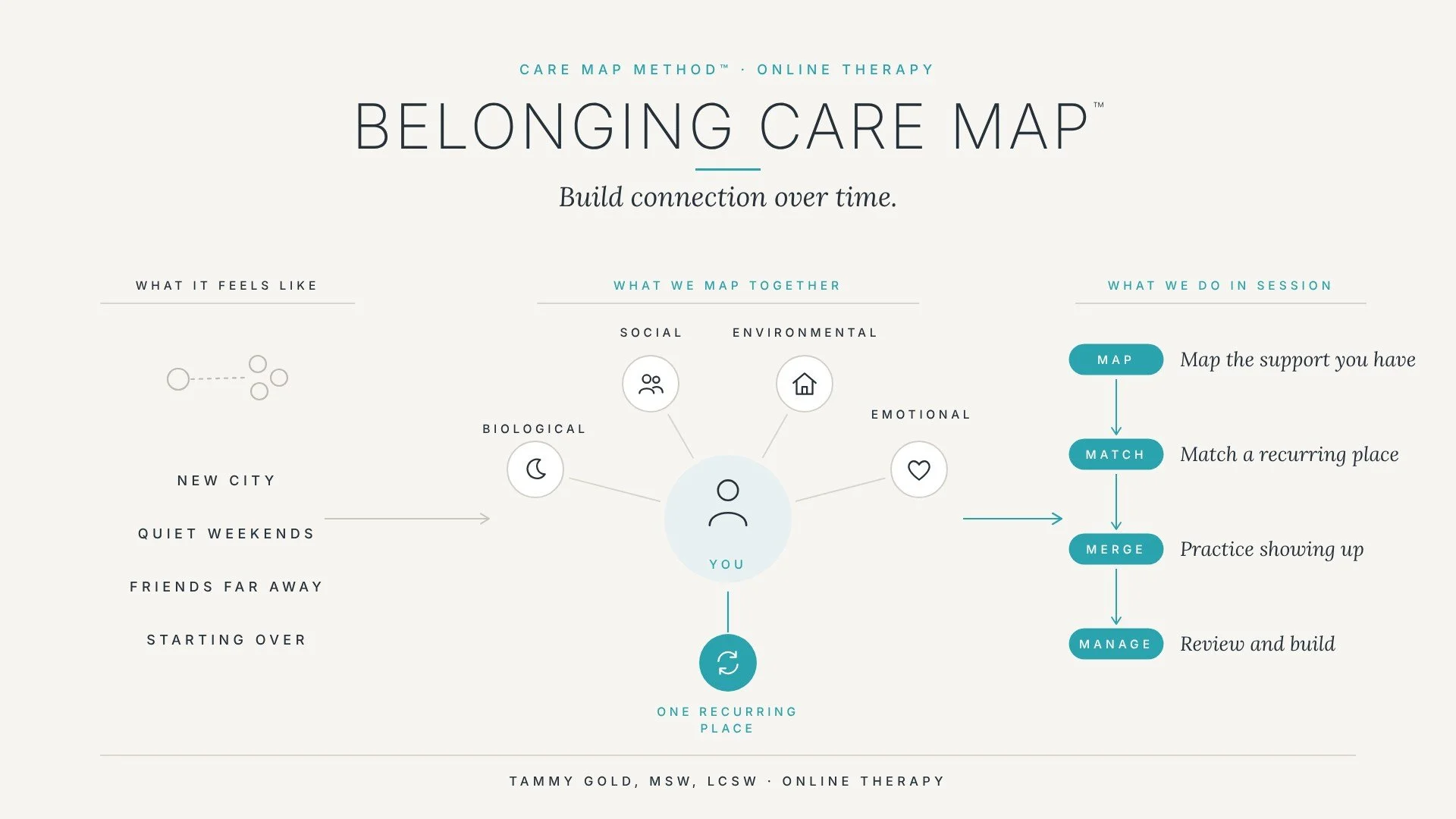
Therapy for Loneliness After College or Moving
Burnout can involve more than a busy week. Explore how therapy can help you understand exhaustion, boundaries and the demands that keep exceeding your capacity.
Young adult attending a video therapy session in a newly furnished apartment.
When your surroundings change faster than your sense of belonging
After college or a move, you may suddenly have to plan the kind of contact that used to happen naturally. Friends are no longer down the hall. People have different schedules, partners or responsibilities. Your new location may look exciting while your evenings feel unexpectedly quiet. You may wonder why you are lonely when you chose the change.
Therapy for loneliness can help you understand that gap between the life you expected and the one you are experiencing. We can make room for what you miss, assess how the transition is affecting you and identify forms of connection that fit your current circumstances.
Loneliness is not always about the number of people around you
You can be surrounded by coworkers, roommates or classmates and still feel unknown. Some relationships may be pleasant without offering the closeness you need. You might also avoid reaching out because you assume everyone else already has enough friends. Social media can make that assumption feel convincing even when it gives you only a partial view.
We can explore the quality of connection you want and what gets in the way. That may involve social anxiety, low mood, grief, mismatched expectations or a practical lack of opportunities. We do not need to reduce every experience of loneliness to a problem with your social skills.
Grieving the community you left behind
A transition may involve losing routines, familiar places and the easy recognition of people who knew your history. Even when old friendships continue, the relationship can feel different across distance. You may feel guilty about not enjoying your new life quickly enough or afraid that missing the old one means the move was a mistake.
Therapy can help you hold mixed feelings without rushing to a verdict. You can appreciate an opportunity and grieve what it cost. We can also examine which parts of the previous community you want to preserve and which needs will require something new.
How I approach building connection
We can use the Care Map Method™ to MAP your current support network and daily environment, MATCH the therapeutic work to the barriers involved, MERGE manageable steps into your routines and MANAGE what changes over time. We also consider energy, health, finances, transport and work schedules.
For example, joining a recurring activity may create more opportunity than attending a different large event every weekend. That does not mean a recurring activity guarantees friendship. It provides a setting in which familiarity can develop. We can discuss how to participate in a way that fits your preferences and how to handle disappointment without abandoning the effort entirely.
Working with fear of reaching out
You may hesitate to message someone because it feels embarrassing to initiate. A delayed response may feel like proof that the attempt was unwelcome. We can examine those interpretations, the relationship involved and what a reasonable next step might look like. The goal is not to make you chase people who repeatedly disregard you.
We can also work on recognizing reciprocity, communicating interest and allowing different relationships to develop at different speeds. You may benefit from several kinds of connection rather than expecting one person to meet every need. Therapy itself can support that exploration, while remaining distinct from a friendship or social-matching service.
Taking loneliness seriously without promising an instant fix
Connection usually develops through experiences over time. Progress may involve feeling less ashamed of loneliness, identifying relationships that fit better or becoming more willing to accept an invitation. We can review how the work affects your mood and functioning, and consider additional supports when appropriate.
If the loneliness is accompanied by persistent depression, major sleep changes or significant withdrawal, we will assess those concerns rather than treat the issue only as a matter of getting out more. You do not need to wait until a transition becomes a crisis before asking for help.
About Tamara Gold
I am Tamara “Tammy” Gold, MSW, LCSW, CEC, a Columbia University-trained therapist, certified coach and author of Secrets of the Nanny Whisperer. My work with individuals and families informs a warm, collaborative approach that connects emotional understanding with practical next steps. Treatment is individualized to your needs; results and timelines vary.
Online appointments and insurance
Online appointments depend on your physical location at each session, clinical fit and current availability. Review my booking profiles to confirm whether I can serve you in your state. Selected insurance plans may be available through Headway or Alma. Coverage, medical-necessity requirements and your costs depend on your individual plan; a life problem alone does not establish insurance coverage.
Frequently asked questions
Is it normal to feel lonely after graduation?
Many transitions involve changes in routine and contact, but your individual distress still matters. We can assess how long it has been happening, what it affects and whether additional clinical concerns need attention.
Can therapy help if I have no local friends?
Therapy can help you understand barriers, manage distress and identify realistic ways to seek connection. It cannot provide or guarantee a friend group. We can also consider community resources that fit your interests.
What if I moved for a partner or job and regret it?
We can explore regret, grief, relationship expectations and practical options without deciding immediately that you must stay or leave. The goal is to understand what needs attention and support thoughtful choices.
Is loneliness the same as social anxiety?
No. Loneliness concerns unmet connection; social anxiety involves fear in social situations. They can occur together or separately. Assessment helps us avoid assuming that the same approach fits both.
Can we work on keeping long-distance friendships?
Yes. We can discuss expectations, communication, reciprocity and the feelings that arise as friendships change. The work can include preserving important relationships while allowing room for new ones.
Should I wait until I am settled before starting therapy?
You do not have to wait. Therapy can be useful during a transition. Before booking, confirm your current location, available appointment times and whether virtual care is appropriate for your needs.
Take the next step
If this sounds like the kind of support you need, review current appointment options and check insurance eligibility through my Headway or Alma profile. You can bring questions about fit, fees and the process before scheduling. You do not need a perfect explanation of the problem to begin.
Book A Session Today & Get The Support You Deserve!
Using Insurance On:
Grow Therapy https://growtherapy.com/invite/979uzxntqh0z
Alma Therapy https://secure.helloalma.com/providers/tamara-gold/
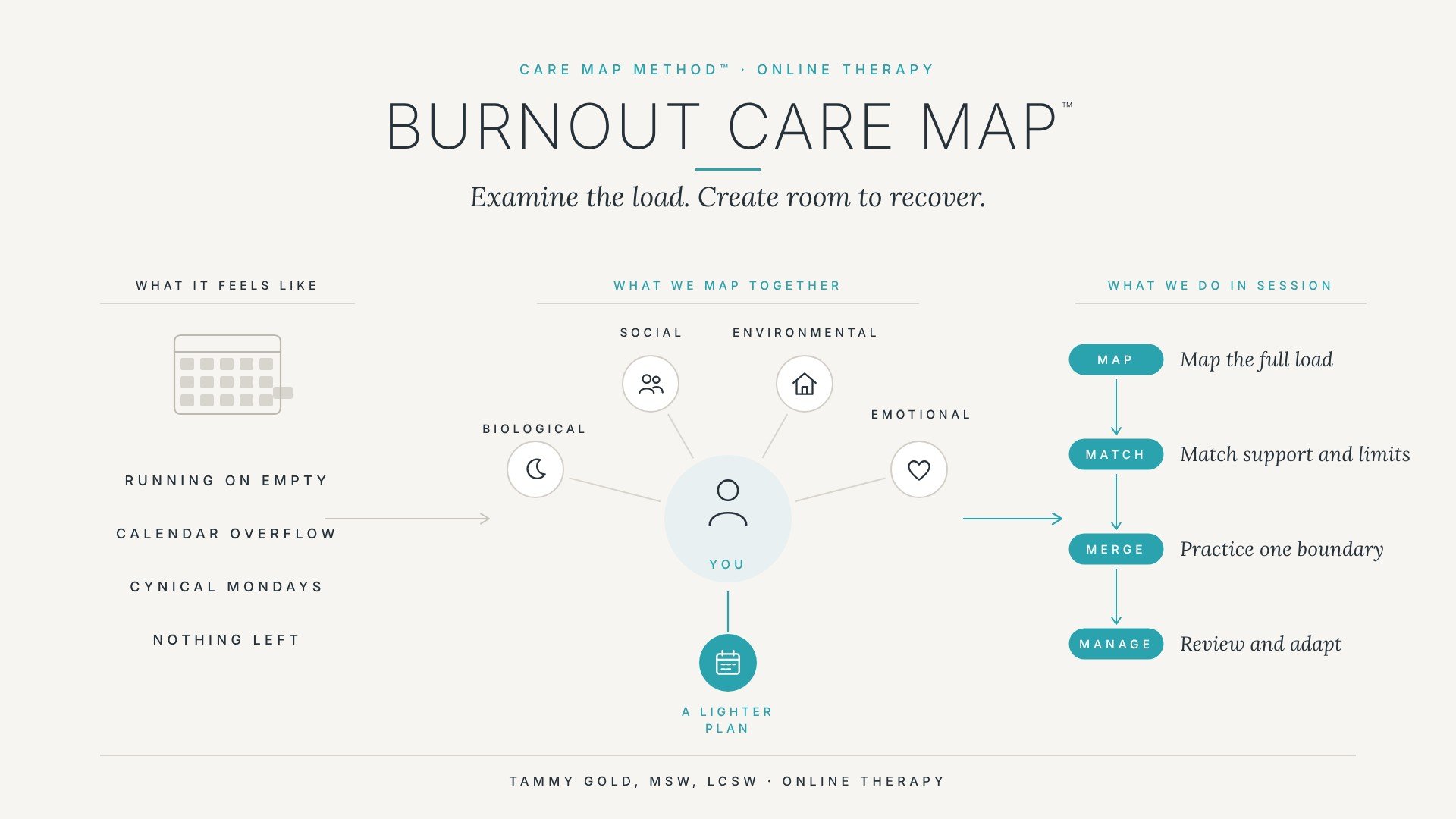
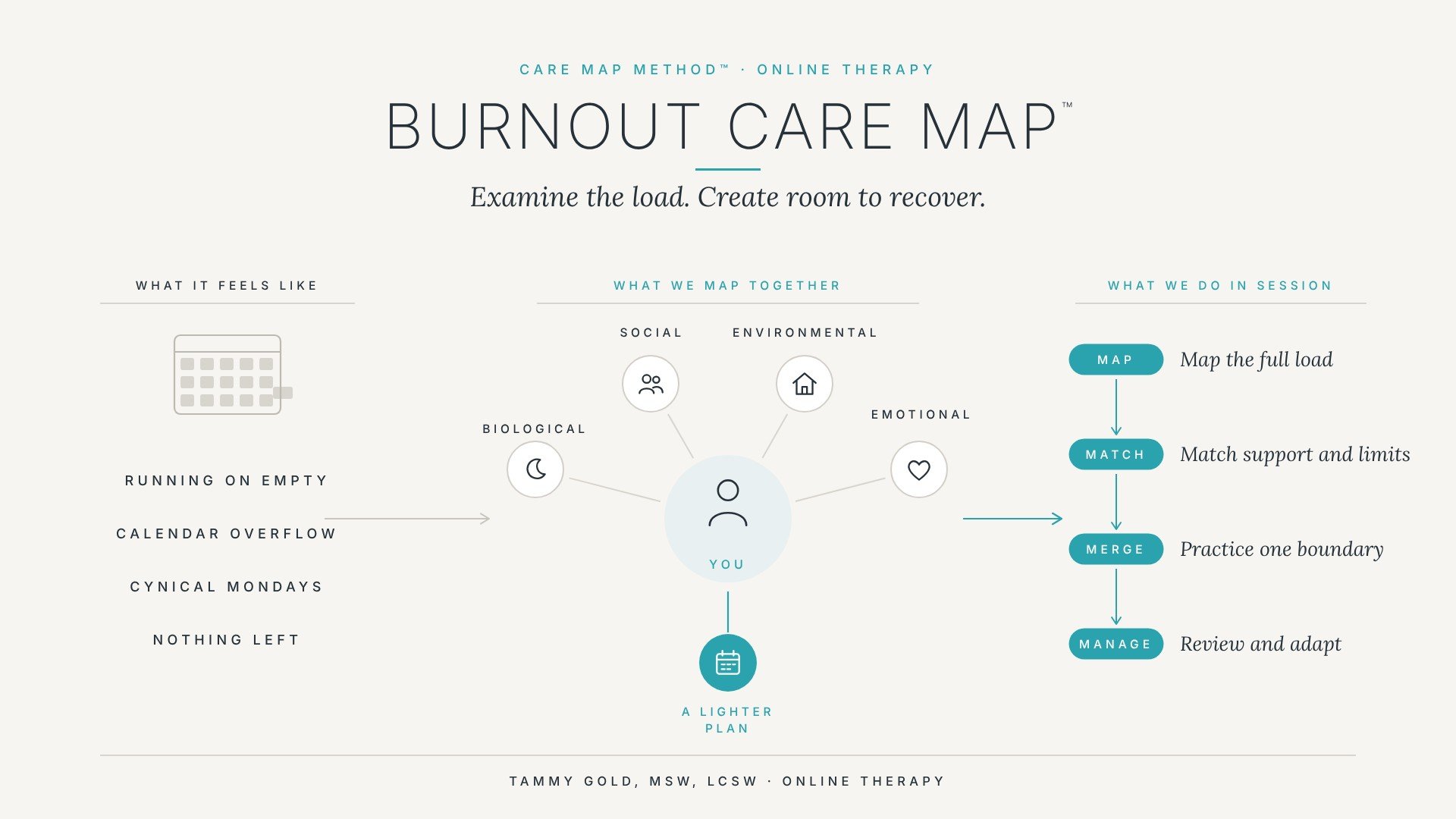
Therapy for Burnout and Emotional Exhaustion
Burnout can involve more than a busy week. Explore how therapy can help you understand exhaustion, boundaries and the demands that keep exceeding your capacity.
Young professional reviewing a weekly calendar during a video therapy appointment.
When pushing through becomes your default
You keep meeting deadlines and answering messages, but the effort required feels heavier than it used to. Small requests irritate you. Time off does not always feel restorative because you spend it catching up or anticipating what comes next. You may worry that slowing down will reveal how close to your limit you have been.
Therapy for burnout and emotional exhaustion can help you understand what is sustaining the overload. Your experience may involve work, relationships, financial pressure, caregiving or several demands at once. We can assess the pattern without assuming a weekend away or a better morning routine will solve it.
Exhaustion deserves a careful assessment
Feeling depleted can have many contributors. Sleep disruption, medical conditions, medications, anxiety and depression may affect energy and motivation. A therapy conversation cannot replace medical evaluation when symptoms suggest that additional assessment is needed. We can discuss those possibilities and coordinate with other care when appropriate.
We will also look at what burnout means in your own words. You may feel detached from work, unable to recover, less patient with people or uncertain whether anything you do is enough. The focus is on your symptoms, functioning and circumstances rather than attaching a label to every difficult week.
Looking at the load rather than only your coping
Coping strategies can help, but they do not make an unreasonable workload reasonable. We can examine the demands on you, the support available and the expectations you place on yourself. Some responsibilities may be negotiable; others may remain difficult for now. Naming that distinction helps us avoid a plan that adds another list of tasks to an already full life.
For a younger professional, the pressure may include proving yourself, paying bills and feeling that you should always be available. We can explore how those realities interact with perfectionism, people-pleasing, or fear of disappointing others. The aim is not to blame you for conditions you did not create.
How our sessions can translate into change
Using the Care Map Method™, we MAP where energy is going and which patterns keep repeating. We MATCH clinical strategies and practical changes to your needs. We MERGE those changes into work and home routines, then MANAGE the results as circumstances evolve. This framework helps organize the work within individualized psychotherapy.
An initial step might be discussing priorities with a supervisor, reducing an optional commitment or identifying a recurring interaction that consumes a disproportionate amount of energy. We can also address the emotions that make a change difficult. A boundary that looks sensible on paper may still bring fear, grief or guilt.
An example of sharing capacity more clearly
Suppose a manager assigns another project when your schedule is already full. You agree immediately, work late and become frustrated that nobody recognizes your effort. In therapy we might examine what prevented you from naming the conflict between the tasks. We can prepare language that reflects your role and actual constraints.
That could mean asking which deadline should move or clarifying what can reasonably be completed. It may not change the manager's response. We would then consider what the response tells you, how to protect your wellbeing and what additional options or professional advice you need.
A more sustainable definition of progress
Progress may mean recognizing overload earlier, spending less time recovering from ordinary interactions or making room for relationships that are not organized around performance. It can also mean acknowledging that a role or arrangement needs to change. We will consider both symptom relief and whether the overall demands are becoming more manageable.
You do not have to wait until you cannot function to seek support. At the same time, therapy should not promise a quick return to your previous output. We can develop goals that account for your health, values and responsibilities, and revisit those goals as we learn what helps.
About Tamara Gold
I am Tamara “Tammy” Gold, MSW, LCSW, CEC, a Columbia University-trained therapist, certified coach and author of Secrets of the Nanny Whisperer. My work with individuals and families informs a warm, collaborative approach that connects emotional understanding with practical next steps. Treatment is individualized to your needs; results and timelines vary.
Online appointments and insurance
Online appointments depend on your physical location at each session, clinical fit and current availability. Review my booking profiles to confirm whether I can serve you in your state. Selected insurance plans may be available through Headway or Alma. Coverage, medical-necessity requirements and your costs depend on your individual plan; a life problem alone does not establish insurance coverage.
Frequently asked questions
Is burnout the same as depression?
No. They can share features, but the terms are not interchangeable. A clinical assessment considers symptoms, duration, context and functioning. Persistent low mood, loss of interest or significant impairment deserves careful evaluation.
Can therapy help if I cannot leave my job?
We can work on coping, communication, limits and decision-making within your actual circumstances. The aim is not to require an immediate job change, nor to suggest that coping alone can fix every workplace condition.
What if rest does not restore my energy?
Persistent or unexplained fatigue can warrant medical assessment in addition to discussing stress and sleep. Therapy can address relevant emotional and behavioral factors while recognizing that exhaustion may have multiple causes.
Can young professionals experience burnout?
Yes. Workload, uncertainty, finances and pressure to prove yourself can be relevant at many career stages. We will focus on your particular experience rather than assume that age determines how much you should be able to handle.
Will therapy just give me more self-care tasks?
We can discuss what is realistic before adding any practice. Sometimes reducing demands, addressing an interaction or changing an expectation is more useful than adding another routine.
How will we know whether therapy is helping?
We can track the goals that matter to you, such as recovery time, sleep, boundaries or participation in relationships. We will review the pattern and adjust treatment or discuss additional care if progress is limited.
Take the next step
If this sounds like the kind of support you need, review current appointment options and check insurance eligibility through my Headway or Alma profile. You can bring questions about fit, fees and the process before scheduling. You do not need a perfect explanation of the problem to begin.
Book A Session Today & Get The Support You Deserve!
Using Insurance On:
Grow Therapy https://growtherapy.com/invite/979uzxntqh0z
Alma Therapy https://secure.helloalma.com/providers/tamara-gold/
Therapy for Overthinking and Self Doubt
hinking through a problem can help, but reviewing it repeatedly can leave you more anxious. Explore therapy for overthinking conversations, decisions and other people’s reactions.
When thinking stops bringing you closer to an answer
You replay what you said, revisit a decision or imagine how a conversation could go wrong. At first the thinking may feel useful. You are trying to prepare, avoid a mistake or understand another person. But after a while you may notice that you have more questions, less confidence and no clearer idea of what to do.
Therapy for overthinking can help you understand the pattern and its effect on your life. We can look at what starts the reviewing, what keeps it going and what you hope it will accomplish. The aim is not to stop all thought or replace every worry with a positive statement.
The different forms overthinking can take
You may review the past, predict future problems or repeatedly question your own choices. Some people seek reassurance from friends, search online or rewrite messages until they feel acceptable. Others keep concerns private and spend hours trying to reach certainty on their own. The same outward behavior can serve different purposes for different people.
We will assess the broader picture, including mood, sleep, concentration, anxiety and daily functioning. Repetitive thoughts can appear in several clinical contexts, so a webpage cannot determine what diagnosis or treatment is appropriate. If a specialized approach is needed, we can discuss that directly.
Understanding the question beneath the question
A repeated thought such as whether you sounded foolish may carry a deeper fear of rejection. Reconsidering a work decision may involve uncertainty about competence or responsibility. Sometimes the concern also reflects a genuine unresolved situation that needs action. We can make room for those possibilities without assuming every thought is meaningless.
In sessions we might distinguish a problem with an available next step from a question that cannot be settled with more mental reviewing. We can also examine self-criticism and the belief that enough preparation should prevent all regret. A more useful goal may be responding thoughtfully while accepting that some uncertainty remains.
Working with an everyday example
Imagine that you send a message and do not receive an immediate reply. You read it again, notice a phrase you wish you had changed and begin drafting an apology. Checking temporarily reduces tension, but soon you need to check again. Your attention moves away from the rest of your day.
We could examine the assumptions, the urge to repair and the effect of repeated checking. We might discuss a way to respond that fits the situation and your treatment plan. The work would also consider what the uncertainty means to you, rather than simply instructing you to stop looking at your phone.
Bringing insight into ordinary routines
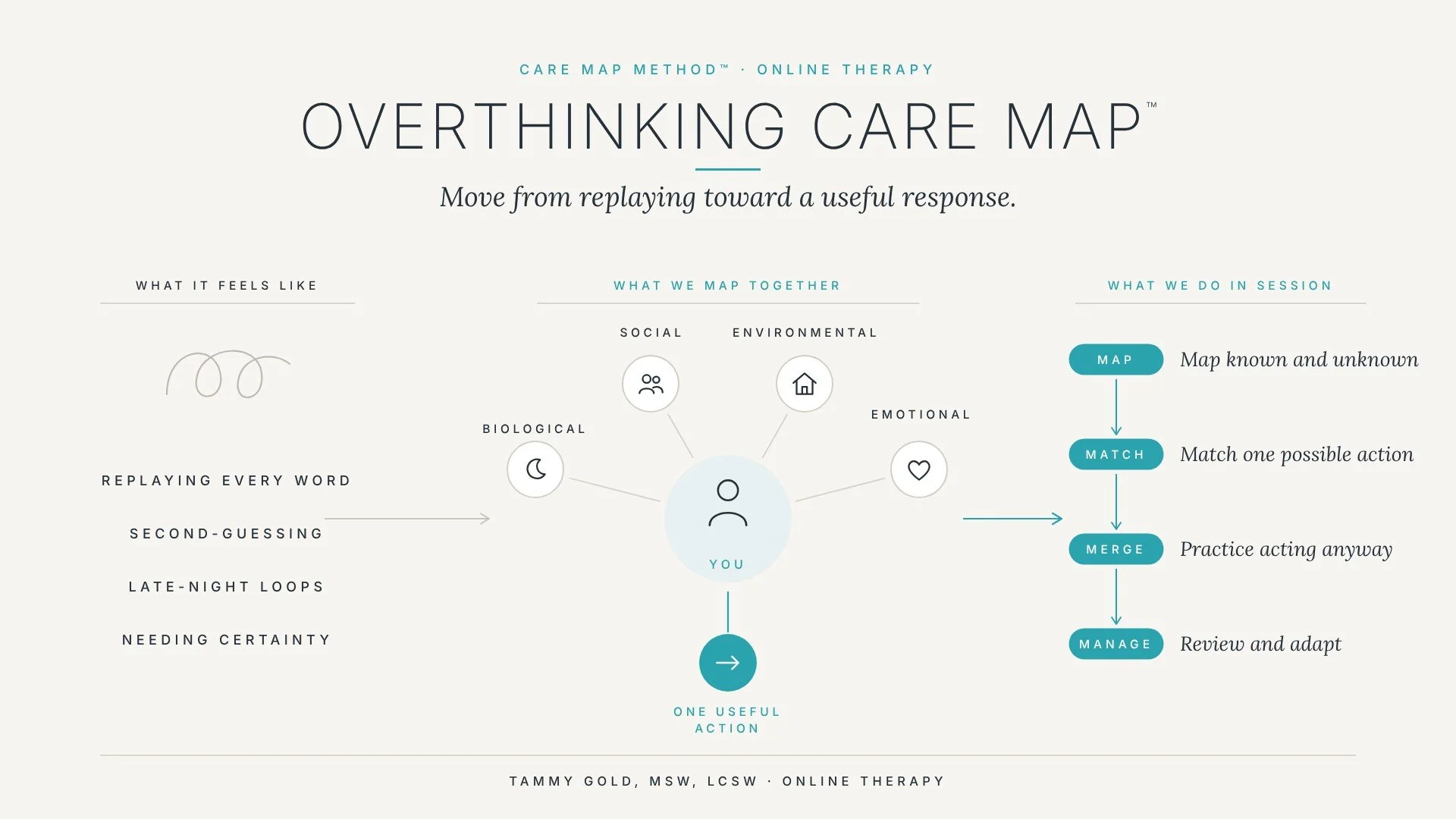
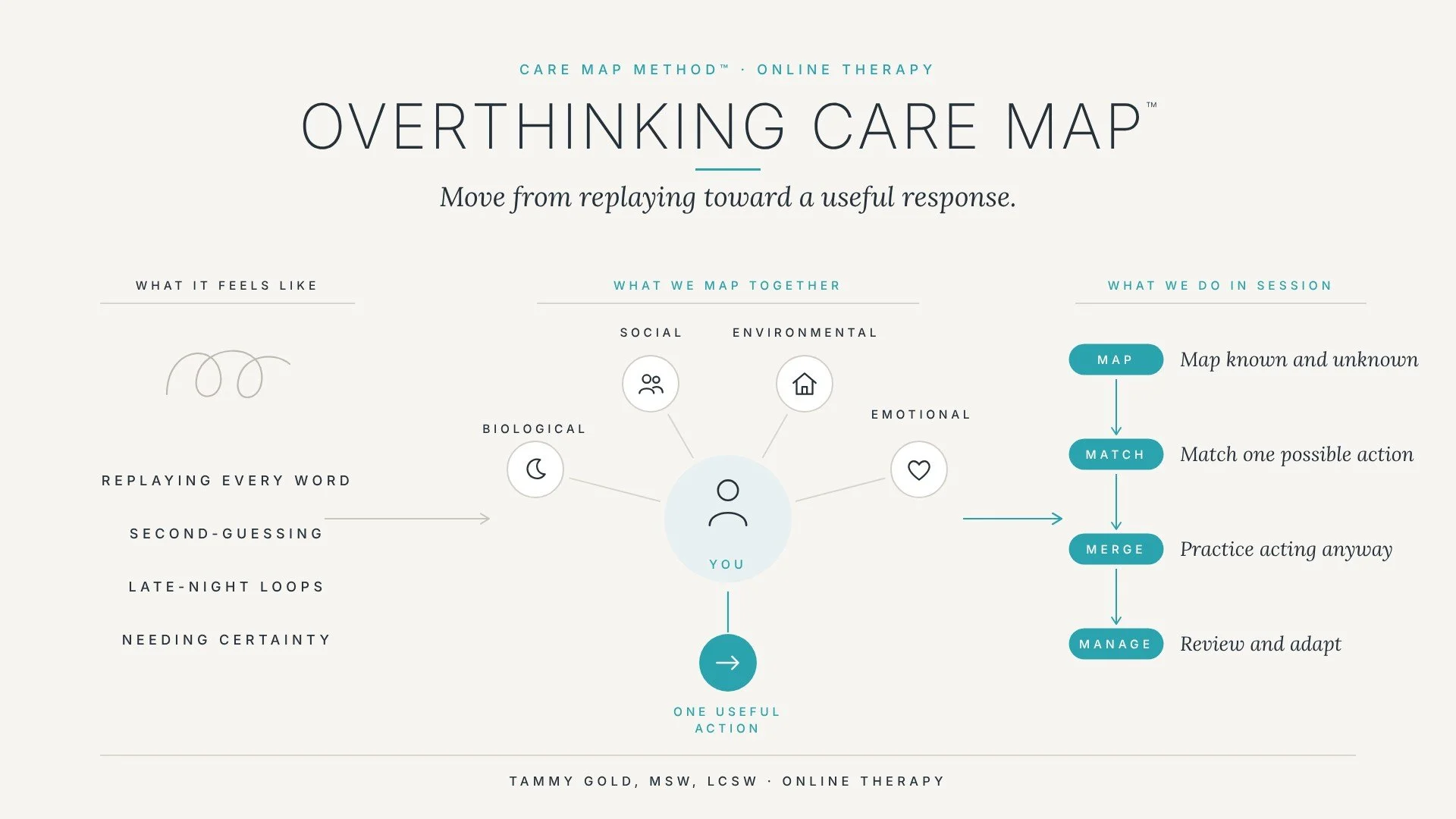
Using the Care Map Method™, we MAP triggers and responses, MATCH the work to your clinical needs, MERGE what is useful into everyday situations and MANAGE the results. That might include noticing when you begin reviewing, identifying a concrete action or changing how you respond to self-critical thoughts.
Between-session practice should be manageable and purposeful. It should not become another task you feel compelled to perform perfectly. We can discuss what happened, including when a strategy did not help. Learning about the pattern is useful information, not evidence that you have failed therapy.
Progress without requiring a perfectly quiet mind
Some difficult thoughts may still occur even when the work is helping. Progress can involve spending less time following them, recovering attention more readily or making a decision without repeatedly asking for confirmation. We will define goals around your functioning and priorities, rather than promising that worry will disappear.
We can also address relationships and situations that keep uncertainty high. If someone communicates inconsistently or a role lacks clear expectations, your environment may need attention too. Therapy can help you make more deliberate choices about both your response and the circumstances around you.
About Tamara Gold
I am Tamara “Tammy” Gold, MSW, LCSW, CEC, a Columbia University-trained therapist, certified coach and author of Secrets of the Nanny Whisperer. My work with individuals and families informs a warm, collaborative approach that connects emotional understanding with practical next steps. Treatment is individualized to your needs; results and timelines vary.
Online appointments and insurance
Online appointments depend on your physical location at each session, clinical fit and current availability. Review my booking profiles to confirm whether I can serve you in your state. Selected insurance plans may be available through Headway or Alma. Coverage, medical-necessity requirements and your costs depend on your individual plan; a life problem alone does not establish insurance coverage.
Frequently asked questions
Is overthinking a diagnosis?
No. It is a common description of repeated thought patterns. Assessment considers whether anxiety, mood, obsessive-compulsive symptoms, stress or another concern may be involved. Treatment should follow that assessment.
Can therapy help me stop replaying conversations?
We can work on the meaning you assign to interactions, repeated reviewing and the impact on your day. Goals may include spending less time reviewing and responding more flexibly, rather than never remembering a conversation.
Why does reassurance only help for a little while?
Reassurance may reduce discomfort briefly without resolving the underlying uncertainty or pattern. We can examine how it functions in your situation and whether a different response would be more useful.
Will you teach me to think positively?
Therapy is not limited to replacing a negative thought with a positive one. We can consider accuracy, uncertainty, emotional meaning, behavior and the real conditions around the concern.
What if I really made a mistake?
We can separate appropriate repair or learning from prolonged punishment of yourself. A mistake may call for action, but repeated self-criticism does not necessarily make the action more effective.
Can we discuss sleep problems related to worry?
Yes. Sleep and worry can affect one another. We can assess the pattern and discuss whether medical evaluation or specialized sleep treatment would be useful alongside therapy.
Take the next step
If this sounds like the kind of support you need, review current appointment options and check insurance eligibility through my Headway or Alma profile. You can bring questions about fit, fees and the process before scheduling. You do not need a perfect explanation of the problem to begin.
Book A Session Today & Get The Support You Deserve!
Using Insurance On:
Grow Therapy https://growtherapy.com/invite/979uzxntqh0z
Alma Therapy https://secure.helloalma.com/providers/tamara-gold/
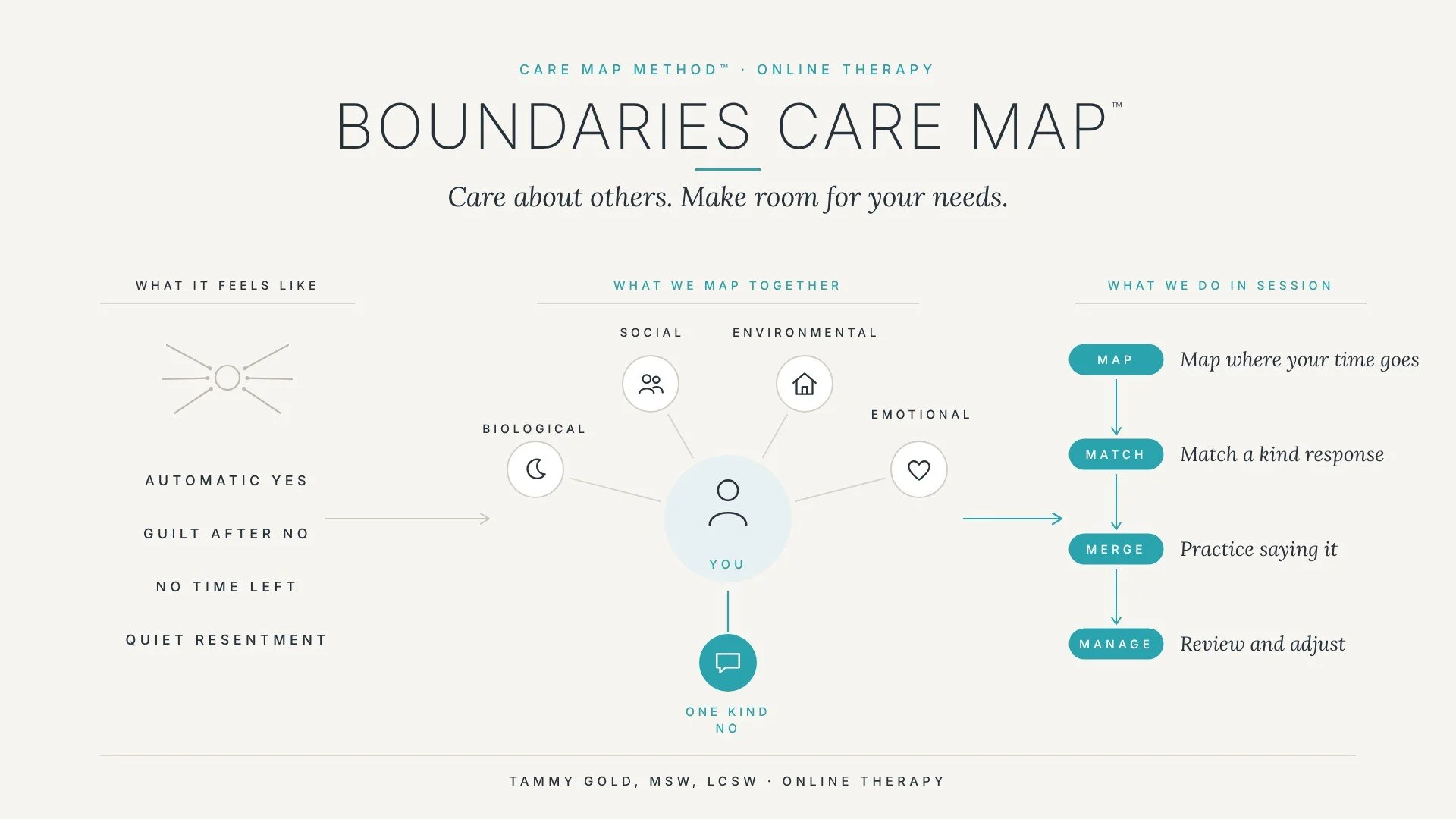
Therapy for People Pleasing and Boundaries
You can care about someone and still need a limit. Therapy can help you understand people-pleasing patterns, communicate your needs and work through the feelings that follow.
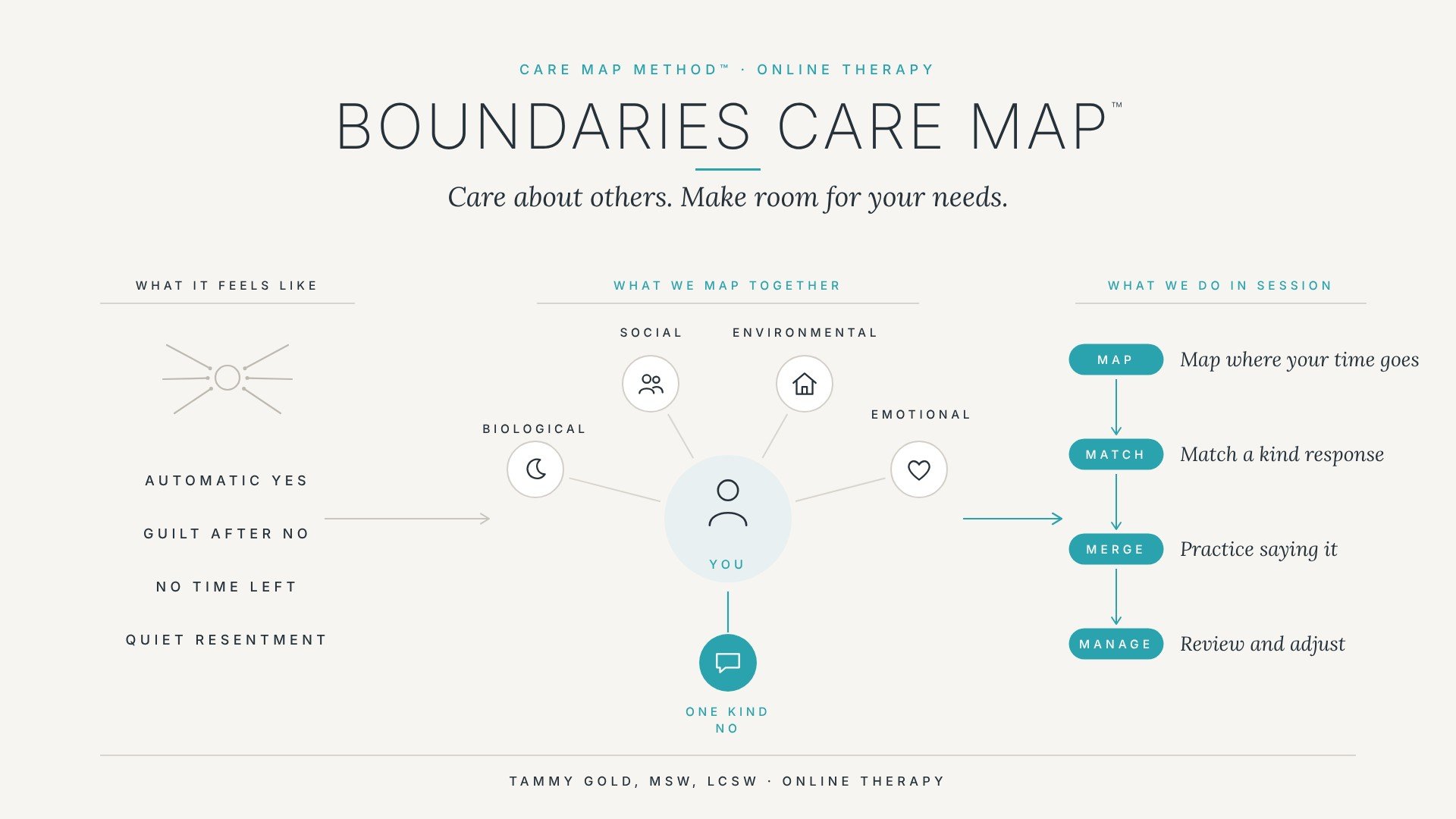
Knowing your limit and still finding it hard to say
You may know that you cannot take on another task and hear yourself agreeing anyway. Perhaps you rewrite a simple message to make sure nobody feels disappointed. You may feel responsible for keeping the peace at work, with friends or in your family, even when doing so leaves you exhausted or resentful.
Therapy for people-pleasing can help you understand what makes a reasonable limit feel difficult. The goal is not to become uncaring or stop considering other people. It is to make more room for your needs and choices, so that kindness does not consistently depend on ignoring your own capacity.
Understanding how the pattern developed
People-pleasing patterns may have helped you maintain connection, avoid conflict or meet expectations earlier in life. You might have learned to notice everyone else's mood before identifying your own. In some environments, being agreeable was rewarded or felt safer than expressing disagreement. Those strategies can continue even when your circumstances have changed.
We can explore the pattern without blaming your family or treating your past as the only explanation. Culture, identity, financial dependence and current power differences also matter. A boundary with a close friend is not the same as a boundary with someone who controls your income or housing.
What boundaries can and cannot do
A boundary communicates what you need, what you can offer or what you will do in a situation. It cannot force another person to agree or behave differently. You may be able to decline a request, limit a conversation or change your availability, but the other person may still feel disappointed.
Therapy can help you prepare for that discomfort. We can distinguish guilt that signals a genuine conflict with your values from guilt that appears whenever you prioritize yourself. We can also consider whether the boundary is realistic, proportionate and safe, and what follow-through would look like if the situation continues.
Practicing language that sounds like you
A useful conversation does not need to sound like a script from a book. We can work with your own words and the relationship involved. If you tend to overexplain, we might practice a shorter response. If you withdraw until you feel angry, we might focus on recognizing the need earlier and communicating it before resentment builds.
For example, a friend may repeatedly call during your workday. A starting point could be naming when you are available and offering a time that works. We would also explore the fear underneath that response, such as worrying that being unavailable will be interpreted as not caring.
Using the Care Map Method in relationship work
We MAP the recurring interaction, including what is asked of you, what you feel and how you respond.
We MATCH the work to the barriers involved, such as fear of conflict, difficulty recognizing needs or uncertainty about your rights in the relationship.
We MERGE practice into real conversations and MANAGE what happens afterward.
The work includes what happens inside you as well as what you say. You may need support tolerating someone else's disappointment, recognizing anger before it becomes overwhelming or allowing a relationship to be less close than you once hoped. This is individualized therapy rather than a rulebook for how every relationship should work.
Building relationships with room for both people
A relationship can contain care, disagreement and limits at the same time. We can consider whether your current patterns allow that. Some people discover that a relationship improves when they become clearer. Others learn that the connection depended heavily on their willingness to keep giving. Either possibility can bring strong feelings.
Progress may mean recognizing a choice before automatically saying yes, asking for time to consider a request or recovering more quickly from guilt. We can evaluate changes together and adjust the pace. If there are threats, coercion or safety concerns, those require specific attention rather than generic advice to be more assertive.
About Tamara Gold
I am Tamara “Tammy” Gold, MSW, LCSW, CEC, a Columbia University-trained therapist, certified coach and author of Secrets of the Nanny Whisperer. My work with individuals and families informs a warm, collaborative approach that connects emotional understanding with practical next steps. Treatment is individualized to your needs; results and timelines vary.
Online appointments and insurance
Online appointments depend on your physical location at each session, clinical fit and current availability. Review my booking profiles to confirm whether I can serve you in your state. Selected insurance plans may be available through Headway or Alma. Coverage, medical-necessity requirements and your costs depend on your individual plan; a life problem alone does not establish insurance coverage.
Frequently asked questions
Is people-pleasing a mental health diagnosis?
No. It describes a pattern that may be associated with anxiety, relationships, past experiences or other concerns. Assessment helps us understand the context and whether a clinical diagnosis is relevant.
Can I set boundaries without being selfish?
We can explore what fairness and responsibility mean in your situation. Considering your limits is not automatically selfish, but the effects of a boundary still deserve thought. Therapy helps you make a deliberate choice rather than acting only from guilt.
What if someone gets angry when I say no?
Their reaction matters, especially if anger involves threats or retaliation. We can assess the relationship and your options before practicing a response. A general communication script is not a substitute for attending to safety.
Will I need to cut people off?
No predetermined outcome is required. Boundaries can involve smaller changes in time, topics, expectations or responsibilities. Some situations call for more distance, but the decision should reflect your circumstances.
Can therapy help with boundaries at work?
Yes. We can discuss workload, role expectations, communication and your emotional response. Employment rules and legal rights may need separate advice from an appropriately qualified professional.
Why do I still feel guilty after setting a reasonable limit?
Feelings do not always change as quickly as behavior. We can examine what the guilt means, whether you need to repair anything and how to tolerate discomfort without immediately undoing the boundary.
Take the next step
If this sounds like the kind of support you need, review current appointment options and check insurance eligibility through my Headway or Alma profile. You can bring questions about fit, fees and the process before scheduling. You do not need a perfect explanation of the problem to begin.
Book A Session Today & Get The Support You Deserve!
Using Insurance On:
Grow Therapy https://growtherapy.com/invite/979uzxntqh0z
Alma Therapy https://secure.helloalma.com/providers/tamara-gold/
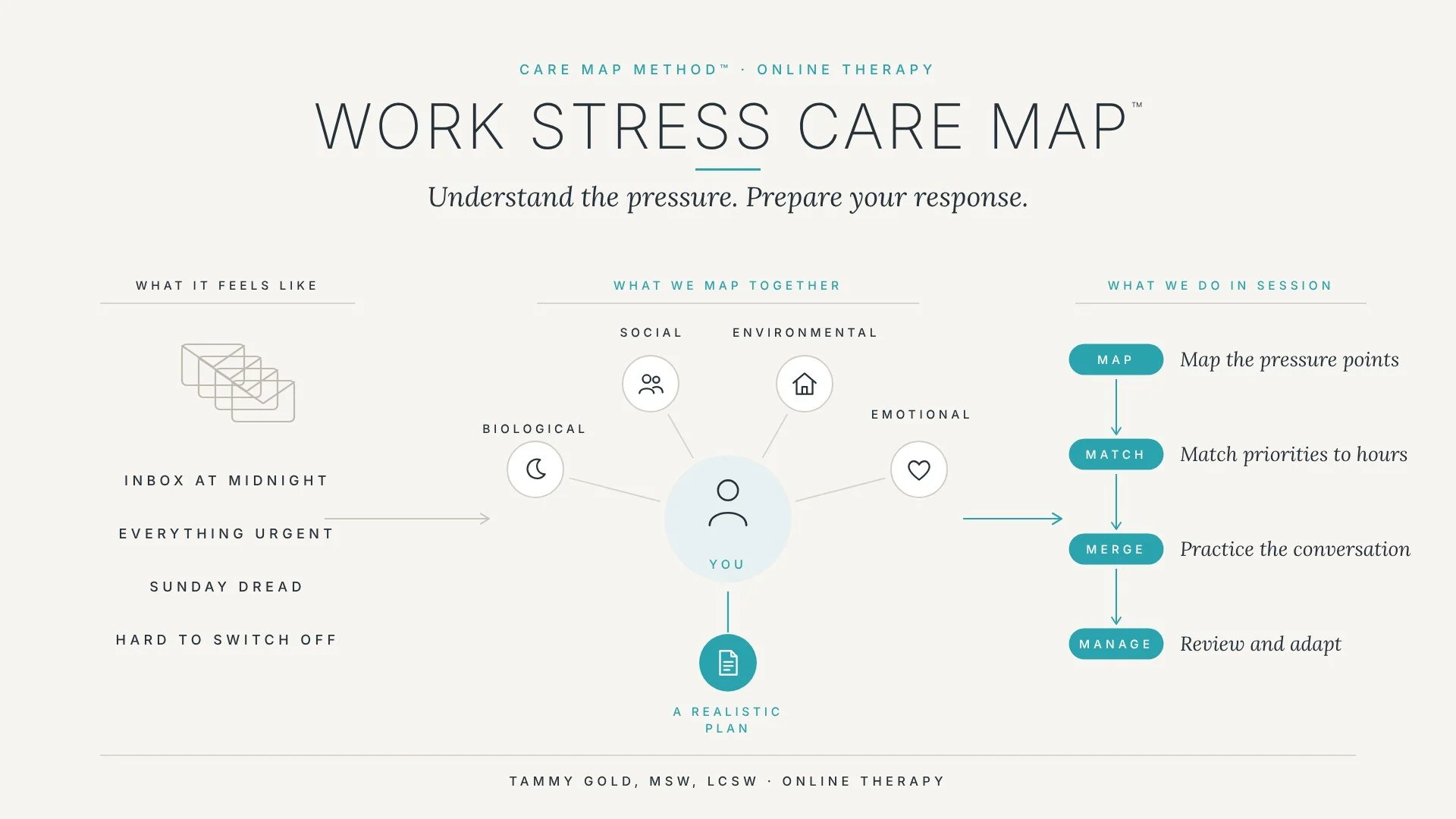
Therapy for Career Anxiety and Life Transitions
Career decisions can stir up fear, family expectations and questions about identity. Therapy can help you understand the emotional pressure and make more deliberate choices.
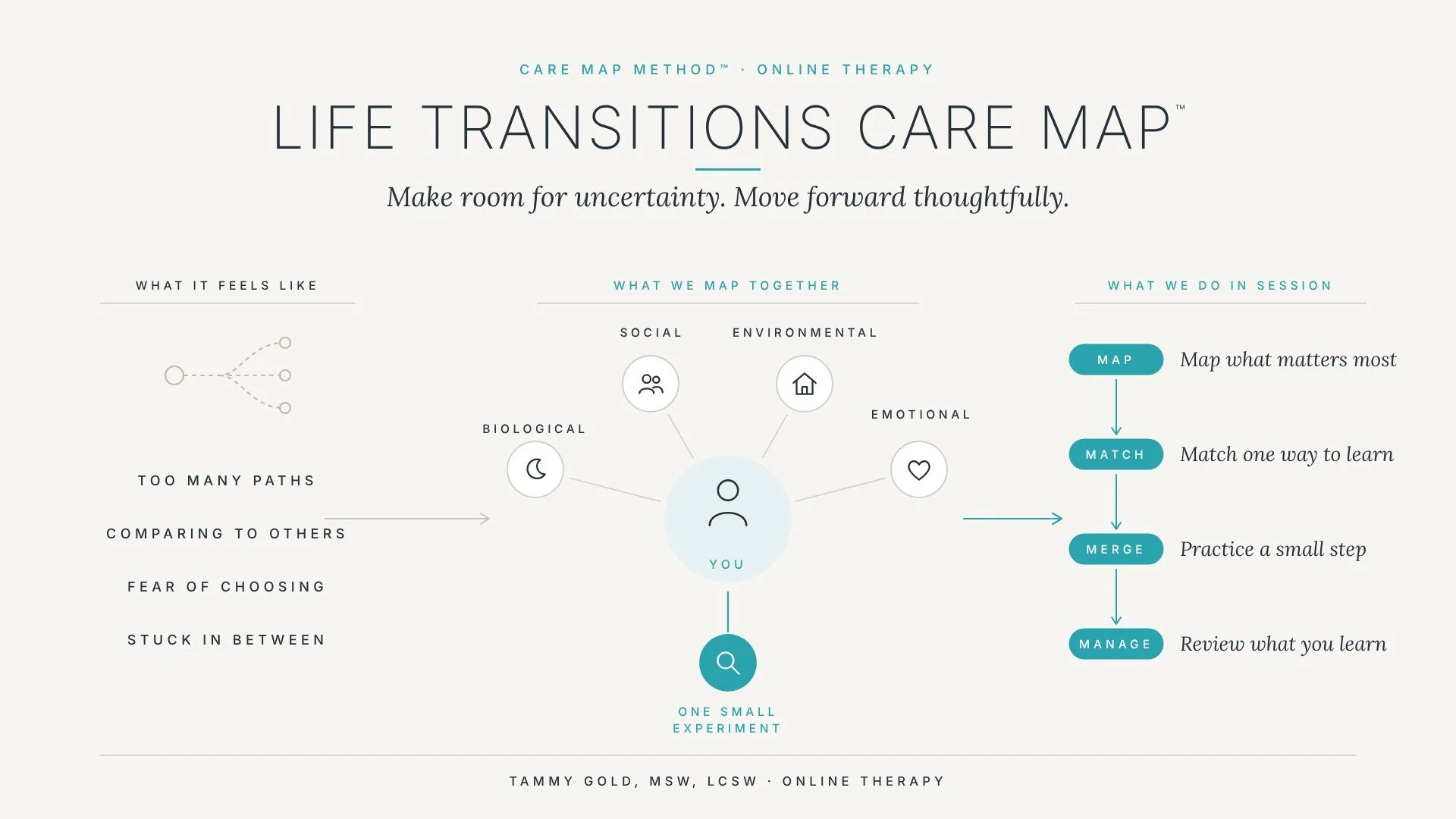
When choosing a direction becomes emotionally consuming
You may know that a job is not working for you and still feel unable to make a change. Or you may have several reasonable options and feel anxious that one decision will determine the rest of your life. Questions about work can become questions about who you are, whether you are successful and what other people expect of you.
Therapy for career anxiety focuses on the emotional and behavioral patterns around those decisions. We can address worry, avoidance, grief, perfectionism and self-doubt while acknowledging practical constraints. This is psychotherapy, not a service that selects a profession, places you in a job or promises a more successful career.
The pressure of being in your twenties or thirties
You may have expected to feel settled by now. Seeing friends announce promotions, homes or major relationships can make your own uncertainty feel like failure. A period sometimes called a quarter-life crisis may include questions about identity, values, work and belonging. That phrase describes an experience; it is not itself a clinical diagnosis.
We can examine the timeline you believe you should meet and where it came from. Family culture, financial needs, social comparisons and earlier achievements may all influence what feels acceptable. Understanding those pressures can help you distinguish a meaningful personal goal from a standard you have been trying to satisfy for someone else.
Understanding what keeps you stuck
Avoidance sometimes looks like doing nothing, but it can also look like endless researching, repeatedly asking other people what to do or waiting to feel completely confident. You may move between wanting a dramatic change and convincing yourself that you should simply be grateful. Both reactions can leave the underlying concern unexplored.
In therapy we can identify the feared outcome, the cost of staying in the current pattern and the information you actually need. We can also assess whether anxiety, low mood or other symptoms are affecting your ability to decide. If vocational testing or specialized career services would help, we can discuss adding those supports.
How the Care Map Method can organize the work
We can MAP the decision, including the emotions, relationships and practical conditions around it. We MATCH the therapeutic work to the barriers we identify, whether that involves tolerating uncertainty, responding to criticism or separating your values from others' expectations. We MERGE insights into manageable actions and MANAGE what happens as you gather more information.
For example, you might begin by speaking with someone in a field you are considering rather than committing to a new degree. That action is not a prescription for everyone. It is an illustration of how we can make a large decision more approachable while continuing to address the emotional meaning attached to it.
Making room for loss and mixed feelings
Even a wanted change may involve grief. Leaving a job can mean losing colleagues, status, routine or a long-held picture of yourself. Losing work unexpectedly may bring anger, shame or fear. Therapy can help you acknowledge those responses without making them the only basis for what you do next.
We can also explore how to discuss uncertainty with a partner or family member. You may need to communicate what kind of support is helpful, what financial boundaries matter and which decisions are yours to make. The conversation can include both emotional support and the realities of your responsibilities.
Decisions without a promise of certainty
No process can guarantee that a choice will feel right forever. A useful goal may be becoming able to make a thoughtful decision with the information available, notice the results and adjust when needed. That can be different from waiting for anxiety to disappear completely.
We will review the goals you bring into therapy and whether the work is helping. Sometimes the next step is a change in role; sometimes it is a change in boundaries or in how you relate to achievement. The direction should follow your assessed needs and priorities rather than a formula about ambition or success.
About Tamara Gold
I am Tamara “Tammy” Gold, MSW, LCSW, CEC, a Columbia University-trained therapist, certified coach and author of Secrets of the Nanny Whisperer. My work with individuals and families informs a warm, collaborative approach that connects emotional understanding with practical next steps. Treatment is individualized to your needs; results and timelines vary.
Online appointments and insurance
Online appointments depend on your physical location at each session, clinical fit and current availability. Review my booking profiles to confirm whether I can serve you in your state. Selected insurance plans may be available through Headway or Alma. Coverage, medical-necessity requirements and your costs depend on your individual plan; a life problem alone does not establish insurance coverage.
Frequently asked questions
Is this the same as career counseling?
This service focuses on mental health, emotional patterns and functioning related to career concerns. It does not include vocational testing, résumé writing, recruitment or job placement. We can discuss whether a separate career professional would complement therapy.
Can therapy help if I feel lost after college?
Yes. We can explore the transition in routine, identity, relationships and expectations, as well as any symptoms affecting your wellbeing. You do not have to know your next step before beginning.
Is a quarter-life crisis a diagnosis?
No. It is an informal phrase for uncertainty or distress around early-adult transitions. A clinical assessment considers your symptoms and functioning rather than using that phrase as a diagnosis.
Can we work on fear of choosing the wrong job?
Yes. We can examine how you evaluate risk, seek reassurance and respond to uncertainty. We can also distinguish useful information gathering from repeated checking that keeps you from making a decision.
Will you tell me to leave my current job?
No. We will consider your circumstances and options together, including finances, responsibilities, health and preferences. Decisions about employment remain yours.
Will insurance pay for career advice?
Do not assume that it will. Psychotherapy coverage depends on the plan and clinical requirements; general career advice or coaching may not qualify. Verify benefits and discuss the nature of the service before booking.
Take the next step
If this sounds like the kind of support you need, review current appointment options and check insurance eligibility through my Headway or Alma profile. You can bring questions about fit, fees and the process before scheduling. You do not need a perfect explanation of the problem to begin.
Book A Session Today & Get The Support You Deserve!
Using Insurance On:
Grow Therapy https://growtherapy.com/invite/979uzxntqh0z
Alma Therapy https://secure.helloalma.com/providers/tamara-gold/
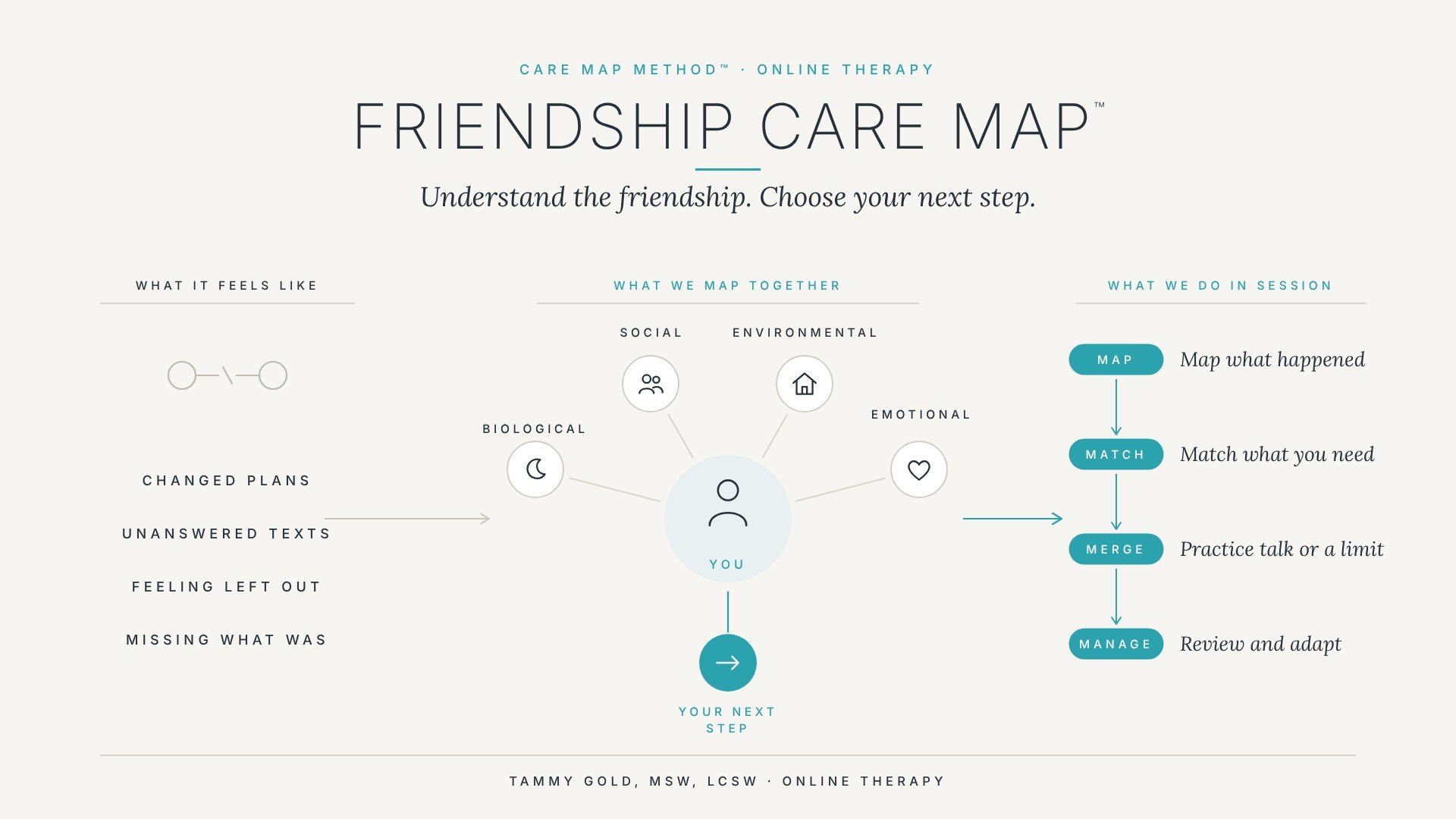
Friendship pain deserves space in the conversation
Friendship changes can bring grief, anxiety and self-doubt. Individual therapy can help you understand the relationship, communicate needs and decide what boundaries fit.
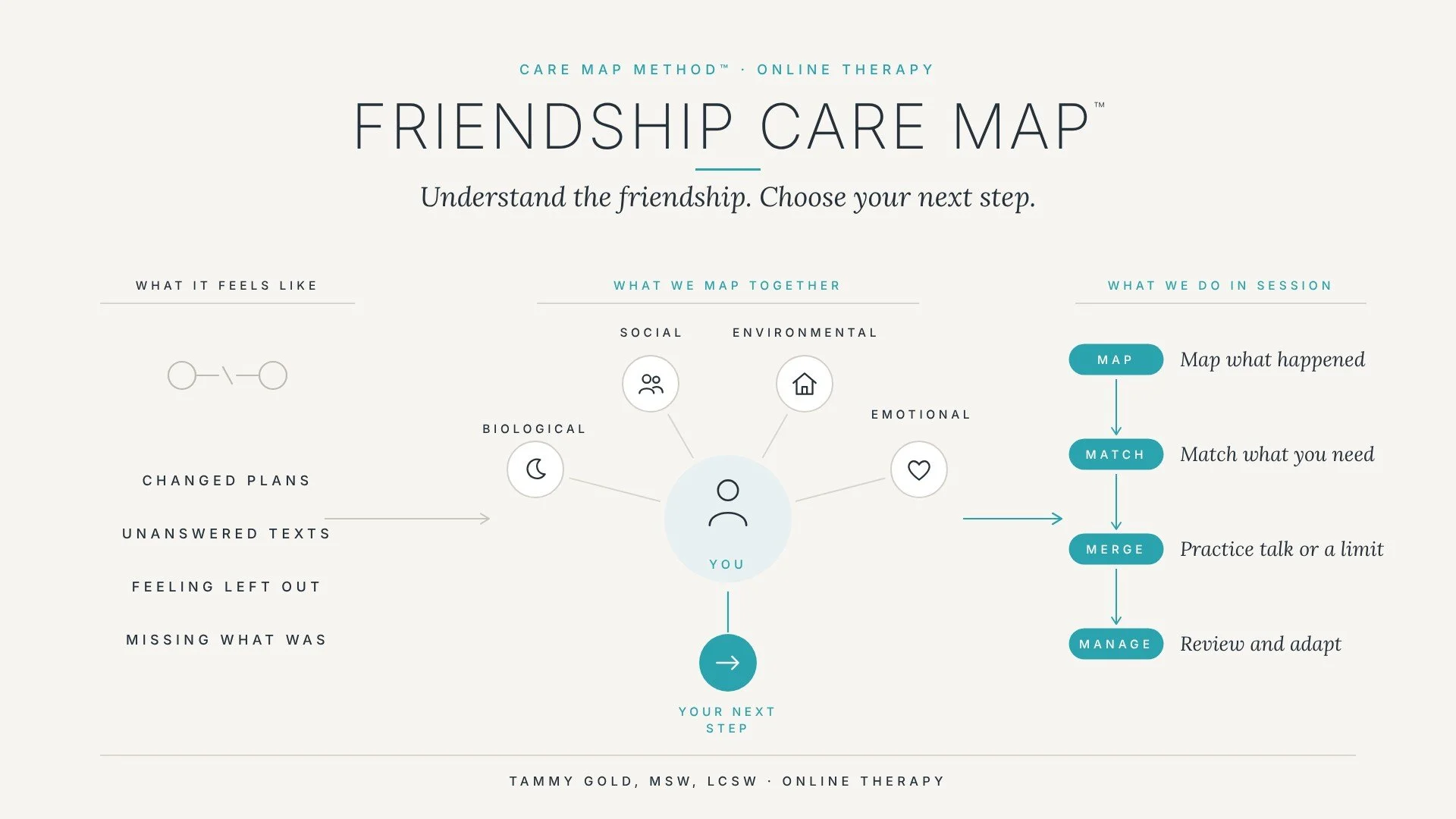
A friendship can be one of the most important relationships in your life. When it changes, ends or becomes uncertain, the impact may be hard to explain to people who expect you to move on. You may miss daily contact, feel embarrassed about caring so much or wonder whether the change says something about your worth.
Therapy for friendship issues gives you space to take that experience seriously. You can bring a specific conflict, a friendship breakup or a repeated pattern of feeling left out. We can explore what happened, how it affected you and what you need now without deciding in advance who is entirely right or wrong.
The situations that can bring someone to therapy
Perhaps a close friend has become less available, a group makes plans without you or a conversation ended badly. You may feel responsible for initiating every interaction. You might also notice checking messages repeatedly, comparing friendships on social media or agreeing to things because you are afraid someone will leave.
Those experiences can have different meanings. A friend may be occupied by a life change, the relationship may have become unbalanced, or earlier experiences may be making uncertainty especially painful. We can examine the available information and your response without pretending we can know another person's intentions from a few texts.
How individual therapy can help
We can work on identifying your needs, communicating concerns, noticing assumptions and tolerating the uncertainty that relationships sometimes involve. Therapy may include practicing a conversation, exploring grief or recognizing a pattern of overgiving. We can also consider when seeking clarification is useful and when repeated reassurance leaves you feeling less secure.
I use the Care Map Method™ to organize the emotional, social, environmental and biological factors involved. That can include your current support network, sleep, stress level and what else is changing in your life. We then develop an individualized treatment plan rather than applying a rule such as always repair the friendship or always walk away.
Working through an example
Imagine that a friend cancels twice and you see a photo of them with other people. You feel rejected and want to send a long message demanding an explanation. You might also be tempted to disappear without saying anything. Neither urge tells us the whole story, but both give us useful information about how hurt you feel.
In therapy we could identify the facts, the interpretation and what you want from the relationship. A next step might be a direct question, a clear statement of impact or a pause before responding. We would also consider whether this is an isolated event or part of a longstanding pattern.
Boundaries without a predetermined ending
A boundary can mean declining a request, changing how much time you spend together or naming a topic you are not willing to discuss. It does not have to mean cutting someone off. At the same time, some relationships may remain harmful or incompatible despite sincere attempts to communicate.
Therapy can help you consider safety, reciprocity, history and your own values. We can prepare for guilt or sadness even when a boundary is appropriate. The aim is not to eliminate every uncomfortable feeling before you act, but to help you respond with more clarity and less pressure to abandon your needs.
Grieving and rebuilding connection
When a friendship ends, you may lose routines, shared communities and a version of your future. It can take time to adjust. We can make room for grief without treating it as proof that you made the wrong decision. You may need different kinds of support from different people rather than a replacement best friend.
Rebuilding connection can begin with small, repeatable opportunities and a more realistic understanding of how adult friendships develop. We can also explore what you want to carry forward from the relationship and what you hope to do differently. You do not need the other person to attend for your own therapy to be useful.
About Tamara Gold
I am Tamara “Tammy” Gold, MSW, LCSW, CEC, a Columbia University-trained therapist, certified coach and author of Secrets of the Nanny Whisperer. My work with individuals and families informs a warm, collaborative approach that connects emotional understanding with practical next steps. Treatment is individualized to your needs; results and timelines vary.
Online appointments and insurance
Online appointments depend on your physical location at each session, clinical fit and current availability. Review my booking profiles to confirm whether I can serve you in your state. Selected insurance plans may be available through Headway or Alma. Coverage, medical-necessity requirements and your costs depend on your individual plan; a life problem alone does not establish insurance coverage.
Frequently asked questions
Can I go to therapy over a friendship breakup?
Yes. The loss of a friendship can affect mood, confidence, routines and other relationships. Therapy can help you process the experience and assess the support you need. Seeking care does not require minimizing or proving the importance of the friendship.
Does my friend need to attend?
No. This page describes individual therapy for your own concerns. Joint sessions would require a separate discussion about clinical appropriateness, consent, privacy and the service being provided.
Can you tell me whether my friend is toxic?
We can examine specific behaviors, their impact and the choices available to you. I cannot diagnose or reliably label someone I have not assessed. Focusing on patterns is generally more useful than assigning a sweeping label.
What if I keep feeling left out?
We can explore the actual social situations, your interpretations and any repeated patterns. That may include communication, belonging, social anxiety or relationships that are not meeting your needs.
Will therapy make me end the friendship?
There is no predetermined outcome. You may decide to communicate, adjust expectations, create distance or work toward repair. The goal is to support an informed choice that fits your values and circumstances.
Can insurance cover therapy for friendship stress?
Coverage depends on your plan and the clinical circumstances, including any applicable diagnosis and medical-necessity requirements. A friendship problem alone does not establish coverage. Verify eligibility and cost before scheduling.
Take the next step
If this sounds like the kind of support you need, review current appointment options and check insurance eligibility through my Headway or Alma profile. You can bring questions about fit, fees and the process before scheduling. You do not need a perfect explanation of the problem to begin.
Book A Session Today & Get The Support You Deserve!
Using Insurance On:
Alma Therapy https://secure.helloalma.com/providers/tamara-gold/
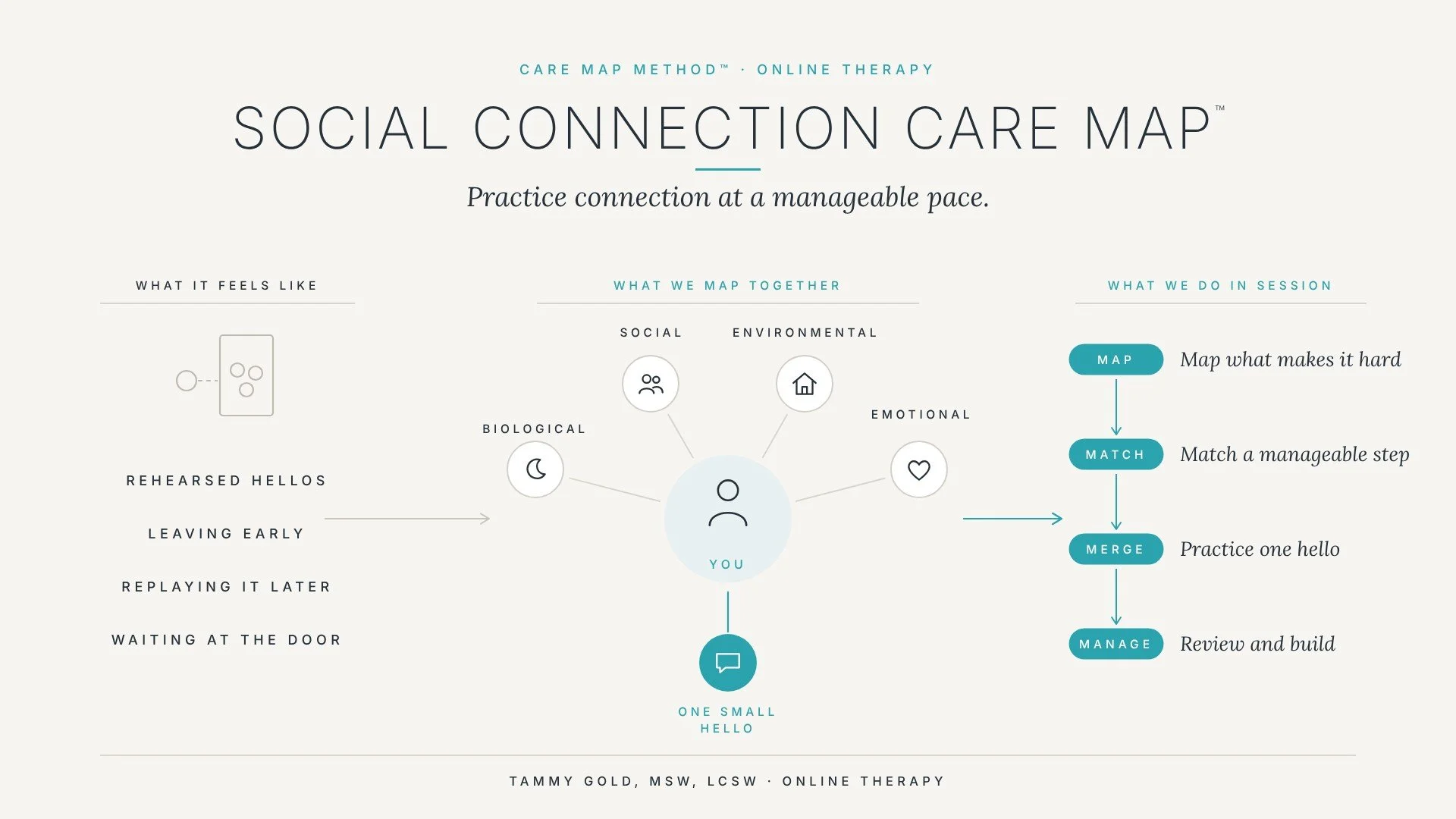
Wanting connection while fearing the interaction
Social situations can feel exhausting when you are monitoring everything you say. Explore therapy for fear of judgment, avoidance and the wish to feel more connected.
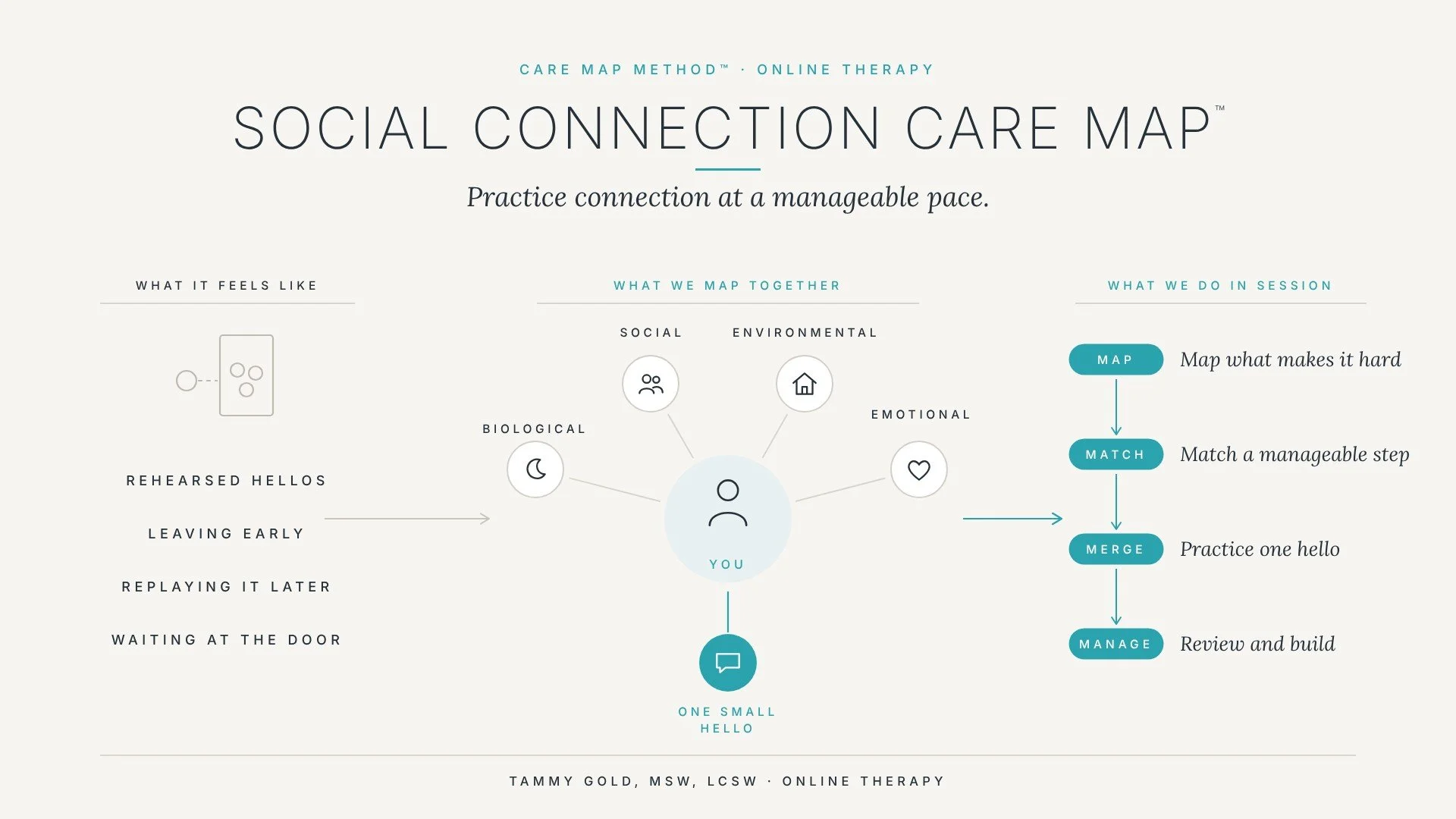
Young adult reviewing a notebook at a quiet cafe table before a meeting.
You might want to attend a gathering and still spend the day looking for a reason to cancel. During a conversation you may focus so intensely on how you appear that it becomes difficult to listen. Afterward, you replay an ordinary comment and wonder whether everyone noticed something wrong. Over time, avoiding situations can make your world smaller even when connection matters to you.
Social anxiety therapy offers space to understand that pattern and consider what would help you participate more freely. The goal is not to turn you into an extrovert or make you enjoy every gathering. It is to reduce the extent to which fear makes choices for you.
Understanding your particular experience
Social anxiety can show up around meetings, dating, new friendships, classes or everyday interactions. One person worries about sounding unintelligent; another fears rejection or visible nervousness. You may be comfortable with close friends but struggle whenever there is uncertainty about your role or how others see you.
We will look at when the anxiety appears, what you predict, what you do to protect yourself and what happens afterward. We can also explore experiences of exclusion, discrimination, bullying or criticism without assuming every fear is irrational. Cultural expectations, neurodivergence and communication preferences may be important parts of the picture.
How I approach the work
I use a collaborative, structured approach that considers your symptoms, goals and circumstances. We may examine interpretations of social events, practice ways to redirect attention, work on self-criticism or plan manageable steps toward situations you want to participate in. Any between-session practice should be discussed and adapted to your needs.
The Care Map Method™ can help organize the work. We MAP situations and responses, MATCH clinical strategies to the difficulties identified, MERGE practice into ordinary life and MANAGE what we learn. If your needs call for specialized assessment or treatment beyond my scope, we will discuss an appropriate referral rather than treating every social difficulty in the same way.
Moving from broad goals to specific situations
A goal such as being more confident can feel vague. A more concrete starting point might be asking one question during a team meeting, attending part of a gathering or sending a message without repeatedly rewriting it. We can consider what makes that step difficult and how you would know whether it was useful.
For example, you might believe that pausing during a conversation will make someone reject you. We can explore that prediction and how it influences your behavior. Progress would not require a flawless conversation. It might involve staying engaged, tolerating uncertainty or recovering more gently when an interaction feels awkward.
Making room for your preferences and limits
Enjoying solitude, needing recovery time or preferring a small number of friendships does not automatically indicate a problem. The question is whether fear is keeping you from the relationships, opportunities or activities you want. Therapy should respect your personality rather than impose a social ideal.
We can also distinguish a situation that needs coping skills from one that needs boundaries or a change of environment. You do not have to practice tolerating disrespect in order to become less anxious. Understanding your needs includes considering where you feel safe, which relationships are reciprocal and how much social energy you realistically have.
What progress may look like
Change can be uneven. You may participate more one week and feel unsettled the next. Together we can review what is changing, which situations remain difficult and whether the approach needs adjustment. We will consider functioning and your experience, not just whether you appear calm to other people.
Useful progress might include spending less time reviewing conversations, responding to invitations more deliberately or feeling able to express a preference. You can also bring doubts about therapy into the sessions. If talking by video itself feels exposing, we can discuss that at the start and consider what would make the appointment more manageable.
About Tamara Gold
I am Tamara “Tammy” Gold, MSW, LCSW, CEC, a Columbia University-trained therapist, certified coach and author of Secrets of the Nanny Whisperer. My work with individuals and families informs a warm, collaborative approach that connects emotional understanding with practical next steps. Treatment is individualized to your needs; results and timelines vary.
Online appointments and insurance
Online appointments depend on your physical location at each session, clinical fit and current availability. Review my booking profiles to confirm whether I can serve you in your state. Selected insurance plans may be available through Headway or Alma. Coverage, medical-necessity requirements and your costs depend on your individual plan; a life problem alone does not establish insurance coverage.
Frequently asked questions
Is social anxiety the same as being shy?
No. Shyness is a temperament or experience, while clinically significant social anxiety involves distress and interference that require assessment. You can seek support without deciding in advance which label fits. We will explore your experience rather than diagnose from a checklist alone.
Can therapy help me make friends?
Therapy can address anxiety, avoidance, communication and beliefs that affect connection. It cannot guarantee friendships or control other people. We can identify realistic ways to approach relationships that fit your interests and preferences.
Will I have to do things that overwhelm me?
We will discuss any practice collaboratively and consider the pace, purpose and support needed. You should be able to ask questions and express discomfort. The plan should fit the assessed problem and your readiness.
What if I only feel anxious at work?
That is useful information. We can examine meetings, feedback, workplace dynamics and performance concerns rather than assuming the same pattern occurs everywhere. Sometimes a broader assessment helps clarify overlapping concerns.
Can we address replaying conversations afterward?
Yes. We can explore the meaning you give to the interaction, how repeated reviewing affects you and what helps you shift attention without demanding certainty about what someone else thought.
Is online therapy an option?
Online appointments may be appropriate depending on your needs and location. We will consider privacy, technology and clinical fit, and discuss other options if virtual care is not sufficient.
Take the next step
If this sounds like the kind of support you need, review current appointment options and check insurance eligibility through my Headway or Alma profile. You can bring questions about fit, fees and the process before scheduling. You do not need a perfect explanation of the problem to begin.
Book A Session Today & Get The Support You Deserve!
I work with insurance using the platforms below:
Alma Therapy https://secure.helloalma.com/providers/tamara-gold/
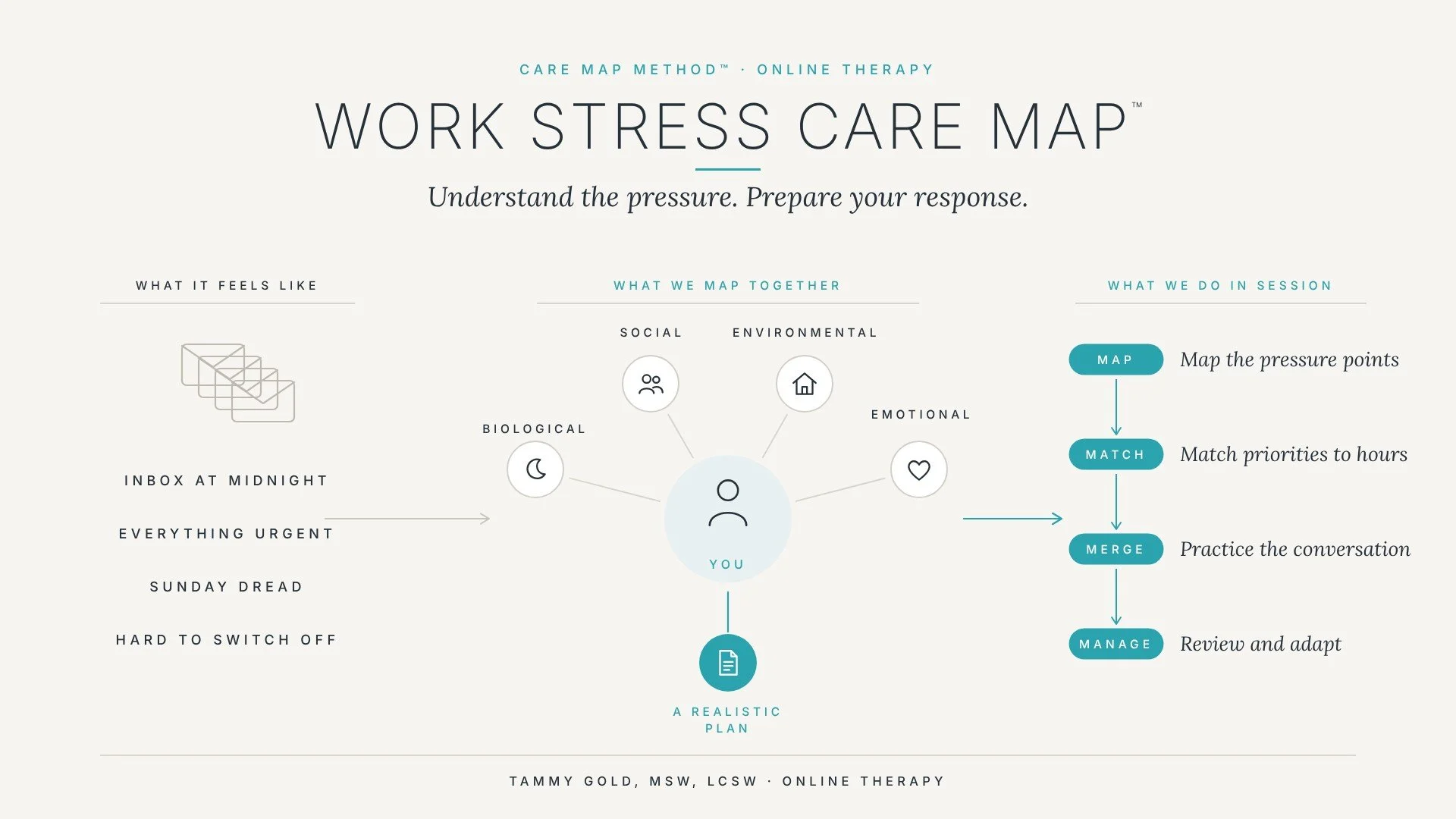
When your job occupies more than your working hours
Dreading Monday, replaying feedback or checking messages after hours? Therapy can help you understand work anxiety and develop a response that fits your job and circumstances.
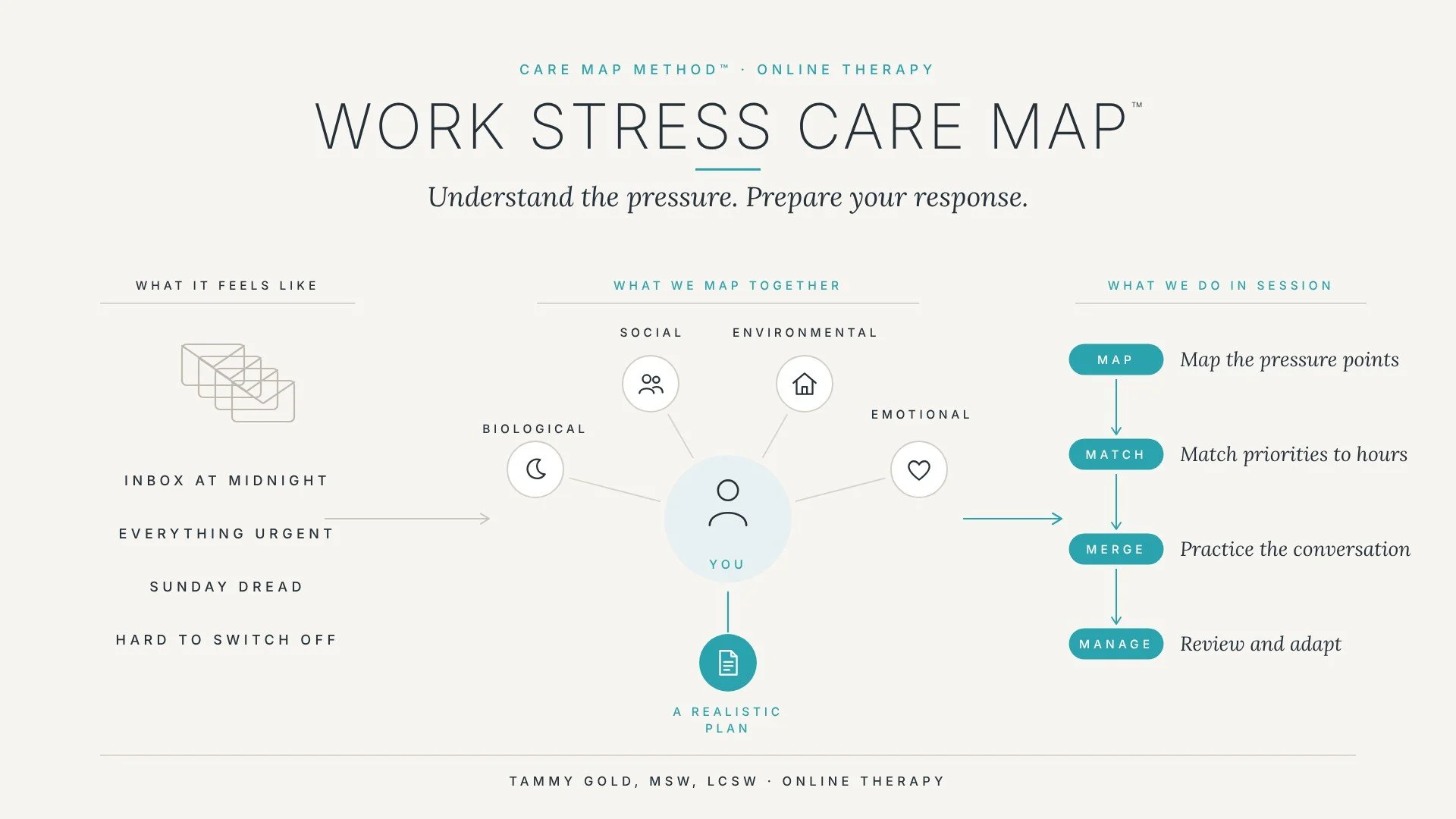
You may notice anxiety before you even open your laptop. A meeting invitation can make your stomach tighten. A brief message from your manager can become something you analyze all day. By Sunday afternoon, you may already be preparing emotionally for Monday, even when nothing specific has happened.
Therapy for work anxiety can help you understand what your mind is anticipating and how the worry is affecting your life. The concern may involve workload, performance fears, conflict, uncertainty or an environment that really is difficult. We can take those possibilities seriously without assuming either that your job is fine or that quitting is the only answer.
Distinguishing the job problem from the anxiety pattern
A new role, unclear expectations or inconsistent feedback can leave almost anyone unsettled. Anxiety can also make neutral situations feel threatening. You may interpret a correction as evidence that you are failing, compare yourself constantly with coworkers or put off a task because you feel you must do it perfectly.
We can examine what happened, what you inferred and what information is still missing. That does not mean explaining away poor treatment. It means making room for both the external conditions and your internal response. The more clearly we understand the problem, the more specific our next steps can be.
What we can work on in sessions
Our work might include preparing for a feedback conversation, responding to a mistake without spiraling, setting realistic availability or recognizing the point at which planning turns into repeated worry. We may explore how earlier experiences with criticism influence what happens with a supervisor now. We can also look at whether sleep, health, financial insecurity or responsibilities outside work are narrowing your capacity.
Using the Care Map Method™, we can
MAP the work situation,
MATCH strategies to the source of distress,
MERGE changes into actual workdays and
MANAGE the results over time.
This framework organizes individualized clinical care; it does not replace assessment or make it your responsibility to fix an unhealthy workplace.
A practical example involving feedback
Suppose your manager says a project needs revisions. Before you have read the details, you are convinced you will lose your job. You spend the evening rereading the message, delay starting the changes and arrive the next morning exhausted. The anxiety has become an additional problem alongside the work itself.
In therapy we might separate the actual request from the feared outcome, notice what your body does when you feel criticized and identify the information you need. A useful step might be asking which two revisions matter most. We would also address the emotional meaning of making a mistake, rather than relying only on productivity advice.
Creating boundaries that account for your role
Advice to stop checking messages is not useful if your job includes genuine on-call duties. Advice to confront your boss may not fit your position or financial security. We can consider the responsibilities you actually have, what flexibility exists and what changes are safest and most realistic for you.
A boundary may begin with clarifying expected response times, creating an end-of-day task note or agreeing on priorities when work exceeds capacity. It can also involve deciding what you will do when a request falls outside that agreement. We can practice language and follow-through while recognizing that you cannot control another person's response.
Making thoughtful decisions about staying or leaving
Sometimes therapy helps a person feel more comfortable in a job. Sometimes it helps them recognize that the role no longer fits. We can examine your values, symptoms, resources and options without forcing an immediate decision. If you need recruiting, vocational testing or legal guidance, those services require the appropriate professional.
The purpose of therapy is to address the emotional and behavioral effects of work stress and support clearer choices. We can review whether your anxiety is easing, whether you are recovering outside work and whether the changes you try are helping. Your goals can evolve as you learn more about the situation.
About Tamara Gold
I am Tamara “Tammy” Gold, MSW, LCSW, CEC, a Columbia University-trained therapist, certified coach and author of Secrets of the Nanny Whisperer. My work with individuals and families informs a warm, collaborative approach that connects emotional understanding with practical next steps. Treatment is individualized to your needs; results and timelines vary.
Online appointments and insurance
Online appointments depend on your physical location at each session, clinical fit and current availability. Review my booking profiles to confirm whether I can serve you in your state. Selected insurance plans may be available through Headway or Alma. Coverage, medical-necessity requirements and your costs depend on your individual plan; a life problem alone does not establish insurance coverage.
Frequently asked questions
Can therapy help with Sunday scaries?
Yes, we can explore the specific worries that build before the workweek and how they affect your behavior, sleep and relationships. The plan depends on whether the main issue is workload, conflict, uncertainty, anxiety or a combination of factors.
What if my workplace really is unhealthy?
Therapy can help you assess the impact, consider your options and protect your wellbeing. It does not require you to view unreasonable conditions as acceptable. Legal or employment-rights questions should be addressed with an appropriately qualified professional.
Can we work on fear of making mistakes?
Yes. We can examine the beliefs and experiences behind that fear, how you respond when something goes wrong and what helps you repair a mistake without prolonged self-criticism or avoidance.
Will you help me decide whether to quit?
We can explore the emotional and practical factors involved, including your financial situation and available alternatives. The decision remains yours. Therapy is not job placement or a guarantee of a particular employment outcome.
Is work anxiety always an anxiety disorder?
No. Distress at work can reflect many circumstances. Assessment considers the pattern, duration, severity and effect on functioning before determining whether a clinical diagnosis is appropriate.
Can I schedule around my workday?
Current appointment options are available through my booking profiles. Availability changes. Check the time zone displayed and confirm your physical location before a virtual session.
Take the next step
If this sounds like the kind of support you need, review current appointment options and check insurance eligibility through my Headway or Alma profile. You can bring questions about fit, fees and the process before scheduling. You do not need a perfect explanation of the problem to begin.
Book A Session Today & Get The Support You Deserve!
I work with insurance using the platforms below:
Alma Therapy https://secure.helloalma.com/providers/tamara-gold/
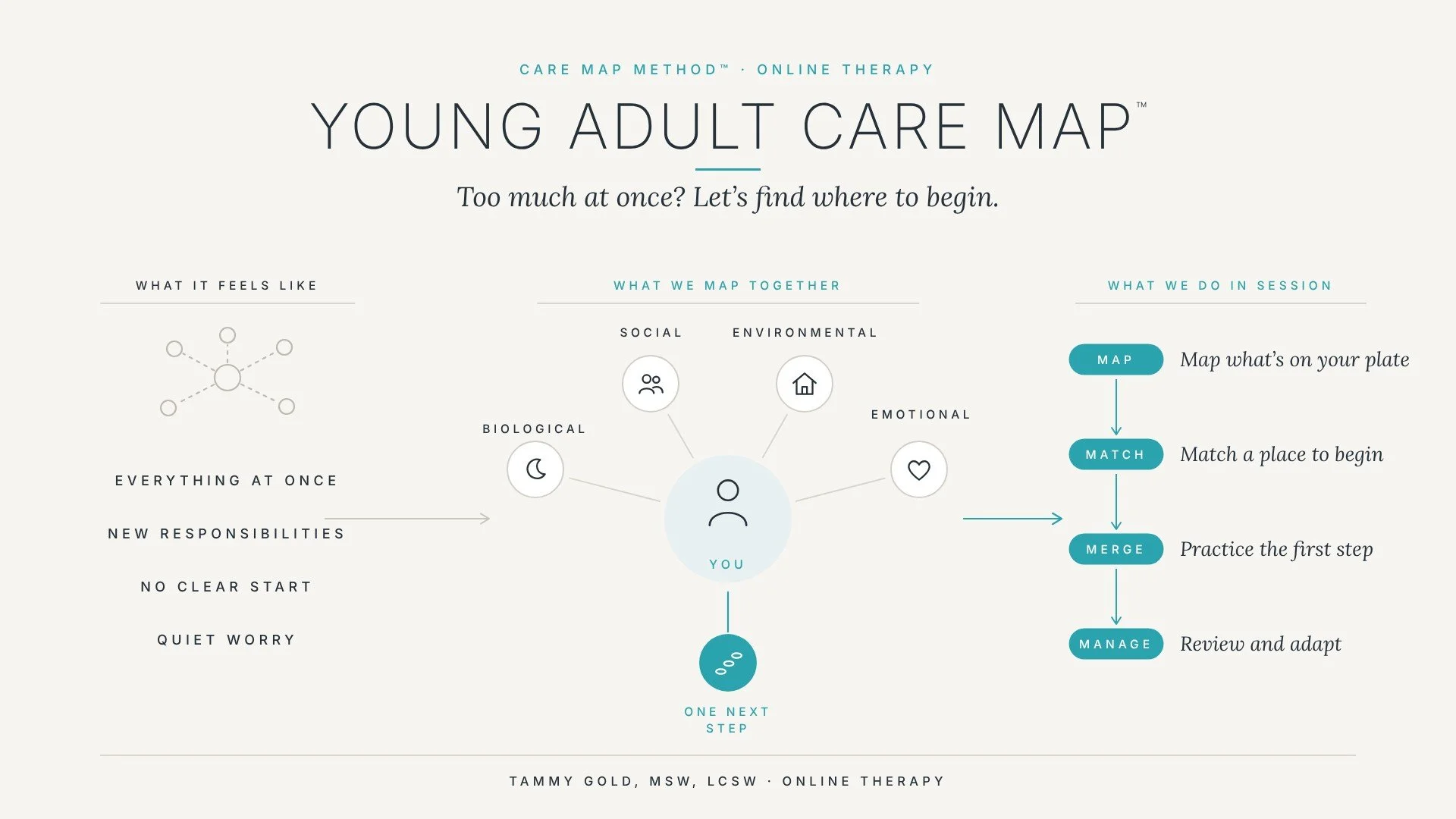
When adulthood looks different from what you expected
Your 20s and 30s can bring friendship changes, career pressure and questions about who you want to become. Explore practical, individualized online therapy with Tamara Gold.
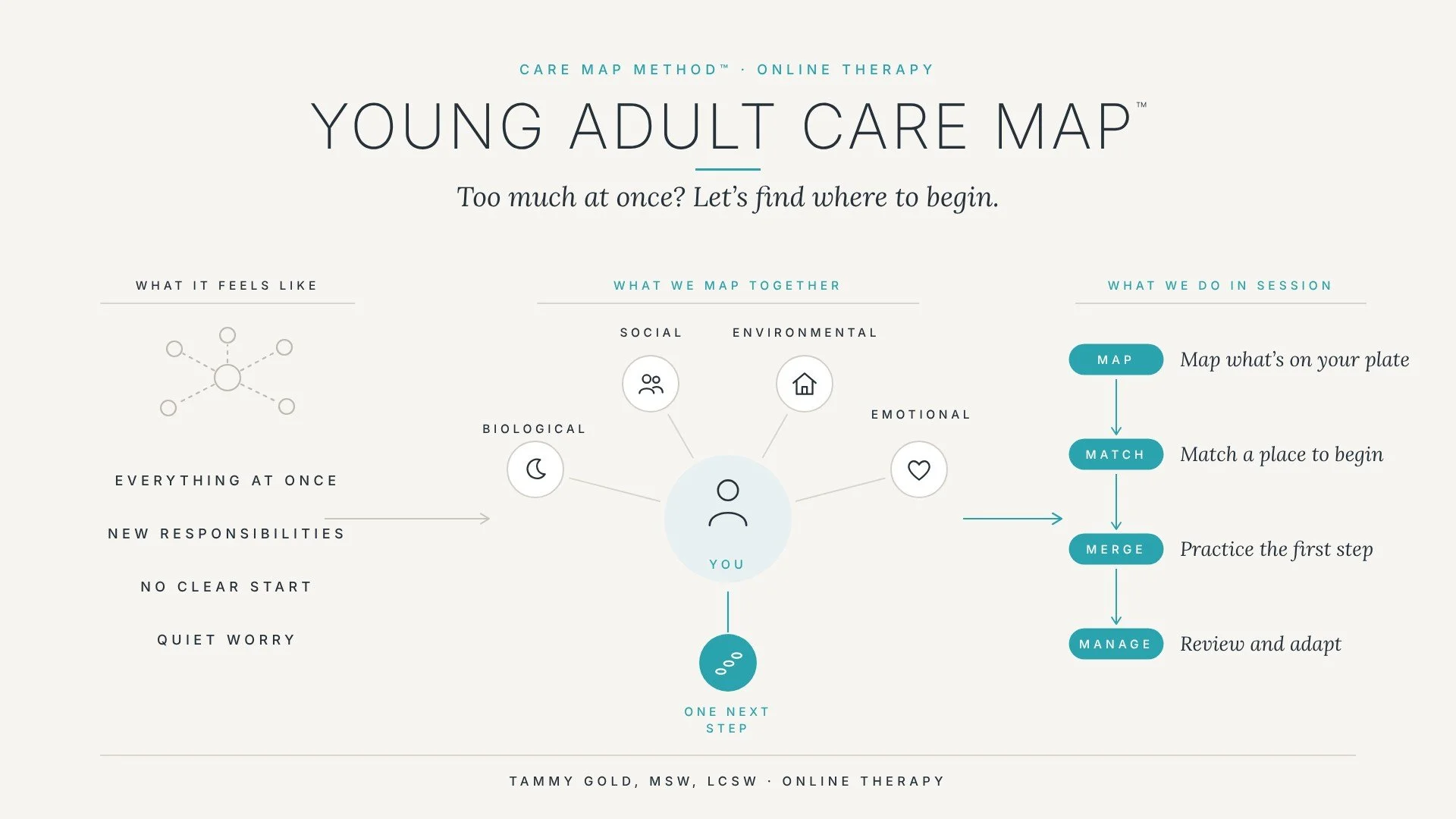
Young adult using a notebook during a video therapy session at home.
You can be doing the things you thought you were supposed to do and still feel uncertain. Maybe you finished college, started a job, moved away from home or entered a serious relationship, yet everyday life feels more confusing than you expected. Friends seem to be moving ahead while you keep wondering whether you are behind. You may look capable to everyone else while privately feeling lonely, anxious or unsure of yourself.
Online therapy for young adults gives you room to understand those feelings without having to present a polished explanation. You can bring work worries, friendship problems, family expectations or questions about your future into the same conversation. We can explore how those parts of your life affect one another and identify a manageable place to begin.
The concerns you can bring into therapy
Some young adults reach out because they cannot stop overthinking. Others are struggling to make friends, recover from a breakup, set boundaries with parents or feel comfortable in a new workplace. You might be comparing yourself with people online, saying yes when you want to say no, or avoiding decisions because you are afraid of choosing incorrectly.
We do not need to treat every difficult transition as a disorder. Part of our work is understanding the intensity, duration and impact of what you are experiencing. That includes looking at your sleep, relationships, concentration and daily functioning, as well as the practical pressures around money, housing, school and employment.
How our sessions can help
I offer a warm, structured space where we can connect emotional insight with changes you can try between appointments. We might notice a pattern of assuming other people are disappointed in you, examine what happens before you avoid a difficult conversation, or work on expressing what you need without a long apology. The direction depends on your priorities and clinical needs.
The Care Map Method™ is an organizing framework I use within individualized therapy. We MAP the pressures and patterns involved, MATCH the work to your needs, MERGE useful insights into everyday situations, and MANAGE what happens next. The framework supports assessment and treatment planning; it is not a separate guaranteed treatment or a promise that every concern has a quick solution.
An example of turning a large worry into a smaller task
Imagine you feel overwhelmed by a new job, a quieter social life and repeated questions from family about your future. Saying that everything is wrong can make it hard to know where to start. We might first separate the immediate work pressure from loneliness and family expectations. Each may need a different response.
One starting point could be preparing a question for your manager. Another could be choosing one repeatable social activity instead of trying to build an entire friend group. We would also make room for the emotions underneath those steps. A practical plan works better when it accounts for fear, grief, energy and the limits of your current circumstances.
What a first appointment is like
Our first conversation focuses on what brought you in, what feels most difficult and what you would like to change. I will ask about relevant history, current supports, health concerns and previous experiences with therapy. You can tell me when a question feels uncomfortable or when you need more time. We will also discuss privacy, fees, appointment arrangements and the fit between your needs and my services.
You do not need a diagnosis before asking about therapy. If another kind of care would better meet your needs, we can discuss that openly. Progress may involve understanding yourself more clearly, feeling less trapped by a familiar pattern or becoming more able to act on your own priorities.
Support that fits your real life
You may be working, studying, between jobs, living with parents or supporting other people. None of those situations makes you more or less deserving of support. Therapy can include the realities of a limited budget, a demanding schedule or a living arrangement you cannot immediately change.
My approach is collaborative. We can revisit the pace of therapy and whether the work is helping with the problems you identified. You are welcome to bring concerns about the sessions themselves. Feeling able to ask questions and disagree is an important part of building a useful therapeutic relationship.
About Tamara Gold
I am Tamara “Tammy” Gold, MSW, LCSW, CEC, a Columbia University-trained therapist, certified coach and author of Secrets of the Nanny Whisperer. My work with individuals and families informs a warm, collaborative approach that connects emotional understanding with practical next steps. Treatment is individualized to your needs; results and timelines vary.
Online appointments and insurance
Online appointments depend on your physical location at each session, clinical fit and current availability. Review my booking profiles to confirm whether I can serve you in your state. Selected insurance plans may be available through Headway or Alma. Coverage, medical-necessity requirements and your costs depend on your individual plan; a life problem alone does not establish insurance coverage.
Frequently asked questions
Is young adult therapy only for college students?
No. Young adults may be working, studying, parenting, looking for a job or figuring out what comes next. The focus is on your concerns and stage of life, not your enrollment status. We will discuss whether my services are a good fit for your age and needs.
What if I cannot explain exactly what is wrong?
You can begin with a feeling, a repeated situation or a change you have noticed. Feeling overwhelmed, disconnected or unlike yourself is enough to start a conversation. The initial assessment helps us understand what is happening and identify appropriate goals.
Can we discuss work, friendships and family together?
Yes. Those areas often interact. We can explore how family expectations shape career decisions or how work stress affects friendships, while keeping treatment focused enough to make the sessions useful.
Will you tell me what decisions to make?
I can help you examine options, understand emotional patterns and practice making decisions. I will not choose your career, partner or life direction for you. The aim is to support your judgment and agency.
Can I attend therapy while away at college?
Your physical location at each session matters. Tell me where you will be before an appointment, including during school terms, breaks and travel. Sessions can proceed only where I am authorized to provide care and other requirements are met.
How long does therapy take?
There is no single timeline. Your goals, symptoms, circumstances and preferences help determine the plan. We can review progress together and discuss frequency, adjustments or referrals when needed.
Take the next step
If this sounds like the kind of support you need, review current appointment options and check insurance eligibility through my Headway or Alma profile. You can bring questions about fit, fees and the process before scheduling. You do not need a perfect explanation of the problem to begin.
Book A Session Today & Get The Support You Deserve!
I work with insurance using the platforms below:
Alma Therapy https://secure.helloalma.com/providers/tamara-gold/
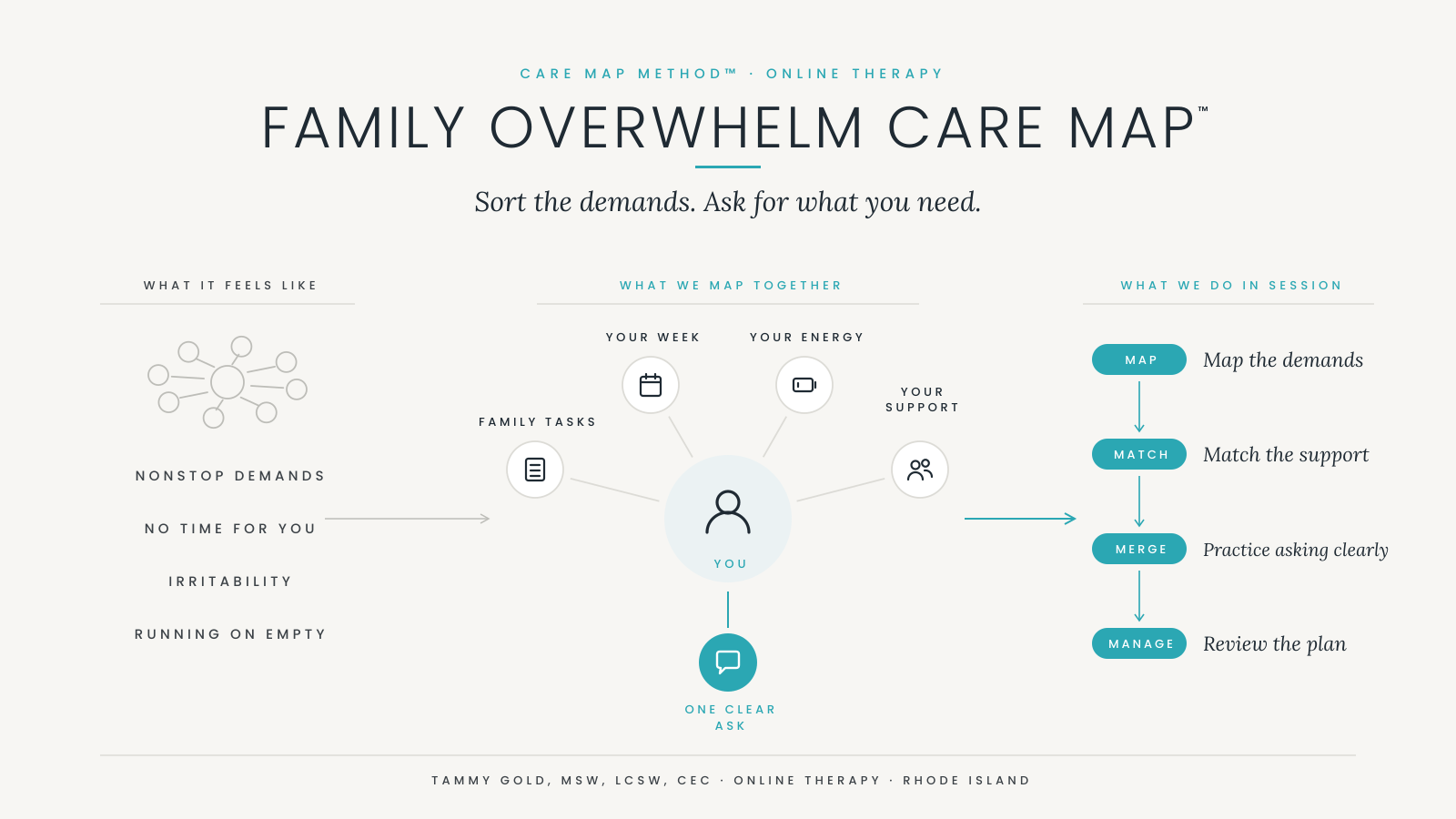
Individual Therapy for Family Overwhelm in Rhode Island
When family requests fill every available space, your own needs can become difficult to hear. Read about individual therapy for family stress, clarifying responsibilities and practicing a request for support. Confirm Rhode Island availability before booking.
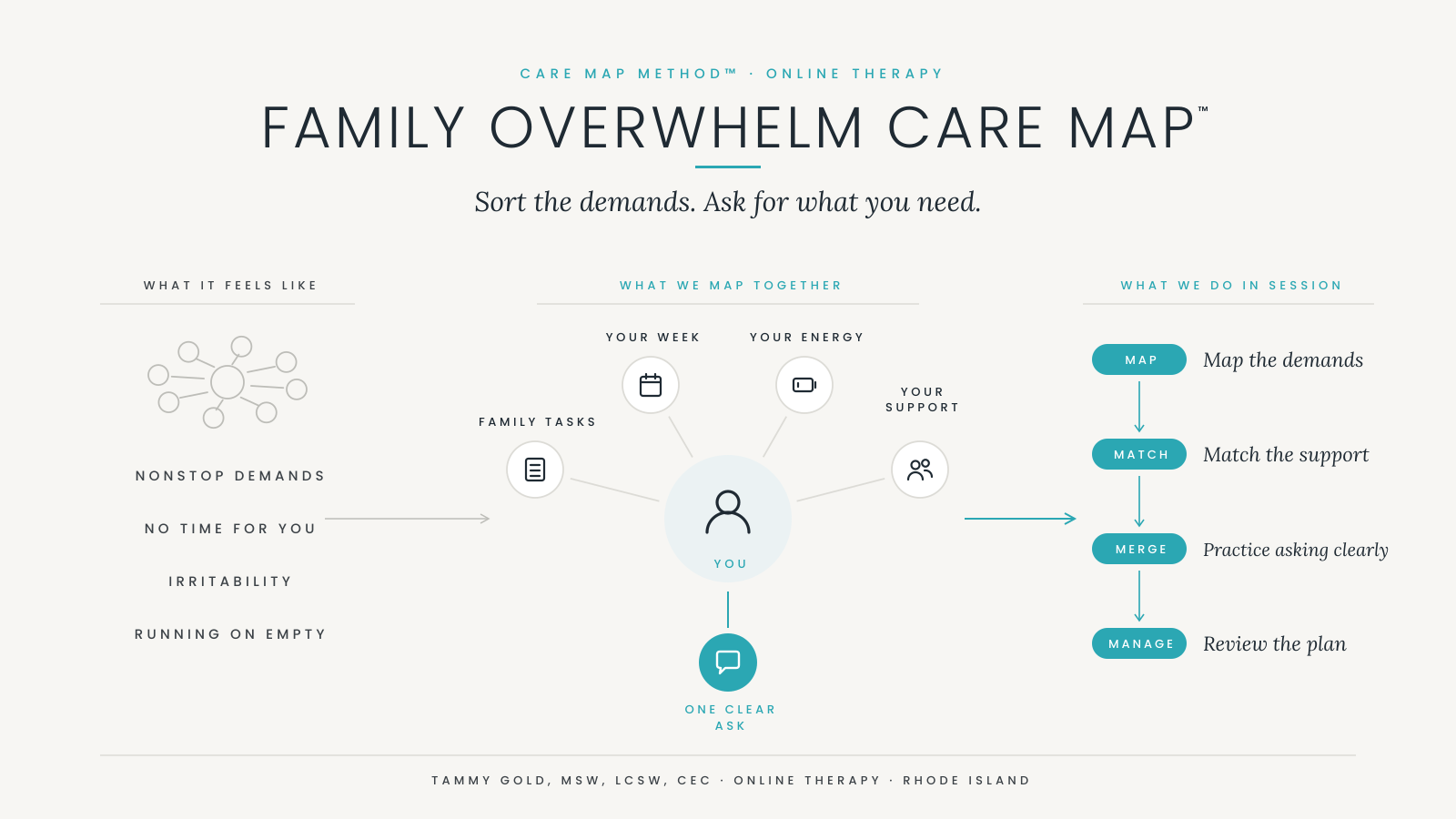
Four illustrated steps for exploring family demands and practicing a request for support.
Individual Therapy for Family Overwhelm in Rhode Island
A partner needs something, a child has a problem and an aging parent calls with another concern. You agree to handle it all, then find yourself snapping, withdrawing or feeling that nobody notices how much you are carrying. There may be no single crisis, but little room to recover between demands.
I’m Tammy Gold, a licensed therapist, author and creator of Care Map Method™. My individual therapy work explores family stress, difficult relationships and emotional overwhelm. If you are seeking support in Rhode Island, the concerns below can help you consider the kind of care you want to discuss.
Check Rhode Island Insurance and Availability on Headway or Alma Therapy Platforms
When family demands fill the whole day
The visible tasks may be only part of the load. You might also be remembering appointments, anticipating reactions, keeping track of messages and deciding which problem needs attention first. Others may see the completed task without seeing the thought and worry around it.
We can explore the effect on your mood, concentration, rest and relationships. You may feel angry, anxious, numb or guilty for wanting time alone. Those feelings deserve context. Loving your family does not remove the emotional effect of competing responsibilities, and your experience does not need to look dramatic to be worth discussing.
How responsibility becomes difficult to share
You may have become the person who steps in because you notice what needs doing. Over time, family members may assume that you will keep handling it. You might want help while also worrying about what will happen if you stop overseeing everything.
In individual therapy, we can explore those expectations and the actual limits of your situation. Some responsibilities are not easy to delegate, and support may be uneven. We can still examine where a request, conversation or change is possible without treating you as responsible for creating a perfectly cooperative family.
What we might work on in a session
For example, we might discuss a day when several people asked for help and you accepted every request. Later, a small question led to an argument. We could look at the demands, what you were telling yourself about responsibility and which feeling had not had room to be expressed.
From there, we might identify one need you want another person to understand and practice asking for specific support. That could mean discussing a task, clarifying timing or explaining that you need time to consider a request. We would also explore what happens if help is unavailable. A later session can review the experience and adjust the plan. The work is collaborative and grounded in your circumstances.
Using Care Map Method for family overwhelm
Care Map Method™ helps organize Biological, Social, Environmental and Emotional factors alongside individual assessment. We may consider your health and energy, family relationships, the practical demands of daily life and the feelings attached to your role.
We MAP the demands and their impact.
We MATCH support or strategies to the needs identified.
We MERGE a chosen approach into daily life through rehearsal or a manageable adjustment.
We MANAGE the plan by reviewing what happened and what remains difficult.
The framework supports therapy without requiring you to turn every feeling into a task or control every family member's response.
Make room for your own experience
You may be so practiced at explaining everyone else's needs that your own are difficult to name. We can spend time understanding what feels hardest before trying to solve it. That might include resentment, fear of being unavailable or sadness about how a relationship has changed.
When you are ready, we can consider one conversation or choice. A goal might involve recognizing when you are near your limit, asking more directly or discussing expectations earlier. Those are possibilities to assess together. Progress may involve greater understanding as well as changes in behavior.
Choosing the type of support that fits
Individual psychotherapy focuses on the mental health and functioning of the person receiving care. Family sessions involve a different arrangement, and practical care-selection consulting has different goals. We can clarify which service you are looking for before you begin.
An initial clinical appointment can include your concerns, relevant history, current symptoms and the effect on daily life. We can discuss previous support, treatment fit and goals. You do not need to arrive knowing how to divide every responsibility or how to explain the whole family situation perfectly.
About Tammy Gold and Rhode Island inquiries
I’m Tammy Gold, MSW, LCSW, CEC. I earned my MSW at Columbia University and my BA at the University of Pennsylvania. My work includes relationships, parenting, caregiving and the emotional demands of family life.
For a Rhode Island inquiry, confirm current authorization, state-specific appointment availability and the service before scheduling. If using insurance, check your exact plan, provider participation and estimated costs through the appropriate platform. A provider profile or insurer name alone does not establish that a particular appointment is available.
Frequently asked questions
Can I seek individual therapy without bringing my family?
Individual therapy can focus on your distress, symptoms, needs and choices within family relationships. Other relatives do not have to attend. Before arranging care in Rhode Island, confirm current authorization, appointment availability and whether the offered service fits your needs.
What if I feel guilty asking for help?
We can explore what asking means to you, what you fear might happen and how responsibility has developed in your family. Guilt deserves attention in its context. It does not need to disappear before you can begin understanding your needs.
Can we work on irritability and resentment?
Those feelings can be discussed alongside the demands, relationships and symptoms you are experiencing. Assessment helps clarify treatment goals. We can explore what happens around a difficult moment and consider a response that fits your circumstances.
Will you tell my relatives what they must do?
Individual therapy centers on your care, not directing absent family members. We can explore requests, communication and choices within your control. We cannot guarantee another person's cooperation or make family decisions on everyone's behalf through your individual sessions.
Is this family therapy or individual therapy?
This page describes individual psychotherapy. Family treatment would require a separate discussion about participants, goals, clinical fit and payment. Practical care consulting is also a different service. Clarify the type of appointment before scheduling so the arrangement matches what you need.
What happens during a first appointment?
A first clinical session can include your concerns, history, symptoms, daily functioning and previous experiences with support. We would consider fit and goals together. For Rhode Island, confirm that a currently authorized and available appointment can be arranged before booking.
Can I use BCBS Massachusetts while in Rhode Island?
Do not assume coverage from the insurer name or a rate listing. Confirm current Rhode Island authorization, the offered appointment, exact-plan participation and estimated costs with the platform. Different Blue Cross products and networks are not automatically interchangeable.
Are Rhode Island appointments currently available?
Please confirm current Rhode Island availability and authorization before scheduling. The ability to view a general provider profile is not confirmation of an appointment in your state. Any insurance and service questions should be clarified before a visit is arranged.
Take the next step
Confirm current Rhode Island authorization, service availability and insurance details before arranging a visit. Once a suitable appointment is available, the first conversation can begin with the concern that led you to seek support.
Book A Session Today & Get The Support You Deserve!
For clients using insurance, I use the platforms below:
Alma Therapy https://secure.helloalma.com/providers/tamara-gold/
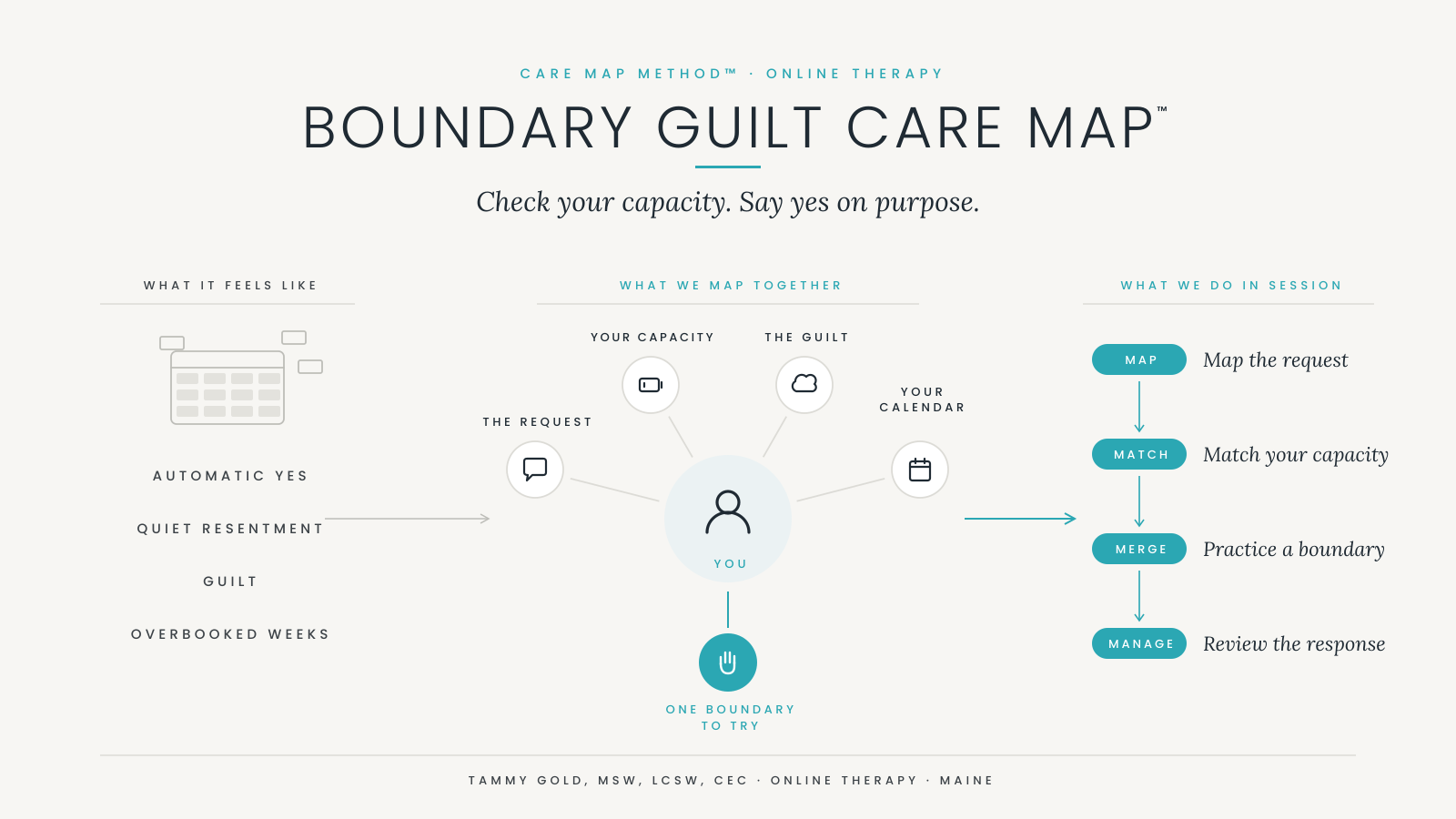
People Pleasing and Boundary Guilt Therapy in Maine
Saying yes can feel easier until you are overwhelmed and resentful. Explore individual online therapy in Maine for people-pleasing and boundary guilt, including how to understand the pressure and practice words that reflect your capacity.
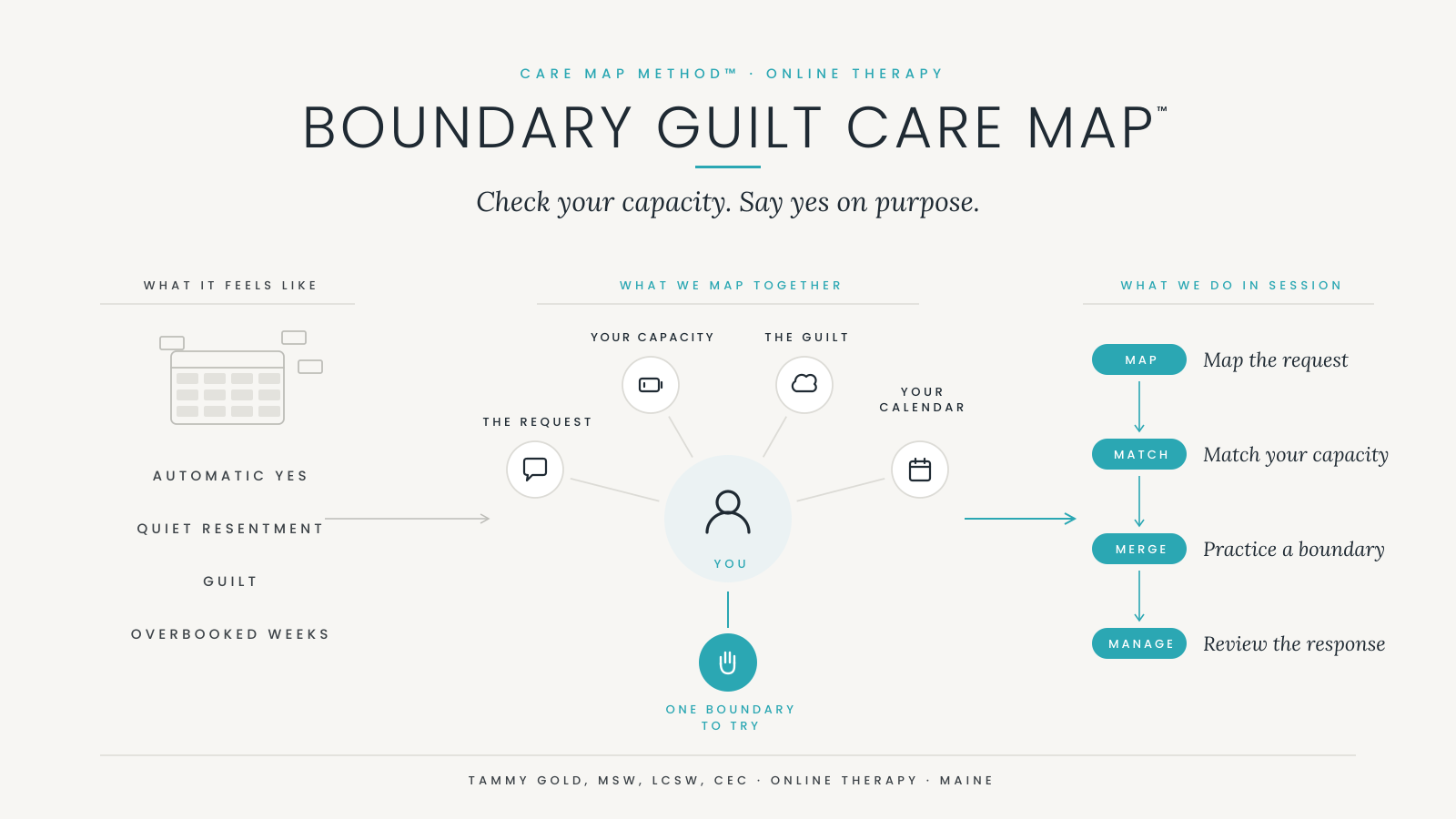
Four illustrated steps for exploring guilt and practicing a boundary around a request.
Someone asks for help and you hear yourself agreeing before you have checked your calendar or your energy. Later, you cancel something you needed and feel resentful. You may then feel guilty for being annoyed with someone you care about.
I’m Tammy Gold, a licensed therapist. I offer individual online therapy for adults in Maine who are struggling with people-pleasing, boundary guilt and relationship stress. We can explore what happens around a request, why declining feels difficult and how you want to respond within your real relationships and responsibilities.
When being helpful leaves little room for you
You may be the person who remembers, organizes and makes things easier for everyone else. People may appreciate your reliability without noticing the cost. You might rarely state a preference until you are already frustrated or exhausted.
Helping others can be an important value. We do not need to treat every generous choice as unhealthy. The concern may be the feeling that you cannot choose differently, the fear attached to disappointing someone or the effect of repeated overcommitment on your well-being. We can explore that distinction in the context of your life.
What saying no brings up
A request may carry more than the task itself. You may fear conflict, losing closeness or being seen as selfish. Past family roles or experiences can shape what you expect to happen when someone is unhappy with you.
In therapy, we can consider what you actually know about the relationship and what you are anticipating. We can make room for cultural expectations, practical obligations and limited support. A boundary that fits one person may not fit your circumstances. Understanding the pressure comes before deciding what language or change would be useful.
What we might work on in a session
For example, we might explore a last-minute request from a relative. You agreed, gave up time you needed to rest and spent the evening feeling angry. We could slow down the moment before you said yes: what you noticed, what you feared and what you wanted the other person to understand.
After exploring those feelings, we might rehearse asking for time to answer, offering a limited form of help or declining a particular task. We would consider the likely consequences and what support you need if the person is disappointed. Later, we can review the experience. The purpose is to understand your choices and capacity, rather than find a sentence that makes everyone approve.
Using MAP MATCH MERGE MANAGE for boundary guilt
Care Map Method™ organizes Biological, Social, Environmental and Emotional factors. Your energy and health, family relationships, available time and feelings about responsibility may each influence the request. We consider the full context alongside your symptoms and treatment goals.
We MAP the request, pressure and effect on you. We MATCH a possible response to your needs, values and capacity. We MERGE it into daily life through practice or a manageable change. We MANAGE the plan by reviewing your feelings, the other person's response and what needs adjusting. You do not have to turn boundaries into another set of rules to follow perfectly.
When guilt remains after a clear conversation
You may express a limit respectfully and still feel uncomfortable. That does not tell us by itself whether the choice was right or wrong. We can explore what the guilt is saying, whether repair is needed and what expectations are being challenged.
You may also discover that someone reacts differently than you feared, or that a pattern remains difficult despite clear words. Both experiences give us information. Therapy can help you stay connected to your own needs while reflecting on the relationship, without promising that every boundary will preserve closeness or prevent conflict.
Beginning with one situation
A first appointment can start with a request you regretted accepting or a conversation you have been postponing. We will discuss your history, current symptoms and how the pattern affects daily life, work and relationships. Together, we can consider treatment fit and goals.
Possible goals might involve pausing before agreeing, noticing a preference earlier or asking for a specific kind of support. Those are examples to explore, not a checklist every client must complete. We can adjust the direction as your circumstances and understanding change.
About Tammy Gold and Maine appointments
I’m Tammy Gold, MSW, LCSW, CEC, a licensed therapist, certified coach and author. I earned my MSW at Columbia University and my BA at the University of Pennsylvania. My work includes relationships, parenting, caregiving and family stress.
Review my Alma profile for current Maine appointments and exact-plan participation. If you are checking Aetna or an Optum-administered plan, use the specific member information and confirm estimated costs. Plan to be physically located in Maine during a Maine online appointment.
Frequently asked questions
Can I set boundaries and still care about people?
Yes. We can explore how caring, responsibility and your own capacity fit together. The work does not require giving up important relationships or generosity. We can consider whether a particular choice reflects your values and what effect it has on your well-being.
What if someone becomes upset when I say no?
We can discuss the actual relationship, possible consequences and how you want to respond. Another person's disappointment cannot always be prevented. Therapy can help you reflect on your needs and options, including whether a conversation, adjustment or other support is appropriate.
Can we practice the exact words?
Yes. We can rehearse language for a specific situation and notice how it feels to say it. The wording should fit your voice and circumstances. It is a starting point for practice, not a script guaranteed to produce agreement.
What if I agree before realizing I do not want to?
We can examine the sequence and where you notice your own preference. Possible work might involve pausing, asking for time or discussing a commitment you need to revisit. We would consider the relationship and practical consequences rather than assume every agreement can be changed.
Is helping others always people-pleasing?
No. Helping can be freely chosen and meaningful. We can explore whether the concern is fear, a sense of having no choice, repeated overcommitment or something else. Your values, responsibilities and the effect on your functioning help us understand the pattern.
Can therapy address resentment after I overcommit?
We can explore the feelings, expectations and circumstances around the commitment, including what you wanted to ask for. That may inform a future conversation or different choice. You do not have to judge the resentment as evidence that you are uncaring.
Can I use Aetna or Optum through Alma in Maine?
Check your exact plan and my current Maine participation through Alma. Optum administers different products, so the company name alone is not enough to establish benefits. Confirm the service and estimated cost before scheduling an appointment.
How do I arrange an online session from Maine?
Use my Alma profile to review current appointments and insurance options for Maine. Plan to attend from a private place while physically located in the state. You can begin with one situation that made you want help understanding the pattern.
Take the next step
You can review current Maine appointment options and your exact insurance plan through my provider profile. Confirm estimated costs before scheduling. We can begin with the situation you want help understanding.
Book A Session Today & Get The Support You Deserve!
For clients using insurance, I use the platforms below:
Alma Therapy https://secure.helloalma.com/providers/tamara-gold/
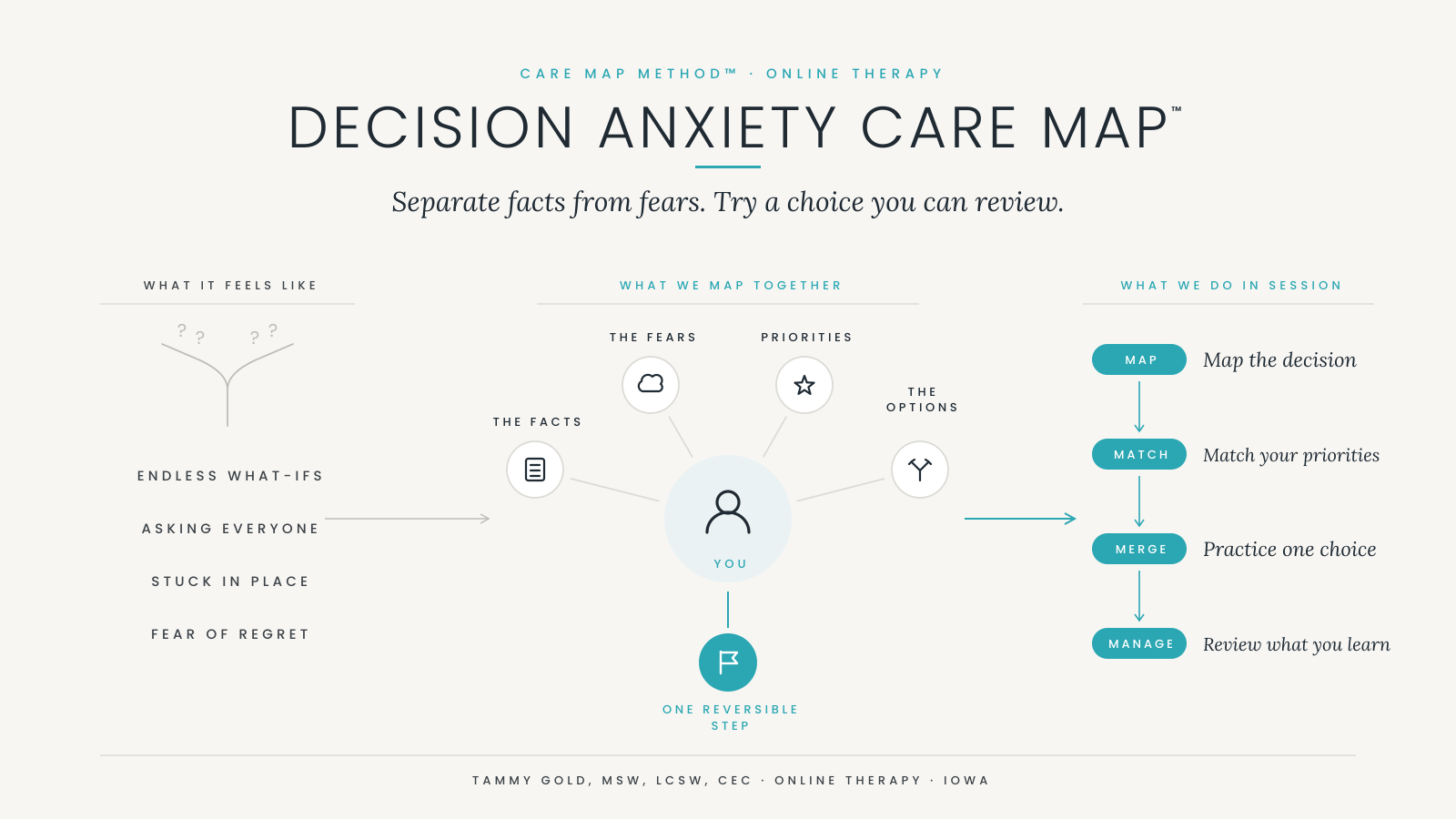
Anxiety and Decision-Making Therapy in Iowa
Repeatedly comparing options or asking for reassurance can leave you less certain than when you started. Explore online therapy in Iowa to understand the worry, clarify priorities and practice a decision process that keeps your choices yours.
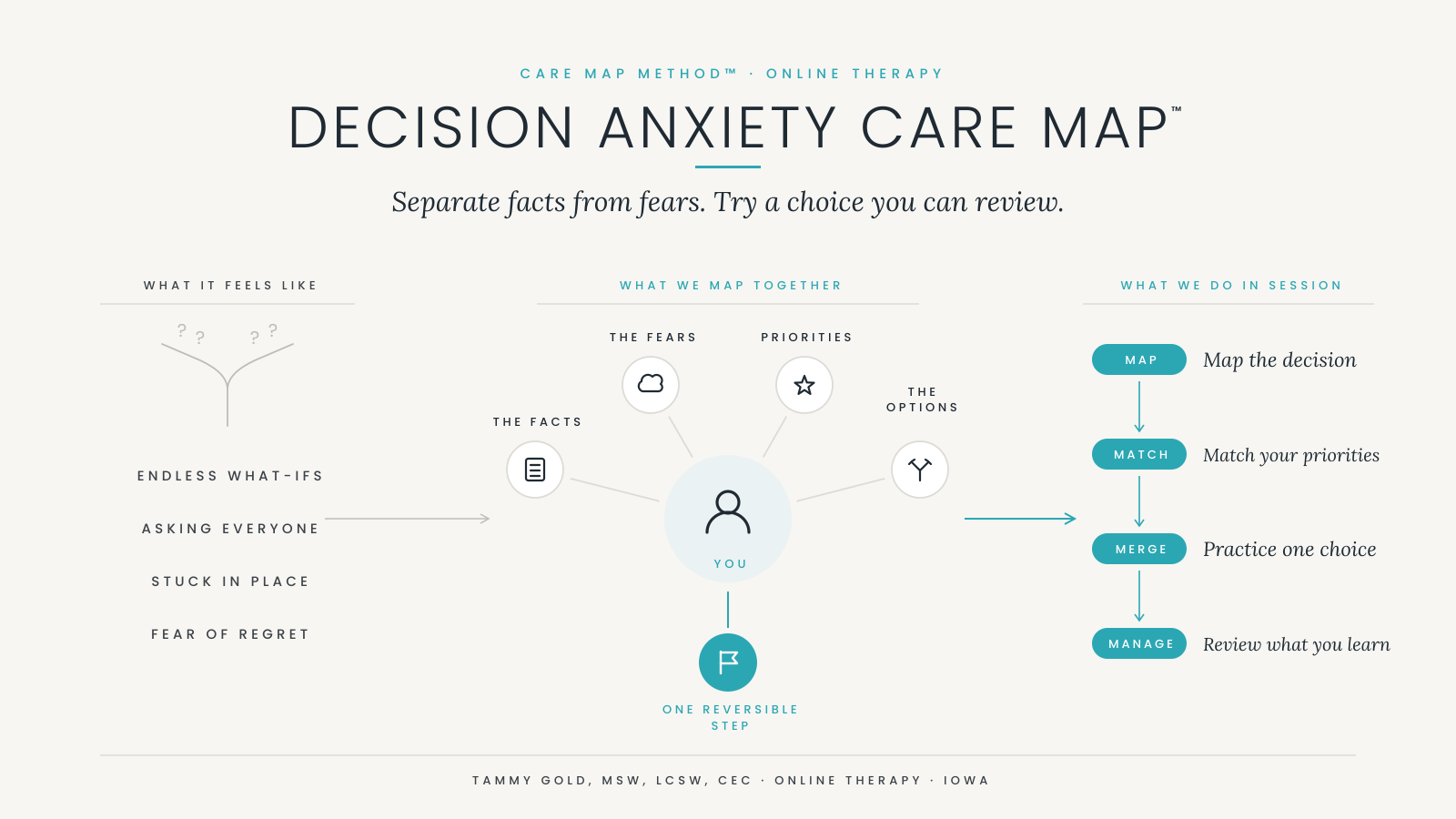
Four illustrated steps for exploring a difficult decision and reviewing a manageable choice.
You compare the options, ask someone what they think and feel settled for a moment. Then another possibility appears and you begin again. A routine decision can take more time and energy than you expected, leaving you frustrated with yourself and worried about making the wrong choice.
I’m Tammy Gold, a licensed therapist. I offer individual online therapy for adults in Iowa experiencing anxiety, relationship stress and difficult life transitions. We can explore what makes decisions feel so loaded, what information you actually need and how you want to respond to uncertainty.
When choosing becomes a cycle of checking
You may reread reviews, ask several people for opinions or postpone answering a simple invitation. Perhaps you make a choice, then keep revisiting it instead of feeling able to move on. Other people may not see how much effort goes into an ordinary day.
We can look at the pattern without assuming that all careful thinking is a problem. Some decisions need time and specialized information. The question is how the process affects you, whether new information is being gained and what happens when you do not feel completely certain. Your assessment helps us understand the concern.
What making the wrong choice seems to mean
The feared outcome may involve disappointing someone, wasting money, causing conflict or proving a harsh belief about yourself. You may feel responsible for predicting consequences that no person could fully know in advance.
In therapy, we can explore the meaning attached to one actual decision. We might consider the standards you are using, whose preferences are taking priority and how past experiences shape the moment. This can help us distinguish a practical question that needs an answer from a repeated attempt to feel perfectly safe.
What we might work on in a session
For example, we might discuss a routine commitment you kept checking with friends. Each opinion added another possibility until you felt less able to choose. We could explore what you hoped the next opinion would settle, what mattered to you and what you feared would happen if someone disagreed.
Together, we might identify the information already available and practice making one proportionate choice. If appropriate, that could involve a small, reversible decision or expressing a preference without another round of consultation. We would discuss the discomfort and review the experience later. The therapist's role is to support your understanding and agency, rather than select the correct life decision for you.
Using the four Care Map steps for decision anxiety
Care Map Method™ helps organize Biological, Social, Environmental and Emotional factors. Fatigue, relationship expectations, the practical setting and emotional history may all affect a choice. We consider those factors alongside your symptoms and functioning.
We MAP the decision, the facts and the feared outcomes. We MATCH support and strategies to the concern and your priorities. We MERGE a chosen approach through rehearsal or a manageable experiment in daily life. We MANAGE the plan by reviewing what you learned and what needs adjustment. The framework does not mean every decision is simple, reversible or appropriate to make without expert advice.
When other people have become part of the decision
You may be used to seeking approval before naming a preference. A partner, parent or friend might offer reassurance generously, while you still find yourself needing more. We can examine the relationship pattern without blaming the person who has been trying to help.
You might practice saying what you prefer, asking one specific factual question or noticing when you are requesting permission rather than information. We can explore what it feels like to have a preference that someone else does not share. The focus stays on your well-being and the choices available in your circumstances.
A first session does not require a finished plan
You can start by describing the choice or pattern that brought you here. We will discuss relevant history, current symptoms and the effect on work, relationships and daily functioning. You can tell me what you have tried and what you would like to be different.
We will consider fit and possible goals together. Financial, medical and legal decisions may require information from the appropriate professionals. Therapy can explore the distress and your participation in the process while respecting those separate areas of expertise.
About Tammy Gold and Iowa appointments
I’m Tammy Gold, MSW, LCSW, CEC, a licensed therapist, certified coach and author. I earned my MSW at Columbia University and my BA at the University of Pennsylvania. My work includes relationships, family stress and the emotional demands of major transitions.
Use my Alma profile to review current Iowa availability and your exact insurance plan. If you have BCBS Massachusetts, verify that specific product and current participation rather than assuming all Blue Cross plans are equivalent. Confirm estimated costs and plan to be physically located in Iowa during an appointment.
Frequently asked questions
Why do ordinary decisions feel so difficult?
We can explore what you fear a choice might mean, the information involved and how the process affects you. There is no single explanation for everyone. Assessment considers your history, symptoms, current pressures and daily functioning before deciding what support fits.
Will you tell me which option to choose?
Your decisions remain yours. Therapy can help you understand priorities, fears and patterns around a choice, while relevant specialists provide information within their expertise. We can practice a decision process without treating the therapist as the authority on your life.
Can we work on asking for reassurance repeatedly?
Yes. We can examine what happens before and after you ask, what the reassurance is meant to settle and how long it helps. That understanding can guide a manageable next step. You do not have to stop a familiar response perfectly.
What if a decision has serious consequences?
We will take the context seriously. Medical, financial or legal questions may need advice from the appropriate professional. Therapy can address the emotional experience and your decision process without replacing expert information or pretending every option is equally safe or reversible.
Is decision paralysis a diagnosis?
It is a descriptive phrase, not a diagnosis by itself. We would discuss the pattern, other symptoms and the impact on your life. Assessment helps clarify whether a clinical condition is present and what form of care may be appropriate.
Do I need to know my therapy goals before contacting you?
No. You can begin with a situation that feels difficult or a pattern you want to understand. We will discuss symptoms, history and functioning, then consider treatment fit and goals together. An initial question can be enough to start the conversation.
Can I use BCBS Massachusetts while located in Iowa?
Check the exact plan and current Iowa provider participation through my Alma profile. The insurer name does not confirm every product or network. Coverage depends on benefits and the clinical service. Review estimated costs before booking an appointment.
How do I check Iowa online appointments?
Open my Alma profile, select your actual location and review current availability and insurance options. Plan to be physically located in Iowa for an Iowa appointment. If the correct state, service or plan is unclear, clarify those details before scheduling.
Take the next step
You can review current Iowa appointment options and your exact insurance plan through my provider profile. Confirm estimated costs before scheduling. We can begin with the situation you want help understanding.
Book A Session Today & Get The Support You Deserve!
For clients using insurance, I use the platforms below:
Alma Therapy https://secure.helloalma.com/providers/tamara-gold/