

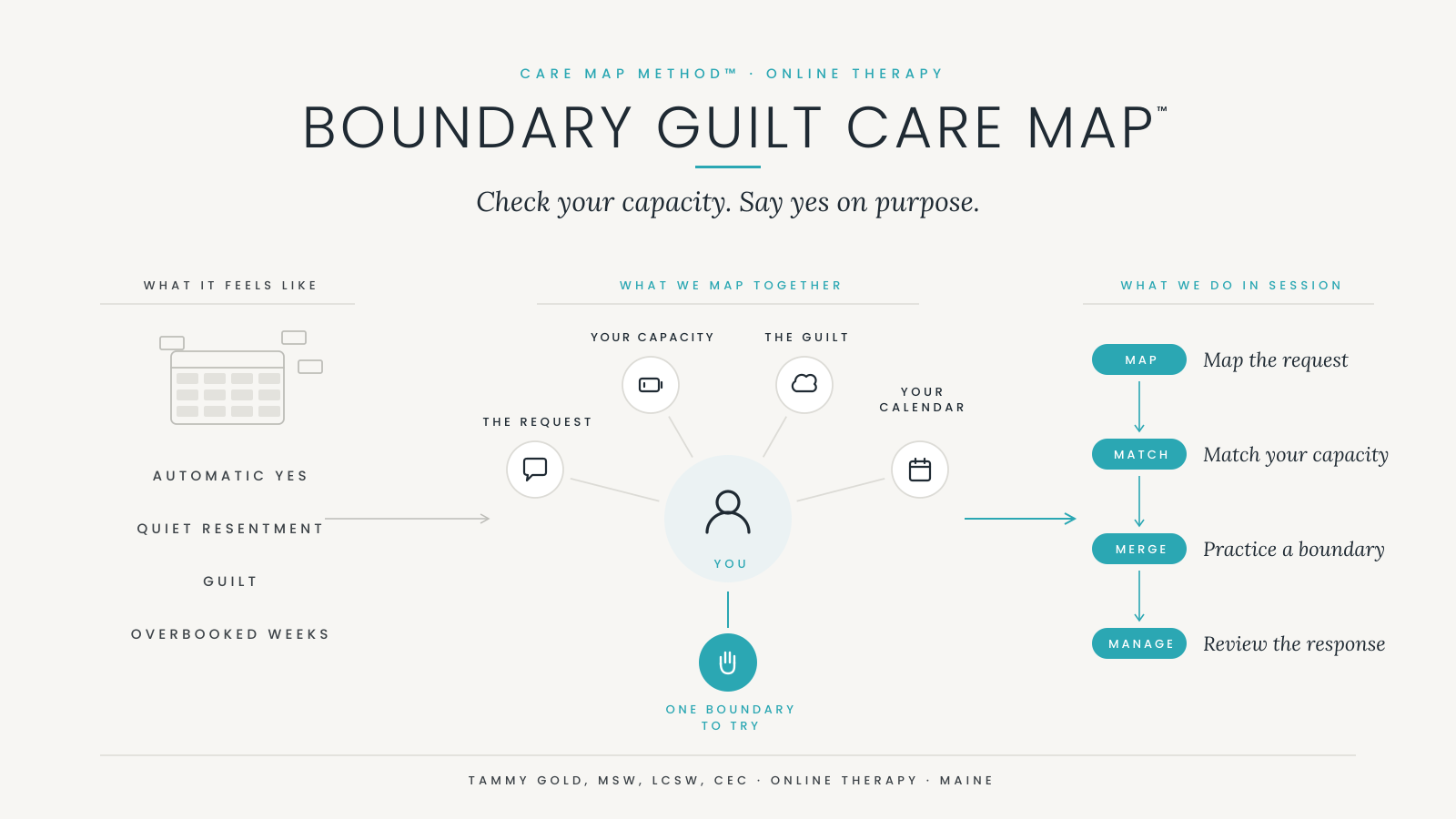
Four illustrated steps for exploring guilt and practicing a boundary around a request.
Someone asks for help and you hear yourself agreeing before you have checked your calendar or your energy. Later, you cancel something you needed and feel resentful. You may then feel guilty for being annoyed with someone you care about.
I’m Tammy Gold, a licensed therapist. I offer individual online therapy for adults in Maine who are struggling with people-pleasing, boundary guilt and relationship stress. We can explore what happens around a request, why declining feels difficult and how you want to respond within your real relationships and responsibilities.
Check Maine Insurance and Availability
When being helpful leaves little room for you
You may be the person who remembers, organizes and makes things easier for everyone else. People may appreciate your reliability without noticing the cost. You might rarely state a preference until you are already frustrated or exhausted.
Helping others can be an important value. We do not need to treat every generous choice as unhealthy. The concern may be the feeling that you cannot choose differently, the fear attached to disappointing someone or the effect of repeated overcommitment on your well-being. We can explore that distinction in the context of your life.
What saying no brings up
A request may carry more than the task itself. You may fear conflict, losing closeness or being seen as selfish. Past family roles or experiences can shape what you expect to happen when someone is unhappy with you.
In therapy, we can consider what you actually know about the relationship and what you are anticipating. We can make room for cultural expectations, practical obligations and limited support. A boundary that fits one person may not fit your circumstances. Understanding the pressure comes before deciding what language or change would be useful.
What we might work on in a session
For example, we might explore a last-minute request from a relative. You agreed, gave up time you needed to rest and spent the evening feeling angry. We could slow down the moment before you said yes: what you noticed, what you feared and what you wanted the other person to understand.
After exploring those feelings, we might rehearse asking for time to answer, offering a limited form of help or declining a particular task. We would consider the likely consequences and what support you need if the person is disappointed. Later, we can review the experience. The purpose is to understand your choices and capacity, rather than find a sentence that makes everyone approve.
Using MAP MATCH MERGE MANAGE for boundary guilt
Care Map Method™ organizes Biological, Social, Environmental and Emotional factors. Your energy and health, family relationships, available time and feelings about responsibility may each influence the request. We consider the full context alongside your symptoms and treatment goals.
We MAP the request, pressure and effect on you. We MATCH a possible response to your needs, values and capacity. We MERGE it into daily life through practice or a manageable change. We MANAGE the plan by reviewing your feelings, the other person's response and what needs adjusting. You do not have to turn boundaries into another set of rules to follow perfectly.
When guilt remains after a clear conversation
You may express a limit respectfully and still feel uncomfortable. That does not tell us by itself whether the choice was right or wrong. We can explore what the guilt is saying, whether repair is needed and what expectations are being challenged.
You may also discover that someone reacts differently than you feared, or that a pattern remains difficult despite clear words. Both experiences give us information. Therapy can help you stay connected to your own needs while reflecting on the relationship, without promising that every boundary will preserve closeness or prevent conflict.
Beginning with one situation
A first appointment can start with a request you regretted accepting or a conversation you have been postponing. We will discuss your history, current symptoms and how the pattern affects daily life, work and relationships. Together, we can consider treatment fit and goals.
Possible goals might involve pausing before agreeing, noticing a preference earlier or asking for a specific kind of support. Those are examples to explore, not a checklist every client must complete. We can adjust the direction as your circumstances and understanding change.
About Tammy Gold and Maine appointments
I’m Tammy Gold, MSW, LCSW, CEC, a licensed therapist, certified coach and author. I earned my MSW at Columbia University and my BA at the University of Pennsylvania. My work includes relationships, parenting, caregiving and family stress.
Review my Alma profile for current Maine appointments and exact-plan participation. If you are checking Aetna or an Optum-administered plan, use the specific member information and confirm estimated costs. Plan to be physically located in Maine during a Maine online appointment.
Frequently asked questions
Can I set boundaries and still care about people?
Yes. We can explore how caring, responsibility and your own capacity fit together. The work does not require giving up important relationships or generosity. We can consider whether a particular choice reflects your values and what effect it has on your well-being.
What if someone becomes upset when I say no?
We can discuss the actual relationship, possible consequences and how you want to respond. Another person's disappointment cannot always be prevented. Therapy can help you reflect on your needs and options, including whether a conversation, adjustment or other support is appropriate.
Can we practice the exact words?
Yes. We can rehearse language for a specific situation and notice how it feels to say it. The wording should fit your voice and circumstances. It is a starting point for practice, not a script guaranteed to produce agreement.
What if I agree before realizing I do not want to?
We can examine the sequence and where you notice your own preference. Possible work might involve pausing, asking for time or discussing a commitment you need to revisit. We would consider the relationship and practical consequences rather than assume every agreement can be changed.
Is helping others always people-pleasing?
No. Helping can be freely chosen and meaningful. We can explore whether the concern is fear, a sense of having no choice, repeated overcommitment or something else. Your values, responsibilities and the effect on your functioning help us understand the pattern.
Can therapy address resentment after I overcommit?
We can explore the feelings, expectations and circumstances around the commitment, including what you wanted to ask for. That may inform a future conversation or different choice. You do not have to judge the resentment as evidence that you are uncaring.
Can I use Aetna or Optum through Alma in Maine?
Check your exact plan and my current Maine participation through Alma. Optum administers different products, so the company name alone is not enough to establish benefits. Confirm the service and estimated cost before scheduling an appointment.
How do I arrange an online session from Maine?
Use my Alma profile to review current appointments and insurance options for Maine. Plan to attend from a private place while physically located in the state. You can begin with one situation that made you want help understanding the pattern.
Take the next step
You can review current Maine appointment options and your exact insurance plan through my provider profile. Confirm estimated costs before scheduling. We can begin with the situation you want help understanding.
Check Maine Insurance and Availability on Headway or Alma today