

Young adult attending a video therapy session in a newly furnished apartment.
When your surroundings change faster than your sense of belonging
After college or a move, you may suddenly have to plan the kind of contact that used to happen naturally. Friends are no longer down the hall. People have different schedules, partners or responsibilities. Your new location may look exciting while your evenings feel unexpectedly quiet. You may wonder why you are lonely when you chose the change.
Therapy for loneliness can help you understand that gap between the life you expected and the one you are experiencing. We can make room for what you miss, assess how the transition is affecting you and identify forms of connection that fit your current circumstances.
Loneliness is not always about the number of people around you
You can be surrounded by coworkers, roommates or classmates and still feel unknown. Some relationships may be pleasant without offering the closeness you need. You might also avoid reaching out because you assume everyone else already has enough friends. Social media can make that assumption feel convincing even when it gives you only a partial view.
We can explore the quality of connection you want and what gets in the way. That may involve social anxiety, low mood, grief, mismatched expectations or a practical lack of opportunities. We do not need to reduce every experience of loneliness to a problem with your social skills.
Grieving the community you left behind
A transition may involve losing routines, familiar places and the easy recognition of people who knew your history. Even when old friendships continue, the relationship can feel different across distance. You may feel guilty about not enjoying your new life quickly enough or afraid that missing the old one means the move was a mistake.
Therapy can help you hold mixed feelings without rushing to a verdict. You can appreciate an opportunity and grieve what it cost. We can also examine which parts of the previous community you want to preserve and which needs will require something new.
How I approach building connection
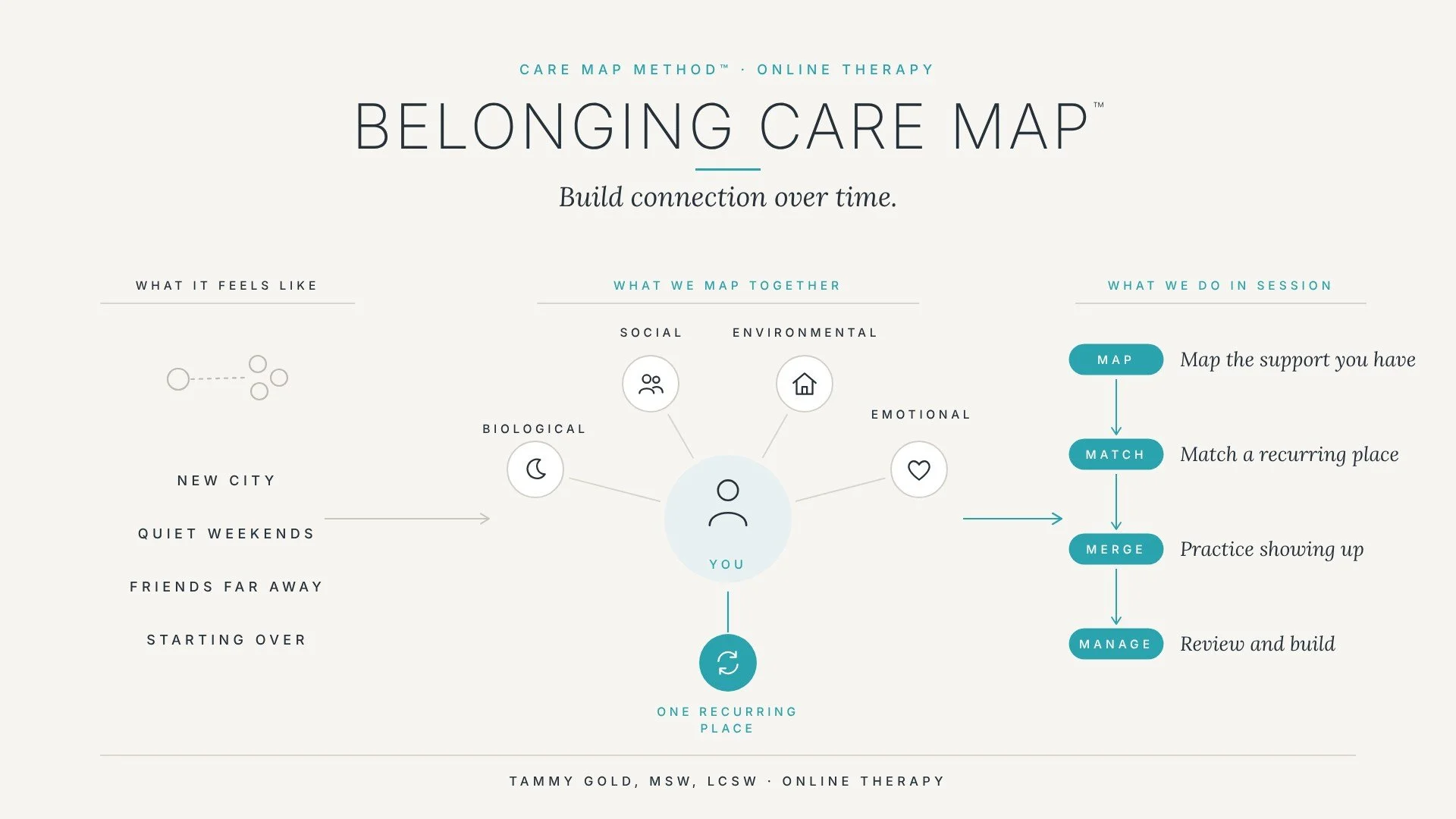
We can use the Care Map Method™ to MAP your current support network and daily environment, MATCH the therapeutic work to the barriers involved, MERGE manageable steps into your routines and MANAGE what changes over time. We also consider energy, health, finances, transport and work schedules.
For example, joining a recurring activity may create more opportunity than attending a different large event every weekend. That does not mean a recurring activity guarantees friendship. It provides a setting in which familiarity can develop. We can discuss how to participate in a way that fits your preferences and how to handle disappointment without abandoning the effort entirely.
Working with fear of reaching out
You may hesitate to message someone because it feels embarrassing to initiate. A delayed response may feel like proof that the attempt was unwelcome. We can examine those interpretations, the relationship involved and what a reasonable next step might look like. The goal is not to make you chase people who repeatedly disregard you.
We can also work on recognizing reciprocity, communicating interest and allowing different relationships to develop at different speeds. You may benefit from several kinds of connection rather than expecting one person to meet every need. Therapy itself can support that exploration, while remaining distinct from a friendship or social-matching service.
Taking loneliness seriously without promising an instant fix
Connection usually develops through experiences over time. Progress may involve feeling less ashamed of loneliness, identifying relationships that fit better or becoming more willing to accept an invitation. We can review how the work affects your mood and functioning, and consider additional supports when appropriate.
If the loneliness is accompanied by persistent depression, major sleep changes or significant withdrawal, we will assess those concerns rather than treat the issue only as a matter of getting out more. You do not need to wait until a transition becomes a crisis before asking for help.
About Tamara Gold
I am Tamara “Tammy” Gold, MSW, LCSW, CEC, a Columbia University-trained therapist, certified coach and author of Secrets of the Nanny Whisperer. My work with individuals and families informs a warm, collaborative approach that connects emotional understanding with practical next steps. Treatment is individualized to your needs; results and timelines vary.
Online appointments and insurance
Online appointments depend on your physical location at each session, clinical fit and current availability. Review my booking profiles to confirm whether I can serve you in your state. Selected insurance plans may be available through Headway or Alma. Coverage, medical-necessity requirements and your costs depend on your individual plan; a life problem alone does not establish insurance coverage.
Frequently asked questions
Is it normal to feel lonely after graduation?
Many transitions involve changes in routine and contact, but your individual distress still matters. We can assess how long it has been happening, what it affects and whether additional clinical concerns need attention.
Can therapy help if I have no local friends?
Therapy can help you understand barriers, manage distress and identify realistic ways to seek connection. It cannot provide or guarantee a friend group. We can also consider community resources that fit your interests.
What if I moved for a partner or job and regret it?
We can explore regret, grief, relationship expectations and practical options without deciding immediately that you must stay or leave. The goal is to understand what needs attention and support thoughtful choices.
Is loneliness the same as social anxiety?
No. Loneliness concerns unmet connection; social anxiety involves fear in social situations. They can occur together or separately. Assessment helps us avoid assuming that the same approach fits both.
Can we work on keeping long-distance friendships?
Yes. We can discuss expectations, communication, reciprocity and the feelings that arise as friendships change. The work can include preserving important relationships while allowing room for new ones.
Should I wait until I am settled before starting therapy?
You do not have to wait. Therapy can be useful during a transition. Before booking, confirm your current location, available appointment times and whether virtual care is appropriate for your needs.
Take the next step
If this sounds like the kind of support you need, review current appointment options and check insurance eligibility through my Headway or Alma profile. You can bring questions about fit, fees and the process before scheduling. You do not need a perfect explanation of the problem to begin.