

When thinking stops bringing you closer to an answer
You replay what you said, revisit a decision or imagine how a conversation could go wrong. At first the thinking may feel useful. You are trying to prepare, avoid a mistake or understand another person. But after a while you may notice that you have more questions, less confidence and no clearer idea of what to do.
Therapy for overthinking can help you understand the pattern and its effect on your life. We can look at what starts the reviewing, what keeps it going and what you hope it will accomplish. The aim is not to stop all thought or replace every worry with a positive statement.
The different forms overthinking can take
You may review the past, predict future problems or repeatedly question your own choices. Some people seek reassurance from friends, search online or rewrite messages until they feel acceptable. Others keep concerns private and spend hours trying to reach certainty on their own. The same outward behavior can serve different purposes for different people.
We will assess the broader picture, including mood, sleep, concentration, anxiety and daily functioning. Repetitive thoughts can appear in several clinical contexts, so a webpage cannot determine what diagnosis or treatment is appropriate. If a specialized approach is needed, we can discuss that directly.
Understanding the question beneath the question
A repeated thought such as whether you sounded foolish may carry a deeper fear of rejection. Reconsidering a work decision may involve uncertainty about competence or responsibility. Sometimes the concern also reflects a genuine unresolved situation that needs action. We can make room for those possibilities without assuming every thought is meaningless.
In sessions we might distinguish a problem with an available next step from a question that cannot be settled with more mental reviewing. We can also examine self-criticism and the belief that enough preparation should prevent all regret. A more useful goal may be responding thoughtfully while accepting that some uncertainty remains.
Working with an everyday example
Imagine that you send a message and do not receive an immediate reply. You read it again, notice a phrase you wish you had changed and begin drafting an apology. Checking temporarily reduces tension, but soon you need to check again. Your attention moves away from the rest of your day.
We could examine the assumptions, the urge to repair and the effect of repeated checking. We might discuss a way to respond that fits the situation and your treatment plan. The work would also consider what the uncertainty means to you, rather than simply instructing you to stop looking at your phone.
Bringing insight into ordinary routines
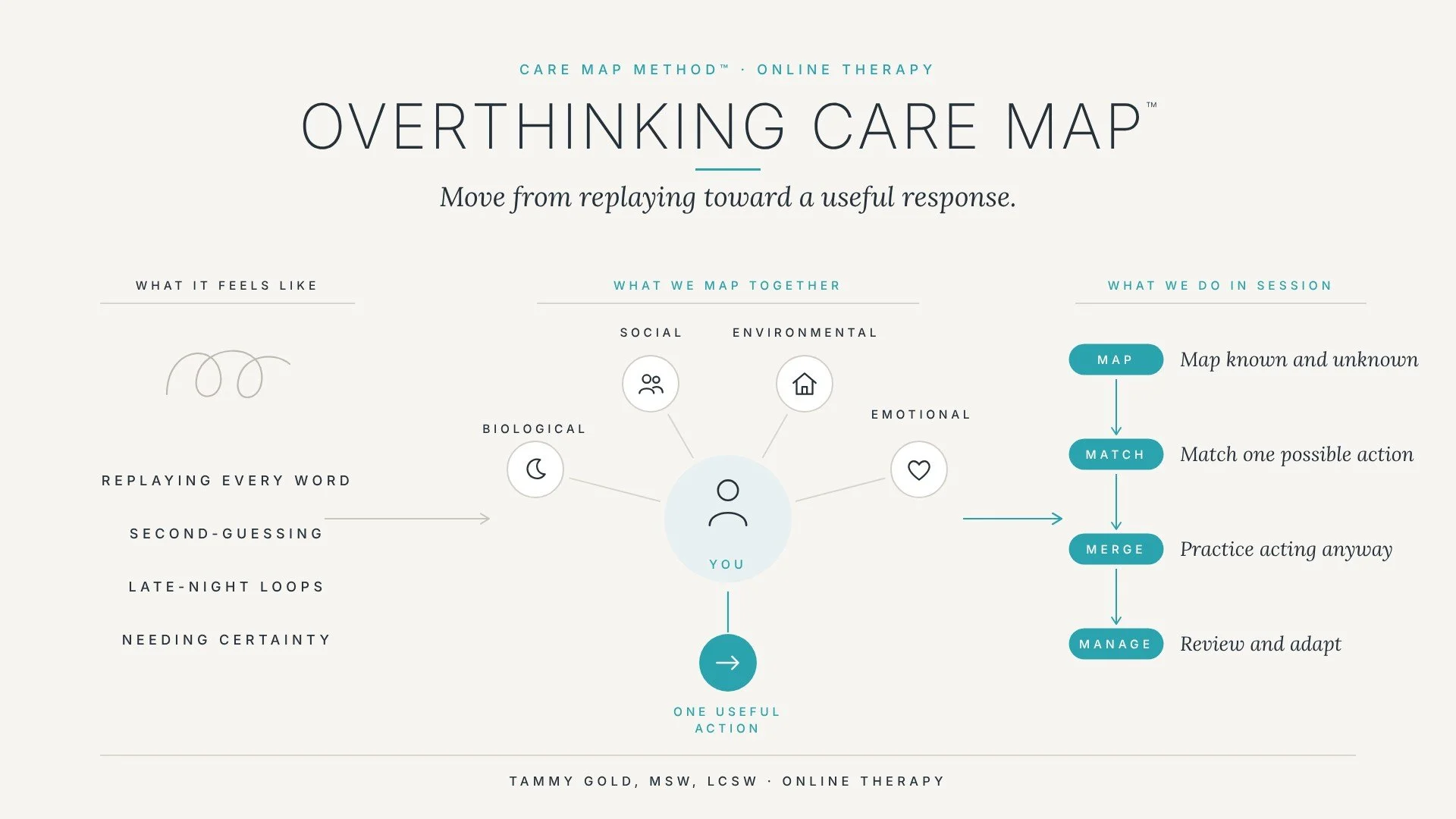
Using the Care Map Method™, we MAP triggers and responses, MATCH the work to your clinical needs, MERGE what is useful into everyday situations and MANAGE the results. That might include noticing when you begin reviewing, identifying a concrete action or changing how you respond to self-critical thoughts.
Between-session practice should be manageable and purposeful. It should not become another task you feel compelled to perform perfectly. We can discuss what happened, including when a strategy did not help. Learning about the pattern is useful information, not evidence that you have failed therapy.
Progress without requiring a perfectly quiet mind
Some difficult thoughts may still occur even when the work is helping. Progress can involve spending less time following them, recovering attention more readily or making a decision without repeatedly asking for confirmation. We will define goals around your functioning and priorities, rather than promising that worry will disappear.
We can also address relationships and situations that keep uncertainty high. If someone communicates inconsistently or a role lacks clear expectations, your environment may need attention too. Therapy can help you make more deliberate choices about both your response and the circumstances around you.
About Tamara Gold
I am Tamara “Tammy” Gold, MSW, LCSW, CEC, a Columbia University-trained therapist, certified coach and author of Secrets of the Nanny Whisperer. My work with individuals and families informs a warm, collaborative approach that connects emotional understanding with practical next steps. Treatment is individualized to your needs; results and timelines vary.
Online appointments and insurance
Online appointments depend on your physical location at each session, clinical fit and current availability. Review my booking profiles to confirm whether I can serve you in your state. Selected insurance plans may be available through Headway or Alma. Coverage, medical-necessity requirements and your costs depend on your individual plan; a life problem alone does not establish insurance coverage.
Frequently asked questions
Is overthinking a diagnosis?
No. It is a common description of repeated thought patterns. Assessment considers whether anxiety, mood, obsessive-compulsive symptoms, stress or another concern may be involved. Treatment should follow that assessment.
Can therapy help me stop replaying conversations?
We can work on the meaning you assign to interactions, repeated reviewing and the impact on your day. Goals may include spending less time reviewing and responding more flexibly, rather than never remembering a conversation.
Why does reassurance only help for a little while?
Reassurance may reduce discomfort briefly without resolving the underlying uncertainty or pattern. We can examine how it functions in your situation and whether a different response would be more useful.
Will you teach me to think positively?
Therapy is not limited to replacing a negative thought with a positive one. We can consider accuracy, uncertainty, emotional meaning, behavior and the real conditions around the concern.
What if I really made a mistake?
We can separate appropriate repair or learning from prolonged punishment of yourself. A mistake may call for action, but repeated self-criticism does not necessarily make the action more effective.
Can we discuss sleep problems related to worry?
Yes. Sleep and worry can affect one another. We can assess the pattern and discuss whether medical evaluation or specialized sleep treatment would be useful alongside therapy.
Take the next step
If this sounds like the kind of support you need, review current appointment options and check insurance eligibility through my Headway or Alma profile. You can bring questions about fit, fees and the process before scheduling. You do not need a perfect explanation of the problem to begin.