

My Adult Child Will Not Speak to Me
When an adult child stops communicating, grief can mix with confusion, anger, shame, and hope. You may reread messages, wonder whether to reach out again, or feel unable to talk openly with friends. Individual therapy gives you space to process the loss and examine your own experience without assuming either person is entirely to blame. I offer online therapy for adults located in Maine. We can explore accountability, boundaries, daily coping, and what respectful contact might look like if it is appropriate. Therapy cannot promise reconciliation. Use my Alma profile to check availability and your specific insurance benefits.
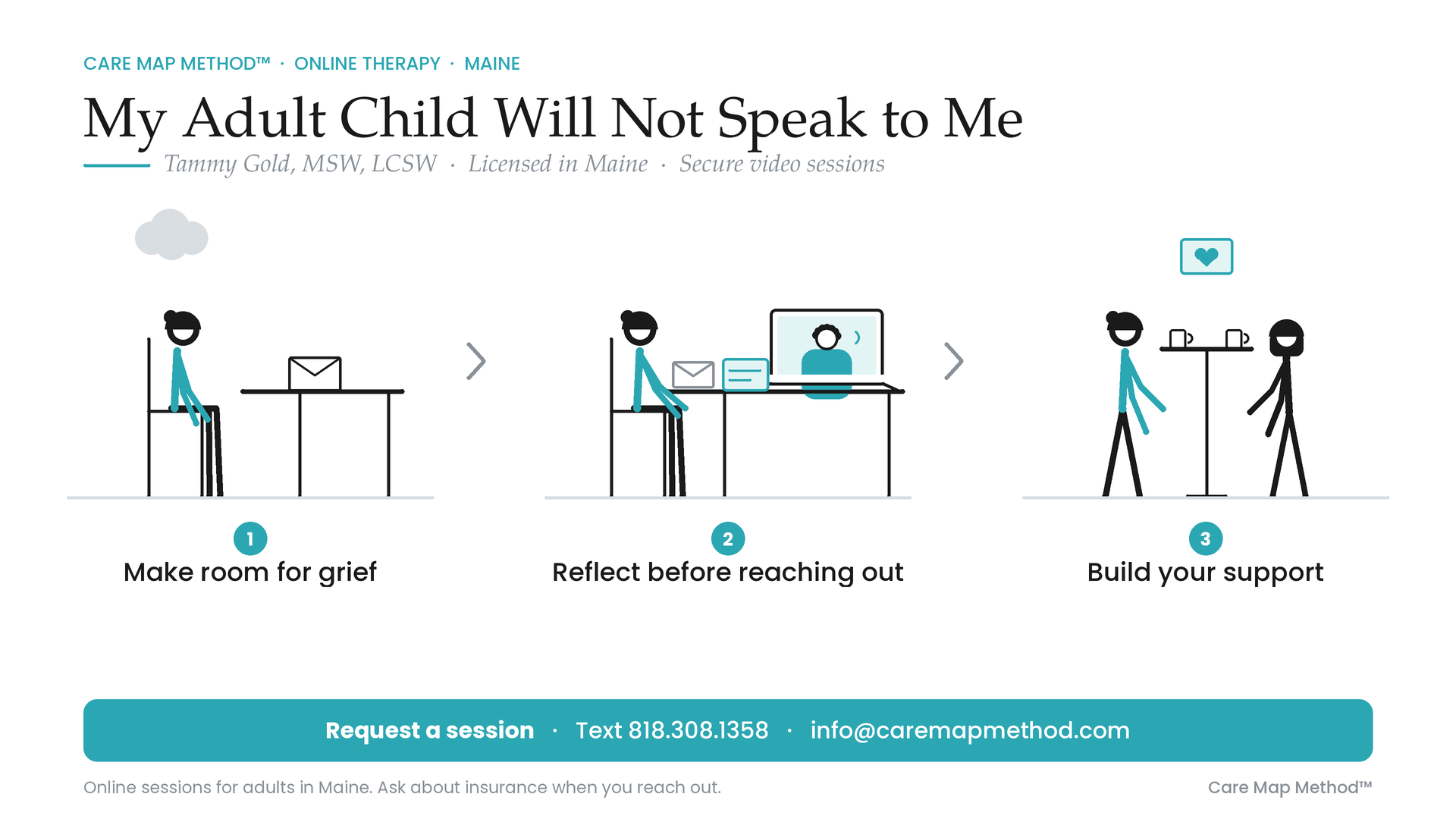
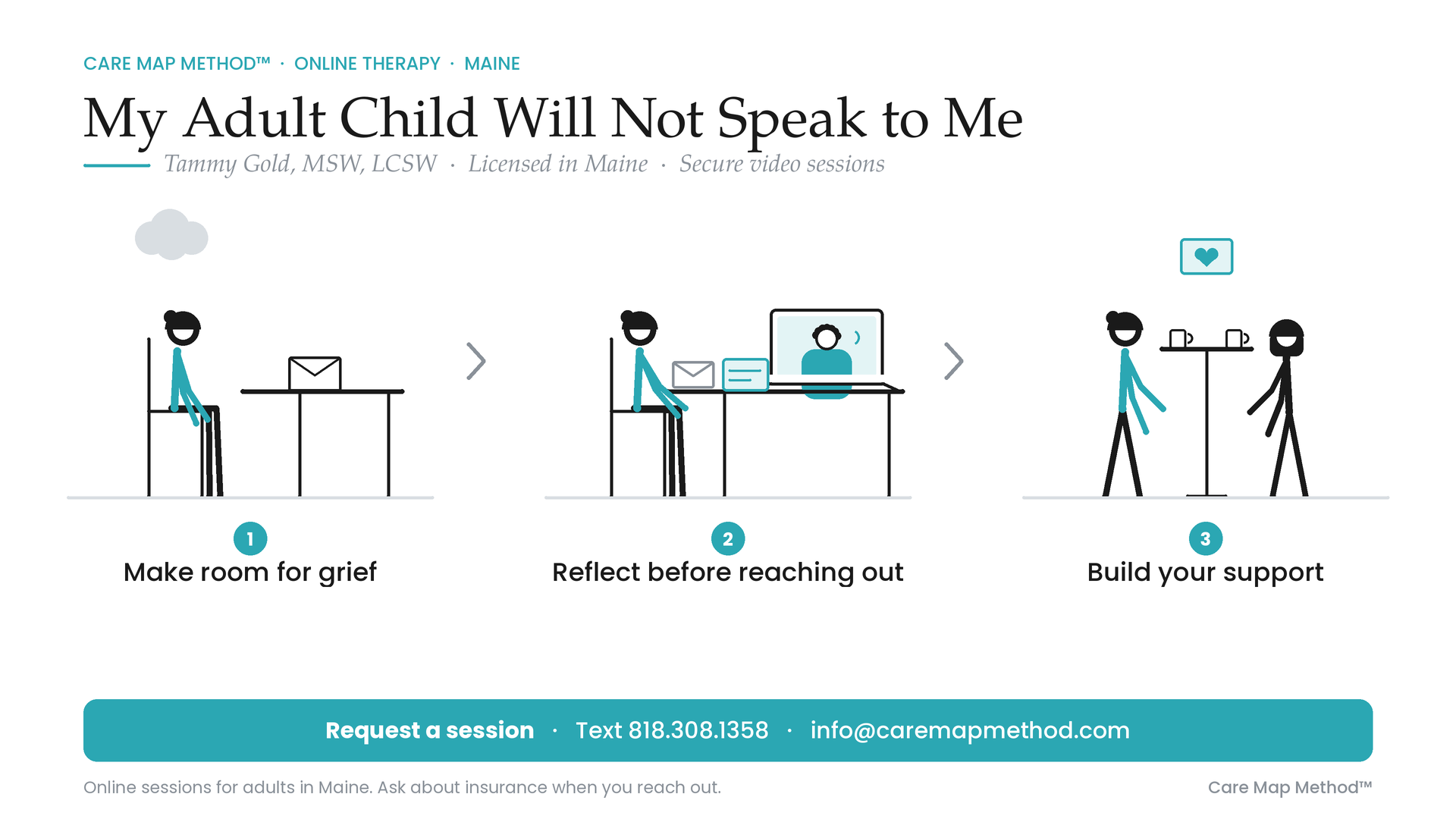
An adult setting aside an unsent letter while talking with a therapist on a laptop; another small scene shows the adult reconnecting with a supportive friend.
When there is no clear ending and no clear way forward
You may still think of your adult child throughout the day while having little or no contact. Holidays, photographs, or an ordinary family question can bring a fresh wave of sadness. You might alternate between wanting to explain yourself and feeling afraid that any message will make things worse.
I am Tammy Gold, LCSW. I offer online individual therapy for adults physically located in Maine. We can make room for the grief, uncertainty, and complicated feelings without rushing you toward forgiveness, repeated contact, or a particular family outcome.
Explore your experience without deciding the whole story
We can discuss how the estrangement affects mood, sleep, concentration, relationships, and daily life. We can also explore the history you bring, what your child has communicated, what you understand, and what remains unclear. Taking your pain seriously does not require dismissing their perspective.
Depending on your needs, sessions may involve grief, responsibility, limits, or the urge to keep seeking an answer. We can distinguish reflection that helps you learn from repetitive self-blame that keeps you stuck. We will not diagnose an absent family member or assume that a particular message will bring them back.
Use Care Map Method to organize what needs attention
Alongside clinical assessment, the Biological, Emotional, Social, and Environmental lens helps us consider how you are sleeping and functioning, the feelings involved, your support system, and situations such as holidays or social media that intensify distress.
MAP the trigger, such as seeing a photograph or receiving no reply. MATCH the need with a strategy for grief, support, accountability, or a boundary. MERGE that strategy into daily life, perhaps by preparing for a holiday or changing a checking habit. MANAGE communication and responses by reviewing what supports you and respects the other person’s limits. The framework is not a reconciliation protocol.
Consider contact carefully and rebuild support
Before sending a message, try writing an unsent version. What is its purpose? Does it acknowledge anything you can take responsibility for? Does it ask your child to manage your distress? Has your child requested no contact? We can examine these questions without assuming sending the message is the right next step.
Progress may involve fewer hours spent checking for a reply, more support outside the relationship, or greater ability to tolerate uncertainty. You can grieve and still participate in your own life. We will review what is helping you function and cope, while recognizing that renewed contact depends on more than your individual therapy work.
Insurance and next steps
I offer online individual therapy through Alma for eligible clients located in Maine. Use my profile to check your specific insurance plan, estimated cost, and appointment options. Network participation and benefits vary. Insurance coverage depends on assessment and the service provided; a concern named on this page does not automatically establish a covered diagnosis.
You do not need to have the whole situation figured out before reaching out. We can begin by understanding what is most difficult and deciding whether this service is a good fit.
Frequently asked questions
Can therapy make my adult child reconnect?
No. Therapy cannot guarantee contact or reconciliation. It can support your coping, reflection, accountability, boundaries, and choices about communication. Your adult child’s decisions and stated limits remain outside your control.
Do you take the parent’s side?
I work with you as the client while remaining open to complexity and missing information. We can take your pain seriously and explore responsibility without treating therapy as a judgment about who is entirely right or wrong.
What will we discuss first?
We begin with what is happening now, how it affects you, relevant history, supports, symptoms, and safety. You do not need to bring every message or prove your account. We can decide together what information is useful.
Can I use my insurance?
My Alma profile can check your exact Maine plan and estimated costs. Coverage depends on benefits, participation, clinical assessment, and the psychotherapy service. Support for estrangement does not automatically mean family mediation or reunification services are covered.
Can my adult child join later?
Any involvement would need a separate discussion of consent, goals, confidentiality, and suitability. We do not assume that inviting them is appropriate or that individual therapy automatically becomes family therapy.
How do I start individual support?
Use “View Maine Availability on Alma” to explore an appointment. A general description of your concern is enough for an initial inquiry. You can begin even if you are unsure what you want to do about the relationship.
About Tammy Gold
Tamara “Tammy” Gold, MSW, LCSW, CEC, is a Columbia University–trained clinical social worker, University of Pennsylvania graduate, certified coach, and founder of Care Map Method™. She is the author of Secrets of the Nanny Whisperer and brings more than 20 years of direct family work. Her therapy style is warm, collaborative, and practical, with attention to emotions, history, and everyday functioning.