

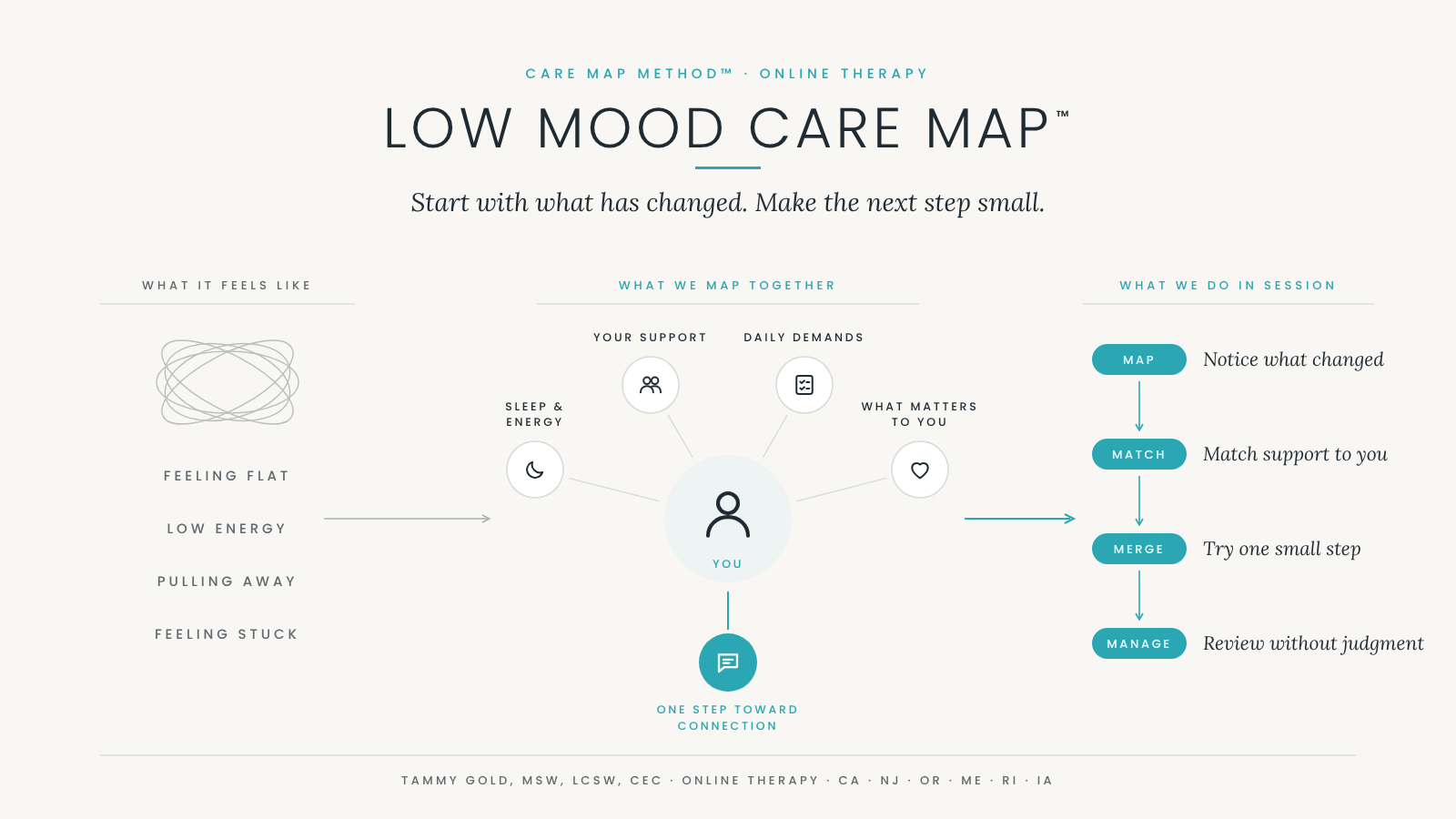
Some days, it takes effort to do things that used to feel ordinary. You may keep going to work, answer messages, or take care of other people, while feeling flat or disconnected inside. Maybe you are sleeping differently, losing interest, or wondering why you cannot just pull yourself out of it.
I’m Tammy Gold, LCSW. I provide individual online therapy for adults who want support with low mood, anxiety, relationships, parenting stress, and major life changes. We can start with what has shifted for you and explore what might help you feel more connected to your life.
Check current insurance and availability on Alma, Headway or Grow Therapy
Low mood does not always look the same
Depression can affect people in different ways. You might feel sad, irritable, numb, tired, or less interested in activities and relationships. Concentration may be harder. A small decision can feel draining. You may withdraw from people because explaining yourself takes more energy than you have.
Some people keep functioning on the outside and feel increasingly disconnected on the inside. Others notice the change most in their sleep, appetite, energy, or ability to manage daily responsibilities. The important question is not whether your experience looks like someone else’s. It is how you have been feeling, how long it has been going on, and how it affects your life.
Start with the change you have noticed
In a first conversation, we can talk about what feels different. You might say, “I used to look forward to seeing my friends, but now I cancel,” or “I get through the day and then I do not have anything left.” We can discuss when you first noticed the change, what else was happening, and what kind of support you have tried.
Therapy is not about blaming you for having a hard time. It is also not about assuming one cause or one solution. We can consider life events, relationships, health, stress, and past experiences as part of the wider picture. If medical or psychiatric care may be helpful, we can discuss coordination or referral to an appropriate professional.
Make the next step small enough to try
When motivation is low, a long list of goals can make the day feel even harder. We can identify one part of life that matters to you and consider a manageable way to approach it. That might mean replying to one message, taking a short walk, asking someone to sit with you while you handle a task, or talking through a difficult conversation before you have it.
We can also explore what makes the step hard. Perhaps you expect yourself to do it perfectly. Maybe you are worried that reaching out will burden someone. Or the activity reminds you of a loss or disappointment. Understanding the barrier helps us choose a response that fits, and we can review what happened without turning it into a pass-or-fail test.
Talk about relationships and responsibilities
Low mood can affect the way you relate to people. You may feel guilty that you are less patient with your children, partner, or friends. Someone close to you may interpret withdrawal as rejection. You may be carrying work or caregiving responsibilities while trying to conceal how much effort it takes to keep up.
In individual therapy, we can focus on your feelings and choices. We might clarify what you want another person to understand, practice how to ask for support, or explore a boundary that would make the week more manageable. You do not need to bring a family member or partner in order to work on your own goals.
Understand the whole situation with Care Map Method
My Care Map Method organizes Biological, Social, Environmental, and Emotional factors that may be affecting a person’s experience. With low mood, that could mean discussing sleep and energy, who is available for support, the demands in your home or workplace, and the emotions connected with a recent change.
We MAP what is happening,
MATCH therapeutic support to your needs,
MERGE a small step into daily life, and
MANAGE the plan through review. The framework helps us organize a conversation; it does not replace clinical assessment or medical care.
When to seek additional or urgent support
If low mood is affecting your ability to function, it may be useful to speak with a licensed mental health professional. Therapy can include an assessment of symptoms, history, and current stressors. A medical professional can help evaluate health concerns or medication questions.
If you are in immediate danger or think you may hurt yourself, call or text 988 in the United States, call 911, or go to an emergency department. A regular therapy appointment is not a crisis service.
What your first appointment can include
We will discuss what brought you to therapy, how you have been feeling, the effect on daily life, and what you would like help with. You can ask questions about how I work. You do not need to arrive with a diagnosis or a detailed plan.
I offer telehealth to adults located in California, New Jersey, Oregon, Maine, Rhode Island, and Iowa, subject to current availability. You must be physically located in a state where I am licensed during the session. Check my Headway or Alma profile for your state, insurance plan, and current openings.
Frequently asked questions
Does feeling low mean I have depression?
Not necessarily. Low mood can have many causes. A clinical assessment considers the symptoms, duration, history, circumstances, and effect on daily life before determining whether a diagnosis applies.
Can therapy help if I am still getting everything done?
Yes. You can seek support even if you are meeting some responsibilities. We can talk about the effort it takes, how you feel, and whether changes in sleep, interest, relationships, or concentration are affecting your life.
What if I do not know what to say in therapy?
You can start with a recent moment or a simple statement such as “I have not felt like myself.” We can take it from there together.
Can therapy help with numbness or irritability?
Those experiences are worth discussing. We can explore when they occur, what may be contributing, and how they affect your relationships and daily routines.
Should I see a doctor too?
If you have health concerns, medication questions, or a significant change in sleep, energy, or appetite, a medical professional can help assess those issues. Therapy and medical care can be complementary.
Can I use insurance for online therapy?
Coverage depends on your plan, eligibility, clinical needs, and current provider participation. Check the exact plan and estimated cost through my Headway or Alma profile.
What if I am having thoughts of suicide?
If you may act on those thoughts or are in immediate danger, call or text 988, call 911, or go to an emergency department. Do not wait for a scheduled therapy appointment for urgent help.
Do I need to be in California for a session?
No. I can provide telehealth to clients physically located in states where I am licensed and currently available, including Rhode Island. Confirm your location and appointment options through the booking profile.