Why High-Functioning Adults Still Feel Anxious, Exhausted, and Overwhelmed
This should be the first therapy-focused blog because it aligns with the clients most likely to find you through Psychology Today and book through Headway: capable adults managing work, parenting, relationships, caregiving, and major life transitions while privately feeling depleted.
You may be meeting deadlines, caring for your family, managing appointments, answering messages, and keeping everyone else organized.
From the outside, you appear capable.
Inside, however, you may feel anxious, emotionally depleted, irritable, or unable to fully relax.
This experience is common among high-functioning adults. You may continue performing well even while your internal stress level keeps rising. Because your responsibilities are still being handled, other people may not recognize how overwhelmed you feel.
You may even question whether you are “struggling enough” to need therapy.
Therapy is not reserved for people who have stopped functioning. It can also help people who are functioning at a high level but paying an increasingly significant emotional and physical price.
What Does “High-Functioning Anxiety” Mean?
“High-functioning anxiety” is not a formal diagnosis. It is a phrase often used to describe people who appear organized, productive, or successful while experiencing persistent anxiety beneath the surface.
You may be:
dependable and responsible
highly prepared
sensitive to mistakes
uncomfortable disappointing others
constantly anticipating what could go wrong
reluctant to ask for help
unable to rest without feeling guilty
mentally reviewing conversations and decisions
functioning through exhaustion
These qualities may help you succeed professionally or manage a complicated family life. Over time, however, the same patterns can contribute to chronic tension, emotional fatigue, sleep problems, resentment, and burnout.
Why Capable Adults Often Miss the Signs
High-functioning adults are often accustomed to solving problems.
When stress increases, they may respond by becoming even more organized, productive, or controlling. They create more lists, work longer hours, take on additional responsibilities, and try harder to prevent mistakes.
This can temporarily create a sense of control.
But increased effort does not always address the underlying anxiety. It may instead reinforce the belief that everything will fall apart unless you personally manage every detail.
Because you continue functioning, it can be difficult to recognize that your coping system is becoming unsustainable.
Signs That Emotional Overload May Be Building
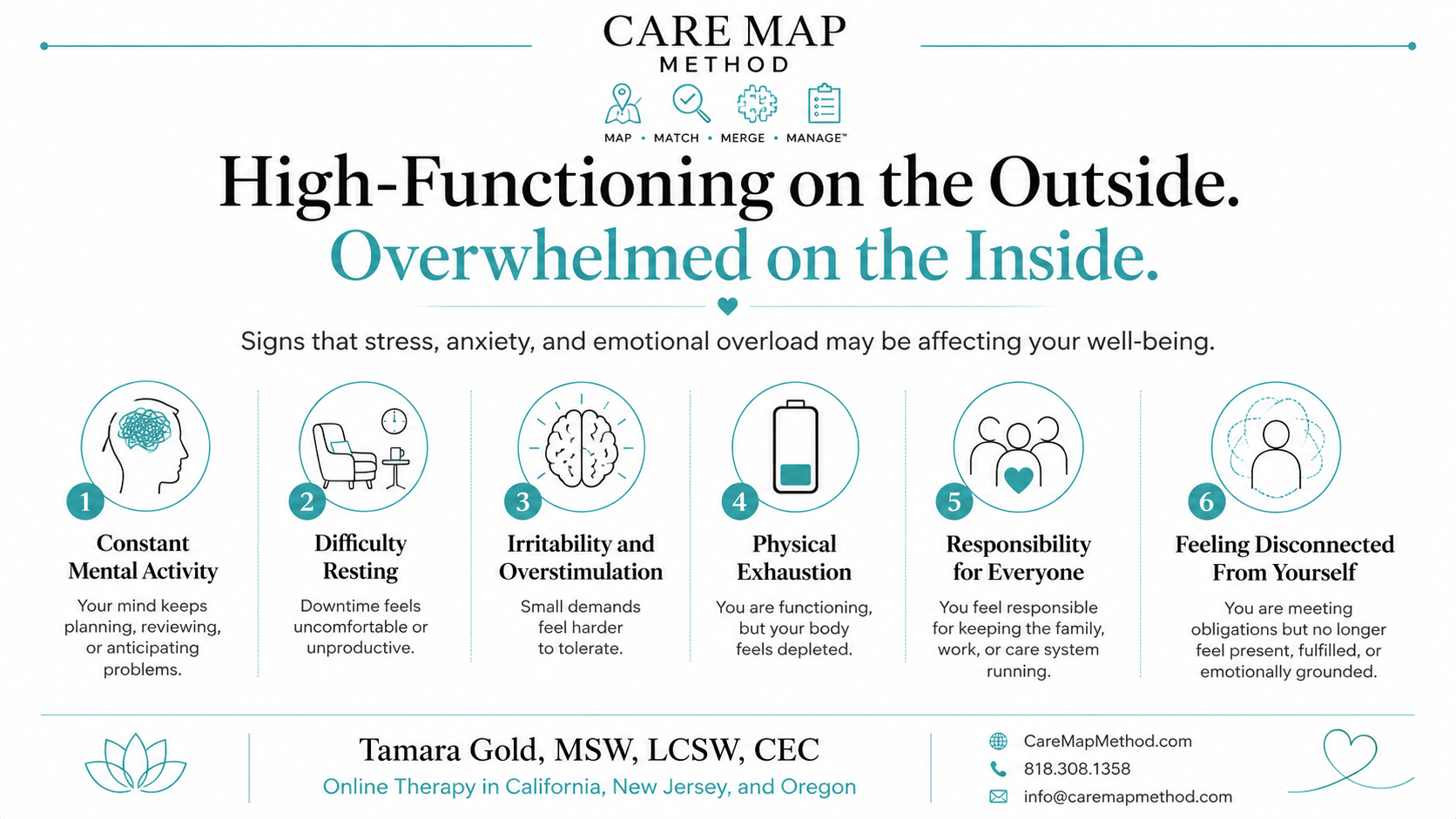
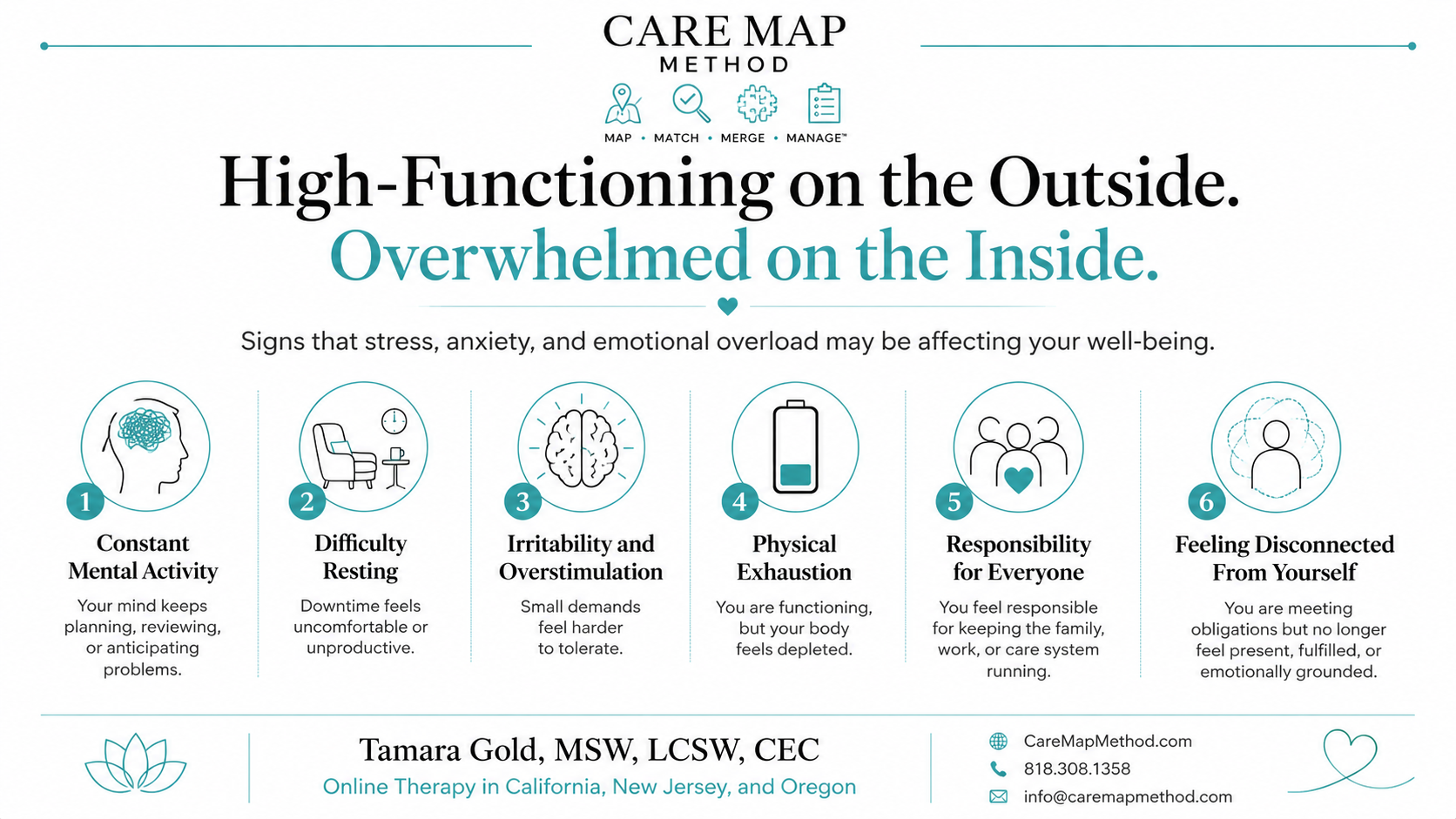
Stress does not always appear as panic or visible distress. It may appear through subtle patterns that gradually become your normal way of living.
1. Your mind is rarely quiet
You may constantly plan, rehearse, anticipate, or review.
Even when nothing urgent is happening, your mind may search for the next problem to solve.
2. You cannot fully enjoy downtime
You may sit down to rest but immediately think about unfinished tasks.
Rest may feel uncomfortable, undeserved, or unproductive.
3. Small demands feel disproportionately difficult
A text message, schedule change, interruption, or minor mistake may feel far more upsetting than it once did.
This does not necessarily mean you are overreacting. It may mean your nervous system is already carrying too much.
4. You feel responsible for everyone
You may believe it is your job to manage other people’s emotions, prevent conflict, remember every detail, and keep the family or workplace functioning.
This can leave little space for your own needs.
5. Your body feels exhausted even when you keep going
Chronic stress can show up as muscle tension, headaches, disrupted sleep, stomach discomfort, fatigue, restlessness, or difficulty concentrating.
You may still complete your responsibilities while feeling physically depleted.
6. You are becoming more irritable or emotionally distant
When your emotional resources are exhausted, you may become impatient, withdrawn, numb, or easily overstimulated.
You may care deeply about the people around you while feeling increasingly unable to engage with them.
7. You no longer feel like yourself
You may be accomplishing everything expected of you but feel disconnected from joy, creativity, confidence, or meaning.
Life may begin to feel like one obligation after another.
Why Parenting and Caregiving Can Intensify These Patterns
Parents and caregivers frequently manage both visible and invisible responsibilities.
Visible tasks include appointments, transportation, meals, work, school, medications, paperwork, and household logistics.
Invisible tasks include:
anticipating everyone’s needs
monitoring emotional well-being
preventing conflict
remembering deadlines
researching options
making difficult decisions
managing guilt
worrying about what may happen next
When you are the person everyone relies on, it can feel risky to slow down.
You may fear that asking for help will burden other people or expose areas where you do not feel fully in control.
Therapy can provide a private space where you are not required to care for, organize, or protect anyone else.
High-Functioning Anxiety Versus Burnout
Anxiety and burnout can overlap, but they are not identical.
Anxiety often involves:
persistent worry
fear of mistakes
overpreparation
difficulty tolerating uncertainty
physical tension
trouble turning off thoughts
Burnout often involves:
emotional exhaustion
reduced motivation
irritability
detachment
feeling ineffective
difficulty recovering between demands
Many people experience both.
Anxiety may drive you to keep performing, while burnout gradually reduces your emotional and physical capacity to continue.
How Therapy Can Help
Therapy can help you understand the patterns underneath chronic overwhelm rather than simply giving you another list of tasks to complete.
The work may include:
identifying triggers and recurring stress cycles
understanding perfectionism and over-responsibility
learning to tolerate uncertainty
reducing guilt around rest and boundaries
noticing physical signs of escalation
improving emotional regulation
changing unhelpful relationship patterns
developing more sustainable routines
separating your responsibilities from other people’s responsibilities
reconnecting with your own priorities and identity
The goal is not to make you less capable.
The goal is to help you use your strengths without sacrificing your health, relationships, or sense of self.
You Do Not Have to Wait Until Everything Falls Apart
Many people postpone therapy because they are still working, parenting, caregiving, or meeting their obligations.
But continued performance does not mean the current situation is sustainable.
You do not need to wait for a crisis, panic attack, relationship rupture, or complete exhaustion before seeking support.
Therapy can be useful when you notice that your current way of coping is becoming too costly.
Online Therapy for Anxiety, Overwhelm, and Life Transitions
I work with adults who may appear capable and composed while privately experiencing anxiety, parenting stress, caregiver strain, relationship stress, burnout, or major life transitions.
My approach is warm, practical, and collaborative. We work to understand what is creating distress, identify patterns that are no longer helping, and develop tools that fit your actual life.
Online therapy is available to clients located in:
California
New Jersey
Oregon
Ready to Begin?
You may not need to change everything at once.
A first therapy appointment can help you clarify what is happening, identify the areas creating the most strain, and determine what kind of support would be most useful.
Use the button below to review insurance options and request an appointment through Headway.
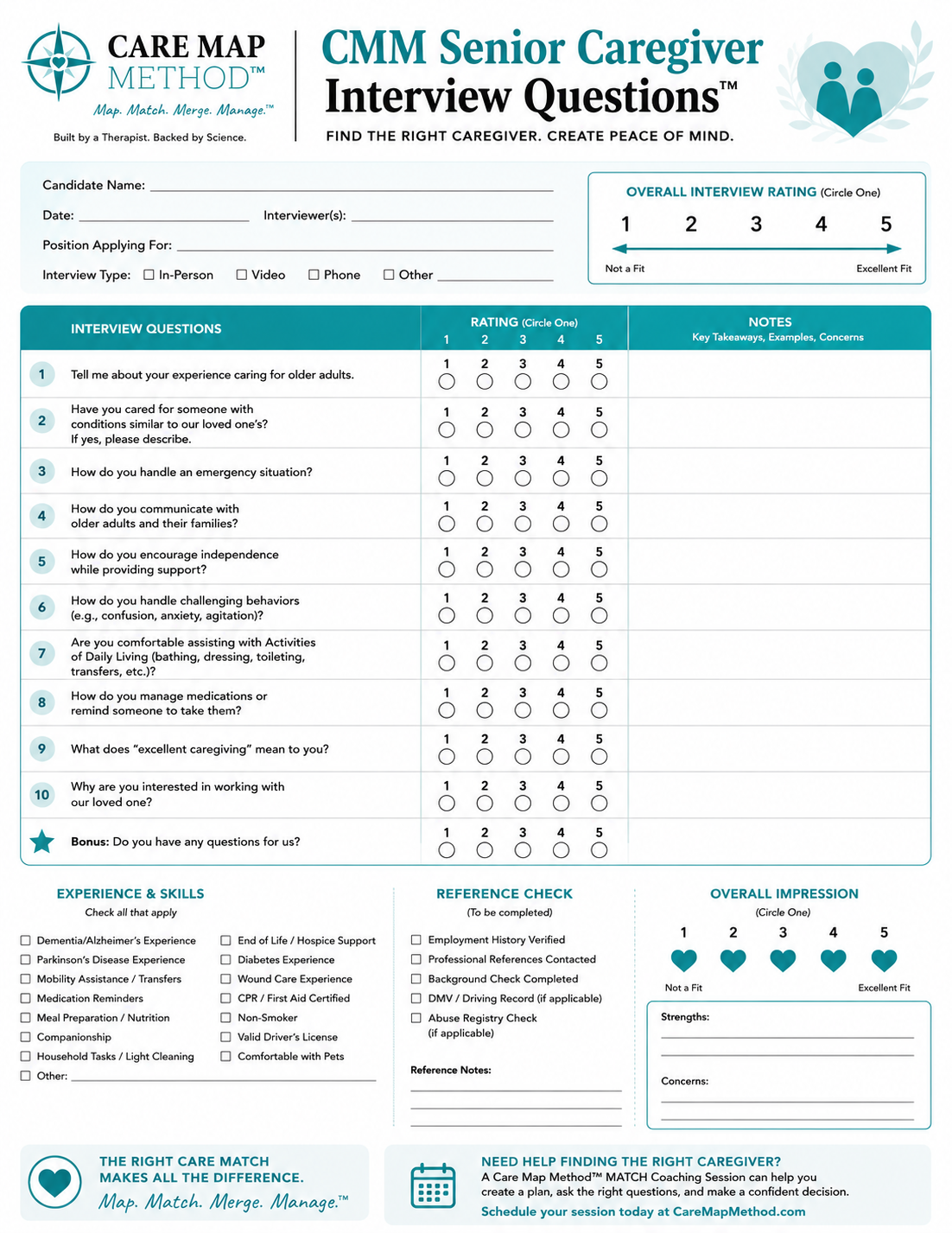
How to Choose the Right Caregiver for Your Aging Parent: 10 Questions Every Family Should Ask
Finding the right caregiver is about more than experience. Learn the interview questions, red flags, and evaluation strategies that help families choose the best caregiver for their loved one.
Hiring a caregiver is about much more than filling an open position.
You're inviting someone into your loved one's home, daily routine, and life.
The right caregiver can improve safety, independence, confidence, and quality of life.
The wrong caregiver can create stress, confusion, poor communication, and unnecessary turnover.
At Care Map Method™, we believe the best outcomes begin with the right match.
Why Matching Matters
Families often focus on credentials alone.
Experience is important—but it isn't everything.
A successful caregiving relationship also depends on:
Personality
Communication style
Patience
Reliability
Flexibility
Family expectations
Medical needs
Emotional compatibility
Finding someone who fits all of these areas requires more than a résumé.
10 Questions Every Family Should Ask
1. Tell me about your caregiving experience.
Listen for specific examples rather than general answers.
2. Have you worked with someone who has similar medical needs?
Examples include:
Dementia
Parkinson's disease
Stroke recovery
Diabetes
Mobility limitations
3. How would you handle an emergency?
You're looking for calm decision-making and sound judgment.
4. How do you communicate with families?
Good caregivers communicate clearly, consistently, and respectfully.
5. Tell me about a difficult caregiving situation.
Past experiences often predict future performance.
6. How do you encourage independence?
Great caregivers support rather than take over.
7. Are you comfortable assisting with Activities of Daily Living?
Examples include:
Bathing
Dressing
Transfers
Toileting
Meal preparation
8. What does excellent caregiving mean to you?
This question reveals values more than skills.
9. Why are you interested in this position?
Look for genuine compassion rather than generic responses.
10. What questions do you have for us?
Excellent caregivers usually ask thoughtful questions.
Don't Forget References
Always verify:
Employment history
Reliability
Attendance
Communication
Strengths
Areas for growth
References often reveal details that interviews do not.
Watch for Red Flags
Be cautious if a caregiver:
Speaks negatively about previous employers
Cannot explain gaps in employment
Avoids answering questions
Arrives late without explanation
Has inconsistent references
Download Our Caregiver Interview Questions™ Worksheet
(Insert your worksheet here.)
Our printable worksheet helps families compare candidates objectively, take organized notes, and feel more confident during the hiring process.
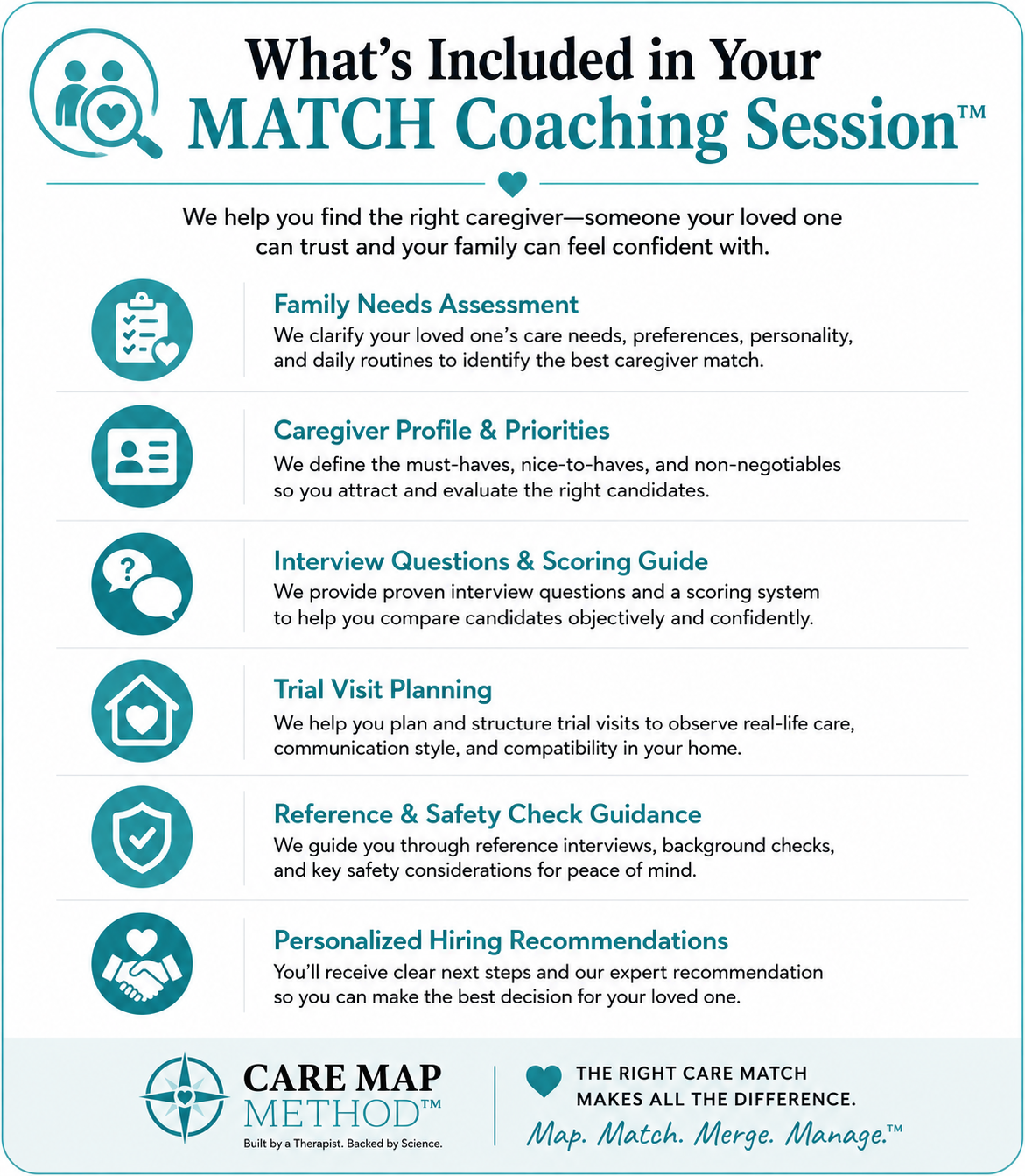
How a Care Map Method™ MATCH Coaching Session Can Help
Choosing a caregiver can feel overwhelming.
During your personalized MATCH Coaching Session™, we'll help you:
Clarify your family's care needs
Create the ideal caregiver profile
Prioritize must-have qualifications
Review interview questions
Plan trial visits
Evaluate references and safety considerations
Compare candidates objectively
Make a confident hiring decision
Our goal is to help you find the caregiver who best fits your loved one's needs—not simply the first available applicant.
Ready to Find the Right Caregiver?
The right caregiver can make daily life safer, calmer, and more fulfilling for your loved one—and for your entire family.
If you're preparing to hire in-home care, our Care Map Method™ MATCH Coaching Session provides expert guidance to help you make an informed decision with confidence.
Book your MATCH Coaching Session today.
7 Signs Your Aging Parent Needs Help with Activities of Daily Living (ADLs)
Many older adults begin needing help gradually. Learn the warning signs that your loved one may need assistance with Activities of Daily Living and discover how to assess their safety and independence.
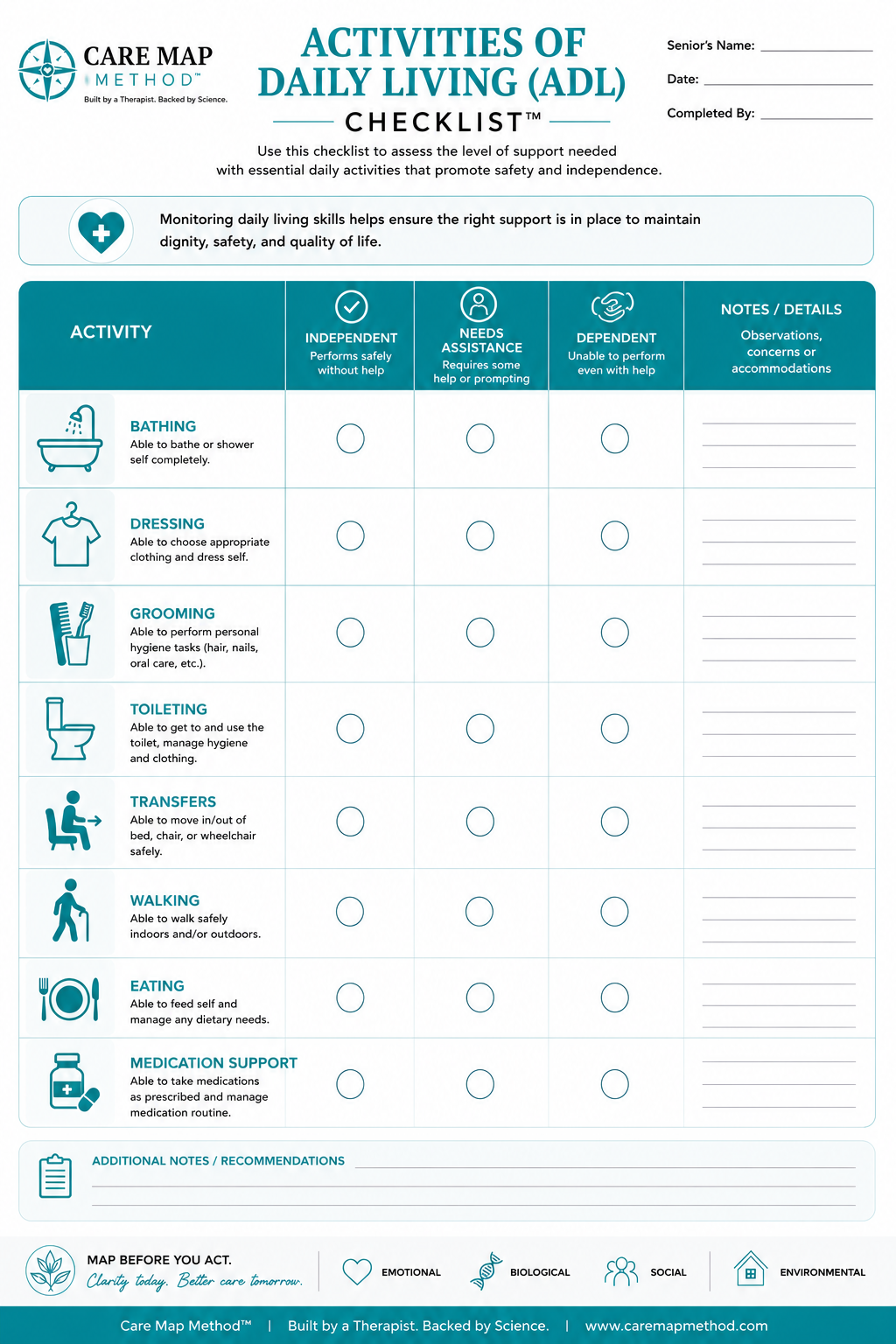
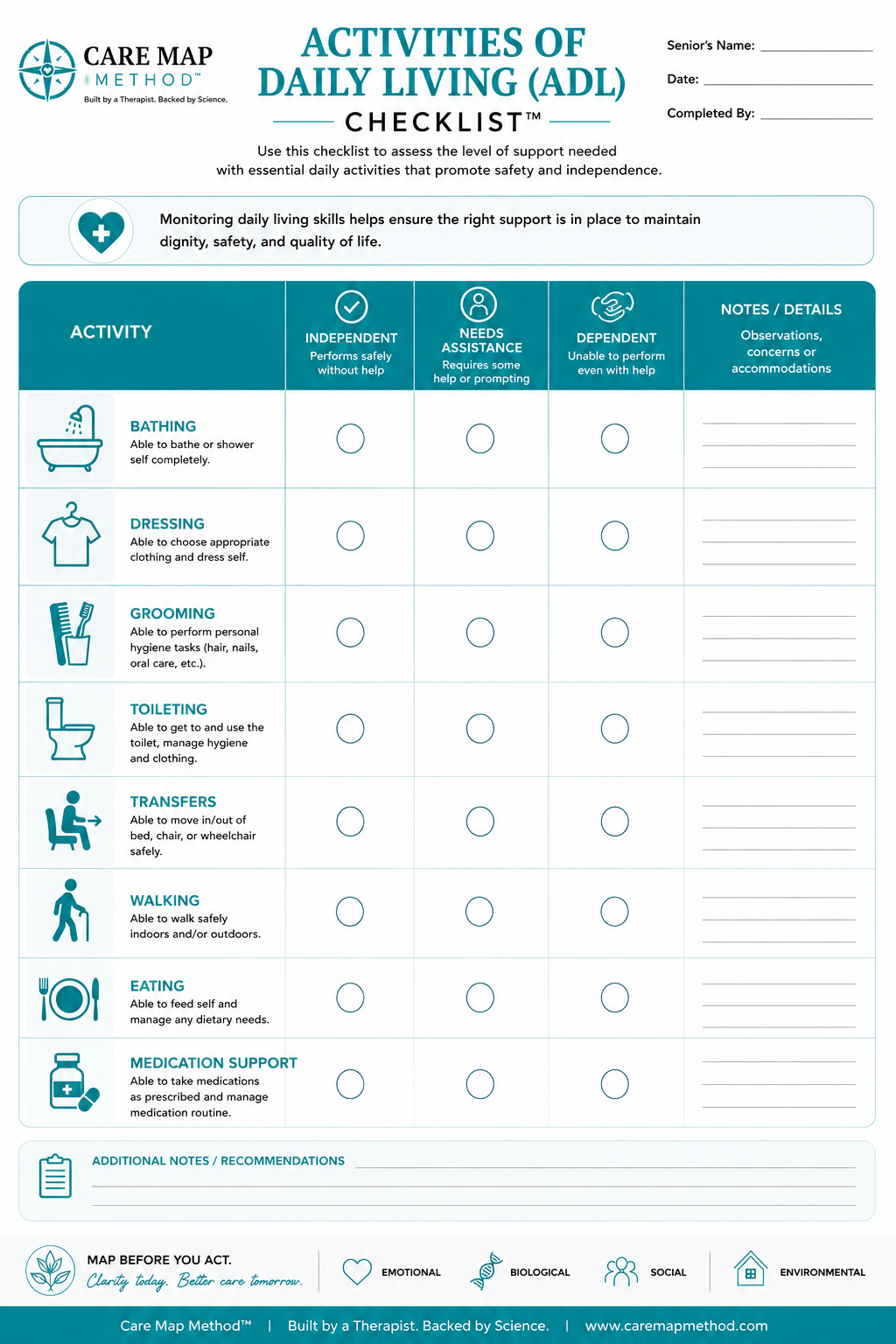
Activities of Daily Living (ADL) Checklist worksheet from Care Map Method™ helping families evaluate whether an older adult needs assistance with bathing, dressing, grooming, eating, mobility, toileting, transfers, and medication support.
7 Signs Your Aging Parent Needs Help with Activities of Daily Living (ADLs)
One of the hardest parts of caring for an aging parent is recognizing when small changes become signs that additional support is needed.
Many older adults want to remain independent, and families often hope they can continue living safely on their own. However, subtle declines in everyday functioning may increase the risk of falls, medication errors, malnutrition, hospitalization, and caregiver stress.
At Care Map Method™, we encourage families to Map Before They Act™. Assessing Activities of Daily Living (ADLs) provides a structured way to understand current abilities and identify where support may improve safety and quality of life.
What Are Activities of Daily Living?
Activities of Daily Living, commonly called ADLs, are the basic self-care tasks people perform every day to remain healthy, safe, and independent.
These include:
Bathing
Dressing
Grooming
Toileting
Walking and mobility
Transfers (getting in and out of bed or a chair)
Eating
Medication management
When one or more of these activities become difficult, it may be time to reassess your loved one's care needs.
1. Difficulty Bathing
Notice if your loved one:
Avoids showers
Appears unsteady in the bathroom
Has poor hygiene
Expresses fear of falling
Bathrooms are one of the most common places where older adults experience falls.
2. Wearing the Same Clothes
Difficulty dressing may include:
Wearing stained clothing
Difficulty with buttons or zippers
Dressing inappropriately for the weather
Needing assistance putting on shoes
These changes may indicate arthritis, weakness, balance problems, or cognitive decline.
3. Changes in Personal Grooming
Poor grooming often develops gradually.
Look for:
Unwashed hair
Long fingernails
Missed shaving
Declining oral hygiene
These changes can sometimes signal depression, memory changes, or physical limitations.
4. Trouble Walking or Getting Up
Watch for:
Holding onto furniture
Difficulty standing
Slower walking speed
Multiple near-falls
Trouble climbing stairs
Even one fall can significantly affect an older adult's confidence and independence.
5. Weight Loss or Poor Nutrition
Ask yourself:
Is food expiring in the refrigerator?
Have they lost weight?
Are they skipping meals?
Are they drinking enough water?
Nutrition plays a major role in strength, healing, and overall health.
6. Medication Mistakes
Medication concerns may include:
Forgotten doses
Duplicate doses
Confusion about prescriptions
Expired medications
Medication management becomes increasingly important as prescriptions become more complex.
7. Increasing Dependence on Family
You may notice yourself:
Driving to every appointment
Managing bills
Preparing meals
Picking up prescriptions
Helping with household tasks
While occasional assistance is normal, increasing dependence may indicate that additional planning is needed.
Download Our Free Activities of Daily Living Checklist™
(Insert your ADL Checklist worksheet image here.)
Our printable worksheet helps families evaluate daily functioning and identify areas where support may improve safety, independence, and quality of life.
Bring the completed checklist to healthcare appointments or use it during family caregiving discussions.
Why Early Assessment Matters
Recognizing changes early allows families to make thoughtful decisions rather than reacting during a crisis.
Early planning can help:
Reduce caregiver stress
Prevent falls
Improve communication among family members
Coordinate medical care
Delay unnecessary hospitalizations
Support aging in place when appropriate
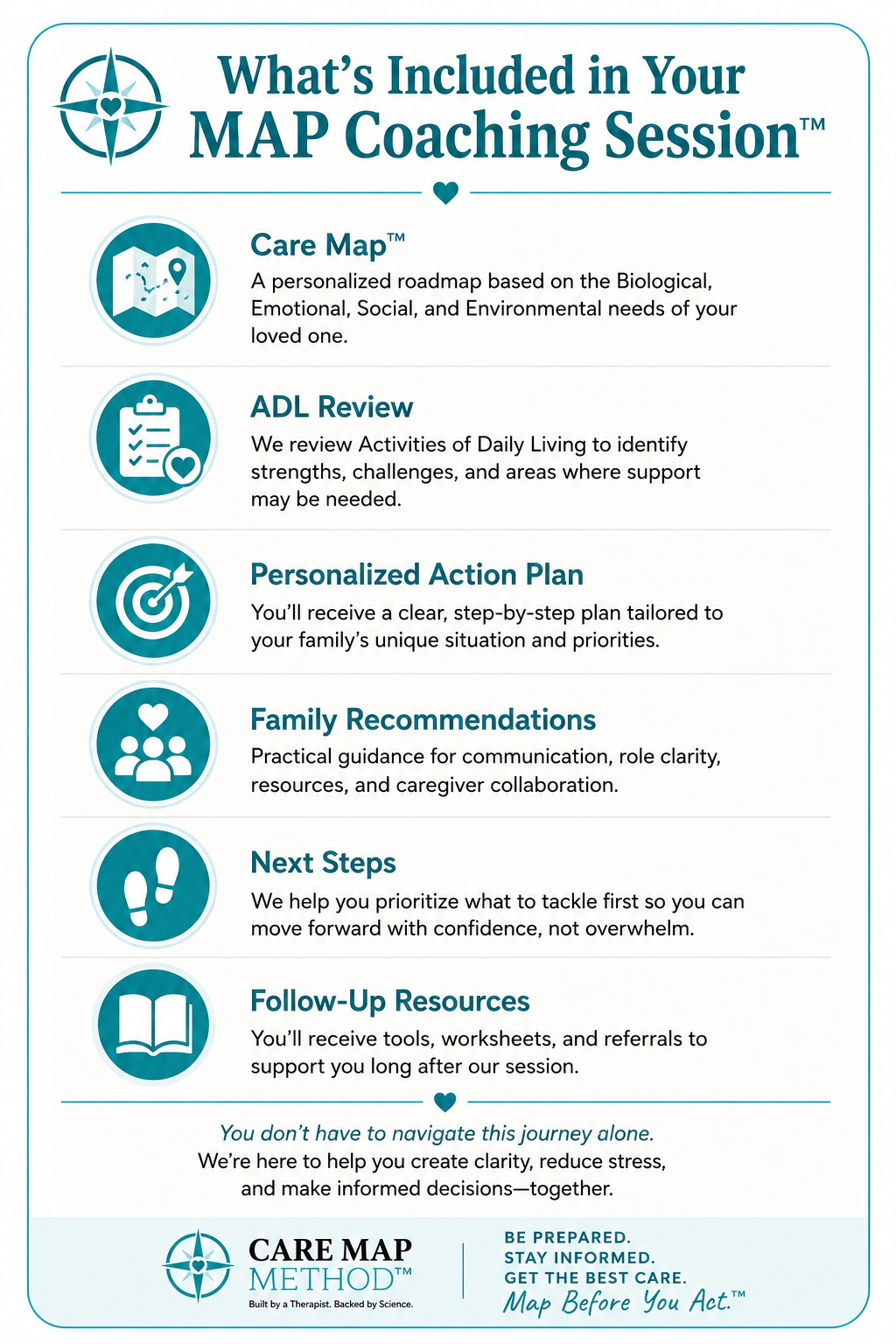
How a Care Map Method™ MAP Coaching Session Can Help
Many families know something has changed but aren't sure what to do next.
During a personalized Care Map Method™ MAP Coaching Session, we'll help you:
Assess Activities of Daily Living
Identify safety concerns
Review medical, emotional, social, and environmental needs
Prioritize next steps
Develop a personalized Care Map™
Create an action plan tailored to your family's situation
Our goal is to help families move forward with confidence instead of uncertainty.
Ready to Better Understand Your Loved One's Needs?
If you're wondering whether your parent can continue living independently—or what level of support is appropriate—you don't have to make those decisions alone.
A Care Map Method™ MAP Coaching Session provides expert guidance, practical tools, and a personalized roadmap based on your loved one's unique situation.
Book your Care Map Method™ MAP Coaching Session today and start planning before a crisis occurs.
25 Questions to Ask Your Parents' Doctor Before It's Too Late
Preparing for a doctor's appointment can make all the difference. Learn the most important questions to ask your aging parent's healthcare providers and discover how Care Map Method™ helps families organize medical care with confidence.
There is one sentence I hear from caregivers almost every week:
"I forgot to ask."
Whether it's about medications, memory loss, falls, nutrition, or pain, families often leave doctor's appointments remembering all the questions they meant to ask—after they've already driven home.
Healthcare appointments are often short. Physicians are balancing many priorities, and families are trying to remember months of concerns in just a few minutes.
That's why preparation matters.
At Care Map Method™, we encourage families to Map Before They Act. One of the simplest ways to do that is to arrive with a written list of questions and a place to record the answers.
Why Medical Appointments Feel So Overwhelming
Caring for an aging parent means managing far more than a single diagnosis.
You may be trying to understand:
multiple medications
recent falls
memory changes
sleep issues
nutrition
mobility
hearing
vision
pain
new specialists
insurance questions
Trying to organize all of those concerns during a fifteen-minute appointment can feel impossible.
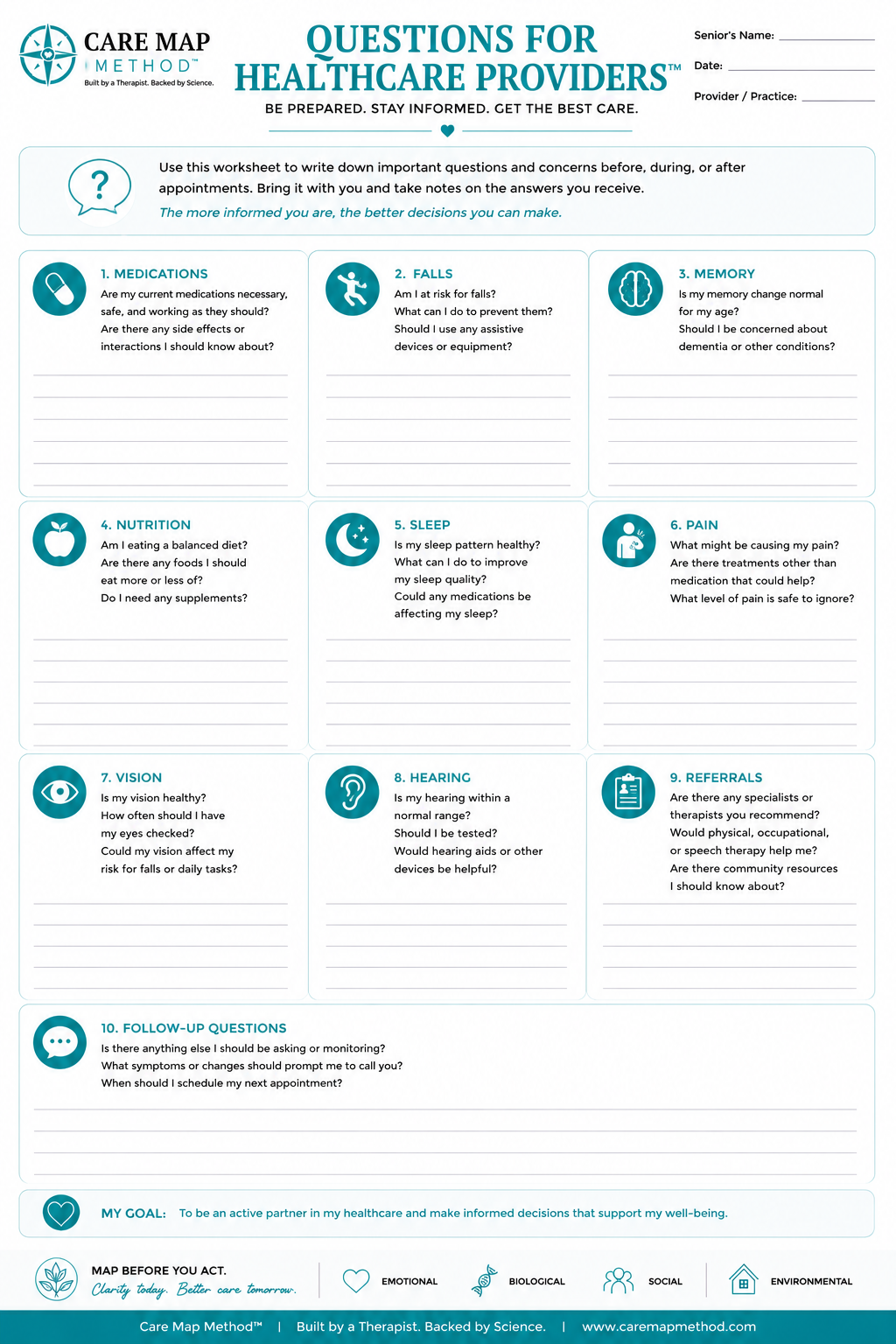
That's why we created the Questions for Healthcare Providers™ Worksheet.
Questions Every Family Should Ask
Instead of relying on memory, organize your concerns into ten important areas.
1. Medications
Ask:
Are all of these medications still necessary?
Could any medications be interacting?
Are side effects causing fatigue, dizziness, or confusion?
2. Falls
Falls are one of the leading causes of hospitalization among older adults.
Ask:
Is my loved one at risk?
Should physical therapy be considered?
Would a walker or cane help?
3. Memory
Not every memory change is dementia.
Ask:
Is this normal aging?
Should additional testing be done?
What symptoms should we monitor?
4. Nutrition
Poor nutrition often contributes to weakness and illness.
Ask:
Are they getting enough protein?
Should they take supplements?
Are there foods to avoid?
5. Sleep
Poor sleep affects nearly every aspect of health.
Ask:
Could medications be causing insomnia?
Is sleep apnea possible?
What healthy sleep habits would you recommend?
6. Pain
Pain should never simply be accepted as "old age."
Ask:
What is causing the pain?
Are there treatments besides medication?
When should we be concerned?
7. Vision
Vision affects driving, balance, and independence.
Ask:
How often should eye exams occur?
Could vision problems increase fall risk?
8. Hearing
Hearing loss often contributes to isolation and cognitive decline.
Ask:
Should hearing be tested?
Would hearing aids improve quality of life?
9. Referrals
Sometimes another specialist can make all the difference.
Ask about:
Physical Therapy
Occupational Therapy
Speech Therapy
Memory Clinics
Social Workers
Community Resources
10. Follow-Up
Before leaving the appointment, always ask:
What symptoms should prompt a phone call?
When should we schedule the next visit?
What changes should we watch for?
Don't Just Collect Information—Organize It
One doctor's appointment rarely answers every question.
Families need a way to organize medical information over time so everyone stays on the same page.
That's exactly why we developed the Care Map Method™.
Instead of reacting to crises, we help families build a personalized roadmap that considers the four pillars of caregiving:
Biological
Emotional
Social
Environmental
This structured approach helps families make informed decisions before problems become emergencies.
How a Care Map Method™ Coaching Session Can Help
During your personalized coaching session, we'll help you:
✔ Prepare for upcoming medical appointments
✔ Organize medications and diagnoses
✔ Identify important questions to ask providers
✔ Review safety concerns such as falls and memory changes
✔ Develop a personalized Care Map™
✔ Create an action plan for next steps
Whether you're just beginning your caregiving journey or managing increasingly complex medical needs, we'll help you move forward with clarity and confidence.
Ready to Feel More Prepared?
If you're caring for an aging parent and feeling overwhelmed by medical appointments, you're not alone.
Our Care Map Method™ Senior Coaching Sessions provide expert guidance to help families understand what to ask, what to prioritize, and what to do next.
Schedule your personalized Care Map Method™ Coaching Session today and start building a plan before the next doctor's appointment.
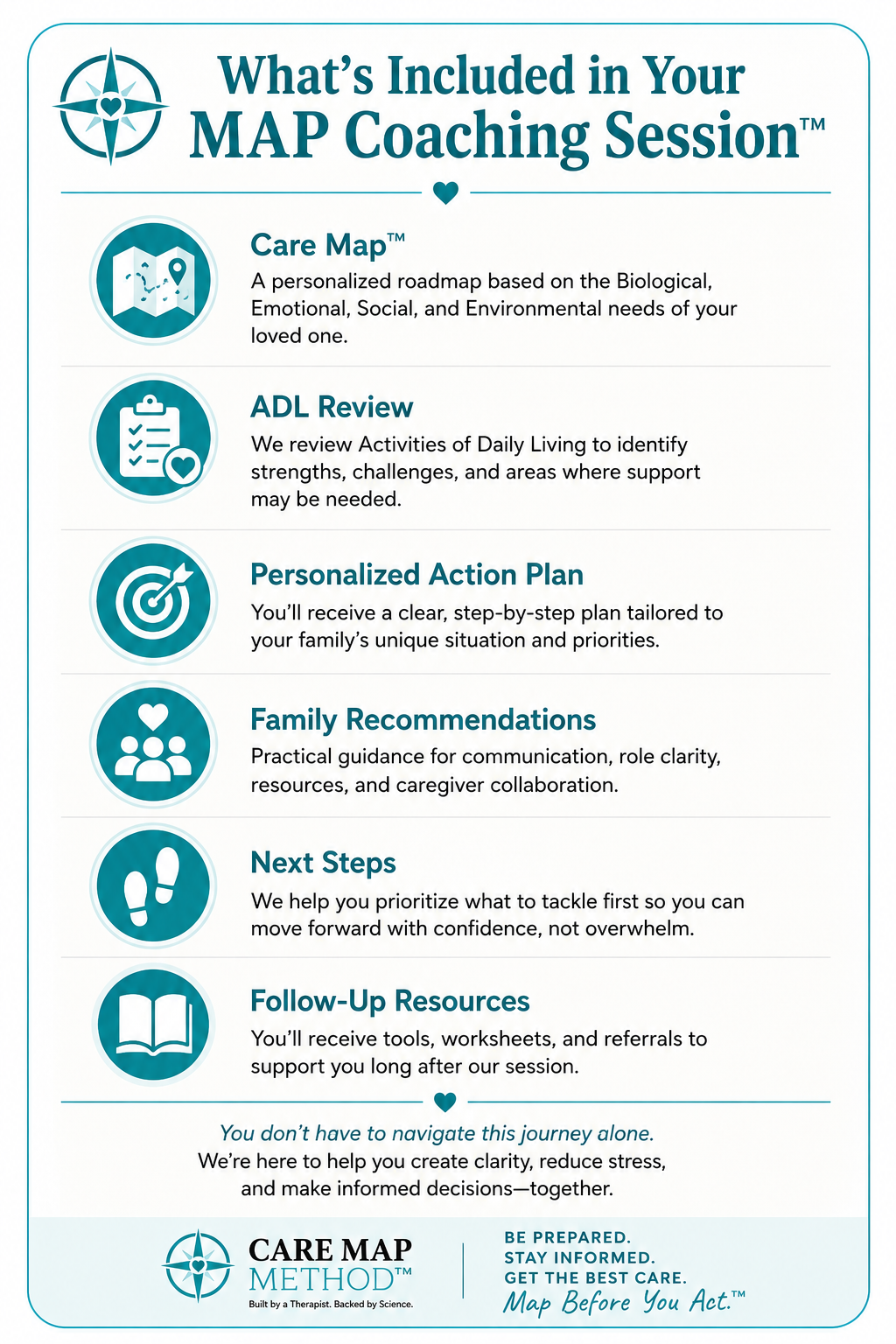

Caregiver Burnout: 15 Warning Signs and What to Do Before You Reach a Breaking Point
Feeling exhausted while caring for an aging parent? Learn the warning signs of caregiver burnout and discover practical tools to reduce stress and build a sustainable care plan.
Caregiver Burnout: 15 Warning Signs and What to Do Before You Reach a Breaking Point
Caregiver Burnout: 15 Warning Signs and What to Do Before You Reach a Breaking Point
Caring for an aging parent or loved one is one of the most meaningful roles many people will ever have. It can also be one of the most emotionally, physically, and mentally demanding.
Many family caregivers quietly carry the weight of coordinating appointments, managing medications, communicating with siblings, handling finances, and balancing careers and children—all while trying to ensure their loved one feels safe and supported.
Over time, these responsibilities can lead to caregiver burnout, a state of chronic stress that affects health, relationships, decision-making, and overall quality of life.
At Care Map Method™, we believe that caregivers deserve support too. Recognizing the warning signs early can help you create a healthier, more sustainable care plan for both you and your loved one.
What Is Caregiver Burnout?
Caregiver burnout is a state of physical, emotional, and mental exhaustion caused by the ongoing demands of caring for another person.
Unlike occasional stress, burnout develops gradually. Many caregivers don't realize how overwhelmed they've become until they feel emotionally depleted or physically unwell.
Burnout isn't a sign of weakness or lack of love—it often reflects the reality of trying to do too much without enough support.
15 Warning Signs of Caregiver Burnout
1. You're constantly exhausted, even after sleeping.
2. You feel guilty whenever you take time for yourself.
3. Small problems trigger big emotional reactions.
4. You're becoming forgetful or having trouble concentrating.
5. You feel isolated from friends or family.
6. Your own medical appointments keep getting postponed.
7. Anxiety feels constant.
8. You have difficulty sleeping.
9. You feel resentful about caregiving responsibilities.
10. You rarely enjoy activities that once made you happy.
11. You feel like you're "doing everything."
12. Family disagreements are increasing.
13. Your physical health is declining.
14. You feel trapped or hopeless.
15. You don't know where to begin asking for help.
If several of these sound familiar, it may be time to step back and reassess your caregiving plan.
Why Planning Reduces Burnout
One of the biggest contributors to caregiver stress is uncertainty.
Questions like:
Am I making the right decisions?
Is Mom safe at home?
Should we hire help?
What happens next?
How do I get my siblings involved?
can create constant mental overload.
Having a structured care plan reduces decision fatigue and helps families move from reacting to planning.
The Care Map Method™ Approach
Our therapist-developed Care Map Method™ organizes caregiving into four essential pillars:
Biological
Medical needs, medications, nutrition, mobility, sleep, and overall physical health.
Emotional
Mental health, coping skills, relationships, grief, resilience, and emotional support.
Social
Family communication, community resources, friendships, caregiving roles, and social connection.
Environmental
Home safety, transportation, accessibility, financial planning, and daily routines.
Looking at all four areas together helps families identify gaps before they become crises.
When Is It Time to Ask for Help?
Many caregivers wait until they're overwhelmed before reaching out.
Support can be valuable much earlier.
Working with a therapist or caregiver coach can help you:
Organize priorities.
Improve family communication.
Reduce stress.
Clarify care options.
Create a realistic care plan.
Prevent burnout before it worsens.
What You'll Receive During a Care Map Method™ Caregiver Support Session
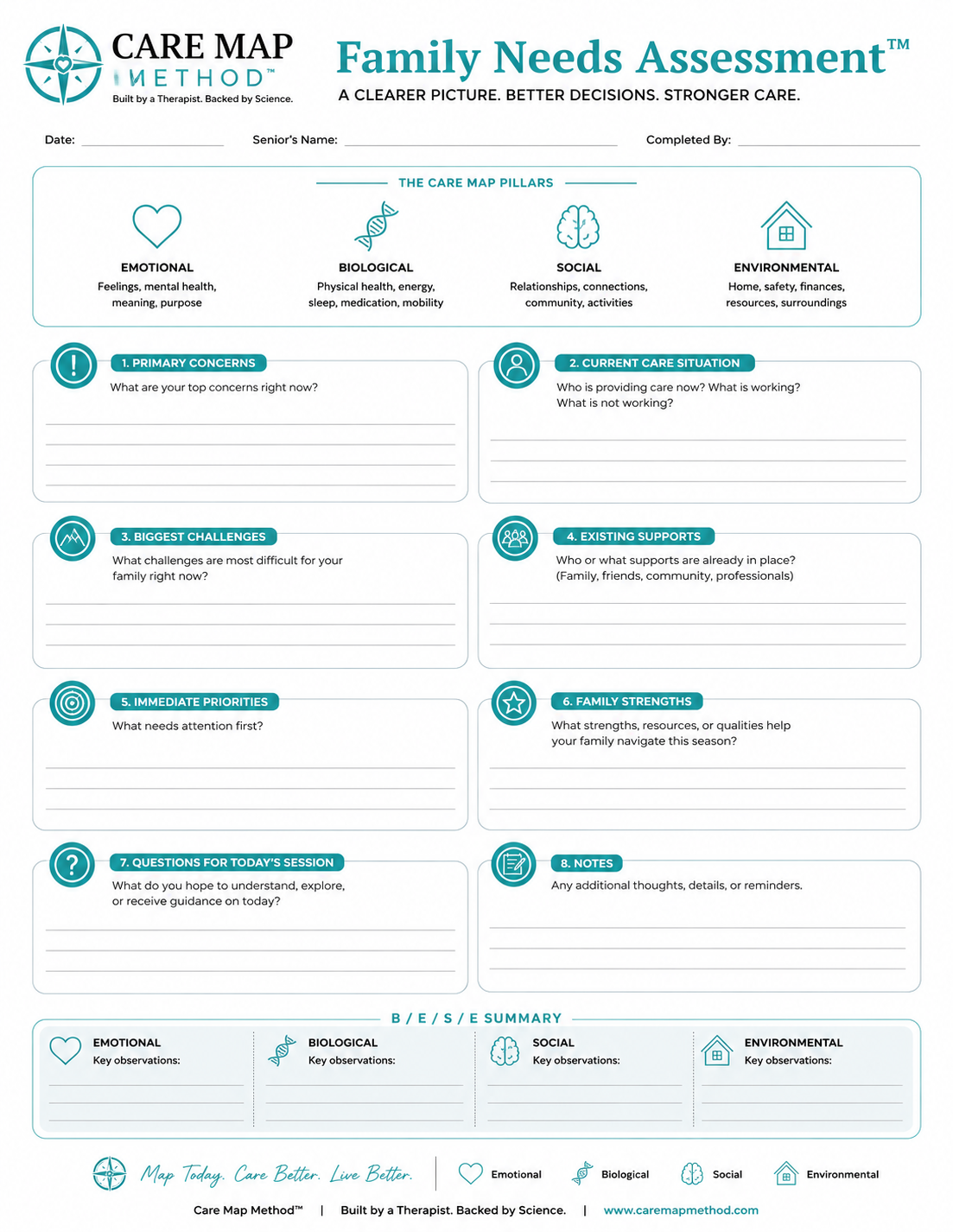
When you schedule a Care Map Method™ coaching session, you'll receive practical tools designed to help you feel more organized and confident, including:
Family Needs Assessment
Caregiver Burnout Assessment
Biological, Emotional, Social & Environmental Care Map
Family Communication Scripts
Weekly Care Planning Worksheet
Personalized Action Plan
These resources are designed to support both the caregiver and the entire family system.
You Don't Have to Do This Alone
Supporting an aging parent is a journey, and no one should feel they have to navigate it without guidance.
Whether you're just beginning to notice signs of stress or you're already feeling overwhelmed, taking one small step toward creating a clear care plan can make a meaningful difference.
Caregiver burnout is not a personal failure—it's a sign that the caregiver needs care too.
Call to Action
Ready to create a personalized care plan?
Schedule a Care Map Method™ Caregiver Support Session to receive practical guidance, therapist-developed tools, and a customized plan that helps you care with greater confidence while protecting your own well-being.
Why Good Elder Care Still Fails: What Families Miss When Choosing Senior Care
Even when families do everything right—hiring help, managing medications, and staying involved—elder care can still feel stressful or incomplete. This article explains what most families miss when choosing senior care and how the Care Map Method™ helps create a clearer care plan.
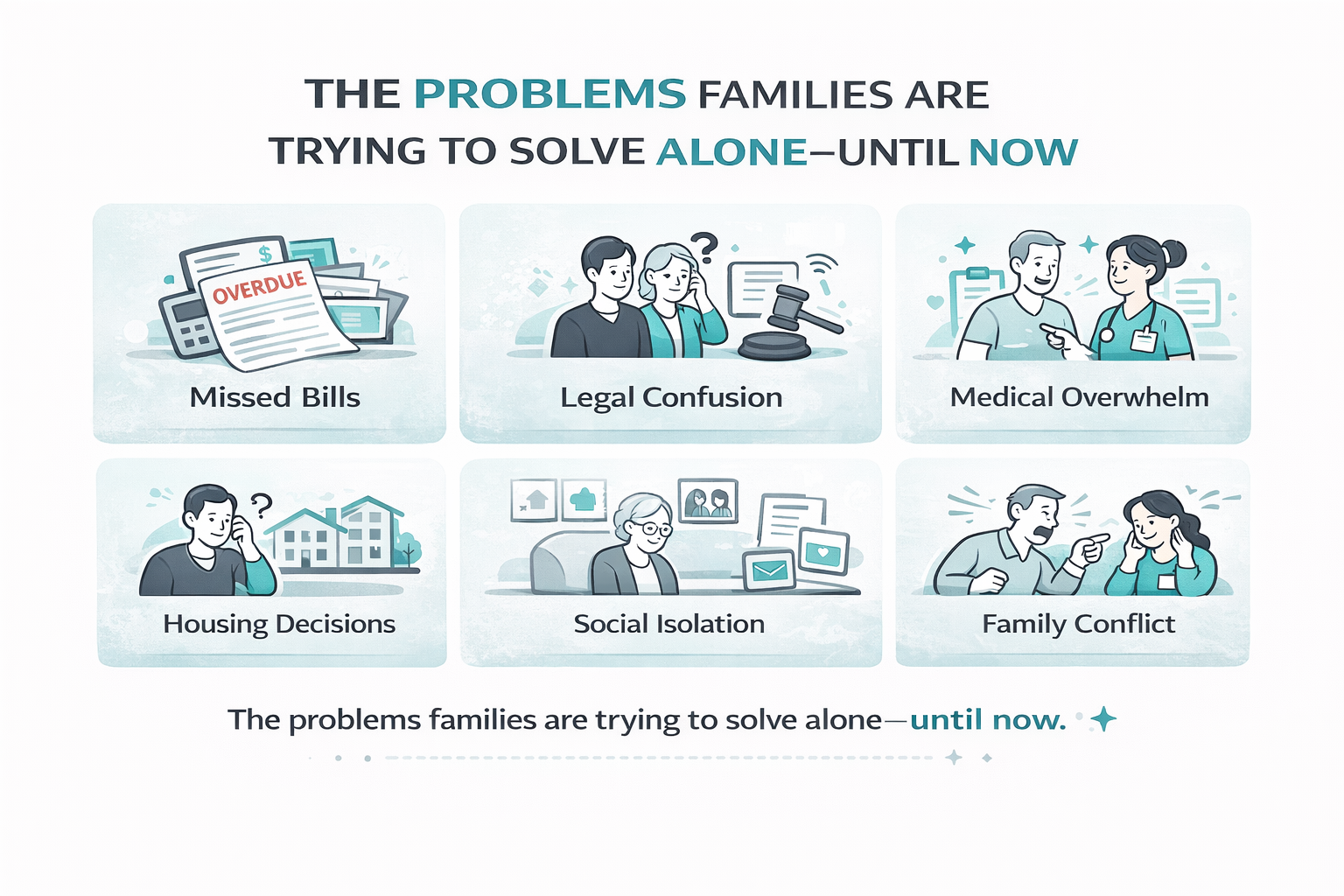
The stress and problems seniors and their family caregivers face from not matched eldercare
Why “Good” Elder Care Still Fails (And What Families Miss)
Choosing senior care for an aging parent is one of the most important and overwhelming decisions families face. Whether you are hiring an in-home caregiver, evaluating assisted living, or coordinating care across multiple providers, many families struggle to know what actually determines good elder care.
Even when care looks adequate on paper—meals, medication reminders, and transportation—something can still feel off. Families often sense that their loved one is not truly thriving, but they cannot identify why.
This is where most elder care decisions fail.
The problem is not effort. It is a lack of a clear, structured system for assessing what seniors actually need across emotional, biological, environmental, and social domains.
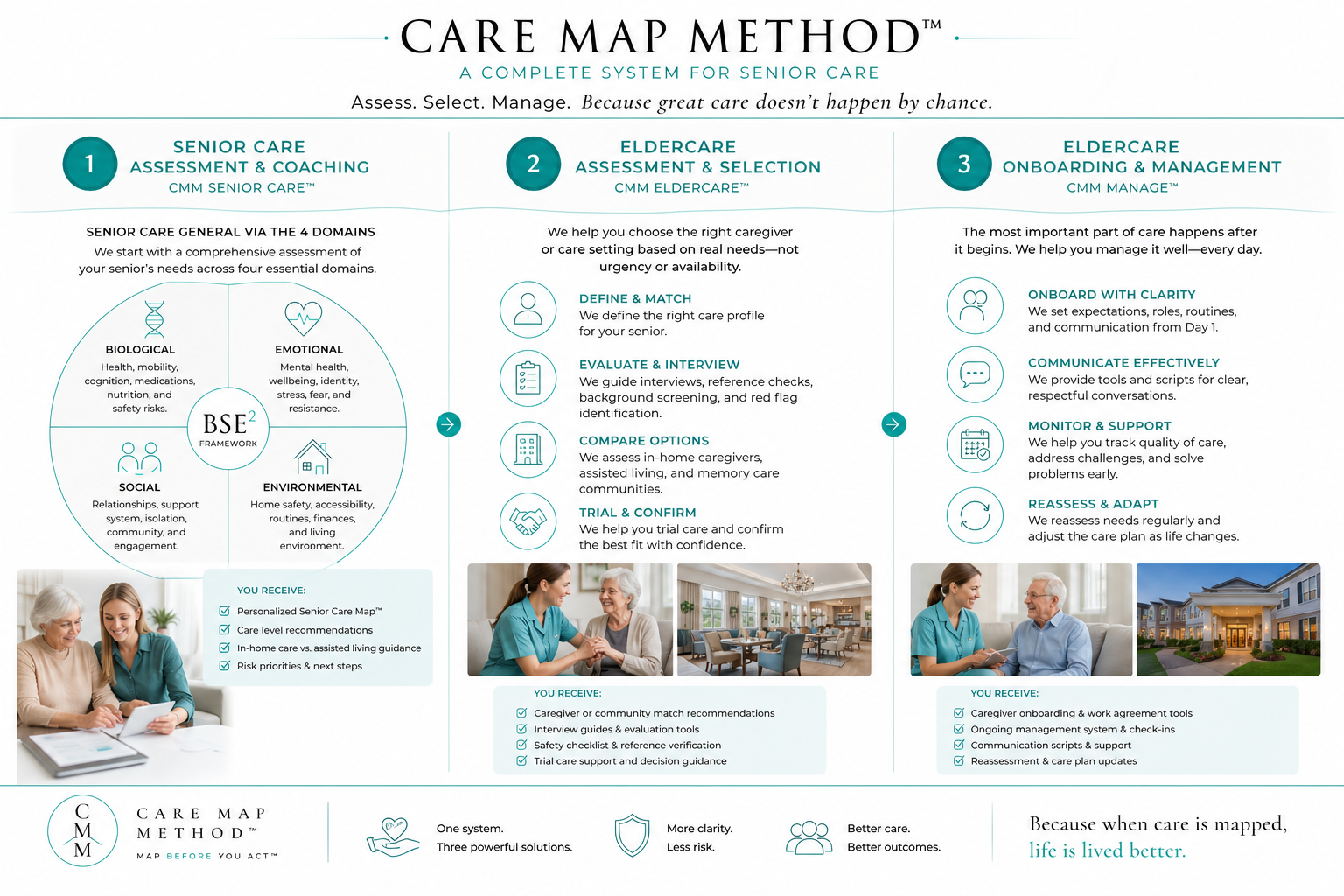
The Hidden Problem in Senior Care Decisions
Most families make elder care decisions based on what is visible and measurable.
They look at:
credentials
availability
cost
logistics
These factors matter—but they are not what determines whether care actually works.
The real issue is that most care decisions ignore how well the caregiver, environment, and structure align with the senior’s deeper needs.
Without that alignment, even “good” care can fail.
What Most Families Focus On in Elder Care (And Why It’s Not Enough)
When choosing childcare or elder care, families are often forced to make quick decisions under stress.
They focus on:
who is available
who seems nice
who has experience
what fits the schedule
But these decisions are reactive.
They do not answer the most important question:
👉 Is this the right fit for this specific person?
Without a structured way to assess needs, families are left guessing—and that guesswork leads to inconsistent outcomes, caregiver turnover, and ongoing stress.H2: The Hidden Problem in Elder Care Decisions
What Actually Determines High-Quality Senior Care
High-quality elder care is not defined by tasks alone.
It is defined by how well care supports the full human experience of the senior.
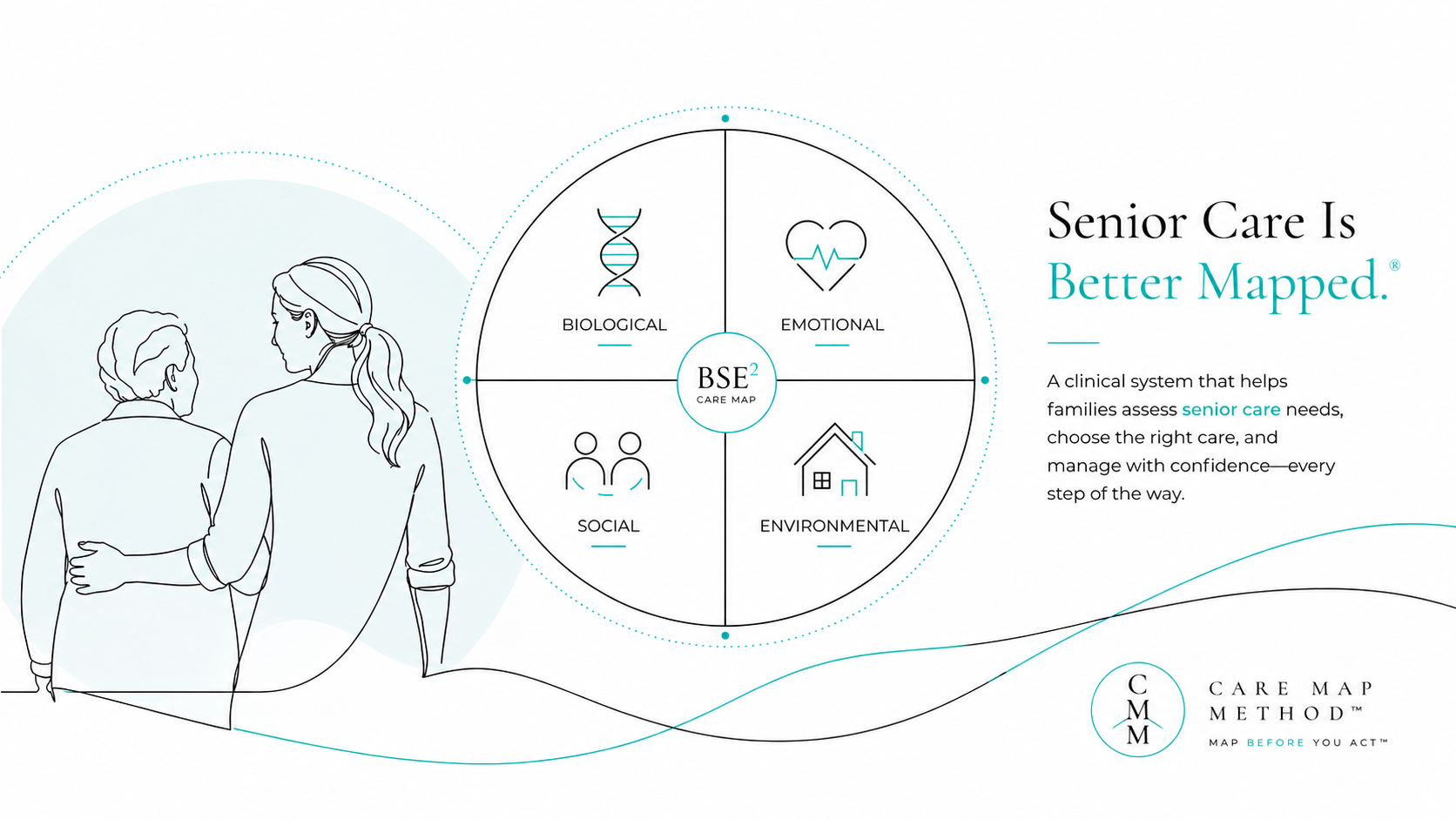
This includes:
Emotional Needs
feeling safe
feeling understood
maintaining dignity
connection and companionship
Biological Needs
health management
medication adherence
nutrition
sleep and physical comfort
Environmental Needs
home safety
routine and structure
ease of daily living
Social & Developmental Needs
communication
engagement
purpose
cognitive stimulation
When these areas are aligned, care works.
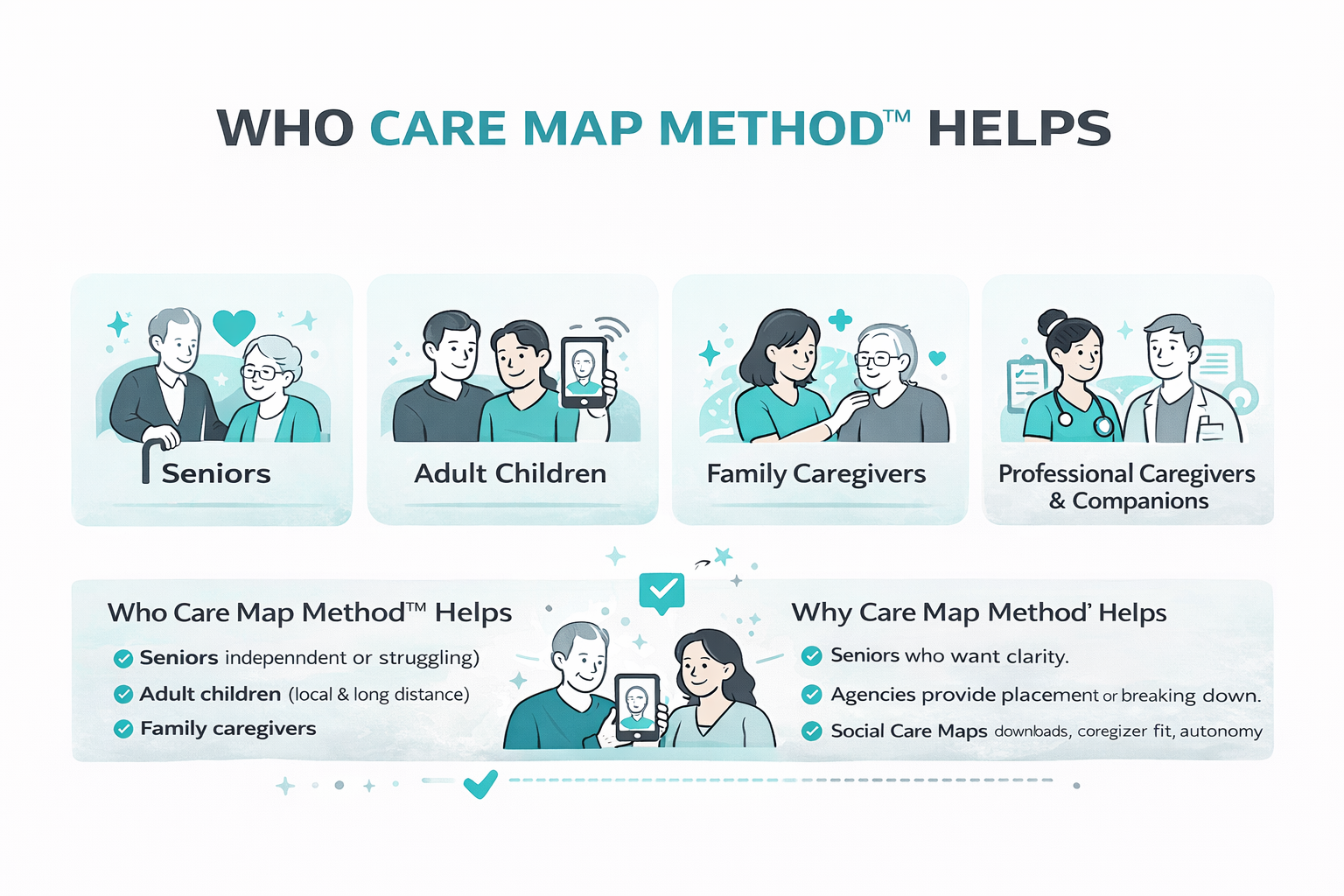
The Care Map Method™ for Choosing Elder Care
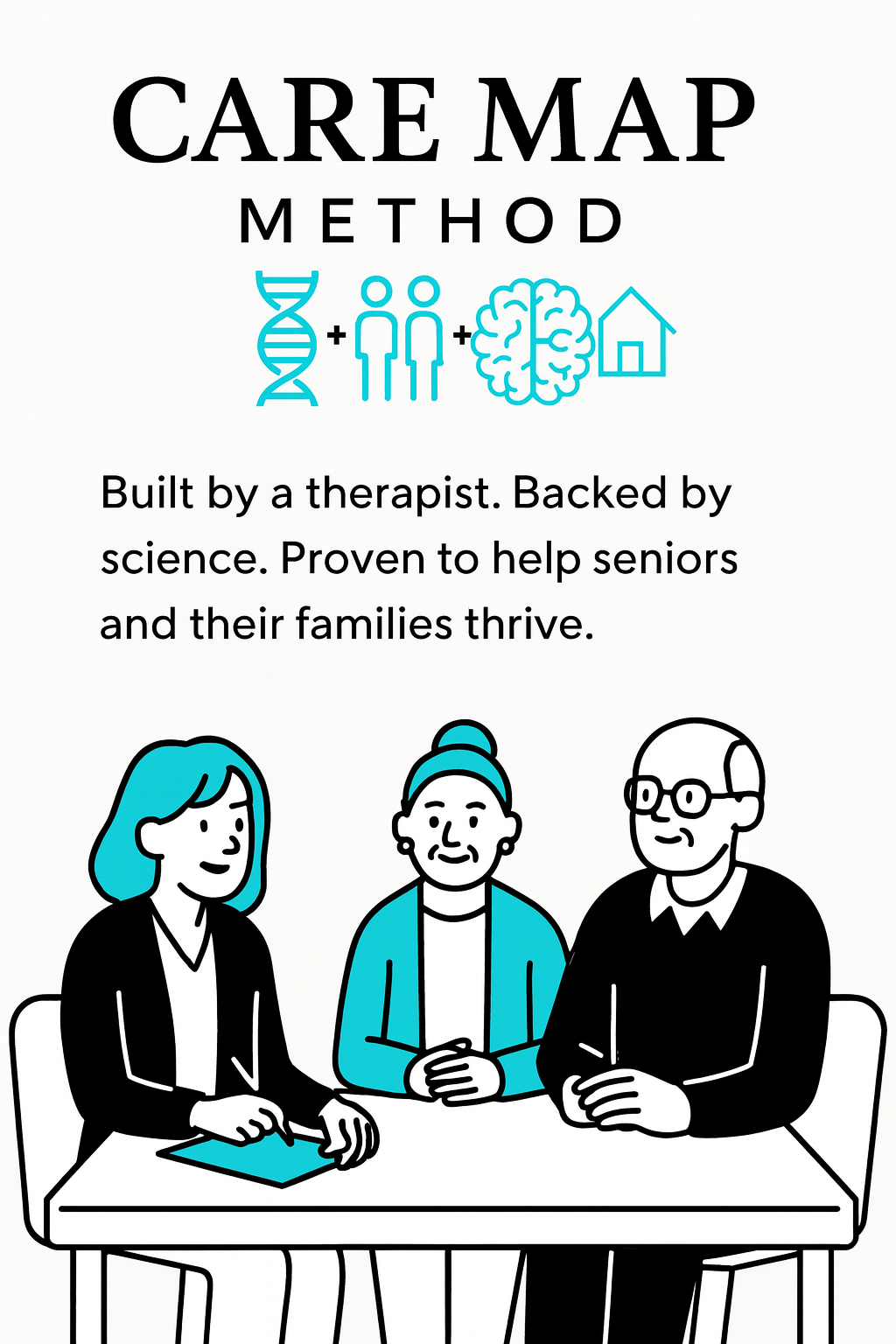
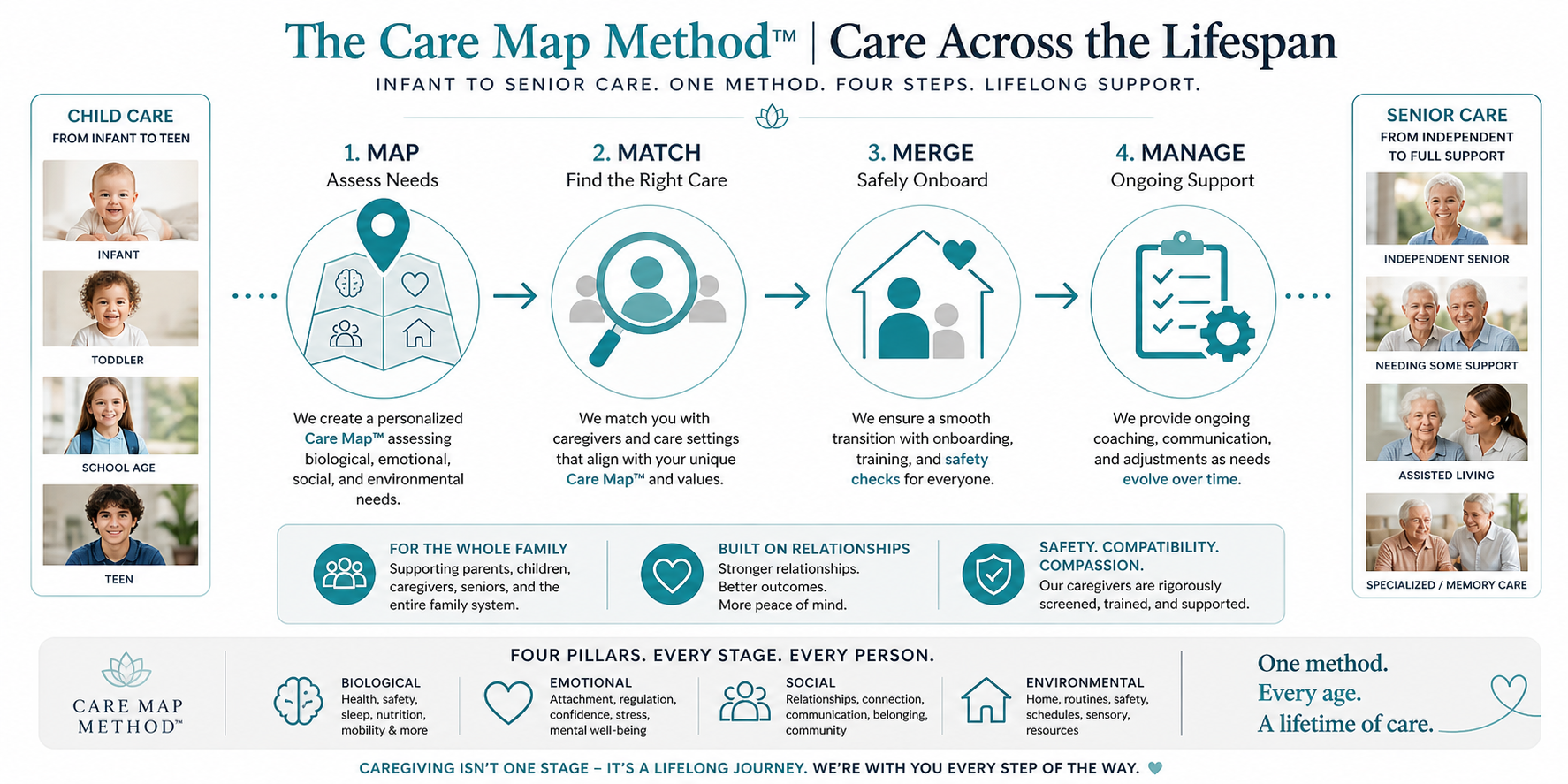
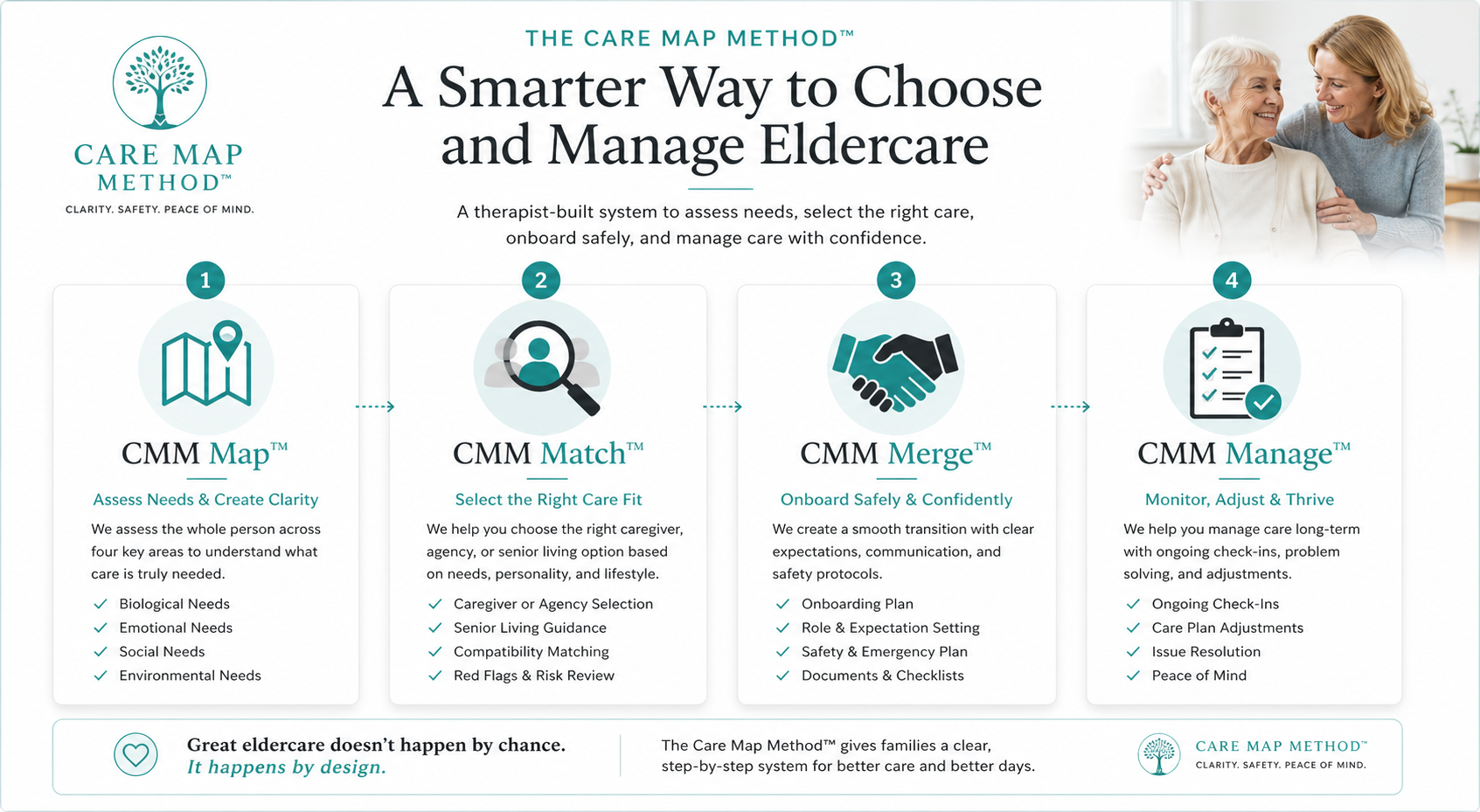
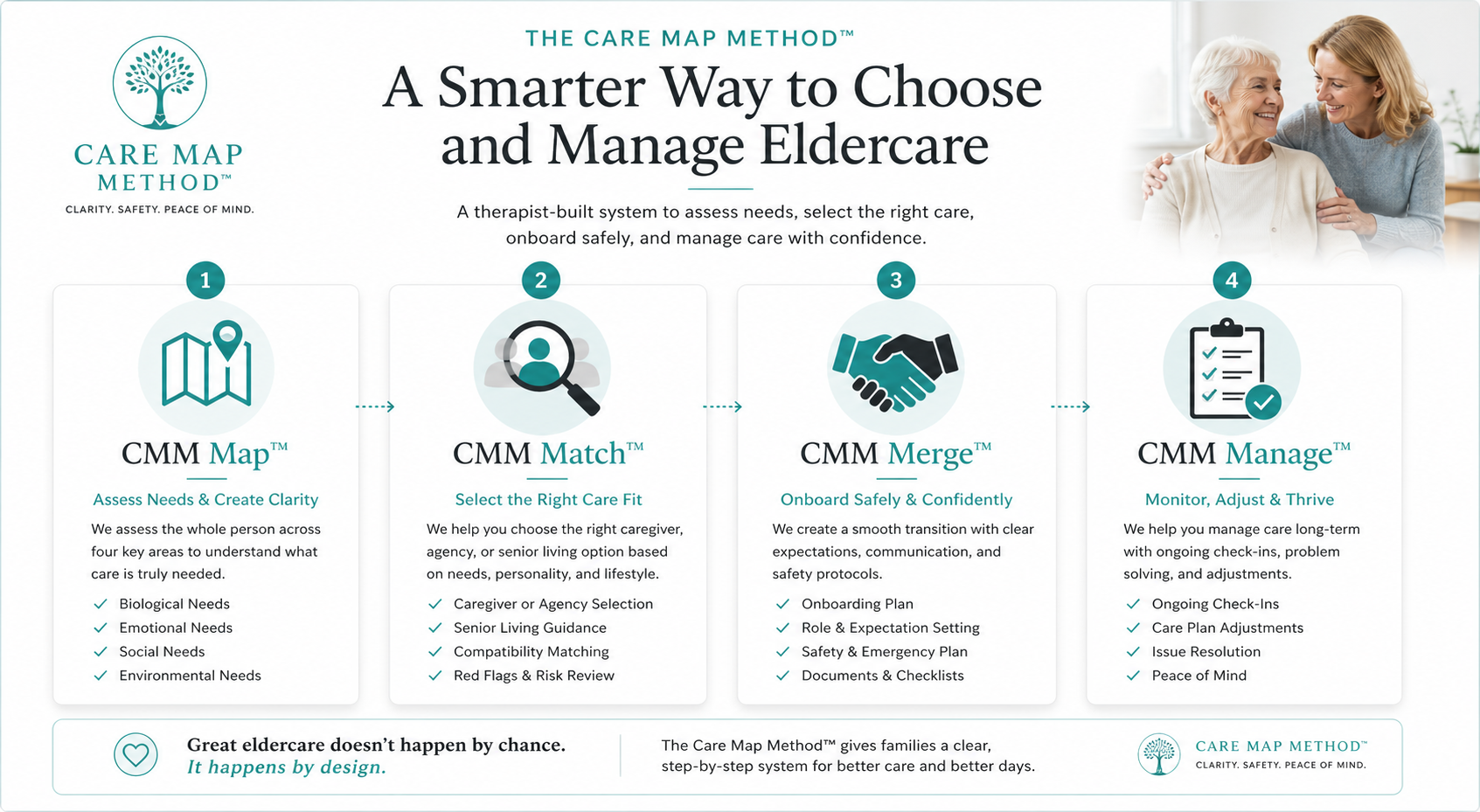
The Care Map Method™ is a therapist-developed system designed to bring structure and clarity to caregiving decisions.
Instead of guessing, families follow a clear process:
1. MAP
Assess the senior’s full needs across emotional, biological, environmental, and social areas.
2. MATCH
Choose the right caregiver or care setting based on those needs—not just availability.
3. MERGE
Onboard care properly with clear expectations, routines, and communication.
4. MANAGE
Monitor care over time, adjust as needed, and ensure long-term success.
This structured approach transforms caregiving from reactive decision-making into a proactive, evidence-based system.
The Missing Variable: Emotional Fit
A caregiver can be competent—and still fail—if emotional alignment is missing.
Many seniors struggle when:
they do not feel understood
communication styles do not match
routines feel disruptive
autonomy is not respected
What looks like resistance is often misalignment.
And without addressing emotional fit, families often cycle through multiple caregivers, increasing stress and instability.
A Better Way to Choose Senior Care
Good elder care is not just about services—it is about alignment.
When families use a structured system to assess and manage care:
stress decreases
outcomes improve
caregivers stay longer
seniors feel more secure and supported
The Care Map Method™ was designed to bring clarity to one of the most complex decisions families face.
Because better care does not happen by chance.
It happens by design.
Download the Senior Care Decision System
Use the same structured framework to assess, choose, and manage care on your own https://caremaptammy.gumroad.com/l/fdbjj
BOOK Your Care Map Senior Session Today
Home Care vs Assisted Living: How to Decide Without Panic or Regret
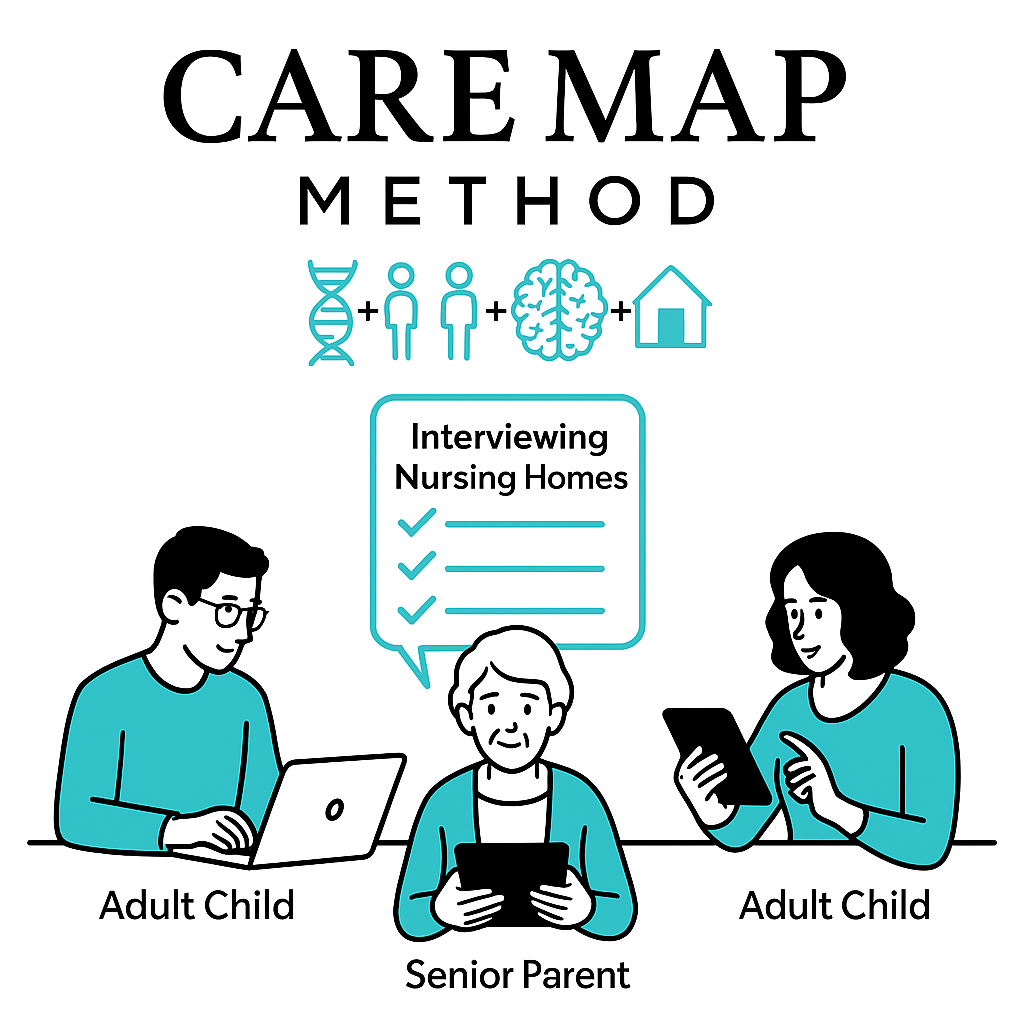
Seniors, adult children and family interviewing eldercare providers
This is one of the most searched elder care questions—and one of the most misunderstood.
The real question is not:
“Which is better?”
It is:
“Which option fits this person’s needs right now?”
When Home Care Works Best
Cognitive function is relatively stable
Home can be modified safely
Emotional attachment to home is strong
Family oversight is realistic
When Assisted Living Works Best
Supervision needs are increasing
Isolation is worsening
Medication management is complex
Safety requires consistency
Timing Matters More Than Location
Too early → resistance
Too late → crisis
Thoughtful timing → adaptation
The Care Map Method™ helps families choose support, not labels.
➡️ Download the Eldercare Selection & Management Guide for a structured decision framework. https://caremaptammy.gumroad.com/l/fdbjj
Why Elder Care Decisions Feel So Emotional (And Why That’s Normal)
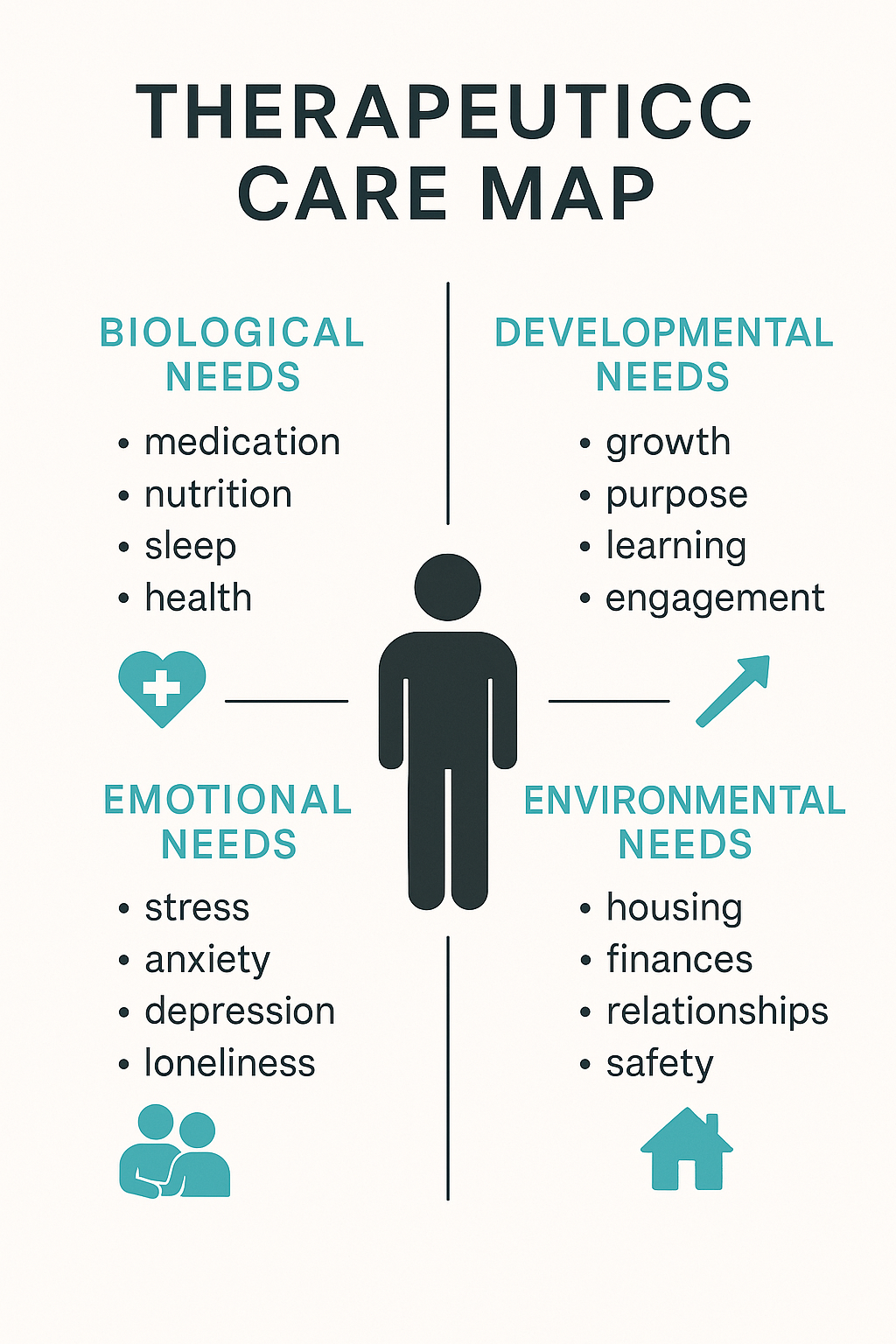
Four Cour Needs Of Seniors: Biological, Developmental, Emotional & Environmental
Elder care decisions are not logistical decisions.
They are identity decisions.
Adult children often feel:
guilt for “taking something away”
fear of betraying a parent
pressure from siblings
responsibility for outcomes they can’t fully control
This emotional weight is not weakness—it is love.
The Developmental Reality
According to Erik Erikson’s final developmental stage—Ego Integrity vs. Despair—aging adults are navigating:
life review
identity integration
fear of loss of control
meaning and legacy
When care decisions ignore this reality, resistance increases.
Why Guilt Clouds Judgment
Guilt thrives when families equate:
care with control
help with failure
independence with safety
In truth, support preserves dignity when it prevents crisis.
A Therapist’s Reframe
You are not deciding whether your parent is capable.
You are deciding what support structure reduces suffering.
Download our book: Is It Time? guide walks families through these decisions with clarity and compassion.https://caremaptammy.gumroad.com/l/fdbjj
How Do I Know When It’s Time for Elder Care? A Therapist’s Framework for Families
How Do I Know When It’s Time for Elder Care? A Therapist’s Framework for Families
Most families wait too long to ask this question.
Not because they don’t care—but because they are waiting for certainty.
In my clinical work with families and aging adults, I see this pattern repeatedly: adult children hoping for a clear moment when the decision becomes obvious. A fall. A diagnosis. A crisis.
But elder care rarely announces itself that clearly.
Instead, need unfolds quietly—through small changes that accumulate over time.
The Mistake Families Make
Families often ask:
“Is it bad enough yet?”
A more useful question is:
“What is happening now—and what will happen if nothing changes?”
This is why I developed the Care Map Method™, a therapeutic framework that evaluates elder care needs across four essential domains.
The Four Signals It May Be Time
Biological
Missed medications
Fatigue or slowed movement
Unexplained weight loss
Increased falls or near-falls
Psychological & Emotional
Withdrawal
Irritability
Anxiety
Fear of being alone
Environmental
Unsafe stairs or bathrooms
Disorganization
Declining cleanliness
Confusion navigating the home
Family Capacity
Adult children compensating quietly
Growing resentment or burnout
Constant vigilance
When two or more of these areas show strain, it is not “too early.”
It is information.
Acting Before Crisis Preserves Choice
Waiting rarely preserves independence.
It often removes options.
The goal of elder care planning is not early action—it is timely action.
Next step: Download our ebook, Is It Time?™ A Therapist’s Senior Care Decision & Assessment System https://caremaptammy.gumroad.com/l/fdbjj
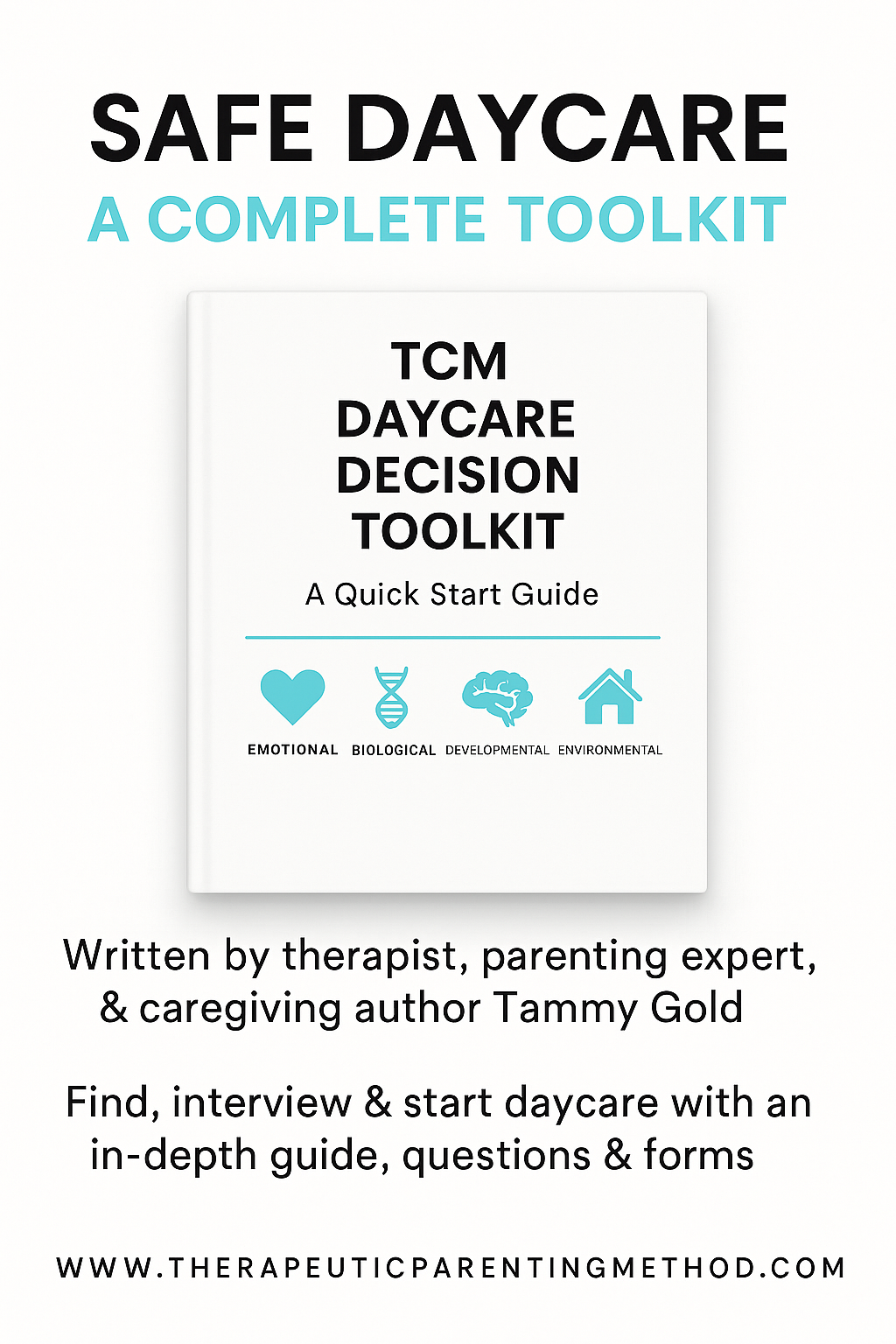
How to Find a Quality Daycare That Truly Supports Your Child
How to Find a Quality Daycare That Truly Supports Your Child
Choosing daycare is one of the most emotionally charged decisions parents make.
For many families, daycare is a practical necessity—but that doesn’t make the process any less overwhelming. A high-quality daycare can support your child’s social, emotional, and cognitive development. A poor fit can create stress, regression, and constant second-guessing.
As a licensed therapist, I encourage parents to move beyond surface-level factors like cost, location, or availability and instead evaluate daycare through a whole-child lens.
This is the foundation of the Care Map Method™—a framework that helps families make confident, informed childcare decisions by understanding their child’s emotional, developmental, biological, and environmental needs.
How the Care Map Method™ Helps You Choose Childcare
Most daycare advice focuses on logistics. The Care Map Method™ focuses on your child.
When evaluating daycare options, consider these four essential areas:
Emotional: How your child manages separation, attachment, and transitions
Developmental: Age, temperament, learning style, and social readiness
Biological: Sleep patterns, feeding needs, health, and sensory sensitivities
Environmental: Group size, noise level, caregiver consistency, and physical space
This framework helps parents move from anxiety and overwhelm to clarity and confidence—without guilt or fear.
Characteristics of a Quality Child Care Center
When touring daycare centers, preparation is key. A quality evaluation looks beyond first impressions and examines four critical areas:
The business
The employees
The program
The building
Each area provides important insight into whether a daycare can consistently meet your child’s needs.
The Business
Daycares may feel warm and nurturing—but they are also businesses. A well-run operation is essential for consistent, high-quality care.
A quality daycare business:
Has been operating for several years
Maintains current licenses and credentials
Provides parent references upon request
Clearly outlines policies and procedures
Strong centers also have clear policies around:
Operating hours
Drop-off and pick-up expectations
Illness and exclusion guidelines
When policies are vague or inconsistently enforced, stress often follows.
The Employees

employee
Caregivers are the heart of any daycare program.
High-quality daycare centers prioritize hiring, training, and retaining engaged staff. According to Department of Labor guidelines, strong childcare providers are typically:
Educated in early childhood development (when possible)
Trained in CPR and emergency response
Responsible, prepared, and emotionally present
Enthusiastic about working with children
Equally important: alignment with your parenting values around sleep, discipline, and feeding.
Centers that offer benefits and professional support tend to have lower turnover—providing children with the consistency they need to feel safe and regulated.
The Program (Curriculum)
Curricula vary widely—and that’s okay.
What matters most is whether the program aligns with your child’s developmental stage and learning style.
According to the U.S. Department of Education, quality daycare programs typically:
Maintain small group sizes with adequate staffing
Offer a thoughtful mix of structured and unstructured activities
Rotate activities to prevent overstimulation or boredom
Limit or eliminate screen time during the day
A strong program supports curiosity, regulation, and secure attachment—not just academic readiness.
The Building
The physical environment plays a larger role than many parents realize.
While building age varies, quality daycare spaces should consistently meet safety and sanitation standards.
A quality daycare facility:
Is clean, organized, and well-maintained
Follows basic safety protocols
Provides nutritious meals and snacks
Offers safe, quiet sleep areas with appropriate bedding
If equipment is broken, rooms feel overcrowded, or safety seems overlooked, trust your instincts.
Finding a Quality Daycare Takes Time
High-quality daycare spots are limited—and in demand.
Parents who wait until the last minute often find their top choices already full. Starting early gives you time to tour, compare, and reflect without pressure.
Remember: if a daycare feels right to you, it likely feels right to many other families too.
Make Confident Daycare Decisions—Without Guesswork
If you’re feeling overwhelmed by daycare choices, you don’t have to navigate this alone.
I created a step-by-step childcare decision system to help parents evaluate daycare and nanny options through a clinical, child-centered lens.
Recommended Resources for Parents
How to Choose Childcare: A Therapist’s Guide Using the Care Map Method™
→ In-depth guidance on choosing daycare, nanny, or hybrid care
Childcare Interview, Reference Check & Trial Toolkit
→ Exact questions, observation logs, and red-flag checklists
Nanny Training & Daycare Onboarding Manuals
→ Editable tools to support consistency and caregiver success
Explore the full Childcare Decision Bundle here: https://caremaptammy.gumroad.com/l/fnogts

How to Choose a Childcare Provider: 4 Simple Steps to Choosing the Best Childcare
There comes a time when every family must choose childcare — and for many parents, this decision feels overwhelming.
What works beautifully for one family may feel completely wrong for another. A neighbor may rave about a daycare center, while a friend swears by having a nanny. With so many opinions and options, parents often feel pressured to decide quickly rather than thoughtfully.
As a licensed therapist and childcare expert, I encourage parents to slow the process down and evaluate childcare through a whole-child lens — one that considers not just logistics, but your child’s emotional safety, development, biology, and environment.
This guide will walk you through four clear steps to help you choose childcare with confidence, using the Care Map Method™.
Choosing Childcare: Understanding the Needs of Both You and Your Child
Step #1: Questions to Ask Yourself
Step #2: Questions About the Type of Care You Want
Step #3: Questions for Daycare Centers
Step #4: Questions for Nannies
Prioritize and Research
Choosing Childcare: Understanding the Needs of Both You and Your Child
Before touring daycare centers or interviewing nannies, it’s essential to understand what your family truly needs.
Consider what daily life will look like once childcare begins:
Will structure and routine help your child feel secure?
Does your child thrive with one-on-one attention?
How does your child handle transitions, noise, or new caregivers?
The Care Map Method™ helps parents evaluate childcare decisions through four essential areas:
Emotional: Attachment, separation, comfort, responsiveness
Developmental: Age, temperament, learning style
Biological: Sleep, feeding, health, sensory needs
Environmental: Group size, consistency, physical space
When childcare aligns across these four areas, children adjust more smoothly — and parents feel more confident.
Step #1: Questions to Ask Yourself Before Choosing Childcare
Choosing childcare requires more thought than most parents expect. Before evaluating any provider, start by asking yourself:
How many hours and which days do I need childcare?
How much flexibility do I need if work schedules change?
Will my needs shift between part-time and full-time care?
What is my realistic budget?
How important is proximity to home or work?
These questions create the foundation for your search and help narrow your options before emotions take over.
Step #2: Questions About the Type of Care You Want
Once logistics are clear, it’s time to consider the kind of care that best supports your child.
Ask yourself:
Is my child ready for group socialization?
Do I value formal childcare education or lived experience more?
What developmental experiences matter most at this age?
Would my child benefit from mixed-age or same-age peers?
Do I want structure, flexibility, or a blend of both?
These answers guide whether daycare, nanny care, or a hybrid option is the best fit.
Feeling unsure how to objectively compare your options?
👉 Download How to Choose Childcare: A Therapist’s Step-by-Step Guide Using the Care Map Method™
This guide walks parents through daycare, nanny, and hybrid care decisions using a calm, structured framework — so you don’t rely on guesswork or guilt.
https://caremaptammy.gumroad.com/l/jlxxie
Step #3: Questions for Daycare Centers
If daycare feels like the right direction, touring centers with intention matters.
When evaluating a daycare, consider asking:
How much individual attention does each child receive?
What are the group sizes?
Is there a balance between structure and free play?
Does the environment feel more like a home or a school?
Are meals provided, and how are nutrition needs handled?
Is the location convenient for daily routines?
Your goal isn’t to find the “best” daycare — it’s to find the one that aligns most closely with your child’s emotional, developmental, and biological needs.
Step #4: Questions for Nannies
For families considering nanny care, the questions extend beyond childcare philosophy into household dynamics.
Important considerations include:
Will the nanny assist with meals or light household tasks?
What training or experience does the nanny have?
How will backup care be handled during illness?
Is the position live-in or live-out?
How will the nanny support socialization?
Will educational support or homework help be included?
Because a nanny works independently in your home, background checks and reference checks are essential. Many families choose to work with reputable placement agencies to add an extra layer of confidence.
Prioritize and Research
After gathering information, create a short list of your top priorities.
No childcare option is perfect — but the right fit will support your child’s needs while allowing your family to function with less stress.
The more intentionally you approach this process, the more confident you’ll feel in your final decision.
Want the Exact Interview Questions and Trial Checklists?
Once you narrow down options, clarity often comes from what you observe during interviews and trial periods.
👉 Get the Childcare Interview, Reference Check & Trial Toolkit
Includes therapist-designed interview questions, reference scripts, trial-week observation logs, and red-flag checklists — all aligned with the Care Map Method™.
https://caremaptammy.gumroad.com/l/fnogts
What Is the Care Map Method™?
The Care Map Method™ was developed by licensed therapist and parenting expert Tammy Gold, LCSW, and is based on over 20 years of clinical experience working with families.
The method integrates four essential pillars:
Emotional
Developmental
Biological
Environmental
By applying this framework, parents move from fear-based decision-making to calm, informed advocacy for their children.
Learn more at www.CareMapMethod.com