


Caring for My Parents Is Hurting My Marriage
Caring for aging parents can consume time, attention, money and emotional energy that once belonged to a marriage. One partner may feel overwhelmed while the other feels shut out, neglected or frustrated. Neither person has to be the villain for the relationship to be under real strain.

A couple experiencing relationship strain while one partner manages aging-parent caregiving responsibilities.
Caring for My Parents Is Hurting My Marriage
Caring for aging parents can consume time, attention, money and emotional energy that once belonged to a marriage. One partner may feel overwhelmed while the other feels shut out, neglected or frustrated. Neither person has to be the villain for the relationship to be under real strain.
You may be functioning well in many areas of life and still feel consumed by this one relationship or transition. When the same thoughts and conversations repeat, it can become difficult to know what is a reasonable reaction, what needs to change, and where to begin.
You may be experiencing
caregiver marriage stress
aging parents and marriage
caregiver burnout
resentment in marriage
sandwich generation couple
family caregiving
A safe place for support and practical solutions
Therapy can help couples name the pressure more accurately, communicate needs without blame, redistribute responsibilities where possible and protect small areas of connection. Caregiving may not become easy, but the marriage does not have to disappear inside it.
My approach is warm, relational and solution-focused. I want therapy to feel like one completely safe place with no judgment, stress, shame or blame. You can unload what you are carrying, better understand yourself and the people around you, name emotions more clearly, and leave with practical ways to move forward. My sole goal is for clients to leave each session feeling better, less alone and more supported.
How I use the Care Map Method™
MAP — Understand the pattern, pressure points, emotions and needs underneath the problem.
MATCH — Identify the support, boundaries, communication and goals that fit your situation.
MERGE — Improve communication and connection among the people and competing needs involved.
MANAGE — Create practical next steps you can use between sessions and adjust as circumstances change.
Using Providence for online therapy in Oregon
I provide online therapy for clients who are physically located in Oregon at the time of the session. Eligible Providence members may be able to use insurance for therapy through Headway. Network participation, benefits, deductibles, copays and eligibility vary by individual plan. Please verify your benefits through Headway before booking.
Frequently asked questions
Can therapy help with this even if the other person does not attend?
Yes. Individual therapy can help you understand patterns, regulate reactions, clarify boundaries and change how you respond even when another person is not participating.
Will therapy just be talking about the problem?
No. There is room to talk and feel fully heard, but my approach also emphasizes clinical insight, communication tools, boundaries and practical next steps.
Do you provide online therapy in Oregon?
Yes. I provide telehealth therapy to appropriate clients located in Oregon, subject to scheduling, clinical fit and applicable requirements.
Can I use Providence for therapy?
Eligible Providence members may be able to use benefits through Headway. Coverage and out-of-pocket costs vary, so benefits should be verified before booking.
What if I am not sure whether my problem is serious enough for therapy?
You do not need to wait for a crisis. Therapy can be useful when a relationship, transition or recurring stress is taking up too much emotional space or affecting daily life.
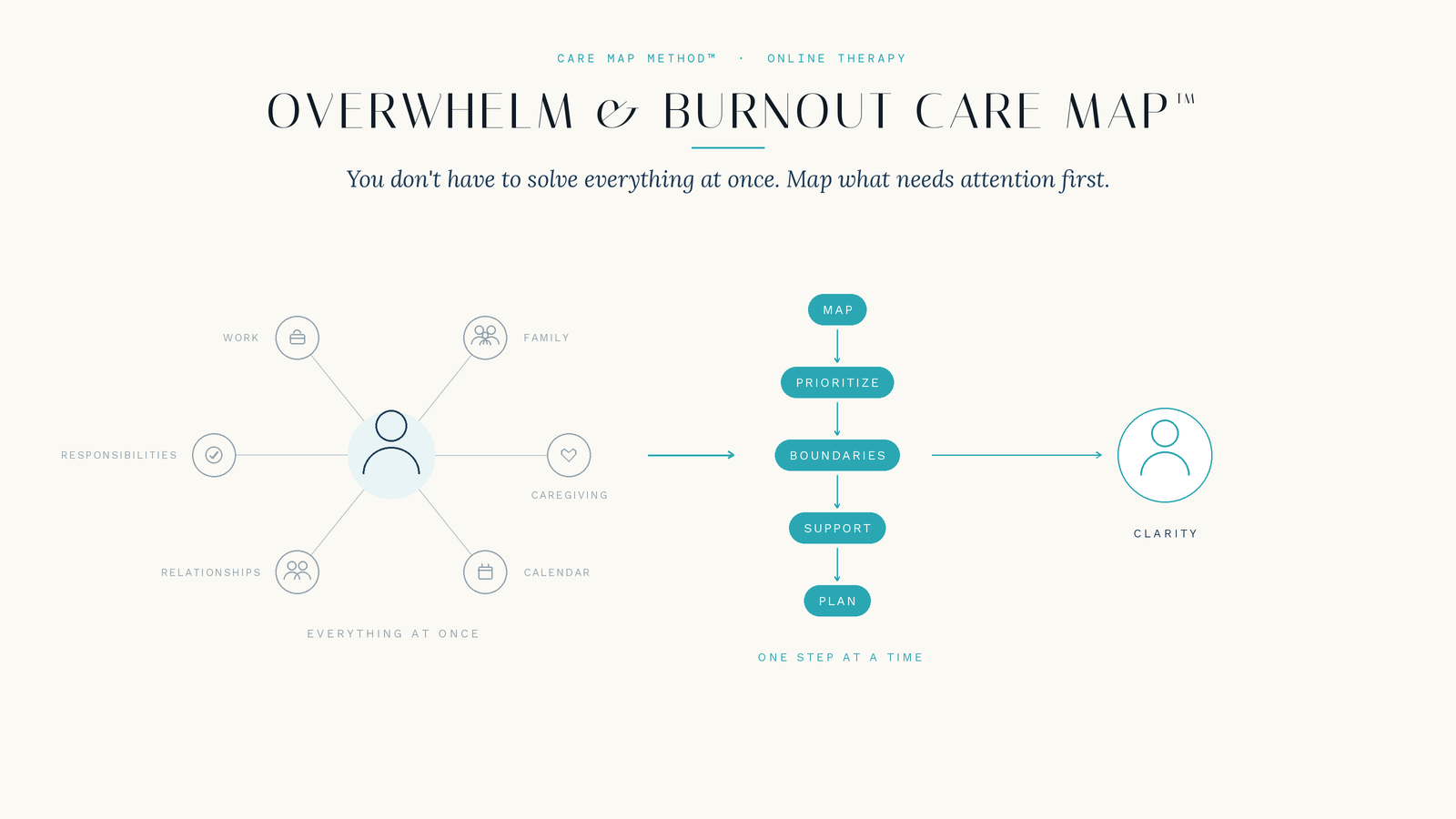
Burnout, Overwhelm & Emotional Exhaustion
When functioning becomes a constant act of pushing through, therapy can help you understand what is driving the overload and build a more sustainable way forward.
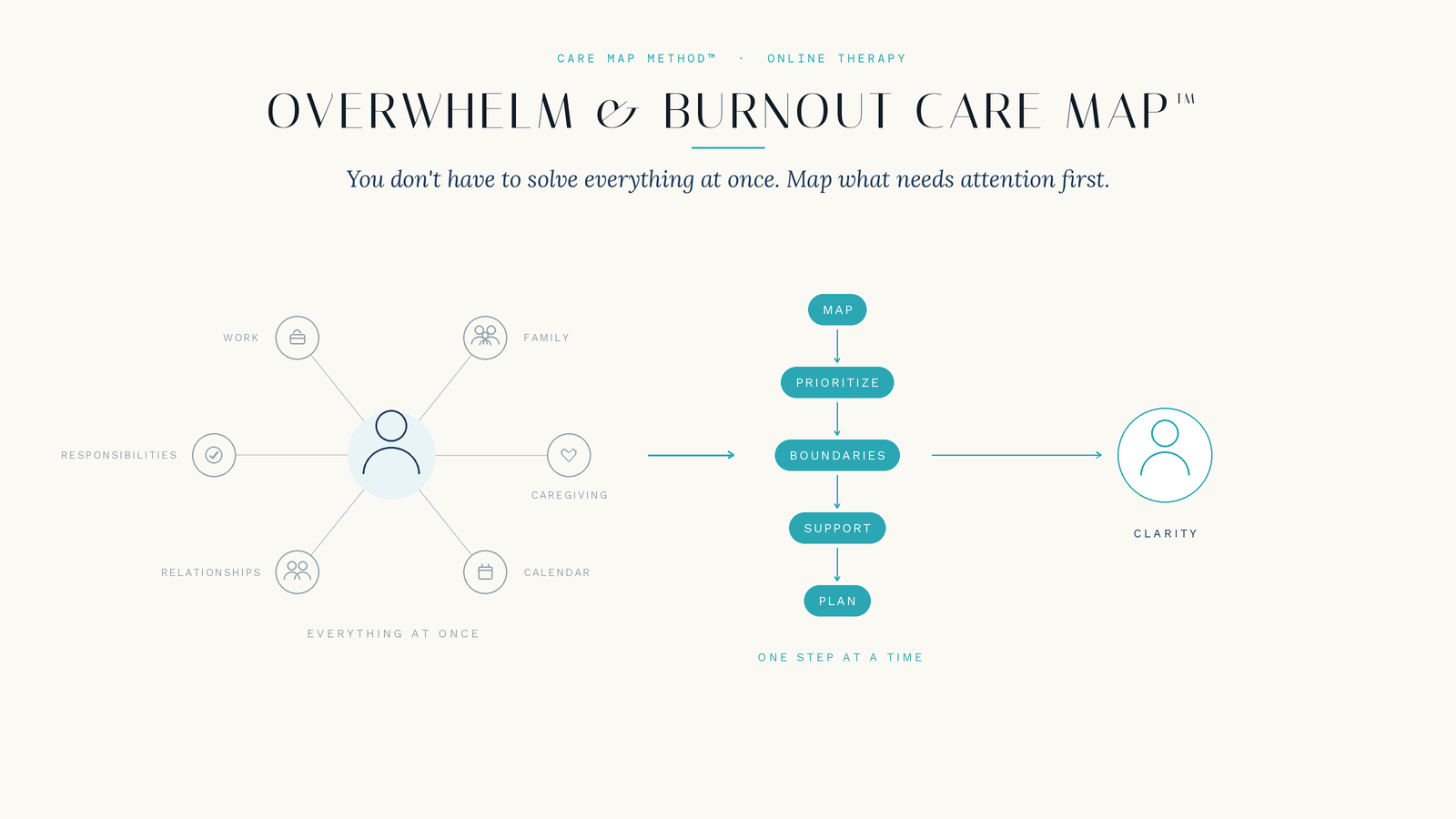
Online Therapy for Burnout, Overwhelm & Emotional Exhaustion
Burnout often develops gradually. You keep functioning, meeting obligations and taking care of other people until everyday tasks begin to feel heavier than they should. You may be irritable, numb, exhausted or unable to stop thinking about what still needs to be done. Therapy can help you understand the system that created the overload rather than treating rest as the only solution.
What You May Be Dealing With
You are tired even when you have technically had time off.
Small requests feel disproportionately overwhelming.
You are functioning externally but feel depleted internally.
You cannot mentally switch off from work or family responsibilities.
You feel resentful because too much depends on you.
You have difficulty asking for help or delegating.
You are less patient with people you care about.
You worry that slowing down will cause everything to fall apart.
How Therapy Can Help
Therapy can help identify the patterns sustaining burnout, such as perfectionism, over-responsibility, people pleasing, chronic stress, unclear boundaries or a life structure that no longer fits. The work may include emotional regulation, boundary setting, realistic prioritization, relationship changes and examining beliefs about worth, productivity and responsibility.
The Care Map Method™ in Therapy
Care Map Method™ is a structured way to organize the people, needs, stressors and choices involved in a complex real-life situation. In psychotherapy, it is used only as an organizing framework within individualized clinical care—not as a substitute for assessment, diagnosis or treatment planning.
MAP — Identify where energy is going, what pressures are chronic and which relationships or roles are most draining.
MATCH — Choose coping tools, boundaries and practical changes that fit the actual source of the overload.
MERGE — Build those changes into work, home and relationship routines.
MANAGE — Track whether the overall load is becoming more sustainable and adjust when circumstances change.
Why Work With Tammy Gold
Tammy Gold works with adults navigating high-responsibility roles across work, parenting, caregiving and relationships. The Care Map Method™ helps organize competing demands so therapy can focus on the patterns and emotions that keep clients stuck in chronic over-functioning.
Insurance & Online Therapy
Online therapy is available for clients located in states where Tammy is licensed and accepting clients. Selected insurance plans are accepted through Headway. Coverage, copays, deductibles, coinsurance and eligibility vary by plan and member.
Use the Headway booking link to check current insurance eligibility and available appointment times. Do not publish contracted reimbursement amounts on the website.
STATE-SPECIFICS
Oregon: Providence Health Plan • Aetna • Regence BlueCross BlueShield of Oregon • Carelon Behavioral Health • Providence Medicare Advantage.
California: Providence Health Plan • Aetna • Carelon Behavioral Health • Anthem Blue Cross California.
New Jersey: Providence Health Plan • Aetna • Carelon Behavioral Health.
Always verify current participation before publishing.
Frequently Asked Questions
What is the difference between stress and burnout?
Stress can be temporary and situation-specific. Burnout often involves more persistent exhaustion, cynicism, reduced capacity and a sense that demands consistently exceed available resources.
Can therapy help if my life circumstances cannot change quickly?
Yes. Therapy can work on coping, boundaries, expectations, communication and decision-making even when some external demands remain.
Is burnout a diagnosis?
Burnout itself is not necessarily a standalone mental health diagnosis. Therapy can assess the symptoms and functioning involved and determine what clinical issues may be relevant.
Can therapy help with work and family burnout at the same time?
Yes. Those systems often interact, and therapy can examine the overall load rather than isolating one domain.
Is insurance accepted?
Selected plans are accepted through Headway. Verify eligibility and expected cost before booking.
If your current way of functioning is no longer sustainable, you do not need to wait until you completely run out of capacity. Check insurance eligibility and book online therapy through Headway.
Email: Info@CareMapMethod.com Text:818.308.1358
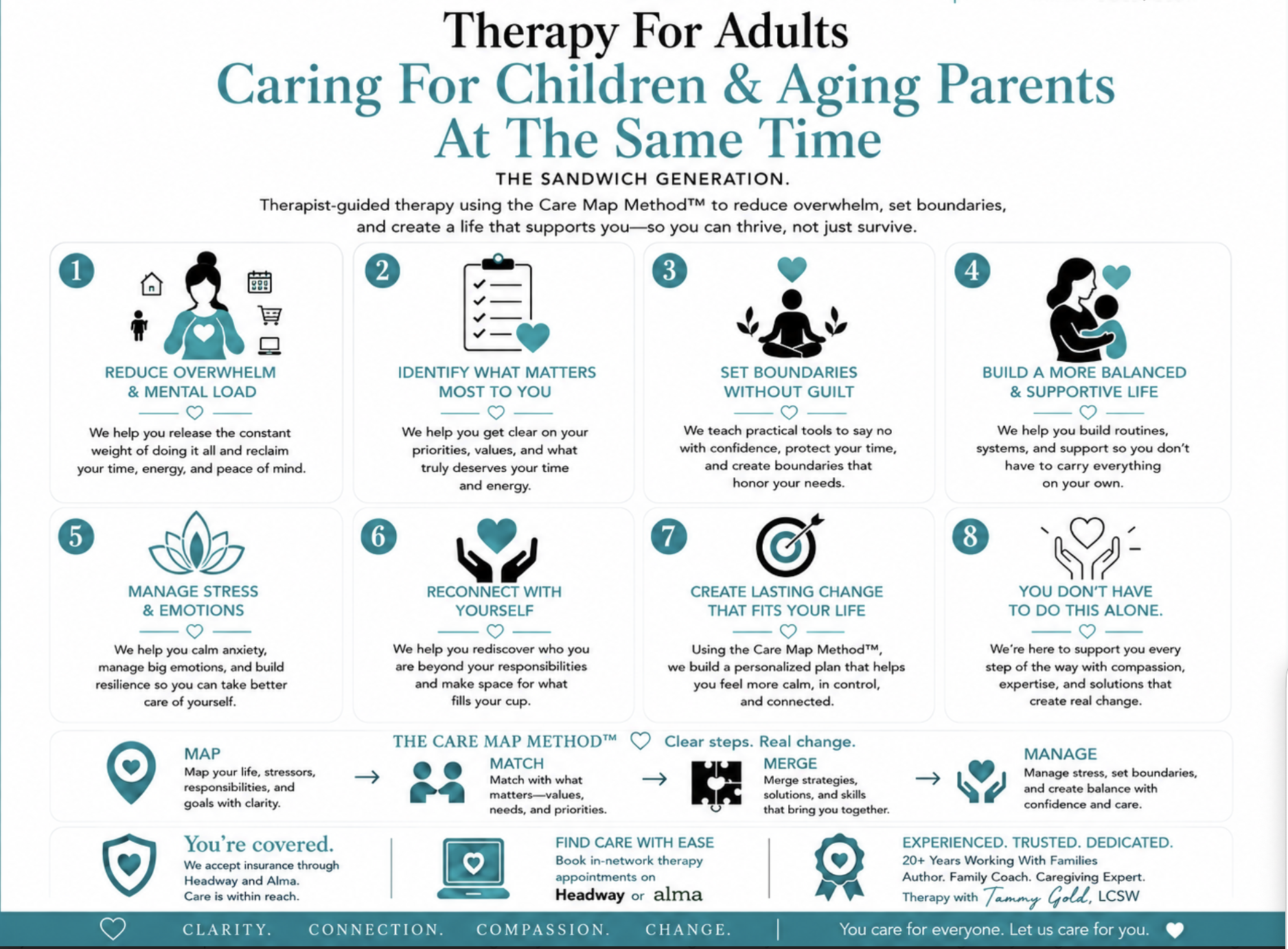
Therapy for Adult Children Caring for Aging Parents While Raising Their Own Family
Therapy for adult children in the sandwich generation who are raising children while caring for aging parents, managing siblings, caregiving decisions and family stress.
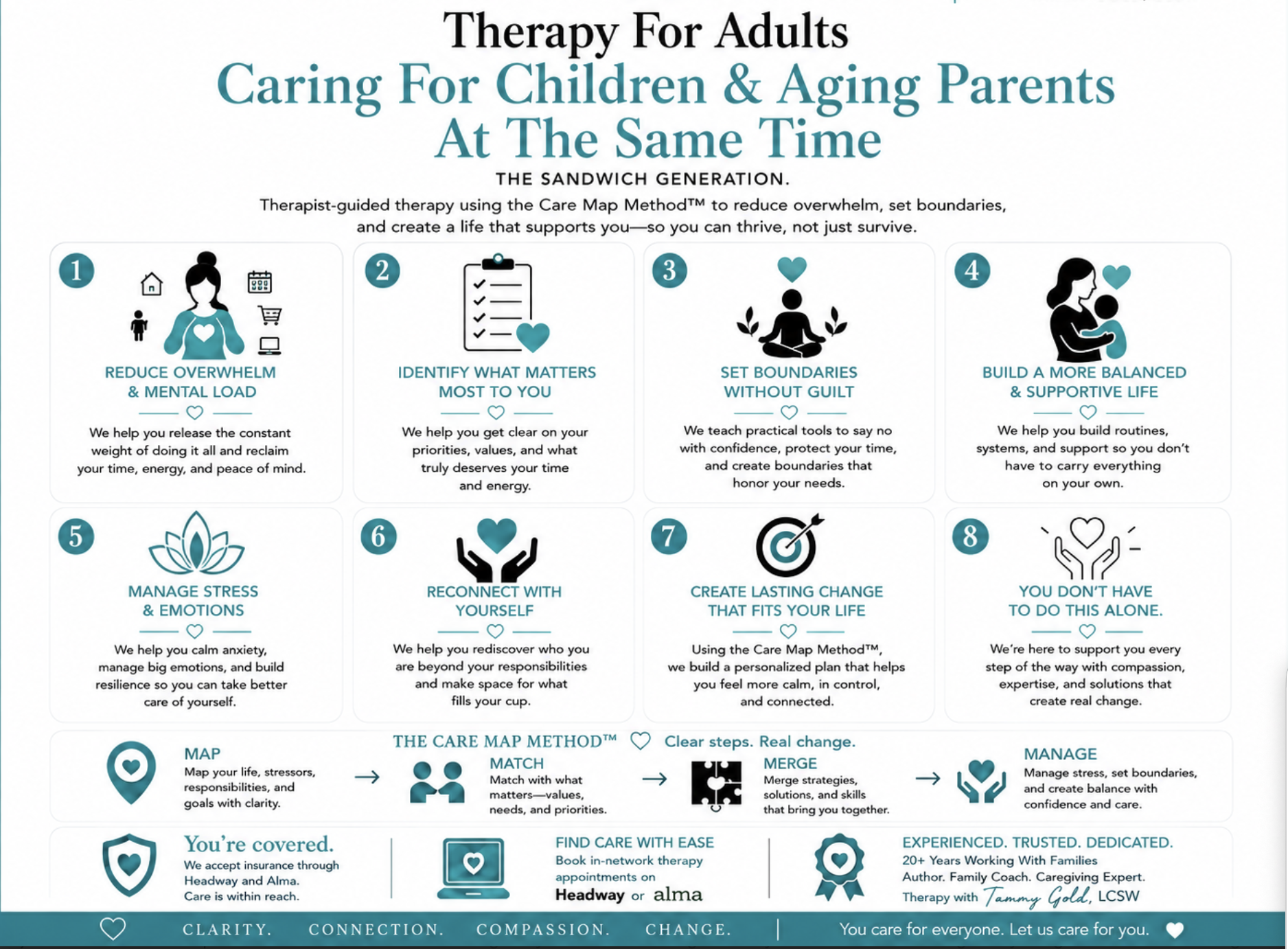
Therapy for Adult Children Caring for Aging Parents While Raising Their Own Family
Caring for aging parents while raising children can create intense emotional pressure. You may be managing your parent’s needs, sibling conflict, eldercare decisions, your own children, work, marriage, finances and the feeling that everyone needs you at once.
I am Tammy Gold, LCSW, a therapist, author and caregiving expert. I offer online therapy for clients in California, New Jersey and Oregon. Depending on your plan and eligibility, insurance may be available through Headway or Alma.
My Psychology Today profile links to booking and insurance options through Headway.
The emotional weight of caregiving
Many adult children feel guilt, resentment, grief, fear, exhaustion and confusion. You may be trying to make good decisions for an aging parent while also feeling pressure from siblings, caregivers, facilities, medical providers or extended family.
Therapy gives you one safe place to talk openly about what you are carrying without being judged.
How the Care Map Method™ helps
Through the Care Map Method™, we Map your parent’s needs and your needs, Match the right supports, Merge communication among family members and care providers, and Manage the plan so it feels more sustainable.
This work combines emotional support with practical problem-solving. The goal is to help you feel less alone, communicate more clearly, set boundaries and make decisions with more steadiness.
Request a session
If you are caring for an aging parent while managing children, work, siblings, marriage or family conflict, visit my Psychology Today profile to request a session. My profile links to booking and insurance options through Headway.
What are common signs of caregiver burnout?
Signs may include exhaustion, irritability, resentment, guilt, sleep problems, reduced concentration, withdrawal, health changes, hopelessness, and feeling unable to keep up with care demands.
How can therapy help caregiver burnout?
Therapy can help caregivers process emotions, identify unsustainable demands, set boundaries, communicate with family, ask for help, and develop a more realistic care plan.
Is it normal to feel resentful while caregiving?
Yes. Resentment can develop when responsibilities are excessive, support is limited, boundaries are unclear, or the caregiver’s own needs are repeatedly postponed. Feeling resentment does not mean you do not love the person.
What if my siblings will not help?
Therapy or coaching can help you clarify what you need, prepare a family conversation, define responsibilities, set limits, and decide what you can realistically continue providing.
How do I know when more professional care is needed?
Consider changes in safety, cognition, mobility, medication, nutrition, hygiene, isolation, wandering, falls, caregiver capacity, and whether current arrangements are sustainable.
Can I care for someone without losing myself?
That is a central goal. Sustainable caregiving requires support, boundaries, realistic expectations, shared responsibility where possible, and attention to the caregiver’s health and identity.
What Care Map worksheet pairs with caregiver burnout?
A Caregiver Burnout Snapshot, Family Capacity Assessment, Weekly Care Plan, Boundary Planner, or Biological-Emotional-Social-Environmental Care Map can help organize the situation.
When is caregiver burnout an emergency?
Seek urgent professional help when there is immediate danger, inability to provide safe care, abuse or neglect concerns, severe medical or psychiatric symptoms, or thoughts of harming yourself or someone else.
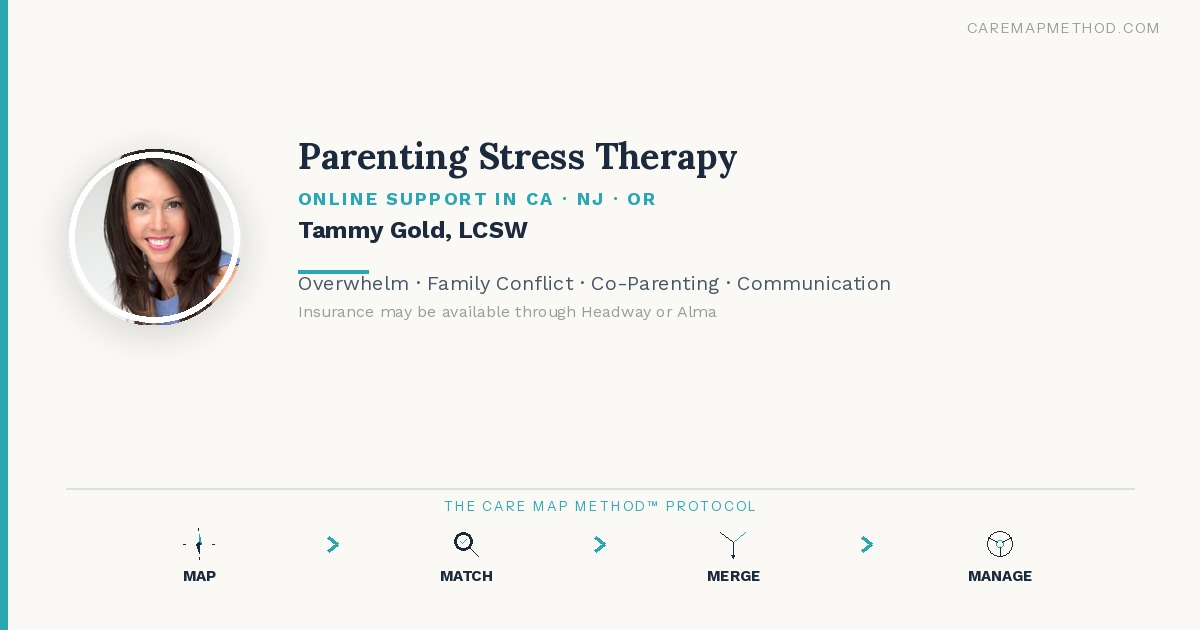
Parenting Stress Therapy with Insurance in CA, NJ & OR
Parenting stress can affect your mood, marriage, communication, patience, and sense of self. Tammy Gold, LCSW offers online therapy for parents in CA, NJ, and OR who are feeling overwhelmed, unsupported, or emotionally exhausted.
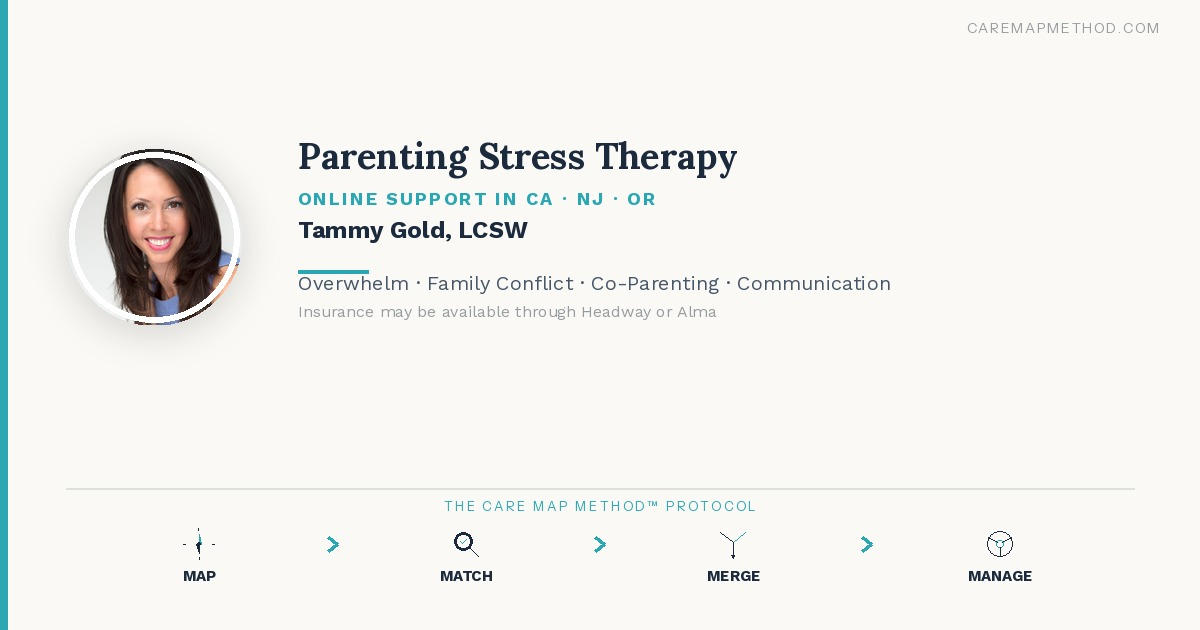
Parenting Stress Therapy with Insurance in CA, NJ & OR
Parenting stress can affect every part of life: your mood, your marriage, your patience, your work, your sleep, and the way you feel about yourself. Many parents are not struggling because they are doing something wrong. They are struggling because they are carrying too much with too little support.
I am Tammy Gold, LCSW, a therapist, author, parenting and family therapy expert, and creator of the Care Map Method™. I support parents in California, New Jersey, and Oregon who are navigating parenting stress, relationship strain, divorce, co-parenting, family conflict, caregiving responsibilities, and emotional overwhelm.
Depending on your plan and eligibility, you may be able to use insurance through Headway or Alma.
View My Psychology Today Profile
My Psychology Today profile links to booking and insurance options through Headway.
When parenting stress becomes too much
Parenting stress often builds slowly. You may notice that you are more reactive than you want to be, more resentful than you expected, or more emotionally exhausted than you can explain.
Constant conflict with your child
Feeling disconnected from your partner
Carrying the emotional labor of the family
Parenting through divorce or separation
Co-parenting stress
Disagreements about discipline, routines, or boundaries
Feeling judged, unsupported, or alone
Balancing work, children, aging parents, and your own needs
Therapy gives you a safe place to be honest about what you are feeling without shame or judgment.
Therapy for parents, couples, and family stress
Parenting does not happen in isolation. Stress with children often affects couples, co-parents, siblings, extended family, school relationships, nanny relationships, daycare decisions, and eldercare responsibilities.
My work is relational. I help clients better understand what is driving behavior, conflict, stress, and communication breakdowns. The goal is not to blame yourself or anyone else. The goal is to understand what is happening and find better ways forward.
My approach
Through the Care Map Method™, we look at emotional, biological, social, and environmental needs. This helps us understand what may be underneath parenting stress and family conflict.
What emotions are being triggered
What needs are not being named
What patterns repeat in the family
What communication breaks down
What support is missing
What practical next steps can reduce stress
My sessions are safe, positive, supportive, and solution-focused. I want clients to feel heard, understood, and less alone while gaining tools they can use at home.
Insurance and booking
Insurance coverage depends on your state, specific plan, eligibility, and platform availability. Clients can review booking and insurance options through my Psychology Today and Headway profiles.
View My Psychology Today Profile
Online parenting stress therapy
I offer online therapy for clients in California, New Jersey, and Oregon. If you are a parent feeling overwhelmed, unsupported, anxious, resentful, or emotionally exhausted, you can request a session through my Psychology Today profile.

Caregiver Burnout: 15 Warning Signs and What to Do Before You Reach a Breaking Point
Feeling exhausted while caring for an aging parent? Learn the warning signs of caregiver burnout and discover practical tools to reduce stress and build a sustainable care plan.
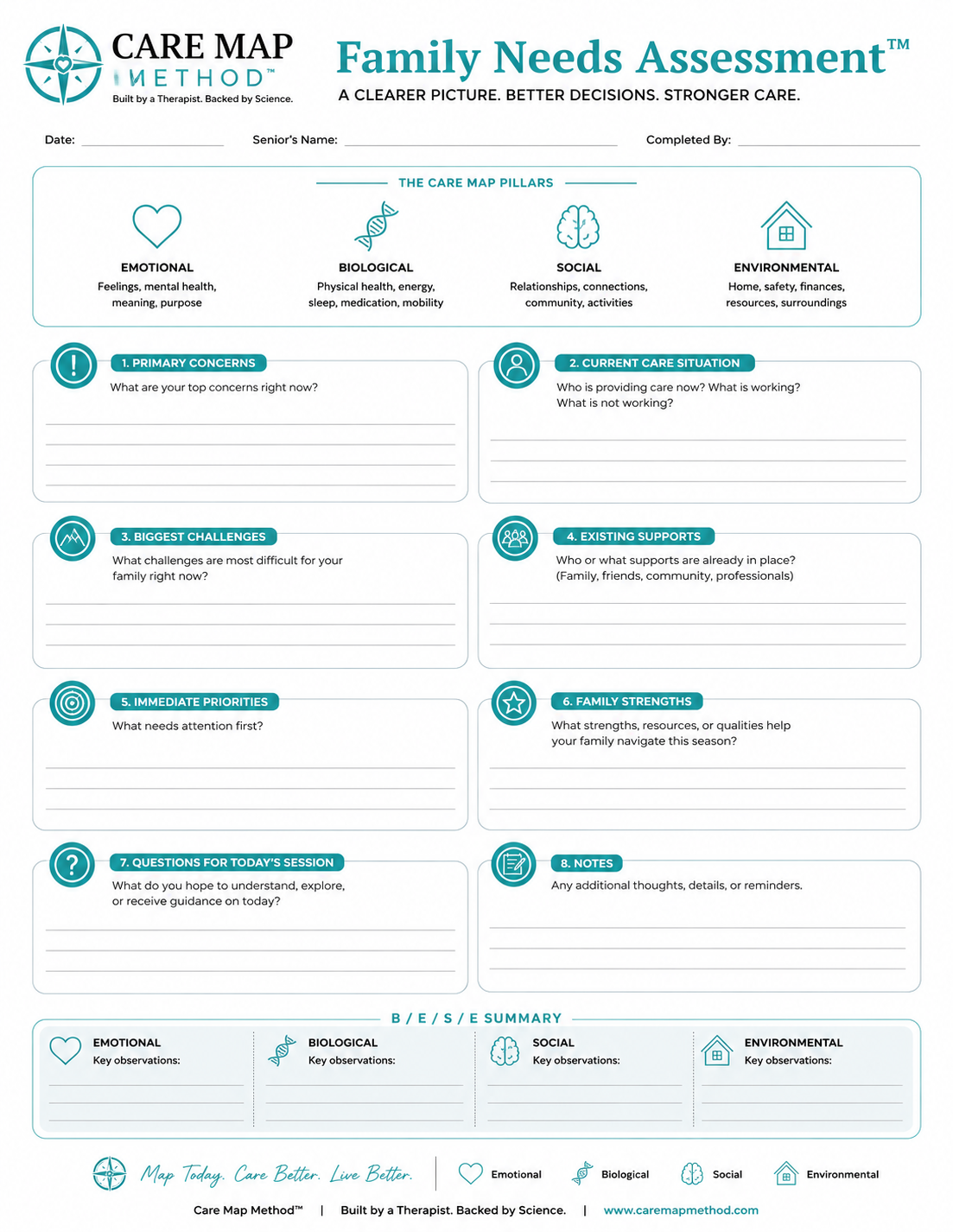
Caregiver Burnout: 15 Warning Signs and What to Do Before You Reach a Breaking Point
Caregiver Burnout: 15 Warning Signs and What to Do Before You Reach a Breaking Point
Caring for an aging parent or loved one is one of the most meaningful roles many people will ever have. It can also be one of the most emotionally, physically, and mentally demanding.
Many family caregivers quietly carry the weight of coordinating appointments, managing medications, communicating with siblings, handling finances, and balancing careers and children—all while trying to ensure their loved one feels safe and supported.
Over time, these responsibilities can lead to caregiver burnout, a state of chronic stress that affects health, relationships, decision-making, and overall quality of life.
At Care Map Method™, we believe that caregivers deserve support too. Recognizing the warning signs early can help you create a healthier, more sustainable care plan for both you and your loved one.
What Is Caregiver Burnout?
Caregiver burnout is a state of physical, emotional, and mental exhaustion caused by the ongoing demands of caring for another person.
Unlike occasional stress, burnout develops gradually. Many caregivers don't realize how overwhelmed they've become until they feel emotionally depleted or physically unwell.
Burnout isn't a sign of weakness or lack of love—it often reflects the reality of trying to do too much without enough support.
15 Warning Signs of Caregiver Burnout
1. You're constantly exhausted, even after sleeping.
2. You feel guilty whenever you take time for yourself.
3. Small problems trigger big emotional reactions.
4. You're becoming forgetful or having trouble concentrating.
5. You feel isolated from friends or family.
6. Your own medical appointments keep getting postponed.
7. Anxiety feels constant.
8. You have difficulty sleeping.
9. You feel resentful about caregiving responsibilities.
10. You rarely enjoy activities that once made you happy.
11. You feel like you're "doing everything."
12. Family disagreements are increasing.
13. Your physical health is declining.
14. You feel trapped or hopeless.
15. You don't know where to begin asking for help.
If several of these sound familiar, it may be time to step back and reassess your caregiving plan.
Why Planning Reduces Burnout
One of the biggest contributors to caregiver stress is uncertainty.
Questions like:
Am I making the right decisions?
Is Mom safe at home?
Should we hire help?
What happens next?
How do I get my siblings involved?
can create constant mental overload.
Having a structured care plan reduces decision fatigue and helps families move from reacting to planning.
The Care Map Method™ Approach
Our therapist-developed Care Map Method™ organizes caregiving into four essential pillars:
Biological
Medical needs, medications, nutrition, mobility, sleep, and overall physical health.
Emotional
Mental health, coping skills, relationships, grief, resilience, and emotional support.
Social
Family communication, community resources, friendships, caregiving roles, and social connection.
Environmental
Home safety, transportation, accessibility, financial planning, and daily routines.
Looking at all four areas together helps families identify gaps before they become crises.
When Is It Time to Ask for Help?
Many caregivers wait until they're overwhelmed before reaching out.
Support can be valuable much earlier.
Working with a therapist or caregiver coach can help you:
Organize priorities.
Improve family communication.
Reduce stress.
Clarify care options.
Create a realistic care plan.
Prevent burnout before it worsens.
What You'll Receive During a Care Map Method™ Caregiver Support Session
When you schedule a Care Map Method™ coaching session, you'll receive practical tools designed to help you feel more organized and confident, including:
Family Needs Assessment
Caregiver Burnout Assessment
Biological, Emotional, Social & Environmental Care Map
Family Communication Scripts
Weekly Care Planning Worksheet
Personalized Action Plan
These resources are designed to support both the caregiver and the entire family system.
You Don't Have to Do This Alone
Supporting an aging parent is a journey, and no one should feel they have to navigate it without guidance.
Whether you're just beginning to notice signs of stress or you're already feeling overwhelmed, taking one small step toward creating a clear care plan can make a meaningful difference.
Caregiver burnout is not a personal failure—it's a sign that the caregiver needs care too.
Call to Action
Ready to create a personalized care plan?
Schedule a Care Map Method™ Caregiver Support Session to receive practical guidance, therapist-developed tools, and a customized plan that helps you care with greater confidence while protecting your own well-being.