Sibling Conflict Over Aging Parents
When siblings disagree about an aging parent, old family roles can collide with urgent care decisions. Therapy can help you manage your own stress and communicate more deliberately.
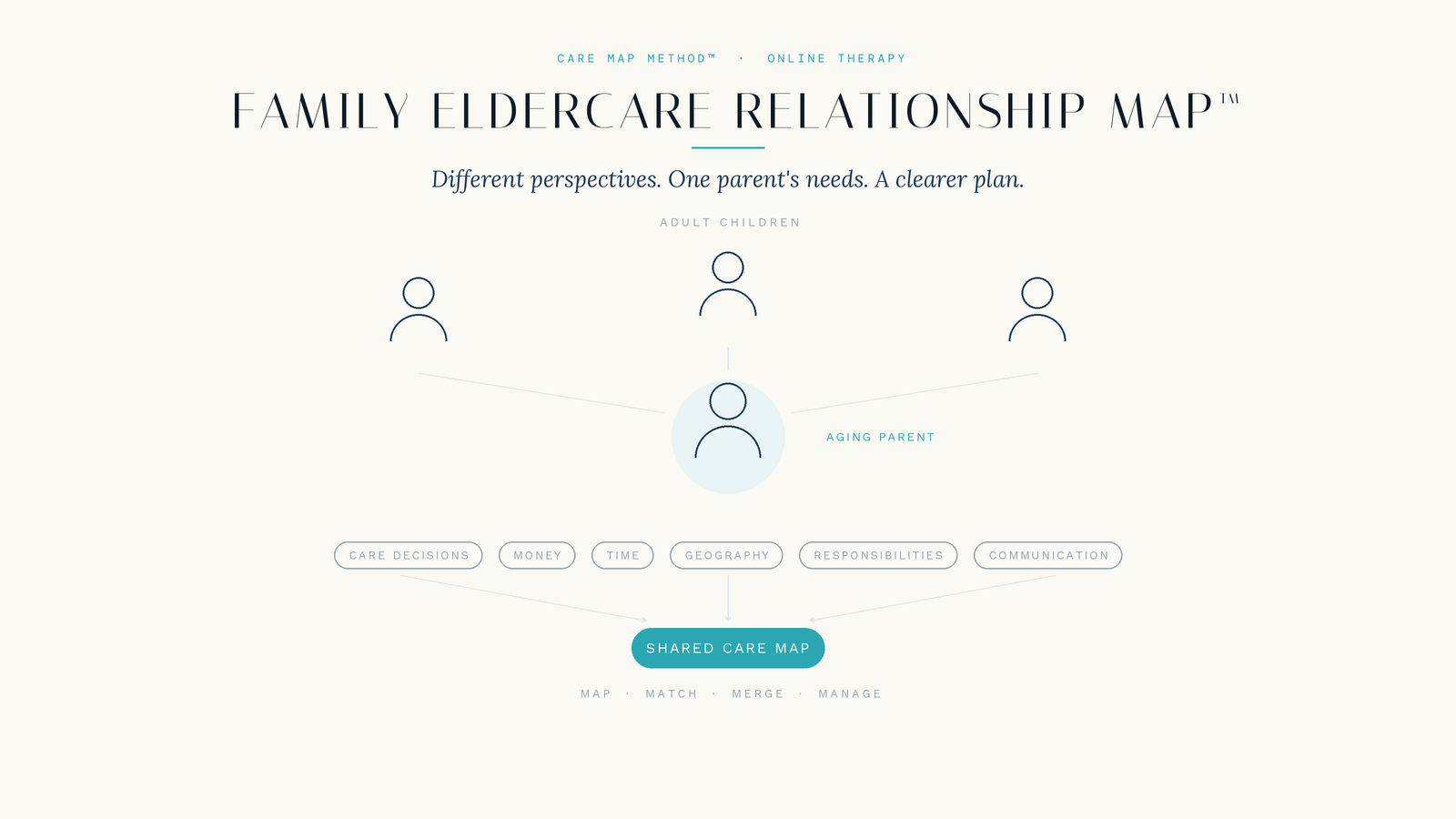
Adult siblings around table reviewing parent-care notes/calendar
Therapy for Sibling Conflict Over Aging Parents
An aging parent’s needs can bring adult siblings back into roles they thought they had outgrown. One sibling may become the default caregiver, another may question every decision from a distance, and old resentments can suddenly become part of conversations about safety, money or care. Therapy can help you understand the family pattern while protecting your own emotional well-being.
Check Insurance Eligibility & Book Online Therapy → CLICK HEADWAY HERE
What You May Be Dealing With
One sibling is doing most of the caregiving and feels resentful.
Family members disagree about whether a parent needs more help.
Money, inheritance or care costs are intensifying conflict.
A sibling criticizes decisions without taking responsibility.
You feel pulled back into childhood roles around your siblings.
Your parent gives different information to different family members.
You dread family calls because every conversation becomes an argument.
You are trying to advocate for your parent without destroying sibling relationships.
How Therapy Can Help
Individual therapy cannot force siblings to cooperate, but it can help you regulate your own reactions, understand the history being activated, clarify your role and decide what boundaries are necessary. Therapy can also help you prepare for difficult conversations, tolerate disagreement and distinguish urgent care needs from longstanding family dynamics.
The Care Map Method™ in Therapy
Care Map Method™ is a structured way to organize the people, needs, stressors and choices involved in a complex real-life situation. In psychotherapy, it is used only as an organizing framework within individualized clinical care—not as a substitute for assessment, diagnosis or treatment planning.
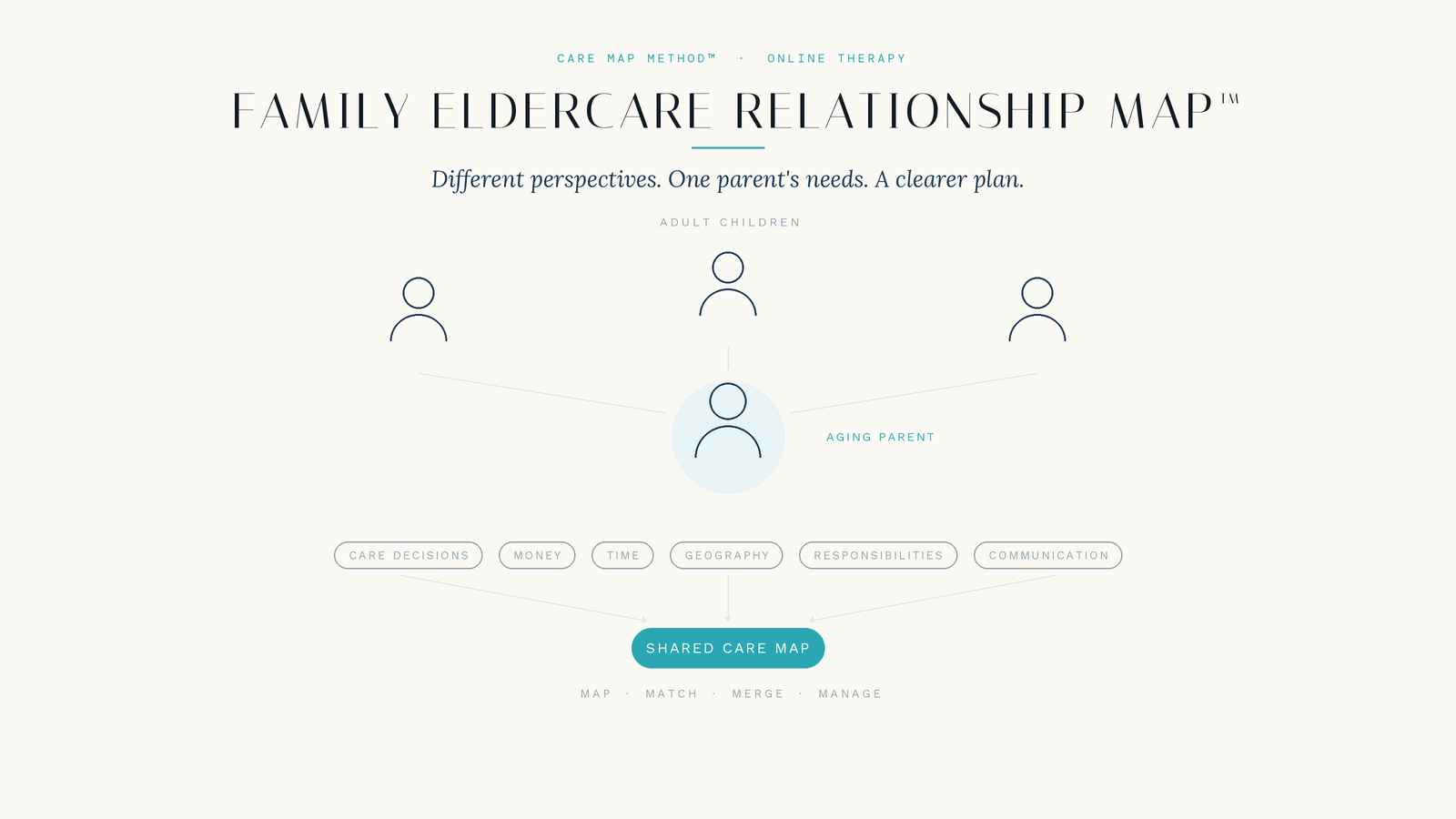
MAP — Identify current care decisions alongside old sibling roles, resentments and communication patterns.
MATCH — Choose boundaries, communication approaches and coping strategies that fit your role and level of responsibility.
MERGE — Apply them to family calls, decision-making and caregiving tasks.
MANAGE — Adjust as the parent’s needs, sibling involvement and care setting change.
Why Work With Tammy Gold
Tammy Gold specializes in the intersection of family relationships and caregiving. Her Care Map Method™ can help clients organize the practical and emotional dimensions of eldercare conflict while therapy remains centered on the client’s own mental health and functioning.
Insurance & Online Therapy
Online therapy is available for clients located in states where Tammy is licensed and accepting clients. Selected insurance plans are accepted through Headway. Coverage, copays, deductibles, coinsurance and eligibility vary by plan and member.
Use the Headway booking link to check current insurance eligibility and available appointment times. Do not publish contracted reimbursement amounts on the website.
STATE-SPECIFIC HELP
Oregon: Providence Health Plan • Aetna • Regence BlueCross BlueShield of Oregon • Carelon Behavioral Health • Providence Medicare Advantage.
California: Providence Health Plan • Aetna • Carelon Behavioral Health • Anthem Blue Cross California.
New Jersey: Providence Health Plan • Aetna • Carelon Behavioral Health.
Always verify current participation before publishing.
Frequently Asked Questions
Can therapy help if my siblings will not participate?
Yes. Individual therapy can focus on your own emotions, boundaries, communication and decisions even if other family members do not attend.
Can you tell us what care our parent needs?
Psychotherapy is not a medical, legal or formal geriatric-care assessment. Therapy can help you manage the emotional and relational stress surrounding care decisions.
Why do sibling conflicts get worse when a parent ages?
Aging-parent decisions can reactivate old family roles, perceived inequities, unresolved resentment and differences in responsibility, geography or finances.
Can therapy help with caregiver resentment?
Yes. Therapy can help you process resentment without shaming it and examine what changes in boundaries, expectations or support may be needed.
Is insurance accepted?
Selected plans are accepted through Headway. Use the eligibility link to confirm current coverage and cost.
You may not be able to control how your siblings respond, but you can change how you participate in the conflict. Check insurance eligibility and book online therapy through Headway.
Info@CareMapMethod.com 818.308.1358 (TEXT)
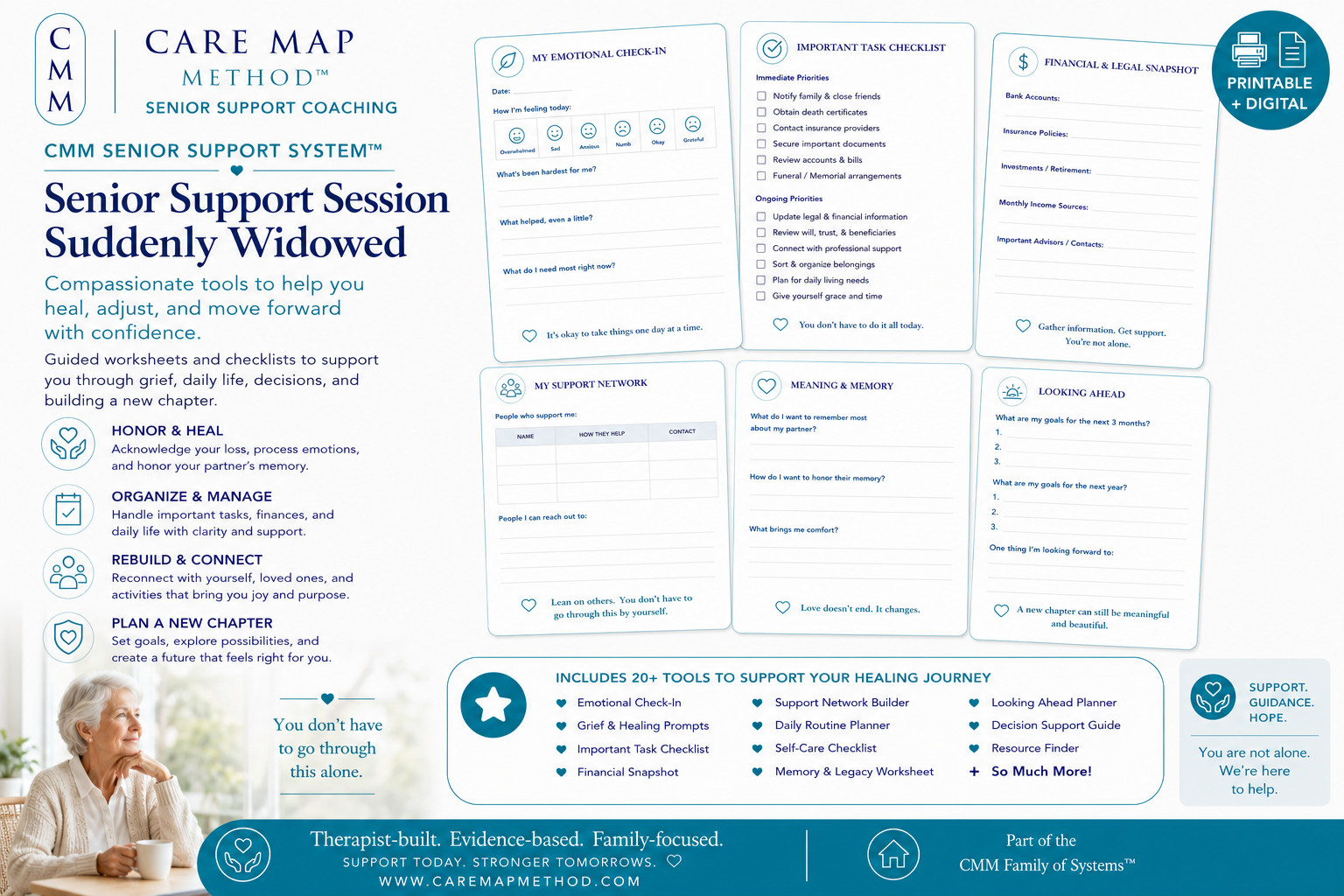
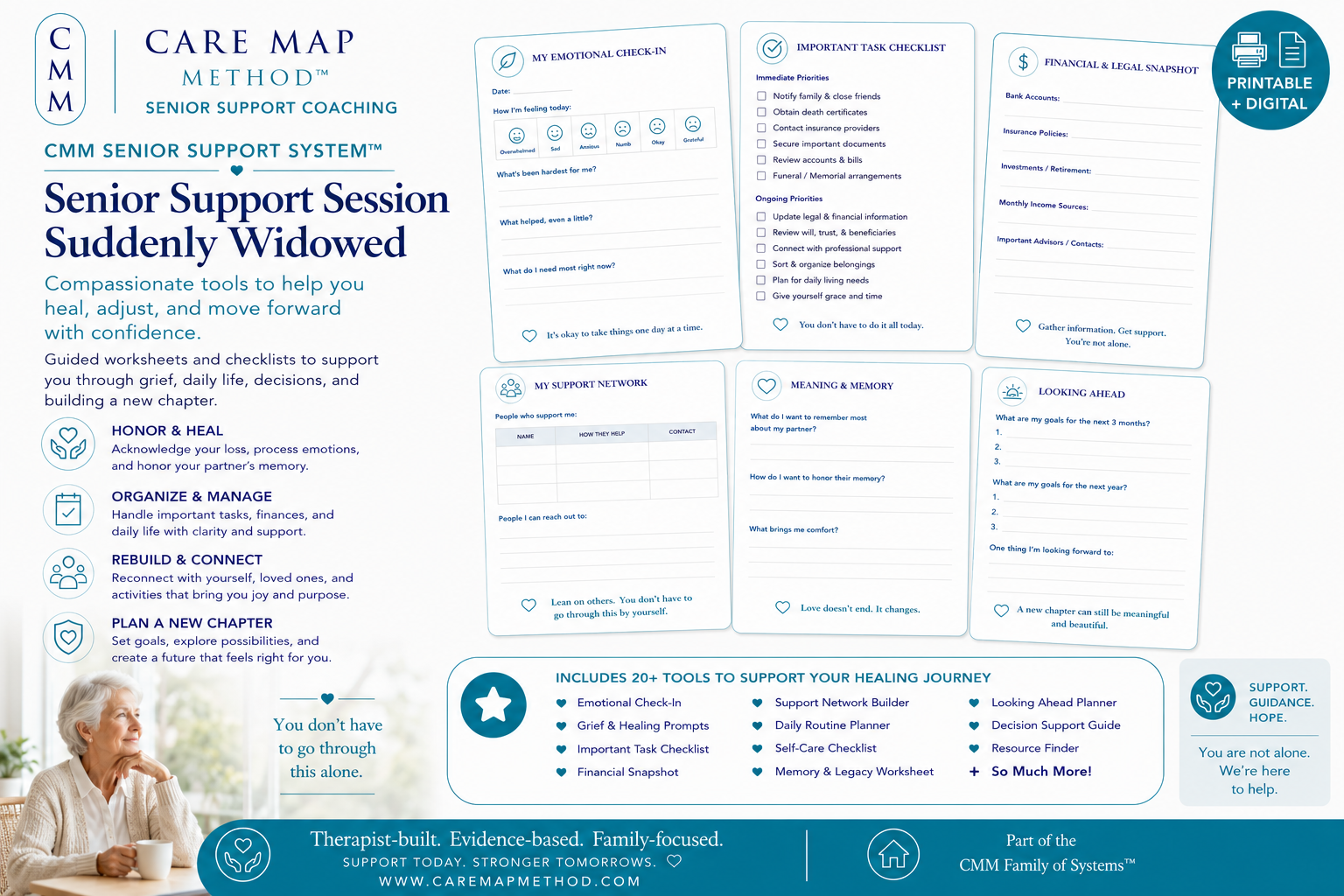
Suddenly Widowed: How to Find Your Footing When Everything Changes
The death of a spouse changes far more than relationship status. It can affect your routines, identity, home, health, finances, and sense of security. The Care Map Method™ helps newly widowed adults organize what needs attention now—without expecting them to solve everything at once.
The sudden death of a spouse can make life feel unfamiliar overnight.
Along with the emotional shock, you may be facing decisions about finances, medical care, household responsibilities, transportation, legal documents, family communication, and where—or how—you want to live. Even ordinary tasks can feel difficult when the person who shared them is no longer there.
Friends and family may offer advice, but their suggestions can quickly become another source of pressure:
“You shouldn’t stay in that house alone.”
“You need to speak with an attorney.”
“You should move closer to us.”
“You have to start getting out more.”
Some of these suggestions may eventually be helpful. But immediately after losing a spouse, the goal is not to make every major decision. The goal is to understand what needs attention, identify reliable support, and create enough stability to take the next manageable step.
That is where a care map can help.
Grief affects more than emotions
Widowhood is often discussed as an emotional experience—and it certainly is. But losing a spouse can affect almost every part of daily life.
You may experience:
Difficulty sleeping or concentrating
Changes in appetite or energy
Forgetfulness and decision fatigue
Anxiety about living alone
Confusion about bills or financial accounts
Loss of familiar routines and social connections
Concern about transportation, home safety, or medical needs
Pressure from family members who disagree about what should happen next
Uncertainty about your identity and future
These responses do not mean that you are incapable. Grief places an enormous demand on the brain and body. Tasks that once felt automatic may temporarily require much more effort.
You do not have to rebuild your entire life at once.
Begin by mapping what has changed
The Care Map Method™ uses four areas—Biological, Emotional, Social, and Environmental—to help you see the whole picture.
Biological needs
Grief can affect sleep, appetite, energy, memory, medication routines, and existing health conditions.
Questions to consider include:
Are you eating and drinking regularly?
Are you taking your medications as prescribed?
Have you missed medical appointments?
Are you sleeping enough to function safely?
Do you have someone who can accompany you to important appointments?
Have you noticed new or worsening physical symptoms?
A primary care provider should be contacted when there are concerning changes in health, sleep, appetite, medication use, or functioning.
Emotional needs
There is no correct schedule for grief. You may feel sadness, numbness, anger, fear, relief, guilt, or several emotions at once.
You may also feel emotionally steady one day and overwhelmed the next. This does not mean that you are moving backward. Grief is rarely linear.
Consider:
Do you have a safe person with whom you can speak honestly?
Would individual therapy or a grief-support group be helpful?
Are family members allowing you to make decisions at your own pace?
Are you being pressured to appear “better” before you feel ready?
What helps you feel grounded during especially difficult moments?
If grief begins to feel unbearable, you cannot function safely, or you are having thoughts of harming yourself, contact a licensed mental health professional, call or text 988, or seek emergency help.
Social needs
The death of a spouse can change friendships, family roles, traditions, and everyday companionship.
Support is most effective when it is specific. Instead of telling others, “Let me know if you need anything,” family members can offer concrete help:
“I can bring dinner on Tuesday.”
“I can drive you to your appointment.”
“I can sit with you while you review the mail.”
“I can help you create a list of accounts without making decisions for you.”
“Would you like company, or would you prefer quiet time today?”
A newly widowed person needs support without losing independence or authority over personal decisions.
Environmental needs
The home may feel different after a spouse dies. It can hold comforting memories while also presenting practical challenges.
Questions may include:
Do you feel physically safe at home?
Did your spouse manage repairs, transportation, technology, finances, or medications?
Are there fall risks or maintenance concerns?
Do you need temporary household assistance?
Is there a trusted emergency contact nearby?
Would small modifications make the home easier to manage?
It is usually unnecessary to decide immediately whether to sell the home or move. Unless there is an urgent safety or financial problem, it may be helpful to stabilize daily life before making an irreversible decision.
Map before you act
Following a loss, people are often pushed toward major choices while they are still in shock. A care map helps separate urgent matters from decisions that can wait.
Needs that may require immediate attention
Personal safety
Food, hydration, sleep, and medication
Care for pets or dependents
Funeral or memorial arrangements
Access to money for immediate expenses
Time-sensitive legal or insurance notifications
Transportation and essential appointments
Decisions that may be able to wait
Selling the home
Giving away personal belongings
Moving to a new community
Making major investments
Changing long-term living arrangements
Allowing someone else to take permanent control of finances
Making decisions primarily to relieve another person’s anxiety
Pausing is not the same as avoiding. It can be a protective and thoughtful choice.
Use the Care Map Method™ to build support
Once your needs are visible, the next steps become easier to organize.
MAP the Need
Identify what has changed across your biological, emotional, social, and environmental life. Separate urgent needs from longer-term concerns.
MATCH the Care
Determine what kind of support fits each need. This might include a physician, therapist, grief group, financial professional, attorney, home-care provider, family member, companion, or household assistant.
Not every problem should be handed to the same person. Matching the right support to the right need reduces confusion and helps protect your independence.
MERGE the Support
Create a clear plan for how family members and professionals will work together.
This may include:
Who will help with appointments
Who can be contacted in an emergency
Which family member will help with paperwork
How financial and legal professionals will communicate with you
What information may be shared—and with whom
Which decisions remain entirely yours
Support should be coordinated around you, not around the preferences of everyone offering advice.
MANAGE the Plan
Your needs may change as the initial shock subsides. Review the plan regularly and adjust it.
Ask:
What is working?
What still feels overwhelming?
Where am I receiving too much help—or not enough?
Are other people respecting my choices?
What decision feels manageable now?
What can still wait?
A care plan is not a permanent declaration about your future. It is a living guide that can change as you do.
How adult children and family members can help
Family members may want to take immediate action because they are grieving and frightened too. But taking over can unintentionally make a widowed parent feel even more powerless.
The most supportive approach is to:
Ask before organizing, discarding, or moving belongings
Avoid pressuring the person to sell or leave the home
Offer two or three manageable choices instead of an overwhelming list
Put important information in writing
Repeat information patiently when needed
Distinguish temporary grief-related difficulty from permanent incapacity
Include the widowed person in every decision affecting their life
Seek professional guidance when family members disagree
The goal is not to remove every responsibility. It is to provide the right amount of support while preserving dignity, choice, and control.
You do not have to know what comes next
After losing a spouse, the future may feel impossible to picture. You do not need to create a new life plan immediately.
Start smaller:
What needs attention today?
What can wait until next week?
Who is one safe person you can contact?
What would make tomorrow feel slightly more manageable?
A compassionate plan does not rush grief. It creates structure around it.
Care Map Method™ Suddenly Widowed Senior Support Session
The Care Map Method™ Suddenly Widowed Senior Support Session helps newly widowed adults and their families organize immediate needs, reduce decision overload, and create a personalized support plan.
During the session, we can:
Map biological, emotional, social, and environmental needs
Separate urgent concerns from decisions that can wait
Identify gaps in daily and professional support
Clarify family roles and communication
Create questions for medical, legal, financial, or care professionals
Develop a practical next-step plan
Protect the widowed adult’s independence and voice
Map before you act. You do not have to navigate the next chapter alone.
Schedule a Care Map Method™ Senior Support Coaching Session
Care Map Method™ coaching provides education, planning, and support. It does not replace medical, mental health, legal, or financial advice.

7 Signs Your Aging Parent Needs Help with Activities of Daily Living (ADLs)
Many older adults begin needing help gradually. Learn the warning signs that your loved one may need assistance with Activities of Daily Living and discover how to assess their safety and independence.
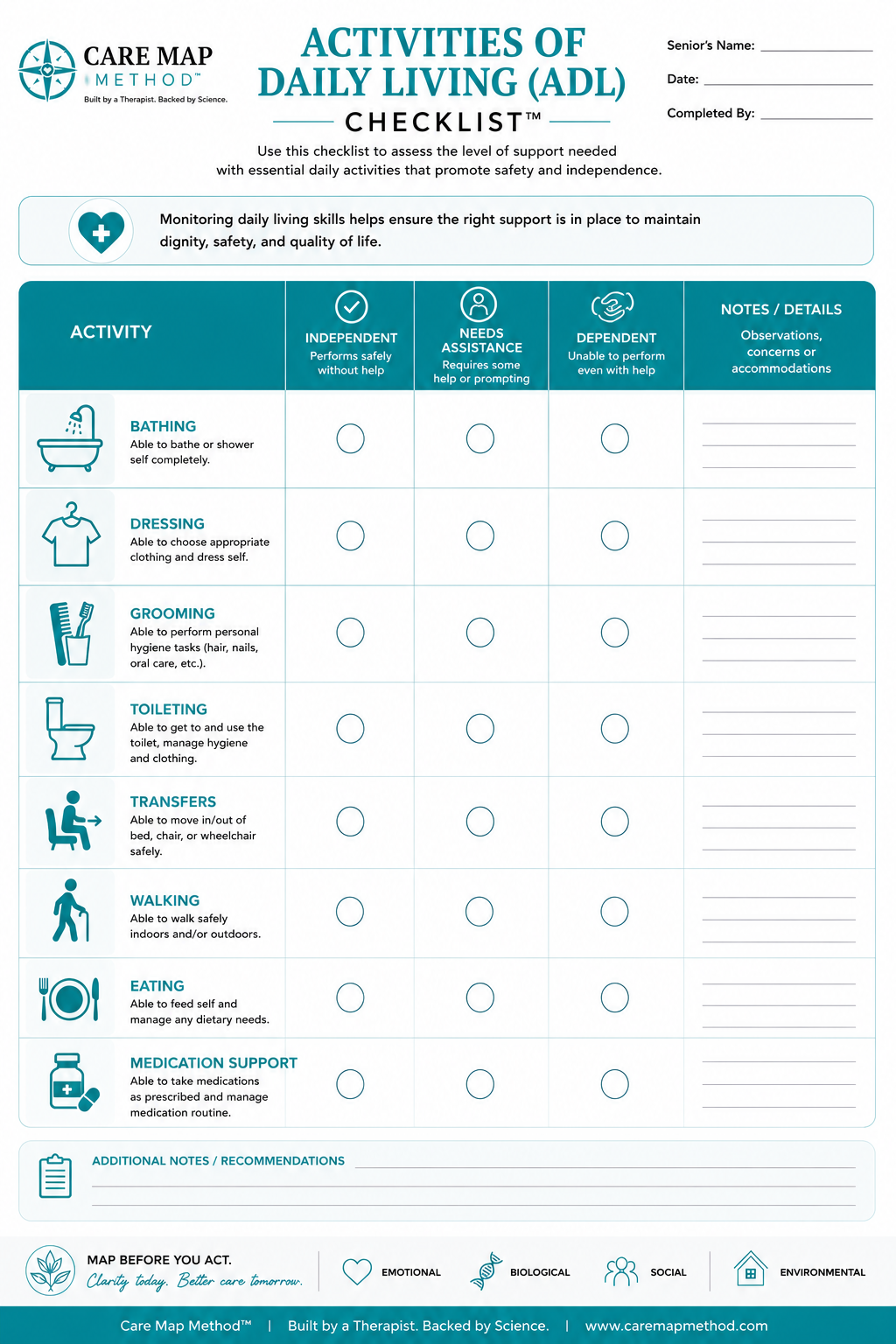
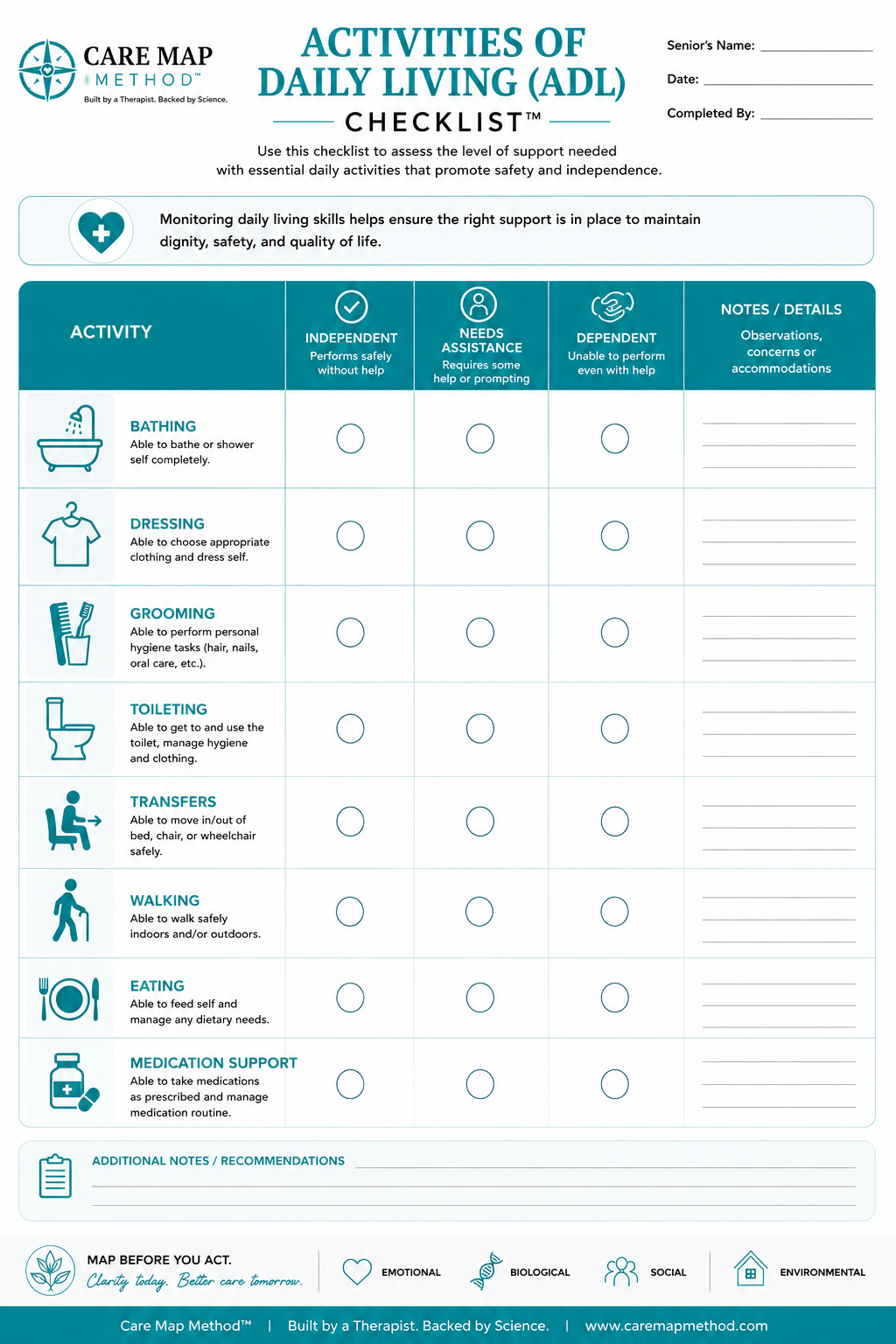
Activities of Daily Living (ADL) Checklist worksheet from Care Map Method™ helping families evaluate whether an older adult needs assistance with bathing, dressing, grooming, eating, mobility, toileting, transfers, and medication support.
7 Signs Your Aging Parent Needs Help with Activities of Daily Living (ADLs)
One of the hardest parts of caring for an aging parent is recognizing when small changes become signs that additional support is needed.
Many older adults want to remain independent, and families often hope they can continue living safely on their own. However, subtle declines in everyday functioning may increase the risk of falls, medication errors, malnutrition, hospitalization, and caregiver stress.
At Care Map Method™, we encourage families to Map Before They Act™. Assessing Activities of Daily Living (ADLs) provides a structured way to understand current abilities and identify where support may improve safety and quality of life.
What Are Activities of Daily Living?
Activities of Daily Living, commonly called ADLs, are the basic self-care tasks people perform every day to remain healthy, safe, and independent.
These include:
Bathing
Dressing
Grooming
Toileting
Walking and mobility
Transfers (getting in and out of bed or a chair)
Eating
Medication management
When one or more of these activities become difficult, it may be time to reassess your loved one's care needs.
1. Difficulty Bathing
Notice if your loved one:
Avoids showers
Appears unsteady in the bathroom
Has poor hygiene
Expresses fear of falling
Bathrooms are one of the most common places where older adults experience falls.
2. Wearing the Same Clothes
Difficulty dressing may include:
Wearing stained clothing
Difficulty with buttons or zippers
Dressing inappropriately for the weather
Needing assistance putting on shoes
These changes may indicate arthritis, weakness, balance problems, or cognitive decline.
3. Changes in Personal Grooming
Poor grooming often develops gradually.
Look for:
Unwashed hair
Long fingernails
Missed shaving
Declining oral hygiene
These changes can sometimes signal depression, memory changes, or physical limitations.
4. Trouble Walking or Getting Up
Watch for:
Holding onto furniture
Difficulty standing
Slower walking speed
Multiple near-falls
Trouble climbing stairs
Even one fall can significantly affect an older adult's confidence and independence.
5. Weight Loss or Poor Nutrition
Ask yourself:
Is food expiring in the refrigerator?
Have they lost weight?
Are they skipping meals?
Are they drinking enough water?
Nutrition plays a major role in strength, healing, and overall health.
6. Medication Mistakes
Medication concerns may include:
Forgotten doses
Duplicate doses
Confusion about prescriptions
Expired medications
Medication management becomes increasingly important as prescriptions become more complex.
7. Increasing Dependence on Family
You may notice yourself:
Driving to every appointment
Managing bills
Preparing meals
Picking up prescriptions
Helping with household tasks
While occasional assistance is normal, increasing dependence may indicate that additional planning is needed.
Download Our Free Activities of Daily Living Checklist™
(Insert your ADL Checklist worksheet image here.)
Our printable worksheet helps families evaluate daily functioning and identify areas where support may improve safety, independence, and quality of life.
Bring the completed checklist to healthcare appointments or use it during family caregiving discussions.
Why Early Assessment Matters
Recognizing changes early allows families to make thoughtful decisions rather than reacting during a crisis.
Early planning can help:
Reduce caregiver stress
Prevent falls
Improve communication among family members
Coordinate medical care
Delay unnecessary hospitalizations
Support aging in place when appropriate
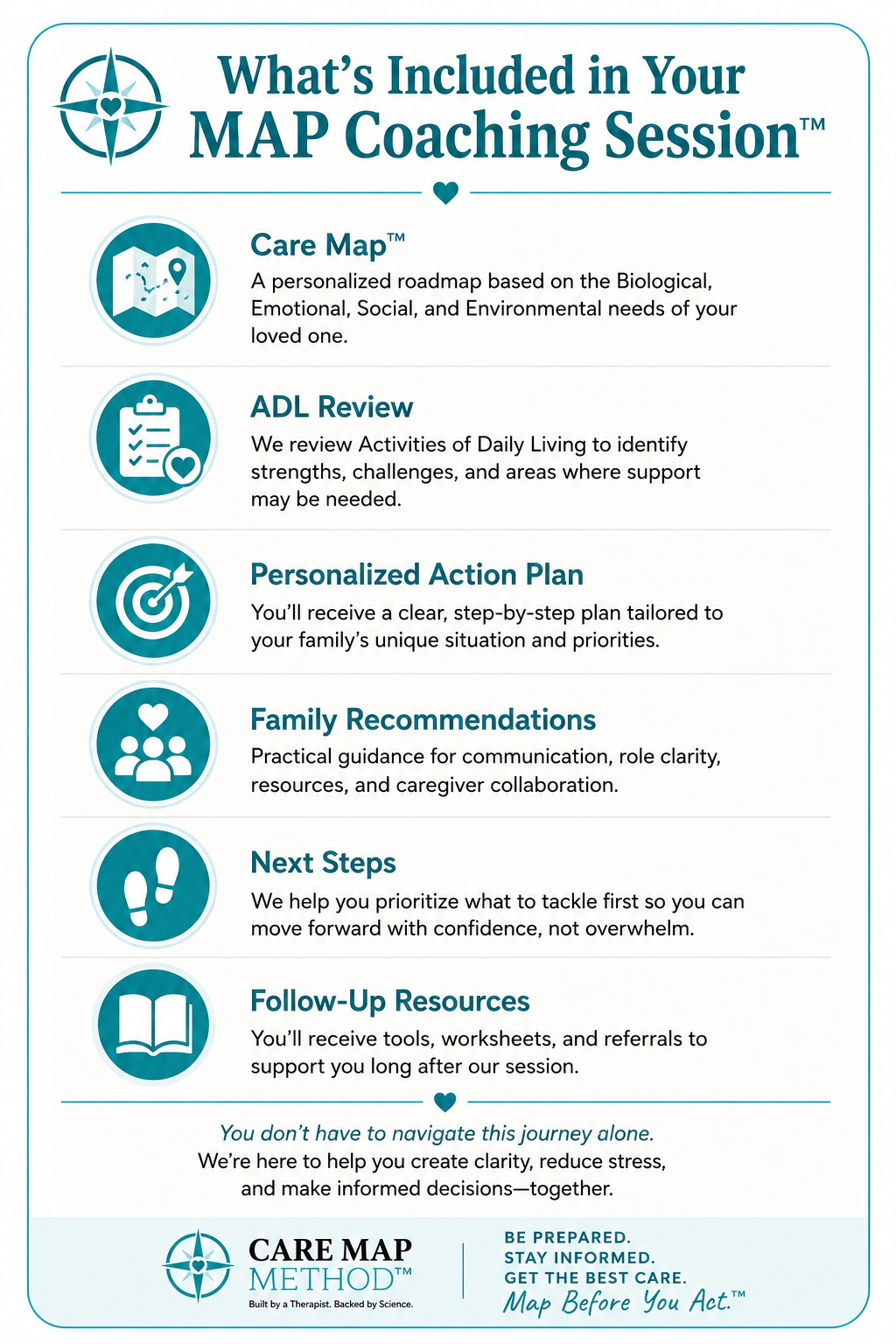
How a Care Map Method™ MAP Coaching Session Can Help
Many families know something has changed but aren't sure what to do next.
During a personalized Care Map Method™ MAP Coaching Session, we'll help you:
Assess Activities of Daily Living
Identify safety concerns
Review medical, emotional, social, and environmental needs
Prioritize next steps
Develop a personalized Care Map™
Create an action plan tailored to your family's situation
Our goal is to help families move forward with confidence instead of uncertainty.
Ready to Better Understand Your Loved One's Needs?
If you're wondering whether your parent can continue living independently—or what level of support is appropriate—you don't have to make those decisions alone.
A Care Map Method™ MAP Coaching Session provides expert guidance, practical tools, and a personalized roadmap based on your loved one's unique situation.
Book your Care Map Method™ MAP Coaching Session today and start planning before a crisis occurs.