Suddenly Widowed: How to Find Your Footing When Everything Changes
The sudden death of a spouse can make life feel unfamiliar overnight.
Along with the emotional shock, you may be facing decisions about finances, medical care, household responsibilities, transportation, legal documents, family communication, and where—or how—you want to live. Even ordinary tasks can feel difficult when the person who shared them is no longer there.
Friends and family may offer advice, but their suggestions can quickly become another source of pressure:
“You shouldn’t stay in that house alone.”
“You need to speak with an attorney.”
“You should move closer to us.”
“You have to start getting out more.”
Some of these suggestions may eventually be helpful. But immediately after losing a spouse, the goal is not to make every major decision. The goal is to understand what needs attention, identify reliable support, and create enough stability to take the next manageable step.
That is where a care map can help.
Grief affects more than emotions
Widowhood is often discussed as an emotional experience—and it certainly is. But losing a spouse can affect almost every part of daily life.
You may experience:
Difficulty sleeping or concentrating
Changes in appetite or energy
Forgetfulness and decision fatigue
Anxiety about living alone
Confusion about bills or financial accounts
Loss of familiar routines and social connections
Concern about transportation, home safety, or medical needs
Pressure from family members who disagree about what should happen next
Uncertainty about your identity and future
These responses do not mean that you are incapable. Grief places an enormous demand on the brain and body. Tasks that once felt automatic may temporarily require much more effort.
You do not have to rebuild your entire life at once.
Begin by mapping what has changed
The Care Map Method™ uses four areas—Biological, Emotional, Social, and Environmental—to help you see the whole picture.
Biological needs
Grief can affect sleep, appetite, energy, memory, medication routines, and existing health conditions.
Questions to consider include:
Are you eating and drinking regularly?
Are you taking your medications as prescribed?
Have you missed medical appointments?
Are you sleeping enough to function safely?
Do you have someone who can accompany you to important appointments?
Have you noticed new or worsening physical symptoms?
A primary care provider should be contacted when there are concerning changes in health, sleep, appetite, medication use, or functioning.
Emotional needs
There is no correct schedule for grief. You may feel sadness, numbness, anger, fear, relief, guilt, or several emotions at once.
You may also feel emotionally steady one day and overwhelmed the next. This does not mean that you are moving backward. Grief is rarely linear.
Consider:
Do you have a safe person with whom you can speak honestly?
Would individual therapy or a grief-support group be helpful?
Are family members allowing you to make decisions at your own pace?
Are you being pressured to appear “better” before you feel ready?
What helps you feel grounded during especially difficult moments?
If grief begins to feel unbearable, you cannot function safely, or you are having thoughts of harming yourself, contact a licensed mental health professional, call or text 988, or seek emergency help.
Social needs
The death of a spouse can change friendships, family roles, traditions, and everyday companionship.
Support is most effective when it is specific. Instead of telling others, “Let me know if you need anything,” family members can offer concrete help:
“I can bring dinner on Tuesday.”
“I can drive you to your appointment.”
“I can sit with you while you review the mail.”
“I can help you create a list of accounts without making decisions for you.”
“Would you like company, or would you prefer quiet time today?”
A newly widowed person needs support without losing independence or authority over personal decisions.
Environmental needs
The home may feel different after a spouse dies. It can hold comforting memories while also presenting practical challenges.
Questions may include:
Do you feel physically safe at home?
Did your spouse manage repairs, transportation, technology, finances, or medications?
Are there fall risks or maintenance concerns?
Do you need temporary household assistance?
Is there a trusted emergency contact nearby?
Would small modifications make the home easier to manage?
It is usually unnecessary to decide immediately whether to sell the home or move. Unless there is an urgent safety or financial problem, it may be helpful to stabilize daily life before making an irreversible decision.
Map before you act
Following a loss, people are often pushed toward major choices while they are still in shock. A care map helps separate urgent matters from decisions that can wait.
Needs that may require immediate attention
Personal safety
Food, hydration, sleep, and medication
Care for pets or dependents
Funeral or memorial arrangements
Access to money for immediate expenses
Time-sensitive legal or insurance notifications
Transportation and essential appointments
Decisions that may be able to wait
Selling the home
Giving away personal belongings
Moving to a new community
Making major investments
Changing long-term living arrangements
Allowing someone else to take permanent control of finances
Making decisions primarily to relieve another person’s anxiety
Pausing is not the same as avoiding. It can be a protective and thoughtful choice.
Use the Care Map Method™ to build support
Once your needs are visible, the next steps become easier to organize.
MAP the Need
Identify what has changed across your biological, emotional, social, and environmental life. Separate urgent needs from longer-term concerns.
MATCH the Care
Determine what kind of support fits each need. This might include a physician, therapist, grief group, financial professional, attorney, home-care provider, family member, companion, or household assistant.
Not every problem should be handed to the same person. Matching the right support to the right need reduces confusion and helps protect your independence.
MERGE the Support
Create a clear plan for how family members and professionals will work together.
This may include:
Who will help with appointments
Who can be contacted in an emergency
Which family member will help with paperwork
How financial and legal professionals will communicate with you
What information may be shared—and with whom
Which decisions remain entirely yours
Support should be coordinated around you, not around the preferences of everyone offering advice.
MANAGE the Plan
Your needs may change as the initial shock subsides. Review the plan regularly and adjust it.
Ask:
What is working?
What still feels overwhelming?
Where am I receiving too much help—or not enough?
Are other people respecting my choices?
What decision feels manageable now?
What can still wait?
A care plan is not a permanent declaration about your future. It is a living guide that can change as you do.
How adult children and family members can help
Family members may want to take immediate action because they are grieving and frightened too. But taking over can unintentionally make a widowed parent feel even more powerless.
The most supportive approach is to:
Ask before organizing, discarding, or moving belongings
Avoid pressuring the person to sell or leave the home
Offer two or three manageable choices instead of an overwhelming list
Put important information in writing
Repeat information patiently when needed
Distinguish temporary grief-related difficulty from permanent incapacity
Include the widowed person in every decision affecting their life
Seek professional guidance when family members disagree
The goal is not to remove every responsibility. It is to provide the right amount of support while preserving dignity, choice, and control.
You do not have to know what comes next
After losing a spouse, the future may feel impossible to picture. You do not need to create a new life plan immediately.
Start smaller:
What needs attention today?
What can wait until next week?
Who is one safe person you can contact?
What would make tomorrow feel slightly more manageable?
A compassionate plan does not rush grief. It creates structure around it.
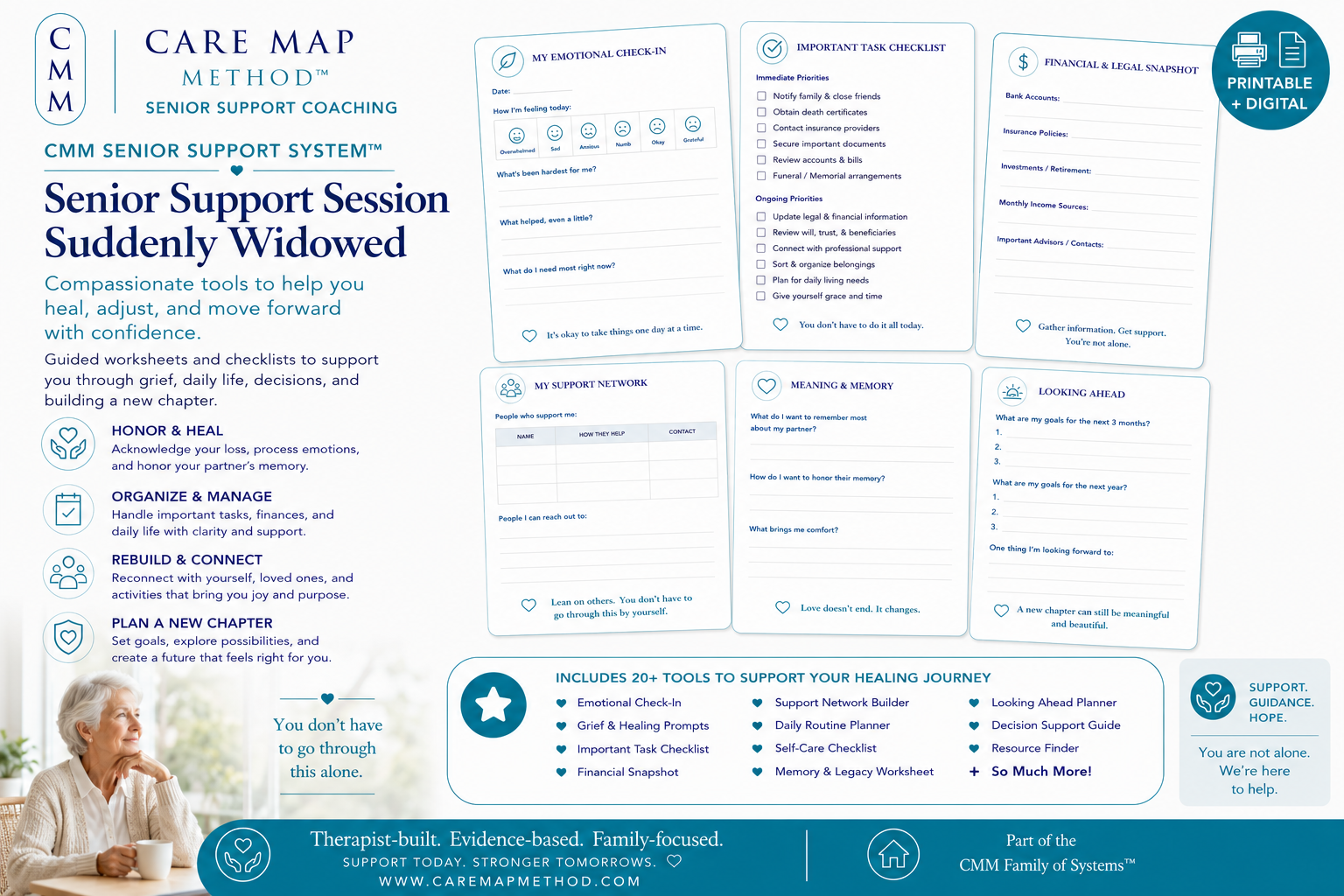
Care Map Method™ Suddenly Widowed Senior Support Session
The Care Map Method™ Suddenly Widowed Senior Support Session helps newly widowed adults and their families organize immediate needs, reduce decision overload, and create a personalized support plan.
During the session, we can:
Map biological, emotional, social, and environmental needs
Separate urgent concerns from decisions that can wait
Identify gaps in daily and professional support
Clarify family roles and communication
Create questions for medical, legal, financial, or care professionals
Develop a practical next-step plan
Protect the widowed adult’s independence and voice
Map before you act. You do not have to navigate the next chapter alone.
Schedule a Care Map Method™ Senior Support Coaching Session
Care Map Method™ coaching provides education, planning, and support. It does not replace medical, mental health, legal, or financial advice.