

Individual Therapy for Family Overwhelm in Rhode Island
When family requests fill every available space, your own needs can become difficult to hear. Read about individual therapy for family stress, clarifying responsibilities and practicing a request for support. Confirm Rhode Island availability before booking.
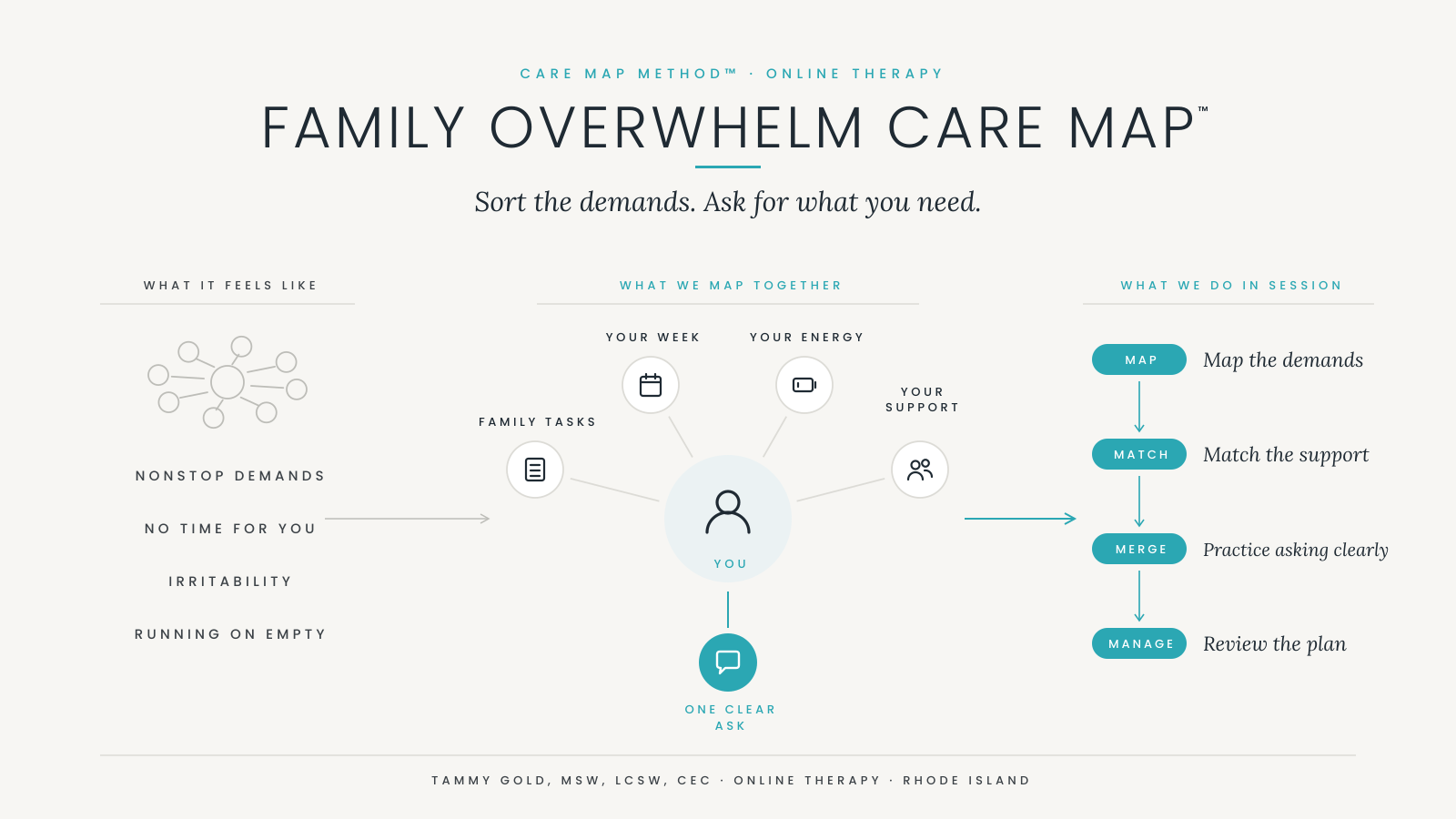
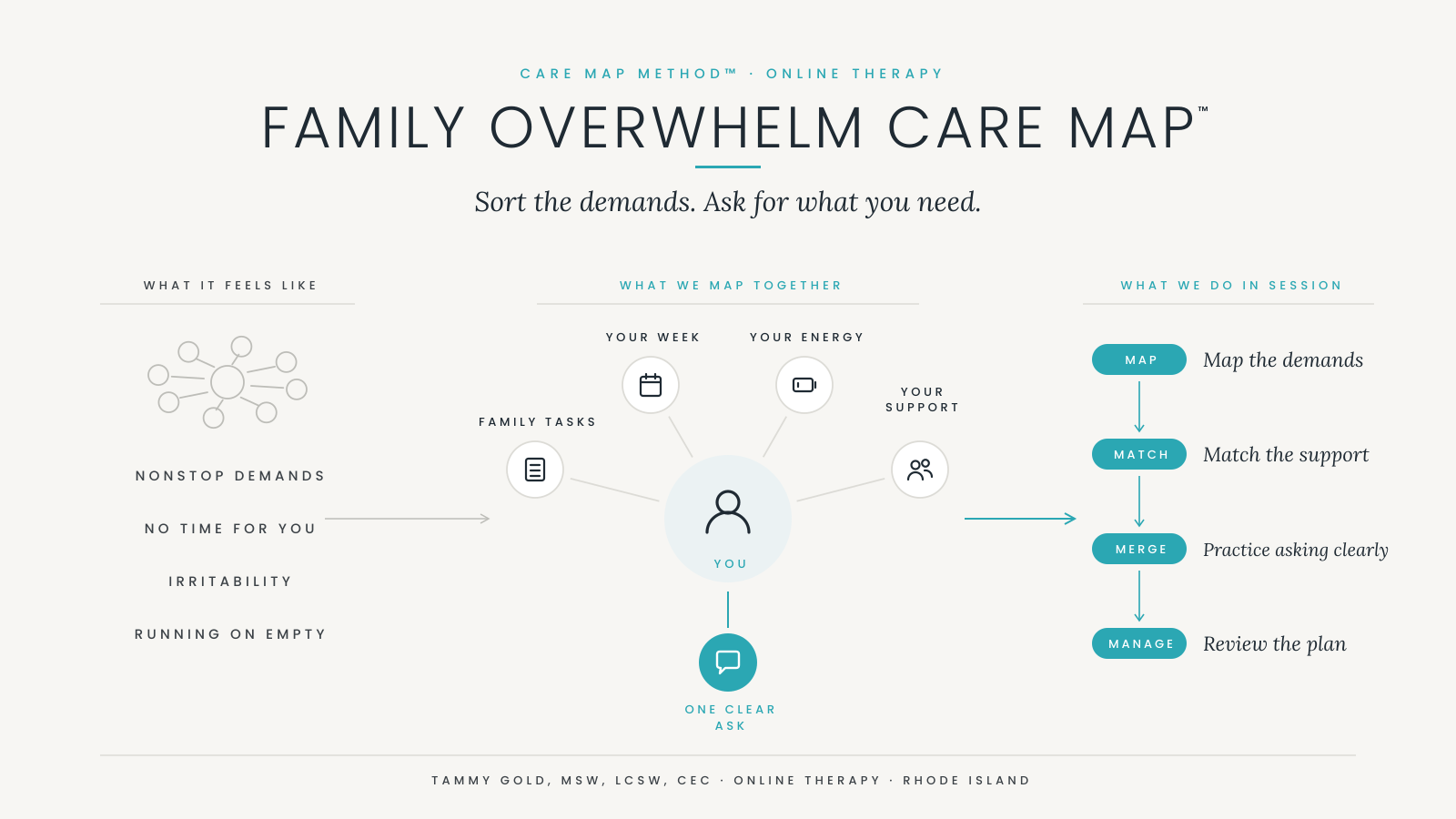
Four illustrated steps for exploring family demands and practicing a request for support.
Private instruction. Do not publish the following article or enable its booking links until Rhode Island independent clinical authorization, platform enrollment and availability have been confirmed. Copy the public article beginning with its main title only after this hold is resolved.
Individual Therapy for Family Overwhelm in Rhode Island
A partner needs something, a child has a problem and an aging parent calls with another concern. You agree to handle it all, then find yourself snapping, withdrawing or feeling that nobody notices how much you are carrying. There may be no single crisis, but little room to recover between demands.
I’m Tammy Gold, a licensed therapist, author and creator of Care Map Method™. My individual therapy work explores family stress, difficult relationships and emotional overwhelm. If you are seeking support in Rhode Island, the concerns below can help you consider the kind of care you want to discuss.
Check Rhode Island Insurance and Availability on Headway or Alma Therapy Platforms
When family demands fill the whole day
The visible tasks may be only part of the load. You might also be remembering appointments, anticipating reactions, keeping track of messages and deciding which problem needs attention first. Others may see the completed task without seeing the thought and worry around it.
We can explore the effect on your mood, concentration, rest and relationships. You may feel angry, anxious, numb or guilty for wanting time alone. Those feelings deserve context. Loving your family does not remove the emotional effect of competing responsibilities, and your experience does not need to look dramatic to be worth discussing.
How responsibility becomes difficult to share
You may have become the person who steps in because you notice what needs doing. Over time, family members may assume that you will keep handling it. You might want help while also worrying about what will happen if you stop overseeing everything.
In individual therapy, we can explore those expectations and the actual limits of your situation. Some responsibilities are not easy to delegate, and support may be uneven. We can still examine where a request, conversation or change is possible without treating you as responsible for creating a perfectly cooperative family.
What we might work on in a session
For example, we might discuss a day when several people asked for help and you accepted every request. Later, a small question led to an argument. We could look at the demands, what you were telling yourself about responsibility and which feeling had not had room to be expressed.
From there, we might identify one need you want another person to understand and practice asking for specific support. That could mean discussing a task, clarifying timing or explaining that you need time to consider a request. We would also explore what happens if help is unavailable. A later session can review the experience and adjust the plan. The work is collaborative and grounded in your circumstances.
Using Care Map Method for family overwhelm
Care Map Method™ helps organize Biological, Social, Environmental and Emotional factors alongside individual assessment. We may consider your health and energy, family relationships, the practical demands of daily life and the feelings attached to your role.
We MAP the demands and their impact. We MATCH support or strategies to the needs identified. We MERGE a chosen approach into daily life through rehearsal or a manageable adjustment. We MANAGE the plan by reviewing what happened and what remains difficult. The framework supports therapy without requiring you to turn every feeling into a task or control every family member's response.
Make room for your own experience
You may be so practiced at explaining everyone else's needs that your own are difficult to name. We can spend time understanding what feels hardest before trying to solve it. That might include resentment, fear of being unavailable or sadness about how a relationship has changed.
When you are ready, we can consider one conversation or choice. A goal might involve recognizing when you are near your limit, asking more directly or discussing expectations earlier. Those are possibilities to assess together. Progress may involve greater understanding as well as changes in behavior.
Choosing the type of support that fits
Individual psychotherapy focuses on the mental health and functioning of the person receiving care. Family sessions involve a different arrangement, and practical care-selection consulting has different goals. We can clarify which service you are looking for before you begin.
An initial clinical appointment can include your concerns, relevant history, current symptoms and the effect on daily life. We can discuss previous support, treatment fit and goals. You do not need to arrive knowing how to divide every responsibility or how to explain the whole family situation perfectly.
About Tammy Gold and Rhode Island inquiries
I’m Tammy Gold, MSW, LCSW, CEC. I earned my MSW at Columbia University and my BA at the University of Pennsylvania. My work includes relationships, parenting, caregiving and the emotional demands of family life.
For a Rhode Island inquiry, confirm current authorization, state-specific appointment availability and the service before scheduling. If using insurance, check your exact plan, provider participation and estimated costs through the appropriate platform. A provider profile or insurer name alone does not establish that a particular appointment is available.
Frequently asked questions
Can I seek individual therapy without bringing my family?
Individual therapy can focus on your distress, symptoms, needs and choices within family relationships. Other relatives do not have to attend. Before arranging care in Rhode Island, confirm current authorization, appointment availability and whether the offered service fits your needs.
What if I feel guilty asking for help?
We can explore what asking means to you, what you fear might happen and how responsibility has developed in your family. Guilt deserves attention in its context. It does not need to disappear before you can begin understanding your needs.
Can we work on irritability and resentment?
Those feelings can be discussed alongside the demands, relationships and symptoms you are experiencing. Assessment helps clarify treatment goals. We can explore what happens around a difficult moment and consider a response that fits your circumstances.
Will you tell my relatives what they must do?
Individual therapy centers on your care, not directing absent family members. We can explore requests, communication and choices within your control. We cannot guarantee another person's cooperation or make family decisions on everyone's behalf through your individual sessions.
Is this family therapy or individual therapy?
This page describes individual psychotherapy. Family treatment would require a separate discussion about participants, goals, clinical fit and payment. Practical care consulting is also a different service. Clarify the type of appointment before scheduling so the arrangement matches what you need.
What happens during a first appointment?
A first clinical session can include your concerns, history, symptoms, daily functioning and previous experiences with support. We would consider fit and goals together. For Rhode Island, confirm that a currently authorized and available appointment can be arranged before booking.
Can I use BCBS Massachusetts while in Rhode Island?
Do not assume coverage from the insurer name or a rate listing. Confirm current Rhode Island authorization, the offered appointment, exact-plan participation and estimated costs with the platform. Different Blue Cross products and networks are not automatically interchangeable.
Are Rhode Island appointments currently available?
Please confirm current Rhode Island availability and authorization before scheduling. The ability to view a general provider profile is not confirmation of an appointment in your state. Any insurance and service questions should be clarified before a visit is arranged.
Take the next step
Confirm current Rhode Island authorization, service availability and insurance details before arranging a visit. Once a suitable appointment is available, the first conversation can begin with the concern that led you to seek support.
Check Rhode Island Insurance and Availability on Headway or Alma Therapy Platforms
People Pleasing and Boundary Guilt Therapy in Maine
Saying yes can feel easier until you are overwhelmed and resentful. Explore individual online therapy in Maine for people-pleasing and boundary guilt, including how to understand the pressure and practice words that reflect your capacity.
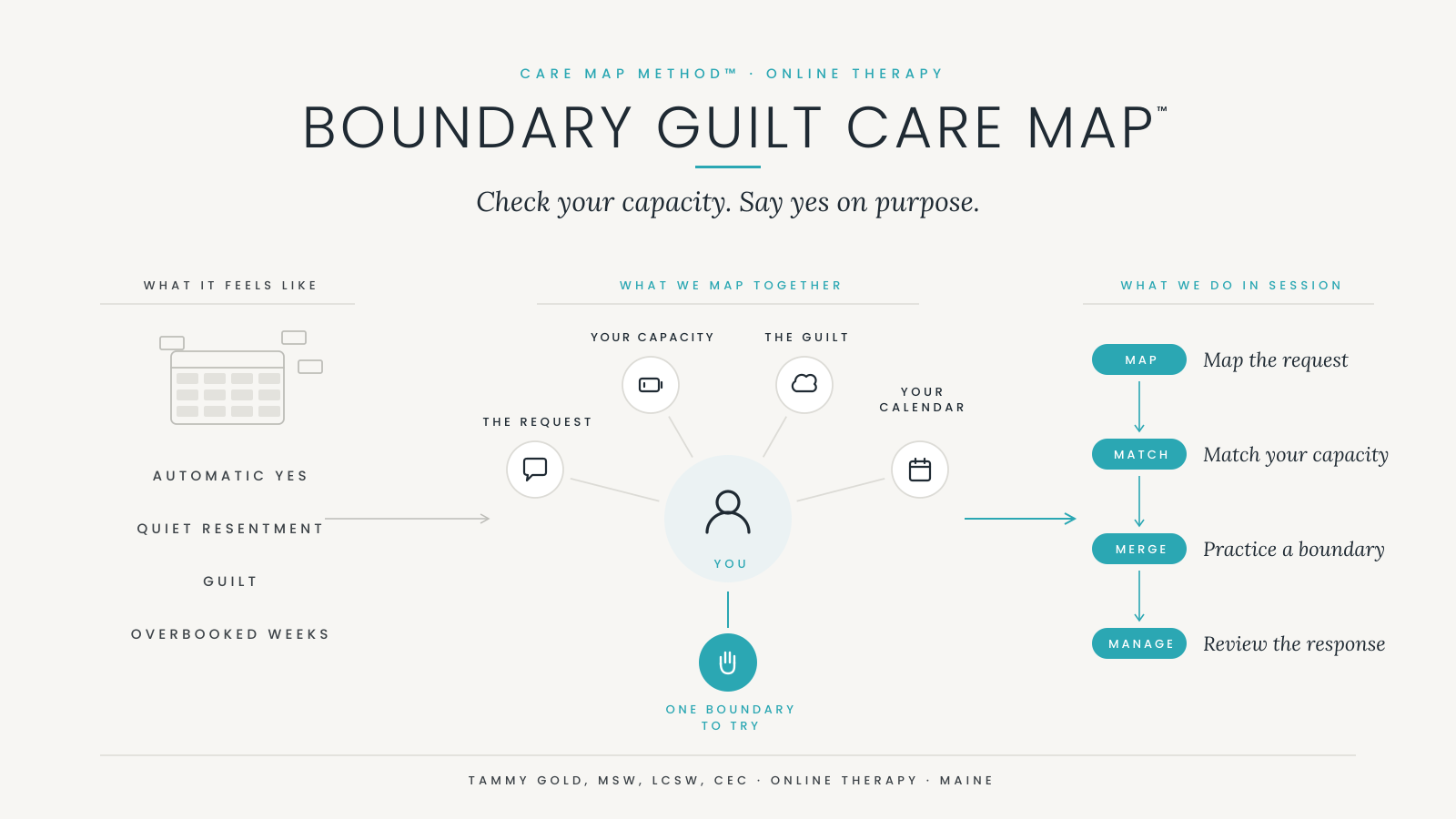
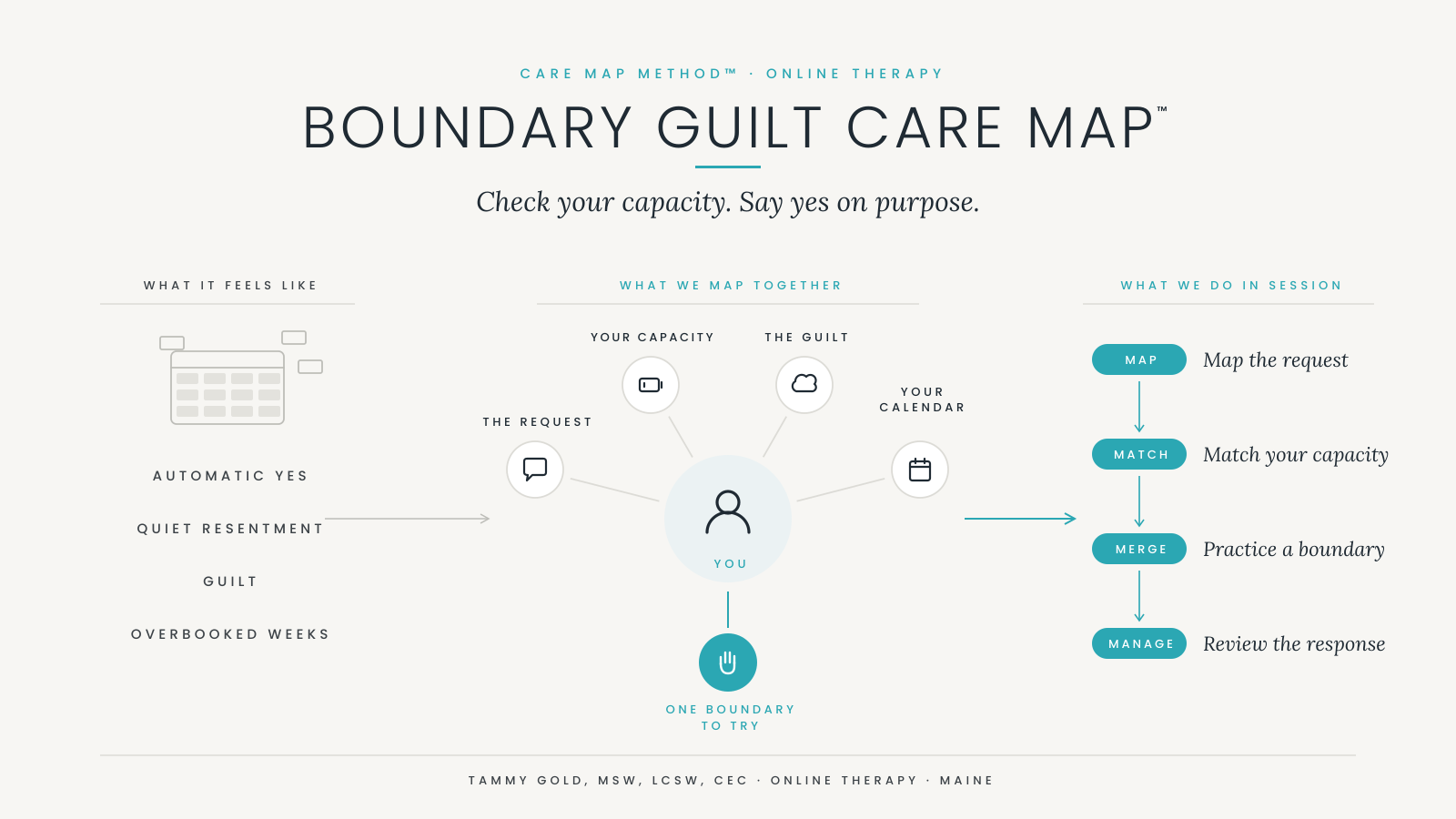
Four illustrated steps for exploring guilt and practicing a boundary around a request.
Someone asks for help and you hear yourself agreeing before you have checked your calendar or your energy. Later, you cancel something you needed and feel resentful. You may then feel guilty for being annoyed with someone you care about.
I’m Tammy Gold, a licensed therapist. I offer individual online therapy for adults in Maine who are struggling with people-pleasing, boundary guilt and relationship stress. We can explore what happens around a request, why declining feels difficult and how you want to respond within your real relationships and responsibilities.
Check Maine Insurance and Availability
When being helpful leaves little room for you
You may be the person who remembers, organizes and makes things easier for everyone else. People may appreciate your reliability without noticing the cost. You might rarely state a preference until you are already frustrated or exhausted.
Helping others can be an important value. We do not need to treat every generous choice as unhealthy. The concern may be the feeling that you cannot choose differently, the fear attached to disappointing someone or the effect of repeated overcommitment on your well-being. We can explore that distinction in the context of your life.
What saying no brings up
A request may carry more than the task itself. You may fear conflict, losing closeness or being seen as selfish. Past family roles or experiences can shape what you expect to happen when someone is unhappy with you.
In therapy, we can consider what you actually know about the relationship and what you are anticipating. We can make room for cultural expectations, practical obligations and limited support. A boundary that fits one person may not fit your circumstances. Understanding the pressure comes before deciding what language or change would be useful.
What we might work on in a session
For example, we might explore a last-minute request from a relative. You agreed, gave up time you needed to rest and spent the evening feeling angry. We could slow down the moment before you said yes: what you noticed, what you feared and what you wanted the other person to understand.
After exploring those feelings, we might rehearse asking for time to answer, offering a limited form of help or declining a particular task. We would consider the likely consequences and what support you need if the person is disappointed. Later, we can review the experience. The purpose is to understand your choices and capacity, rather than find a sentence that makes everyone approve.
Using MAP MATCH MERGE MANAGE for boundary guilt
Care Map Method™ organizes Biological, Social, Environmental and Emotional factors. Your energy and health, family relationships, available time and feelings about responsibility may each influence the request. We consider the full context alongside your symptoms and treatment goals.
We MAP the request, pressure and effect on you. We MATCH a possible response to your needs, values and capacity. We MERGE it into daily life through practice or a manageable change. We MANAGE the plan by reviewing your feelings, the other person's response and what needs adjusting. You do not have to turn boundaries into another set of rules to follow perfectly.
When guilt remains after a clear conversation
You may express a limit respectfully and still feel uncomfortable. That does not tell us by itself whether the choice was right or wrong. We can explore what the guilt is saying, whether repair is needed and what expectations are being challenged.
You may also discover that someone reacts differently than you feared, or that a pattern remains difficult despite clear words. Both experiences give us information. Therapy can help you stay connected to your own needs while reflecting on the relationship, without promising that every boundary will preserve closeness or prevent conflict.
Beginning with one situation
A first appointment can start with a request you regretted accepting or a conversation you have been postponing. We will discuss your history, current symptoms and how the pattern affects daily life, work and relationships. Together, we can consider treatment fit and goals.
Possible goals might involve pausing before agreeing, noticing a preference earlier or asking for a specific kind of support. Those are examples to explore, not a checklist every client must complete. We can adjust the direction as your circumstances and understanding change.
About Tammy Gold and Maine appointments
I’m Tammy Gold, MSW, LCSW, CEC, a licensed therapist, certified coach and author. I earned my MSW at Columbia University and my BA at the University of Pennsylvania. My work includes relationships, parenting, caregiving and family stress.
Review my Alma profile for current Maine appointments and exact-plan participation. If you are checking Aetna or an Optum-administered plan, use the specific member information and confirm estimated costs. Plan to be physically located in Maine during a Maine online appointment.
Frequently asked questions
Can I set boundaries and still care about people?
Yes. We can explore how caring, responsibility and your own capacity fit together. The work does not require giving up important relationships or generosity. We can consider whether a particular choice reflects your values and what effect it has on your well-being.
What if someone becomes upset when I say no?
We can discuss the actual relationship, possible consequences and how you want to respond. Another person's disappointment cannot always be prevented. Therapy can help you reflect on your needs and options, including whether a conversation, adjustment or other support is appropriate.
Can we practice the exact words?
Yes. We can rehearse language for a specific situation and notice how it feels to say it. The wording should fit your voice and circumstances. It is a starting point for practice, not a script guaranteed to produce agreement.
What if I agree before realizing I do not want to?
We can examine the sequence and where you notice your own preference. Possible work might involve pausing, asking for time or discussing a commitment you need to revisit. We would consider the relationship and practical consequences rather than assume every agreement can be changed.
Is helping others always people-pleasing?
No. Helping can be freely chosen and meaningful. We can explore whether the concern is fear, a sense of having no choice, repeated overcommitment or something else. Your values, responsibilities and the effect on your functioning help us understand the pattern.
Can therapy address resentment after I overcommit?
We can explore the feelings, expectations and circumstances around the commitment, including what you wanted to ask for. That may inform a future conversation or different choice. You do not have to judge the resentment as evidence that you are uncaring.
Can I use Aetna or Optum through Alma in Maine?
Check your exact plan and my current Maine participation through Alma. Optum administers different products, so the company name alone is not enough to establish benefits. Confirm the service and estimated cost before scheduling an appointment.
How do I arrange an online session from Maine?
Use my Alma profile to review current appointments and insurance options for Maine. Plan to attend from a private place while physically located in the state. You can begin with one situation that made you want help understanding the pattern.
Take the next step
You can review current Maine appointment options and your exact insurance plan through my provider profile. Confirm estimated costs before scheduling. We can begin with the situation you want help understanding.
Check Maine Insurance and Availability on Headway or Alma today
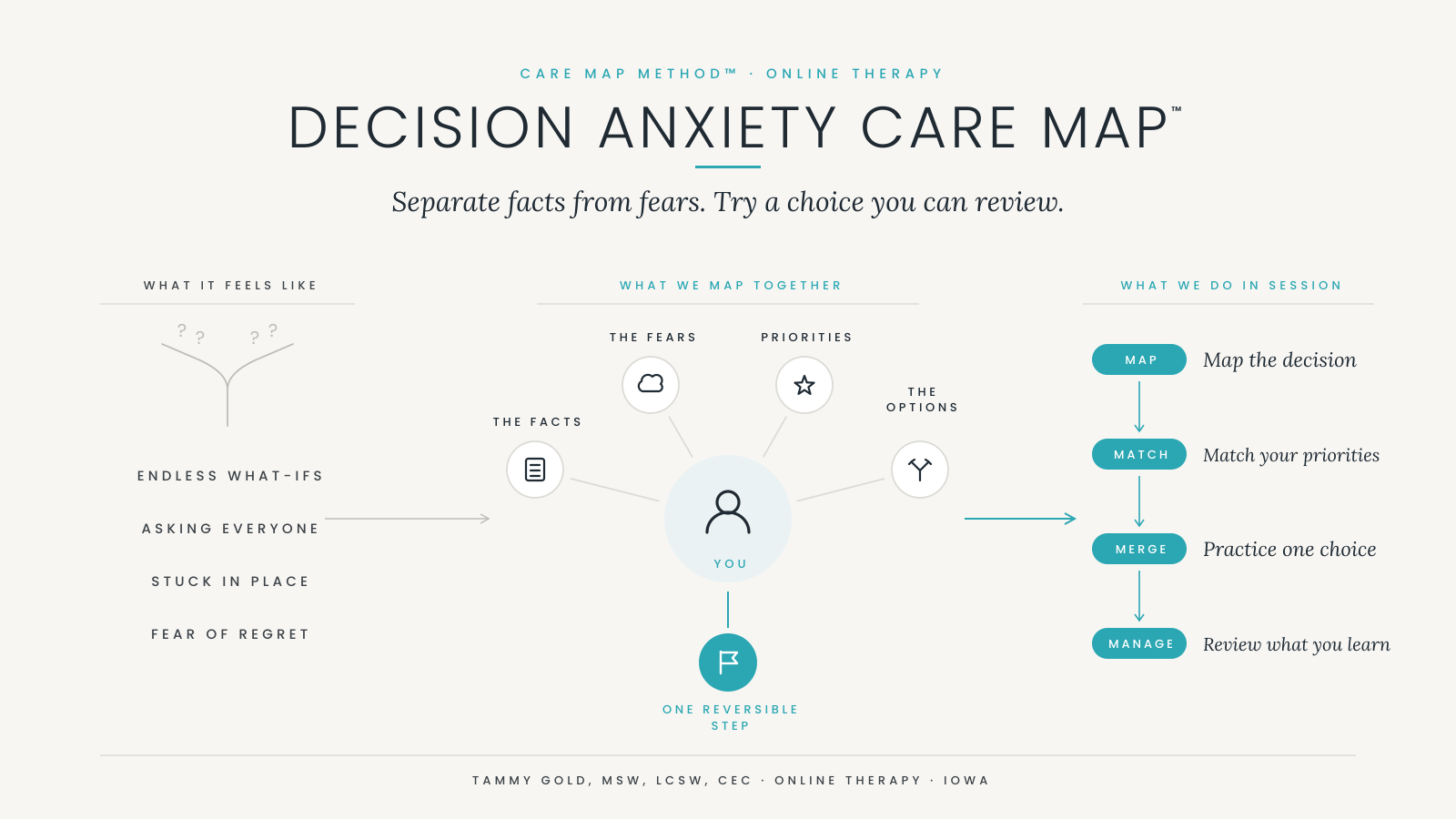
Anxiety and Decision-Making Therapy in Iowa
Repeatedly comparing options or asking for reassurance can leave you less certain than when you started. Explore online therapy in Iowa to understand the worry, clarify priorities and practice a decision process that keeps your choices yours.
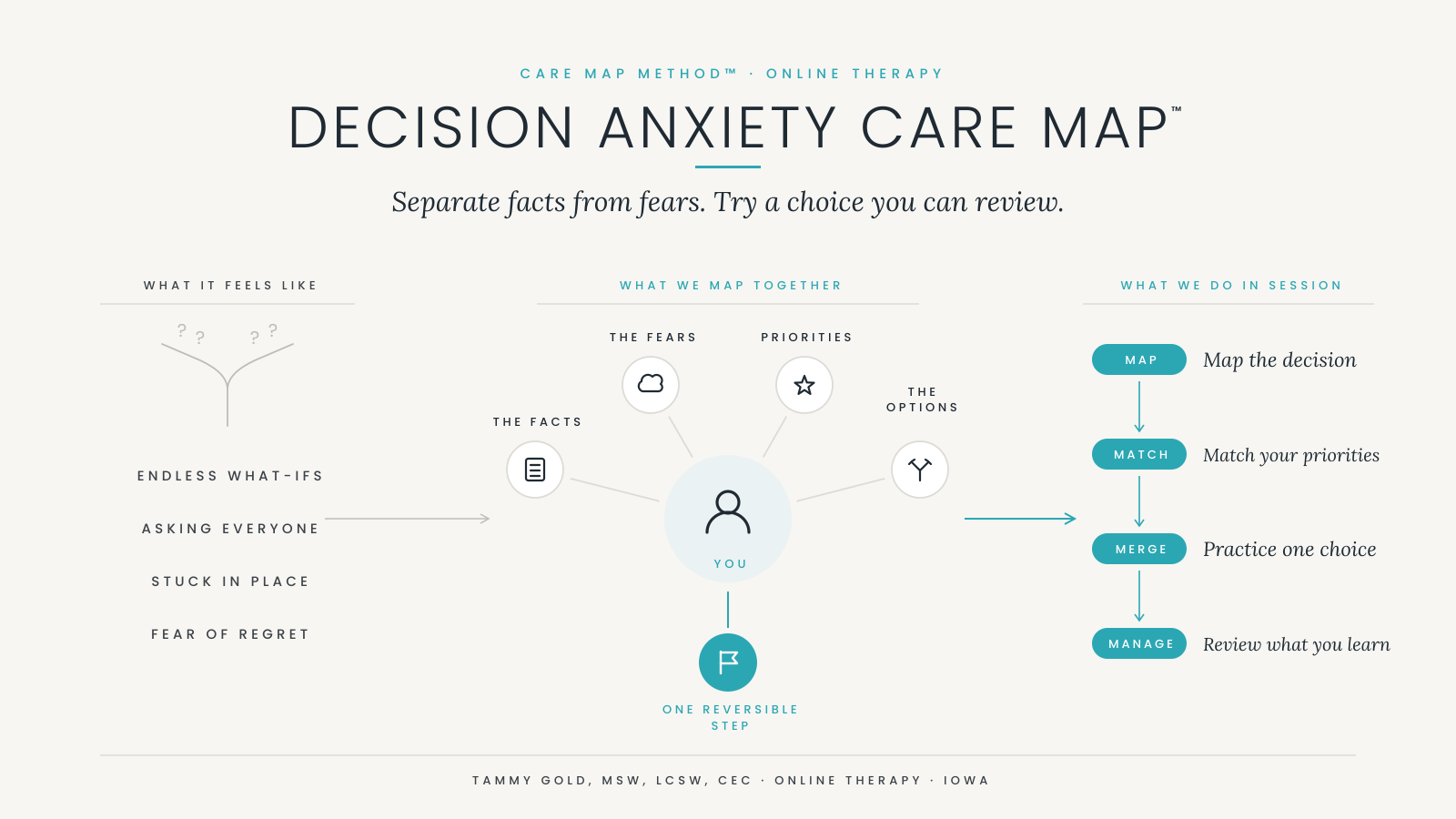
Four illustrated steps for exploring a difficult decision and reviewing a manageable choice.
You compare the options, ask someone what they think and feel settled for a moment. Then another possibility appears and you begin again. A routine decision can take more time and energy than you expected, leaving you frustrated with yourself and worried about making the wrong choice.
I’m Tammy Gold, a licensed therapist. I offer individual online therapy for adults in Iowa experiencing anxiety, relationship stress and difficult life transitions. We can explore what makes decisions feel so loaded, what information you actually need and how you want to respond to uncertainty.
Check Iowa Insurance and Availability
When choosing becomes a cycle of checking
You may reread reviews, ask several people for opinions or postpone answering a simple invitation. Perhaps you make a choice, then keep revisiting it instead of feeling able to move on. Other people may not see how much effort goes into an ordinary day.
We can look at the pattern without assuming that all careful thinking is a problem. Some decisions need time and specialized information. The question is how the process affects you, whether new information is being gained and what happens when you do not feel completely certain. Your assessment helps us understand the concern.
What making the wrong choice seems to mean
The feared outcome may involve disappointing someone, wasting money, causing conflict or proving a harsh belief about yourself. You may feel responsible for predicting consequences that no person could fully know in advance.
In therapy, we can explore the meaning attached to one actual decision. We might consider the standards you are using, whose preferences are taking priority and how past experiences shape the moment. This can help us distinguish a practical question that needs an answer from a repeated attempt to feel perfectly safe.
What we might work on in a session
For example, we might discuss a routine commitment you kept checking with friends. Each opinion added another possibility until you felt less able to choose. We could explore what you hoped the next opinion would settle, what mattered to you and what you feared would happen if someone disagreed.
Together, we might identify the information already available and practice making one proportionate choice. If appropriate, that could involve a small, reversible decision or expressing a preference without another round of consultation. We would discuss the discomfort and review the experience later. The therapist's role is to support your understanding and agency, rather than select the correct life decision for you.
Using the four Care Map steps for decision anxiety
Care Map Method™ helps organize Biological, Social, Environmental and Emotional factors. Fatigue, relationship expectations, the practical setting and emotional history may all affect a choice. We consider those factors alongside your symptoms and functioning.
We MAP the decision, the facts and the feared outcomes. We MATCH support and strategies to the concern and your priorities. We MERGE a chosen approach through rehearsal or a manageable experiment in daily life. We MANAGE the plan by reviewing what you learned and what needs adjustment. The framework does not mean every decision is simple, reversible or appropriate to make without expert advice.
When other people have become part of the decision
You may be used to seeking approval before naming a preference. A partner, parent or friend might offer reassurance generously, while you still find yourself needing more. We can examine the relationship pattern without blaming the person who has been trying to help.
You might practice saying what you prefer, asking one specific factual question or noticing when you are requesting permission rather than information. We can explore what it feels like to have a preference that someone else does not share. The focus stays on your well-being and the choices available in your circumstances.
A first session does not require a finished plan
You can start by describing the choice or pattern that brought you here. We will discuss relevant history, current symptoms and the effect on work, relationships and daily functioning. You can tell me what you have tried and what you would like to be different.
We will consider fit and possible goals together. Financial, medical and legal decisions may require information from the appropriate professionals. Therapy can explore the distress and your participation in the process while respecting those separate areas of expertise.
About Tammy Gold and Iowa appointments
I’m Tammy Gold, MSW, LCSW, CEC, a licensed therapist, certified coach and author. I earned my MSW at Columbia University and my BA at the University of Pennsylvania. My work includes relationships, family stress and the emotional demands of major transitions.
Use my Alma profile to review current Iowa availability and your exact insurance plan. If you have BCBS Massachusetts, verify that specific product and current participation rather than assuming all Blue Cross plans are equivalent. Confirm estimated costs and plan to be physically located in Iowa during an appointment.
Frequently asked questions
Why do ordinary decisions feel so difficult?
We can explore what you fear a choice might mean, the information involved and how the process affects you. There is no single explanation for everyone. Assessment considers your history, symptoms, current pressures and daily functioning before deciding what support fits.
Will you tell me which option to choose?
Your decisions remain yours. Therapy can help you understand priorities, fears and patterns around a choice, while relevant specialists provide information within their expertise. We can practice a decision process without treating the therapist as the authority on your life.
Can we work on asking for reassurance repeatedly?
Yes. We can examine what happens before and after you ask, what the reassurance is meant to settle and how long it helps. That understanding can guide a manageable next step. You do not have to stop a familiar response perfectly.
What if a decision has serious consequences?
We will take the context seriously. Medical, financial or legal questions may need advice from the appropriate professional. Therapy can address the emotional experience and your decision process without replacing expert information or pretending every option is equally safe or reversible.
Is decision paralysis a diagnosis?
It is a descriptive phrase, not a diagnosis by itself. We would discuss the pattern, other symptoms and the impact on your life. Assessment helps clarify whether a clinical condition is present and what form of care may be appropriate.
Do I need to know my therapy goals before contacting you?
No. You can begin with a situation that feels difficult or a pattern you want to understand. We will discuss symptoms, history and functioning, then consider treatment fit and goals together. An initial question can be enough to start the conversation.
Can I use BCBS Massachusetts while located in Iowa?
Check the exact plan and current Iowa provider participation through my Alma profile. The insurer name does not confirm every product or network. Coverage depends on benefits and the clinical service. Review estimated costs before booking an appointment.
How do I check Iowa online appointments?
Open my Alma profile, select your actual location and review current availability and insurance options. Plan to be physically located in Iowa for an Iowa appointment. If the correct state, service or plan is unclear, clarify those details before scheduling.
Take the next step
You can review current Iowa appointment options and your exact insurance plan through my provider profile. Confirm estimated costs before scheduling. We can begin with the situation you want help understanding.
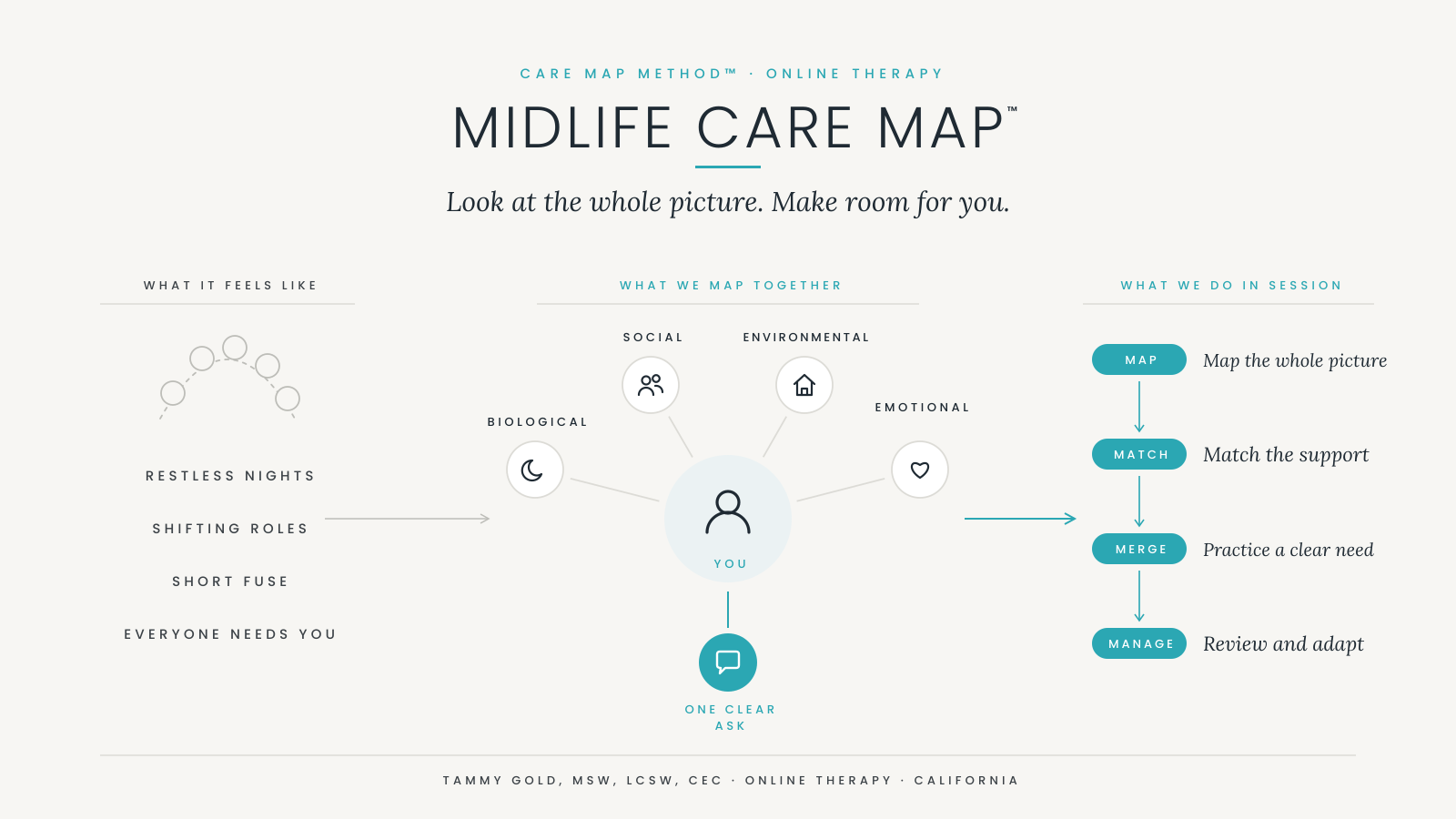
Therapy for Menopause and Midlife Relationship Stress in California
Midlife may bring health questions, changing roles and relationship strain at the same time. Explore individual therapy in California for the emotional experience, with practical conversations and support alongside appropriate medical care.
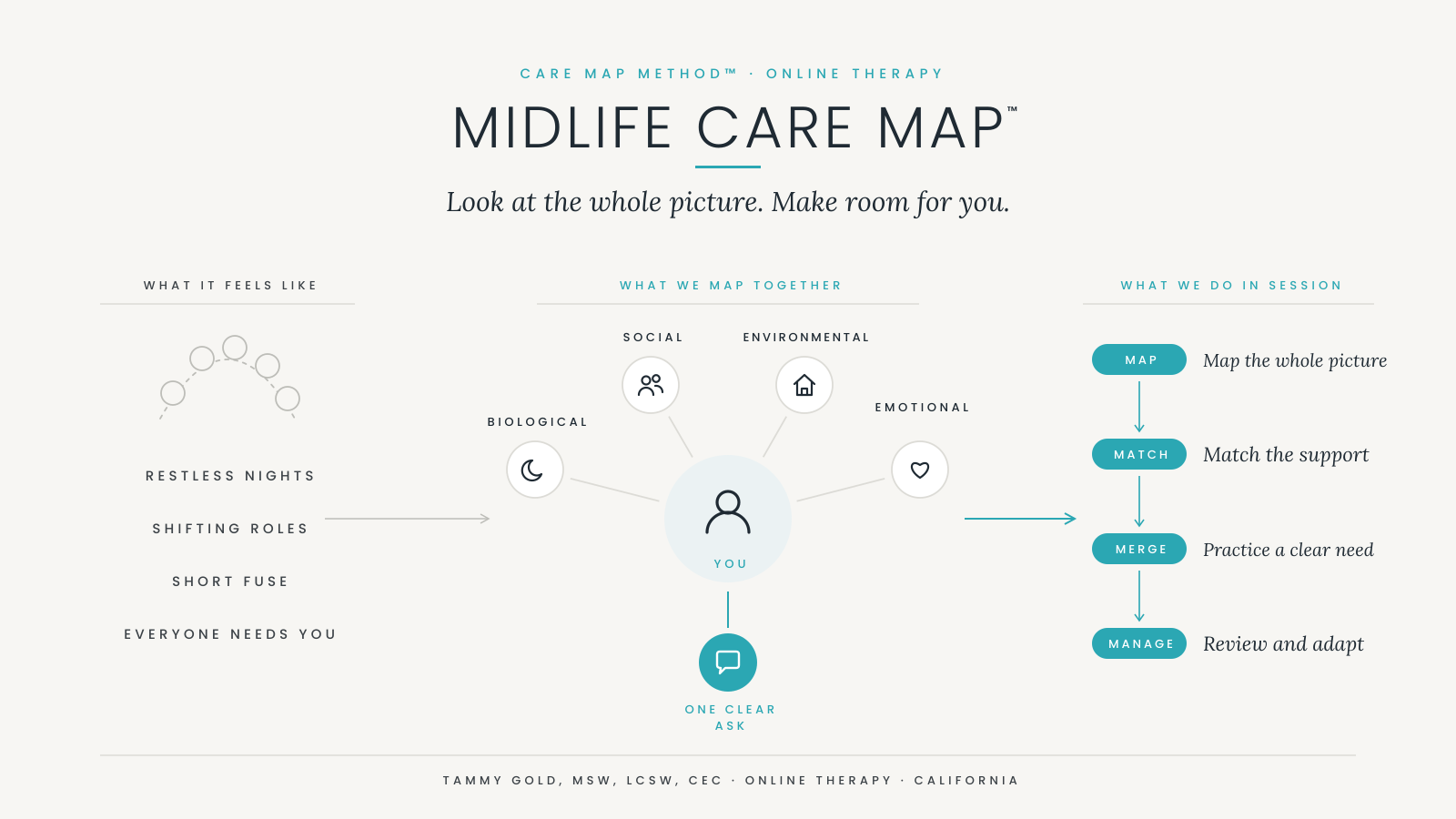
Four illustrated steps for exploring midlife pressures and practicing a request for support.
You may feel less patient, more easily overwhelmed or unsure why familiar responsibilities now take so much out of you. A conversation with a partner can turn tense quickly. You might be trying to manage work, children or aging parents while wondering where your own needs belong.
I’m Tammy Gold, LCSW. I offer individual online therapy for adults in California navigating emotional and relationship stress, including the pressures that can accompany midlife. We can explore the full situation and consider what support, communication or changes may fit your needs.
Check California Insurance and Availability
When several changes arrive together
Midlife can involve questions about health, changes in family roles, caregiving demands, work pressure and a different sense of yourself. If you are experiencing perimenopause or menopause, you may also be discussing sleep, physical symptoms or treatment with a medical professional.
Therapy gives us a place to explore the emotional and relational experience without assuming one factor explains everything. You may be grieving a role that is changing, frustrated by expectations at home or worried that others misunderstand you. Your circumstances and symptoms deserve individual attention rather than a single explanation about age or hormones.
When you feel unlike yourself in relationships
Perhaps you have less tolerance for being interrupted or feel hurt when a partner expects the same energy you used to have. You may want more support and also feel guilty asking for it. Someone saying, “You never used to mind,” can make it harder to explain that your needs have changed.
We can explore what those exchanges bring up for you. That may include resentment, sadness, fear of disconnection or uncertainty about what to ask for. Naming a feeling can help us understand what matters before deciding whether a conversation, boundary or another kind of support would be useful.
What we might work on in a session
For example, we might discuss an evening after disrupted sleep and a demanding day. A routine request from a partner led to a sharp response, followed by guilt. We could map the circumstances, your interpretation of the request and the need that went unspoken.
We might then rehearse a sentence that communicates your experience more directly, such as asking for a specific responsibility to be shared or explaining that you need time before discussing a difficult issue. We would consider the relationship context and what feels realistic. If health questions are contributing, those belong with an appropriate clinician. Therapy can support how you understand and communicate your experience while medical care addresses medical concerns.
Using the Care Map Method in midlife
Care Map Method™ considers Biological, Social, Environmental and Emotional factors alongside individual clinical assessment. We can make room for health and energy, the people around you, the demands of your setting and feelings about identity or change.
We MAP the interacting pressures rather than isolate one argument.
We MATCH suitable therapeutic support and, when relevant, identify questions for other professionals.
We MERGE a chosen response into your life through rehearsal or a manageable adjustment.
We MANAGE the plan by reviewing what helped, what was difficult and what has changed. This gives our work structure while leaving room for uncertainty.
Your needs can change without a complete explanation
You may be waiting until you can explain everything perfectly before asking someone to respond differently. We can explore what you already know: which situations leave you depleted, which expectations feel unrealistic and what you would like another person to understand.
You do not have to turn every feeling into a request immediately. There may be grief, disappointment or anger that needs attention first. When you are ready, we can consider one conversation or choice and review its effect. The goal is to work with your actual circumstances, rather than add another demand to manage midlife correctly.
What the first appointment can include
We will discuss your concerns, history, current symptoms, daily functioning and available support. You can tell me about medical care you are receiving and what you want therapy to focus on. We will consider treatment fit and goals together.
Psychotherapy does not replace medical evaluation or treatment. I do not determine whether a symptom is caused by hormones or recommend a medication plan through this service. With appropriate permission and arrangements, coordination with another treating professional may be considered when it supports your care.
About Tammy Gold and California appointments
I’m Tammy Gold, MSW, LCSW, CEC, a licensed therapist, certified coach and author. I earned my MSW at Columbia University and my BA at the University of Pennsylvania. My work includes relationships, parenting, caregiving and major family transitions.
Review my Headway or Alma profile for current California availability, exact-plan participation and estimated costs. Insurance coverage depends on your benefits and the assessed clinical service. Plan to be physically located in California during an appointment.
Frequently asked questions
Can therapy address the emotional side of menopause or midlife changes?
Therapy can explore your feelings, symptoms, relationships and functioning during this stage of life. Assessment helps clarify appropriate treatment goals. We do not assume that every concern is caused by menopause or that the same support fits everyone's experience.
Will you tell me whether my symptoms are hormonal?
Medical evaluation belongs with an appropriate health professional. We can discuss how symptoms and uncertainty affect you, what you want to ask your clinician and what support you need. Psychotherapy does not establish a medical cause for a symptom.
Can I attend while receiving medical treatment?
Yes, subject to treatment fit. Therapy can focus on emotional and relationship concerns alongside medical care. You can tell me about other treatment during assessment. Any coordination with another professional would depend on your permission and appropriate care arrangements.
Can we work on irritability and relationship strain?
We can explore the circumstances, feelings and interaction patterns involved, including what happens before and after a difficult exchange. Possible goals might include expressing needs or understanding a reaction. Assessment helps determine which focus fits your mental health concerns.
What if caregiving and work are also overwhelming me?
Those pressures belong in the conversation. We can look at the combined demands on your energy, relationships and daily life rather than separate the midlife concern from everything else. Understanding that context helps us consider realistic support and goals.
Will therapy replace medical care for menopause?
No. This service is psychotherapy, not medical evaluation or prescribing. Continue to bring medical questions to an appropriate clinician. Our work can address your emotional experience, functioning and relationships while respecting the different roles of your health professionals.
Can insurance cover these therapy appointments?
Coverage depends on your exact benefits, active provider participation and the assessed clinical service. Check your California plan through my Headway or Alma profile and confirm estimated costs before scheduling. A life stage or topic alone does not establish coverage.
How do I book an online session in California?
Review current appointment and insurance options through my provider profiles. Plan to attend while physically located in California, from a space where you can talk privately. The first appointment can begin with the change or interaction that has been hardest lately.
Take the next step
You can review current California appointment options and your exact insurance plan through my provider profile. Confirm estimated costs before scheduling. We can begin with the situation you want help understanding.
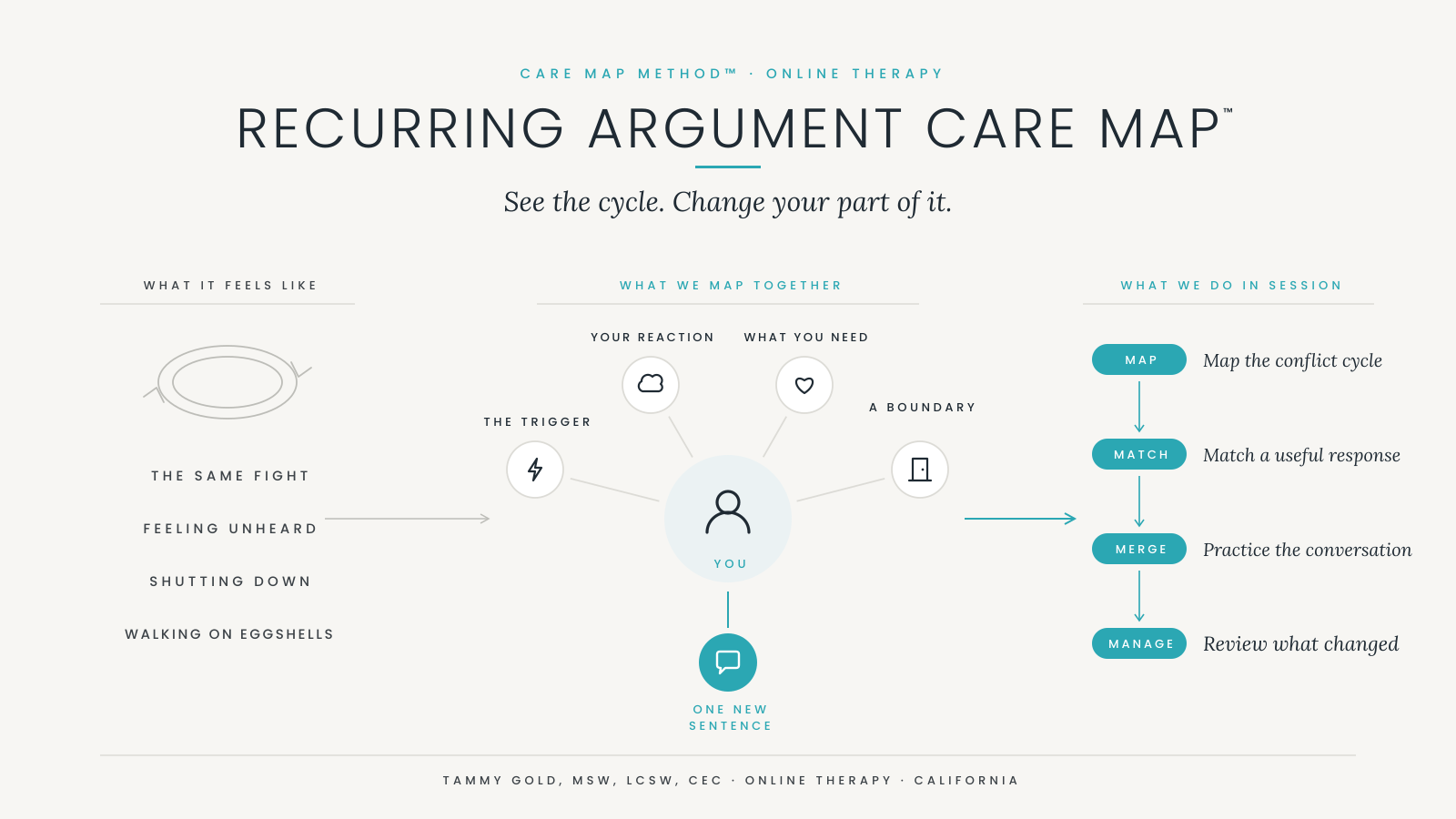
Individual Therapy for Recurring Relationship Arguments in California
When the same argument keeps returning, the pattern can matter as much as the subject. Explore individual therapy in California to understand your experience, identify an underlying need and practice a clearer request.
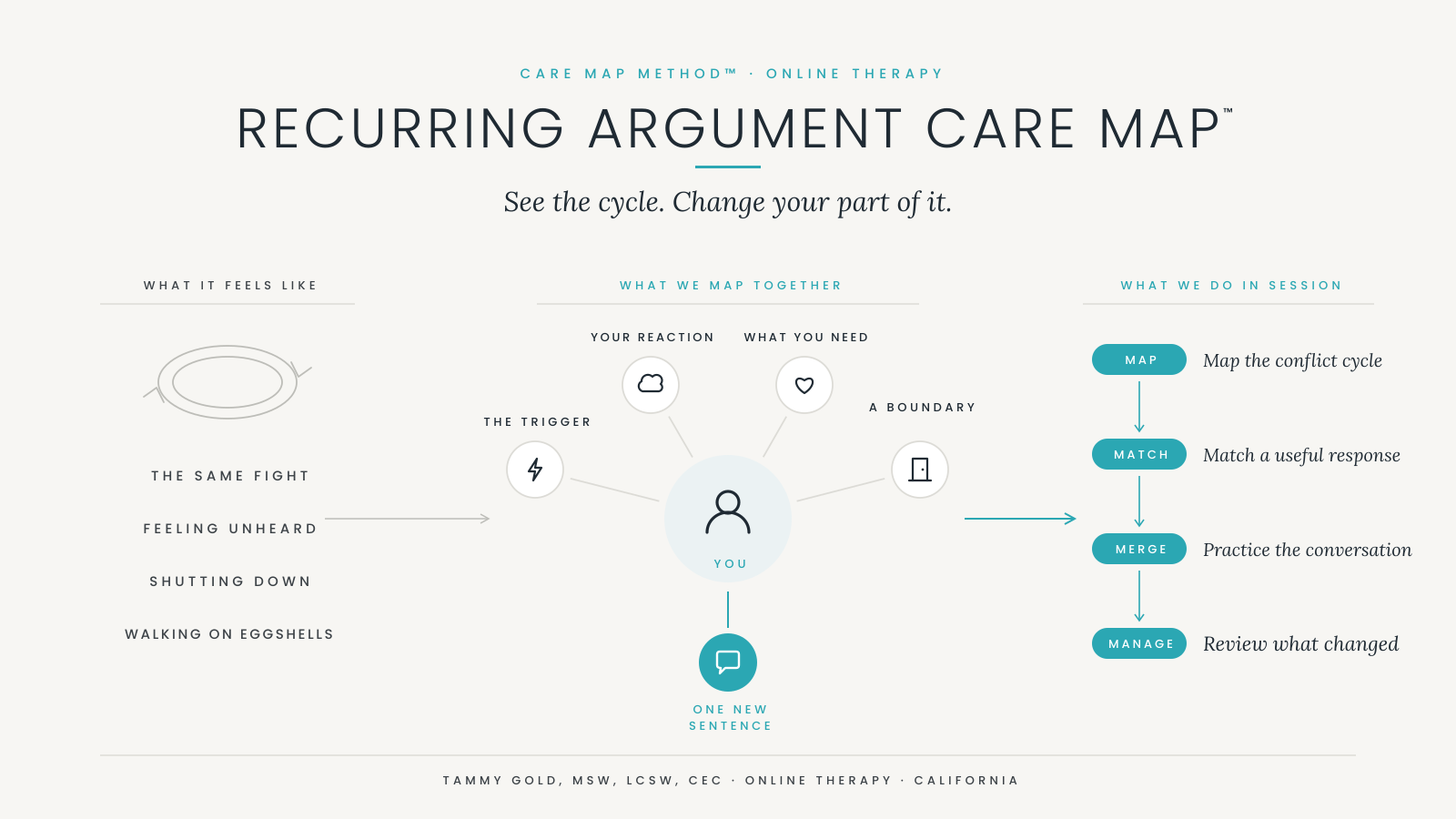
You start by talking about dishes, schedules or a text message. Within minutes, you are having the argument you know by heart. One person feels criticized, someone becomes defensive and the conversation ends with distance rather than understanding. You may spend the rest of the day wishing you had said it differently.
I’m Tammy Gold, LCSW. I offer individual online therapy for adults in California who are struggling with relationship stress and recurring conflict. We can explore your experience of the pattern, the needs underneath it and how you want to respond.
Check California Insurance and Availability On Headway Therapy Platform
When the topic changes but the argument feels familiar
The subject might be money one week and parenting the next. What feels familiar may be the sequence: trying to get heard, hearing a complaint, raising the intensity or withdrawing. You may feel frustrated that a conversation about one task becomes a much larger question about whether you matter.
We can examine a specific exchange with enough detail to understand it. That means considering what happened before the argument, what each statement meant to you and what you did next. We do not need to assume both people have the same experience or that one explanation fits every conflict.
Understand your part without taking all the blame
When you seek individual therapy for relationship problems, the focus is your mental health, needs and choices. That can include reflecting on responses you want to change while also recognizing behavior from others that hurts or confuses you.
You may notice that you defend yourself before understanding the request, stay silent until resentment builds or try to resolve everything when you are both exhausted. We can explore why a response makes sense to you in the moment and what happens afterward. Understanding your participation is different from accepting responsibility for the whole relationship.
What we might work on in a session
For example, we might explore a conversation about household tasks that shifted into criticism and withdrawal. You asked for help, heard yourself sounding sharper than intended and then felt dismissed. We could slow down the exchange and identify what you wanted the other person to understand.
After making room for those feelings, we might rehearse a more specific request or consider a different time to raise it. We could discuss how to name a pause without abandoning the subject, or how you want to respond if the conversation becomes unproductive. The practice is something to learn from, not a promise that the next conversation will go smoothly. Later, we can review what happened and what needs more attention.
Using MAP MATCH MERGE MANAGE in relationship work
Care Map Method™ helps organize Biological, Social, Environmental and Emotional factors. Fatigue, family roles, an overloaded schedule and past experiences may all shape a disagreement. We consider that context alongside your symptoms and treatment goals.
We MAP the interaction and the meaning it has for you.
We MATCH a possible approach to the need, such as a clearer request or boundary.
We MERGE it into real life through rehearsal and a manageable next step.
We MANAGE the plan by reviewing your experience and making adjustments. The framework supports individualized therapy rather than prescribing the same script to every relationship.
When your needs have become difficult to name
You may know you are upset without knowing what to ask for. “Help more” can carry a need for reliability, recognition, rest or shared responsibility. We can explore which of those matters in the moment and what a concrete request would sound like.
We can also discuss what happens when you make a request and nothing changes. You are allowed to consider your own needs even when another person disagrees. Therapy can help you reflect on options and consequences without deciding the future of your relationship for you.
Individual therapy when a partner does not attend
You can work on your own distress and relationship participation without requiring your partner to join. The first appointment can include your concerns, relevant history, current symptoms and how the conflict affects daily life. We can discuss goals and whether this approach fits.
Couples or family therapy would involve a separate assessment and arrangement. This page describes individual psychotherapy. Insurance participation for individual care should not be taken as confirmation of coverage for a joint service. We can clarify the type of support you are seeking before you begin.
About Tammy Gold and California appointments
I’m Tammy Gold, MSW, LCSW, CEC, a licensed therapist, certified coach and author. I earned my MSW at Columbia University and my BA at the University of Pennsylvania. My work includes relationships, parenting, caregiving and family stress.
Review my Headway or Alma profile for current California appointments and exact-plan participation. Confirm estimated costs before scheduling. During a California online appointment, plan to be physically located in California and somewhere you can speak privately.
Frequently asked questions
Can I come alone if my partner will not attend?
Yes. Individual therapy can focus on your distress, needs, reactions and choices within a relationship. You do not need a partner's participation to discuss those concerns. Joint treatment would require a separate conversation about the service and arrangements.
Will you decide which of us is right?
Our work can explore what happened, its impact and your part in the pattern without becoming a verdict about the relationship. Context and differences matter. We can examine responsibility and needs without assuming one person explains every part of the conflict.
What if I shut down during arguments?
We can explore what you notice before withdrawing, what the moment means to you and what happens afterward. Depending on your needs, we might practice language for expressing overwhelm, requesting a pause or returning to a topic. The approach is individualized.
Can we practice a difficult conversation?
Yes. We can rehearse words, timing and possible responses in a hypothetical conversation. We will also consider how the language feels to you and what remains outside your control. A rehearsed request cannot guarantee agreement from another person.
What if communication tips have not helped before?
We can look at why a suggestion was difficult to use, what the situation required and whether a different focus is needed. More information is not always the missing piece. Your emotional experience and the actual relationship context belong in the discussion.
Is this couples therapy?
This page describes individual psychotherapy. Couples therapy involves a different treatment arrangement with joint participation and its own assessment. If that is the service you want, clarify availability, fit and payment before scheduling rather than assuming it is the same appointment.
Can I use Aetna or BCBS Massachusetts in California?
Check current participation for your exact California plan through my Headway or Alma profile. Platform networks can differ, and plans with similar names are not interchangeable. Benefits and assessed clinical needs determine coverage. Confirm the estimated cost before booking.
How do I arrange a California online appointment?
Use my provider profiles to check current availability and insurance information. Plan to be physically located in California and able to speak privately. You can bring a recent disagreement or a recurring concern as a starting point for the first session.
Take the next step
You can review current California appointment options and your exact insurance plan through my provider profile. Confirm estimated costs before scheduling. We can begin with the situation you want help understanding.
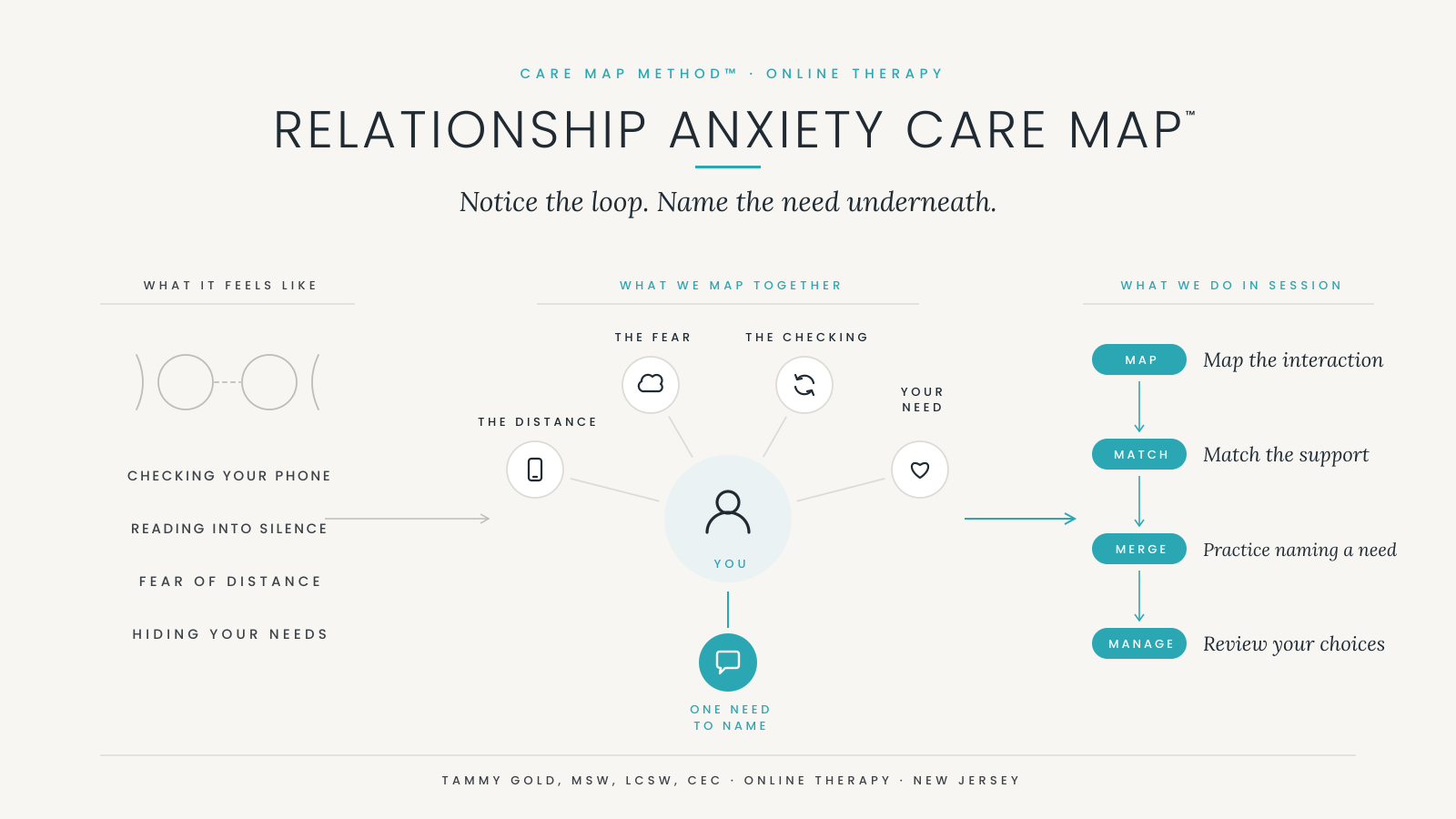
Relationship Anxiety and Anxious Attachment Therapy in New Jersey
A slow reply or request for space can bring up fear, repeated checking and self-doubt. Explore individual therapy in New Jersey for relationship anxiety, with room to understand the context and practice expressing a need.
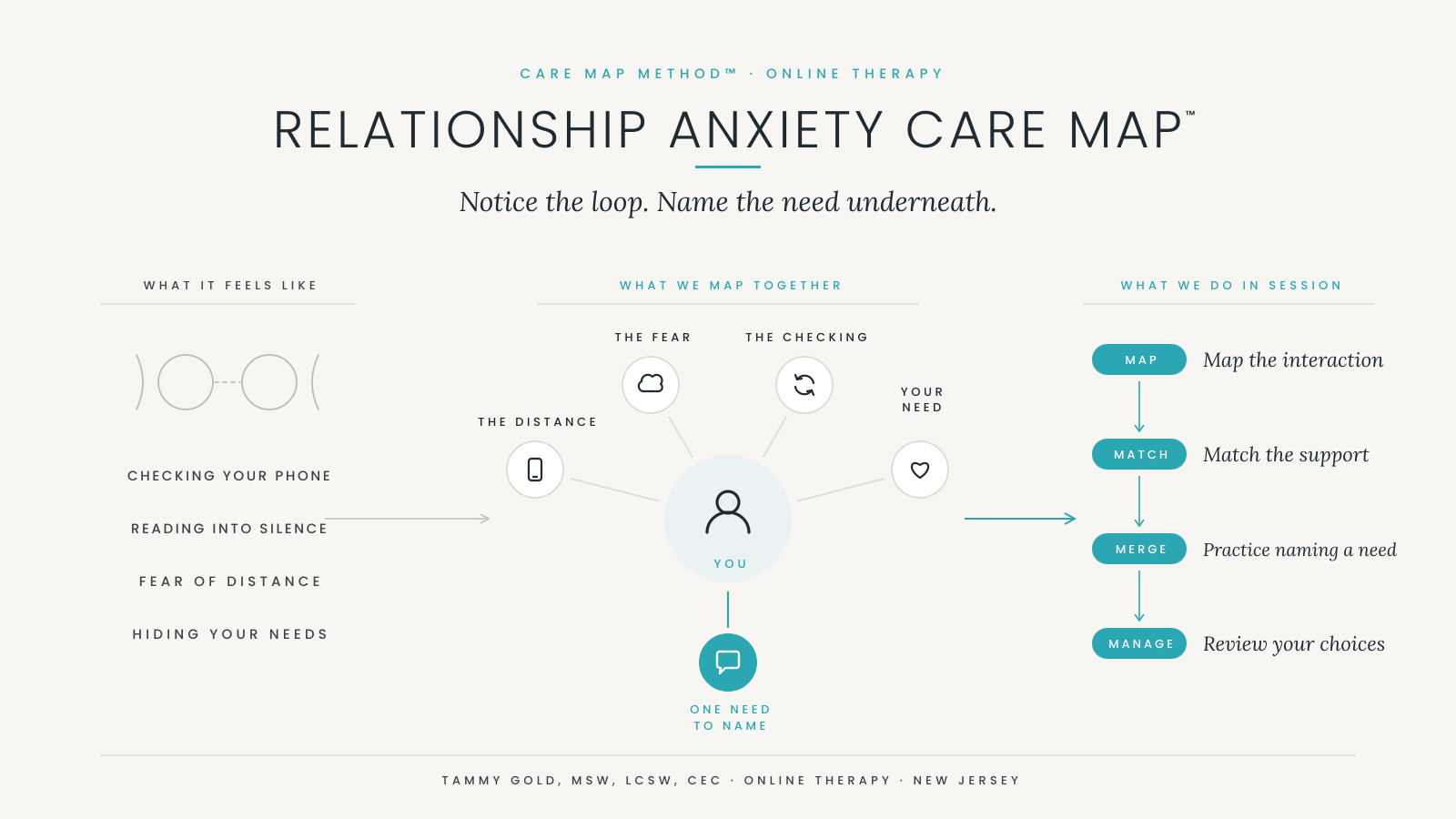
A shorter reply, a canceled plan or a request for space can leave you feeling unsettled for hours. You may keep checking your phone, wonder whether you have done something wrong or feel an urgent need to restore closeness. Then you may criticize yourself for needing reassurance.
I’m Tammy Gold, LCSW. I offer individual online therapy for adults in New Jersey experiencing relationship anxiety and difficult patterns around connection. We can explore what happens for you in those moments, the actual relationship context and what you want to do next.
Check New Jersey Insurance and Availability On Headway
When distance feels like a threat to the relationship
You may notice changes in tone quickly or feel unable to relax until you know where you stand. Perhaps you try to explain more, ask another question or make yourself easier to be with. These responses can take energy away from work, friendships and your own preferences.
We can look closely at one situation rather than assume all worry comes from the same source. Sometimes the uncertainty reflects a relationship that is genuinely unclear. Earlier experiences, expectations and current stress may also matter. Your feelings deserve context, not a label that dismisses them.
What attachment language can help us explore?
You may have encountered the phrase anxious attachment and recognized parts of your experience. It can give you language for discussing closeness and fear, but it does not explain every relationship or establish a clinical diagnosis by itself.
In therapy, we can explore patterns without deciding who you or your partner must be. We might consider what you expect when someone becomes less available, how you learned to seek connection and which responses support or undermine your own needs. We will also assess symptoms and daily functioning to clarify treatment fit.
What we might work on in a session
For example, we might explore what happened after a partner asked for space. You sent several messages, received little clarity and then felt ashamed. We could slow down the exchange: what was said, what you feared, what you needed and what each additional message was intended to accomplish.
After understanding the emotional experience, we might rehearse a direct request such as asking when you will reconnect or naming what uncertainty feels like for you. We would also discuss your options if the other person cannot or will not provide clarity. The work supports your understanding and agency; it does not depend on making a partner become more available.
Using Care Map Method for relationship anxiety
Care Map Method™ helps us consider Biological, Social, Environmental and Emotional factors together. Your energy, available support, daily pressures and emotional history may shape how a particular exchange feels. We also pay attention to the behavior and circumstances you describe in the present relationship.
We MAP the interaction and its meaning. We MATCH therapeutic support and possible responses to your needs. We MERGE a chosen approach through rehearsal or a manageable change in daily life. We MANAGE the plan by reviewing your experience, including what remains hard. The framework gives our work structure without treating your relationship as a problem with a guaranteed formula.
Express a need without losing yourself in the response
You may spend so much time anticipating another person's reaction that your own preference becomes difficult to hear. We can explore what you want to ask for, what you are willing to accept and what you would need to consider if the pattern continues.
A conversation can be clearer and still feel uncomfortable. We can make room for disappointment or uncertainty after you express a need. The goal is not to perform the perfect request so another person gives the desired answer. It is to understand your experience and participate in ways that reflect your values.
Individual therapy when your partner is not attending
You can seek help for your own anxiety, distress and functioning even if your partner does not want therapy. Our work can include relationship experiences while remaining centered on your treatment. Couples therapy is a separate service and requires its own discussion of fit and arrangements.
At the first appointment, we will discuss your concerns, relevant history and current symptoms. You can tell me what support has felt helpful or unhelpful. We will consider goals together, without requiring you to decide the future of the relationship before we begin.
About Tammy Gold and New Jersey appointments
I’m Tammy Gold, MSW, LCSW, CEC. I earned my MSW at Columbia University and my BA at the University of Pennsylvania. My work includes relationships, parenting, caregiving and the emotional demands of family life.
Use my Headway or Alma profile to check current New Jersey appointments and exact-plan participation. The plans available can differ by platform. Confirm estimated costs before scheduling and plan to be physically located in New Jersey during your appointment.
Frequently asked questions
Can I attend without my partner?
Yes. Individual therapy can address your symptoms, self-understanding and choices within a relationship. Your partner does not have to attend. If couples care is being considered, we would discuss that separately rather than assume individual treatment automatically becomes joint treatment.
Is anxious attachment a diagnosis?
The phrase is commonly used to describe a relationship pattern, but it does not establish a clinical diagnosis. We would assess your concerns, history, symptoms and functioning. Attachment language can be explored without reducing your experience to one category.
What if my partner really is inconsistent?
We can consider the relationship behavior you describe alongside your emotional responses. Therapy should not assume that every concern is an inaccurate fear. We can explore what you know, what remains unclear and what choices you want to consider.
Will you tell me whether to stay or leave?
There is no predetermined outcome. We can explore your values, experiences, needs and options while keeping the decision yours. You do not have to settle that question before seeking help with the distress you are experiencing now.
Can we practice asking for reassurance more clearly?
Yes. We can examine what you need reassurance about and rehearse words that fit your situation. We will also consider the pattern around the request and your experience afterward. A clearer request cannot guarantee the response you hope for.
Can individual therapy make my partner change?
We cannot guarantee changes in another person's behavior. Individual therapy focuses on your mental health, understanding and participation. It may help you clarify what you need and how you want to respond, including when the other person remains unavailable.
Can I use Aetna or BCBS Massachusetts in New Jersey?
Check my Headway or Alma profile using your exact plan and New Jersey location. These platforms may offer different networks. Do not assume every plan from the same insurer is included. Confirm participation, the clinical service and estimated costs before booking.
How do online appointments work in New Jersey?
Review current availability through my provider profiles and plan to attend from a private space while physically located in New Jersey. In the first session, we can discuss your concerns, assess fit and begin identifying goals that matter to you.
Take the next step
You can review current New Jersey appointment options and your exact insurance plan through my provider profile. Confirm estimated costs before scheduling. We can begin with the situation you want help understanding.
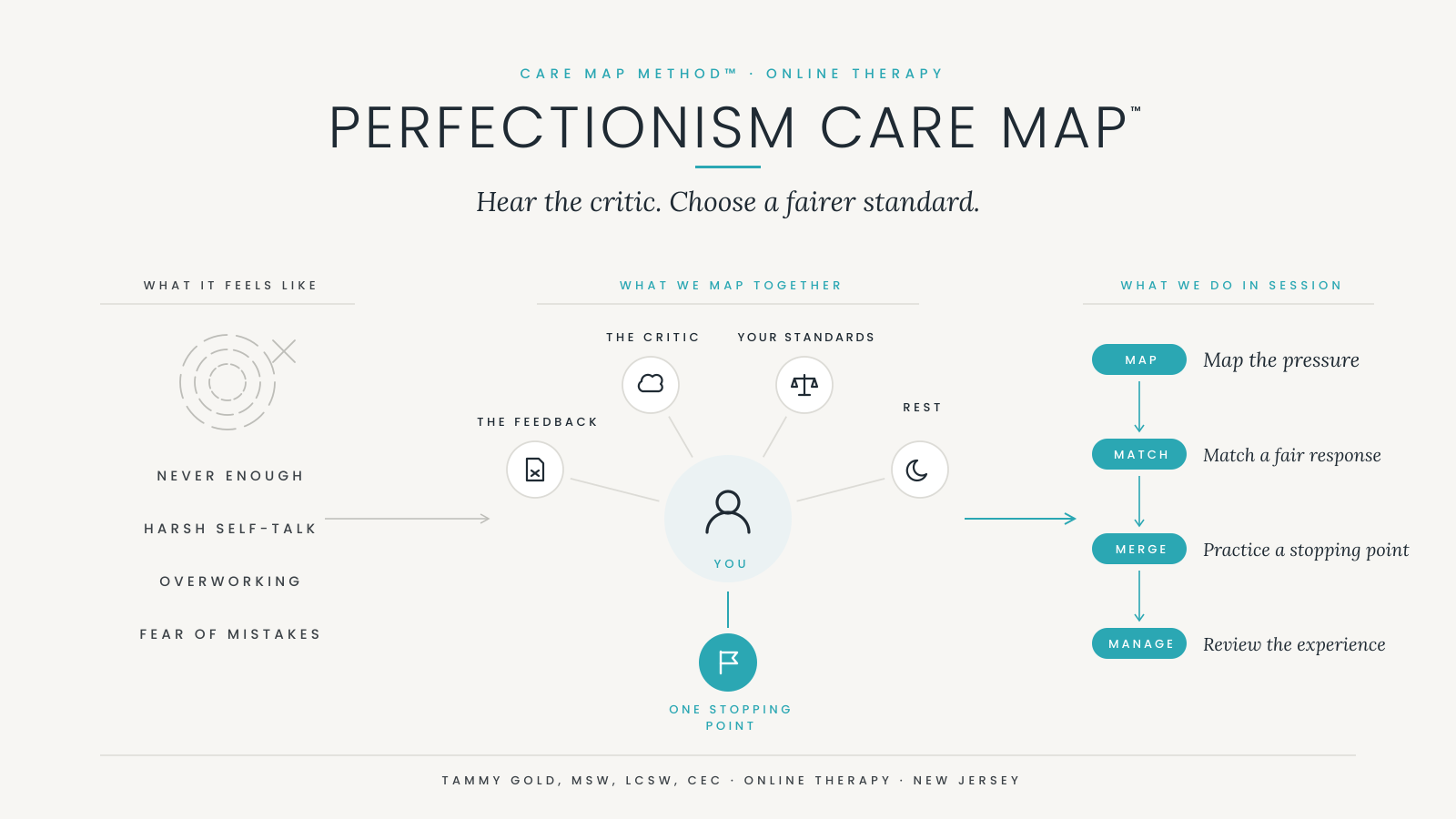
Perfectionism and Self-Criticism Therapy in New Jersey
Working hard does not always quiet the feeling that you should be doing more. Explore individual online therapy in New Jersey for perfectionism, self-criticism and the pressure around feedback, mistakes and rest.
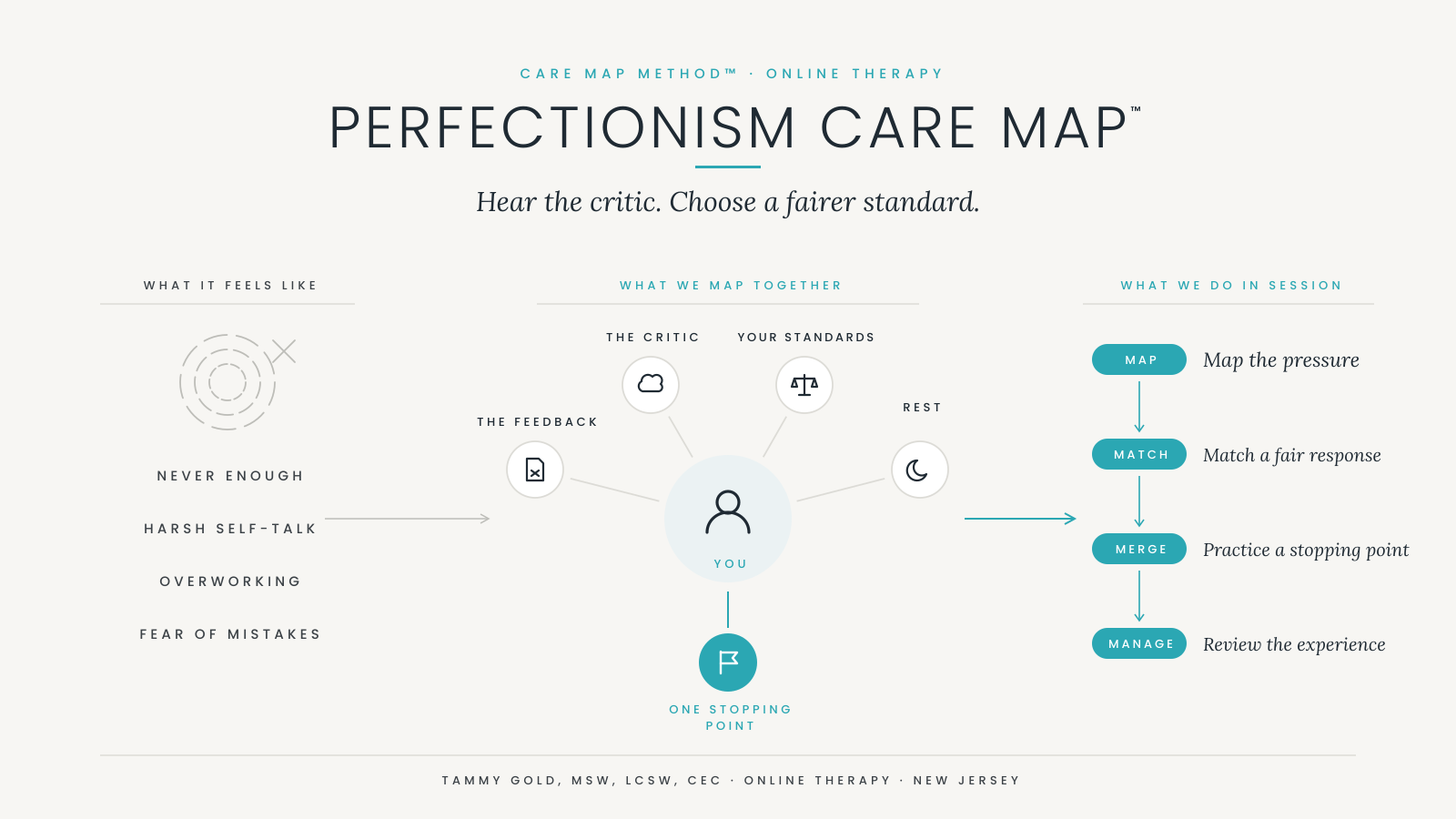
You finish something and immediately notice what could have been better. A small mistake stays with you long after other people have moved on. Even when you are doing well, resting may feel uncomfortable because there is always something else to improve.
I’m Tammy Gold, LCSW. I offer individual online therapy for adults in New Jersey who struggle with perfectionism, self-criticism and fear of getting things wrong. We can explore the pressure you put on yourself, what it protects you from and how you want to relate to your work, relationships and responsibilities.
Check New Jersey Insurance and Availability
When your standards leave little room for you
You may spend too long preparing a message, delay a task because you cannot see how to do it well enough or feel embarrassed asking for help. Perhaps you keep meeting expectations while privately feeling that you are falling short.
This can appear in parenting, work, caregiving and relationships. You might expect yourself to remain patient through every difficult moment or feel personally responsible for a family member’s disappointment. Therapy gives us space to examine those expectations and their effect on your well-being.
Understand what happens after a mistake
Imagine receiving a small correction at work. You know what needs changing, but your thoughts move quickly to “I am not good at this” or “They should not have trusted me.” You work late to compensate and avoid asking a question the next day.
In a session, we might separate the specific feedback from the larger judgment about yourself. We can explore the feelings it brings up and consider a response that addresses the task without turning one correction into an account of your worth. That could include clarifying the feedback or deciding when the revision is complete.
Keep what matters while examining the pressure
You may worry that easing self-criticism means becoming careless, letting people down or losing the motivation that has helped you succeed. We can take that concern seriously. Your values and ambitions belong in the conversation.
We might explore whether the way you push yourself is helping you complete the task or keeping you trapped in preparation. We can also consider whose expectations you are trying to satisfy. The work should reflect your goals, rather than replace one rigid standard with another rule about being relaxed.
Practice a response that fits real life
A manageable experiment could be asking for clarification before trying to anticipate every preference, setting a stopping point for a routine task or making a direct request for help. We would discuss the worry involved and review the experience afterward.
For a parent, the starting point might be what happens after losing patience during a hard evening. We can look at accountability, repair and realistic expectations without spending the whole session judging whether you are a good parent. One difficult interaction deserves context and attention, rather than a verdict about your entire relationship.
Bring the whole situation into focus
Care Map Method™ helps us organize Biological, Social, Environmental and Emotional factors. We may consider fatigue and health, family expectations, work demands, available support and the emotional history of making mistakes. The same standard can feel very different depending on what else you are carrying.
We MAP the pressure and its context, MATCH suitable support, MERGE changes into your routines and MANAGE the plan through review. Within individual therapy, the framework helps us stay connected to your circumstances and treatment goals. Progress does not have to become another performance you judge.
Your first appointment
We can start with a situation you keep criticizing yourself about. We will also discuss relevant history, symptoms, daily functioning and previous experiences with support. Together, we can consider whether my approach fits and what you would like therapy to help you understand or change.
About Tammy Gold
I’m Tamara “Tammy” Gold, MSW, LCSW, CEC, a licensed clinical social worker, certified coach and author. I earned my MSW at Columbia University and my BA at the University of Pennsylvania. My work includes relationships, parenting, caregiving and the pressure of feeling responsible for everyone around you.
New Jersey appointments and insurance
Individual online appointments are available through my participating platforms, subject to current scheduling and treatment fit. Review my Headway and Alma profiles with your New Jersey location and exact insurance information. The plans available can differ between platforms.
Confirm benefits and estimated costs before scheduling. During a New Jersey appointment, you need to be physically located in New Jersey. Our first conversation can begin with the situation that made you think it might be time for support.
Frequently asked questions
Can I work on perfectionism without giving up my goals?
Yes. We can explore the goals and values you want to keep while examining the distress around meeting them. The focus may include how you respond to feedback, decide when something is finished or ask for help. Your ambitions can remain part of treatment.
Why do small mistakes feel so personal?
That is something we can explore in the context of your experiences, relationships and current pressures. A correction may bring up fear of rejection, shame or older expectations, but we would not assume the explanation in advance. Your assessment helps us understand the pattern.
Can perfectionism include putting things off?
You may find that fear of doing something inadequately makes it difficult to begin or finish. We can examine what happens with a particular task and consider manageable next steps. Procrastination alone does not tell us the cause or establish a diagnosis.
Can we talk about guilt when I rest?
Yes. We can explore what you believe rest means, whose needs you feel responsible for and what happens when you pause. The aim is to understand the guilt and your choices within real responsibilities, rather than assign another schedule you must follow perfectly.
Do I need to have an anxiety diagnosis before contacting you?
No. You can ask about an appointment without having a diagnosis. We will assess symptoms, history and functioning to clarify treatment fit. If you plan to use insurance, coverage depends on your benefits, current participation and the clinical service identified through assessment.
Is this productivity coaching?
This page describes individual psychotherapy focused on your mental health and functioning. We may discuss tasks or work patterns when they relate to treatment, but the service is not a productivity program. Coaching would require a separate discussion about goals, scope and payment.
Can I use Aetna or BCBS Massachusetts in New Jersey?
Check your exact plan and current New Jersey participation through my Headway or Alma profile. These platforms may offer different networks. Coverage depends on your benefits and the assessed clinical service. Confirm estimated costs before scheduling rather than relying on the insurer name alone.
How do online sessions work in New Jersey?
Review current availability through the booking links and choose a private place where you can talk comfortably. Plan to be physically located in New Jersey during your appointment. We will discuss your concerns, assess fit and work together on goals relevant to your life.
Take the next step
You can review current New Jersey appointment options and your exact insurance plan through my provider profile. Confirm estimated costs before scheduling. We can begin with the situation you want help understanding.
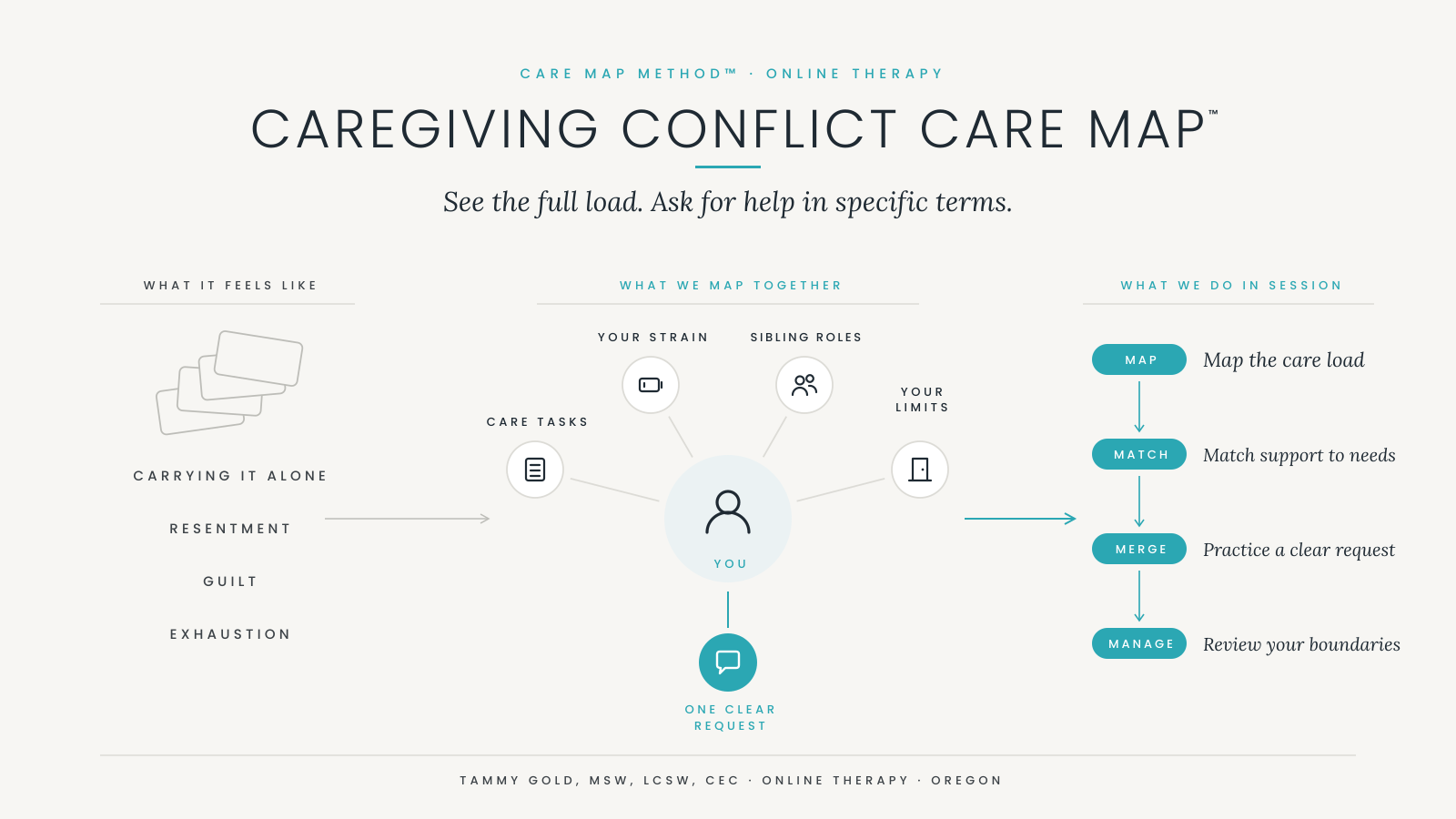
Therapy for Sibling Conflict Over Aging Parents in Oregon
Carrying a parent's care while arguing with siblings can leave you angry, guilty and alone. Explore individual therapy in Oregon for the emotional strain, including how to clarify your needs and practice a specific request for support.
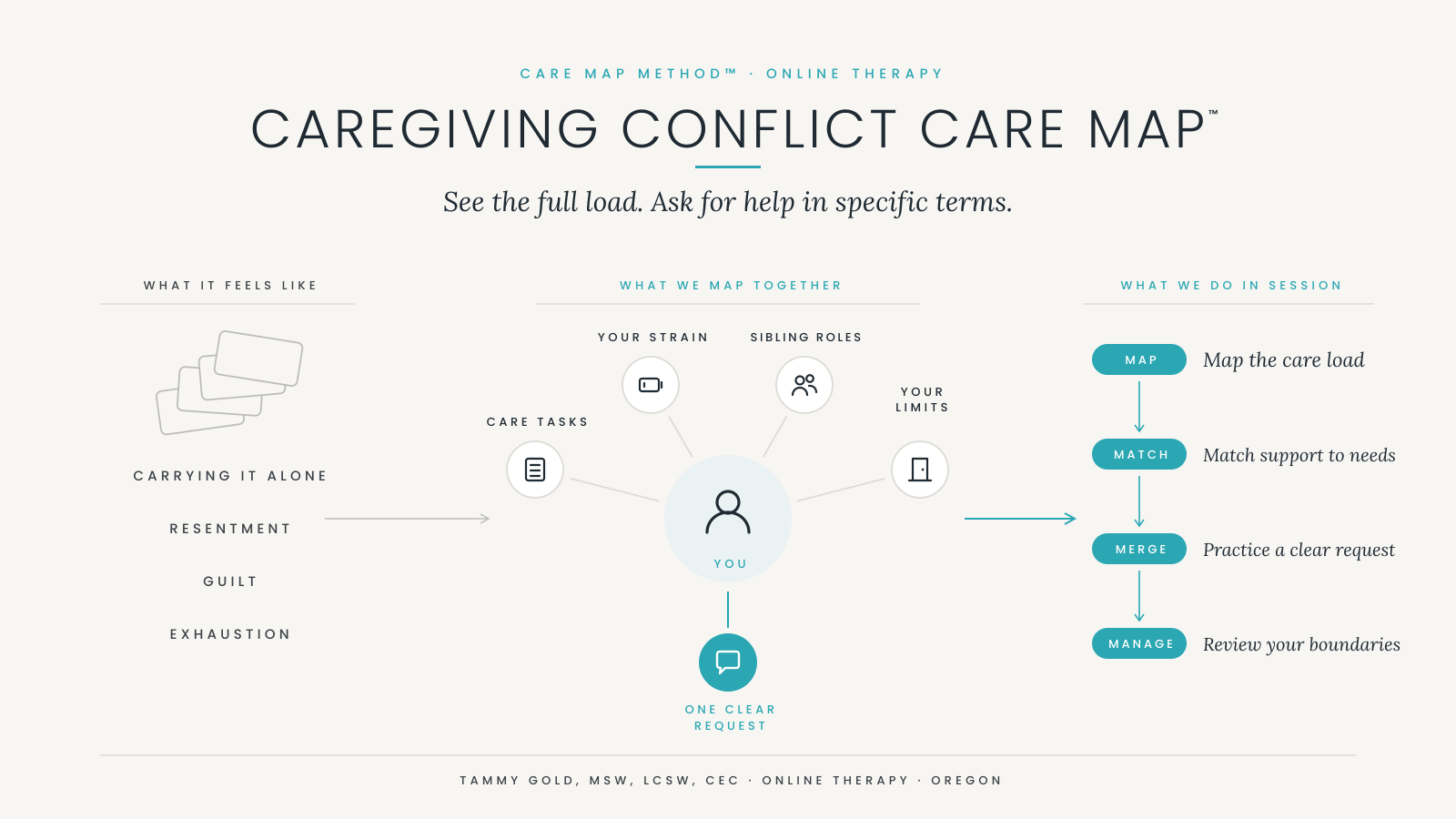
Four illustrated steps for exploring caregiving strain and practicing a specific request.
You schedule the appointments, follow up on the messages and notice when something changes with your parent. Then a sibling questions a decision from a distance. You may feel angry about carrying the responsibility and guilty for resenting people you love.
I’m Tammy Gold, LCSW. I offer individual online therapy for adults in Oregon dealing with caregiving strain, family conflict and emotional overwhelm. We can explore the effect this situation has on you, clarify what support you need and practice how you want to respond.
Check Oregon Insurance and Availability On Headway
The care load includes what other people do not see
An appointment may take an hour, but arranging it can involve several calls, transportation, reminders and time away from work. You may also be the person anticipating problems, tracking updates and trying to keep everyone calm. That invisible work can be difficult to explain until you are already exhausted.
We can make room for the emotional experience alongside the tasks. Perhaps you feel alone, watched or unable to step away. You may love being close to your parent and still need help. Those feelings can be discussed together without turning them into a judgment about whether you care enough.
Old family roles can enter a new care situation
You may have been the organizer long before your parent needed support. A sibling might expect you to know the answers, while you expect them to notice that you are struggling. The care discussion can quickly become a familiar argument about who contributes, who decides and who gets heard.
In individual therapy, we can explore the expectations you carry and how they affect your choices. We do not need to decide what an absent sibling secretly feels. We can consider what has actually happened, what you have asked for and which parts of the relationship remain uncertain.
What we might work on in a session
For example, we might discuss a day when you arranged a medical visit and received criticism afterward. We could look at the anger, worry or guilt the exchange brought up, and what you wanted your sibling to understand. We would also consider any real limits around time, distance or available resources.
From there, we might rehearse a request for one defined responsibility: making a particular call, arranging transportation or taking a scheduled update. We can explore how you want to respond if the person declines. Practicing the request supports your clarity; it cannot guarantee cooperation. A later conversation in therapy can help us review what the experience showed about your needs and options.
Using the four Care Map steps
The Care Map Method™ organizes Biological, Social, Environmental and Emotional factors. Your health and rest, family relationships, practical care setting and emotional history all help us understand the situation. Within therapy, the focus remains your mental health and functioning.
We MAP the responsibilities and their impact.
We MATCH support options to your needs and circumstances.
We MERGE a chosen approach into life through rehearsal, a boundary or a specific request.
We MANAGE the plan by reviewing what happened and adjusting what is feasible. It is a way to organize our work without expecting you to manage every person perfectly.
When saying what you need brings guilt
You may worry that asking for a break means your parent will go without care or that a sibling will think you are selfish. Sometimes a practical discussion cannot move forward until those fears have room in the conversation.
We can explore what being a responsible daughter, son or sibling means to you. We might distinguish what you choose to offer from what you feel unable to decline. The goal is to understand your values and capacity within real constraints, including situations where the available options are imperfect.
What individual therapy can and cannot take on
This page describes therapy for the adult seeking help. Your parent's medical assessment, treatment and legal decision-making remain with the appropriate professionals. Individual sessions are also different from family mediation or a consultation focused on selecting a care provider.
You can bring practical situations into therapy because they affect your well-being. We will clarify the purpose of our work and whether another type of support is needed. If family sessions are being considered, participation, fit and payment arrangements require a separate discussion.
About Tammy Gold and getting started
I’m Tamara “Tammy” Gold, MSW, LCSW, CEC, a licensed therapist, certified coach and author. I earned my MSW at Columbia University and my BA at the University of Pennsylvania. My work includes parenting, caregiving and difficult family relationships.
An initial appointment can begin with one recent exchange or the feeling you have been reluctant to say aloud. We will discuss symptoms, history, functioning and goals. Review my Headway or Alma profile for current Oregon appointments, exact-plan eligibility and estimated costs before scheduling.
Frequently asked questions
Can I attend if my siblings will not participate?
Yes. Individual therapy can focus on your own distress, needs and choices within the family situation. We can discuss relatives without requiring their attendance. A family treatment arrangement would involve separate assessment and agreement rather than being assumed from individual care.
Will you tell my siblings they need to help?
Individual therapy is centered on your care. We can work on how you understand the situation, express needs and respond to others. We cannot require relatives to cooperate or use your sessions to make decisions on their behalf.
Can we work on resentment and guilt together?
Yes. These feelings can occur alongside love, commitment and concern for your parent. We can explore what each feeling points to, how it affects you and what changes may fit your circumstances. You do not need to choose one acceptable emotion.
What if a sibling refuses the request we practice?
We can review the response, your feelings and the options available afterward. That may include revisiting a boundary, identifying another source of support or recognizing a limit. Rehearsing language does not promise that another person will agree.
Is this family mediation?
No. This page describes individual psychotherapy for your mental health concerns. Mediation aims to help people resolve a dispute through a different process. We can clarify the service you are looking for before beginning, including whether another professional would be appropriate.
Can you decide what medical care my parent needs?
Your parent's medical care belongs with their health professionals and authorized decision-makers. Therapy can explore how the situation affects you. Care-selection consulting is a separate service with different goals and arrangements; it should not be assumed to be covered psychotherapy.
Can I use Providence, Regence or Aetna in Oregon?
Review my Headway profile with your exact plan and Oregon location. Current participation and benefits determine available options; the company name alone is not enough. Coverage also depends on the assessed clinical service. Confirm estimated costs before scheduling.
How do I start an individual online session?
Check current Oregon availability through my provider profiles. Plan to attend from a private place while physically located in Oregon. You can begin with a recent family exchange, an ongoing worry or the feeling that you are carrying more than you can sustain.
Take the next step
You can review current Oregon appointment options and your exact insurance plan through my provider profile. Confirm estimated costs before scheduling. We can begin with the situation you want help understanding.
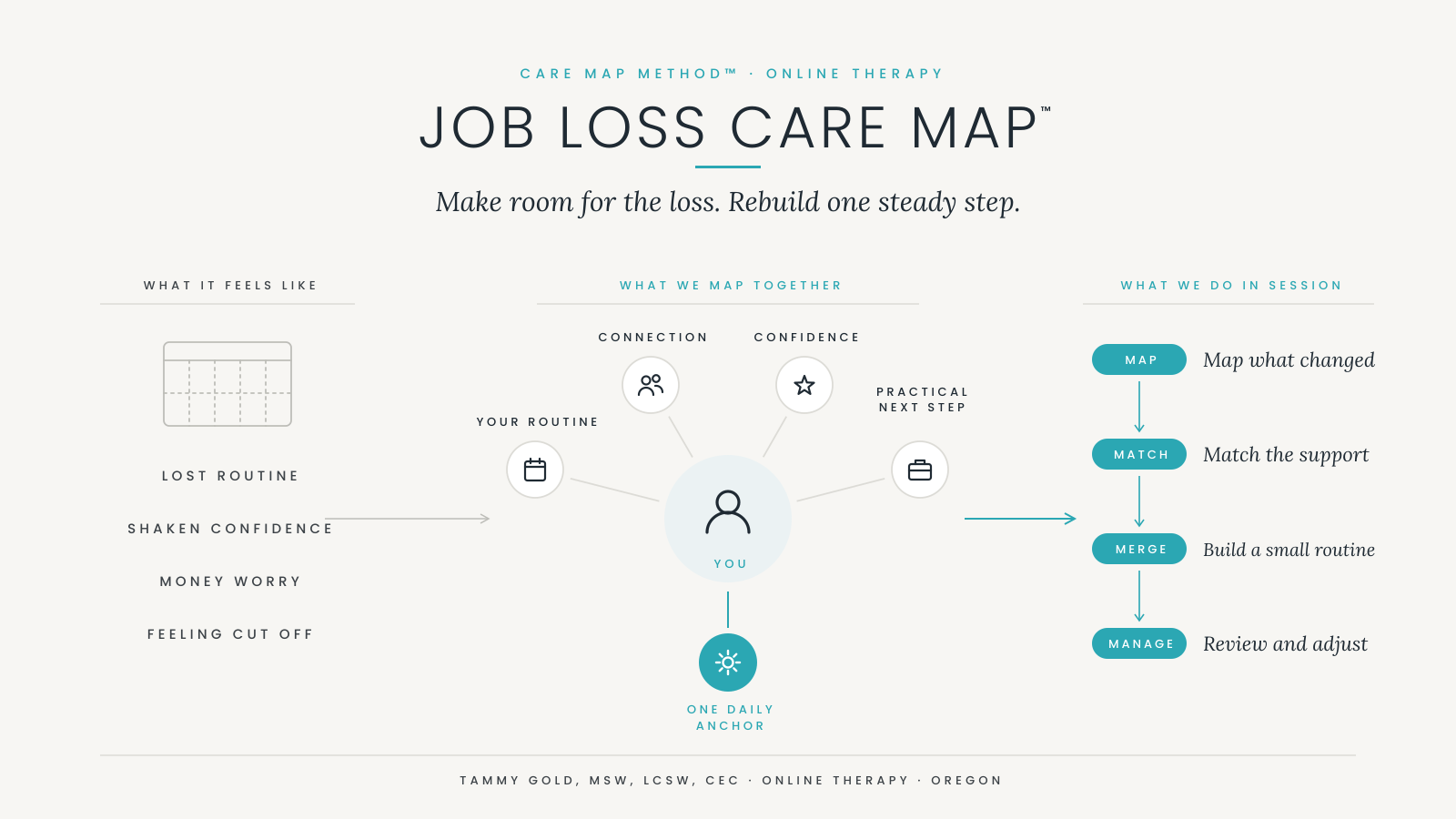
Therapy After Job Loss in Oregon
A job loss can affect confidence, relationships and the structure of daily life. Learn what individual therapy in Oregon can involve as you make room for the loss, understand current pressures and consider a manageable next step.
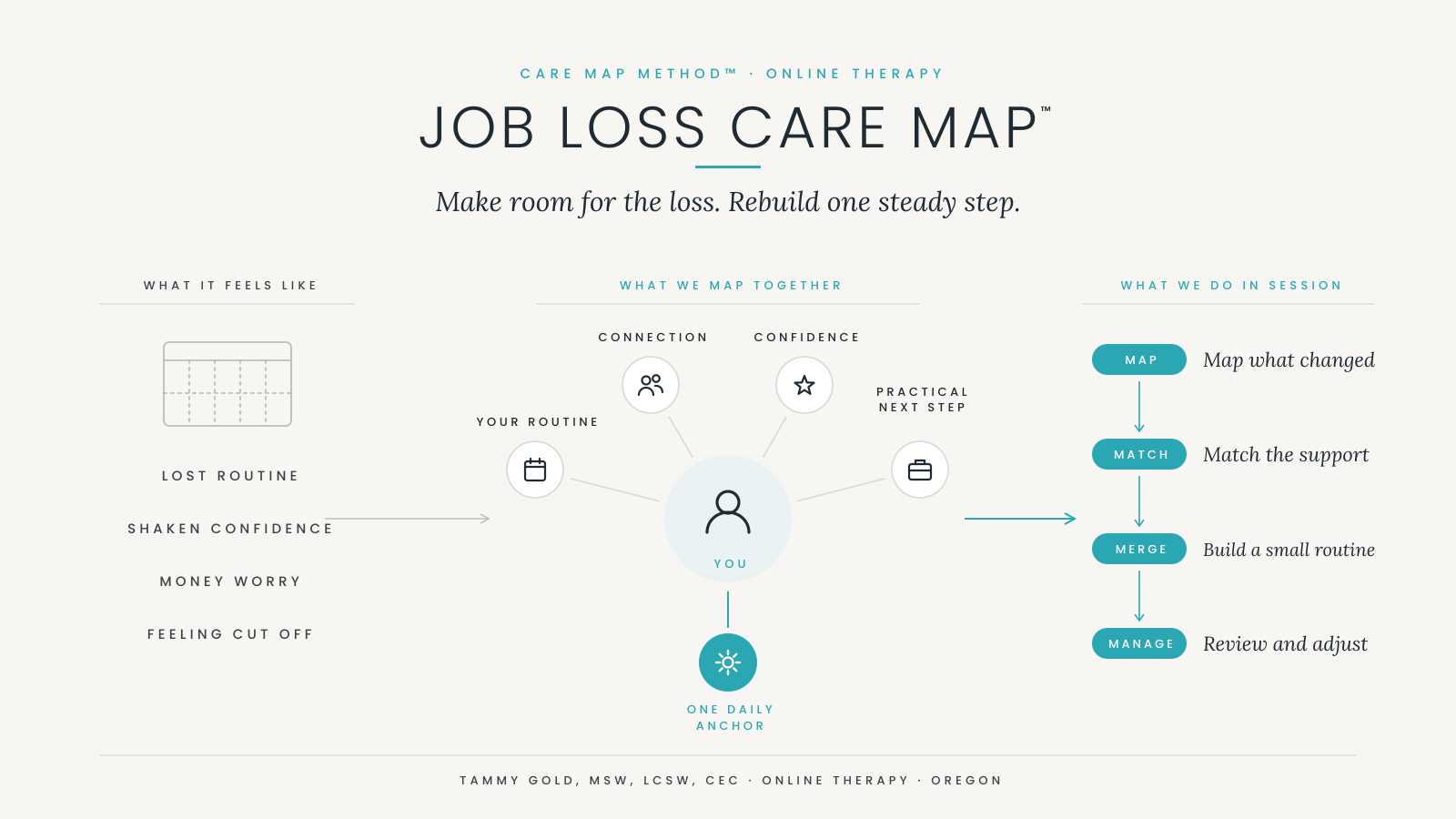
llustrated steps for exploring job loss and building a manageable routine.
Losing a job can leave you trying to solve several problems at once. There is the practical question of what comes next, and then there is the quieter question of what the loss means about you. You may feel embarrassed telling people, anxious about money or unsure how to structure a day that used to organize itself.
I’m Tammy Gold, LCSW. I offer individual online therapy for adults in Oregon navigating anxiety, difficult relationships and major life changes. Therapy after job loss can give you room to understand the emotional impact while considering a manageable way forward.
Check Oregon Insurance and Availability On Headway
When work provided more than a paycheck
Work may have given you familiar people, recognition, a routine or a clear answer when someone asked what you do. Losing those things together can feel disorienting, even if parts of the job were difficult. Relief and grief may appear in the same day.
Your circumstances matter. A sudden layoff, an expected contract ending and leaving because of health or family pressures are different experiences. We can discuss what changed for you without assuming that updating a resume answers the whole problem. We will also assess how you are sleeping, functioning and relating to the people around you.
When the loss starts sounding like a judgment
You might catch yourself thinking, “I should have seen this coming,” or “Everyone else is moving ahead.” A question from a friend can feel like an examination. You may avoid answering messages because you do not want to explain the situation again.
We can explore those reactions with care. That includes understanding what you believe the event says about your competence, security or place in your family. Taking responsibility for a particular decision is different from treating an employment change as a complete account of your worth. We can examine that distinction in your actual circumstances.
What we might work on in a session
For example, we might explore an evening when you spent hours checking job postings, then felt ashamed about not applying. We could look at what you were hoping to feel more certain about, what made starting difficult and how the search affected your sleep or relationship.
Before deciding on a task, we would make room for the loss itself. Then we might consider one realistic change: choosing a defined time for applications, preparing what to say to a friend or discussing expectations with a partner. A later session gives us a chance to review what happened. The plan should teach us something about your needs, rather than become another test you feel you failed.
Using the Care Map Method after job loss
Care Map Method™ helps us organize Biological, Social, Environmental and Emotional factors alongside individual assessment. We may consider your health and energy, the relationships you can lean on, financial or scheduling pressures and the feelings attached to the change.
We MAP what has changed and what feels hardest. We MATCH therapeutic support and suitable strategies to those concerns. We MERGE a chosen step into daily life, such as practicing a conversation or trying a modest routine. We MANAGE the plan through review and adjustment. Employment services, financial advice and benefits questions remain with the professionals who handle those areas.
When your family is also adjusting
You and a partner may have different assumptions about spending, household responsibilities or how quickly you should find something else. You may be trying to reassure children while feeling uncertain yourself. These conversations can become tense when each person is carrying a different fear.
Individual therapy can focus on your experience and participation. We might clarify what you want someone to understand, what information you are ready to share and which practical discussion needs to happen next. We cannot control another person's response, but we can explore how you want to communicate and what support you need afterward.
What the first appointment can include
You can begin with the part that is hardest to explain. We will discuss the employment change, relevant history, symptoms and the effect on daily functioning. You can tell me what support you already have and what has felt useful or unhelpful.
Together, we can consider treatment fit and possible goals. You do not need to know your next career move before asking for support. If the concern would be better served by a different professional or level of care, that belongs in our discussion too.
About Tammy Gold
I’m Tamara “Tammy” Gold, MSW, LCSW, CEC, a licensed therapist, certified coach and author. I earned my MSW at Columbia University and my BA at the University of Pennsylvania. My work includes relationships, family stress, caregiving and the emotional demands of major life changes.
Oregon insurance and online appointments
Review my Headway profile for current Oregon appointment options and exact-plan participation, including any applicable Providence, Regence or Aetna options. Alma provides a separate route to check current options. Coverage can differ between platforms.
An employment change may affect your benefits, so confirm that your coverage is active and check estimated costs before scheduling. Plan to be physically located in Oregon during an Oregon appointment.
Frequently asked questions
Can I start therapy before finding another job?
Yes. We can begin with the emotional impact, current symptoms and daily functioning while your future is uncertain. Assessment helps clarify treatment fit and goals. Having a job-search plan or a particular diagnosis before you contact me is not required.
Will you help me find a job or write my resume?
This service is individual psychotherapy. We may discuss work-related fears or routines as they relate to your mental health, but recruitment and resume preparation are different services. We can consider whether outside career support would be useful alongside therapy.
What if I feel embarrassed about being laid off?
You can bring that feeling into the session. We can explore what you fear people will assume, how the event affects your identity and what you want to share. You do not have to make the experience sound positive before discussing it.
Can therapy address tension with my partner after job loss?
Individual therapy can explore your feelings, expectations and part in difficult conversations. We might practice explaining a need or discussing changed responsibilities. Your partner does not have to attend; couples treatment would require a separate conversation about fit and arrangements.
What if I keep avoiding applications?
We can examine what happens around a particular task, including worry, grief, fatigue or practical barriers. Avoidance alone does not explain its cause. Understanding the sequence helps us consider an appropriate next step rather than assume that more pressure will help.
Will you tell me which career to choose?
We can explore what matters to you and what makes a decision difficult, while keeping the decision yours. Therapy focuses on your mental health and functioning. Specialized career, financial or legal questions may need support from the appropriate professional.
Can I use insurance after losing employer coverage?
Check your current eligibility directly through the platform or insurer. Do not assume former employer benefits remain active. Coverage for therapy depends on the exact plan, provider participation and clinical service. Confirm your estimated responsibility before booking.
How do I arrange online therapy in Oregon?
Use my Headway or Alma profile to check current Oregon availability and insurance options. Choose a private place where you can speak comfortably and plan to be physically located in Oregon. Clarify questions about costs or the service before confirming your appointment.
Take the next step
You can review current Oregon appointment options and your exact insurance plan through my provider profile. Confirm estimated costs before scheduling. We can begin with the situation you want help understanding.
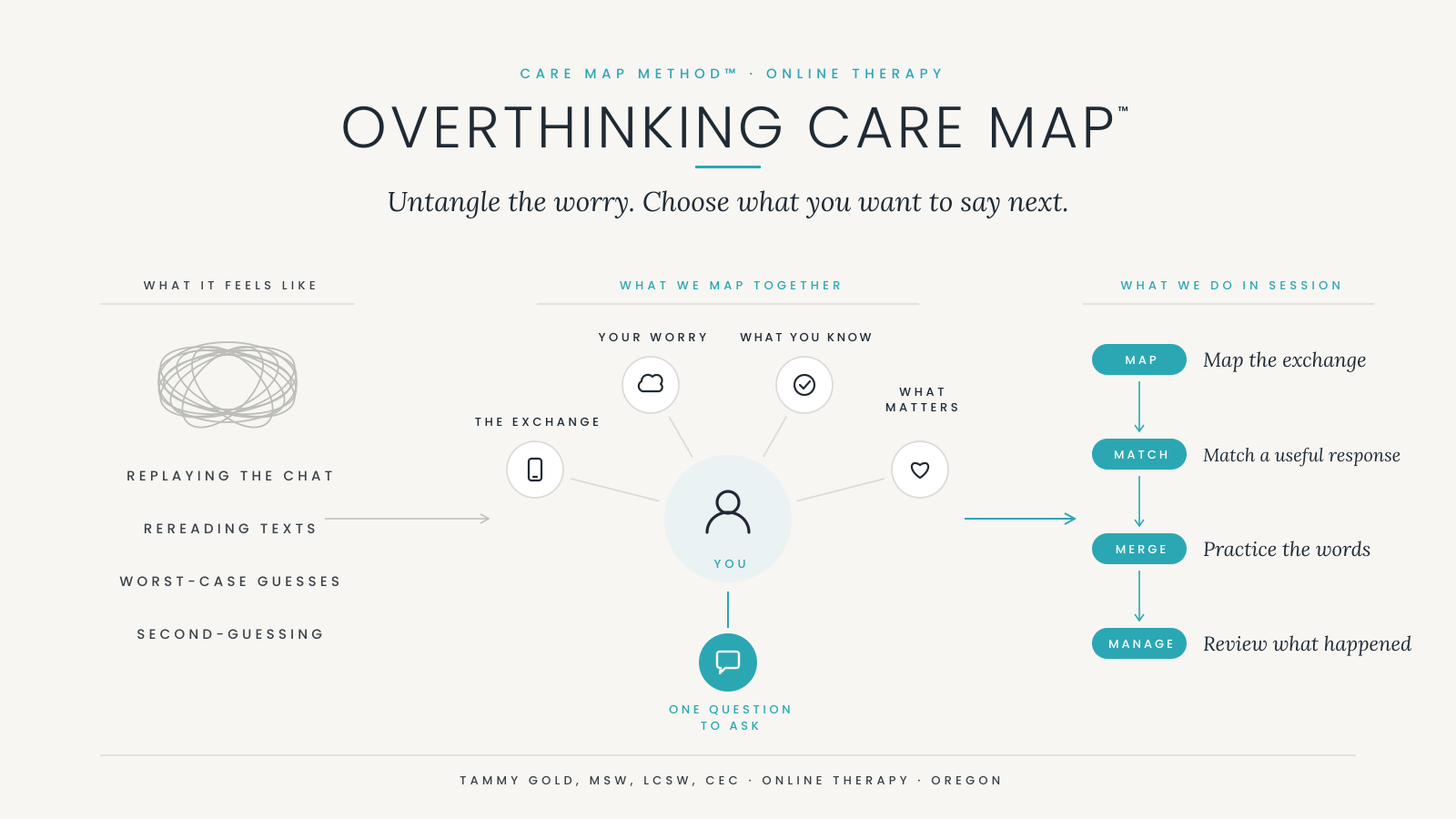
Anxiety and Overthinking Therapy in Oregon
When a conversation keeps replaying long after it ends, the worry can crowd out the rest of your day. Explore how individual online therapy in Oregon can help you understand the pattern and practice a response that fits your needs.
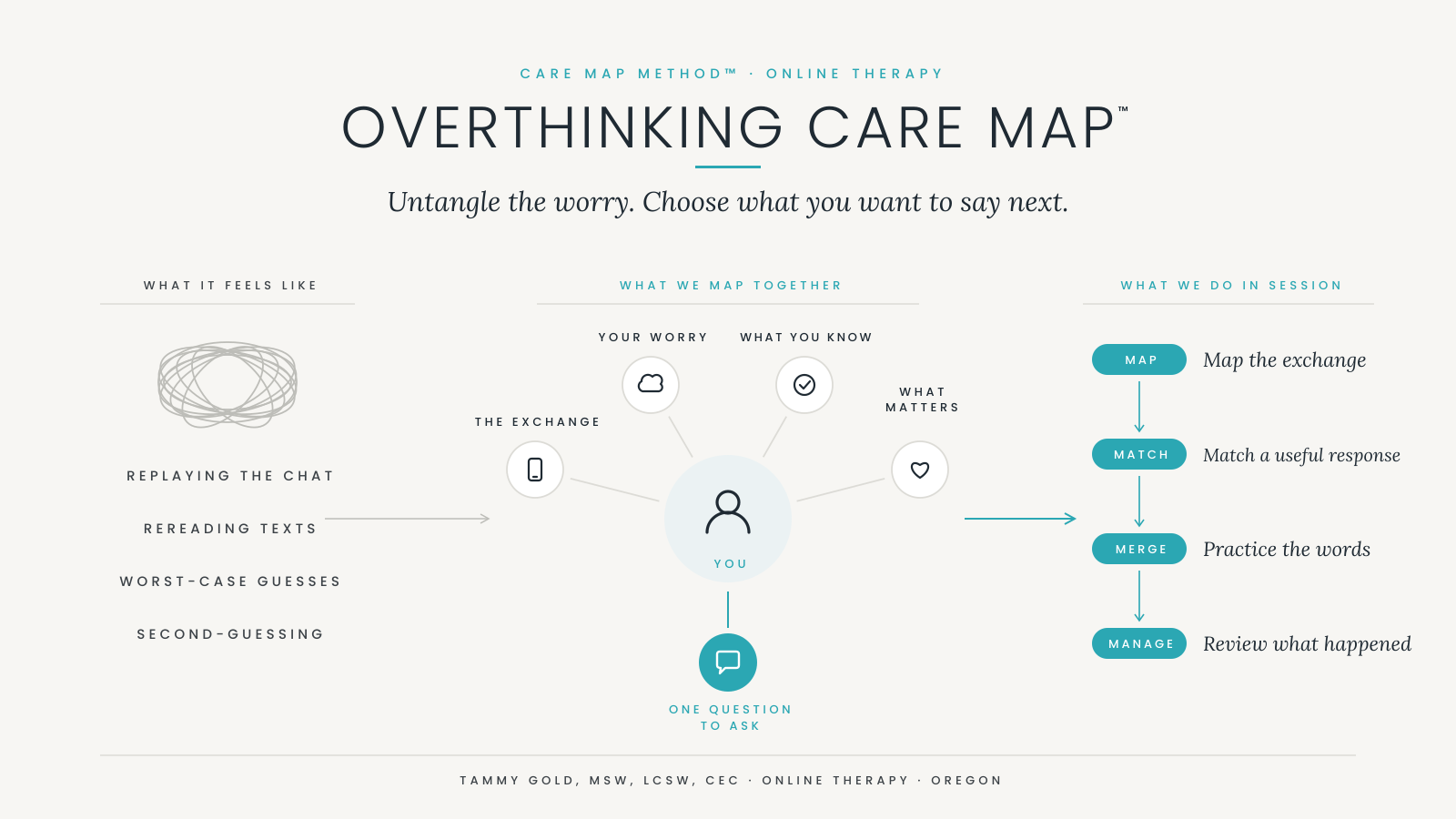
Four illustrated steps for exploring an anxious conversation and practicing a response.
The conversation ended hours ago, but you are still going over it. You wonder whether you sounded rude, missed something important or should send another message. Even when nothing is happening, your mind may be preparing for the next problem.
I’m Tammy Gold, LCSW. I offer individual online therapy for adults in Oregon who want help understanding anxiety and patterns of overthinking. We can look at what keeps pulling you back into worry, how it affects your relationships and daily life, and where a different response might become possible. Click Link Below To Check Options on Headway:
Check Oregon Insurance and Availability
When thinking stops bringing clarity
You may spend a long time deciding what to say, ask several people for reassurance or check a message repeatedly. For a moment, that may feel useful. Then a new question appears and you begin again. You can be capable and dependable while feeling exhausted by the work happening in your head.
In therapy, we can examine your particular pattern without assuming that all worry has the same cause. Current pressures, earlier experiences and uncertainty in a relationship may each play a part. We will also assess symptoms and functioning to understand what kind of care fits.
Start with one moment that keeps returning
Imagine receiving a short reply from someone you care about. You decide they must be upset. You reread the exchange, draft an explanation and put off something else while waiting for reassurance. In session, we might separate what you observed from what you feared it meant.
We can explore the feeling underneath the checking and consider a response you are willing to try. That might involve asking a clear question, returning to a planned activity or noticing the urge to seek another opinion before acting on it. The aim is to understand your choices while allowing room for genuine uncertainty.
Make space for the concerns underneath the worry
Sometimes overthinking gathers around a fear of disappointing people, making a mistake or losing a relationship. You may believe that reviewing every possibility will keep something painful from happening. We can consider where that expectation came from and how it serves you now.
You do not have to defend how much the situation matters. We can take the concern seriously while examining whether your current response gives you the information or relief you need. If there is a practical problem to address, we can distinguish that task from questions that have no clear answer yet.
Work on responses you can use in daily life
Our work may include recognizing the point where reflection becomes repetition, practicing how to express a need or exploring what happens when you leave a small question unanswered. We can choose a manageable situation and review the experience together.
For example, you might practice saying, “I want to check what you meant,” instead of writing a long apology based on an assumption. Or we might discuss how to end an evening of rereading work messages. The next step should fit your circumstances, comfort and treatment goals.
Look at the whole picture with Care Map Method
Care Map Method™ helps organize Biological, Social, Environmental and Emotional factors in our conversations. We may consider your energy and health, the people around you, the pressures of your day and the feelings that make a particular situation difficult. Medical questions remain with the appropriate health professional.
We MAP the pattern, MATCH suitable therapeutic support, MERGE changes into your actual routines and MANAGE the plan through review. This structure supports individual clinical care; it does not require you to complete a perfect plan before you are allowed to feel better.
Meet Tammy Gold
I’m Tammy Gold, MSW, LCSW, CEC. I earned my MSW at Columbia University and my BA at the University of Pennsylvania. My work with adults and families includes anxiety, difficult relationships, parenting stress and caregiving. I bring a warm, practical approach and an interest in understanding the situation before deciding what to change.
Online appointments and insurance in Oregon
You can review my Headway and Alma profiles for current Oregon appointments and exact plan participation. Headway may offer options such as Providence, Regence, Aetna and Carelon, depending on the product and eligibility. Confirm benefits and estimated costs before booking.
During an Oregon appointment, you need to be physically located in Oregon. A private place where you can speak comfortably can help you use the session. We can begin with the worry or recent situation that prompted you to reach out.
Frequently asked questions
Can therapy help when I cannot stop replaying conversations?
We can examine what starts the replaying, the meaning you attach to the exchange and what you do next. Treatment can focus on your symptoms, relationships and responses. Your assessment and goals will guide the work rather than a single rule for stopping thoughts.
Is overthinking the same as an anxiety disorder?
Overthinking describes an experience, rather than establishing a diagnosis by itself. We would discuss the thoughts, associated symptoms, history and impact on daily life. That assessment helps determine whether there is a clinical condition and what treatment or other support may be appropriate.
Will you tell me to stop caring what people think?
We can explore why another person’s response matters and how you want to participate in the relationship. Caring about people can remain important to you. Our conversations can focus on the distress and habits around uncertainty, along with communication that reflects your needs.
What if I understand the pattern but keep repeating it?
Knowing the pattern gives us information, but it does not mean the next response will be easy. We can look at the moment it repeats, choose a smaller step and review what got in the way. Difficulty is something to understand together.
Can we work on relationship and workplace worries?
Yes. You may bring concerns involving a partner, parent, friend, coworker or boss. We will consider your experience and functioning, including what is within your control and what depends on others. The work remains centered on your own treatment goals.
What happens during the first session?
We will discuss your concerns, relevant history, current symptoms and the effect on daily life. You can ask questions and describe previous experiences with therapy. We will begin assessing fit and possible goals; you do not need to arrive with a diagnosis or organized explanation.
Can I use insurance for anxiety therapy in Oregon?
Coverage depends on your exact benefits, current provider participation and assessed clinical service. Check my Headway or Alma profile using your Oregon location and member information. Confirm any deductible, copay or coinsurance before scheduling, even if your insurer appears on a general list.
How do I arrange an online appointment?
Use the Headway or Alma link to review current Oregon availability and insurance options. Plan to attend from a private space while physically located in Oregon. If you have questions about the service or estimated cost, clarify those before confirming the appointment.
Take the next step
You can review current Oregon appointment options and your exact insurance plan through my provider profile. Confirm estimated costs before scheduling. We can begin with the situation you want help understanding.
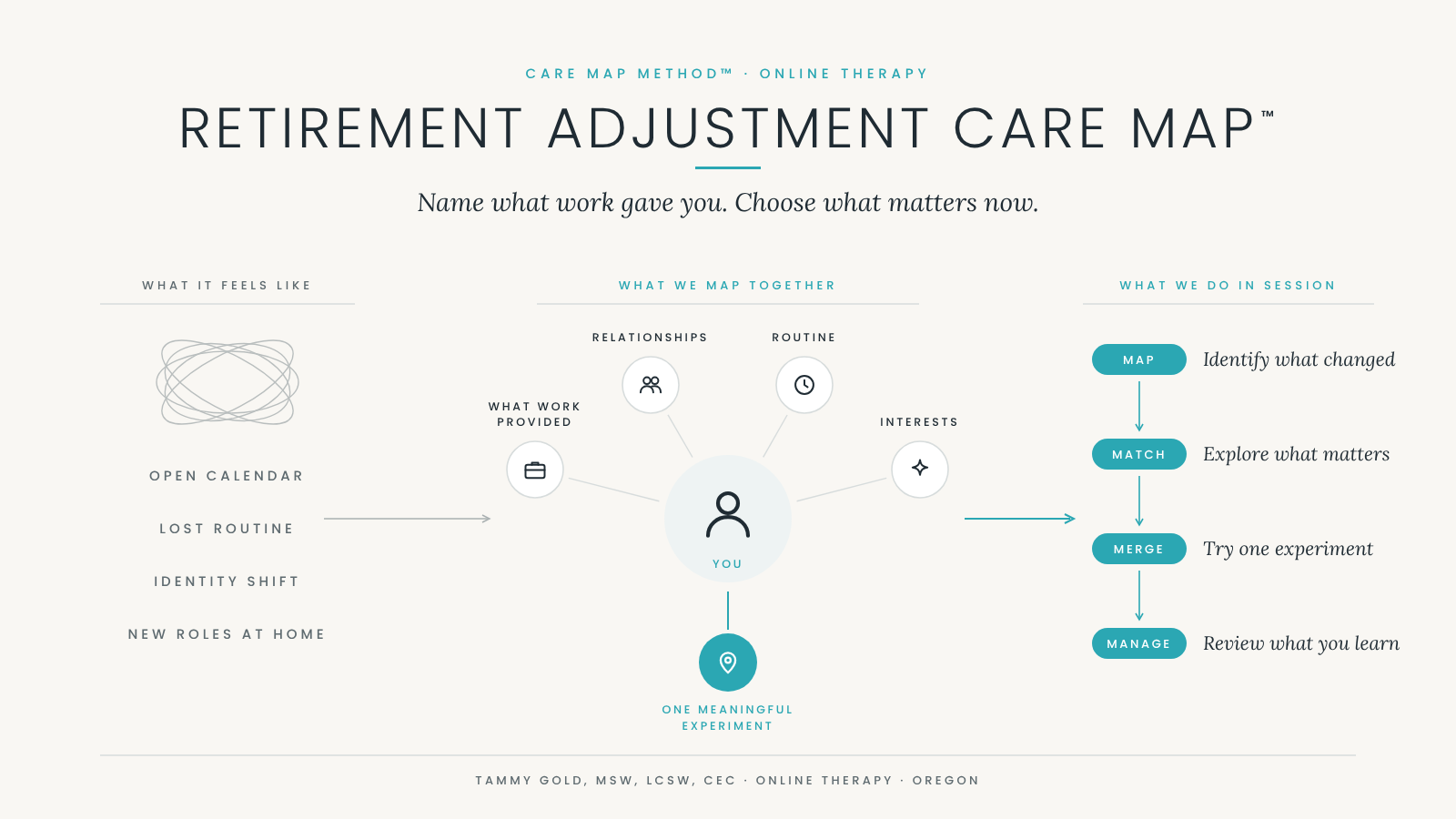
Online Therapy for Retirement Adjustment in Oregon
Retirement can change your identity, relationships and sense of purpose. Online therapy in Oregon can help you explore what you miss, discuss expectations at home and choose meaningful next steps for this stage of life.
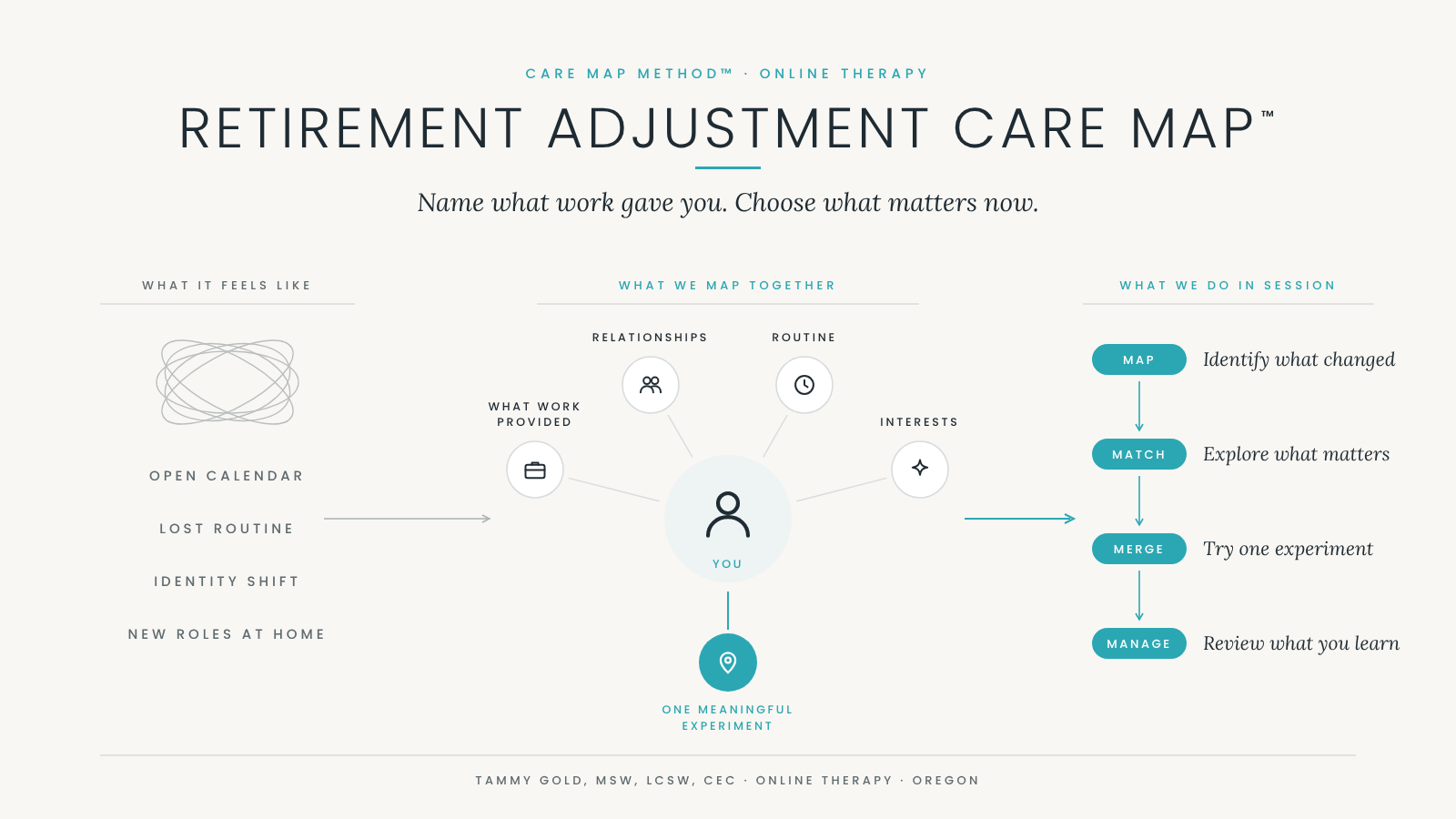
You may have looked forward to leaving work and still miss the structure, contact or sense of usefulness it provided. More time at home can also change relationships in ways you did not anticipate.
I’m Tammy Gold. I offer individual online therapy for adults in Oregon navigating life transitions and relationship stress. We can explore what retirement has changed for you and what you need in this stage of life.
Identify what work used to provide
Perhaps you miss being asked for your opinion, having a reason to leave the house or seeing familiar people. We can examine those losses without assuming that a busier calendar will automatically address them.
Retirement may have been chosen, forced or shaped by health and finances. Those differences matter. We will also discuss mood, sleep, concentration and functioning rather than assume every change is ordinary adjustment.
Explore the new expectations at home
You may feel that family members now consider you permanently available. Or you and a partner may have different ideas about shared time and privacy.
A conversation could begin, “I want us to discuss what we each need from the week, including time together and time independently.” We can explore the feelings underneath that request and whether it fits your situation.
Build a next step around meaning
We can consider what you want to continue, what you are ready to release and what you would like to try. A next step might be reconnecting with one person or making space for an interest you have postponed.
The goal is not to perform a perfect retirement. We can work on your experience of the change and review what supports your well-being. Financial planning and medical questions belong with the appropriate professionals.
What we can work on together in session
We can map a typical day before and after retirement to understand what changed beyond the hours of paid work. We might identify missing social contact, a loss of recognition, less privacy at home or uncertainty about how to describe yourself. We will also assess symptoms that deserve attention in their own right.
Together, we can choose one meaningful experiment: contacting a person you miss, setting aside time for an interest or discussing expectations with a partner. We can explore what makes that step appealing or difficult and keep it realistic for your energy and resources. At a later visit, we can review the experience and adjust the direction. You do not need a complete plan for this stage of life before therapy can be useful.
When an open calendar feels uncomfortable
Work may have offered more than a schedule. It may have provided recognition, familiar conversations or a clear way to know you had contributed. If those supports disappear at once, being told to “enjoy your freedom” can feel lonely. We can explore what you miss and which parts you would like to carry forward in a different form.
You may also feel pressure to say yes to family responsibilities because you are no longer employed. We can discuss the difference between choosing to help and feeling unable to decline. Your interests, energy and relationships deserve consideration in the new arrangement.
Try a direction without deciding your whole future
We might identify one connection you want to maintain, one activity that interests you or one conversation about expectations at home. The purpose is to learn what feels meaningful and realistic, rather than fill every hour. If low mood, withdrawal or other symptoms are affecting daily life, we will assess those concerns directly. Retirement does not make distress something you simply have to accept, and seeking support does not mean you are doing this stage of life incorrectly.
A practical way to understand what is happening
My Care Map Method™ helps us look at Biological, Social, Environmental and Emotional factors alongside clinical assessment. We consider your health and energy, relationships, daily circumstances and emotional experience rather than isolate one difficult moment from the rest of your life. We MAP the need, MATCH appropriate support, MERGE that support into your circumstances and MANAGE the plan as we learn what is useful. This is an organizing framework within individualized therapy, not a promise of a particular result.
What your first session can include
You can bring one situation you want help understanding. We will discuss your concern, relevant history, symptoms, daily functioning and available support. You can tell me what has or has not helped before and what you need to feel comfortable talking. My aim is to offer empathy without judgment and begin exploring a practical next step, while allowing time for assessment. We will decide together whether my approach fits and which goals matter to you. You do not need to arrive knowing the right words or the solution.
About Tammy Gold
I’m Tamara “Tammy” Gold, MSW, LCSW, CEC. I earned my clinical MSW at Columbia University and my BA at the University of Pennsylvania. My work with families includes parenting, caregiving and difficult relationships. I bring empathy without judgment and a practical interest in helping you understand the problem and consider what comes next.
Frequently asked questions
Can I come before I retire?
Yes. We can explore the anticipated transition and assess what support fits.
What if I did not choose to stop working?
We can make room for the loss, anger or uncertainty involved rather than assume retirement is welcome.
Is this financial retirement planning?
No. This page describes psychotherapy for mental health and adjustment.
Can I discuss changes with my spouse?
Yes. Individual therapy can explore your experience of the relationship; couples services would require a separate discussion.
Do you accept Medicare?
Do not assume coverage. Ask about your exact plan and the practice’s current enrollment before booking.
How do I start from Oregon?
Confirm current availability, your physical location, treatment fit and payment arrangements before scheduling.
What if I miss work but do not want to return?
We can explore the parts you miss without assuming that returning to employment is the answer. The loss of a role and a preference for retirement can coexist.
Will you tell me to volunteer or find a hobby?
We can consider those possibilities if they interest you, but the work begins with what has changed and what matters to you. A fuller calendar is not the only possible goal.
Booking and profile options
Choose a platform that shows current appointments for your physical location in Oregon and your exact insurance plan. Availability and participation can differ across platforms.
Check availability and insurance on Grow Therapy
Check availability and insurance on Alma
Check availability and insurance on Headway
Read my profile or contact me on Psychology Today
Before confirming a visit, check the service, current provider participation, your exact benefits and estimated costs. Coverage depends on your plan and the assessed clinical service; a life event alone does not establish insurance eligibility. You must be physically located where I am authorized to provide care at each session.
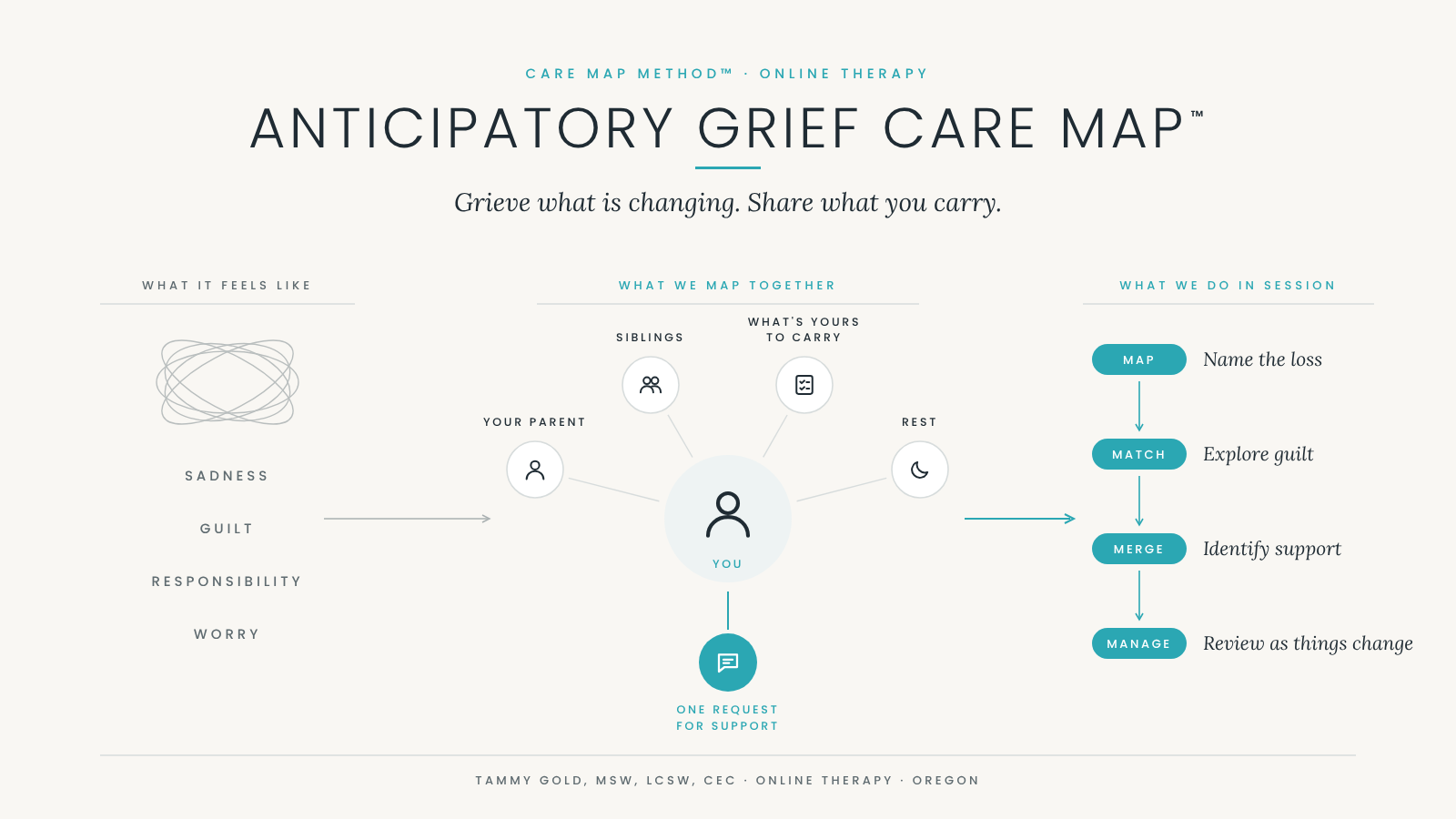
Online Therapy for Anticipatory Grief in Oregon
Watching a parent’s health change can bring grief before a death has occurred. Online therapy in Oregon offers space for sadness, guilt and frustration, with practical support for identifying your limits and asking for help.
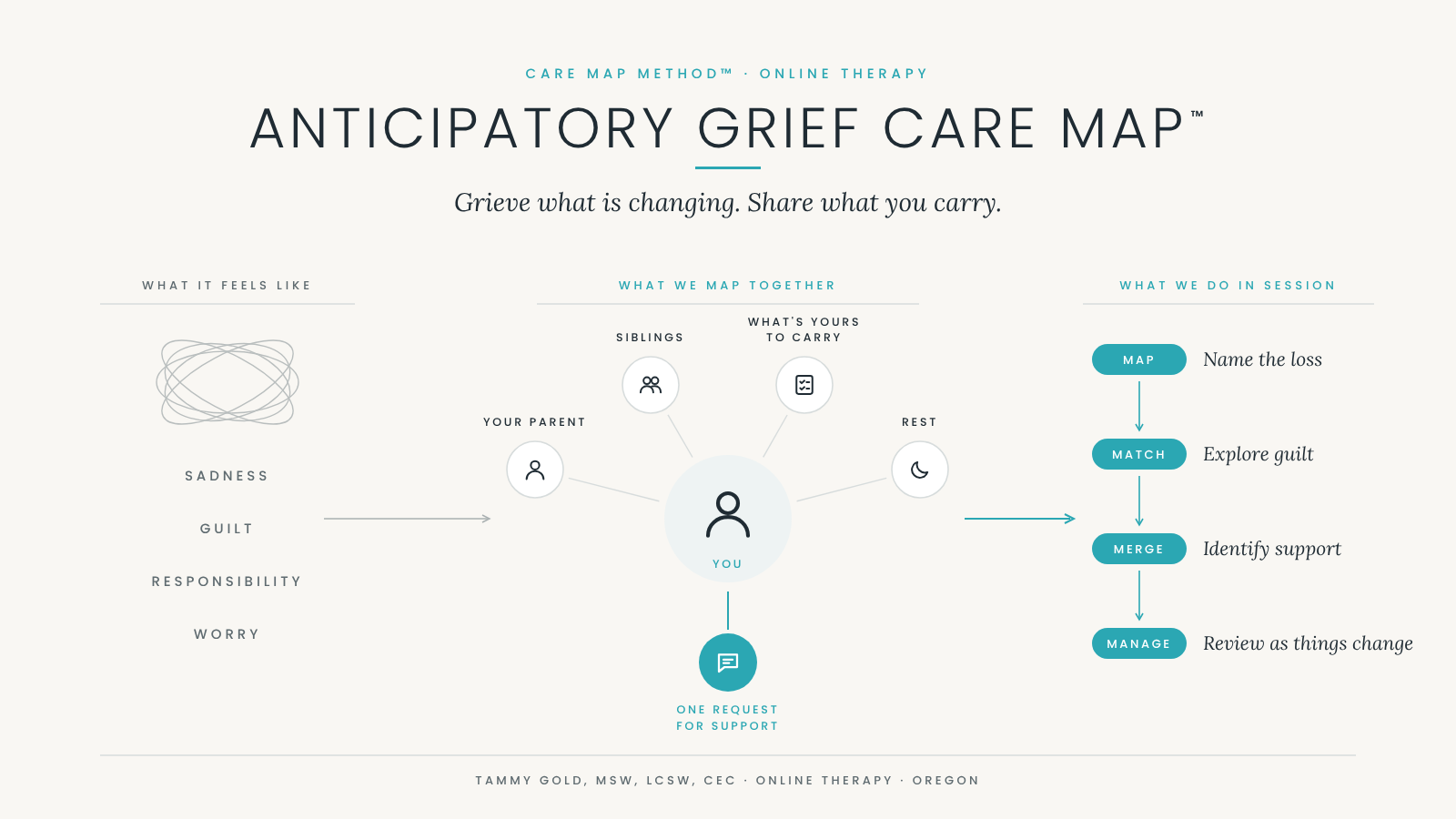
You may be grieving conversations you can no longer have, a role that has changed or a future that feels uncertain. When people focus only on what your parent needs, it can be difficult to explain what you are losing too.
I’m Tammy Gold. I offer individual online therapy for adults in Oregon, including adult children and caregivers dealing with family changes. We can explore the grief, worry and complicated feelings around a parent’s declining health.
Make room for what is changing
Grief before an expected loss is sometimes described as anticipatory grief. It does not follow one required pattern. You may feel sadness, anger, numbness or guilt, and those feelings may change from day to day.
We can discuss what you are experiencing without treating love and frustration as incompatible. Assessment also helps clarify whether your symptoms and functioning call for additional support.
Distinguish caring from carrying everything
Perhaps every missed visit feels like a failure, even when work or health limits what you can do. We can examine the expectation you hold yourself to and what responsibilities are realistically yours.
A request for help might begin, “I need someone else to handle this appointment so I can keep managing the parts I already do.” We can explore the feelings attached to that request and how family responses affect you.
Find a way to be present that fits the relationship now
You may be trying to make every interaction meaningful or fearing the next change. Therapy can provide room to discuss those pressures and consider what connection means in your circumstances.
Medical decisions, prognosis and questions about the parent’s treatment remain with their health care team. This service focuses on the adult client’s mental health and choices, rather than treating the parent through someone else’s sessions.
What we can work on together in session
We can begin with one moment that has stayed with you: leaving a visit, receiving an update or feeling frustrated during a care task. We can name what you are grieving, explore the meaning of the guilt and look at the responsibilities you are carrying. There is room for love, anger, sadness and fatigue in the same conversation.
If you need practical support, we can rehearse a specific request to a relative, identify a limit around one responsibility or consider how you want to recover after a difficult visit. The next step should fit your time, resources and relationship with your parent. We can review what helped and what remains hard in a later session. Medical decisions and the parent's treatment remain with their care team; our work centers on your mental health.
When grief and ordinary responsibilities overlap
You may move from a difficult visit straight into a work meeting or return home to people who need you. The lack of space between roles can leave feelings unspoken. We can discuss what happens when you postpone your own reactions and what kind of support would fit the time and energy you actually have.
Sibling differences can add another layer. One relative may want more updates, another may avoid the situation and someone may question the choices being made. We can explore your part in these relationships without treating you as responsible for everyone’s agreement. Questions about legal authority or medical decisions need the appropriate professional guidance.
Start with what feels hardest to say
You might want to talk about anger, relief after leaving a visit or fear that you are already forgetting who your parent used to be. These feelings can be discussed with care. We can consider how they affect sleep, concentration and relationships, and what helps you feel less isolated. The work does not require a perfect visit or a particular way of grieving to count as caring.
A practical way to understand what is happening
My Care Map Method™ helps us look at Biological, Social, Environmental and Emotional factors alongside clinical assessment. We consider your health and energy, relationships, daily circumstances and emotional experience rather than isolate one difficult moment from the rest of your life. We MAP the need, MATCH appropriate support, MERGE that support into your circumstances and MANAGE the plan as we learn what is useful. This is an organizing framework within individualized therapy, not a promise of a particular result.
What your first session can include
You can bring one situation you want help understanding. We will discuss your concern, relevant history, symptoms, daily functioning and available support. You can tell me what has or has not helped before and what you need to feel comfortable talking. My aim is to offer empathy without judgment and begin exploring a practical next step, while allowing time for assessment. We will decide together whether my approach fits and which goals matter to you. You do not need to arrive knowing the right words or the solution.
About Tammy Gold
I’m Tamara “Tammy” Gold, MSW, LCSW, CEC. I earned my clinical MSW at Columbia University and my BA at the University of Pennsylvania. My work with families includes parenting, caregiving and difficult relationships. I bring empathy without judgment and a practical interest in helping you understand the problem and consider what comes next.
Frequently asked questions
Can grief begin before someone dies?
Yes. People can grieve anticipated loss and changes in a relationship. Your experience still needs individual attention rather than a fixed stage model.
Does feeling relief or frustration mean I do not care?
Those feelings do not provide a complete measure of your relationship. We can explore their context without judging you.
Are you treating my parent?
No. This page describes individual therapy for the adult seeking help.
Can you advise on dementia treatment?
No. Diagnosis, medical care and prognosis belong with the parent’s clinical team.
Is this the same as senior-care consulting?
No. Psychotherapy and care-selection consulting are separate services with different goals and payment arrangements.
Does insurance cover grief?
The loss situation alone does not establish coverage. Confirm assessed clinical needs, your Oregon plan and current participation before starting.
Can I come if I am not the main caregiver?
Yes. A parent’s health changes can affect you even when someone else provides most of the practical care. Assessment helps clarify your support needs.
Can I discuss guilt about taking a break?
Yes. We can explore the expectations behind the guilt and what rest or shared responsibility might mean in your actual circumstances.
Booking and profile options
Choose a platform that shows current appointments for your physical location in Oregon and your exact insurance plan. Availability and participation can differ across platforms.
Check availability and insurance on Grow Therapy
Check availability and insurance on Alma
Check availability and insurance on Headway
Read my profile or contact me on Psychology Today
Before confirming a visit, check the service, current provider participation, your exact benefits and estimated costs. Coverage depends on your plan and the assessed clinical service; a life event alone does not establish insurance eligibility. You must be physically located where I am authorized to provide care at each session.
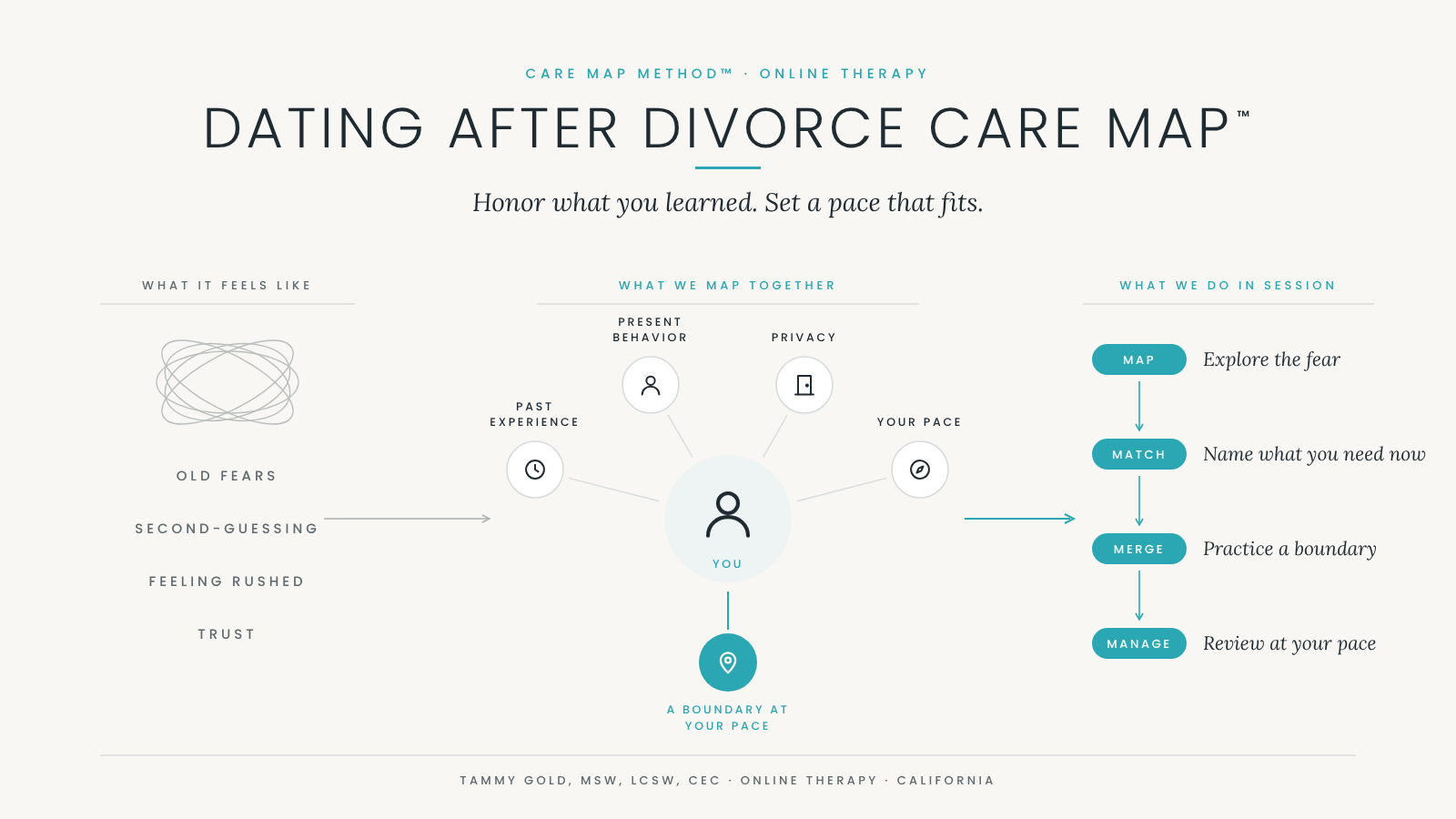
Online Therapy for Dating After Divorce in California
Dating after divorce can bring hope alongside uncertainty about trust and your own judgment. Online therapy in California offers support for processing past experiences, recognizing present concerns and practicing boundaries at a pace that fits you.
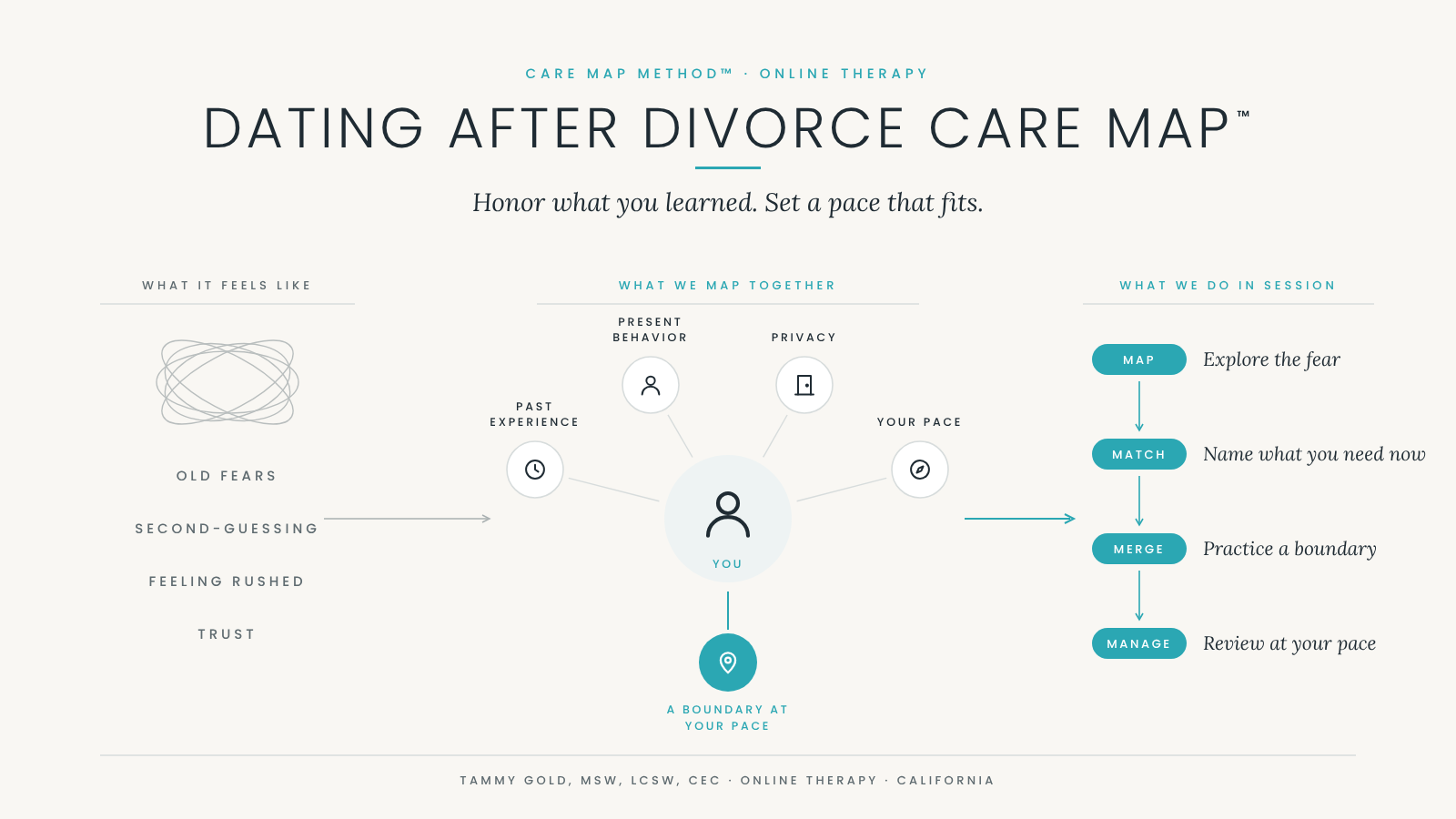
You may feel ready for connection and still find yourself questioning your judgment. A delayed message, new expectation or unfamiliar disagreement can bring up memories of what happened before.
I’m Tammy Gold. I offer individual online therapy for adults in California navigating relationship stress and life changes. We can explore what dating again means to you and what would help you participate with more awareness of your own needs.
Understand what you are carrying into the new situation
The goal is not to pretend the previous relationship did not happen. We can examine what you learned, what remains painful and how you distinguish a present concern from a fear based on earlier experience.
We will take actual behavior seriously. Therapy should not encourage you to overlook warning signs in order to appear trusting or optimistic.
Practice keeping a preference visible
Perhaps you want to move slowly, keep some personal information private or decline a plan without explaining your whole history. We can explore what makes that difficult.
A starting point might be, “I would like to keep getting to know you, and I need more time before taking that step.” We can consider how that fits your circumstances and what the response tells you about your options.
Make choices without accepting someone else’s timetable
Friends and relatives may have opinions about when you should date, whether you should remarry or how much caution is reasonable. We can explore those expectations alongside your own values.
You do not have to prove you have recovered by entering a new relationship. We can work on grief, confidence and boundaries while leaving the timing and decisions with you. If parenting or co-parenting is involved, we can discuss its emotional impact without providing legal advice.
What we can work on together in session
We can begin with a recent dating moment that triggered doubt and explore both your earlier experiences and the present person's actual behavior. For example, we might discuss whether a request to move faster conflicts with your preference or brings up pressure you recognize from a previous relationship. We will not ask you to ignore a current concern to prove you are ready to trust.
Then we can practice wording that fits your pace, such as, “I am interested in getting to know you, and I am not ready for that step.” We can explore the feelings that arise when you say it and what you want to notice afterward. A next step may be expressing one preference or giving yourself time to decide. Later sessions can examine the experience with curiosity rather than grade the date as a success or failure.
When a new connection brings an old fear
You might notice yourself expecting an argument after expressing a preference, apologizing before asking a question or searching for reassurance that the relationship is secure. We can explore when those responses developed and whether they fit what is happening now. Your past deserves attention without becoming the only explanation for every new experience.
You may also be grieving the life you expected to have, even while feeling interested in someone new. Those feelings can coexist. We can discuss the pressure to appear completely healed and what it would mean to be honest about your pace without sharing more than you want.
Make room for your present responsibilities
Dating may now involve parenting schedules, limited free time or concerns about how much family members should know. We can explore the emotional strain of balancing these responsibilities and how you want to communicate availability. An early goal might be stating a preference before resentment builds or recognizing a situation in which you need more information. Therapy cannot certify that a new partner is trustworthy; it can support your ability to consider what you observe and what you need.
A practical way to understand what is happening
My Care Map Method™ helps us look at Biological, Social, Environmental and Emotional factors alongside clinical assessment. We consider your health and energy, relationships, daily circumstances and emotional experience rather than isolate one difficult moment from the rest of your life. We MAP the need, MATCH appropriate support, MERGE that support into your circumstances and MANAGE the plan as we learn what is useful. This is an organizing framework within individualized therapy, not a promise of a particular result.
What your first session can include
You can bring one situation you want help understanding. We will discuss your concern, relevant history, symptoms, daily functioning and available support. You can tell me what has or has not helped before and what you need to feel comfortable talking. My aim is to offer empathy without judgment and begin exploring a practical next step, while allowing time for assessment. We will decide together whether my approach fits and which goals matter to you. You do not need to arrive knowing the right words or the solution.
About Tammy Gold
I’m Tamara “Tammy” Gold, MSW, LCSW, CEC. I earned my clinical MSW at Columbia University and my BA at the University of Pennsylvania. My work with families includes parenting, caregiving and difficult relationships. I bring empathy without judgment and a practical interest in helping you understand the problem and consider what comes next.
Frequently asked questions
Do I need to be ready for a serious relationship?
No. We can explore what you want and whether dating fits your life now.
Will therapy tell me when I should date?
There is no universal schedule. We can discuss your needs, circumstances and choices.
Can I discuss trust after a difficult marriage?
Yes, within treatment fit. Assessment helps determine whether additional specialized care is needed.
Do you provide dating or matchmaking services?
No. This page describes individual psychotherapy.
Can we discuss the impact on my children?
We can explore your parenting-related distress and choices. Children’s treatment or legal questions need separate appropriate services.
Can I use insurance in California?
Verify exact plan participation, assessed clinical needs and estimated costs through the appropriate active platform.
What if dating is harder than I expected?
We can explore what feels difficult, how it affects daily life and whether your current approach fits your needs. You do not have to force a particular pace.
Can I come if I am not currently dating?
Yes. We can work on your experience of divorce, relationship concerns and goals without requiring you to be using dating apps or seeing someone.
Booking and profile options
Choose a platform that shows current appointments for your physical location in California and your exact insurance plan. Availability and participation can differ across platforms.
Check availability and insurance on Grow Therapy
Check availability and insurance on Alma
Check availability and insurance on Headway
Read my profile or contact me on Psychology Today
Before confirming a visit, check the service, current provider participation, your exact benefits and estimated costs. Coverage depends on your plan and the assessed clinical service; a life event alone does not establish insurance eligibility. You must be physically located where I am authorized to provide care at each session.
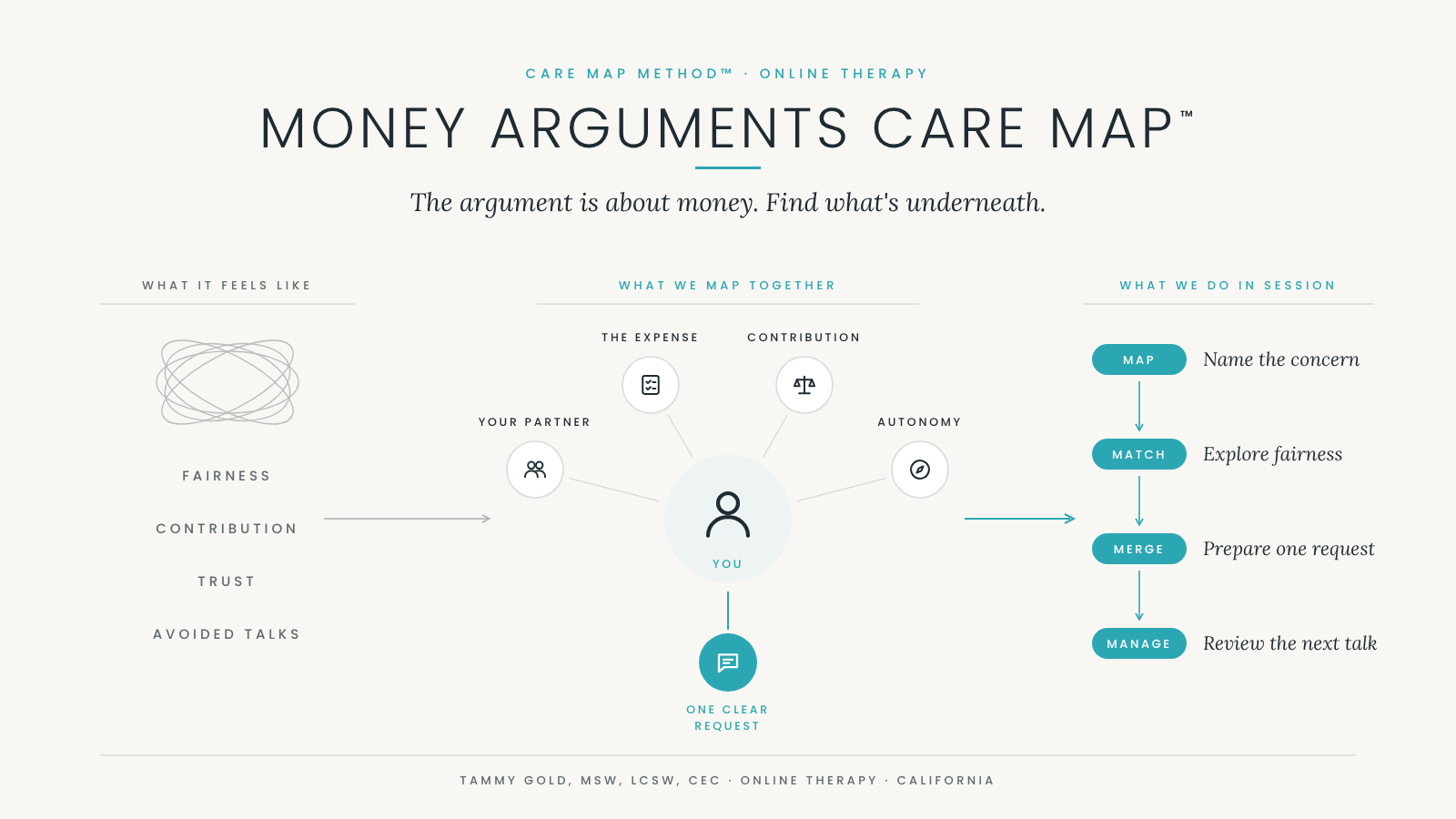
Individual Therapy for Money Arguments in California
Money disagreements can bring up deeper concerns about fairness, security and feeling valued. Individual online therapy in California can help you understand the emotional pattern, express your needs and prepare for a more focused conversation.
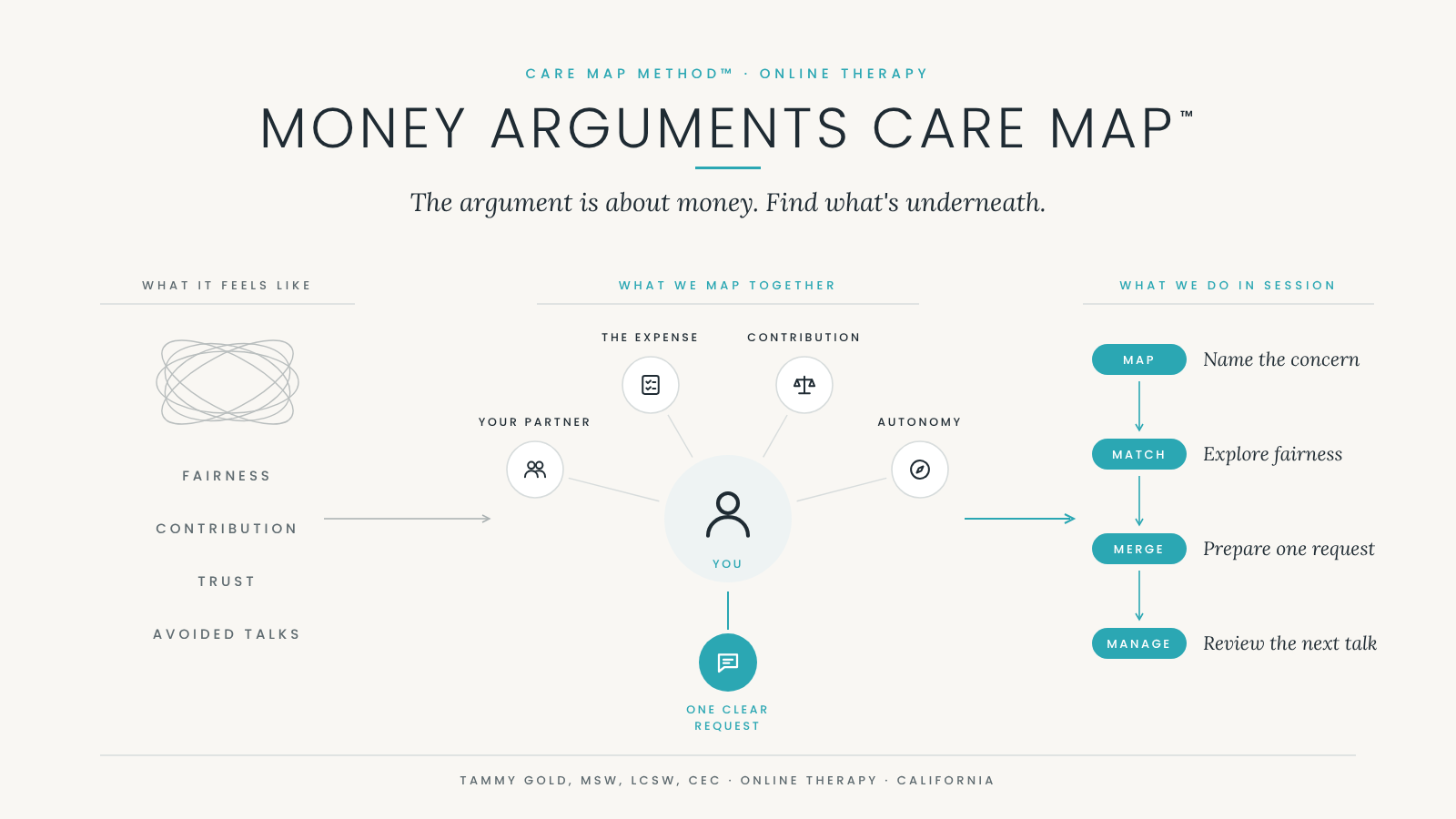
You may begin with a bill and end up arguing about fairness, trust or whether your contributions matter. Even when the numbers are clear, the emotional meaning can make the conversation hard to finish.
I’m Tammy Gold. I offer individual online therapy for adults in California. We can explore how financial conflict affects your mental health and prepare a clearer way to express the concern underneath it.
Look at what money represents to you
For one person, saving may mean safety. For another, being questioned about spending may feel like loss of autonomy. We can explore your history and the meanings attached to a recent disagreement without assuming everyone should have the same relationship with money.
Financial constraints are real. We will not treat practical hardship as something a different attitude alone can resolve.
Choose the part of the conversation you want to change
Perhaps you want to ask for a regular discussion rather than be questioned in the middle of a purchase. Perhaps you need to name the work you contribute that is not reflected in income.
An example might be, “When we discuss the expense, I also need us to discuss the responsibility and time around it.” We can explore what you want understood, how to state it and whether the setting supports a useful discussion.
Consider your response and your options
We can look at avoiding, overexplaining or becoming defensive, while taking the other person’s behavior seriously. Individual therapy cannot make a partner cooperate or settle a financial disagreement.
If money is being used to control access to necessities, restrict your choices or threaten you, tell your therapist. Safety and appropriate outside support may matter more than preparing another joint conversation. Investment, debt, tax and legal advice remain with qualified professionals.
What we can work on together in session
We can explore one money argument and identify the concern beneath it: security, fairness, independence, recognition or something else. We can map what you heard, what you felt and how the exchange escalated or shut down. We will also recognize practical financial pressures that cannot be resolved through communication alone.
If appropriate, we can rehearse a specific request, such as discussing a shared expense at an agreed time or including unpaid household work in a conversation about contribution. We can consider whether you feel able to disagree safely and what additional support may be needed. A next step could be preparing one question or identifying a boundary. We will review how it affects you without making your partner's cooperation the measure of whether your therapy is worthwhile.
When the same argument has several layers
You may be discussing a purchase while also feeling unseen as a caregiver, worried about debt or uncomfortable depending on someone else’s income. We can separate these concerns enough to understand them. A question about shared expenses may need a different response from a fear that you have no say in your own life.
Family experiences can shape what feels normal around saving, generosity, privacy and obligation. Exploring those experiences can help explain a reaction without excusing harmful behavior. We can also consider what happens before and after an argument: whether you avoid opening bills, repeatedly justify ordinary needs or lose sleep rehearsing the next discussion.
Find a useful starting point
Bring one recent exchange and the concern you wished you could express. We might work on naming the feeling, deciding what information you need or identifying a boundary that matters to you. If practical debt or budgeting help is needed, we can discuss the role of appropriate outside resources. Therapy supports your mental health alongside those practical needs; it does not replace the financial work or require you to minimize financial hardship.
A practical way to understand what is happening
My Care Map Method™ helps us look at Biological, Social, Environmental and Emotional factors alongside clinical assessment. We consider your health and energy, relationships, daily circumstances and emotional experience rather than isolate one difficult moment from the rest of your life. We MAP the need, MATCH appropriate support, MERGE that support into your circumstances and MANAGE the plan as we learn what is useful. This is an organizing framework within individualized therapy, not a promise of a particular result.
What your first session can include
You can bring one situation you want help understanding. We will discuss your concern, relevant history, symptoms, daily functioning and available support. You can tell me what has or has not helped before and what you need to feel comfortable talking. My aim is to offer empathy without judgment and begin exploring a practical next step, while allowing time for assessment. We will decide together whether my approach fits and which goals matter to you. You do not need to arrive knowing the right words or the solution.
About Tammy Gold
I’m Tamara “Tammy” Gold, MSW, LCSW, CEC. I earned my clinical MSW at Columbia University and my BA at the University of Pennsylvania. My work with families includes parenting, caregiving and difficult relationships. I bring empathy without judgment and a practical interest in helping you understand the problem and consider what comes next.
Frequently asked questions
Do you provide financial planning?
No. This page describes psychotherapy for emotional and relational distress, not financial advice.
Can I attend alone for money conflict?
Yes. You can work on your mental health, choices and communication individually.
Will you decide who spends too much?
No. We can examine your experience and its impact without becoming a financial arbitrator.
What if the problem is actual financial hardship?
We can support your mental health while recognizing practical needs may call for additional resources or professional advice.
Is this couples counseling?
No. Couples services and payment require a separate discussion. Relationship-only counseling is generally self-pay.
Can I use insurance?
Verify your California plan, active participation, estimated costs and the assessed clinical service before scheduling.
Can unequal income affect how I feel in the relationship?
Yes. We can explore feelings about contribution, dependence, power and autonomy while recognizing that income is only one part of a household’s responsibilities.
Can we discuss avoiding money conversations?
Yes. We can examine what makes them difficult, their effect on your well-being and what support you need before deciding whether and how to raise a concern.
Booking and profile options
Choose a platform that shows current appointments for your physical location in California and your exact insurance plan. Availability and participation can differ across platforms.
Check availability and insurance on Grow Therapy
Check availability and insurance on Alma
Check availability and insurance on Headway
Read my profile or contact me on Psychology Today
Before confirming a visit, check the service, current provider participation, your exact benefits and estimated costs. Coverage depends on your plan and the assessed clinical service; a life event alone does not establish insurance eligibility. You must be physically located where I am authorized to provide care at each session.
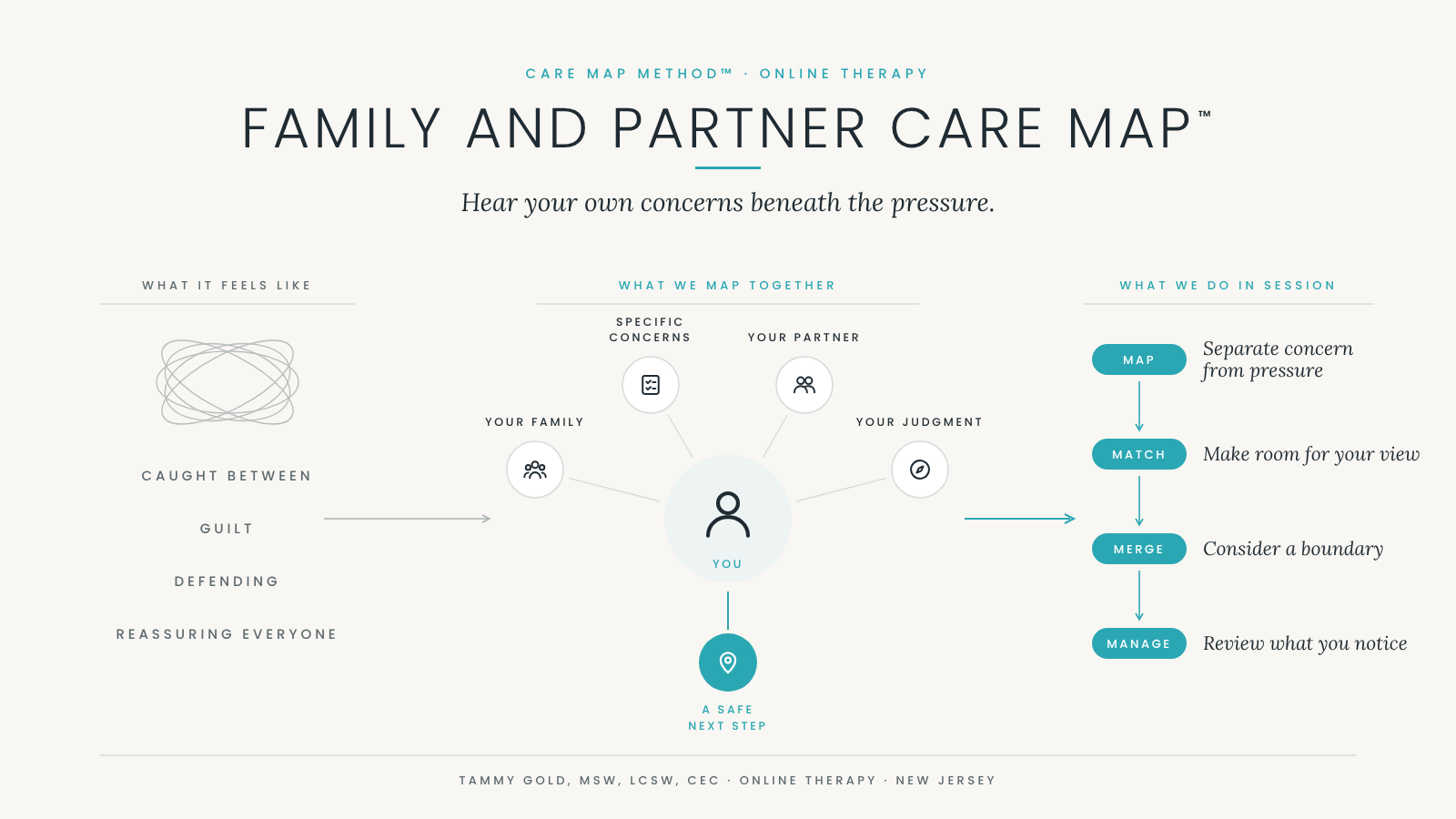
Individual Therapy When Family Disapproves of Your Partner in New Jersey
Sharing a home can bring unexpected tension about chores, privacy and responsibilities. Individual online therapy in Iowa can help you understand the feelings beneath recurring disagreements and practice clearer requests for what you need.
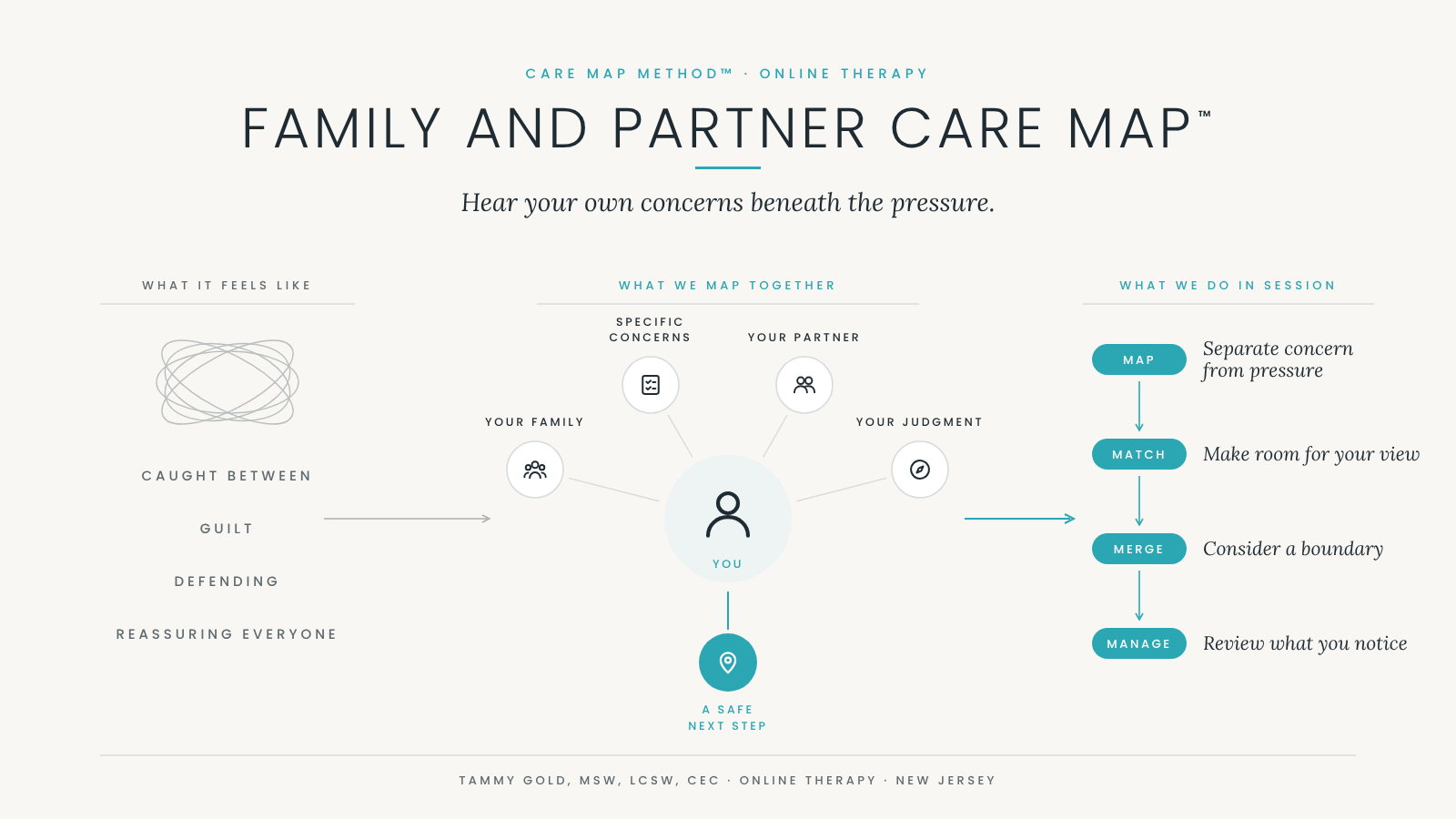
A conversation about your relationship can leave you feeling that you must defend your partner, reassure your family and somehow keep everyone close. You may feel guilty before you have even decided what you believe about their concerns.
I’m Tammy Gold. I offer individual online therapy for adults in New Jersey. We can explore your experience of the pressure and help you consider your own needs, observations and choices.
Separate the concerns from the pressure
Relatives may raise a specific behavior that deserves attention. They may also express expectations shaped by culture, religion or their own hopes for your life. Those are not automatically the same kind of concern.
We can examine what was said, what you have observed and what makes it difficult to think clearly. Therapy does not assume that the family is wrong or that the partner is right.
Give your own judgment room
Perhaps you want to say, “I am willing to discuss a specific concern, but repeated criticism is making it harder for me to hear you.” We can explore whether that request fits your circumstances and how you would respond if the conversation continues.
You may also need space to consider a concern privately rather than defend the relationship because you feel cornered. Understanding your response can help you make a choice you can stand behind.
Work on connection and limits together
We can discuss what you want to share, which conversations you will participate in and how the conflict affects your mental health. We will consider dependence on family resources, identity, cultural expectations and safety.
If there are threats, coercion or fear in either relationship, safety and appropriate support take priority. A generic communication script is not sufficient for every situation.
What we can work on together in session
We can take a recent family conversation and separate three things: what was actually said, what you believe about the concern and what you felt pressured to do. That distinction can create room to think when everyone seems to want an immediate answer. We can also consider the practical dependence, culture and relationship history shaping your options.
You might practice asking for a specific example, limiting repeated criticism or telling your partner you need time to consider a concern. We can discuss how you expect each person to respond and whether a conversation is safe and useful. A next step may be a boundary, a private reflection or a request for support. You remain the decision-maker; therapy does not require choosing a side to demonstrate progress.
When every gathering feels like a test
You may spend a family visit monitoring comments, preparing defenses or reassuring your partner afterward. Even an ordinary invitation can become a question about loyalty. We can explore the burden of managing everyone’s feelings and the assumptions that keep you in that role.
Sometimes the pressure comes from both directions. Your partner may want you to confront a relative immediately, while your family expects reassurance that nothing has changed. We can consider what you actually agree with, what you are still unsure about and what you need time to decide. Taking time to think can be meaningful when a conflict pushes you toward an instant answer.
Prepare for a conversation you choose
You might want to set a limit around criticism, ask for an example of a concern or tell your partner that a decision needs more discussion. We can explore the likely response and your practical options, including whether a conversation is safe and useful at all. The goal is to support your judgment and emotional well-being, rather than make you responsible for producing harmony among people with different wishes.
A practical way to understand what is happening
My Care Map Method™ helps us look at Biological, Social, Environmental and Emotional factors alongside clinical assessment. We consider your health and energy, relationships, daily circumstances and emotional experience rather than isolate one difficult moment from the rest of your life. We MAP the need, MATCH appropriate support, MERGE that support into your circumstances and MANAGE the plan as we learn what is useful. This is an organizing framework within individualized therapy, not a promise of a particular result.
What your first session can include
You can bring one situation you want help understanding. We will discuss your concern, relevant history, symptoms, daily functioning and available support. You can tell me what has or has not helped before and what you need to feel comfortable talking. My aim is to offer empathy without judgment and begin exploring a practical next step, while allowing time for assessment. We will decide together whether my approach fits and which goals matter to you. You do not need to arrive knowing the right words or the solution.
About Tammy Gold
I’m Tamara “Tammy” Gold, MSW, LCSW, CEC. I earned my clinical MSW at Columbia University and my BA at the University of Pennsylvania. My work with families includes parenting, caregiving and difficult relationships. I bring empathy without judgment and a practical interest in helping you understand the problem and consider what comes next.
Frequently asked questions
Will you tell me whether to choose my partner or family?
We can help you explore the decision without making it for you.
Can I come without either of them?
Yes. This page describes individual psychotherapy.
Can cultural or religious expectations be discussed?
Yes. We can explore their meaning for you without assuming that one approach fits every family.
What if my family has noticed something concerning?
We can examine specific observations seriously rather than automatically dismiss them as interference.
Is this mediation?
No. We are not negotiating a family agreement or evaluating people who are not clients.
Does insurance cover relationship pressure?
The situation alone does not determine coverage. Eligibility depends on assessed clinical needs, the service and your exact plan.
Can I set limits and still value my family?
We can explore what connection and limits mean in your family and culture. A limit does not have to begin with deciding that someone no longer matters.
What if I agree with part of their criticism?
You can discuss that uncertainty openly. Therapy can offer space to consider a concern without requiring you to defend or reject the entire relationship.
Booking and profile options
Choose a platform that shows current appointments for your physical location in New Jersey and your exact insurance plan. Availability and participation can differ across platforms.
Check availability and insurance on Grow Therapy
Check availability and insurance on Alma
Check availability and insurance on Headway
Read my profile or contact me on Psychology Today
Before confirming a visit, check the service, current provider participation, your exact benefits and estimated costs. Coverage depends on your plan and the assessed clinical service; a life event alone does not establish insurance eligibility. You must be physically located where I am authorized to provide care at each session.
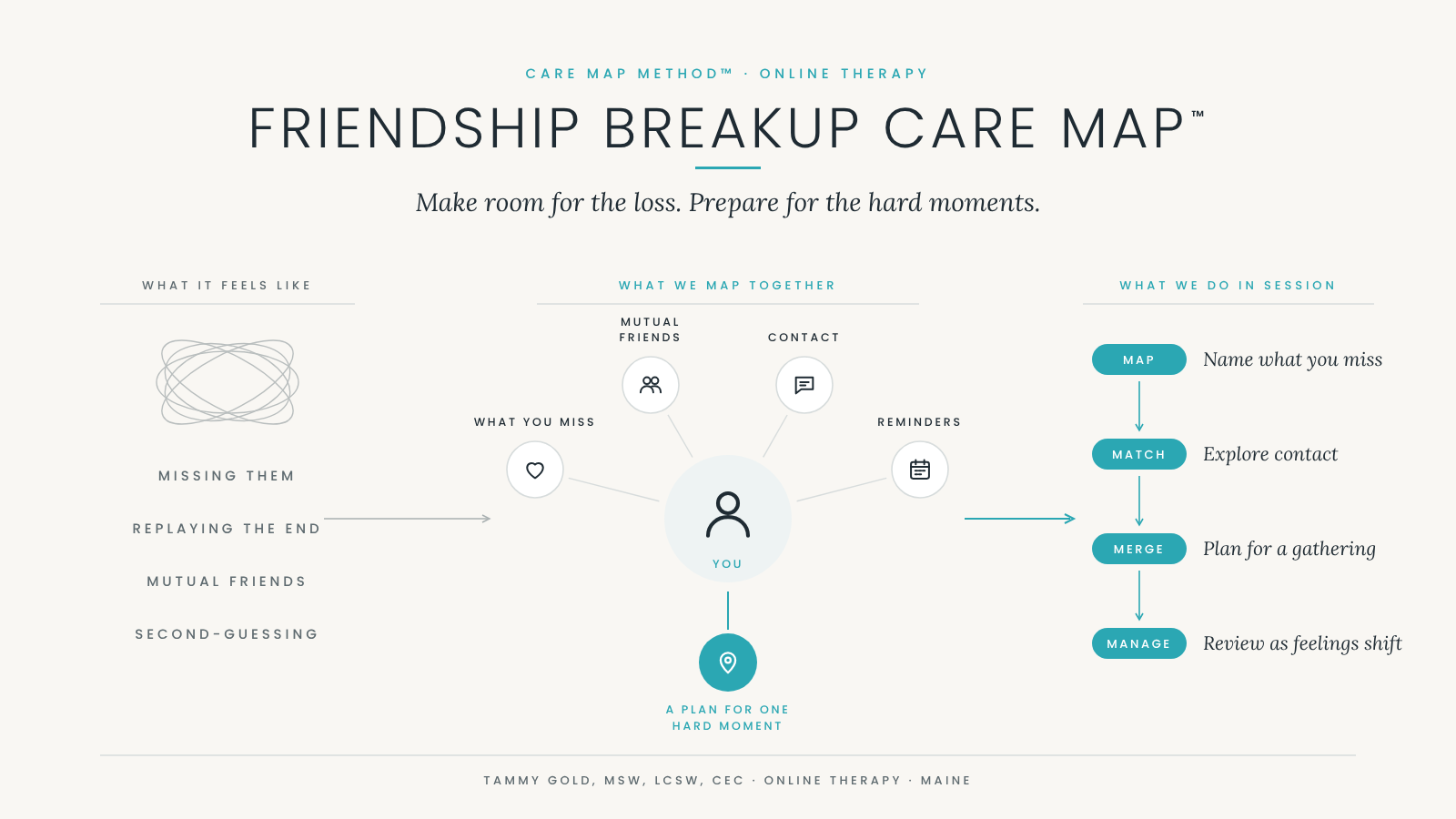
Online Therapy After a Friendship Breakup in Maine
Losing a friendship can bring grief, self-doubt and uncomfortable situations with mutual friends. Online therapy in Maine offers space to process the ending, consider boundaries and prepare for the moments that feel hardest.
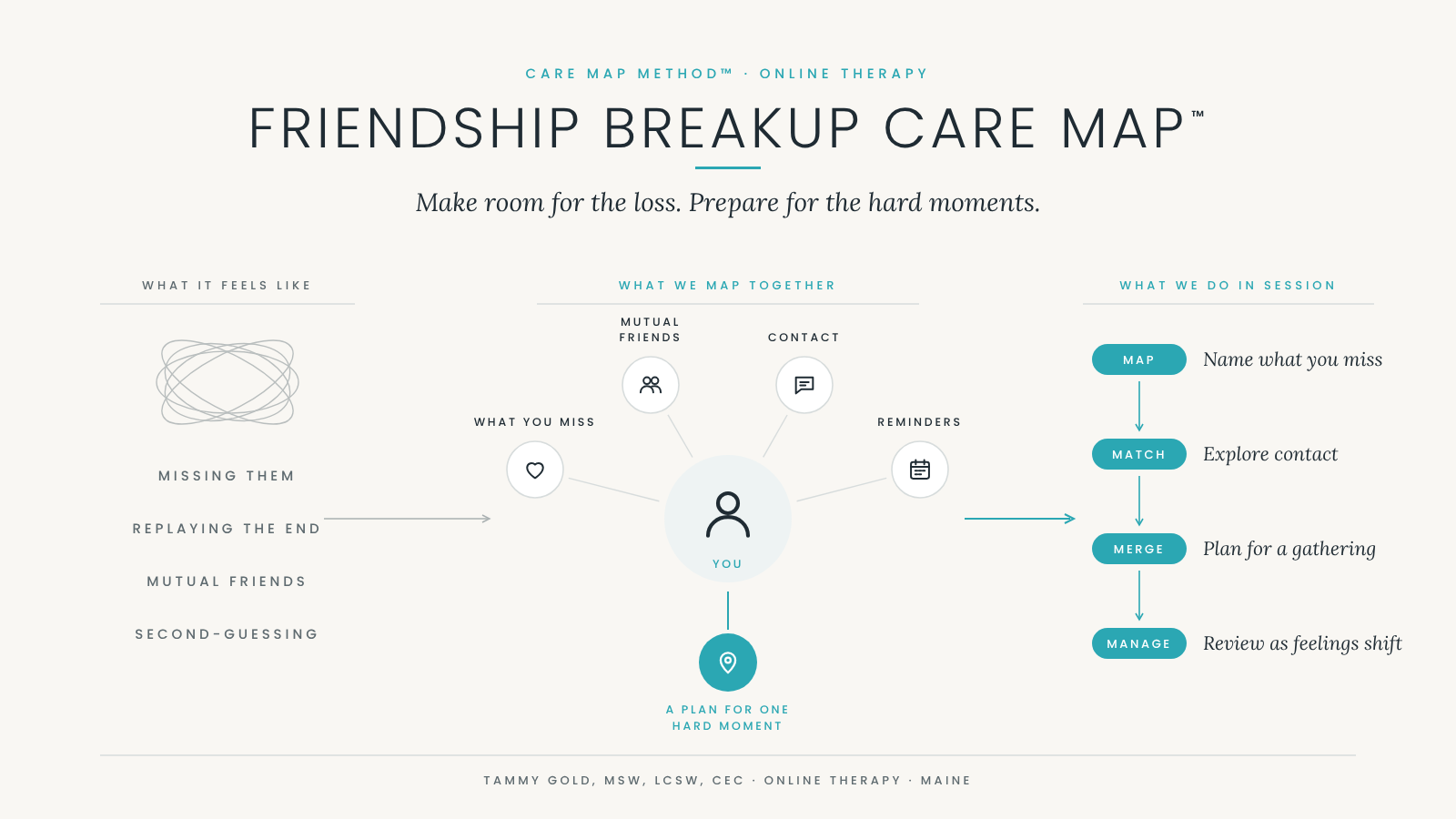
Maine Therapy, Friendship Breakup, Friendship Grief, Relationship Boundaries
You may miss the person you used to call first. You may also feel embarrassed that the ending has affected you so much. When people minimize friendship loss, it can become difficult to explain why a photograph, mutual invitation or unanswered message stays with you.
I’m Tammy Gold. I offer individual online therapy for adults in Maine. We can make room for the loss and explore how it is affecting your sense of trust, connection and daily life.
Understand what you lost
The ending may involve more than contact with one person. You might miss shared routines, a social circle or the feeling of being known. We can explore those meanings without requiring you to justify the length of the friendship or prove who was entirely at fault.
If you keep replaying the final exchange, we can distinguish questions that may be answerable from questions the other person may never resolve for you.
Consider contact without making it the only path
Perhaps you want to send a long explanation. We might discuss what you hope it will accomplish, what response you can realistically expect and how you would care for yourself if no response comes.
We can also explore accountability and regret where they fit. Understanding your part does not mean accepting responsibility for every part of the relationship.
Rebuild connection at your own pace
You do not have to replace the friendship immediately. We can consider the supports you already have, how mutual friendships feel and what boundaries would help at shared events. An early goal could be expressing the loss to a trusted person or deciding how to handle reminders, rather than forcing yourself to stop caring.
What we can work on together in session
We can begin with a recent reminder of the friendship and explore what made it painful. Was it missing companionship, feeling excluded, regretting something you said or not knowing why the relationship changed? Naming the specific loss helps us choose a useful focus instead of asking you to stop thinking about the person.
If a shared gathering is approaching, we can rehearse how you want to respond to questions, decide what you prefer to keep private and identify someone you can contact afterward. If you are considering a message, we can explore your purpose and expectations before deciding whether to send it. A next step might be one sentence you feel comfortable saying or a support plan for the event. We can revisit that plan as your feelings and circumstances change.
When the ending affects your other friendships
You may be deciding whether to attend a birthday gathering, mute a group conversation or explain why you have been quieter. Each choice can feel loaded when you are worried about being discussed or asked to take sides. We can explore what you want people to know and what you would prefer to keep private. You do not owe every mutual friend the full story.
Sometimes the harder part is comparing the friendship you remember with the way it ended. You may miss the closeness and still recognize patterns that hurt you. Therapy can hold both experiences without requiring you to label the whole friendship good or bad.
Notice what support looks like now
We might consider who can listen without pushing you toward reconciliation, where you still feel comfortable showing up and how you want to respond to an unexpected reminder. An early step could be deciding what to say if someone asks about your former friend. We can revisit that choice as your feelings change. There is no requirement to stop missing someone before you are allowed to invest in your present life.
A practical way to understand what is happening
My Care Map Method™ helps us look at Biological, Social, Environmental and Emotional factors alongside clinical assessment. We consider your health and energy, relationships, daily circumstances and emotional experience rather than isolate one difficult moment from the rest of your life. We MAP the need, MATCH appropriate support, MERGE that support into your circumstances and MANAGE the plan as we learn what is useful. This is an organizing framework within individualized therapy, not a promise of a particular result.
What your first session can include
You can bring one situation you want help understanding. We will discuss your concern, relevant history, symptoms, daily functioning and available support. You can tell me what has or has not helped before and what you need to feel comfortable talking. My aim is to offer empathy without judgment and begin exploring a practical next step, while allowing time for assessment. We will decide together whether my approach fits and which goals matter to you. You do not need to arrive knowing the right words or the solution.
About Tammy Gold
I’m Tamara “Tammy” Gold, MSW, LCSW, CEC. I earned my clinical MSW at Columbia University and my BA at the University of Pennsylvania. My work with families includes parenting, caregiving and difficult relationships. I bring empathy without judgment and a practical interest in helping you understand the problem and consider what comes next.
Frequently asked questions
Is friendship loss a legitimate reason to seek help?
You can ask for support when a relationship loss affects your well-being. Assessment helps establish the care that fits.
Will you tell me to reconnect?
There is no predetermined outcome. We can explore contact, distance and your own participation.
Can I attend if the ending was partly my fault?
Yes. Therapy can include responsibility, regret and learning without reducing you to a mistake.
Can we work on mutual-friend situations?
Yes. We can examine the emotions and choices involved in invitations, shared spaces and conversations.
Is this mediation with my former friend?
No. This page describes individual psychotherapy, not a process for resolving the dispute between you.
Does insurance cover friendship grief?
The event alone does not establish coverage. Verify benefits and estimated costs, and discuss assessed clinical needs before starting.
What if I keep looking at their social media?
We can explore what you hope to find, how checking affects you and what limits you would like to try. The goal is understanding, rather than blaming you for missing someone.
Can I grieve a friendship I chose to end?
Yes. Choosing distance does not erase attachment, sadness or uncertainty. We can discuss both the reasons you left and what you miss.
Booking and profile options
For appointments while you are in Maine, please use Alma while enrollment on other platforms is pending. The other profiles below are available for reference; they do not confirm appointments or insurance participation in this state.
Check availability and insurance on Grow Therapy
Check availability and insurance on Alma
Check availability and insurance on Headway
Read my profile or contact me on Psychology Today
Before confirming a visit, check the service, current provider participation, your exact benefits, and estimated costs. Coverage depends on your plan and the assessed clinical service; a life event alone does not establish insurance eligibility. You must be physically located where I am authorized to provide care at each session.
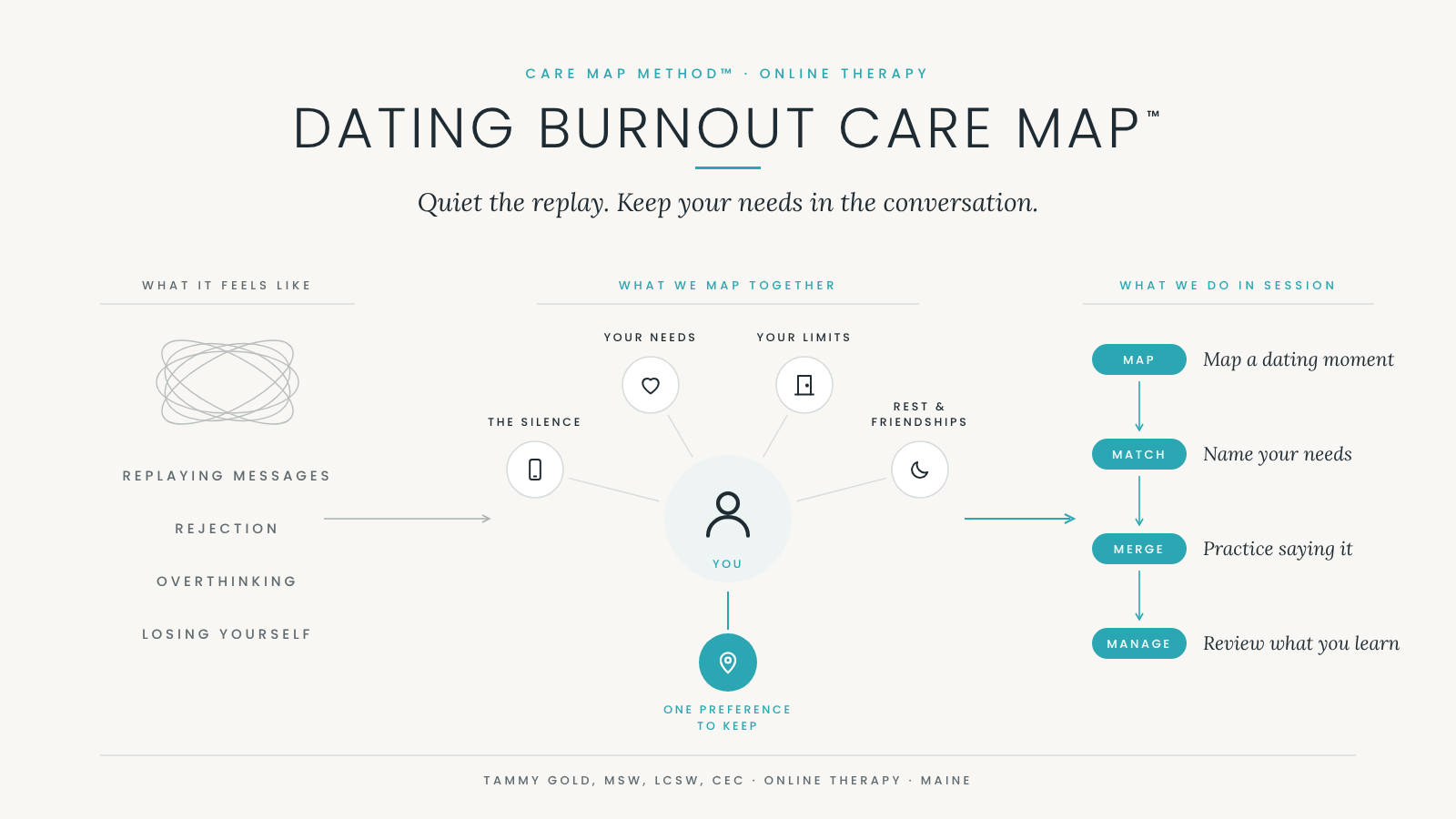
Dating feels exhausting. Your needs still matter.
Dating apps, unanswered messages and repeated disappointment can leave you questioning yourself. Explore online therapy in Maine to understand relationship patterns, practice boundaries and take practical steps that keep your needs in the picture.
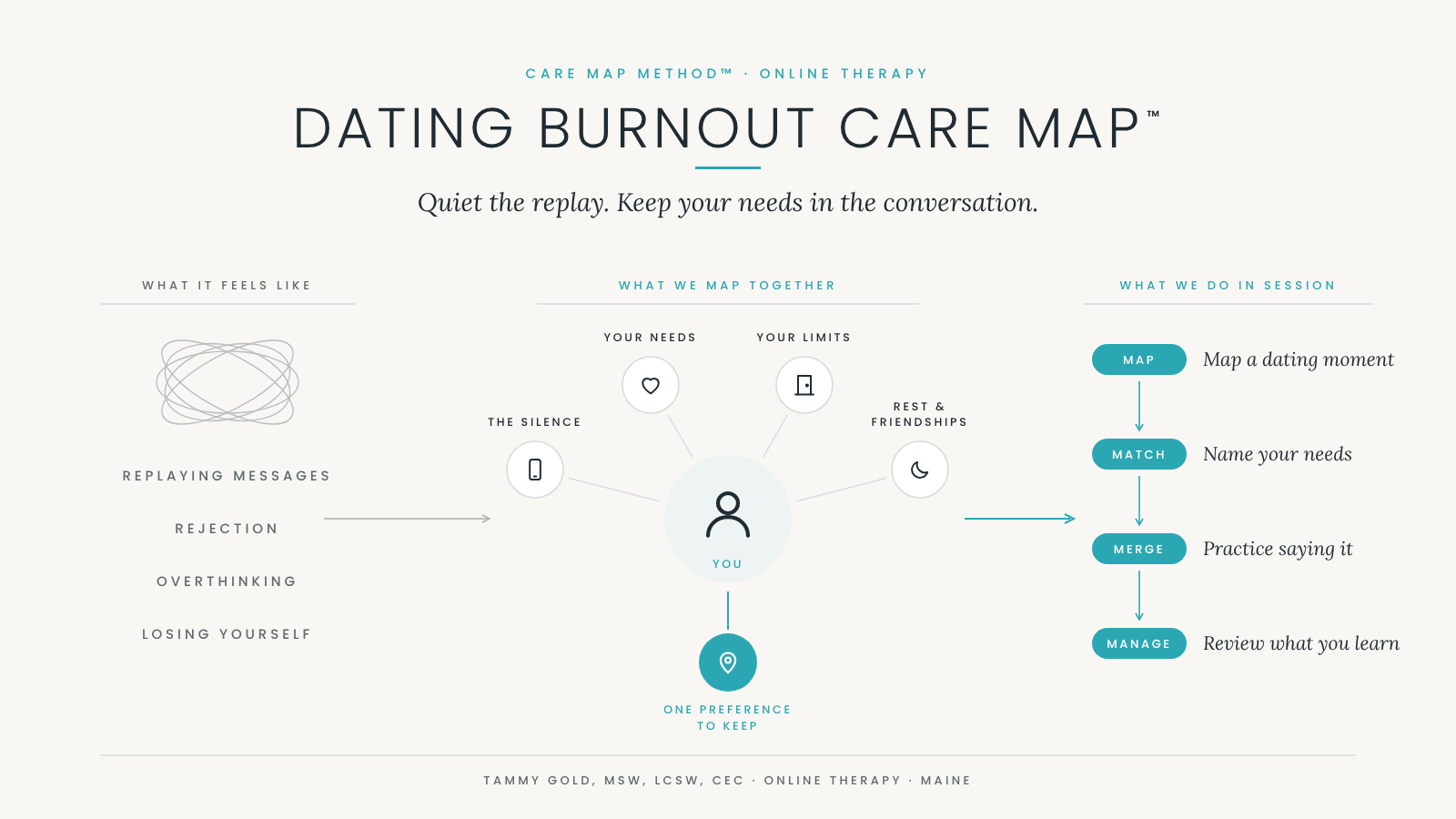
You may want a relationship while dreading another introduction, unanswered message or disappointing date. Perhaps you keep checking your phone, questioning what you said or trying to become the person you think someone else wants.
I’m Tammy Gold. I offer individual online therapy for adults physically located in Maine. We can explore the impact dating is having on your mental health and work toward choices that feel more consistent with your needs.
Check Maine Appointments on Alma
Understand the cycle around a disappointment
We might begin with one recent exchange. What happened? What did you conclude about yourself? What did you do to feel more certain afterward? Repeatedly reviewing a message can feel like problem-solving while leaving the same question unresolved.
We can examine your expectations, experiences and relationship patterns without assuming every disappointment has the same cause. Your circumstances and the behavior of the people you meet matter too.
Keep your preferences in the conversation
Perhaps you agree to plans you do not want because you fear losing the connection. We can explore that fear and practice a response such as, “I would like to see you again, but that time does not work for me.” The words should fit your situation rather than become another performance to get right.
Taking a break, changing how you participate or continuing with clearer limits are possibilities to explore. Therapy does not prescribe a particular relationship timeline.
Give the rest of your life room
We can discuss how dating affects rest, friendships and concentration. An early goal might be recognizing when you are setting aside a preference or spending less time trying to interpret silence. Those goals concern your well-being; another person’s response remains outside your control.
What we can work on together in session
We can take one recent dating exchange and map the sequence: what happened, what you told yourself it meant, what you felt and what you did next. For example, an unanswered message may lead to self-criticism, repeated checking and canceling your own plans in case the person replies. We can explore where you have a choice in that sequence without dismissing the disappointment.
Then we can practice a response that reflects your needs, such as expressing a scheduling preference or choosing when to stop checking for the evening. If it fits, you might leave with one boundary or small experiment to try. In a later session, we can review what happened, what felt difficult and what needs adjusting. The work focuses on your well-being and participation in dating; it does not depend on securing a particular person's interest.
When dating stress turns into self-criticism
A disappointing exchange can quickly become a much larger story: “I am always too much,” “Nobody will choose me,” or “I should have known better.” We can slow down that story and consider what you actually know, what you are assuming and which older experiences make the moment especially painful. You do not need to become indifferent to wanting love to take your own feelings seriously.
We can also explore the difference between choosing connection and trying to earn reassurance. That might mean noticing when you cancel your own plans to remain available, ignore a preference or keep checking an app after you have stopped enjoying it. Rather than set a rule you must follow perfectly, we can choose one situation to understand and review what happens.
Bring the question you are already asking
You might begin with, “Why do I feel rejected before I know this person?” or “How can I take a break without feeling I am giving up?” You do not need a polished explanation. We can start with the conversation, feeling or pattern that brought you here and decide together what support would be useful.
A practical way to understand what is happening
My Care Map Method™ helps us look at Biological, Social, Environmental and Emotional factors alongside clinical assessment. We consider your health and energy, relationships, daily circumstances and emotional experience rather than isolate one difficult moment from the rest of your life. We MAP the need, MATCH appropriate support, MERGE that support into your circumstances and MANAGE the plan as we learn what is useful. This is an organizing framework within individualized therapy, not a promise of a particular result.
What your first session can include
You can bring one situation you want help understanding. We will discuss your concern, relevant history, symptoms, daily functioning and available support. You can tell me what has or has not helped before and what you need to feel comfortable talking. My aim is to offer empathy without judgment and begin exploring a practical next step, while allowing time for assessment. We will decide together whether my approach fits and which goals matter to you. You do not need to arrive knowing the right words or the solution.
About Tammy Gold
I’m Tammy Gold, MSW, LCSW, CEC. I earned my clinical MSW at Columbia University and my BA at the University of Pennsylvania. My work with families includes parenting, caregiving and difficult relationships. I bring empathy without judgment and a practical interest in helping you understand the problem and consider what comes next.
Frequently asked questions
Can I come even if I am single?
Yes. Individual therapy can address your distress, self-understanding and relationship choices without requiring a partner.
Will you tell me which dating app to use?
We can explore your experience of dating. This is psychotherapy, not a matchmaking or profile-management service.
Does rejection mean something is wrong with me?
One person’s response does not provide a complete explanation of you. We can examine what rejection brings up without dismissing its impact.
Will therapy help me find a partner?
We can work on your mental health and choices. We cannot guarantee attraction, compatibility or a relationship.
Can we discuss boundaries and intimacy?
Yes, within treatment fit, your comfort and the scope of individual care.
Can I use insurance in Maine and other states?
Check your exact plan and estimated costs through my active Alma profile. Coverage also depends on the assessed clinical service.
Can we work on overthinking after dates?
Yes. We can explore the thoughts, feelings and checking habits that follow a date, then consider responses that support your well-being.
Do I have to stop dating while in therapy?
No. We can discuss continuing, changing your approach or taking a break based on your circumstances and preferences.
Booking and profile options
For appointments while you are in Maine, please use Alma while enrollment on other platforms is pending. The other profiles below are available for reference; they do not confirm appointments or insurance participation in this state. Therapy on these platforms below
Check availability and insurance on Grow Therapy
Check availability and insurance on Alma
Check availability and insurance on Headway
Read my profile or contact me on Psychology Today
Before confirming a visit, check the service, current provider participation, your exact benefits and estimated costs. Coverage depends on your plan and the assessed clinical service; a life event alone does not establish insurance eligibility. You must be physically located where I am authorized to provide care at each session.
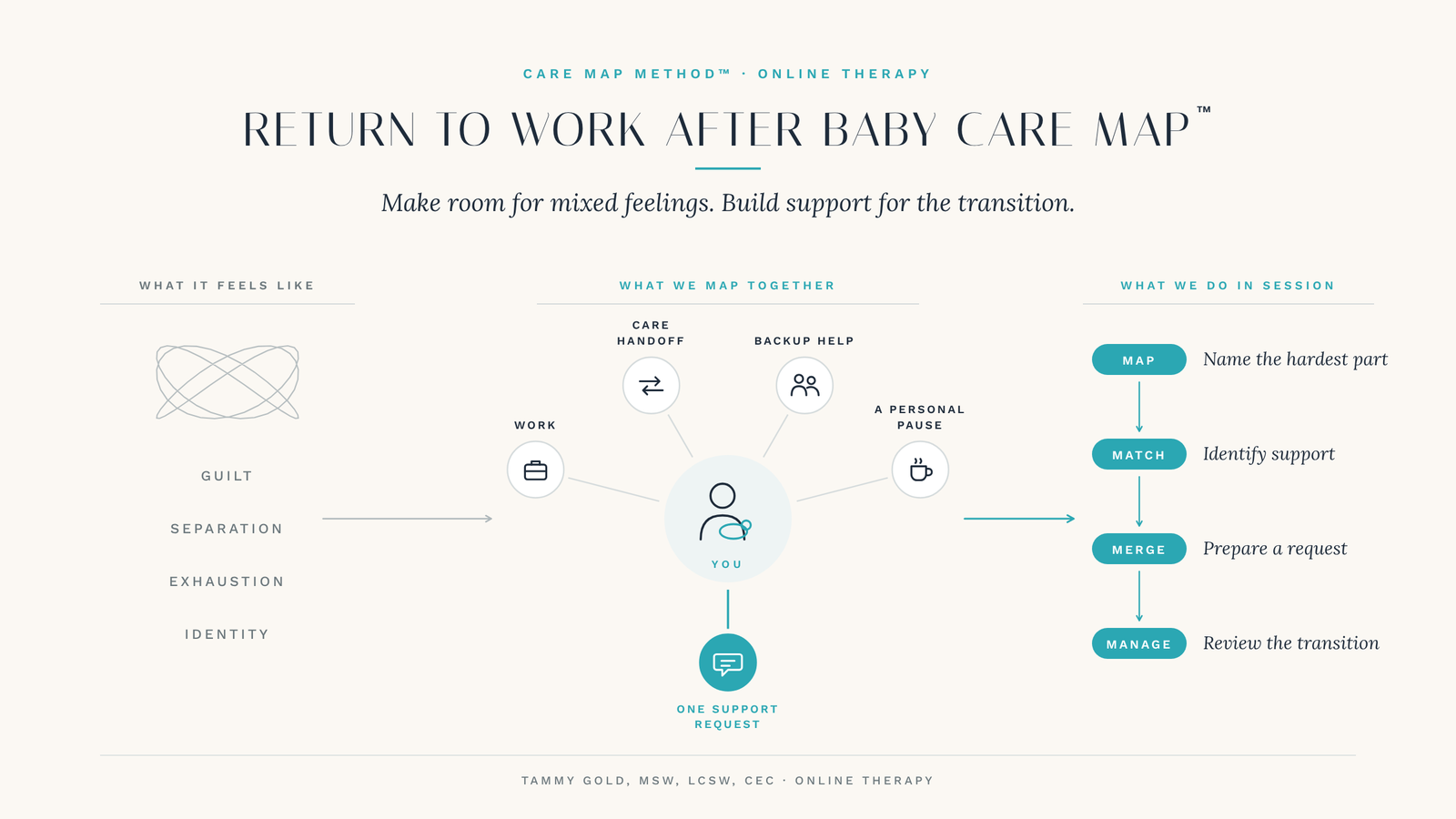
Returning to work after a baby and feeling torn
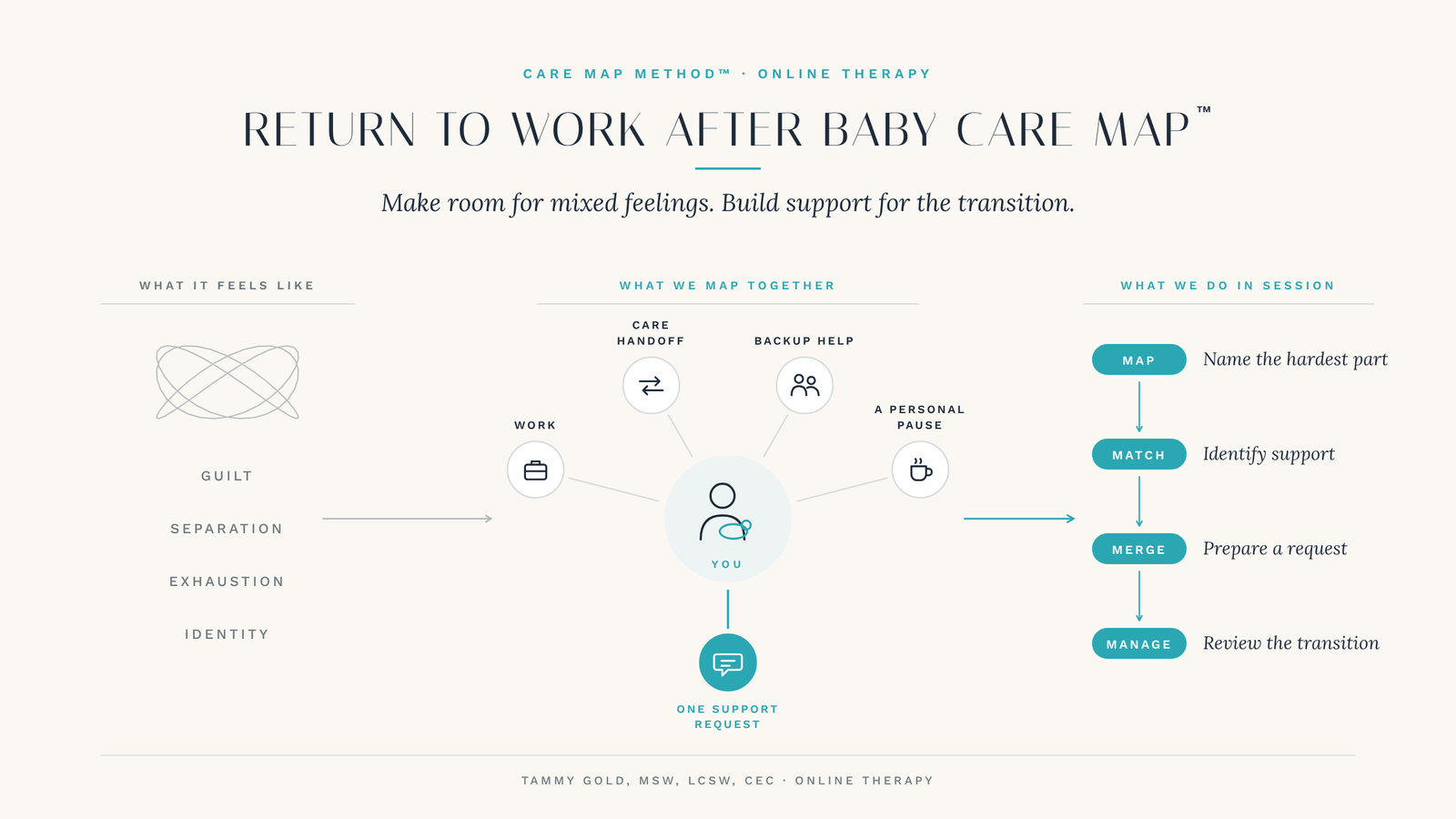
An adult caregiver preparing a work bag near baby supplies in a calm home setting.
You may want to return to work and still feel guilty about leaving your baby with someone else. You may also worry about performing well, managing care arrangements or being expected to carry the same workload at home.
I’m Tammy Gold. I offer individual online therapy for adults navigating parenting and relationship stress. If you will be physically located in Oregon for sessions, ask about current availability and payment options.
Separate the decisions from the judgment
A childcare decision can become a question about whether you are a good parent. A work adjustment can feel like evidence that you are no longer capable. We can explore those meanings while considering the practical realities around you.
We will discuss symptoms, functioning, support and relevant history. Persistent or worsening mood symptoms after birth also deserve attention from your health care team and appropriate mental health assessment.
Work on one transition you can prepare for
Perhaps the hardest moment is the first drop-off, asking your partner to take responsibility for care coordination or talking with a manager about returning expectations.
We can identify what feels difficult and practice a clear request. An example might be, “I need us to divide the planning and backup care, not only the drop-offs.” This is illustrative language; your plan will reflect your actual relationships and resources.
Give your own adjustment room
You may be grieving time at home, relieved to return, resentful about limited options or unsure who you are in this new arrangement. Therapy can provide space for those feelings without prescribing one correct parenting or career choice.
My Care Map Method™ organizes Biological, Emotional, Social and Environmental pressures. We map the transition, match appropriate support, merge manageable steps into the work and care routine and manage the plan as needs change.
Clarify what therapy can provide
This page describes psychotherapy for the adult’s mental health. Childcare selection consulting is a separate service, and medical advice about the baby remains with the baby’s clinician. If your symptoms call for specialized perinatal treatment, we will discuss a suitable referral.
At intake, we will agree on realistic goals and explain the treatment and payment arrangements. You can begin with one part of the return that you are finding hard to face.
Questions about starting therapy
Can I want to work and still feel guilty? Yes. We can explore those feelings and their meaning without requiring you to defend your career or parenting choices.
Is this childcare placement? No. Psychotherapy and childcare consulting are separate services with different goals and payment arrangements.
Will you tell me which care arrangement is best? We can explore your emotional response and values. This therapy page does not promise a childcare evaluation or placement.
Can non-birthing parents attend? Yes, when their own adjustment and mental health needs fit individual treatment.
What if I need postpartum specialist care? We will assess clinical fit and discuss appropriate specialized support or referrals.
Can I book from Oregon? Ask about current Oregon availability and confirm exact plan participation and estimated costs before scheduling.
Ask about current availability, clinical fit and payment options. Confirm the state where you will be located before scheduling.
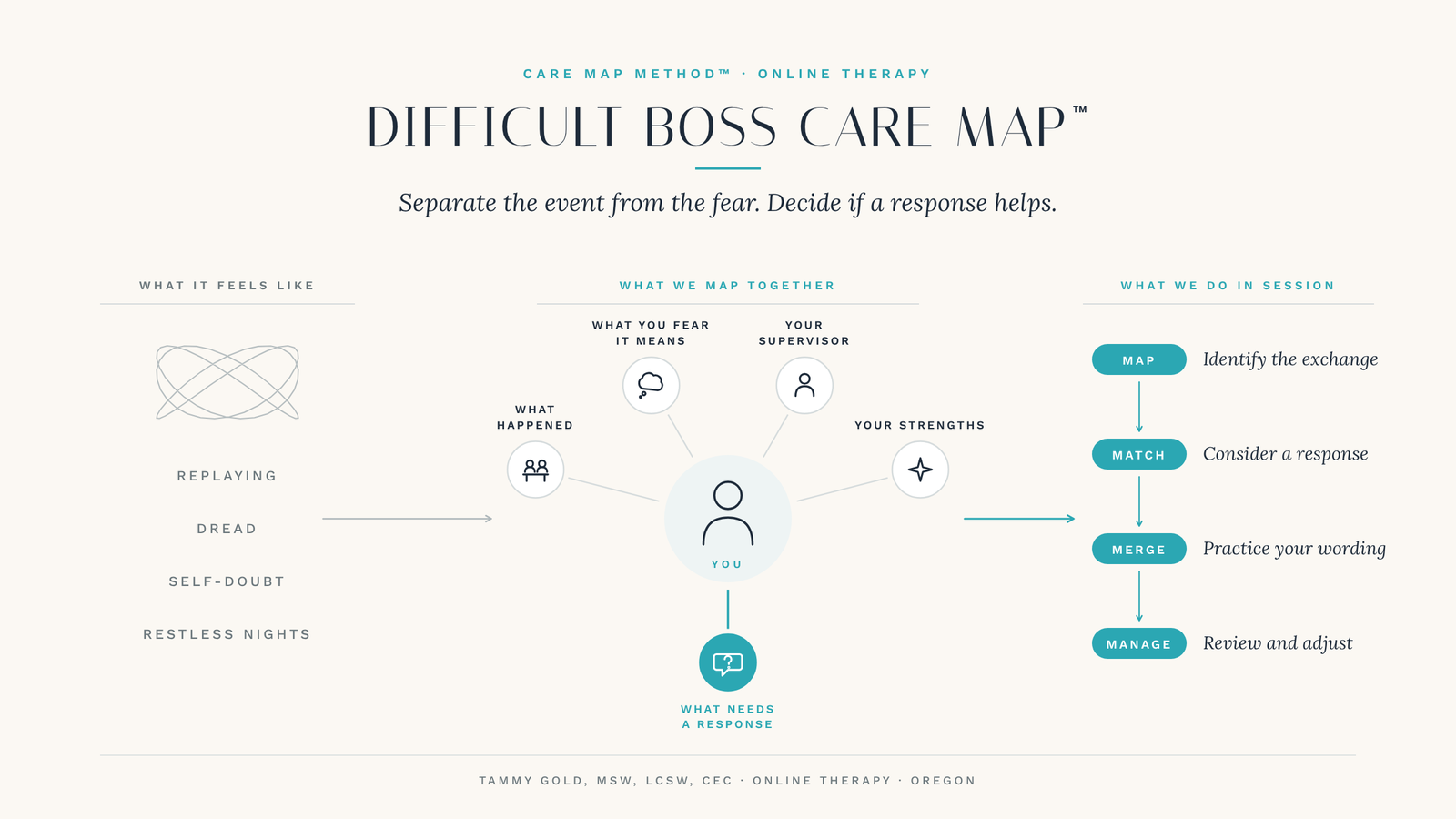
When criticism from your boss takes over the evening
The meeting ended, but you are still defending yourself in your head. You may replay a supervisor’s tone, wonder how coworkers interpreted the exchange or spend the evening rewriting a response you never send.
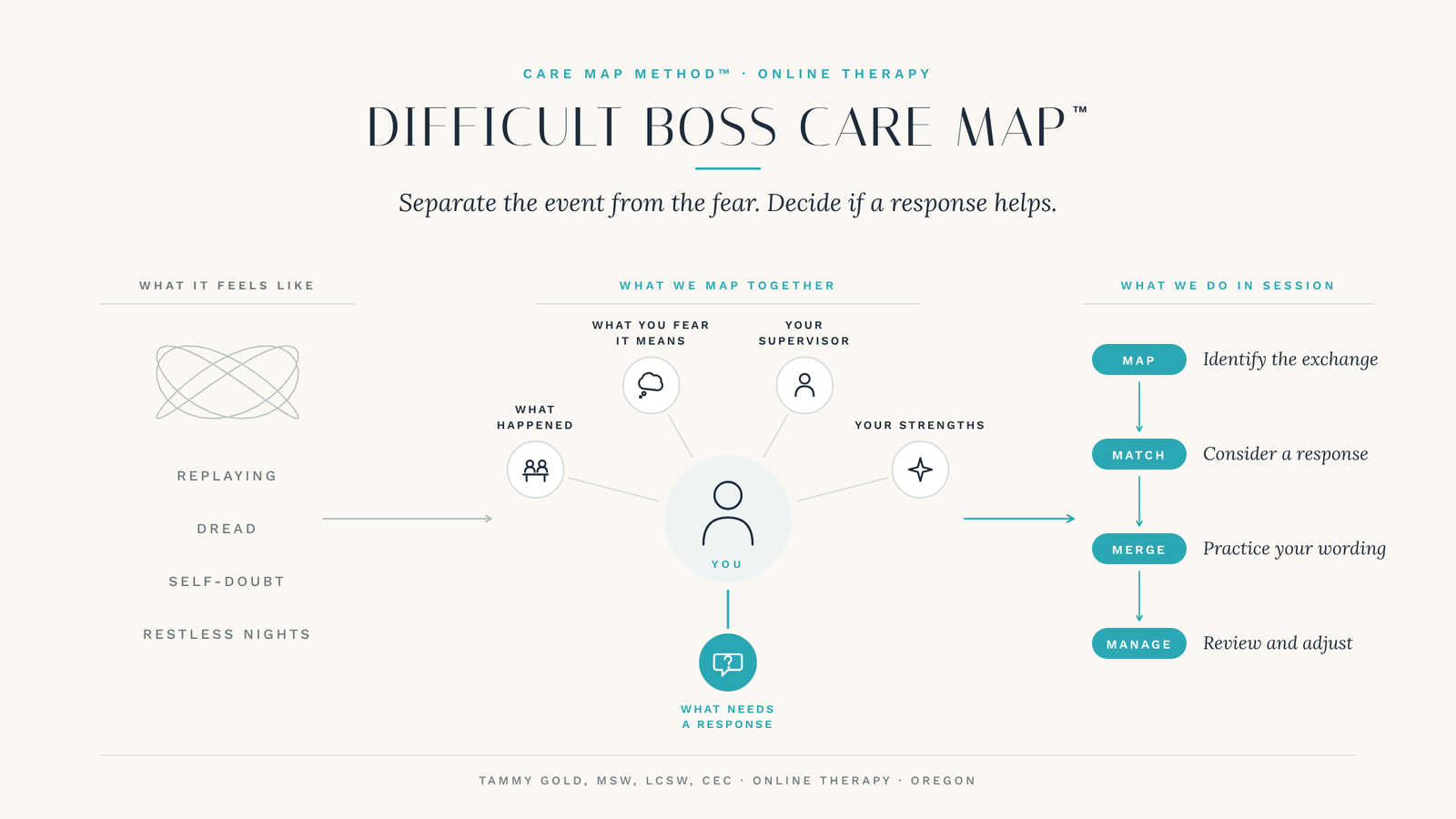
The meeting ended, but you are still defending yourself in your head. You may replay a supervisor’s tone, wonder how coworkers interpreted the exchange or spend the evening rewriting a response you never send.
I’m Tammy Gold. I offer individual online therapy for adults in Oregon. We can explore how difficult workplace interactions affect your mental health and develop a response grounded in your circumstances.
Look at the exchange without filling in every blank
We can begin with what was actually said or done. What was useful feedback? What was unclear, dismissive or inappropriate? What are you afraid the interaction means for your job or for how others see you?
This work does not assume that the environment is fair. It helps us distinguish the practical concern from the conclusions that may be keeping the event active in your mind. We will consider power, money and your responsibilities as well as feelings.
Choose whether a response is needed
Sometimes clarification is useful: “I want to make sure I understand the change you are asking for.” Sometimes a pause gives you time to decide what you actually want to address.
We can practice wording, explore what makes it difficult to use and discuss appropriate outside support when a concern involves workplace rights or policy. Therapy is not an investigation of your employer or a substitute for legal advice.
Understand the urge to keep reviewing
Replaying the exchange may feel like preparing, proving your position or preventing another mistake. We can explore whether it helps you decide what to do or leaves you caught in the same argument.
My Care Map Method™ organizes Biological, Emotional, Social and Environmental factors. We map the interaction and aftermath, match a strategy to your needs, merge a practice into the workweek and manage the plan as we review it.
Set goals around your well-being
You might want to ask a question with less avoidance, spend less time mentally defending yourself or become clearer about your options. We will assess symptoms and functioning and decide together whether my approach is a fit.
Your employer does not need to participate in individual therapy. We will discuss confidentiality and its exceptions, and any proposed communication with another professional would follow the appropriate consent process.
Questions about starting therapy
Is the goal to stop caring about my work? No. We can explore how to care about your responsibilities without allowing one interaction to occupy all of your attention.
Will you tell me to confront my supervisor? There is no prescribed response. We will consider your role, risks and realistic options.
Can you decide whether I was bullied? We can examine behavior and its impact, but therapy is not an employer investigation or legal determination.
Can I work on coworker conflict too? Yes, when the effect on your mental health fits the practice. The focus remains your experience and choices.
Is burnout automatically an insurance diagnosis? No. Assessment determines clinical needs; coverage depends on the service, plan and active participation.
Which Oregon insurance route should I use? Use only the platform and plan currently verified for you. A brand name in an old article does not establish current coverage.
Ask about current availability, clinical fit and payment options. Confirm the state where you will be located before scheduling.
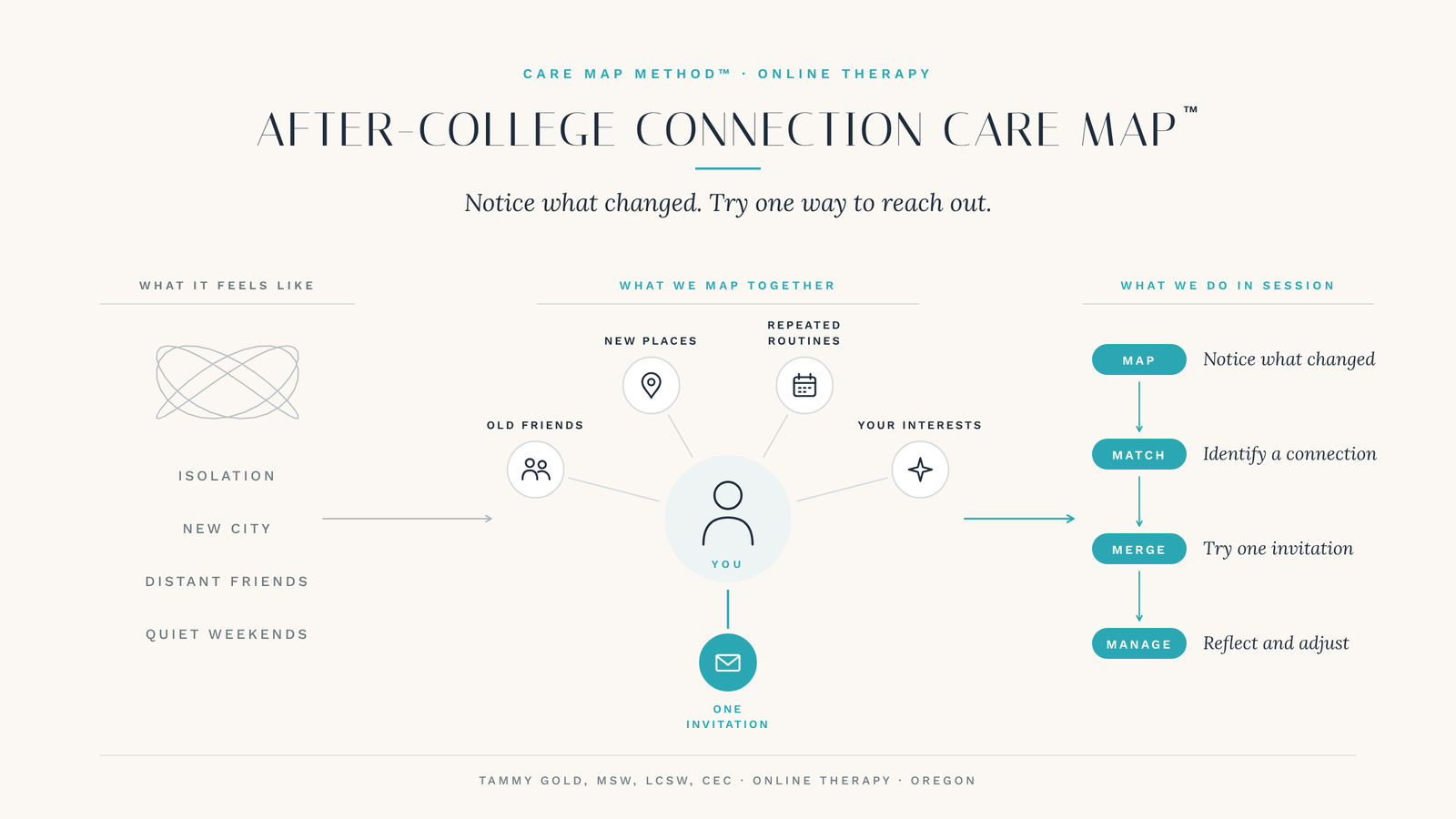
Lonely After College Therapy for Adults in Oregon
You may be working, studying or managing daily responsibilities while missing the easy contact you had with people before. Friends have moved, schedules no longer match and a free evening can feel more isolating than restful.
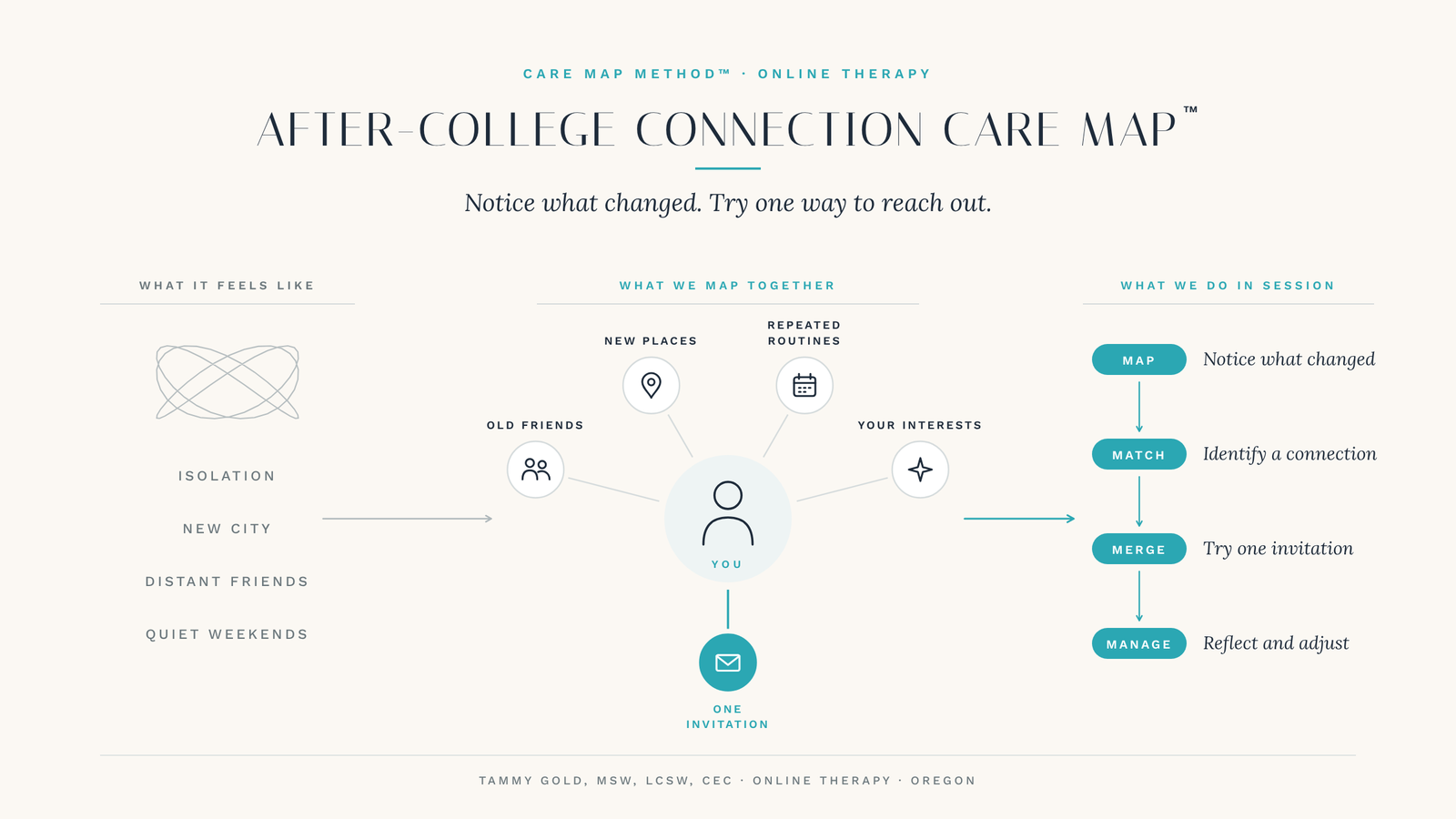
A young adult writing a message at a quiet café table with an unreadable phone screen.
You may be working, studying or managing daily responsibilities while missing the easy contact you had with people before. Friends have moved, schedules no longer match and a free evening can feel more isolating than restful.
I’m Tammy Gold. I offer individual online therapy for adults physically located in Oregon. We can explore the loss of connection after college or a move and how it is affecting your mood, confidence and daily life.
Understand what changed around you
College often provides repeated contact without requiring a plan every time. When that structure disappears, the effort involved in maintaining a friendship can change. We can look at your actual circumstances rather than assume that difficulty connecting means you have failed socially.
Perhaps you feel embarrassed reaching out, compare your social life with what you see online or avoid invitations because you expect to feel out of place. We can discuss those experiences alongside any symptoms that need assessment.
Work with one moment of disconnection
Imagine wanting to message a friend but deciding they probably do not want to hear from you. We might explore the evidence for that conclusion, what a response would mean to you and whether a small invitation fits the relationship.
We can also make space for disappointment when a friendship changes. Therapy does not require treating every connection as recoverable or every lonely evening as a task to fix.
Make room for connection that suits your life
Possible work includes expressing interest more directly, managing the feelings after an unanswered message or identifying settings where repeated contact is realistic. We will consider energy, money, transportation and other constraints rather than make a generic list of activities.
My Care Map Method™ organizes Biological, Emotional, Social and Environmental needs. We map the pattern, match a support or strategy, merge one manageable practice into your routine and manage what you learn over time.
Start with what feels hardest
The first session can include your recent transition, relationship history, symptoms and support. We will assess whether my approach fits your needs and choose goals together. Those goals might concern avoidance, self-criticism or a clearer way to reach out, rather than a promised number of friends.
Questions about starting therapy
Do I need to have attended college? No. A similar transition can happen after leaving a program, moving or entering work. We can assess whether the concern fits this service.
Is this a social anxiety specialty service? No specialty claim is made here. Assessment helps determine whether general transition support or specialized treatment is appropriate.
Can therapy guarantee that I will make friends? No. We can work on your feelings, patterns and choices; other people’s responses are outside our control.
Can I discuss a friendship breakup? Yes, when the effect on your mental health fits individual treatment. We can explore the loss and what you need next.
Can I attend while traveling? Confirm your physical location before each visit. Care must occur where I am authorized to practice.
Can I use insurance in Oregon? Verify current participation, your exact plan, assessed clinical service and estimated session costs before scheduling.
Ask about current availability, clinical fit and payment options. Confirm the state where you will be located before scheduling.