

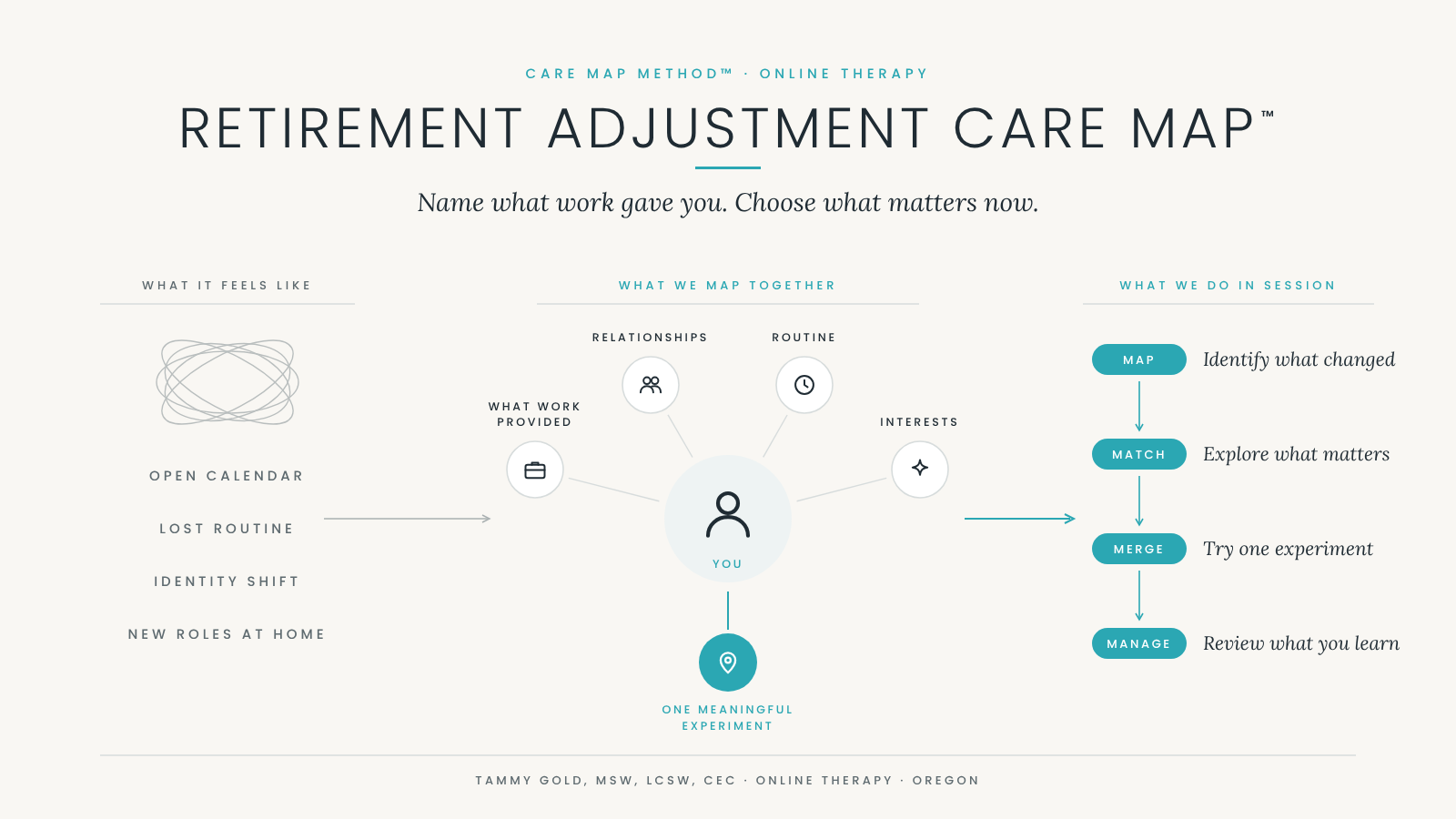
Online Therapy for Retirement Adjustment in Oregon
Retirement can change your identity, relationships and sense of purpose. Online therapy in Oregon can help you explore what you miss, discuss expectations at home and choose meaningful next steps for this stage of life.
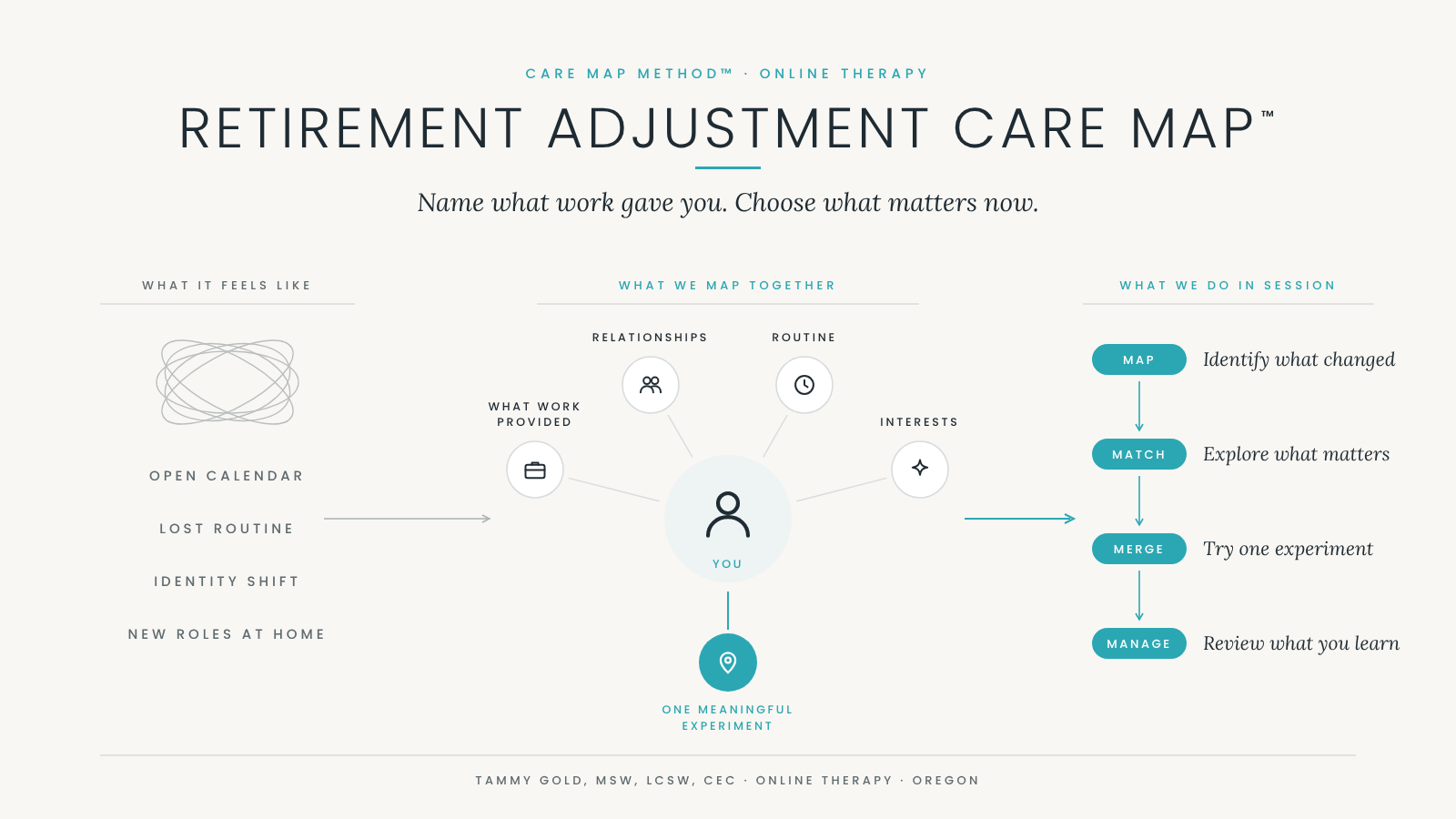
You may have looked forward to leaving work and still miss the structure, contact or sense of usefulness it provided. More time at home can also change relationships in ways you did not anticipate.
I’m Tammy Gold. I offer individual online therapy for adults in Oregon navigating life transitions and relationship stress. We can explore what retirement has changed for you and what you need in this stage of life.
Identify what work used to provide
Perhaps you miss being asked for your opinion, having a reason to leave the house or seeing familiar people. We can examine those losses without assuming that a busier calendar will automatically address them.
Retirement may have been chosen, forced or shaped by health and finances. Those differences matter. We will also discuss mood, sleep, concentration and functioning rather than assume every change is ordinary adjustment.
Explore the new expectations at home
You may feel that family members now consider you permanently available. Or you and a partner may have different ideas about shared time and privacy.
A conversation could begin, “I want us to discuss what we each need from the week, including time together and time independently.” We can explore the feelings underneath that request and whether it fits your situation.
Build a next step around meaning
We can consider what you want to continue, what you are ready to release and what you would like to try. A next step might be reconnecting with one person or making space for an interest you have postponed.
The goal is not to perform a perfect retirement. We can work on your experience of the change and review what supports your well-being. Financial planning and medical questions belong with the appropriate professionals.
What we can work on together in session
We can map a typical day before and after retirement to understand what changed beyond the hours of paid work. We might identify missing social contact, a loss of recognition, less privacy at home or uncertainty about how to describe yourself. We will also assess symptoms that deserve attention in their own right.
Together, we can choose one meaningful experiment: contacting a person you miss, setting aside time for an interest or discussing expectations with a partner. We can explore what makes that step appealing or difficult and keep it realistic for your energy and resources. At a later visit, we can review the experience and adjust the direction. You do not need a complete plan for this stage of life before therapy can be useful.
When an open calendar feels uncomfortable
Work may have offered more than a schedule. It may have provided recognition, familiar conversations or a clear way to know you had contributed. If those supports disappear at once, being told to “enjoy your freedom” can feel lonely. We can explore what you miss and which parts you would like to carry forward in a different form.
You may also feel pressure to say yes to family responsibilities because you are no longer employed. We can discuss the difference between choosing to help and feeling unable to decline. Your interests, energy and relationships deserve consideration in the new arrangement.
Try a direction without deciding your whole future
We might identify one connection you want to maintain, one activity that interests you or one conversation about expectations at home. The purpose is to learn what feels meaningful and realistic, rather than fill every hour. If low mood, withdrawal or other symptoms are affecting daily life, we will assess those concerns directly. Retirement does not make distress something you simply have to accept, and seeking support does not mean you are doing this stage of life incorrectly.
A practical way to understand what is happening
My Care Map Method™ helps us look at Biological, Social, Environmental and Emotional factors alongside clinical assessment. We consider your health and energy, relationships, daily circumstances and emotional experience rather than isolate one difficult moment from the rest of your life. We MAP the need, MATCH appropriate support, MERGE that support into your circumstances and MANAGE the plan as we learn what is useful. This is an organizing framework within individualized therapy, not a promise of a particular result.
What your first session can include
You can bring one situation you want help understanding. We will discuss your concern, relevant history, symptoms, daily functioning and available support. You can tell me what has or has not helped before and what you need to feel comfortable talking. My aim is to offer empathy without judgment and begin exploring a practical next step, while allowing time for assessment. We will decide together whether my approach fits and which goals matter to you. You do not need to arrive knowing the right words or the solution.
About Tammy Gold
I’m Tamara “Tammy” Gold, MSW, LCSW, CEC. I earned my clinical MSW at Columbia University and my BA at the University of Pennsylvania. My work with families includes parenting, caregiving and difficult relationships. I bring empathy without judgment and a practical interest in helping you understand the problem and consider what comes next.
Frequently asked questions
Can I come before I retire?
Yes. We can explore the anticipated transition and assess what support fits.
What if I did not choose to stop working?
We can make room for the loss, anger or uncertainty involved rather than assume retirement is welcome.
Is this financial retirement planning?
No. This page describes psychotherapy for mental health and adjustment.
Can I discuss changes with my spouse?
Yes. Individual therapy can explore your experience of the relationship; couples services would require a separate discussion.
Do you accept Medicare?
Do not assume coverage. Ask about your exact plan and the practice’s current enrollment before booking.
How do I start from Oregon?
Confirm current availability, your physical location, treatment fit and payment arrangements before scheduling.
What if I miss work but do not want to return?
We can explore the parts you miss without assuming that returning to employment is the answer. The loss of a role and a preference for retirement can coexist.
Will you tell me to volunteer or find a hobby?
We can consider those possibilities if they interest you, but the work begins with what has changed and what matters to you. A fuller calendar is not the only possible goal.
Booking and profile options
Choose a platform that shows current appointments for your physical location in Oregon and your exact insurance plan. Availability and participation can differ across platforms.
Check availability and insurance on Grow Therapy
Check availability and insurance on Alma
Check availability and insurance on Headway
Read my profile or contact me on Psychology Today
Before confirming a visit, check the service, current provider participation, your exact benefits and estimated costs. Coverage depends on your plan and the assessed clinical service; a life event alone does not establish insurance eligibility. You must be physically located where I am authorized to provide care at each session.
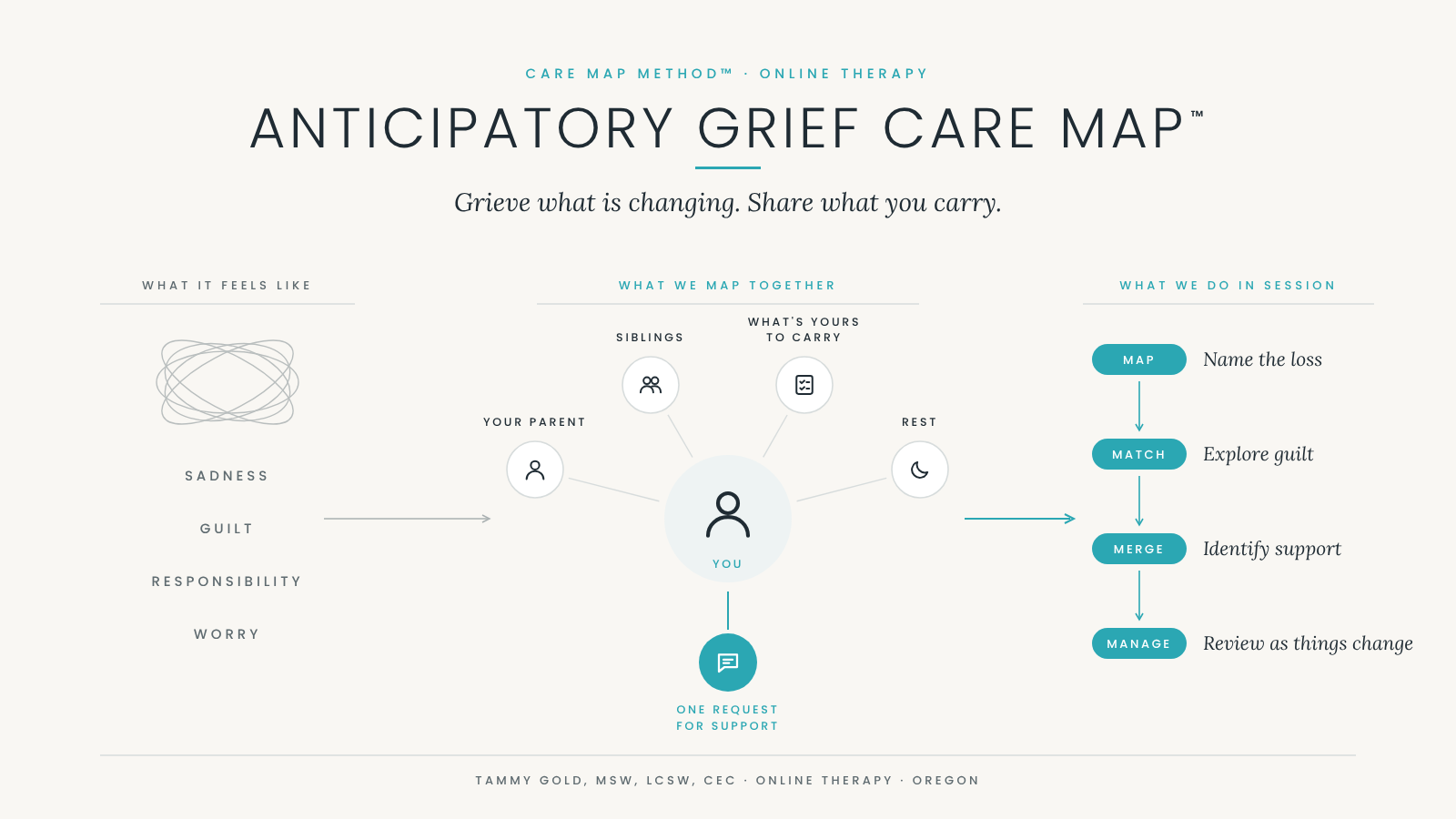
Online Therapy for Anticipatory Grief in Oregon
Watching a parent’s health change can bring grief before a death has occurred. Online therapy in Oregon offers space for sadness, guilt and frustration, with practical support for identifying your limits and asking for help.
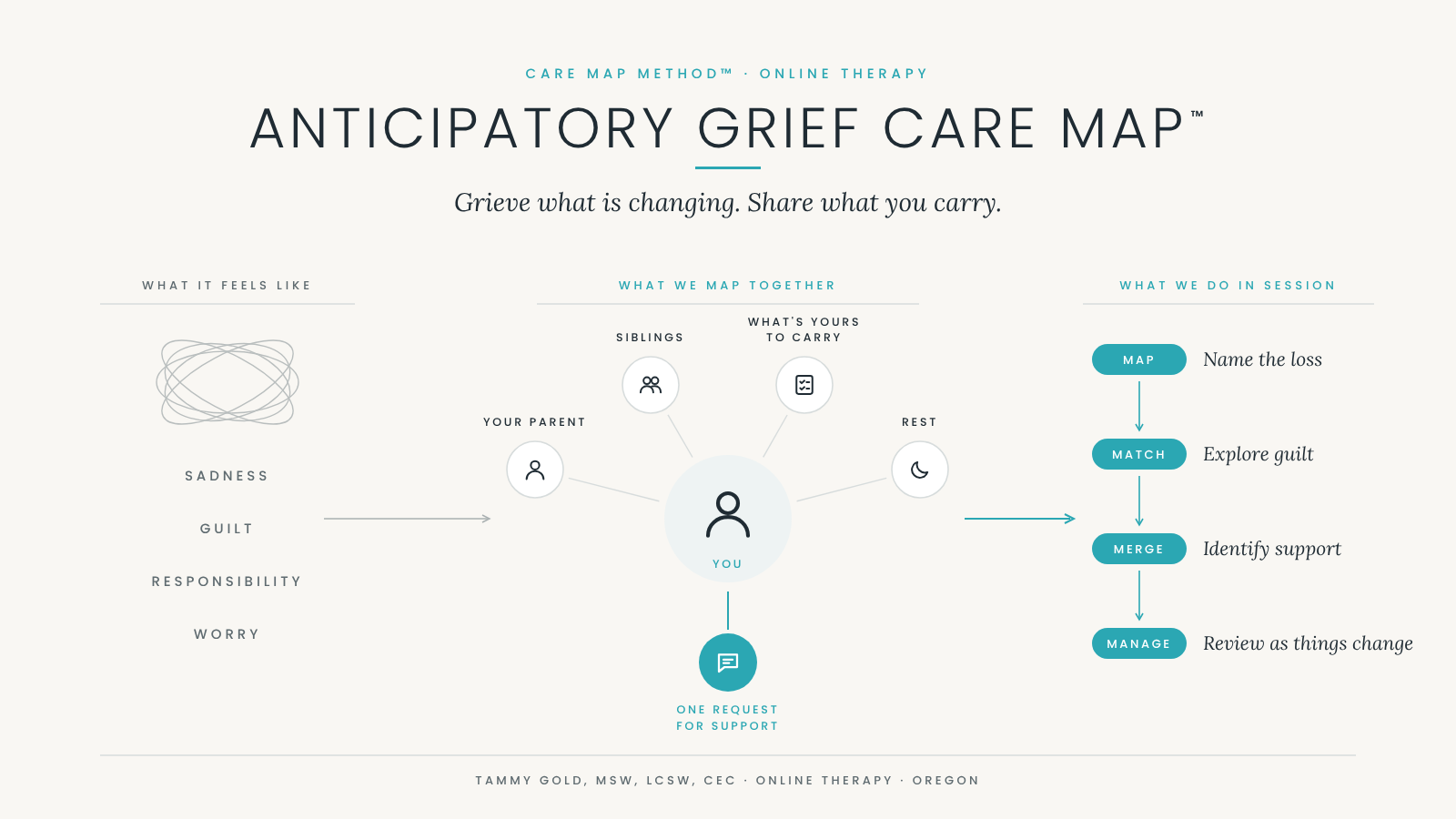
You may be grieving conversations you can no longer have, a role that has changed or a future that feels uncertain. When people focus only on what your parent needs, it can be difficult to explain what you are losing too.
I’m Tammy Gold. I offer individual online therapy for adults in Oregon, including adult children and caregivers dealing with family changes. We can explore the grief, worry and complicated feelings around a parent’s declining health.
Make room for what is changing
Grief before an expected loss is sometimes described as anticipatory grief. It does not follow one required pattern. You may feel sadness, anger, numbness or guilt, and those feelings may change from day to day.
We can discuss what you are experiencing without treating love and frustration as incompatible. Assessment also helps clarify whether your symptoms and functioning call for additional support.
Distinguish caring from carrying everything
Perhaps every missed visit feels like a failure, even when work or health limits what you can do. We can examine the expectation you hold yourself to and what responsibilities are realistically yours.
A request for help might begin, “I need someone else to handle this appointment so I can keep managing the parts I already do.” We can explore the feelings attached to that request and how family responses affect you.
Find a way to be present that fits the relationship now
You may be trying to make every interaction meaningful or fearing the next change. Therapy can provide room to discuss those pressures and consider what connection means in your circumstances.
Medical decisions, prognosis and questions about the parent’s treatment remain with their health care team. This service focuses on the adult client’s mental health and choices, rather than treating the parent through someone else’s sessions.
What we can work on together in session
We can begin with one moment that has stayed with you: leaving a visit, receiving an update or feeling frustrated during a care task. We can name what you are grieving, explore the meaning of the guilt and look at the responsibilities you are carrying. There is room for love, anger, sadness and fatigue in the same conversation.
If you need practical support, we can rehearse a specific request to a relative, identify a limit around one responsibility or consider how you want to recover after a difficult visit. The next step should fit your time, resources and relationship with your parent. We can review what helped and what remains hard in a later session. Medical decisions and the parent's treatment remain with their care team; our work centers on your mental health.
When grief and ordinary responsibilities overlap
You may move from a difficult visit straight into a work meeting or return home to people who need you. The lack of space between roles can leave feelings unspoken. We can discuss what happens when you postpone your own reactions and what kind of support would fit the time and energy you actually have.
Sibling differences can add another layer. One relative may want more updates, another may avoid the situation and someone may question the choices being made. We can explore your part in these relationships without treating you as responsible for everyone’s agreement. Questions about legal authority or medical decisions need the appropriate professional guidance.
Start with what feels hardest to say
You might want to talk about anger, relief after leaving a visit or fear that you are already forgetting who your parent used to be. These feelings can be discussed with care. We can consider how they affect sleep, concentration and relationships, and what helps you feel less isolated. The work does not require a perfect visit or a particular way of grieving to count as caring.
A practical way to understand what is happening
My Care Map Method™ helps us look at Biological, Social, Environmental and Emotional factors alongside clinical assessment. We consider your health and energy, relationships, daily circumstances and emotional experience rather than isolate one difficult moment from the rest of your life. We MAP the need, MATCH appropriate support, MERGE that support into your circumstances and MANAGE the plan as we learn what is useful. This is an organizing framework within individualized therapy, not a promise of a particular result.
What your first session can include
You can bring one situation you want help understanding. We will discuss your concern, relevant history, symptoms, daily functioning and available support. You can tell me what has or has not helped before and what you need to feel comfortable talking. My aim is to offer empathy without judgment and begin exploring a practical next step, while allowing time for assessment. We will decide together whether my approach fits and which goals matter to you. You do not need to arrive knowing the right words or the solution.
About Tammy Gold
I’m Tamara “Tammy” Gold, MSW, LCSW, CEC. I earned my clinical MSW at Columbia University and my BA at the University of Pennsylvania. My work with families includes parenting, caregiving and difficult relationships. I bring empathy without judgment and a practical interest in helping you understand the problem and consider what comes next.
Frequently asked questions
Can grief begin before someone dies?
Yes. People can grieve anticipated loss and changes in a relationship. Your experience still needs individual attention rather than a fixed stage model.
Does feeling relief or frustration mean I do not care?
Those feelings do not provide a complete measure of your relationship. We can explore their context without judging you.
Are you treating my parent?
No. This page describes individual therapy for the adult seeking help.
Can you advise on dementia treatment?
No. Diagnosis, medical care and prognosis belong with the parent’s clinical team.
Is this the same as senior-care consulting?
No. Psychotherapy and care-selection consulting are separate services with different goals and payment arrangements.
Does insurance cover grief?
The loss situation alone does not establish coverage. Confirm assessed clinical needs, your Oregon plan and current participation before starting.
Can I come if I am not the main caregiver?
Yes. A parent’s health changes can affect you even when someone else provides most of the practical care. Assessment helps clarify your support needs.
Can I discuss guilt about taking a break?
Yes. We can explore the expectations behind the guilt and what rest or shared responsibility might mean in your actual circumstances.
Booking and profile options
Choose a platform that shows current appointments for your physical location in Oregon and your exact insurance plan. Availability and participation can differ across platforms.
Check availability and insurance on Grow Therapy
Check availability and insurance on Alma
Check availability and insurance on Headway
Read my profile or contact me on Psychology Today
Before confirming a visit, check the service, current provider participation, your exact benefits and estimated costs. Coverage depends on your plan and the assessed clinical service; a life event alone does not establish insurance eligibility. You must be physically located where I am authorized to provide care at each session.
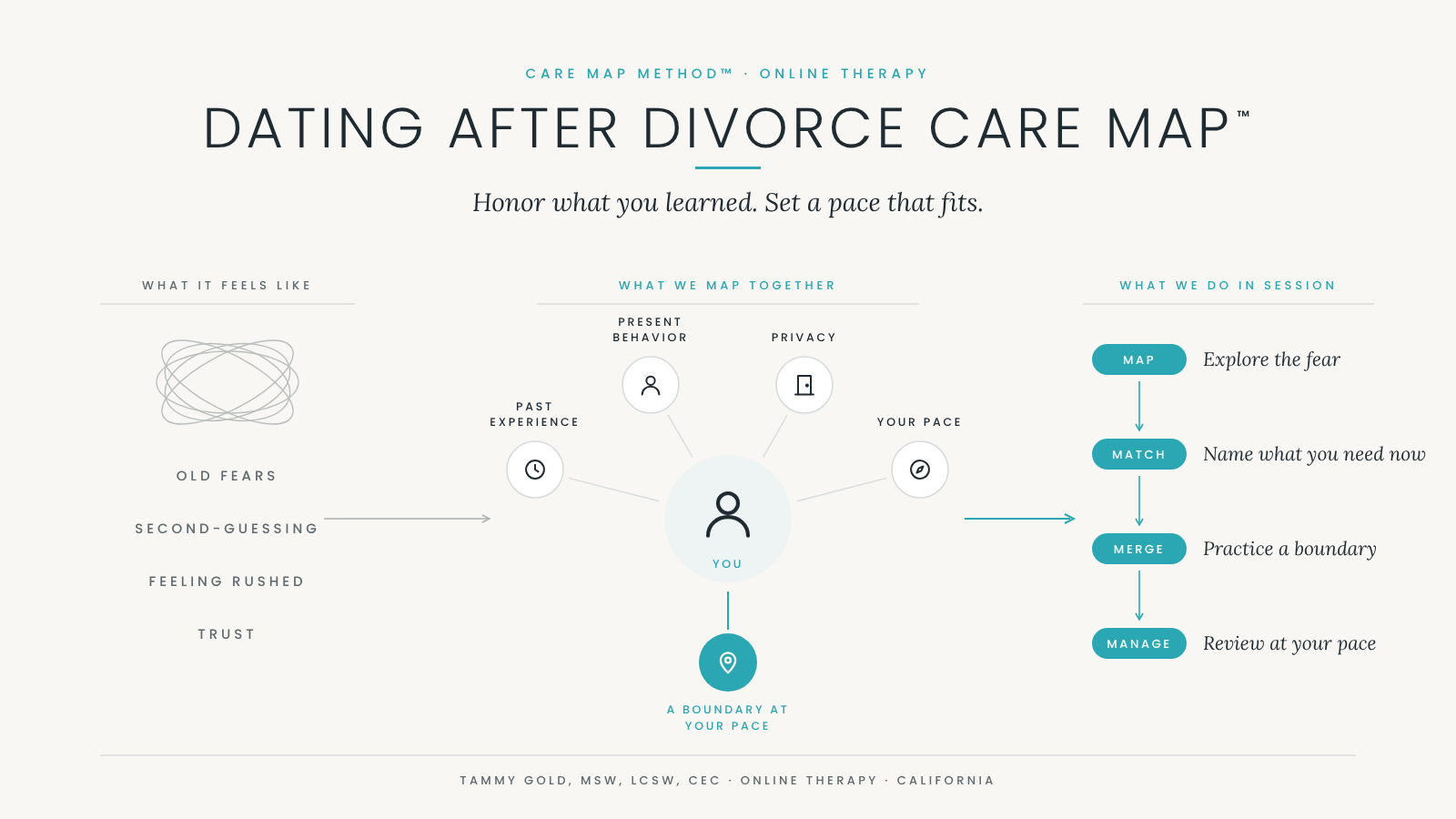
Online Therapy for Dating After Divorce in California
Dating after divorce can bring hope alongside uncertainty about trust and your own judgment. Online therapy in California offers support for processing past experiences, recognizing present concerns and practicing boundaries at a pace that fits you.
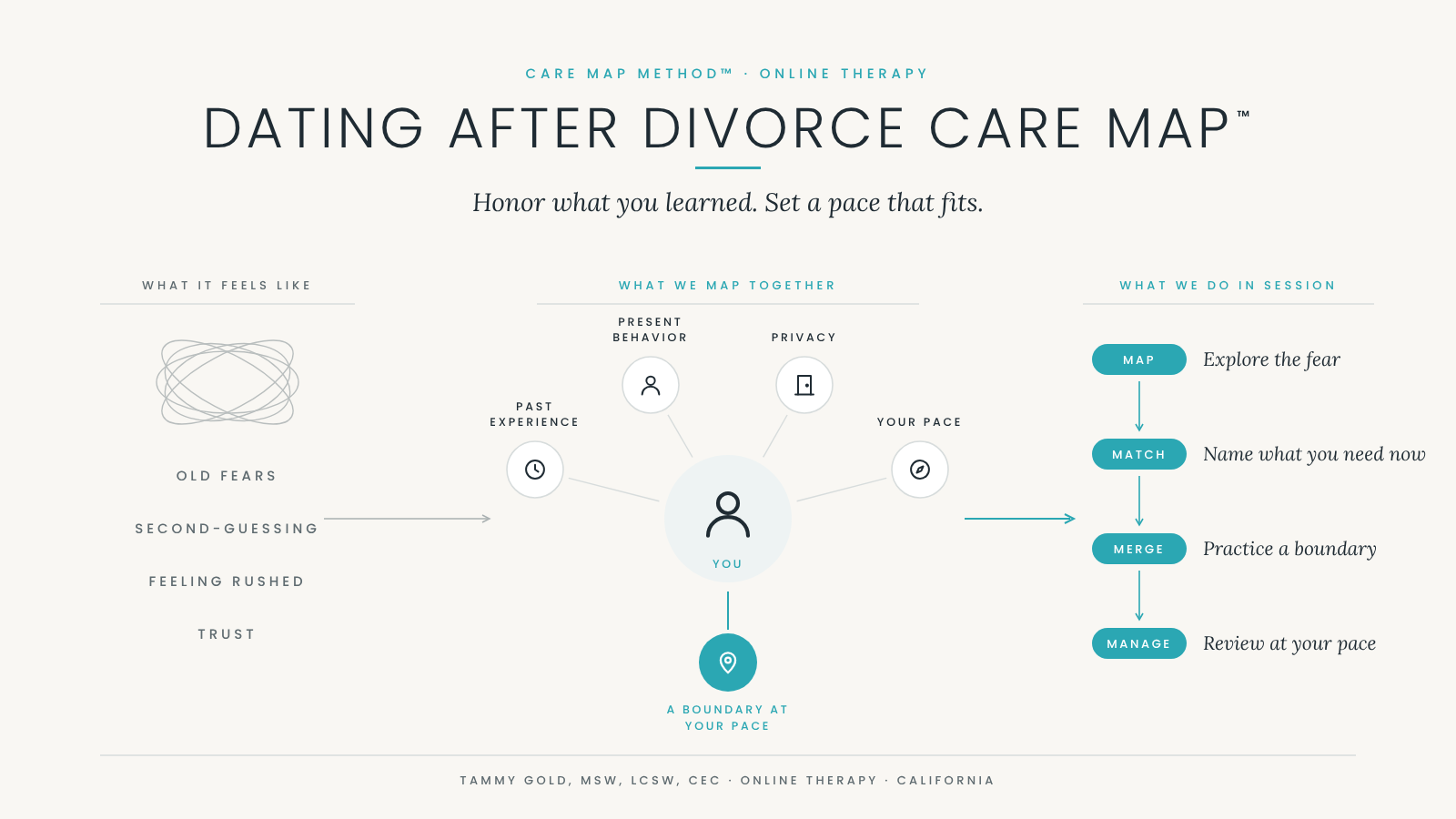
You may feel ready for connection and still find yourself questioning your judgment. A delayed message, new expectation or unfamiliar disagreement can bring up memories of what happened before.
I’m Tammy Gold. I offer individual online therapy for adults in California navigating relationship stress and life changes. We can explore what dating again means to you and what would help you participate with more awareness of your own needs.
Understand what you are carrying into the new situation
The goal is not to pretend the previous relationship did not happen. We can examine what you learned, what remains painful and how you distinguish a present concern from a fear based on earlier experience.
We will take actual behavior seriously. Therapy should not encourage you to overlook warning signs in order to appear trusting or optimistic.
Practice keeping a preference visible
Perhaps you want to move slowly, keep some personal information private or decline a plan without explaining your whole history. We can explore what makes that difficult.
A starting point might be, “I would like to keep getting to know you, and I need more time before taking that step.” We can consider how that fits your circumstances and what the response tells you about your options.
Make choices without accepting someone else’s timetable
Friends and relatives may have opinions about when you should date, whether you should remarry or how much caution is reasonable. We can explore those expectations alongside your own values.
You do not have to prove you have recovered by entering a new relationship. We can work on grief, confidence and boundaries while leaving the timing and decisions with you. If parenting or co-parenting is involved, we can discuss its emotional impact without providing legal advice.
What we can work on together in session
We can begin with a recent dating moment that triggered doubt and explore both your earlier experiences and the present person's actual behavior. For example, we might discuss whether a request to move faster conflicts with your preference or brings up pressure you recognize from a previous relationship. We will not ask you to ignore a current concern to prove you are ready to trust.
Then we can practice wording that fits your pace, such as, “I am interested in getting to know you, and I am not ready for that step.” We can explore the feelings that arise when you say it and what you want to notice afterward. A next step may be expressing one preference or giving yourself time to decide. Later sessions can examine the experience with curiosity rather than grade the date as a success or failure.
When a new connection brings an old fear
You might notice yourself expecting an argument after expressing a preference, apologizing before asking a question or searching for reassurance that the relationship is secure. We can explore when those responses developed and whether they fit what is happening now. Your past deserves attention without becoming the only explanation for every new experience.
You may also be grieving the life you expected to have, even while feeling interested in someone new. Those feelings can coexist. We can discuss the pressure to appear completely healed and what it would mean to be honest about your pace without sharing more than you want.
Make room for your present responsibilities
Dating may now involve parenting schedules, limited free time or concerns about how much family members should know. We can explore the emotional strain of balancing these responsibilities and how you want to communicate availability. An early goal might be stating a preference before resentment builds or recognizing a situation in which you need more information. Therapy cannot certify that a new partner is trustworthy; it can support your ability to consider what you observe and what you need.
A practical way to understand what is happening
My Care Map Method™ helps us look at Biological, Social, Environmental and Emotional factors alongside clinical assessment. We consider your health and energy, relationships, daily circumstances and emotional experience rather than isolate one difficult moment from the rest of your life. We MAP the need, MATCH appropriate support, MERGE that support into your circumstances and MANAGE the plan as we learn what is useful. This is an organizing framework within individualized therapy, not a promise of a particular result.
What your first session can include
You can bring one situation you want help understanding. We will discuss your concern, relevant history, symptoms, daily functioning and available support. You can tell me what has or has not helped before and what you need to feel comfortable talking. My aim is to offer empathy without judgment and begin exploring a practical next step, while allowing time for assessment. We will decide together whether my approach fits and which goals matter to you. You do not need to arrive knowing the right words or the solution.
About Tammy Gold
I’m Tamara “Tammy” Gold, MSW, LCSW, CEC. I earned my clinical MSW at Columbia University and my BA at the University of Pennsylvania. My work with families includes parenting, caregiving and difficult relationships. I bring empathy without judgment and a practical interest in helping you understand the problem and consider what comes next.
Frequently asked questions
Do I need to be ready for a serious relationship?
No. We can explore what you want and whether dating fits your life now.
Will therapy tell me when I should date?
There is no universal schedule. We can discuss your needs, circumstances and choices.
Can I discuss trust after a difficult marriage?
Yes, within treatment fit. Assessment helps determine whether additional specialized care is needed.
Do you provide dating or matchmaking services?
No. This page describes individual psychotherapy.
Can we discuss the impact on my children?
We can explore your parenting-related distress and choices. Children’s treatment or legal questions need separate appropriate services.
Can I use insurance in California?
Verify exact plan participation, assessed clinical needs and estimated costs through the appropriate active platform.
What if dating is harder than I expected?
We can explore what feels difficult, how it affects daily life and whether your current approach fits your needs. You do not have to force a particular pace.
Can I come if I am not currently dating?
Yes. We can work on your experience of divorce, relationship concerns and goals without requiring you to be using dating apps or seeing someone.
Booking and profile options
Choose a platform that shows current appointments for your physical location in California and your exact insurance plan. Availability and participation can differ across platforms.
Check availability and insurance on Grow Therapy
Check availability and insurance on Alma
Check availability and insurance on Headway
Read my profile or contact me on Psychology Today
Before confirming a visit, check the service, current provider participation, your exact benefits and estimated costs. Coverage depends on your plan and the assessed clinical service; a life event alone does not establish insurance eligibility. You must be physically located where I am authorized to provide care at each session.
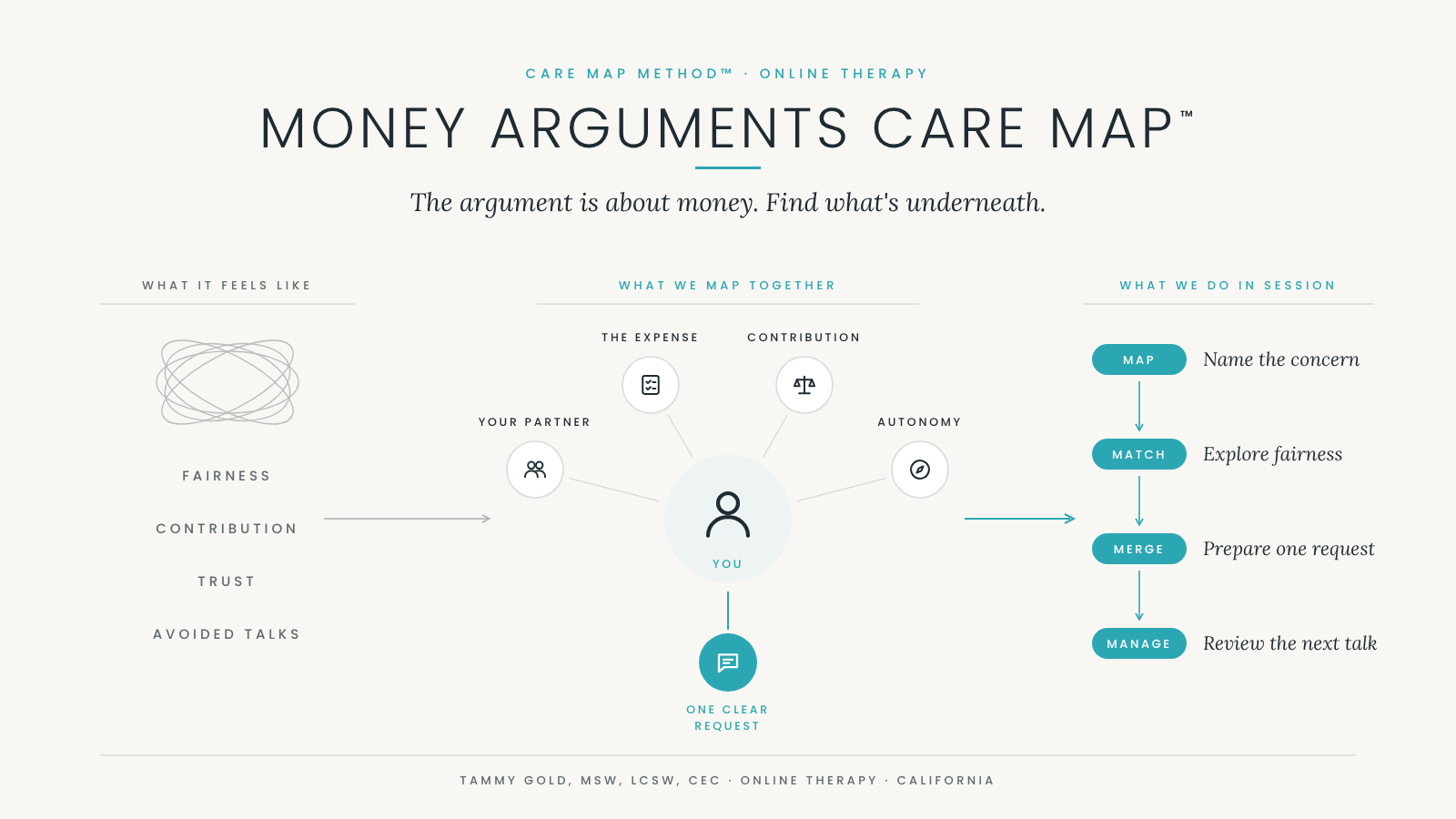
Individual Therapy for Money Arguments in California
Money disagreements can bring up deeper concerns about fairness, security and feeling valued. Individual online therapy in California can help you understand the emotional pattern, express your needs and prepare for a more focused conversation.
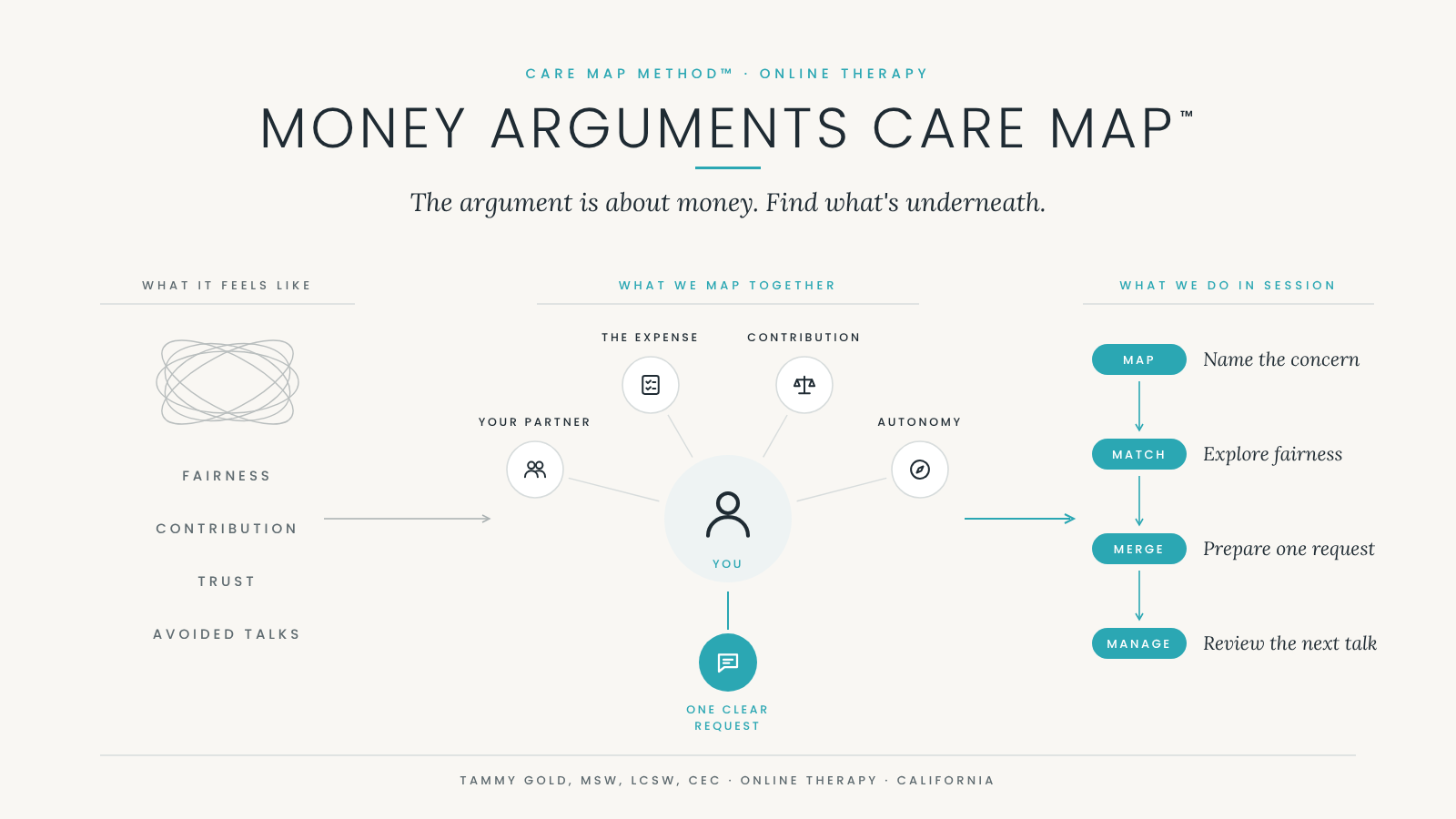
You may begin with a bill and end up arguing about fairness, trust or whether your contributions matter. Even when the numbers are clear, the emotional meaning can make the conversation hard to finish.
I’m Tammy Gold. I offer individual online therapy for adults in California. We can explore how financial conflict affects your mental health and prepare a clearer way to express the concern underneath it.
Look at what money represents to you
For one person, saving may mean safety. For another, being questioned about spending may feel like loss of autonomy. We can explore your history and the meanings attached to a recent disagreement without assuming everyone should have the same relationship with money.
Financial constraints are real. We will not treat practical hardship as something a different attitude alone can resolve.
Choose the part of the conversation you want to change
Perhaps you want to ask for a regular discussion rather than be questioned in the middle of a purchase. Perhaps you need to name the work you contribute that is not reflected in income.
An example might be, “When we discuss the expense, I also need us to discuss the responsibility and time around it.” We can explore what you want understood, how to state it and whether the setting supports a useful discussion.
Consider your response and your options
We can look at avoiding, overexplaining or becoming defensive, while taking the other person’s behavior seriously. Individual therapy cannot make a partner cooperate or settle a financial disagreement.
If money is being used to control access to necessities, restrict your choices or threaten you, tell your therapist. Safety and appropriate outside support may matter more than preparing another joint conversation. Investment, debt, tax and legal advice remain with qualified professionals.
What we can work on together in session
We can explore one money argument and identify the concern beneath it: security, fairness, independence, recognition or something else. We can map what you heard, what you felt and how the exchange escalated or shut down. We will also recognize practical financial pressures that cannot be resolved through communication alone.
If appropriate, we can rehearse a specific request, such as discussing a shared expense at an agreed time or including unpaid household work in a conversation about contribution. We can consider whether you feel able to disagree safely and what additional support may be needed. A next step could be preparing one question or identifying a boundary. We will review how it affects you without making your partner's cooperation the measure of whether your therapy is worthwhile.
When the same argument has several layers
You may be discussing a purchase while also feeling unseen as a caregiver, worried about debt or uncomfortable depending on someone else’s income. We can separate these concerns enough to understand them. A question about shared expenses may need a different response from a fear that you have no say in your own life.
Family experiences can shape what feels normal around saving, generosity, privacy and obligation. Exploring those experiences can help explain a reaction without excusing harmful behavior. We can also consider what happens before and after an argument: whether you avoid opening bills, repeatedly justify ordinary needs or lose sleep rehearsing the next discussion.
Find a useful starting point
Bring one recent exchange and the concern you wished you could express. We might work on naming the feeling, deciding what information you need or identifying a boundary that matters to you. If practical debt or budgeting help is needed, we can discuss the role of appropriate outside resources. Therapy supports your mental health alongside those practical needs; it does not replace the financial work or require you to minimize financial hardship.
A practical way to understand what is happening
My Care Map Method™ helps us look at Biological, Social, Environmental and Emotional factors alongside clinical assessment. We consider your health and energy, relationships, daily circumstances and emotional experience rather than isolate one difficult moment from the rest of your life. We MAP the need, MATCH appropriate support, MERGE that support into your circumstances and MANAGE the plan as we learn what is useful. This is an organizing framework within individualized therapy, not a promise of a particular result.
What your first session can include
You can bring one situation you want help understanding. We will discuss your concern, relevant history, symptoms, daily functioning and available support. You can tell me what has or has not helped before and what you need to feel comfortable talking. My aim is to offer empathy without judgment and begin exploring a practical next step, while allowing time for assessment. We will decide together whether my approach fits and which goals matter to you. You do not need to arrive knowing the right words or the solution.
About Tammy Gold
I’m Tamara “Tammy” Gold, MSW, LCSW, CEC. I earned my clinical MSW at Columbia University and my BA at the University of Pennsylvania. My work with families includes parenting, caregiving and difficult relationships. I bring empathy without judgment and a practical interest in helping you understand the problem and consider what comes next.
Frequently asked questions
Do you provide financial planning?
No. This page describes psychotherapy for emotional and relational distress, not financial advice.
Can I attend alone for money conflict?
Yes. You can work on your mental health, choices and communication individually.
Will you decide who spends too much?
No. We can examine your experience and its impact without becoming a financial arbitrator.
What if the problem is actual financial hardship?
We can support your mental health while recognizing practical needs may call for additional resources or professional advice.
Is this couples counseling?
No. Couples services and payment require a separate discussion. Relationship-only counseling is generally self-pay.
Can I use insurance?
Verify your California plan, active participation, estimated costs and the assessed clinical service before scheduling.
Can unequal income affect how I feel in the relationship?
Yes. We can explore feelings about contribution, dependence, power and autonomy while recognizing that income is only one part of a household’s responsibilities.
Can we discuss avoiding money conversations?
Yes. We can examine what makes them difficult, their effect on your well-being and what support you need before deciding whether and how to raise a concern.
Booking and profile options
Choose a platform that shows current appointments for your physical location in California and your exact insurance plan. Availability and participation can differ across platforms.
Check availability and insurance on Grow Therapy
Check availability and insurance on Alma
Check availability and insurance on Headway
Read my profile or contact me on Psychology Today
Before confirming a visit, check the service, current provider participation, your exact benefits and estimated costs. Coverage depends on your plan and the assessed clinical service; a life event alone does not establish insurance eligibility. You must be physically located where I am authorized to provide care at each session.
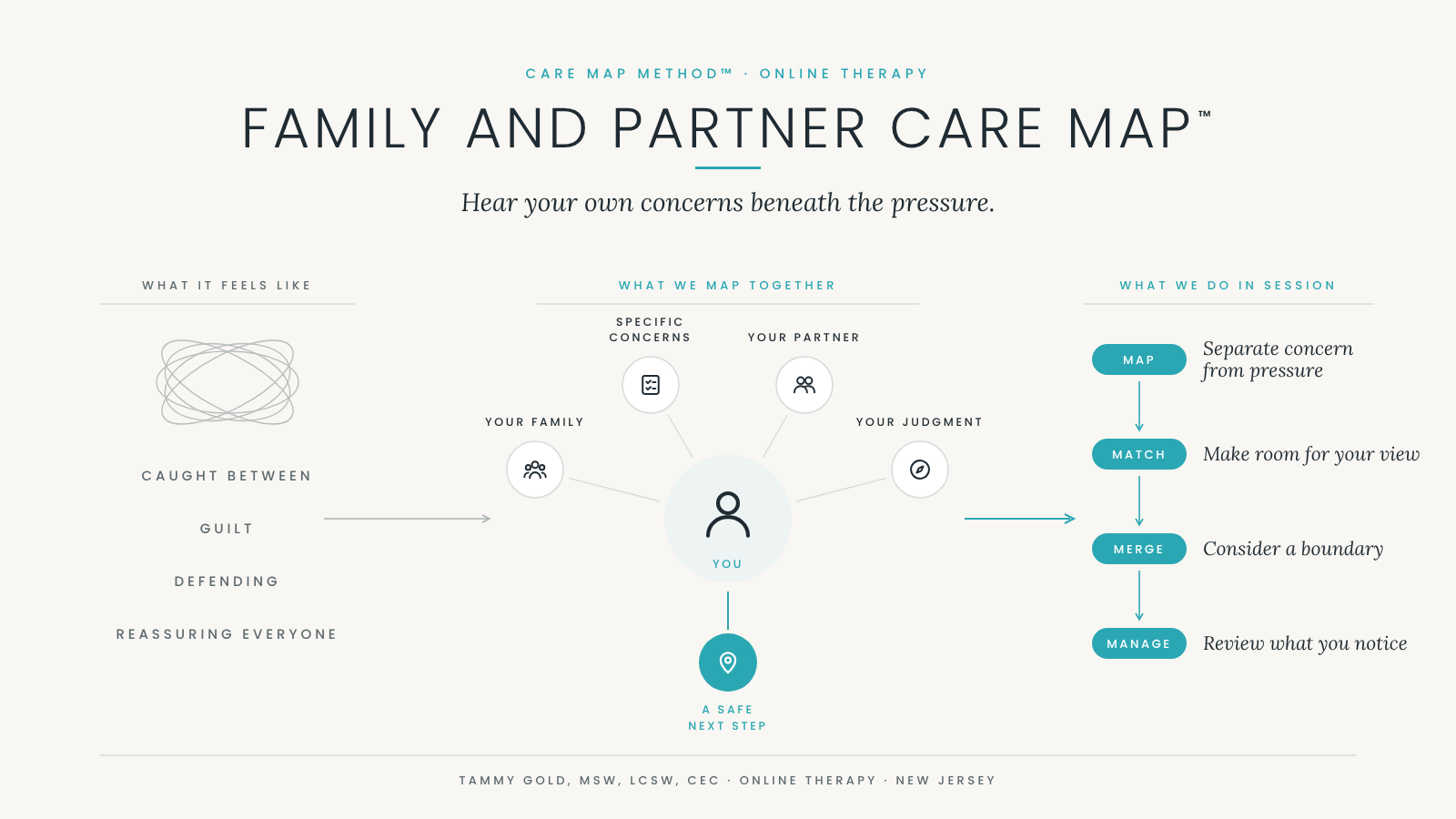
Individual Therapy When Family Disapproves of Your Partner in New Jersey
Sharing a home can bring unexpected tension about chores, privacy and responsibilities. Individual online therapy in Iowa can help you understand the feelings beneath recurring disagreements and practice clearer requests for what you need.
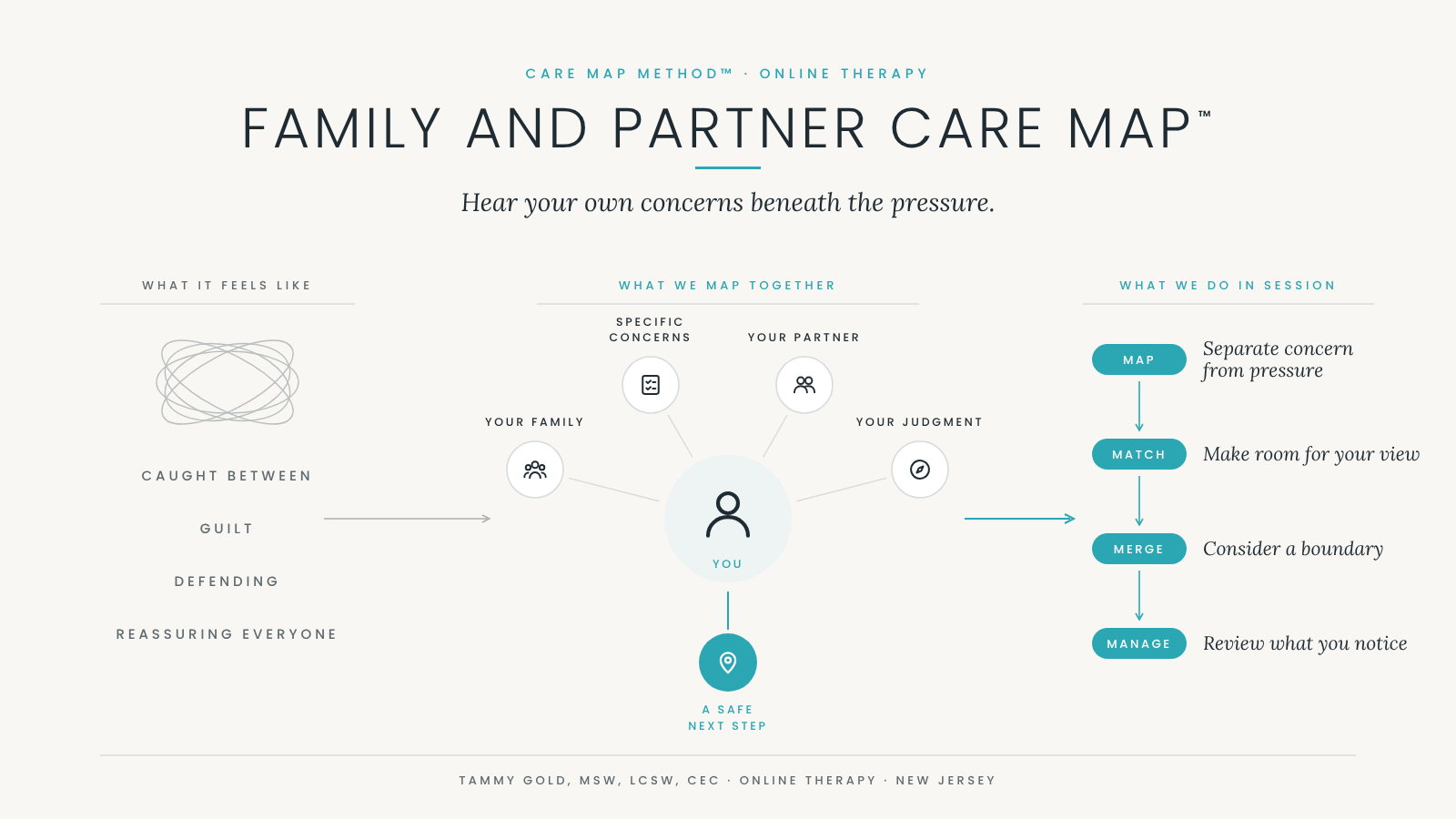
A conversation about your relationship can leave you feeling that you must defend your partner, reassure your family and somehow keep everyone close. You may feel guilty before you have even decided what you believe about their concerns.
I’m Tammy Gold. I offer individual online therapy for adults in New Jersey. We can explore your experience of the pressure and help you consider your own needs, observations and choices.
Separate the concerns from the pressure
Relatives may raise a specific behavior that deserves attention. They may also express expectations shaped by culture, religion or their own hopes for your life. Those are not automatically the same kind of concern.
We can examine what was said, what you have observed and what makes it difficult to think clearly. Therapy does not assume that the family is wrong or that the partner is right.
Give your own judgment room
Perhaps you want to say, “I am willing to discuss a specific concern, but repeated criticism is making it harder for me to hear you.” We can explore whether that request fits your circumstances and how you would respond if the conversation continues.
You may also need space to consider a concern privately rather than defend the relationship because you feel cornered. Understanding your response can help you make a choice you can stand behind.
Work on connection and limits together
We can discuss what you want to share, which conversations you will participate in and how the conflict affects your mental health. We will consider dependence on family resources, identity, cultural expectations and safety.
If there are threats, coercion or fear in either relationship, safety and appropriate support take priority. A generic communication script is not sufficient for every situation.
What we can work on together in session
We can take a recent family conversation and separate three things: what was actually said, what you believe about the concern and what you felt pressured to do. That distinction can create room to think when everyone seems to want an immediate answer. We can also consider the practical dependence, culture and relationship history shaping your options.
You might practice asking for a specific example, limiting repeated criticism or telling your partner you need time to consider a concern. We can discuss how you expect each person to respond and whether a conversation is safe and useful. A next step may be a boundary, a private reflection or a request for support. You remain the decision-maker; therapy does not require choosing a side to demonstrate progress.
When every gathering feels like a test
You may spend a family visit monitoring comments, preparing defenses or reassuring your partner afterward. Even an ordinary invitation can become a question about loyalty. We can explore the burden of managing everyone’s feelings and the assumptions that keep you in that role.
Sometimes the pressure comes from both directions. Your partner may want you to confront a relative immediately, while your family expects reassurance that nothing has changed. We can consider what you actually agree with, what you are still unsure about and what you need time to decide. Taking time to think can be meaningful when a conflict pushes you toward an instant answer.
Prepare for a conversation you choose
You might want to set a limit around criticism, ask for an example of a concern or tell your partner that a decision needs more discussion. We can explore the likely response and your practical options, including whether a conversation is safe and useful at all. The goal is to support your judgment and emotional well-being, rather than make you responsible for producing harmony among people with different wishes.
A practical way to understand what is happening
My Care Map Method™ helps us look at Biological, Social, Environmental and Emotional factors alongside clinical assessment. We consider your health and energy, relationships, daily circumstances and emotional experience rather than isolate one difficult moment from the rest of your life. We MAP the need, MATCH appropriate support, MERGE that support into your circumstances and MANAGE the plan as we learn what is useful. This is an organizing framework within individualized therapy, not a promise of a particular result.
What your first session can include
You can bring one situation you want help understanding. We will discuss your concern, relevant history, symptoms, daily functioning and available support. You can tell me what has or has not helped before and what you need to feel comfortable talking. My aim is to offer empathy without judgment and begin exploring a practical next step, while allowing time for assessment. We will decide together whether my approach fits and which goals matter to you. You do not need to arrive knowing the right words or the solution.
About Tammy Gold
I’m Tamara “Tammy” Gold, MSW, LCSW, CEC. I earned my clinical MSW at Columbia University and my BA at the University of Pennsylvania. My work with families includes parenting, caregiving and difficult relationships. I bring empathy without judgment and a practical interest in helping you understand the problem and consider what comes next.
Frequently asked questions
Will you tell me whether to choose my partner or family?
We can help you explore the decision without making it for you.
Can I come without either of them?
Yes. This page describes individual psychotherapy.
Can cultural or religious expectations be discussed?
Yes. We can explore their meaning for you without assuming that one approach fits every family.
What if my family has noticed something concerning?
We can examine specific observations seriously rather than automatically dismiss them as interference.
Is this mediation?
No. We are not negotiating a family agreement or evaluating people who are not clients.
Does insurance cover relationship pressure?
The situation alone does not determine coverage. Eligibility depends on assessed clinical needs, the service and your exact plan.
Can I set limits and still value my family?
We can explore what connection and limits mean in your family and culture. A limit does not have to begin with deciding that someone no longer matters.
What if I agree with part of their criticism?
You can discuss that uncertainty openly. Therapy can offer space to consider a concern without requiring you to defend or reject the entire relationship.
Booking and profile options
Choose a platform that shows current appointments for your physical location in New Jersey and your exact insurance plan. Availability and participation can differ across platforms.
Check availability and insurance on Grow Therapy
Check availability and insurance on Alma
Check availability and insurance on Headway
Read my profile or contact me on Psychology Today
Before confirming a visit, check the service, current provider participation, your exact benefits and estimated costs. Coverage depends on your plan and the assessed clinical service; a life event alone does not establish insurance eligibility. You must be physically located where I am authorized to provide care at each session.
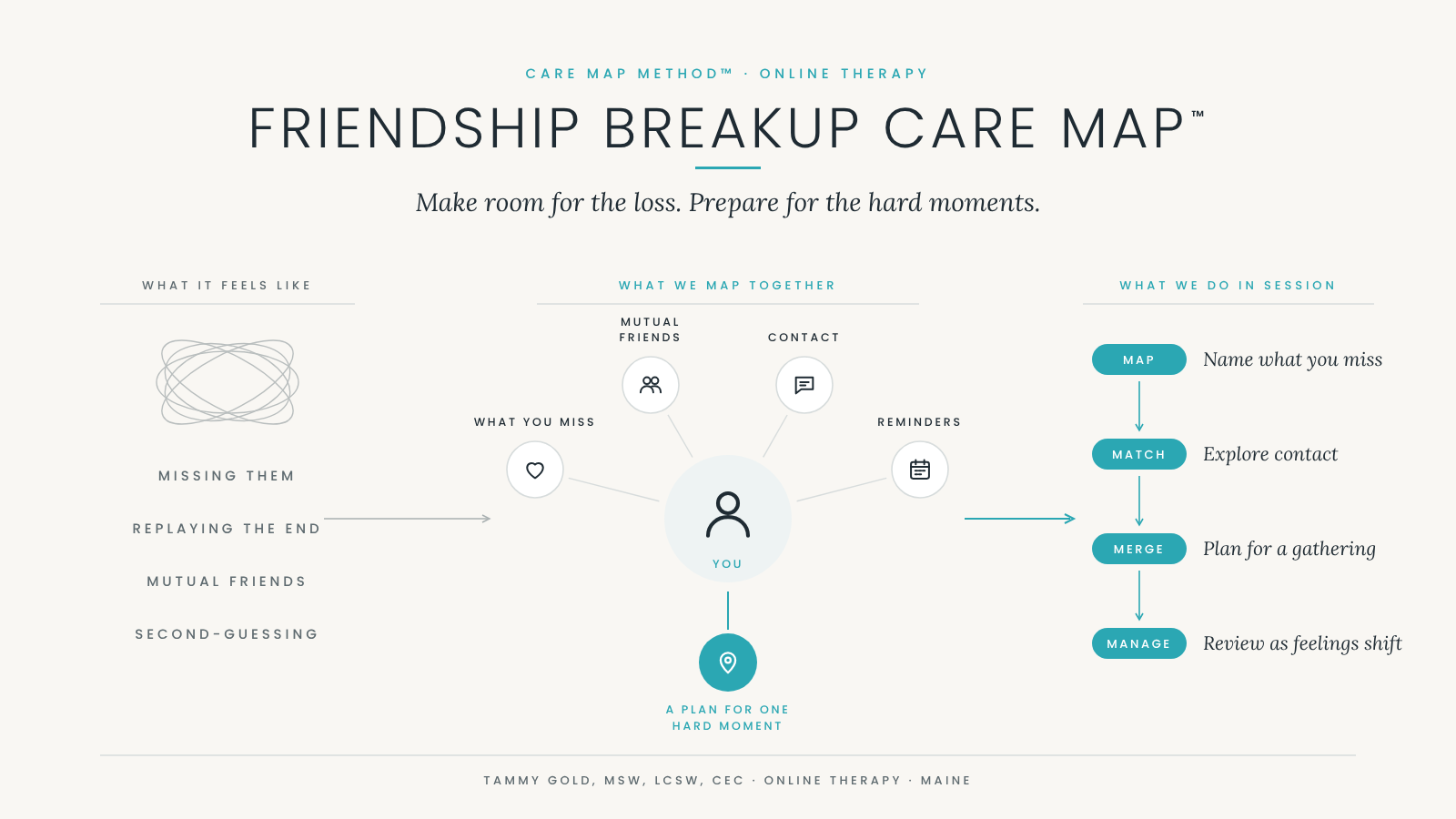
Online Therapy After a Friendship Breakup in Maine
Losing a friendship can bring grief, self-doubt and uncomfortable situations with mutual friends. Online therapy in Maine offers space to process the ending, consider boundaries and prepare for the moments that feel hardest.
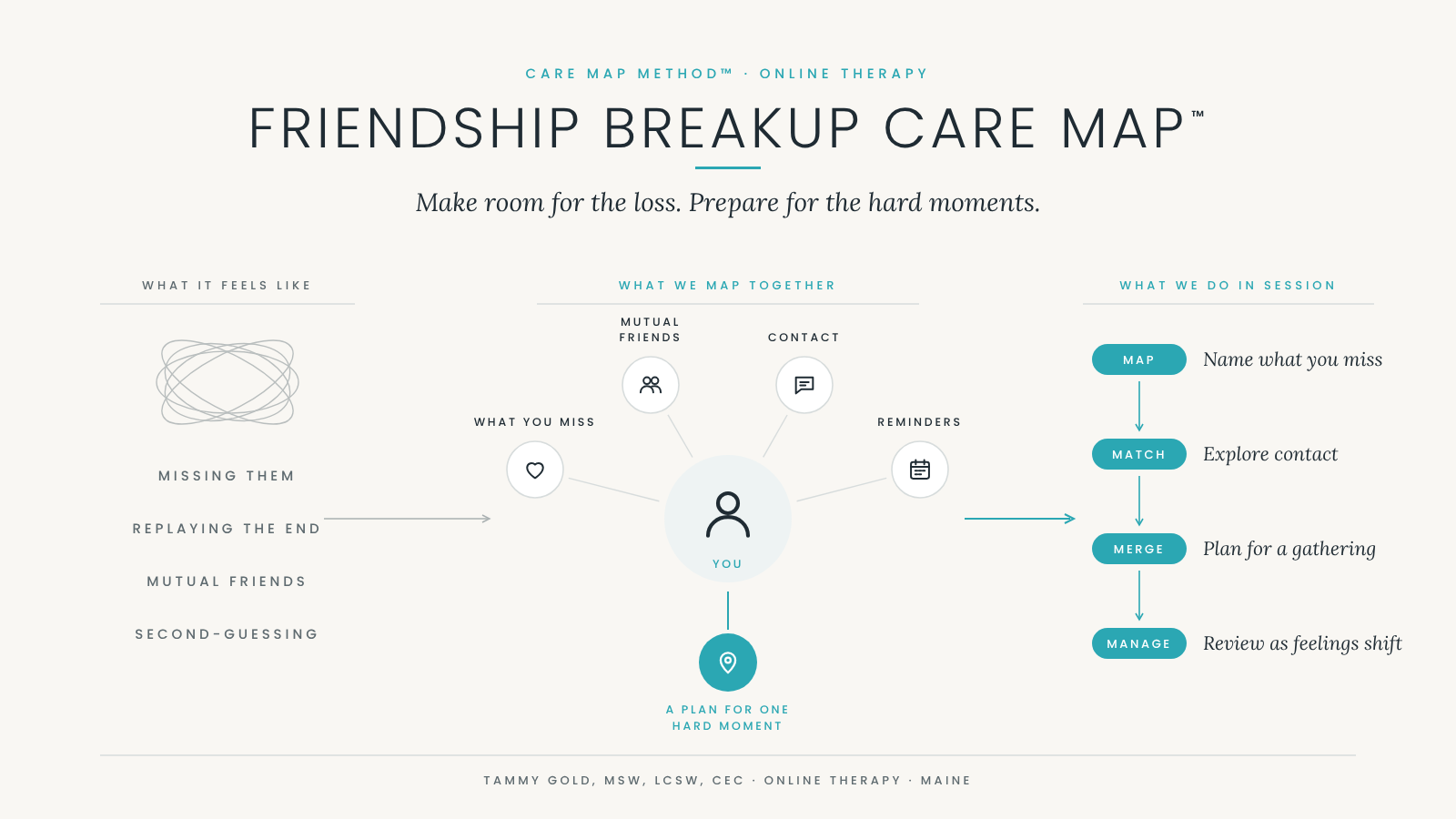
Maine Therapy, Friendship Breakup, Friendship Grief, Relationship Boundaries
You may miss the person you used to call first. You may also feel embarrassed that the ending has affected you so much. When people minimize friendship loss, it can become difficult to explain why a photograph, mutual invitation or unanswered message stays with you.
I’m Tammy Gold. I offer individual online therapy for adults in Maine. We can make room for the loss and explore how it is affecting your sense of trust, connection and daily life.
Understand what you lost
The ending may involve more than contact with one person. You might miss shared routines, a social circle or the feeling of being known. We can explore those meanings without requiring you to justify the length of the friendship or prove who was entirely at fault.
If you keep replaying the final exchange, we can distinguish questions that may be answerable from questions the other person may never resolve for you.
Consider contact without making it the only path
Perhaps you want to send a long explanation. We might discuss what you hope it will accomplish, what response you can realistically expect and how you would care for yourself if no response comes.
We can also explore accountability and regret where they fit. Understanding your part does not mean accepting responsibility for every part of the relationship.
Rebuild connection at your own pace
You do not have to replace the friendship immediately. We can consider the supports you already have, how mutual friendships feel and what boundaries would help at shared events. An early goal could be expressing the loss to a trusted person or deciding how to handle reminders, rather than forcing yourself to stop caring.
What we can work on together in session
We can begin with a recent reminder of the friendship and explore what made it painful. Was it missing companionship, feeling excluded, regretting something you said or not knowing why the relationship changed? Naming the specific loss helps us choose a useful focus instead of asking you to stop thinking about the person.
If a shared gathering is approaching, we can rehearse how you want to respond to questions, decide what you prefer to keep private and identify someone you can contact afterward. If you are considering a message, we can explore your purpose and expectations before deciding whether to send it. A next step might be one sentence you feel comfortable saying or a support plan for the event. We can revisit that plan as your feelings and circumstances change.
When the ending affects your other friendships
You may be deciding whether to attend a birthday gathering, mute a group conversation or explain why you have been quieter. Each choice can feel loaded when you are worried about being discussed or asked to take sides. We can explore what you want people to know and what you would prefer to keep private. You do not owe every mutual friend the full story.
Sometimes the harder part is comparing the friendship you remember with the way it ended. You may miss the closeness and still recognize patterns that hurt you. Therapy can hold both experiences without requiring you to label the whole friendship good or bad.
Notice what support looks like now
We might consider who can listen without pushing you toward reconciliation, where you still feel comfortable showing up and how you want to respond to an unexpected reminder. An early step could be deciding what to say if someone asks about your former friend. We can revisit that choice as your feelings change. There is no requirement to stop missing someone before you are allowed to invest in your present life.
A practical way to understand what is happening
My Care Map Method™ helps us look at Biological, Social, Environmental and Emotional factors alongside clinical assessment. We consider your health and energy, relationships, daily circumstances and emotional experience rather than isolate one difficult moment from the rest of your life. We MAP the need, MATCH appropriate support, MERGE that support into your circumstances and MANAGE the plan as we learn what is useful. This is an organizing framework within individualized therapy, not a promise of a particular result.
What your first session can include
You can bring one situation you want help understanding. We will discuss your concern, relevant history, symptoms, daily functioning and available support. You can tell me what has or has not helped before and what you need to feel comfortable talking. My aim is to offer empathy without judgment and begin exploring a practical next step, while allowing time for assessment. We will decide together whether my approach fits and which goals matter to you. You do not need to arrive knowing the right words or the solution.
About Tammy Gold
I’m Tamara “Tammy” Gold, MSW, LCSW, CEC. I earned my clinical MSW at Columbia University and my BA at the University of Pennsylvania. My work with families includes parenting, caregiving and difficult relationships. I bring empathy without judgment and a practical interest in helping you understand the problem and consider what comes next.
Frequently asked questions
Is friendship loss a legitimate reason to seek help?
You can ask for support when a relationship loss affects your well-being. Assessment helps establish the care that fits.
Will you tell me to reconnect?
There is no predetermined outcome. We can explore contact, distance and your own participation.
Can I attend if the ending was partly my fault?
Yes. Therapy can include responsibility, regret and learning without reducing you to a mistake.
Can we work on mutual-friend situations?
Yes. We can examine the emotions and choices involved in invitations, shared spaces and conversations.
Is this mediation with my former friend?
No. This page describes individual psychotherapy, not a process for resolving the dispute between you.
Does insurance cover friendship grief?
The event alone does not establish coverage. Verify benefits and estimated costs, and discuss assessed clinical needs before starting.
What if I keep looking at their social media?
We can explore what you hope to find, how checking affects you and what limits you would like to try. The goal is understanding, rather than blaming you for missing someone.
Can I grieve a friendship I chose to end?
Yes. Choosing distance does not erase attachment, sadness or uncertainty. We can discuss both the reasons you left and what you miss.
Booking and profile options
For appointments while you are in Maine, please use Alma while enrollment on other platforms is pending. The other profiles below are available for reference; they do not confirm appointments or insurance participation in this state.
Check availability and insurance on Grow Therapy
Check availability and insurance on Alma
Check availability and insurance on Headway
Read my profile or contact me on Psychology Today
Before confirming a visit, check the service, current provider participation, your exact benefits, and estimated costs. Coverage depends on your plan and the assessed clinical service; a life event alone does not establish insurance eligibility. You must be physically located where I am authorized to provide care at each session.
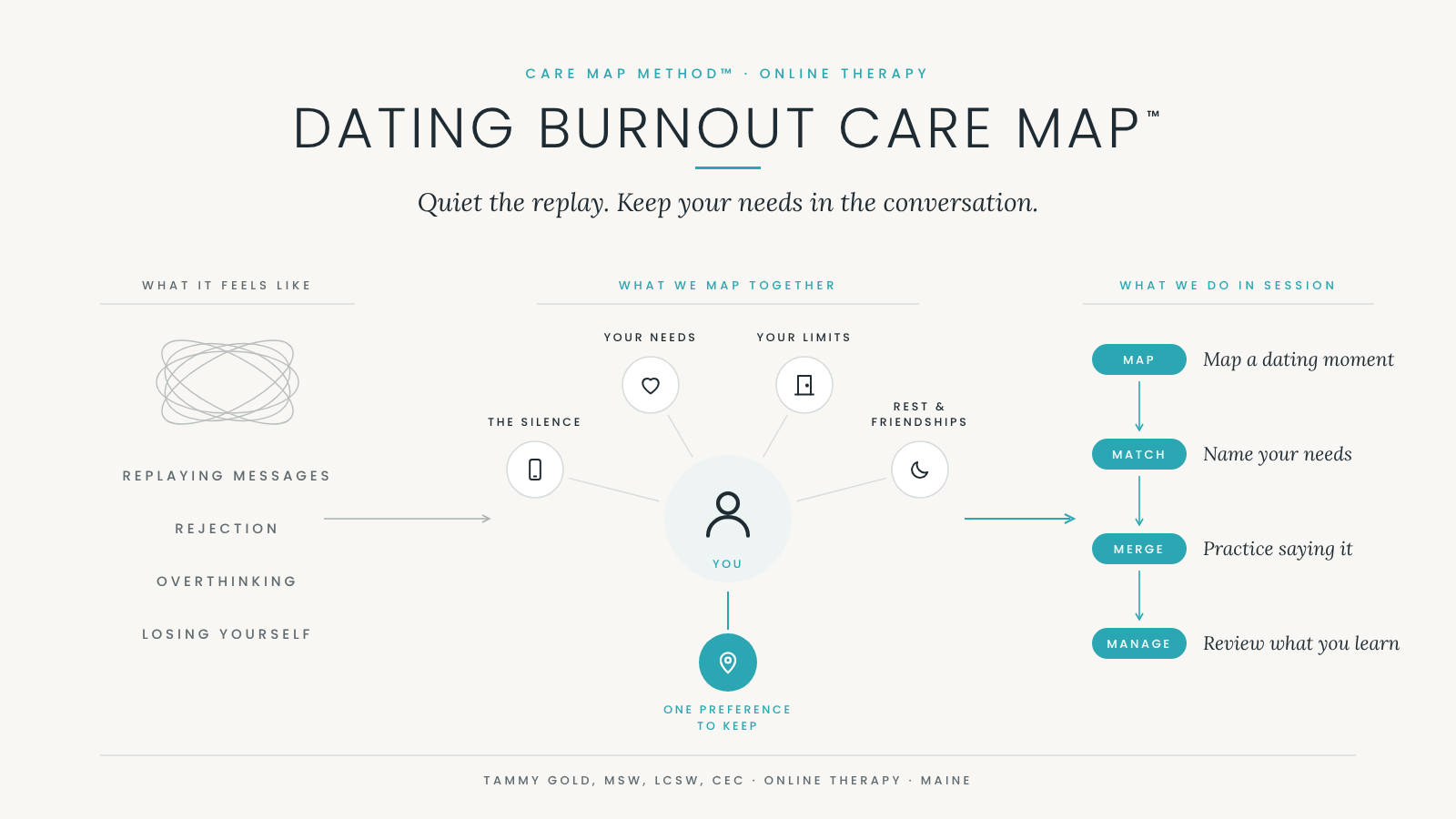
Dating feels exhausting. Your needs still matter.
Dating apps, unanswered messages and repeated disappointment can leave you questioning yourself. Explore online therapy in Maine to understand relationship patterns, practice boundaries and take practical steps that keep your needs in the picture.
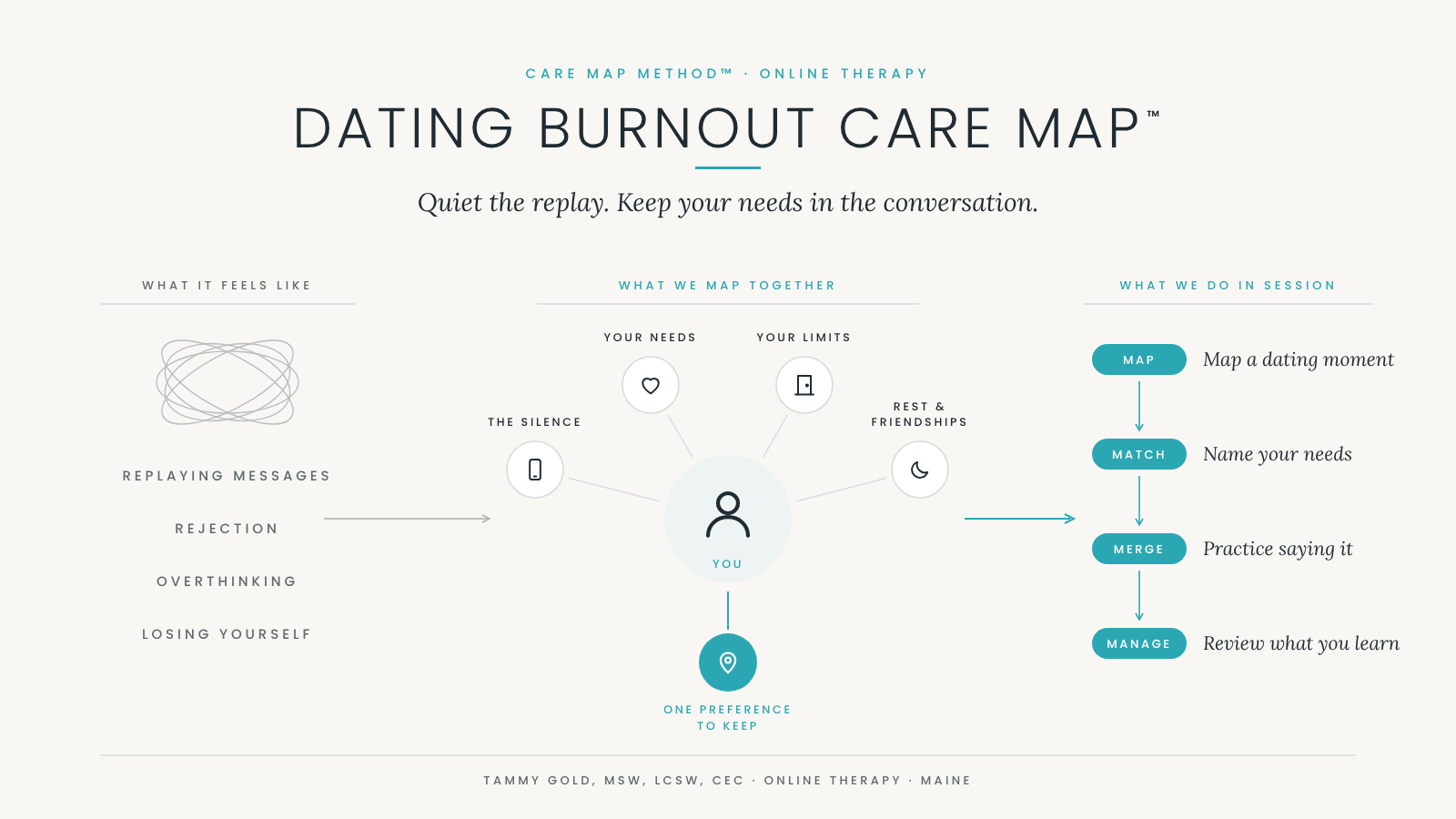
You may want a relationship while dreading another introduction, unanswered message or disappointing date. Perhaps you keep checking your phone, questioning what you said or trying to become the person you think someone else wants.
I’m Tammy Gold. I offer individual online therapy for adults physically located in Maine. We can explore the impact dating is having on your mental health and work toward choices that feel more consistent with your needs.
Check Maine Appointments on Alma
Understand the cycle around a disappointment
We might begin with one recent exchange. What happened? What did you conclude about yourself? What did you do to feel more certain afterward? Repeatedly reviewing a message can feel like problem-solving while leaving the same question unresolved.
We can examine your expectations, experiences and relationship patterns without assuming every disappointment has the same cause. Your circumstances and the behavior of the people you meet matter too.
Keep your preferences in the conversation
Perhaps you agree to plans you do not want because you fear losing the connection. We can explore that fear and practice a response such as, “I would like to see you again, but that time does not work for me.” The words should fit your situation rather than become another performance to get right.
Taking a break, changing how you participate or continuing with clearer limits are possibilities to explore. Therapy does not prescribe a particular relationship timeline.
Give the rest of your life room
We can discuss how dating affects rest, friendships and concentration. An early goal might be recognizing when you are setting aside a preference or spending less time trying to interpret silence. Those goals concern your well-being; another person’s response remains outside your control.
What we can work on together in session
We can take one recent dating exchange and map the sequence: what happened, what you told yourself it meant, what you felt and what you did next. For example, an unanswered message may lead to self-criticism, repeated checking and canceling your own plans in case the person replies. We can explore where you have a choice in that sequence without dismissing the disappointment.
Then we can practice a response that reflects your needs, such as expressing a scheduling preference or choosing when to stop checking for the evening. If it fits, you might leave with one boundary or small experiment to try. In a later session, we can review what happened, what felt difficult and what needs adjusting. The work focuses on your well-being and participation in dating; it does not depend on securing a particular person's interest.
When dating stress turns into self-criticism
A disappointing exchange can quickly become a much larger story: “I am always too much,” “Nobody will choose me,” or “I should have known better.” We can slow down that story and consider what you actually know, what you are assuming and which older experiences make the moment especially painful. You do not need to become indifferent to wanting love to take your own feelings seriously.
We can also explore the difference between choosing connection and trying to earn reassurance. That might mean noticing when you cancel your own plans to remain available, ignore a preference or keep checking an app after you have stopped enjoying it. Rather than set a rule you must follow perfectly, we can choose one situation to understand and review what happens.
Bring the question you are already asking
You might begin with, “Why do I feel rejected before I know this person?” or “How can I take a break without feeling I am giving up?” You do not need a polished explanation. We can start with the conversation, feeling or pattern that brought you here and decide together what support would be useful.
A practical way to understand what is happening
My Care Map Method™ helps us look at Biological, Social, Environmental and Emotional factors alongside clinical assessment. We consider your health and energy, relationships, daily circumstances and emotional experience rather than isolate one difficult moment from the rest of your life. We MAP the need, MATCH appropriate support, MERGE that support into your circumstances and MANAGE the plan as we learn what is useful. This is an organizing framework within individualized therapy, not a promise of a particular result.
What your first session can include
You can bring one situation you want help understanding. We will discuss your concern, relevant history, symptoms, daily functioning and available support. You can tell me what has or has not helped before and what you need to feel comfortable talking. My aim is to offer empathy without judgment and begin exploring a practical next step, while allowing time for assessment. We will decide together whether my approach fits and which goals matter to you. You do not need to arrive knowing the right words or the solution.
About Tammy Gold
I’m Tammy Gold, MSW, LCSW, CEC. I earned my clinical MSW at Columbia University and my BA at the University of Pennsylvania. My work with families includes parenting, caregiving and difficult relationships. I bring empathy without judgment and a practical interest in helping you understand the problem and consider what comes next.
Frequently asked questions
Can I come even if I am single?
Yes. Individual therapy can address your distress, self-understanding and relationship choices without requiring a partner.
Will you tell me which dating app to use?
We can explore your experience of dating. This is psychotherapy, not a matchmaking or profile-management service.
Does rejection mean something is wrong with me?
One person’s response does not provide a complete explanation of you. We can examine what rejection brings up without dismissing its impact.
Will therapy help me find a partner?
We can work on your mental health and choices. We cannot guarantee attraction, compatibility or a relationship.
Can we discuss boundaries and intimacy?
Yes, within treatment fit, your comfort and the scope of individual care.
Can I use insurance in Maine and other states?
Check your exact plan and estimated costs through my active Alma profile. Coverage also depends on the assessed clinical service.
Can we work on overthinking after dates?
Yes. We can explore the thoughts, feelings and checking habits that follow a date, then consider responses that support your well-being.
Do I have to stop dating while in therapy?
No. We can discuss continuing, changing your approach or taking a break based on your circumstances and preferences.
Booking and profile options
For appointments while you are in Maine, please use Alma while enrollment on other platforms is pending. The other profiles below are available for reference; they do not confirm appointments or insurance participation in this state. Therapy on these platforms below
Check availability and insurance on Grow Therapy
Check availability and insurance on Alma
Check availability and insurance on Headway
Read my profile or contact me on Psychology Today
Before confirming a visit, check the service, current provider participation, your exact benefits and estimated costs. Coverage depends on your plan and the assessed clinical service; a life event alone does not establish insurance eligibility. You must be physically located where I am authorized to provide care at each session.
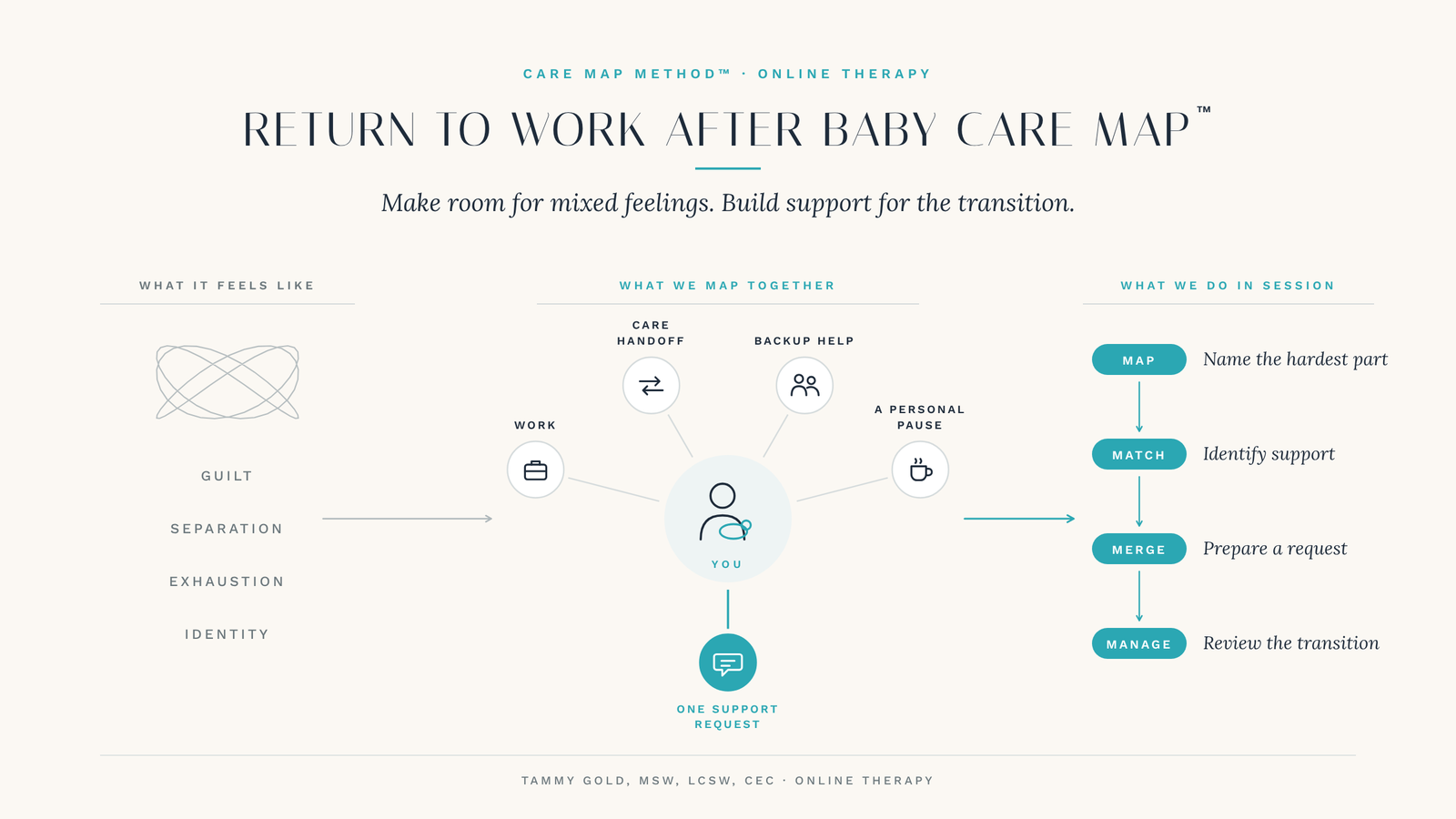
Returning to work after a baby and feeling torn
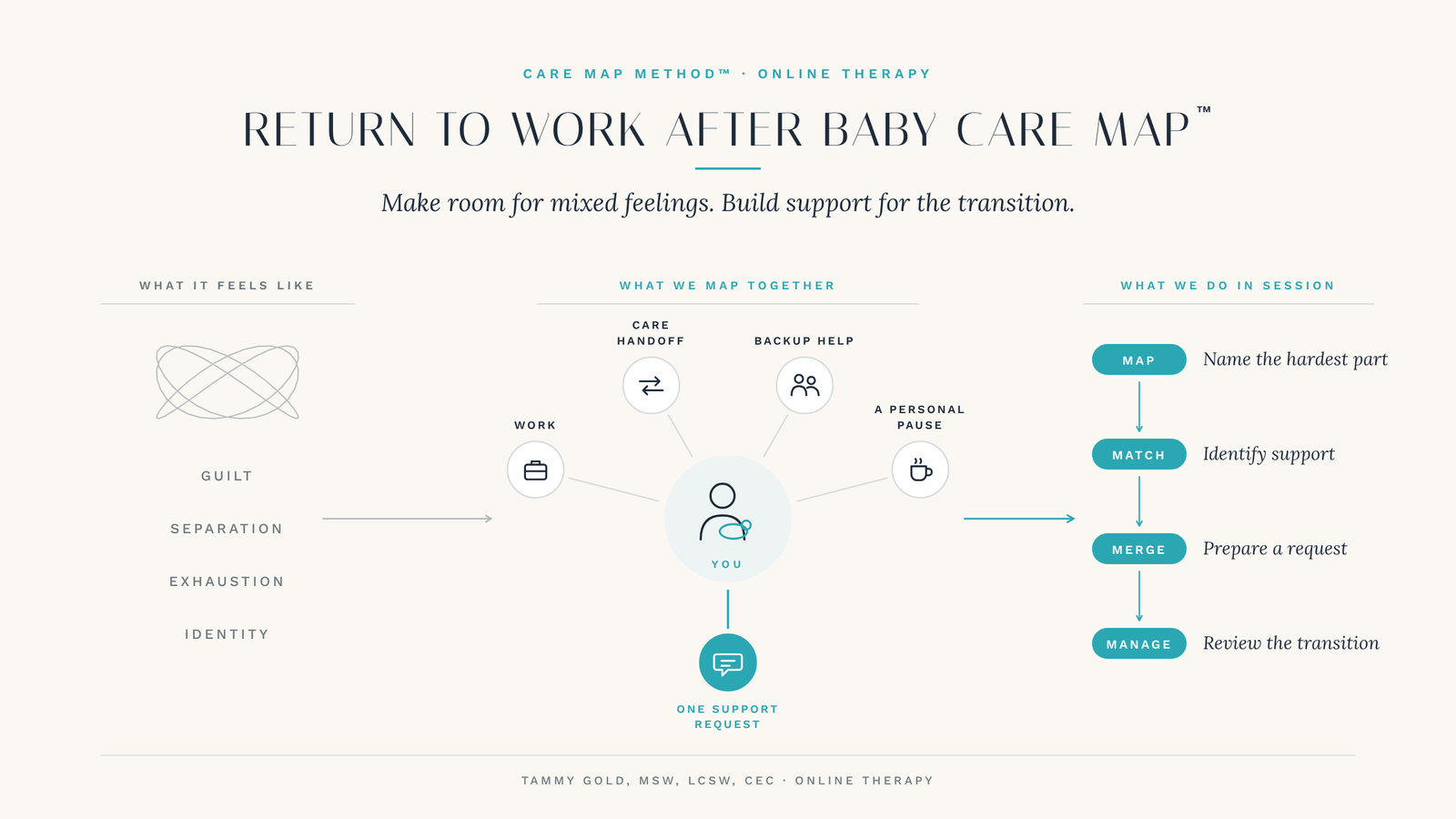
An adult caregiver preparing a work bag near baby supplies in a calm home setting.
You may want to return to work and still feel guilty about leaving your baby with someone else. You may also worry about performing well, managing care arrangements or being expected to carry the same workload at home.
I’m Tammy Gold. I offer individual online therapy for adults navigating parenting and relationship stress. If you will be physically located in Oregon for sessions, ask about current availability and payment options.
Separate the decisions from the judgment
A childcare decision can become a question about whether you are a good parent. A work adjustment can feel like evidence that you are no longer capable. We can explore those meanings while considering the practical realities around you.
We will discuss symptoms, functioning, support and relevant history. Persistent or worsening mood symptoms after birth also deserve attention from your health care team and appropriate mental health assessment.
Work on one transition you can prepare for
Perhaps the hardest moment is the first drop-off, asking your partner to take responsibility for care coordination or talking with a manager about returning expectations.
We can identify what feels difficult and practice a clear request. An example might be, “I need us to divide the planning and backup care, not only the drop-offs.” This is illustrative language; your plan will reflect your actual relationships and resources.
Give your own adjustment room
You may be grieving time at home, relieved to return, resentful about limited options or unsure who you are in this new arrangement. Therapy can provide space for those feelings without prescribing one correct parenting or career choice.
My Care Map Method™ organizes Biological, Emotional, Social and Environmental pressures. We map the transition, match appropriate support, merge manageable steps into the work and care routine and manage the plan as needs change.
Clarify what therapy can provide
This page describes psychotherapy for the adult’s mental health. Childcare selection consulting is a separate service, and medical advice about the baby remains with the baby’s clinician. If your symptoms call for specialized perinatal treatment, we will discuss a suitable referral.
At intake, we will agree on realistic goals and explain the treatment and payment arrangements. You can begin with one part of the return that you are finding hard to face.
Questions about starting therapy
Can I want to work and still feel guilty? Yes. We can explore those feelings and their meaning without requiring you to defend your career or parenting choices.
Is this childcare placement? No. Psychotherapy and childcare consulting are separate services with different goals and payment arrangements.
Will you tell me which care arrangement is best? We can explore your emotional response and values. This therapy page does not promise a childcare evaluation or placement.
Can non-birthing parents attend? Yes, when their own adjustment and mental health needs fit individual treatment.
What if I need postpartum specialist care? We will assess clinical fit and discuss appropriate specialized support or referrals.
Can I book from Oregon? Ask about current Oregon availability and confirm exact plan participation and estimated costs before scheduling.
Ask about current availability, clinical fit and payment options. Confirm the state where you will be located before scheduling.
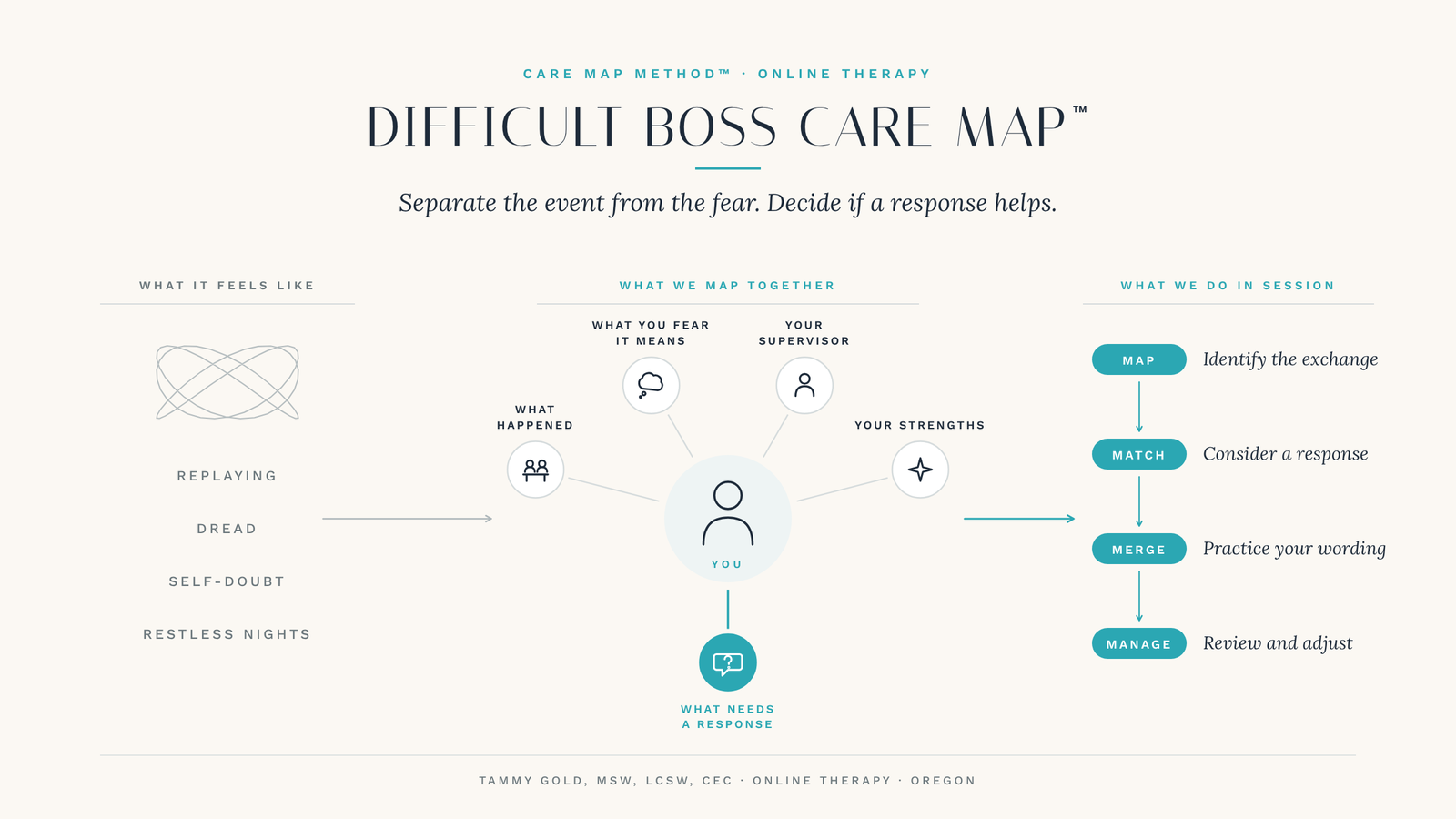
When criticism from your boss takes over the evening
The meeting ended, but you are still defending yourself in your head. You may replay a supervisor’s tone, wonder how coworkers interpreted the exchange or spend the evening rewriting a response you never send.
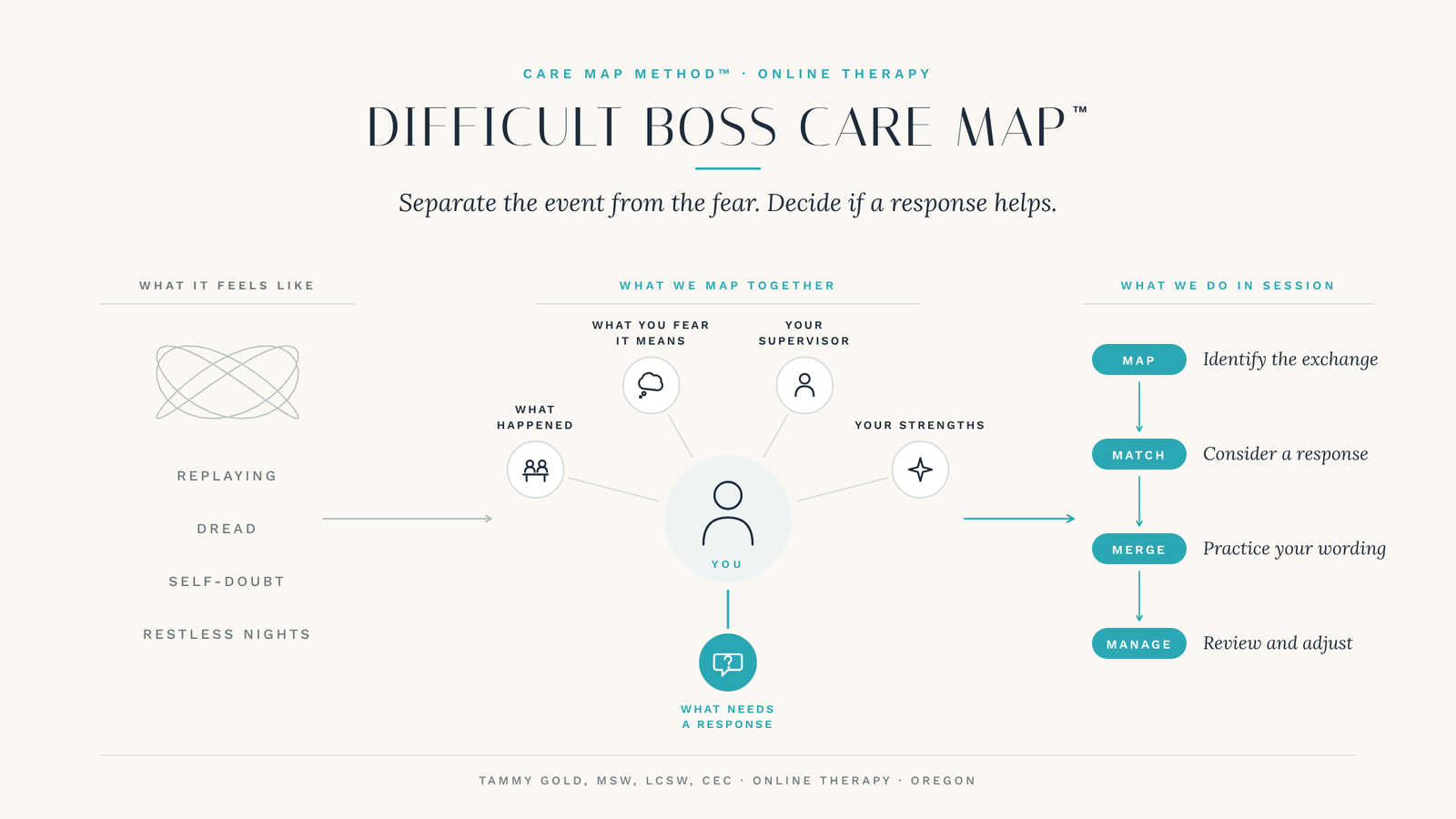
The meeting ended, but you are still defending yourself in your head. You may replay a supervisor’s tone, wonder how coworkers interpreted the exchange or spend the evening rewriting a response you never send.
I’m Tammy Gold. I offer individual online therapy for adults in Oregon. We can explore how difficult workplace interactions affect your mental health and develop a response grounded in your circumstances.
Look at the exchange without filling in every blank
We can begin with what was actually said or done. What was useful feedback? What was unclear, dismissive or inappropriate? What are you afraid the interaction means for your job or for how others see you?
This work does not assume that the environment is fair. It helps us distinguish the practical concern from the conclusions that may be keeping the event active in your mind. We will consider power, money and your responsibilities as well as feelings.
Choose whether a response is needed
Sometimes clarification is useful: “I want to make sure I understand the change you are asking for.” Sometimes a pause gives you time to decide what you actually want to address.
We can practice wording, explore what makes it difficult to use and discuss appropriate outside support when a concern involves workplace rights or policy. Therapy is not an investigation of your employer or a substitute for legal advice.
Understand the urge to keep reviewing
Replaying the exchange may feel like preparing, proving your position or preventing another mistake. We can explore whether it helps you decide what to do or leaves you caught in the same argument.
My Care Map Method™ organizes Biological, Emotional, Social and Environmental factors. We map the interaction and aftermath, match a strategy to your needs, merge a practice into the workweek and manage the plan as we review it.
Set goals around your well-being
You might want to ask a question with less avoidance, spend less time mentally defending yourself or become clearer about your options. We will assess symptoms and functioning and decide together whether my approach is a fit.
Your employer does not need to participate in individual therapy. We will discuss confidentiality and its exceptions, and any proposed communication with another professional would follow the appropriate consent process.
Questions about starting therapy
Is the goal to stop caring about my work? No. We can explore how to care about your responsibilities without allowing one interaction to occupy all of your attention.
Will you tell me to confront my supervisor? There is no prescribed response. We will consider your role, risks and realistic options.
Can you decide whether I was bullied? We can examine behavior and its impact, but therapy is not an employer investigation or legal determination.
Can I work on coworker conflict too? Yes, when the effect on your mental health fits the practice. The focus remains your experience and choices.
Is burnout automatically an insurance diagnosis? No. Assessment determines clinical needs; coverage depends on the service, plan and active participation.
Which Oregon insurance route should I use? Use only the platform and plan currently verified for you. A brand name in an old article does not establish current coverage.
Ask about current availability, clinical fit and payment options. Confirm the state where you will be located before scheduling.
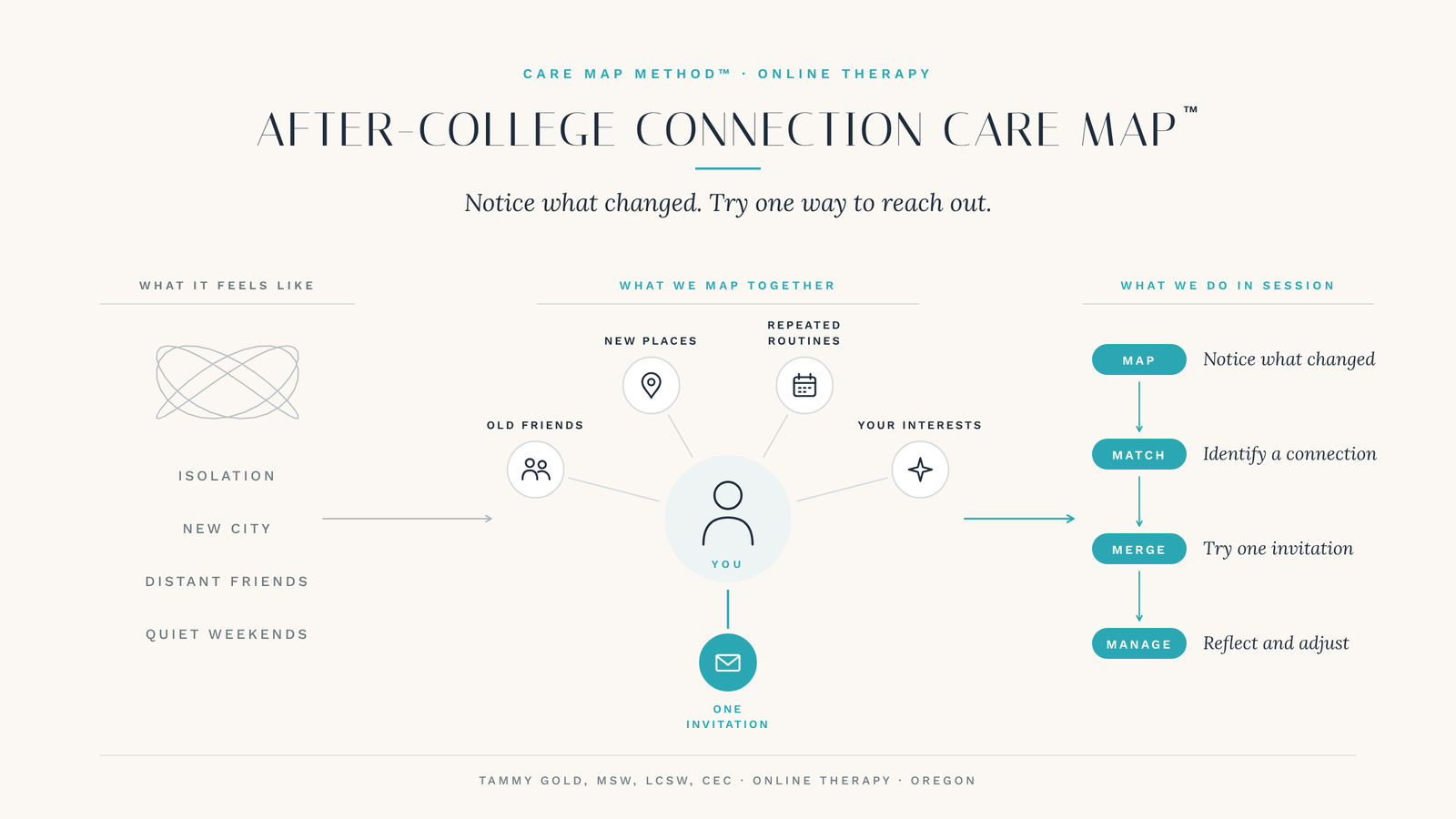
Lonely After College Therapy for Adults in Oregon
You may be working, studying or managing daily responsibilities while missing the easy contact you had with people before. Friends have moved, schedules no longer match and a free evening can feel more isolating than restful.
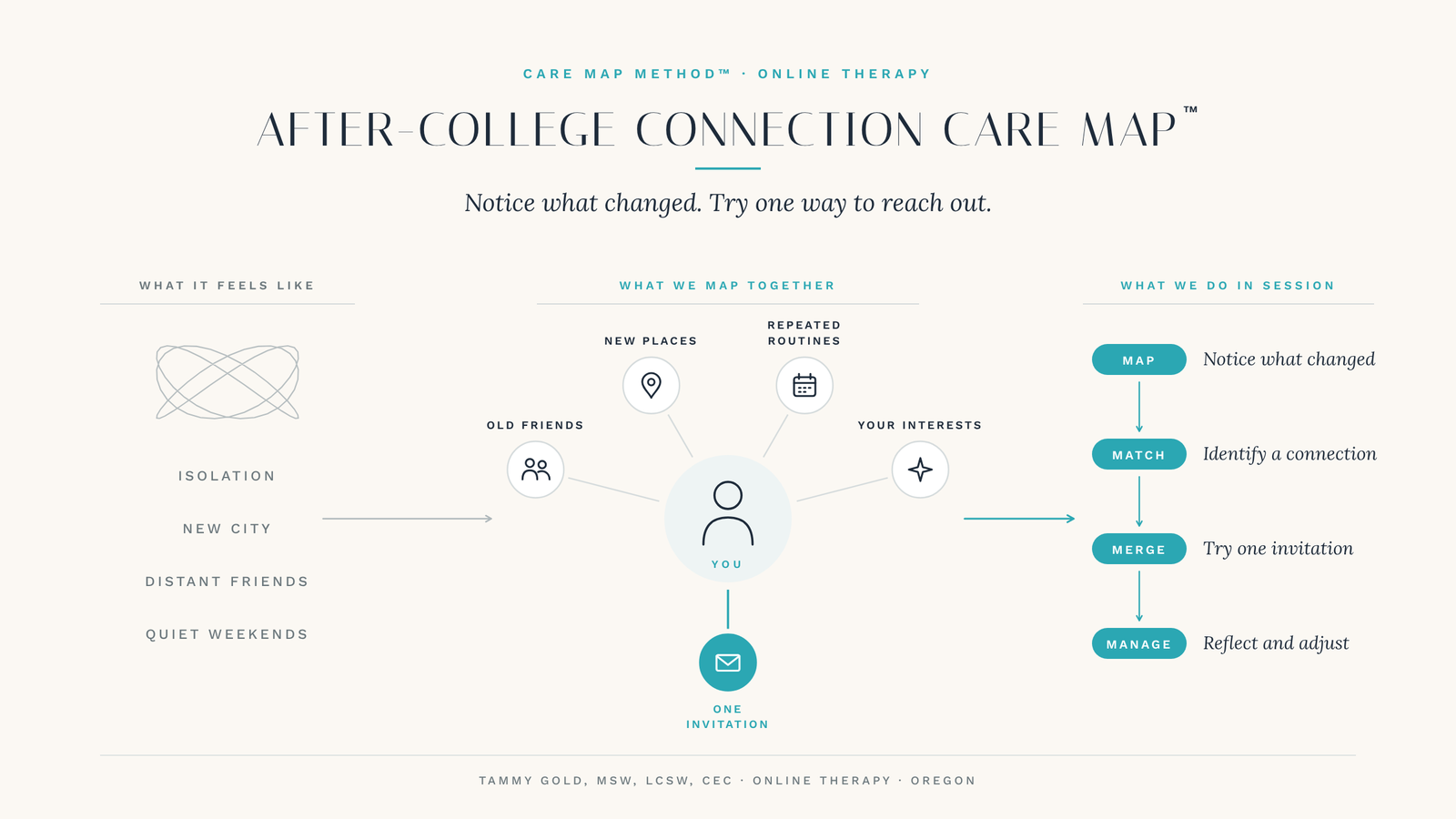
A young adult writing a message at a quiet café table with an unreadable phone screen.
You may be working, studying or managing daily responsibilities while missing the easy contact you had with people before. Friends have moved, schedules no longer match and a free evening can feel more isolating than restful.
I’m Tammy Gold. I offer individual online therapy for adults physically located in Oregon. We can explore the loss of connection after college or a move and how it is affecting your mood, confidence and daily life.
Understand what changed around you
College often provides repeated contact without requiring a plan every time. When that structure disappears, the effort involved in maintaining a friendship can change. We can look at your actual circumstances rather than assume that difficulty connecting means you have failed socially.
Perhaps you feel embarrassed reaching out, compare your social life with what you see online or avoid invitations because you expect to feel out of place. We can discuss those experiences alongside any symptoms that need assessment.
Work with one moment of disconnection
Imagine wanting to message a friend but deciding they probably do not want to hear from you. We might explore the evidence for that conclusion, what a response would mean to you and whether a small invitation fits the relationship.
We can also make space for disappointment when a friendship changes. Therapy does not require treating every connection as recoverable or every lonely evening as a task to fix.
Make room for connection that suits your life
Possible work includes expressing interest more directly, managing the feelings after an unanswered message or identifying settings where repeated contact is realistic. We will consider energy, money, transportation and other constraints rather than make a generic list of activities.
My Care Map Method™ organizes Biological, Emotional, Social and Environmental needs. We map the pattern, match a support or strategy, merge one manageable practice into your routine and manage what you learn over time.
Start with what feels hardest
The first session can include your recent transition, relationship history, symptoms and support. We will assess whether my approach fits your needs and choose goals together. Those goals might concern avoidance, self-criticism or a clearer way to reach out, rather than a promised number of friends.
Questions about starting therapy
Do I need to have attended college? No. A similar transition can happen after leaving a program, moving or entering work. We can assess whether the concern fits this service.
Is this a social anxiety specialty service? No specialty claim is made here. Assessment helps determine whether general transition support or specialized treatment is appropriate.
Can therapy guarantee that I will make friends? No. We can work on your feelings, patterns and choices; other people’s responses are outside our control.
Can I discuss a friendship breakup? Yes, when the effect on your mental health fits individual treatment. We can explore the loss and what you need next.
Can I attend while traveling? Confirm your physical location before each visit. Care must occur where I am authorized to practice.
Can I use insurance in Oregon? Verify current participation, your exact plan, assessed clinical service and estimated session costs before scheduling.
Ask about current availability, clinical fit and payment options. Confirm the state where you will be located before scheduling.
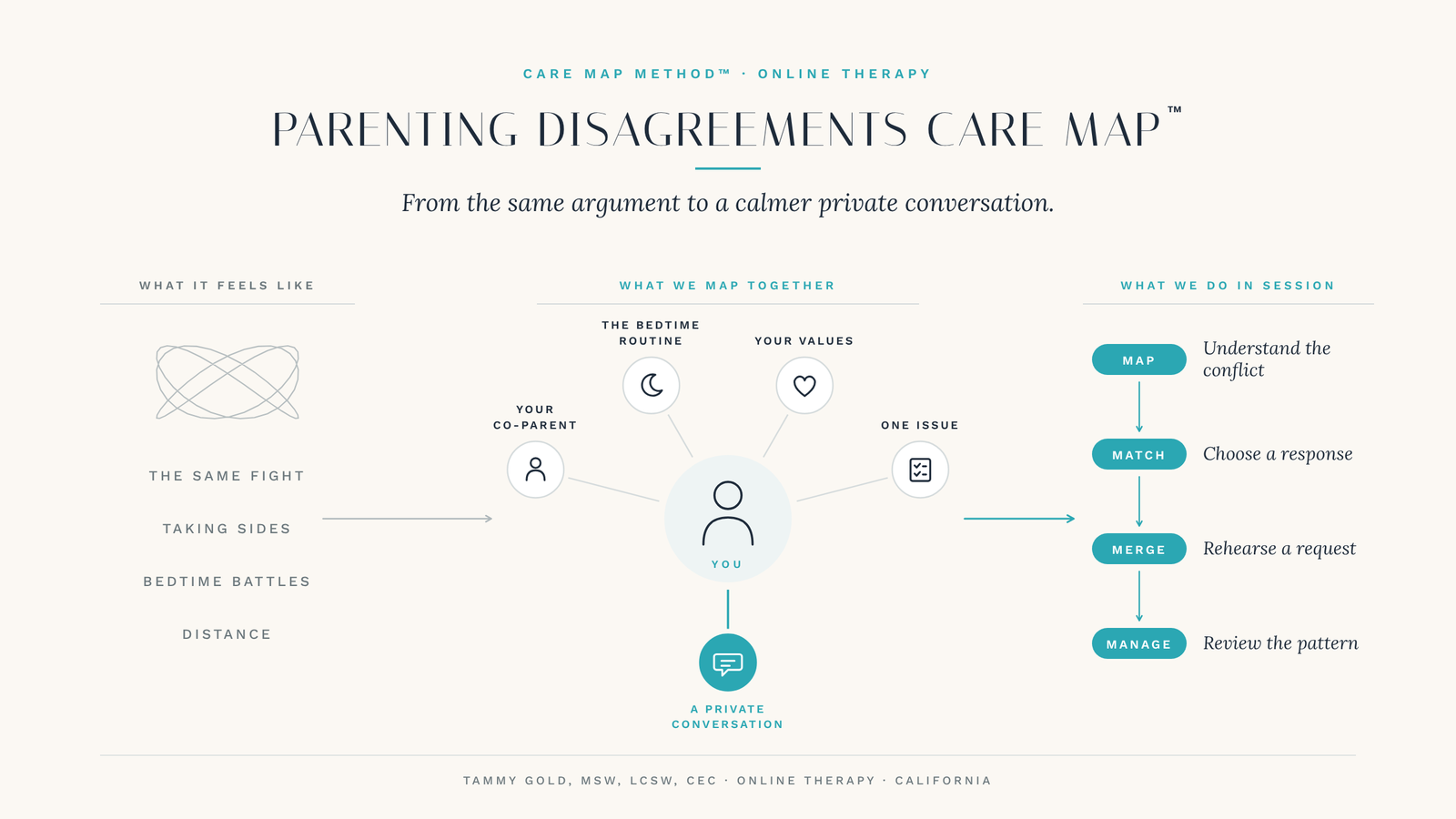
When parenting disagreements keep becoming relationship arguments
One of you sets a limit and the other changes it. A discussion about bedtime becomes an argument about respect. You may be worried about your child while also feeling criticized or unsupported by your partner.
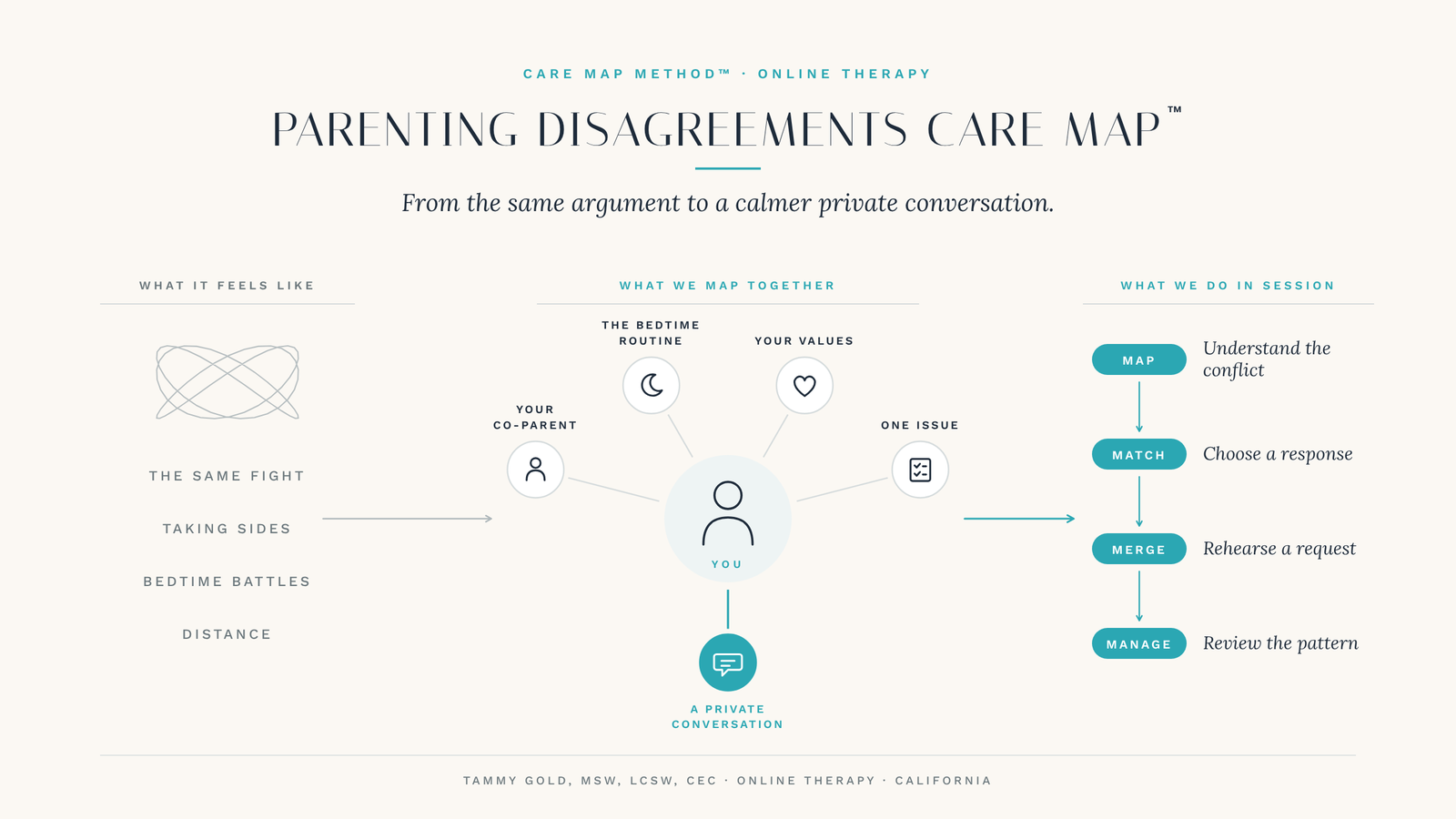
An adult reviewing notes about a family routine at a table away from the child’s play area.
One of you sets a limit and the other changes it. A discussion about bedtime becomes an argument about respect. You may be worried about your child while also feeling criticized or unsupported by your partner.
I’m Tammy Gold. I offer individual online therapy for adults in California. We can explore how parenting disagreements affect your mental health and work on responses that fit your role and circumstances.
Identify the conflict beneath the parenting decision
You may have different beliefs about structure, affection or consequences. You may also attach different meanings to disagreement: one person hears criticism, while the other hears that their concern does not matter.
We can examine a specific interaction, what you felt and what you did next. We will consider your family history, present responsibilities and whether fatigue or limited support is making discussion harder.
Move one discussion away from the heated moment
An example might be, “I want us to discuss this privately before it comes up again, because I do not want to keep arguing in front of our child.” We can practice expressing the issue without trying to settle every parenting difference at once.
Individual therapy focuses on your experience and choices. We can explore how to make a request, respond to disagreement and decide whether a separate couples or family service would be useful. It cannot require another adult to cooperate.
Consider your own emotional response
Perhaps you feel compelled to defend every decision or find yourself withdrawing until resentment builds. Therapy can give you room to understand those patterns and take responsibility for your part without taking responsibility for everything.
My Care Map Method™ organizes Biological, Emotional, Social and Environmental factors. We map a recurring conflict, match a coping or communication strategy, merge practice into one situation and manage the plan as we review it.
Begin with an adult treatment goal
The first session includes assessment of your concerns and functioning. An initial goal could be expressing disagreement more clearly or recovering from a conflict with less rumination. We are treating the adult’s mental health; your child’s developmental or behavioral needs may require separate evaluation.
If there is intimidation, violence or fear, safety and appropriate support take priority over a joint discussion.
Questions about starting therapy
Can I attend if my partner refuses? Yes. Individual therapy can address your distress and choices without requiring partner participation.
Will you decide whose parenting style is right? We can explore behavior, impact and appropriate concerns without making a verdict about a person who has not been assessed.
Is my child included in these sessions? This page describes individual adult care. Child or family treatment would require a separate discussion and consent process.
Can you assess a developmental concern? A child’s developmental concerns belong with their pediatric clinician or another appropriate evaluator.
Is this couples therapy with insurance? No. Couples services and coverage require separate assessment; relationship-only counseling is generally self-pay.
How do I start in California? Ask about current individual therapy availability and confirm your plan and payment options before scheduling.
Ask about current availability, clinical fit and payment options. Confirm the state where you will be located before scheduling.
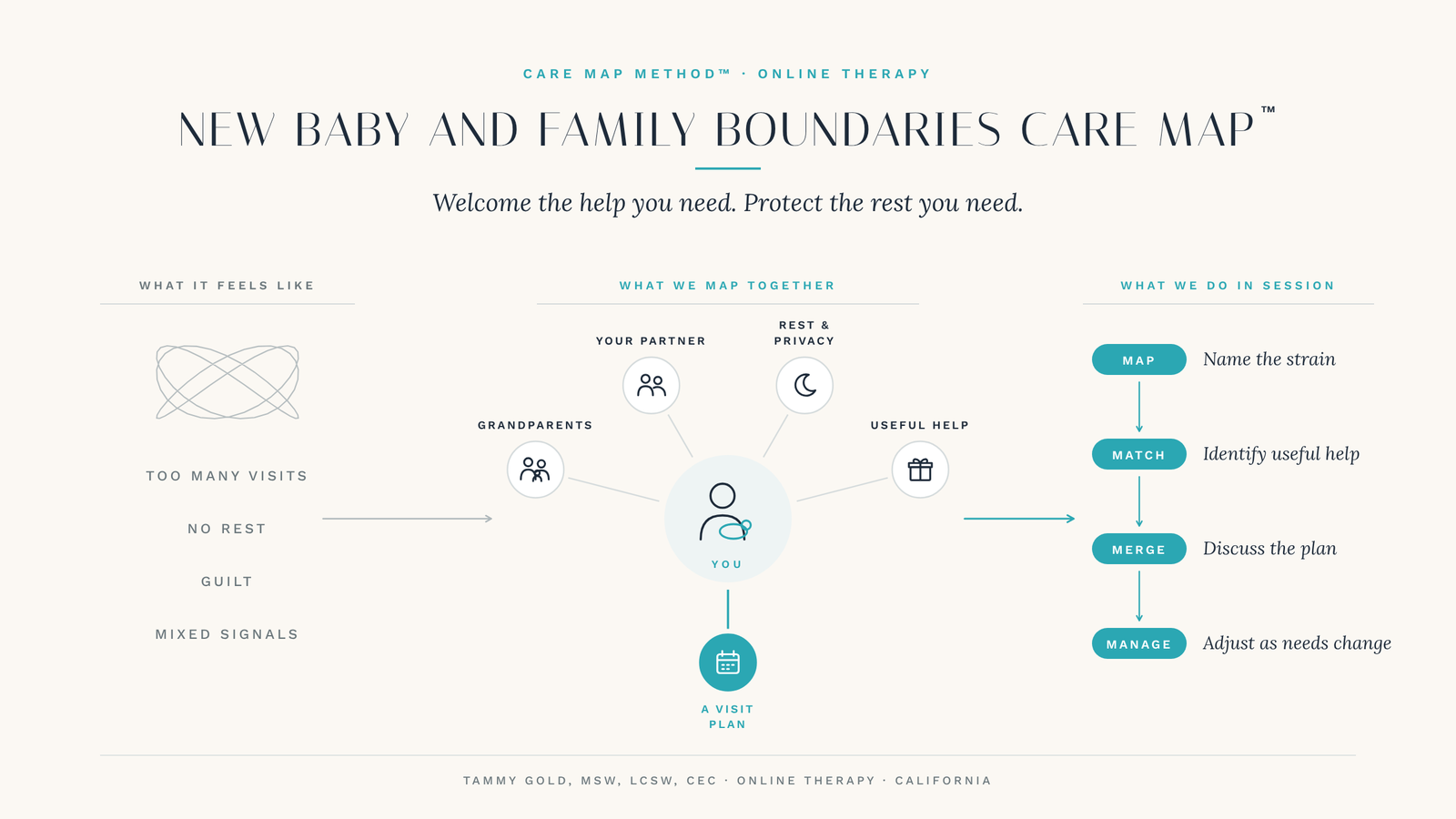
A new baby and too many family expectations
You may appreciate that relatives want to help and still feel overwhelmed by visits, advice or decisions made without asking you. When you are adjusting to a new baby, another conversation about who gets to come over can feel like too much.
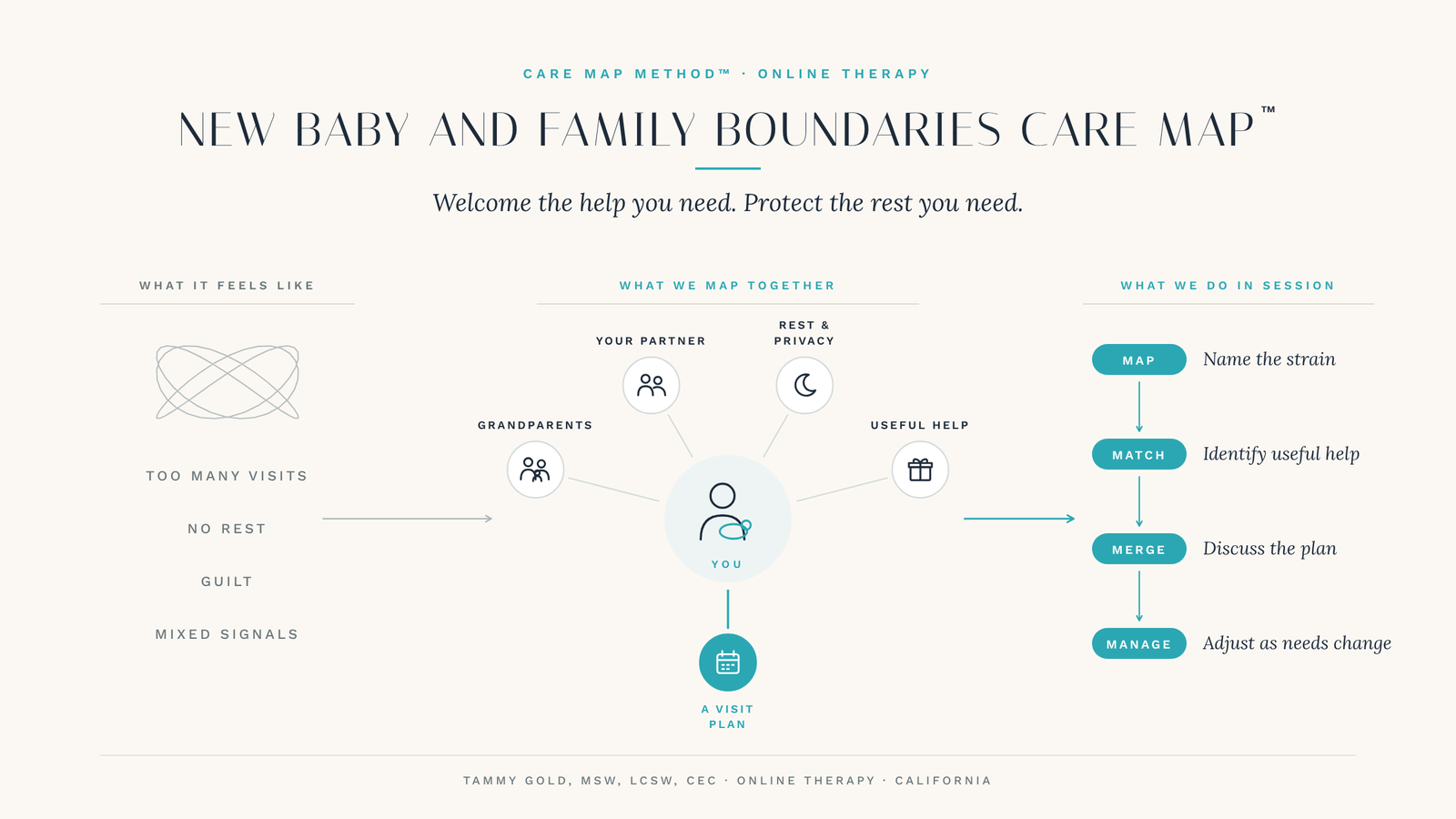
An adult caregiver resting beside a notebook in a calm living room with baby supplies in the background.
You may appreciate that relatives want to help and still feel overwhelmed by visits, advice or decisions made without asking you. When you are adjusting to a new baby, another conversation about who gets to come over can feel like too much.
I’m Tammy Gold. I offer individual online therapy for adults in California. We can explore the emotional strain around extended family involvement and work on how you want to participate in those relationships.
Distinguish help from another responsibility
One person’s idea of help may be different from what you need. You may find yourself hosting, explaining routines or managing someone else’s disappointment while trying to understand your own adjustment.
In therapy, we can identify the specific situation that leaves you feeling crowded or unsupported. We will also discuss mood, functioning and support needs, including whether a specialist perinatal referral would be appropriate.
Prepare a request you and your partner can discuss
An example might be, “I want visits arranged with us in advance, and I need us to agree who will communicate that.” We can explore what makes the request difficult, what you can control and how to respond if relatives do not agree.
We can also discuss the meaning you attach to your partner’s response. Feeling unsupported may involve more than the visit itself. Individual therapy gives you room to consider that experience without requiring your partner or relatives to attend.
Keep parenting health decisions with the right clinicians
Feeding, sleep safety, infection precautions and other medical questions should be discussed with your pediatric or prenatal care team. Therapy can help with the emotions and communication surrounding those recommendations; it does not replace that guidance.
My Care Map Method™ organizes Biological, Emotional, Social and Environmental pressures. We map the concern, match support and boundary options, merge a small agreement into the family routine and manage the plan as the baby’s needs and your own needs change.
Decide what would make the next week more manageable
We might begin with one visit, one recurring comment or one conversation with your partner. At intake, we will assess clinical fit and agree on goals grounded in your well-being. Persistent or worsening mood symptoms deserve discussion with your health care team as well as an appropriate mental health assessment.
Questions about starting therapy
Can I be grateful and still need fewer visitors? We can explore both feelings and the practical choices available, without requiring you to dismiss either one.
Will you tell me who can visit my baby? No. We can work on your needs, choices and communication; family and medical decisions remain with the appropriate people.
Is this postpartum depression treatment? This page concerns adjustment and relationship stress. Assessment determines whether specialized perinatal treatment or another referral is needed.
Can a non-birthing parent attend? Yes, when their own mental health needs fit individual treatment.
Do you offer baby medical advice? No. Ask the baby’s clinician about feeding, safe sleep, illness precautions and other health questions.
Can I use insurance? Confirm assessed clinical needs, your exact California plan, active participation and estimated costs before booking.
Ask about current availability, clinical fit and payment options. Confirm the state where you will be located before scheduling.
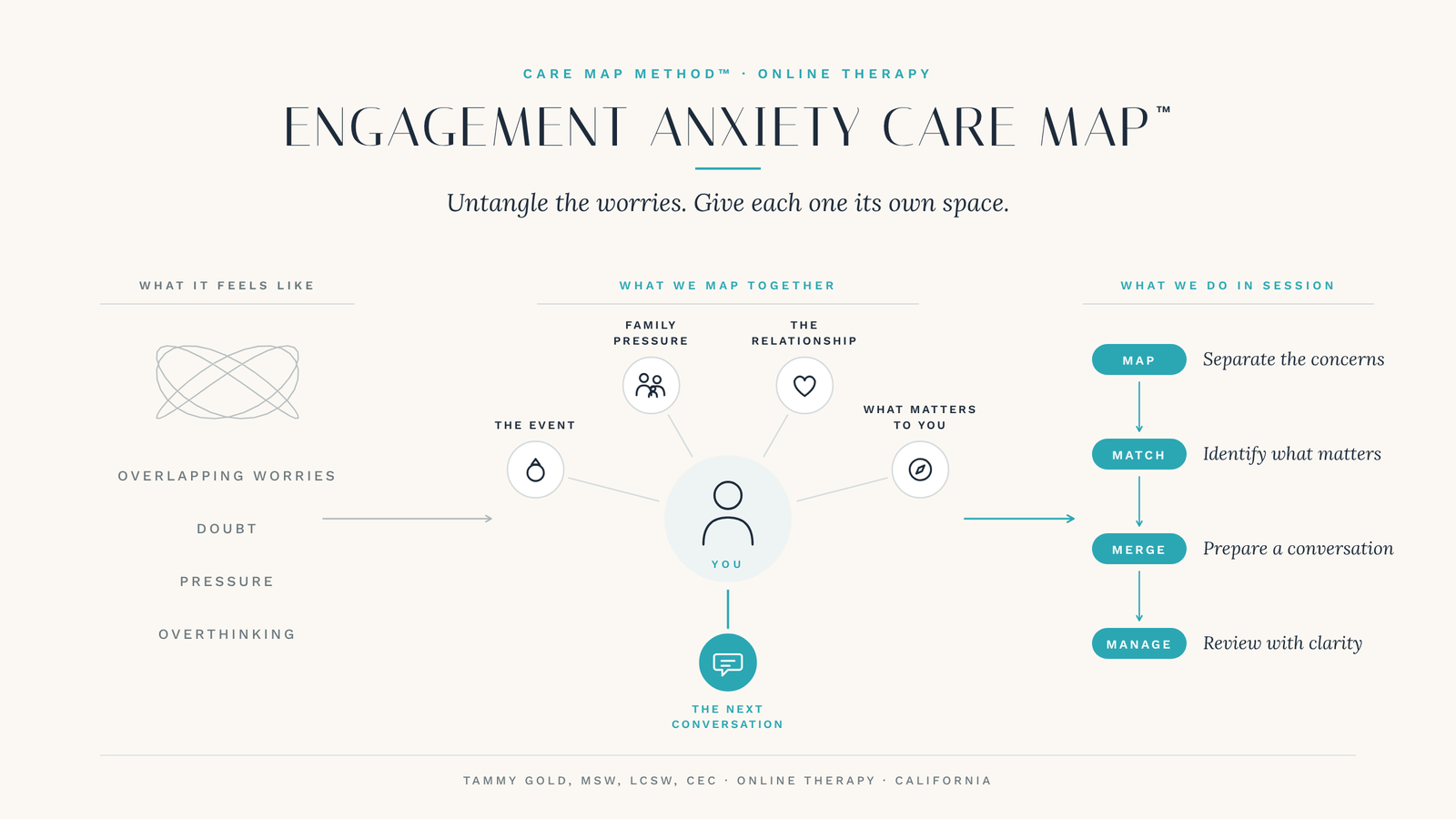
Engaged and anxious about what comes next
People congratulate you, and you find yourself wondering why you do not feel the way you expected. You may be excited and worried at the same time, or unsure which concerns belong to wedding planning and which belong to the relationship.
People congratulate you, and you find yourself wondering why you do not feel the way you expected. You may be excited and worried at the same time, or unsure which concerns belong to wedding planning and which belong to the relationship.
I’m Tammy Gold. I offer individual online therapy for adults in California. We can explore your experience of engagement without requiring you to arrive with an answer about what it means.
Give different concerns their own attention
Anxiety about a large event, pressure from relatives and questions about a partner’s behavior may need different kinds of discussion. We can separate those concerns rather than treat all uncertainty as harmless nerves or as proof that the relationship must end.
We will consider what has changed since the engagement, how you have handled conflict together and whether you feel able to express needs. Trust, safety, money and expectations about future family life may be relevant.
Explore the question you keep putting off
Perhaps you want to ask about shared responsibilities or whether you both want children. Perhaps the difficult question is whether you can disagree without being dismissed.
We can look at the issue itself and the feelings that arise when you consider raising it. A conversation might begin, “I want us to talk about what daily life together will look like, not only the wedding.” That wording is an example, not a requirement or a client account.
Understand your own expectations
Family experiences and cultural messages can influence what commitment means to you. We can explore those influences without assuming that your history determines the relationship’s future.
My Care Map Method™ helps organize Biological, Emotional, Social and Environmental pressures. We map the concern, match appropriate support and strategies, merge a practical step into your life and manage the plan as more becomes clear. The framework supports individualized care; it is not a test of whether you should marry.
Begin individually
Your partner does not need to attend for you to seek help with your own mental health. We will assess symptoms, functioning and treatment fit, and discuss any need for couples work or another referral separately. Threats, coercion or fear require attention to safety rather than a generic communication plan.
Questions about starting therapy
Does anxiety mean I should end my engagement? Not automatically. We can explore the specific concerns without assuming a particular decision.
Will you reassure me that the relationship is right? Therapy can help you examine your experience and choices. It cannot certify compatibility or guarantee a future outcome.
Can I come alone? Yes. This page describes individual psychotherapy for the adult client.
Is this an OCD treatment page? No. Repetitive relationship doubts can have different causes; specialized OCD assessment or treatment may require referral.
Is premarital counseling covered by insurance? Relationship-only premarital counseling is generally self-pay. Coverage for individual psychotherapy depends on assessed clinical needs and the plan.
How do I check California availability? Ask about current appointment options and verify the exact insurance plan and estimated costs before scheduling.
Ask about current availability, clinical fit and payment options. Confirm the state where you will be located before scheduling.
Click For Session on Headway Click For Sessions On Alma Click For Sessions on Grow Therapy
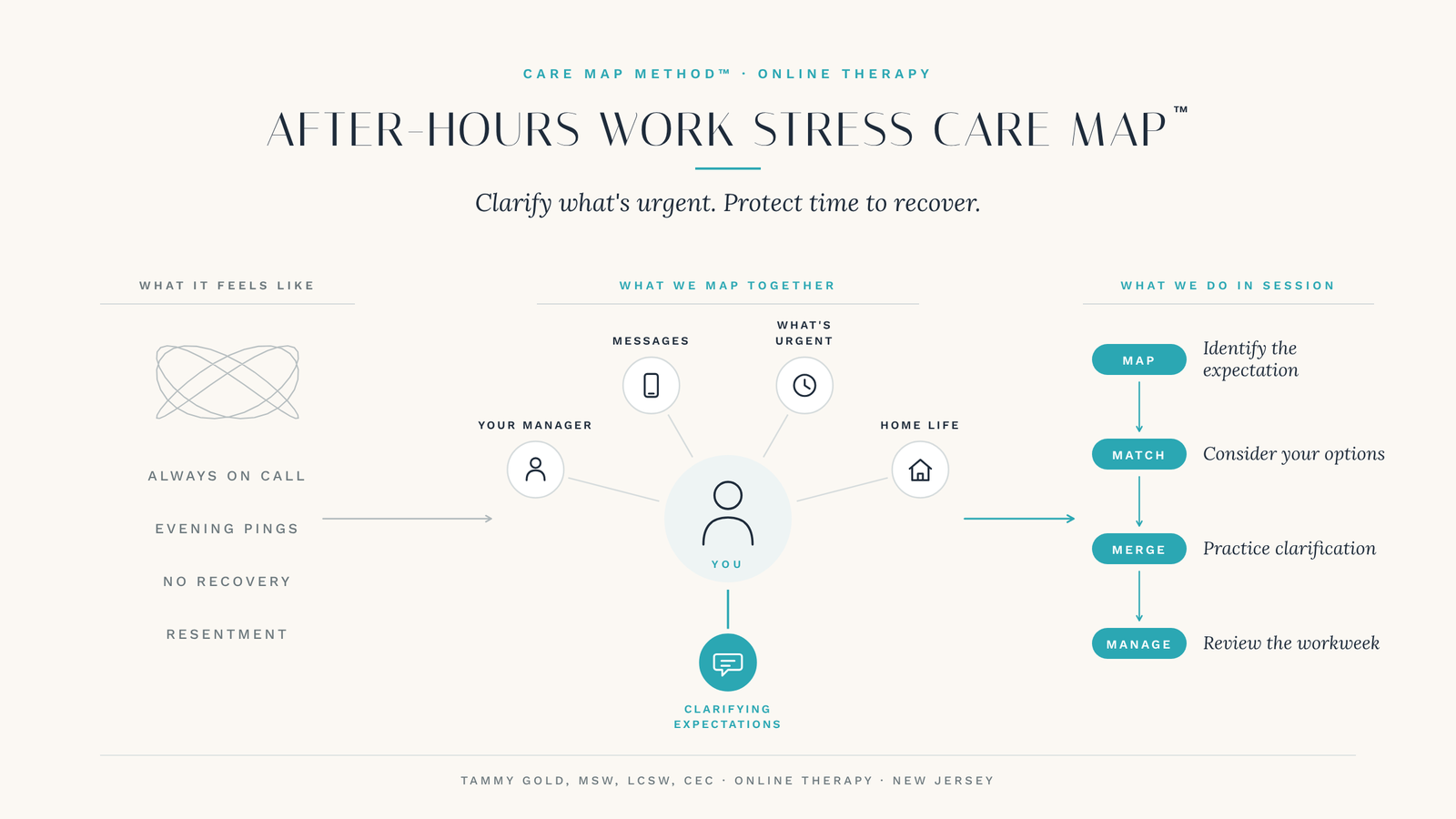
Workplace stress when the messages keep coming
Your workday ends, but your attention stays on the phone. When a message arrives from your boss, you feel you should respond immediately—even when you are unsure whether that is expected.
An adult placing a work phone beside a closed laptop at home in the evening.
Your workday ends, but your attention stays on the phone. When a message arrives from your boss, you feel you should respond immediately—even when you are unsure whether that is expected.
I’m Tammy Gold. I offer individual online therapy for adults in New Jersey. We can explore how workplace demands and relationships affect your mental health, including what makes it difficult to disengage after work.
Understand the expectation and the fear
Some jobs have explicit on-call responsibilities. Others rely on unclear expectations. We can distinguish what your role requires from assumptions you have made and examine any consequences you have actually experienced.
That distinction does not require you to ignore a difficult work environment. We can consider workload, power, finances and the support available to you. We will also discuss the effect on sleep, concentration and relationships outside work.
Prepare a clarification rather than a confrontation
You might want to ask, “For messages that arrive after my scheduled hours, which need an immediate response and which can wait until morning?” We can practice wording that fits your role and explore what feels risky about asking.
If a direct conversation is not appropriate, we can consider other options within your control. Therapy does not provide employment-law advice or guarantee that a manager will respond reasonably.
Work on what happens after the notification
Perhaps you keep rereading a message even after you have answered it. We can examine the feared outcome, the reassurance you are seeking and whether repeated checking is helping you make a decision or keeping you engaged with the worry.
My Care Map Method™ organizes Biological, Emotional, Social and Environmental pressures. We map the sequence, match a strategy to your circumstances, merge one practice into the workweek and manage the plan as we review the results.
Choose a goal you can evaluate
An early goal might be clarifying one expectation or spending less of an evening mentally preparing for tomorrow’s conversation. We will decide together what meaningful change would look like for you.
The first session includes assessment of your concerns, history and functioning. Your employer does not need to participate for you to seek individual support. We will explain confidentiality and its exceptions before treatment.
Questions about starting therapy
Should I stop answering my boss immediately? There is no universal rule. We can consider actual job duties, consequences and your circumstances before choosing a response.
Can you give legal advice about after-hours work? No. Employment rights and legal decisions belong with qualified legal or workplace advisers.
Will therapy make me leave my job? There is no predetermined outcome. We can explore your options without prescribing a career decision.
Can I work on difficult feedback too? Yes. Individual therapy can examine how workplace interactions affect your mental health and responses.
Will my employer be told? We will discuss confidentiality and its legal exceptions. We do not routinely notify an employer that you are in therapy.
Can I use Headway or Alma? Use the route currently verified for your New Jersey plan and service. Platform membership alone does not establish coverage.
Ask about current availability, clinical fit and payment options. Confirm the state where you will be located before scheduling.
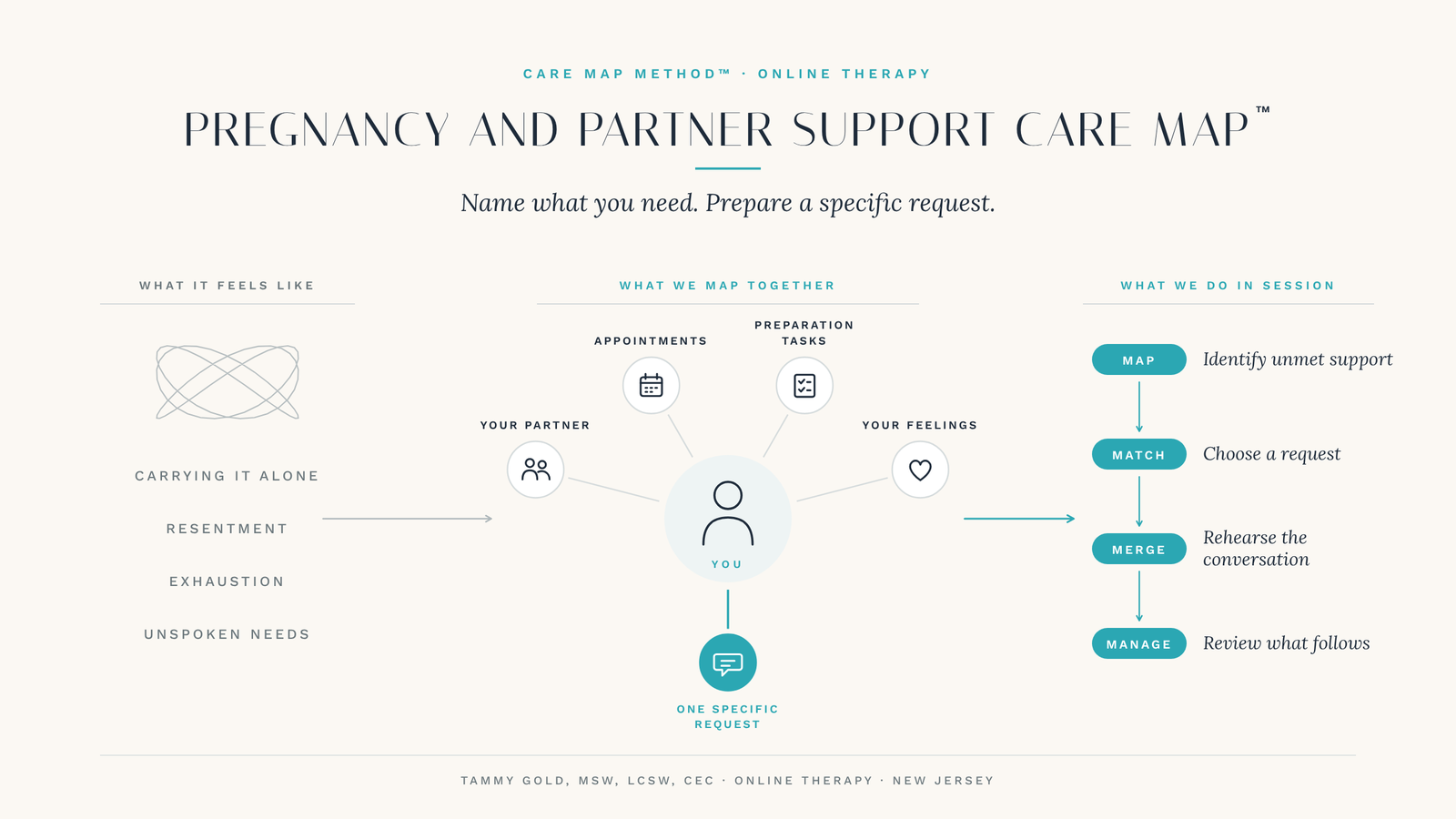
Feeling unsupported by your partner during pregnancy
You may be handling appointments, preparation and changes in how you feel while wondering why your partner does not seem to understand the weight of it. A discussion about a practical task can become an argument about whether you can rely on each other.
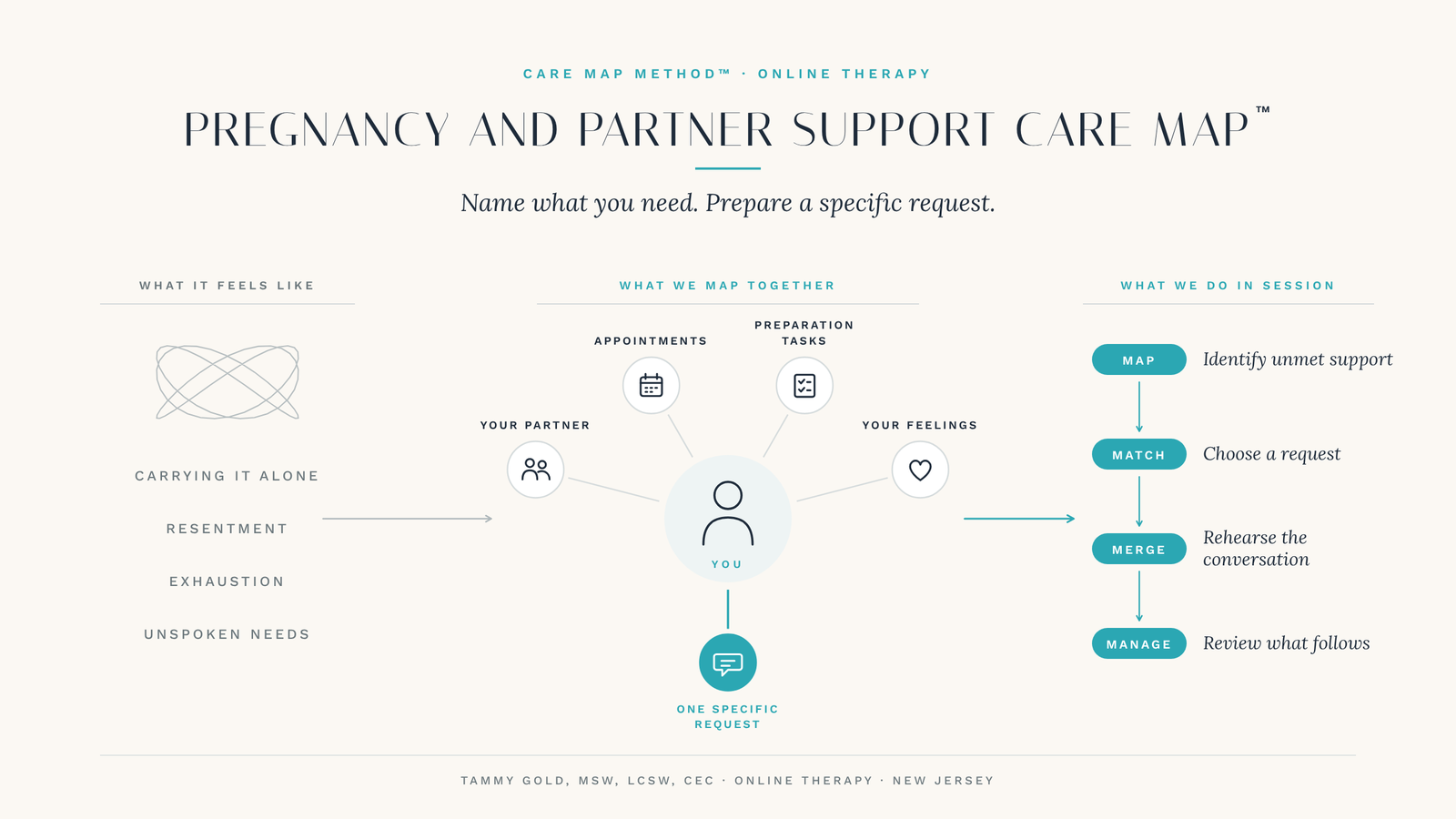
A pregnant adult reflecting with a notebook in a private comfortable room.
You may be handling appointments, preparation and changes in how you feel while wondering why your partner does not seem to understand the weight of it. A discussion about a practical task can become an argument about whether you can rely on each other.
I’m Tammy Gold. I offer individual online therapy for adults in New Jersey dealing with relationship stress and life transitions. We can explore the strain surrounding pregnancy and assess whether my services are an appropriate fit.
Name the support you are missing
“Be more supportive” can contain several needs: listening without dismissing you, taking responsibility for a task, joining a conversation or recognizing how uncertain you feel.
In therapy, we can identify the particular experience that leaves you feeling alone. We will also discuss symptoms, functioning and relevant history rather than assume every difficult feeling comes from the relationship.
Prepare a request that reflects the real concern
An example might be, “When I manage every appointment and task, I worry that the same pattern will continue after birth. I want us to agree on what you will take responsibility for.”
We can explore what makes that conversation hard, whether your request is realistic and how to respond to the answer. This is an illustrative example. Individual therapy cannot make a partner participate or change their behavior.
Make space for your own experience
You may also be holding feelings you have not shared: ambivalence about changing roles, grief about independence or fear of becoming responsible for everyone. We can explore those feelings without requiring a particular view of pregnancy or family life.
My Care Map Method™ organizes Biological, Emotional, Social and Environmental pressures. We map what is happening, match supports and communication approaches, merge a manageable step into preparation and manage the plan as circumstances change. Pregnancy-related medical questions remain with your prenatal clinicians.
Coordinate the right support
Tell your prenatal clinician about persistent anxiety, low mood or changes that interfere with functioning. We can discuss coordination with your permission and referrals when specialized perinatal treatment is indicated. If your relationship involves threats or coercion, safety and appropriate support take priority over a conversation exercise.
Questions about starting therapy
Can I attend without my partner? Yes. This page describes individual therapy for your distress, choices and mental health.
Is this couples therapy? No. Any couples service would require a separate discussion of fit, structure and payment.
Can you tell me whether my feelings are hormones? We cannot determine the medical cause through this page. Discuss physical and mood changes with your prenatal clinician; therapy can assess psychological and relational needs.
Do you prescribe during pregnancy? No. Medication decisions belong with your prescribing and prenatal clinicians.
What if I need specialist perinatal care? We will discuss an appropriate referral rather than assume general relationship support meets every need.
Will my insurance cover this? Coverage depends on assessed clinical needs, current New Jersey network participation and your exact plan. Confirm details before starting.
Ask about current availability, clinical fit and payment options. Confirm the state where you will be located before scheduling.
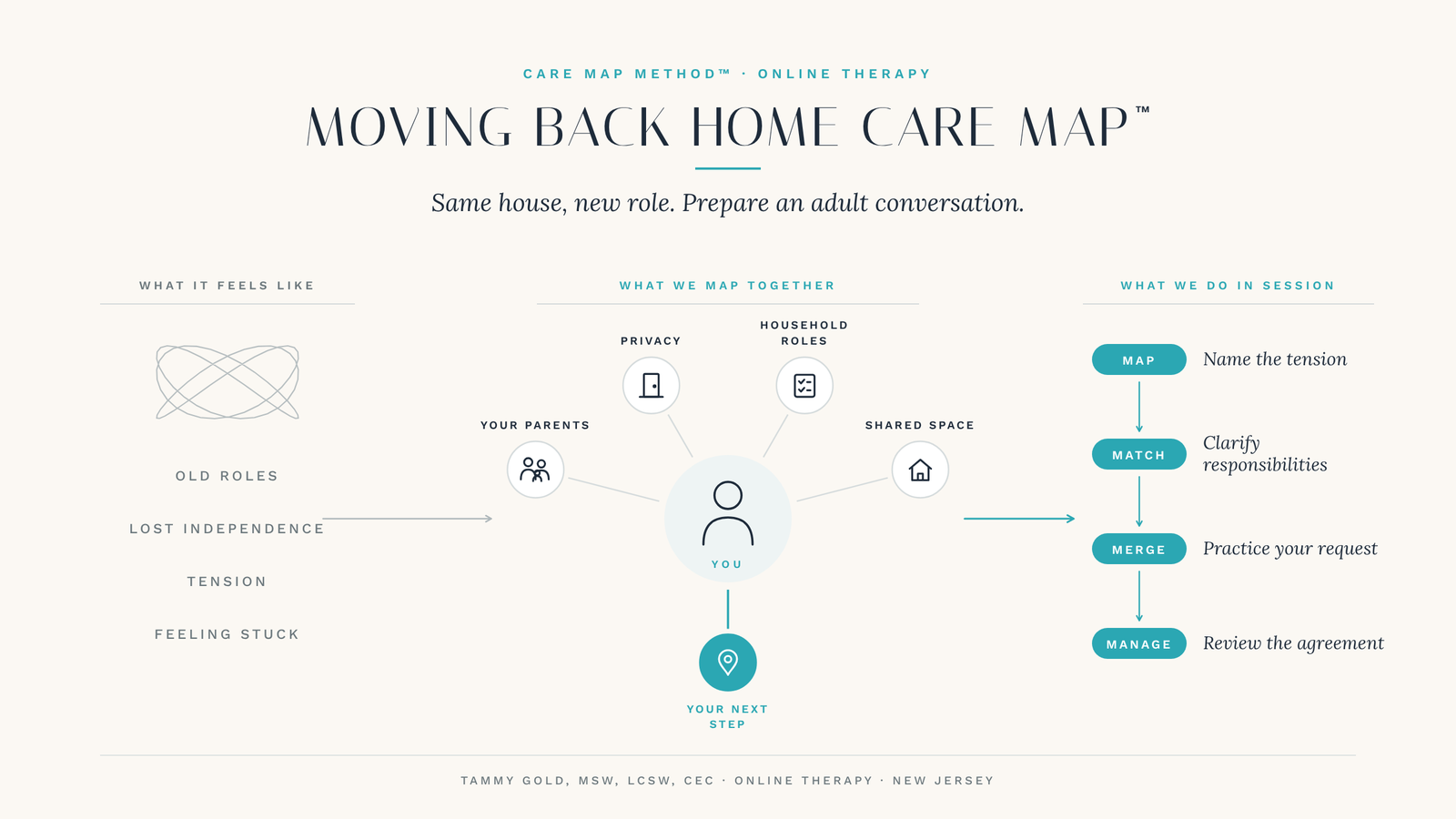
Moving home after college and feeling like a child again
Living with your parents may make financial sense while still being emotionally difficult. A question about your plans can feel like criticism. A disagreement about a visitor can turn into an argument about gratitude or maturity
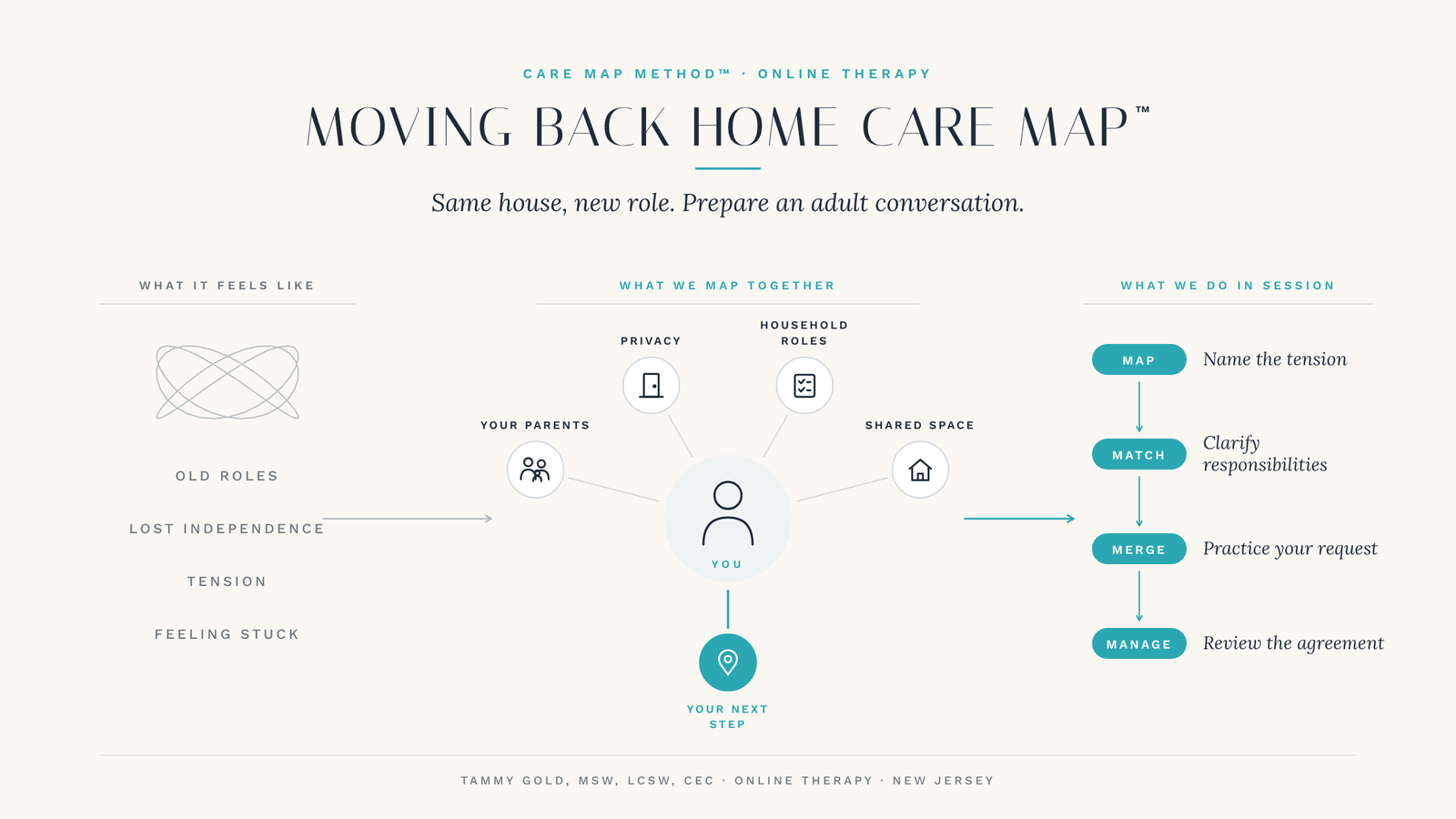
An adult in their twenties writing privately at a desk in a family home.
Living with your parents may make financial sense while still being emotionally difficult. A question about your plans can feel like criticism. A disagreement about a visitor can turn into an argument about gratitude or maturity.
I’m Tammy Gold. I offer individual online therapy for adults in New Jersey, including young adults navigating family relationships and independence. We can explore how living together affects you and what a workable adult role could look like.
Separate dependence from your sense of worth
Housing costs, job uncertainty and family responsibilities can shape where you live. Needing support does not provide a complete explanation of who you are or what you can do.
In therapy, we can examine how you interpret a parent’s questions, what you feel expected to prove and whether you have space to express an ordinary preference. We will also discuss mood, sleep, motivation and the effect of conflict on everyday life.
Work on a specific household conversation
Rather than trying to establish independence in one argument, we might identify a concrete issue: privacy, contributions to the home, use of shared space or how often you discuss your job search.
A starting point could be, “I want to agree on what I am responsible for here and when we will check in about my plans.” We can explore the fear behind making that request and consider how to respond if the conversation becomes heated.
Build a next step you own
Therapy can help you consider goals within your actual resources. That might involve a routine, a conversation or a step toward work or housing. You remain responsible for your choices; therapy is not a deadline imposed by your family.
My Care Map Method™ helps organize Biological, Emotional, Social and Environmental factors. We map the interaction, match a strategy to your needs, merge practice into a real conversation and manage the plan as you learn what is workable.
A confidential space for the adult client
We will discuss confidentiality, consent and any family involvement during intake. Parents paying for treatment does not automatically make them participants in your care. If you use someone else’s insurance, we can discuss questions to ask the insurer about statements and communications before you begin.
Questions about starting therapy
Do my parents need to attend? No. Individual therapy focuses on you. Any family participation would be discussed with you and require appropriate consent.
Will you report back to my parents if they pay? Payment alone does not automatically authorize sharing clinical information. We will explain confidentiality and its exceptions.
Can I use a parent’s insurance privately? Ask the insurer about explanations of benefits, online access and communications. We cannot guarantee that the policyholder will not see billing information.
Is this a failure-to-launch program? No. This is individual psychotherapy for the adult’s assessed mental health needs, not a compliance or placement program.
Will therapy tell me to move out? There is no preset outcome. We can explore choices within your safety, finances and circumstances.
How do I check New Jersey coverage? Verify your exact plan, current provider participation and estimated session cost before booking.
Ask about current availability, clinical fit and payment options. Confirm the state where you will be located before scheduling.
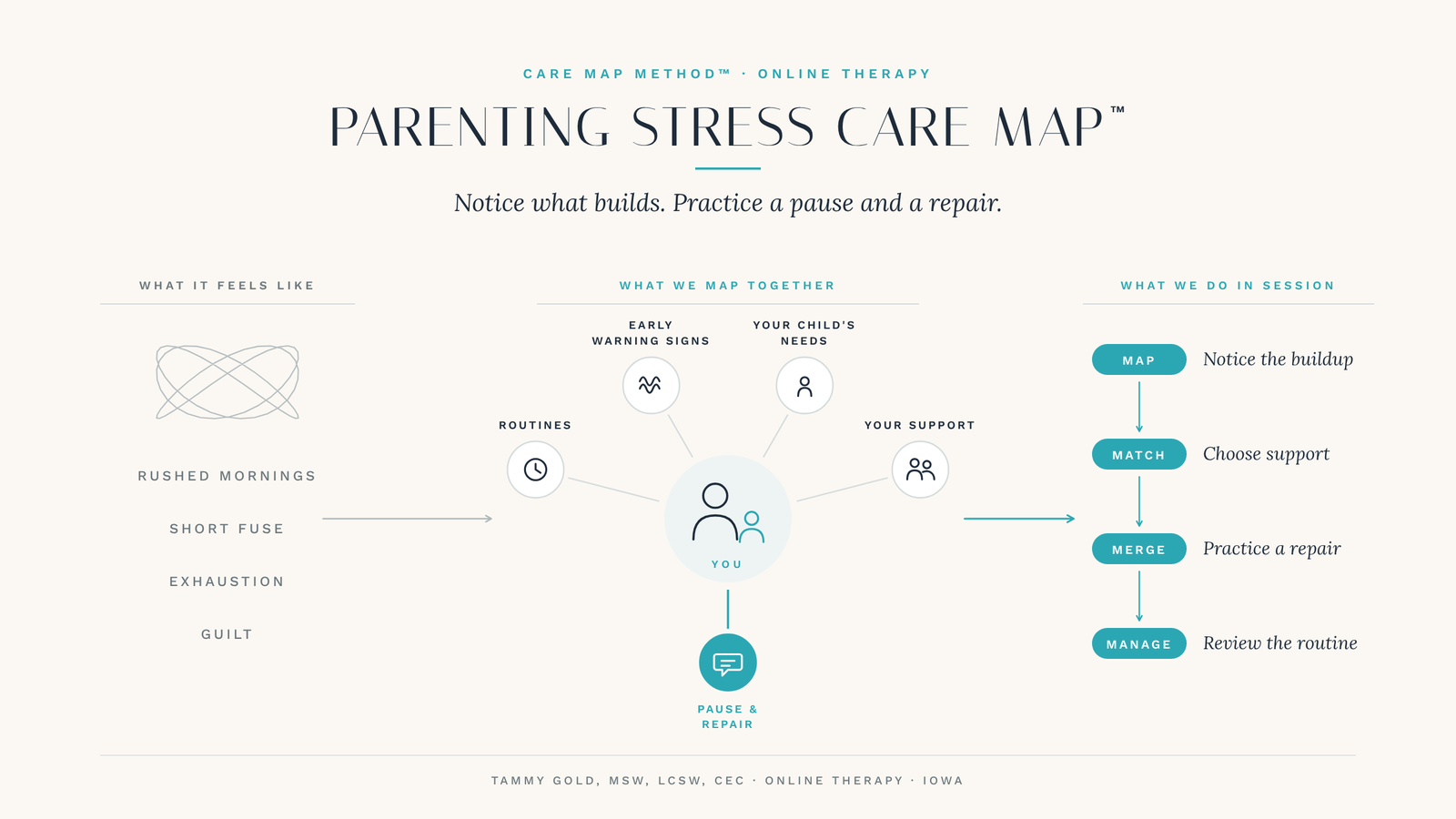
When toddler parenting leaves you overwhelmed
The difficult moment might be small from the outside: shoes, a cup, another request at the end of a long day. Inside, you feel pushed past what you can manage. Afterward, you worry about your reaction and promise yourself that tomorrow will be different.
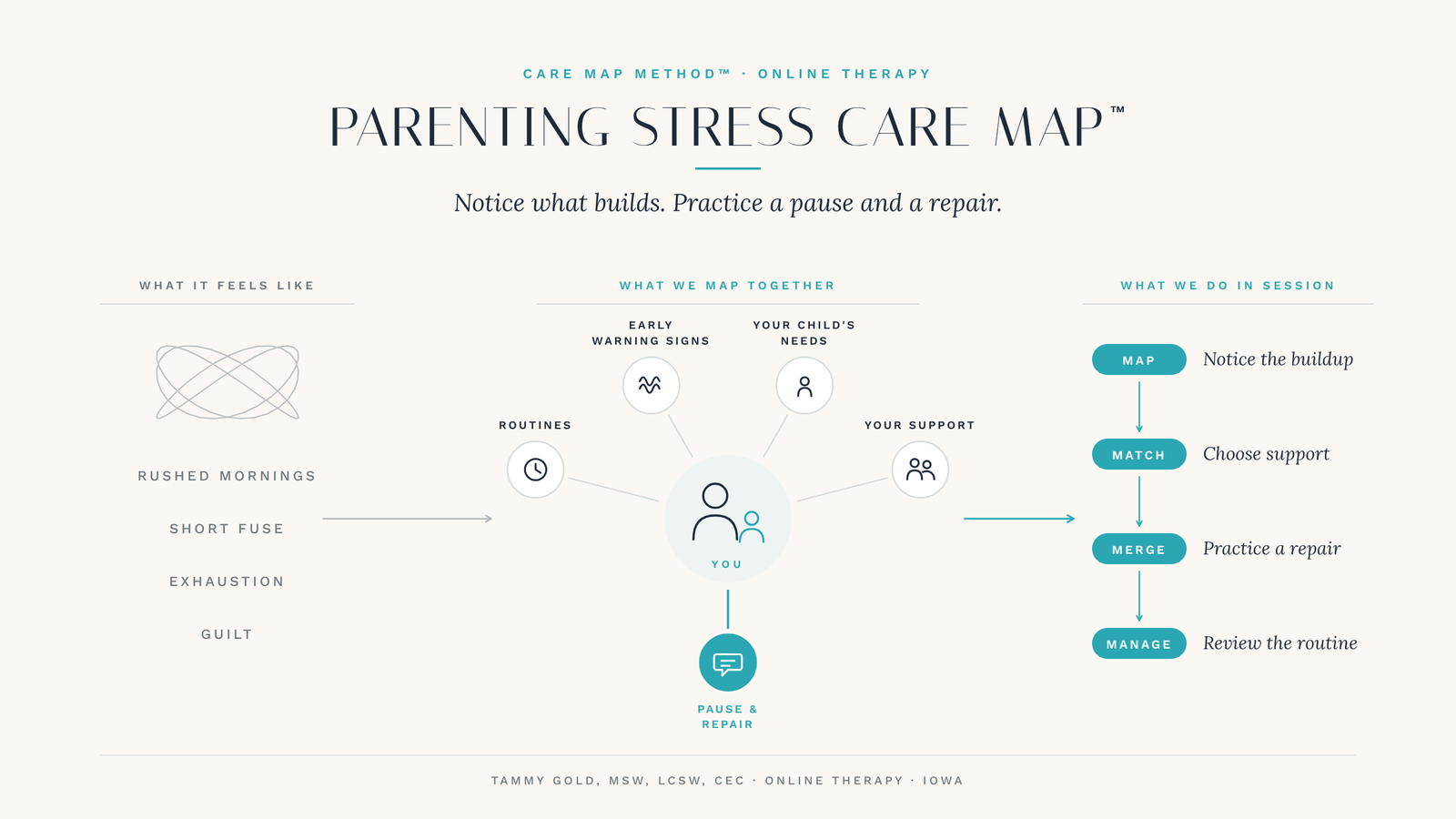
An adult caregiver pausing at a kitchen counter while a toddler plays safely nearby.
The difficult moment might be small from the outside: shoes, a cup, another request at the end of a long day. Inside, you feel pushed past what you can manage. Afterward, you worry about your reaction and promise yourself that tomorrow will be different.
I’m Tammy Gold. I offer individual online therapy for adults physically located in Iowa, including parents dealing with overwhelm, guilt and relationship strain. We can take your concern seriously and work on what happens around those moments.
Look earlier than the outburst
We might review the hour before a difficult interaction. What demands were competing? Were you already feeling unsupported, rushed or judged? What did your child’s behavior mean to you in that moment?
This does not remove your responsibility for how you respond. It helps us identify where a different response or additional support might become possible. We can discuss your mental health, relevant history and how the strain affects daily functioning.
Give the adult a place in the plan
Parenting information can be useful, but you may also need space for your own anger, sadness or disappointment. Perhaps you are carrying most of the responsibilities or trying to parent differently from how you were raised.
In therapy, we can work on those feelings and practice a request that names a need: “I need us to agree who handles the evening routine before we are both exhausted.” The wording will depend on your family and circumstances.
Practice repair without expecting perfection
A repair might sound like, “I raised my voice. That was my responsibility. I want to say it again more calmly.” We can explore how to take responsibility while keeping an appropriate limit, and how to respond to the guilt that follows.
My Care Map Method™ organizes Biological, Emotional, Social and Environmental pressures. We map a recurring moment, match a manageable strategy, merge practice into that routine and manage the plan as we review it.
What we can assess together
The first session can begin with one situation you want to handle differently. We will discuss symptoms, support and treatment fit. This is care for the adult; a child’s developmental or behavioral concerns may call for their own pediatric or child-focused evaluation.
Questions about starting therapy
Is my toddler the therapy client? No. This page describes individual psychotherapy for the parent or adult caregiver.
Will you diagnose my child? Not through your individual treatment. A child’s needs require an appropriate separate assessment.
Can I come if I am a father or another caregiver? Yes. The service is for adult caregivers whose own mental health needs fit the practice.
Is this the same as parent coaching? No. Coaching is a separate service. Psychotherapy addresses the adult’s assessed mental health needs.
What if I am afraid I might hurt my child? Seek immediate help to keep everyone safe, using emergency services when danger is imminent. Do not wait for a routine appointment.
Can insurance cover my sessions? We will assess clinical needs and confirm current Iowa network participation and your plan’s requirements before making coverage claims.
Ask about current availability, clinical fit and payment options. Confirm the state where you will be located before scheduling.
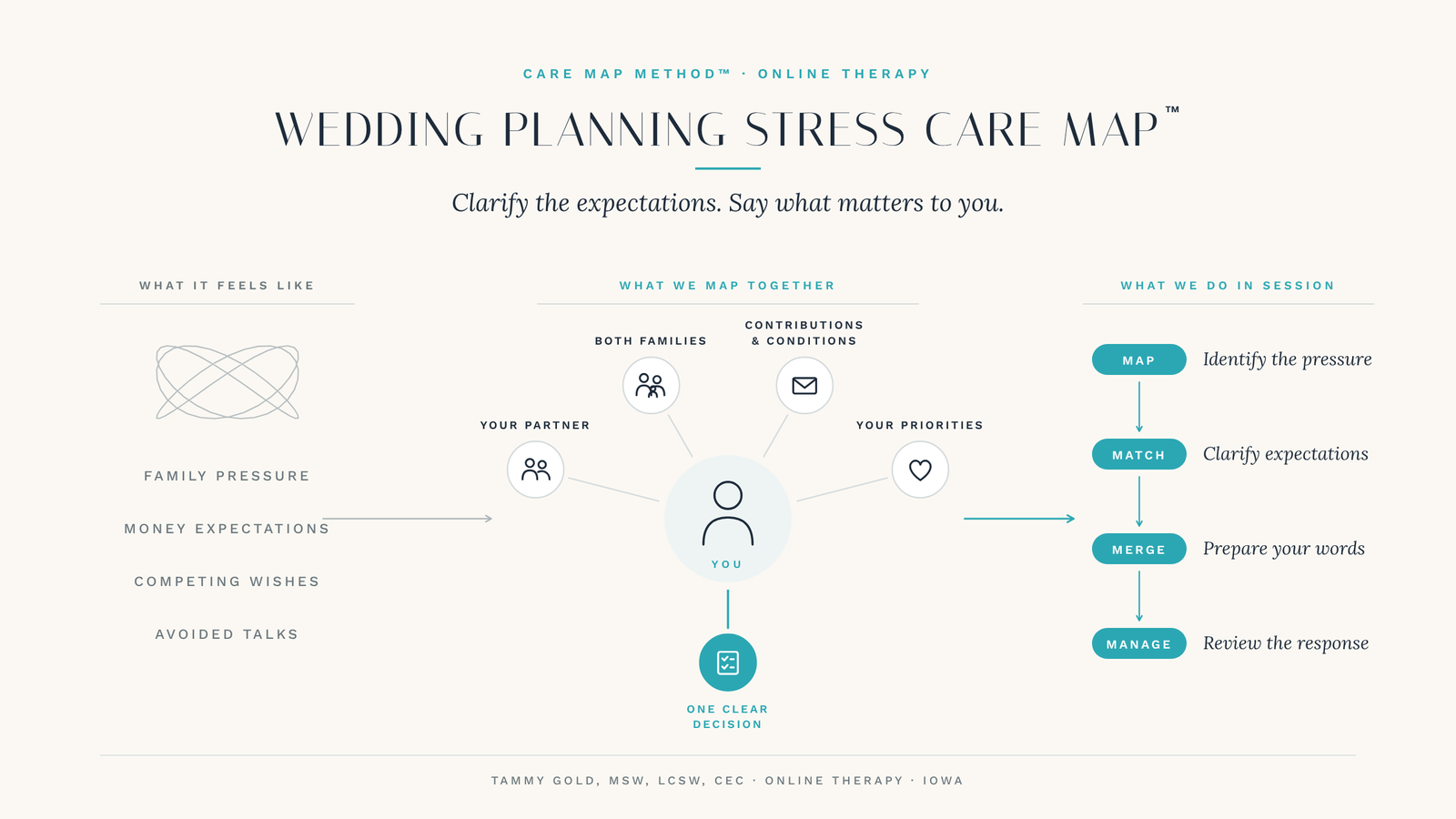
Wedding planning and family pressure in Iowa
You expected decisions about a wedding. You may not have expected every decision to become a conversation about loyalty, gratitude or who gets a say.
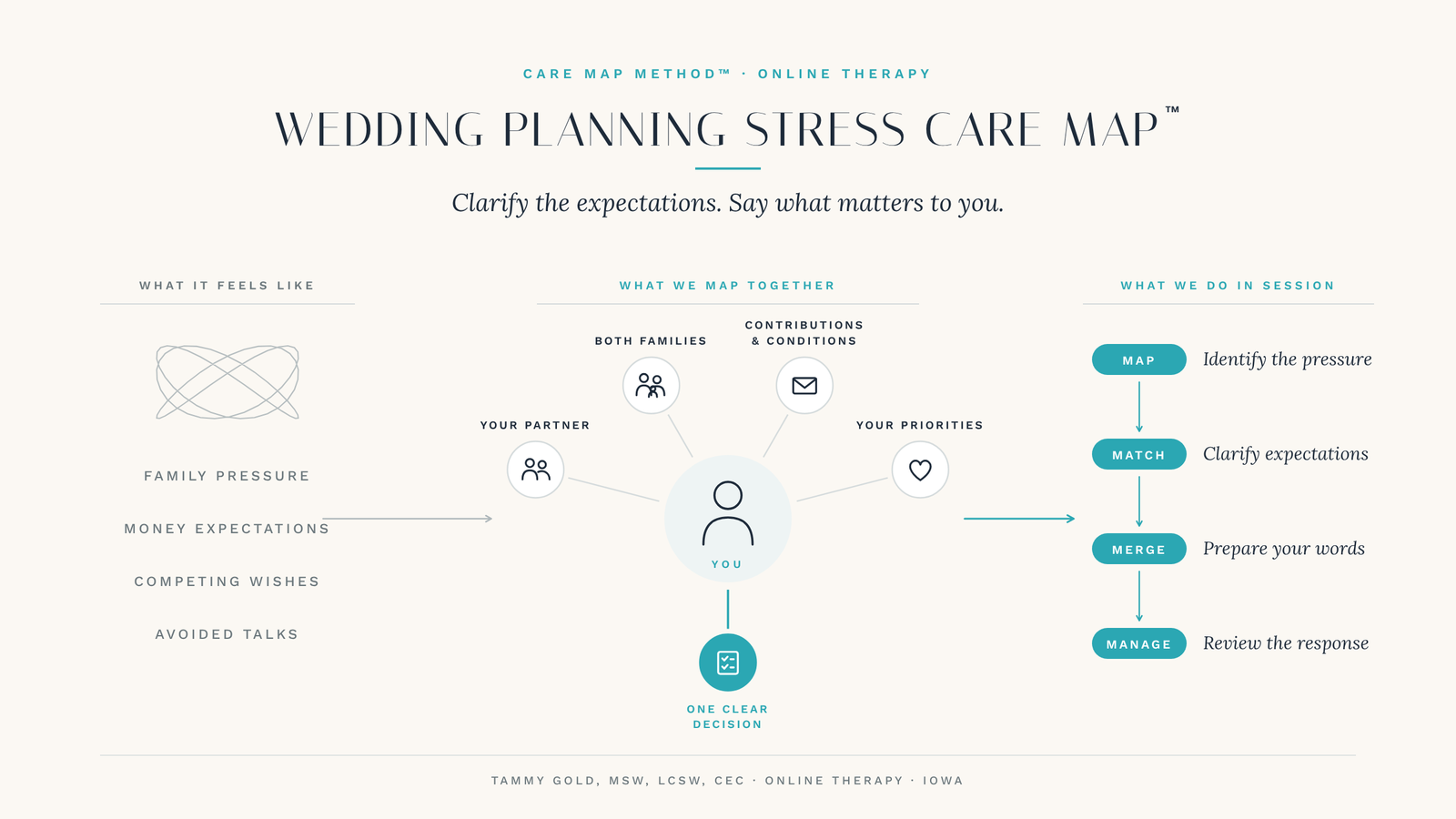
An engaged adult reviewing a simple wedding budget notebook without readable financial information.
You expected decisions about a wedding. You may not have expected every decision to become a conversation about loyalty, gratitude or who gets a say.
If relatives are helping financially, it can feel difficult to express a preference without seeming ungrateful. If your partner reacts differently to the pressure, you may feel alone with the consequences.
I’m Tammy Gold. I offer individual online therapy for adults in Iowa dealing with relationship stress and life transitions. We can explore the emotional strain around your engagement and the conversations you are avoiding.
Understand what the money represents
A disagreement about a guest list might also involve expectations about family belonging. A budget conversation may raise fears about disappointing someone who has supported you for years.
We can look at those meanings alongside the practical situation. What was actually offered? What conditions were stated? Which expectations are assumptions? We will not provide legal or financial advice, but we can work on the feelings and relationships affecting your decisions.
Identify a decision you can discuss clearly
For example, you might want to say, “Before we accept more help, I want to understand what decisions you expect to make.” In therapy, we can explore whether that wording fits and what makes the question hard to ask.
We can also prepare a conversation with your partner about how to respond to relatives together, while recognizing that individual therapy cannot direct your partner’s behavior.
Allow uncertainty without treating it as an answer
Feeling anxious during engagement does not automatically mean the relationship is wrong. It also does not mean you should ignore a concern. We can distinguish event pressure from questions about compatibility, trust or safety and give each the attention it deserves.
My Care Map Method™ helps us map Biological, Emotional, Social and Environmental pressures, match support to your needs, merge a practical step into planning and manage what you learn afterward.
Begin with your experience
In an initial session, we will discuss your concerns, functioning, history and goals. You can come alone even if the concern involves your partner or family. The focus is your mental health and decision-making, rather than wedding logistics or a promise to resolve every disagreement.
Questions about starting therapy
Is this premarital couples counseling? No. This page describes individual psychotherapy. Couples or premarital services would need separate discussion.
Will you tell me whether to cancel my wedding? We can examine your concerns and choices without deciding for you or guaranteeing an outcome.
Can therapy help if my family is paying? We can explore the pressure, expectations and conversations involved. Financial or contract advice belongs with qualified advisers.
Can I attend without my fiancé or fiancée? Yes. You can work on your distress and choices individually.
Does wedding anxiety automatically qualify for insurance? No. Coverage depends on assessed mental health needs and your plan; relationship-only premarital counseling is generally self-pay.
Can I book online therapy in Iowa? Ask about current Iowa availability, clinical fit and payment arrangements before confirming a session.
Ask about current availability, clinical fit and payment options. Confirm the state where you will be located before scheduling.
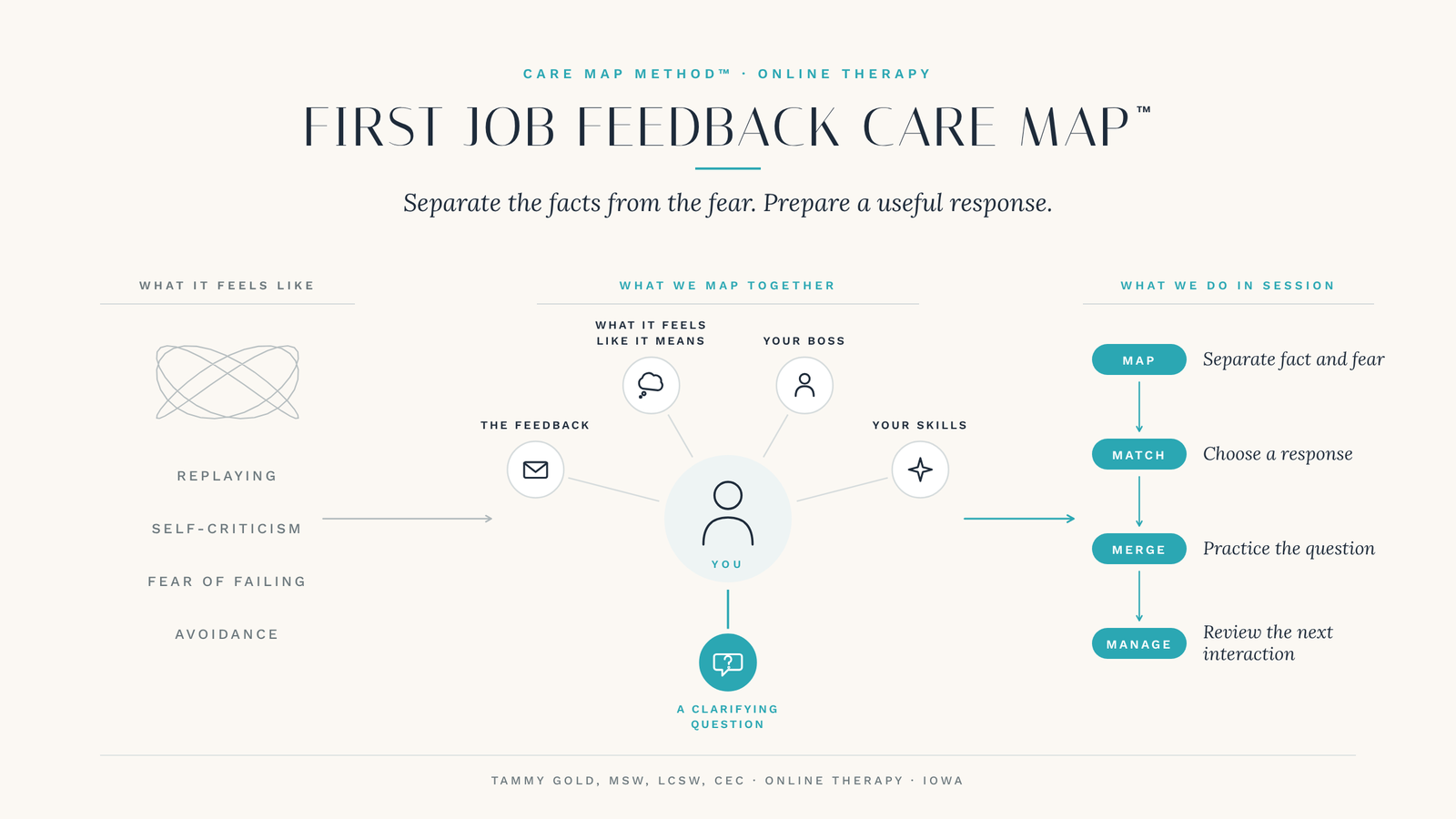
When feedback at your first job feels personal
A short message from your boss can change your whole evening. You may reread it, wonder if you are about to lose the job or spend hours trying to prove you deserve to be there.
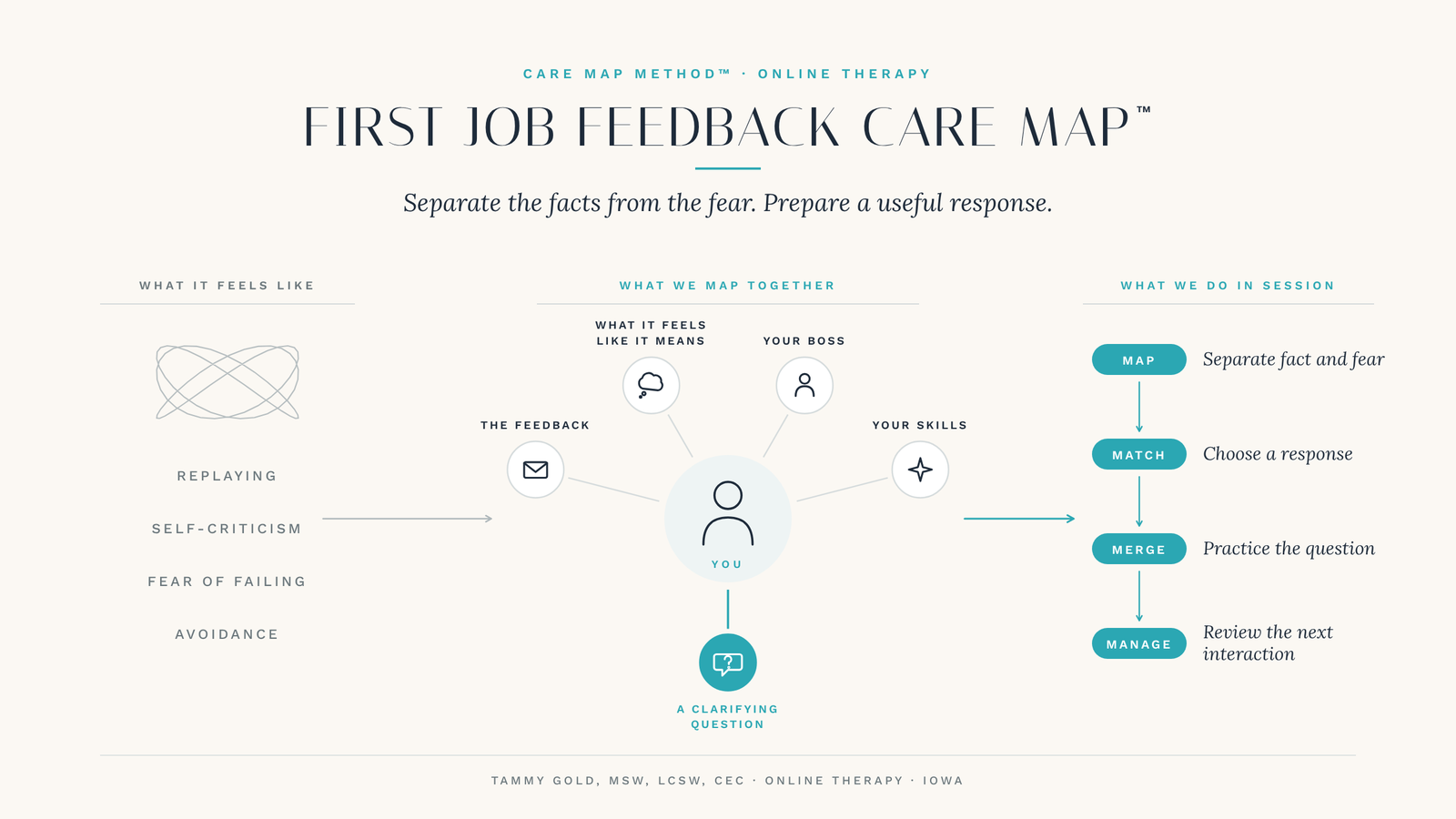
A young adult preparing a question in a notebook beside a laptop at home
A short message from your boss can change your whole evening. You may reread it, wonder if you are about to lose the job or spend hours trying to prove you deserve to be there.
I’m Tammy Gold. I offer individual online therapy for adults physically located in Iowa, including younger adults navigating work and relationship stress. We can explore what feedback brings up for you and how to respond without letting one interaction define your competence.
Sort the actual request from the feared conclusion
There may be something specific to learn or correct. There may also be unclear expectations, a difficult manager or an environment that does not provide enough support.
We can examine an actual exchange rather than assume the problem is simply confidence. What was requested? What remains unclear? What meaning did you attach to the feedback? How much time have you spent trying to prevent further criticism?
Practice asking a useful question
Imagine receiving “This needs more work” with little explanation. We might prepare a response such as, “Could you tell me the two changes that would make the biggest difference?” This is an illustrative example, not a client story.
We can also explore why asking feels risky and what happened in earlier relationships when you needed clarification. The goal is to choose a response that fits your workplace, responsibilities and safety, rather than follow a one-size-fits-all script.
Protect the part of life outside work
Overpreparing and checking messages may feel reassuring in the moment while leaving little time for rest or friends. We can look at the pattern and discuss realistic boundaries around reviewing an interaction or seeking more reassurance.
My Care Map Method™ helps organize Biological, Emotional, Social and Environmental pressures. We map the feedback cycle, match coping and communication strategies, merge one practice into the workweek and manage the plan based on what happens.
Start with a recent moment
In the first session, we will discuss the concern, symptoms, history and support around you. We may identify goals such as recovering more quickly after feedback or asking for clarification with less avoidance. Therapy supports your mental health; it is not an employment evaluation or a guarantee of promotion.
Questions about starting therapy
Do I need a diagnosis before reaching out? No. Assessment is part of starting care. Feeling distressed after feedback does not establish a diagnosis by itself.
Is imposter syndrome a diagnosis? It is a common descriptive phrase rather than a formal diagnosis. We can explore the experience behind it.
Will my employer get my therapy notes? We will explain confidentiality and its exceptions at intake. We do not routinely send notes to your employer.
Can you tell me whether my boss is toxic? We can examine behavior and its impact without diagnosing someone who has not been assessed.
Is this career coaching? This page describes individual psychotherapy focused on your distress and functioning, not career placement or performance consulting.
How do I check insurance in Iowa? Ask about current Iowa participation and verify the exact plan, clinical service and estimated cost before booking.
Ask about current availability, clinical fit and payment options. Confirm the state where you will be located before scheduling.
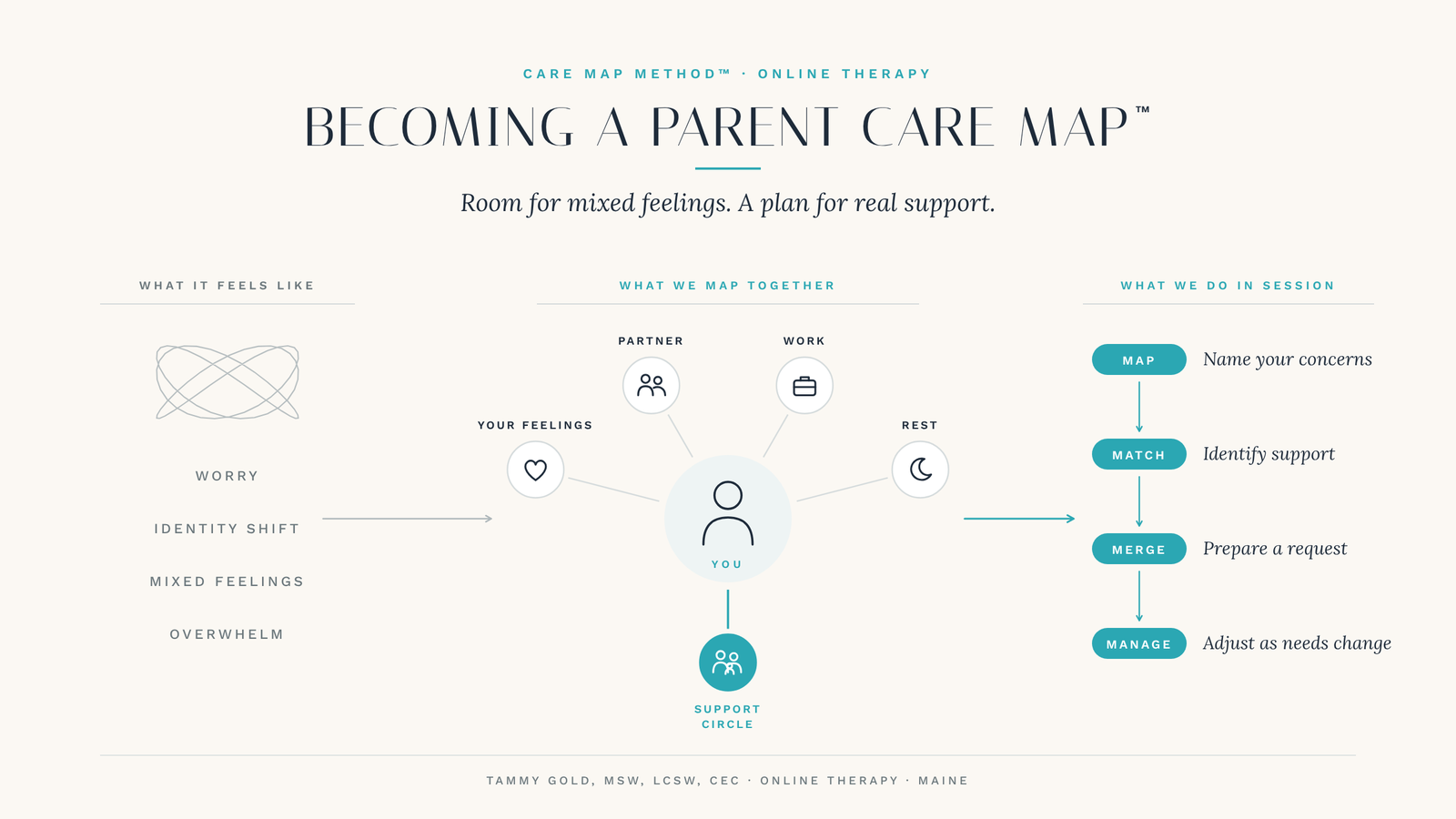
Pregnant and overwhelmed about becoming a parent
You may want this pregnancy and still feel frightened about what comes next. Thoughts about your identity, relationship, finances or ability to parent can be difficult to share when people expect you to feel only excited.
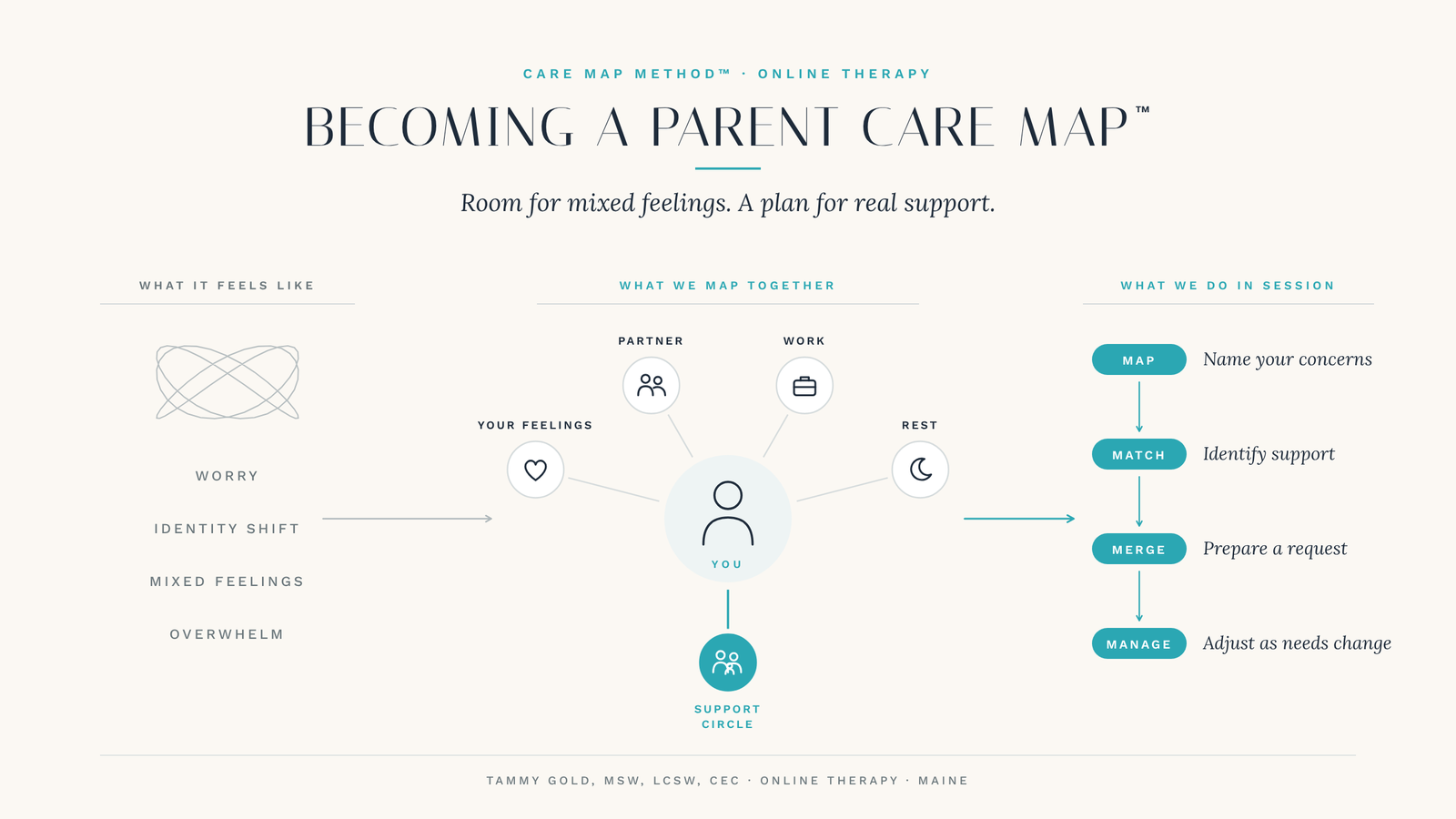
A pregnant adult comfortably seated with a notebook in a quiet home setting
You may want this pregnancy and still feel frightened about what comes next. Thoughts about your identity, relationship, finances or ability to parent can be difficult to share when people expect you to feel only excited.
I’m Tammy Gold. I offer individual online therapy for adults in Maine. For pregnancy-related adjustment and relationship stress, we can explore what is changing, what feels difficult and what support would be useful. We will assess whether my services fit your needs.
Make room for the feelings you are editing out
Perhaps you worry about repeating family patterns, losing independence or being expected to handle everything. You may feel pressure to become a different person before the baby arrives.
We can discuss those concerns without making assumptions about what your pregnancy means to you. We will also consider the intensity of your symptoms and their effect on everyday functioning. Emotional support can sit alongside ongoing prenatal care.
Turn an undefined fear into a conversation
“I am not ready” might contain several different concerns. One could be uncertainty about who will help after birth; another could be fear of how conflict with your partner will change under pressure.
In a session, we might separate those concerns and practice a specific request: “I want us to discuss how we will share responsibilities and what help we can actually count on.” We can explore both the request and the feelings that make it hard to make.
Consider the whole transition
My Care Map Method™ organizes Biological, Emotional, Social and Environmental factors. We map the concern, match appropriate supports, merge manageable steps into preparation and manage the plan as your needs change. Medical questions remain with your prenatal clinicians.
Possible goals include expressing your needs more clearly, recognizing which expectations are yours and making room for uncertainty without letting it occupy every conversation. Your treatment plan will depend on assessment rather than a standard preparation checklist.
Find the level of care that fits
Tell your prenatal clinician about persistent anxiety, low mood or changes that affect functioning. With your permission, care can be coordinated when appropriate. If you need specialized perinatal treatment or a higher level of care, we will discuss suitable referrals. This service does not provide obstetric advice or medication management.
Questions about starting therapy
Can I want a baby and still feel afraid? Yes. We can explore those feelings without treating them as a verdict on your future parenting.
Is this a childbirth or parenting class? No. It is individual psychotherapy focused on your mental health and adjustment.
Do you provide pregnancy medication advice? No. Discuss medication and pregnancy-related medical decisions with your prescribing and prenatal clinicians.
What if I need specialized pregnancy mental health care? We will assess clinical fit and discuss an appropriate referral when your needs call for specialized care.
Does my partner have to attend? No. This page describes individual care. Any partner involvement would require discussion of treatment goals and consent.
Can I use my insurance? Confirm current Maine network participation, benefits, estimated costs and coverage requirements before scheduling.
Ask about current availability, clinical fit and payment options. Confirm the state where you will be located before scheduling.