
Providence Therapy in California for Divorce, Separation & Relationship Conflict
Online divorce and relationship therapy in California for Providence members using the Care Map Method to reduce conflict, improve communication and create practical next steps.

Online divorce and relationship therapy in California for Providence members using the Care Map Method to reduce conflict, improve communication and create practical next steps.
Providence Therapy in California for Divorce, Separation & Relationship Conflict
Move Through Divorce With Less Conflict and More Clarity
Divorce can make every conversation feel loaded. Therapy can help you slow the conflict, understand what is underneath it, and make clearer decisions for yourself and your family.
Insurance-safe line: I provide online therapy to clients in California and participate with select insurance plans through Headway. Providence Health Plan eligibility and benefits vary by individual plan and should be verified before scheduling.
Care Map Method™: MAP → MATCH → MERGE → MANAGE
MAP — identify the conflict cycle, emotional triggers and practical stressors.
MATCH — clarify needs, priorities, boundaries and realistic goals.
MERGE — build healthier communication, co-parenting language and decision-making.
MANAGE — create next steps that reduce reactivity and support a more stable future.
When divorce turns every conversation into a fight
Separation and divorce can bring grief, anger, fear, guilt, financial pressure, parenting disagreements and uncertainty at the same time. Even people who normally communicate well can become reactive when the relationship, home and family structure are changing.
Therapy should help you move forward, not just repeat the story
My approach is warm, nonjudgmental and solution-focused. We make space for the feelings while also identifying what needs to change. The goal is not to decide who is right. It is to help you understand the pattern, communicate more effectively, protect your emotional wellbeing and create practical next steps.
A structured way to reduce conflict
Using the Care Map Method™, we look at the biological, emotional, social and environmental factors affecting the situation. That can include sleep and stress, grief and anger, children and extended family, schedules, finances, living arrangements and communication patterns. Then we build a plan that fits your real life.
You can come alone
Your former or current partner does not have to participate for therapy to be useful. Individual therapy can help you regulate reactions, prepare difficult conversations, clarify boundaries and make decisions from a calmer place.
Learn More On Psychology Today
Ready for support and a practical plan? If you are located in California, you can view current availability and verify insurance eligibility through my Headway booking link. I provide a warm, nonjudgmental space focused on understanding the problem and creating real next steps.
Can therapy help if my spouse or ex will not participate?
Yes. Individual therapy can still help you change your communication, boundaries, emotional responses and decision-making.
Can therapy help with co-parenting conflict?
Yes. We can work on triggers, communication structure, boundaries, schedules and keeping children’s needs more central.
Does Providence cover online therapy in California?
Coverage depends on your specific plan, eligibility and provider participation. Verify benefits through Headway before scheduling.
Is divorce therapy the same as legal advice?
No. Therapy supports emotional wellbeing, communication and decision-making. Legal questions should be directed to a qualified attorney.
What happens in the first session?
We identify the most urgent concerns, map the conflict pattern, clarify goals and begin practical next steps.

Online Therapy for Workplace Stress, Difficult Bosses & Conflict
Work stress can follow you home. Get personalized therapy for difficult bosses, coworker conflict, boundaries, burnout and career stress.
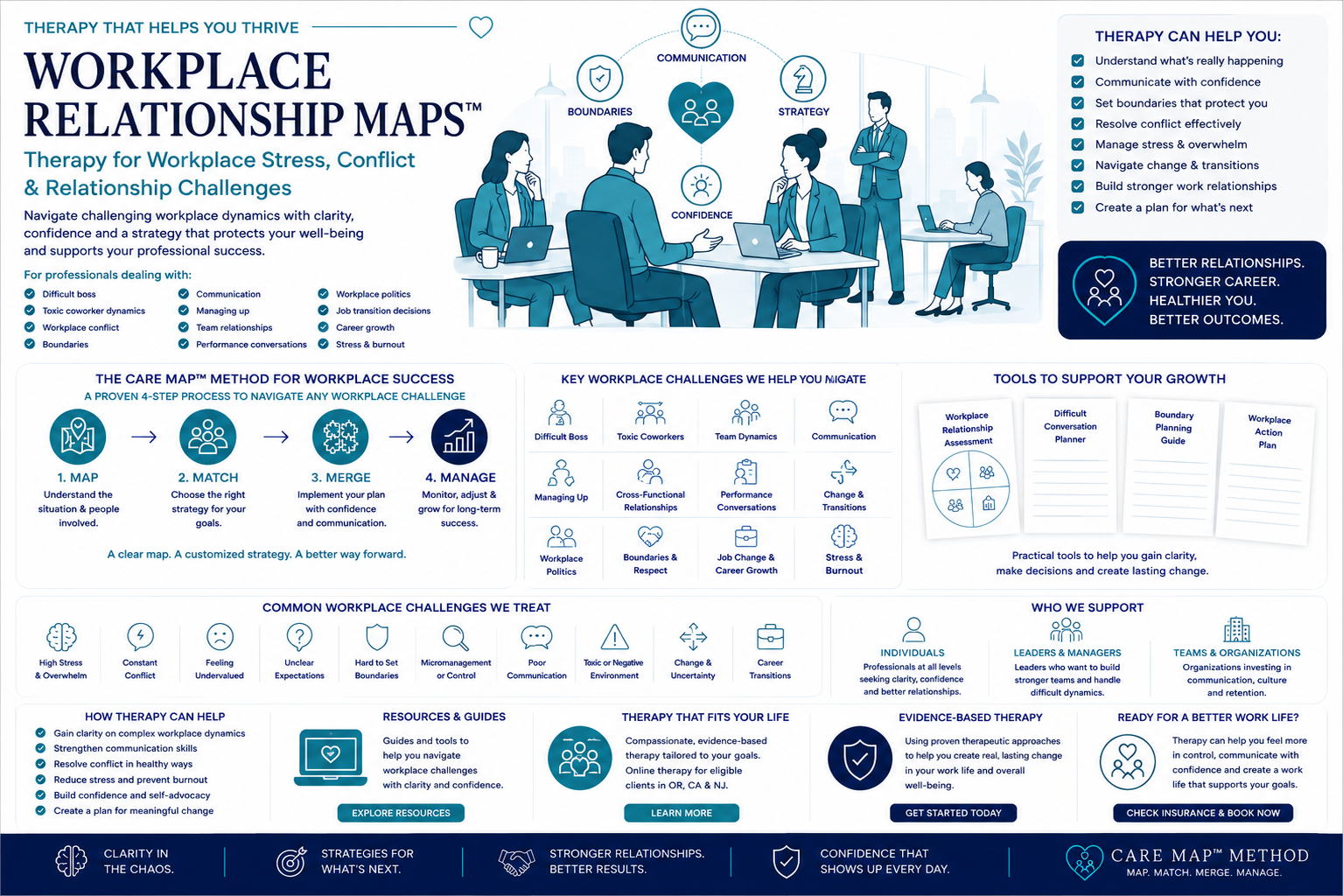
Online therapy for workplace stress, difficult bosses, coworker conflict, boundaries and burnout in CA, NJ and Oregon Check insurance eligibility and book online.
Online Therapy for Workplace Stress, Difficult Bosses & Conflict
A difficult boss, a tense coworker relationship, or a politically complicated workplace can take up far more mental space than the hours you spend at work. You may replay conversations, second-guess what you said, worry about your reputation, or feel stuck between speaking up and staying quiet. Therapy can give you a structured place to understand what is happening, how it is affecting you, and what choices are realistically available.
Check Insurance Eligibility & Book Online Therapy → Via HEADWAY
What You May Be Dealing With
You dread meetings, emails or interactions with a particular person.
You replay workplace conversations long after the workday ends.
You feel micromanaged, criticized, excluded or undervalued.
You are unsure how to set a boundary without making the situation worse.
Coworker conflict is affecting your confidence, sleep, mood or concentration.
You are trying to decide whether to address the situation, escalate it, change roles or leave.
You are burned out from carrying too much responsibility or emotional labor.
You want to communicate more clearly without becoming reactive or shutting down.
How Therapy Can Help
Therapy is not about giving you a one-size-fits-all script for dealing with a difficult person. The work starts by understanding the specific relationship, the power dynamics, your emotional reactions, your goals and the risks involved. Together, we can identify patterns, strengthen boundaries, prepare for difficult conversations, work on emotional regulation, and clarify what is within your control. If a job decision is part of the problem, therapy can also help you separate fear, exhaustion and frustration from the practical factors that matter to your next step.
The Care Map Method™ in Therapy
Care Map Method™ is a structured way to organize the people, needs, stressors and choices involved in a complex real-life situation. In psychotherapy, it is used only as an organizing framework within individualized clinical care—not as a substitute for assessment, diagnosis or treatment planning.
MAP — Identify the people, pressures, triggers, history and emotional impact of the workplace situation.
MATCH — Identify coping strategies, communication approaches, boundaries and decision-making tools that fit the situation.
MERGE — Practice how to apply those strategies in real conversations, meetings, routines and workdays.
MANAGE — Review what changes, what does not, and how you want to respond as the situation evolves.
Why Work With Tammy Gold
Tammy Gold is a licensed therapist, author and nationally recognized parenting, relationship and caregiving expert with more than 20 years of experience helping people navigate complex interpersonal situations. Her Care Map Method™ provides a structured way to organize the people, needs, stressors and choices involved in a real-life problem while keeping psychotherapy individualized to the client.
Insurance & Online Therapy
Online therapy is available for clients located in states where Tammy is licensed and accepting clients. Selected insurance plans are accepted through Headway. Coverage, copays, deductibles, coinsurance and eligibility vary by plan and member.
Use the Headway booking link to check current insurance eligibility and available appointment times. Do not publish contracted reimbursement amounts on the website.
Oregon: Providence Health Plan • Aetna • Regence BlueCross BlueShield of Oregon • Carelon Behavioral Health • Providence Medicare Advantage.
California: Providence Health Plan • Aetna • Carelon Behavioral Health • Anthem Blue Cross California.
New Jersey: Providence Health Plan • Aetna • Carelon Behavioral Health.
Always verify current participation before publishing.
Frequently Asked Questions
Do you offer therapy for problems with a boss or coworker?
Yes. Individual therapy can focus on the emotional and relational impact of a difficult workplace situation, including communication, boundaries, anxiety, burnout, confidence and decision-making.
Can therapy help me decide whether to stay in or leave a job?
Therapy can help you clarify what is driving the decision, identify your priorities, examine recurring patterns and think through the emotional consequences of different options. The decision remains yours.
How can therapy help with workplace boundaries?
Therapy can help you identify where boundaries are unclear, understand why asserting them feels difficult, and develop more sustainable ways to communicate limits while managing the emotions that come with doing so.
Can I use insurance for online therapy?
Selected insurance plans are accepted through Headway. Eligibility and out-of-pocket costs depend on your individual plan. Use the booking link to verify current benefits.
Do you provide online therapy throughout New Jersey, California, or Oregon?
Telehealth sessions are available to appropriate clients located in states where Tammy is licensed and currently accepting clients. Availability can be confirmed through the booking process.
Work problems do not have to occupy every part of your life. If you want a structured place to understand the relationship, reduce the emotional spillover and decide what comes next, check your insurance eligibility and book an online therapy session through Headway.

Friendship Conflict Therapy: When a Close Friendship Becomes Painful or Confusing
Online therapy in Oregon for friendship conflict, betrayal, boundaries, loneliness, difficult communication and relationship loss. Insurance varies.

Friendship Conflict Therapy in Oregon
Friendship problems can hurt as deeply as romantic or family conflict, yet people often feel they are supposed to simply get over them. Betrayal, exclusion, mismatched expectations, boundary problems or the end of a long friendship can create real grief and anxiety.
A nonjudgmental place to understand what happened
Therapy gives you space to talk openly about anger, embarrassment, loneliness and confusion. We can identify the relationship pattern, what you need now and whether your goal is repair, clearer boundaries, acceptance or moving forward.
Turn emotional overwhelm into practical choices
MAP what happened and why it affected you. MATCH your needs with realistic relationship goals. MERGE communication and boundaries into your next steps. MANAGE the outcome, including grief if the relationship changes or ends.
Online Oregon therapy and insurance
Telehealth is available for clients located in Oregon. If you want to use insurance, Headway can verify your current plan eligibility and available cost information before booking.
Is friendship conflict a valid reason to seek therapy?
Yes. Relationship loss, betrayal and chronic interpersonal stress can significantly affect mood, anxiety, sleep and daily functioning.
Can therapy help me decide whether to end a friendship?
Therapy can help you clarify your values, boundaries, patterns and options. The decision remains yours.
Can I work on loneliness as well as the conflict?
Yes. Therapy can address both the specific relationship and the broader effects on trust, connection and loneliness.
Can Headway check my Aetna plan in Oregon?
Headway can verify participating insurance information. Eligibility depends on your specific plan and provider participation.

Aetna Couples Counseling in California for Repeated Arguments and Communication Problems
Online relationship therapy in California for repeated arguments, marriage stress, and communication problems. Verify Aetna benefits and book through Headway.

Aetna Couples Counseling in California for Repeated Arguments and Communication Problems
You may love your partner and still feel trapped in the same argument. One person pushes for answers while the other withdraws. A discussion about money, parenting, family, intimacy, or household responsibilities quickly becomes criticism, defensiveness, silence, or resentment. The surface topic changes, but the emotional cycle stays the same.
You do not have to carry this alone. My goal is to provide a warm, confidential, and nonjudgmental space where you can unpack what is happening without shame, blame, or pressure. Therapy can offer emotional support and practical direction at the same time.
Relationship therapy creates a structured place to slow the cycle down. We identify the trigger, the protective reaction, the unmet need underneath it, and the point where communication breaks down. Each partner has room to be heard without the session becoming another argument. The purpose is not to decide who is right. It is to understand what keeps happening and practice safer, clearer ways to respond.
ONLINE THERAPY IN CALIFORNIA
Insurance may be available through Headway depending on your plan, eligibility, state, and session type. Verify benefits before booking.
How the Care Map Method™ helps
MAP
Identify the recurring conflict cycle, emotional triggers, physical stress, family pressures, and environmental demands affecting the relationship.
MATCH
Clarify each partner’s needs, fears, goals, communication style, and the tools most likely to fit the relationship.
MERGE
Practice listening, repair, boundary language, emotional regulation, and communication strategies that both partners can use outside therapy.
MANAGE
Create agreements, check-ins, conflict plans, and realistic next steps so progress continues between sessions.
What clients can work toward
Recognize the argument before it escalates
Communicate needs without blame or shame
Reduce defensiveness and emotional withdrawal
Rebuild teamwork, trust, and connection
Therapy is not only a place to talk about what went wrong. It is a place to feel heard, understand the pattern, practice healthier responses, and build a plan that can be used in daily life. Progress depends on the circumstances and cannot be guaranteed, but the work can become clearer, more intentional, and more supported.
Frequently asked questions
Does Aetna cover couples counseling in California?
Coverage depends on the specific plan, clinical eligibility, session type, and platform rules. Use the Headway insurance-verification process before scheduling and do not assume every Aetna plan covers couples or family sessions.
Can I attend alone if my partner will not come?
Yes. Individual relationship therapy can help you understand the cycle, regulate reactions, communicate differently, set boundaries, and make clearer decisions even when your partner does not attend.
Why do we keep having the same argument?
Repeated arguments are often maintained by emotional triggers, unmet needs, protective reactions, assumptions, and communication habits rather than the surface topic alone.
Will the therapist take sides?
The goal is not to label one partner right and the other wrong. The focus is understanding the relationship pattern and helping both people communicate more safely and effectively.
What happens in the first session?
We clarify the main concern, the conflict cycle, each person’s goals, and the emotional and practical factors affecting the relationship. We also identify initial tools and priorities.
Is online couples therapy appropriate?
Online therapy can be useful when both participants can join from a private, safe location in the state where the therapist is licensed. Suitability and insurance coverage should be confirmed before booking.
You deserve one place where you can be honest without worrying about judgment, shame, or blame. Together, we can understand what is happening, identify what needs to change, and create practical steps toward a healthier relationship and a more manageable life..

Horizon BCBSNJ Therapy for Divorce, Co-Parenting & Family Conflict in New Jersey
New Jersey therapy for divorce, co-parenting conflict, communication and family stress. Horizon BCBSNJ eligibility may be available through Headway.
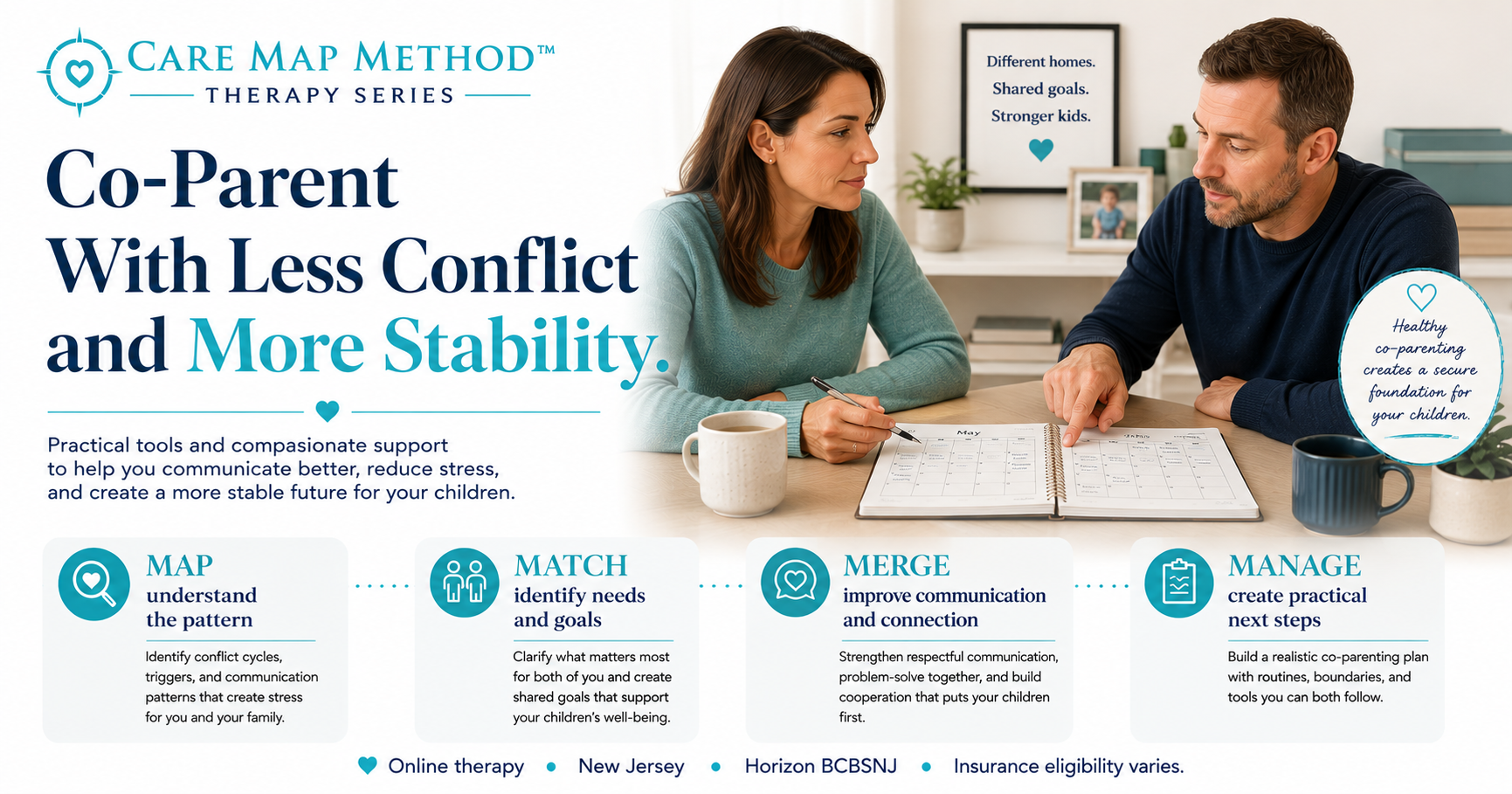
Horizon BCBSNJ therapy in New Jersey for divorce, co-parenting conflict and family communication using the Care Map Method.
Co-Parent With Less Conflict and More Stability
You may no longer be partners, but you are still connected through parenting. Therapy can help reduce reactive communication and create a more workable co-parenting structure.
I provide online therapy to clients in New Jersey and participate with select insurance plans through Headway. Horizon BCBSNJ eligibility and benefits vary by individual plan and should be verified before scheduling.
Care Map Method™: MAP → MATCH → MERGE → MANAGE
MAP — identify triggers, recurring fights and children’s needs.
MATCH — clarify priorities, boundaries and decision-making roles.
MERGE — create calmer communication and predictable routines.
MANAGE — build a co-parenting plan you can actually follow.
The relationship changes, but the parenting continues
Co-parenting can be difficult when old relationship pain mixes with schedules, school, holidays, money and new partners. Even a short text can reactivate years of conflict.
Protect the children from the adult conflict
The goal is not perfect friendship with your ex. It is to reduce unnecessary conflict, communicate clearly and create enough predictability that children are not placed in the middle.
Create structure where emotion has taken over
We can establish communication rules, boundaries, transition routines and strategies for responding when the other parent is angry or uncooperative.
Individual therapy can still improve co-parenting
Your ex does not have to attend for you to become less reactive, more strategic and clearer about your boundaries.
Ready for support and a practical plan? If you are located in New Jersey, you can view current availability and verify insurance eligibility through my Headway booking link. I provide a warm, nonjudgmental space focused on understanding the problem and creating real next steps.
Can I do co-parenting therapy alone?
Yes. Individual therapy can help you change your communication, regulation and boundaries.
Can therapy make my ex cooperate?
Therapy cannot control another person, but it can help you communicate strategically and reduce your participation in unproductive cycles.
Does Horizon BCBSNJ cover online therapy?
Coverage and eligibility vary by plan. Verify through Headway.
Can therapy help with new partners or blended-family stress?
Yes. These transitions can create additional communication and boundary issues that we can address.
Is co-parenting therapy legal mediation?
No. Therapy is not legal mediation or legal advice.

Aetna Therapy in New Jersey for Adult Sibling Conflict, Resentment & Family Stress
Online therapy in New Jersey for adult sibling conflict, resentment, family roles and boundaries. Aetna eligibility may be available through Headway.

Aetna therapy in New Jersey for adult sibling conflict, resentment, family roles and healthier boundaries with the Care Map Method.
When Sibling Conflict Follows You Into Adulthood
Adult sibling conflict can instantly reopen old roles. Therapy can help you understand the history without staying trapped in it.
I provide online therapy to clients in New Jersey and participate with select insurance plans through Headway. Aetna eligibility and benefits vary by individual plan and should be verified before scheduling.
Care Map Method™: MAP → MATCH → MERGE → MANAGE
MAP — identify old family roles, current triggers and unresolved hurt.
MATCH — clarify needs, expectations and appropriate boundaries.
MERGE — improve direct communication and reduce triangulation.
MANAGE — decide what a healthier relationship looks like now.
Sibling conflict is rarely only about the current issue
Arguments about parents, holidays, money, caregiving, inheritance or grandchildren can carry decades of comparison, favoritism and old roles underneath them.
You are allowed to want both peace and connection
Therapy can help you stop getting pulled into the same role you had at age twelve. We identify what belongs to the present and what belongs to the family history.
Build communication that is direct and realistic
We can work on boundary language, difficult conversations, expectations and ways to avoid involving other relatives in the conflict.
A healthier relationship may look different
The goal is not always closeness. Sometimes success means respectful contact, clearer limits, less guilt and more emotional freedom.
Ready for support and a practical plan? If you are located in New Jersey, you can view current availability and verify insurance eligibility through my Headway booking link. I provide a warm, nonjudgmental space focused on understanding the problem and creating real next steps.
Can therapy help adult siblings who are not both attending?
Yes. Individual therapy can help you understand the pattern and change your own responses and boundaries.
Why do sibling fights feel so intense?
They often activate childhood roles, comparison, loyalty and long-standing unmet needs.
Can you help with siblings fighting over aging parents?
Yes. Caregiving roles, responsibility and decision-making are common sources of adult sibling conflict.
Does Aetna cover therapy in New Jersey?
Coverage depends on your plan and eligibility. Verify through Headway.
What if I do not want a close relationship with my sibling?
Therapy can help you define a level of contact and boundaries that protect your wellbeing.

Providence Therapy in New Jersey for Parent–Adult Child Conflict & Family Relationships
New Jersey online therapy for conflict with adult children, family boundaries and communication. Providence eligibility may be available through Headway.
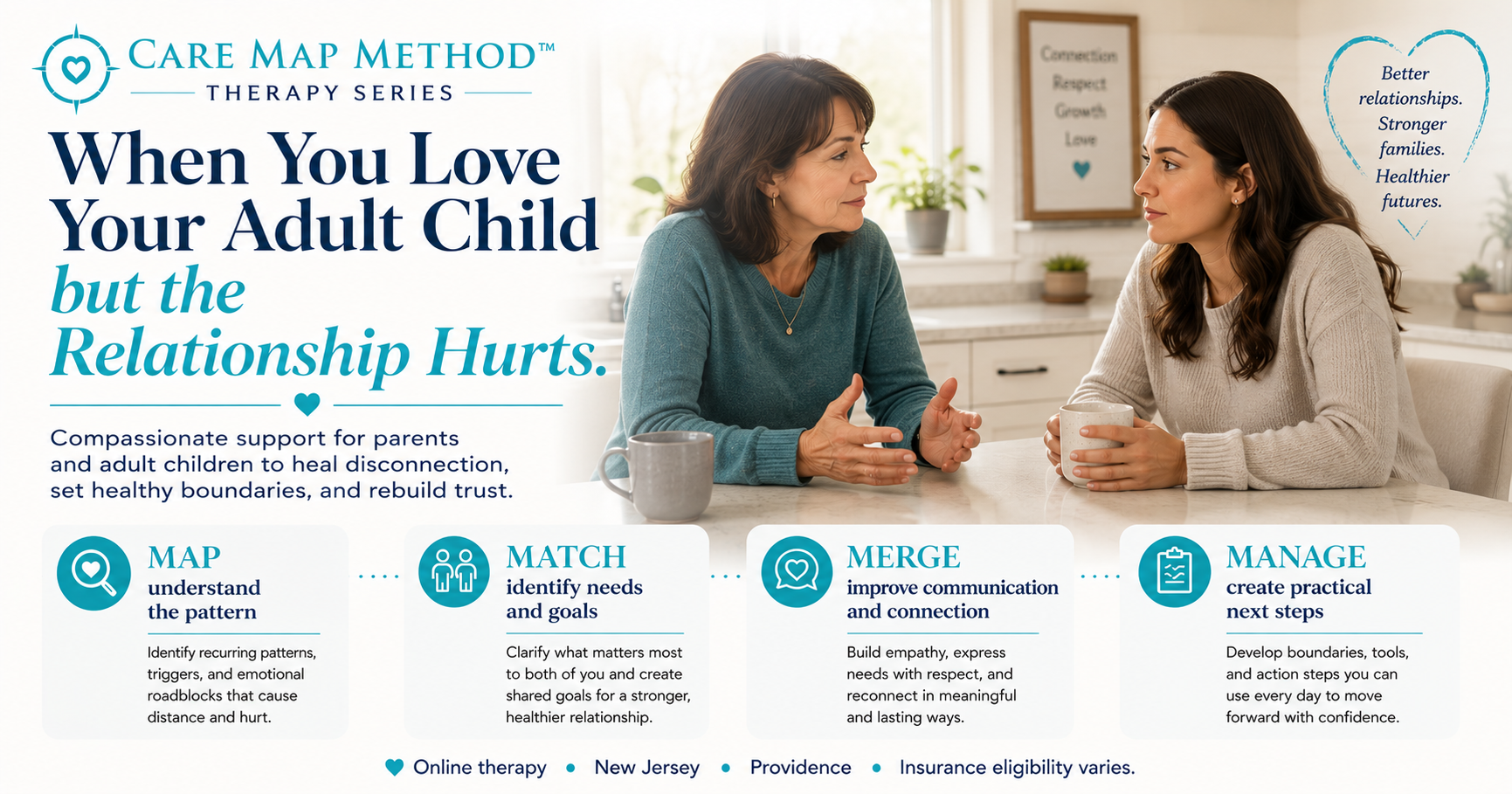
Providence therapy in New Jersey for parent and adult child conflict, boundaries and communication using the Care Map Method.
When You Love Your Adult Child but the Relationship Hurts
Adult children still need parents, but the relationship has to change. Therapy can help families move from criticism, guilt, and control toward boundaries, respect, and connection.
Insurance-safe line: I provide online therapy to clients in New Jersey and participate with select insurance plans through Headway. Providence Health Plan eligibility and benefits vary by individual plan and should be verified before scheduling.
Care Map Method™: MAP → MATCH → MERGE → MANAGE
MAP — identify the repeating family pattern and emotional triggers.
MATCH — clarify each person’s needs, expectations and boundaries.
MERGE — improve communication without overfunctioning or withdrawing.
MANAGE — create realistic agreements and a healthier adult relationship.
The relationship has changed, but the pattern may not have
Conflict with an adult son or daughter can be especially painful because the relationship carries years of history. Parents may feel rejected, worried or disrespected. Adult children may feel criticized, controlled or misunderstood.
Therapy can help without choosing sides
We look at what each person is experiencing, what is being communicated and what is being assumed. The goal is not to prove who is right. It is to reduce the cycle that keeps both sides hurt and defensive.
Boundaries can protect connection
Healthy boundaries are not punishment. They help clarify what you can offer, what you cannot control and how you want to communicate. We can develop language for money, housing, grandchildren, holidays, caregiving and other emotionally loaded topics.
You can begin even if your adult child will not attend
Parents often make meaningful changes by changing how they respond, what they reinforce and how they communicate.
Ready for support and a practical plan? If you are located in New Jersey, you can view current availability and verify insurance eligibility through my Headway booking link. I provide a warm, nonjudgmental space focused on understanding the problem and creating real next steps.
Can therapy help if my adult child will not come?
Yes. Parent-only work can change communication, boundaries and the family pattern.
How do I set boundaries without losing my adult child?
We focus on respectful, specific boundaries and communication that protects both the relationship and your wellbeing.
Can therapy help with estrangement?
Therapy can help you process grief, understand patterns, evaluate contact and communicate thoughtfully when contact is possible.
Does Providence cover therapy in New Jersey?
Eligibility and benefits vary by plan. Verify through Headway before booking.
Can we discuss financial support or living at home?
Yes. These are common areas of parent–adult child conflict and can be addressed directly.

Carelon Therapy in California for a Difficult Boss, Coworker Conflict & Work Stress
Online California therapy for difficult bosses, coworker conflict, work anxiety and boundaries. Carelon eligibility may be available through Headway.
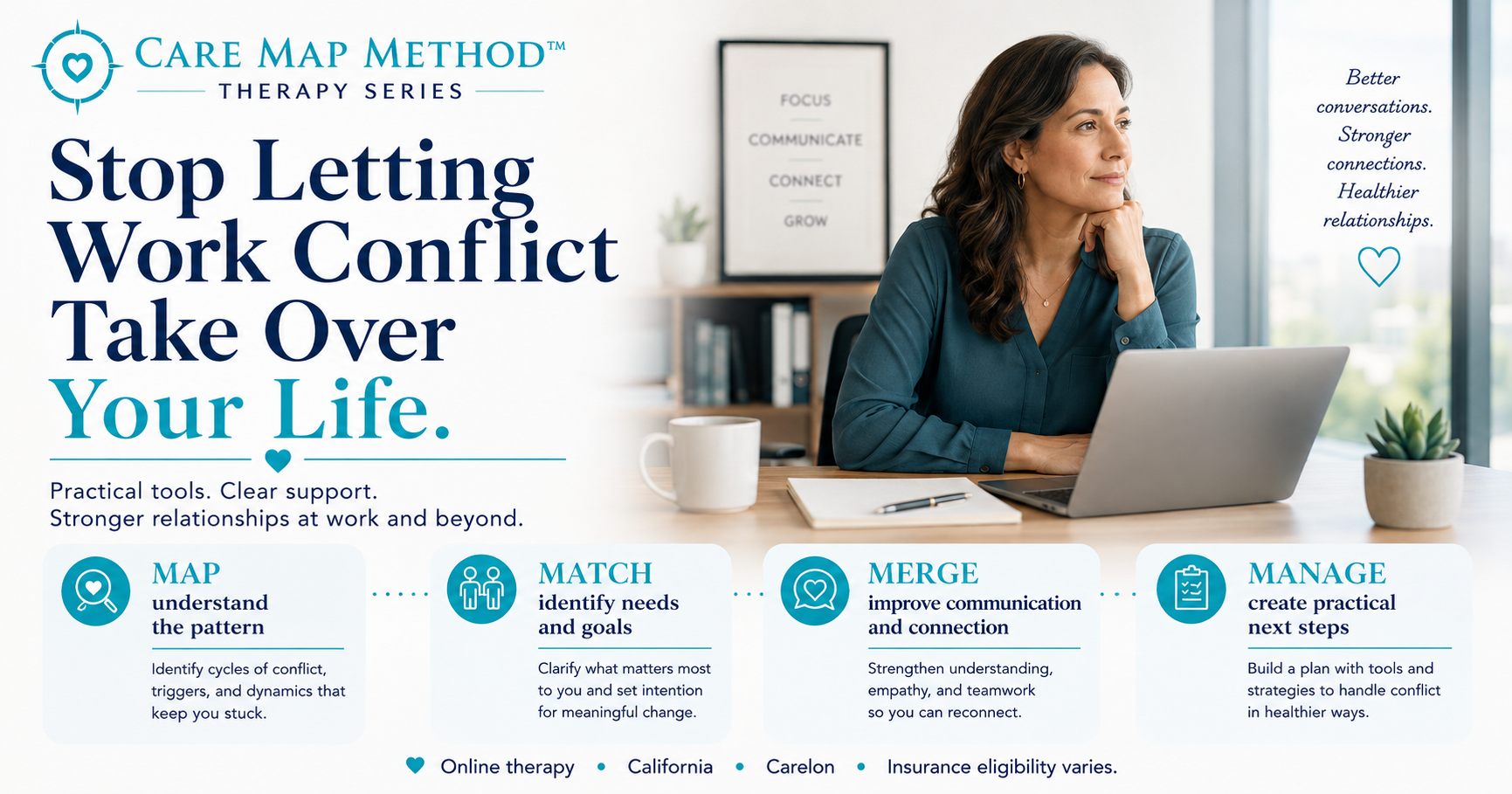
Carelon therapy in California for difficult boss, coworker conflict and work stress, with practical communication and boundary strategies using the Care Map Method.
Stop Letting Work Conflict Take Over Your Life
A difficult boss or coworker can affect your sleep, confidence, family life and mood long after the workday ends. Therapy can help you respond strategically instead of carrying the conflict everywhere.
Insurance-safe line: I provide online therapy to clients in California and participate with select insurance plans through Headway. Carelon eligibility and benefits vary by individual plan and should be verified before scheduling.
Care Map Method™: MAP → MATCH → MERGE → MANAGE
MAP — identify triggers, workplace dynamics and the impact on your wellbeing.
MATCH — clarify goals, boundaries and what is within your control.
MERGE — prepare communication, scripts and healthier responses.
MANAGE — create a practical work strategy and protect your life outside work.
When work follows you home
Workplace conflict can become emotionally consuming. You may replay meetings, worry about the next email, question yourself or take the tension home to your partner and family.
Understand the relationship pattern at work
Sometimes the issue is workload or management. Sometimes it involves communication styles, unclear roles, perfectionism, fear of rejection, people-pleasing or a pattern of reacting strongly to criticism. We map the whole situation rather than assuming the answer is simply “quit.”
Build a strategy
Therapy can help you prepare difficult conversations, set boundaries, regulate your nervous system, decide what deserves a response and determine when repair, escalation or a career change makes sense.
Protect your confidence
The goal is not to make you tolerate an unhealthy workplace. It is to help you think clearly, protect your well-being, and make decisions with confidence rather than panic or anger.
Ready for support and a practical plan? If you are located in California, you can view current availability and verify insurance eligibility through my Headway booking link. I provide a warm, nonjudgmental space focused on understanding the problem and creating real next steps.
Can therapy help with a difficult boss?
Yes. Therapy can help with stress regulation, communication, boundaries, confidence and decision-making.
What if my coworker is the problem, not me?
Therapy does not require you to take responsibility for another person’s behavior. It helps you decide how you want to respond and protect yourself.
Can therapy help me stop thinking about work at night?
Yes. We can develop boundaries, transition routines, and strategies for interrupting rumination.
Does Carelon cover online therapy in California?
Coverage and eligibility vary. Confirm your specific benefits through Headway.
Can you help me decide whether to leave my job?
We can evaluate the emotional, practical and relational factors so you can make a more deliberate decision.

Carelon Therapy in California for Family Conflict With Parents, Children, and Adult Children
Carelon family conflict therapy in California for parents, children, and adult children using Map, Match, Merge, and Manage.
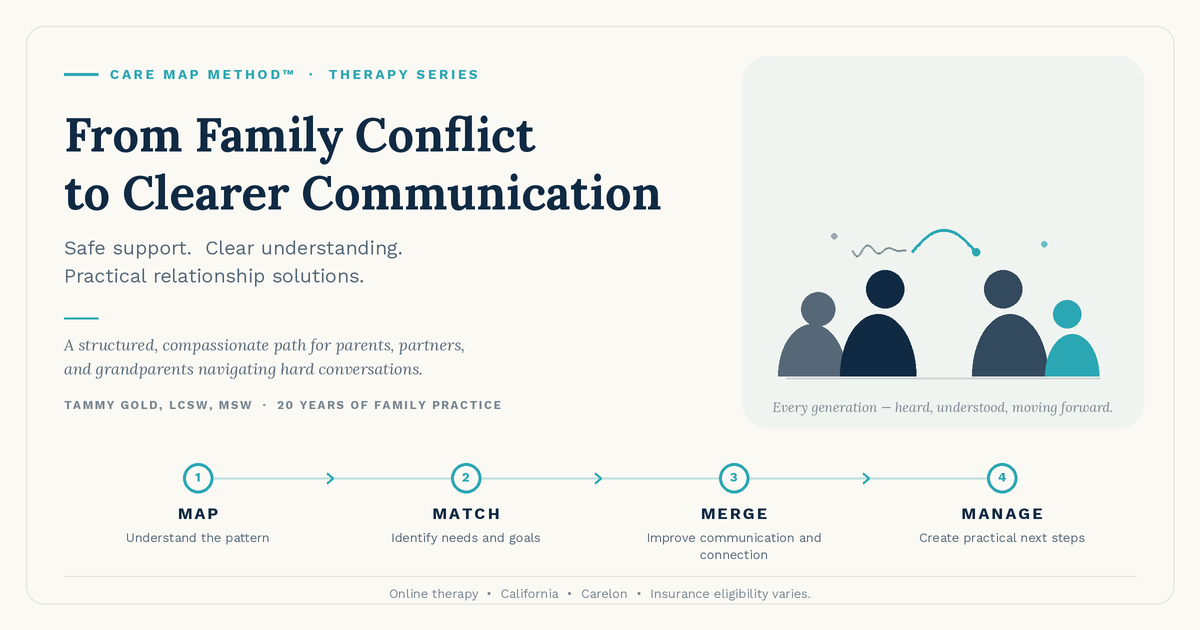
Carelon Therapy in California for Family Conflict With Parents, Children, and Adult Children
Family conflict often contains years of history. A current disagreement can activate old roles, unresolved hurt, loyalty conflicts, criticism, guilt, or fear of rejection. Problems with a parent, child, teenager, or adult child may leave you feeling angry, helpless, responsible, or unsure whether to speak up or pull away.
You do not have to carry this alone. My goal is to provide a warm, confidential, and nonjudgmental space where you can unpack what is happening without shame, blame, or pressure. Therapy can offer emotional support and practical direction at the same time.
Therapy provides a nonjudgmental place to unpack the relationship without forcing an immediate confrontation. We identify the pattern, separate present concerns from historical pain, clarify what you need, and develop communication and boundary strategies that fit the relationship. Progress can begin even if the other family member does not attend.
ONLINE THERAPY IN CALIFORNIA
Insurance may be available through Headway depending on your plan, eligibility, state, and session type. Verify benefits before booking.
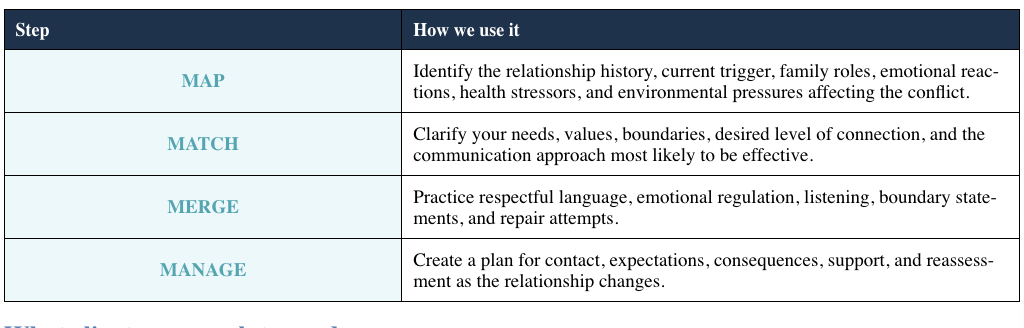
Carelon family conflict therapy in California for parents, children, and adult children using Map, Match, Merge, and Manage.
What clients can work toward
Understand why the conflict feels so intense
Communicate without escalating the pattern
Set boundaries with less guilt
Choose a healthier level of connection
Therapy is not only a place to talk about what went wrong. It is a place to feel heard, understand the pattern, practice healthier responses, and build a plan that can be used in daily life. Progress depends on the circumstances and cannot be guaranteed, but the work can become clearer, more intentional, and more supported.
Frequently asked questions
Can therapy help if my family member refuses to attend?
Yes. Individual therapy can help you change your side of the pattern, clarify boundaries, prepare conversations, and make healthier decisions.
Does Carelon cover family therapy in California?
Coverage depends on the specific plan, clinical need, session type, and current network rules. Verify eligibility through Headway before booking.
Can therapy improve a relationship with an adult child?
Therapy can help parents and adult children understand roles, expectations, independence, boundaries, and communication. Improvement may begin with one person changing the pattern.
How do I set boundaries without ending the relationship?
Boundaries can be specific, respectful, and focused on what you will do rather than controlling the other person. Therapy can help prepare the wording and follow-through.
Will therapy blame the parent or child?
No. The goal is to understand the system and the needs of the people involved, not to assign shame or blame.
What if the conflict involves safety or abuse?
Safety comes first. Therapy may include safety planning and referral to appropriate specialized, legal, medical, or crisis resources when needed.
Final booking call to action
You deserve one place where you can be honest without worrying about judgment, shame, or blame. Together, we can understand what is happening, identify what needs to change, and create practical steps toward a healthier relationship and a more manageable life.

Regence BCBS Therapy in Oregon for a Difficult Boss, Coworker Conflict, and Work Stress
Online therapy in Oregon for a difficult boss, coworker conflict, workplace anxiety, burnout, communication, and boundaries. Verify Regence benefits.

egence BCBS therapy in Oregon for difficult boss relationships, coworker conflict, workplace anxiety, burnout, and boundaries.
Regence BCBS Therapy in Oregon for a Difficult Boss, Coworker Conflict, and Work Stress
A difficult boss or coworker can affect sleep, confidence, concentration, family life, and physical health. You may replay conversations, anticipate criticism, avoid speaking up, overwork to prove yourself, or carry anger home. The problem may involve a genuinely unhealthy workplace, but it can also activate older patterns involving authority, rejection, perfectionism, or conflict avoidance.
You do not have to carry this alone. My goal is to provide a warm, confidential, and nonjudgmental space where you can unpack what is happening without shame, blame, or pressure. Therapy can offer emotional support and practical direction at the same time.
Therapy helps you distinguish what belongs to the workplace, what the situation activates emotionally, and what choices are available. We prepare communication, strengthen boundaries, reduce reactivity, and evaluate whether repair, escalation, role change, or departure is the healthiest path
How the Care Map Method™ helps
MAP
Identify the workplace pattern, trigger events, power dynamics, emotional and physical impact, policies, workload, and environmental constraints.
MATCH
Clarify goals, boundaries, communication strategies, documentation needs, support resources, and realistic options.
MERGE
Practice difficult conversations, assertive language, emotional regulation, and ways to protect home life from work spillover.
MANAGE
Create an action plan, decision timeline, coping routine, documentation process, and criteria for evaluating change..
What clients can work toward
Reduce rumination after work
Communicate with greater confidence
Set clearer professional boundaries
Make a thoughtful stay-or-leave decision
Therapy is not only a place to talk about what went wrong. It is a place to feel heard, understand the pattern, practice healthier responses, and build a plan that can be used in daily life. Progress depends on the circumstances and cannot be guaranteed, but the work can become clearer, more intentional, and more supported.
Frequently asked questions
Can therapy help with a difficult boss?
Yes. Therapy can help you understand the dynamic, regulate stress, prepare for communication, set boundaries, and decide what is within your control.
Does Regence BCBS cover online therapy in Oregon?
Coverage varies by plan and eligibility. Verify current benefits and network participation through Headway before scheduling.
How do I know if the workplace is toxic or I am overreacting?
Therapy can help examine patterns, evidence, policies, impact on functioning, and whether concerns persist across people and settings.
Can therapy help me stop taking work stress home?
Yes. We can build transition routines, boundaries, emotional regulation, and communication strategies that reduce spillover.
Should I confront my boss?
That depends on the power dynamic, safety, evidence, organizational culture, goals, and available protections. Therapy can help plan rather than react.
Is career counseling part of this work?
Therapy may include values, identity, confidence, burnout, and decision-making around career transitions, while specialized career services may also be appropriate.
Final booking call to action
You deserve one place where you can be honest without worrying about judgment, shame, or blame. Together, we can understand what is happening, identify what needs to change, and create practical steps toward a healthier relationship and a more manageable life.
Verify your insurance and request an online therapy appointment through my Psychology Today / Headway booking path.

Horizon BCBS Therapy in New Jersey for Sibling Conflict and Family Caregiving
Online therapy in New Jersey for sibling conflict, caregiver burden, aging-parent decisions, boundaries, and family communication. Verify Horizon benefits.
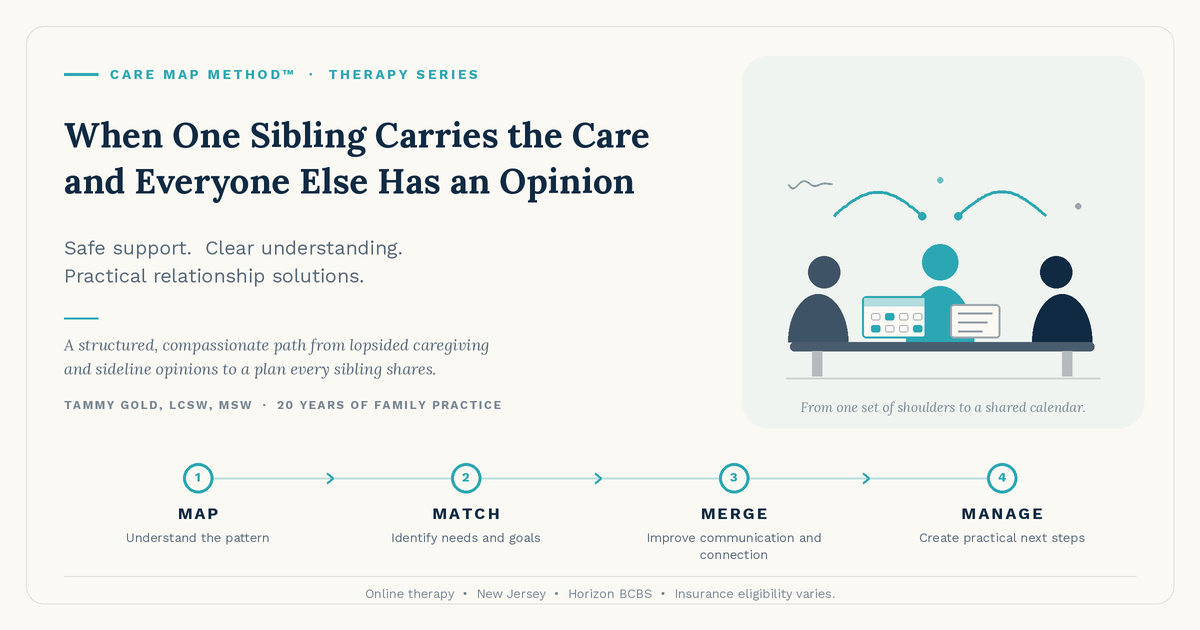
Horizon BCBS therapy in New Jersey for sibling conflict, caregiver burden, aging-parent decisions, and family communication.
Horizon BCBS Therapy in New Jersey for Sibling Conflict and Family Caregiving
Family caregiving can create a painful imbalance. One sibling may handle appointments, calls, emergencies, and daily care while others participate less or criticize decisions from a distance. Old family roles quickly return, and conversations about the parent become arguments about fairness, loyalty, money, and who has always done more.
You do not have to carry this alone. My goal is to provide a warm, confidential, and nonjudgmental space where you can unpack what is happening without shame, blame, or pressure. Therapy can offer emotional support and practical direction at the same time.
Therapy offers a neutral place to identify both the practical imbalance and the emotional history underneath it. We clarify what the parent needs, what each sibling can realistically contribute, and what boundaries are necessary. The work focuses on reducing blame and creating a plan that is more sustainable.
ONLINE THERAPY IN NEW JERSEY
Insurance may be available through Headway depending on your plan, eligibility, state, and session type. Verify benefits before booking.
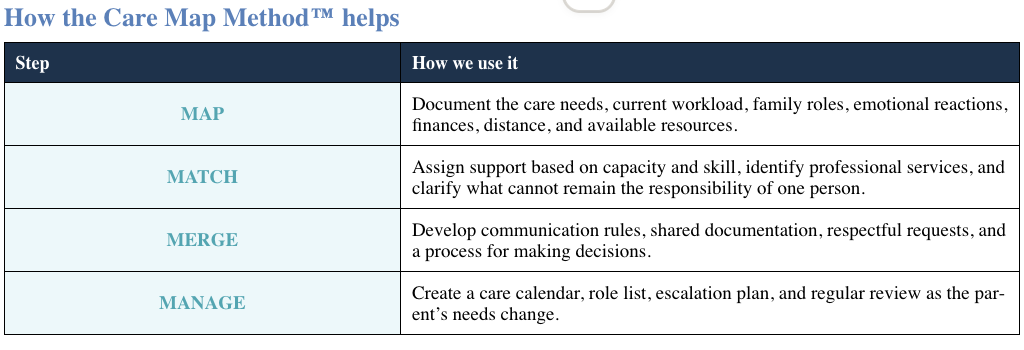
How the Care Map Method™ helps
MAP
Document the care needs, current workload, family roles, emotional reactions, finances, distance, and available resources.
MATCH
Assign support based on capacity and skill, identify professional services, and clarify what cannot remain the responsibility of one person.
MERGE
Develop communication rules, shared documentation, respectful requests, and a process for making decisions.
MANAGE
Create a care calendar, role list, escalation plan, and regular review as the parent’s needs change.
What clients can work toward
· Make invisible caregiving work visible
· Reduce resentment and guilt
· Create clearer sibling responsibilities
· Protect the caregiver’s health and limits
Therapy is not only a place to talk about what went wrong. It is a place to feel heard, understand the pattern, practice healthier responses, and build a plan that can be used in daily life. Progress depends on the circumstances and cannot be guaranteed, but the work can become clearer, more intentional, and more supported.
Frequently asked questions
Can family therapy help when siblings live in different states?
Online sessions may allow family members to participate when legal, clinical, and licensing requirements are met. Individual therapy is also useful when joint work is not possible.
Does Horizon BCBS cover family caregiving therapy?
Coverage depends on the plan, clinical need, session type, and current network rules. Verify benefits before scheduling.
What if my siblings refuse to help?
Therapy can help you communicate clearly, stop overfunctioning, set limits, pursue outside resources, and decide what you can safely continue.
How do we include the aging parent in decisions?
The parent’s preferences and autonomy should be included whenever possible, while safety, capacity, medical advice, and legal considerations may affect the process.
Can therapy help with caregiver guilt?
Yes. Therapy can separate love from unlimited responsibility and help caregivers create boundaries that are compassionate and sustainable.
What practical tools might we use?
A family capacity assessment, care calendar, communication plan, provider question list, and written role agreement can make the situation more manageable
You deserve one place where you can be honest without worrying about judgment, shame, or blame. Together, we can understand what is happening, identify what needs to change, and create practical steps toward a healthier relationship and a more manageable life.

Aetna Therapy in New Jersey for Failure to Launch and Conflict With an Adult Child
Online therapy in New Jersey for failure to launch, adult-child conflict, boundaries, financial dependence, and family stress. Verify Aetna benefits through Headway.
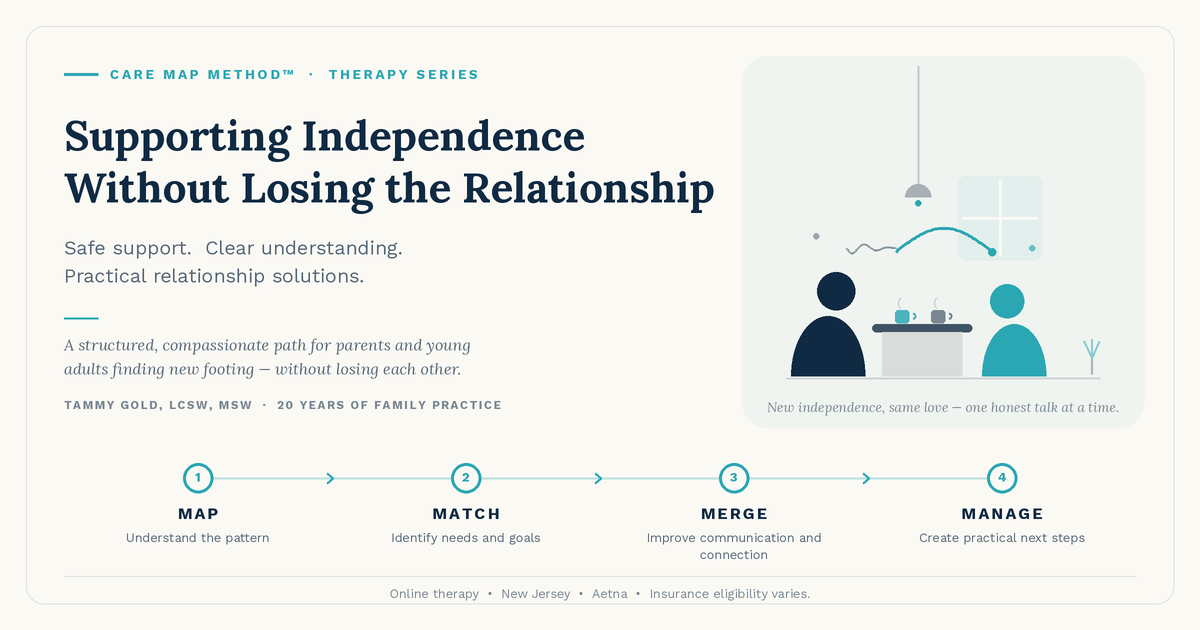
Aetna therapy in New Jersey for failure to launch, adult-child conflict, boundaries, and building independence with the Care Map Method.
Aetna Therapy in New Jersey for Failure to Launch and Conflict With an Adult Child
Parents may feel frightened, guilty, angry, or exhausted when an adult child is not progressing toward work, education, financial responsibility, or independent living. The adult child may feel ashamed, criticized, anxious, misunderstood, or unsure where to begin. Repeated pressure and rescue can create a cycle in which everyone feels stuck.
You do not have to carry this alone. My goal is to provide a warm, confidential, and nonjudgmental space where you can unpack what is happening without shame, blame, or pressure. Therapy can offer emotional support and practical direction at the same time.
Therapy helps the family move beyond labels and examine the full picture. We distinguish skill gaps, emotional barriers, health concerns, family patterns, and environmental realities. Parents can learn to support growth without overfunctioning, while adult children can clarify goals, responsibilities, and achievable steps.
ONLINE THERAPY IN NEW JERSEY
Insurance may be available through Headway depending on your plan, eligibility, state, and session type. Verify benefits before booking.
How the Care Map Method™ helps
MAP
Assess functioning, mental and physical health, daily routines, responsibilities, motivation, family dynamics, and environmental barriers.
MATCH
Identify appropriate expectations, supports, treatment referrals, skills, incentives, and consequences.
MERGE
Create respectful communication and align support with responsibility rather than rescue or repeated criticism.
MANAGE
Build written goals, timelines, household agreements, progress reviews, and a plan for adjusting support.
What clients can work toward
· Reduce recurring parent-adult child conflict
· Create clearer expectations and boundaries
· Support independence without abandonment
· Replace vague pressure with measurable next steps
Therapy is not only a place to talk about what went wrong. It is a place to feel heard, understand the pattern, practice healthier responses, and build a plan that can be used in daily life. Progress depends on the circumstances and cannot be guaranteed, but the work can become clearer, more intentional, and more supported.
Frequently asked questions
What does failure to launch mean?
It commonly describes difficulty progressing toward education, work, financial responsibility, household contribution, or independent living. It is a description, not a diagnosis.
Does Aetna cover online therapy in New Jersey?
Coverage varies by plan, eligibility, and network participation. Confirm benefits through Headway before booking.
Can parents attend without the adult child?
Yes. Parents can work on boundaries, communication, expectations, guilt, fear, and how they respond to dependence.
Should we stop financial support?
There is no universal answer. Support should be evaluated in relation to health, functioning, effort, family capacity, and whether it promotes growth or maintains dependence.
What if anxiety, depression, ADHD, or substance use is involved?
Those concerns may require specialized assessment or treatment. Therapy can help identify the need for additional providers and coordinate family expectations appropriately.
How do we set a deadline without destroying the relationship?
A deadline works best when it is realistic, specific, connected to clear steps, and communicated respectfully with predictable follow-through.

Horizon BCBS Therapy in New Jersey for Sibling Conflict and Family Caregiving
Online therapy in New Jersey for sibling conflict, caregiver burden, aging-parent decisions, boundaries, and family communication. Verify Horizon benefits.
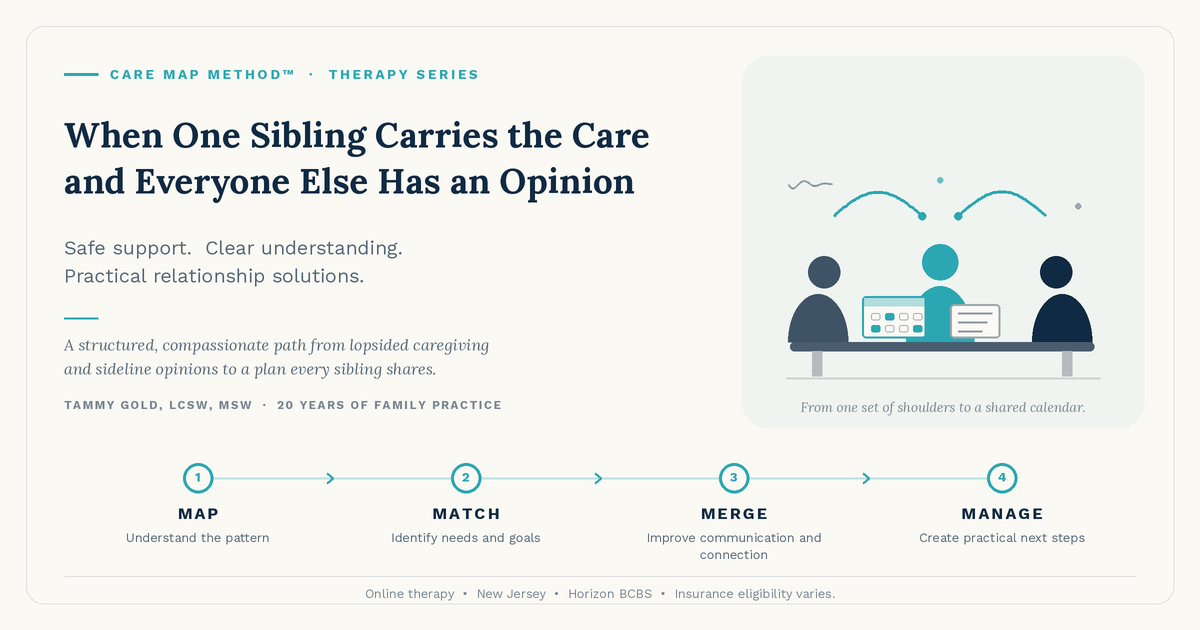
Horizon BCBS therapy in New Jersey for sibling conflict, caregiver burden, aging-parent decisions, and family communication.
Horizon BCBS Therapy in New Jersey for Sibling Conflict and Family Caregiving
Family caregiving can create a painful imbalance. One sibling may handle appointments, calls, emergencies, and daily care while others participate less or criticize decisions from a distance. Old family roles quickly return, and conversations about the parent become arguments about fairness, loyalty, money, and who has always done more.
You do not have to carry this alone. My goal is to provide a warm, confidential, and nonjudgmental space where you can unpack what is happening without shame, blame, or pressure. Therapy can offer emotional support and practical direction at the same time.
Therapy offers a neutral place to identify both the practical imbalance and the emotional history underneath it. We clarify what the parent needs, what each sibling can realistically contribute, and what boundaries are necessary. The work focuses on reducing blame and creating a plan that is more sustainable.
ONLINE THERAPY IN NEW JERSEY
Insurance may be available through Headway depending on your plan, eligibility, state, and session type. Verify benefits before booking.
What clients can work toward
Make invisible caregiving work visible
Reduce resentment and guilt
Create clearer sibling responsibilities
Protect the caregiver’s health and limits
Therapy is not only a place to talk about what went wrong. It is a place to feel heard, understand the pattern, practice healthier responses, and build a plan that can be used in daily life. Progress depends on the circumstances and cannot be guaranteed, but the work can become clearer, more intentional, and more supported.
Frequently asked questions
Can family therapy help when siblings live in different states?
Online sessions may allow family members to participate when legal, clinical, and licensing requirements are met. Individual therapy is also useful when joint work is not possible.
Does Horizon BCBS cover family caregiving therapy?
Coverage depends on the plan, clinical need, session type, and current network rules. Verify benefits before scheduling.
What if my siblings refuse to help?
Therapy can help you communicate clearly, stop overfunctioning, set limits, pursue outside resources, and decide what you can safely continue.
How do we include the aging parent in decisions?
The parent’s preferences and autonomy should be included whenever possible, while safety, capacity, medical advice, and legal considerations may affect the process.
Can therapy help with caregiver guilt?
Yes. Therapy can separate love from unlimited responsibility and help caregivers create boundaries that are compassionate and sustainable.
What practical tools might we use?
A family capacity assessment, care calendar, communication plan, provider question list, and written role agreement can make the situation more manageable.
Final booking call to action
You deserve one place where you can be honest without worrying about judgment, shame, or blame. Together, we can understand what is happening, identify what needs to change, and create practical steps toward a healthier relationship and a more manageable life.

Aetna Therapy in New Jersey for Failure to Launch and Conflict With an Adult Child
Online therapy in New Jersey for failure to launch, adult-child conflict, boundaries, financial dependence, and family stress. Verify Aetna benefits through Headway
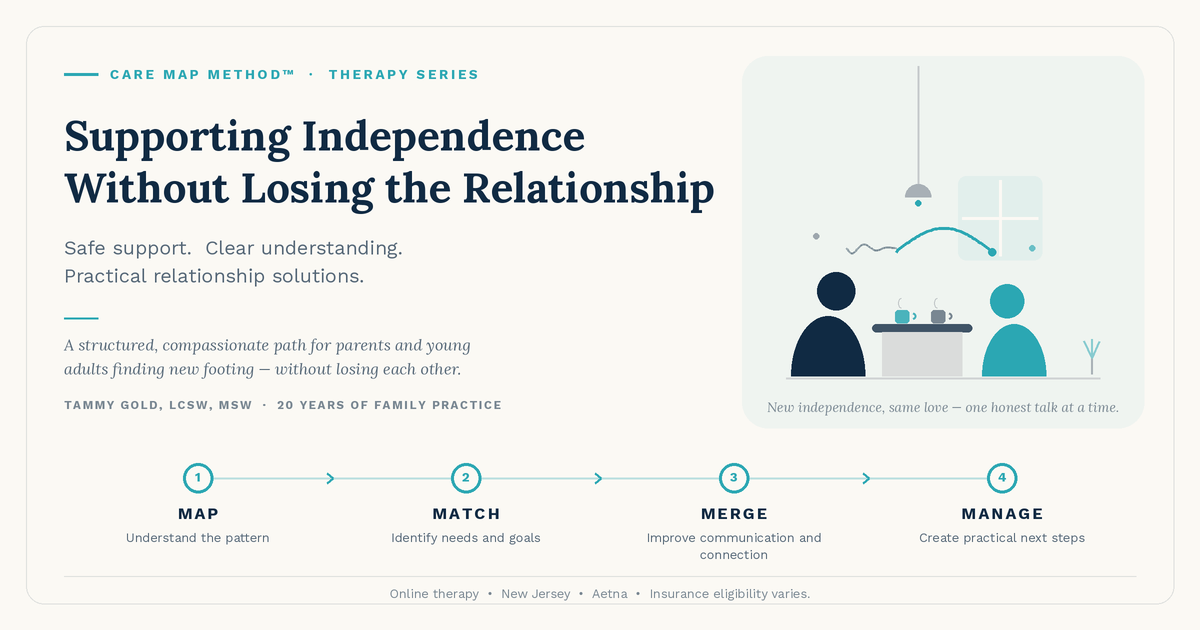
Aetna therapy in New Jersey for failure to launch, adult-child conflict, boundaries, and building independence with the Care Map Method.
Aetna Therapy in New Jersey for Failure to Launch and Conflict With an Adult Child
Parents may feel frightened, guilty, angry, or exhausted when an adult child is not progressing toward work, education, financial responsibility, or independent living. The adult child may feel ashamed, criticized, anxious, misunderstood, or unsure where to begin. Repeated pressure and rescue can create a cycle in which everyone feels stuck.
You do not have to carry this alone. My goal is to provide a warm, confidential, and nonjudgmental space where you can unpack what is happening without shame, blame, or pressure. Therapy can offer emotional support and practical direction at the same time.
Therapy helps the family move beyond labels and examine the full picture. We distinguish skill gaps, emotional barriers, health concerns, family patterns, and environmental realities. Parents can learn to support growth without overfunctioning, while adult children can clarify goals, responsibilities, and achievable steps.
ONLINE THERAPY IN NEW JERSEY
Insurance may be available through Headway depending on your plan, eligibility, state, and session type. Verify benefits before booking.
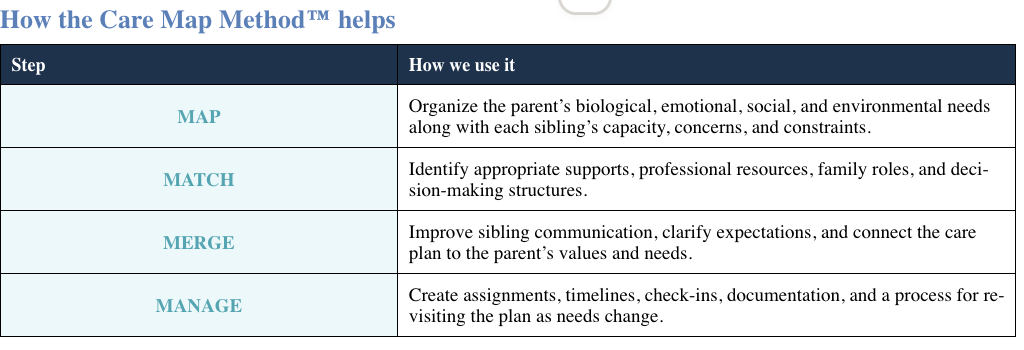
What clients can work toward
Reduce recurring parent-adult child conflict
Create clearer expectations and boundaries
Support independence without abandonment
Replace vague pressure with measurable next steps
Therapy is not only a place to talk about what went wrong. It is a place to feel heard, understand the pattern, practice healthier responses, and build a plan that can be used in daily life. Progress depends on the circumstances and cannot be guaranteed, but the work can become clearer, more intentional, and more supported.
Frequently asked questions
What does failure to launch mean?
It commonly describes difficulty progressing toward education, work, financial responsibility, household contribution, or independent living. It is a description, not a diagnosis.
Does Aetna cover online therapy in New Jersey?
Coverage varies by plan, eligibility, and network participation. Confirm benefits through Headway before booking.
Can parents attend without the adult child?
Yes. Parents can work on boundaries, communication, expectations, guilt, fear, and how they respond to dependence.
Should we stop financial support?
There is no universal answer. Support should be evaluated in relation to health, functioning, effort, family capacity, and whether it promotes growth or maintains dependence.
What if anxiety, depression, ADHD, or substance use is involved?
Those concerns may require specialized assessment or treatment. Therapy can help identify the need for additional providers and coordinate family expectations appropriately.
How do we set a deadline without destroying the relationship?
A deadline works best when it is realistic, specific, connected to clear steps, and communicated respectfully with predictable follow-through.
Final booking call to action
You deserve one place where you can be honest without worrying about judgment, shame, or blame. Together, we can understand what is happening, identify what needs to change, and create practical steps toward a healthier relationship and a more manageable life.
Verify your insurance and request an online therapy appointment through my Psychology Today / Headway booking path.

Providence Therapy in California for Sibling Conflict Over an Aging Parent
Online therapy in California for siblings arguing about an aging parent, caregiver burden, eldercare decisions, and family communication. Verify Providence benefits.
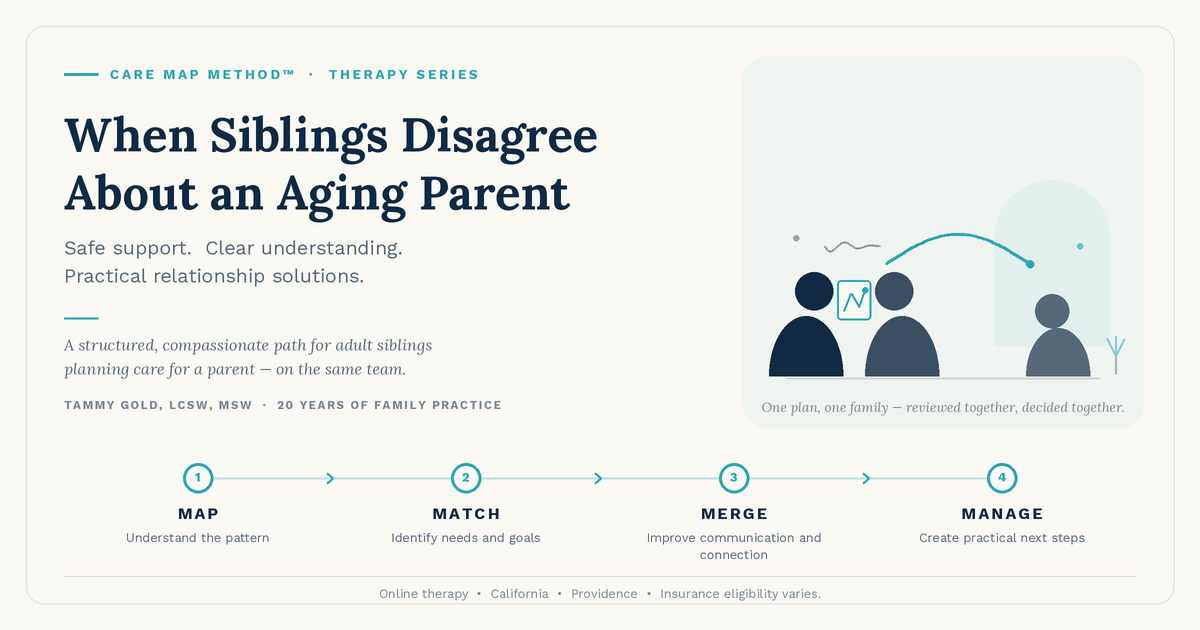
Providence therapy in California for sibling conflict, aging-parent care decisions, caregiver stress, and family communication.
Providence Therapy in California for Sibling Conflict Over an Aging Parent
A parent’s decline can reopen old sibling roles and create urgent disagreements about safety, money, housing, medical care, driving, and who should do what. One sibling may feel abandoned with the work. Another may feel criticized or excluded. Everyone may believe they are protecting the parent, yet the family becomes less able to make decisions together.
You do not have to carry this alone. My goal is to provide a warm, confidential, and nonjudgmental space where you can unpack what is happening without shame, blame, or pressure. Therapy can offer emotional support and practical direction at the same time.
Therapy creates a structured space to separate the care problem from the sibling history. We identify facts, fears, capacities, and practical limits. Each person’s concern can be heard while the family develops clearer communication, roles, and next steps. The goal is not perfect agreement; it is a safer, more workable process.
ONLINE THERAPY IN CALIFORNIA
Insurance may be available through Headway depending on your plan, eligibility, state, and session type. Verify benefits before booking.
What clients can work toward
Reduce blame among siblings
Clarify realistic roles and responsibilities
Make decisions from the full care picture
Protect the parent and the sibling relationships
Therapy is not only a place to talk about what went wrong. It is a place to feel heard, understand the pattern, practice healthier responses, and build a plan that can be used in daily life. Progress depends on the circumstances and cannot be guaranteed, but the work can become clearer, more intentional, and more supported.
Frequently asked questions
Can therapy help siblings agree about eldercare?
Therapy may not produce complete agreement, but it can improve communication, clarify facts and capacities, reduce blame, and create a more workable decision process.
Does Providence cover this type of therapy?
Benefits vary by plan, clinical eligibility, state, and platform. Verify current coverage before scheduling.
Can I attend without my siblings?
Yes. Individual therapy can help you manage caregiver stress, set limits, prepare conversations, and decide what you can realistically provide.
How do we divide caregiving fairly?
Fair does not always mean equal. Roles should reflect time, distance, finances, skills, health, and willingness. A structured care map can make those differences visible.
What if a parent refuses help?
Therapy can help the family assess risk, respect autonomy where possible, communicate concerns, and decide what actions are appropriate within legal and ethical limits.
When is specialized eldercare guidance needed?
Professional medical, legal, financial, or care-management expertise may be needed for capacity, safety, placement, benefits, or complex medical decisions.
Final booking call to action
You deserve one place where you can be honest without worrying about judgment, shame, or blame. Together, we can understand what is happening, identify what needs to change, and create practical steps toward a healthier relationship and a more manageable life.
Verify your insurance and request an online therapy appointment through my Psychology Today / Headway booking path.
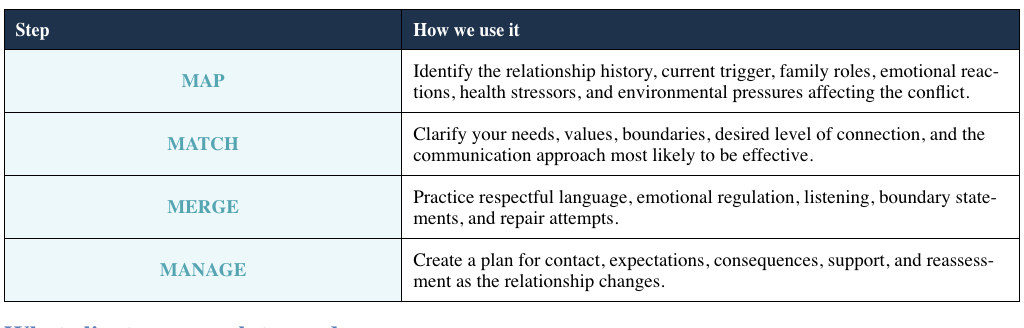
Providence therapy in California for sibling conflict, aging-parent care decisions, caregiver stress, and family

Anthem Therapy in California for Parenting Stress That Is Hurting Your Relationship
Online therapy in California for parenting stress, marriage conflict, emotional overload, and communication problems. Verify Anthem benefits through Headway.

Anthem therapy in California for parenting stress, marriage conflict, mental load, and communication using the Care Map Method.
Anthem Therapy in California for Parenting Stress That Is Hurting Your Relationship
Parenting stress can quietly become relationship stress. Couples may argue about discipline, sleep, schedules, money, screens, school, household labor, or who carries the mental load. Both people may feel unappreciated, exhausted, and convinced that the other does not understand how much they are doing.
You do not have to carry this alone. My goal is to provide a warm, confidential, and nonjudgmental space where you can unpack what is happening without shame, blame, or pressure. Therapy can offer emotional support and practical direction at the same time.
Therapy helps separate the parenting problem from the relationship injury underneath it. We make room for exhaustion, resentment, fear, and disappointment without turning the session into a blame exchange. We then translate those feelings into clearer requests, shared priorities, and realistic agreements for the family.
ONLINE THERAPY IN CALIFORNIA
Insurance may be available through Headway depending on your plan, eligibility, state, and session type. Verify benefits before booking.
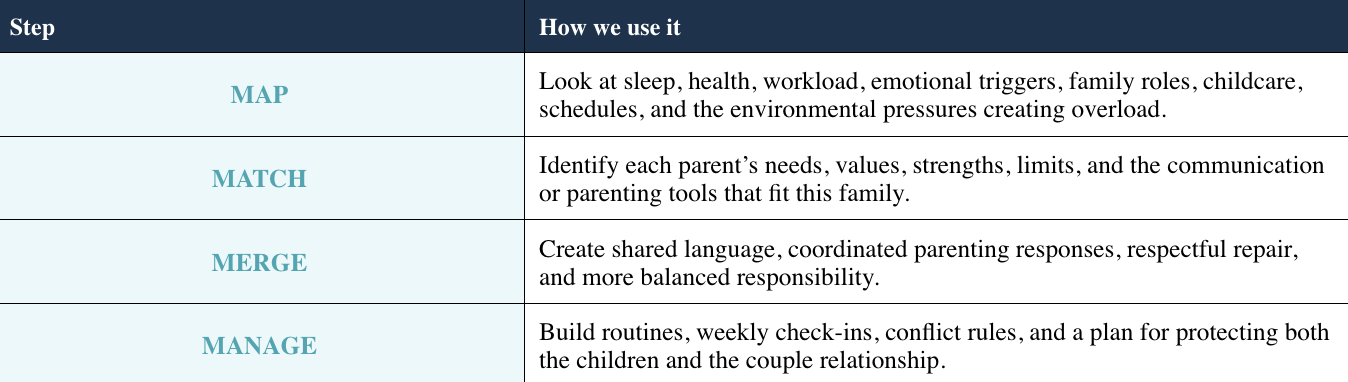
Anthem therapy in California for parenting stress, marriage conflict, mental load, and communication using the Care Map Method.
What clients can work toward
Reduce resentment and emotional overload
Improve parenting teamwork
Communicate before stress becomes conflict
Protect connection while raising children
Therapy is not only a place to talk about what went wrong. It is a place to feel heard, understand the pattern, practice healthier responses, and build a plan that can be used in daily life. Progress depends on the circumstances and cannot be guaranteed, but the work can become clearer, more intentional, and more supported.
Frequently asked questions
Can parenting stress damage a marriage?
Yes. Chronic fatigue, unequal responsibility, financial pressure, reduced couple time, and disagreements about parenting can create resentment and disconnection.
Does Anthem cover online therapy in California?
Coverage varies by plan, eligibility, location, and platform participation. Verify benefits through the current Headway booking process before scheduling.
Can therapy help if we disagree about discipline?
Yes. Therapy can clarify shared values, identify why each approach feels important, and help parents develop more consistent and workable responses.
Can one parent come alone?
Yes. Individual therapy can help a parent regulate stress, communicate needs, change reactive patterns, and make more thoughtful family decisions.
Will we receive practical tools?
Yes. Sessions may include communication scripts, division-of-labor discussions, parenting plans, routines, repair strategies, and concrete next steps.
What if we are too busy for therapy?
Online scheduling may reduce travel demands. The goal is to make sessions useful and focused so the time invested improves daily family functioning.

Therapy for Communication Problems With a Partner, Parent, Adult Child, Boss or Caregiver
Therapy for clients struggling to communicate with a partner, parent, adult child, sibling, boss, coworker, nanny, daycare provider, caregiver or senior care professional.
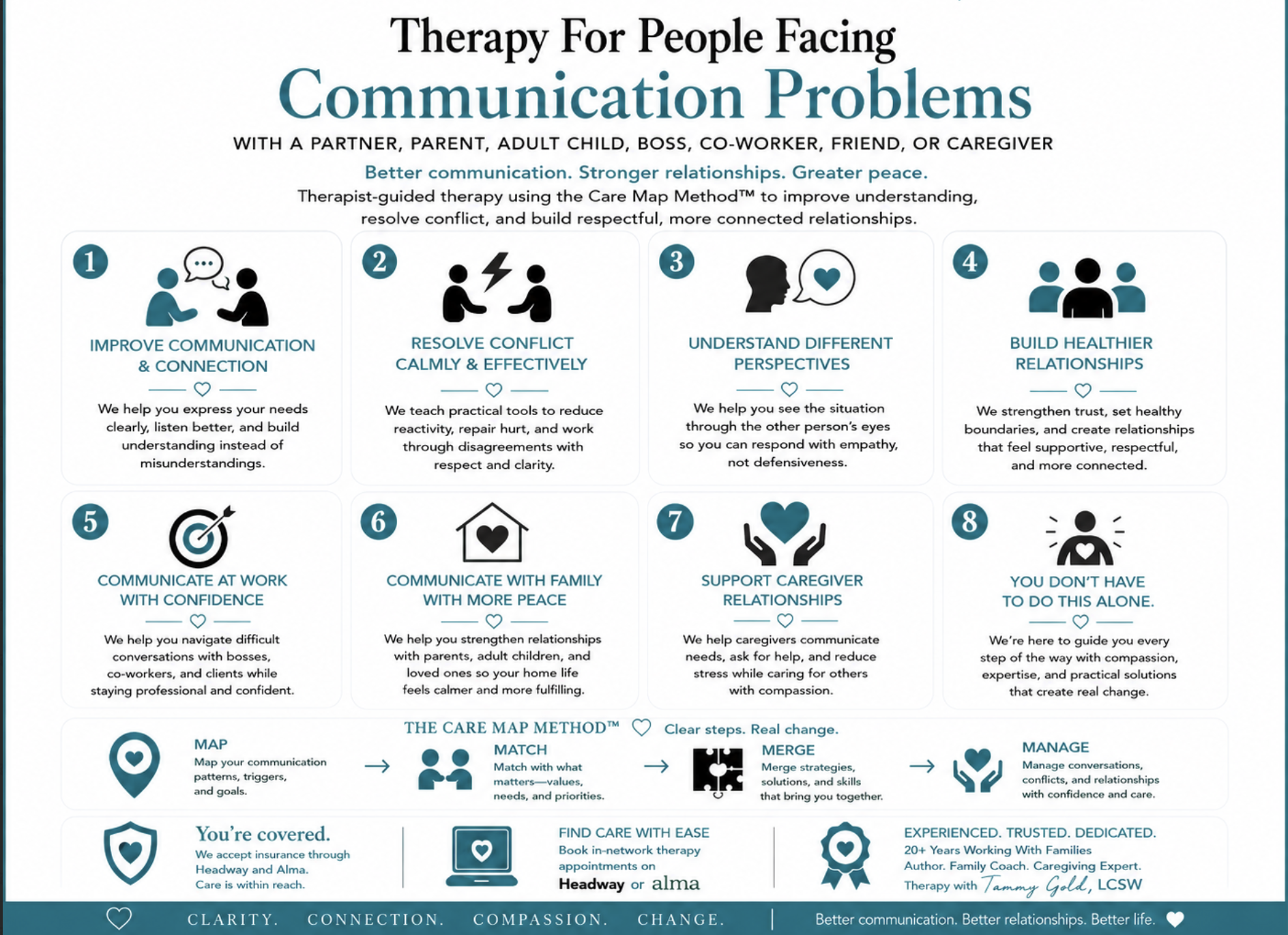
Therapy for Communication Problems With Important People in Your Life
Communication problems can happen in any important relationship: with a partner, child, adult child, parent, sibling, friend, boss, coworker, neighbor, co-parent, nanny, daycare provider, caregiver or senior care professional. When communication breaks down, people often feel misunderstood, defensive, resentful, anxious or emotionally exhausted.
I am Tammy Gold, LCSW. I offer online therapy for clients in California, New Jersey and Oregon. Depending on your plan and eligibility, insurance may be available through Headway or Alma.
My Psychology Today profile links to booking and insurance options through Headway.
When communication becomes stressful
You may know what you feel but not how to say it. You may worry that speaking honestly will create conflict. You may shut down, over-explain, apologize, become reactive or avoid the conversation altogether. Therapy can help you understand the pattern and find more effective words.
The goal is not to make you perfect. The goal is to help you communicate with more clarity, compassion and confidence.
How sessions help
Using the Care Map Method™, we Map what is causing the communication breakdown, Match the needs and triggers underneath it, Merge better language and listening, and Manage boundaries or next steps.
This approach is especially helpful for clients dealing with family conflict, parenting stress, divorce, co-parenting, work stress, caregiver management, childcare situations or eldercare decisions.
Request a session
If you are struggling with communication in an important relationship, visit my Psychology Today profile to request a session. My profile links to booking and insurance options through Headway.
What types of relationship concerns do you help with?
I help clients with couples and marriage concerns, communication problems, parenting stress, family conflict, divorce, co-parenting, adult children, sibling relationships, caregiver stress, workplace relationships, boundaries, and major life transitions.
What makes your approach to relationship therapy different?
My approach combines a warm, supportive, nonjudgmental therapeutic space with a structured process. We use the Care Map Method™ to understand what is driving the problem, identify needs and patterns, strengthen communication, and create practical next steps.
Will therapy be a safe and nonjudgmental space?
Yes. My goal is to provide one place where clients can speak honestly without shame, blame, criticism, or pressure. Clients can unpack feelings, understand patterns, and receive compassionate support and practical guidance.
Is therapy only for couples?
No. Individual therapy can help improve relationships with a spouse, partner, child, parent, sibling, adult child, friend, coworker, boss, caregiver, or other important person—even when that person does not attend therapy.
Do you provide couples counseling?
Yes. Couples work may address repeated arguments, communication problems, emotional disconnection, parenting disagreements, trust, boundaries, divorce decisions, and co-parenting. Insurance coverage for couples or family sessions varies by plan.
What happens during the first therapy session?
We discuss what is bringing you to therapy, what feels most important, what you want to change, and what has or has not helped before. We begin mapping the biological, emotional, social, and environmental factors affecting the situation and identify initial priorities.
Do you only listen, or will I receive practical tools?
Therapy includes emotional support and space to process feelings, but it is also solution-focused. Clients may receive communication tools, scripts, boundary language, reflection questions, relationship strategies, and practical next steps.
Do you offer online therapy?
Yes. Online therapy is available to clients physically located in California, New Jersey, or Oregon at the time of the session.
What insurance plans do you accept?
Insurance availability varies by state, plan, eligibility, and booking platform. Prospective clients should use the booking or insurance-verification link to confirm current coverage before scheduling.
How do I schedule therapy?
Use the Psychology Today or designated booking link on the page to view availability, confirm insurance eligibility, and request a therapy appointment.

Therapy for Adult Children Caring for Aging Parents While Raising Their Own Family
Therapy for adult children in the sandwich generation who are raising children while caring for aging parents, managing siblings, caregiving decisions and family stress.
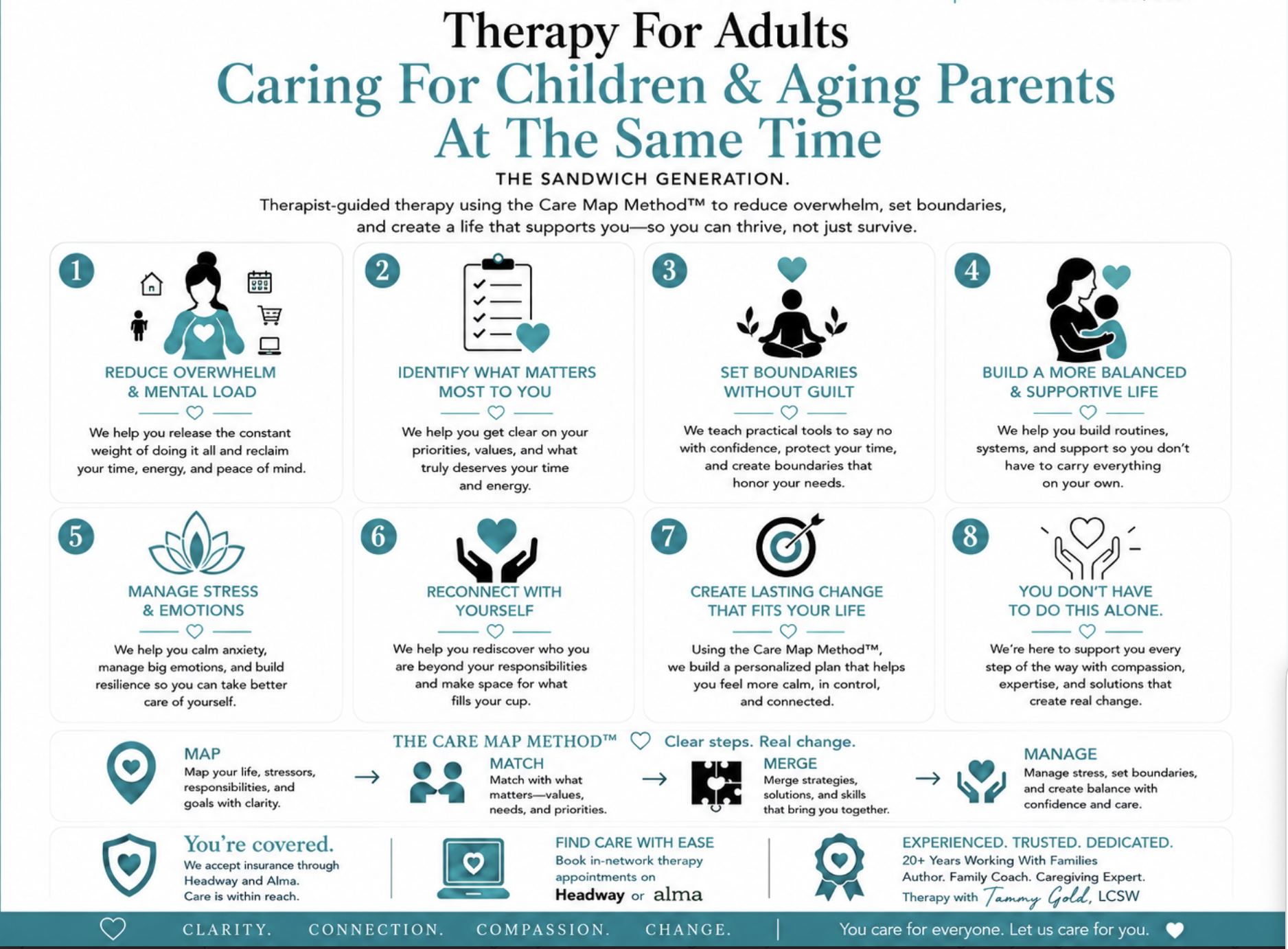
Therapy for Adult Children Caring for Aging Parents While Raising Their Own Family
Caring for aging parents while raising children can create intense emotional pressure. You may be managing your parent’s needs, sibling conflict, eldercare decisions, your own children, work, marriage, finances and the feeling that everyone needs you at once.
I am Tammy Gold, LCSW, a therapist, author and caregiving expert. I offer online therapy for clients in California, New Jersey and Oregon. Depending on your plan and eligibility, insurance may be available through Headway or Alma.
My Psychology Today profile links to booking and insurance options through Headway.
The emotional weight of caregiving
Many adult children feel guilt, resentment, grief, fear, exhaustion and confusion. You may be trying to make good decisions for an aging parent while also feeling pressure from siblings, caregivers, facilities, medical providers or extended family.
Therapy gives you one safe place to talk openly about what you are carrying without being judged.
How the Care Map Method™ helps
Through the Care Map Method™, we Map your parent’s needs and your needs, Match the right supports, Merge communication among family members and care providers, and Manage the plan so it feels more sustainable.
This work combines emotional support with practical problem-solving. The goal is to help you feel less alone, communicate more clearly, set boundaries and make decisions with more steadiness.
Request a session
If you are caring for an aging parent while managing children, work, siblings, marriage or family conflict, visit my Psychology Today profile to request a session. My profile links to booking and insurance options through Headway.
What are common signs of caregiver burnout?
Signs may include exhaustion, irritability, resentment, guilt, sleep problems, reduced concentration, withdrawal, health changes, hopelessness, and feeling unable to keep up with care demands.
How can therapy help caregiver burnout?
Therapy can help caregivers process emotions, identify unsustainable demands, set boundaries, communicate with family, ask for help, and develop a more realistic care plan.
Is it normal to feel resentful while caregiving?
Yes. Resentment can develop when responsibilities are excessive, support is limited, boundaries are unclear, or the caregiver’s own needs are repeatedly postponed. Feeling resentment does not mean you do not love the person.
What if my siblings will not help?
Therapy or coaching can help you clarify what you need, prepare a family conversation, define responsibilities, set limits, and decide what you can realistically continue providing.
How do I know when more professional care is needed?
Consider changes in safety, cognition, mobility, medication, nutrition, hygiene, isolation, wandering, falls, caregiver capacity, and whether current arrangements are sustainable.
Can I care for someone without losing myself?
That is a central goal. Sustainable caregiving requires support, boundaries, realistic expectations, shared responsibility where possible, and attention to the caregiver’s health and identity.
What Care Map worksheet pairs with caregiver burnout?
A Caregiver Burnout Snapshot, Family Capacity Assessment, Weekly Care Plan, Boundary Planner, or Biological-Emotional-Social-Environmental Care Map can help organize the situation.
When is caregiver burnout an emergency?
Seek urgent professional help when there is immediate danger, inability to provide safe care, abuse or neglect concerns, severe medical or psychiatric symptoms, or thoughts of harming yourself or someone else.

Toddler Parenting Support: Create a Personalized Care Map for Your Growing Child
Toddler behavior is communication. The Care Map Method™ Toddler Coaching Session helps parents understand their child’s biological, emotional, social, and environmental needs and create practical strategies for tantrums, sleep, eating, routines, development, childcare, and family life.
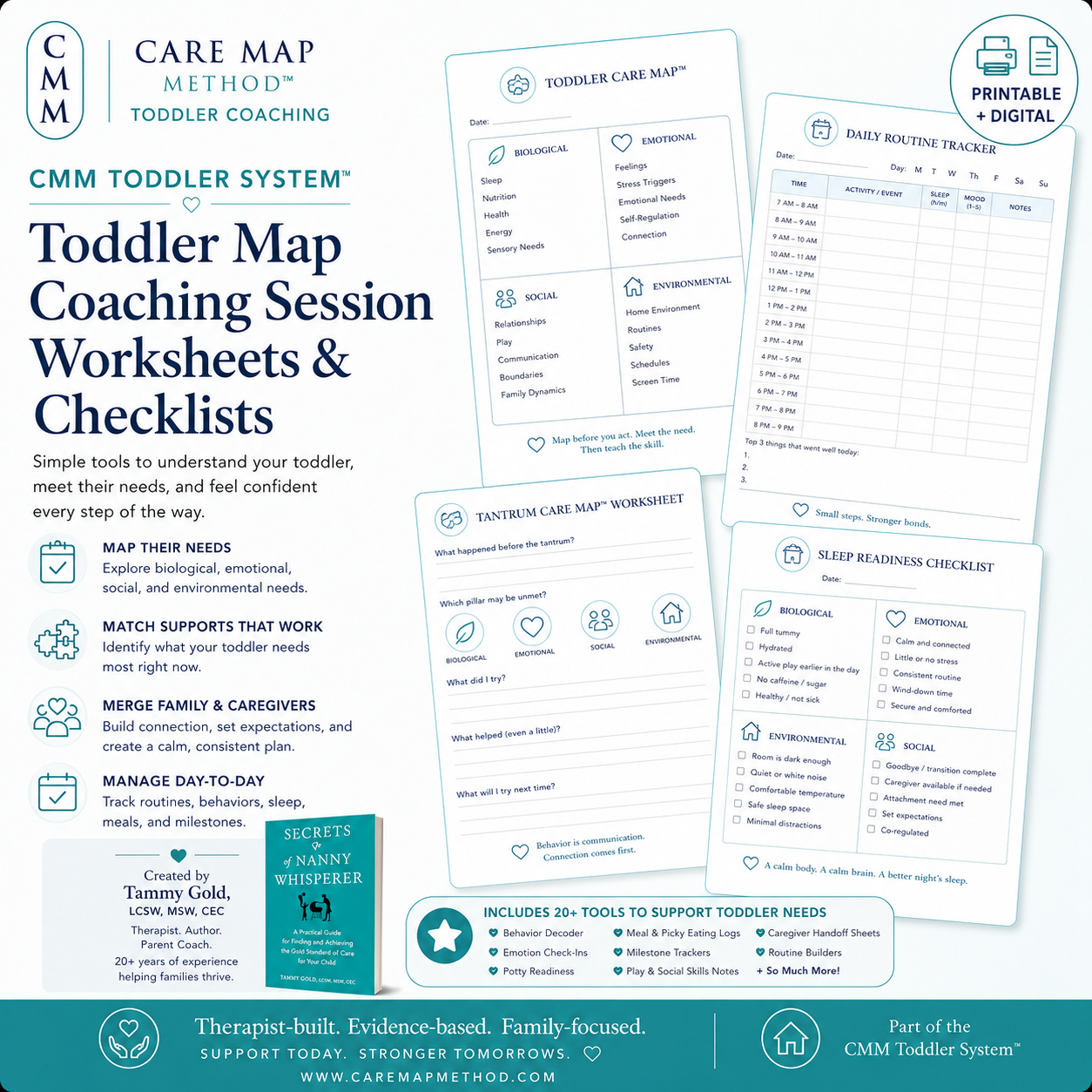
The toddler years can be delightful, exhausting, funny, and confusing—sometimes within the same five minutes.
Your toddler may want to do everything independently while still needing help with almost everything. They may understand far more than they can communicate. They can move quickly from excitement to frustration, resist ordinary routines, and have powerful reactions to seemingly small changes.
Parents are often left wondering:
Is this typical toddler behavior?
Why are the tantrums getting worse?
Should my child be talking more?
Why is bedtime suddenly so difficult?
How do I set limits without constantly battling?
Is my child ready for preschool or daycare?
How can all caregivers respond consistently?
Generic parenting advice rarely accounts for the whole child. A strategy that works for one toddler may overwhelm another because children differ in temperament, language, sensory processing, developmental pace, routines, and family circumstances.
The Care Map Method™ Toddler Care Map Coaching Session helps parents understand what is happening beneath the behavior and create a practical plan for their individual child and family.
What is toddler parent coaching?
Toddler parent coaching is a structured, personalized service that helps parents understand their child’s development, behavior, routines, and care needs.
During a Care Map Method™ Toddler Coaching Session, we may address:
Tantrums and emotional regulation
Biting, hitting, throwing, or yelling
Sleep and bedtime struggles
Picky eating and mealtime stress
Toilet-learning readiness
Language and communication
Separation anxiety
Transitions and resistance
Boundaries and discipline
Toddler safety and childproofing
Nanny, babysitter, daycare, or preschool concerns
Parent and caregiver consistency
Sibling adjustment
Parent exhaustion and family stress
The goal is not to eliminate every difficult behavior. Toddlers are still learning how to communicate, wait, transition, tolerate frustration, and manage strong feelings.
The goal is to understand what the behavior may be communicating and teach the child the skills they are developmentally ready to learn.
Toddler behavior is communication
Toddlers do not usually have the language, impulse control, or emotional regulation skills to explain exactly what they need.
A toddler who screams at bedtime may be overtired, frightened by separation, overstimulated, resisting a transition, or reacting to an inconsistent routine.
A child who hits another child may be overwhelmed, frustrated, seeking space, imitating behavior, or unable to say, “I was using that.”
A child who refuses to get dressed may want control, dislike how the clothing feels, struggle with transitions, or simply need more time.
Understanding the reason behind a behavior does not mean allowing unsafe or inappropriate behavior. It helps parents choose a response that addresses both the behavior and the unmet need or developing skill underneath it.
Start with the B/E/S/E Toddler Care Map
The Care Map Method™ looks at four connected areas of a toddler’s life: Biological, Emotional, Social, and Environmental needs.
Biological needs
A toddler’s physical state has a major influence on behavior.
Biological needs may include:
Sleep and nap patterns
Hunger and eating
Growth and nutrition
Physical activity
Illness, pain, or discomfort
Digestion and toileting
Speech, motor, and developmental progress
Sensory preferences and sensitivities
Medical and dental care
Before labeling a child as “difficult” or “defiant,” it is helpful to consider whether the child is tired, hungry, uncomfortable, overstimulated, or being asked to do something beyond their current developmental ability.
Persistent concerns about feeding, sleep, hearing, speech, movement, growth, toileting, or development should be discussed with the child’s pediatric healthcare provider.
Emotional needs
Toddlers experience strong feelings before they have the skills to manage them.
Emotional care may include:
Helping the child identify feelings
Offering comfort without removing every limit
Creating predictable responses
Supporting secure attachment
Preparing for separations and transitions
Teaching simple calming strategies
Understanding the child’s temperament
Providing choices within appropriate boundaries
Toddlers borrow regulation from the adults around them. This is called co-regulation. A calm, clear adult response helps the child gradually learn how to manage frustration, disappointment, and change.
Social needs
Toddlers are beginning to learn how relationships work.
They may be practicing how to:
Share space and toys
Take turns
Ask for help
Join play
Use words instead of hitting
Separate from a parent
Adapt to different caregivers
Interact with siblings
Follow simple group routines
Recover after conflict
Young toddlers often engage in parallel play—playing near other children rather than cooperatively with them. Social skills develop gradually and require patient teaching, modeling, and repetition.
Environmental needs
The environment can either support toddler success or create unnecessary conflict.
Environmental factors include:
Home safety and childproofing
Toy and activity organization
Noise, lighting, and stimulation
Daily routines
Visual schedules
Transition warnings
Child-accessible choices
Sleep spaces
Mealtime arrangements
Consistency between home and childcare
Sometimes changing the environment is more effective than repeatedly correcting the child.
For example, placing a visual routine near the front door may help with leaving the house. Offering two weather-appropriate outfits may reduce dressing battles. Creating a calm-down space may provide a safe place to recover from overwhelming feelings.
Use MAP, MATCH, MERGE, and MANAGE for toddler care
Once we understand the child’s full care picture, the Care Map Method™ provides a clear path forward.
MAP the Need
We identify the toddler’s biological, emotional, social, and environmental needs while also considering family stress, schedules, caregiver arrangements, and parent concerns.
The care map helps parents look for patterns:
Do tantrums happen before meals?
Is behavior harder after missed naps?
Does the child struggle during rushed transitions?
Is the same behavior happening at home and daycare?
Are different caregivers using different limits?
Does the child have the words needed to express the problem?
A behavior tracker can help parents identify what happens before, during, and after a difficult moment.
MATCH the Care
Next, we determine what kind of support fits each need.
Support may include:
A pediatrician
A speech-language pathologist
An occupational therapist
A developmental specialist
A feeding professional
A licensed mental health professional
A parent coach
A nanny or babysitter
A daycare or preschool program
Early-intervention services
Trusted family support
Not every toddler challenge requires a specialist. Coaching can help parents determine what can be addressed through changes in routines and responses—and what should be evaluated further.
MERGE the Support
Toddlers benefit when the important adults in their lives communicate clearly.
A shared toddler care plan may include:
Daily routines
Sleep and nap expectations
Food preferences and restrictions
Toilet-learning language
Approved discipline and redirection strategies
Comfort and calming methods
Safety expectations
Screen-time boundaries
Medication or health information
Communication between parents and caregivers
Responses to hitting, biting, tantrums, or separation distress
Parents, grandparents, nannies, babysitters, and daycare teachers do not need to respond identically in every situation. However, they should understand the child’s essential needs and the family’s central expectations.
MANAGE the Plan
Toddlers develop quickly. Their language, mobility, interests, sleep, emotions, and social needs can change within months.
Families should regularly ask:
What is improving?
What continues to be difficult?
Has the child developed new skills?
Are our expectations age-appropriate?
Are all caregivers communicating?
Is the environment still safe and supportive?
Do we need additional professional guidance?
Is this care arrangement still the right fit?
A Toddler Care Map is not a permanent set of rules. It is a flexible plan that grows with the child.
Understanding toddler tantrums
Tantrums are a common part of early development. They often occur when a toddler is tired, hungry, overstimulated, frustrated, or unable to communicate a need.
During a tantrum, the child’s thinking and language abilities may be temporarily less available. Long explanations and repeated questions are unlikely to help in the peak of the moment.
A helpful response may include:
Make sure the child and others are safe.
Lower your voice and reduce stimulation.
Use a short statement: “You are upset. I’m here.”
Hold the boundary: “I won’t let you hit.”
Allow time for the child’s body to settle.
Reconnect and teach after the child is calmer.
Parents do not need to fix every feeling. A child can be disappointed and still be safe, supported, and loved.
Discipline should teach—not frighten
Effective toddler discipline focuses on safety, connection, repetition, and skill-building.
Helpful strategies may include:
Clear and brief limits
Consistent follow-through
Redirection
Age-appropriate choices
Predictable routines
Transition warnings
Positive attention for helpful behavior
Modeling the desired behavior
Teaching simple replacement phrases
Repairing the relationship after difficult moments
Instead of only saying, “Stop hitting,” a parent might say:
“I won’t let you hit. Say, ‘My turn,’ or ask me for help.”
The limit remains firm, but the child also learns what to do next time.
Preparing for daycare, preschool, or a new caregiver
Starting daycare, preschool, or care with a nanny can be a major transition for a toddler.
A thoughtful transition plan may include:
Short introductory visits
A simple goodbye ritual
A familiar comfort object when permitted
Consistent pickup and drop-off language
A written description of routines and calming strategies
Gradually increasing care hours when possible
Clear communication between parents and caregivers
Patience with temporary changes in sleep or behavior
A child’s distress during separation does not automatically mean the placement is wrong. What matters is how the child is comforted, how the caregiver responds, and whether the child gradually begins to feel secure.
When might toddler coaching help?
A Care Map Method™ Toddler Coaching Session may be helpful if:
Tantrums are affecting daily family life
You are dealing with hitting, biting, or throwing
Bedtime or naps have become difficult
Meals feel like a constant battle
You are unsure how to set effective boundaries
You and your partner disagree about discipline
Your child is having difficulty separating
You are preparing for daycare or preschool
You are hiring or onboarding a nanny
Different caregivers use conflicting approaches
Your toddler is adjusting to a new sibling, home, or family routine
You want to understand whether a concern may require additional evaluation
You do not have to wait until family life feels unmanageable. Parent coaching can help you create a plan before ordinary toddler challenges become ongoing patterns of stress.
What happens during a CMM Toddler Care Map Coaching Session?
The session is personalized to the child, the family, and the current concerns.
Together, we can:
Complete a B/E/S/E Toddler Care Map
Identify possible triggers behind difficult behavior
Review sleep, eating, play, toileting, and daily routines
Explore temperament and sensory needs
Create age-appropriate behavior strategies
Develop scripts for tantrums, transitions, and limit-setting
Clarify responsibilities between parents and caregivers
Prepare for a nanny, daycare, preschool, or other transition
Identify areas that may need professional evaluation
Create a practical family action plan
Parents leave with clear priorities, personalized scripts, and concrete next steps they can begin using at home.
Frequently asked questions about toddler coaching
Is toddler coaching only for serious behavior problems?
No. Many parents use coaching for common developmental challenges such as tantrums, sleep, picky eating, separation anxiety, transitions, and limit-setting.
Can toddler coaching help with tantrums?
Yes. Coaching can help parents identify possible triggers, create a consistent response, teach replacement skills, and adjust routines or environments that may be contributing to the tantrums.
Can you help us prepare our toddler for preschool?
Yes. A Toddler Care Map can help parents evaluate readiness, prepare for separation, communicate with teachers, and create consistent routines between home and school.
Can both parents or caregivers participate?
Yes. Including both parents or other central caregivers can help create clearer expectations and more consistent responses.
Does toddler coaching replace medical or developmental evaluation?
No. Coaching provides education, planning, and parenting support. Medical, speech, feeding, hearing, sensory, or developmental concerns should be evaluated by an appropriately qualified professional.
Your toddler does not need a perfect parent
Toddlers need adults who are curious, responsive, consistent, and willing to adjust as the child grows.
You do not have to stop every tantrum or have the perfect routine. You need a clearer understanding of your child and a practical plan that your family can actually follow.
Map before you act.
Care Map Method™ Toddler Care Map Coaching Session
The Care Map Method™ Toddler Care Map Coaching Session helps parents understand what may be driving their toddler’s behavior and develop an individualized plan for home, childcare, and family life.
Your session may include:
A personalized B/E/S/E Toddler Care Map
Tantrum and behavior-trigger assessment
Sleep, mealtime, toileting, and routine review
Toddler communication and regulation strategies
Parent scripts for limits and transitions
Daycare, preschool, or nanny preparation
Parent and caregiver communication tools
A personalized action plan and next steps
Built by a therapist. Backed by science. Designed for real family life.
Schedule a Care Map Method™ Toddler Coaching Session
Care Map Method™ coaching provides education, care planning, and parenting support. It does not replace pediatric, medical, developmental, feeding, speech, occupational-therapy, or mental-health evaluation and treatment.


Therapy for Mothers Who Feel Like They Are Carrying Everything
Online therapy for mothers and parents who feel responsible for everyone else while feeling overwhelmed, unseen, anxious, resentful or emotionally exhausted.
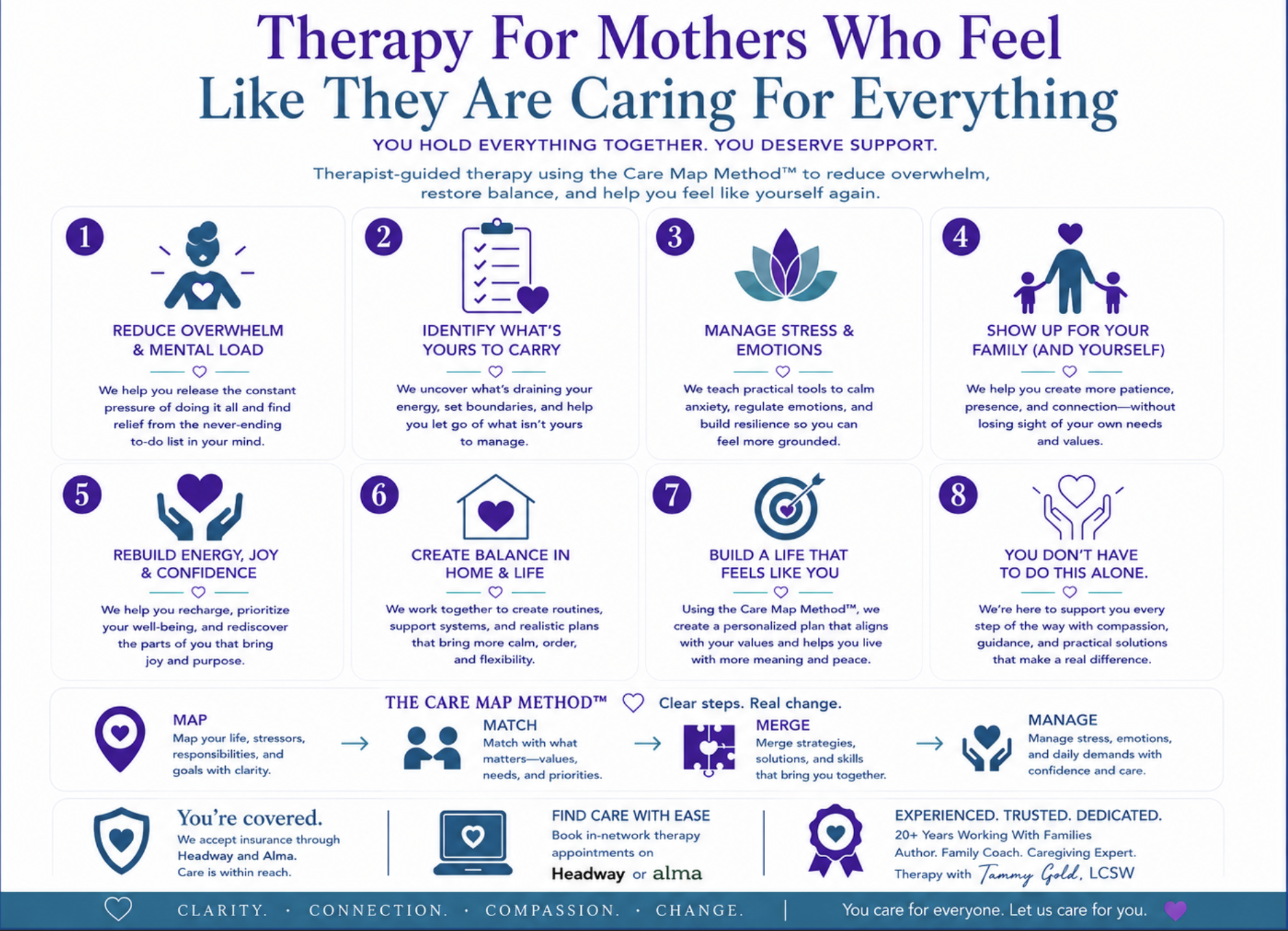
Therapy for Mothers Who Feel Like They Are Carrying Everything
Many mothers and parents are carrying far more than anyone can see. They may be managing children, school, work, schedules, marriage, divorce, co-parenting, aging parents, household responsibilities, family conflict, emotional labor and everyone else’s needs while feeling unseen themselves.
I am Tammy Gold, LCSW. I offer online therapy for clients in California, New Jersey and Oregon. Depending on your state, plan and eligibility, insurance may be available through Headway or Alma.
My Psychology Today profile links to booking and insurance options through Headway.
When carrying everything becomes too much
You may feel anxious, resentful, tired, guilty, irritable, disconnected or ashamed for not feeling more grateful. You may be the person everyone relies on, but still feel alone. Therapy can be the one place where you do not have to manage everyone else’s emotions.
My goal is to help you feel safe, supported and truly heard.
How therapy helps
Through the Care Map Method™, we look at what is happening emotionally, biologically, socially and environmentally. We identify what you are carrying, what needs are not being named, what boundaries are missing and what practical support could reduce stress.
The goal is to help you understand yourself, communicate needs more clearly, reduce shame and create small solutions that make daily life feel more manageable.
Request a session
If you are a mother or parent feeling overwhelmed by parenting stress, relationship stress, divorce, caregiving, work pressure or family conflict, visit my Psychology Today profile to request a session. My profile links to booking and insurance options through Headway.