

Couples Counseling with Insurance for Parents Who Keep Having the Same Fight
Therapy for couples and parents who keep having the same fight about parenting, chores, money, emotional labor, divorce concerns or family responsibilities.
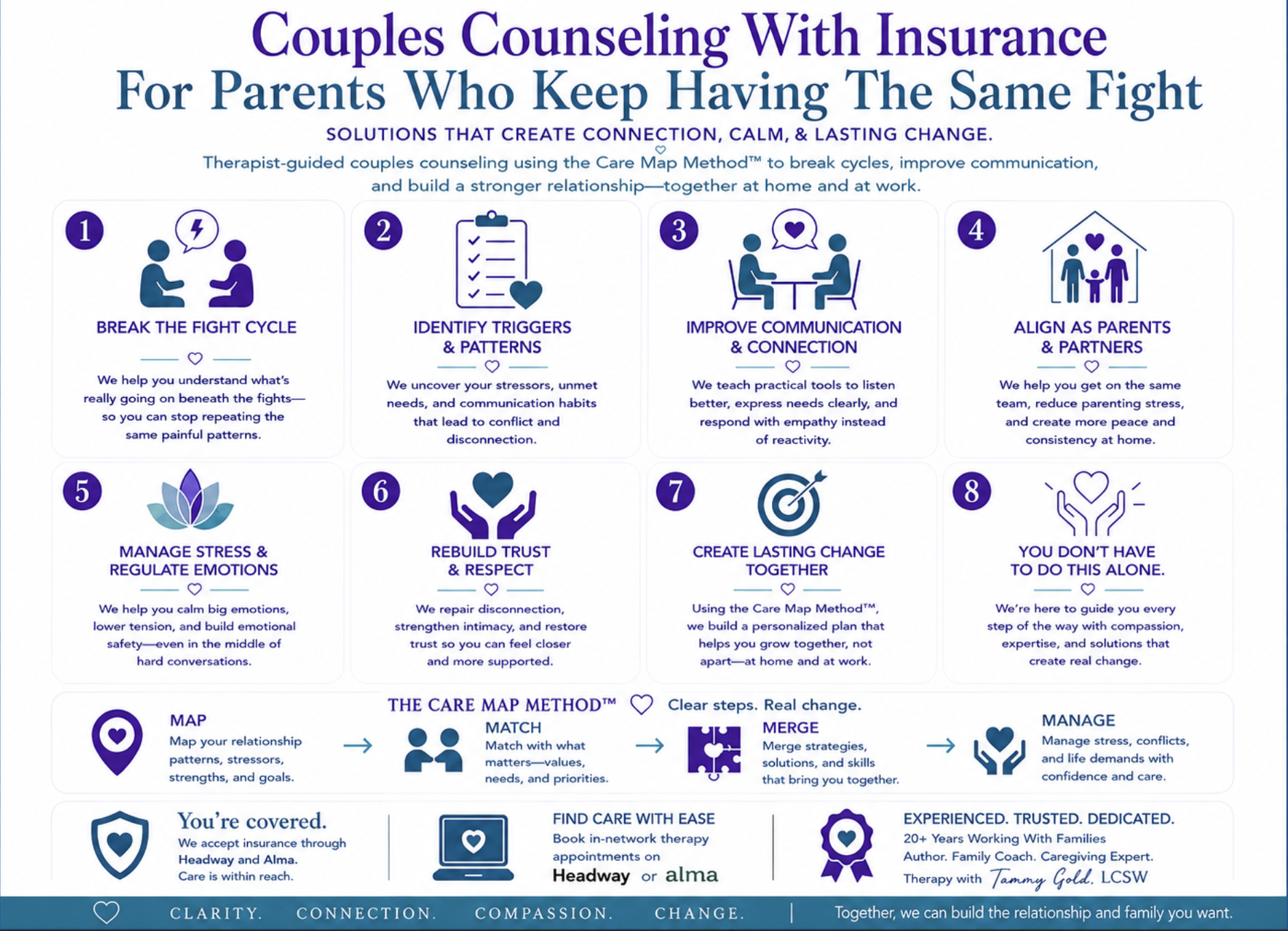
Couples Counseling with Insurance for Parents Who Keep Having the Same Fight
Many couples do not come to therapy because they stopped caring. They come because they keep having the same fight and cannot figure out how to stop the cycle. For parents, the fight may be about children, chores, money, schedules, emotional labor, in-laws, co-parenting, intimacy, work stress or feeling unsupported.
I am Tammy Gold, LCSW. I support adults, couples and parents in California, New Jersey and Oregon. Depending on your plan and eligibility, insurance may be available through Headway or Alma.
My Psychology Today profile links to booking and insurance options through Headway.
Why repeated fights happen
Repeated fights often happen because the surface topic is not the only issue. Underneath the argument may be fear, loneliness, resentment, exhaustion, feeling unseen, feeling criticized, or not knowing how to ask for support without sounding angry.
Therapy helps slow the pattern down so each person can feel heard without shame or blame.
How I help couples and parents
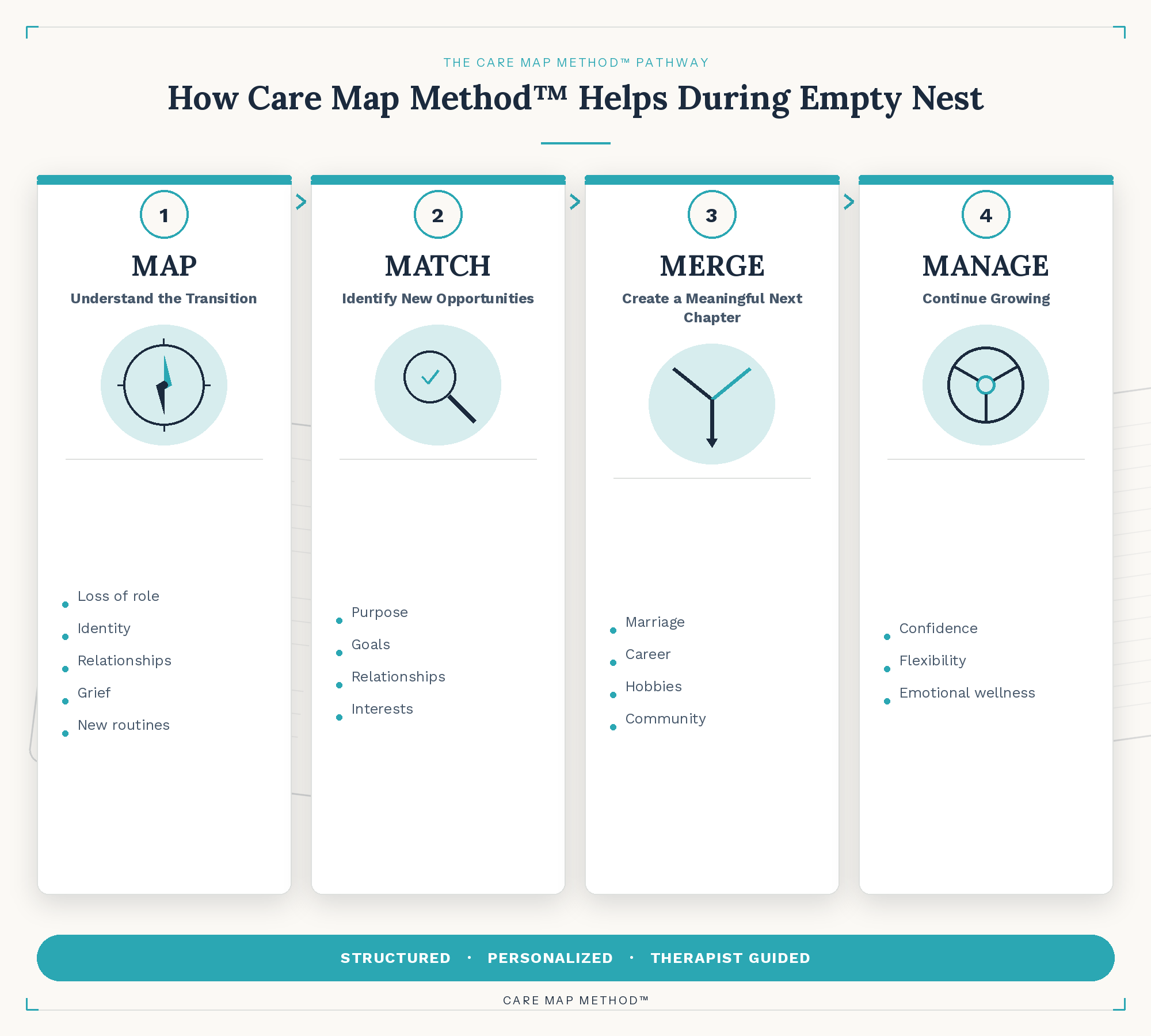
Through the Care Map Method™, we Map the repeated fight cycle, Match each partner’s needs and triggers, Merge safer communication and Manage repair tools for real life. The goal is to help both partners understand what is happening underneath the conflict and build better ways to respond.
Sessions are designed to be respectful and compassionate. I work to help each person feel heard while keeping the focus on understanding, communication and small positive solutions.
Request a session
If you are looking for therapy for relationship stress, parenting stress, communication problems, divorce concerns or family conflict, visit my Psychology Today profile to request a session. My profile links to booking and insurance options through Headway.
Why do couples keep having the same argument?
Repeated arguments are often maintained by deeper emotional triggers, unmet needs, defensive reactions, assumptions, and communication patterns rather than the surface topic alone.
Can couples therapy help communication?
Yes. Couples therapy can help partners slow down conflict, identify the pattern, hear each other more accurately, communicate needs more clearly, and practice repair.
What if my partner will not attend?
Individual therapy can still help you understand the relationship pattern, regulate your reactions, communicate differently, clarify boundaries, and make more thoughtful decisions.
Is couples therapy only for relationships in crisis?
No. Couples may seek therapy for recurring conflict, disconnection, parenting stress, intimacy concerns, life transitions, premarital preparation, or to strengthen a relationship before problems escalate.
Will the therapist take sides?
The goal is not to declare one partner right and the other wrong. The work focuses on understanding the relationship system, helping both people feel heard, and identifying healthier patterns.
Can therapy help couples affected by parenting stress?
Yes. Parenting can create exhaustion, resentment, role imbalance, disagreement about discipline, and reduced time for connection. Therapy can help couples rebuild teamwork and communication.
What does Map, Match, Merge, and Manage look like for couples?
MAP identifies the conflict cycle. MATCH clarifies each partner’s needs and goals. MERGE builds healthier communication and repair. MANAGE creates tools and agreements that can be used between sessions.
How long does couples therapy take?
The length varies based on the concerns, goals, severity of conflict, participation, and whether there are complicating factors. Some couples seek focused short-term work, while others benefit from longer support.

Carelon Behavioral Health Therapy for Relationship Stress, Parenting and Family Conflict
Online therapy for clients with Carelon Behavioral Health who need support for relationship stress, parenting strain, family conflict, divorce, co-parenting and caregiver burnout.
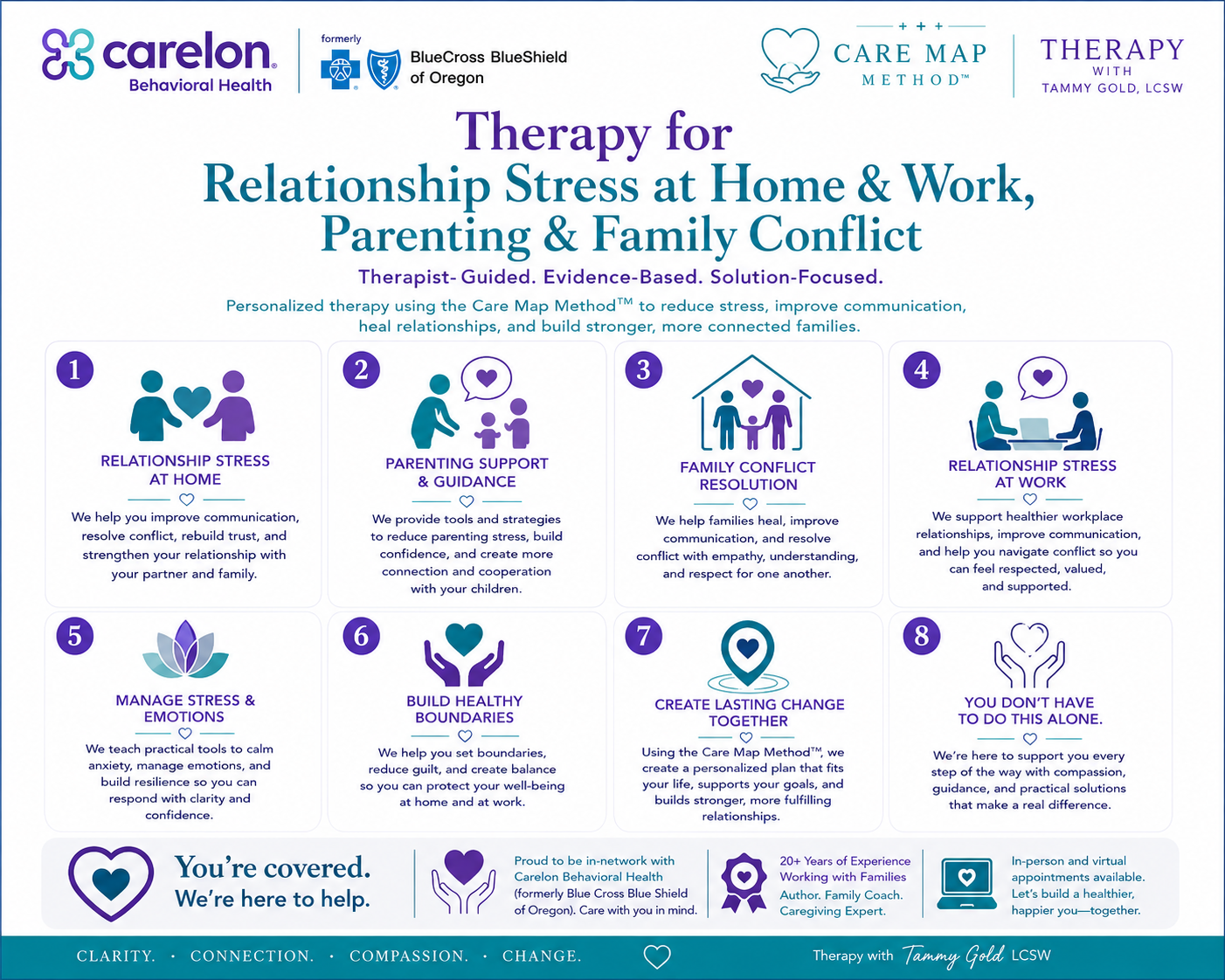
Carelon Behavioral Health Therapy for Relationship and Family Stress
If you are searching for therapy through Carelon Behavioral Health, you may be looking for support that is warm, practical and focused on the real-life relationships causing stress. Many clients reach out because they feel overwhelmed by marriage stress, parenting conflict, divorce, co-parenting, family conflict, caregiving, work stress or difficult relationships.
I am Tammy Gold, LCSW, a therapist licensed in California, New Jersey and Oregon. Depending on your state, plan and eligibility, Carelon Behavioral Health may be available through Headway.
My Psychology Today profile links to booking and insurance options through Headway.
Relational therapy for everyday life
My work is especially helpful for clients struggling with a partner, child, parent, sibling, friend, coworker, boss, co-parent, nanny, daycare provider, caregiver or senior care professional. These relationships can create stress when communication breaks down, needs go unnamed, or shame and blame take over.
In therapy, you have a safe place to feel heard and a structured process for understanding what is happening.
The Care Map Method™ process
Using the Care Map Method™, we look at the emotional, biological, social and environmental pieces of the problem. We Map the Need, Match the Support, Merge better communication and Manage a plan forward.
This process helps clients identify triggers, understand behavior, reduce shame, name needs and create practical solutions for real life.
Request a session
If you are looking for therapy for relationship stress, parenting stress, family conflict, divorce, co-parenting, caregiver burnout or work stress, visit my Psychology Today profile to request a session. My profile links to booking and insurance options through Headway.

Regence BlueCross BlueShield Oregon Therapy for Caregiver Burnout, Parenting Stress and Relationships
Online therapy in Oregon for Regence BCBS clients navigating caregiver burnout, parenting stress, relationship strain, family conflict, divorce and life transitions.
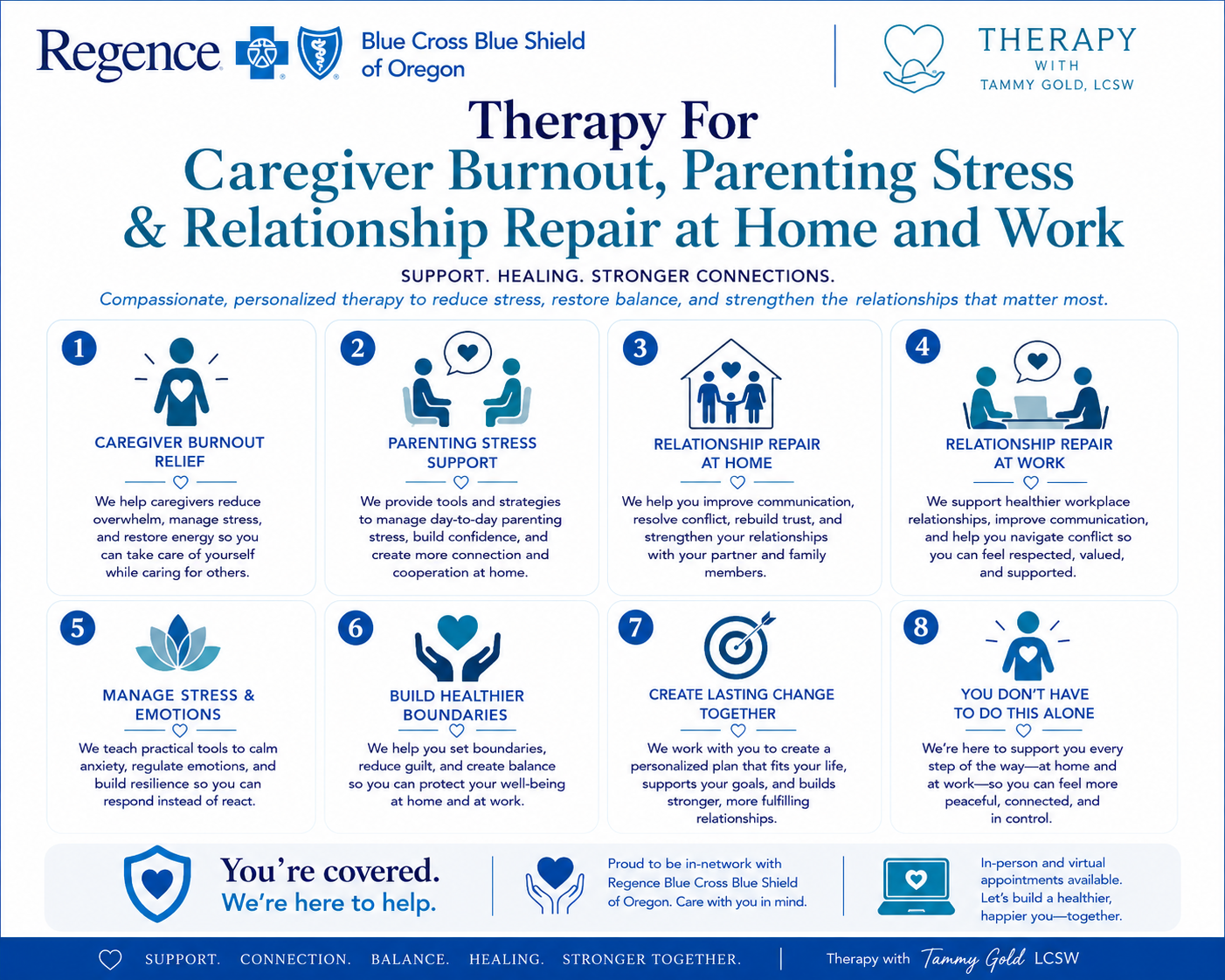
Regence BCBS Oregon Therapy for Caregiver Burnout and Relationship Stress
Caregiver burnout can occur when you are responsible for too many people and lack sufficient support for yourself. You may be caring for children, aging parents, a partner, family members or multiple generations while also trying to manage work, relationships and your own emotional needs.
I am Tammy Gold, LCSW, and I offer online therapy for clients located in Oregon. Depending on your plan and eligibility, Regence BlueCross BlueShield of Oregon may be available through Headway.
My Psychology Today profile links to booking and insurance options through Headway.
What caregiver burnout can feel like
Burnout can look like resentment, guilt, exhaustion, anxiety, irritability, grief, conflict or the feeling that everyone needs something from you. It can affect your marriage, parenting, work, siblings, family decisions, eldercare planning and the way you see yourself.
Therapy gives you one safe place to exhale, say what you are carrying and begin creating a more sustainable plan.
How therapy helps
Through the Care Map Method™, we Map what you are carrying emotionally and practically, Match the support and boundaries that are missing, Merge clearer communication with the people involved and Manage a plan that is more sustainable.
The goal is not to make you care less. The goal is to help you care without losing yourself, reduce shame and guilt, and communicate your needs with more clarity.
Request a session
If you are in Oregon and looking for therapy for caregiver burnout, parenting stress, family conflict, relationship stress, divorce or life transitions, visit my Psychology Today profile to request a session. My profile links to booking and insurance options through Headway.

Horizon Blue Cross Blue Shield of New Jersey Therapy for Family Conflict, Parenting and Divorce Stress
Online therapy in New Jersey for clients with Horizon BCBS who are navigating family conflict, parenting stress, divorce, co-parenting, relationship strain and caregiver burnout.
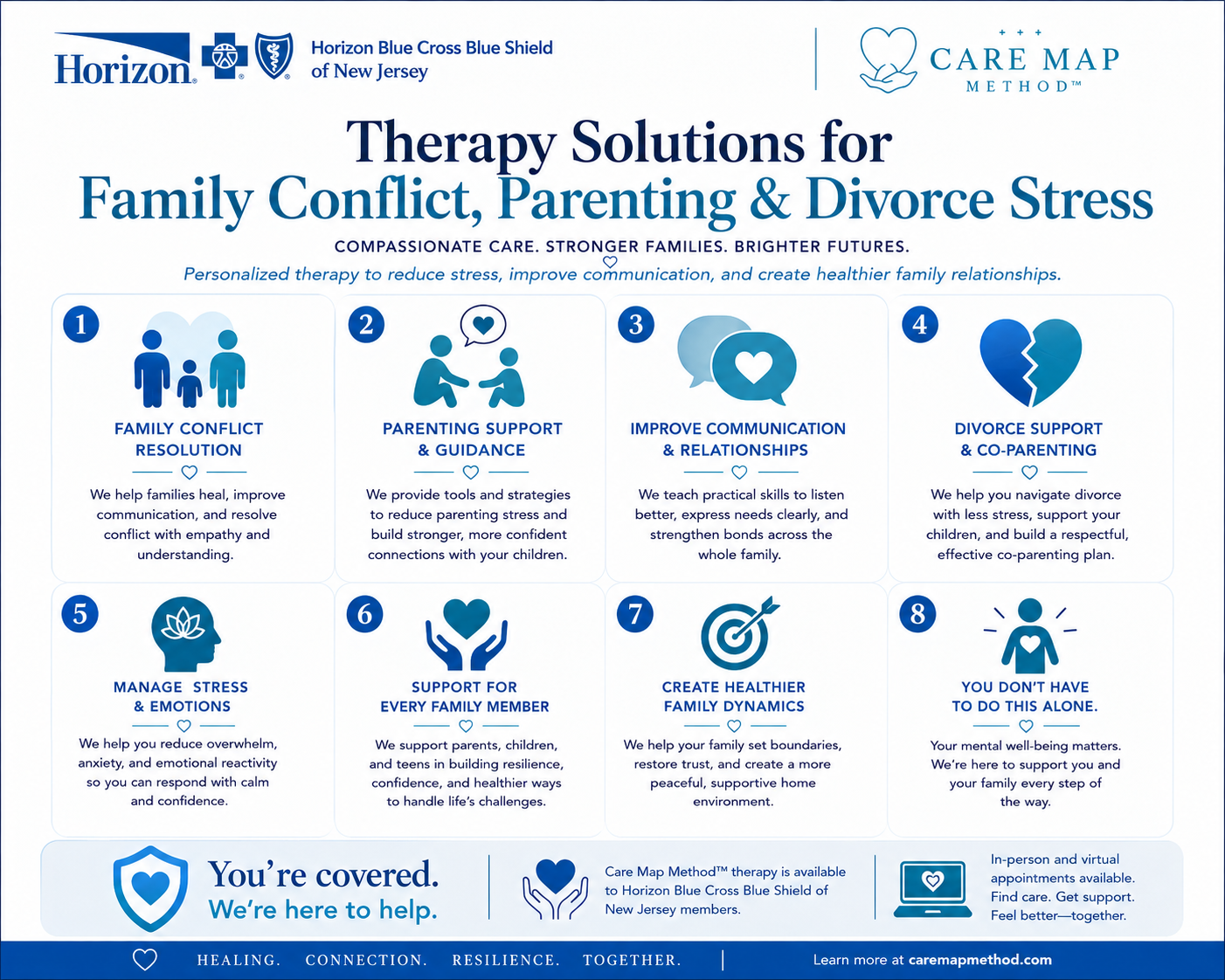
Horizon BCBS New Jersey Therapy for Family Conflict and Parenting Stress
Family conflict can be exhausting, especially when you are trying to manage parenting, marriage stress, divorce, co-parenting, adult children, siblings, aging parents, work pressure or caregiving responsibilities at the same time. Many clients want help, but they also want therapy to feel safe, respectful and practical.
I am Tammy Gold, LCSW, and I offer online therapy for clients located in New Jersey. Depending on your plan and eligibility, Horizon Blue Cross Blue Shield of New Jersey may be available through Headway.
My Psychology Today profile links to booking and insurance options through Headway.
Who this work helps
This therapy may be helpful if you are struggling with a partner, co-parent, child, adult child, sibling, parent, in-law, friend, boss, coworker, nanny, daycare provider, caregiver or senior care facility. Relational stress often creates anxiety, resentment, guilt, emotional exhaustion and communication breakdowns.
My goal is to help you feel heard and supported while also understanding the pattern underneath the conflict.
How sessions are structured
Through the Care Map Method™, we look at what is happening emotionally, biologically, socially and environmentally. We Map the Need, Match the Support, Merge communication and Manage the plan. This helps clients move from confusion and blame toward clearer language, better boundaries and practical next steps.
For couples, parents or families, sessions are designed to help each person feel heard respectfully and compassionately, without increasing shame or conflict.
Request a session
If you are in New Jersey and looking for therapy for family conflict, parenting stress, divorce, co-parenting, caregiver burnout or relationship stress, visit my Psychology Today profile to request a session. My profile links to booking and insurance options through Headway.

Providence Health Plan Online Therapy for Relationship Stress, Parenting and Caregiver Burnout
Online therapy for clients with Providence Health Plan who need support with relationships, parenting stress, divorce, caregiving, work stress and family conflict.
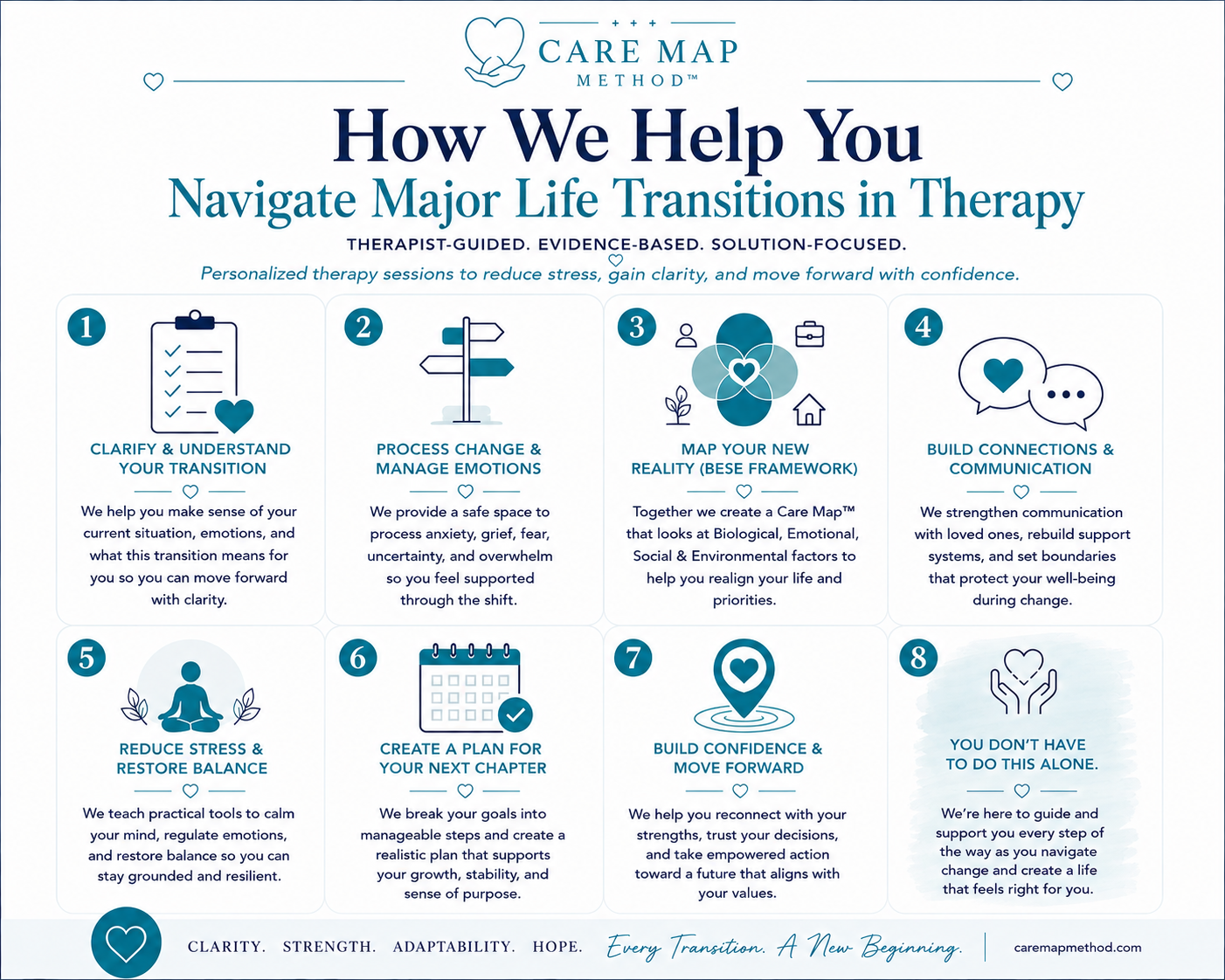
Providence Health Plan online therapy with Tammy Gold, LCSW for relationship stress, parenting stress, caregiver burnout, divorce and family conflict.
Providence Health Plan Online Therapy
If you have Providence Health Plan and are looking for online therapy, you may be trying to find support that feels both emotionally safe and practical. Many clients are not just looking for someone to listen. They want to feel heard, understood, and helped with real-life stress involving relationships, parenting, divorce, caregiving, work, and family responsibilities.
I am Tammy Gold, LCSW, a therapist licensed in California, New Jersey and Oregon. Depending on your state, plan and eligibility, Providence Health Plan may be available through Headway.
My Psychology Today profile links to booking and insurance options through Headway.
Therapy for the stress that happens inside relationships
My work is especially helpful for clients who are struggling with a partner, child, parent, sibling, friend, coworker, boss, co-parent, caregiver, nanny, daycare provider or senior care professional. Relationship stress can leave people feeling anxious, resentful, guilty, disconnected or unsure how to communicate without making things worse.
Therapy gives you a safe place to say what you need to say, understand what is underneath the emotion and find better words for difficult conversations.
How the Care Map Method™ supports change
Using the Care Map Method™, we look at biological, emotional, social and environmental factors that may be creating stress. Then we work through Map, Match, Merge and Manage: map the problem, match the needs, merge healthier communication and manage the plan forward.
This helps therapy feel supportive but also useful. The goal is for you to leave sessions feeling less alone, clearer and better equipped with language, boundaries, tools and next steps.
Request a session
If you are looking for therapy for relationship stress, parenting stress, divorce, co-parenting, caregiver burnout or family conflict, visit my Psychology Today profile to request a session. My profile links to booking and insurance options through Headway.

Anthem Blue Cross California Therapy for Busy Parents, Couples and Family Stress
Online therapy in California for clients with Anthem Blue Cross California who are navigating relationship stress, parenting strain, divorce, caregiving and family conflict.
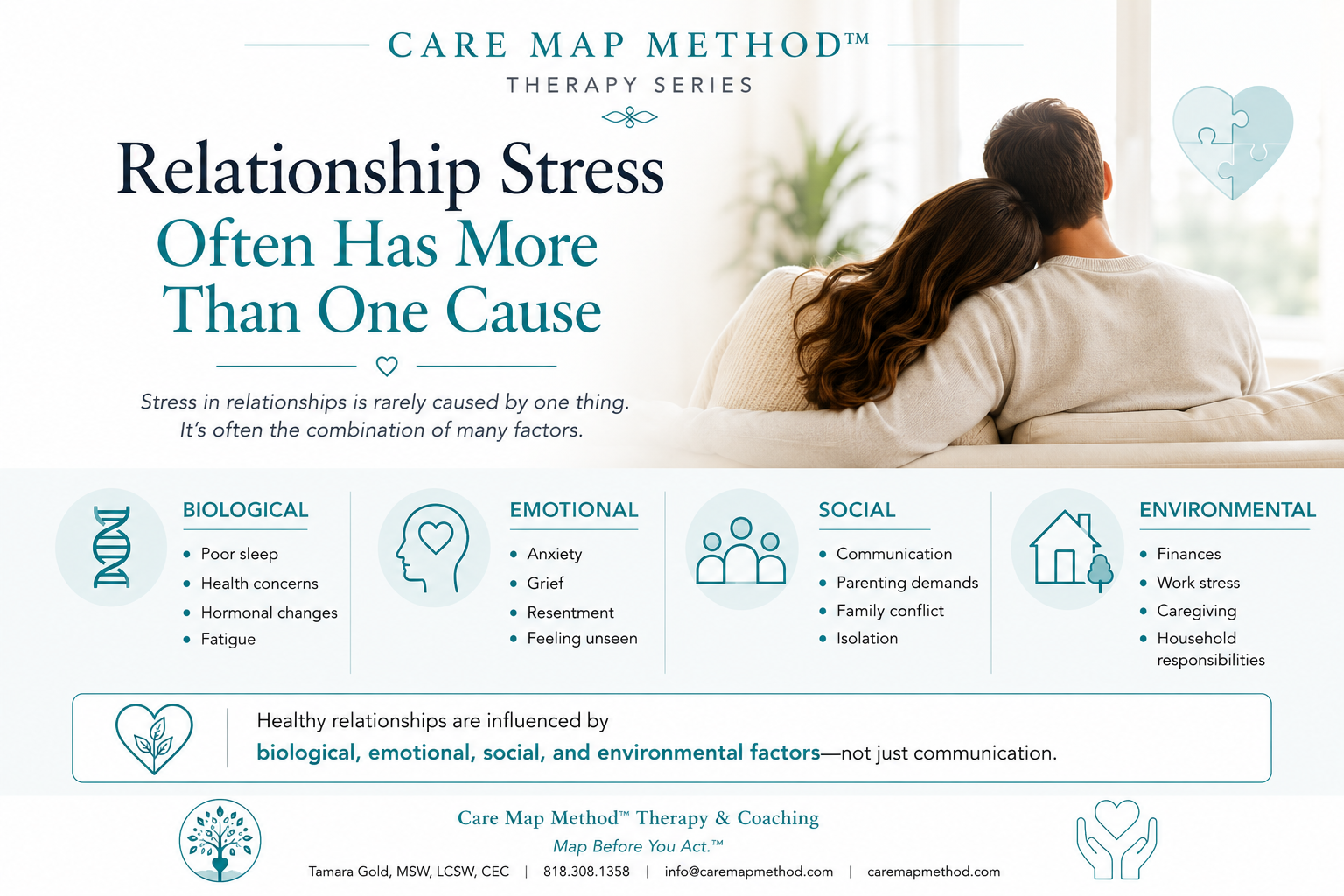
Anthem Blue Cross California Therapy for Busy Parents and Couples
Many busy parents and couples reach out for therapy when family life starts to feel heavier than expected. The problem is not always one dramatic crisis. Often it is the daily build-up of work stress, parenting strain, resentment, poor communication, divorce stress, co-parenting tension, caregiving responsibilities and emotional exhaustion.
I am Tammy Gold, LCSW. I offer online therapy for clients located in California. Depending on your plan and eligibility, Anthem Blue Cross California insurance may be available through Headway.
My Psychology Today profile links to booking and insurance options through Headway.
Common reasons clients reach out
Clients often come to therapy because they are tired of repeating the same arguments, carrying the emotional labor of the family, feeling unseen by a partner, struggling with a child, or trying to manage a divorce or co-parenting situation without more conflict. Others are overwhelmed by caregiving, work stress, a difficult boss or coworker, or the pressure of being responsible for everyone else.
Therapy can help you slow down, feel supported and understand what is really happening underneath the stress.
How sessions help
My sessions are warm, supportive and solution-focused. Through the Care Map Method™, we Map what is causing stress, Match the needs underneath the conflict, Merge better communication between the people involved, and Manage the plan with realistic tools, boundaries and next steps.
The goal is to reduce shame and blame, help you name emotions more clearly, communicate needs more directly and create practical changes that make daily life feel more manageable.
Request a session
If you are looking for online therapy in California for relationship stress, parenting stress, divorce, co-parenting, caregiver burnout or family conflict, visit my Psychology Today profile to request a session. My profile links to booking and insurance options through Headway.

Aetna Online Therapy in California for Relationship Stress, Parenting Stress and Divorce Support
Aetna online therapy in California for adults, couples, parents and caregivers navigating relationship stress, parenting strain, divorce, co-parenting, family conflict and caregiver burnout.
Aetna Online Therapy in California
If you are searching for Aetna online therapy in California, you may be looking for a therapist who understands not only anxiety or stress, but the relationships and family responsibilities that often create the stress in the first place. Many clients are managing marriage strain, parenting demands, divorce or co-parenting conflict, caregiving responsibilities, work pressure and the feeling of carrying too much without enough support.
I am Tammy Gold, LCSW, a therapist, author, parenting and family therapy expert, and creator of the Care Map Method™. I offer online therapy for clients located in California. Depending on your specific plan, eligibility and platform availability, Aetna insurance may be available through Headway or Alma.
My Psychology Today profile links to booking and insurance options through Headway.
Who this therapy is for
This page is for adults, couples, parents and caregivers who feel overwhelmed by important relationships and responsibilities. You may be struggling with a partner, child, co-parent, parent, sibling, caregiver, nanny, daycare provider, coworker, boss or family member. You may feel anxious, resentful, disconnected, emotionally exhausted or unsure how to ask for what you need without creating more conflict.
Therapy gives you one safe, supportive place where you do not have to censor yourself, apologize for your feelings or worry about being judged. My goal is to help you feel heard, understood and less alone while also giving you practical language and tools for real life.
How the Care Map Method™ helps
Through the Care Map Method™, we look at what may be happening emotionally, biologically, socially and environmentally. This gives us a 360-degree picture of your life and relationships so we can understand what is driving stress, behavior, conflict or disconnection.
We Map the Need, Match the Support, Merge the people involved through clearer communication and Manage the plan with practical next steps. Therapy is not about blame or shame. It is about understanding what is happening, naming emotions and needs, and building a calmer way forward.
Request a session
If you are located in California and want therapy for relationship stress, parenting stress, divorce, co-parenting, caregiver burnout, work stress or family conflict, you can request a session through my Psychology Today profile. My Psychology Today profile links to booking and insurance options through Headway.

Divorce and Co-Parenting Therapy with Insurance
Divorce and co-parenting can create emotional stress, communication challenges, and family strain. Tammy Gold, LCSW offers online therapy for clients in CA, NJ, and OR seeking safe, supportive, solution-focused help.
Divorce and Co-Parenting Therapy with Insurance
Divorce and co-parenting can be emotionally exhausting. Even when separation is necessary, the process can bring stress, grief, anger, fear, guilt, confusion, and conflict. When children are involved, the emotional weight can feel even heavier.
I am Tammy Gold, LCSW, a therapist, author, parenting and family therapy expert, and creator of the Care Map Method™. I support adults, parents, and families navigating divorce, separation, co-parenting stress, parenting conflict, family transitions, relationship strain, and communication challenges.
I offer online therapy for clients in California, New Jersey, and Oregon. Depending on your plan and eligibility, you may be able to use insurance through Headway or Alma.
View My Psychology Today Profile
My Psychology Today profile links to booking and insurance options through Headway.
When divorce and co-parenting feel overwhelming
Divorce is not only a legal or logistical process. It is also an emotional and relational transition. You may be trying to manage your own feelings while also protecting your children, communicating with a co-parent, handling conflict, rebuilding routines, and making major decisions.
Co-parenting conflict
Communication breakdowns
Parenting stress during divorce
Emotional overwhelm
Anger, grief, guilt, or resentment
Difficulty setting boundaries
Conflict with an ex-partner
Stress about how children are coping
New family routines
Blended family or extended family pressure
A safe place without shame or blame
My goal is to make therapy feel like one safe place where you do not have to censor yourself, apologize for your feelings, or worry about being judged. Divorce and co-parenting can bring up intense emotions. Therapy gives you room to name those emotions, understand them, and decide how you want to respond.
The goal is not to blame one person or create more conflict. The goal is to help you feel supported, understand what is happening, communicate more clearly, and protect emotional safety for yourself and your children.
My approach
Through the Care Map Method™, we look at emotional, biological, social, and environmental needs. This helps create a fuller picture of what life feels like during divorce or co-parenting stress.
What is triggering conflict
What emotions are hardest to manage
What communication patterns repeat
What boundaries are needed
What your children may need
What support systems are missing
What practical next steps can reduce stress
My sessions combine emotional support, education, and practical solutions. I want clients to leave feeling less alone, clearer, more grounded, and better equipped to advocate for their needs.
Insurance and booking
Insurance availability depends on your specific plan, state, eligibility, and platform availability. Clients can review booking and insurance options through my Psychology Today and Headway profiles.
View My Psychology Today Profile
Online divorce and co-parenting therapy
I offer online therapy for clients in California, New Jersey, and Oregon. If you are navigating divorce, separation, co-parenting conflict, parenting stress, or family transition, you can request a session through my Psychology Today profile.

Parenting Stress Therapy with Insurance in CA, NJ & OR
Parenting stress can affect your mood, marriage, communication, patience, and sense of self. Tammy Gold, LCSW offers online therapy for parents in CA, NJ, and OR who are feeling overwhelmed, unsupported, or emotionally exhausted.
Parenting Stress Therapy with Insurance in CA, NJ & OR
Parenting stress can affect every part of life: your mood, your marriage, your patience, your work, your sleep, and the way you feel about yourself. Many parents are not struggling because they are doing something wrong. They are struggling because they are carrying too much with too little support.
I am Tammy Gold, LCSW, a therapist, author, parenting and family therapy expert, and creator of the Care Map Method™. I support parents in California, New Jersey, and Oregon who are navigating parenting stress, relationship strain, divorce, co-parenting, family conflict, caregiving responsibilities, and emotional overwhelm.
Depending on your plan and eligibility, you may be able to use insurance through Headway or Alma.
View My Psychology Today Profile
My Psychology Today profile links to booking and insurance options through Headway.
When parenting stress becomes too much
Parenting stress often builds slowly. You may notice that you are more reactive than you want to be, more resentful than you expected, or more emotionally exhausted than you can explain.
Constant conflict with your child
Feeling disconnected from your partner
Carrying the emotional labor of the family
Parenting through divorce or separation
Co-parenting stress
Disagreements about discipline, routines, or boundaries
Feeling judged, unsupported, or alone
Balancing work, children, aging parents, and your own needs
Therapy gives you a safe place to be honest about what you are feeling without shame or judgment.
Therapy for parents, couples, and family stress
Parenting does not happen in isolation. Stress with children often affects couples, co-parents, siblings, extended family, school relationships, nanny relationships, daycare decisions, and eldercare responsibilities.
My work is relational. I help clients better understand what is driving behavior, conflict, stress, and communication breakdowns. The goal is not to blame yourself or anyone else. The goal is to understand what is happening and find better ways forward.
My approach
Through the Care Map Method™, we look at emotional, biological, social, and environmental needs. This helps us understand what may be underneath parenting stress and family conflict.
What emotions are being triggered
What needs are not being named
What patterns repeat in the family
What communication breaks down
What support is missing
What practical next steps can reduce stress
My sessions are safe, positive, supportive, and solution-focused. I want clients to feel heard, understood, and less alone while gaining tools they can use at home.
Insurance and booking
Insurance coverage depends on your state, specific plan, eligibility, and platform availability. Clients can review booking and insurance options through my Psychology Today and Headway profiles.
View My Psychology Today Profile
Online parenting stress therapy
I offer online therapy for clients in California, New Jersey, and Oregon. If you are a parent feeling overwhelmed, unsupported, anxious, resentful, or emotionally exhausted, you can request a session through my Psychology Today profile.

Online Therapy in Oregon Accepting Aetna, Regence BCBS, Providence & Carelon
Tammy Gold, LCSW offers online therapy in Oregon for adults, couples, parents, and caregivers navigating relationship stress, parenting strain, divorce, co-parenting, caregiver burnout, and major life transitions. Insurance may be available through Headway or Alma.
Online Therapy in Oregon Accepting Aetna, Regence BCBS, Providence & Carelon
If you are looking for online therapy in Oregon and are feeling overwhelmed by relationship stress, parenting responsibilities, divorce, co-parenting, family conflict, work stress, or caregiving demands, therapy can provide a safe place to feel heard and supported.
I am Tammy Gold, LCSW, a therapist, author, parenting and family therapy expert, and creator of the Care Map Method™. I help adults, couples, parents, and caregivers better understand themselves, the people around them, and the emotional patterns that may be creating stress or disconnection.
Depending on your plan and eligibility, you may be able to use insurance through Headway or Alma, including plans such as Aetna, Providence Health Plan, Regence BlueCross BlueShield of Oregon, and Carelon.
View My Psychology Today Profile
My Psychology Today profile links to booking and insurance options through Headway.
Support for people carrying too much
Many clients come to therapy because they feel like they are the person everyone depends on. They may be trying to manage parenting, work, marriage, divorce, caregiving, aging parents, childcare issues, family expectations, or relationship conflict while feeling anxious, resentful, exhausted, or alone.
Therapy can help you slow down and understand what is happening underneath the stress.
Common areas of focus
Relationship stress
Parenting stress
Divorce and co-parenting
Family conflict
Caregiver burnout
Work stress and professional relationship stress
Childcare and senior care decisions
Emotional overwhelm
Communication issues
Life transitions
My approach
I use the Care Map Method™ to help clients understand what may be happening emotionally, biologically, socially, and environmentally. This gives us a fuller picture of what life feels like and what may be driving stress, behavior, conflict, or disconnection.
Therapy with me is designed to be both emotionally supportive and practical. My goal is for clients to feel safe, heard, and less alone while also gaining tools, language, and solutions that help them move forward.
Insurance and booking
Insurance coverage depends on your specific plan, state, eligibility, and platform availability. Clients can review booking and insurance options through my Psychology Today and Headway profiles.
View My Psychology Today Profile
Online therapy in Oregon
I offer online therapy for clients located in Oregon. If you are looking for therapy for relationship stress, parenting stress, divorce, co-parenting, caregiver burnout, work stress, or family conflict, you can request a session through my Psychology Today profile.

Online Therapy in New Jersey Accepting Aetna, Horizon BCBS & Providence
Tammy Gold, LCSW offers online therapy in Oregon for adults, couples, parents, and caregivers navigating relationship stress, parenting strain, divorce, co-parenting, caregiver burnout, and major life transitions. Insurance may be available through Headway or Alma
If you are looking for online therapy in New Jersey and feel overwhelmed by relationship stress, parenting demands, divorce, co-parenting, work stress, caregiving responsibilities, or family conflict, therapy can help you feel less alone and more supported.
I am Tammy Gold, LCSW, a therapist, author, parenting and family therapy expert, and creator of the Care Map Method™. I support adults, couples, parents, and caregivers who are trying to understand themselves, their relationships, and the patterns creating stress in daily life.
Depending on your plan and eligibility, you may be able to use insurance through Headway or Alma, including plans such as Aetna, Horizon Blue Cross Blue Shield of New Jersey, Providence Health Plan, and Carelon.
View My Psychology Today Profile
My Psychology Today profile links to booking and insurance options through Headway.
Therapy for adults, couples, parents, and caregivers in New Jersey
Many people come to therapy because they are carrying too much. They may be managing parenting, marriage stress, divorce, co-parenting, work pressure, aging parents, childcare decisions, eldercare responsibilities, or complicated family dynamics.
You may feel anxious, resentful, disconnected, emotionally exhausted, or unsure how to communicate your needs without creating more conflict. Therapy gives you one safe, positive, supportive space to talk honestly without judgment, shame, or pressure.
What therapy can help with
Relationship conflict
Parenting stress
Divorce or separation
Co-parenting challenges
Family conflict
Work stress or boss/coworker stress
Caregiver burnout
Childcare or eldercare decision stress
Communication difficulties
Feeling emotionally overloaded or unsupported
My approach
Through the Care Map Method™, we look at emotional, biological, social, and environmental needs to get a clearer picture of what is happening in your life and relationships.
This approach helps us move beyond blame and shame. Instead of asking, “What is wrong with me?” or “What is wrong with them?” we look at what may be driving emotions, behavior, communication patterns, and stress.
My sessions are supportive and solution-focused. Clients can feel, process, release, understand, and also leave with practical language and tools for real life.
Insurance and booking
Insurance coverage depends on your specific plan, location, eligibility, and platform availability. Clients can review booking and insurance options through my Psychology Today and Headway profiles.
View My Psychology Today Profile
Online therapy in New Jersey
I offer online therapy for clients located in New Jersey. If you are looking for therapy for relationship stress, parenting stress, divorce, co-parenting, caregiver burnout, work stress, or family conflict, you can request a session through my Psychology Today profile.

Online Therapy in California Accepting Aetna, Anthem, Providence & Carelon
Tammy Gold, LCSW offers online therapy in California for adults, couples, parents, and caregivers navigating relationship stress, parenting strain, divorce, co-parenting, caregiver burnout, work stress, and family conflict. Insurance may be available through Headway or Alma.
If you are looking for online therapy in California and are feeling overwhelmed by relationship stress, parenting challenges, divorce, co-parenting, caregiver burnout, or family responsibilities, therapy can offer one safe place to feel heard, supported, and understood.
I am Tammy Gold, LCSW, a therapist, author, parenting and family therapy expert, and creator of the Care Map Method™. I work with adults, couples, parents, and caregivers who are trying to manage the emotional weight of modern family life, relationship stress, work/family strain, caregiving demands, and major life transitions.
Depending on your plan and eligibility, you may be able to use insurance through Headway or Alma, including plans such as Aetna, Anthem Blue Cross California, Providence Health Plan, and Carelon Behavioral Health.
[Button: View My Psychology Today Profile]
My Psychology Today profile links to booking and insurance options through Headway.
Therapy for relationship, parenting, and family stress in California
Many clients come to therapy because they are functioning on the outside but feeling anxious, resentful, disconnected, exhausted, or emotionally overloaded inside. They may be struggling with a partner, child, parent, sibling, co-parent, friend, coworker, boss, nanny, daycare provider, caregiver, or senior care professional.
Therapy gives you space to slow down, understand what is happening, and find language for emotions and needs that may feel difficult to express.
Common reasons clients reach out
Clients often seek therapy for:
Relationship stress and communication problems
Parenting stress and family conflict
Divorce and co-parenting challenges
Caregiver burnout
Work stress and boss or coworker stress
Childcare or eldercare decision stress
Feeling unsupported or emotionally exhausted
Difficulty naming needs or setting boundaries
Major life transitions
My approach
I created the Care Map Method™ to help people better understand themselves and the people around them. In therapy, we look at what may be happening emotionally, biologically, socially, and environmentally so we can understand what is driving stress, behavior, conflict, and disconnection.
My sessions are designed to feel safe, supportive, and solution-focused. There is no judgment, shame, or blame. My goal is to help you feel less alone, understand what is happening, communicate more clearly, and leave with practical tools you can use in real life.
Insurance and booking
Insurance coverage depends on your specific plan, state, eligibility, and platform availability. Clients can review booking and insurance options through my Psychology Today and Headway profiles.
[Button: View My Psychology Today Profile]
Online therapy in California
I offer online therapy for clients located in California. If you are looking for therapy for relationship stress, parenting stress, divorce, co-parenting, caregiver burnout, family conflict, or work/family overwhelm, you can request a session through my Psychology Today profile.

Why Every Relationship Needs a Care Map: Improving Communication Before Small Problems Become Big Ones
Relationship problems rarely begin with one dramatic event. Learn how mapping the whole relationship system can reveal what is driving conflict and what can change.
Relationship problems rarely begin with one dramatic event. More often, two people slowly become trapped in a pattern: one pushes for an answer, the other withdraws; one carries the practical load, the other feels criticized; both feel unheard, and each new disagreement confirms an increasingly painful story about the relationship.
Communication advice can sound simple from the outside. Listen better. Stay calm. Use “I” statements. Those tools matter, but they are difficult to use when exhaustion, old injuries, parenting pressure, work stress, money concerns, or fear of rejection are operating beneath the conversation. The argument may be about dishes, a text message, or a late arrival, while the deeper issue is trust, recognition, safety, or unequal responsibility.
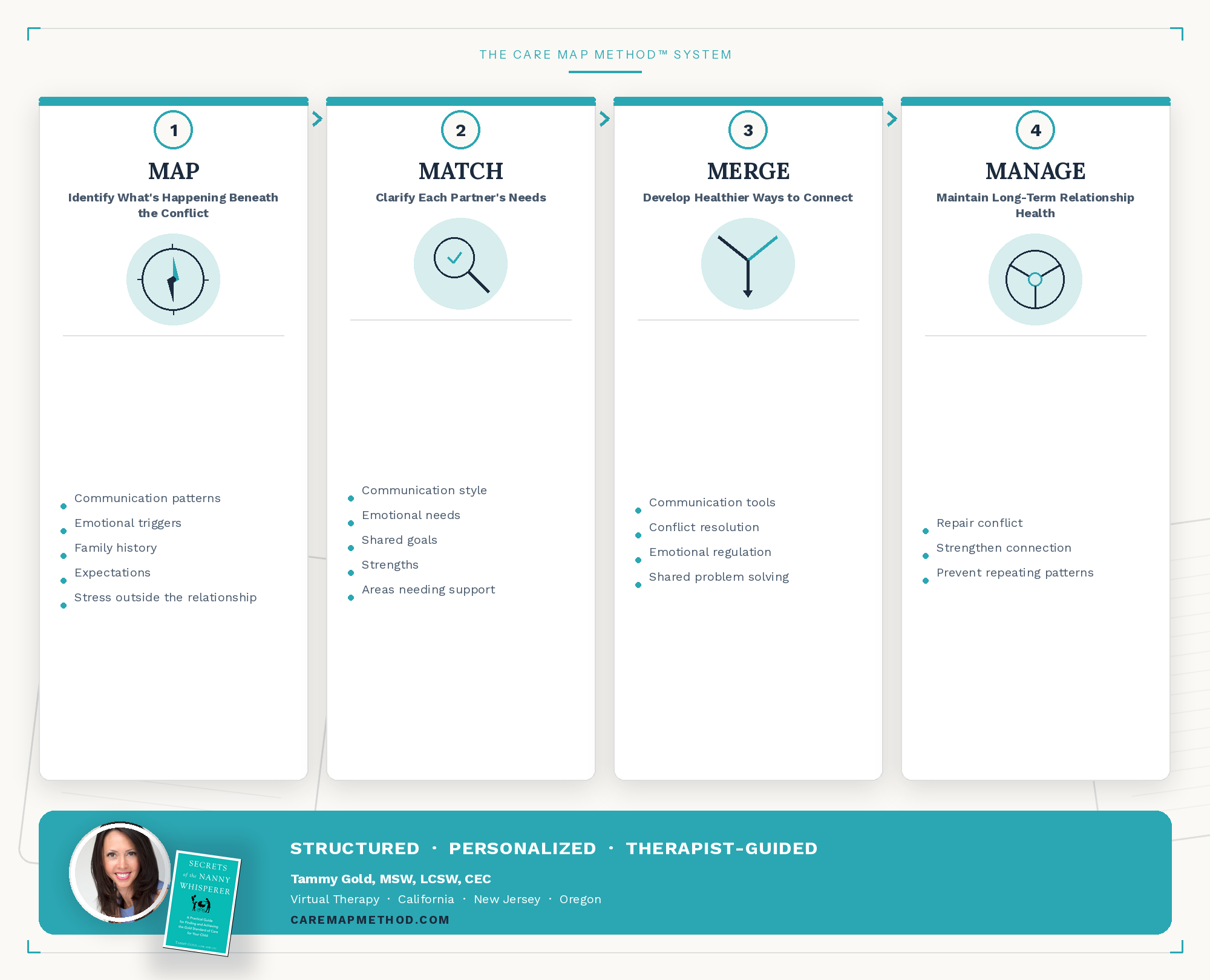
MAP → MATCH → MERGE → MANAGE
A structured, individualized framework for understanding the problem, selecting the right supports, integrating practical changes, and adjusting the plan over time.
Why small problems become recurring conflicts
Relationship conflict becomes chronic when the couple keeps trying to solve the visible disagreement without understanding the system that produces it. A partner who asks for more help may not only be requesting a completed task; they may be asking to feel less alone. A partner who becomes defensive may hear the request as proof that nothing they do is good enough.
Once this cycle is established, both people begin reacting to the pattern rather than the present moment. Tone becomes more important than content. Neutral comments are interpreted through accumulated hurt. Repair attempts are missed because each person is protecting against the next disappointment.
Signs that communication has become a system problem
You do not need to be in constant crisis to benefit from relationship therapy. Persistent patterns deserve attention, particularly when you notice several of the following:
The same argument returns without meaningful resolution
One person pursues while the other shuts down or leaves
Conversations quickly become criticism, defensiveness, contempt, or blame
Practical responsibilities feel chronically unequal
Affection and friendship have been replaced by logistics
You avoid important topics because conflict feels inevitable
External pressures such as parenting, caregiving, work, or finances dominate the relationship
One or both partners feel lonely while still together
The Care Map Method™: from argument to actionable understanding
In Care Map Method™ therapy, the goal is not simply to decide who is right. We organize the situation so that the couple can see what is happening, what each person needs, and which changes are realistic. The framework is structured but individualized.
MAP: identify what is driving the pattern
The MAP stage examines the whole relationship through biological, emotional, social, and environmental factors. Biological factors may include sleep deprivation, menopause, chronic illness, medication effects, or nervous-system activation. Emotional factors include fear, resentment, grief, shame, and unmet attachment needs. Social factors include family-of-origin patterns, parenting roles, friendships, and cultural expectations. Environmental factors include work schedules, finances, housing, technology, and the distribution of household labor.
This broader map often reduces blame. A couple may discover that a “communication problem” is being intensified by untreated exhaustion, unclear roles, or a transition they never consciously discussed.
MATCH: identify what each person and the relationship need
After the pattern is clear, therapy helps match the problem with the right supports and skills. One couple may need a reliable process for difficult conversations. Another may need stronger boundaries with extended family. Another may need to rebalance labor, rebuild trust after secrecy, or learn how to regulate before attempting resolution.
The match is specific. Generic advice is less useful than identifying the exact intervention that fits the couple’s needs, strengths, history, and current capacity.
MERGE: turn insight into new relationship practices
Insight matters only when it can be brought into daily life. During MERGE, the couple practices concrete changes: how to begin a conversation without accusation, how to request help clearly, how to pause without abandoning the discussion, and how to create agreements that are measurable rather than vague.
This may include a weekly planning conversation, a division-of-labor agreement, conflict-repair language, technology boundaries, or a plan for handling recurring family stress. The purpose is not to make the relationship mechanical. It is to create enough structure that connection is not repeatedly sacrificed to chaos.
MANAGE: maintain progress when life becomes stressful again
Every relationship encounters new stress. The MANAGE stage focuses on recognizing early warning signs, reviewing agreements, and adjusting the plan before old patterns fully return. Couples learn to ask: What has changed? Which support is no longer working? What needs to be renegotiated?
This turns therapy into a transferable process rather than a temporary improvement that depends on everything remaining calm.
What solution-focused relationship therapy can produce
Therapy cannot guarantee that every relationship will continue, and it should not pressure anyone to remain in an unsafe situation. It can, however, help people understand their patterns, communicate more accurately, make decisions with greater clarity, and develop practical tools for the relationship they are trying to build.
For many couples and family members, the most meaningful change is moving from “We keep having the same fight” to “We understand the cycle, know what each of us needs, and have a plan for what to do next.”
When to seek support
Consider reaching out when conflict is repetitive, emotional distance is increasing, major transitions are exposing unresolved differences, or attempts to solve the problem independently keep producing the same outcome. Early support is often more effective than waiting until resentment has hardened into hopelessness.
Ready to talk?
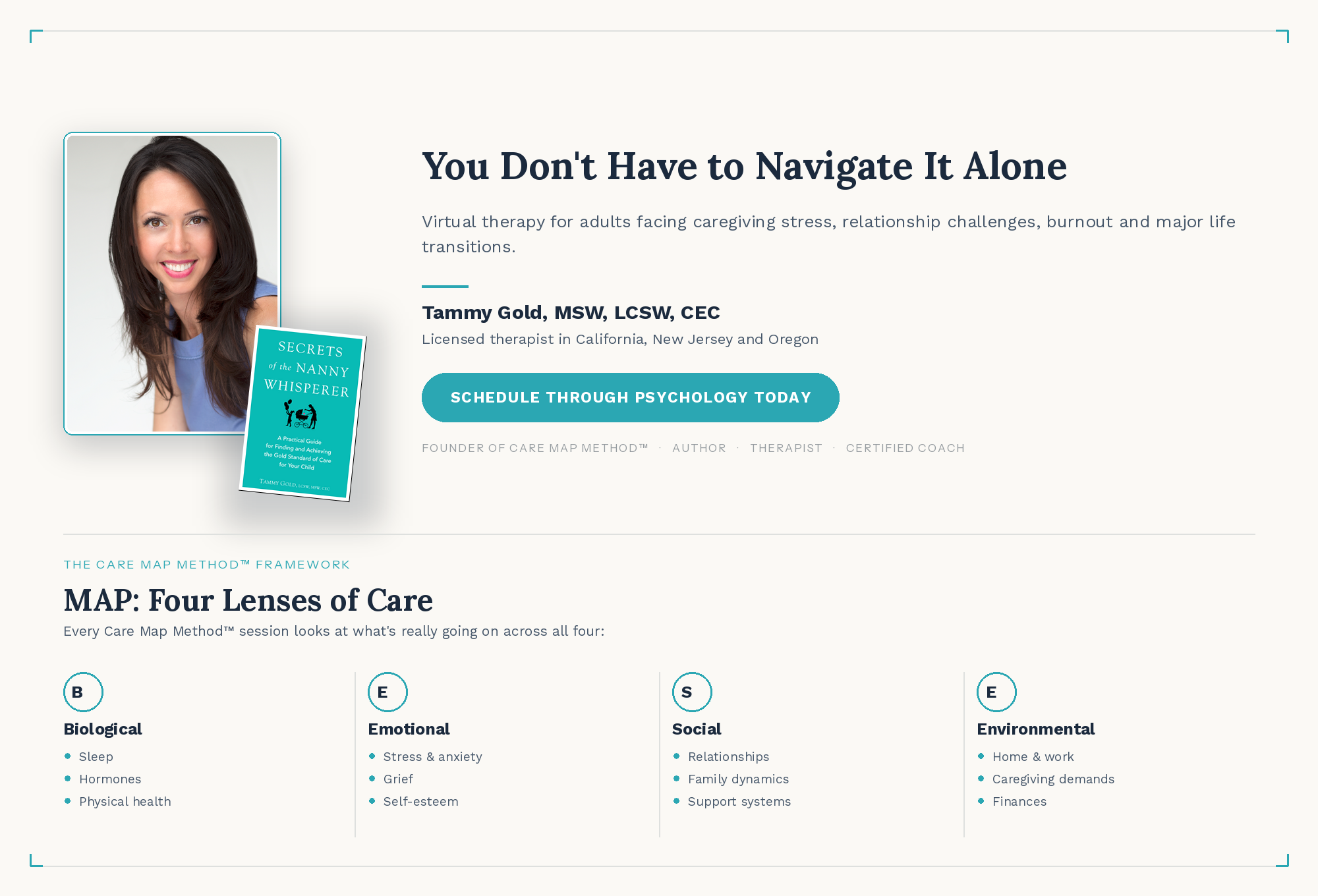
If this issue is affecting your emotional health, relationships, work, or daily functioning, support is available. Tammy Gold provides virtual therapy for adults in California, New Jersey, and Oregon. Schedule through Tammy Gold’s Psychology Today profile
About Tammy Gold
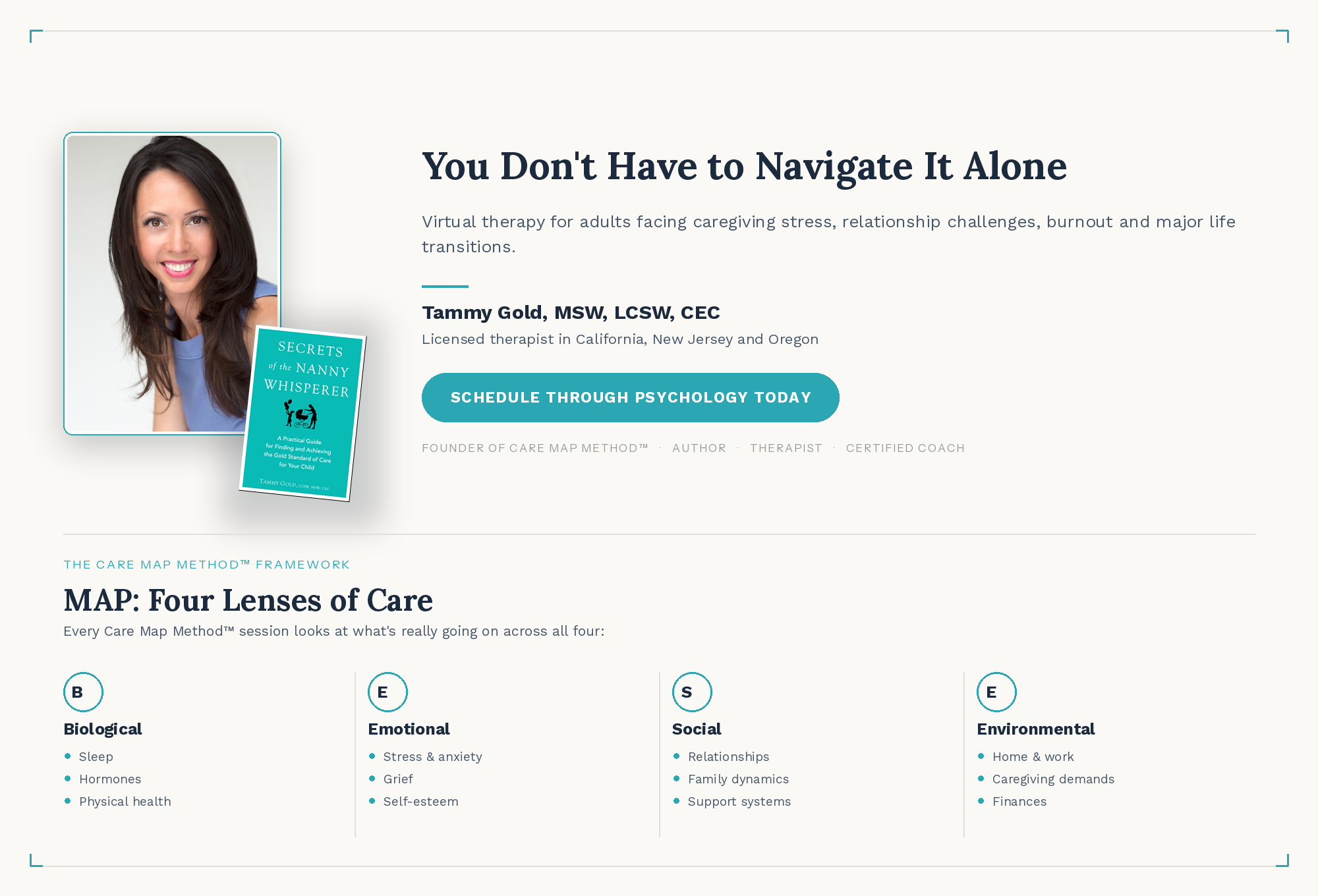
Tammy Gold, MSW, LCSW, CEC, is the founder of Care Map Method™, a licensed clinical social worker in California, New Jersey, and Oregon, a certified coach, and the author of Secrets of the Nanny Whisperer. She helps adults and families navigate relationships, caregiving, burnout, parenting, work stress, and major life transitions through a structured, practical, relationship-centered approach.
Educational notice: This article is for general educational purposes and is not a substitute for individualized medical, legal, or mental health care. If you are experiencing an emergency or immediate safety concern, contact local emergency services or an appropriate crisis resource.
Why do couples keep having the same argument?
Repeated arguments are often maintained by deeper emotional triggers, unmet needs, defensive reactions, assumptions, and communication patterns rather than the surface topic alone.
Can couples therapy help communication?
Yes. Couples therapy can help partners slow down conflict, identify the pattern, hear each other more accurately, communicate needs more clearly, and practice repair.
What if my partner will not attend?
Individual therapy can still help you understand the relationship pattern, regulate your reactions, communicate differently, clarify boundaries, and make more thoughtful decisions.
Is couples therapy only for relationships in crisis?
No. Couples may seek therapy for recurring conflict, disconnection, parenting stress, intimacy concerns, life transitions, premarital preparation, or to strengthen a relationship before problems escalate.
Will the therapist take sides?
The goal is not to declare one partner right and the other wrong. The work focuses on understanding the relationship system, helping both people feel heard, and identifying healthier patterns.
Can therapy help couples affected by parenting stress?
Yes. Parenting can create exhaustion, resentment, role imbalance, disagreement about discipline, and reduced time for connection. Therapy can help couples rebuild teamwork and communication.
What does Map, Match, Merge, and Manage look like for couples?
MAP identifies the conflict cycle. MATCH clarifies each partner’s needs and goals. MERGE builds healthier communication and repair. MANAGE creates tools and agreements that can be used between sessions.
How long does couples therapy take?
The length varies based on the concerns, goals, severity of conflict, participation, and whether there are complicating factors. Some couples seek focused short-term work, while others benefit from longer support.

Empty Nest Syndrome: Finding Purpose During Life’s Next Chapter
When children leave home, parents may experience grief, identity changes, relationship strain, and uncertainty about what comes next. Therapy can help make this transition meaningful.
When a child leaves for college, moves out, marries, or becomes more independent, parents often feel proud and relieved. They may also feel grief, loneliness, anxiety, or a surprising loss of direction.
These reactions can coexist. Loving your child's independence does not prevent you from missing the daily relationship, familiar routines, and identity that active parenting provided.
Why the empty nest can feel like a real loss
Parenting structures time, attention, relationships, and the physical home for many years. School calendars, meals, activities, transportation, and emotional support create a daily rhythm. When that rhythm changes, the absence can be felt in ordinary moments: a quiet kitchen, an unused bedroom, or a weekend with no one to drive anywhere.
The loss is not only of proximity. It may include the loss of a role in which you felt needed and competent. Even when the transition is developmentally healthy, it can require genuine grieving.
Common empty-nest experiences
Parents may notice:
Sadness or tearfulness that seems disproportionate to the event
Anxiety about the child’s safety, choices, or adjustment
Compulsive checking, texting, or monitoring
Difficulty sleeping or concentrating
A sense that the home or marriage feels unfamiliar
Uncertainty about personal goals or identity
Resentment when the adult child appears distant
Conflict with a partner who is adjusting differently
Relief followed by guilt for feeling relieved
When partners experience the transition differently
One partner may feel devastated while the other feels energized by new freedom. One may want frequent contact with the child; the other may emphasize independence. These differences can create conflict if each person interprets the other's response as uncaring or excessive.
Couples may also discover that years of child-centered routines allowed them to avoid unresolved issues. The quieter home can expose emotional distance, unequal labor, or uncertainty about what they enjoy together. This does not necessarily mean the relationship is failing. It means the couple may need to build a new version of the relationship rather than waiting for the old one to return.
Letting the parent-child relationship evolve
Adult children still need connection, but the form of support changes. The parent's task gradually shifts from direct management to availability, consultation, and respect for autonomy.
This transition can be difficult when worry is high. Frequent advice or checking may feel like love to the parent but like mistrust to the adult child. Therapy can help parents tolerate uncertainty while maintaining a warm, appropriate connection.
The empty nest and women’s identity
Women are often encouraged to invest deeply in caregiving and then expected to transition smoothly when daily caregiving decreases. The resulting identity questions can be significant: Who am I when I am not organizing everyone else's life? What do I want beyond being needed?
These questions are not selfish. They are part of constructing a fuller identity that can include parenting without being limited to it.
When aging parents enter the picture
For many adults, the empty nest is not an uncomplicated release from caregiving. As children become independent, aging parents may begin to need more support.
This can create a rapid shift from one caregiving system to another, leaving little time to recover or consider personal goals. It is important to avoid automatically filling every newly available hour with eldercare. A sustainable plan should account for the adult child's independence, the older parent's needs, and the midlife adult's own health and future.
Rebuilding purpose without forcing a reinvention
You do not need to identify a dramatic new purpose immediately. Purpose can be rebuilt gradually through relationships, work, creativity, learning, service, health, travel, or simple routines that belong to you.
Start by noticing what was postponed during intensive parenting. Some interests will still matter; others will not. The goal is not to recreate your pre-parenting self but to discover what fits now.
A practical transition map
Consider mapping four areas:
Biological: sleep, health, movement, and energy during the transition
Emotional: grief, relief, anxiety, pride, regret, and changing identity
Social: friendships, partnership, community, and the evolving relationship with the adult child
Environmental: changes to the home, schedule, finances, work, and caregiving responsibilities
How therapy can help
Therapy can provide support when the transition brings persistent sadness, anxiety, relationship conflict, or a sense of emptiness. It can help parents process grief, adjust communication with adult children, strengthen a partnership, and clarify what they want from the next stage of life.
The work is not about erasing attachment. It is about allowing the relationship with your child to mature while expanding your own life.
The next chapter can hold more than one truth
You can miss the version of family life that has ended and still welcome what comes next. You can be proud of your child and feel lonely. You can appreciate new freedom and feel uncertain about how to use it.
A healthy transition does not require choosing one emotion. It requires making room for the full experience while gradually building a life that remains connected, purposeful, and your own.
Ready for support?
If the empty-nest transition has brought grief, anxiety, relationship strain, or uncertainty about your identity, therapy can help you move into the next chapter with greater clarity. Tammy Gold, MSW, LCSW, CEC, provides confidential virtual therapy for adults located in California, New Jersey, and Oregon.
Book through Psychology Today: https://www.psychologytoday.com/us/therapists/tamara-jill-gold-los-angeles-ca/1713403
Learn more: CareMapMethod.com
About Tammy Gold
Tammy Gold, MSW, LCSW, CEC, is the founder of Care Map Method™, a licensed clinical social worker in California, New Jersey, and Oregon, a certified coach, and the author of Secrets of the Nanny Whisperer. Her work centers on relationships, caregiving, burnout, parenting transitions, workplace stress, women’s midlife concerns, and practical support during major life changes.
Educational notice: This article is for general educational purposes and is not a substitute for individualized medical or mental health care. If you are experiencing an emergency or immediate safety concern, contact emergency services or an appropriate crisis resource in your area.

Workplace Burnout or Just Too Much? How to Know When It Is Time for Therapy
Workplace burnout can affect sleep, health, confidence, and relationships. Learn how it differs from ordinary stress and when therapy may help.
A demanding job can produce temporary periods of stress. Burnout is different. It develops when high demands, low control, inadequate recovery, conflict, or misalignment continue long enough that your emotional and physical resources begin to erode.
You may still be performing well. In fact, many people seek therapy only after months of compensating through longer hours, perfectionism, and constant availability. Outward competence can hide significant internal depletion.
Burnout versus ordinary work stress
Ordinary stress usually has a clear endpoint. A project ends, a deadline passes, or a busy season settles down. Burnout is more persistent and often includes emotional exhaustion, cynicism or detachment, and a reduced sense of effectiveness.
You may notice that weekends no longer restore you, small requests feel intolerable, or achievements produce little satisfaction. The issue is not simply that work is difficult. It is that the current relationship between you and the work has become unsustainable.
Signs that work stress is affecting your health
Common signs include:
Difficulty falling asleep because your mind continues rehearsing work problems
Waking with dread or physical tension
Headaches, gastrointestinal symptoms, muscle pain, or persistent fatigue
Increased reliance on alcohol, food, screens, or other numbing behaviors
Trouble concentrating or making decisions
Feeling emotionally flat with family and friends
Frequent irritability or conflict at home
Checking messages compulsively or feeling unable to disconnect
Believing that one mistake could expose you as inadequate
The relationship side of workplace burnout
Burnout is not only about workload. It can be driven by relationships: an unpredictable manager, unclear expectations, a hostile coworker, chronic lack of recognition, pressure to absorb other people's responsibilities, or a culture in which boundaries are punished.
People who are highly attuned to others may spend enormous energy managing a boss's mood, preventing conflict, or compensating for a disorganized team. This emotional labor is real work, even when it is not listed in the job description.
Perfectionism and overfunctioning
Perfectionism can initially look like a professional advantage. You anticipate problems, produce careful work, and become the person others rely on. Over time, however, the standard may become impossible to maintain.
Overfunctioning occurs when you repeatedly do more than your role requires because you fear what will happen if you stop. The workplace then adapts around your extra labor. Therapy can help you distinguish professional responsibility from anxiety-driven overresponsibility.
When the problem follows you home
Workplace burnout often enters personal relationships. You may be physically present but mentally preoccupied, too depleted for intimacy, or impatient with ordinary family needs. A partner may experience your withdrawal as disinterest, while you feel that there is simply nothing left to give.
This is an important signal. A job does not have to be objectively terrible to be incompatible with your current health, family responsibilities, or values.
A practical workplace stress map
Before making a major decision, map the problem specifically:
Demands: What tasks, hours, or expectations are creating the greatest strain?
Control: Which parts of the role can you influence, and which are fixed?
Relationships: Which interactions consistently increase stress?
Recovery: Do you have genuine periods when you are not working or anticipating work?
Values: Is the job asking you to act in ways that conflict with your priorities?
Consequences: What is the current arrangement costing your health and relationships?
Boundaries that are more useful than “work-life balance”
The phrase work-life balance can feel unrealistic when work demands fluctuate. More useful boundaries are concrete and observable.
Examples include setting a time after which nonurgent messages wait until morning, requesting written priorities when assignments conflict, limiting how often you rescue a colleague, or protecting one recurring block of personal time. A boundary is not merely what you ask another person to do. It is the action you will take to protect a limit.
Should you leave the job?
Therapy should not automatically persuade you to stay or leave. It can help you evaluate the situation with greater clarity.
Some workplace problems improve through communication, role clarification, leave, a schedule change, or stronger boundaries. Others reflect a culture or leadership structure that is unlikely to change. The task is to assess whether the environment can become workable and what risks accompany each option.
How therapy can help
Therapy for workplace burnout can address stress regulation, conflict patterns, perfectionism, imposter feelings, decision-making, and the effect of work on relationships.
It can also help you prepare for difficult conversations, understand why certain authority dynamics feel especially activating, and build a transition plan if leaving becomes the healthiest choice. The aim is not to help you tolerate unlimited stress. It is to help you respond strategically rather than from panic or depletion.
You do not have to wait for collapse
Many professionals assume they should seek help only when they can no longer function. Earlier support is often more effective. If work is consistently affecting sleep, health, confidence, or relationships, that is enough reason to take the problem seriously.
Burnout is not proof that you are incapable. It may be evidence that your current workload, workplace relationships, or coping structure needs to change.
Ready for support?
If workplace stress is affecting your sleep, health, confidence, or relationships, therapy can help you assess the situation, set clearer boundaries, and make informed decisions. Tammy Gold, MSW, LCSW, CEC, provides confidential virtual therapy for adults located in California, New Jersey, and Oregon.
Book through Psychology Today: https://www.psychologytoday.com/us/therapists/tamara-jill-gold-los-angeles-ca/1713403
Learn more: CareMapMethod.com
About Tammy Gold
Tammy Gold, MSW, LCSW, CEC, is the founder of Care Map Method™, a licensed clinical social worker in California, New Jersey, and Oregon, a certified coach, and the author of Secrets of the Nanny Whisperer. Her work centers on relationships, caregiving, burnout, parenting transitions, workplace stress, women’s midlife concerns, and practical support during major life changes.
Educational notice: This article is for general educational purposes and is not a substitute for individualized medical or mental health care. If you are experiencing an emergency or immediate safety concern, contact emergency services or an appropriate crisis resource in your area.

Menopause, Mood Changes and Relationships: Why Everything Suddenly Feels Harder
Midlife may bring hormonal changes, relationship strain, caregiving, work pressure, and identity shifts at once. Therapy can help women understand the full picture and respond with greater clarity.
Many women enter perimenopause or menopause expecting physical changes such as hot flashes or disrupted sleep. They may be less prepared for the emotional and relational changes: feeling less patient, more reactive, unusually anxious, disconnected from a partner, uncertain about identity, or overwhelmed by responsibilities that were previously manageable.
It is tempting to reduce the entire experience to hormones or, in the opposite direction, to dismiss hormones and assume the problem is purely psychological. In practice, midlife distress is often created by several interacting factors.
Why midlife can feel emotionally crowded
Menopause often arrives during a period of intense relational and practical demands. A woman may be parenting teenagers, launching young adults, caring for aging parents, reassessing a marriage, managing workplace pressure, and noticing changes in her own health at the same time.
Sleep disruption can lower emotional tolerance. Physical symptoms may affect confidence and intimacy. Longstanding relationship patterns may become harder to ignore. A role that once provided meaning, such as active parenting, may be changing. The question is rarely only, “Are my hormones changing?” It is also, “What else in my life can no longer continue in the same way?”
Mood changes deserve a full assessment
Emotional changes during midlife can include irritability, anxiety, sadness, reduced motivation, difficulty concentrating, emotional sensitivity, or a sense of not feeling like oneself.
These experiences should not be minimized. They also should not automatically be attributed to one cause. A thoughtful evaluation considers physical health, sleep, medication, stress, relationships, caregiving responsibilities, work demands, previous mental health history, and major life transitions. Therapy can be one part of that broader support plan.
How menopause can affect relationships
Partners may misinterpret changes in energy, desire, patience, or emotional responsiveness. One person may feel rejected while the other feels pressured and misunderstood. Minor disagreements can begin to carry the weight of years of unresolved labor, unequal responsibility, or poor communication.
The goal is not to blame menopause for every relationship problem. Instead, it is to recognize that a biological transition can reduce the capacity to keep compensating for patterns that were already difficult. What appears to be a sudden relationship crisis may partly be the point at which an old system stops working.
Parenting during perimenopause and menopause
Parenting adolescents or young adults can be emotionally demanding. Children may be separating, challenging limits, or preparing to leave home just as a mother is experiencing her own changes in identity and regulation.
This combination can intensify conflict. A teenager's normal push for independence may feel more personal. A college departure may evoke grief, relief, pride, and uncertainty. Therapy can help distinguish the child's developmental task from the parent's emotional transition so that each can be addressed more clearly.
Caring for aging parents at the same time
Many midlife women become the default organizers of care for aging parents. They may manage appointments, communicate with siblings, and respond to crises while also working and parenting.
This is one reason a menopause-related emotional complaint should be understood in context. A woman may not need to become better at tolerating an unreasonable load. She may need help changing the load, setting boundaries, or obtaining additional care.
Identity after years of caring for others
Midlife can raise questions that were postponed during the busiest parenting and career years: What do I want now? Which relationships are reciprocal? What parts of my identity have been neglected? What do I want the next decade to look like?
These questions can feel destabilizing, but they can also mark a healthy developmental transition. Therapy provides space to explore them without requiring an immediate, dramatic life decision.
A relationship-centered approach
A relationship-centered therapy approach looks at symptoms within the systems surrounding the woman. It considers the relationship with a partner, children, parents, work, the body, and the self.
Using the Care Map Method™ lens, it can be helpful to map biological needs such as sleep and medical care; emotional needs such as grief, anger, or self-compassion; social needs such as partnership and friendship; and environmental needs such as workload, household roles, and privacy. This broader map often reveals practical changes that symptom-focused advice misses.
Practical ways to reduce pressure
The following steps may help create more stability:
Track mood, sleep, physical symptoms, and major stressors so patterns are easier to identify.
Discuss significant physical or mood changes with an appropriate medical professional.
Name the specific relationship pattern that is causing distress rather than describing the entire relationship as failing.
Reevaluate household and caregiving labor instead of assuming you must continue carrying the same responsibilities.
Protect time for friendships, movement, creativity, or interests that are not organized around serving others.
Delay major decisions made at the peak of exhaustion, while still taking persistent dissatisfaction seriously.
How therapy can help
Therapy can help women understand emotional changes without shame, improve communication, address burnout, grieve changing roles, and reconnect with a sense of agency.
It can be especially useful when midlife concerns are tied to relationships rather than a single isolated symptom. The work is not simply about reducing distress; it is about building a life structure and relationship pattern that fit the person you are becoming.
Midlife is not a personal failure
Feeling unsettled during menopause does not mean you are weak, ungrateful, or becoming someone unrecognizable. It may mean that your body, roles, and relationships are changing faster than your existing support system.
With thoughtful medical and psychological support, midlife can become a period of clearer boundaries, more honest relationships, and renewed direction.
Ready for support?
If menopause or midlife changes are affecting your mood, relationships, caregiving role, or sense of identity, therapy can help you understand the full picture and decide what needs to change. Tammy Gold, MSW, LCSW, CEC, provides confidential virtual therapy for adults located in California, New Jersey, and Oregon.
Book through Psychology Today: https://www.psychologytoday.com/us/therapists/tamara-jill-gold-los-angeles-ca/1713403
Learn more: CareMapMethod.com
About Tammy Gold
Tammy Gold, MSW, LCSW, CEC, is the founder of Care Map Method™, a licensed clinical social worker in California, New Jersey, and Oregon, a certified coach, and the author of Secrets of the Nanny Whisperer. Her work centers on relationships, caregiving, burnout, parenting transitions, workplace stress, women’s midlife concerns, and practical support during major life changes.
Educational notice: This article is for general educational purposes and is not a substitute for individualized medical or mental health care. If you are experiencing an emergency or immediate safety concern, contact emergency services or an appropriate crisis resource in your area.

Caring for Children and Aging Parents at the Same Time
Adults caring for children and aging parents often face competing needs, financial pressure, guilt, and relationship strain. Learn how to create a more workable family care plan.
The sandwich generation describes adults who are supporting children while also helping aging parents or other older relatives. The term sounds simple, but the lived experience can involve dozens of competing responsibilities: school schedules, college planning, work deadlines, medical appointments, insurance questions, sibling disagreements, household needs, and unpredictable emergencies.
The central problem is often not a lack of love. It is that several people legitimately need you at the same time, while your own needs remain last on the list.
Why this stage is uniquely demanding
Middle adulthood was once imagined as a relatively stable period. In reality, it may involve parenting teenagers or young adults, caring for parents with increasing medical or cognitive needs, maintaining a career, managing a household, and navigating changes in marriage, health, and identity.
Each role has different emotional expectations. Children may need encouragement and independence. Aging parents may need protection while resisting loss of control. Employers may expect consistent performance regardless of what is happening at home. You may feel pulled in opposite directions all day.
The invisible mental load
The sandwich generation often carries a large amount of cognitive labor: remembering who needs what, anticipating problems, researching options, following up with professionals, and managing communication among family members.
This mental load can be exhausting even when the visible tasks seem manageable. You may sit at work while thinking about a parent's fall risk, then attend a child's event while worrying about an unanswered medical message. Your body is in one place while your mind is coordinating several systems.
Common emotional patterns
Several emotional experiences are especially common:
Guilt that someone is always receiving less attention than they need
Resentment followed by shame for feeling resentful
Anxiety about a parent’s safety or decline
Fear that caregiving will interfere with work or financial stability
Conflict with a spouse about time, money, privacy, or unequal labor
Anger toward siblings who appear less involved
Sadness about a child leaving home while a parent becomes more dependent
Loss of identity outside the roles of employee, parent, partner, and caregiver
How the pressure affects couples
Sandwich-generation stress can expose existing differences in how partners define responsibility. One partner may feel morally obligated to provide extensive hands-on care. The other may worry about finances, the children, or the impact on the household.
These disagreements are not always evidence that one partner is caring and the other is selfish. They may reflect different fears, family histories, and thresholds for risk. Productive conversations focus on specific capacities and consequences rather than accusations about character.
Mapping competing needs instead of reacting to emergencies
A useful first step is to stop treating every demand as equally urgent. The Care Map Method™ organizes needs across biological, emotional, social, and environmental domains and then separates immediate safety issues from important but nonurgent concerns.
For an aging parent, an immediate issue may be medication confusion or unsafe driving. For a teenager, it may be a mental health concern or school crisis. Other needs may be important but schedulable. A written map allows the family to see where professional support, shared responsibility, or a change in expectations is required.
A practical family capacity assessment
Ask these questions before agreeing to a new responsibility:
What exactly is being requested?
How often will it occur, and for how long?
What will I have to stop doing in order to take this on?
Could another person, service, or professional complete part of it?
Is this a true emergency, or has the family delayed planning until the issue feels urgent?
What boundary would make this responsibility manageable?
Reducing guilt through clearer roles
Guilt often grows in vague situations. When no one has defined who is responsible for what, the most responsive person may feel accountable for everything.
Clear roles do not eliminate sadness or difficult decisions, but they reduce confusion. A family care plan might specify who attends medical appointments, who manages finances, who handles weekly calls, and what will trigger a move to more professional support. Parenting responsibilities can be mapped in the same way so that one system does not silently consume all available energy.
Protecting your work and financial stability
Many adults underestimate the professional cost of ongoing caregiving. Missed work, reduced concentration, unplanned travel, and frequent interruptions can affect income and career progression.
Protecting your employment is not a sign that you care less. Your financial stability may be essential to your children, your future, and your ability to assist an aging parent. Therapy can help you make decisions that account for long-term consequences rather than responding solely to immediate guilt.
How therapy can help
Therapy can help sandwich-generation adults clarify priorities, communicate with spouses and siblings, set limits, process anticipatory grief, and recognize when they have moved from healthy responsibility into chronic overfunctioning.
It can also provide a consistent space in which you are not required to care for anyone else. That alone can be meaningful when nearly every relationship has become organized around another person's needs.
Creating a sustainable next step
You do not need to solve every future problem today. Begin by identifying the most unstable part of the system. It may be a parent's home safety, a sibling communication problem, a teenager's needs, or your own exhaustion.
Addressing one clearly defined pressure point is often more effective than attempting to become more efficient at carrying an impossible load.
Ready for support?
If you are caring for children and aging parents while trying to preserve your work, health, and relationships, therapy can help you clarify priorities and reduce the strain. Tammy Gold, MSW, LCSW, CEC, provides confidential virtual therapy for adults located in California, New Jersey, and Oregon.
Book through Psychology Today: https://www.psychologytoday.com/us/therapists/tamara-jill-gold-los-angeles-ca/17
Learn more: CareMapMethod.com
About Tammy Gold
Tammy Gold, MSW, LCSW, CEC, is the founder of Care Map Method™, a licensed clinical social worker in California, New Jersey, and Oregon, a certified coach, and the author of Secrets of the Nanny Whisperer. Her work centers on relationships, caregiving, burnout, parenting transitions, workplace stress, women’s midlife concerns, and practical support during major life changes.
Educational notice: This article is for general educational purposes and is not a substitute for individualized medical or mental health care. If you are experiencing an emergency or immediate safety concern, contact emergency services or an appropriate crisis resource in your area.
What are common signs of caregiver burnout?
Signs may include exhaustion, irritability, resentment, guilt, sleep problems, reduced concentration, withdrawal, health changes, hopelessness, and feeling unable to keep up with care demands.
How can therapy help caregiver burnout?
Therapy can help caregivers process emotions, identify unsustainable demands, set boundaries, communicate with family, ask for help, and develop a more realistic care plan.
Is it normal to feel resentful while caregiving?
Yes. Resentment can develop when responsibilities are excessive, support is limited, boundaries are unclear, or the caregiver’s own needs are repeatedly postponed. Feeling resentment does not mean you do not love the person.
What if my siblings will not help?
Therapy or coaching can help you clarify what you need, prepare a family conversation, define responsibilities, set limits, and decide what you can realistically continue providing.
How do I know when more professional care is needed?
Consider changes in safety, cognition, mobility, medication, nutrition, hygiene, isolation, wandering, falls, caregiver capacity, and whether current arrangements are sustainable.
Can I care for someone without losing myself?
That is a central goal. Sustainable caregiving requires support, boundaries, realistic expectations, shared responsibility where possible, and attention to the caregiver’s health and identity.
What Care Map worksheet pairs with caregiver burnout?
A Caregiver Burnout Snapshot, Family Capacity Assessment, Weekly Care Plan, Boundary Planner, or Biological-Emotional-Social-Environmental Care Map can help organize the situation.
When is caregiver burnout an emergency?
Seek urgent professional help when there is immediate danger, inability to provide safe care, abuse or neglect concerns, severe medical or psychiatric symptoms, or thoughts of harming yourself or someone else.

Caregiver Burnout: When Caring for Everyone Else Is Costing You Your Health
Caregiver burnout can affect your health, relationships, concentration, and ability to provide care. Learn the warning signs and how therapy can help you create a more sustainable plan.
Caregiving often begins with love, urgency, or a sense of responsibility. You may start by attending one medical appointment, arranging groceries, or checking in more often. Over time, the role can quietly expand until you are coordinating medications, managing family conflict, handling emergencies, and trying to keep your own household and work life functioning at the same time.
Many caregivers do not recognize burnout until they are already depleted. They may tell themselves that their loved one has it worse, that no one else can help, or that resting would be selfish. Yet caregiving is not sustainable when the caregiver's physical health, emotional stability, and relationships are deteriorating.
What caregiver burnout actually looks like
Caregiver burnout is more than feeling tired after a difficult week. It is a state of ongoing physical, emotional, and mental depletion related to prolonged caregiving demands and insufficient recovery, support, or control.
Burnout may develop gradually. Because the caregiver keeps adapting to each new demand, the level of strain can begin to feel normal. The most important question is not whether you are managing to complete the tasks. It is whether the current arrangement is costing you more than you can continue to give.
Common warning signs
You may be approaching or experiencing caregiver burnout when several of the following patterns persist:
Constant fatigue that does not improve with one good night of sleep
Irritability, resentment, anger, or emotional numbness
Difficulty concentrating, making decisions, or completing ordinary tasks
Withdrawing from friends, activities, or relationships
Feeling trapped, guilty, or convinced that no one else can do the job correctly
Changes in appetite, sleep, headaches, muscle tension, or other stress-related symptoms
Frequent conflict with siblings, a spouse, paid caregivers, or the person receiving care
Losing patience and then feeling ashamed about it
Neglecting your own medical appointments, finances, work, or household needs
Why responsible caregivers are especially vulnerable
The people most likely to become overextended are often the most conscientious. They notice what needs to be done, anticipate problems, and step in before others ask. Those strengths are valuable, but without limits they can produce a role in which one person becomes the default manager of everyone else's needs.
Family systems can reinforce this pattern. One sibling may live farther away. Another may minimize the parent's decline. A spouse may assume you have the situation handled. The aging parent may resist outside help. You can end up carrying both the practical labor and the emotional burden of convincing everyone that change is necessary.
How burnout affects relationships
Caregiving stress rarely stays confined to the caregiving relationship. It can enter a marriage through arguments about time, money, privacy, and competing responsibilities. It can affect parenting when patience is low. It can create resentment between siblings when contributions feel unequal.
Burnout can also distort your relationship with the person receiving care. Love may still be present, but it becomes mixed with frustration, grief, obligation, and anticipatory loss. Therapy can provide a place to speak honestly about those mixed feelings without being judged.
A Care Map Method™ perspective
The Care Map Method™ begins by mapping the whole situation rather than reacting to the loudest immediate problem. For caregivers, that means assessing not only the loved one's needs but also the caregiver's capacity.
A useful map includes four areas: biological needs such as sleep, health, medication, and physical stamina; emotional needs such as grief, fear, anger, and guilt; social needs such as family cooperation, friendship, and respite; and environmental needs such as the home, transportation, safety, finances, and access to professional care.
When one area is ignored, the entire care plan becomes less stable. A plan that keeps an older adult safe but causes the primary caregiver to become ill is not a successful long-term plan.
Practical steps that reduce strain
Burnout rarely resolves through positive thinking alone. It usually requires changing the structure around the caregiver.
Write down every recurring caregiving task, including invisible tasks such as reminders, research, and emotional reassurance.
Separate tasks that only you can do from tasks another relative, professional, or service could handle.
Create one shared place for schedules, medical information, contacts, and updates.
Set a specific boundary rather than making a vague request. For example: “I can attend one appointment each week, but I cannot remain the only transportation plan.”
Schedule recovery time before you feel you have earned it. Recovery is part of maintaining the care system.
Ask the medical team, social worker, agency, or community program what respite and caregiver resources are available.
How therapy can help
Therapy for caregiver burnout is not simply a place to vent. It can help you examine the beliefs and relationship patterns that keep you overfunctioning, practice clearer boundaries, manage guilt, communicate with family members, and make decisions under stress.
It can also help you process grief. Caregivers often grieve many losses before a death: a parent's independence, a spouse's personality, the future they expected, or the relationship they once had. Naming those losses can reduce the pressure to pretend that everything is fine.
The goal is not to make you care less. It is to help you care in a way that is emotionally and practically sustainable.
When it is time to seek support
Consider reaching out when stress is persistent, your health or relationships are being affected, you feel unable to set limits, or you are making major care decisions while emotionally depleted. You do not have to wait until you are in crisis to deserve support.
A healthier care plan includes the caregiver. Your needs are not separate from the system; they are one of the conditions that determine whether the system can continue.
Ready for support?
If caregiving has left you depleted, resentful, anxious, or unsure how to set limits, therapy can help you build a more sustainable plan. Tammy Gold, MSW, LCSW, CEC, provides confidential virtual therapy for adults located in California, New Jersey, and Oregon.
Book through Psychology Today: https://www.psychologytoday.com/us/therapists/tamara-jill-gold-los-angeles-ca/1713403
Learn more: CareMapMethod.com
About Tammy Gold
Tammy Gold, MSW, LCSW, CEC, is the founder of Care Map Method™, a licensed clinical social worker in California, New Jersey, and Oregon, a certified coach, and the author of Secrets of the Nanny Whisperer. Her work centers on relationships, caregiving, burnout, parenting transitions, workplace stress, women’s midlife concerns, and practical support during major life changes.
Educational notice: This article is for general educational purposes and is not a substitute for individualized medical or mental health care. If you are experiencing an emergency or immediate safety concern, contact emergency services or an appropriate crisis resource in your area.
What are common signs of caregiver burnout?
Signs may include exhaustion, irritability, resentment, guilt, sleep problems, reduced concentration, withdrawal, health changes, hopelessness, and feeling unable to keep up with care demands.
How can therapy help caregiver burnout?
Therapy can help caregivers process emotions, identify unsustainable demands, set boundaries, communicate with family, ask for help, and develop a more realistic care plan.
Is it normal to feel resentful while caregiving?
Yes. Resentment can develop when responsibilities are excessive, support is limited, boundaries are unclear, or the caregiver’s own needs are repeatedly postponed. Feeling resentment does not mean you do not love the person.
What if my siblings will not help?
Therapy or coaching can help you clarify what you need, prepare a family conversation, define responsibilities, set limits, and decide what you can realistically continue providing.
How do I know when more professional care is needed?
Consider changes in safety, cognition, mobility, medication, nutrition, hygiene, isolation, wandering, falls, caregiver capacity, and whether current arrangements are sustainable.
Can I care for someone without losing myself?
That is a central goal. Sustainable caregiving requires support, boundaries, realistic expectations, shared responsibility where possible, and attention to the caregiver’s health and identity.
What Care Map worksheet pairs with caregiver burnout?
A Caregiver Burnout Snapshot, Family Capacity Assessment, Weekly Care Plan, Boundary Planner, or Biological-Emotional-Social-Environmental Care Map can help organize the situation.
When is caregiver burnout an emergency?
Seek urgent professional help when there is immediate danger, inability to provide safe care, abuse or neglect concerns, severe medical or psychiatric symptoms, or thoughts of harming yourself or someone else.

Therapy for Caregiver Burnout: When Caring for Others Is Affecting Your Mental Health
Caregiving can be an act of love and still become emotionally, physically, and relationally overwhelming. Learn the signs of caregiver burnout, why guilt and resentment develop, and how therapy can help you build a more sustainable plan.
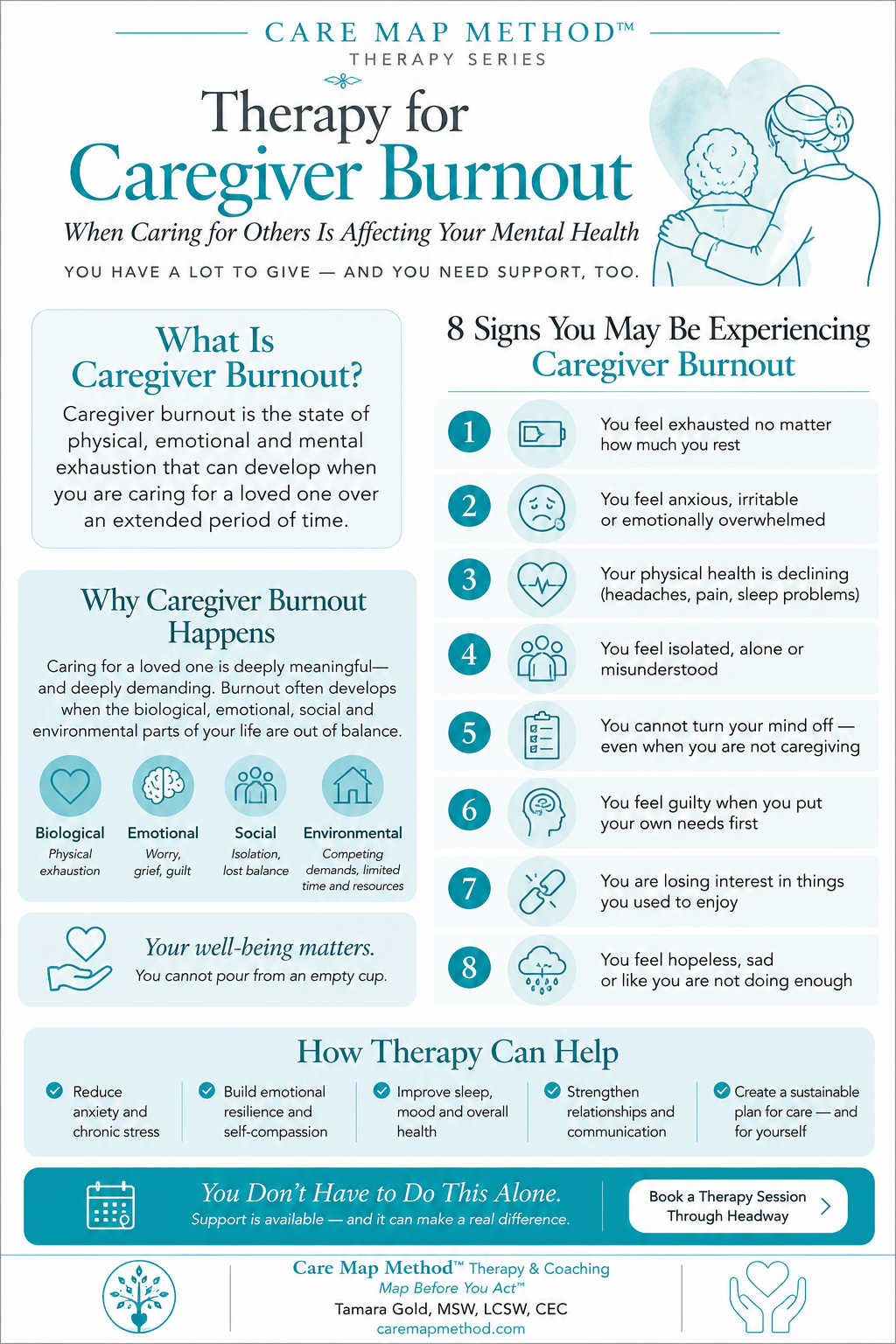
Caregiving Can Be an Act of Love—and Still Become Too Much
Caregiving rarely begins with a formal job description. It may start with one medical appointment, a few groceries, or a promise to “keep an eye on things.” Gradually, you become the person who coordinates medications, answers late-night calls, communicates with physicians, manages family disagreements, researches services, handles emergencies, or worries about what might happen next.
You may love the person you are caring for deeply. You may also feel exhausted, resentful, frightened, irritable, lonely, or trapped. Those feelings can coexist. They do not mean you are uncaring, selfish, or failing. They often mean that your responsibilities have exceeded the emotional, physical, relational, or practical resources available to you.
Caregiver burnout is not simply being tired after a demanding week. It is a pattern of depletion that can affect your mood, sleep, concentration, body, relationships, work, and ability to make decisions. The National Institute on Aging notes that caregivers may be at increased risk for physical and mental health problems, sleep disruption, and chronic health conditions when their own needs repeatedly go unattended.
For many caregivers, therapy becomes the only place where they do not have to be the organizer, problem-solver, peacekeeper, or “strong one.” It can provide room to understand what is happening, reduce guilt, improve boundaries, make clearer decisions, and build a sustainable plan for caring without disappearing inside the role.
What Is Caregiver Burnout?
Caregiver burnout is a state of emotional, mental, and physical exhaustion associated with prolonged caregiving demands and insufficient recovery, support, control, or relief. It can arise while caring for an aging parent, a spouse with chronic illness, a child with medical or behavioral needs, a family member with dementia, or several people across generations.
Burnout does not require round-the-clock hands-on care. A long-distance caregiver may carry constant worry, logistical responsibility, travel demands, financial strain, or guilt. A family member who is not the primary caregiver may still be managing medical decisions, sibling conflict, paperwork, or crises. The burden is not measured only by hours. It is also shaped by unpredictability, emotional intensity, family dynamics, and the sense that there is no safe point at which to step away.
Signs Caregiving May Be Affecting Your Mental Health
Caregiver stress can look different from one person to another. You may be functioning well on the outside while feeling increasingly depleted internally. Common warning signs include:
Feeling emotionally exhausted, overwhelmed, anxious, or constantly “on alert.”
Becoming more impatient, irritable, reactive, or angry than usual.
Having difficulty sleeping, staying asleep, or resting even when you have the opportunity.
Losing interest in activities, friendships, exercise, or routines that once helped you feel like yourself.
Feeling guilty whenever you rest, say no, ask for help, or spend money or time on your own needs.
Experiencing resentment toward the person receiving care, other relatives, professionals, or a partner who seems less involved.
Having trouble concentrating, remembering details, organizing tasks, or making decisions.
Feeling lonely or misunderstood because other people do not see the full extent of what you carry.
Noticing headaches, muscle tension, digestive problems, appetite changes, fatigue, or other stress-related physical symptoms.
Using alcohol, food, work, screens, shopping, or other behaviors to numb or escape the pressure.
Feeling hopeless, emotionally detached, or as though nothing you do will ever be enough.
Important
Burnout is not a moral diagnosis. It is information. Your mind and body may be signaling that the current care system is asking more of you than one person can sustainably provide.
Why Caregivers Often Wait Too Long to Seek Help
Many caregivers normalize a level of distress they would immediately recognize as serious in someone else. They may tell themselves, “This is just what family does,” “Other people have it worse,” or “I can deal with myself after the crisis passes.” But caregiving crises often do not end cleanly. One decision leads to another, and the temporary emergency becomes a long-term way of life.
Caregivers also face practical barriers. Appointments, work demands, childcare, transportation, privacy concerns, and financial pressure can make it difficult to obtain support. Some fear that admitting distress will be interpreted as abandoning the person they love. Others have built an identity around competence and find it uncomfortable to be the one who needs care.
Therapy does not require you to reject your responsibilities. It can help you carry them differently—and decide which responsibilities were never yours alone.
The Care Map Method™ Perspective: Look at the Whole System
Caregiver distress is rarely caused by one thought, one relationship, or one task. I use the Care Map Method™ to examine the whole system through four interconnected areas: Biological, Emotional, Social, and Environmental needs. This helps us identify what is actually driving the overload rather than treating every problem as a personal failure.
BIOLOGICAL
Sleep, health conditions, hormonal changes, pain, nutrition, medication effects, fatigue, and the physical demands of care.
EMOTIONAL
Grief, anxiety, guilt, anger, resentment, anticipatory loss, helplessness, perfectionism, and fear of making the wrong decision.
SOCIAL
Family roles, sibling conflict, marriage stress, isolation, cultural expectations, work demands, and unequal distribution of responsibility.
ENVIRONMENTAL
The home setting, safety risks, finances, transportation, care availability, medical systems, schedules, paperwork, and geographic distance.
Mapping these areas can reveal an important truth: the caregiver may not need to become more resilient; the care system may need more support, clearer expectations, different communication, or a different plan.
The Hidden Emotional Experiences of Caregiving
Anticipatory grief
You may be grieving changes in a parent, spouse, child, or relationship before a death has occurred. You may miss who the person was, the future you expected, or the version of yourself that existed before caregiving became central.
Ambiguous loss
The person you love may still be physically present while memory, personality, independence, communication, or reciprocity has changed. This type of loss can be difficult to explain and difficult for others to recognize.
Guilt
Caregivers often feel guilty for being tired, wanting time away, living at a distance, feeling angry, considering paid care, or being unable to meet every need. Guilt can become a substitute for realistic decision-making.
Resentment
Resentment often signals chronic imbalance, not lack of love. It may point to unsupported labor, unspoken expectations, sibling inequality, financial strain, or boundaries that have repeatedly been crossed.
Identity loss
You may no longer know where caregiving ends and your own life begins. Personal goals, friendships, work, intimacy, and health can gradually move to the margins.
Decision fatigue
Repeated medical, financial, logistical, and family decisions can reduce your ability to think clearly. Even small choices may begin to feel impossible.
How Caregiver Stress Can Affect Relationships
Caregiving does not occur in isolation. It enters marriages, sibling relationships, parent-child dynamics, friendships, and workplaces. Partners may argue about time, money, boundaries, or whose family receives priority. Siblings may revert to old roles: the responsible one, the distant one, the critic, the rescuer, or the person who avoids conflict until a crisis.
Even supportive relationships can become strained when every conversation centers on appointments, emergencies, or difficult decisions. Intimacy may decline. Friends may stop asking because they do not know what to say. Caregivers may withdraw because explaining everything feels exhausting.
Therapy can help distinguish the caregiving problem from the relationship pattern surrounding it. The goal is not to eliminate every disagreement. It is to create clearer roles, more direct communication, realistic expectations, and greater protection for the relationships you want to preserve.
How Therapy Can Help With Caregiver Burnout
Therapy for caregiver burnout is not limited to relaxation techniques. While stress-reduction skills can be useful, caregivers often need a combination of emotional support, practical problem-solving, boundary work, grief processing, communication planning, and decision support.
Name what is happening. Burnout becomes harder to address when everything is described only as “stress.” Therapy helps separate grief, anxiety, anger, guilt, relationship conflict, overload, and practical care problems.
Identify the highest-pressure points. Rather than trying to fix your entire life at once, we can determine which one or two demands are creating the greatest risk or depletion.
Challenge impossible standards. Many caregivers operate under beliefs such as “I should be able to do this alone” or “A good daughter would never place a parent in care.” Therapy can examine whether those standards are humane, accurate, or sustainable.
Build boundaries that fit the situation. A boundary may involve time, money, communication, availability, transportation, living arrangements, or which tasks you can and cannot provide.
Prepare for difficult conversations. Therapy can help you plan what to say to siblings, partners, parents, adult children, employers, physicians, or paid caregivers—especially when emotions are high.
Process grief and mixed emotions. Love, resentment, sadness, relief, fear, and anger may all be present. Therapy offers a place to hold complexity without judgment.
Reconnect with your identity. Caregiving may be an important role, but it does not have to become your entire identity. Therapy can help you protect health, relationships, work, meaning, and future goals.
Create a more sustainable care plan. Emotional insight is important, but caregivers also need concrete next steps. We can map needs, match appropriate support, merge that support into family life, and manage the plan as conditions change.
Practical Steps You Can Begin This Week
These steps are not a substitute for professional or medical care, but they can help you move from vague overwhelm toward clearer action.
1. Write down everything you are carrying
Include visible tasks and invisible mental labor: reminders, research, worry, scheduling, follow-up, conflict management, emotional support, and contingency planning.
2. Circle what only you can do
Some tasks require your legal authority, knowledge, or relationship. Many others may be delegated, shared, automated, delayed, or stopped.
3. Choose one specific request
“I need more help” often produces vague responses. Try: “Can you handle Tuesday transportation for the next four weeks?” or “Can you call these three agencies and compare availability?”
4. Protect one non-caregiving appointment
Schedule one recurring block for your health, therapy, movement, rest, friendship, spiritual life, or another activity that supports your identity.
5. Create a communication rhythm
Instead of responding to multiple family messages all day, consider one weekly update, a shared document, or a designated family call.
6. Plan relief before collapse
The CDC emphasizes consistent breaks and respite. Relief is not something caregivers must earn after becoming ill. It is part of a functional care plan.
7. Tell a healthcare professional that you are a caregiver
Your physician or therapist needs to understand the context affecting your sleep, mood, concentration, and physical symptoms.
When Is It Time to Seek Therapy?
You do not need to wait until you are in crisis. Consider speaking with a therapist when caregiving is consistently affecting your sleep, health, mood, concentration, work, relationship, parenting, or ability to function. Therapy may also be helpful when you are facing a major care decision, recurring family conflict, anticipatory grief, or a transition such as bringing a parent into your home, hiring help, moving a loved one to a facility, or preparing for end-of-life care.
Seek more immediate support if you are experiencing persistent hopelessness, panic, substance misuse, thoughts of self-harm, inability to safely care for yourself or another person, or a situation involving abuse, neglect, or imminent danger. In an emergency, call 911. In the United States, call or text 988 for crisis support.
Online Therapy for Caregiver Burnout in California, New Jersey, and Oregon
I provide virtual therapy to adults, couples, and families located in California, New Jersey, and Oregon. My work is warm, structured, practical, and solution-focused. I help clients navigate caregiver burnout, aging-parent stress, chronic illness, relationship strain, family conflict, parenting pressure, grief, and major life transitions.
Using the Care Map Method™, we look beyond the immediate crisis to understand the biological, emotional, social, and environmental needs affecting the whole family system. Together, we identify what is not working, clarify priorities, develop communication strategies, and create realistic next steps.
Ready to Begin?
View availability, insurance participation, and appointment options through my secure Headway profile. Therapy is available virtually for eligible clients physically located in California, New Jersey, or Oregon.
Book online therapy with Tamara Gold through Headway
Frequently Asked Questions About Caregiver Burnout Therapy
Is caregiver burnout the same as depression?
Not necessarily. Caregiver burnout may involve exhaustion, irritability, emotional detachment, guilt, sleep problems, and reduced functioning. Depression can include persistent sadness, loss of interest, hopelessness, and other symptoms that extend beyond caregiving. They can overlap, and a licensed professional can help assess what you are experiencing.
Can I attend therapy if the person I care for is not in therapy?
Yes. Individual therapy can focus on your stress, grief, boundaries, decisions, relationships, and well-being. The person receiving care does not need to participate.
Can therapy help with sibling conflict over an aging parent?
Yes. Therapy can help you clarify roles, prepare conversations, identify old family patterns, set boundaries, and decide what you are realistically willing and able to do. Family therapy may be appropriate when multiple relatives are willing to participate and are located where the therapist is licensed.
What if I feel guilty taking time for therapy?
Guilt is common among caregivers, but support is not a diversion from caregiving. Protecting your health can improve judgment, communication, and the sustainability of the care you provide.
Does online therapy work for caregiver stress?
Online therapy can be particularly practical for caregivers because it reduces travel and can be accessed privately from an appropriate location. Suitability depends on your needs, safety, technology, and state location at the time of the session.
Do you accept insurance?
Insurance participation and eligibility vary by state and plan. The Headway booking page can show current participating plans and help clients verify benefits and estimated costs before scheduling.
What is the difference between therapy and caregiver coaching?
Therapy addresses mental health symptoms, emotional patterns, grief, relationships, functioning, and clinical concerns. Coaching is generally more focused on planning, education, and implementation. The appropriate service depends on your goals, location, clinical needs, and whether you want to use insurance.
You Are Allowed to Need Care, Too
Caregiving can be meaningful, intimate, and deeply important. It can also be relentless. You do not have to deny the love in order to acknowledge the cost. You do not have to reach complete exhaustion before asking for support. And you do not have to solve every problem alone to be a good caregiver.
A sustainable care plan includes the caregiver. Therapy can help you understand what you are carrying, protect your mental health, communicate more clearly, and make decisions from a place of greater steadiness rather than constant crisis.
Sources and Further Reading
National Institute on Aging — Taking Care of Yourself: Tips for Caregivers
Centers for Disease Control and Prevention — Caring for Yourself When Caring for Another
Centers for Disease Control and Prevention — Steps for Creating and Maintaining a Care Plan
National Institute on Aging — Caregiving Toolkit
What are common signs of caregiver burnout?
Signs may include exhaustion, irritability, resentment, guilt, sleep problems, reduced concentration, withdrawal, health changes, hopelessness, and feeling unable to keep up with care demands.
How can therapy help caregiver burnout?
Therapy can help caregivers process emotions, identify unsustainable demands, set boundaries, communicate with family, ask for help, and develop a more realistic care plan.
Is it normal to feel resentful while caregiving?
Yes. Resentment can develop when responsibilities are excessive, support is limited, boundaries are unclear, or the caregiver’s own needs are repeatedly postponed. Feeling resentment does not mean you do not love the person.
What if my siblings will not help?
Therapy or coaching can help you clarify what you need, prepare a family conversation, define responsibilities, set limits, and decide what you can realistically continue providing.
How do I know when more professional care is needed?
Consider changes in safety, cognition, mobility, medication, nutrition, hygiene, isolation, wandering, falls, caregiver capacity, and whether current arrangements are sustainable.
Can I care for someone without losing myself?
That is a central goal. Sustainable caregiving requires support, boundaries, realistic expectations, shared responsibility where possible, and attention to the caregiver’s health and identity.
What Care Map worksheet pairs with caregiver burnout?
A Caregiver Burnout Snapshot, Family Capacity Assessment, Weekly Care Plan, Boundary Planner, or Biological-Emotional-Social-Environmental Care Map can help organize the situation.
When is caregiver burnout an emergency?
Seek urgent professional help when there is immediate danger, inability to provide safe care, abuse or neglect concerns, severe medical or psychiatric symptoms, or thoughts of harming yourself or someone else.

The First 30 Days Matter: How to Successfully Onboard a New Caregiver
Successful caregiving doesn't happen by chance.
It happens when families intentionally prepare caregivers for success.
A thoughtful onboarding process transforms a new caregiver into a trusted member of the care team.
At Care Map Method™, our MERGE Coaching Session provides the tools, structure, and guidance to help families create confident, collaborative caregiving relationships.
Finding the right caregiver is a tremendous accomplishment—but hiring someone is only half of the process.
Many families assume that once the caregiver starts, everything will naturally fall into place. In reality, the first month often determines whether a caregiving relationship becomes successful or stressful.
At Care Map Method™, we call this the MERGE phase.
MERGE is where families and caregivers build trust, establish expectations, and create a plan for working together before misunderstandings develop.
Without a thoughtful onboarding process, even an exceptional caregiver can struggle.
Why Caregiver Onboarding Matters
Every family has its own routines.
Every senior has unique preferences.
Every caregiver arrives with different experiences.
If these expectations are never discussed, problems quickly emerge.
Common issues include:
Different expectations about responsibilities
Communication breakdowns
Family disagreements
Missed medications or appointments
Confusion over schedules
Burnout for both caregiver and family
A structured onboarding process dramatically reduces these risks.
The MERGE Process
During a Care Map Method™ MERGE Session, we help families create a smooth transition using seven essential components.
First Day Checklist
Before the caregiver arrives, families prepare:
Emergency contacts
Medication lists
Home safety information
Daily routines
House rules
Important phone numbers
Everyone begins with the same information.
Caregiver Orientation
Rather than expecting caregivers to "figure it out," we provide a clear orientation that covers:
Medical needs
Mobility assistance
Meal preferences
Communication style
Personal routines
Family expectations
This builds confidence from day one.
Family Meetings
Caregiving works best when everyone communicates openly.
We facilitate conversations that align:
Adult children
Spouses
Paid caregivers
Physicians
Other family members
Everyone understands the care plan and their role.
Communication Scripts
Many families avoid difficult conversations until frustration builds.
We provide respectful scripts for discussing:
Performance concerns
Schedule changes
Requests
Appreciation
Feedback
Difficult situations
Clear communication prevents resentment.
Expectations & Roles
One of the biggest causes of caregiver turnover is unclear expectations.
Together we define:
Daily responsibilities
Weekly responsibilities
Transportation
Meal preparation
Personal care
Household duties
Documentation
Clarity creates consistency.
Healthy Boundaries
Professional caregiving requires compassion and boundaries.
We help families establish guidelines for:
Work hours
Personal privacy
Financial requests
Family involvement
Time off
Decision-making
Healthy boundaries protect everyone.
Work Agreements
A written agreement minimizes confusion.
Topics include:
Schedule
Compensation
Duties
Communication
Emergencies
Time off
Performance reviews
Everyone knows what success looks like.
The Benefits of a Structured MERGE Process
Families often report:
Less stress
Better communication
Fewer conflicts
More caregiver confidence
Greater consistency
Improved quality of care
Longer caregiver retention
When expectations are clear, relationships become stronger.
Caregiving Is a Partnership
Successful caregiving doesn't happen by chance.
It happens when families intentionally prepare caregivers for success.
A thoughtful onboarding process transforms a new caregiver into a trusted member of the care team.
At Care Map Method™, our MERGE Coaching Session provides the tools, structure, and guidance to help families create confident, collaborative caregiving relationships.