Why Every Relationship Needs a Care Map: Improving Communication Before Small Problems Become Big Ones
Relationship problems rarely begin with one dramatic event. More often, two people slowly become trapped in a pattern: one pushes for an answer, the other withdraws; one carries the practical load, the other feels criticized; both feel unheard, and each new disagreement confirms an increasingly painful story about the relationship.
Communication advice can sound simple from the outside. Listen better. Stay calm. Use “I” statements. Those tools matter, but they are difficult to use when exhaustion, old injuries, parenting pressure, work stress, money concerns, or fear of rejection are operating beneath the conversation. The argument may be about dishes, a text message, or a late arrival, while the deeper issue is trust, recognition, safety, or unequal responsibility.
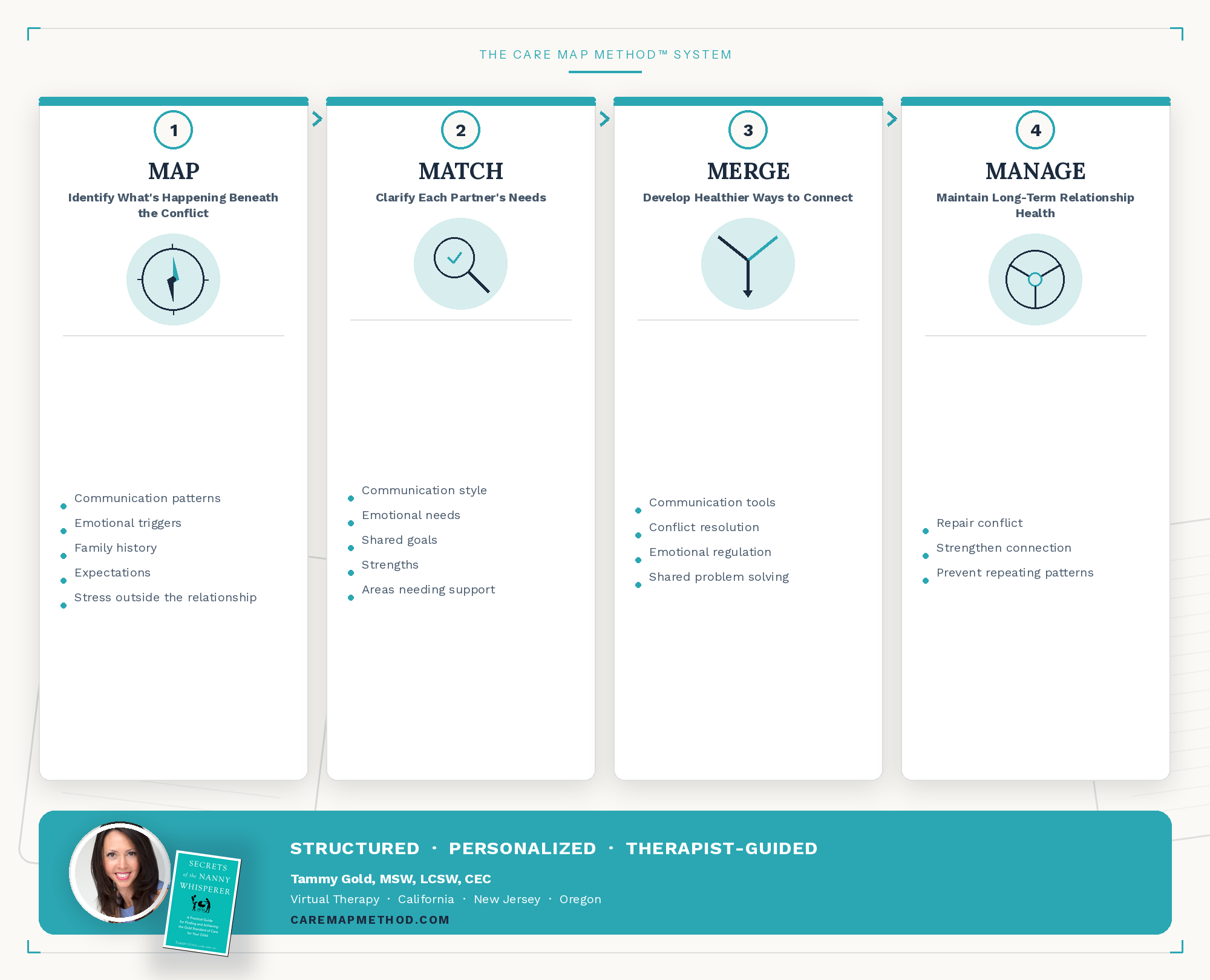
MAP → MATCH → MERGE → MANAGE
A structured, individualized framework for understanding the problem, selecting the right supports, integrating practical changes, and adjusting the plan over time.
Why small problems become recurring conflicts
Relationship conflict becomes chronic when the couple keeps trying to solve the visible disagreement without understanding the system that produces it. A partner who asks for more help may not only be requesting a completed task; they may be asking to feel less alone. A partner who becomes defensive may hear the request as proof that nothing they do is good enough.
Once this cycle is established, both people begin reacting to the pattern rather than the present moment. Tone becomes more important than content. Neutral comments are interpreted through accumulated hurt. Repair attempts are missed because each person is protecting against the next disappointment.
Signs that communication has become a system problem
You do not need to be in constant crisis to benefit from relationship therapy. Persistent patterns deserve attention, particularly when you notice several of the following:
The same argument returns without meaningful resolution
One person pursues while the other shuts down or leaves
Conversations quickly become criticism, defensiveness, contempt, or blame
Practical responsibilities feel chronically unequal
Affection and friendship have been replaced by logistics
You avoid important topics because conflict feels inevitable
External pressures such as parenting, caregiving, work, or finances dominate the relationship
One or both partners feel lonely while still together
The Care Map Method™: from argument to actionable understanding
In Care Map Method™ therapy, the goal is not simply to decide who is right. We organize the situation so that the couple can see what is happening, what each person needs, and which changes are realistic. The framework is structured but individualized.
MAP: identify what is driving the pattern
The MAP stage examines the whole relationship through biological, emotional, social, and environmental factors. Biological factors may include sleep deprivation, menopause, chronic illness, medication effects, or nervous-system activation. Emotional factors include fear, resentment, grief, shame, and unmet attachment needs. Social factors include family-of-origin patterns, parenting roles, friendships, and cultural expectations. Environmental factors include work schedules, finances, housing, technology, and the distribution of household labor.
This broader map often reduces blame. A couple may discover that a “communication problem” is being intensified by untreated exhaustion, unclear roles, or a transition they never consciously discussed.
MATCH: identify what each person and the relationship need
After the pattern is clear, therapy helps match the problem with the right supports and skills. One couple may need a reliable process for difficult conversations. Another may need stronger boundaries with extended family. Another may need to rebalance labor, rebuild trust after secrecy, or learn how to regulate before attempting resolution.
The match is specific. Generic advice is less useful than identifying the exact intervention that fits the couple’s needs, strengths, history, and current capacity.
MERGE: turn insight into new relationship practices
Insight matters only when it can be brought into daily life. During MERGE, the couple practices concrete changes: how to begin a conversation without accusation, how to request help clearly, how to pause without abandoning the discussion, and how to create agreements that are measurable rather than vague.
This may include a weekly planning conversation, a division-of-labor agreement, conflict-repair language, technology boundaries, or a plan for handling recurring family stress. The purpose is not to make the relationship mechanical. It is to create enough structure that connection is not repeatedly sacrificed to chaos.
MANAGE: maintain progress when life becomes stressful again
Every relationship encounters new stress. The MANAGE stage focuses on recognizing early warning signs, reviewing agreements, and adjusting the plan before old patterns fully return. Couples learn to ask: What has changed? Which support is no longer working? What needs to be renegotiated?
This turns therapy into a transferable process rather than a temporary improvement that depends on everything remaining calm.
What solution-focused relationship therapy can produce
Therapy cannot guarantee that every relationship will continue, and it should not pressure anyone to remain in an unsafe situation. It can, however, help people understand their patterns, communicate more accurately, make decisions with greater clarity, and develop practical tools for the relationship they are trying to build.
For many couples and family members, the most meaningful change is moving from “We keep having the same fight” to “We understand the cycle, know what each of us needs, and have a plan for what to do next.”
When to seek support
Consider reaching out when conflict is repetitive, emotional distance is increasing, major transitions are exposing unresolved differences, or attempts to solve the problem independently keep producing the same outcome. Early support is often more effective than waiting until resentment has hardened into hopelessness.
Ready to talk?
If this issue is affecting your emotional health, relationships, work, or daily functioning, support is available. Tammy Gold provides virtual therapy for adults in California, New Jersey, and Oregon. Schedule through Tammy Gold’s Psychology Today profile
About Tammy Gold
Tammy Gold, MSW, LCSW, CEC, is the founder of Care Map Method™, a licensed clinical social worker in California, New Jersey, and Oregon, a certified coach, and the author of Secrets of the Nanny Whisperer. She helps adults and families navigate relationships, caregiving, burnout, parenting, work stress, and major life transitions through a structured, practical, relationship-centered approach.
Educational notice: This article is for general educational purposes and is not a substitute for individualized medical, legal, or mental health care. If you are experiencing an emergency or immediate safety concern, contact local emergency services or an appropriate crisis resource.
Why do couples keep having the same argument?
Repeated arguments are often maintained by deeper emotional triggers, unmet needs, defensive reactions, assumptions, and communication patterns rather than the surface topic alone.
Can couples therapy help communication?
Yes. Couples therapy can help partners slow down conflict, identify the pattern, hear each other more accurately, communicate needs more clearly, and practice repair.
What if my partner will not attend?
Individual therapy can still help you understand the relationship pattern, regulate your reactions, communicate differently, clarify boundaries, and make more thoughtful decisions.
Is couples therapy only for relationships in crisis?
No. Couples may seek therapy for recurring conflict, disconnection, parenting stress, intimacy concerns, life transitions, premarital preparation, or to strengthen a relationship before problems escalate.
Will the therapist take sides?
The goal is not to declare one partner right and the other wrong. The work focuses on understanding the relationship system, helping both people feel heard, and identifying healthier patterns.
Can therapy help couples affected by parenting stress?
Yes. Parenting can create exhaustion, resentment, role imbalance, disagreement about discipline, and reduced time for connection. Therapy can help couples rebuild teamwork and communication.
What does Map, Match, Merge, and Manage look like for couples?
MAP identifies the conflict cycle. MATCH clarifies each partner’s needs and goals. MERGE builds healthier communication and repair. MANAGE creates tools and agreements that can be used between sessions.
How long does couples therapy take?
The length varies based on the concerns, goals, severity of conflict, participation, and whether there are complicating factors. Some couples seek focused short-term work, while others benefit from longer support.