
Couples Counseling with Insurance for Parents Who Keep Having the Same Fight
Couples Counseling with Insurance for Parents Who Keep Having the Same Fight
Many couples do not come to therapy because they stopped caring. They come because they keep having the same fight and cannot figure out how to stop the cycle. For parents, the fight may be about children, chores, money, schedules, emotional labor, in-laws, co-parenting, intimacy, work stress or feeling unsupported.
I am Tammy Gold, LCSW. I support adults, couples and parents in California, New Jersey and Oregon. Depending on your plan and eligibility, insurance may be available through Headway or Alma.
My Psychology Today profile links to booking and insurance options through Headway.
Why repeated fights happen
Repeated fights often happen because the surface topic is not the only issue. Underneath the argument may be fear, loneliness, resentment, exhaustion, feeling unseen, feeling criticized, or not knowing how to ask for support without sounding angry.
Therapy helps slow the pattern down so each person can feel heard without shame or blame.
How I help couples and parents
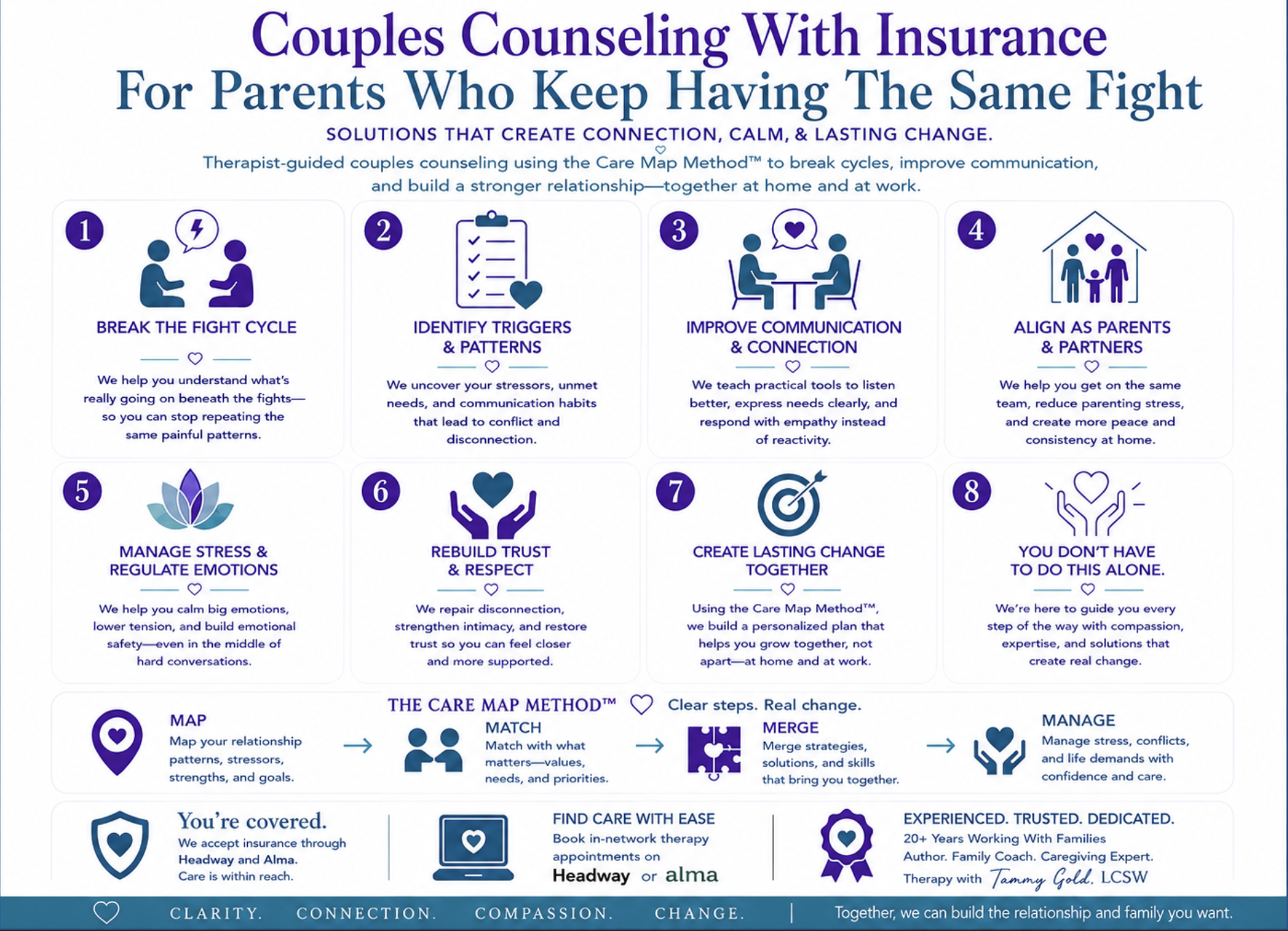
Through the Care Map Method™, we Map the repeated fight cycle, Match each partner’s needs and triggers, Merge safer communication and Manage repair tools for real life. The goal is to help both partners understand what is happening underneath the conflict and build better ways to respond.
Sessions are designed to be respectful and compassionate. I work to help each person feel heard while keeping the focus on understanding, communication and small positive solutions.
Request a session
If you are looking for therapy for relationship stress, parenting stress, communication problems, divorce concerns or family conflict, visit my Psychology Today profile to request a session. My profile links to booking and insurance options through Headway.
Why do couples keep having the same argument?
Repeated arguments are often maintained by deeper emotional triggers, unmet needs, defensive reactions, assumptions, and communication patterns rather than the surface topic alone.
Can couples therapy help communication?
Yes. Couples therapy can help partners slow down conflict, identify the pattern, hear each other more accurately, communicate needs more clearly, and practice repair.
What if my partner will not attend?
Individual therapy can still help you understand the relationship pattern, regulate your reactions, communicate differently, clarify boundaries, and make more thoughtful decisions.
Is couples therapy only for relationships in crisis?
No. Couples may seek therapy for recurring conflict, disconnection, parenting stress, intimacy concerns, life transitions, premarital preparation, or to strengthen a relationship before problems escalate.
Will the therapist take sides?
The goal is not to declare one partner right and the other wrong. The work focuses on understanding the relationship system, helping both people feel heard, and identifying healthier patterns.
Can therapy help couples affected by parenting stress?
Yes. Parenting can create exhaustion, resentment, role imbalance, disagreement about discipline, and reduced time for connection. Therapy can help couples rebuild teamwork and communication.
What does Map, Match, Merge, and Manage look like for couples?
MAP identifies the conflict cycle. MATCH clarifies each partner’s needs and goals. MERGE builds healthier communication and repair. MANAGE creates tools and agreements that can be used between sessions.
How long does couples therapy take?
The length varies based on the concerns, goals, severity of conflict, participation, and whether there are complicating factors. Some couples seek focused short-term work, while others benefit from longer support.