

Horizon BCBS Therapy in New Jersey for Sibling Conflict and Family Caregiving
Online therapy in New Jersey for sibling conflict, caregiver burden, aging-parent decisions, boundaries, and family communication. Verify Horizon benefits.
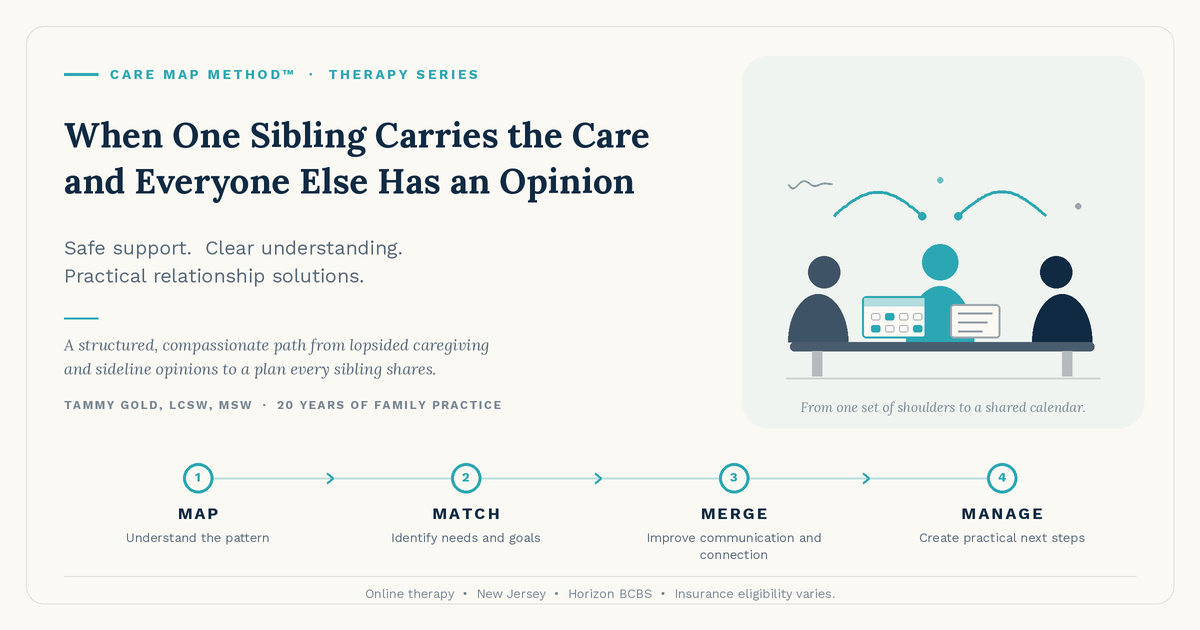
Horizon BCBS therapy in New Jersey for sibling conflict, caregiver burden, aging-parent decisions, and family communication.
Horizon BCBS Therapy in New Jersey for Sibling Conflict and Family Caregiving
Family caregiving can create a painful imbalance. One sibling may handle appointments, calls, emergencies, and daily care while others participate less or criticize decisions from a distance. Old family roles quickly return, and conversations about the parent become arguments about fairness, loyalty, money, and who has always done more.
You do not have to carry this alone. My goal is to provide a warm, confidential, and nonjudgmental space where you can unpack what is happening without shame, blame, or pressure. Therapy can offer emotional support and practical direction at the same time.
Therapy offers a neutral place to identify both the practical imbalance and the emotional history underneath it. We clarify what the parent needs, what each sibling can realistically contribute, and what boundaries are necessary. The work focuses on reducing blame and creating a plan that is more sustainable.
ONLINE THERAPY IN NEW JERSEY
Insurance may be available through Headway depending on your plan, eligibility, state, and session type. Verify benefits before booking.
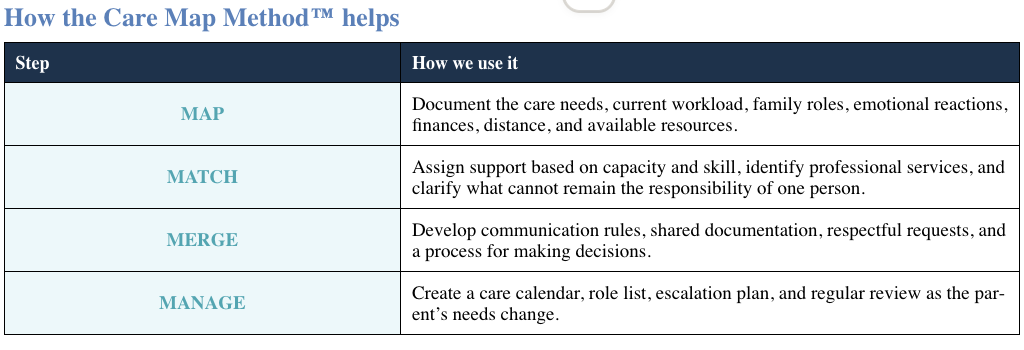
How the Care Map Method™ helps
MAP
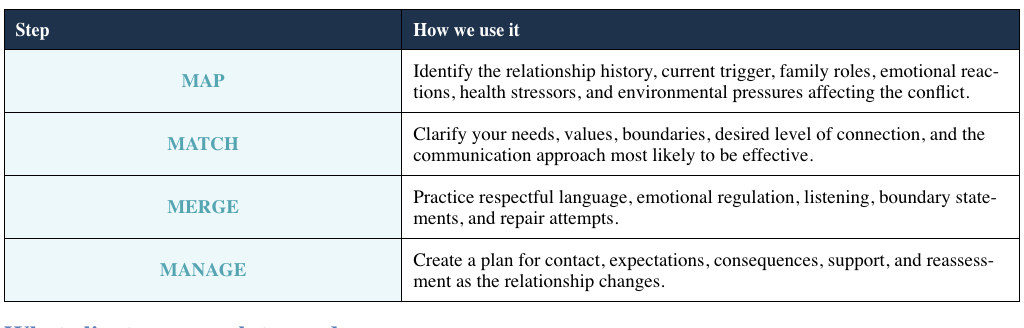
Document the care needs, current workload, family roles, emotional reactions, finances, distance, and available resources.
MATCH
Assign support based on capacity and skill, identify professional services, and clarify what cannot remain the responsibility of one person.
MERGE
Develop communication rules, shared documentation, respectful requests, and a process for making decisions.
MANAGE
Create a care calendar, role list, escalation plan, and regular review as the parent’s needs change.
What clients can work toward
· Make invisible caregiving work visible
· Reduce resentment and guilt
· Create clearer sibling responsibilities
· Protect the caregiver’s health and limits
Therapy is not only a place to talk about what went wrong. It is a place to feel heard, understand the pattern, practice healthier responses, and build a plan that can be used in daily life. Progress depends on the circumstances and cannot be guaranteed, but the work can become clearer, more intentional, and more supported.
Frequently asked questions
Can family therapy help when siblings live in different states?
Online sessions may allow family members to participate when legal, clinical, and licensing requirements are met. Individual therapy is also useful when joint work is not possible.
Does Horizon BCBS cover family caregiving therapy?
Coverage depends on the plan, clinical need, session type, and current network rules. Verify benefits before scheduling.
What if my siblings refuse to help?
Therapy can help you communicate clearly, stop overfunctioning, set limits, pursue outside resources, and decide what you can safely continue.
How do we include the aging parent in decisions?
The parent’s preferences and autonomy should be included whenever possible, while safety, capacity, medical advice, and legal considerations may affect the process.
Can therapy help with caregiver guilt?
Yes. Therapy can separate love from unlimited responsibility and help caregivers create boundaries that are compassionate and sustainable.
What practical tools might we use?
A family capacity assessment, care calendar, communication plan, provider question list, and written role agreement can make the situation more manageable
You deserve one place where you can be honest without worrying about judgment, shame, or blame. Together, we can understand what is happening, identify what needs to change, and create practical steps toward a healthier relationship and a more manageable life.
Book A Session Today & Get The Support You Deserve!
For clients using insurance, I use the platforms below:
Alma Therapy https://secure.helloalma.com/providers/tamara-gold/

Aetna Therapy in New Jersey for Failure to Launch and Conflict With an Adult Child
Online therapy in New Jersey for failure to launch, adult-child conflict, boundaries, financial dependence, and family stress. Verify Aetna benefits through Headway.
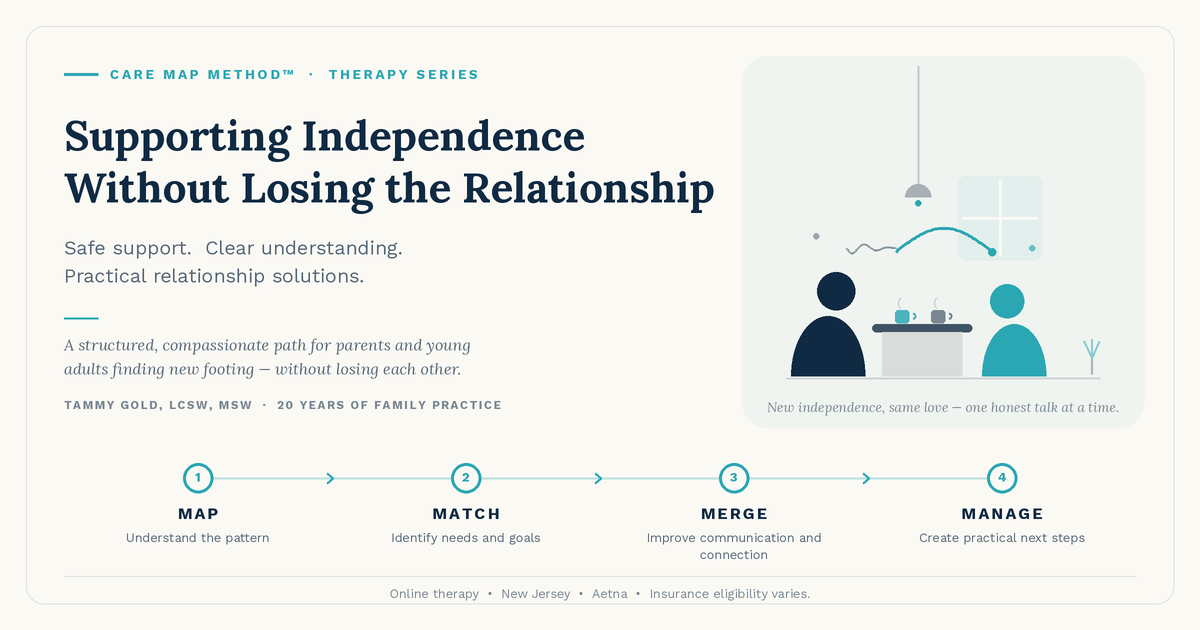
Aetna therapy in New Jersey for failure to launch, adult-child conflict, boundaries, and building independence with the Care Map Method.
Aetna Therapy in New Jersey for Failure to Launch and Conflict With an Adult Child
Parents may feel frightened, guilty, angry, or exhausted when an adult child is not progressing toward work, education, financial responsibility, or independent living. The adult child may feel ashamed, criticized, anxious, misunderstood, or unsure where to begin. Repeated pressure and rescue can create a cycle in which everyone feels stuck.
You do not have to carry this alone. My goal is to provide a warm, confidential, and nonjudgmental space where you can unpack what is happening without shame, blame, or pressure. Therapy can offer emotional support and practical direction at the same time.
Therapy helps the family move beyond labels and examine the full picture. We distinguish skill gaps, emotional barriers, health concerns, family patterns, and environmental realities. Parents can learn to support growth without overfunctioning, while adult children can clarify goals, responsibilities, and achievable steps.
ONLINE THERAPY IN NEW JERSEY
Insurance may be available through Headway depending on your plan, eligibility, state, and session type. Verify benefits before booking.
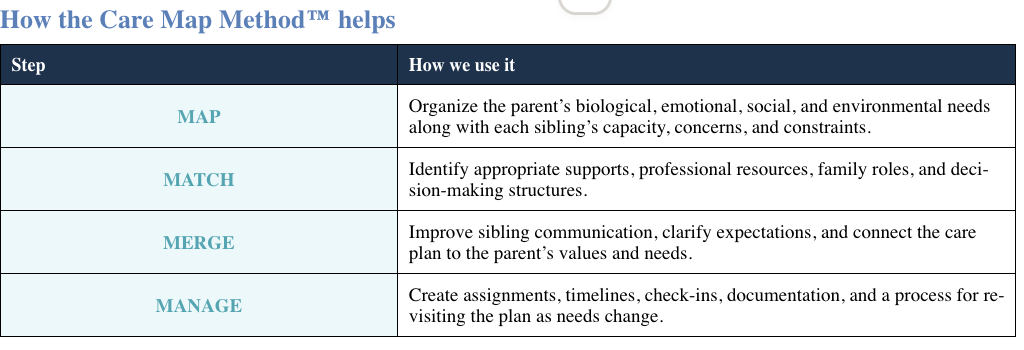
How the Care Map Method™ helps
MAP
Assess functioning, mental and physical health, daily routines, responsibilities, motivation, family dynamics, and environmental barriers.
MATCH
Identify appropriate expectations, supports, treatment referrals, skills, incentives, and consequences.
MERGE
Create respectful communication and align support with responsibility rather than rescue or repeated criticism.
MANAGE
Build written goals, timelines, household agreements, progress reviews, and a plan for adjusting support.
What clients can work toward
· Reduce recurring parent-adult child conflict
· Create clearer expectations and boundaries
· Support independence without abandonment
· Replace vague pressure with measurable next steps
Therapy is not only a place to talk about what went wrong. It is a place to feel heard, understand the pattern, practice healthier responses, and build a plan that can be used in daily life. Progress depends on the circumstances and cannot be guaranteed, but the work can become clearer, more intentional, and more supported.
Frequently asked questions
What does failure to launch mean?
It commonly describes difficulty progressing toward education, work, financial responsibility, household contribution, or independent living. It is a description, not a diagnosis.
Does Aetna cover online therapy in New Jersey?
Coverage varies by plan, eligibility, and network participation. Confirm benefits through Headway before booking.
Can parents attend without the adult child?
Yes. Parents can work on boundaries, communication, expectations, guilt, fear, and how they respond to dependence.
Should we stop financial support?
There is no universal answer. Support should be evaluated in relation to health, functioning, effort, family capacity, and whether it promotes growth or maintains dependence.
What if anxiety, depression, ADHD, or substance use is involved?
Those concerns may require specialized assessment or treatment. Therapy can help identify the need for additional providers and coordinate family expectations appropriately.
How do we set a deadline without destroying the relationship?
A deadline works best when it is realistic, specific, connected to clear steps, and communicated respectfully with predictable follow-through.
Book A Session Today & Get The Support You Deserve!
For clients using insurance, I use the platforms below:
Alma Therapy https://secure.helloalma.com/providers/tamara-gold/

Horizon BCBS Therapy in New Jersey for Sibling Conflict and Family Caregiving
Online therapy in New Jersey for sibling conflict, caregiver burden, aging-parent decisions, boundaries, and family communication. Verify Horizon benefits.
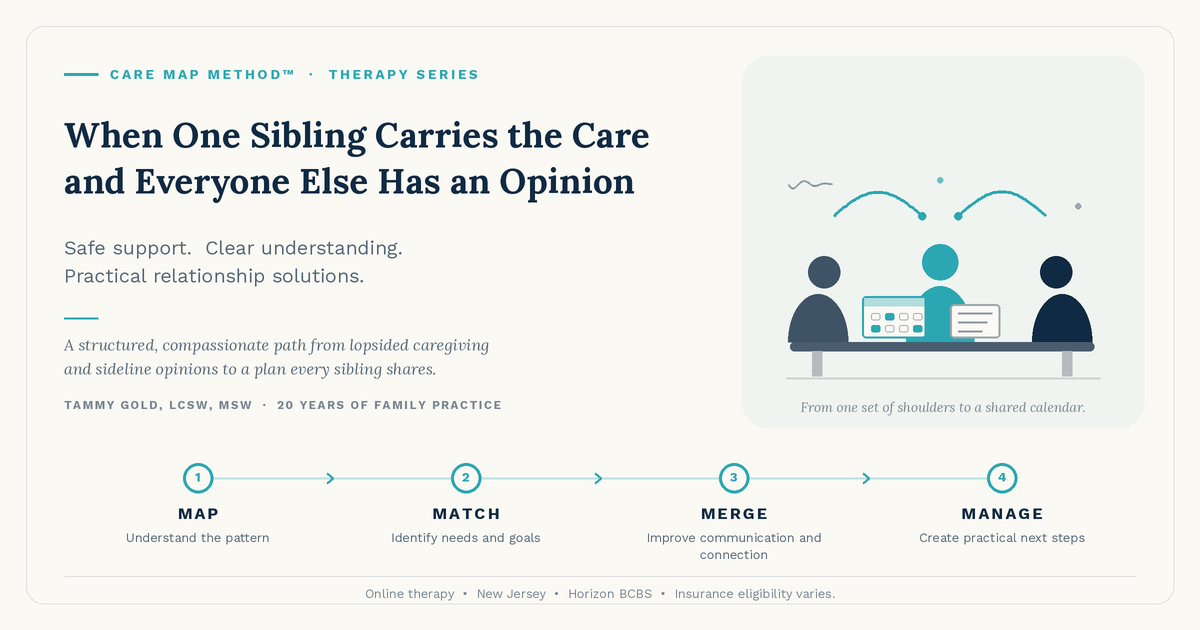
Horizon BCBS therapy in New Jersey for sibling conflict, caregiver burden, aging-parent decisions, and family communication.
Horizon BCBS Therapy in New Jersey for Sibling Conflict and Family Caregiving
Family caregiving can create a painful imbalance. One sibling may handle appointments, calls, emergencies, and daily care while others participate less or criticize decisions from a distance. Old family roles quickly return, and conversations about the parent become arguments about fairness, loyalty, money, and who has always done more.
You do not have to carry this alone. My goal is to provide a warm, confidential, and nonjudgmental space where you can unpack what is happening without shame, blame, or pressure. Therapy can offer emotional support and practical direction at the same time.
Therapy offers a neutral place to identify both the practical imbalance and the emotional history underneath it. We clarify what the parent needs, what each sibling can realistically contribute, and what boundaries are necessary. The work focuses on reducing blame and creating a plan that is more sustainable.
ONLINE THERAPY IN NEW JERSEY
Insurance may be available through Headway depending on your plan, eligibility, state, and session type. Verify benefits before booking.
What clients can work toward
Make invisible caregiving work visible
Reduce resentment and guilt
Create clearer sibling responsibilities
Protect the caregiver’s health and limits
Therapy is not only a place to talk about what went wrong. It is a place to feel heard, understand the pattern, practice healthier responses, and build a plan that can be used in daily life. Progress depends on the circumstances and cannot be guaranteed, but the work can become clearer, more intentional, and more supported.
Frequently asked questions
Can family therapy help when siblings live in different states?
Online sessions may allow family members to participate when legal, clinical, and licensing requirements are met. Individual therapy is also useful when joint work is not possible.
Does Horizon BCBS cover family caregiving therapy?
Coverage depends on the plan, clinical need, session type, and current network rules. Verify benefits before scheduling.
What if my siblings refuse to help?
Therapy can help you communicate clearly, stop overfunctioning, set limits, pursue outside resources, and decide what you can safely continue.
How do we include the aging parent in decisions?
The parent’s preferences and autonomy should be included whenever possible, while safety, capacity, medical advice, and legal considerations may affect the process.
Can therapy help with caregiver guilt?
Yes. Therapy can separate love from unlimited responsibility and help caregivers create boundaries that are compassionate and sustainable.
What practical tools might we use?
A family capacity assessment, care calendar, communication plan, provider question list, and written role agreement can make the situation more manageable.
Final booking call to action
You deserve one place where you can be honest without worrying about judgment, shame, or blame. Together, we can understand what is happening, identify what needs to change, and create practical steps toward a healthier relationship and a more manageable life.
Book A Session Today & Get The Support You Deserve!
For clients using insurance, I use the platforms below:
Alma Therapy https://secure.helloalma.com/providers/tamara-gold/

Aetna Therapy in New Jersey for Failure to Launch and Conflict With an Adult Child
Online therapy in New Jersey for failure to launch, adult-child conflict, boundaries, financial dependence, and family stress. Verify Aetna benefits through Headway
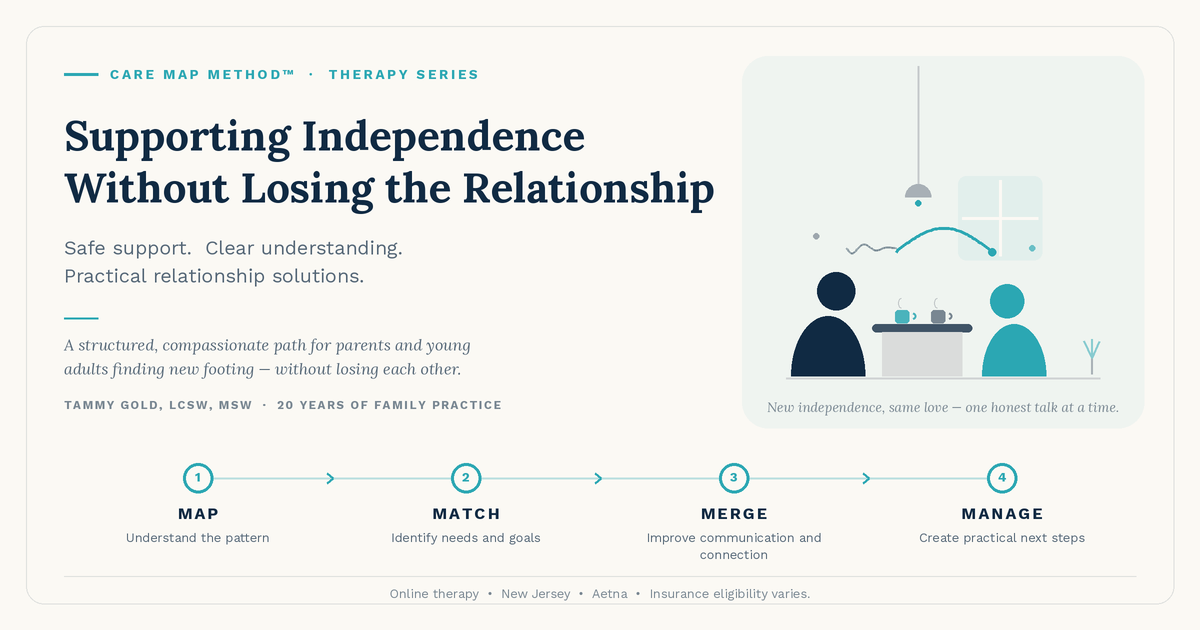
Aetna therapy in New Jersey for failure to launch, adult-child conflict, boundaries, and building independence with the Care Map Method.
Aetna Therapy in New Jersey for Failure to Launch and Conflict With an Adult Child
Parents may feel frightened, guilty, angry, or exhausted when an adult child is not progressing toward work, education, financial responsibility, or independent living. The adult child may feel ashamed, criticized, anxious, misunderstood, or unsure where to begin. Repeated pressure and rescue can create a cycle in which everyone feels stuck.
You do not have to carry this alone. My goal is to provide a warm, confidential, and nonjudgmental space where you can unpack what is happening without shame, blame, or pressure. Therapy can offer emotional support and practical direction at the same time.
Therapy helps the family move beyond labels and examine the full picture. We distinguish skill gaps, emotional barriers, health concerns, family patterns, and environmental realities. Parents can learn to support growth without overfunctioning, while adult children can clarify goals, responsibilities, and achievable steps.
ONLINE THERAPY IN NEW JERSEY
Insurance may be available through Headway depending on your plan, eligibility, state, and session type. Verify benefits before booking.
What clients can work toward
Reduce recurring parent-adult child conflict
Create clearer expectations and boundaries
Support independence without abandonment
Replace vague pressure with measurable next steps
Therapy is not only a place to talk about what went wrong. It is a place to feel heard, understand the pattern, practice healthier responses, and build a plan that can be used in daily life. Progress depends on the circumstances and cannot be guaranteed, but the work can become clearer, more intentional, and more supported.
Frequently asked questions
What does failure to launch mean?
It commonly describes difficulty progressing toward education, work, financial responsibility, household contribution, or independent living. It is a description, not a diagnosis.
Does Aetna cover online therapy in New Jersey?
Coverage varies by plan, eligibility, and network participation. Confirm benefits through Headway before booking.
Can parents attend without the adult child?
Yes. Parents can work on boundaries, communication, expectations, guilt, fear, and how they respond to dependence.
Should we stop financial support?
There is no universal answer. Support should be evaluated in relation to health, functioning, effort, family capacity, and whether it promotes growth or maintains dependence.
What if anxiety, depression, ADHD, or substance use is involved?
Those concerns may require specialized assessment or treatment. Therapy can help identify the need for additional providers and coordinate family expectations appropriately.
How do we set a deadline without destroying the relationship?
A deadline works best when it is realistic, specific, connected to clear steps, and communicated respectfully with predictable follow-through.
Final booking call to action
You deserve one place where you can be honest without worrying about judgment, shame, or blame. Together, we can understand what is happening, identify what needs to change, and create practical steps toward a healthier relationship and a more manageable life.
Verify your insurance and request an online therapy appointment through my Psychology Today / Headway booking path.
Book A Session Today & Get The Support You Deserve!
For clients using insurance, I use the platforms below:
Alma Therapy https://secure.helloalma.com/providers/tamara-gold/

Providence Therapy in California for Sibling Conflict Over an Aging Parent
Online therapy in California for siblings arguing about an aging parent, caregiver burden, eldercare decisions, and family communication. Verify Providence benefits.
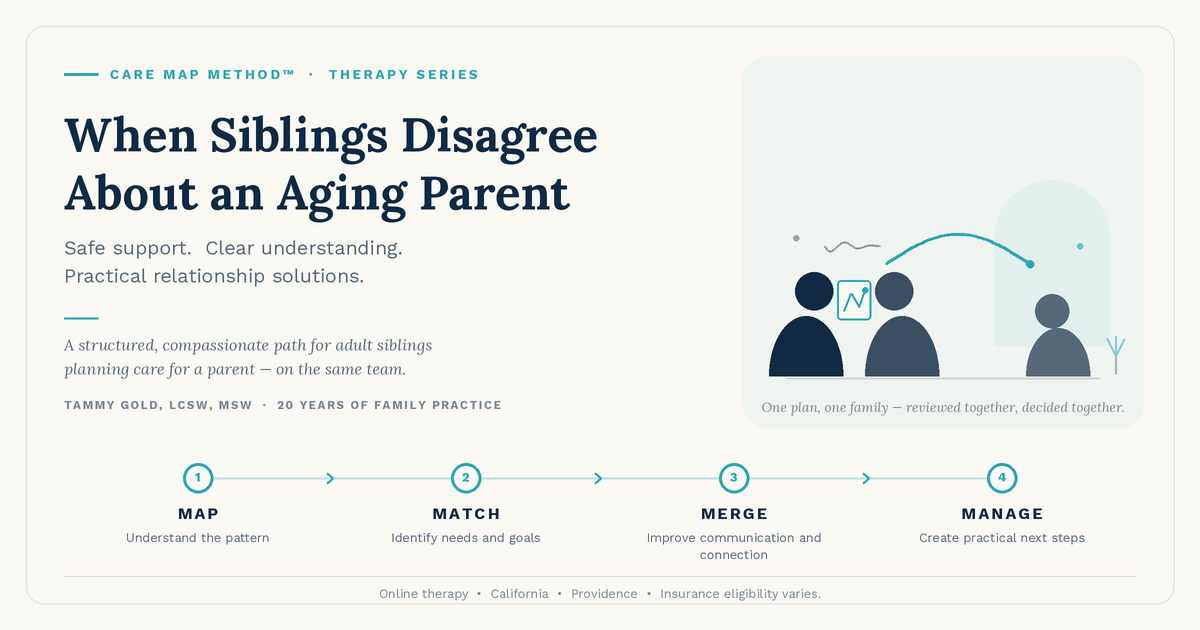
Providence therapy in California for sibling conflict, aging-parent care decisions, caregiver stress, and family communication.
Providence Therapy in California for Sibling Conflict Over an Aging Parent
A parent’s decline can reopen old sibling roles and create urgent disagreements about safety, money, housing, medical care, driving, and who should do what. One sibling may feel abandoned with the work. Another may feel criticized or excluded. Everyone may believe they are protecting the parent, yet the family becomes less able to make decisions together.
You do not have to carry this alone. My goal is to provide a warm, confidential, and nonjudgmental space where you can unpack what is happening without shame, blame, or pressure. Therapy can offer emotional support and practical direction at the same time.
Therapy creates a structured space to separate the care problem from the sibling history. We identify facts, fears, capacities, and practical limits. Each person’s concern can be heard while the family develops clearer communication, roles, and next steps. The goal is not perfect agreement; it is a safer, more workable process.
ONLINE THERAPY IN CALIFORNIA
Insurance may be available through Headway depending on your plan, eligibility, state, and session type. Verify benefits before booking.
What clients can work toward
Reduce blame among siblings
Clarify realistic roles and responsibilities
Make decisions from the full care picture
Protect the parent and the sibling relationships
Therapy is not only a place to talk about what went wrong. It is a place to feel heard, understand the pattern, practice healthier responses, and build a plan that can be used in daily life. Progress depends on the circumstances and cannot be guaranteed, but the work can become clearer, more intentional, and more supported.
Frequently asked questions
Can therapy help siblings agree about eldercare?
Therapy may not produce complete agreement, but it can improve communication, clarify facts and capacities, reduce blame, and create a more workable decision process.
Does Providence cover this type of therapy?
Benefits vary by plan, clinical eligibility, state, and platform. Verify current coverage before scheduling.
Can I attend without my siblings?
Yes. Individual therapy can help you manage caregiver stress, set limits, prepare conversations, and decide what you can realistically provide.
How do we divide caregiving fairly?
Fair does not always mean equal. Roles should reflect time, distance, finances, skills, health, and willingness. A structured care map can make those differences visible.
What if a parent refuses help?
Therapy can help the family assess risk, respect autonomy where possible, communicate concerns, and decide what actions are appropriate within legal and ethical limits.
When is specialized eldercare guidance needed?
Professional medical, legal, financial, or care-management expertise may be needed for capacity, safety, placement, benefits, or complex medical decisions.
Final booking call to action
You deserve one place where you can be honest without worrying about judgment, shame, or blame. Together, we can understand what is happening, identify what needs to change, and create practical steps toward a healthier relationship and a more manageable life.
Verify your insurance and request an online therapy appointment through my Psychology Today / Headway booking path.
Book A Session Today & Get The Support You Deserve!
For clients using insurance, I use the platforms below:
Alma Therapy https://secure.helloalma.com/providers/tamara-gold/
Providence therapy in California for sibling conflict, aging-parent care decisions, caregiver stress, and family

Anthem Therapy in California for Parenting Stress That Is Hurting Your Relationship
Online therapy in California for parenting stress, marriage conflict, emotional overload, and communication problems. Verify Anthem benefits through Headway.

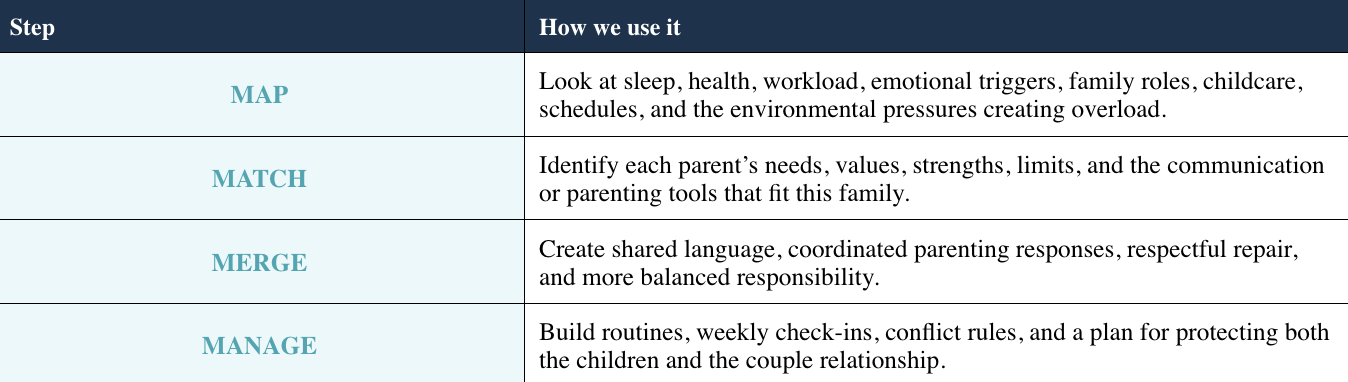
Anthem therapy in California for parenting stress, marriage conflict, mental load, and communication using the Care Map Method.
Anthem Therapy in California for Parenting Stress That Is Hurting Your Relationship
Parenting stress can quietly become relationship stress. Couples may argue about discipline, sleep, schedules, money, screens, school, household labor, or who carries the mental load. Both people may feel unappreciated, exhausted, and convinced that the other does not understand how much they are doing.
You do not have to carry this alone. My goal is to provide a warm, confidential, and nonjudgmental space where you can unpack what is happening without shame, blame, or pressure. Therapy can offer emotional support and practical direction at the same time.
Therapy helps separate the parenting problem from the relationship injury underneath it. We make room for exhaustion, resentment, fear, and disappointment without turning the session into a blame exchange. We then translate those feelings into clearer requests, shared priorities, and realistic agreements for the family.
ONLINE THERAPY IN CALIFORNIA
Insurance may be available through Headway depending on your plan, eligibility, state, and session type. Verify benefits before booking.
Anthem therapy in California for parenting stress, marriage conflict, mental load, and communication using the Care Map Method.
What clients can work toward
Reduce resentment and emotional overload
Improve parenting teamwork
Communicate before stress becomes conflict
Protect connection while raising children
Therapy is not only a place to talk about what went wrong. It is a place to feel heard, understand the pattern, practice healthier responses, and build a plan that can be used in daily life. Progress depends on the circumstances and cannot be guaranteed, but the work can become clearer, more intentional, and more supported.
Frequently asked questions
Can parenting stress damage a marriage?
Yes. Chronic fatigue, unequal responsibility, financial pressure, reduced couple time, and disagreements about parenting can create resentment and disconnection.
Does Anthem cover online therapy in California?
Coverage varies by plan, eligibility, location, and platform participation. Verify benefits through the current Headway booking process before scheduling.
Can therapy help if we disagree about discipline?
Yes. Therapy can clarify shared values, identify why each approach feels important, and help parents develop more consistent and workable responses.
Can one parent come alone?
Yes. Individual therapy can help a parent regulate stress, communicate needs, change reactive patterns, and make more thoughtful family decisions.
Will we receive practical tools?
Yes. Sessions may include communication scripts, division-of-labor discussions, parenting plans, routines, repair strategies, and concrete next steps.
What if we are too busy for therapy?
Online scheduling may reduce travel demands. The goal is to make sessions useful and focused so the time invested improves daily family functioning.
Book A Session Today & Get The Support You Deserve!
For clients using insurance, I use the platforms below:
Alma Therapy https://secure.helloalma.com/providers/tamara-gold/

Therapy for Communication Problems With a Partner, Parent, Adult Child, Boss or Caregiver
Therapy for clients struggling to communicate with a partner, parent, adult child, sibling, boss, coworker, nanny, daycare provider, caregiver or senior care professional.
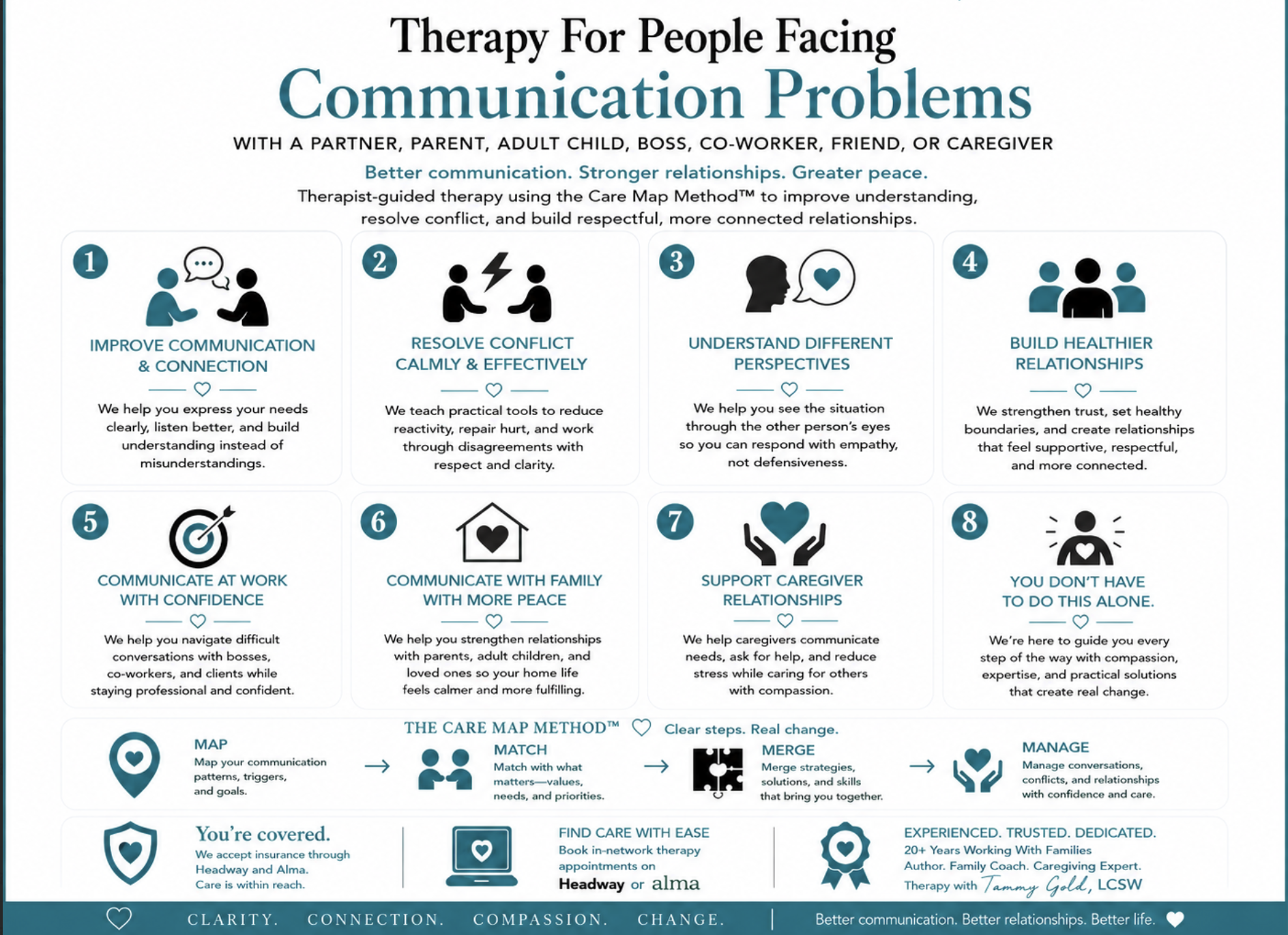
Therapy for Communication Problems With Important People in Your Life
Communication problems can happen in any important relationship: with a partner, child, adult child, parent, sibling, friend, boss, coworker, neighbor, co-parent, nanny, daycare provider, caregiver or senior care professional. When communication breaks down, people often feel misunderstood, defensive, resentful, anxious or emotionally exhausted.
I am Tammy Gold, LCSW. I offer online therapy for clients in California, New Jersey and Oregon. Depending on your plan and eligibility, insurance may be available through Headway or Alma.
My Psychology Today profile links to booking and insurance options through Headway.
When communication becomes stressful
You may know what you feel but not how to say it. You may worry that speaking honestly will create conflict. You may shut down, over-explain, apologize, become reactive or avoid the conversation altogether. Therapy can help you understand the pattern and find more effective words.
The goal is not to make you perfect. The goal is to help you communicate with more clarity, compassion and confidence.
How sessions help
Using the Care Map Method™, we Map what is causing the communication breakdown, Match the needs and triggers underneath it, Merge better language and listening, and Manage boundaries or next steps.
This approach is especially helpful for clients dealing with family conflict, parenting stress, divorce, co-parenting, work stress, caregiver management, childcare situations or eldercare decisions.
Request a session
If you are struggling with communication in an important relationship, visit my Psychology Today profile to request a session. My profile links to booking and insurance options through Headway.
What types of relationship concerns do you help with?
I help clients with couples and marriage concerns, communication problems, parenting stress, family conflict, divorce, co-parenting, adult children, sibling relationships, caregiver stress, workplace relationships, boundaries, and major life transitions.
What makes your approach to relationship therapy different?
My approach combines a warm, supportive, nonjudgmental therapeutic space with a structured process. We use the Care Map Method™ to understand what is driving the problem, identify needs and patterns, strengthen communication, and create practical next steps.
Will therapy be a safe and nonjudgmental space?
Yes. My goal is to provide one place where clients can speak honestly without shame, blame, criticism, or pressure. Clients can unpack feelings, understand patterns, and receive compassionate support and practical guidance.
Is therapy only for couples?
No. Individual therapy can help improve relationships with a spouse, partner, child, parent, sibling, adult child, friend, coworker, boss, caregiver, or other important person—even when that person does not attend therapy.
Do you provide couples counseling?
Yes. Couples work may address repeated arguments, communication problems, emotional disconnection, parenting disagreements, trust, boundaries, divorce decisions, and co-parenting. Insurance coverage for couples or family sessions varies by plan.
What happens during the first therapy session?
We discuss what is bringing you to therapy, what feels most important, what you want to change, and what has or has not helped before. We begin mapping the biological, emotional, social, and environmental factors affecting the situation and identify initial priorities.
Do you only listen, or will I receive practical tools?
Therapy includes emotional support and space to process feelings, but it is also solution-focused. Clients may receive communication tools, scripts, boundary language, reflection questions, relationship strategies, and practical next steps.
Do you offer online therapy?
Yes. Online therapy is available to clients physically located in California, New Jersey, or Oregon at the time of the session.
What insurance plans do you accept?
Insurance availability varies by state, plan, eligibility, and booking platform. Prospective clients should use the booking or insurance-verification link to confirm current coverage before scheduling.
How do I schedule therapy?
Use the Psychology Today or designated booking link on the page to view availability, confirm insurance eligibility, and request a therapy appointment.
Book A Session Today & Get The Support You Deserve!
For clients using insurance, I use the platforms below:
Alma Therapy https://secure.helloalma.com/providers/tamara-gold/

Therapy for Adult Children Caring for Aging Parents While Raising Their Own Family
Therapy for adult children in the sandwich generation who are raising children while caring for aging parents, managing siblings, caregiving decisions and family stress.
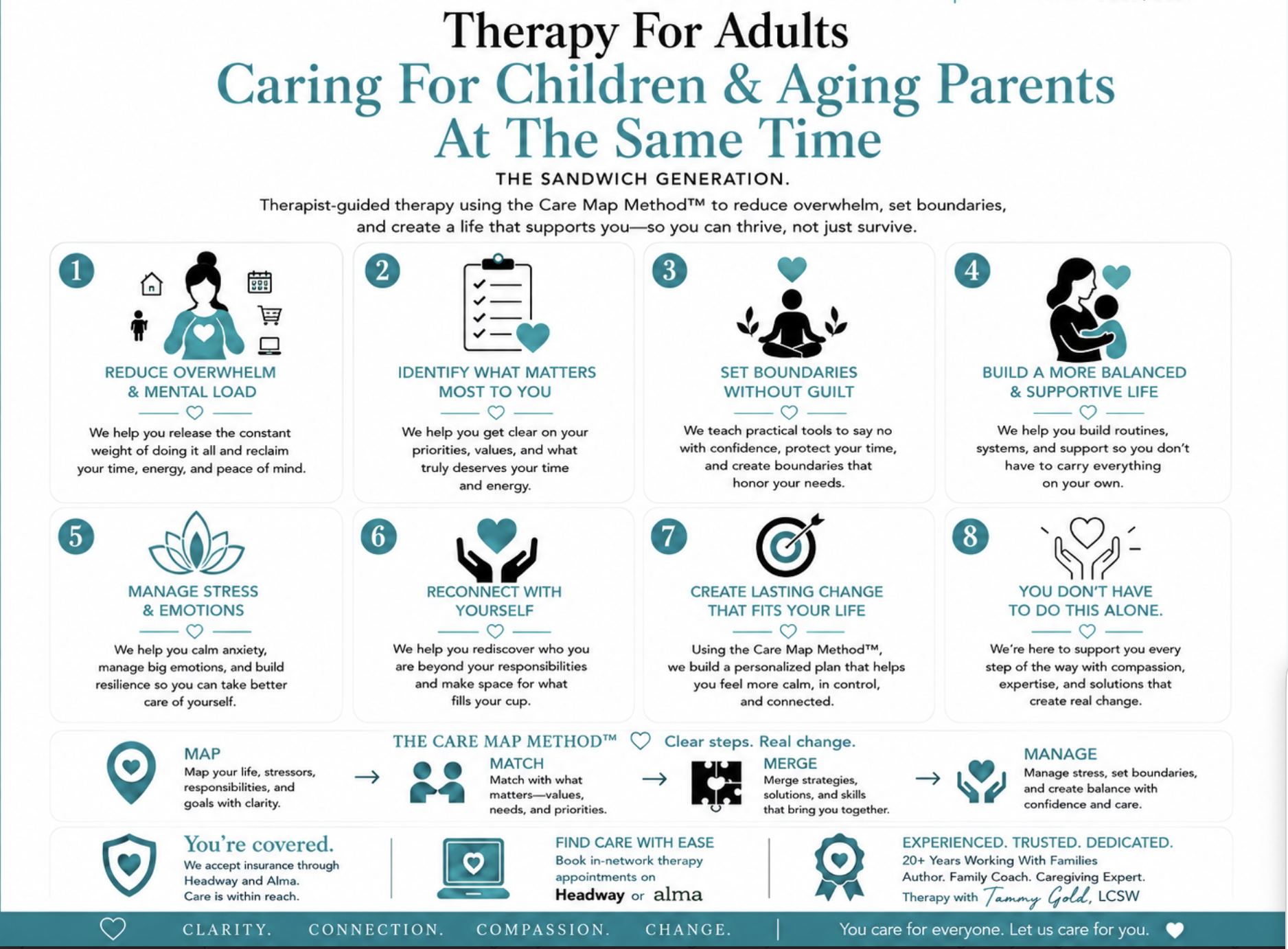
Therapy for Adult Children Caring for Aging Parents While Raising Their Own Family
Caring for aging parents while raising children can create intense emotional pressure. You may be managing your parent’s needs, sibling conflict, eldercare decisions, your own children, work, marriage, finances and the feeling that everyone needs you at once.
I am Tammy Gold, LCSW, a therapist, author and caregiving expert. I offer online therapy for clients in California, New Jersey and Oregon. Depending on your plan and eligibility, insurance may be available through Headway or Alma.
My Psychology Today profile links to booking and insurance options through Headway.
The emotional weight of caregiving
Many adult children feel guilt, resentment, grief, fear, exhaustion and confusion. You may be trying to make good decisions for an aging parent while also feeling pressure from siblings, caregivers, facilities, medical providers or extended family.
Therapy gives you one safe place to talk openly about what you are carrying without being judged.
How the Care Map Method™ helps
Through the Care Map Method™, we Map your parent’s needs and your needs, Match the right supports, Merge communication among family members and care providers, and Manage the plan so it feels more sustainable.
This work combines emotional support with practical problem-solving. The goal is to help you feel less alone, communicate more clearly, set boundaries and make decisions with more steadiness.
Request a session
If you are caring for an aging parent while managing children, work, siblings, marriage or family conflict, visit my Psychology Today profile to request a session. My profile links to booking and insurance options through Headway.
What are common signs of caregiver burnout?
Signs may include exhaustion, irritability, resentment, guilt, sleep problems, reduced concentration, withdrawal, health changes, hopelessness, and feeling unable to keep up with care demands.
How can therapy help caregiver burnout?
Therapy can help caregivers process emotions, identify unsustainable demands, set boundaries, communicate with family, ask for help, and develop a more realistic care plan.
Is it normal to feel resentful while caregiving?
Yes. Resentment can develop when responsibilities are excessive, support is limited, boundaries are unclear, or the caregiver’s own needs are repeatedly postponed. Feeling resentment does not mean you do not love the person.
What if my siblings will not help?
Therapy or coaching can help you clarify what you need, prepare a family conversation, define responsibilities, set limits, and decide what you can realistically continue providing.
How do I know when more professional care is needed?
Consider changes in safety, cognition, mobility, medication, nutrition, hygiene, isolation, wandering, falls, caregiver capacity, and whether current arrangements are sustainable.
Can I care for someone without losing myself?
That is a central goal. Sustainable caregiving requires support, boundaries, realistic expectations, shared responsibility where possible, and attention to the caregiver’s health and identity.
What Care Map worksheet pairs with caregiver burnout?
A Caregiver Burnout Snapshot, Family Capacity Assessment, Weekly Care Plan, Boundary Planner, or Biological-Emotional-Social-Environmental Care Map can help organize the situation.
When is caregiver burnout an emergency?
Seek urgent professional help when there is immediate danger, inability to provide safe care, abuse or neglect concerns, severe medical or psychiatric symptoms, or thoughts of harming yourself or someone else.
Book A Session Today & Get The Support You Deserve!
For clients using insurance, I use the platforms below:
Alma Therapy https://secure.helloalma.com/providers/tamara-gold/

Toddler Parenting Support: Create a Personalized Care Map for Your Growing Child
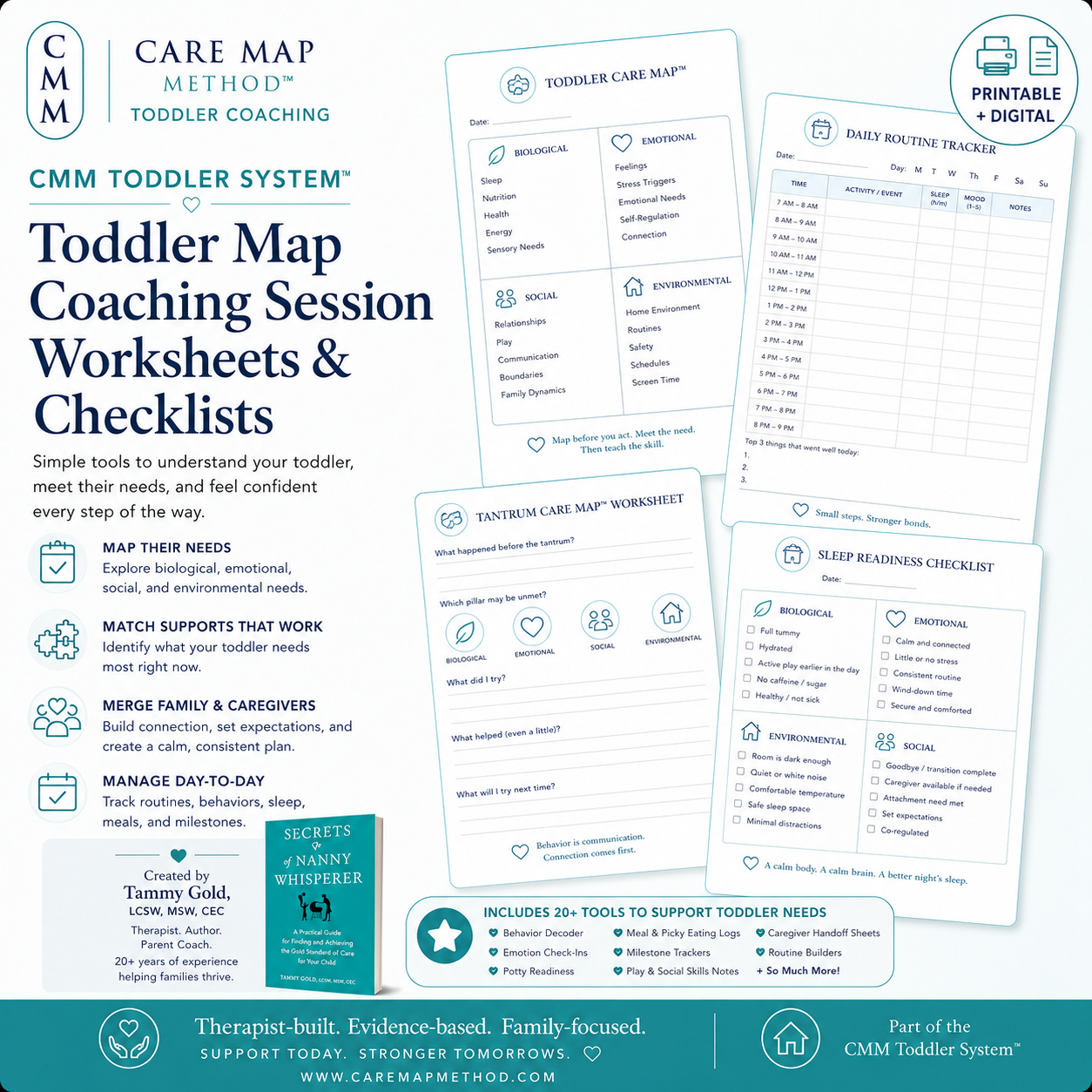
Toddler behavior is communication. The Care Map Method™ Toddler Coaching Session helps parents understand their child’s biological, emotional, social, and environmental needs and create practical strategies for tantrums, sleep, eating, routines, development, childcare, and family life.
The toddler years can be delightful, exhausting, funny, and confusing—sometimes within the same five minutes.
Your toddler may want to do everything independently while still needing help with almost everything. They may understand far more than they can communicate. They can move quickly from excitement to frustration, resist ordinary routines, and have powerful reactions to seemingly small changes.
Parents are often left wondering:
Is this typical toddler behavior?
Why are the tantrums getting worse?
Should my child be talking more?
Why is bedtime suddenly so difficult?
How do I set limits without constantly battling?
Is my child ready for preschool or daycare?
How can all caregivers respond consistently?
Generic parenting advice rarely accounts for the whole child. A strategy that works for one toddler may overwhelm another because children differ in temperament, language, sensory processing, developmental pace, routines, and family circumstances.
The Care Map Method™ Toddler Care Map Coaching Session helps parents understand what is happening beneath the behavior and create a practical plan for their individual child and family.
What is toddler parent coaching?
Toddler parent coaching is a structured, personalized service that helps parents understand their child’s development, behavior, routines, and care needs.
During a Care Map Method™ Toddler Coaching Session, we may address:
Tantrums and emotional regulation
Biting, hitting, throwing, or yelling
Sleep and bedtime struggles
Picky eating and mealtime stress
Toilet-learning readiness
Language and communication
Separation anxiety
Transitions and resistance
Boundaries and discipline
Toddler safety and childproofing
Nanny, babysitter, daycare, or preschool concerns
Parent and caregiver consistency
Sibling adjustment
Parent exhaustion and family stress
The goal is not to eliminate every difficult behavior. Toddlers are still learning how to communicate, wait, transition, tolerate frustration, and manage strong feelings.
The goal is to understand what the behavior may be communicating and teach the child the skills they are developmentally ready to learn.
Toddler behavior is communication
Toddlers do not usually have the language, impulse control, or emotional regulation skills to explain exactly what they need.
A toddler who screams at bedtime may be overtired, frightened by separation, overstimulated, resisting a transition, or reacting to an inconsistent routine.
A child who hits another child may be overwhelmed, frustrated, seeking space, imitating behavior, or unable to say, “I was using that.”
A child who refuses to get dressed may want control, dislike how the clothing feels, struggle with transitions, or simply need more time.
Understanding the reason behind a behavior does not mean allowing unsafe or inappropriate behavior. It helps parents choose a response that addresses both the behavior and the unmet need or developing skill underneath it.
Start with the B/E/S/E Toddler Care Map
The Care Map Method™ looks at four connected areas of a toddler’s life: Biological, Emotional, Social, and Environmental needs.
Biological needs
A toddler’s physical state has a major influence on behavior.
Biological needs may include:
Sleep and nap patterns
Hunger and eating
Growth and nutrition
Physical activity
Illness, pain, or discomfort
Digestion and toileting
Speech, motor, and developmental progress
Sensory preferences and sensitivities
Medical and dental care
Before labeling a child as “difficult” or “defiant,” it is helpful to consider whether the child is tired, hungry, uncomfortable, overstimulated, or being asked to do something beyond their current developmental ability.
Persistent concerns about feeding, sleep, hearing, speech, movement, growth, toileting, or development should be discussed with the child’s pediatric healthcare provider.
Emotional needs
Toddlers experience strong feelings before they have the skills to manage them.
Emotional care may include:
Helping the child identify feelings
Offering comfort without removing every limit
Creating predictable responses
Supporting secure attachment
Preparing for separations and transitions
Teaching simple calming strategies
Understanding the child’s temperament
Providing choices within appropriate boundaries
Toddlers borrow regulation from the adults around them. This is called co-regulation. A calm, clear adult response helps the child gradually learn how to manage frustration, disappointment, and change.
Social needs
Toddlers are beginning to learn how relationships work.
They may be practicing how to:
Share space and toys
Take turns
Ask for help
Join play
Use words instead of hitting
Separate from a parent
Adapt to different caregivers
Interact with siblings
Follow simple group routines
Recover after conflict
Young toddlers often engage in parallel play—playing near other children rather than cooperatively with them. Social skills develop gradually and require patient teaching, modeling, and repetition.
Environmental needs
The environment can either support toddler success or create unnecessary conflict.
Environmental factors include:
Home safety and childproofing
Toy and activity organization
Noise, lighting, and stimulation
Daily routines
Visual schedules
Transition warnings
Child-accessible choices
Sleep spaces
Mealtime arrangements
Consistency between home and childcare
Sometimes changing the environment is more effective than repeatedly correcting the child.
For example, placing a visual routine near the front door may help with leaving the house. Offering two weather-appropriate outfits may reduce dressing battles. Creating a calm-down space may provide a safe place to recover from overwhelming feelings.
Use MAP, MATCH, MERGE, and MANAGE for toddler care
Once we understand the child’s full care picture, the Care Map Method™ provides a clear path forward.
MAP the Need
We identify the toddler’s biological, emotional, social, and environmental needs while also considering family stress, schedules, caregiver arrangements, and parent concerns.
The care map helps parents look for patterns:
Do tantrums happen before meals?
Is behavior harder after missed naps?
Does the child struggle during rushed transitions?
Is the same behavior happening at home and daycare?
Are different caregivers using different limits?
Does the child have the words needed to express the problem?
A behavior tracker can help parents identify what happens before, during, and after a difficult moment.
MATCH the Care
Next, we determine what kind of support fits each need.
Support may include:
A pediatrician
A speech-language pathologist
An occupational therapist
A developmental specialist
A feeding professional
A licensed mental health professional
A parent coach
A nanny or babysitter
A daycare or preschool program
Early-intervention services
Trusted family support
Not every toddler challenge requires a specialist. Coaching can help parents determine what can be addressed through changes in routines and responses—and what should be evaluated further.
MERGE the Support
Toddlers benefit when the important adults in their lives communicate clearly.
A shared toddler care plan may include:
Daily routines
Sleep and nap expectations
Food preferences and restrictions
Toilet-learning language
Approved discipline and redirection strategies
Comfort and calming methods
Safety expectations
Screen-time boundaries
Medication or health information
Communication between parents and caregivers
Responses to hitting, biting, tantrums, or separation distress
Parents, grandparents, nannies, babysitters, and daycare teachers do not need to respond identically in every situation. However, they should understand the child’s essential needs and the family’s central expectations.
MANAGE the Plan
Toddlers develop quickly. Their language, mobility, interests, sleep, emotions, and social needs can change within months.
Families should regularly ask:
What is improving?
What continues to be difficult?
Has the child developed new skills?
Are our expectations age-appropriate?
Are all caregivers communicating?
Is the environment still safe and supportive?
Do we need additional professional guidance?
Is this care arrangement still the right fit?
A Toddler Care Map is not a permanent set of rules. It is a flexible plan that grows with the child.
Understanding toddler tantrums
Tantrums are a common part of early development. They often occur when a toddler is tired, hungry, overstimulated, frustrated, or unable to communicate a need.
During a tantrum, the child’s thinking and language abilities may be temporarily less available. Long explanations and repeated questions are unlikely to help in the peak of the moment.
A helpful response may include:
Make sure the child and others are safe.
Lower your voice and reduce stimulation.
Use a short statement: “You are upset. I’m here.”
Hold the boundary: “I won’t let you hit.”
Allow time for the child’s body to settle.
Reconnect and teach after the child is calmer.
Parents do not need to fix every feeling. A child can be disappointed and still be safe, supported, and loved.
Discipline should teach—not frighten
Effective toddler discipline focuses on safety, connection, repetition, and skill-building.
Helpful strategies may include:
Clear and brief limits
Consistent follow-through
Redirection
Age-appropriate choices
Predictable routines
Transition warnings
Positive attention for helpful behavior
Modeling the desired behavior
Teaching simple replacement phrases
Repairing the relationship after difficult moments
Instead of only saying, “Stop hitting,” a parent might say:
“I won’t let you hit. Say, ‘My turn,’ or ask me for help.”
The limit remains firm, but the child also learns what to do next time.
Preparing for daycare, preschool, or a new caregiver
Starting daycare, preschool, or care with a nanny can be a major transition for a toddler.
A thoughtful transition plan may include:
Short introductory visits
A simple goodbye ritual
A familiar comfort object when permitted
Consistent pickup and drop-off language
A written description of routines and calming strategies
Gradually increasing care hours when possible
Clear communication between parents and caregivers
Patience with temporary changes in sleep or behavior
A child’s distress during separation does not automatically mean the placement is wrong. What matters is how the child is comforted, how the caregiver responds, and whether the child gradually begins to feel secure.
When might toddler coaching help?
A Care Map Method™ Toddler Coaching Session may be helpful if:
Tantrums are affecting daily family life
You are dealing with hitting, biting, or throwing
Bedtime or naps have become difficult
Meals feel like a constant battle
You are unsure how to set effective boundaries
You and your partner disagree about discipline
Your child is having difficulty separating
You are preparing for daycare or preschool
You are hiring or onboarding a nanny
Different caregivers use conflicting approaches
Your toddler is adjusting to a new sibling, home, or family routine
You want to understand whether a concern may require additional evaluation
You do not have to wait until family life feels unmanageable. Parent coaching can help you create a plan before ordinary toddler challenges become ongoing patterns of stress.
What happens during a CMM Toddler Care Map Coaching Session?
The session is personalized to the child, the family, and the current concerns.
Together, we can:
Complete a B/E/S/E Toddler Care Map
Identify possible triggers behind difficult behavior
Review sleep, eating, play, toileting, and daily routines
Explore temperament and sensory needs
Create age-appropriate behavior strategies
Develop scripts for tantrums, transitions, and limit-setting
Clarify responsibilities between parents and caregivers
Prepare for a nanny, daycare, preschool, or other transition
Identify areas that may need professional evaluation
Create a practical family action plan
Parents leave with clear priorities, personalized scripts, and concrete next steps they can begin using at home.
Frequently asked questions about toddler coaching
Is toddler coaching only for serious behavior problems?
No. Many parents use coaching for common developmental challenges such as tantrums, sleep, picky eating, separation anxiety, transitions, and limit-setting.
Can toddler coaching help with tantrums?
Yes. Coaching can help parents identify possible triggers, create a consistent response, teach replacement skills, and adjust routines or environments that may be contributing to the tantrums.
Can you help us prepare our toddler for preschool?
Yes. A Toddler Care Map can help parents evaluate readiness, prepare for separation, communicate with teachers, and create consistent routines between home and school.
Can both parents or caregivers participate?
Yes. Including both parents or other central caregivers can help create clearer expectations and more consistent responses.
Does toddler coaching replace medical or developmental evaluation?
No. Coaching provides education, planning, and parenting support. Medical, speech, feeding, hearing, sensory, or developmental concerns should be evaluated by an appropriately qualified professional.
Your toddler does not need a perfect parent
Toddlers need adults who are curious, responsive, consistent, and willing to adjust as the child grows.
You do not have to stop every tantrum or have the perfect routine. You need a clearer understanding of your child and a practical plan that your family can actually follow.
Map before you act.
Care Map Method™ Toddler Care Map Coaching Session
The Care Map Method™ Toddler Care Map Coaching Session helps parents understand what may be driving their toddler’s behavior and develop an individualized plan for home, childcare, and family life.
Your session may include:
A personalized B/E/S/E Toddler Care Map
Tantrum and behavior-trigger assessment
Sleep, mealtime, toileting, and routine review
Toddler communication and regulation strategies
Parent scripts for limits and transitions
Daycare, preschool, or nanny preparation
Parent and caregiver communication tools
A personalized action plan and next steps
Built by a therapist. Backed by science. Designed for real family life.
Schedule a Care Map Method™ Toddler Coaching Session
Care Map Method™ coaching provides education, care planning, and parenting support. It does not replace pediatric, medical, developmental, feeding, speech, occupational-therapy, or mental-health evaluation and treatment.


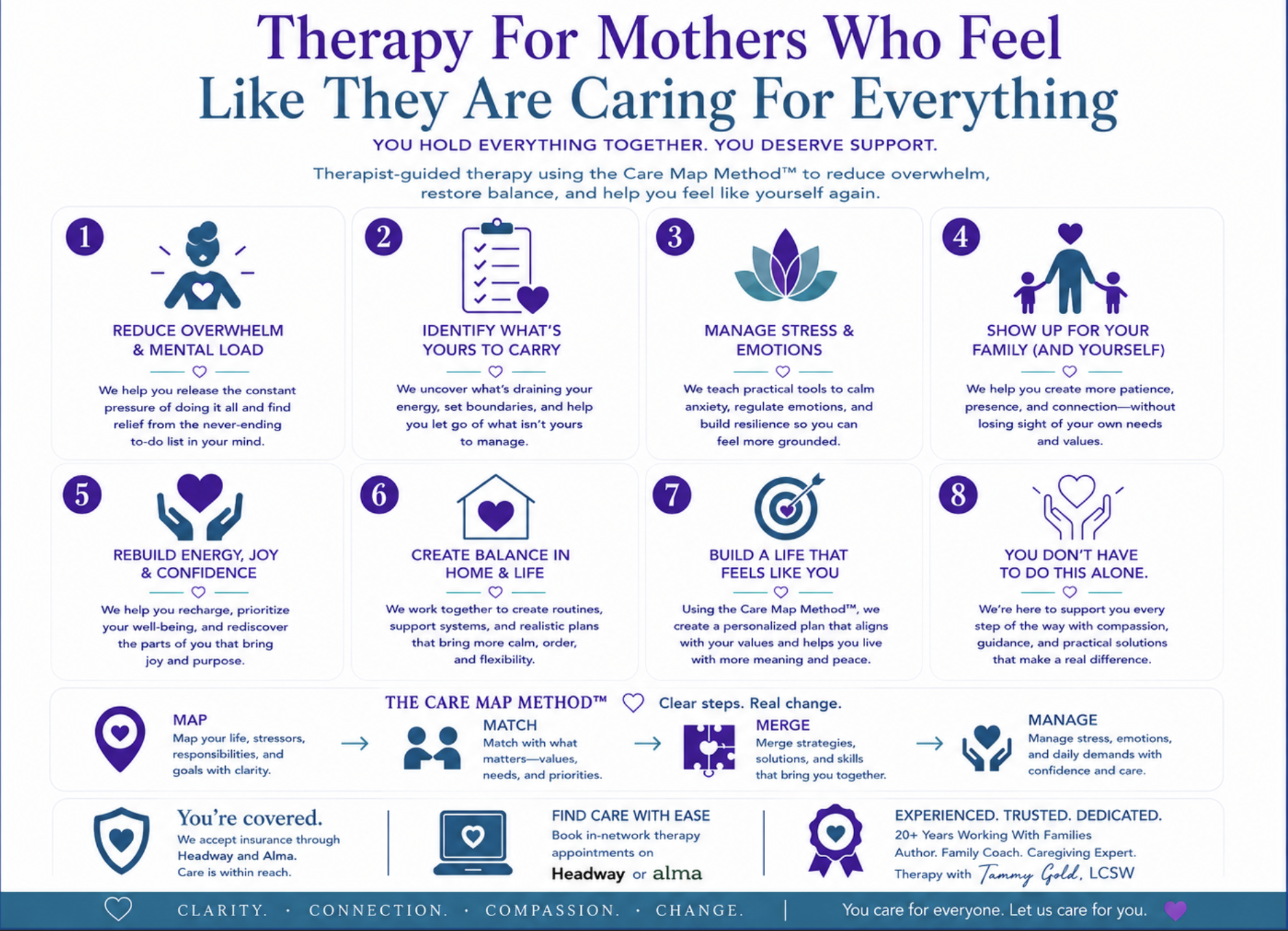
Therapy for Mothers Who Feel Like They Are Carrying Everything
Online therapy for mothers and parents who feel responsible for everyone else while feeling overwhelmed, unseen, anxious, resentful or emotionally exhausted.
Therapy for Mothers Who Feel Like They Are Carrying Everything
Many mothers and parents are carrying far more than anyone can see. They may be managing children, school, work, schedules, marriage, divorce, co-parenting, aging parents, household responsibilities, family conflict, emotional labor and everyone else’s needs while feeling unseen themselves.
I am Tammy Gold, LCSW. I offer online therapy for clients in California, New Jersey and Oregon. Depending on your state, plan and eligibility, insurance may be available through Headway or Alma.
My Psychology Today profile links to booking and insurance options through Headway.
When carrying everything becomes too much
You may feel anxious, resentful, tired, guilty, irritable, disconnected or ashamed for not feeling more grateful. You may be the person everyone relies on, but still feel alone. Therapy can be the one place where you do not have to manage everyone else’s emotions.
My goal is to help you feel safe, supported and truly heard.
How therapy helps
Through the Care Map Method™, we look at what is happening emotionally, biologically, socially and environmentally. We identify what you are carrying, what needs are not being named, what boundaries are missing and what practical support could reduce stress.
The goal is to help you understand yourself, communicate needs more clearly, reduce shame and create small solutions that make daily life feel more manageable.
Request a session
If you are a mother or parent feeling overwhelmed by parenting stress, relationship stress, divorce, caregiving, work pressure or family conflict, visit my Psychology Today profile to request a session. My profile links to booking and insurance options through Headway.
Book A Session Today & Get The Support You Deserve!
For clients using insurance, I use the platforms below:
Alma Therapy https://secure.helloalma.com/providers/tamara-gold/

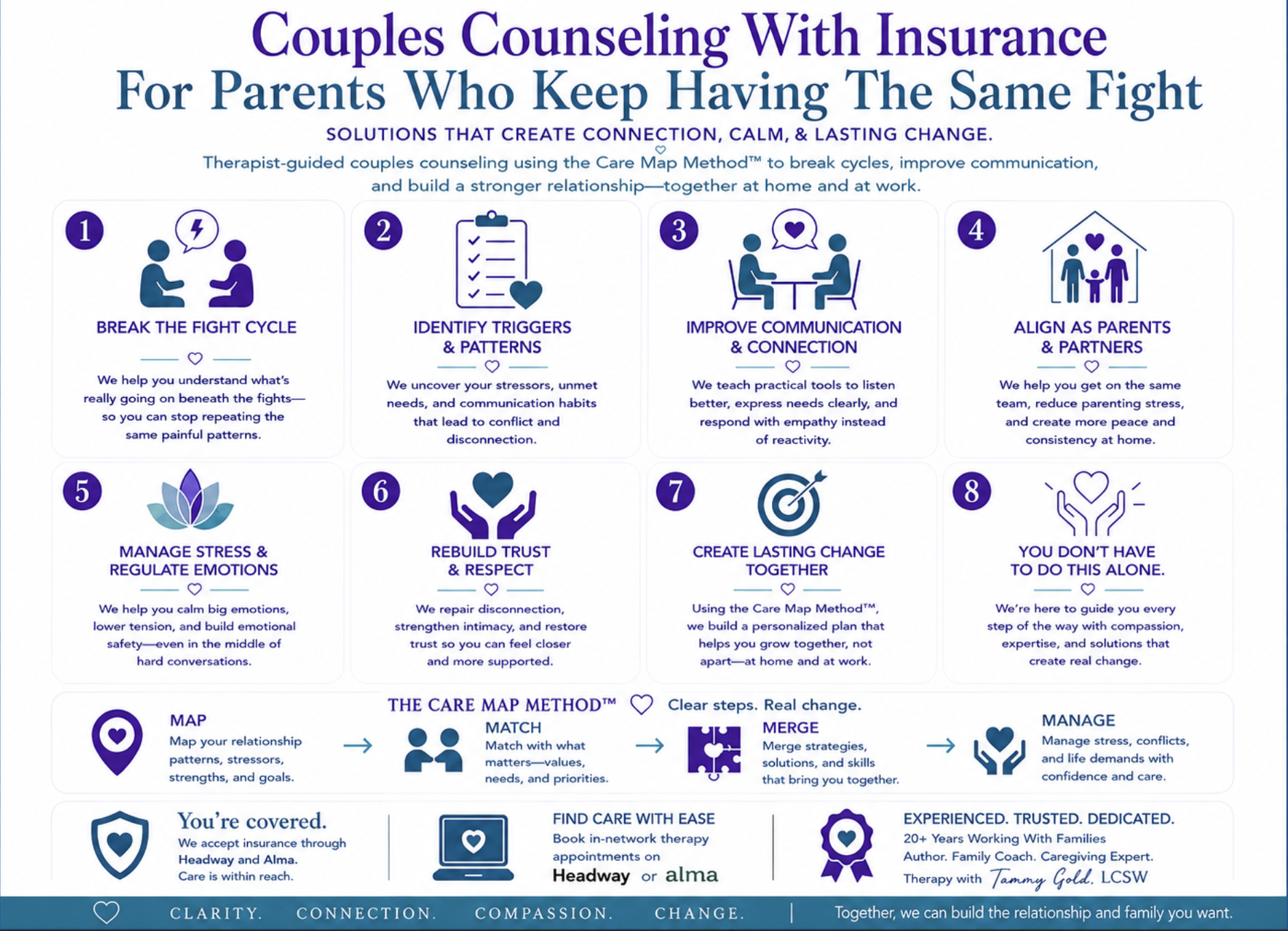
Couples Counseling with Insurance for Parents Who Keep Having the Same Fight
Therapy for couples and parents who keep having the same fight about parenting, chores, money, emotional labor, divorce concerns or family responsibilities.
Couples Counseling with Insurance for Parents Who Keep Having the Same Fight
Many couples do not come to therapy because they stopped caring. They come because they keep having the same fight and cannot figure out how to stop the cycle. For parents, the fight may be about children, chores, money, schedules, emotional labor, in-laws, co-parenting, intimacy, work stress or feeling unsupported.
I am Tammy Gold, LCSW. I support adults, couples and parents in California, New Jersey and Oregon. Depending on your plan and eligibility, insurance may be available through Headway or Alma.
My Psychology Today profile links to booking and insurance options through Headway.
Why repeated fights happen
Repeated fights often happen because the surface topic is not the only issue. Underneath the argument may be fear, loneliness, resentment, exhaustion, feeling unseen, feeling criticized, or not knowing how to ask for support without sounding angry.
Therapy helps slow the pattern down so each person can feel heard without shame or blame.
How I help couples and parents
Through the Care Map Method™, we Map the repeated fight cycle, Match each partner’s needs and triggers, Merge safer communication and Manage repair tools for real life. The goal is to help both partners understand what is happening underneath the conflict and build better ways to respond.
Sessions are designed to be respectful and compassionate. I work to help each person feel heard while keeping the focus on understanding, communication and small positive solutions.
Request a session
If you are looking for therapy for relationship stress, parenting stress, communication problems, divorce concerns or family conflict, visit my Psychology Today profile to request a session. My profile links to booking and insurance options through Headway.
Why do couples keep having the same argument?
Repeated arguments are often maintained by deeper emotional triggers, unmet needs, defensive reactions, assumptions, and communication patterns rather than the surface topic alone.
Can couples therapy help communication?
Yes. Couples therapy can help partners slow down conflict, identify the pattern, hear each other more accurately, communicate needs more clearly, and practice repair.
What if my partner will not attend?
Individual therapy can still help you understand the relationship pattern, regulate your reactions, communicate differently, clarify boundaries, and make more thoughtful decisions.
Is couples therapy only for relationships in crisis?
No. Couples may seek therapy for recurring conflict, disconnection, parenting stress, intimacy concerns, life transitions, premarital preparation, or to strengthen a relationship before problems escalate.
Will the therapist take sides?
The goal is not to declare one partner right and the other wrong. The work focuses on understanding the relationship system, helping both people feel heard, and identifying healthier patterns.
Can therapy help couples affected by parenting stress?
Yes. Parenting can create exhaustion, resentment, role imbalance, disagreement about discipline, and reduced time for connection. Therapy can help couples rebuild teamwork and communication.
What does Map, Match, Merge, and Manage look like for couples?
MAP identifies the conflict cycle.
MATCH clarifies each partner’s needs and goals.
MERGE builds healthier communication and repair.
MANAGE creates tools and agreements to use between sessions.
How long does couples therapy take?
The length varies based on the concerns, goals, severity of conflict, participation, and complicating factors. Some couples seek focused short-term work, while others benefit from longer support.
Book A Session Today & Get The Support You Deserve!
For clients using insurance, I use the platforms below:
Alma Therapy https://secure.helloalma.com/providers/tamara-gold/

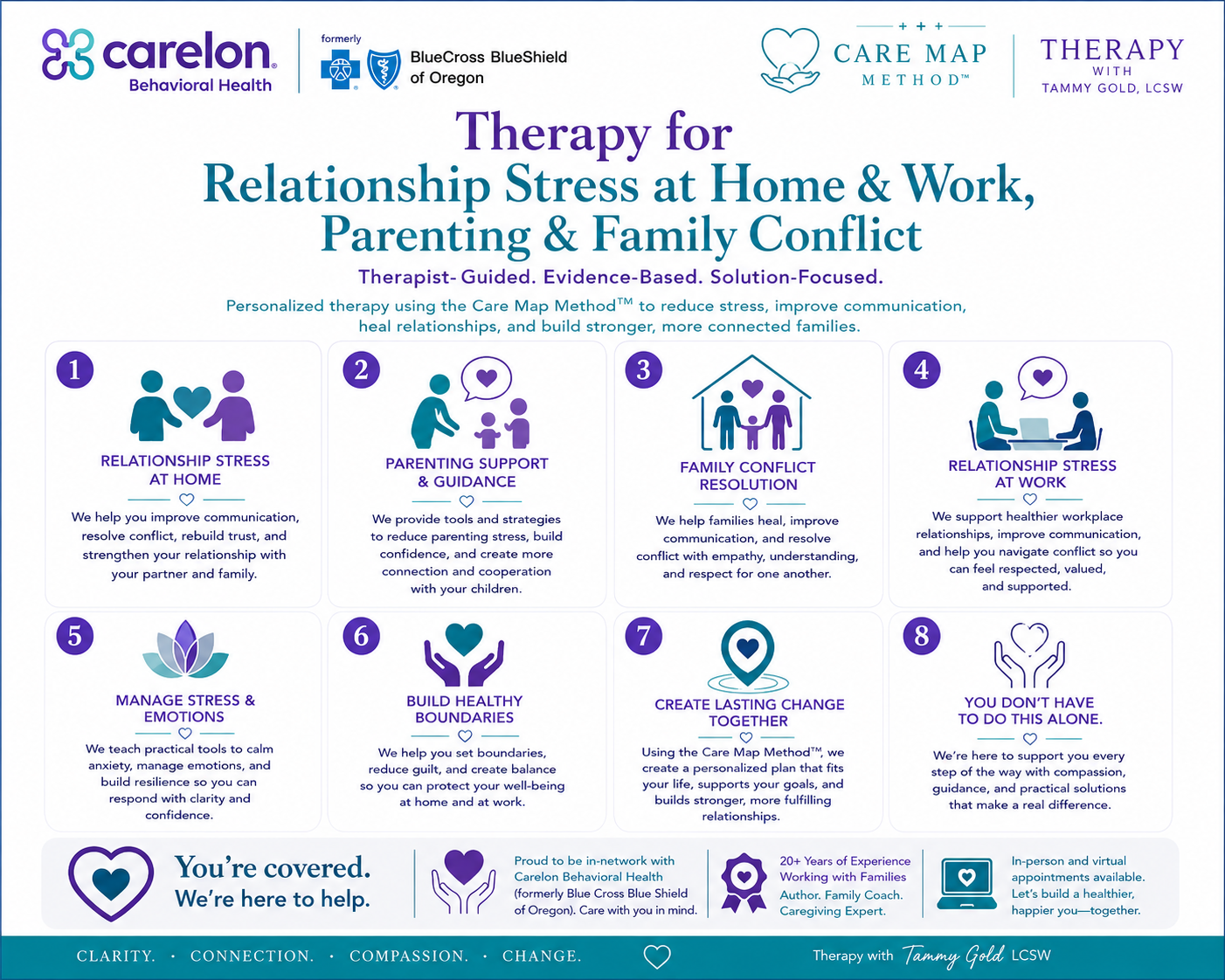
Carelon Behavioral Health Therapy for Relationship Stress, Parenting and Family Conflict
Online therapy for clients with Carelon Behavioral Health who need support for relationship stress, parenting strain, family conflict, divorce, co-parenting and caregiver burnout.
Carelon Behavioral Health Therapy for Relationship and Family Stress
If you are searching for therapy through Carelon Behavioral Health, you may be looking for support that is warm, practical and focused on the real-life relationships causing stress. Many clients reach out because they feel overwhelmed by marriage stress, parenting conflict, divorce, co-parenting, family conflict, caregiving, work stress or difficult relationships.
I am Tammy Gold, LCSW, a therapist licensed in California, New Jersey and Oregon. Depending on your state, plan and eligibility, Carelon Behavioral Health may be available through Headway.
My Psychology Today profile links to booking and insurance options through Headway.
Relational therapy for everyday life
My work is especially helpful for clients struggling with a partner, child, parent, sibling, friend, coworker, boss, co-parent, nanny, daycare provider, caregiver or senior care professional. These relationships can create stress when communication breaks down, needs go unnamed, or shame and blame take over.
In therapy, you have a safe place to feel heard and a structured process for understanding what is happening.
The Care Map Method™ process
Using the Care Map Method™, we look at the emotional, biological, social and environmental pieces of the problem. We Map the Need, Match the Support, Merge better communication and Manage a plan forward.
This process helps clients identify triggers, understand behavior, reduce shame, name needs and create practical solutions for real life.
Request a session
If you are looking for therapy for relationship stress, parenting stress, family conflict, divorce, co-parenting, caregiver burnout or work stress, visit my Psychology Today profile to request a session. My profile links to booking and insurance options through Headway.

Regence BlueCross BlueShield Oregon Therapy for Caregiver Burnout, Parenting Stress and Relationships
Online therapy in Oregon for Regence BCBS clients navigating caregiver burnout, parenting stress, relationship strain, family conflict, divorce and life transitions.
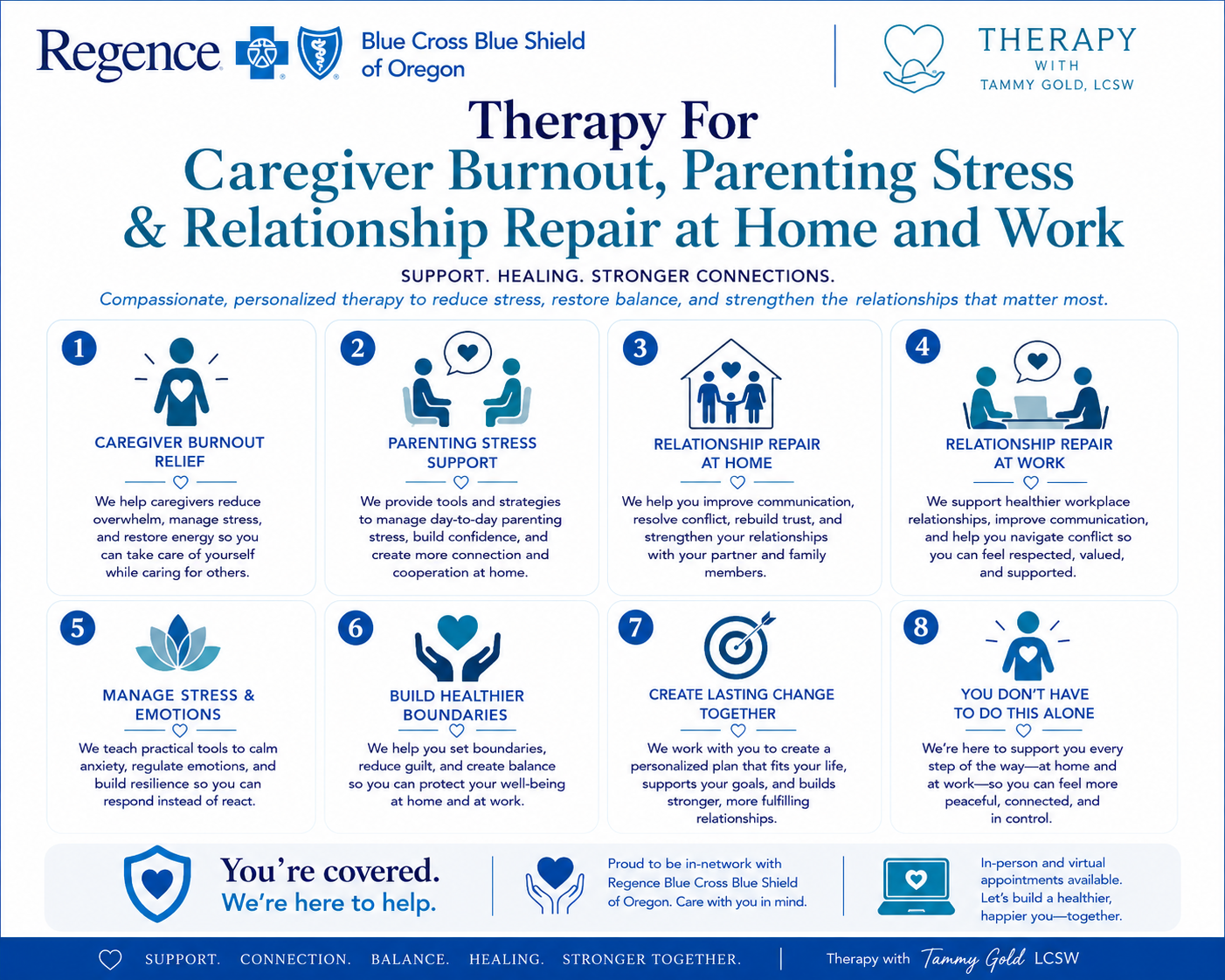
Regence BCBS Oregon Therapy for Caregiver Burnout and Relationship Stress
Caregiver burnout can occur when you are responsible for too many people and lack sufficient support for yourself. You may be caring for children, aging parents, a partner, family members or multiple generations while also trying to manage work, relationships and your own emotional needs.
I am Tammy Gold, LCSW, and I offer online therapy for clients located in Oregon. Depending on your plan and eligibility, Regence BlueCross BlueShield of Oregon may be available through Headway.
My Psychology Today profile links to booking and insurance options through Headway.
What caregiver burnout can feel like
Burnout can look like resentment, guilt, exhaustion, anxiety, irritability, grief, conflict or the feeling that everyone needs something from you. It can affect your marriage, parenting, work, siblings, family decisions, eldercare planning and the way you see yourself.
Therapy gives you one safe place to exhale, say what you are carrying and begin creating a more sustainable plan.
How therapy helps
Through the Care Map Method™, we Map what you are carrying emotionally and practically, Match the support and boundaries that are missing, Merge clearer communication with the people involved and Manage a plan that is more sustainable.
The goal is not to make you care less. The goal is to help you care without losing yourself, reduce shame and guilt, and communicate your needs with more clarity.
Request a session
If you are in Oregon and looking for therapy for caregiver burnout, parenting stress, family conflict, relationship stress, divorce or life transitions, visit my Psychology Today profile to request a session. My profile links to booking and insurance options through Headway.
Book A Session Today & Get The Support You Deserve!
For clients using insurance, I use the platforms below:
Alma Therapy https://secure.helloalma.com/providers/tamara-gold/

Horizon Blue Cross Blue Shield of New Jersey Therapy for Family Conflict, Parenting and Divorce Stress
Online therapy in New Jersey for clients with Horizon BCBS who are navigating family conflict, parenting stress, divorce, co-parenting, relationship strain and caregiver burnout.
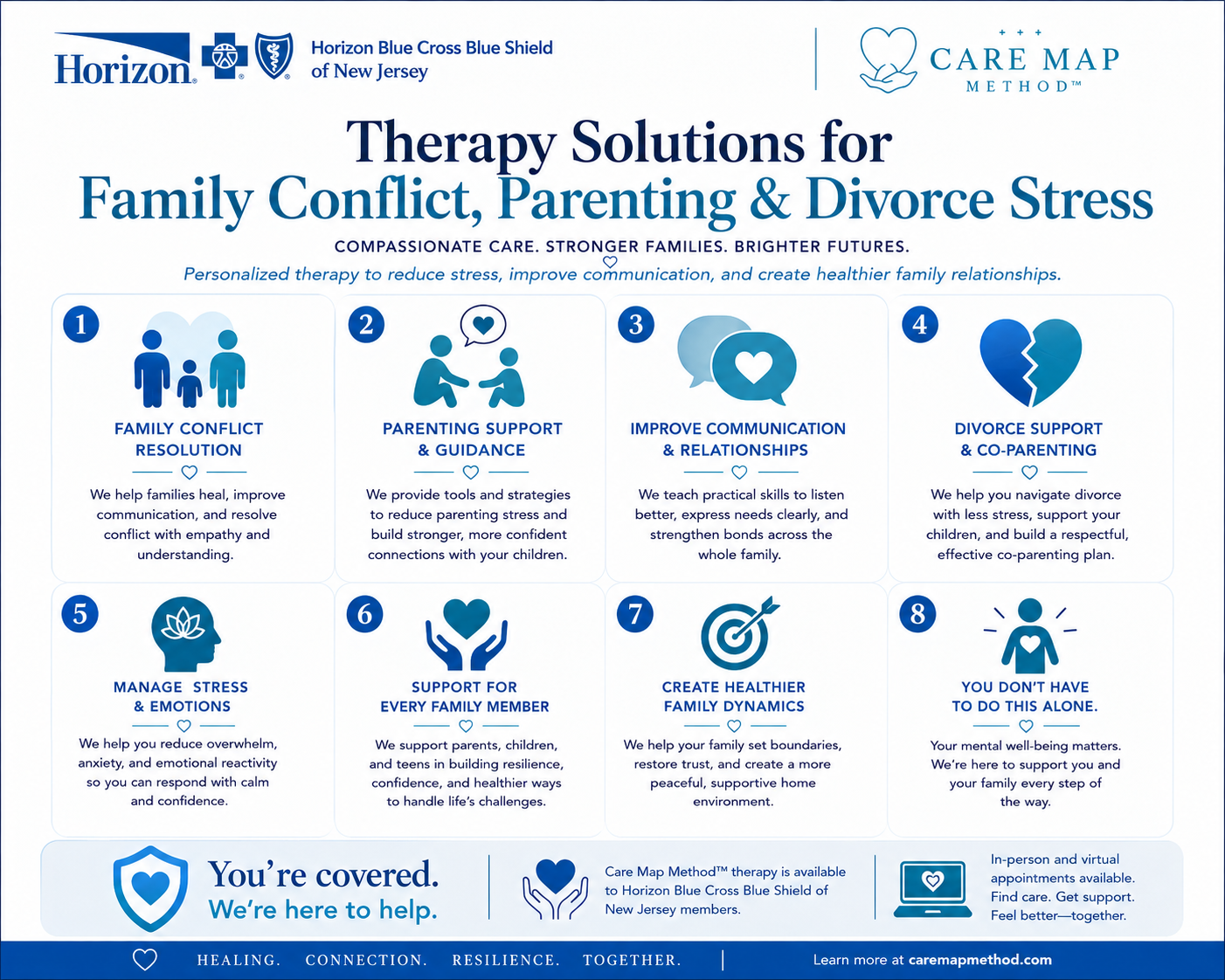
Horizon BCBS New Jersey Therapy for Family Conflict and Parenting Stress
Family conflict can be exhausting, especially when you are trying to manage parenting, marriage stress, divorce, co-parenting, adult children, siblings, aging parents, work pressure or caregiving responsibilities at the same time. Many clients want help, but they also want therapy to feel safe, respectful and practical.
I am Tammy Gold, LCSW, and I offer online therapy for clients located in New Jersey. Depending on your plan and eligibility, Horizon Blue Cross Blue Shield of New Jersey may be available through Headway.
My Psychology Today profile links to booking and insurance options through Headway.
Who this work helps
This therapy may be helpful if you are struggling with a partner, co-parent, child, adult child, sibling, parent, in-law, friend, boss, coworker, nanny, daycare provider, caregiver or senior care facility. Relational stress often creates anxiety, resentment, guilt, emotional exhaustion and communication breakdowns.
My goal is to help you feel heard and supported while also understanding the pattern underneath the conflict.
How sessions are structured
Through the Care Map Method™, we look at what is happening emotionally, biologically, socially and environmentally. We Map the Need, Match the Support, Merge communication and Manage the plan. This helps clients move from confusion and blame toward clearer language, better boundaries and practical next steps.
For couples, parents or families, sessions are designed to help each person feel heard respectfully and compassionately, without increasing shame or conflict.
Request a session
If you are in New Jersey and looking for therapy for family conflict, parenting stress, divorce, co-parenting, caregiver burnout or relationship stress, visit my Psychology Today profile to request a session. My profile links to booking and insurance options through Headway.
Book A Session Today & Get The Support You Deserve!
For clients using insurance, I use the platforms below:
Alma Therapy https://secure.helloalma.com/providers/tamara-gold/

Providence Health Plan Online Therapy for Relationship Stress, Parenting and Caregiver Burnout
Online therapy for clients with Providence Health Plan who need support with relationships, parenting stress, divorce, caregiving, work stress and family conflict.
Providence Health Plan online therapy with Tammy Gold, LCSW for relationship stress, parenting stress, caregiver burnout, divorce and family conflict.
Providence Health Plan Online Therapy
If you have Providence Health Plan and are looking for online therapy, you may be trying to find support that feels both emotionally safe and practical. Many clients are not just looking for someone to listen. They want to feel heard, understood, and helped with real-life stress involving relationships, parenting, divorce, caregiving, work, and family responsibilities.
I am Tammy Gold, LCSW, a therapist licensed in California, New Jersey and Oregon. Depending on your state, plan and eligibility, Providence Health Plan may be available through Headway.
My Psychology Today profile links to booking and insurance options through Headway.
Therapy for the stress that happens inside relationships
My work is especially helpful for clients who are struggling with a partner, child, parent, sibling, friend, coworker, boss, co-parent, caregiver, nanny, daycare provider or senior care professional. Relationship stress can leave people feeling anxious, resentful, guilty, disconnected or unsure how to communicate without making things worse.
Therapy gives you a safe place to say what you need to say, understand what is underneath the emotion and find better words for difficult conversations.
How the Care Map Method™ supports change
Using the Care Map Method™, we look at biological, emotional, social and environmental factors that may be creating stress. Then we work through Map, Match, Merge and Manage: map the problem, match the needs, merge healthier communication and manage the plan forward.
This helps therapy feel supportive but also useful. The goal is for you to leave sessions feeling less alone, clearer and better equipped with language, boundaries, tools and next steps.
Request a session
If you are looking for therapy for relationship stress, parenting stress, divorce, co-parenting, caregiver burnout or family conflict, visit my Psychology Today profile to request a session. My profile links to booking and insurance options through Headway.
Book A Session Today & Get The Support You Deserve!
For clients using insurance, I use the platforms below:
Alma Therapy https://secure.helloalma.com/providers/tamara-gold/

Anthem Blue Cross California Therapy for Busy Parents, Couples and Family Stress
Online therapy in California for clients with Anthem Blue Cross California who are navigating relationship stress, parenting strain, divorce, caregiving and family conflict.
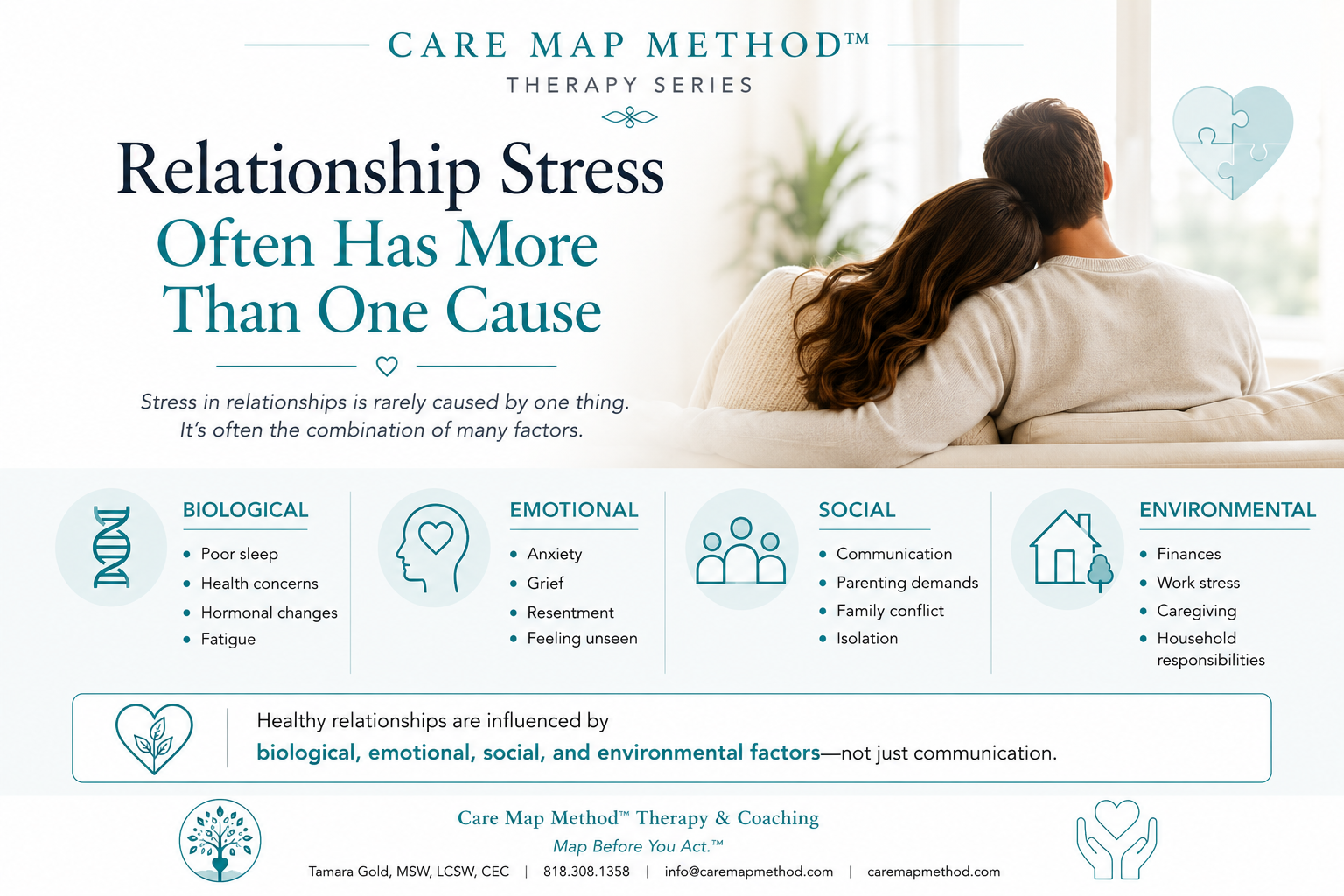
Anthem Blue Cross California Therapy for Busy Parents and Couples
Many busy parents and couples reach out for therapy when family life starts to feel heavier than expected. The problem is not always one dramatic crisis. Often it is the daily build-up of work stress, parenting strain, resentment, poor communication, divorce stress, co-parenting tension, caregiving responsibilities and emotional exhaustion.
I am Tammy Gold, LCSW. I offer online therapy for clients located in California. Depending on your plan and eligibility, Anthem Blue Cross California insurance may be available through Headway.
My Psychology Today profile links to booking and insurance options through Headway.
Common reasons clients reach out
Clients often come to therapy because they are tired of repeating the same arguments, carrying the emotional labor of the family, feeling unseen by a partner, struggling with a child, or trying to manage a divorce or co-parenting situation without more conflict. Others are overwhelmed by caregiving, work stress, a difficult boss or coworker, or the pressure of being responsible for everyone else.
Therapy can help you slow down, feel supported and understand what is really happening underneath the stress.
How sessions help
My sessions are warm, supportive and solution-focused. Through the Care Map Method™, we Map what is causing stress, Match the needs underneath the conflict, Merge better communication between the people involved, and Manage the plan with realistic tools, boundaries and next steps.
The goal is to reduce shame and blame, help you name emotions more clearly, communicate needs more directly and create practical changes that make daily life feel more manageable.
Request a session
If you are looking for online therapy in California for relationship stress, parenting stress, divorce, co-parenting, caregiver burnout or family conflict, visit my Psychology Today profile to request a session. My profile links to booking and insurance options through Headway.

Aetna Online Therapy in California for Relationship Stress, Parenting Stress and Divorce Support
Aetna online therapy in California for adults, couples, parents and caregivers navigating relationship stress, parenting strain, divorce, co-parenting, family conflict and caregiver burnout.
Aetna Online Therapy in California
If you are searching for Aetna online therapy in California, you may be looking for a therapist who understands not only anxiety or stress, but the relationships and family responsibilities that often create the stress in the first place. Many clients are managing marriage strain, parenting demands, divorce or co-parenting conflict, caregiving responsibilities, work pressure and the feeling of carrying too much without enough support.
I am Tammy Gold, LCSW, a therapist, author, parenting and family therapy expert, and creator of the Care Map Method™. I offer online therapy for clients located in California. Depending on your specific plan, eligibility and platform availability, Aetna insurance may be available through Headway or Alma.
My Psychology Today profile links to booking and insurance options through Headway.
Who this therapy is for
This page is for adults, couples, parents and caregivers who feel overwhelmed by important relationships and responsibilities. You may be struggling with a partner, child, co-parent, parent, sibling, caregiver, nanny, daycare provider, coworker, boss or family member. You may feel anxious, resentful, disconnected, emotionally exhausted or unsure how to ask for what you need without creating more conflict.
Therapy gives you one safe, supportive place where you do not have to censor yourself, apologize for your feelings or worry about being judged. My goal is to help you feel heard, understood and less alone while also giving you practical language and tools for real life.
How the Care Map Method™ helps
Through the Care Map Method™, we look at what may be happening emotionally, biologically, socially and environmentally. This gives us a 360-degree picture of your life and relationships so we can understand what is driving stress, behavior, conflict or disconnection.
We Map the Need, Match the Support, Merge the people involved through clearer communication and Manage the plan with practical next steps. Therapy is not about blame or shame. It is about understanding what is happening, naming emotions and needs, and building a calmer way forward.
Request a session
If you are located in California and want therapy for relationship stress, parenting stress, divorce, co-parenting, caregiver burnout, work stress or family conflict, you can request a session through my Psychology Today profile. My Psychology Today profile links to booking and insurance options through Headway.

Divorce and Co-Parenting Therapy with Insurance
Divorce and co-parenting can create emotional stress, communication challenges, and family strain. Tammy Gold, LCSW offers online therapy for clients in CA, NJ, and OR seeking safe, supportive, solution-focused help.
Divorce and Co-Parenting Therapy with Insurance
Divorce and co-parenting can be emotionally exhausting. Even when separation is necessary, the process can bring stress, grief, anger, fear, guilt, confusion, and conflict. When children are involved, the emotional weight can feel even heavier.
I am Tammy Gold, LCSW, a therapist, author, parenting and family therapy expert, and creator of the Care Map Method™. I support adults, parents, and families navigating divorce, separation, co-parenting stress, parenting conflict, family transitions, relationship strain, and communication challenges.
I offer online therapy for clients in California, New Jersey, and Oregon. Depending on your plan and eligibility, you may be able to use insurance through Headway or Alma.
View My Psychology Today Profile
My Psychology Today profile links to booking and insurance options through Headway.
When divorce and co-parenting feel overwhelming
Divorce is not only a legal or logistical process. It is also an emotional and relational transition. You may be trying to manage your own feelings while also protecting your children, communicating with a co-parent, handling conflict, rebuilding routines, and making major decisions.
Co-parenting conflict
Communication breakdowns
Parenting stress during divorce
Emotional overwhelm
Anger, grief, guilt, or resentment
Difficulty setting boundaries
Conflict with an ex-partner
Stress about how children are coping
New family routines
Blended family or extended family pressure
A safe place without shame or blame
My goal is to make therapy feel like one safe place where you do not have to censor yourself, apologize for your feelings, or worry about being judged. Divorce and co-parenting can bring up intense emotions. Therapy gives you room to name those emotions, understand them, and decide how you want to respond.
The goal is not to blame one person or create more conflict. The goal is to help you feel supported, understand what is happening, communicate more clearly, and protect emotional safety for yourself and your children.
My approach
Through the Care Map Method™, we look at emotional, biological, social, and environmental needs. This helps create a fuller picture of what life feels like during divorce or co-parenting stress.
What is triggering conflict
What emotions are hardest to manage
What communication patterns repeat
What boundaries are needed
What your children may need
What support systems are missing
What practical next steps can reduce stress
My sessions combine emotional support, education, and practical solutions. I want clients to leave feeling less alone, clearer, more grounded, and better equipped to advocate for their needs.
Insurance and booking
Insurance availability depends on your specific plan, state, eligibility, and platform availability. Clients can review booking and insurance options through my Psychology Today and Headway profiles.
View My Psychology Today Profile
Online divorce and co-parenting therapy
I offer online therapy for clients in California, New Jersey, and Oregon. If you are navigating divorce, separation, co-parenting conflict, parenting stress, or family transition, you can request a session through my Psychology Today profile.
Book A Session Today & Get The Support You Deserve!
For clients using insurance, I use the platforms below:
Alma Therapy https://secure.helloalma.com/providers/tamara-gold/

Parenting Stress Therapy with Insurance in CA, NJ & OR
Parenting stress can affect your mood, marriage, communication, patience, and sense of self. Tammy Gold, LCSW offers online therapy for parents in CA, NJ, and OR who are feeling overwhelmed, unsupported, or emotionally exhausted.
Parenting Stress Therapy with Insurance in CA, NJ & OR
Parenting stress can affect every part of life: your mood, your marriage, your patience, your work, your sleep, and the way you feel about yourself. Many parents are not struggling because they are doing something wrong. They are struggling because they are carrying too much with too little support.
I am Tammy Gold, LCSW, a therapist, author, parenting and family therapy expert, and creator of the Care Map Method™. I support parents in California, New Jersey, and Oregon who are navigating parenting stress, relationship strain, divorce, co-parenting, family conflict, caregiving responsibilities, and emotional overwhelm.
Depending on your plan and eligibility, you may be able to use insurance through Headway or Alma.
View My Psychology Today Profile
My Psychology Today profile links to booking and insurance options through Headway.
When parenting stress becomes too much
Parenting stress often builds slowly. You may notice that you are more reactive than you want to be, more resentful than you expected, or more emotionally exhausted than you can explain.
Constant conflict with your child
Feeling disconnected from your partner
Carrying the emotional labor of the family
Parenting through divorce or separation
Co-parenting stress
Disagreements about discipline, routines, or boundaries
Feeling judged, unsupported, or alone
Balancing work, children, aging parents, and your own needs
Therapy gives you a safe place to be honest about what you are feeling without shame or judgment.
Therapy for parents, couples, and family stress
Parenting does not happen in isolation. Stress with children often affects couples, co-parents, siblings, extended family, school relationships, nanny relationships, daycare decisions, and eldercare responsibilities.
My work is relational. I help clients better understand what is driving behavior, conflict, stress, and communication breakdowns. The goal is not to blame yourself or anyone else. The goal is to understand what is happening and find better ways forward.
My approach
Through the Care Map Method™, we look at emotional, biological, social, and environmental needs. This helps us understand what may be underneath parenting stress and family conflict.
What emotions are being triggered
What needs are not being named
What patterns repeat in the family
What communication breaks down
What support is missing
What practical next steps can reduce stress
My sessions are safe, positive, supportive, and solution-focused. I want clients to feel heard, understood, and less alone while gaining tools they can use at home.
Insurance and booking
Insurance coverage depends on your state, specific plan, eligibility, and platform availability. Clients can review booking and insurance options through my Psychology Today and Headway profiles.
View My Psychology Today Profile
Online parenting stress therapy
I offer online therapy for clients in California, New Jersey, and Oregon. If you are a parent feeling overwhelmed, unsupported, anxious, resentful, or emotionally exhausted, you can request a session through my Psychology Today profile.
Book A Session Today & Get The Support You Deserve!
For clients using insurance, I use the platforms below:
Alma Therapy https://secure.helloalma.com/providers/tamara-gold/

Online Therapy in Oregon Accepting Aetna, Regence BCBS, Providence & Carelon
Tammy Gold, LCSW offers online therapy in Oregon for adults, couples, parents, and caregivers navigating relationship stress, parenting strain, divorce, co-parenting, caregiver burnout, and major life transitions. Insurance may be available through Headway or Alma.
Online Therapy in Oregon Accepting Aetna, Regence BCBS, Providence & Carelon
If you are looking for online therapy in Oregon and are feeling overwhelmed by relationship stress, parenting responsibilities, divorce, co-parenting, family conflict, work stress, or caregiving demands, therapy can provide a safe place to feel heard and supported.
I am Tammy Gold, LCSW, a therapist, author, parenting and family therapy expert, and creator of the Care Map Method™. I help adults, couples, parents, and caregivers better understand themselves, the people around them, and the emotional patterns that may be creating stress or disconnection.
Depending on your plan and eligibility, you may be able to use insurance through Headway or Alma, including plans such as Aetna, Providence Health Plan, Regence BlueCross BlueShield of Oregon, and Carelon.
View My Psychology Today Profile
My Psychology Today profile links to booking and insurance options through Headway.
Support for people carrying too much
Many clients come to therapy because they feel like they are the person everyone depends on. They may be trying to manage parenting, work, marriage, divorce, caregiving, aging parents, childcare issues, family expectations, or relationship conflict while feeling anxious, resentful, exhausted, or alone.
Therapy can help you slow down and understand what is happening underneath the stress.
Common areas of focus
Relationship stress
Parenting stress
Divorce and co-parenting
Family conflict
Caregiver burnout
Work stress and professional relationship stress
Childcare and senior care decisions
Emotional overwhelm
Communication issues
Life transitions
My approach
I use the Care Map Method™ to help clients understand what may be happening emotionally, biologically, socially, and environmentally. This gives us a fuller picture of what life feels like and what may be driving stress, behavior, conflict, or disconnection.
Therapy with me is designed to be both emotionally supportive and practical. My goal is for clients to feel safe, heard, and less alone while also gaining tools, language, and solutions that help them move forward.
Insurance and booking
Insurance coverage depends on your specific plan, state, eligibility, and platform availability. Clients can review booking and insurance options through my Psychology Today and Headway profiles.
View My Psychology Today Profile
Online therapy in Oregon
I offer online therapy for clients located in Oregon. If you are looking for therapy for relationship stress, parenting stress, divorce, co-parenting, caregiver burnout, work stress, or family conflict, you can request a session through my Psychology Today profile.
Book A Session Today & Get The Support You Deserve!
For clients using insurance, I use the platforms below:
Alma Therapy https://secure.helloalma.com/providers/tamara-gold/