
Why Every Relationship Needs a Care Map: Improving Communication Before Small Problems Become Big Ones
Relationship problems rarely begin with one dramatic event. Learn how mapping the whole relationship system can reveal what is driving conflict and what can change.

Relationship problems rarely begin with one dramatic event. More often, two people slowly become trapped in a pattern: one pushes for an answer, the other withdraws; one carries the practical load, the other feels criticized; both feel unheard, and each new disagreement confirms an increasingly painful story about the relationship.
Communication advice can sound simple from the outside. Listen better. Stay calm. Use “I” statements. Those tools matter, but they are difficult to use when exhaustion, old injuries, parenting pressure, work stress, money concerns, or fear of rejection are operating beneath the conversation. The argument may be about dishes, a text message, or a late arrival, while the deeper issue is trust, recognition, safety, or unequal responsibility.
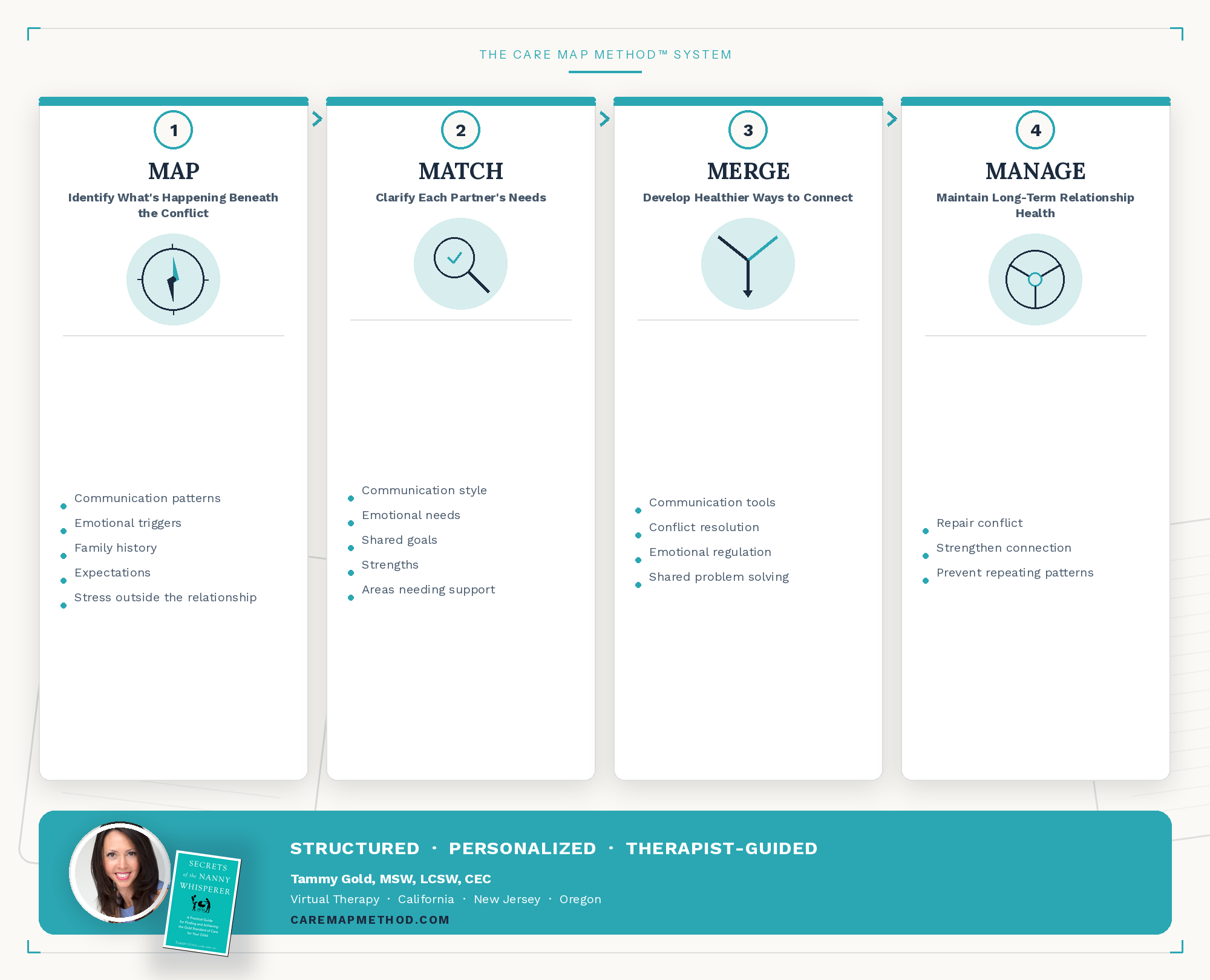
MAP → MATCH → MERGE → MANAGE
A structured, individualized framework for understanding the problem, selecting the right supports, integrating practical changes, and adjusting the plan over time.
Why small problems become recurring conflicts
Relationship conflict becomes chronic when the couple keeps trying to solve the visible disagreement without understanding the system that produces it. A partner who asks for more help may not only be requesting a completed task; they may be asking to feel less alone. A partner who becomes defensive may hear the request as proof that nothing they do is good enough.
Once this cycle is established, both people begin reacting to the pattern rather than the present moment. Tone becomes more important than content. Neutral comments are interpreted through accumulated hurt. Repair attempts are missed because each person is protecting against the next disappointment.
Signs that communication has become a system problem
You do not need to be in constant crisis to benefit from relationship therapy. Persistent patterns deserve attention, particularly when you notice several of the following:
The same argument returns without meaningful resolution
One person pursues while the other shuts down or leaves
Conversations quickly become criticism, defensiveness, contempt, or blame
Practical responsibilities feel chronically unequal
Affection and friendship have been replaced by logistics
You avoid important topics because conflict feels inevitable
External pressures such as parenting, caregiving, work, or finances dominate the relationship
One or both partners feel lonely while still together
The Care Map Method™: from argument to actionable understanding
In Care Map Method™ therapy, the goal is not simply to decide who is right. We organize the situation so that the couple can see what is happening, what each person needs, and which changes are realistic. The framework is structured but individualized.
MAP: identify what is driving the pattern
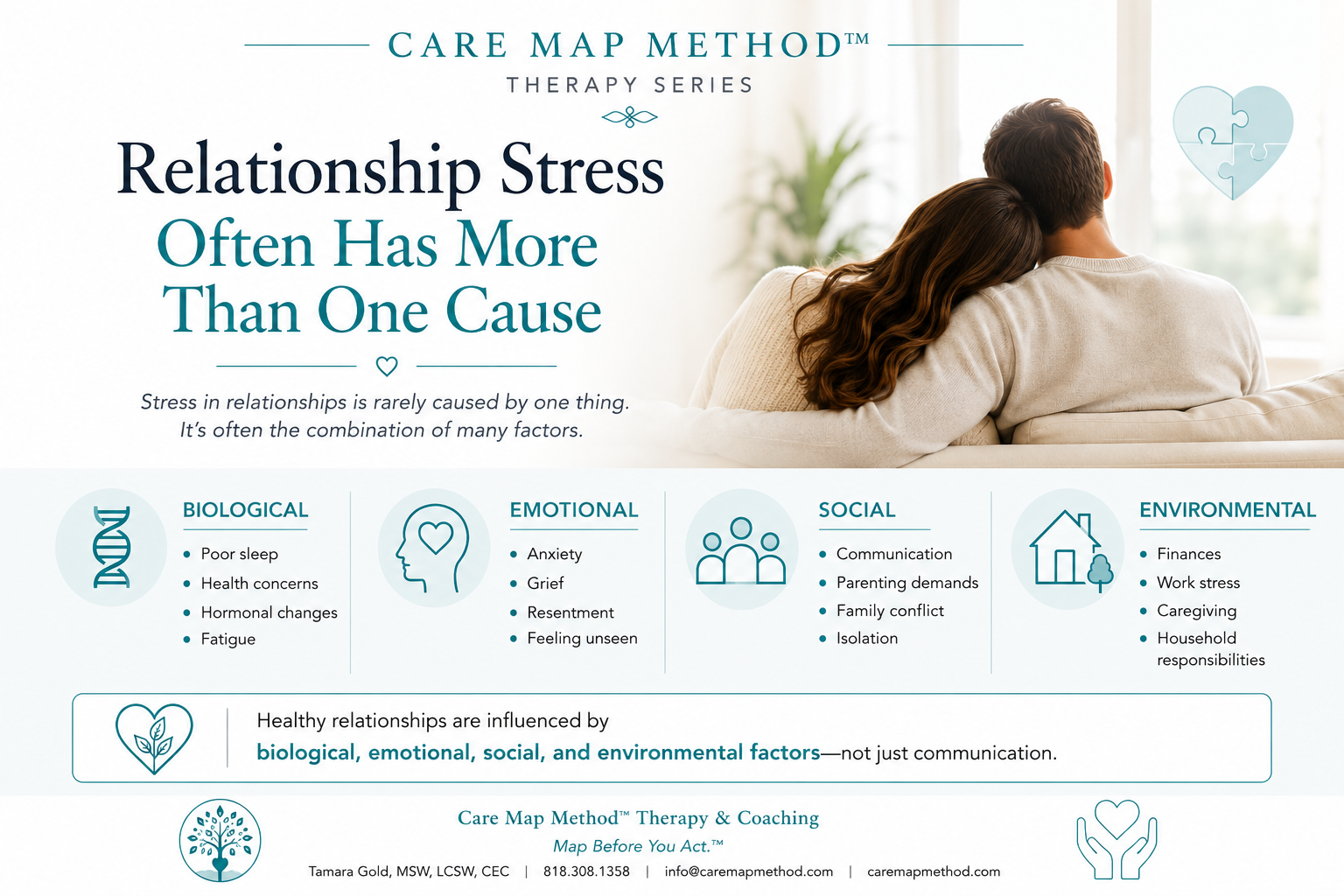
The MAP stage examines the whole relationship through biological, emotional, social, and environmental factors. Biological factors may include sleep deprivation, menopause, chronic illness, medication effects, or nervous-system activation. Emotional factors include fear, resentment, grief, shame, and unmet attachment needs. Social factors include family-of-origin patterns, parenting roles, friendships, and cultural expectations. Environmental factors include work schedules, finances, housing, technology, and the distribution of household labor.
This broader map often reduces blame. A couple may discover that a “communication problem” is being intensified by untreated exhaustion, unclear roles, or a transition they never consciously discussed.
MATCH: identify what each person and the relationship need
After the pattern is clear, therapy helps match the problem with the right supports and skills. One couple may need a reliable process for difficult conversations. Another may need stronger boundaries with extended family. Another may need to rebalance labor, rebuild trust after secrecy, or learn how to regulate before attempting resolution.
The match is specific. Generic advice is less useful than identifying the exact intervention that fits the couple’s needs, strengths, history, and current capacity.
MERGE: turn insight into new relationship practices
Insight matters only when it can be brought into daily life. During MERGE, the couple practices concrete changes: how to begin a conversation without accusation, how to request help clearly, how to pause without abandoning the discussion, and how to create agreements that are measurable rather than vague.
This may include a weekly planning conversation, a division-of-labor agreement, conflict-repair language, technology boundaries, or a plan for handling recurring family stress. The purpose is not to make the relationship mechanical. It is to create enough structure that connection is not repeatedly sacrificed to chaos.
MANAGE: maintain progress when life becomes stressful again
Every relationship encounters new stress. The MANAGE stage focuses on recognizing early warning signs, reviewing agreements, and adjusting the plan before old patterns fully return. Couples learn to ask: What has changed? Which support is no longer working? What needs to be renegotiated?
This turns therapy into a transferable process rather than a temporary improvement that depends on everything remaining calm.
What solution-focused relationship therapy can produce
Therapy cannot guarantee that every relationship will continue, and it should not pressure anyone to remain in an unsafe situation. It can, however, help people understand their patterns, communicate more accurately, make decisions with greater clarity, and develop practical tools for the relationship they are trying to build.
For many couples and family members, the most meaningful change is moving from “We keep having the same fight” to “We understand the cycle, know what each of us needs, and have a plan for what to do next.”
When to seek support
Consider reaching out when conflict is repetitive, emotional distance is increasing, major transitions are exposing unresolved differences, or attempts to solve the problem independently keep producing the same outcome. Early support is often more effective than waiting until resentment has hardened into hopelessness.
Ready to talk?
If this issue is affecting your emotional health, relationships, work, or daily functioning, support is available. Tammy Gold provides virtual therapy for adults in California, New Jersey, and Oregon. Schedule through Tammy Gold’s Psychology Today profile
About Tammy Gold
Tammy Gold, MSW, LCSW, CEC, is the founder of Care Map Method™, a licensed clinical social worker in California, New Jersey, and Oregon, a certified coach, and the author of Secrets of the Nanny Whisperer. She helps adults and families navigate relationships, caregiving, burnout, parenting, work stress, and major life transitions through a structured, practical, relationship-centered approach.
Educational notice: This article is for general educational purposes and is not a substitute for individualized medical, legal, or mental health care. If you are experiencing an emergency or immediate safety concern, contact local emergency services or an appropriate crisis resource.

Preschool Parenting Support: Create a Personalized Care Map for Your Child
Preschoolers are developing independence, emotional regulation, communication, friendships, and school-readiness skills. The Care Map Method™ Preschool Coaching Session helps parents understand their child’s biological, emotional, social, and environmental needs and create a practical plan for behavior, routines, development, preschool, and family life.
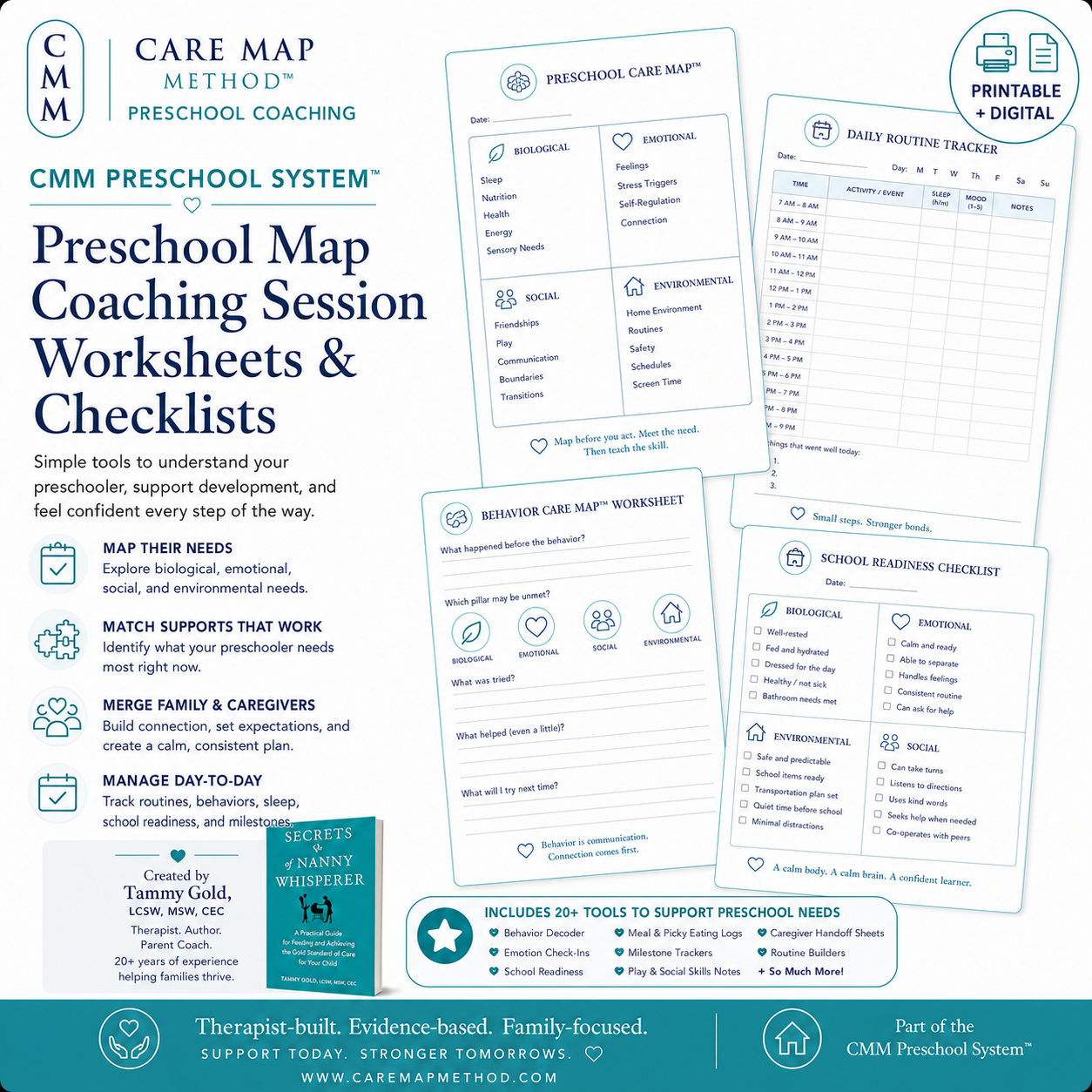
The preschool years bring enormous growth.
Between approximately ages three and five, children develop more language, imagination, independence, physical ability, and interest in friendships. They may appear remarkably grown-up one moment and become completely overwhelmed the next.
A preschooler might tell an elaborate story but struggle to explain why they hit a friend. They may insist on doing everything independently but become upset when a task feels difficult. They may follow routines at school while resisting those same routines at home.
Parents often wonder:
Is this behavior developmentally typical?
Is my child ready for preschool or kindergarten?
How should I respond to meltdowns, defiance, or aggression?
Why does my child behave well at school but fall apart at home?
Should I be concerned about language, sensory needs, or social skills?
How can teachers, parents, and caregivers respond consistently?
The Care Map Method™ Preschool Care Map Coaching Session helps parents look beyond a single behavior and understand the whole child.
Instead of asking only, “How do I stop this behavior?” we explore a more helpful question:
What is this behavior communicating, and what skill or support does this child need?
What is preschool parent coaching?
Preschool parent coaching is a personalized service that helps parents understand their child’s behavior, development, routines, relationships, and learning environment.
A Care Map Method™ Preschool Coaching Session may address:
Meltdowns and emotional regulation
Defiance and power struggles
Hitting, yelling, grabbing, or impulsive behavior
Separation anxiety
Preschool adjustment
Kindergarten readiness
Friendship and social difficulties
Sleep and bedtime
Picky eating and mealtime stress
Toilet-learning challenges or regression
Language and communication
Sensory sensitivities
Sibling conflict
Parent and caregiver consistency
Choosing a preschool, nanny, or after-school caregiver
Coaching does not begin with the assumption that the child is misbehaving intentionally. We look at developmental ability, temperament, stress, routines, relationships, and environmental demands before creating a plan.
Preschool behavior is often a clue
A preschooler’s behavior can tell us something important—even when the behavior itself needs to be stopped.
A child who refuses to get dressed may be seeking control, struggling with a transition, disliking the clothing’s texture, or feeling anxious about school.
A child who pushes classmates may lack the language or impulse control to protect their space appropriately.
A child who behaves well at preschool but melts down after returning home may have spent the day working hard to follow directions, manage sensory stimulation, and navigate social demands.
Understanding what is beneath a behavior does not mean removing boundaries. It allows parents to respond with both firmness and insight.
The child still needs a clear limit—but may also need rest, practice, visual support, simpler directions, sensory accommodation, or help learning a replacement skill.
Start with the B/E/S/E Preschool Care Map
The Care Map Method™ examines four connected areas of a child’s life: Biological, Emotional, Social, and Environmental needs.
Biological needs
A preschooler’s physical condition can strongly influence behavior, attention, learning, and emotional regulation.
Biological needs may include:
Sleep and rest
Hunger and nutrition
Physical activity
Toileting
Hearing and vision
Speech and language development
Fine- and gross-motor development
Sensory needs
Illness, pain, or discomfort
Medical and dental care
A child who appears oppositional may be tired, hungry, uncomfortable, overstimulated, or unable to complete the task being requested.
Persistent concerns involving sleep, feeding, hearing, speech, movement, toileting, growth, or development should be discussed with the child’s pediatric healthcare provider or an appropriately qualified specialist.
Emotional needs
Preschoolers have strong feelings but are still developing the ability to understand and manage them.
Emotional support may include:
Naming feelings
Recognizing early signs of overwhelm
Practicing calming strategies
Creating predictable routines
Preparing for transitions
Offering appropriate choices
Setting calm and consistent limits
Supporting confidence and independence
Reconnecting after difficult moments
Understanding the child’s temperament
Children gradually learn regulation through repeated experiences of co-regulation with trusted adults. The goal is not to prevent every difficult feeling. It is to help the child experience feelings safely and build skills for handling them.
Social needs
Preschoolers are learning how to participate in relationships outside the family.
Developing social skills may include:
Joining play
Sharing space and materials
Waiting and taking turns
Expressing preferences
Respecting personal space
Asking for help
Handling disappointment
Repairing after conflict
Understanding simple group expectations
Developing friendships
A child may be social and confident in one setting but quiet or overwhelmed in another. Social development should be considered in the context of temperament, language, sensory needs, familiarity, and the demands of the environment.
Environmental needs
The environment can either support a preschooler’s developing abilities or repeatedly ask for more than the child can manage.
Environmental factors include:
Household routines
Preschool classroom size and structure
Noise, lighting, and activity level
Transition warnings
Visual schedules
Child-accessible organization
Opportunities for movement
Quiet recovery spaces
Screen use
Family schedules
Consistency between home, school, and caregivers
Sometimes the most effective intervention is an environmental adjustment.
A visual morning routine may reduce repeated reminders. A quiet decompression period after preschool may prevent an afternoon meltdown. Fewer toys available at once may improve play and reduce overwhelm.
Use MAP, MATCH, MERGE, and MANAGE for preschool care
The Care Map Method™ turns information about the child into an organized, practical plan.
MAP the Need
We assess the child’s biological, emotional, social, and environmental needs while considering family routines, school expectations, caregiver arrangements, and parent concerns.
We may look for patterns such as:
When and where does the behavior occur?
What happens immediately before it?
Is the child tired, hungry, rushed, or overstimulated?
Does the behavior happen at home, school, or both?
Are expectations appropriate for the child’s age and current skills?
Are different adults responding in different ways?
What helps the child recover?
This prevents families from treating every behavior as a separate problem when several behaviors may share the same underlying trigger.
MATCH the Care
Next, we identify the right type of support for each need.
Support might include:
A pediatrician
A preschool teacher
A speech-language pathologist
An occupational therapist
A developmental specialist
A feeding professional
A child mental health professional
An educational consultant
A parent coach
A nanny or babysitter
Early-childhood or school-district services
Not every challenge requires professional treatment. Coaching helps families determine what may improve with new strategies or routines and what warrants additional evaluation.
MERGE the Support
Parents, teachers, nannies, grandparents, and other caregivers should understand the child’s essential needs and the family’s central expectations.
A shared Preschool Care Map may include:
Daily routines
Sleep and mealtime information
Toileting language and expectations
Transition strategies
Calming and regulation tools
Responses to aggression or unsafe behavior
Social-development goals
Sensory preferences
Medical and safety information
Communication between home and school
Approved discipline and redirection approaches
Every adult will have an individual style. The goal is not rigid uniformity. It is enough consistency to help the child feel safe and understand what to expect.
MANAGE the Plan
Preschoolers change quickly. As their language, confidence, friendships, routines, and school expectations develop, their care plans should develop too.
Families can regularly review:
What is working?
What remains difficult?
Has the child gained new skills?
Are expectations still developmentally appropriate?
Are home and school communicating effectively?
Does the environment support the child?
Is the current school or care arrangement still a good fit?
Is additional professional guidance needed?
A Preschool Care Map is a living plan, not a permanent label.
Why preschoolers sometimes fall apart at home
Some children hold themselves together throughout the preschool day and release their accumulated emotions when they return to the safety of home.
This can look like:
Crying over a small request
Refusing ordinary routines
Fighting with siblings
Becoming unusually controlling
Increased clinginess
Hyperactive or silly behavior
Difficulty deciding what they want
A sudden meltdown
This does not necessarily mean the child is manipulative or that something is wrong at school. The child may simply be tired from managing transitions, noise, instructions, peer interactions, and separation.
A gentle after-school routine may include:
A warm greeting without many questions
Food and water
Physical connection or quiet companionship
Free movement or outdoor play
Reduced demands
A predictable transition into the evening
Parents can remain consistent with limits while acknowledging that the child’s capacity may be lower after a demanding day.
Teaching emotional regulation before the meltdown
Preschoolers cannot learn complex coping skills while they are completely overwhelmed. Regulation strategies should be practiced during calm moments.
Helpful skills may include:
Naming feelings
Taking slow breaths
Asking for help
Using a quiet space
Pushing against a wall
Squeezing a pillow
Getting a drink of water
Choosing between two solutions
Using a phrase such as “I need a break”
Practicing what to do when another child says no
During a meltdown, parents can use short, steady language:
“You’re upset. I’m here.”
“I won’t let you hit.”
“It’s okay to be angry. It’s not okay to hurt.”
“We can talk when your body is calmer.”
“You wanted more time. It is still time to leave.”
The adult’s job is to keep everyone safe, maintain the limit, and help the child return to regulation.
Is my child ready for preschool or kindergarten?
School readiness involves more than recognizing letters, numbers, shapes, and colors.
A child’s readiness may also include the ability to:
Separate from a parent with support
Communicate basic needs
Follow simple directions
Participate in a group for short periods
Manage toileting at the level expected by the program
Move between activities
Recover from disappointment with adult help
Interact safely with peers
Ask for assistance
Handle the sensory demands of the classroom
Children develop unevenly. A child may have advanced academic skills while needing more support with regulation or social interaction. Another child may be highly social but need help with language or fine-motor tasks.
The right question is not simply, “Is my child smart enough?” It is:
What setting and support will help this child function, learn, and feel secure?
Choosing the right preschool or caregiver
A preschool should be matched to the child—not selected only because it is popular, academically impressive, or convenient.
Parents may want to consider:
Classroom size
Child-to-teacher ratio
Teaching style
Daily schedule
Expectations for sitting and group participation
Opportunities for movement and outdoor play
Discipline practices
Communication with parents
Support for separation
Experience with sensory, language, or developmental differences
Teacher warmth and responsiveness
How the program handles conflict and strong emotions
Similarly, a nanny or babysitter should understand the child’s temperament, routines, communication style, and regulation needs.
The best placement is one in which the caregiver can respond to the whole child.
When might preschool coaching help?
A Care Map Method™ Preschool Coaching Session may be helpful when:
Meltdowns or power struggles are affecting family life
Your child is hitting, yelling, grabbing, or acting impulsively
You are concerned about social skills or friendships
Your child resists preschool or separation
Your child behaves differently at home and school
You are deciding between preschool programs
You are preparing for kindergarten
You and your partner disagree about discipline
Sleep, meals, or toileting have become stressful
Your child is adjusting to a sibling, move, divorce, or family change
Parents, teachers, and caregivers need a more consistent approach
You are unsure whether a concern requires professional evaluation
You do not have to wait for a crisis. A care map can help organize concerns and identify the next appropriate step.
What happens during a CMM Preschool Care Map Coaching Session?
The session is personalized to your child’s age, temperament, routines, school experience, and family needs.
Together, we can:
Complete a B/E/S/E Preschool Care Map
Identify possible triggers behind behavior
Review sleep, eating, toileting, play, and routines
Explore emotional regulation and sensory needs
Develop age-appropriate behavior strategies
Create scripts for limits, transitions, and social conflicts
Evaluate preschool or caregiver fit
Improve communication between home, school, and caregivers
Identify areas that may need professional evaluation
Develop a personalized family action plan
Parents leave with organized priorities, usable language, and practical next steps.
Frequently asked questions about preschool coaching
Is preschool coaching only for children with behavior problems?
No. Families may use coaching for ordinary developmental challenges, school transitions, routine difficulties, discipline questions, caregiver communication, or preschool selection.
Can coaching help with preschool meltdowns?
Yes. Coaching can help identify triggers, determine which skills the child needs, adjust routines or environmental demands, and create a consistent adult response.
Can you help us decide whether our child is ready for kindergarten?
Coaching can help parents organize observations about regulation, communication, social functioning, independence, routines, and classroom participation. Formal developmental or educational assessments should be completed by appropriately qualified professionals.
Can you help us choose a preschool?
Yes. The Care Map Method™ helps parents define what their individual child needs and use that profile to evaluate programs, teachers, classroom environments, and transition plans.
Can teachers, nannies, or other caregivers participate?
Yes. Including central caregivers can improve communication and create a more consistent plan across settings.
Does preschool coaching replace developmental or mental health care?
No. Coaching provides education, care planning, and parenting support. Medical, developmental, speech, sensory, educational, or mental health concerns should be evaluated by the appropriate professional.
Your child needs understanding and structure—not perfection
Preschoolers are learning how to function in a much larger world. They need room to develop while also receiving safe limits, predictable routines, and patient teaching.
Parents do not need a perfect response to every difficult moment. They need a clearer understanding of their child and a practical plan that can grow as the child does.
Map before you act.
Care Map Method™ Preschool Care Map Coaching Session
The Care Map Method™ Preschool Care Map Coaching Session helps parents understand their child’s behavior, development, emotional regulation, social needs, routines, and learning environment.
Your personalized session may include:
A complete B/E/S/E Preschool Care Map
Behavior and trigger assessment
Emotional-regulation and communication strategies
Sleep, mealtime, toileting, and routine review
Parent scripts for boundaries and transitions
Preschool selection or adjustment support
Kindergarten-readiness planning
Parent, teacher, and caregiver communication tools
A personalized action plan and next steps
Built by a therapist. Backed by science. Designed for real family life.
Schedule a Care Map Method™ Preschool Coaching Session
Care Map Method™ coaching provides education, care planning, and parenting support. It does not replace pediatric, medical, developmental, educational, speech, occupational-therapy, or mental-health evaluation and treatment.

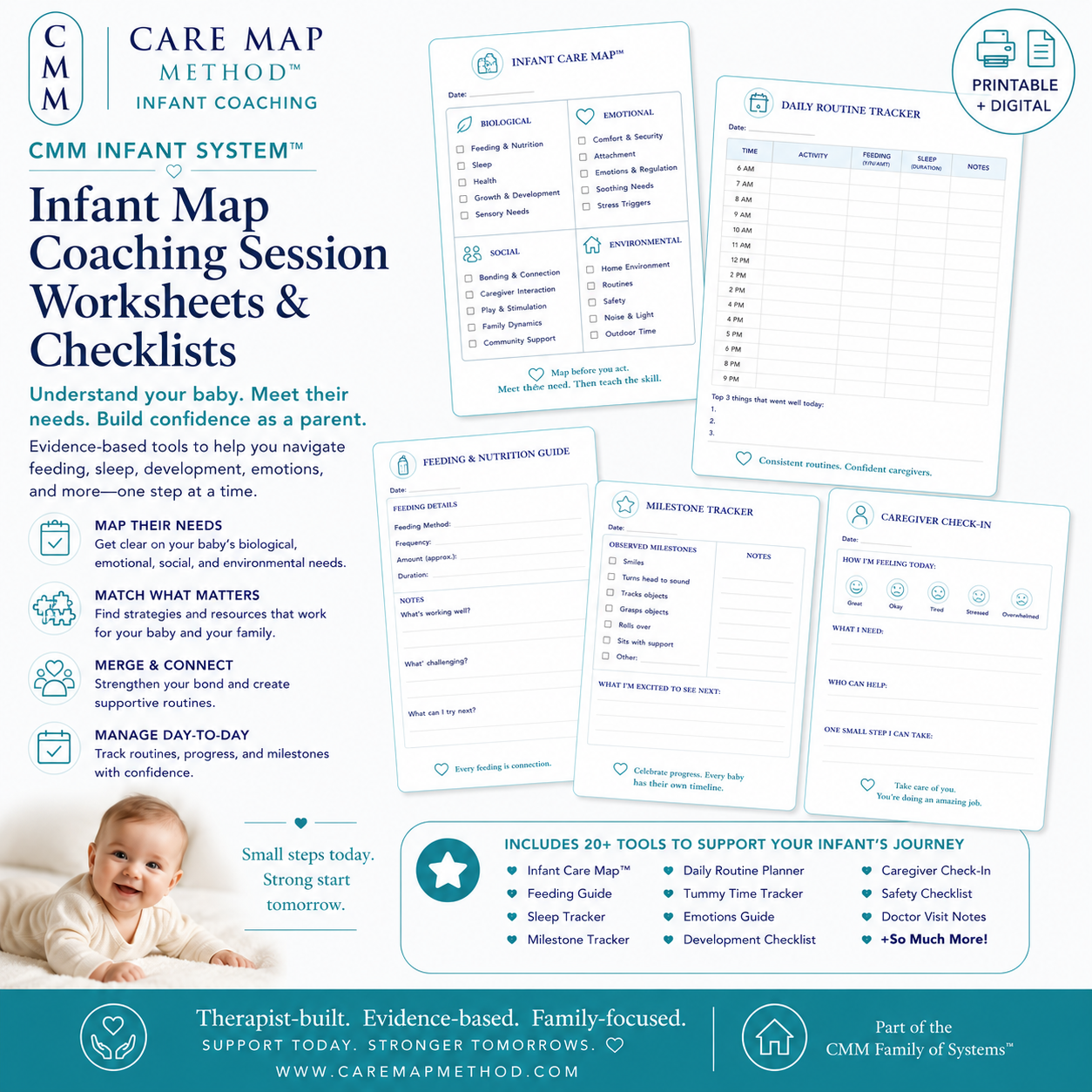
Infant Care Coaching: Create a Personalized Care Plan for Your Baby and Family
Every baby—and every family—is different. The Care Map Method™ Infant Coaching Session helps parents understand their baby’s biological, emotional, social, and environmental needs and create a practical plan for feeding, sleep, soothing, development, childcare, and family support.
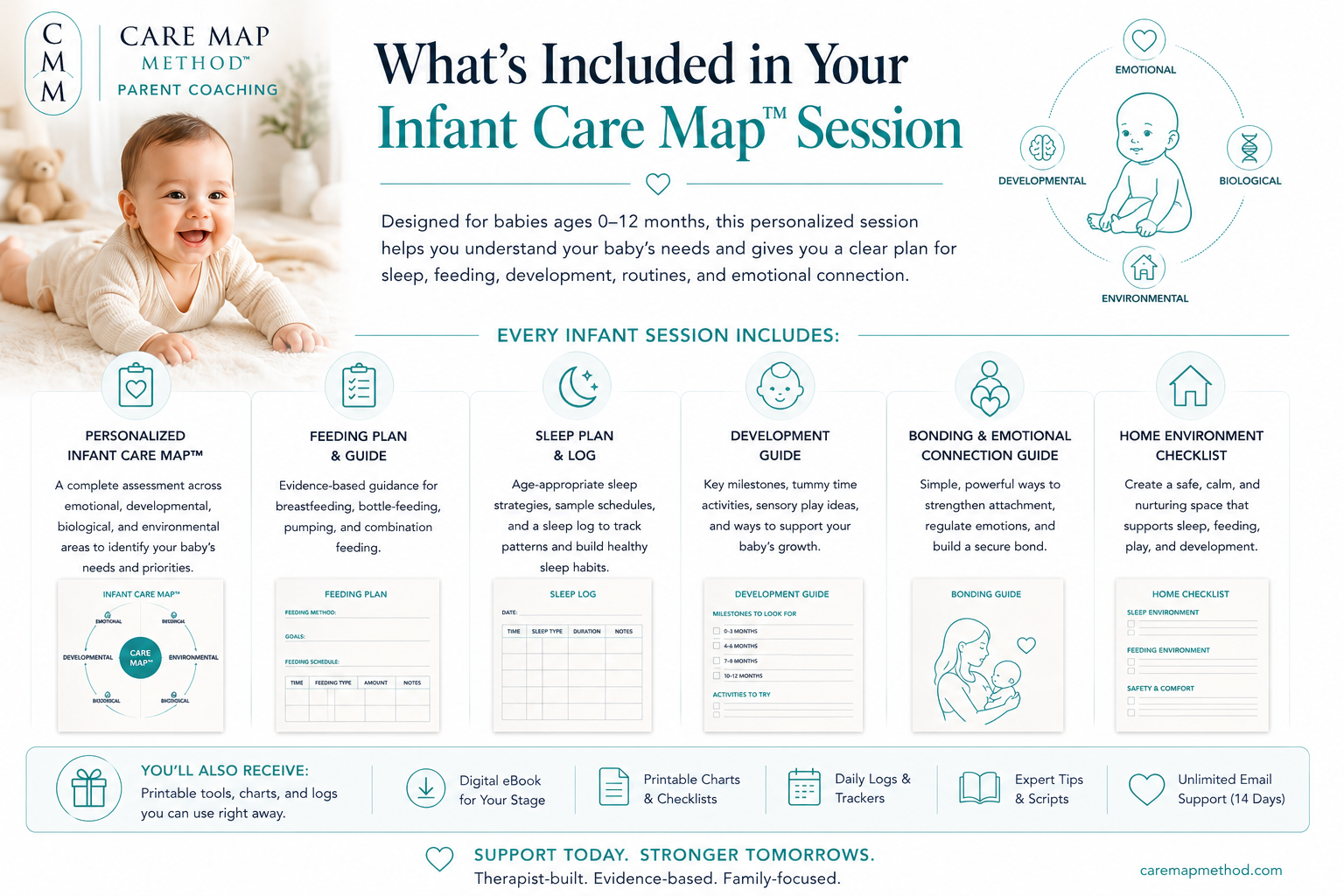
Bringing home a baby can be joyful, exhausting, and overwhelming—all at the same time.
New parents are often surrounded by advice about feeding, sleep, schedules, soothing, development, childcare, and what they “should” be doing. But much of that advice is generic, conflicting, or disconnected from the realities of the individual baby and family.
One baby may settle easily but struggle with feeding. Another may feed well but wake frequently. A parent may understand what the baby needs but lack enough practical support to meet those needs consistently.
The Care Map Method™ Infant Coaching Session helps parents step away from one-size-fits-all advice and look at the whole picture.
Instead of beginning with, “What schedule should my baby follow?” we begin with a more useful question:
What does this baby—and this family—need right now?
What is infant care coaching?
Infant care coaching is a structured, personalized service that helps parents understand their baby’s needs, organize daily care, identify areas of stress, and create practical routines and support systems.
During a Care Map Method™ Infant Coaching Session, we explore:
Feeding and sleeping patterns
Crying, soothing, and regulation
Infant temperament and sensory preferences
Bonding and attachment
Age-appropriate development and play
Parent exhaustion and emotional well-being
Family routines and division of responsibilities
Childcare and caregiver support
Home organization and infant safety
Communication between parents and caregivers
Infant coaching does not replace pediatric medical care. It provides education, planning, problem-solving, and family support around the day-to-day experience of caring for a baby.
Why generic infant advice does not always work
Parents are frequently told to follow a particular schedule, sleep approach, feeding system, or parenting philosophy. But a plan that works beautifully for one baby may be completely wrong for another.
Babies differ in their:
Temperament
Feeding needs
Sleep patterns
Sensory sensitivity
Ability to transition between activities
Response to noise, light, touch, and movement
Need for physical closeness
Developmental pace
Medical history
Adaptability to different caregivers
Families also differ. Work schedules, culture, finances, living arrangements, parental health, sibling needs, and available support all influence what is realistic.
A useful infant-care plan must consider both the baby and the family caring for that baby.
Start with the Care Map Method™ B/E/S/E assessment
The Care Map Method™ examines four connected areas of care: Biological, Emotional, Social, and Environmental needs.
Biological needs
A baby’s biological care includes the physical foundations of well-being:
Feeding patterns and concerns
Sleep and wake windows
Diapering and digestion
Growth and pediatric care
Physical comfort
Motor development
Signs of illness or discomfort
Age-appropriate routines
Parents may benefit from keeping simple records of feeding, sleep, crying, and other patterns. These observations can help the family—and the baby’s pediatrician—understand what may be contributing to a concern.
Questions that involve feeding difficulties, poor weight gain, illness, breathing, persistent pain, unusual lethargy, or developmental concerns should always be discussed with the baby’s pediatric healthcare provider.
Emotional needs
Babies communicate their emotional and regulatory needs through facial expressions, body movement, sounds, crying, and changes in alertness.
Emotional care includes:
Responsive caregiving
Comfort and soothing
Secure attachment
Recognizing hunger, fatigue, and overstimulation
Supporting co-regulation
Creating predictable responses
Understanding the baby’s individual temperament
Responsive care does not require parents to prevent every cry. It means becoming curious about what the baby may be communicating and responding as consistently and sensitively as possible.
Parents’ emotional health matters too. Exhaustion, anxiety, postpartum depression, birth trauma, and lack of support can make caregiving much harder. Supporting the parent is part of supporting the baby.
Social needs
Even very young babies benefit from warm and responsive social interaction.
An infant’s social world may include:
Parents
Siblings
Grandparents
Extended family
Nannies or babysitters
Daycare teachers
Healthcare professionals
Family friends and community support
The goal is not to surround the baby with constant activity. It is to build a small, safe network of caregivers who understand the baby’s cues, routines, and needs.
Social care also includes helping parents decide how to manage visitors, family expectations, differing parenting opinions, and transitions between caregivers.
Environmental needs
A baby’s environment can influence sleep, feeding, regulation, development, and safety.
Environmental factors include:
Safe sleep arrangements
Noise and light
Room temperature
Feeding and changing areas
Developmentally appropriate play spaces
Household routines
Travel and transportation
Pets and siblings
Childproofing as mobility develops
Consistency between home and childcare
The goal is not to create a perfect home. It is to create an environment that is safe, manageable, and responsive to the family’s real needs.
Apply MAP, MATCH, MERGE, and MANAGE to infant care
Once we understand the full care picture, the Care Map Method™ provides a practical path forward.
MAP the Need
We identify the baby’s biological, emotional, social, and environmental needs while also considering the parents’ capacity, concerns, schedules, and support.
The care map may uncover patterns that are easy to miss when everyone is tired. For example, a “sleep problem” may be connected to feeding, overstimulation, inconsistent routines, caregiver transitions, or an environmental factor.
MATCH the Care
Next, we determine what type of support fits each need.
Depending on the family, support may include:
A pediatrician
A lactation consultant
A postpartum mental health professional
A sleep specialist
A developmental professional
A postpartum doula
A nanny or babysitter
A daycare program
Trusted family assistance
Parent coaching
The goal is not to hire every possible professional. It is to match the right support to the actual need.
MERGE the Support
When several adults care for a baby, they need clear and consistent communication.
A practical infant care plan may include:
Feeding instructions
Sleep and soothing routines
Safe sleep expectations
Medication or health information
Emergency contacts
Preferred communication methods
Daily caregiver notes
Responsibilities for each parent or caregiver
A transition plan for returning to work or beginning childcare
Consistency does not mean that every caregiver must do everything identically. It means that everyone understands the essential expectations for the baby’s safety, comfort, and care.
MANAGE the Plan
Babies change quickly. A plan that works at eight weeks may need to be adjusted at four months.
Families can review:
What is working?
What continues to feel difficult?
Has the baby’s feeding or sleep pattern changed?
Are the parents receiving enough rest and support?
Is the childcare arrangement meeting the baby’s needs?
Are all caregivers communicating effectively?
Does the home environment need to change as the baby develops?
The infant care plan should grow along with the baby.
Common reasons parents seek infant coaching
A Care Map Method™ Infant Coaching Session may be helpful when:
You feel overwhelmed by conflicting infant-care advice
Your baby’s routines feel unpredictable
Feeding, sleep, or soothing is creating family stress
You are unsure how to recognize your baby’s cues
You and your partner disagree about infant care
You need help dividing responsibilities
You are returning to work
You are choosing a nanny, babysitter, or daycare
You need to prepare a caregiver for your baby
Your family has limited support
You want a practical care plan before the baby arrives
Your first months of parenthood feel harder than expected
Parents do not need to be in crisis to benefit from coaching. Planning early can prevent confusion and help the entire family feel more confident.
What happens during a Care Map Method™ Infant Coaching Session?
The session is tailored to the baby’s age, needs, family structure, and current challenges.
Together, we can:
Complete a Biological, Emotional, Social, and Environmental care assessment
Identify the family’s most urgent concerns
Review feeding, sleep, soothing, development, and daily routines
Explore infant temperament and individual cues
Identify appropriate professional or caregiving support
Prepare for a nanny, daycare, babysitter, or return-to-work transition
Develop caregiver instructions and communication tools
Clarify responsibilities between parents and other caregivers
Create a personalized Infant Care Map and next-step plan
Families leave with organized priorities and practical tools—not another overwhelming list of parenting rules.
Frequently asked questions about infant coaching
Is infant coaching the same as medical care?
No. Infant coaching supports parents with education, planning, routines, caregiver communication, and family decision-making. Medical, feeding, growth, or developmental concerns should be evaluated by the appropriate licensed healthcare professional.
Can infant coaching help us choose childcare?
Yes. The Care Map Method™ can help parents identify what their baby needs from a nanny, babysitter, postpartum caregiver, or daycare program. Families can then use those needs to guide interviews, trials, reference checks, onboarding, and caregiver communication.
Can both parents attend the session?
Yes. Including both parents or other central caregivers can help clarify expectations, reduce conflict, and create a more consistent plan.
Is the session only for first-time parents?
No. Infant coaching can help first-time parents, experienced parents, families with multiple children, grandparents providing care, and parents managing new or complex caregiving arrangements.
Can we have a session before our baby is born?
Yes. A prenatal infant-planning session can help families prepare feeding and sleep areas, divide responsibilities, anticipate support needs, select caregivers, and create a flexible plan for the early weeks.
You do not need a perfect routine—you need the right plan
Caring for an infant involves constant learning and adjustment. The goal is not to follow every piece of advice or create a flawless schedule.
The goal is to understand your baby, support the people providing care, and build a plan that works for your actual family.
Map before you act.
Care Map Method™ Infant Coaching Session
The Care Map Method™ Infant Coaching Session gives parents a personalized, therapist-developed framework for understanding their baby and organizing care.
Your session may include:
A complete B/E/S/E Infant Care Map
Feeding, sleep, soothing, and routine review
Infant temperament and cue guidance
Parent and family support planning
Nanny, babysitter, or daycare preparation
Caregiver communication tools
A personalized list of priorities and next steps
Built by a therapist. Backed by science. Designed for real family life.
Schedule a Care Map Method™ Infant Coaching Session
Care Map Method™ coaching provides education, planning, and family support. It does not diagnose or treat medical, developmental, feeding, sleep, or mental health conditions.

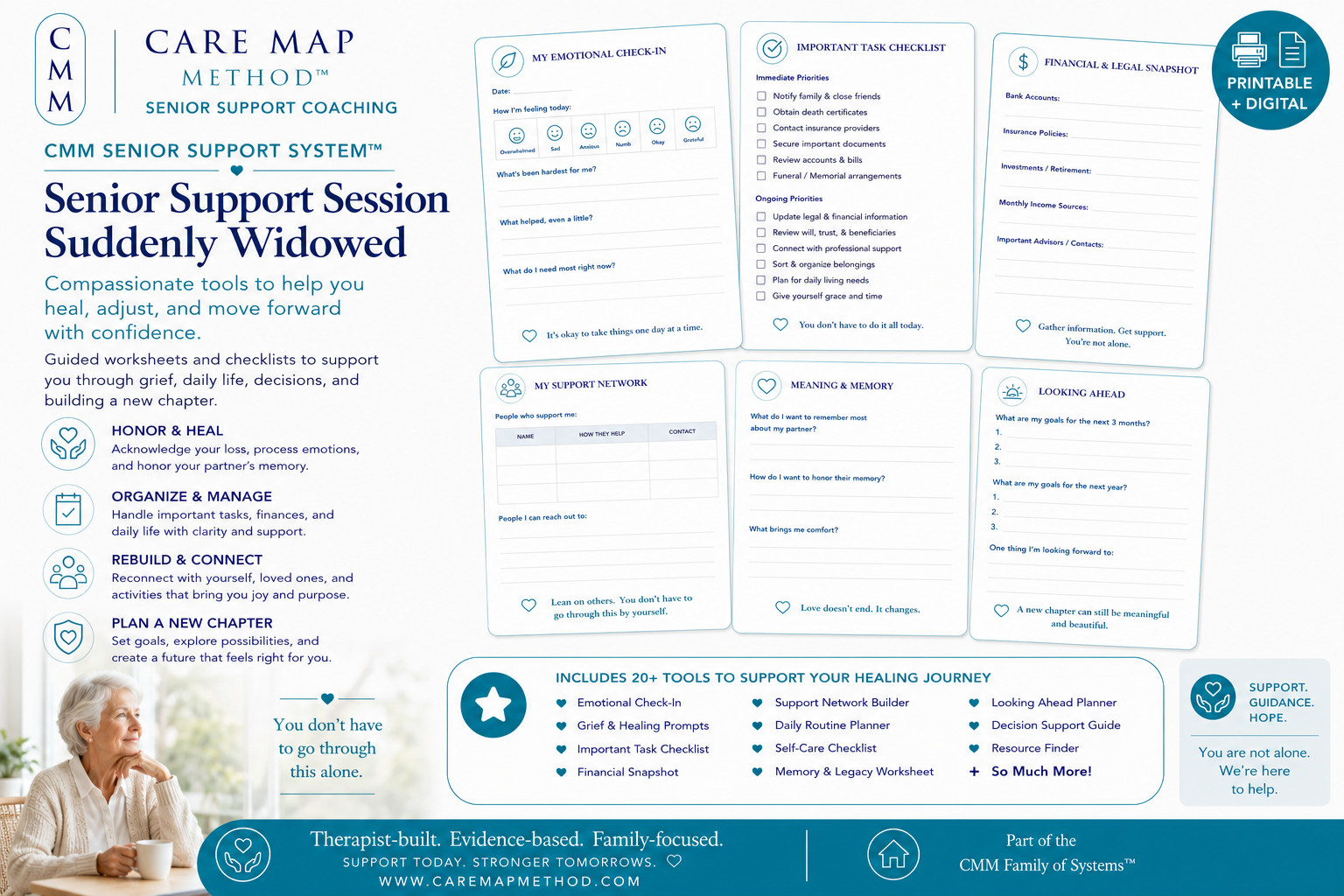
Suddenly Widowed: How to Find Your Footing When Everything Changes
The death of a spouse changes far more than relationship status. It can affect your routines, identity, home, health, finances, and sense of security. The Care Map Method™ helps newly widowed adults organize what needs attention now—without expecting them to solve everything at once.
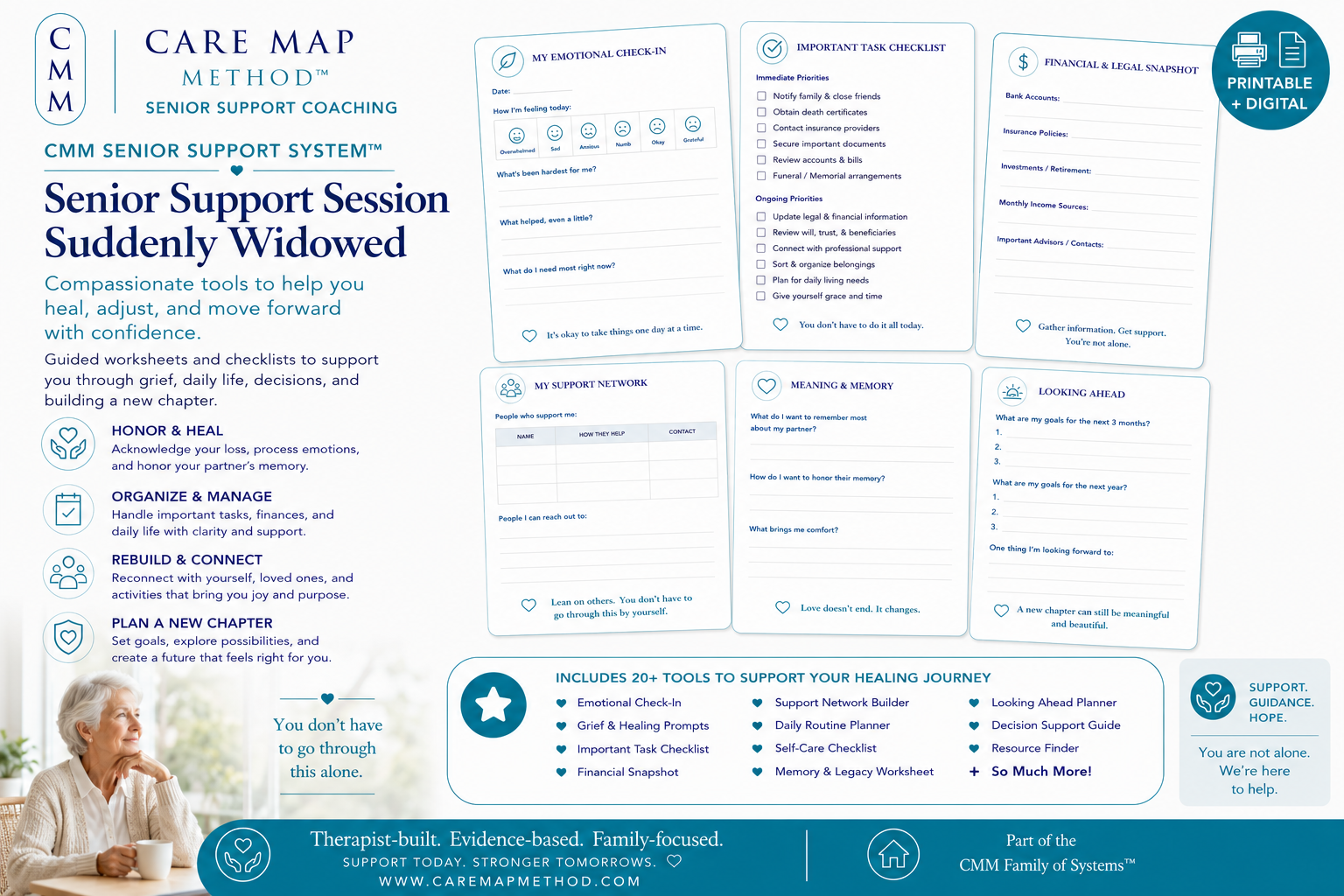
The sudden death of a spouse can make life feel unfamiliar overnight.
Along with the emotional shock, you may be facing decisions about finances, medical care, household responsibilities, transportation, legal documents, family communication, and where—or how—you want to live. Even ordinary tasks can feel difficult when the person who shared them is no longer there.
Friends and family may offer advice, but their suggestions can quickly become another source of pressure:
“You shouldn’t stay in that house alone.”
“You need to speak with an attorney.”
“You should move closer to us.”
“You have to start getting out more.”
Some of these suggestions may eventually be helpful. But immediately after losing a spouse, the goal is not to make every major decision. The goal is to understand what needs attention, identify reliable support, and create enough stability to take the next manageable step.
That is where a care map can help.
Grief affects more than emotions
Widowhood is often discussed as an emotional experience—and it certainly is. But losing a spouse can affect almost every part of daily life.
You may experience:
Difficulty sleeping or concentrating
Changes in appetite or energy
Forgetfulness and decision fatigue
Anxiety about living alone
Confusion about bills or financial accounts
Loss of familiar routines and social connections
Concern about transportation, home safety, or medical needs
Pressure from family members who disagree about what should happen next
Uncertainty about your identity and future
These responses do not mean that you are incapable. Grief places an enormous demand on the brain and body. Tasks that once felt automatic may temporarily require much more effort.
You do not have to rebuild your entire life at once.
Begin by mapping what has changed
The Care Map Method™ uses four areas—Biological, Emotional, Social, and Environmental—to help you see the whole picture.
Biological needs
Grief can affect sleep, appetite, energy, memory, medication routines, and existing health conditions.
Questions to consider include:
Are you eating and drinking regularly?
Are you taking your medications as prescribed?
Have you missed medical appointments?
Are you sleeping enough to function safely?
Do you have someone who can accompany you to important appointments?
Have you noticed new or worsening physical symptoms?
A primary care provider should be contacted when there are concerning changes in health, sleep, appetite, medication use, or functioning.
Emotional needs
There is no correct schedule for grief. You may feel sadness, numbness, anger, fear, relief, guilt, or several emotions at once.
You may also feel emotionally steady one day and overwhelmed the next. This does not mean that you are moving backward. Grief is rarely linear.
Consider:
Do you have a safe person with whom you can speak honestly?
Would individual therapy or a grief-support group be helpful?
Are family members allowing you to make decisions at your own pace?
Are you being pressured to appear “better” before you feel ready?
What helps you feel grounded during especially difficult moments?
If grief begins to feel unbearable, you cannot function safely, or you are having thoughts of harming yourself, contact a licensed mental health professional, call or text 988, or seek emergency help.
Social needs
The death of a spouse can change friendships, family roles, traditions, and everyday companionship.
Support is most effective when it is specific. Instead of telling others, “Let me know if you need anything,” family members can offer concrete help:
“I can bring dinner on Tuesday.”
“I can drive you to your appointment.”
“I can sit with you while you review the mail.”
“I can help you create a list of accounts without making decisions for you.”
“Would you like company, or would you prefer quiet time today?”
A newly widowed person needs support without losing independence or authority over personal decisions.
Environmental needs
The home may feel different after a spouse dies. It can hold comforting memories while also presenting practical challenges.
Questions may include:
Do you feel physically safe at home?
Did your spouse manage repairs, transportation, technology, finances, or medications?
Are there fall risks or maintenance concerns?
Do you need temporary household assistance?
Is there a trusted emergency contact nearby?
Would small modifications make the home easier to manage?
It is usually unnecessary to decide immediately whether to sell the home or move. Unless there is an urgent safety or financial problem, it may be helpful to stabilize daily life before making an irreversible decision.
Map before you act
Following a loss, people are often pushed toward major choices while they are still in shock. A care map helps separate urgent matters from decisions that can wait.
Needs that may require immediate attention
Personal safety
Food, hydration, sleep, and medication
Care for pets or dependents
Funeral or memorial arrangements
Access to money for immediate expenses
Time-sensitive legal or insurance notifications
Transportation and essential appointments
Decisions that may be able to wait
Selling the home
Giving away personal belongings
Moving to a new community
Making major investments
Changing long-term living arrangements
Allowing someone else to take permanent control of finances
Making decisions primarily to relieve another person’s anxiety
Pausing is not the same as avoiding. It can be a protective and thoughtful choice.
Use the Care Map Method™ to build support
Once your needs are visible, the next steps become easier to organize.
MAP the Need
Identify what has changed across your biological, emotional, social, and environmental life. Separate urgent needs from longer-term concerns.
MATCH the Care
Determine what kind of support fits each need. This might include a physician, therapist, grief group, financial professional, attorney, home-care provider, family member, companion, or household assistant.
Not every problem should be handed to the same person. Matching the right support to the right need reduces confusion and helps protect your independence.
MERGE the Support
Create a clear plan for how family members and professionals will work together.
This may include:
Who will help with appointments
Who can be contacted in an emergency
Which family member will help with paperwork
How financial and legal professionals will communicate with you
What information may be shared—and with whom
Which decisions remain entirely yours
Support should be coordinated around you, not around the preferences of everyone offering advice.
MANAGE the Plan
Your needs may change as the initial shock subsides. Review the plan regularly and adjust it.
Ask:
What is working?
What still feels overwhelming?
Where am I receiving too much help—or not enough?
Are other people respecting my choices?
What decision feels manageable now?
What can still wait?
A care plan is not a permanent declaration about your future. It is a living guide that can change as you do.
How adult children and family members can help
Family members may want to take immediate action because they are grieving and frightened too. But taking over can unintentionally make a widowed parent feel even more powerless.
The most supportive approach is to:
Ask before organizing, discarding, or moving belongings
Avoid pressuring the person to sell or leave the home
Offer two or three manageable choices instead of an overwhelming list
Put important information in writing
Repeat information patiently when needed
Distinguish temporary grief-related difficulty from permanent incapacity
Include the widowed person in every decision affecting their life
Seek professional guidance when family members disagree
The goal is not to remove every responsibility. It is to provide the right amount of support while preserving dignity, choice, and control.
You do not have to know what comes next
After losing a spouse, the future may feel impossible to picture. You do not need to create a new life plan immediately.
Start smaller:
What needs attention today?
What can wait until next week?
Who is one safe person you can contact?
What would make tomorrow feel slightly more manageable?
A compassionate plan does not rush grief. It creates structure around it.
Care Map Method™ Suddenly Widowed Senior Support Session
The Care Map Method™ Suddenly Widowed Senior Support Session helps newly widowed adults and their families organize immediate needs, reduce decision overload, and create a personalized support plan.
During the session, we can:
Map biological, emotional, social, and environmental needs
Separate urgent concerns from decisions that can wait
Identify gaps in daily and professional support
Clarify family roles and communication
Create questions for medical, legal, financial, or care professionals
Develop a practical next-step plan
Protect the widowed adult’s independence and voice
Map before you act. You do not have to navigate the next chapter alone.
Schedule a Care Map Method™ Senior Support Coaching Session
Care Map Method™ coaching provides education, planning, and support. It does not replace medical, mental health, legal, or financial advice.

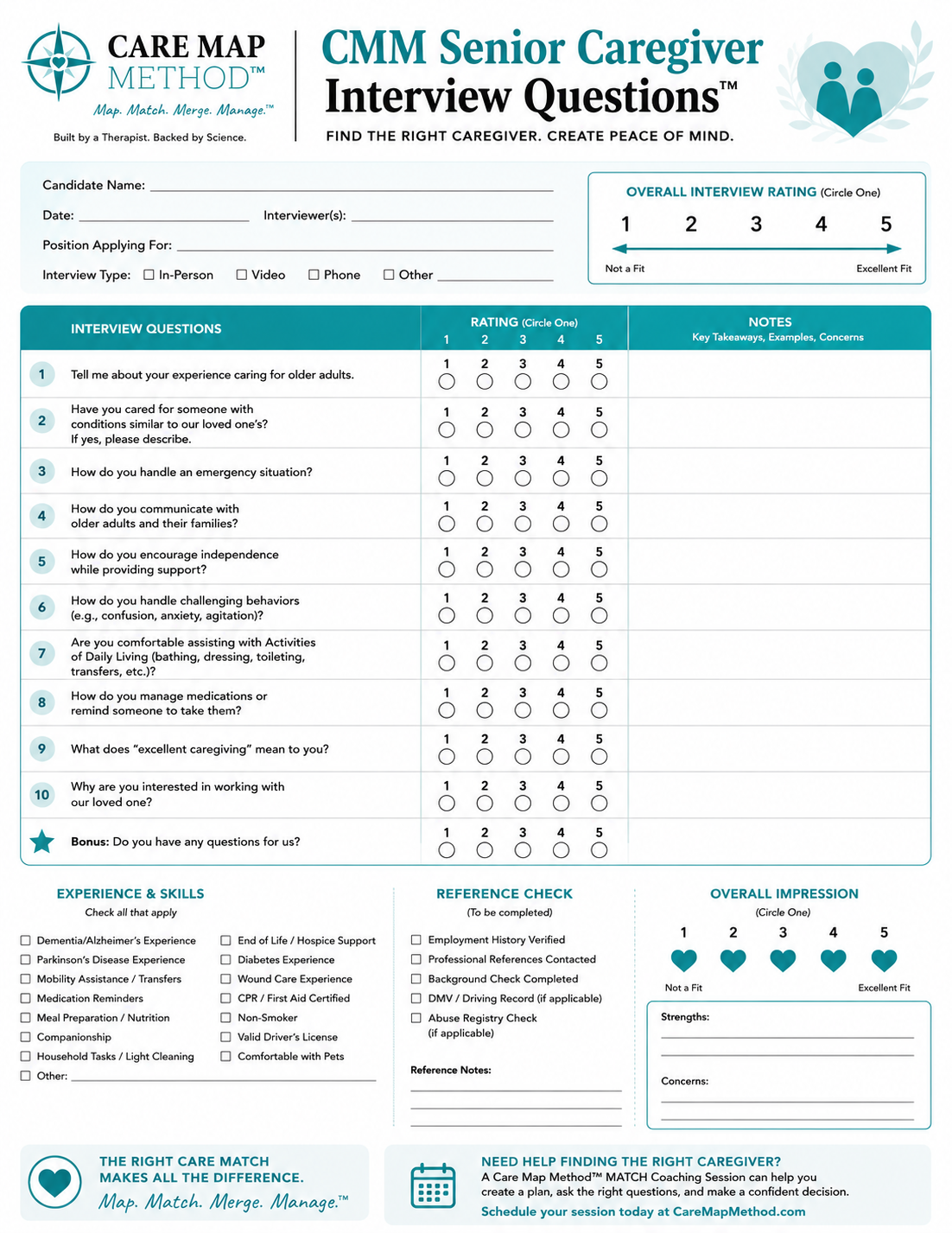
How to Choose the Right Caregiver for Your Aging Parent: 10 Questions Every Family Should Ask
Finding the right caregiver is about more than experience. Learn the interview questions, red flags, and evaluation strategies that help families choose the best caregiver for their loved one.
Hiring a caregiver is about much more than filling an open position.
You're inviting someone into your loved one's home, daily routine, and life.
The right caregiver can improve safety, independence, confidence, and quality of life.
The wrong caregiver can create stress, confusion, poor communication, and unnecessary turnover.
At Care Map Method™, we believe the best outcomes begin with the right match.
Why Matching Matters
Families often focus on credentials alone.
Experience is important—but it isn't everything.
A successful caregiving relationship also depends on:
Personality
Communication style
Patience
Reliability
Flexibility
Family expectations
Medical needs
Emotional compatibility
Finding someone who fits all of these areas requires more than a résumé.
10 Questions Every Family Should Ask
1. Tell me about your caregiving experience.
Listen for specific examples rather than general answers.
2. Have you worked with someone who has similar medical needs?
Examples include:
Dementia
Parkinson's disease
Stroke recovery
Diabetes
Mobility limitations
3. How would you handle an emergency?
You're looking for calm decision-making and sound judgment.
4. How do you communicate with families?
Good caregivers communicate clearly, consistently, and respectfully.
5. Tell me about a difficult caregiving situation.
Past experiences often predict future performance.
6. How do you encourage independence?
Great caregivers support rather than take over.
7. Are you comfortable assisting with Activities of Daily Living?
Examples include:
Bathing
Dressing
Transfers
Toileting
Meal preparation
8. What does excellent caregiving mean to you?
This question reveals values more than skills.
9. Why are you interested in this position?
Look for genuine compassion rather than generic responses.
10. What questions do you have for us?
Excellent caregivers usually ask thoughtful questions.
Don't Forget References
Always verify:
Employment history
Reliability
Attendance
Communication
Strengths
Areas for growth
References often reveal details that interviews do not.
Watch for Red Flags
Be cautious if a caregiver:
Speaks negatively about previous employers
Cannot explain gaps in employment
Avoids answering questions
Arrives late without explanation
Has inconsistent references
Download Our Caregiver Interview Questions™ Worksheet
(Insert your worksheet here.)
Our printable worksheet helps families compare candidates objectively, take organized notes, and feel more confident during the hiring process.
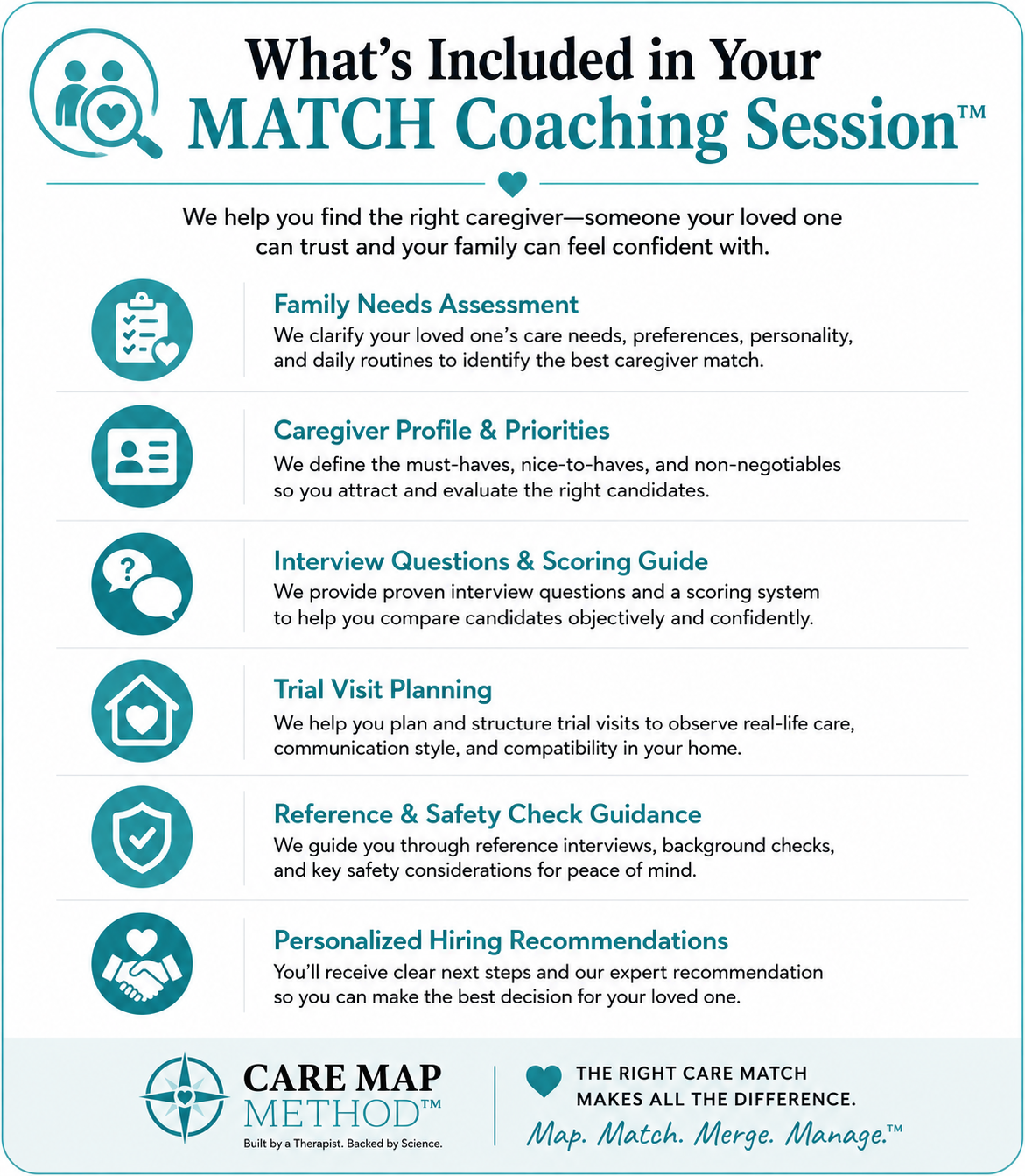
How a Care Map Method™ MATCH Coaching Session Can Help
Choosing a caregiver can feel overwhelming.
During your personalized MATCH Coaching Session™, we'll help you:
Clarify your family's care needs
Create the ideal caregiver profile
Prioritize must-have qualifications
Review interview questions
Plan trial visits
Evaluate references and safety considerations
Compare candidates objectively
Make a confident hiring decision
Our goal is to help you find the caregiver who best fits your loved one's needs—not simply the first available applicant.
Ready to Find the Right Caregiver?
The right caregiver can make daily life safer, calmer, and more fulfilling for your loved one—and for your entire family.
If you're preparing to hire in-home care, our Care Map Method™ MATCH Coaching Session provides expert guidance to help you make an informed decision with confidence.
Book your MATCH Coaching Session today.
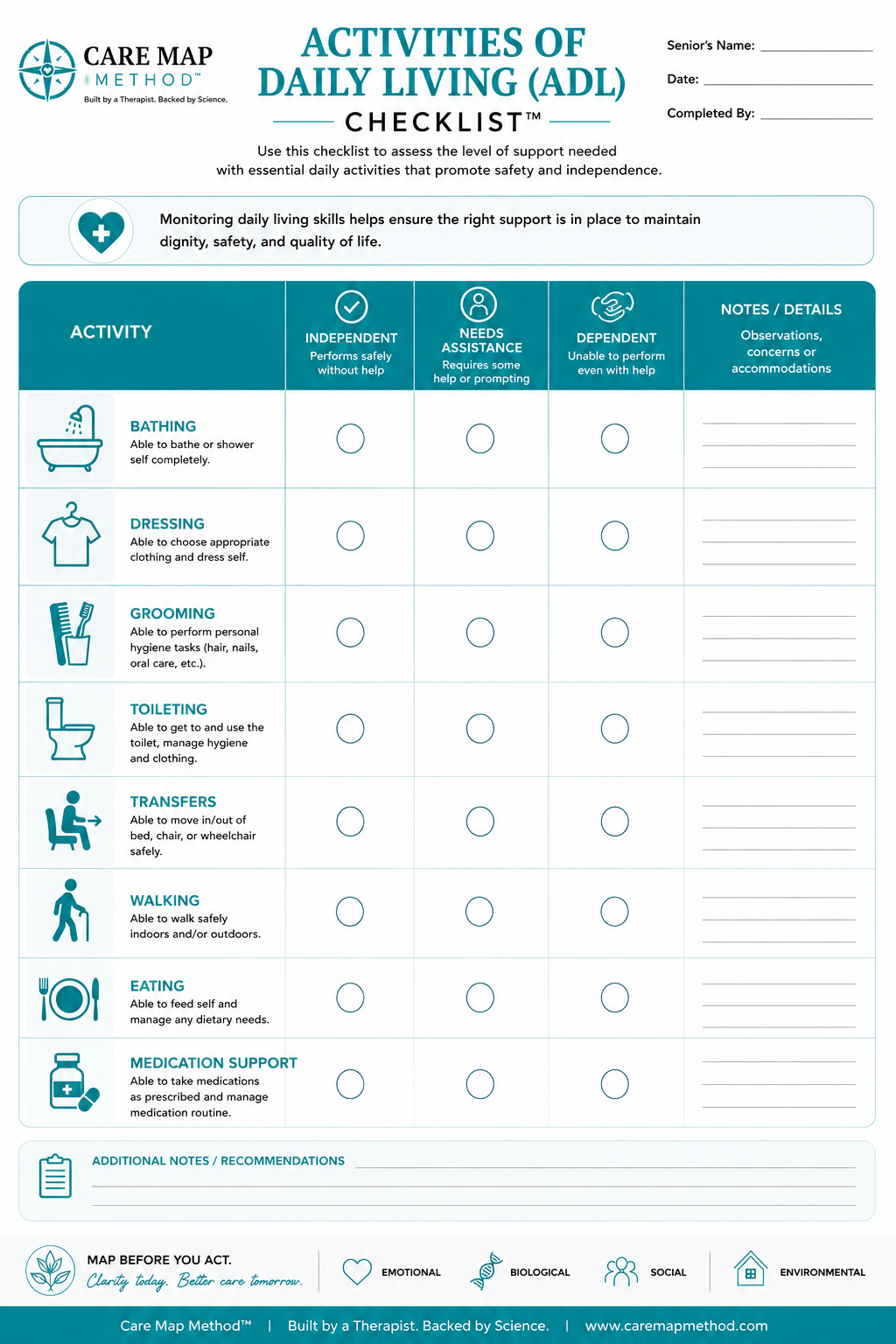
7 Signs Your Aging Parent Needs Help with Activities of Daily Living (ADLs)
Many older adults begin needing help gradually. Learn the warning signs that your loved one may need assistance with Activities of Daily Living and discover how to assess their safety and independence.
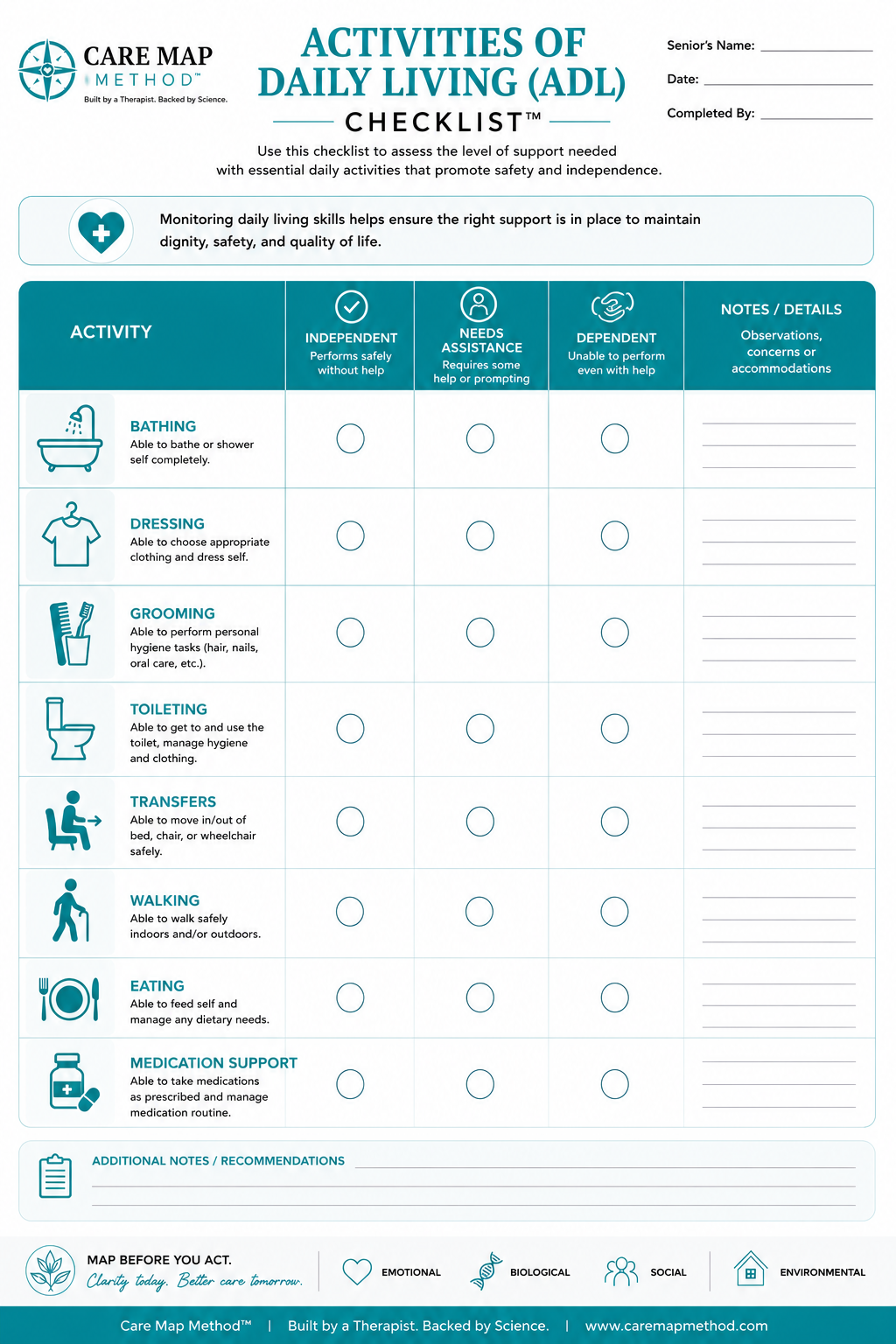
Activities of Daily Living (ADL) Checklist worksheet from Care Map Method™ helping families evaluate whether an older adult needs assistance with bathing, dressing, grooming, eating, mobility, toileting, transfers, and medication support.
7 Signs Your Aging Parent Needs Help with Activities of Daily Living (ADLs)
One of the hardest parts of caring for an aging parent is recognizing when small changes become signs that additional support is needed.
Many older adults want to remain independent, and families often hope they can continue living safely on their own. However, subtle declines in everyday functioning may increase the risk of falls, medication errors, malnutrition, hospitalization, and caregiver stress.
At Care Map Method™, we encourage families to Map Before They Act™. Assessing Activities of Daily Living (ADLs) provides a structured way to understand current abilities and identify where support may improve safety and quality of life.
What Are Activities of Daily Living?
Activities of Daily Living, commonly called ADLs, are the basic self-care tasks people perform every day to remain healthy, safe, and independent.
These include:
Bathing
Dressing
Grooming
Toileting
Walking and mobility
Transfers (getting in and out of bed or a chair)
Eating
Medication management
When one or more of these activities become difficult, it may be time to reassess your loved one's care needs.
1. Difficulty Bathing
Notice if your loved one:
Avoids showers
Appears unsteady in the bathroom
Has poor hygiene
Expresses fear of falling
Bathrooms are one of the most common places where older adults experience falls.
2. Wearing the Same Clothes
Difficulty dressing may include:
Wearing stained clothing
Difficulty with buttons or zippers
Dressing inappropriately for the weather
Needing assistance putting on shoes
These changes may indicate arthritis, weakness, balance problems, or cognitive decline.
3. Changes in Personal Grooming
Poor grooming often develops gradually.
Look for:
Unwashed hair
Long fingernails
Missed shaving
Declining oral hygiene
These changes can sometimes signal depression, memory changes, or physical limitations.
4. Trouble Walking or Getting Up
Watch for:
Holding onto furniture
Difficulty standing
Slower walking speed
Multiple near-falls
Trouble climbing stairs
Even one fall can significantly affect an older adult's confidence and independence.
5. Weight Loss or Poor Nutrition
Ask yourself:
Is food expiring in the refrigerator?
Have they lost weight?
Are they skipping meals?
Are they drinking enough water?
Nutrition plays a major role in strength, healing, and overall health.
6. Medication Mistakes
Medication concerns may include:
Forgotten doses
Duplicate doses
Confusion about prescriptions
Expired medications
Medication management becomes increasingly important as prescriptions become more complex.
7. Increasing Dependence on Family
You may notice yourself:
Driving to every appointment
Managing bills
Preparing meals
Picking up prescriptions
Helping with household tasks
While occasional assistance is normal, increasing dependence may indicate that additional planning is needed.
Download Our Free Activities of Daily Living Checklist™
(Insert your ADL Checklist worksheet image here.)
Our printable worksheet helps families evaluate daily functioning and identify areas where support may improve safety, independence, and quality of life.
Bring the completed checklist to healthcare appointments or use it during family caregiving discussions.
Why Early Assessment Matters
Recognizing changes early allows families to make thoughtful decisions rather than reacting during a crisis.
Early planning can help:
Reduce caregiver stress
Prevent falls
Improve communication among family members
Coordinate medical care
Delay unnecessary hospitalizations
Support aging in place when appropriate
How a Care Map Method™ MAP Coaching Session Can Help
Many families know something has changed but aren't sure what to do next.
During a personalized Care Map Method™ MAP Coaching Session, we'll help you:
Assess Activities of Daily Living
Identify safety concerns
Review medical, emotional, social, and environmental needs
Prioritize next steps
Develop a personalized Care Map™
Create an action plan tailored to your family's situation
Our goal is to help families move forward with confidence instead of uncertainty.
Ready to Better Understand Your Loved One's Needs?
If you're wondering whether your parent can continue living independently—or what level of support is appropriate—you don't have to make those decisions alone.
A Care Map Method™ MAP Coaching Session provides expert guidance, practical tools, and a personalized roadmap based on your loved one's unique situation.
Book your Care Map Method™ MAP Coaching Session today and start planning before a crisis occurs.