

Online Therapy for Retirement Adjustment in Oregon
Retirement can change your identity, relationships and sense of purpose. Online therapy in Oregon can help you explore what you miss, discuss expectations at home and choose meaningful next steps for this stage of life.
You may have looked forward to leaving work and still miss the structure, contact or sense of usefulness it provided. More time at home can also change relationships in ways you did not anticipate.
I’m Tammy Gold. I offer individual online therapy for adults in Oregon navigating life transitions and relationship stress. We can explore what retirement has changed for you and what you need in this stage of life.
Identify what work used to provide
Perhaps you miss being asked for your opinion, having a reason to leave the house or seeing familiar people. We can examine those losses without assuming that a busier calendar will automatically address them.
Retirement may have been chosen, forced or shaped by health and finances. Those differences matter. We will also discuss mood, sleep, concentration and functioning rather than assume every change is ordinary adjustment.
Explore the new expectations at home
You may feel that family members now consider you permanently available. Or you and a partner may have different ideas about shared time and privacy.
A conversation could begin, “I want us to discuss what we each need from the week, including time together and time independently.” We can explore the feelings underneath that request and whether it fits your situation.
Build a next step around meaning
We can consider what you want to continue, what you are ready to release and what you would like to try. A next step might be reconnecting with one person or making space for an interest you have postponed.
The goal is not to perform a perfect retirement. We can work on your experience of the change and review what supports your well-being. Financial planning and medical questions belong with the appropriate professionals.
What we can work on together in session
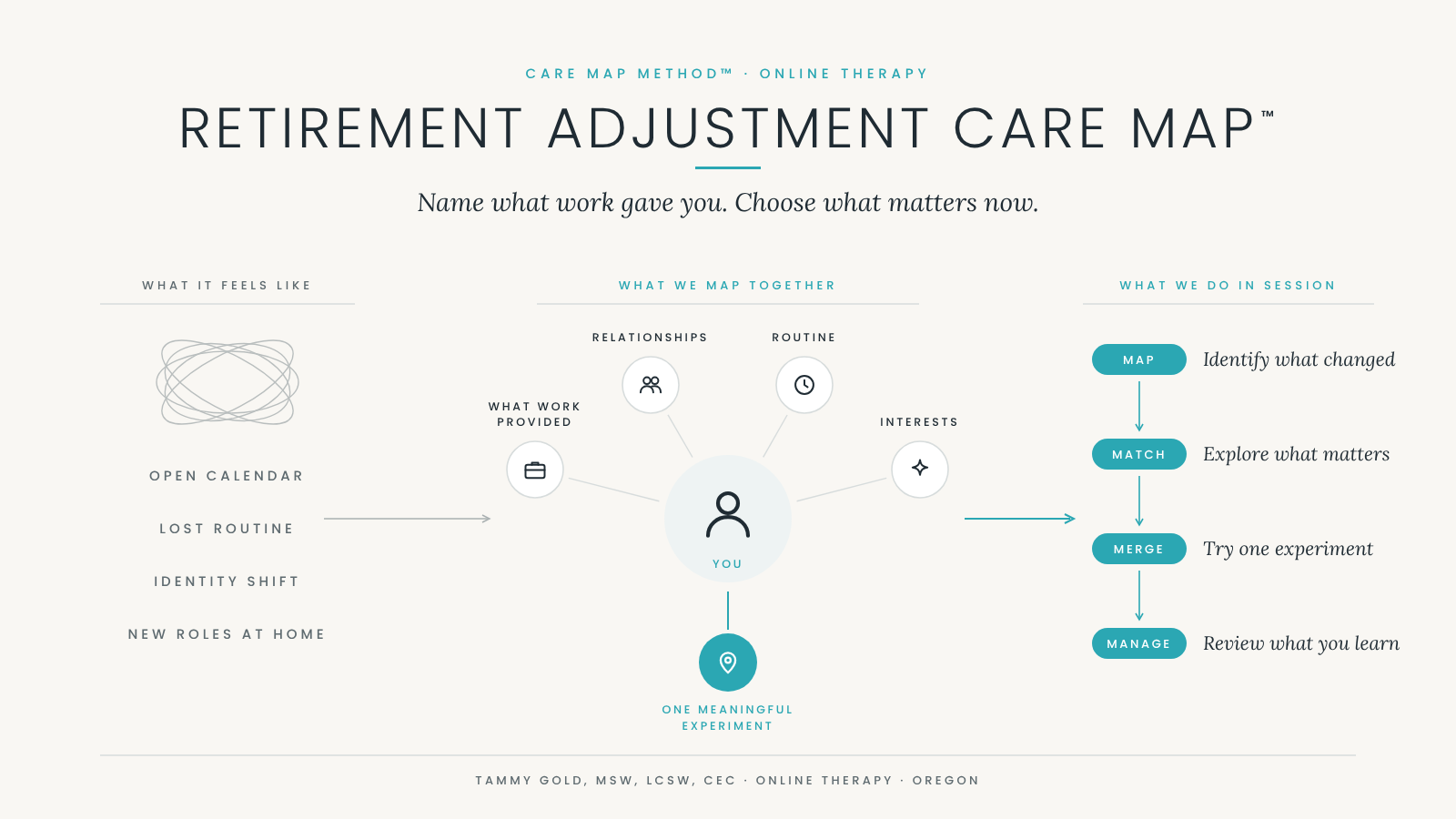
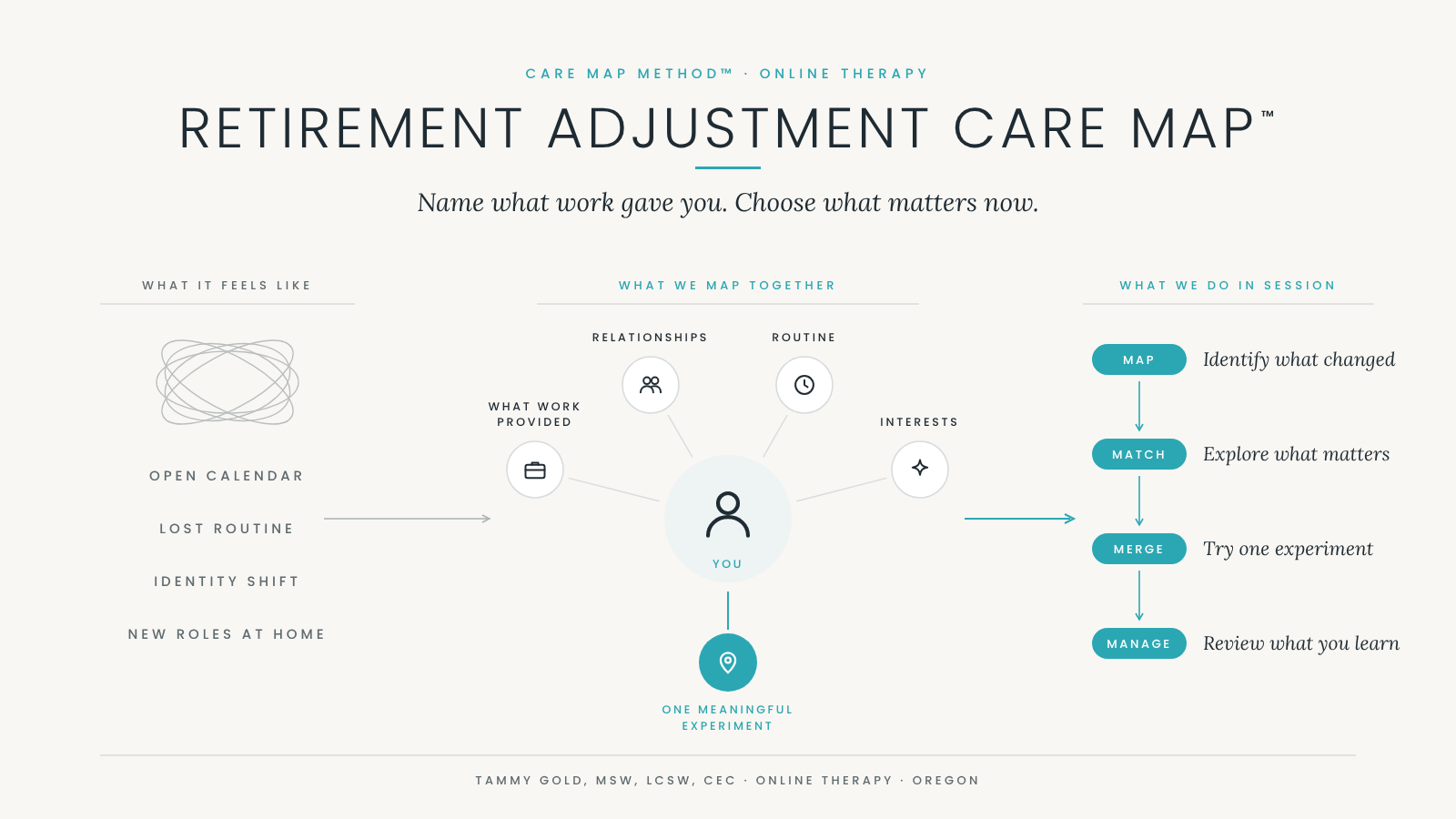
We can map a typical day before and after retirement to understand what changed beyond the hours of paid work. We might identify missing social contact, a loss of recognition, less privacy at home or uncertainty about how to describe yourself. We will also assess symptoms that deserve attention in their own right.
Together, we can choose one meaningful experiment: contacting a person you miss, setting aside time for an interest or discussing expectations with a partner. We can explore what makes that step appealing or difficult and keep it realistic for your energy and resources. At a later visit, we can review the experience and adjust the direction. You do not need a complete plan for this stage of life before therapy can be useful.
When an open calendar feels uncomfortable
Work may have offered more than a schedule. It may have provided recognition, familiar conversations or a clear way to know you had contributed. If those supports disappear at once, being told to “enjoy your freedom” can feel lonely. We can explore what you miss and which parts you would like to carry forward in a different form.
You may also feel pressure to say yes to family responsibilities because you are no longer employed. We can discuss the difference between choosing to help and feeling unable to decline. Your interests, energy and relationships deserve consideration in the new arrangement.
Try a direction without deciding your whole future
We might identify one connection you want to maintain, one activity that interests you or one conversation about expectations at home. The purpose is to learn what feels meaningful and realistic, rather than fill every hour. If low mood, withdrawal or other symptoms are affecting daily life, we will assess those concerns directly. Retirement does not make distress something you simply have to accept, and seeking support does not mean you are doing this stage of life incorrectly.
A practical way to understand what is happening
My Care Map Method™ helps us look at Biological, Social, Environmental and Emotional factors alongside clinical assessment. We consider your health and energy, relationships, daily circumstances and emotional experience rather than isolate one difficult moment from the rest of your life. We MAP the need, MATCH appropriate support, MERGE that support into your circumstances and MANAGE the plan as we learn what is useful. This is an organizing framework within individualized therapy, not a promise of a particular result.
What your first session can include
You can bring one situation you want help understanding. We will discuss your concern, relevant history, symptoms, daily functioning and available support. You can tell me what has or has not helped before and what you need to feel comfortable talking. My aim is to offer empathy without judgment and begin exploring a practical next step, while allowing time for assessment. We will decide together whether my approach fits and which goals matter to you. You do not need to arrive knowing the right words or the solution.
About Tammy Gold
I’m Tamara “Tammy” Gold, MSW, LCSW, CEC. I earned my clinical MSW at Columbia University and my BA at the University of Pennsylvania. My work with families includes parenting, caregiving and difficult relationships. I bring empathy without judgment and a practical interest in helping you understand the problem and consider what comes next.
Frequently asked questions
Can I come before I retire?
Yes. We can explore the anticipated transition and assess what support fits.
What if I did not choose to stop working?
We can make room for the loss, anger or uncertainty involved rather than assume retirement is welcome.
Is this financial retirement planning?
No. This page describes psychotherapy for mental health and adjustment.
Can I discuss changes with my spouse?
Yes. Individual therapy can explore your experience of the relationship; couples services would require a separate discussion.
Do you accept Medicare?
Do not assume coverage. Ask about your exact plan and the practice’s current enrollment before booking.
How do I start from Oregon?
Confirm current availability, your physical location, treatment fit and payment arrangements before scheduling.
What if I miss work but do not want to return?
We can explore the parts you miss without assuming that returning to employment is the answer. The loss of a role and a preference for retirement can coexist.
Will you tell me to volunteer or find a hobby?
We can consider those possibilities if they interest you, but the work begins with what has changed and what matters to you. A fuller calendar is not the only possible goal.
Booking and profile options
Choose a platform that shows current appointments for your physical location in Oregon and your exact insurance plan. Availability and participation can differ across platforms.
Check availability and insurance on Grow Therapy
Check availability and insurance on Alma
Check availability and insurance on Headway
Read my profile or contact me on Psychology Today
Before confirming a visit, check the service, current provider participation, your exact benefits and estimated costs. Coverage depends on your plan and the assessed clinical service; a life event alone does not establish insurance eligibility. You must be physically located where I am authorized to provide care at each session.
Dating feels exhausting. Your needs still matter.
Dating apps, unanswered messages and repeated disappointment can leave you questioning yourself. Explore online therapy in Maine to understand relationship patterns, practice boundaries and take practical steps that keep your needs in the picture.
You may want a relationship while dreading another introduction, unanswered message or disappointing date. Perhaps you keep checking your phone, questioning what you said or trying to become the person you think someone else wants.
I’m Tammy Gold. I offer individual online therapy for adults physically located in Maine. We can explore the impact dating is having on your mental health and work toward choices that feel more consistent with your needs.
Check Maine Appointments on Alma
Understand the cycle around a disappointment
We might begin with one recent exchange. What happened? What did you conclude about yourself? What did you do to feel more certain afterward? Repeatedly reviewing a message can feel like problem-solving while leaving the same question unresolved.
We can examine your expectations, experiences and relationship patterns without assuming every disappointment has the same cause. Your circumstances and the behavior of the people you meet matter too.
Keep your preferences in the conversation
Perhaps you agree to plans you do not want because you fear losing the connection. We can explore that fear and practice a response such as, “I would like to see you again, but that time does not work for me.” The words should fit your situation rather than become another performance to get right.
Taking a break, changing how you participate or continuing with clearer limits are possibilities to explore. Therapy does not prescribe a particular relationship timeline.
Give the rest of your life room
We can discuss how dating affects rest, friendships and concentration. An early goal might be recognizing when you are setting aside a preference or spending less time trying to interpret silence. Those goals concern your well-being; another person’s response remains outside your control.
What we can work on together in session
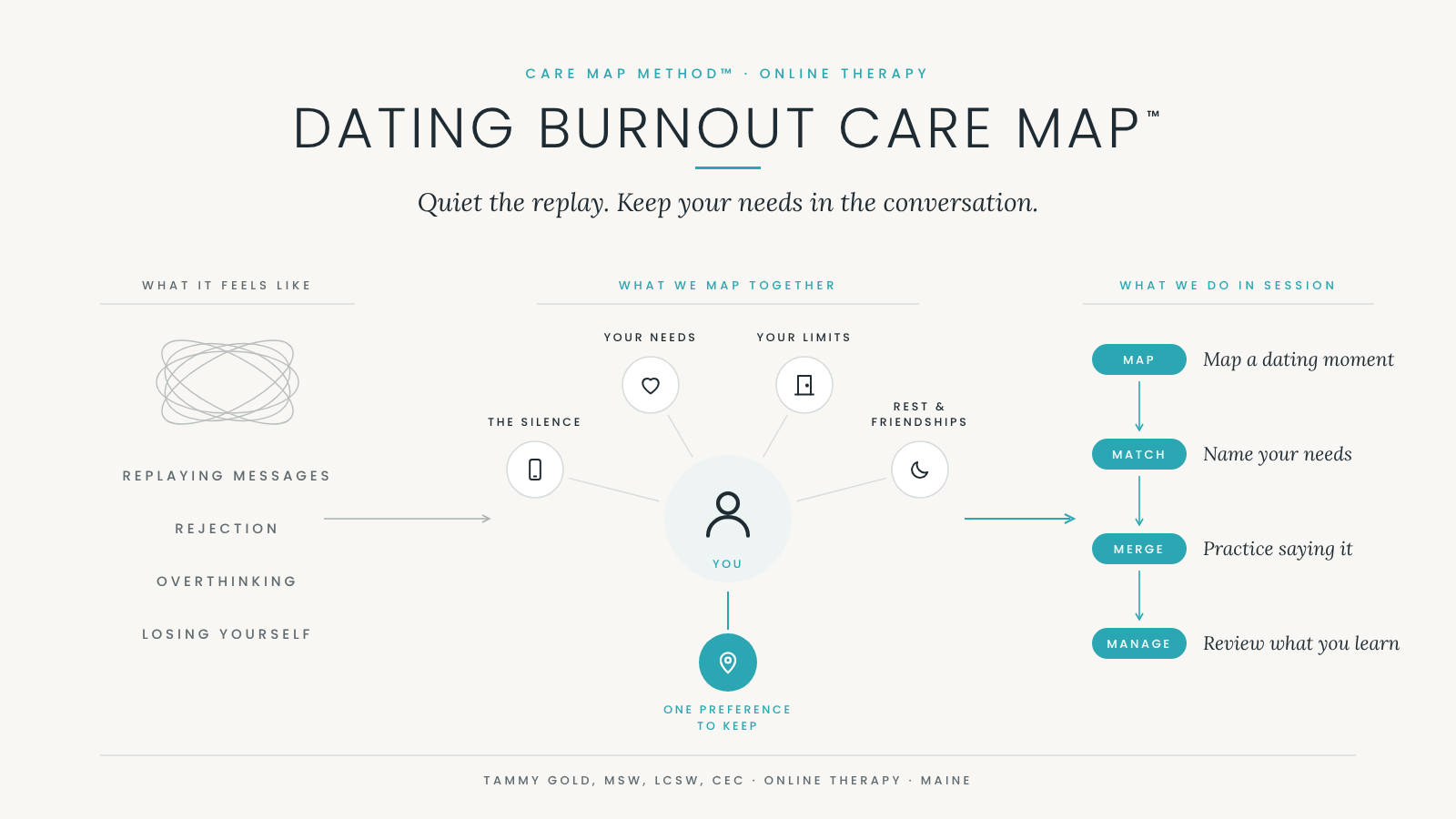
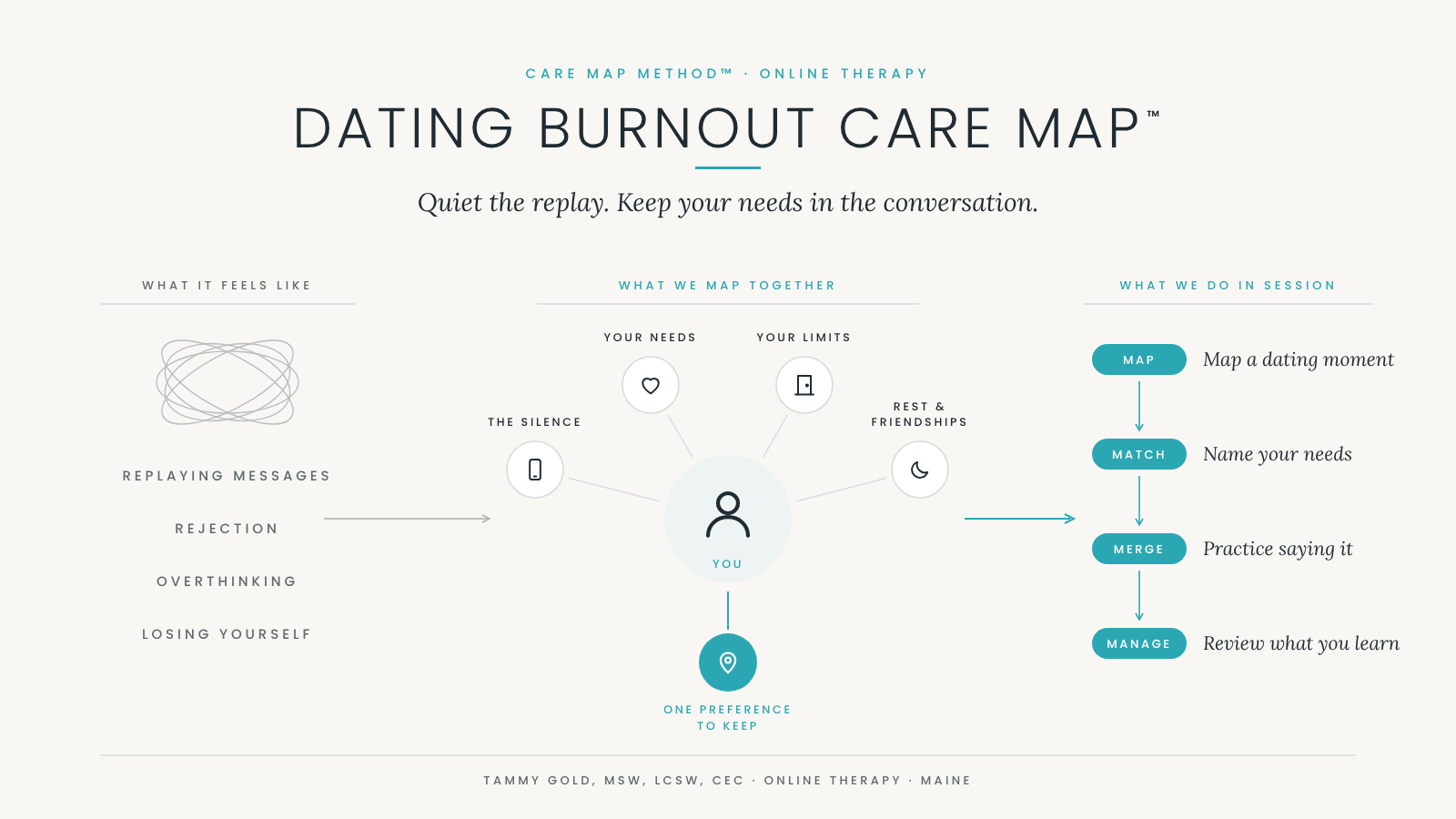
We can take one recent dating exchange and map the sequence: what happened, what you told yourself it meant, what you felt and what you did next. For example, an unanswered message may lead to self-criticism, repeated checking and canceling your own plans in case the person replies. We can explore where you have a choice in that sequence without dismissing the disappointment.
Then we can practice a response that reflects your needs, such as expressing a scheduling preference or choosing when to stop checking for the evening. If it fits, you might leave with one boundary or small experiment to try. In a later session, we can review what happened, what felt difficult and what needs adjusting. The work focuses on your well-being and participation in dating; it does not depend on securing a particular person's interest.
When dating stress turns into self-criticism
A disappointing exchange can quickly become a much larger story: “I am always too much,” “Nobody will choose me,” or “I should have known better.” We can slow down that story and consider what you actually know, what you are assuming and which older experiences make the moment especially painful. You do not need to become indifferent to wanting love to take your own feelings seriously.
We can also explore the difference between choosing connection and trying to earn reassurance. That might mean noticing when you cancel your own plans to remain available, ignore a preference or keep checking an app after you have stopped enjoying it. Rather than set a rule you must follow perfectly, we can choose one situation to understand and review what happens.
Bring the question you are already asking
You might begin with, “Why do I feel rejected before I know this person?” or “How can I take a break without feeling I am giving up?” You do not need a polished explanation. We can start with the conversation, feeling or pattern that brought you here and decide together what support would be useful.
A practical way to understand what is happening
My Care Map Method™ helps us look at Biological, Social, Environmental and Emotional factors alongside clinical assessment. We consider your health and energy, relationships, daily circumstances and emotional experience rather than isolate one difficult moment from the rest of your life. We MAP the need, MATCH appropriate support, MERGE that support into your circumstances and MANAGE the plan as we learn what is useful. This is an organizing framework within individualized therapy, not a promise of a particular result.
What your first session can include
You can bring one situation you want help understanding. We will discuss your concern, relevant history, symptoms, daily functioning and available support. You can tell me what has or has not helped before and what you need to feel comfortable talking. My aim is to offer empathy without judgment and begin exploring a practical next step, while allowing time for assessment. We will decide together whether my approach fits and which goals matter to you. You do not need to arrive knowing the right words or the solution.
About Tammy Gold
I’m Tammy Gold, MSW, LCSW, CEC. I earned my clinical MSW at Columbia University and my BA at the University of Pennsylvania. My work with families includes parenting, caregiving and difficult relationships. I bring empathy without judgment and a practical interest in helping you understand the problem and consider what comes next.
Frequently asked questions
Can I come even if I am single?
Yes. Individual therapy can address your distress, self-understanding and relationship choices without requiring a partner.
Will you tell me which dating app to use?
We can explore your experience of dating. This is psychotherapy, not a matchmaking or profile-management service.
Does rejection mean something is wrong with me?
One person’s response does not provide a complete explanation of you. We can examine what rejection brings up without dismissing its impact.
Will therapy help me find a partner?
We can work on your mental health and choices. We cannot guarantee attraction, compatibility or a relationship.
Can we discuss boundaries and intimacy?
Yes, within treatment fit, your comfort and the scope of individual care.
Can I use insurance in Maine and other states?
Check your exact plan and estimated costs through my active Alma profile. Coverage also depends on the assessed clinical service.
Can we work on overthinking after dates?
Yes. We can explore the thoughts, feelings and checking habits that follow a date, then consider responses that support your well-being.
Do I have to stop dating while in therapy?
No. We can discuss continuing, changing your approach or taking a break based on your circumstances and preferences.
Booking and profile options
For appointments while you are in Maine, please use Alma while enrollment on other platforms is pending. The other profiles below are available for reference; they do not confirm appointments or insurance participation in this state. Therapy on these platforms below
Check availability and insurance on Grow Therapy
Check availability and insurance on Alma
Check availability and insurance on Headway
Read my profile or contact me on Psychology Today
Before confirming a visit, check the service, current provider participation, your exact benefits and estimated costs. Coverage depends on your plan and the assessed clinical service; a life event alone does not establish insurance eligibility. You must be physically located where I am authorized to provide care at each session.

Aetna Therapy for Parent–Adult Child Conflict in Oregon
Online Oregon therapy for parent-adult child conflict, communication, autonomy and boundaries with Tammy Gold, LCSW. Eligibility varies.
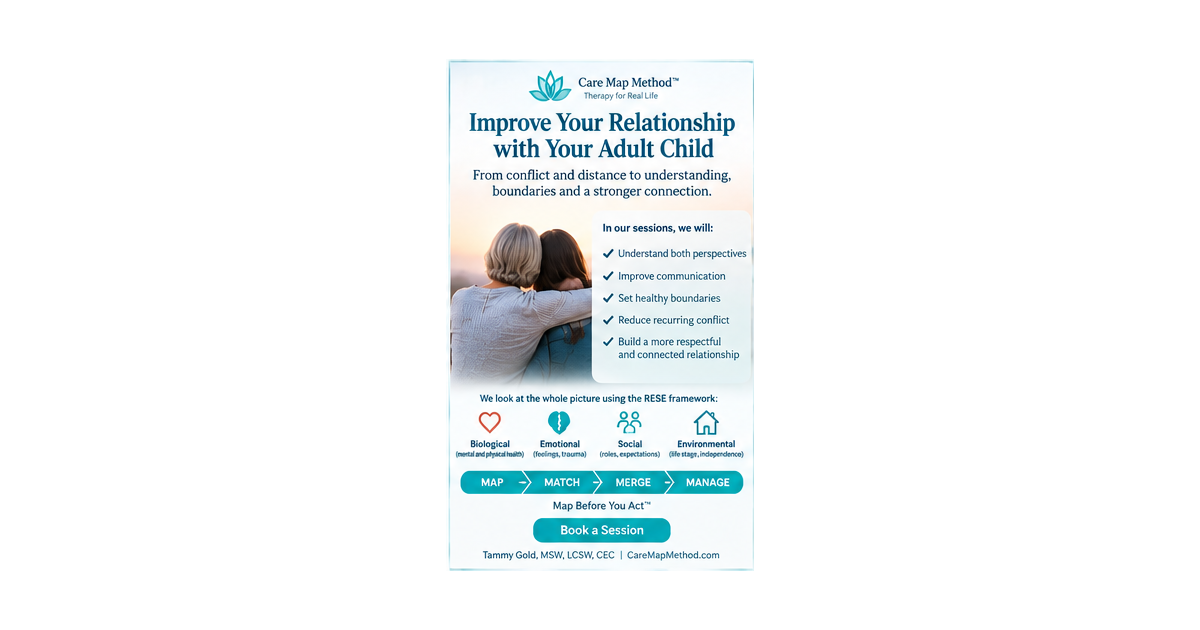
Aetna online therapy in Oregon with Tammy Gold, LCSW for parent–adult child conflict.
Aetna Therapy for Parent–Adult Child Conflict in Oregon
Parenting does not end when a child becomes an adult, but the relationship changes. Advice that once felt protective can now feel like pressure. Help can be interpreted as control. A parent may feel rejected while an adult child may feel that there is not enough room to make independent choices.
The goal is not to decide who is right. It is to understand the pattern clearly enough to communicate with more intention and create a relationship that fits this stage of life.
I am Tammy Gold, MSW, LCSW, CEC, a licensed therapist, author and creator of the Care Map Method™. I provide online psychotherapy to eligible clients located in Oregon, including adults dealing with relationship stress, family conflict, caregiving and major life transitions.
Depending on your specific plan, eligibility and current network participation, Aetna may be available for psychotherapy. Coverage, copays, deductibles and benefits vary and should be verified before scheduling.
Does this sound familiar?
· Your role as a parent is changing, but old patterns remain.
· Attempts to help are interpreted as pressure or intrusion.
· You disagree about money, partners, career, parenting or lifestyle.
· You want connection while respecting that your child is now an adult.
Why the surface problem may not be the whole problem
Families and couples often begin by trying to solve the most visible problem. But the visible problem may be only one part of the Care Map. Stress, health, expectations, attachment needs, changing roles, communication habits, family history and the surrounding environment can all affect what happens next.
Looking at the broader pattern can reduce shame and blame. Instead of asking only, “Who caused this?” we can ask, “What is happening, what does each person need, what is within my control, and what response is most likely to be useful?”
How I use the Care Map Method™ in therapy
MAP — Understand what is actually happening
We identify the problem, the repeating pattern and the needs underneath it. I look at biological, emotional, social and environmental factors rather than reducing a complicated relationship to one argument or one person’s behavior.
MATCH — Match the right support or strategy
Once the pattern is clearer, we identify approaches that fit the actual need. That may involve communication, boundaries, coping strategies, emotional regulation, role changes, additional support or a different way of responding.
MERGE — Bring understanding into the relationship
Insight matters most when it can be used. We translate what you are learning into conversations, decisions, requests and boundaries that are realistic for your life and relationships.
MANAGE — Adjust as life changes
Relationships and caregiving systems are dynamic. We notice what is helping, what is not, and what needs to be adjusted rather than expecting one conversation or technique to solve everything permanently.
A safe place without shame or blame
My approach is warm, active, practical and nonjudgmental. Therapy can be one completely safe place to say what you are actually thinking and feeling without having to protect everyone else, perform competence or decide immediately what you are going to do.
My goal is not simply to have you talk about the problem. I want you to better understand yourself and the people around you, name emotions and needs more clearly, reduce unnecessary shame and blame, and leave with practical next steps.
Online therapy in Oregon
I provide telehealth psychotherapy to eligible clients who are physically located in Oregon at the time of service. Aetna may be available depending on your individual plan, eligibility and current network participation. Please verify your benefits before scheduling.
Relationship and family problems can also be addressed in individual therapy. Another person does not necessarily need to participate for you to work on your own communication, boundaries, emotions and responses.
About Tammy Gold, MSW, LCSW, CEC
Tammy Gold is a licensed clinical social worker, therapist, author and creator of the Care Map Method™. For more than 20 years, her work has focused on the relationships and care systems surrounding families—from marriage and parenting to adult children, caregiving and aging parents.
She earned her MSW from Columbia University and her undergraduate degree from the University of Pennsylvania. Her family and caregiving expertise has been featured in national media. Add the approved press-logo strip here to reinforce authority without interrupting the clinical message.
How does a parent’s role change with an adult child?
Therapy can help you slow down the pattern, understand the needs and emotions underneath it, and identify practical changes within your control. The work is individualized to your situation and does not promise a particular outcome.
Can therapy help if only the parent attends?
Yes. Individual therapy can focus on your emotions, communication, boundaries and responses even when another family member or partner does not participate. Therapy cannot guarantee that another person will change.
What if my adult child wants more distance?
Therapy can help you slow down the pattern, understand the needs and emotions underneath it, and identify practical changes within your control. The work is individualized to your situation and does not promise a particular outcome.
How can I communicate without overstepping?
Therapy can help you slow down the pattern, understand the needs and emotions underneath it, and identify practical changes within your control. The work is individualized to your situation and does not promise a particular outcome.
Does Aetna cover teletherapy in Oregon?
Aetna may be available depending on your specific plan, eligibility, clinical circumstances and current network participation. Benefits, copays and deductibles vary, so verify coverage before scheduling.
You do not have to solve the whole relationship today
A useful first step is often understanding the pattern more clearly. Therapy can help you slow down, identify what you need, distinguish what is within your control from what is not, and decide what a healthier next response could look like.
Insurance note: Aetna eligibility and benefits vary. Verify your individual coverage before scheduling

My Coworker Is Making Work Unbearable: Therapy for Workplace Conflict
Conflict with a coworker can make an otherwise manageable job feel unbearable. Exclusion, criticism, competition, gossip or unclear roles can lead you to scan every interaction for the next problem and carry the tension into evenings and weekends.

My Coworker Is Making Work Unbearable: Therapy for Workplace Conflict
My Coworker Is Making Work Unbearable: Therapy for Workplace Conflict
Conflict with a coworker can make an otherwise manageable job feel unbearable. Exclusion, criticism, competition, gossip or unclear roles can lead you to scan every interaction for the next problem and carry the tension into evenings and weekends.
You may be functioning well in many areas of life and still feel consumed by this one relationship or transition. When the same thoughts and conversations repeat, it can become difficult to know what is a reasonable reaction, what needs to change, and where to begin.
You may be experiencing
coworker conflict
workplace exclusion
office stress
difficult coworker
work boundaries
ruminating after work
A safe place for support and practical solutions
Therapy can help you distinguish facts from assumptions, identify triggers, strengthen professional boundaries and plan communication that protects both your wellbeing and your career. We can also consider when documentation, management support or a job change may be appropriate.
My approach is warm, relational and solution-focused. I want therapy to feel like one completely safe place with no judgment, stress, shame or blame. You can unload what you are carrying, better understand yourself and the people around you, name emotions more clearly, and leave with practical ways to move forward. My sole goal is for clients to leave each session feeling better, less alone and more supported.
How I use the Care Map Method™
MAP — Understand the pattern, pressure points, emotions and needs underneath the problem.
MATCH — Identify the support, boundaries, communication and goals that fit your situation.
MERGE — Improve communication and connection among the people and competing needs involved.
MANAGE — Create practical next steps you can use between sessions and adjust as circumstances change.
Using Regence BCBS for online therapy in Oregon
I provide online therapy for clients who are physically located in Oregon at the time of the session. Eligible Regence BCBS members may be able to use insurance for therapy through Headway. Network participation, benefits, deductibles, copays and eligibility vary by individual plan. Please verify your benefits through Headway before booking.
Frequently asked questions
Can therapy help with this even if the other person does not attend?
Yes. Individual therapy can help you understand patterns, regulate reactions, clarify boundaries and change how you respond even when another person is not participating.
Will therapy just be talking about the problem?
No. There is room to talk and feel fully heard, but my approach also emphasizes clinical insight, communication tools, boundaries and practical next steps.
Do you provide online therapy in Oregon?
Yes. I provide telehealth therapy to appropriate clients located in Oregon, subject to scheduling, clinical fit and applicable requirements.
Can I use Regence BCBS for therapy?
Eligible Regence BCBS members may be able to use benefits through Headway. Coverage and out-of-pocket costs vary, so benefits should be verified before booking.
What if I am not sure whether my problem is serious enough for therapy?
You do not need to wait for a crisis. Therapy can be useful when a relationship, transition or recurring stress is taking up too much emotional space or affecting daily life.

Co-Parenting With a Difficult Ex Without Losing Your Peace
Co-parenting can keep you emotionally connected to a relationship you thought had ended. Texts, schedule changes, school decisions, money and different parenting styles can trigger the same conflict patterns that existed during the marriage.

A co-parenting plan and calendar representing communication and boundaries after divorce.
Co-Parenting With a Difficult Ex Without Losing Your Peace
Co-parenting can keep you emotionally connected to a relationship you thought had ended. Texts, schedule changes, school decisions, money and different parenting styles can trigger the same conflict patterns that existed during the marriage.
You may be functioning well in many areas of life and still feel consumed by this one relationship or transition. When the same thoughts and conversations repeat, it can become difficult to know what is a reasonable reaction, what needs to change, and where to begin.
You may be experiencing
co-parenting conflict
difficult ex
divorce stress
parallel parenting
boundaries with ex spouse
co-parent communication
A safe place for support and practical solutions
Therapy can focus on what you can control: your communication, boundaries, emotional regulation and decision-making. We can create clearer expectations, reduce reactive exchanges and keep the child's needs separate from unresolved adult conflict. The aim is not perfect cooperation; it is a more stable and sustainable way to parent.
My approach is warm, relational and solution-focused. I want therapy to feel like one completely safe place with no judgment, stress, shame or blame. You can unload what you are carrying, better understand yourself and the people around you, name emotions more clearly, and leave with practical ways to move forward. My sole goal is for clients to leave each session feeling better, less alone and more supported.
How I use the Care Map Method™
MAP — Understand the pattern, pressure points, emotions and needs underneath the problem.
MATCH — Identify the support, boundaries, communication and goals that fit your situation.
MERGE — Improve communication and connection among the people and competing needs involved.
MANAGE — Create practical next steps you can use between sessions and adjust as circumstances change.
Using Horizon BCBSNJ for online therapy in New Jersey
I provide online therapy for clients who are physically located in New Jersey at the time of the session. Eligible Horizon BCBSNJ members may be able to use insurance for therapy through Headway. Network participation, benefits, deductibles, copays and eligibility vary by individual plan. Please verify your benefits through Headway before booking.
Frequently asked questions
Can therapy help with this even if the other person does not attend?
Yes. Individual therapy can help you understand patterns, regulate reactions, clarify boundaries and change how you respond even when another person is not participating.
Will therapy just be talking about the problem?
No. There is room to talk and feel fully heard, but my approach also emphasizes clinical insight, communication tools, boundaries and practical next steps.
Do you provide online therapy in New Jersey?
Yes. I provide telehealth therapy to appropriate clients located in New Jersey, subject to scheduling, clinical fit and applicable requirements.
Can I use Horizon BCBSNJ for therapy?
Eligible Horizon BCBSNJ members may be able to use benefits through Headway. Coverage and out-of-pocket costs vary, so benefits should be verified before booking.
What if I am not sure whether my problem is serious enough for therapy?
You do not need to wait for a crisis. Therapy can be useful when a relationship, transition or recurring stress is taking up too much emotional space or affecting daily life.

Why Do My Siblings and I Fight Every Time We Discuss Our Parents?
Aging-parent decisions can reactivate sibling roles that have existed for decades. One person may feel they do everything. Another may feel criticized or excluded. Old resentments can become attached to new questions about medical care, money, driving, housing or who should take responsibility.

Adult siblings in a tense family discussion about an aging parent's care.
Why Do My Siblings and I Fight Every Time We Discuss Our Parents?
Aging-parent decisions can reactivate sibling roles that have existed for decades. One person may feel they do everything. Another may feel criticized or excluded. Old resentments can become attached to new questions about medical care, money, driving, housing or who should take responsibility.
You may be functioning well in many areas of life and still feel consumed by this one relationship or transition. When the same thoughts and conversations repeat, it can become difficult to know what is a reasonable reaction, what needs to change, and where to begin.
You may be experiencing
sibling conflict
aging parent stress
siblings fighting over elder care
family caregiving conflict
resentment between siblings
care decisions for parents
A safe place for support and practical solutions
Therapy can help separate the current care problem from the family history surrounding it. We can clarify responsibilities, communication and boundaries while making space for different perspectives. The goal is not to prove which sibling is right; it is to reduce destructive conflict and make the situation more manageable.
My approach is warm, relational and solution-focused. I want therapy to feel like one completely safe place with no judgment, stress, shame or blame. You can unload what you are carrying, better understand yourself and the people around you, name emotions more clearly, and leave with practical ways to move forward. My sole goal is for clients to leave each session feeling better, less alone and more supported.
How I use the Care Map Method™
MAP — Understand the pattern, pressure points, emotions and needs underneath the problem.
MATCH — Identify the support, boundaries, communication and goals that fit your situation.
MERGE — Improve communication and connection among the people and competing needs involved.
MANAGE — Create practical next steps you can use between sessions and adjust as circumstances change.
Using Horizon BCBSNJ for online therapy in New Jersey
I provide online therapy for clients who are physically located in New Jersey at the time of the session. Eligible Horizon BCBSNJ members may be able to use insurance for therapy through Headway. Network participation, benefits, deductibles, copays and eligibility vary by individual plan. Please verify your benefits through Headway before booking.
Frequently asked questions
Can therapy help with this even if the other person does not attend?
Yes. Individual therapy can help you understand patterns, regulate reactions, clarify boundaries and change how you respond even when another person is not participating.
Will therapy just be talking about the problem?
No. There is room to talk and feel fully heard, but my approach also emphasizes clinical insight, communication tools, boundaries and practical next steps.
Do you provide online therapy in New Jersey?
Yes. I provide telehealth therapy to appropriate clients located in New Jersey, subject to scheduling, clinical fit and applicable requirements.
Can I use Horizon BCBSNJ for therapy?
Eligible Horizon BCBSNJ members may be able to use benefits through Headway. Coverage and out-of-pocket costs vary, so benefits should be verified before booking.
What if I am not sure whether my problem is serious enough for therapy?
You do not need to wait for a crisis. Therapy can be useful when a relationship, transition or recurring stress is taking up too much emotional space or affecting daily life.

Should I Stay Married or Get Divorced? Therapy for Relationship Decisions
Deciding whether to stay in a marriage can feel impossible when love, resentment, children, finances, history and fear are all present at once. You may move between certainty and doubt from one day to the next. Therapy does not need to push you toward staying or leaving.

A calendar and journal representing uncertainty about whether to stay married or separate.
Should I Stay Married or Get Divorced? Therapy for Relationship Decisions
Deciding whether to stay in a marriage can feel impossible when love, resentment, children, finances, history and fear are all present at once. You may move between certainty and doubt from one day to the next. Therapy does not need to push you toward staying or leaving.
You may be functioning well in many areas of life and still feel consumed by this one relationship or transition. When the same thoughts and conversations repeat, it can become difficult to know what is a reasonable reaction, what needs to change, and where to begin.
You may be experiencing
should I get divorced
marriage resentment
relationship decision therapy
emotional distance
co-parenting concerns
separation stress
A safe place for support and practical solutions
The work can instead help you slow the decision down enough to understand the relationship clearly. We can examine recurring patterns, unmet needs, communication, trust, boundaries and what meaningful change would actually require. If separation becomes the decision, therapy can also support communication and co-parenting with less conflict.
My approach is warm, relational and solution-focused. I want therapy to feel like one completely safe place with no judgment, stress, shame or blame. You can unload what you are carrying, better understand yourself and the people around you, name emotions more clearly, and leave with practical ways to move forward. My sole goal is for clients to leave each session feeling better, less alone and more supported.
How I use the Care Map Method™
MAP — Understand the pattern, pressure points, emotions and needs underneath the problem.
MATCH — Identify the support, boundaries, communication and goals that fit your situation.
MERGE — Improve communication and connection among the people and competing needs involved.
MANAGE — Create practical next steps you can use between sessions and adjust as circumstances change.
Using Providence for online therapy in California
I provide online therapy for clients who are physically located in California at the time of the session. Eligible Providence members may be able to use insurance for therapy through Headway. Network participation, benefits, deductibles, copays and eligibility vary by individual plan. Please verify your benefits through Headway before booking.
Frequently asked questions
Can therapy help with this even if the other person does not attend?
Yes. Individual therapy can help you understand patterns, regulate reactions, clarify boundaries and change how you respond even when another person is not participating.
Will therapy just be talking about the problem?
No. There is room to talk and feel fully heard, but my approach also emphasizes clinical insight, communication tools, boundaries and practical next steps.
Do you provide online therapy in California?
Yes. I provide telehealth therapy to appropriate clients located in California, subject to scheduling, clinical fit and applicable requirements.
Can I use Providence for therapy?
Eligible Providence members may be able to use benefits through Headway. Coverage and out-of-pocket costs vary, so benefits should be verified before booking.
What if I am not sure whether my problem is serious enough for therapy?
You do not need to wait for a crisis. Therapy can be useful when a relationship, transition or recurring stress is taking up too much emotional space or affecting daily life.

Back-to-School Stress Is Affecting Our Whole Family
Back-to-school season can expose pressure points that were easier to manage during summer: morning battles, homework, sports, social worries, learning concerns, sleep changes and parental overload. When everyone is rushed, even small problems can become repeated family conflict.

A parent supporting a school-aged child during a stressful back-to-school transition.
Back-to-School Stress Is Affecting Our Whole Family
Back-to-school season can expose pressure points that were easier to manage during summer: morning battles, homework, sports, social worries, learning concerns, sleep changes and parental overload. When everyone is rushed, even small problems can become repeated family conflicts.
You may be functioning well in many areas of life and still feel consumed by this one relationship or transition. When the same thoughts and conversations repeat, it can become difficult to know what is a reasonable reaction, what needs to change, and where to begin.
You may be experiencing
back-to-school anxiety
parenting stress
homework conflict
school transition stress
family communication
overwhelmed parents
A safe place for support and practical solutions
Therapy can help separate the practical problem from the emotional reaction around it. We can identify what each family member needs, reduce shame and blame, and create routines and communication strategies that are realistic for your household. Parents do not need another place to be judged; they need support and workable solutions.
My approach is warm, relational and solution-focused. I want therapy to feel like one completely safe place with no judgment, stress, shame or blame. You can unload what you are carrying, better understand yourself and the people around you, name emotions more clearly, and leave with practical ways to move forward. My sole goal is for clients to leave each session feeling better, less alone and more supported.
How I use the Care Map Method™
MAP — Understand the pattern, pressure points, emotions and needs underneath the problem.
MATCH — Identify the support, boundaries, communication and goals that fit your situation.
MERGE — Improve communication and connection among the people and competing needs involved.
MANAGE — Create practical next steps you can use between sessions and adjust as circumstances change.
Using Providence for online therapy in California
I provide online therapy for clients who are physically located in California at the time of the session. Eligible Providence members may be able to use insurance for therapy through Headway. Network participation, benefits, deductibles, copays and eligibility vary by individual plan. Please verify your benefits through Headway before booking.
Frequently asked questions
Can therapy help with this even if the other person does not attend?
Yes. Individual therapy can help you understand patterns, regulate reactions, clarify boundaries and change how you respond even when another person is not participating.
Will therapy just be talking about the problem?
No. There is room to talk and feel fully heard, but my approach also emphasizes clinical insight, communication tools, boundaries and practical next steps.
Do you provide online therapy in California?
Yes. I provide telehealth therapy to appropriate clients located in California, subject to scheduling, clinical fit and applicable requirements.
Can I use Providence for therapy?
Eligible Providence members may be able to use benefits through Headway. Coverage and out-of-pocket costs vary, so benefits should be verified before booking.
What if I am not sure whether my problem is serious enough for therapy?
You do not need to wait for a crisis. Therapy can be useful when a relationship, transition or recurring stress is taking up too much emotional space or affecting daily life.