The First 30 Days Matter: How to Successfully Onboard a New Caregiver
Successful caregiving doesn't happen by chance.
It happens when families intentionally prepare caregivers for success.
A thoughtful onboarding process transforms a new caregiver into a trusted member of the care team.
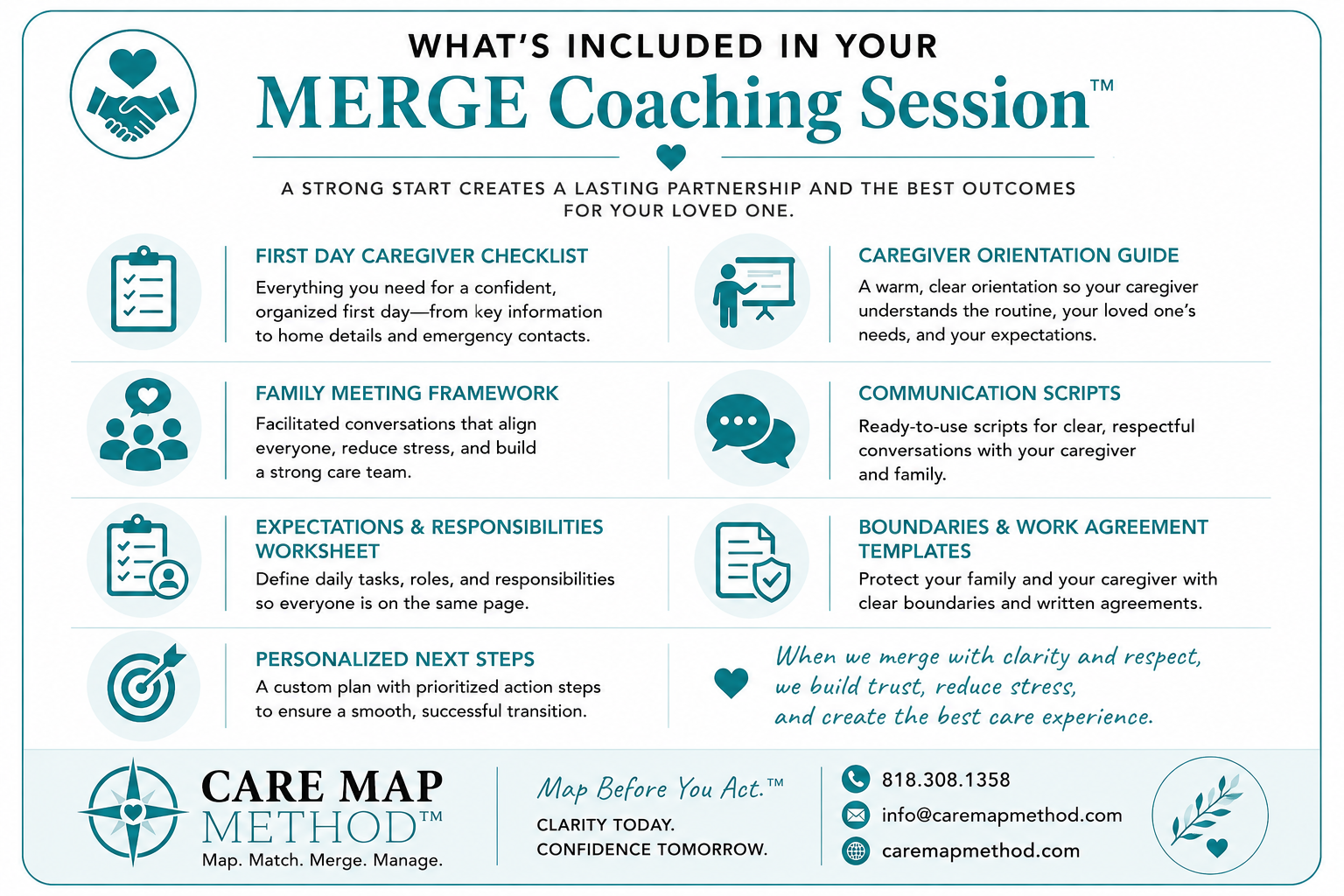
At Care Map Method™, our MERGE Coaching Session provides the tools, structure, and guidance to help families create confident, collaborative caregiving relationships.
Finding the right caregiver is a tremendous accomplishment—but hiring someone is only half of the process.
Many families assume that once the caregiver starts, everything will naturally fall into place. In reality, the first month often determines whether a caregiving relationship becomes successful or stressful.
At Care Map Method™, we call this the MERGE phase.
MERGE is where families and caregivers build trust, establish expectations, and create a plan for working together before misunderstandings develop.
Without a thoughtful onboarding process, even an exceptional caregiver can struggle.
Why Caregiver Onboarding Matters
Every family has its own routines.
Every senior has unique preferences.
Every caregiver arrives with different experiences.
If these expectations are never discussed, problems quickly emerge.
Common issues include:
Different expectations about responsibilities
Communication breakdowns
Family disagreements
Missed medications or appointments
Confusion over schedules
Burnout for both caregiver and family
A structured onboarding process dramatically reduces these risks.
The MERGE Process
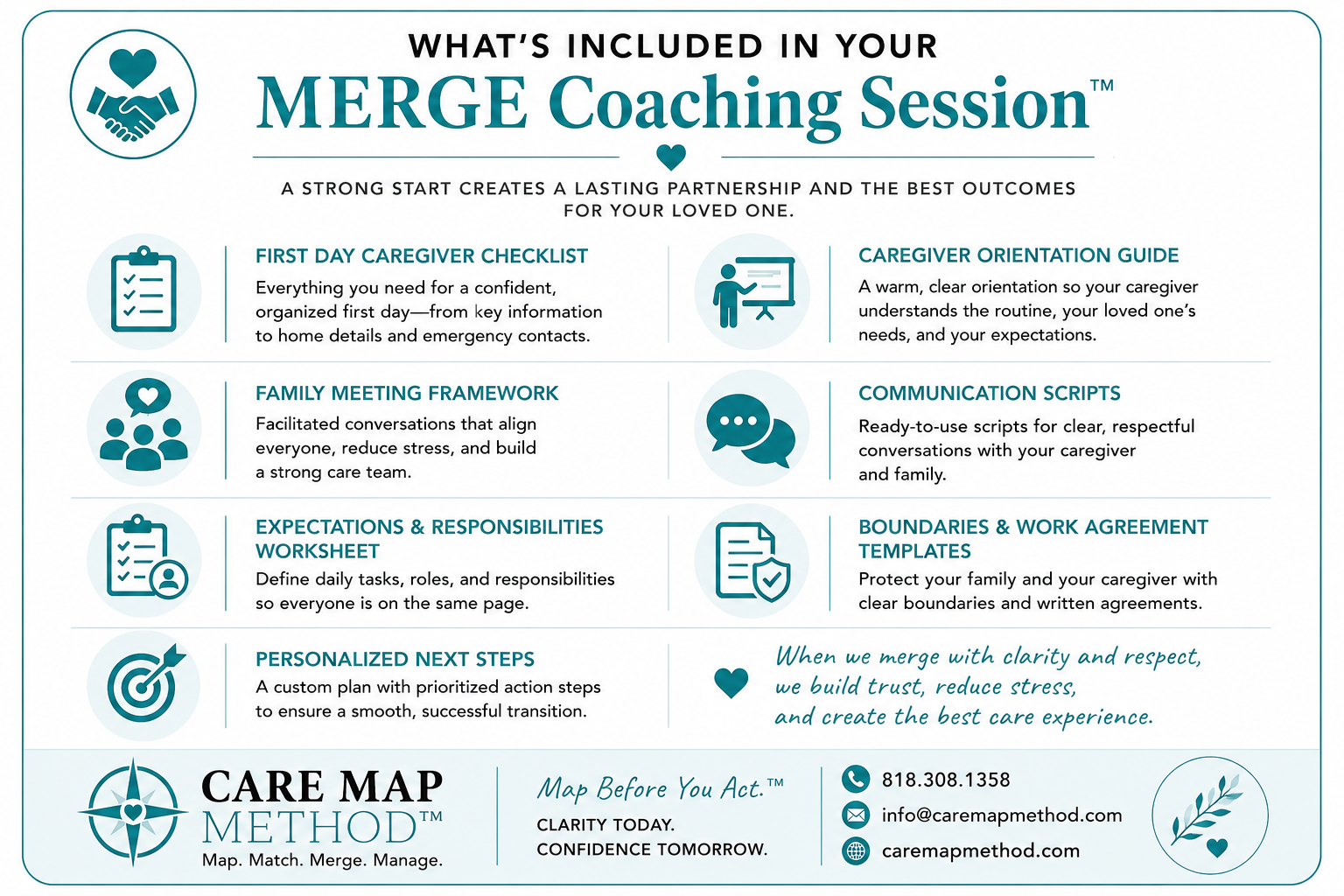
During a Care Map Method™ MERGE Session, we help families create a smooth transition using seven essential components.
First Day Checklist
Before the caregiver arrives, families prepare:
Emergency contacts
Medication lists
Home safety information
Daily routines
House rules
Important phone numbers
Everyone begins with the same information.
Caregiver Orientation
Rather than expecting caregivers to "figure it out," we provide a clear orientation that covers:
Medical needs
Mobility assistance
Meal preferences
Communication style
Personal routines
Family expectations
This builds confidence from day one.
Family Meetings
Caregiving works best when everyone communicates openly.
We facilitate conversations that align:
Adult children
Spouses
Paid caregivers
Physicians
Other family members
Everyone understands the care plan and their role.
Communication Scripts
Many families avoid difficult conversations until frustration builds.
We provide respectful scripts for discussing:
Performance concerns
Schedule changes
Requests
Appreciation
Feedback
Difficult situations
Clear communication prevents resentment.
Expectations & Roles
One of the biggest causes of caregiver turnover is unclear expectations.
Together we define:
Daily responsibilities
Weekly responsibilities
Transportation
Meal preparation
Personal care
Household duties
Documentation
Clarity creates consistency.
Healthy Boundaries
Professional caregiving requires compassion and boundaries.
We help families establish guidelines for:
Work hours
Personal privacy
Financial requests
Family involvement
Time off
Decision-making
Healthy boundaries protect everyone.
Work Agreements
A written agreement minimizes confusion.
Topics include:
Schedule
Compensation
Duties
Communication
Emergencies
Time off
Performance reviews
Everyone knows what success looks like.
The Benefits of a Structured MERGE Process
Families often report:
Less stress
Better communication
Fewer conflicts
More caregiver confidence
Greater consistency
Improved quality of care
Longer caregiver retention
When expectations are clear, relationships become stronger.
Caregiving Is a Partnership
Successful caregiving doesn't happen by chance.
It happens when families intentionally prepare caregivers for success.
A thoughtful onboarding process transforms a new caregiver into a trusted member of the care team.
At Care Map Method™, our MERGE Coaching Session provides the tools, structure, and guidance to help families create confident, collaborative caregiving relationships.
How to Choose the Right Caregiver for Your Aging Parent: 10 Questions Every Family Should Ask
Finding the right caregiver is about more than experience. Learn the interview questions, red flags, and evaluation strategies that help families choose the best caregiver for their loved one.
Hiring a caregiver is about much more than filling an open position.
You're inviting someone into your loved one's home, daily routine, and life.
The right caregiver can improve safety, independence, confidence, and quality of life.
The wrong caregiver can create stress, confusion, poor communication, and unnecessary turnover.
At Care Map Method™, we believe the best outcomes begin with the right match.
Why Matching Matters
Families often focus on credentials alone.
Experience is important—but it isn't everything.
A successful caregiving relationship also depends on:
Personality
Communication style
Patience
Reliability
Flexibility
Family expectations
Medical needs
Emotional compatibility
Finding someone who fits all of these areas requires more than a résumé.
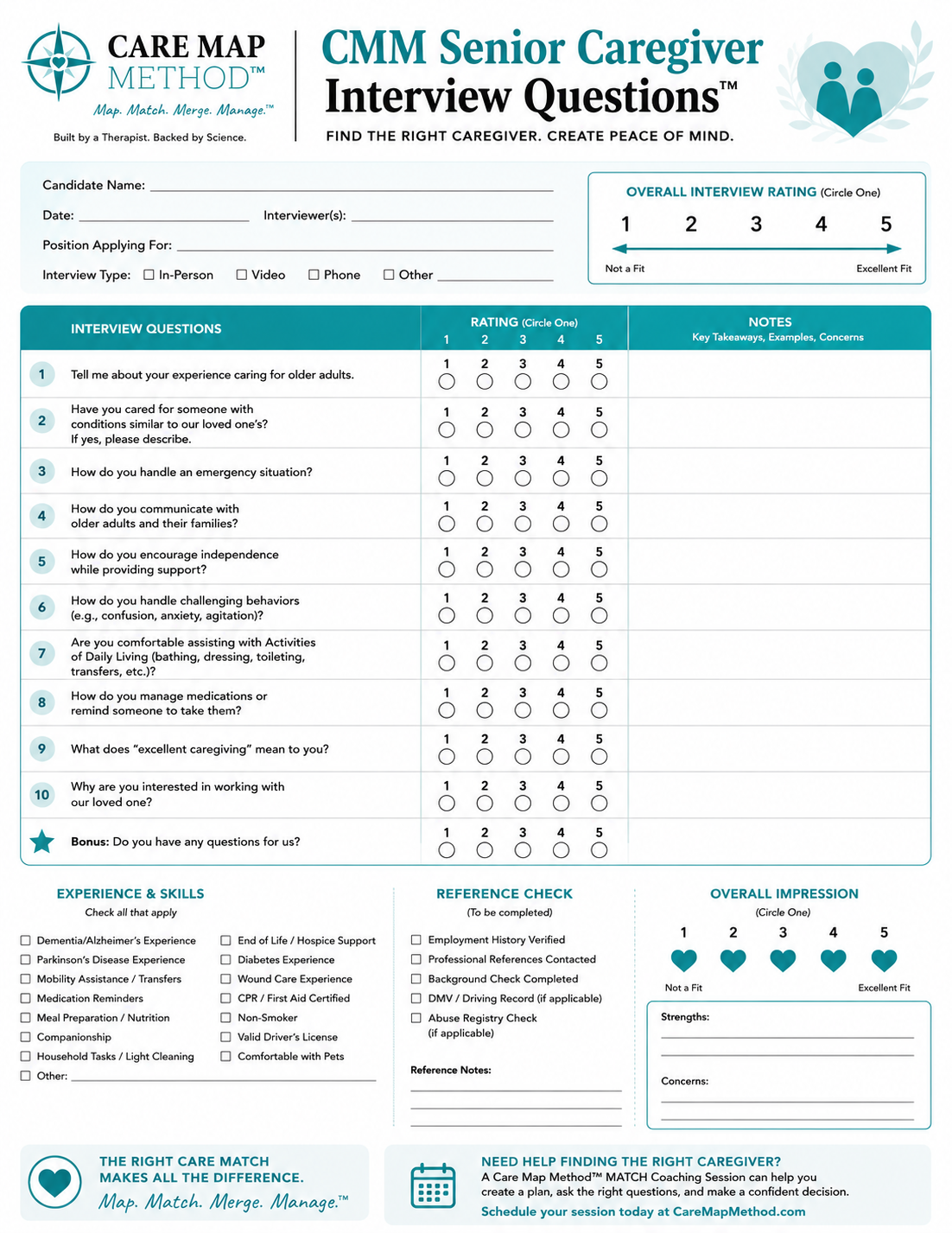
10 Questions Every Family Should Ask
1. Tell me about your caregiving experience.
Listen for specific examples rather than general answers.
2. Have you worked with someone who has similar medical needs?
Examples include:
Dementia
Parkinson's disease
Stroke recovery
Diabetes
Mobility limitations
3. How would you handle an emergency?
You're looking for calm decision-making and sound judgment.
4. How do you communicate with families?
Good caregivers communicate clearly, consistently, and respectfully.
5. Tell me about a difficult caregiving situation.
Past experiences often predict future performance.
6. How do you encourage independence?
Great caregivers support rather than take over.
7. Are you comfortable assisting with Activities of Daily Living?
Examples include:
Bathing
Dressing
Transfers
Toileting
Meal preparation
8. What does excellent caregiving mean to you?
This question reveals values more than skills.
9. Why are you interested in this position?
Look for genuine compassion rather than generic responses.
10. What questions do you have for us?
Excellent caregivers usually ask thoughtful questions.
Don't Forget References
Always verify:
Employment history
Reliability
Attendance
Communication
Strengths
Areas for growth
References often reveal details that interviews do not.
Watch for Red Flags
Be cautious if a caregiver:
Speaks negatively about previous employers
Cannot explain gaps in employment
Avoids answering questions
Arrives late without explanation
Has inconsistent references
Download Our Caregiver Interview Questions™ Worksheet
(Insert your worksheet here.)
Our printable worksheet helps families compare candidates objectively, take organized notes, and feel more confident during the hiring process.
How a Care Map Method™ MATCH Coaching Session Can Help
Choosing a caregiver can feel overwhelming.
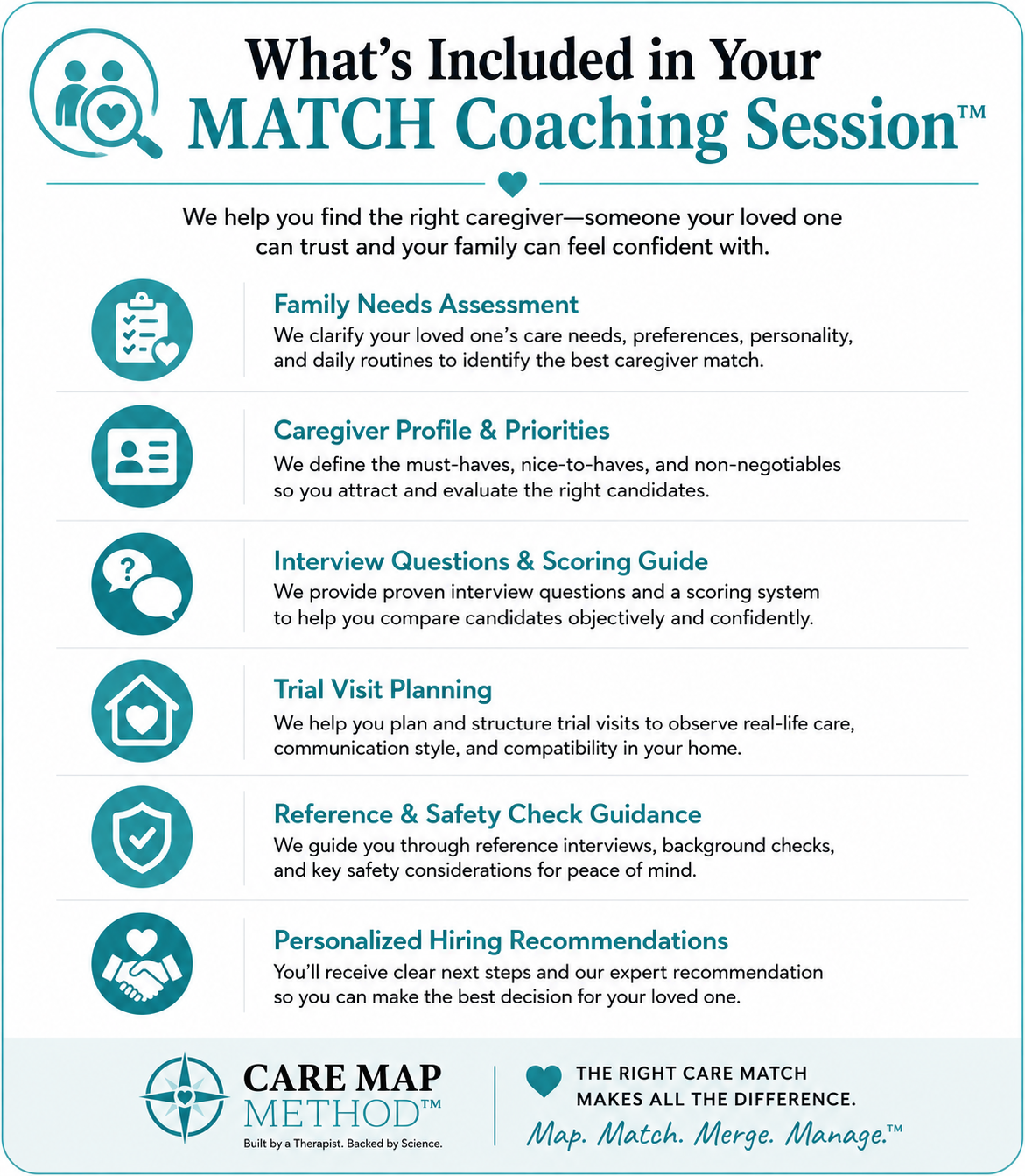
During your personalized MATCH Coaching Session™, we'll help you:
Clarify your family's care needs
Create the ideal caregiver profile
Prioritize must-have qualifications
Review interview questions
Plan trial visits
Evaluate references and safety considerations
Compare candidates objectively
Make a confident hiring decision
Our goal is to help you find the caregiver who best fits your loved one's needs—not simply the first available applicant.
Ready to Find the Right Caregiver?
The right caregiver can make daily life safer, calmer, and more fulfilling for your loved one—and for your entire family.
If you're preparing to hire in-home care, our Care Map Method™ MATCH Coaching Session provides expert guidance to help you make an informed decision with confidence.
Book your MATCH Coaching Session today.
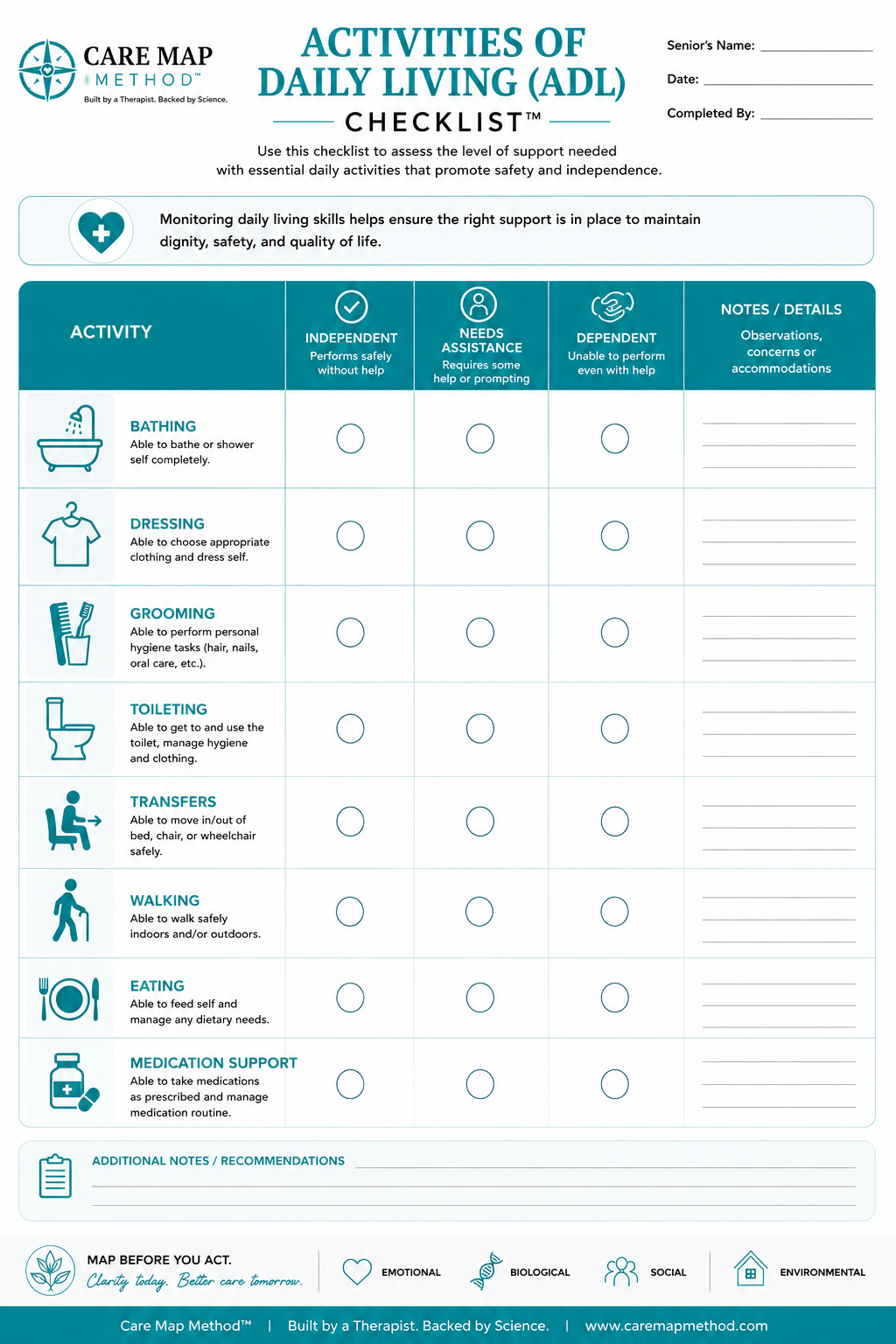
7 Signs Your Aging Parent Needs Help with Activities of Daily Living (ADLs)
Many older adults begin needing help gradually. Learn the warning signs that your loved one may need assistance with Activities of Daily Living and discover how to assess their safety and independence.
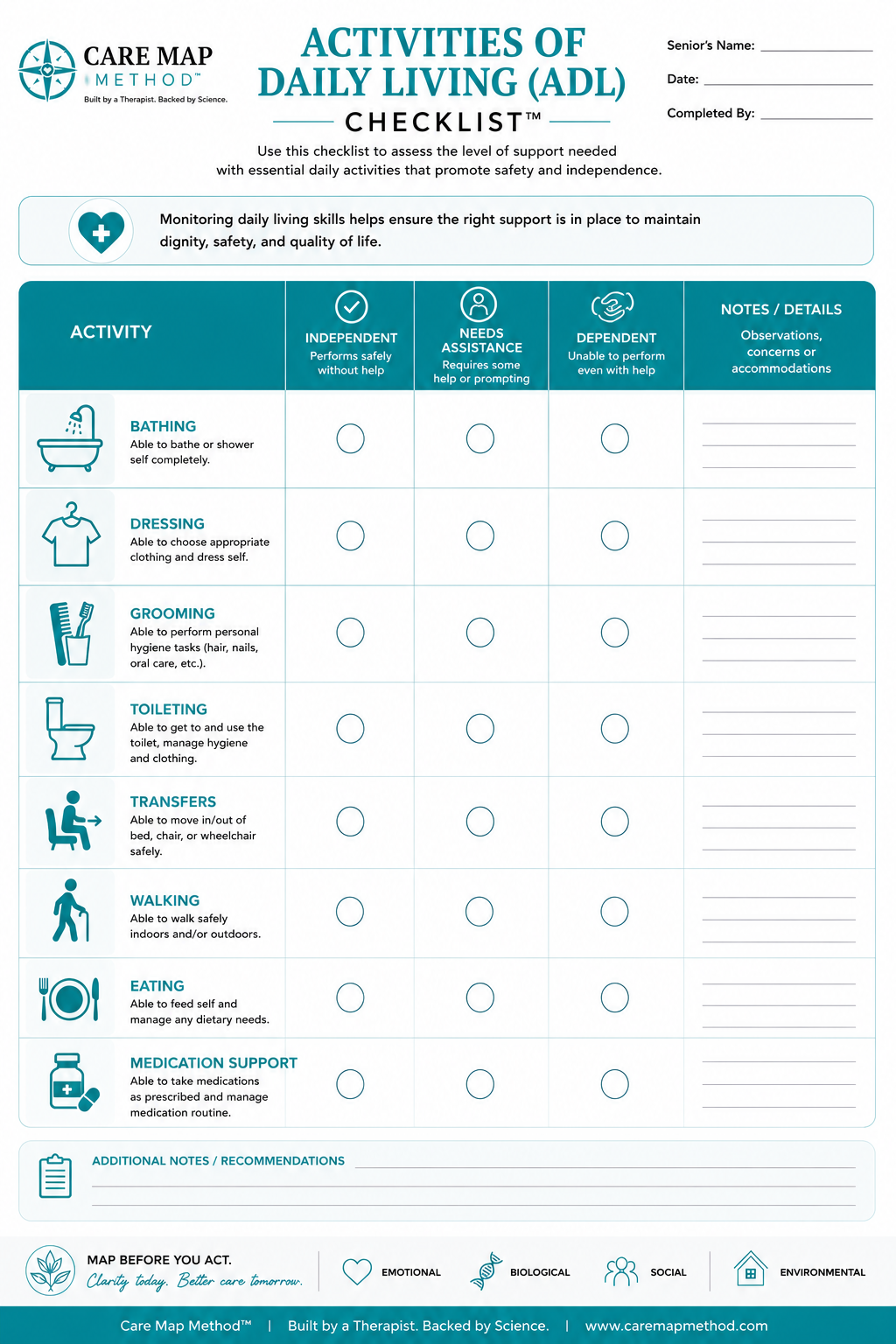
Activities of Daily Living (ADL) Checklist worksheet from Care Map Method™ helping families evaluate whether an older adult needs assistance with bathing, dressing, grooming, eating, mobility, toileting, transfers, and medication support.
7 Signs Your Aging Parent Needs Help with Activities of Daily Living (ADLs)
One of the hardest parts of caring for an aging parent is recognizing when small changes become signs that additional support is needed.
Many older adults want to remain independent, and families often hope they can continue living safely on their own. However, subtle declines in everyday functioning may increase the risk of falls, medication errors, malnutrition, hospitalization, and caregiver stress.
At Care Map Method™, we encourage families to Map Before They Act™. Assessing Activities of Daily Living (ADLs) provides a structured way to understand current abilities and identify where support may improve safety and quality of life.
What Are Activities of Daily Living?
Activities of Daily Living, commonly called ADLs, are the basic self-care tasks people perform every day to remain healthy, safe, and independent.
These include:
Bathing
Dressing
Grooming
Toileting
Walking and mobility
Transfers (getting in and out of bed or a chair)
Eating
Medication management
When one or more of these activities become difficult, it may be time to reassess your loved one's care needs.
1. Difficulty Bathing
Notice if your loved one:
Avoids showers
Appears unsteady in the bathroom
Has poor hygiene
Expresses fear of falling
Bathrooms are one of the most common places where older adults experience falls.
2. Wearing the Same Clothes
Difficulty dressing may include:
Wearing stained clothing
Difficulty with buttons or zippers
Dressing inappropriately for the weather
Needing assistance putting on shoes
These changes may indicate arthritis, weakness, balance problems, or cognitive decline.
3. Changes in Personal Grooming
Poor grooming often develops gradually.
Look for:
Unwashed hair
Long fingernails
Missed shaving
Declining oral hygiene
These changes can sometimes signal depression, memory changes, or physical limitations.
4. Trouble Walking or Getting Up
Watch for:
Holding onto furniture
Difficulty standing
Slower walking speed
Multiple near-falls
Trouble climbing stairs
Even one fall can significantly affect an older adult's confidence and independence.
5. Weight Loss or Poor Nutrition
Ask yourself:
Is food expiring in the refrigerator?
Have they lost weight?
Are they skipping meals?
Are they drinking enough water?
Nutrition plays a major role in strength, healing, and overall health.
6. Medication Mistakes
Medication concerns may include:
Forgotten doses
Duplicate doses
Confusion about prescriptions
Expired medications
Medication management becomes increasingly important as prescriptions become more complex.
7. Increasing Dependence on Family
You may notice yourself:
Driving to every appointment
Managing bills
Preparing meals
Picking up prescriptions
Helping with household tasks
While occasional assistance is normal, increasing dependence may indicate that additional planning is needed.
Download Our Free Activities of Daily Living Checklist™
(Insert your ADL Checklist worksheet image here.)
Our printable worksheet helps families evaluate daily functioning and identify areas where support may improve safety, independence, and quality of life.
Bring the completed checklist to healthcare appointments or use it during family caregiving discussions.
Why Early Assessment Matters
Recognizing changes early allows families to make thoughtful decisions rather than reacting during a crisis.
Early planning can help:
Reduce caregiver stress
Prevent falls
Improve communication among family members
Coordinate medical care
Delay unnecessary hospitalizations
Support aging in place when appropriate
How a Care Map Method™ MAP Coaching Session Can Help
Many families know something has changed but aren't sure what to do next.
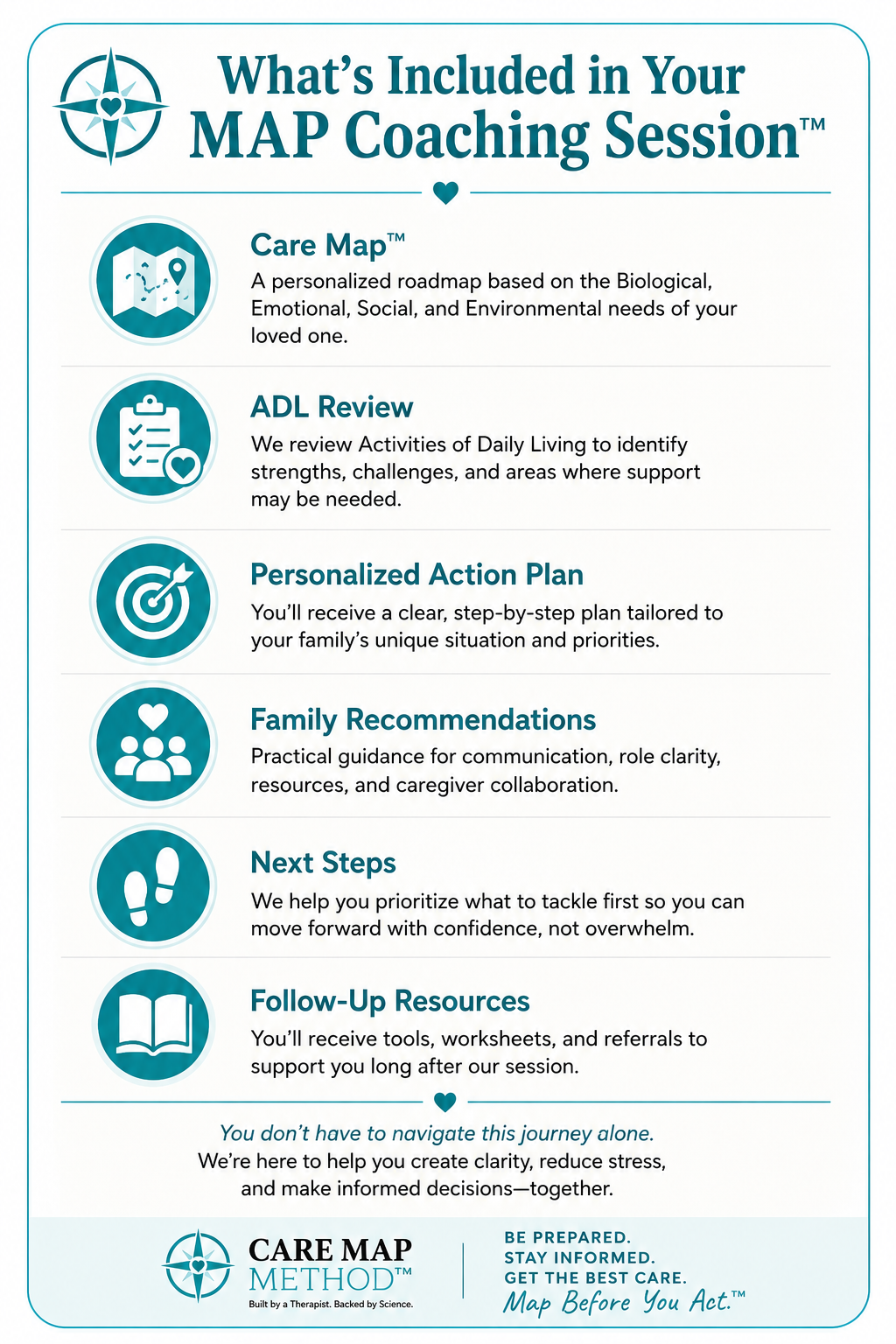
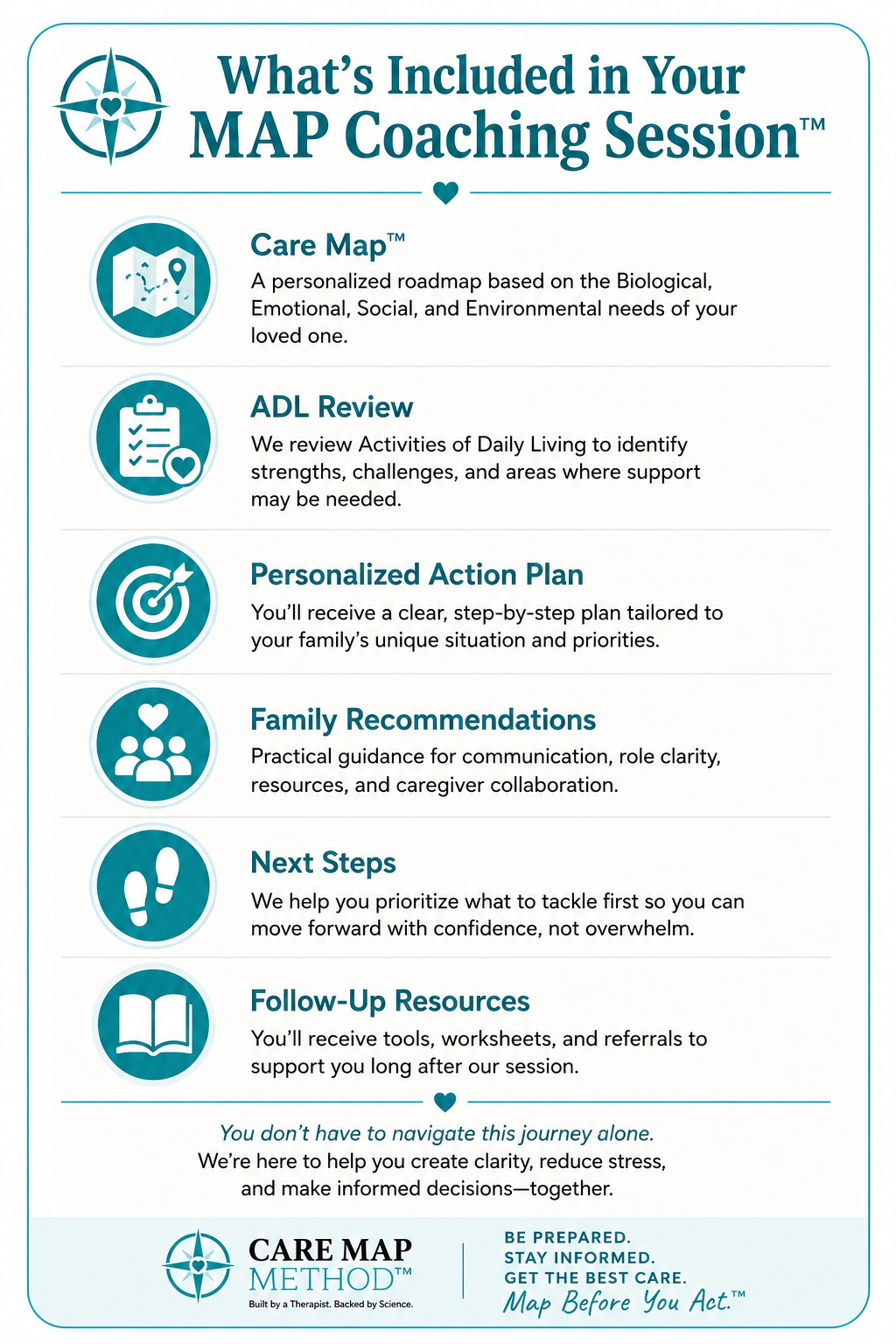
During a personalized Care Map Method™ MAP Coaching Session, we'll help you:
Assess Activities of Daily Living
Identify safety concerns
Review medical, emotional, social, and environmental needs
Prioritize next steps
Develop a personalized Care Map™
Create an action plan tailored to your family's situation
Our goal is to help families move forward with confidence instead of uncertainty.
Ready to Better Understand Your Loved One's Needs?
If you're wondering whether your parent can continue living independently—or what level of support is appropriate—you don't have to make those decisions alone.
A Care Map Method™ MAP Coaching Session provides expert guidance, practical tools, and a personalized roadmap based on your loved one's unique situation.
Book your Care Map Method™ MAP Coaching Session today and start planning before a crisis occurs.
25 Questions to Ask Your Parents' Doctor Before It's Too Late
Preparing for a doctor's appointment can make all the difference. Learn the most important questions to ask your aging parent's healthcare providers and discover how Care Map Method™ helps families organize medical care with confidence.
There is one sentence I hear from caregivers almost every week:
"I forgot to ask."
Whether it's about medications, memory loss, falls, nutrition, or pain, families often leave doctor's appointments remembering all the questions they meant to ask—after they've already driven home.
Healthcare appointments are often short. Physicians are balancing many priorities, and families are trying to remember months of concerns in just a few minutes.
That's why preparation matters.
At Care Map Method™, we encourage families to Map Before They Act. One of the simplest ways to do that is to arrive with a written list of questions and a place to record the answers.
Why Medical Appointments Feel So Overwhelming
Caring for an aging parent means managing far more than a single diagnosis.
You may be trying to understand:
multiple medications
recent falls
memory changes
sleep issues
nutrition
mobility
hearing
vision
pain
new specialists
insurance questions
Trying to organize all of those concerns during a fifteen-minute appointment can feel impossible.
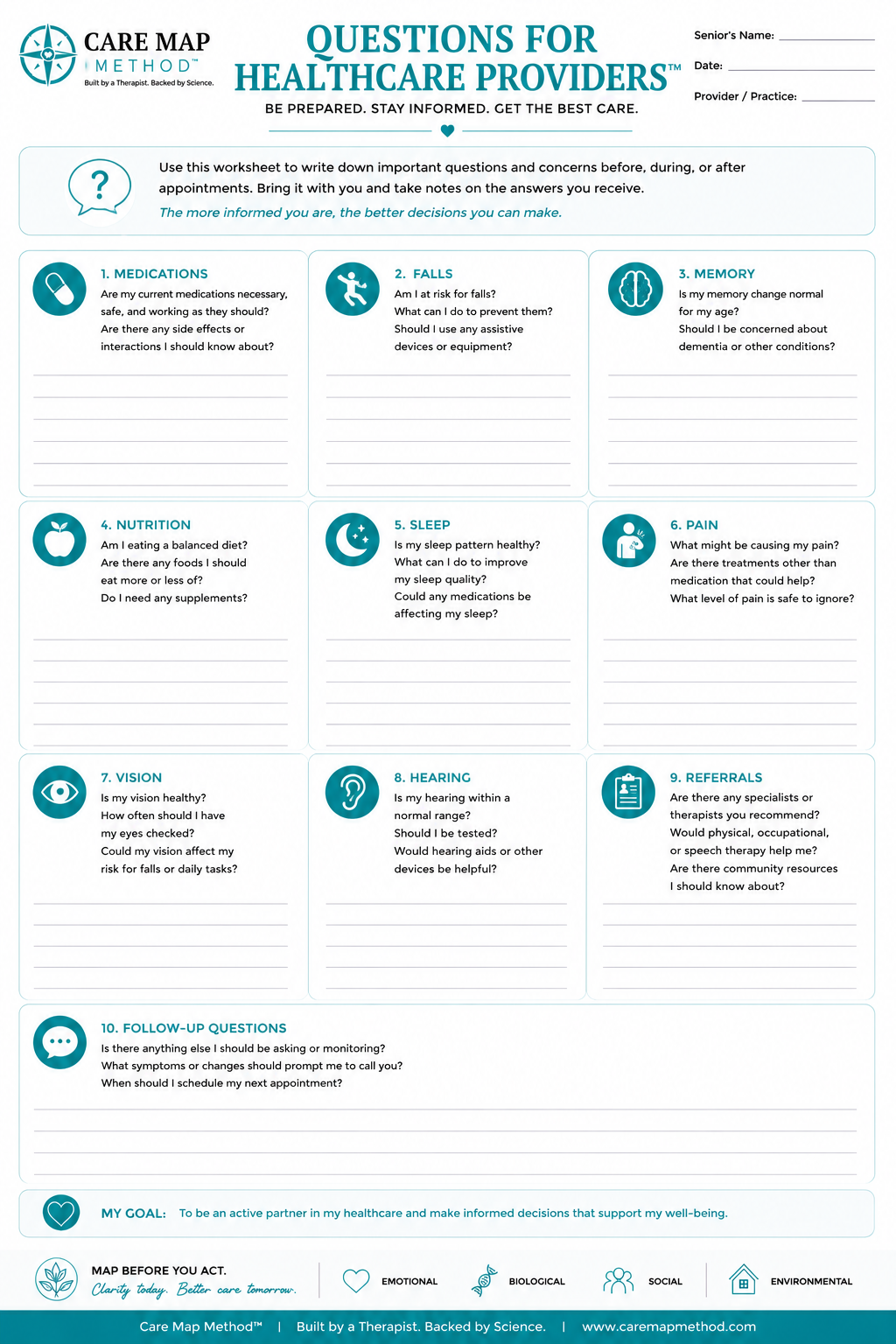
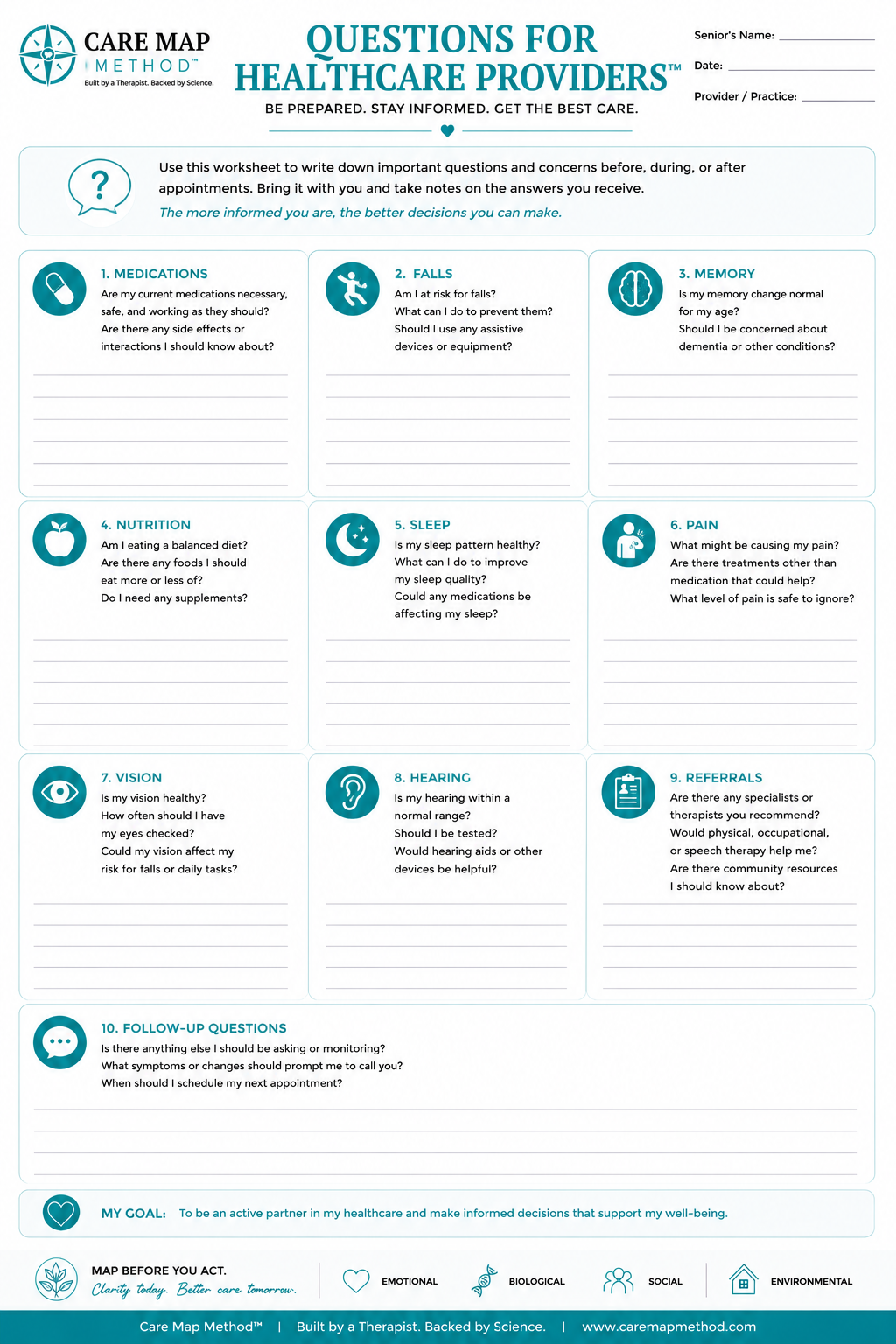
That's why we created the Questions for Healthcare Providers™ Worksheet.
Questions Every Family Should Ask
Instead of relying on memory, organize your concerns into ten important areas.
1. Medications
Ask:
Are all of these medications still necessary?
Could any medications be interacting?
Are side effects causing fatigue, dizziness, or confusion?
2. Falls
Falls are one of the leading causes of hospitalization among older adults.
Ask:
Is my loved one at risk?
Should physical therapy be considered?
Would a walker or cane help?
3. Memory
Not every memory change is dementia.
Ask:
Is this normal aging?
Should additional testing be done?
What symptoms should we monitor?
4. Nutrition
Poor nutrition often contributes to weakness and illness.
Ask:
Are they getting enough protein?
Should they take supplements?
Are there foods to avoid?
5. Sleep
Poor sleep affects nearly every aspect of health.
Ask:
Could medications be causing insomnia?
Is sleep apnea possible?
What healthy sleep habits would you recommend?
6. Pain
Pain should never simply be accepted as "old age."
Ask:
What is causing the pain?
Are there treatments besides medication?
When should we be concerned?
7. Vision
Vision affects driving, balance, and independence.
Ask:
How often should eye exams occur?
Could vision problems increase fall risk?
8. Hearing
Hearing loss often contributes to isolation and cognitive decline.
Ask:
Should hearing be tested?
Would hearing aids improve quality of life?
9. Referrals
Sometimes another specialist can make all the difference.
Ask about:
Physical Therapy
Occupational Therapy
Speech Therapy
Memory Clinics
Social Workers
Community Resources
10. Follow-Up
Before leaving the appointment, always ask:
What symptoms should prompt a phone call?
When should we schedule the next visit?
What changes should we watch for?
Don't Just Collect Information—Organize It
One doctor's appointment rarely answers every question.
Families need a way to organize medical information over time so everyone stays on the same page.
That's exactly why we developed the Care Map Method™.
Instead of reacting to crises, we help families build a personalized roadmap that considers the four pillars of caregiving:
Biological
Emotional
Social
Environmental
This structured approach helps families make informed decisions before problems become emergencies.
How a Care Map Method™ Coaching Session Can Help
During your personalized coaching session, we'll help you:
✔ Prepare for upcoming medical appointments
✔ Organize medications and diagnoses
✔ Identify important questions to ask providers
✔ Review safety concerns such as falls and memory changes
✔ Develop a personalized Care Map™
✔ Create an action plan for next steps
Whether you're just beginning your caregiving journey or managing increasingly complex medical needs, we'll help you move forward with clarity and confidence.
Ready to Feel More Prepared?
If you're caring for an aging parent and feeling overwhelmed by medical appointments, you're not alone.
Our Care Map Method™ Senior Coaching Sessions provide expert guidance to help families understand what to ask, what to prioritize, and what to do next.
Schedule your personalized Care Map Method™ Coaching Session today and start building a plan before the next doctor's appointment.