
Aetna Therapy in New Jersey When Your Adult Child Won’t Talk to You
Online New Jersey therapy for parents coping with adult-child estrangement, communication breakdown and family boundaries. Aetna eligibility varies.
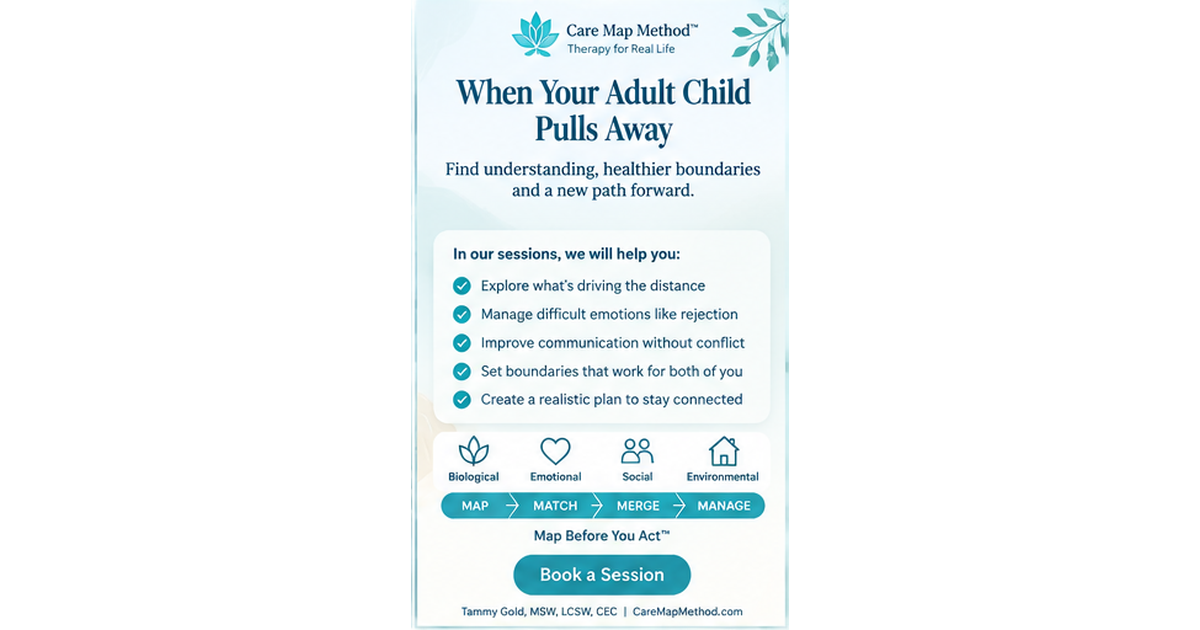
Aetna online therapy in New Jersey with Tammy Gold, LCSW for adult child estrangement & communication breakdown.
Aetna Therapy in New Jersey: When Your Adult Child Won’t Talk to You
When an adult child pulls away or stops communicating, the uncertainty can be as painful as the distance itself. You may replay conversations, question what you should have done differently, or feel torn between reaching out and respecting the space they have requested.
Therapy does not begin with an assumption that reconciliation is the goal. It can give you a private place to understand the relationship, process grief and anger, clarify what is within your control, and decide how you want to respond.
I am Tammy Gold, MSW, LCSW, CEC, a licensed therapist, author and creator of the Care Map Method™. I provide online psychotherapy to eligible clients located in New Jersey, including adults dealing with relationship stress, family conflict, caregiving and major life transitions.
Depending on your specific plan, eligibility and current network participation, Aetna may be available for psychotherapy. Coverage, copays, deductibles and benefits vary and should be verified before scheduling.
Check Insurance & Book Therapy On HEADWAY
Does this sound familiar?
· Contact has become limited, tense or nonexistent.
· You replay conversations trying to understand what happened.
· You are torn between reaching out and respecting distance.
· Grief, shame, anger and uncertainty are affecting the rest of your life.
Why the surface problem may not be the whole problem
Families and couples often begin by trying to solve the most visible problem. But the visible problem may be only one part of the Care Map. Stress, health, expectations, attachment needs, changing roles, communication habits, family history and the surrounding environment can all affect what happens next.
Looking at the broader pattern can reduce shame and blame. Instead of asking only, “Who caused this?” we can ask, “What is happening, what does each person need, what is within my control, and what response is most likely to be useful?”
How I use the Care Map Method™ in therapy
MAP — Understand what is actually happening
We identify the problem, the repeating pattern and the needs underneath it. I look at biological, emotional, social and environmental factors rather than reducing a complicated relationship to one argument or one person’s behavior.
MATCH — Match the right support or strategy
Once the pattern is clearer, we identify approaches that fit the actual need. That may involve communication, boundaries, coping strategies, emotional regulation, role changes, additional support or a different way of responding.
MERGE — Bring understanding into the relationship
Insight matters most when it can be used. We translate what you are learning into conversations, decisions, requests and boundaries that are realistic for your life and relationships.
MANAGE — Adjust as life changes
Relationships and caregiving systems are dynamic. We notice what is helping, what is not, and what needs to be adjusted rather than expecting one conversation or technique to solve everything permanently.
A safe place without shame or blame
My approach is warm, active, practical and nonjudgmental. Therapy can be one completely safe place to say what you are actually thinking and feeling without having to protect everyone else, perform competence or decide immediately what you are going to do.
My goal is not simply to have you talk about the problem. I want you to better understand yourself and the people around you, name emotions and needs more clearly, reduce unnecessary shame and blame, and leave with practical next steps.
Online therapy in New Jersey
I provide telehealth psychotherapy to eligible clients who are physically located in New Jersey at the time of service. Aetna may be available depending on your individual plan, eligibility and current network participation. Please verify your benefits before scheduling.
Relationship and family problems can also be addressed in individual therapy. Another person does not necessarily need to participate for you to work on your own communication, boundaries, emotions and responses.
About Tammy Gold, MSW, LCSW, CEC
Tammy Gold is a licensed clinical social worker, therapist, author and creator of the Care Map Method™. For more than 20 years, her work has focused on the relationships and care systems surrounding families—from marriage and parenting to adult children, caregiving and aging parents.
She earned her MSW from Columbia University and her undergraduate degree from the University of Pennsylvania. Her family and caregiving expertise has been featured in national media. Add the approved press-logo strip here to reinforce authority without interrupting the clinical message.
Frequently asked questions
Can therapy help with adult-child estrangement?
Therapy can help you understand the relationship, process grief and uncertainty, clarify boundaries and consider how you want to communicate. It does not require reconciliation or a particular relationship outcome.
Will therapy tell me to cut off or reconcile?
Therapy can help you understand the relationship, process grief and uncertainty, clarify boundaries and consider how you want to communicate. It does not require reconciliation or a particular relationship outcome.
Can I come alone?
Yes. Individual therapy can focus on your emotions, communication, boundaries and responses even when another family member or partner does not participate. Therapy cannot guarantee that another person will change.
How do I respect a boundary while leaving the door open?
A useful boundary clarifies what you will do, accept or participate in. Therapy can help you make boundaries more specific, communicate them without unnecessary escalation and manage the guilt or anxiety that may follow.
Does Aetna cover online therapy in New Jersey?
Aetna may be available depending on your specific plan, eligibility, clinical circumstances and current network participation. Benefits, copays and deductibles vary, so verify coverage before scheduling.
You do not have to solve the whole relationship today
A useful first step is often understanding the pattern more clearly. Therapy can help you slow down, identify what you need, distinguish what is within your control from what is not, and decide what a healthier next response could look like.
Insurance note: Aetna eligibility and benefits vary. Verify your individual coverage before scheduling.

My Adult Child Isn't Moving Forward
When an adult child is stuck, parents can become trapped between helping and enabling. Therapy can help with money, expectations, boundaries, motivation and family conflict.
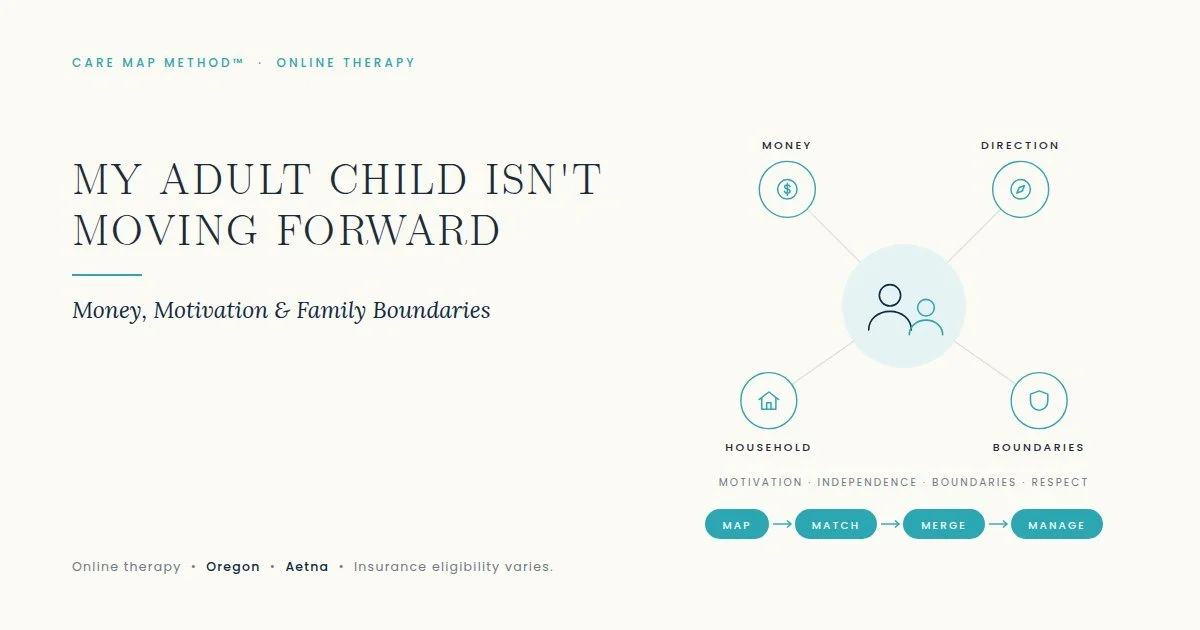
Online therapy in Oregon for failure to launch, adult-child boundaries, money conflict and family stress; Aetna eligibility varies. Oregon Aetna
When an adult child is stuck, parents can become trapped between helping and enabling. Therapy can help with money, expectations, boundaries, motivation and family conflict.
When Helping Starts to Feel Like Holding Everything Up
Parents of struggling adult children often feel caught between compassion and fear. You may be paying bills, managing appointments, tolerating broken agreements or avoiding limits because you are afraid your child will fall apart. At the same time, resentment and worry can take over the household.
How Therapy Can Help
Therapy can help you distinguish support from rescue, clarify expectations, set realistic financial and household boundaries, prepare conversations and decide what you can control while preserving as much connection as possible.
The Care Map Method™: Map • Match • Merge • Manage
MAP — Understand the pattern. Identify triggers, recurring interactions, stressors, beliefs and roles that keep the problem going.
MATCH — Identify needs and goals. Clarify what matters most, what you can influence and what a healthier outcome would look like.
MERGE — Improve communication and connection. Practice clearer language, boundaries, listening and responses that reduce reactivity and support healthier relationships.
MANAGE — Create practical next steps. Build realistic strategies, routines, agreements and coping tools you can use outside the session.
Online therapy and insurance
I provide online therapy for clients located in Oregon. I may participate with Aetna through Headway, depending on the specific plan and my current network participation. Insurance eligibility, benefits, copays, deductibles and coverage vary. Please verify your benefits through Headway before your appointment.
A safe place to unload—and a plan to move forward
My style is warm, supportive, practical and nonjudgmental. There is room to say the things you are embarrassed, angry, confused or exhausted about without shame or blame. We will make space for the feelings and also work toward tangible changes, clearer decisions and concrete next steps.
Ready for support?
If this issue is affecting your mood, relationships, work, sleep or sense of stability, you do not have to wait until it becomes a crisis. Use my Headway profile to check insurance eligibility and available appointment times.
FAQ
Can therapy help even if the other person does not attend?
Yes. Individual therapy can help you understand patterns, regulate your responses, clarify boundaries, prepare conversations and make decisions about how you want to participate in the relationship.
Do you accept Aetna in Oregon?
I may participate with Aetna through Headway for clients located in Oregon. Your specific plan and benefits must be verified because eligibility and costs vary.
Is this only a place to talk about the problem?
No. Emotional support matters, but my approach is also structured and solution-focused. We identify what is happening, what you need, what can change and what concrete steps you can take next.
What happens in the first session?
We focus on what is bringing you in, the relevant relationships and stressors, the patterns you are noticing and the outcome you want. We begin creating a Care Map so you leave with clearer direction.
Is online therapy nonjudgmental?
My approach emphasizes warmth, respect and understanding rather than shame, blame or judgment, within the normal confidentiality and clinical limits of psychotherapy.
Email: Info@CareMapMethod.com Text:818.308.1358