

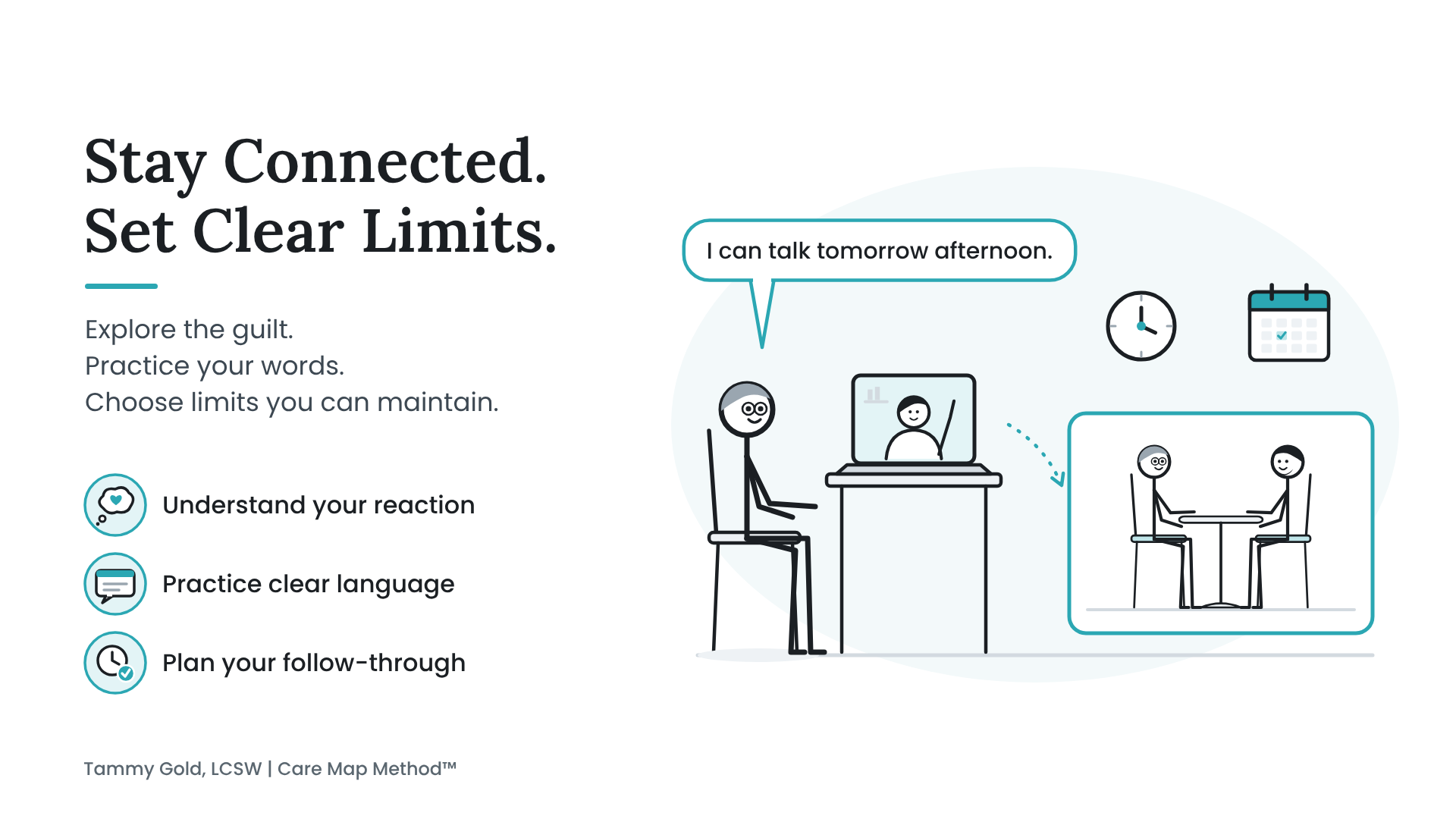
Therapy for Boundaries With Adult Children in Oregon
Online therapy for Oregon parents struggling with guilt, conflict, or boundaries with adult children. Check Regence BCBS eligibility through Headway.
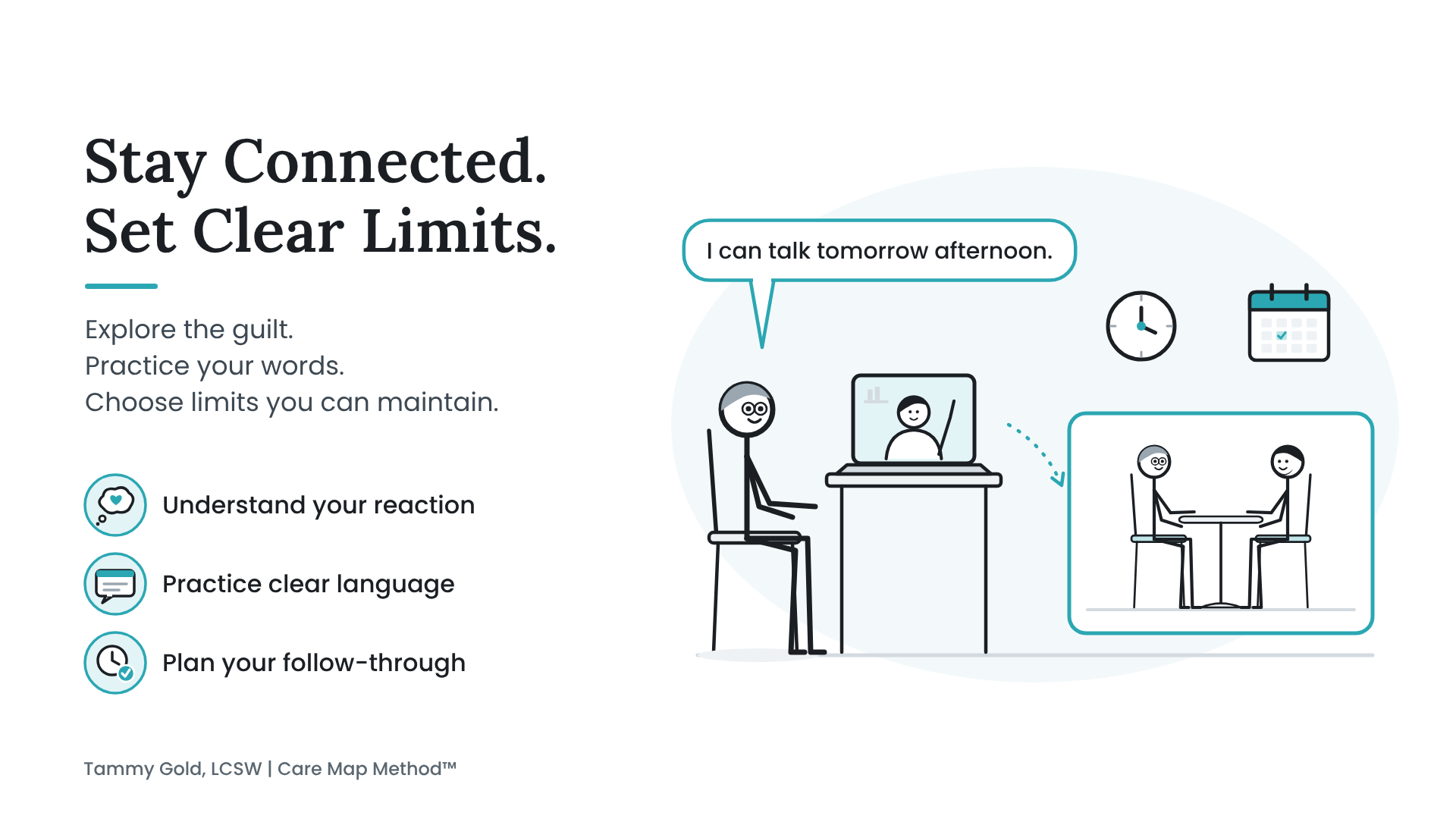
You want to stay close to your adult child, but every call seems to bring another crisis, request, or disagreement. You may be afraid that setting a limit will cost you the relationship.
I am Tammy Gold, LCSW. I offer individual online therapy for adults located in Oregon. Regence BlueCross BlueShield of Oregon appears on my Headway profile; please check your exact plan and eligibility before booking.
Check insurance and booking through Headway
Love and availability are different questions
Individual therapy can help you explore the fear, guilt, sadness, or resentment around family boundaries. We can look at what happens before you agree to something, how you feel afterward, and which patterns leave you exhausted. The goal is to make thoughtful choices about your own behavior while respecting that your adult child makes theirs.
Choose a limit you can maintain
A boundary is more usable when it states what you will do. Instead of repeatedly asking someone to stop calling late at night, you might decide: “I can talk tomorrow afternoon. I am not available for this conversation tonight.” We can practice the wording, prepare for your emotional reaction, and reconsider the plan when circumstances genuinely change.
Understand the family pattern
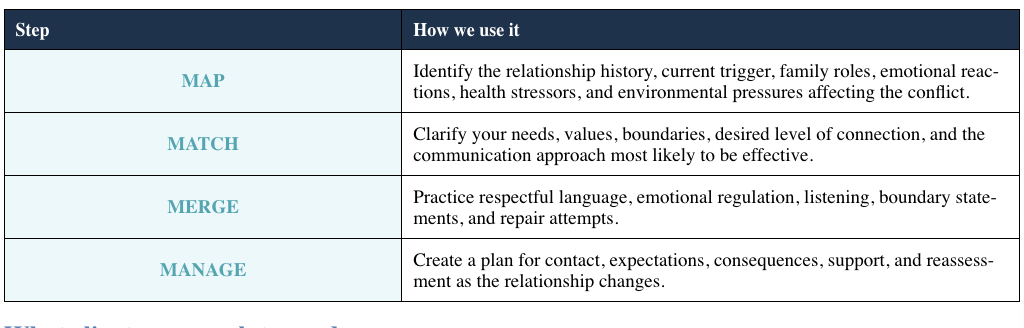
Using the Care Map Method™, we Map the interaction and its effects, Match your needs with coping skills and realistic limits, Merge those limits into communication, and Manage what follows. Biological, Emotional, Social, and Environmental factors help us understand your capacity and the pressures on the relationship without reducing either person to a label.
What we would explore in your first session
We can begin with a recent request or conversation that left you upset. What did your adult child ask for? What did you agree to? What did you fear would happen if you said no? We would discuss your symptoms, relevant history, and the effect on your daily life. Your goal might be responding more thoughtfully to financial requests, reducing arguments, or deciding when you are available to talk. You do not need your adult child’s agreement to work on your own responses.
An example of setting a financial limit
Suppose you have agreed to several expenses and now feel anxious whenever your phone rings. We can explore what you can realistically offer and practice wording that states the limit: “I can contribute this amount toward this expense. I cannot take on the additional payment.” This is an illustrative exercise, not a client story or financial advice. We would also discuss what happens after you speak, including guilt, repeated requests, or the temptation to change your answer just to end the discomfort.
Prepare for the feeling after the boundary
A useful boundary plan includes what you will do when the conversation ends. You might wait before replying to another request, write down what made your limit necessary, or bring the exchange to your next session. Choose an action that fits the situation and your responsibilities. We can distinguish an ordinary disagreement from a circumstance that needs urgent attention. The aim is to help you stay thoughtful about your choices when emotions make immediate agreement feel easier.
How we review progress
We can review whether your limits are clearer, whether you follow through more consistently, and whether you spend less time caught in the same argument. We can also explore grief about how the relationship has changed. Staying connected may involve a different level of contact or support than you once imagined. Your treatment goals can reflect both your wish for closeness and your need for a sustainable life.
About Tammy Gold
I am Tamara “Tammy” Gold, MSW, LCSW, CEC, a licensed therapist and certified coach with a clinical MSW from Columbia University. I founded the Care Map Method™ and have more than 20 years of direct work with families. These sessions focus on your individual mental health and treatment goals.
Take the next step
If this concern is affecting your daily life, view my profile to explore fit and current booking options. Check your exact plan and estimated costs before scheduling. You can also read the online therapy booking guide for help choosing a platform.
Check insurance and book through Headway
Read the online therapy booking guide
Frequently asked questions
Can I attend without my adult child?
Yes. Individual therapy focuses on your mental health and choices. Your adult child does not need to participate.
Does Regence BCBS Oregon cover this therapy?
Coverage depends on your specific plan, provider eligibility, and clinical requirements. Family conflict alone does not guarantee coverage; check your benefits through Headway.
Will you decide who is right?
We can examine the interaction, its impact on you, and your options. The work focuses on understanding and change rather than issuing a verdict about a family member.
Can I seek help if we are currently estranged?
Yes. We can explore grief, uncertainty, and your choices around contact. Individual therapy cannot promise reconciliation, but it can support you as you consider what is possible.
Does a boundary mean ending the relationship?
A boundary can address time, money, communication, or what you will participate in. We can explore a range of options and what each would mean in your circumstances.
Can I change a boundary later?
Yes. We can review what changed and whether a different limit makes sense. A thoughtful revision can reflect new information, while still taking your needs seriously.

Why Is My Relationship With My Adult Daughter So Hard?
Online therapy in New Jersey for mother and adult daughter conflict, boundaries and family communication; Aetna eligibility varies.
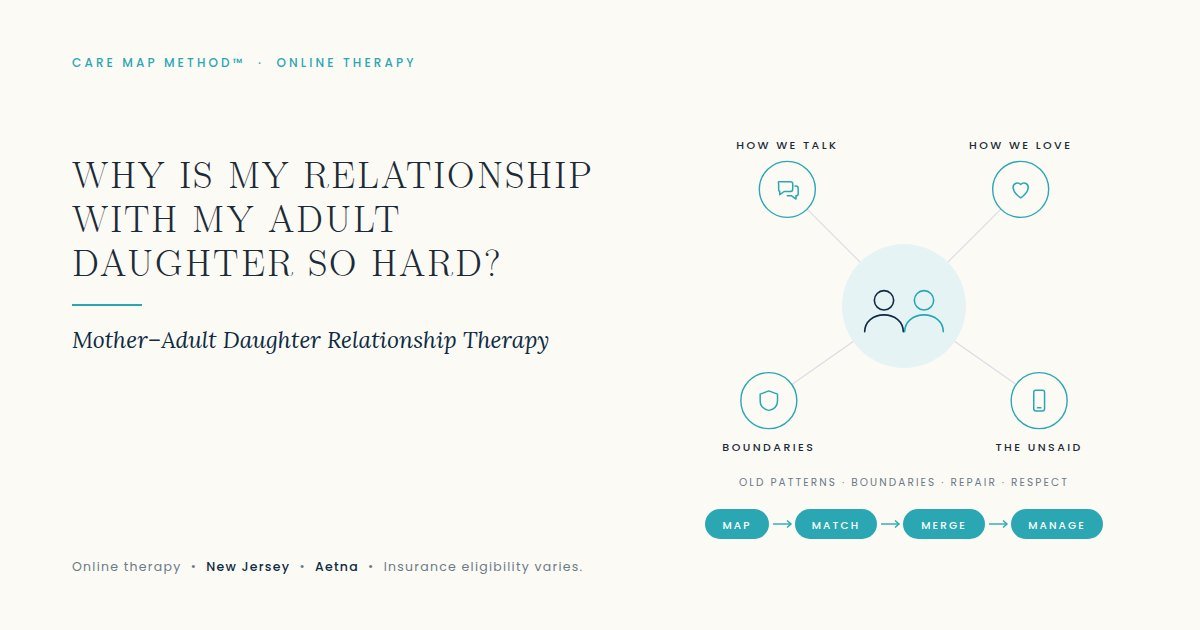
Online therapy in New Jersey for mother and adult daughter conflict, boundaries and family communication; Aetna eligibility varies.
Love Does Not Prevent Conflict
Adult mother-daughter relationships can be deeply loving and deeply activating. Old family roles can reappear quickly. Advice can feel like criticism. Independence can feel like rejection. Silence can feel punishing. One conversation can carry decades of history.
How Therapy Can Help
Individual therapy can help you understand your side of the pattern, identify the boundaries and communication you want, prepare difficult conversations and decide how to stay connected without repeatedly sacrificing your own emotional stability.
The Care Map Method™: Map • Match • Merge • Manage
MAP — Understand the pattern. Identify triggers, recurring interactions, stressors, beliefs and roles that keep the problem going.
MATCH — Identify needs and goals. Clarify what matters most, what you can influence and what a healthier outcome would look like.
MERGE — Improve communication and connection. Practice clearer language, boundaries, listening and responses that reduce reactivity and support healthier relationships.
MANAGE — Create practical next steps. Build realistic strategies, routines, agreements and coping tools you can use outside the session.
Online therapy and insurance
I provide online therapy for clients located in New Jersey. I may participate with Aetna through Headway, depending on the specific plan and my current network participation. Insurance eligibility, benefits, copays, deductibles and coverage vary. Please verify your benefits through Headway before your appointment.
A safe place to unload—and a plan to move forward
My style is warm, supportive, practical and nonjudgmental. There is room to say the things you are embarrassed, angry, confused or exhausted about without shame or blame. We will make space for the feelings and also work toward tangible changes, clearer decisions and concrete next steps.
Ready for support?
If this issue is affecting your mood, relationships, work, sleep or sense of stability, you do not have to wait until it becomes a crisis. Use my Headway profile to check insurance eligibility and available appointment times.
FAQ
Can therapy help even if the other person does not attend?
Yes. Individual therapy can help you understand patterns, regulate your responses, clarify boundaries, prepare conversations and make decisions about how you want to participate in the relationship.
Do you accept Aetna in New Jersey?
I may participate with Aetna through Headway for clients located in New Jersey. Your specific plan and benefits must be verified because eligibility and costs vary.
Is this only a place to talk about the problem?
No. Emotional support matters, but my approach is also structured and solution-focused. We identify what is happening, what you need, what can change and what concrete steps you can take next.
What happens in the first session?
We focus on what is bringing you in, the relevant relationships and stressors, the patterns you are noticing and the outcome you want. We begin creating a Care Map so you leave with clearer direction.
Is online therapy nonjudgmental?
My approach emphasizes warmth, respect and understanding rather than shame, blame or judgment, within the normal confidentiality and clinical limits of psychotherapy.

Carelon Therapy in California for Family Conflict With Parents, Children, and Adult Children
Carelon family conflict therapy in California for parents, children, and adult children using Map, Match, Merge, and Manage.
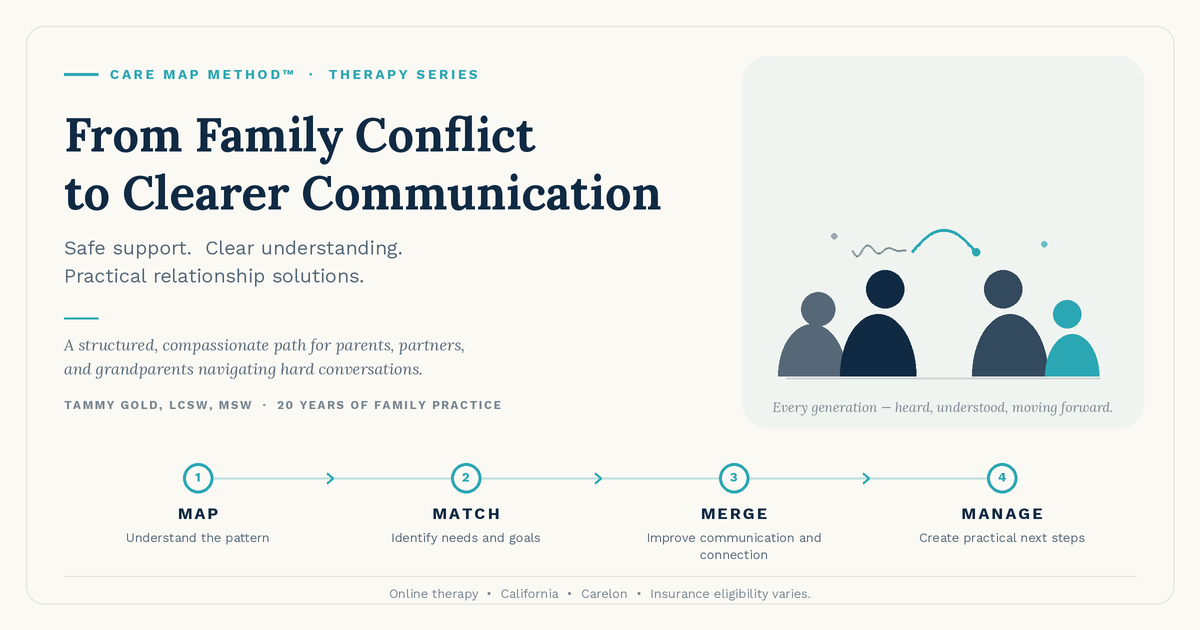
Carelon Therapy in California for Family Conflict With Parents, Children, and Adult Children
Family conflict often contains years of history. A current disagreement can activate old roles, unresolved hurt, loyalty conflicts, criticism, guilt, or fear of rejection. Problems with a parent, child, teenager, or adult child may leave you feeling angry, helpless, responsible, or unsure whether to speak up or pull away.
You do not have to carry this alone. My goal is to provide a warm, confidential, and nonjudgmental space where you can unpack what is happening without shame, blame, or pressure. Therapy can offer emotional support and practical direction at the same time.
Therapy provides a nonjudgmental place to unpack the relationship without forcing an immediate confrontation. We identify the pattern, separate present concerns from historical pain, clarify what you need, and develop communication and boundary strategies that fit the relationship. Progress can begin even if the other family member does not attend.
ONLINE THERAPY IN CALIFORNIA
Insurance may be available through Headway depending on your plan, eligibility, state, and session type. Verify benefits before booking.
Carelon family conflict therapy in California for parents, children, and adult children using Map, Match, Merge, and Manage.
What clients can work toward
Understand why the conflict feels so intense
Communicate without escalating the pattern
Set boundaries with less guilt
Choose a healthier level of connection
Therapy is not only a place to talk about what went wrong. It is a place to feel heard, understand the pattern, practice healthier responses, and build a plan that can be used in daily life. Progress depends on the circumstances and cannot be guaranteed, but the work can become clearer, more intentional, and more supported.
Frequently asked questions
Can therapy help if my family member refuses to attend?
Yes. Individual therapy can help you change your side of the pattern, clarify boundaries, prepare conversations, and make healthier decisions.
Does Carelon cover family therapy in California?
Coverage depends on the specific plan, clinical need, session type, and current network rules. Verify eligibility through Headway before booking.
Can therapy improve a relationship with an adult child?
Therapy can help parents and adult children understand roles, expectations, independence, boundaries, and communication. Improvement may begin with one person changing the pattern.
How do I set boundaries without ending the relationship?
Boundaries can be specific, respectful, and focused on what you will do rather than controlling the other person. Therapy can help prepare the wording and follow-through.
Will therapy blame the parent or child?
No. The goal is to understand the system and the needs of the people involved, not to assign shame or blame.
What if the conflict involves safety or abuse?
Safety comes first. Therapy may include safety planning and referral to appropriate specialized, legal, medical, or crisis resources when needed.
Final booking call to action
You deserve one place where you can be honest without worrying about judgment, shame, or blame. Together, we can understand what is happening, identify what needs to change, and create practical steps toward a healthier relationship and a more manageable life.