

Workplace Burnout or Just Too Much? How to Know When It Is Time for Therapy
Workplace burnout can affect sleep, health, confidence, and relationships. Learn how it differs from ordinary stress and when therapy may help.
A demanding job can produce temporary periods of stress. Burnout is different. It develops when high demands, low control, inadequate recovery, conflict, or misalignment continue long enough that your emotional and physical resources begin to erode.
You may still be performing well. In fact, many people seek therapy only after months of compensating through longer hours, perfectionism, and constant availability. Outward competence can hide significant internal depletion.
Burnout versus ordinary work stress
Ordinary stress usually has a clear endpoint. A project ends, a deadline passes, or a busy season settles down. Burnout is more persistent and often includes emotional exhaustion, cynicism or detachment, and a reduced sense of effectiveness.
You may notice that weekends no longer restore you, small requests feel intolerable, or achievements produce little satisfaction. The issue is not simply that work is difficult. It is that the current relationship between you and the work has become unsustainable.
Signs that work stress is affecting your health
Common signs include:
Difficulty falling asleep because your mind continues rehearsing work problems
Waking with dread or physical tension
Headaches, gastrointestinal symptoms, muscle pain, or persistent fatigue
Increased reliance on alcohol, food, screens, or other numbing behaviors
Trouble concentrating or making decisions
Feeling emotionally flat with family and friends
Frequent irritability or conflict at home
Checking messages compulsively or feeling unable to disconnect
Believing that one mistake could expose you as inadequate
The relationship side of workplace burnout
Burnout is not only about workload. It can be driven by relationships: an unpredictable manager, unclear expectations, a hostile coworker, chronic lack of recognition, pressure to absorb other people's responsibilities, or a culture in which boundaries are punished.
People who are highly attuned to others may spend enormous energy managing a boss's mood, preventing conflict, or compensating for a disorganized team. This emotional labor is real work, even when it is not listed in the job description.
Perfectionism and overfunctioning
Perfectionism can initially look like a professional advantage. You anticipate problems, produce careful work, and become the person others rely on. Over time, however, the standard may become impossible to maintain.
Overfunctioning occurs when you repeatedly do more than your role requires because you fear what will happen if you stop. The workplace then adapts around your extra labor. Therapy can help you distinguish professional responsibility from anxiety-driven overresponsibility.
When the problem follows you home
Workplace burnout often enters personal relationships. You may be physically present but mentally preoccupied, too depleted for intimacy, or impatient with ordinary family needs. A partner may experience your withdrawal as disinterest, while you feel that there is simply nothing left to give.
This is an important signal. A job does not have to be objectively terrible to be incompatible with your current health, family responsibilities, or values.
A practical workplace stress map
Before making a major decision, map the problem specifically:
Demands: What tasks, hours, or expectations are creating the greatest strain?
Control: Which parts of the role can you influence, and which are fixed?
Relationships: Which interactions consistently increase stress?
Recovery: Do you have genuine periods when you are not working or anticipating work?
Values: Is the job asking you to act in ways that conflict with your priorities?
Consequences: What is the current arrangement costing your health and relationships?
Boundaries that are more useful than “work-life balance”
The phrase work-life balance can feel unrealistic when work demands fluctuate. More useful boundaries are concrete and observable.
Examples include setting a time after which nonurgent messages wait until morning, requesting written priorities when assignments conflict, limiting how often you rescue a colleague, or protecting one recurring block of personal time. A boundary is not merely what you ask another person to do. It is the action you will take to protect a limit.
Should you leave the job?
Therapy should not automatically persuade you to stay or leave. It can help you evaluate the situation with greater clarity.
Some workplace problems improve through communication, role clarification, leave, a schedule change, or stronger boundaries. Others reflect a culture or leadership structure that is unlikely to change. The task is to assess whether the environment can become workable and what risks accompany each option.
How therapy can help
Therapy for workplace burnout can address stress regulation, conflict patterns, perfectionism, imposter feelings, decision-making, and the effect of work on relationships.
It can also help you prepare for difficult conversations, understand why certain authority dynamics feel especially activating, and build a transition plan if leaving becomes the healthiest choice. The aim is not to help you tolerate unlimited stress. It is to help you respond strategically rather than from panic or depletion.
You do not have to wait for collapse
Many professionals assume they should seek help only when they can no longer function. Earlier support is often more effective. If work is consistently affecting sleep, health, confidence, or relationships, that is enough reason to take the problem seriously.
Burnout is not proof that you are incapable. It may be evidence that your current workload, workplace relationships, or coping structure needs to change.
Ready for support?
If workplace stress is affecting your sleep, health, confidence, or relationships, therapy can help you assess the situation, set clearer boundaries, and make informed decisions. Tammy Gold, MSW, LCSW, CEC, provides confidential virtual therapy for adults located in California, New Jersey, and Oregon.
Book through Psychology Today: https://www.psychologytoday.com/us/therapists/tamara-jill-gold-los-angeles-ca/1713403
Learn more: CareMapMethod.com
About Tammy Gold
Tammy Gold, MSW, LCSW, CEC, is the founder of Care Map Method™, a licensed clinical social worker in California, New Jersey, and Oregon, a certified coach, and the author of Secrets of the Nanny Whisperer. Her work centers on relationships, caregiving, burnout, parenting transitions, workplace stress, women’s midlife concerns, and practical support during major life changes.
Educational notice: This article is for general educational purposes and is not a substitute for individualized medical or mental health care. If you are experiencing an emergency or immediate safety concern, contact emergency services or an appropriate crisis resource in your area.
Caring for Children and Aging Parents at the Same Time
Adults caring for children and aging parents often face competing needs, financial pressure, guilt, and relationship strain. Learn how to create a more workable family care plan.
The sandwich generation describes adults who are supporting children while also helping aging parents or other older relatives. The term sounds simple, but the lived experience can involve dozens of competing responsibilities: school schedules, college planning, work deadlines, medical appointments, insurance questions, sibling disagreements, household needs, and unpredictable emergencies.
The central problem is often not a lack of love. It is that several people legitimately need you at the same time, while your own needs remain last on the list.
Why this stage is uniquely demanding
Middle adulthood was once imagined as a relatively stable period. In reality, it may involve parenting teenagers or young adults, caring for parents with increasing medical or cognitive needs, maintaining a career, managing a household, and navigating changes in marriage, health, and identity.
Each role has different emotional expectations. Children may need encouragement and independence. Aging parents may need protection while resisting loss of control. Employers may expect consistent performance regardless of what is happening at home. You may feel pulled in opposite directions all day.
The invisible mental load
The sandwich generation often carries a large amount of cognitive labor: remembering who needs what, anticipating problems, researching options, following up with professionals, and managing communication among family members.
This mental load can be exhausting even when the visible tasks seem manageable. You may sit at work while thinking about a parent's fall risk, then attend a child's event while worrying about an unanswered medical message. Your body is in one place while your mind is coordinating several systems.
Common emotional patterns
Several emotional experiences are especially common:
Guilt that someone is always receiving less attention than they need
Resentment followed by shame for feeling resentful
Anxiety about a parent’s safety or decline
Fear that caregiving will interfere with work or financial stability
Conflict with a spouse about time, money, privacy, or unequal labor
Anger toward siblings who appear less involved
Sadness about a child leaving home while a parent becomes more dependent
Loss of identity outside the roles of employee, parent, partner, and caregiver
How the pressure affects couples
Sandwich-generation stress can expose existing differences in how partners define responsibility. One partner may feel morally obligated to provide extensive hands-on care. The other may worry about finances, the children, or the impact on the household.
These disagreements are not always evidence that one partner is caring and the other is selfish. They may reflect different fears, family histories, and thresholds for risk. Productive conversations focus on specific capacities and consequences rather than accusations about character.
Mapping competing needs instead of reacting to emergencies
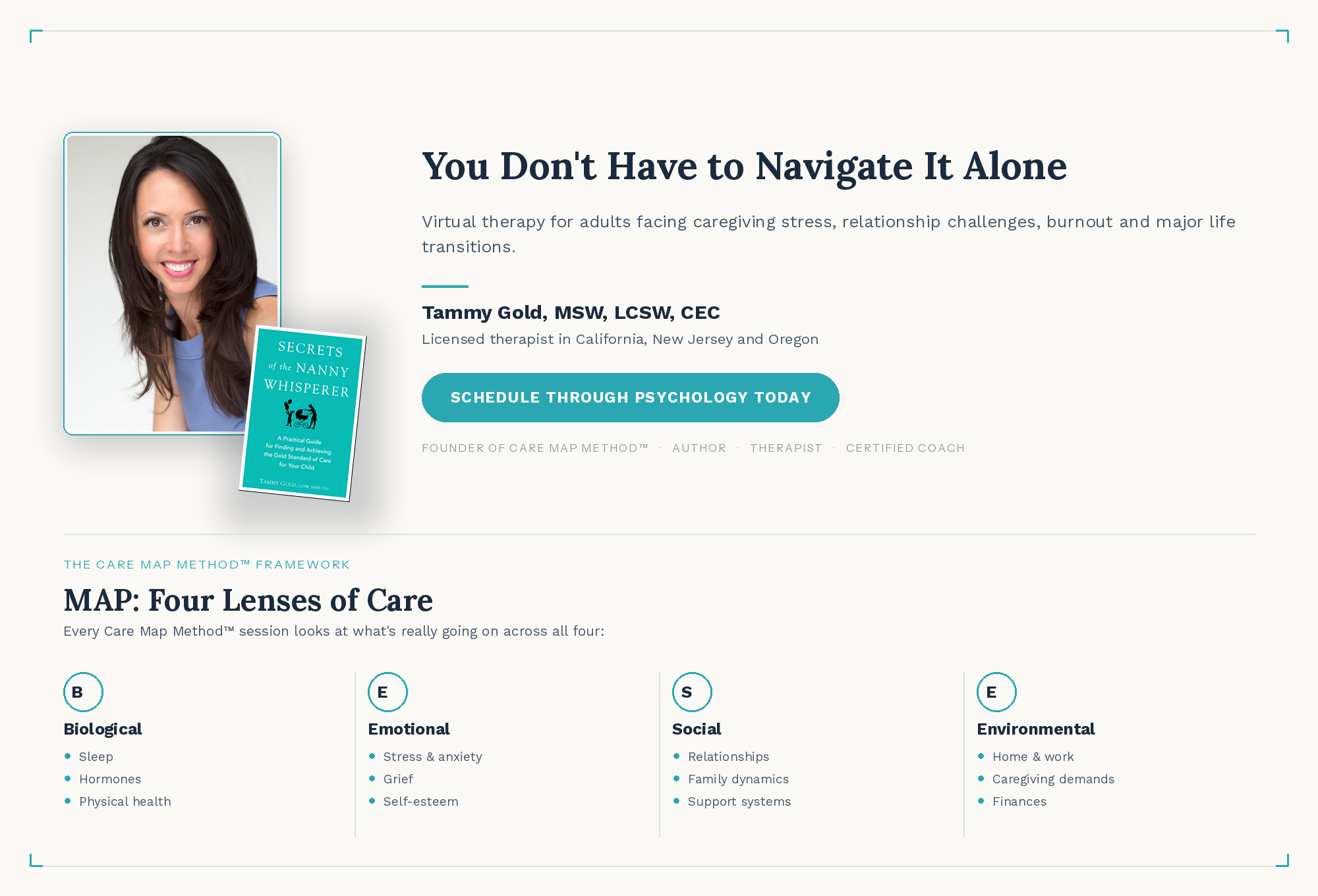
A useful first step is to stop treating every demand as equally urgent. The Care Map Method™ organizes needs across biological, emotional, social, and environmental domains and then separates immediate safety issues from important but nonurgent concerns.
For an aging parent, an immediate issue may be medication confusion or unsafe driving. For a teenager, it may be a mental health concern or school crisis. Other needs may be important but schedulable. A written map allows the family to see where professional support, shared responsibility, or a change in expectations is required.
A practical family capacity assessment
Ask these questions before agreeing to a new responsibility:
What exactly is being requested?
How often will it occur, and for how long?
What will I have to stop doing in order to take this on?
Could another person, service, or professional complete part of it?
Is this a true emergency, or has the family delayed planning until the issue feels urgent?
What boundary would make this responsibility manageable?
Reducing guilt through clearer roles
Guilt often grows in vague situations. When no one has defined who is responsible for what, the most responsive person may feel accountable for everything.
Clear roles do not eliminate sadness or difficult decisions, but they reduce confusion. A family care plan might specify who attends medical appointments, who manages finances, who handles weekly calls, and what will trigger a move to more professional support. Parenting responsibilities can be mapped in the same way so that one system does not silently consume all available energy.
Protecting your work and financial stability
Many adults underestimate the professional cost of ongoing caregiving. Missed work, reduced concentration, unplanned travel, and frequent interruptions can affect income and career progression.
Protecting your employment is not a sign that you care less. Your financial stability may be essential to your children, your future, and your ability to assist an aging parent. Therapy can help you make decisions that account for long-term consequences rather than responding solely to immediate guilt.
How therapy can help
Therapy can help sandwich-generation adults clarify priorities, communicate with spouses and siblings, set limits, process anticipatory grief, and recognize when they have moved from healthy responsibility into chronic overfunctioning.
It can also provide a consistent space in which you are not required to care for anyone else. That alone can be meaningful when nearly every relationship has become organized around another person's needs.
Creating a sustainable next step
You do not need to solve every future problem today. Begin by identifying the most unstable part of the system. It may be a parent's home safety, a sibling communication problem, a teenager's needs, or your own exhaustion.
Addressing one clearly defined pressure point is often more effective than attempting to become more efficient at carrying an impossible load.
Ready for support?
If you are caring for children and aging parents while trying to preserve your work, health, and relationships, therapy can help you clarify priorities and reduce the strain. Tammy Gold, MSW, LCSW, CEC, provides confidential virtual therapy for adults located in California, New Jersey, and Oregon.
Book through Psychology Today: https://www.psychologytoday.com/us/therapists/tamara-jill-gold-los-angeles-ca/17
Learn more: CareMapMethod.com
About Tammy Gold
Tammy Gold, MSW, LCSW, CEC, is the founder of Care Map Method™, a licensed clinical social worker in California, New Jersey, and Oregon, a certified coach, and the author of Secrets of the Nanny Whisperer. Her work centers on relationships, caregiving, burnout, parenting transitions, workplace stress, women’s midlife concerns, and practical support during major life changes.
Educational notice: This article is for general educational purposes and is not a substitute for individualized medical or mental health care. If you are experiencing an emergency or immediate safety concern, contact emergency services or an appropriate crisis resource in your area.