Providence Therapy for Sandwich Generation Stress in Oregon
Online Oregon therapy for sandwich-generation stress, caregiving, parenting and family overload with Tammy Gold, LCSW. Eligibility varies.
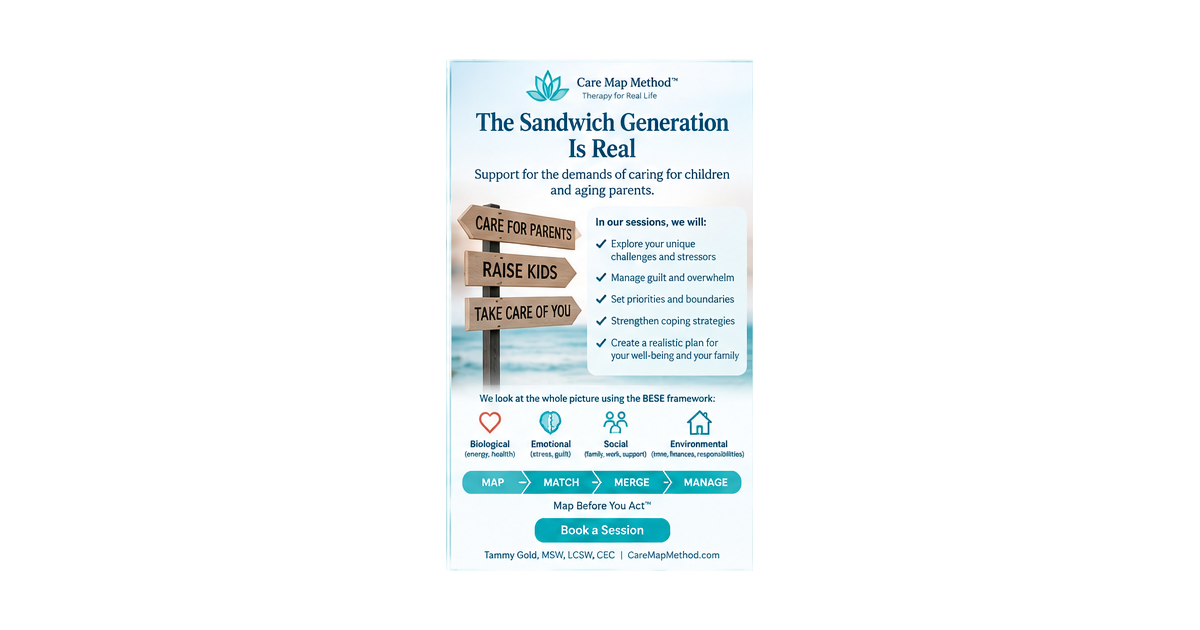
Providence Health Plan online therapy in Oregon with Tammy Gold, LCSW for sandwich generation stress.
Providence Therapy for Sandwich Generation Stress in Oregon
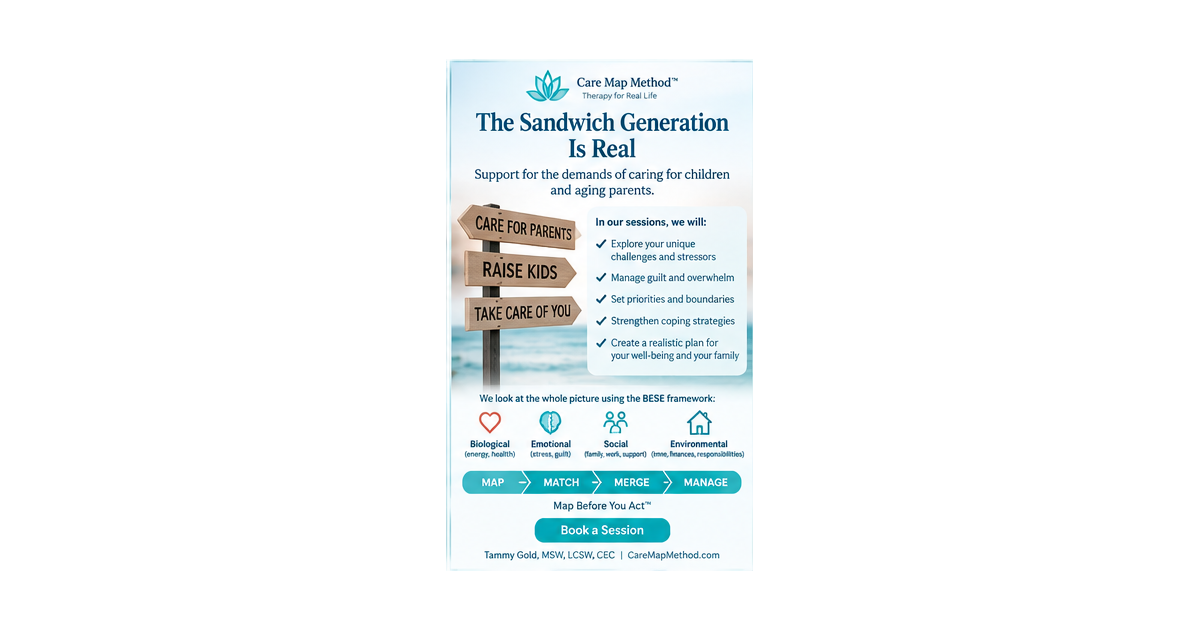
Your children need you. Your parents need you. Work needs you. Your partner may need you too. When you are in the sandwich generation, there can be almost no part of the day when somebody is not asking for your time, attention or emotional energy.
Therapy can become the place where your needs finally make it onto the map—not because the people you love matter less, but because a system that depends on you also has to account for your capacity.
I am Tammy Gold, MSW, LCSW, CEC, a licensed therapist, author and creator of the Care Map Method™. I provide online psychotherapy to eligible clients located in Oregon, including adults dealing with relationship stress, family conflict, caregiving and major life transitions.
Depending on your specific plan, eligibility and current network participation, Providence Health Plan may be available for psychotherapy. Coverage, copays, deductibles and benefits vary and should be verified before scheduling.
Does this sound familiar?
· You are supporting children while coordinating care for aging parents.
· Work and relationships are squeezed between competing responsibilities.
· You feel guilty no matter which person gets your attention.
· There is little time to notice your own emotional or physical needs.
Your Children Need You. Your Parents Need You. Where Do You Fit?
Why the surface problem may not be the whole problem
Families and couples often begin by trying to solve the most visible problem. But the visible problem may be only one part of the Care Map. Stress, health, expectations, attachment needs, changing roles, communication habits, family history and the surrounding environment can all affect what happens next.
Looking at the broader pattern can reduce shame and blame. Instead of asking only, “Who caused this?” we can ask, “What is happening, what does each person need, what is within my control, and what response is most likely to be useful?”
How I use the Care Map Method™ in therapy
MAP — Understand what is actually happening
We identify the problem, the repeating pattern and the needs underneath it. I look at biological, emotional, social and environmental factors rather than reducing a complicated relationship to one argument or one person’s behavior.
MATCH — Match the right support or strategy
Once the pattern is clearer, we identify approaches that fit the actual need. That may involve communication, boundaries, coping strategies, emotional regulation, role changes, additional support or a different way of responding.
MERGE — Bring understanding into the relationship
Insight matters most when it can be used. We translate what you are learning into conversations, decisions, requests and boundaries that are realistic for your life and relationships.
MANAGE — Adjust as life changes
Relationships and caregiving systems are dynamic. We notice what is helping, what is not, and what needs to be adjusted rather than expecting one conversation or technique to solve everything permanently.
A safe place without shame or blame
My approach is warm, active, practical and nonjudgmental. Therapy can be one completely safe place to say what you are actually thinking and feeling without having to protect everyone else, perform competence or decide immediately what you are going to do.
My goal is not simply to have you talk about the problem. I want you to better understand yourself and the people around you, name emotions and needs more clearly, reduce unnecessary shame and blame, and leave with practical next steps.
Online therapy in Oregon
I provide telehealth psychotherapy to eligible clients who are physically located in Oregon at the time of service. Providence Health Plan may be available depending on your individual plan, eligibility and current network participation. Please verify your benefits before scheduling.
Relationship and family problems can also be addressed in individual therapy. Another person does not necessarily need to participate for you to work on your own communication, boundaries, emotions and responses.
About Tammy Gold, MSW, LCSW, CEC
Tammy Gold is a licensed clinical social worker, therapist, author and creator of the Care Map Method™. For more than 20 years, her work has focused on the relationships and care systems surrounding families—from marriage and parenting to adult children, caregiving and aging parents.
She earned her MSW from Columbia University and her undergraduate degree from the University of Pennsylvania. Her family and caregiving expertise has been featured in national media. Add the approved press-logo strip here to reinforce authority without interrupting the clinical message.
What is sandwich-generation stress?
Therapy can help you identify overload, grief, resentment, guilt and family patterns, then develop more sustainable boundaries and coping strategies. Practical care decisions may also require medical, legal or care-management professionals.
Can therapy help when my responsibilities cannot be reduced?
Therapy can help you slow down the pattern, understand the needs and emotions underneath it, and identify practical changes within your control. The work is individualized to your situation and does not promise a particular outcome.
How do I set limits with both children and parents?
Therapy can help you slow down the pattern, understand the needs and emotions underneath it, and identify practical changes within your control. The work is individualized to your situation and does not promise a particular outcome.
Can caregiver stress affect marriage and work?
Therapy can help you identify overload, grief, resentment, guilt and family patterns, then develop more sustainable boundaries and coping strategies. Practical care decisions may also require medical, legal or care-management professionals.
Does Providence cover online therapy in Oregon?
Providence Health Plan may be available depending on your specific plan, eligibility, clinical circumstances and current network participation. Benefits, copays and deductibles vary, so verify coverage before scheduling.
You do not have to solve the whole relationship today
A useful first step is often understanding the pattern more clearly. Therapy can help you slow down, identify what you need, distinguish what is within your control from what is not, and decide what a healthier next response could look like.
Insurance note: Providence Health Plan eligibility and benefits vary. Verify your individual coverage before scheduling.
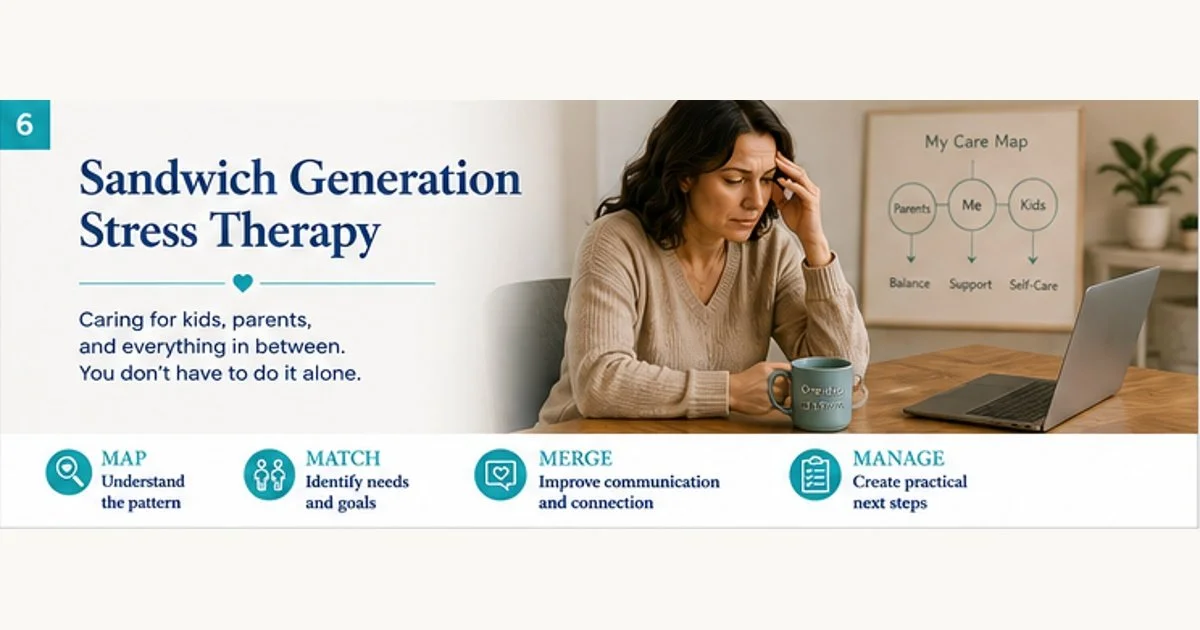
Sandwich Generation Stress Therapy
Support for adults simultaneously managing children, aging parents, work, relationships and the invisible emotional load of family caregiving.
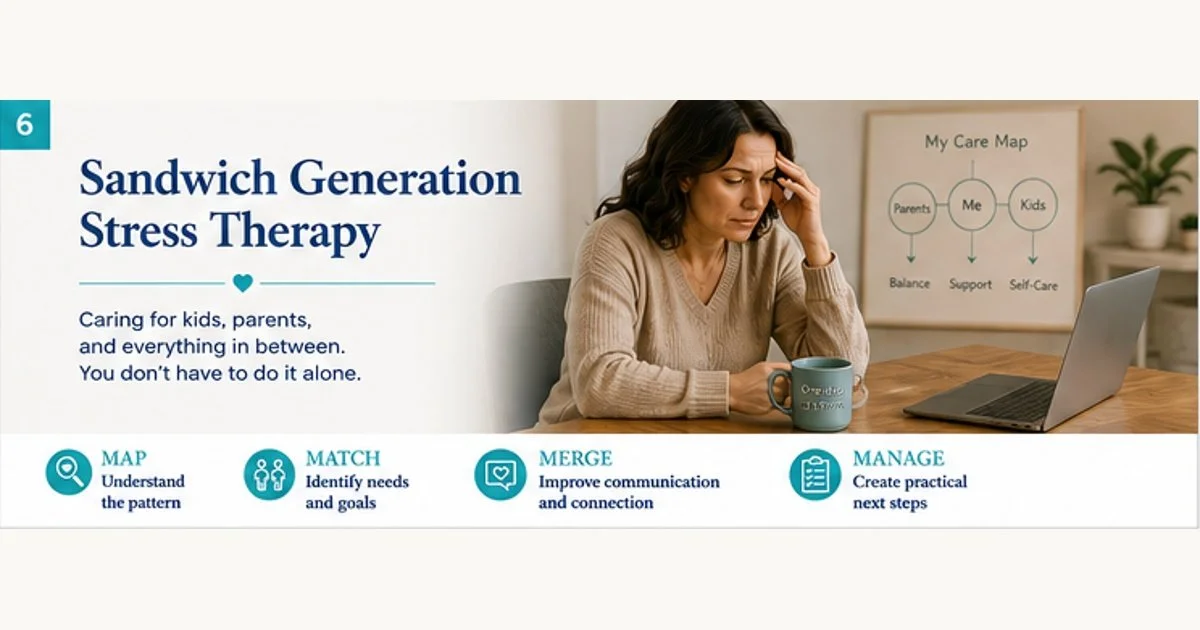
Adult balancing family and caregiving responsibilities, representing therapy for sandwich-generation stress in NJ, CA & Oregon
Therapy for the Sandwich Generation
Being in the sandwich generation can feel like living in permanent triage. Your children may still need emotional, financial, or practical support while your parents need more care, more decisions, and more attention. At the same time, you may be working, managing a household, maintaining a relationship, and trying to remember that you are a person with needs too. Therapy can help you organize the overload and create a way of caring for others that does not require disappearing from your own life.
Check insurance & book online therapy on Psychology Today
When everyone seems to need you at once
The pressure is not only the number of tasks. It is the constant switching of roles: parent, adult child, partner, employee, caregiver, sibling, advocate, scheduler, decision-maker. Each role can carry different expectations, and there may be no point in the day when you feel completely off duty.
Many sandwich-generation adults feel guilty no matter where they put their attention. If you help your parent, you worry about your children. If you focus on your child, you feel you are neglecting your parent. If you take time for yourself, it can feel irresponsible. That cycle can create exhaustion, resentment, anxiety and emotional numbness.
How therapy can help
Therapy can help you identify which responsibilities are truly yours, which ones can be shared, and which expectations may be unrealistic. We can work on boundaries, sibling communication, parenting stress, caregiver guilt, anticipatory grief, relationship strain and the pressure to be the person who always handles everything.
We can also focus on preserving your identity and relationships outside caregiving. The goal is not to optimize every minute of your life. It is to build a more sustainable system where your needs are part of the map rather than an afterthought.
The Care Map Method: Map • Match • Merge • Manage
MAP — Understand the pattern. We map the people who depend on you, the practical responsibilities, emotional stressors, family roles and pressure points.
MATCH — Identify needs and goals. We clarify what each person needs, what you need, what is realistic, and which priorities require attention now versus later.
MERGE — Improve communication and connection. We work on asking for help, setting limits, discussing responsibilities with siblings or partners, and communicating without carrying every conversation alone.
MANAGE — Create practical next steps. We develop routines, boundaries, coping tools and support systems that help you function without staying in constant emergency mode.
You do not have to carry everyone at once
There may never be a period when no one needs you. The therapeutic goal is therefore not to wait until life becomes easy. It is to help you feel more supported, more deliberate, and less consumed by the competing demands around you.
Online therapy and insurance in NJ, CA & Oregon
I provide online psychotherapy for clients who are physically located in states where I am licensed and available to practice. I work with selected insurance plans through Headway. Coverage, eligibility, copays, deductibles and network participation vary by plan and member. Use the Headway booking link to verify benefits before scheduling.
Choose the Oregon, California or New Jersey module from the front of this document and place it here. For the highest-pay strategy, lead with the priority plan(s) for that state while keeping the copy accurate and conditional.
Ready for support and a plan?
If this situation is affecting your mood, sleep, work, relationships or sense of stability, you do not have to wait until it becomes a crisis. Therapy can be a safe, nonjudgmental place to unload what you are carrying while also developing tangible tools and a clearer path forward. Use the Headway link to check insurance eligibility and current appointment availability.
FAQ
What is sandwich-generation stress?
It is the emotional and practical strain that can occur when an adult is simultaneously supporting children and aging parents while managing work, relationships and their own needs.
Can therapy help when I am responsible for both children and parents?
Yes. Therapy can help organize priorities, reduce guilt, strengthen boundaries, improve family communication and address burnout or anxiety.
How can I reduce caregiver resentment and guilt?
We can explore unrealistic responsibility, family roles, unspoken expectations, grief and the difference between caring deeply and doing everything.
Can therapy help with sibling or family conflict?
Yes. Therapy can help you prepare conversations, clarify your own role, set boundaries and respond more intentionally when family members disagree.
How do I book through insurance?
Use the Headway booking link to check current eligibility and benefits for your specific state and plan.
Sandwich Generation Stress Therapy
Support for adults simultaneously managing children, aging parents, work, relationships and the invisible emotional load of family caregiving.
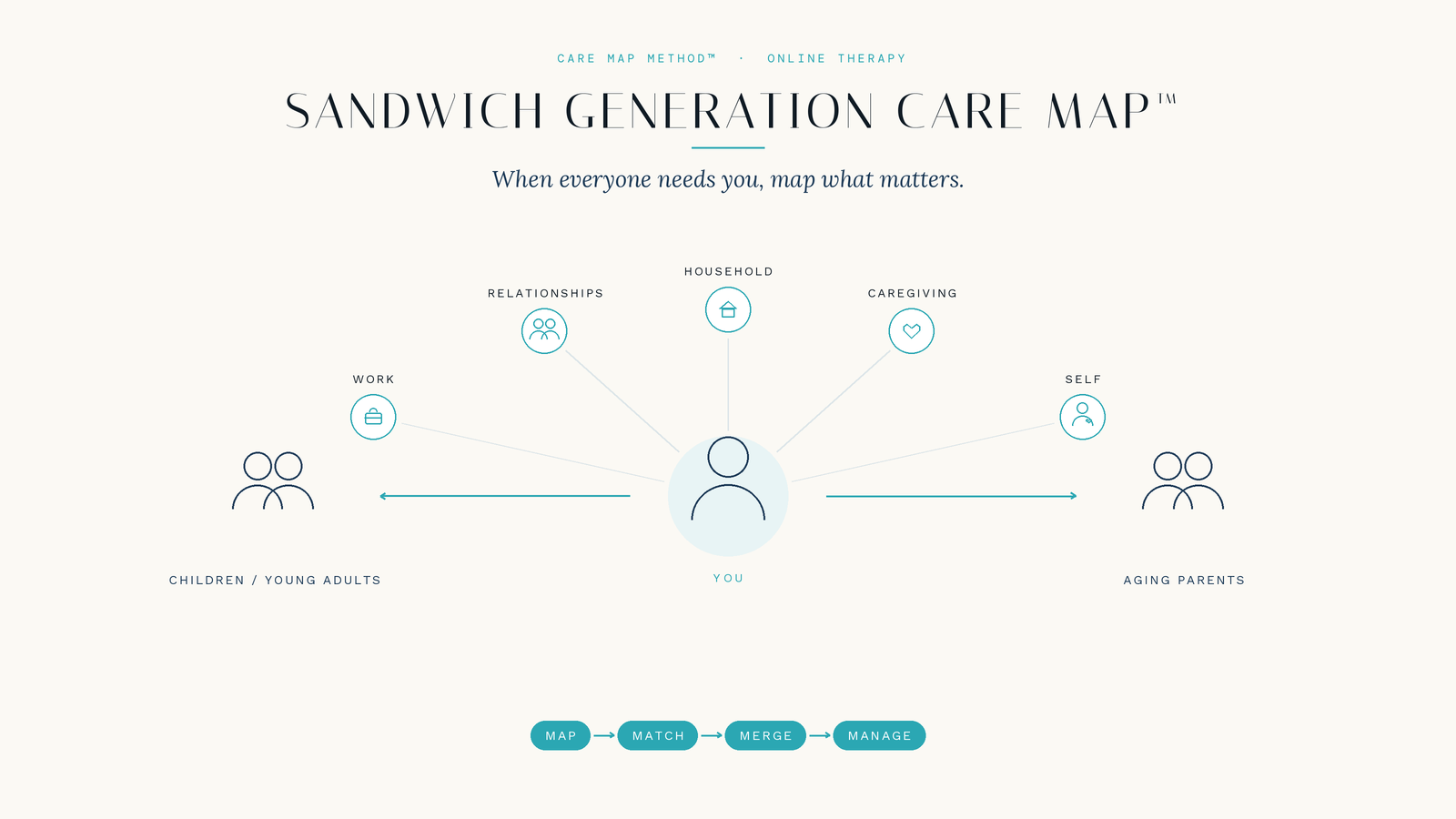
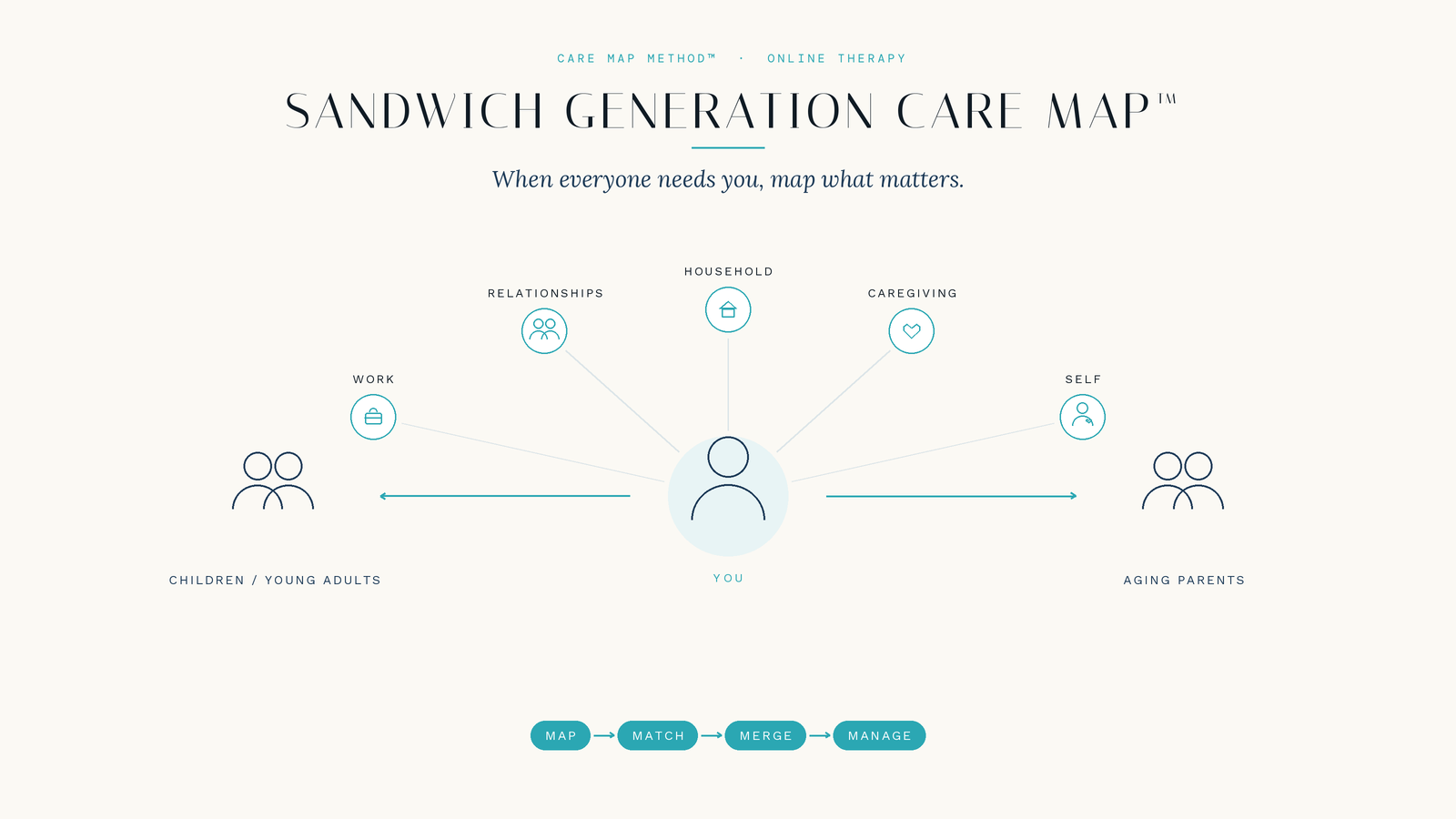
Sandwich Generation Care Map showing competing responsibilities
Therapy for the Sandwich Generation
You may be helping a child with one crisis while answering a call about an aging parent and trying to keep up with work, a relationship and your own responsibilities. The sandwich generation often functions as the family’s coordination center, carrying logistical tasks and emotional worry that other people may not fully see. Therapy can help you find a more sustainable way to live inside competing demands.
Check Insurance Eligibility & Book Online Therapy → ON HEADWAY
What You May Be Dealing With
You are caring for children and aging parents at the same time.
Everyone seems to need you, and there is no time when you are truly off duty.
You feel guilty when you prioritize yourself.
Work is being affected by family responsibilities.
You are irritable, exhausted or emotionally numb.
Your partner or siblings do not seem to understand the amount you are carrying.
You are making decisions for multiple generations at once.
You worry that if you stop managing everything, the system will fall apart.
How Therapy Can Help
Therapy can help you examine over-responsibility, guilt, boundaries, resentment, anxiety and the family roles that keep you in constant management mode. Together, we can look at what is truly yours to carry, what can be delegated, where expectations need to change and how to protect your emotional capacity while remaining connected to the people you care about.
The Care Map Method™ in Therapy
Care Map Method™ is a structured way to organize the people, needs, stressors and choices involved in a complex real-life situation. In psychotherapy, it is used only as an organizing framework within individualized clinical care—not as a substitute for assessment, diagnosis or treatment planning.
MAP — See the full system: children, parents, work, partner, logistics, emotional load and your own needs.
MATCH — Identify boundaries, coping tools, communication strategies and supports for the highest-pressure areas.
MERGE — Put changes into schedules, conversations, caregiving roles and family expectations.
MANAGE — Revisit the plan as children and parents move into new stages.
Why Work With Tammy Gold
Tammy Gold’s work spans parenting, childcare, caregiving and eldercare, giving her a broad family-systems perspective on the pressures unique to the sandwich generation. In therapy, the Care Map Method™ can help clients see competing roles more clearly and reduce the sense that every problem must be solved simultaneously.
Insurance & Online Therapy
Online therapy is available for clients located in states where Tammy is licensed and accepting clients. Selected insurance plans are accepted through Headway. Coverage, copays, deductibles, coinsurance and eligibility vary by plan and member.
Use the Headway booking link to check current insurance eligibility and available appointment times. Do not publish contracted reimbursement amounts on the website.
STATES
Oregon: Providence Health Plan • Aetna • Regence BlueCross BlueShield of Oregon • Carelon Behavioral Health • Providence Medicare Advantage.
California: Providence Health Plan • Aetna • Carelon Behavioral Health • Anthem Blue Cross California.
New Jersey: Providence Health Plan • Aetna • Carelon Behavioral Health.
Always verify current participation before publishing.
Frequently Asked Questions
What is sandwich-generation stress?
It refers to the strain that can occur when an adult is simultaneously supporting children and aging parents while also managing work, relationships and personal responsibilities.
Can therapy help when I am responsible for both children and parents?
Yes. Therapy can address stress, anxiety, guilt, resentment, boundaries and the emotional effects of carrying multiple caregiving roles.
How can I reduce caregiver resentment and guilt?
Therapy can help you examine unrealistic expectations, clarify responsibility, make room for difficult emotions and develop more sustainable boundaries.
Can therapy help with sibling or family conflict?
Individual therapy can help you understand your role in conflict and prepare for clearer communication, even when other family members are not participating.
How do I book through insurance?
Use the Headway link to verify current eligibility, expected costs and available appointments.
Reach Out Today info@CareMapMethod 818.308.1358
Being needed by two generations does not mean you have to disappear in the middle. Check insurance eligibility and book online therapy through Headway.
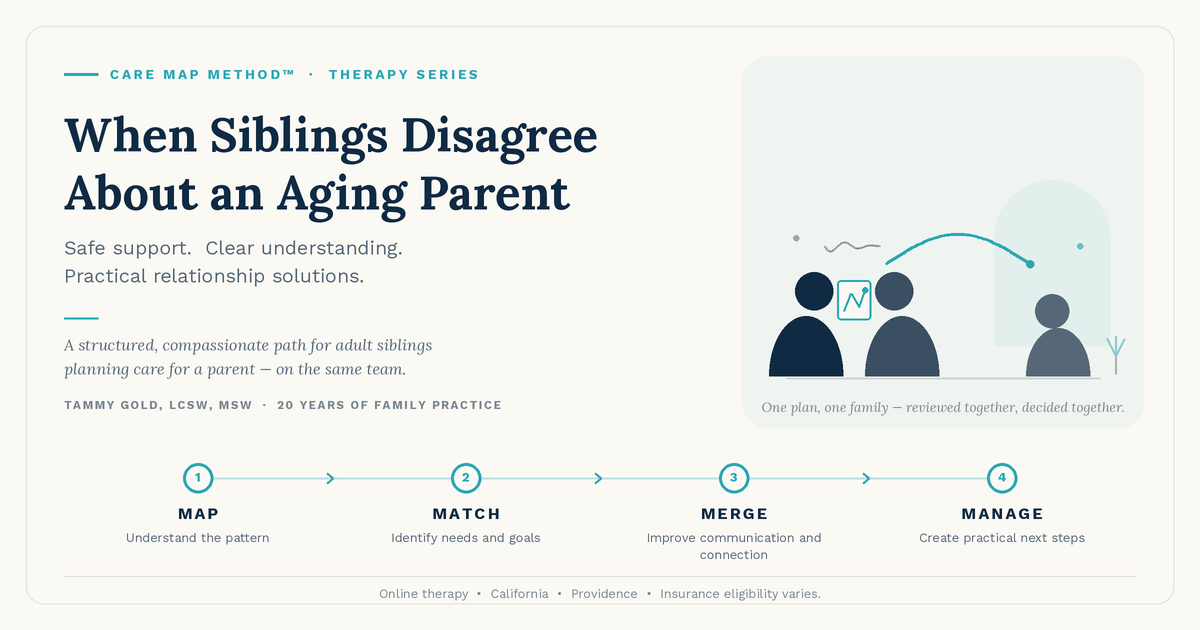
Providence Therapy in California for Sibling Conflict Over an Aging Parent
Online therapy in California for siblings arguing about an aging parent, caregiver burden, eldercare decisions, and family communication. Verify Providence benefits.
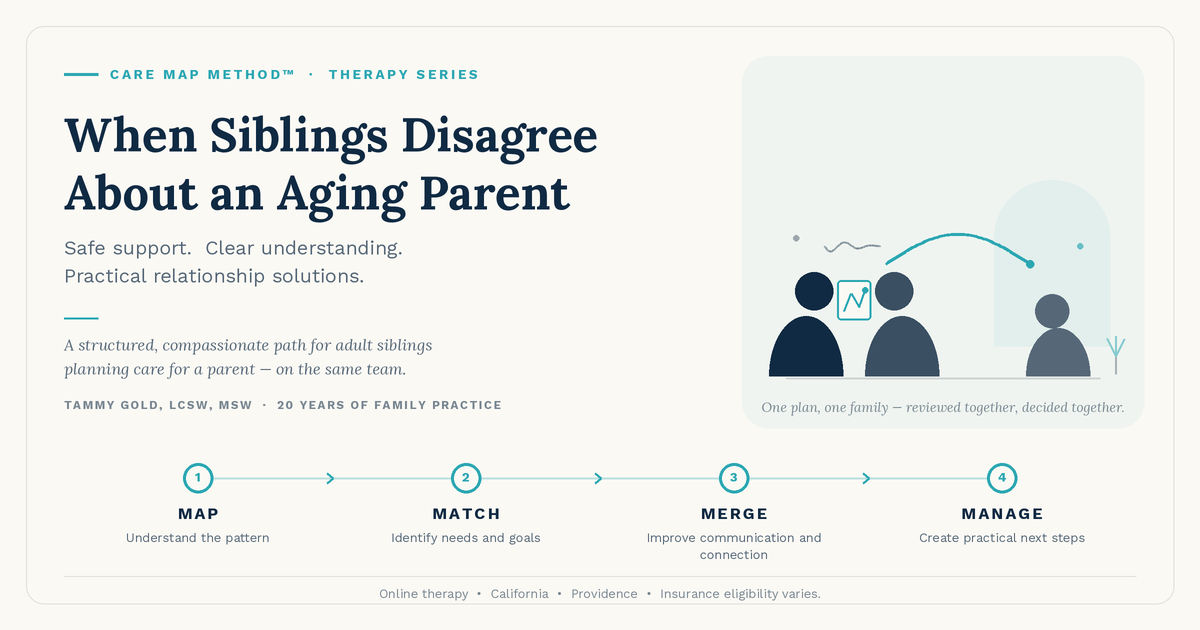
Providence therapy in California for sibling conflict, aging-parent care decisions, caregiver stress, and family communication.
Providence Therapy in California for Sibling Conflict Over an Aging Parent
A parent’s decline can reopen old sibling roles and create urgent disagreements about safety, money, housing, medical care, driving, and who should do what. One sibling may feel abandoned with the work. Another may feel criticized or excluded. Everyone may believe they are protecting the parent, yet the family becomes less able to make decisions together.
You do not have to carry this alone. My goal is to provide a warm, confidential, and nonjudgmental space where you can unpack what is happening without shame, blame, or pressure. Therapy can offer emotional support and practical direction at the same time.
Therapy creates a structured space to separate the care problem from the sibling history. We identify facts, fears, capacities, and practical limits. Each person’s concern can be heard while the family develops clearer communication, roles, and next steps. The goal is not perfect agreement; it is a safer, more workable process.
ONLINE THERAPY IN CALIFORNIA
Insurance may be available through Headway depending on your plan, eligibility, state, and session type. Verify benefits before booking.
What clients can work toward
Reduce blame among siblings
Clarify realistic roles and responsibilities
Make decisions from the full care picture
Protect the parent and the sibling relationships
Therapy is not only a place to talk about what went wrong. It is a place to feel heard, understand the pattern, practice healthier responses, and build a plan that can be used in daily life. Progress depends on the circumstances and cannot be guaranteed, but the work can become clearer, more intentional, and more supported.
Frequently asked questions
Can therapy help siblings agree about eldercare?
Therapy may not produce complete agreement, but it can improve communication, clarify facts and capacities, reduce blame, and create a more workable decision process.
Does Providence cover this type of therapy?
Benefits vary by plan, clinical eligibility, state, and platform. Verify current coverage before scheduling.
Can I attend without my siblings?
Yes. Individual therapy can help you manage caregiver stress, set limits, prepare conversations, and decide what you can realistically provide.
How do we divide caregiving fairly?
Fair does not always mean equal. Roles should reflect time, distance, finances, skills, health, and willingness. A structured care map can make those differences visible.
What if a parent refuses help?
Therapy can help the family assess risk, respect autonomy where possible, communicate concerns, and decide what actions are appropriate within legal and ethical limits.
When is specialized eldercare guidance needed?
Professional medical, legal, financial, or care-management expertise may be needed for capacity, safety, placement, benefits, or complex medical decisions.
Final booking call to action
You deserve one place where you can be honest without worrying about judgment, shame, or blame. Together, we can understand what is happening, identify what needs to change, and create practical steps toward a healthier relationship and a more manageable life.
Verify your insurance and request an online therapy appointment through my Psychology Today / Headway booking path.
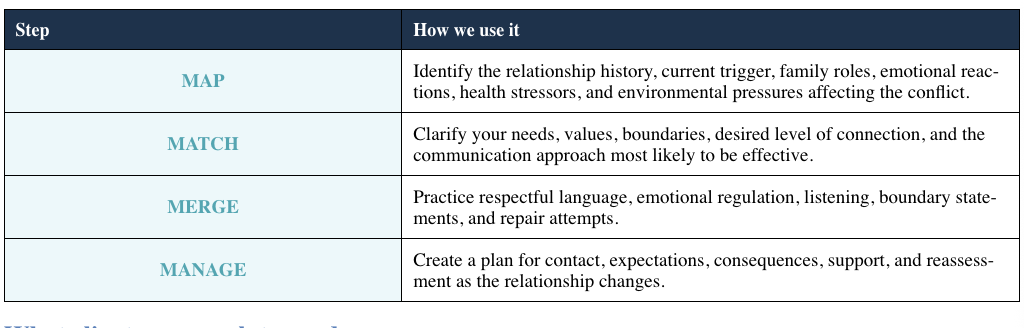
Providence therapy in California for sibling conflict, aging-parent care decisions, caregiver stress, and family