

Nanny Trial Day: What to Watch Before You Hire
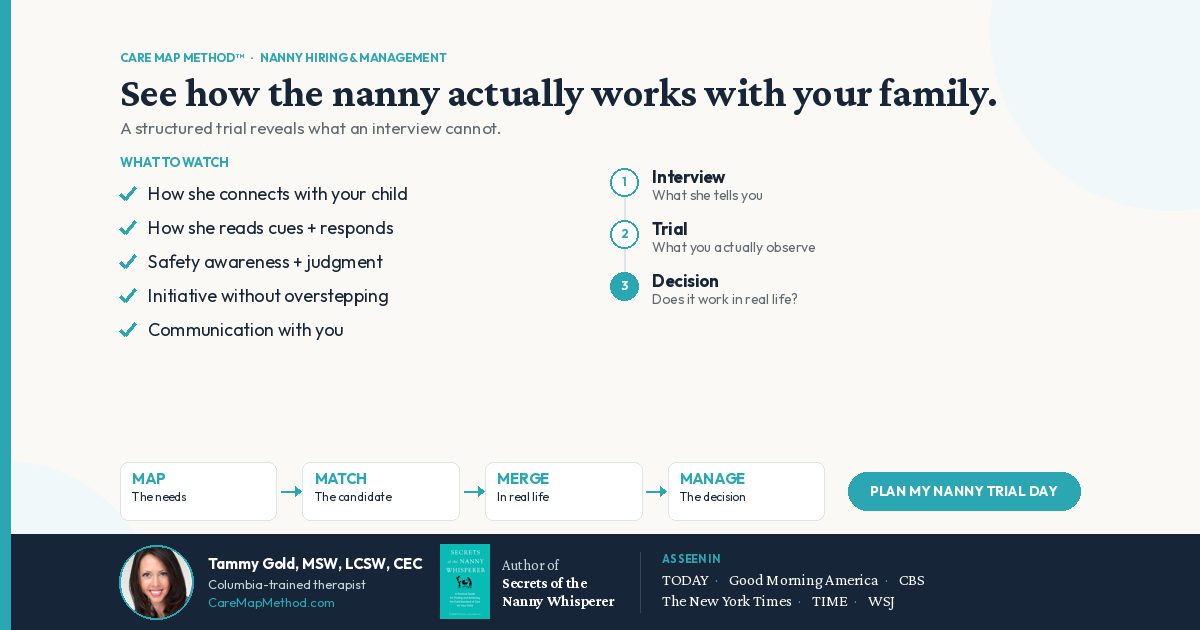
A nanny trial day lets you see what an interview cannot: how a caregiver enters your child’s world, handles routines, communicates and responds in real time.
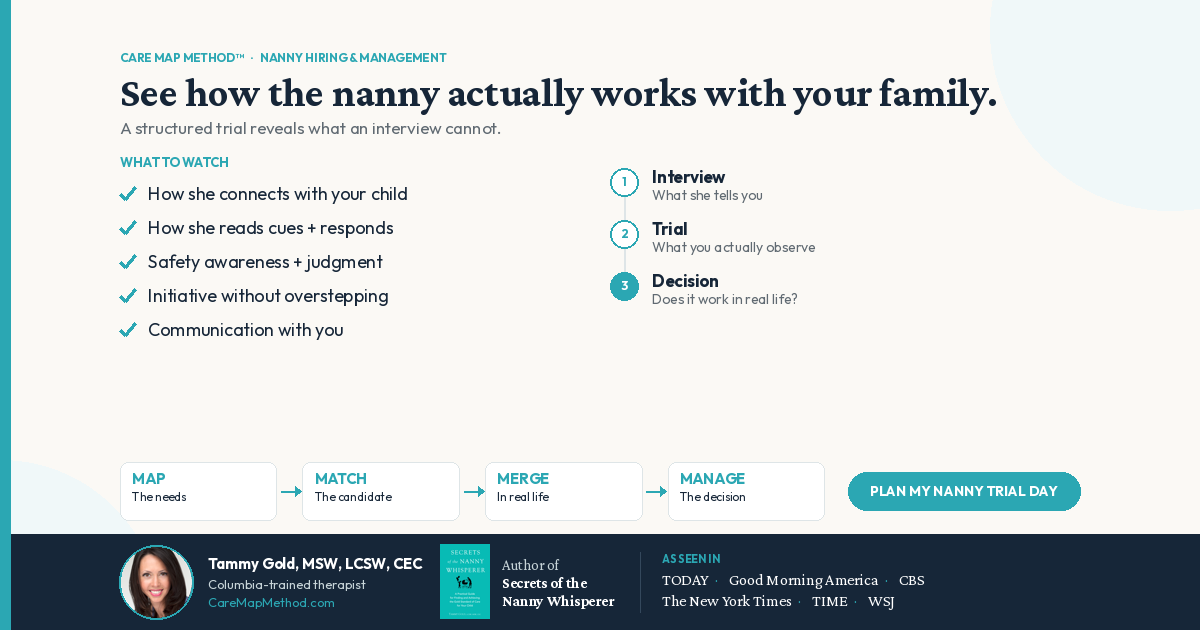
An interview tells you what a nanny says; a trial shows you how they work
A trial period can reveal how a caregiver approaches your child, follows routines, handles uncertainty, communicates with parents and adapts when the day does not go exactly as planned.
Make the trial realistic
Include ordinary parts of the job: play, meals, transitions, school pickup, nap preparation or getting out the door, depending on your child’s age. You do not need to manufacture a crisis. Real family life provides enough information.
Observe connection without demanding instant attachment
Some excellent caregivers build relationships gradually. Watch whether the nanny gets down to the child’s level, notices cues, follows the child’s interests, sets appropriate boundaries and stays emotionally steady.
Watch how the nanny handles the spaces between instructions
Does the candidate notice what needs doing? Ask appropriate questions? Respect household boundaries? Adapt when a plan changes? Initiative matters, but the right amount of initiative depends on what your family wants.
Evaluate your own reactions too
Parents can become so focused on whether the child “likes” the nanny that they miss their own concerns—or reject a strong candidate because the first hour was awkward. Use structured criteria alongside intuition.
MERGE begins during the trial
In the Care Map Method™, the trial is the beginning of MERGE: bringing caregiver, child and parents into one working system. The trial helps identify what will need to be clarified during onboarding if you move forward.
Expert trial-day planning
I help families decide what to observe, build a trial-day scorecard and debrief afterward. The goal is to convert a vague feeling of “I think she was good” into a more informed hiring decision.
How the Care Map Method™ Helps
MAP → MATCH → MERGE → MANAGE gives parents a repeatable decision system instead of relying on urgency, charisma or guesswork.
MAP: Define the child, family, role, routines, values, expectations and non-negotiables.
MATCH: Compare the candidate’s demonstrated experience, temperament, judgment and working style with the mapped needs.
MERGE: Use the trial and onboarding period to integrate nanny, child and parents into one functioning care system.
MANAGE: Create clear communication, feedback, boundaries and periodic reassessment as the child and job evolve.
Already found candidates—or not sure where to begin? I can help you prepare the interview, evaluate fit, structure screening and references, plan the trial, onboard your nanny and create a practical management system.
$195 Book Your Nanny Call Today So I Can Help Answer→
Should a nanny trial day be paid?
How long should a nanny trial be?
Should parents stay home during the trial?
What should I watch during a nanny trial?
What if my child is shy with the candidate?
Can I trial more than one nanny?