


First Time Hiring a Nanny: A Step-by-Step Guide for Parents
Hiring your first nanny can feel overwhelming because parents are simultaneously choosing a caregiver and becoming an employer. This step-by-step guide organizes the process.
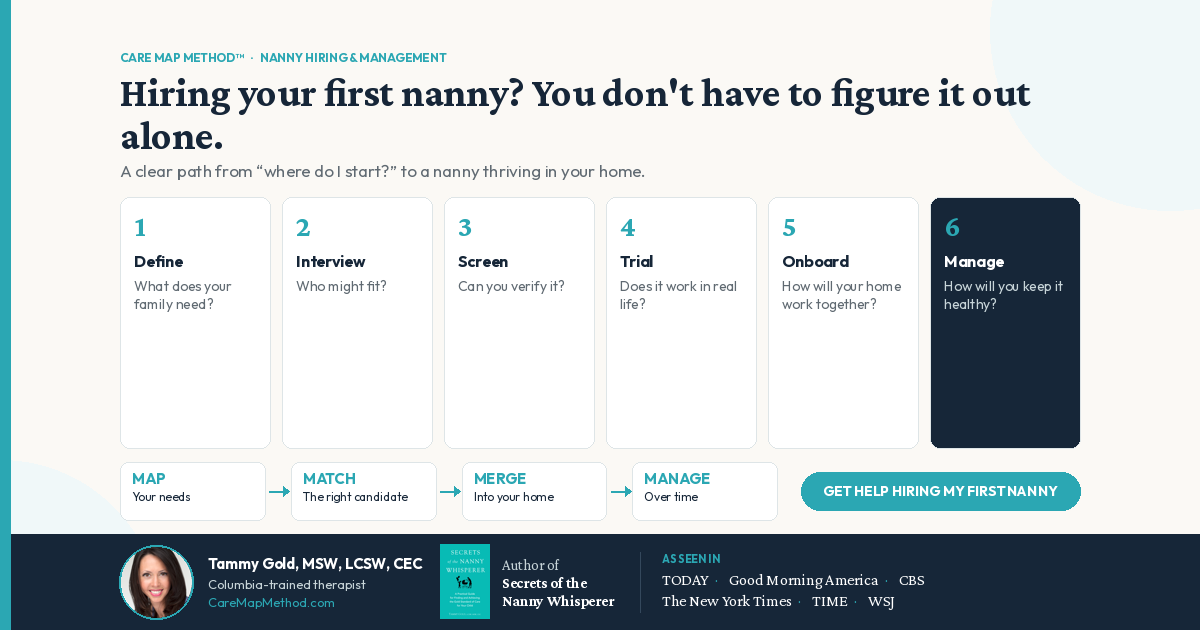
First time hiring a nanny step-by-step process from family needs through interview, screening, trial, onboarding and management.
The first nanny hire can feel much bigger than parents expect
You are not only deciding who will care for your child. You are defining a job, evaluating applicants, checking information, setting compensation and expectations, and preparing to manage someone inside your home. A system makes the process less reactive.
Step 1: MAP the job
Write down schedule, ages, responsibilities, transportation, child-related household tasks, routines, parenting approach, communication preferences and what success would look like after 30 days.
Step 2: Find and interview candidates
Whether candidates come from an agency, referral or online platform, use the same core criteria. Structured questions make comparison easier and reduce the temptation to hire solely because someone feels immediately likable.
Step 3: Screen
Verify references, credentials and background information using appropriate resources. In California, families should understand TrustLine and its role in screening in-home caregivers.
Step 4: Trial
Use a paid trial to observe how the nanny interacts with your child and functions within your real routines.
Step 5: Put expectations in writing
A written work agreement can clarify duties, schedule, compensation, guaranteed hours, time off, driving, communication and other terms. Families should obtain appropriate payroll, tax and legal guidance for their circumstances.
Step 6: Onboard
Do not hand over a list and disappear. Orient the nanny to the child, home, routines, safety information, preferences and decision-making boundaries.
Step 7: MANAGE
Schedule feedback rather than waiting until something is wrong. The nanny-family relationship needs maintenance as children develop and household needs change.
A guide beside you
I help first-time nanny employers turn an unfamiliar process into a clear sequence using MAP → MATCH → MERGE → MANAGE.
How the Care Map Method™ Helps
MAP → MATCH → MERGE → MANAGE gives parents a repeatable decision system instead of relying on urgency, charisma or guesswork.
MAP: Define the child, family, role, routines, values, expectations and non-negotiables.
MATCH: Compare the candidate’s demonstrated experience, temperament, judgment and working style with the mapped needs.
MERGE: Use the trial and onboarding period to integrate nanny, child and parents into one functioning care system.
MANAGE: Create clear communication, feedback, boundaries and periodic reassessment as the child and job evolve.
Expert CTA
Already found candidates—or not sure where to begin? I can help you prepare the interview, evaluate fit, structure screening and references, plan the trial, onboard your nanny and create a practical management system.
Book A Call So I Can Help You Answer:
Where should I start when hiring my first nanny?
Do I need a nanny contract?
What background checks should I consider?
Should I use a nanny agency?
How do I compare two strong candidates?
What should happen during the first week?
Email: Info@CareMapMethod.com Text: 818.308.1358


How to Hire the Right Nanny: Interview, Screen, Trial, Onboard & Manage
Hiring a nanny is not just about finding someone with experience. It is about finding the caregiver who fits your child, family, parenting style and everyday needs. Tammy Gold helps families interview, screen, evaluate, trial, onboard and manage nannies using the Care Map Method™.
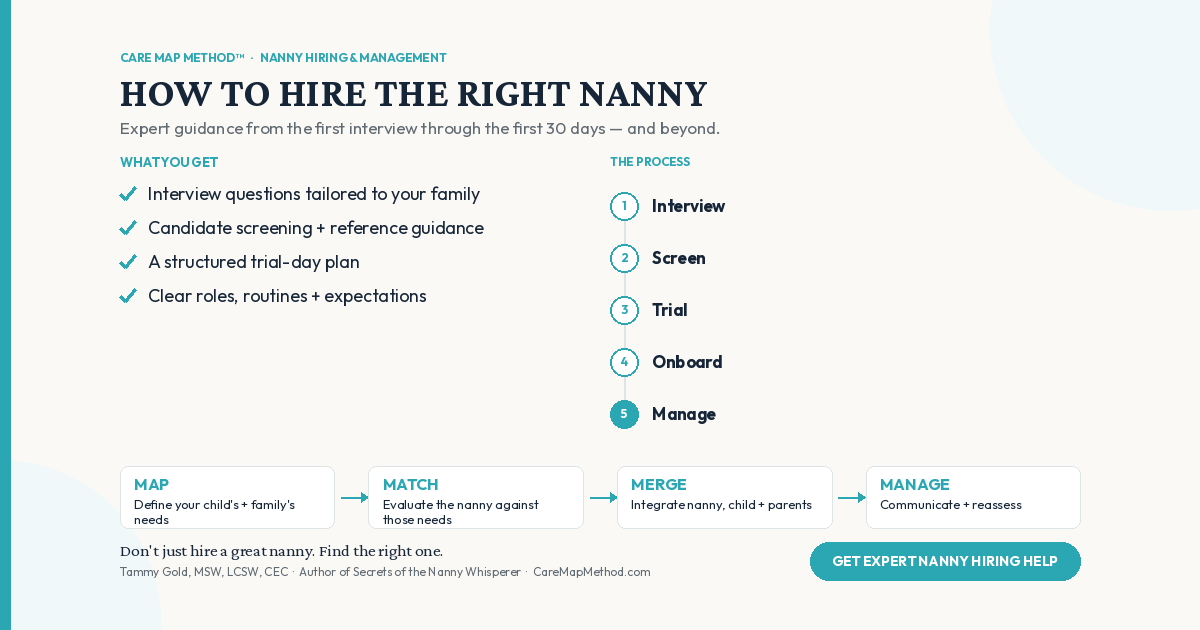
Hiring a nanny is one of the most personal hiring decisions a family makes
A nanny works inside your home, participates in your child’s daily routines and becomes part of the emotional and practical system of family life. Yet many parents are asked to make this decision using the same tools they would use for an ordinary job hire: a résumé, a short interview and a few references. Those pieces matter, but they do not answer the most important question: Is this the right caregiver for this child and this family?
Start with the family, not the candidate
Before you interview anyone, define what the job actually requires. Consider your child’s age and temperament, schedule, transitions, sleep and feeding routines, activity level, parenting approach, household expectations, transportation needs and the amount of initiative you want a nanny to take. A highly experienced nanny can still be the wrong match if the family and caregiver have incompatible expectations.
Interview for real-life fit
A strong nanny interview goes beyond “How many years have you worked with children?” Ask candidates to describe what they would do in situations that resemble your real life: a toddler refusing to leave the park, an infant who will not settle, siblings fighting, a parent running late, or a disagreement about a household rule. You are listening for judgment, flexibility, warmth, communication and whether the nanny’s instincts align with your family.
Screen carefully and verify
References and background screening are separate parts of the process. References help you understand how someone actually performed in prior jobs; background checks verify different kinds of safety information. For California families, TrustLine is an important state-run screening resource for in-home and license-exempt child care providers. Screening should complement—not replace—interviews, references and assessment of fit.
Use a trial to observe, not to stage a performance
A paid trial gives you information an interview cannot. Watch how the nanny enters your child’s world, responds to cues, handles transitions, communicates with you, takes initiative and recovers when something does not go perfectly. The goal is not perfection. The goal is to see the caregiver’s natural style and how it fits your family.
Onboarding is part of hiring
The hiring decision is not finished when the nanny says yes. The first days and weeks establish expectations around routines, communication, safety, household responsibilities, decision-making, privacy, schedule changes and feedback. A thoughtful onboarding process reduces ambiguity and gives both the family and nanny a clearer path to success.
The Care Map Method™: MAP → MATCH → MERGE → MANAGE
MAP your child, family and job needs.
MATCH those needs to the caregiver’s experience, temperament and working style.
MERGE the nanny into the family system through a structured trial, orientation and communication plan.
MANAGE the relationship through feedback, clear expectations and reassessment as your child and family change.
Expert guidance when the decision feels too important to guess
I am Tammy Gold, MSW, LCSW, CEC, author of Secrets of the Nanny Whisperer and creator of the Care Map Method™. For more than two decades, my work with families has focused on understanding children, parents, caregivers and the relationships between them. Families can work with me to prepare for interviews, evaluate candidates, structure trials, onboard a new nanny and create a practical management plan.
How the Care Map Method™ Helps
MAP → MATCH → MERGE → MANAGE gives parents a repeatable decision system instead of relying on urgency, charisma or guesswork.
MAP: Define the child, family, role, routines, values, expectations and non-negotiables.
MATCH: Compare the candidate’s demonstrated experience, temperament, judgment and working style with the mapped needs.
MERGE: Use the trial and onboarding period to integrate nanny, child and parents into one functioning care system.
MANAGE: Create clear communication, feedback, boundaries and periodic reassessment as the child and job evolve.
Already found candidates—or not sure where to begin? I can help you prepare the interview, evaluate fit, structure screening and references, plan the trial, onboard your nanny and create a practical management system.
Get $195 Expert Nanny Hiring Help Call To Answer →
What should I look for when hiring a nanny?
How many nanny candidates should I interview?
Should I do a paid nanny trial day?
What is the difference between a reference check and a background check?
How do I know whether a nanny is the right personality fit?
What should be included in nanny onboarding?
Can you help if I already found my own candidates?
Book Your Nanny Session Today