


Am I Doing Enough for My Aging Parent?
Online therapy in Oregon for caregiver guilt, aging-parent stress, anticipatory grief and family conflict; Providence eligibility varies.

Online therapy in Oregon for caregiver guilt, aging-parent stress, anticipatory grief and family conflict; Providence eligibility varies.
Caregiver guilt can persist no matter how much you do. Therapy can help with worry, anticipatory grief, family conflict, boundaries and the emotional burden of aging-parent care.
The Impossible Standard of Doing Enough
OREGON • PROVIDENCE
Caring for an aging parent can create a constant feeling that you should be doing more. You may be managing appointments, finances, siblings, emergencies, and your own household while still feeling guilty when you rest, say no, or make a decision your parent dislikes.
How Therapy Can Help
Therapy can help distinguish love from over-responsibility, process grief and fear, set realistic limits, communicate with siblings and make difficult decisions without using guilt as the only measure of whether you are a good son or daughter.
The Care Map Method™: Map • Match • Merge • Manage
MAP — Understand the pattern. Identify triggers, recurring interactions, stressors, beliefs and roles that keep the problem going.
MATCH — Identify needs and goals. Clarify what matters most, what you can influence and what a healthier outcome would look like.
MERGE — Improve communication and connection. Practice clearer language, boundaries, listening and responses that reduce reactivity and support healthier relationships.
MANAGE — Create practical next steps. Build realistic strategies, routines, agreements and coping tools you can use outside the session.
Online therapy and insurance
I provide online therapy for clients located in Oregon. I may participate with Providence through Headway, depending on the specific plan and my current network participation. Insurance eligibility, benefits, copays, deductibles and coverage vary. Please verify your benefits through Headway before your appointment.
A safe place to unload—and a plan to move forward
My style is warm, supportive, practical and nonjudgmental. There is room to say the things you are embarrassed, angry, confused or exhausted about without shame or blame. We will make space for the feelings and also work toward tangible changes, clearer decisions and concrete next steps.
Ready for support?
If this issue is affecting your mood, relationships, work, sleep or sense of stability, you do not have to wait until it becomes a crisis. Use my Headway profile to check insurance eligibility and available appointment times.
FAQ
Can therapy help even if the other person does not attend?
Yes. Individual therapy can help you understand patterns, regulate your responses, clarify boundaries, prepare conversations and make decisions about how you want to participate in the relationship.
Do you accept Providence in Oregon?
I may participate with Providence through Headway for clients located in Oregon. Your specific plan and benefits must be verified because eligibility and costs vary.
Is this only a place to talk about the problem?
No. Emotional support matters, but my approach is also structured and solution-focused. We identify what is happening, what you need, what can change and what concrete steps you can take next.
What happens in the first session?
We focus on what is bringing you in, the relevant relationships and stressors, the patterns you are noticing and the outcome you want. We begin creating a Care Map so you leave with clearer direction.
Is online therapy nonjudgmental?
My approach emphasizes warmth, respect and understanding rather than shame, blame or judgment, within the normal confidentiality and clinical limits of psychotherapy.
Info@CareMapMethod.com TEXT: 818.308.1358
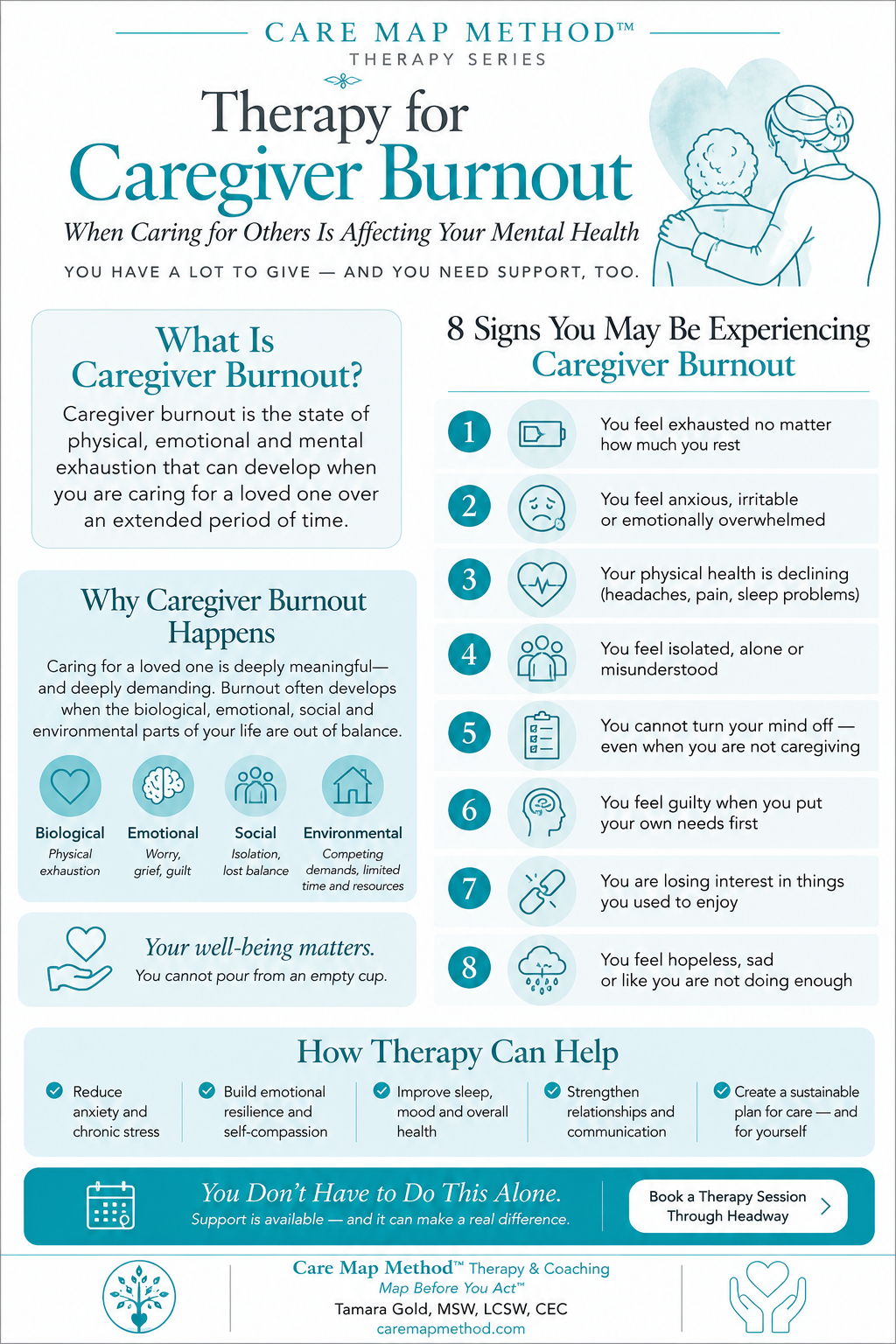
Therapy for Caregiver Burnout: When Caring for Others Is Affecting Your Mental Health
Caregiving can be an act of love and still become emotionally, physically, and relationally overwhelming. Learn the signs of caregiver burnout, why guilt and resentment develop, and how therapy can help you build a more sustainable plan.
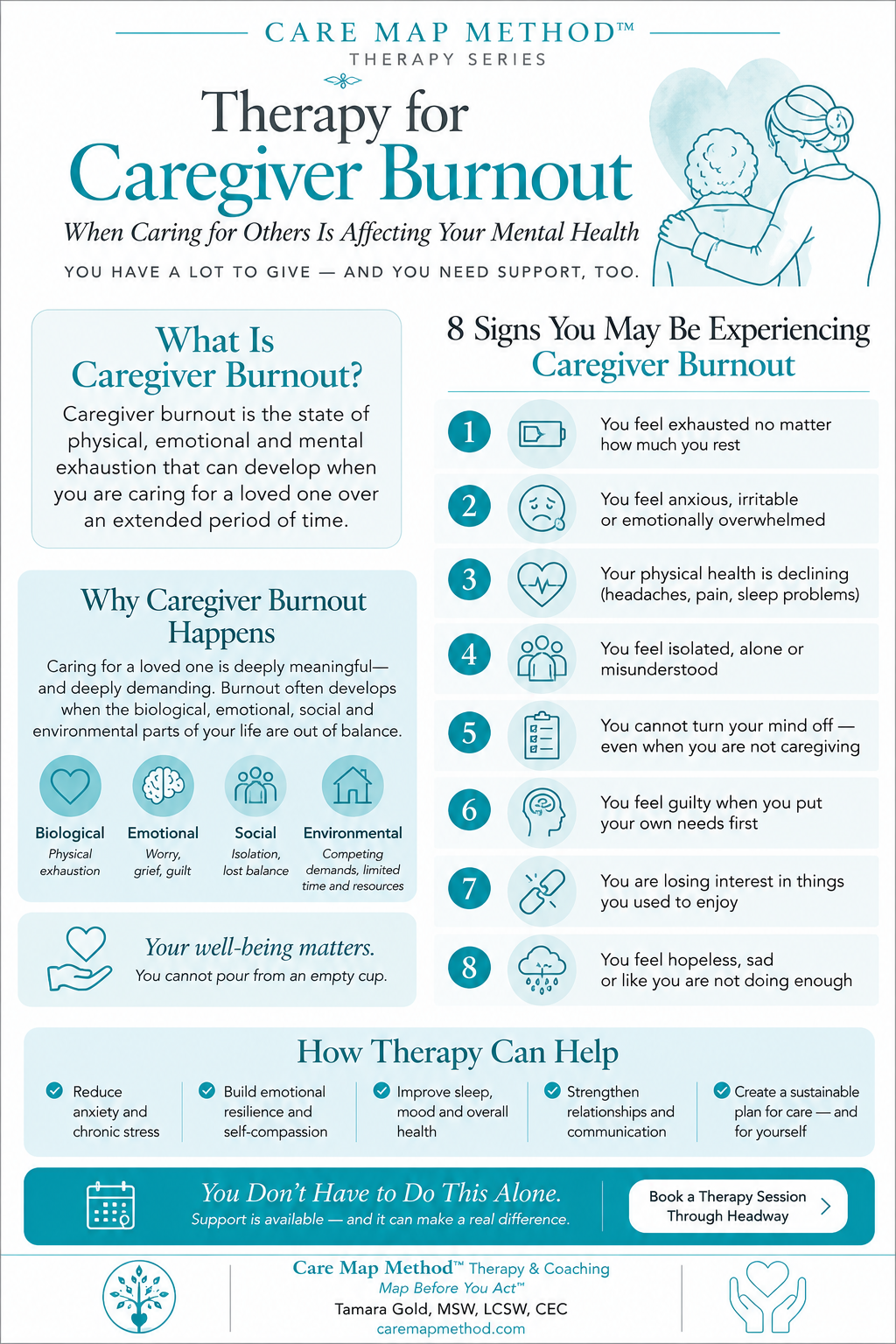
Caregiving Can Be an Act of Love—and Still Become Too Much
Caregiving rarely begins with a formal job description. It may start with one medical appointment, a few groceries, or a promise to “keep an eye on things.” Gradually, you become the person who coordinates medications, answers late-night calls, communicates with physicians, manages family disagreements, researches services, handles emergencies, or worries about what might happen next.
You may love the person you are caring for deeply. You may also feel exhausted, resentful, frightened, irritable, lonely, or trapped. Those feelings can coexist. They do not mean you are uncaring, selfish, or failing. They often mean that your responsibilities have exceeded the emotional, physical, relational, or practical resources available to you.
Caregiver burnout is not simply being tired after a demanding week. It is a pattern of depletion that can affect your mood, sleep, concentration, body, relationships, work, and ability to make decisions. The National Institute on Aging notes that caregivers may be at increased risk for physical and mental health problems, sleep disruption, and chronic health conditions when their own needs repeatedly go unattended.
For many caregivers, therapy becomes the only place where they do not have to be the organizer, problem-solver, peacekeeper, or “strong one.” It can provide room to understand what is happening, reduce guilt, improve boundaries, make clearer decisions, and build a sustainable plan for caring without disappearing inside the role.
What Is Caregiver Burnout?
Caregiver burnout is a state of emotional, mental, and physical exhaustion associated with prolonged caregiving demands and insufficient recovery, support, control, or relief. It can arise while caring for an aging parent, a spouse with chronic illness, a child with medical or behavioral needs, a family member with dementia, or several people across generations.
Burnout does not require round-the-clock hands-on care. A long-distance caregiver may carry constant worry, logistical responsibility, travel demands, financial strain, or guilt. A family member who is not the primary caregiver may still be managing medical decisions, sibling conflict, paperwork, or crises. The burden is not measured only by hours. It is also shaped by unpredictability, emotional intensity, family dynamics, and the sense that there is no safe point at which to step away.
Signs Caregiving May Be Affecting Your Mental Health
Caregiver stress can look different from one person to another. You may be functioning well on the outside while feeling increasingly depleted internally. Common warning signs include:
Feeling emotionally exhausted, overwhelmed, anxious, or constantly “on alert.”
Becoming more impatient, irritable, reactive, or angry than usual.
Having difficulty sleeping, staying asleep, or resting even when you have the opportunity.
Losing interest in activities, friendships, exercise, or routines that once helped you feel like yourself.
Feeling guilty whenever you rest, say no, ask for help, or spend money or time on your own needs.
Experiencing resentment toward the person receiving care, other relatives, professionals, or a partner who seems less involved.
Having trouble concentrating, remembering details, organizing tasks, or making decisions.
Feeling lonely or misunderstood because other people do not see the full extent of what you carry.
Noticing headaches, muscle tension, digestive problems, appetite changes, fatigue, or other stress-related physical symptoms.
Using alcohol, food, work, screens, shopping, or other behaviors to numb or escape the pressure.
Feeling hopeless, emotionally detached, or as though nothing you do will ever be enough.
Important
Burnout is not a moral diagnosis. It is information. Your mind and body may be signaling that the current care system is asking more of you than one person can sustainably provide.
Why Caregivers Often Wait Too Long to Seek Help
Many caregivers normalize a level of distress they would immediately recognize as serious in someone else. They may tell themselves, “This is just what family does,” “Other people have it worse,” or “I can deal with myself after the crisis passes.” But caregiving crises often do not end cleanly. One decision leads to another, and the temporary emergency becomes a long-term way of life.
Caregivers also face practical barriers. Appointments, work demands, childcare, transportation, privacy concerns, and financial pressure can make it difficult to obtain support. Some fear that admitting distress will be interpreted as abandoning the person they love. Others have built an identity around competence and find it uncomfortable to be the one who needs care.
Therapy does not require you to reject your responsibilities. It can help you carry them differently—and decide which responsibilities were never yours alone.
The Care Map Method™ Perspective: Look at the Whole System
Caregiver distress is rarely caused by one thought, one relationship, or one task. I use the Care Map Method™ to examine the whole system through four interconnected areas: Biological, Emotional, Social, and Environmental needs. This helps us identify what is actually driving the overload rather than treating every problem as a personal failure.
BIOLOGICAL
Sleep, health conditions, hormonal changes, pain, nutrition, medication effects, fatigue, and the physical demands of care.
EMOTIONAL
Grief, anxiety, guilt, anger, resentment, anticipatory loss, helplessness, perfectionism, and fear of making the wrong decision.
SOCIAL
Family roles, sibling conflict, marriage stress, isolation, cultural expectations, work demands, and unequal distribution of responsibility.
ENVIRONMENTAL
The home setting, safety risks, finances, transportation, care availability, medical systems, schedules, paperwork, and geographic distance.
Mapping these areas can reveal an important truth: the caregiver may not need to become more resilient; the care system may need more support, clearer expectations, different communication, or a different plan.
The Hidden Emotional Experiences of Caregiving
Anticipatory grief
You may be grieving changes in a parent, spouse, child, or relationship before a death has occurred. You may miss who the person was, the future you expected, or the version of yourself that existed before caregiving became central.
Ambiguous loss
The person you love may still be physically present while memory, personality, independence, communication, or reciprocity has changed. This type of loss can be difficult to explain and difficult for others to recognize.
Guilt
Caregivers often feel guilty for being tired, wanting time away, living at a distance, feeling angry, considering paid care, or being unable to meet every need. Guilt can become a substitute for realistic decision-making.
Resentment
Resentment often signals chronic imbalance, not lack of love. It may point to unsupported labor, unspoken expectations, sibling inequality, financial strain, or boundaries that have repeatedly been crossed.
Identity loss
You may no longer know where caregiving ends and your own life begins. Personal goals, friendships, work, intimacy, and health can gradually move to the margins.
Decision fatigue
Repeated medical, financial, logistical, and family decisions can reduce your ability to think clearly. Even small choices may begin to feel impossible.
How Caregiver Stress Can Affect Relationships
Caregiving does not occur in isolation. It enters marriages, sibling relationships, parent-child dynamics, friendships, and workplaces. Partners may argue about time, money, boundaries, or whose family receives priority. Siblings may revert to old roles: the responsible one, the distant one, the critic, the rescuer, or the person who avoids conflict until a crisis.
Even supportive relationships can become strained when every conversation centers on appointments, emergencies, or difficult decisions. Intimacy may decline. Friends may stop asking because they do not know what to say. Caregivers may withdraw because explaining everything feels exhausting.
Therapy can help distinguish the caregiving problem from the relationship pattern surrounding it. The goal is not to eliminate every disagreement. It is to create clearer roles, more direct communication, realistic expectations, and greater protection for the relationships you want to preserve.
How Therapy Can Help With Caregiver Burnout
Therapy for caregiver burnout is not limited to relaxation techniques. While stress-reduction skills can be useful, caregivers often need a combination of emotional support, practical problem-solving, boundary work, grief processing, communication planning, and decision support.
Name what is happening. Burnout becomes harder to address when everything is described only as “stress.” Therapy helps separate grief, anxiety, anger, guilt, relationship conflict, overload, and practical care problems.
Identify the highest-pressure points. Rather than trying to fix your entire life at once, we can determine which one or two demands are creating the greatest risk or depletion.
Challenge impossible standards. Many caregivers operate under beliefs such as “I should be able to do this alone” or “A good daughter would never place a parent in care.” Therapy can examine whether those standards are humane, accurate, or sustainable.
Build boundaries that fit the situation. A boundary may involve time, money, communication, availability, transportation, living arrangements, or which tasks you can and cannot provide.
Prepare for difficult conversations. Therapy can help you plan what to say to siblings, partners, parents, adult children, employers, physicians, or paid caregivers—especially when emotions are high.
Process grief and mixed emotions. Love, resentment, sadness, relief, fear, and anger may all be present. Therapy offers a place to hold complexity without judgment.
Reconnect with your identity. Caregiving may be an important role, but it does not have to become your entire identity. Therapy can help you protect health, relationships, work, meaning, and future goals.
Create a more sustainable care plan. Emotional insight is important, but caregivers also need concrete next steps. We can map needs, match appropriate support, merge that support into family life, and manage the plan as conditions change.
Practical Steps You Can Begin This Week
These steps are not a substitute for professional or medical care, but they can help you move from vague overwhelm toward clearer action.
1. Write down everything you are carrying
Include visible tasks and invisible mental labor: reminders, research, worry, scheduling, follow-up, conflict management, emotional support, and contingency planning.
2. Circle what only you can do
Some tasks require your legal authority, knowledge, or relationship. Many others may be delegated, shared, automated, delayed, or stopped.
3. Choose one specific request
“I need more help” often produces vague responses. Try: “Can you handle Tuesday transportation for the next four weeks?” or “Can you call these three agencies and compare availability?”
4. Protect one non-caregiving appointment
Schedule one recurring block for your health, therapy, movement, rest, friendship, spiritual life, or another activity that supports your identity.
5. Create a communication rhythm
Instead of responding to multiple family messages all day, consider one weekly update, a shared document, or a designated family call.
6. Plan relief before collapse
The CDC emphasizes consistent breaks and respite. Relief is not something caregivers must earn after becoming ill. It is part of a functional care plan.
7. Tell a healthcare professional that you are a caregiver
Your physician or therapist needs to understand the context affecting your sleep, mood, concentration, and physical symptoms.
When Is It Time to Seek Therapy?
You do not need to wait until you are in crisis. Consider speaking with a therapist when caregiving is consistently affecting your sleep, health, mood, concentration, work, relationship, parenting, or ability to function. Therapy may also be helpful when you are facing a major care decision, recurring family conflict, anticipatory grief, or a transition such as bringing a parent into your home, hiring help, moving a loved one to a facility, or preparing for end-of-life care.
Seek more immediate support if you are experiencing persistent hopelessness, panic, substance misuse, thoughts of self-harm, inability to safely care for yourself or another person, or a situation involving abuse, neglect, or imminent danger. In an emergency, call 911. In the United States, call or text 988 for crisis support.
Online Therapy for Caregiver Burnout in California, New Jersey, and Oregon
I provide virtual therapy to adults, couples, and families located in California, New Jersey, and Oregon. My work is warm, structured, practical, and solution-focused. I help clients navigate caregiver burnout, aging-parent stress, chronic illness, relationship strain, family conflict, parenting pressure, grief, and major life transitions.
Using the Care Map Method™, we look beyond the immediate crisis to understand the biological, emotional, social, and environmental needs affecting the whole family system. Together, we identify what is not working, clarify priorities, develop communication strategies, and create realistic next steps.
Ready to Begin?
View availability, insurance participation, and appointment options through my secure Headway profile. Therapy is available virtually for eligible clients physically located in California, New Jersey, or Oregon.
Book online therapy with Tamara Gold through Headway
Frequently Asked Questions About Caregiver Burnout Therapy
Is caregiver burnout the same as depression?
Not necessarily. Caregiver burnout may involve exhaustion, irritability, emotional detachment, guilt, sleep problems, and reduced functioning. Depression can include persistent sadness, loss of interest, hopelessness, and other symptoms that extend beyond caregiving. They can overlap, and a licensed professional can help assess what you are experiencing.
Can I attend therapy if the person I care for is not in therapy?
Yes. Individual therapy can focus on your stress, grief, boundaries, decisions, relationships, and well-being. The person receiving care does not need to participate.
Can therapy help with sibling conflict over an aging parent?
Yes. Therapy can help you clarify roles, prepare conversations, identify old family patterns, set boundaries, and decide what you are realistically willing and able to do. Family therapy may be appropriate when multiple relatives are willing to participate and are located where the therapist is licensed.
What if I feel guilty taking time for therapy?
Guilt is common among caregivers, but support is not a diversion from caregiving. Protecting your health can improve judgment, communication, and the sustainability of the care you provide.
Does online therapy work for caregiver stress?
Online therapy can be particularly practical for caregivers because it reduces travel and can be accessed privately from an appropriate location. Suitability depends on your needs, safety, technology, and state location at the time of the session.
Do you accept insurance?
Insurance participation and eligibility vary by state and plan. The Headway booking page can show current participating plans and help clients verify benefits and estimated costs before scheduling.
What is the difference between therapy and caregiver coaching?
Therapy addresses mental health symptoms, emotional patterns, grief, relationships, functioning, and clinical concerns. Coaching is generally more focused on planning, education, and implementation. The appropriate service depends on your goals, location, clinical needs, and whether you want to use insurance.
You Are Allowed to Need Care, Too
Caregiving can be meaningful, intimate, and deeply important. It can also be relentless. You do not have to deny the love in order to acknowledge the cost. You do not have to reach complete exhaustion before asking for support. And you do not have to solve every problem alone to be a good caregiver.
A sustainable care plan includes the caregiver. Therapy can help you understand what you are carrying, protect your mental health, communicate more clearly, and make decisions from a place of greater steadiness rather than constant crisis.
Sources and Further Reading
National Institute on Aging — Taking Care of Yourself: Tips for Caregivers
Centers for Disease Control and Prevention — Caring for Yourself When Caring for Another
Centers for Disease Control and Prevention — Steps for Creating and Maintaining a Care Plan
National Institute on Aging — Caregiving Toolkit
What are common signs of caregiver burnout?
Signs may include exhaustion, irritability, resentment, guilt, sleep problems, reduced concentration, withdrawal, health changes, hopelessness, and feeling unable to keep up with care demands.
How can therapy help caregiver burnout?
Therapy can help caregivers process emotions, identify unsustainable demands, set boundaries, communicate with family, ask for help, and develop a more realistic care plan.
Is it normal to feel resentful while caregiving?
Yes. Resentment can develop when responsibilities are excessive, support is limited, boundaries are unclear, or the caregiver’s own needs are repeatedly postponed. Feeling resentment does not mean you do not love the person.
What if my siblings will not help?
Therapy or coaching can help you clarify what you need, prepare a family conversation, define responsibilities, set limits, and decide what you can realistically continue providing.
How do I know when more professional care is needed?
Consider changes in safety, cognition, mobility, medication, nutrition, hygiene, isolation, wandering, falls, caregiver capacity, and whether current arrangements are sustainable.
Can I care for someone without losing myself?
That is a central goal. Sustainable caregiving requires support, boundaries, realistic expectations, shared responsibility where possible, and attention to the caregiver’s health and identity.
What Care Map worksheet pairs with caregiver burnout?
A Caregiver Burnout Snapshot, Family Capacity Assessment, Weekly Care Plan, Boundary Planner, or Biological-Emotional-Social-Environmental Care Map can help organize the situation.
When is caregiver burnout an emergency?
Seek urgent professional help when there is immediate danger, inability to provide safe care, abuse or neglect concerns, severe medical or psychiatric symptoms, or thoughts of harming yourself or someone else.
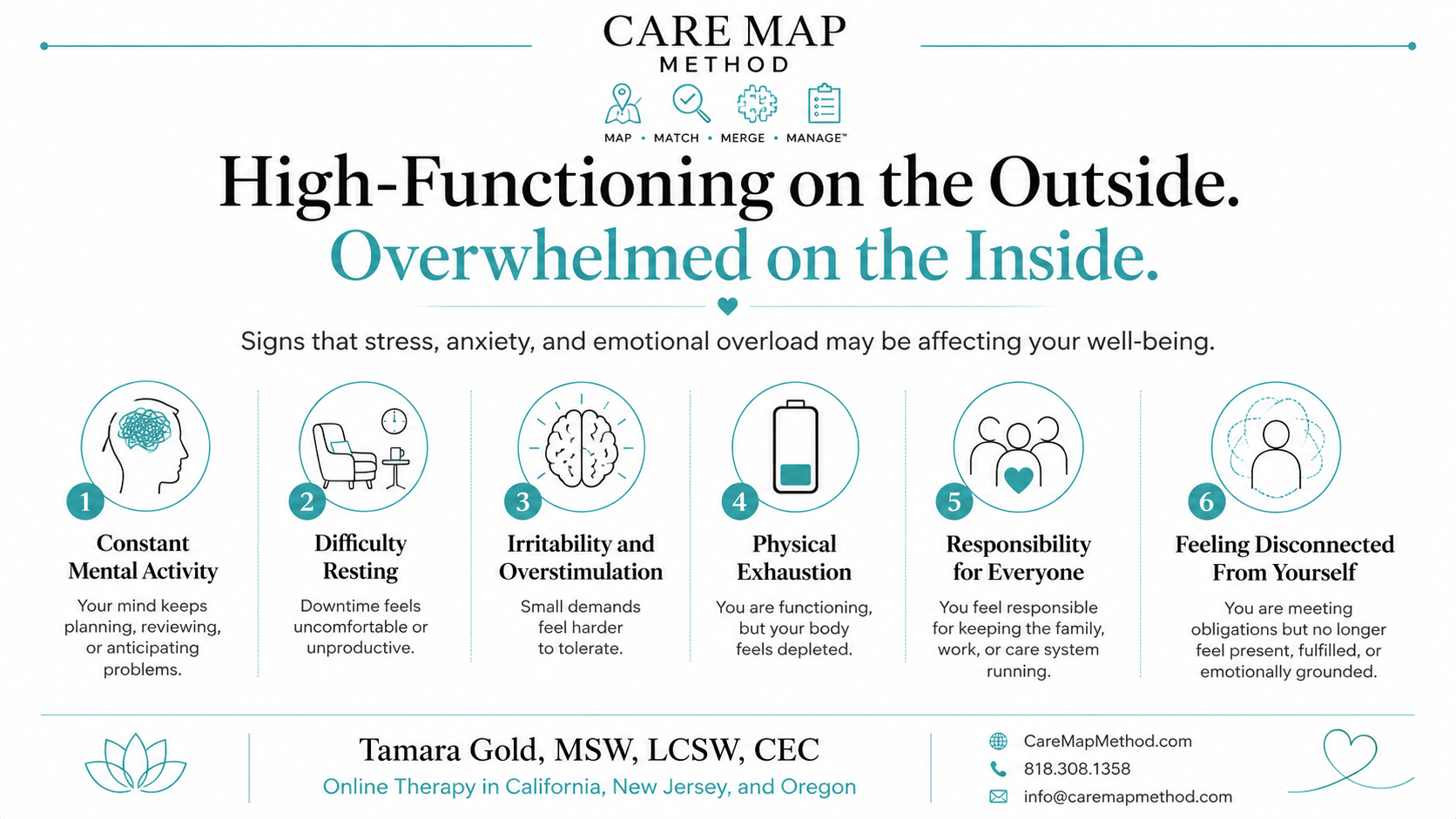
Why High-Functioning Adults Still Feel Anxious, Exhausted, and Overwhelmed
This should be the first therapy-focused blog because it aligns with the clients most likely to find you through Psychology Today and book through Headway: capable adults managing work, parenting, relationships, caregiving, and major life transitions while privately feeling depleted.
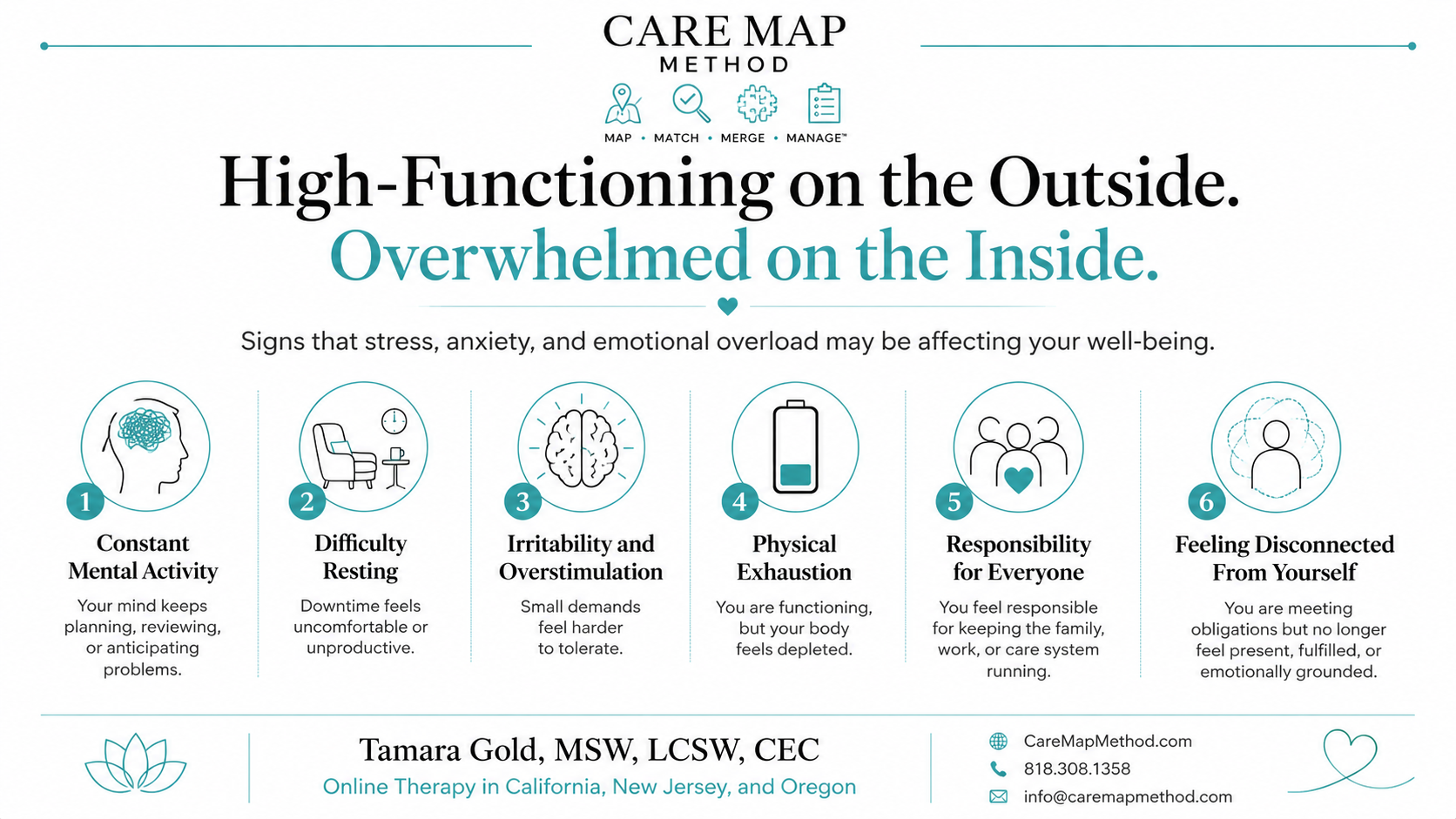
You may be meeting deadlines, caring for your family, managing appointments, answering messages, and keeping everyone else organized.
From the outside, you appear capable.
Inside, however, you may feel anxious, emotionally depleted, irritable, or unable to fully relax.
This experience is common among high-functioning adults. You may continue performing well even while your internal stress level keeps rising. Because your responsibilities are still being handled, other people may not recognize how overwhelmed you feel.
You may even question whether you are “struggling enough” to need therapy.
Therapy is not reserved for people who have stopped functioning. It can also help people who are functioning at a high level but paying an increasingly significant emotional and physical price.
What Does “High-Functioning Anxiety” Mean?
“High-functioning anxiety” is not a formal diagnosis. It is a phrase often used to describe people who appear organized, productive, or successful while experiencing persistent anxiety beneath the surface.
You may be:
dependable and responsible
highly prepared
sensitive to mistakes
uncomfortable disappointing others
constantly anticipating what could go wrong
reluctant to ask for help
unable to rest without feeling guilty
mentally reviewing conversations and decisions
functioning through exhaustion
These qualities may help you succeed professionally or manage a complicated family life. Over time, however, the same patterns can contribute to chronic tension, emotional fatigue, sleep problems, resentment, and burnout.
Why Capable Adults Often Miss the Signs
High-functioning adults are often accustomed to solving problems.
When stress increases, they may respond by becoming even more organized, productive, or controlling. They create more lists, work longer hours, take on additional responsibilities, and try harder to prevent mistakes.
This can temporarily create a sense of control.
But increased effort does not always address the underlying anxiety. It may instead reinforce the belief that everything will fall apart unless you personally manage every detail.
Because you continue functioning, it can be difficult to recognize that your coping system is becoming unsustainable.
Signs That Emotional Overload May Be Building
Stress does not always appear as panic or visible distress. It may appear through subtle patterns that gradually become your normal way of living.
1. Your mind is rarely quiet
You may constantly plan, rehearse, anticipate, or review.
Even when nothing urgent is happening, your mind may search for the next problem to solve.
2. You cannot fully enjoy downtime
You may sit down to rest but immediately think about unfinished tasks.
Rest may feel uncomfortable, undeserved, or unproductive.
3. Small demands feel disproportionately difficult
A text message, schedule change, interruption, or minor mistake may feel far more upsetting than it once did.
This does not necessarily mean you are overreacting. It may mean your nervous system is already carrying too much.
4. You feel responsible for everyone
You may believe it is your job to manage other people’s emotions, prevent conflict, remember every detail, and keep the family or workplace functioning.
This can leave little space for your own needs.
5. Your body feels exhausted even when you keep going
Chronic stress can show up as muscle tension, headaches, disrupted sleep, stomach discomfort, fatigue, restlessness, or difficulty concentrating.
You may still complete your responsibilities while feeling physically depleted.
6. You are becoming more irritable or emotionally distant
When your emotional resources are exhausted, you may become impatient, withdrawn, numb, or easily overstimulated.
You may care deeply about the people around you while feeling increasingly unable to engage with them.
7. You no longer feel like yourself
You may be accomplishing everything expected of you but feel disconnected from joy, creativity, confidence, or meaning.
Life may begin to feel like one obligation after another.
Why Parenting and Caregiving Can Intensify These Patterns
Parents and caregivers frequently manage both visible and invisible responsibilities.
Visible tasks include appointments, transportation, meals, work, school, medications, paperwork, and household logistics.
Invisible tasks include:
anticipating everyone’s needs
monitoring emotional well-being
preventing conflict
remembering deadlines
researching options
making difficult decisions
managing guilt
worrying about what may happen next
When you are the person everyone relies on, it can feel risky to slow down.
You may fear that asking for help will burden other people or expose areas where you do not feel fully in control.
Therapy can provide a private space where you are not required to care for, organize, or protect anyone else.
High-Functioning Anxiety Versus Burnout
Anxiety and burnout can overlap, but they are not identical.
Anxiety often involves:
persistent worry
fear of mistakes
overpreparation
difficulty tolerating uncertainty
physical tension
trouble turning off thoughts
Burnout often involves:
emotional exhaustion
reduced motivation
irritability
detachment
feeling ineffective
difficulty recovering between demands
Many people experience both.
Anxiety may drive you to keep performing, while burnout gradually reduces your emotional and physical capacity to continue.
How Therapy Can Help
Therapy can help you understand the patterns underneath chronic overwhelm rather than simply giving you another list of tasks to complete.
The work may include:
identifying triggers and recurring stress cycles
understanding perfectionism and over-responsibility
learning to tolerate uncertainty
reducing guilt around rest and boundaries
noticing physical signs of escalation
improving emotional regulation
changing unhelpful relationship patterns
developing more sustainable routines
separating your responsibilities from other people’s responsibilities
reconnecting with your own priorities and identity
The goal is not to make you less capable.
The goal is to help you use your strengths without sacrificing your health, relationships, or sense of self.
You Do Not Have to Wait Until Everything Falls Apart
Many people postpone therapy because they are still working, parenting, caregiving, or meeting their obligations.
But continued performance does not mean the current situation is sustainable.
You do not need to wait for a crisis, panic attack, relationship rupture, or complete exhaustion before seeking support.
Therapy can be useful when you notice that your current way of coping is becoming too costly.
Online Therapy for Anxiety, Overwhelm, and Life Transitions
I work with adults who may appear capable and composed while privately experiencing anxiety, parenting stress, caregiver strain, relationship stress, burnout, or major life transitions.
My approach is warm, practical, and collaborative. We work to understand what is creating distress, identify patterns that are no longer helping, and develop tools that fit your actual life.
Online therapy is available to clients located in:
California
New Jersey
Oregon
Ready to Begin?
You may not need to change everything at once.
A first therapy appointment can help you clarify what is happening, identify the areas creating the most strain, and determine what kind of support would be most useful.
Use the button below to review insurance options and request an appointment through Headway.