


Boundary Setting & Difficult Relationships Therapy
Stop repeating the same exhausting relationship patterns. Build clearer boundaries, stronger communication and a plan for difficult interactions.

Two family members having a calm conversation, representing therapy for boundaries and difficult relationships in CA, NJ & Oregon
Therapy for Boundaries & Difficult Relationships
Setting a boundary can sound simple until the relationship actually matters to you. You may know exactly what you want to say and still feel guilty, anxious, selfish, or afraid of the other person's reaction. If you have spent years keeping the peace, overexplaining, rescuing, or putting other people's needs first, even a reasonable limit can feel emotionally dangerous. Therapy can help you understand why the pattern is so powerful and practice a different way of relating.
Why boundaries can feel so difficult
Boundary problems often develop in relationships where love, responsibility, fear, guilt, and obligation are mixed together. You may be dealing with a parent who expects constant access, an adult child who relies heavily on you, a sibling who becomes angry when challenged, a partner who dismisses your needs, or a coworker who repeatedly crosses limits.
The issue is not always knowing what the boundary should be. The harder part is tolerating the discomfort that follows when you stop doing what everyone expects. Therapy can help you prepare for that discomfort so the boundary becomes more than a sentence you say once.
Therapy for people-pleasing and difficult relationships
We can look at the beliefs underneath the pattern: Do you feel responsible for everyone else's feelings? Do you equate conflict with rejection? Do you fear that saying no will end the relationship? Do you become so overwhelmed that you either give in or cut off completely?
Therapy can help you find a middle ground between over-accommodating and withdrawing. We can work on assertiveness, emotional regulation, guilt, communication, and realistic expectations about what another person may or may not change.
The Care Map Method: Map • Match • Merge • Manage
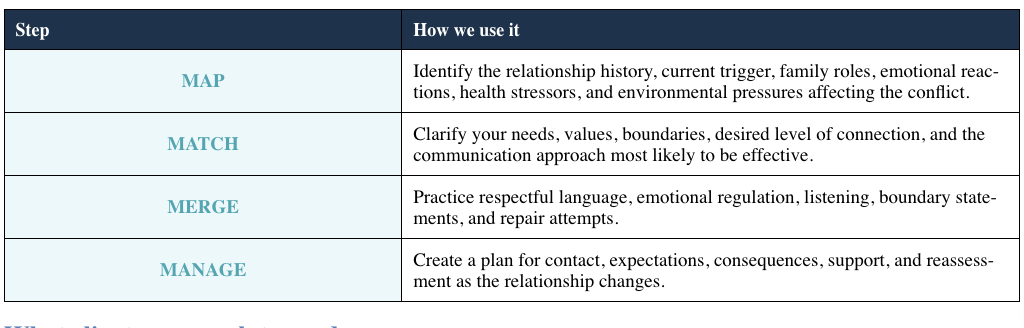
MAP — Understand the pattern. We identify where boundaries are being crossed, what triggers guilt or fear, and what roles you have been carrying in the relationship.
MATCH — Identify needs and goals. We clarify your values, limits, responsibilities and what you want the relationship to look like going forward.
MERGE — Improve communication and connection. We develop direct but respectful language, listening skills and ways to hold a boundary without unnecessary escalation.
MANAGE — Create practical next steps. We plan for follow-through, likely reactions, self-care, and the routines or scripts that make the boundary sustainable.
Boundaries are not the same as rejection
A healthy boundary is not a punishment. It is information about what you can participate in and what you cannot. In many relationships, clearer limits actually reduce resentment and create more room for genuine connection. Therapy can help you practice that distinction in a way that feels supportive rather than shaming.
Online therapy and insurance in NJ, CA & Oregon
I provide online psychotherapy for clients who are physically located in states where I am licensed and available to practice. I work with selected insurance plans through Headway. Coverage, eligibility, copays, deductibles and network participation vary by plan and member. Use the Headway booking link to verify benefits before scheduling.
Choose the Oregon, California or New Jersey module from the front of this document and place it here. For the highest-pay strategy, lead with the priority plan(s) for that state while keeping the copy accurate and conditional.
Ready for support and a plan?
If this situation is affecting your mood, sleep, work, relationships or sense of stability, you do not have to wait until it becomes a crisis. Therapy can be a safe, nonjudgmental place to unload what you are carrying while also developing tangible tools and a clearer path forward. Use the Headway link to check insurance eligibility and current appointment availability.
FAQ
Why is setting boundaries so difficult?
Boundaries can activate guilt, fear of conflict, old family roles, people-pleasing patterns and worries about rejection. Therapy can help you understand and tolerate those reactions.
Can therapy help with people-pleasing?
Yes. Therapy can address the beliefs and emotions that make it difficult to say no, disappoint others or prioritize your own needs.
How do I set a boundary without ending the relationship?
We can work on clear language, realistic expectations, emotional regulation and consistent follow-through while preserving as much respect and connection as the relationship allows.
Can we work on scripts for difficult conversations?
Yes. Practical scripts and rehearsal can be useful when you know what you want to say but struggle to communicate it under stress.
Is online therapy covered by insurance?
Coverage varies by plan and state. Headway can help verify current eligibility and benefits before you book.
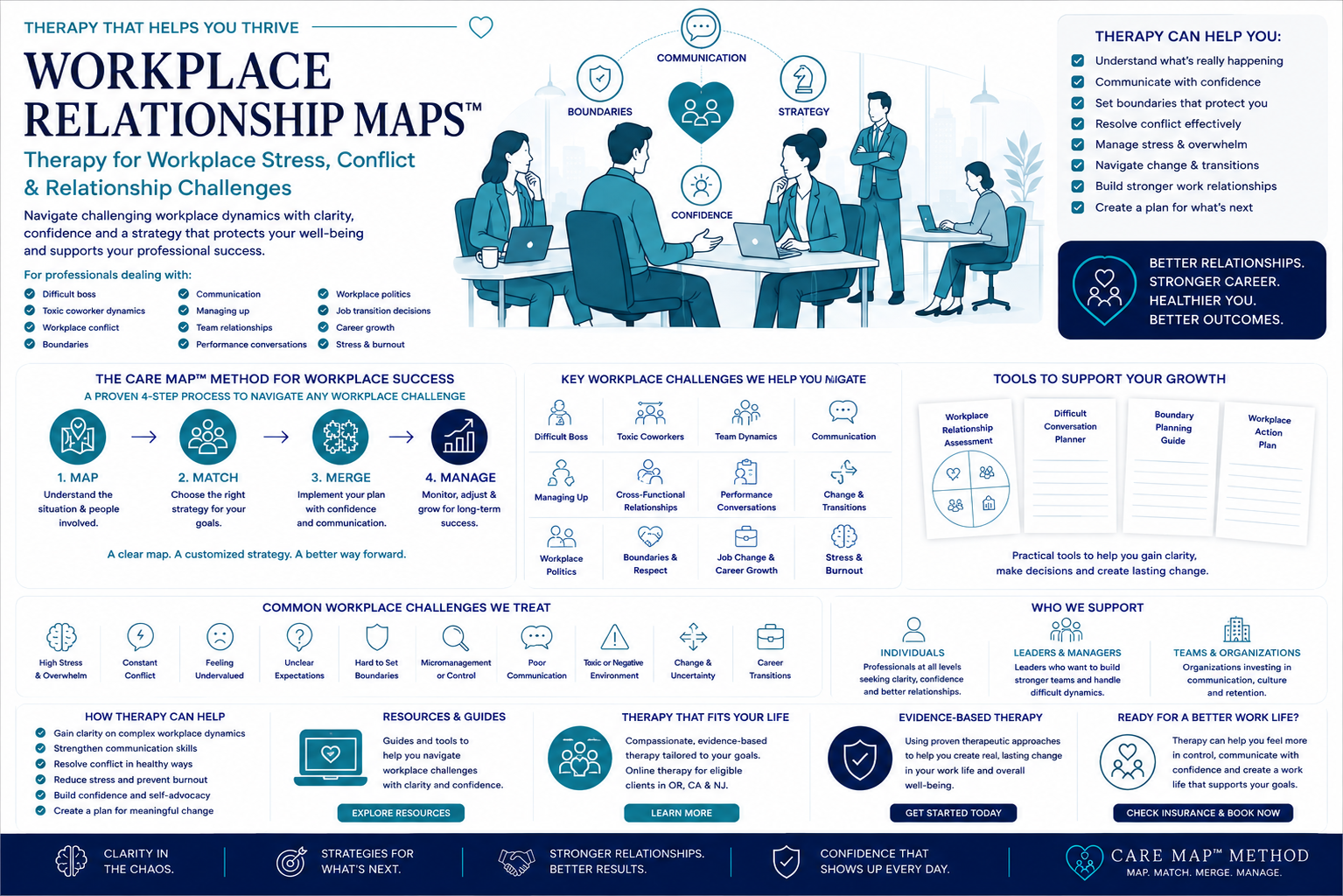
Online Therapy for Workplace Stress, Difficult Bosses & Conflict
Work stress can follow you home. Get personalized therapy for difficult bosses, coworker conflict, boundaries, burnout and career stress.
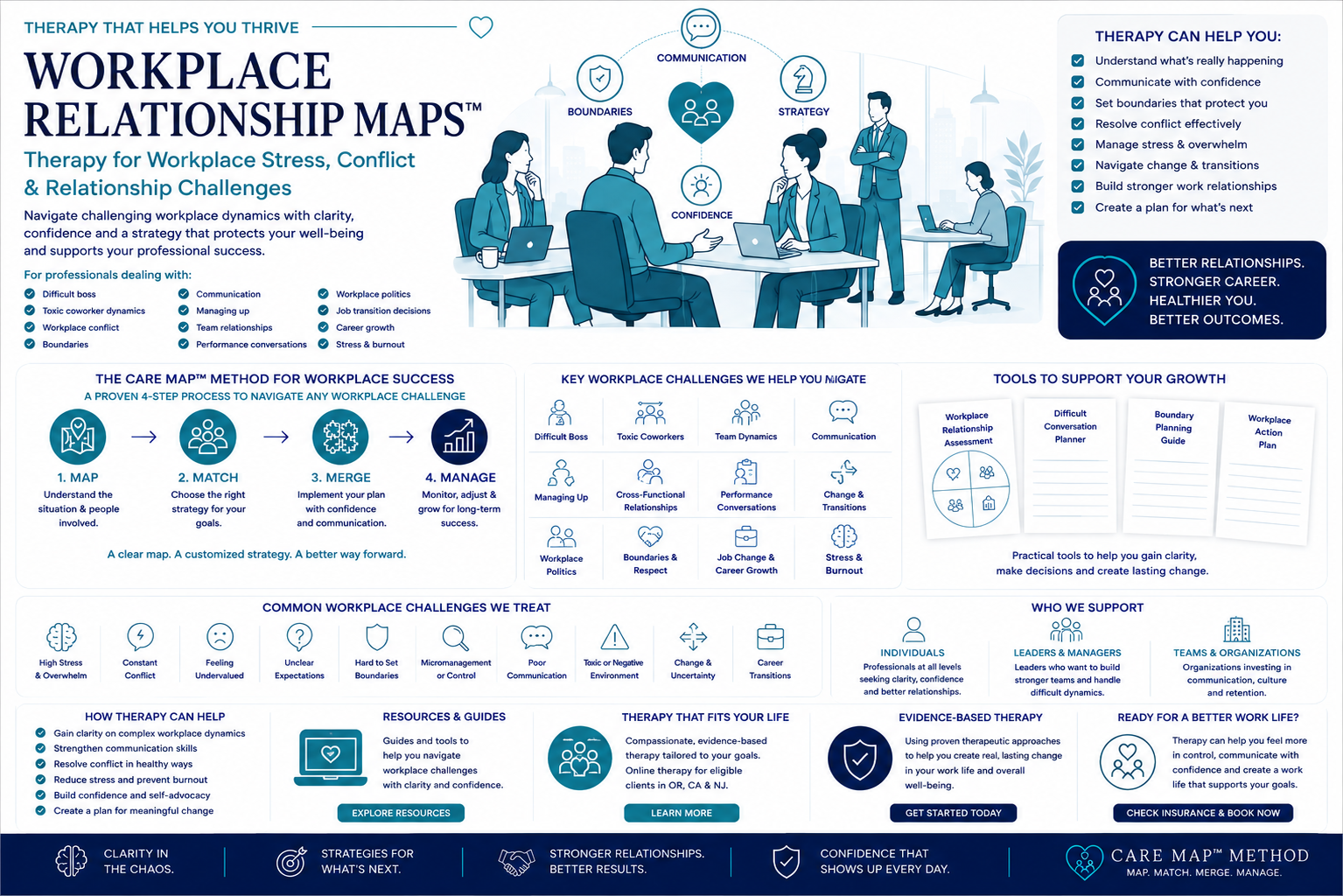
Online therapy for workplace stress, difficult bosses, coworker conflict, boundaries and burnout in CA, NJ and Oregon Check insurance eligibility and book online.
Online Therapy for Workplace Stress, Difficult Bosses & Conflict
A difficult boss, a tense coworker relationship, or a politically complicated workplace can take up far more mental space than the hours you spend at work. You may replay conversations, second-guess what you said, worry about your reputation, or feel stuck between speaking up and staying quiet. Therapy can give you a structured place to understand what is happening, how it is affecting you, and what choices are realistically available.
Check Insurance Eligibility & Book Online Therapy → Via HEADWAY
What You May Be Dealing With
You dread meetings, emails or interactions with a particular person.
You replay workplace conversations long after the workday ends.
You feel micromanaged, criticized, excluded or undervalued.
You are unsure how to set a boundary without making the situation worse.
Coworker conflict is affecting your confidence, sleep, mood or concentration.
You are trying to decide whether to address the situation, escalate it, change roles or leave.
You are burned out from carrying too much responsibility or emotional labor.
You want to communicate more clearly without becoming reactive or shutting down.
How Therapy Can Help
Therapy is not about giving you a one-size-fits-all script for dealing with a difficult person. The work starts by understanding the specific relationship, the power dynamics, your emotional reactions, your goals and the risks involved. Together, we can identify patterns, strengthen boundaries, prepare for difficult conversations, work on emotional regulation, and clarify what is within your control. If a job decision is part of the problem, therapy can also help you separate fear, exhaustion and frustration from the practical factors that matter to your next step.
The Care Map Method™ in Therapy
Care Map Method™ is a structured way to organize the people, needs, stressors and choices involved in a complex real-life situation. In psychotherapy, it is used only as an organizing framework within individualized clinical care—not as a substitute for assessment, diagnosis or treatment planning.
MAP — Identify the people, pressures, triggers, history and emotional impact of the workplace situation.
MATCH — Identify coping strategies, communication approaches, boundaries and decision-making tools that fit the situation.
MERGE — Practice how to apply those strategies in real conversations, meetings, routines and workdays.
MANAGE — Review what changes, what does not, and how you want to respond as the situation evolves.
Why Work With Tammy Gold
Tammy Gold is a licensed therapist, author and nationally recognized parenting, relationship and caregiving expert with more than 20 years of experience helping people navigate complex interpersonal situations. Her Care Map Method™ provides a structured way to organize the people, needs, stressors and choices involved in a real-life problem while keeping psychotherapy individualized to the client.
Insurance & Online Therapy
Online therapy is available for clients located in states where Tammy is licensed and accepting clients. Selected insurance plans are accepted through Headway. Coverage, copays, deductibles, coinsurance and eligibility vary by plan and member.
Use the Headway booking link to check current insurance eligibility and available appointment times. Do not publish contracted reimbursement amounts on the website.
Oregon: Providence Health Plan • Aetna • Regence BlueCross BlueShield of Oregon • Carelon Behavioral Health • Providence Medicare Advantage.
California: Providence Health Plan • Aetna • Carelon Behavioral Health • Anthem Blue Cross California.
New Jersey: Providence Health Plan • Aetna • Carelon Behavioral Health.
Always verify current participation before publishing.
Frequently Asked Questions
Do you offer therapy for problems with a boss or coworker?
Yes. Individual therapy can focus on the emotional and relational impact of a difficult workplace situation, including communication, boundaries, anxiety, burnout, confidence and decision-making.
Can therapy help me decide whether to stay in or leave a job?
Therapy can help you clarify what is driving the decision, identify your priorities, examine recurring patterns and think through the emotional consequences of different options. The decision remains yours.
How can therapy help with workplace boundaries?
Therapy can help you identify where boundaries are unclear, understand why asserting them feels difficult, and develop more sustainable ways to communicate limits while managing the emotions that come with doing so.
Can I use insurance for online therapy?
Selected insurance plans are accepted through Headway. Eligibility and out-of-pocket costs depend on your individual plan. Use the booking link to verify current benefits.
Do you provide online therapy throughout New Jersey, California, or Oregon?
Telehealth sessions are available to appropriate clients located in states where Tammy is licensed and currently accepting clients. Availability can be confirmed through the booking process.
Work problems do not have to occupy every part of your life. If you want a structured place to understand the relationship, reduce the emotional spillover and decide what comes next, check your insurance eligibility and book an online therapy session through Headway.
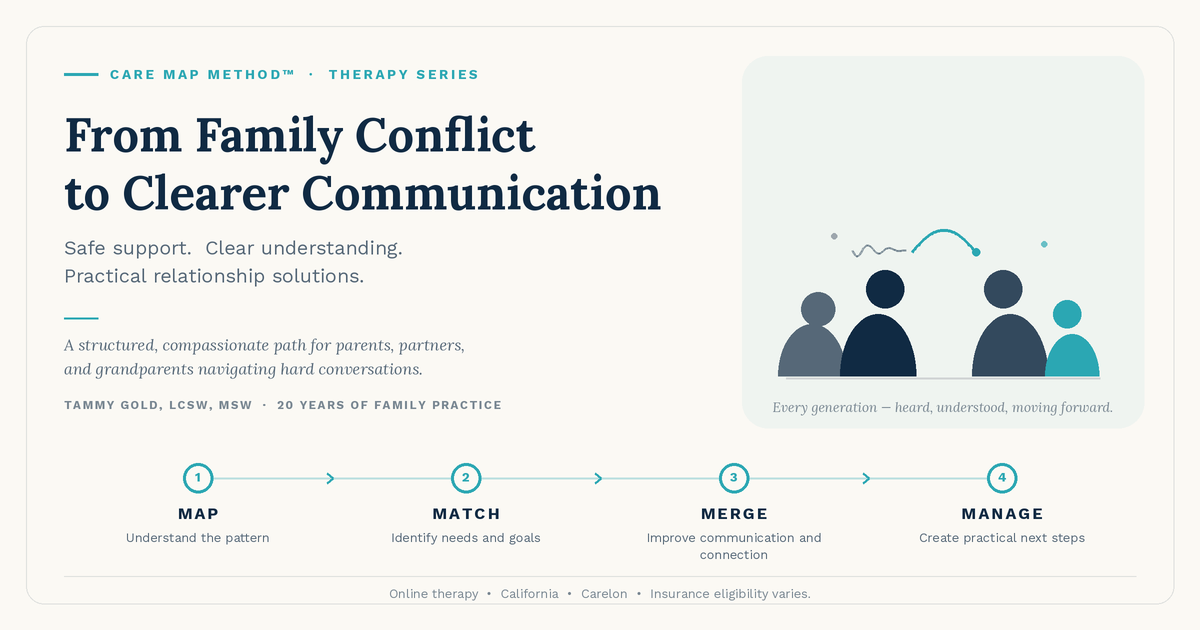
Carelon Therapy in California for Family Conflict With Parents, Children, and Adult Children
Carelon family conflict therapy in California for parents, children, and adult children using Map, Match, Merge, and Manage.
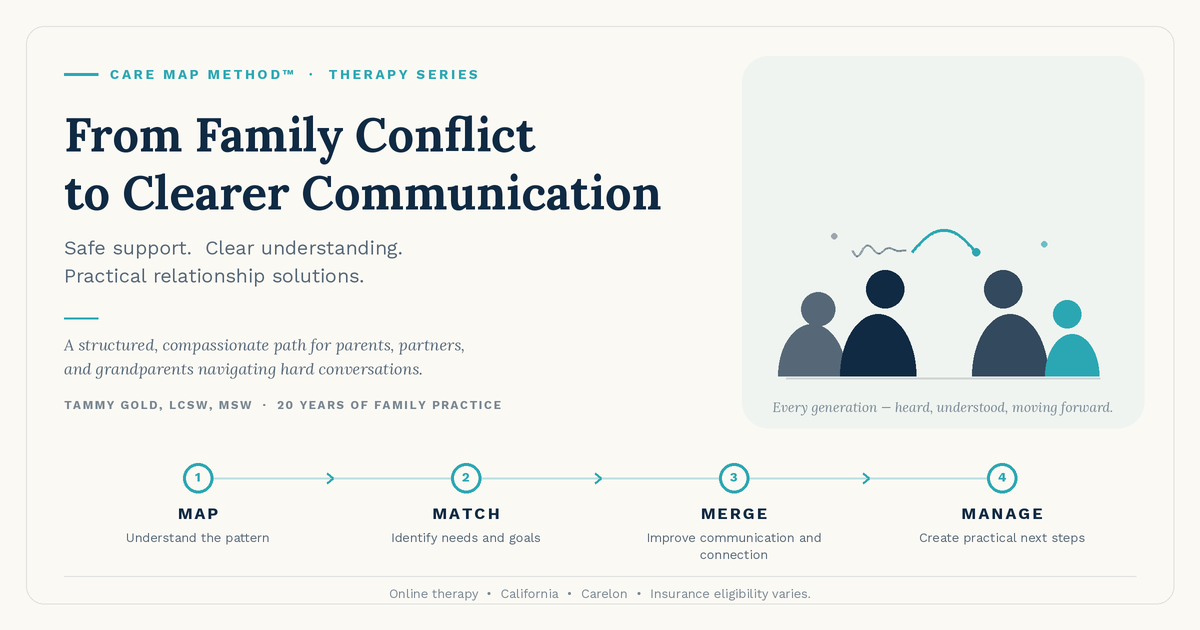
Carelon Therapy in California for Family Conflict With Parents, Children, and Adult Children
Family conflict often contains years of history. A current disagreement can activate old roles, unresolved hurt, loyalty conflicts, criticism, guilt, or fear of rejection. Problems with a parent, child, teenager, or adult child may leave you feeling angry, helpless, responsible, or unsure whether to speak up or pull away.
You do not have to carry this alone. My goal is to provide a warm, confidential, and nonjudgmental space where you can unpack what is happening without shame, blame, or pressure. Therapy can offer emotional support and practical direction at the same time.
Therapy provides a nonjudgmental place to unpack the relationship without forcing an immediate confrontation. We identify the pattern, separate present concerns from historical pain, clarify what you need, and develop communication and boundary strategies that fit the relationship. Progress can begin even if the other family member does not attend.
ONLINE THERAPY IN CALIFORNIA
Insurance may be available through Headway depending on your plan, eligibility, state, and session type. Verify benefits before booking.
Carelon family conflict therapy in California for parents, children, and adult children using Map, Match, Merge, and Manage.
What clients can work toward
Understand why the conflict feels so intense
Communicate without escalating the pattern
Set boundaries with less guilt
Choose a healthier level of connection
Therapy is not only a place to talk about what went wrong. It is a place to feel heard, understand the pattern, practice healthier responses, and build a plan that can be used in daily life. Progress depends on the circumstances and cannot be guaranteed, but the work can become clearer, more intentional, and more supported.
Frequently asked questions
Can therapy help if my family member refuses to attend?
Yes. Individual therapy can help you change your side of the pattern, clarify boundaries, prepare conversations, and make healthier decisions.
Does Carelon cover family therapy in California?
Coverage depends on the specific plan, clinical need, session type, and current network rules. Verify eligibility through Headway before booking.
Can therapy improve a relationship with an adult child?
Therapy can help parents and adult children understand roles, expectations, independence, boundaries, and communication. Improvement may begin with one person changing the pattern.
How do I set boundaries without ending the relationship?
Boundaries can be specific, respectful, and focused on what you will do rather than controlling the other person. Therapy can help prepare the wording and follow-through.
Will therapy blame the parent or child?
No. The goal is to understand the system and the needs of the people involved, not to assign shame or blame.
What if the conflict involves safety or abuse?
Safety comes first. Therapy may include safety planning and referral to appropriate specialized, legal, medical, or crisis resources when needed.
Final booking call to action
You deserve one place where you can be honest without worrying about judgment, shame, or blame. Together, we can understand what is happening, identify what needs to change, and create practical steps toward a healthier relationship and a more manageable life.

Regence BCBS Therapy in Oregon for a Difficult Boss, Coworker Conflict, and Work Stress
Online therapy in Oregon for a difficult boss, coworker conflict, workplace anxiety, burnout, communication, and boundaries. Verify Regence benefits.

egence BCBS therapy in Oregon for difficult boss relationships, coworker conflict, workplace anxiety, burnout, and boundaries.
Regence BCBS Therapy in Oregon for a Difficult Boss, Coworker Conflict, and Work Stress
A difficult boss or coworker can affect sleep, confidence, concentration, family life, and physical health. You may replay conversations, anticipate criticism, avoid speaking up, overwork to prove yourself, or carry anger home. The problem may involve a genuinely unhealthy workplace, but it can also activate older patterns involving authority, rejection, perfectionism, or conflict avoidance.
You do not have to carry this alone. My goal is to provide a warm, confidential, and nonjudgmental space where you can unpack what is happening without shame, blame, or pressure. Therapy can offer emotional support and practical direction at the same time.
Therapy helps you distinguish what belongs to the workplace, what the situation activates emotionally, and what choices are available. We prepare communication, strengthen boundaries, reduce reactivity, and evaluate whether repair, escalation, role change, or departure is the healthiest path
How the Care Map Method™ helps
MAP
Identify the workplace pattern, trigger events, power dynamics, emotional and physical impact, policies, workload, and environmental constraints.
MATCH
Clarify goals, boundaries, communication strategies, documentation needs, support resources, and realistic options.
MERGE
Practice difficult conversations, assertive language, emotional regulation, and ways to protect home life from work spillover.
MANAGE
Create an action plan, decision timeline, coping routine, documentation process, and criteria for evaluating change..
What clients can work toward
Reduce rumination after work
Communicate with greater confidence
Set clearer professional boundaries
Make a thoughtful stay-or-leave decision
Therapy is not only a place to talk about what went wrong. It is a place to feel heard, understand the pattern, practice healthier responses, and build a plan that can be used in daily life. Progress depends on the circumstances and cannot be guaranteed, but the work can become clearer, more intentional, and more supported.
Frequently asked questions
Can therapy help with a difficult boss?
Yes. Therapy can help you understand the dynamic, regulate stress, prepare for communication, set boundaries, and decide what is within your control.
Does Regence BCBS cover online therapy in Oregon?
Coverage varies by plan and eligibility. Verify current benefits and network participation through Headway before scheduling.
How do I know if the workplace is toxic or I am overreacting?
Therapy can help examine patterns, evidence, policies, impact on functioning, and whether concerns persist across people and settings.
Can therapy help me stop taking work stress home?
Yes. We can build transition routines, boundaries, emotional regulation, and communication strategies that reduce spillover.
Should I confront my boss?
That depends on the power dynamic, safety, evidence, organizational culture, goals, and available protections. Therapy can help plan rather than react.
Is career counseling part of this work?
Therapy may include values, identity, confidence, burnout, and decision-making around career transitions, while specialized career services may also be appropriate.
Final booking call to action
You deserve one place where you can be honest without worrying about judgment, shame, or blame. Together, we can understand what is happening, identify what needs to change, and create practical steps toward a healthier relationship and a more manageable life.
Verify your insurance and request an online therapy appointment through my Psychology Today / Headway booking path.
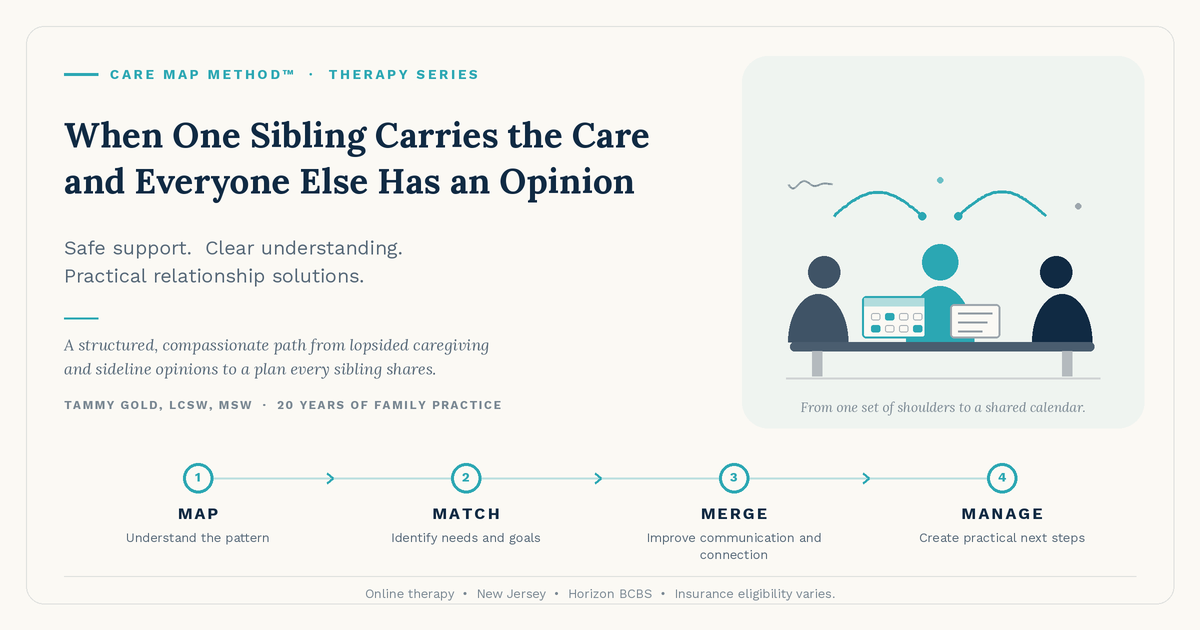
Horizon BCBS Therapy in New Jersey for Sibling Conflict and Family Caregiving
Online therapy in New Jersey for sibling conflict, caregiver burden, aging-parent decisions, boundaries, and family communication. Verify Horizon benefits.
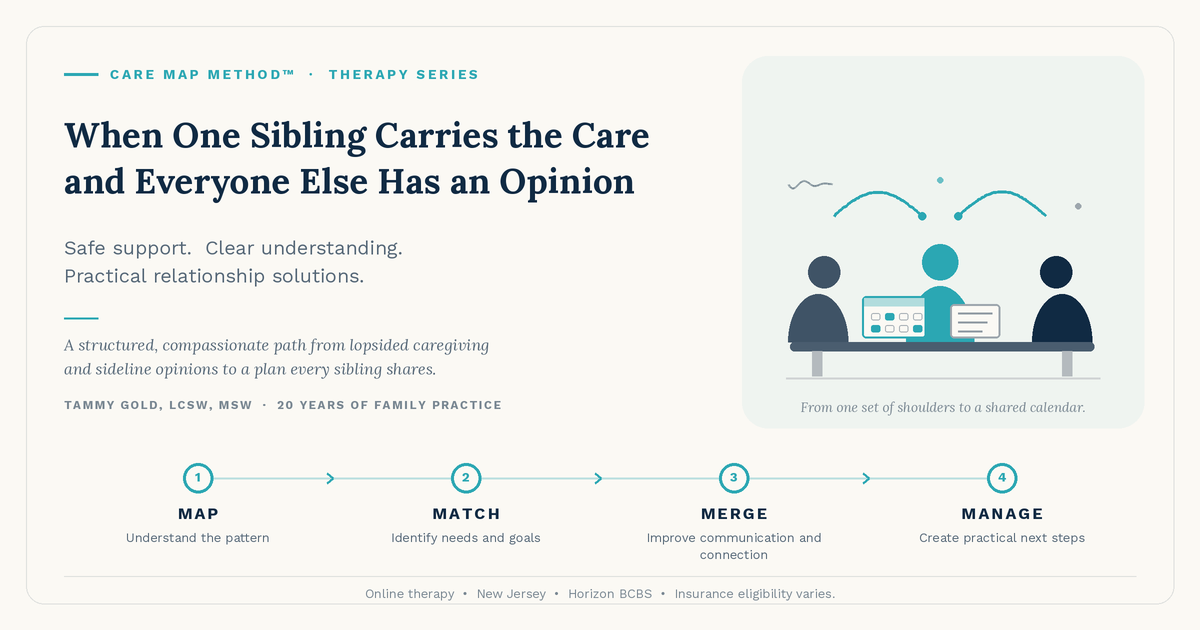
Horizon BCBS therapy in New Jersey for sibling conflict, caregiver burden, aging-parent decisions, and family communication.
Horizon BCBS Therapy in New Jersey for Sibling Conflict and Family Caregiving
Family caregiving can create a painful imbalance. One sibling may handle appointments, calls, emergencies, and daily care while others participate less or criticize decisions from a distance. Old family roles quickly return, and conversations about the parent become arguments about fairness, loyalty, money, and who has always done more.
You do not have to carry this alone. My goal is to provide a warm, confidential, and nonjudgmental space where you can unpack what is happening without shame, blame, or pressure. Therapy can offer emotional support and practical direction at the same time.
Therapy offers a neutral place to identify both the practical imbalance and the emotional history underneath it. We clarify what the parent needs, what each sibling can realistically contribute, and what boundaries are necessary. The work focuses on reducing blame and creating a plan that is more sustainable.
ONLINE THERAPY IN NEW JERSEY
Insurance may be available through Headway depending on your plan, eligibility, state, and session type. Verify benefits before booking.
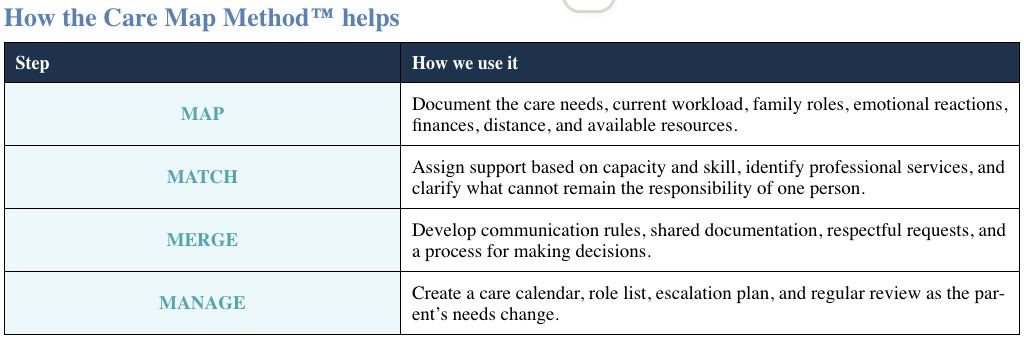
How the Care Map Method™ helps
MAP
Document the care needs, current workload, family roles, emotional reactions, finances, distance, and available resources.
MATCH
Assign support based on capacity and skill, identify professional services, and clarify what cannot remain the responsibility of one person.
MERGE
Develop communication rules, shared documentation, respectful requests, and a process for making decisions.
MANAGE
Create a care calendar, role list, escalation plan, and regular review as the parent’s needs change.
What clients can work toward
· Make invisible caregiving work visible
· Reduce resentment and guilt
· Create clearer sibling responsibilities
· Protect the caregiver’s health and limits
Therapy is not only a place to talk about what went wrong. It is a place to feel heard, understand the pattern, practice healthier responses, and build a plan that can be used in daily life. Progress depends on the circumstances and cannot be guaranteed, but the work can become clearer, more intentional, and more supported.
Frequently asked questions
Can family therapy help when siblings live in different states?
Online sessions may allow family members to participate when legal, clinical, and licensing requirements are met. Individual therapy is also useful when joint work is not possible.
Does Horizon BCBS cover family caregiving therapy?
Coverage depends on the plan, clinical need, session type, and current network rules. Verify benefits before scheduling.
What if my siblings refuse to help?
Therapy can help you communicate clearly, stop overfunctioning, set limits, pursue outside resources, and decide what you can safely continue.
How do we include the aging parent in decisions?
The parent’s preferences and autonomy should be included whenever possible, while safety, capacity, medical advice, and legal considerations may affect the process.
Can therapy help with caregiver guilt?
Yes. Therapy can separate love from unlimited responsibility and help caregivers create boundaries that are compassionate and sustainable.
What practical tools might we use?
A family capacity assessment, care calendar, communication plan, provider question list, and written role agreement can make the situation more manageable
You deserve one place where you can be honest without worrying about judgment, shame, or blame. Together, we can understand what is happening, identify what needs to change, and create practical steps toward a healthier relationship and a more manageable life.
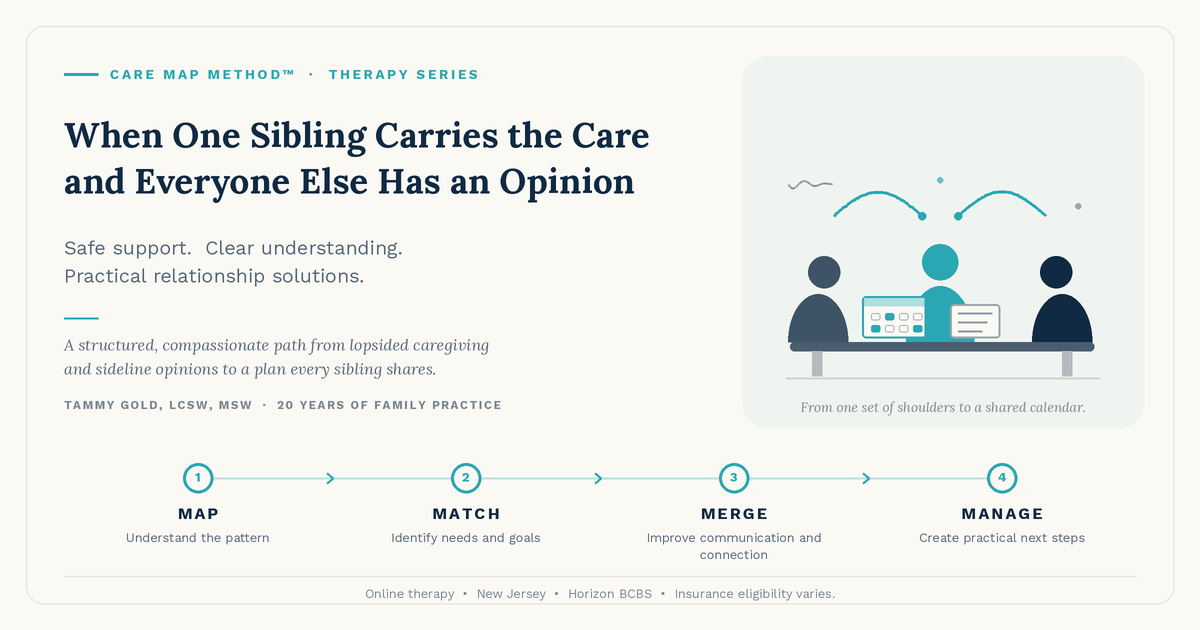
Horizon BCBS Therapy in New Jersey for Sibling Conflict and Family Caregiving
Online therapy in New Jersey for sibling conflict, caregiver burden, aging-parent decisions, boundaries, and family communication. Verify Horizon benefits.
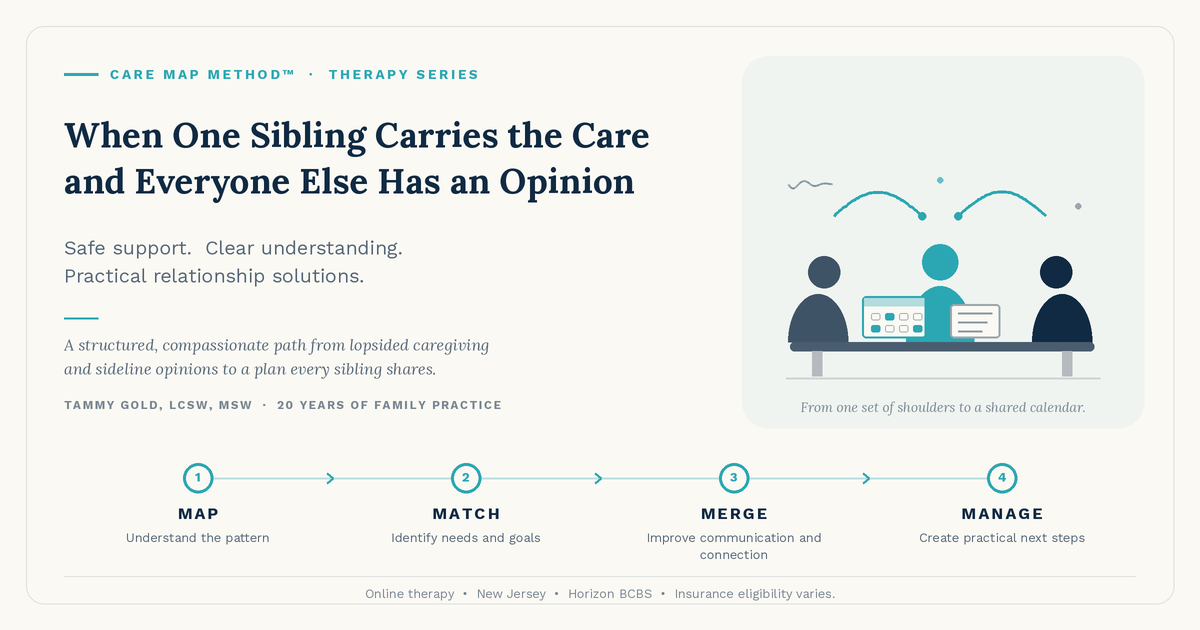
Horizon BCBS therapy in New Jersey for sibling conflict, caregiver burden, aging-parent decisions, and family communication.
Horizon BCBS Therapy in New Jersey for Sibling Conflict and Family Caregiving
Family caregiving can create a painful imbalance. One sibling may handle appointments, calls, emergencies, and daily care while others participate less or criticize decisions from a distance. Old family roles quickly return, and conversations about the parent become arguments about fairness, loyalty, money, and who has always done more.
You do not have to carry this alone. My goal is to provide a warm, confidential, and nonjudgmental space where you can unpack what is happening without shame, blame, or pressure. Therapy can offer emotional support and practical direction at the same time.
Therapy offers a neutral place to identify both the practical imbalance and the emotional history underneath it. We clarify what the parent needs, what each sibling can realistically contribute, and what boundaries are necessary. The work focuses on reducing blame and creating a plan that is more sustainable.
ONLINE THERAPY IN NEW JERSEY
Insurance may be available through Headway depending on your plan, eligibility, state, and session type. Verify benefits before booking.
What clients can work toward
Make invisible caregiving work visible
Reduce resentment and guilt
Create clearer sibling responsibilities
Protect the caregiver’s health and limits
Therapy is not only a place to talk about what went wrong. It is a place to feel heard, understand the pattern, practice healthier responses, and build a plan that can be used in daily life. Progress depends on the circumstances and cannot be guaranteed, but the work can become clearer, more intentional, and more supported.
Frequently asked questions
Can family therapy help when siblings live in different states?
Online sessions may allow family members to participate when legal, clinical, and licensing requirements are met. Individual therapy is also useful when joint work is not possible.
Does Horizon BCBS cover family caregiving therapy?
Coverage depends on the plan, clinical need, session type, and current network rules. Verify benefits before scheduling.
What if my siblings refuse to help?
Therapy can help you communicate clearly, stop overfunctioning, set limits, pursue outside resources, and decide what you can safely continue.
How do we include the aging parent in decisions?
The parent’s preferences and autonomy should be included whenever possible, while safety, capacity, medical advice, and legal considerations may affect the process.
Can therapy help with caregiver guilt?
Yes. Therapy can separate love from unlimited responsibility and help caregivers create boundaries that are compassionate and sustainable.
What practical tools might we use?
A family capacity assessment, care calendar, communication plan, provider question list, and written role agreement can make the situation more manageable.
Final booking call to action
You deserve one place where you can be honest without worrying about judgment, shame, or blame. Together, we can understand what is happening, identify what needs to change, and create practical steps toward a healthier relationship and a more manageable life.
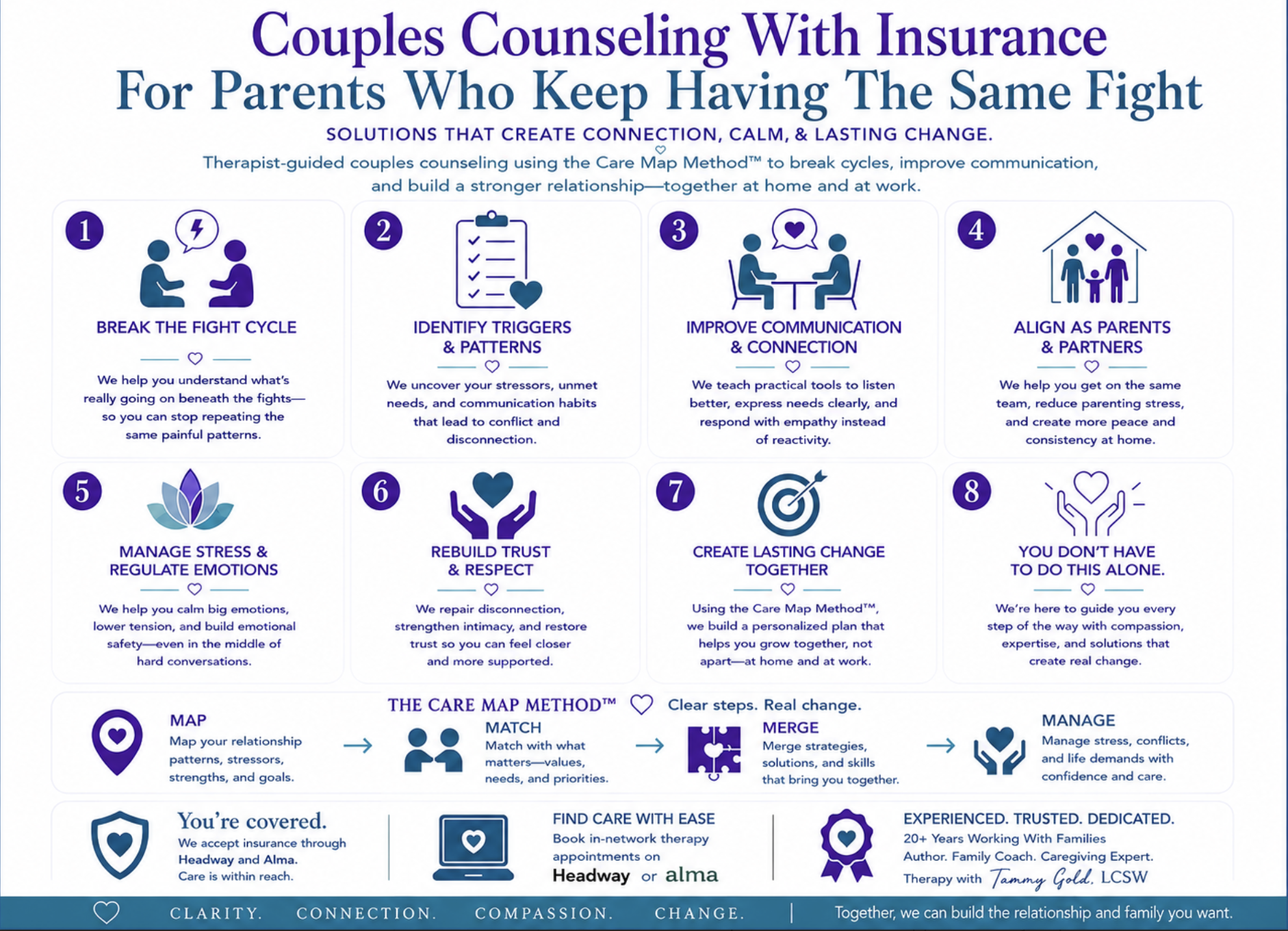
Couples Counseling with Insurance for Parents Who Keep Having the Same Fight
Therapy for couples and parents who keep having the same fight about parenting, chores, money, emotional labor, divorce concerns or family responsibilities.
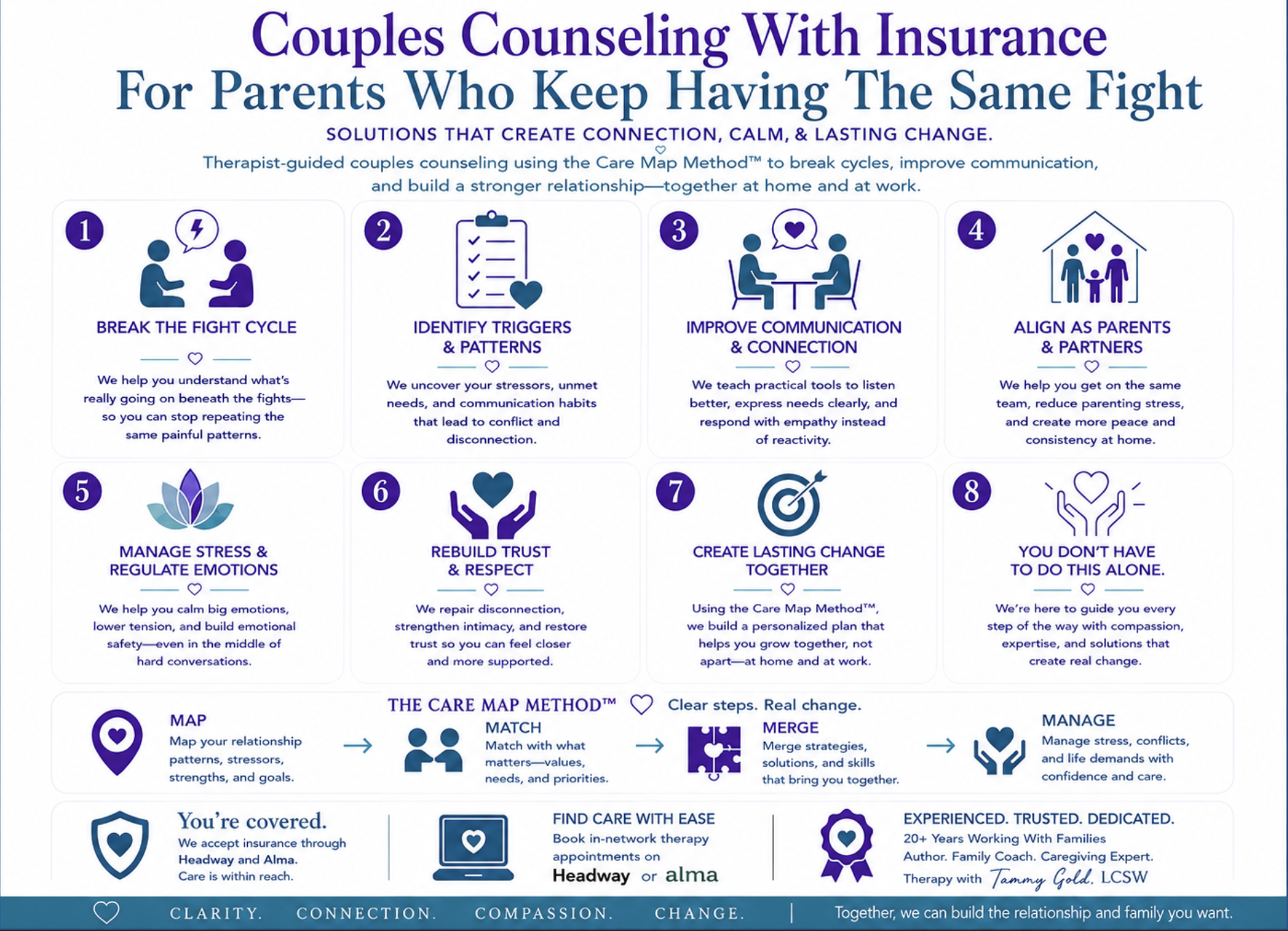
Couples Counseling with Insurance for Parents Who Keep Having the Same Fight
Many couples do not come to therapy because they stopped caring. They come because they keep having the same fight and cannot figure out how to stop the cycle. For parents, the fight may be about children, chores, money, schedules, emotional labor, in-laws, co-parenting, intimacy, work stress or feeling unsupported.
I am Tammy Gold, LCSW. I support adults, couples and parents in California, New Jersey and Oregon. Depending on your plan and eligibility, insurance may be available through Headway or Alma.
My Psychology Today profile links to booking and insurance options through Headway.
Why repeated fights happen
Repeated fights often happen because the surface topic is not the only issue. Underneath the argument may be fear, loneliness, resentment, exhaustion, feeling unseen, feeling criticized, or not knowing how to ask for support without sounding angry.
Therapy helps slow the pattern down so each person can feel heard without shame or blame.
How I help couples and parents
Through the Care Map Method™, we Map the repeated fight cycle, Match each partner’s needs and triggers, Merge safer communication and Manage repair tools for real life. The goal is to help both partners understand what is happening underneath the conflict and build better ways to respond.
Sessions are designed to be respectful and compassionate. I work to help each person feel heard while keeping the focus on understanding, communication and small positive solutions.
Request a session
If you are looking for therapy for relationship stress, parenting stress, communication problems, divorce concerns or family conflict, visit my Psychology Today profile to request a session. My profile links to booking and insurance options through Headway.
Why do couples keep having the same argument?
Repeated arguments are often maintained by deeper emotional triggers, unmet needs, defensive reactions, assumptions, and communication patterns rather than the surface topic alone.
Can couples therapy help communication?
Yes. Couples therapy can help partners slow down conflict, identify the pattern, hear each other more accurately, communicate needs more clearly, and practice repair.
What if my partner will not attend?
Individual therapy can still help you understand the relationship pattern, regulate your reactions, communicate differently, clarify boundaries, and make more thoughtful decisions.
Is couples therapy only for relationships in crisis?
No. Couples may seek therapy for recurring conflict, disconnection, parenting stress, intimacy concerns, life transitions, premarital preparation, or to strengthen a relationship before problems escalate.
Will the therapist take sides?
The goal is not to declare one partner right and the other wrong. The work focuses on understanding the relationship system, helping both people feel heard, and identifying healthier patterns.
Can therapy help couples affected by parenting stress?
Yes. Parenting can create exhaustion, resentment, role imbalance, disagreement about discipline, and reduced time for connection. Therapy can help couples rebuild teamwork and communication.
What does Map, Match, Merge, and Manage look like for couples?
MAP identifies the conflict cycle. MATCH clarifies each partner’s needs and goals. MERGE builds healthier communication and repair. MANAGE creates tools and agreements that can be used between sessions.
How long does couples therapy take?
The length varies based on the concerns, goals, severity of conflict, participation, and whether there are complicating factors. Some couples seek focused short-term work, while others benefit from longer support.