

Therapy for Overthinking and Self Doubt
hinking through a problem can help, but reviewing it repeatedly can leave you more anxious. Explore therapy for overthinking conversations, decisions and other people’s reactions.
When thinking stops bringing you closer to an answer
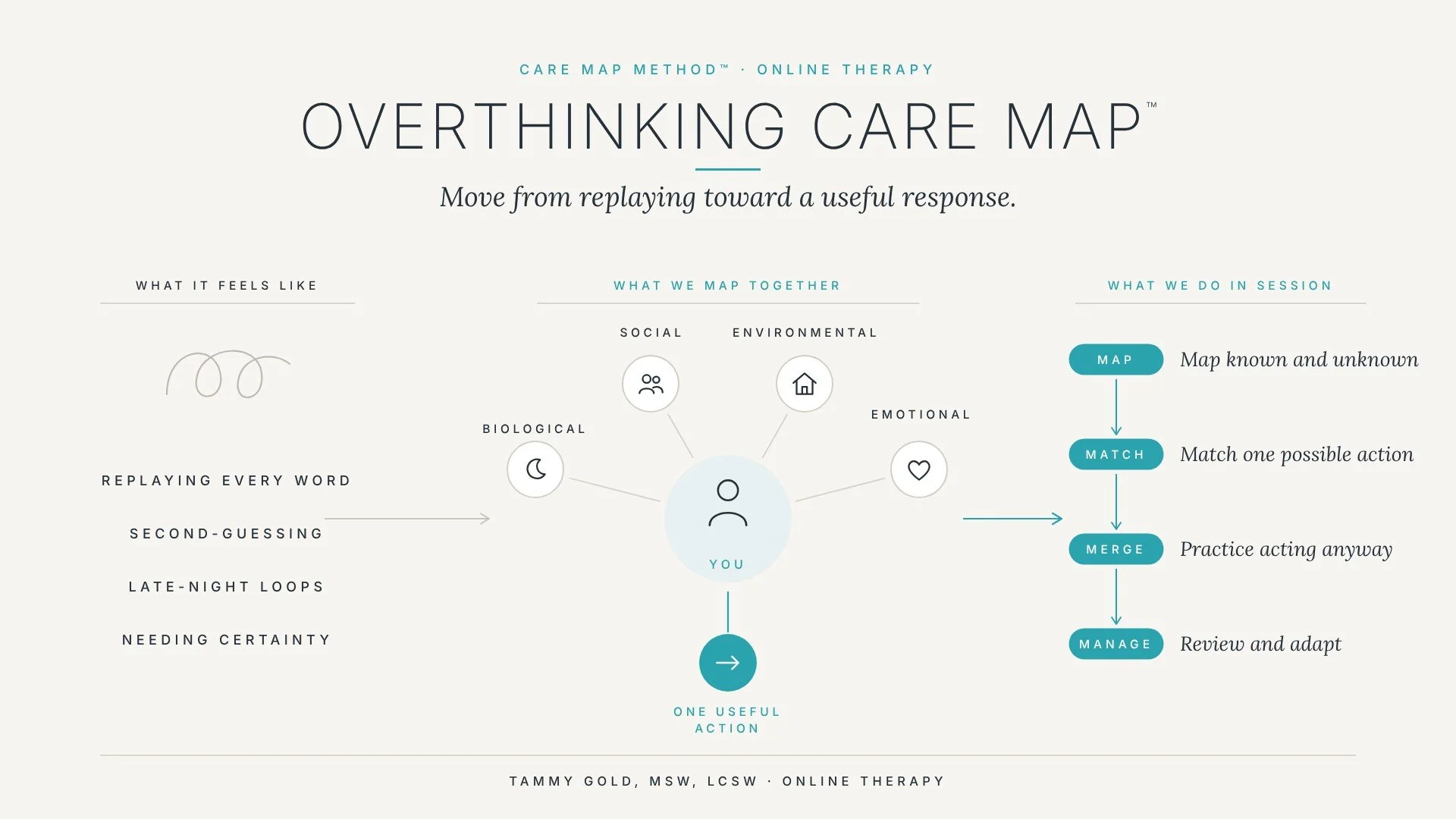
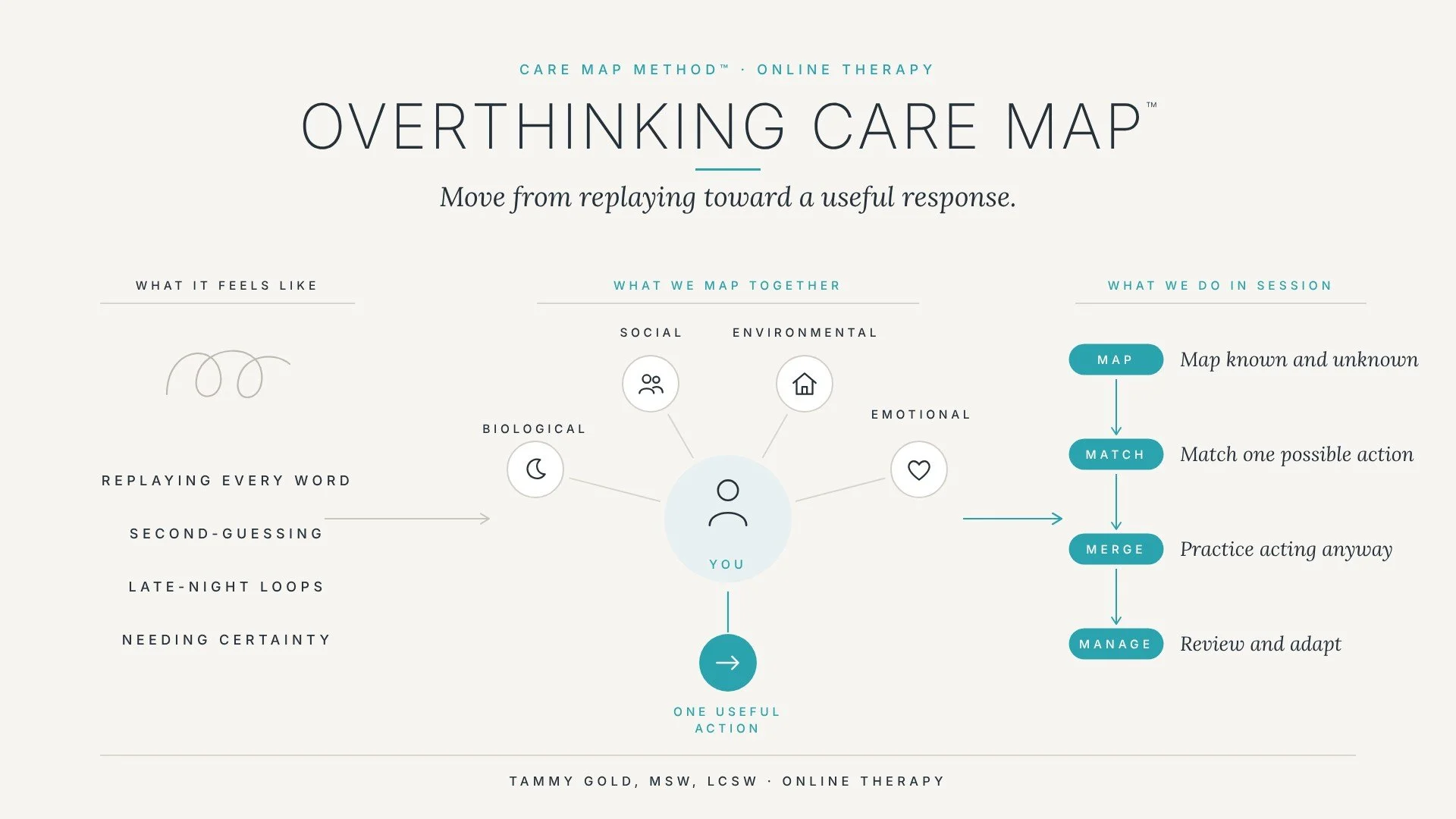
You replay what you said, revisit a decision or imagine how a conversation could go wrong. At first the thinking may feel useful. You are trying to prepare, avoid a mistake or understand another person. But after a while you may notice that you have more questions, less confidence and no clearer idea of what to do.
Therapy for overthinking can help you understand the pattern and its effect on your life. We can look at what starts the reviewing, what keeps it going and what you hope it will accomplish. The aim is not to stop all thought or replace every worry with a positive statement.
The different forms overthinking can take
You may review the past, predict future problems or repeatedly question your own choices. Some people seek reassurance from friends, search online or rewrite messages until they feel acceptable. Others keep concerns private and spend hours trying to reach certainty on their own. The same outward behavior can serve different purposes for different people.
We will assess the broader picture, including mood, sleep, concentration, anxiety and daily functioning. Repetitive thoughts can appear in several clinical contexts, so a webpage cannot determine what diagnosis or treatment is appropriate. If a specialized approach is needed, we can discuss that directly.
Understanding the question beneath the question
A repeated thought such as whether you sounded foolish may carry a deeper fear of rejection. Reconsidering a work decision may involve uncertainty about competence or responsibility. Sometimes the concern also reflects a genuine unresolved situation that needs action. We can make room for those possibilities without assuming every thought is meaningless.
In sessions we might distinguish a problem with an available next step from a question that cannot be settled with more mental reviewing. We can also examine self-criticism and the belief that enough preparation should prevent all regret. A more useful goal may be responding thoughtfully while accepting that some uncertainty remains.
Working with an everyday example
Imagine that you send a message and do not receive an immediate reply. You read it again, notice a phrase you wish you had changed and begin drafting an apology. Checking temporarily reduces tension, but soon you need to check again. Your attention moves away from the rest of your day.
We could examine the assumptions, the urge to repair and the effect of repeated checking. We might discuss a way to respond that fits the situation and your treatment plan. The work would also consider what the uncertainty means to you, rather than simply instructing you to stop looking at your phone.
Bringing insight into ordinary routines
Using the Care Map Method™, we MAP triggers and responses, MATCH the work to your clinical needs, MERGE what is useful into everyday situations and MANAGE the results. That might include noticing when you begin reviewing, identifying a concrete action or changing how you respond to self-critical thoughts.
Between-session practice should be manageable and purposeful. It should not become another task you feel compelled to perform perfectly. We can discuss what happened, including when a strategy did not help. Learning about the pattern is useful information, not evidence that you have failed therapy.
Progress without requiring a perfectly quiet mind
Some difficult thoughts may still occur even when the work is helping. Progress can involve spending less time following them, recovering attention more readily or making a decision without repeatedly asking for confirmation. We will define goals around your functioning and priorities, rather than promising that worry will disappear.
We can also address relationships and situations that keep uncertainty high. If someone communicates inconsistently or a role lacks clear expectations, your environment may need attention too. Therapy can help you make more deliberate choices about both your response and the circumstances around you.
About Tamara Gold
I am Tamara “Tammy” Gold, MSW, LCSW, CEC, a Columbia University-trained therapist, certified coach and author of Secrets of the Nanny Whisperer. My work with individuals and families informs a warm, collaborative approach that connects emotional understanding with practical next steps. Treatment is individualized to your needs; results and timelines vary.
Online appointments and insurance
Online appointments depend on your physical location at each session, clinical fit and current availability. Review my booking profiles to confirm whether I can serve you in your state. Selected insurance plans may be available through Headway or Alma. Coverage, medical-necessity requirements and your costs depend on your individual plan; a life problem alone does not establish insurance coverage.
Frequently asked questions
Is overthinking a diagnosis?
No. It is a common description of repeated thought patterns. Assessment considers whether anxiety, mood, obsessive-compulsive symptoms, stress or another concern may be involved. Treatment should follow that assessment.
Can therapy help me stop replaying conversations?
We can work on the meaning you assign to interactions, repeated reviewing and the impact on your day. Goals may include spending less time reviewing and responding more flexibly, rather than never remembering a conversation.
Why does reassurance only help for a little while?
Reassurance may reduce discomfort briefly without resolving the underlying uncertainty or pattern. We can examine how it functions in your situation and whether a different response would be more useful.
Will you teach me to think positively?
Therapy is not limited to replacing a negative thought with a positive one. We can consider accuracy, uncertainty, emotional meaning, behavior and the real conditions around the concern.
What if I really made a mistake?
We can separate appropriate repair or learning from prolonged punishment of yourself. A mistake may call for action, but repeated self-criticism does not necessarily make the action more effective.
Can we discuss sleep problems related to worry?
Yes. Sleep and worry can affect one another. We can assess the pattern and discuss whether medical evaluation or specialized sleep treatment would be useful alongside therapy.
Take the next step
If this sounds like the kind of support you need, review current appointment options and check insurance eligibility through my Headway or Alma profile. You can bring questions about fit, fees and the process before scheduling. You do not need a perfect explanation of the problem to begin.
Online Therapy for Dating After Divorce in California
Dating after divorce can bring hope alongside uncertainty about trust and your own judgment. Online therapy in California offers support for processing past experiences, recognizing present concerns and practicing boundaries at a pace that fits you.
You may feel ready for connection and still find yourself questioning your judgment. A delayed message, new expectation or unfamiliar disagreement can bring up memories of what happened before.
I’m Tammy Gold. I offer individual online therapy for adults in California navigating relationship stress and life changes. We can explore what dating again means to you and what would help you participate with more awareness of your own needs.
Understand what you are carrying into the new situation
The goal is not to pretend the previous relationship did not happen. We can examine what you learned, what remains painful and how you distinguish a present concern from a fear based on earlier experience.
We will take actual behavior seriously. Therapy should not encourage you to overlook warning signs in order to appear trusting or optimistic.
Practice keeping a preference visible
Perhaps you want to move slowly, keep some personal information private or decline a plan without explaining your whole history. We can explore what makes that difficult.
A starting point might be, “I would like to keep getting to know you, and I need more time before taking that step.” We can consider how that fits your circumstances and what the response tells you about your options.
Make choices without accepting someone else’s timetable
Friends and relatives may have opinions about when you should date, whether you should remarry or how much caution is reasonable. We can explore those expectations alongside your own values.
You do not have to prove you have recovered by entering a new relationship. We can work on grief, confidence and boundaries while leaving the timing and decisions with you. If parenting or co-parenting is involved, we can discuss its emotional impact without providing legal advice.
What we can work on together in session
We can begin with a recent dating moment that triggered doubt and explore both your earlier experiences and the present person's actual behavior. For example, we might discuss whether a request to move faster conflicts with your preference or brings up pressure you recognize from a previous relationship. We will not ask you to ignore a current concern to prove you are ready to trust.
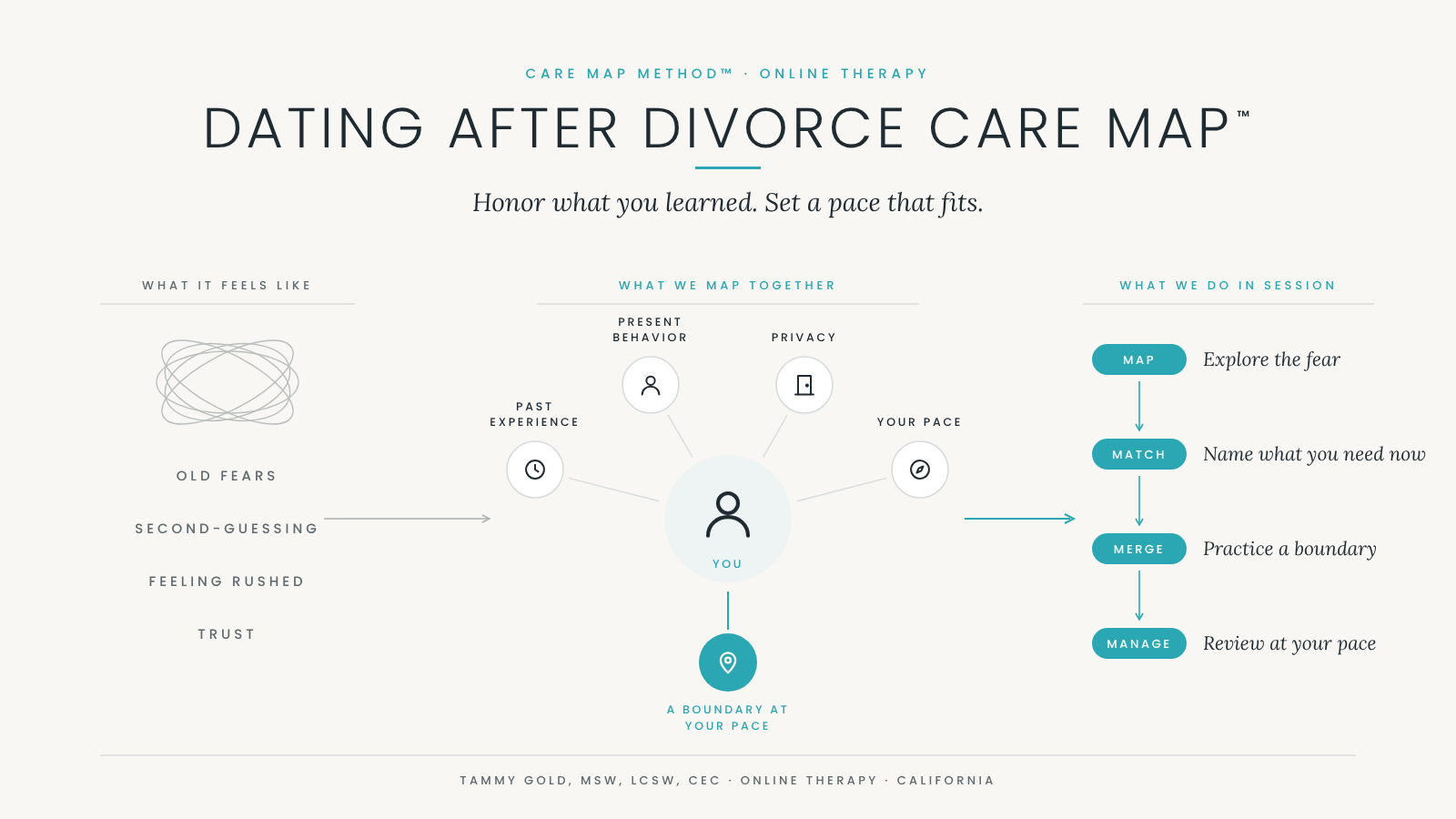
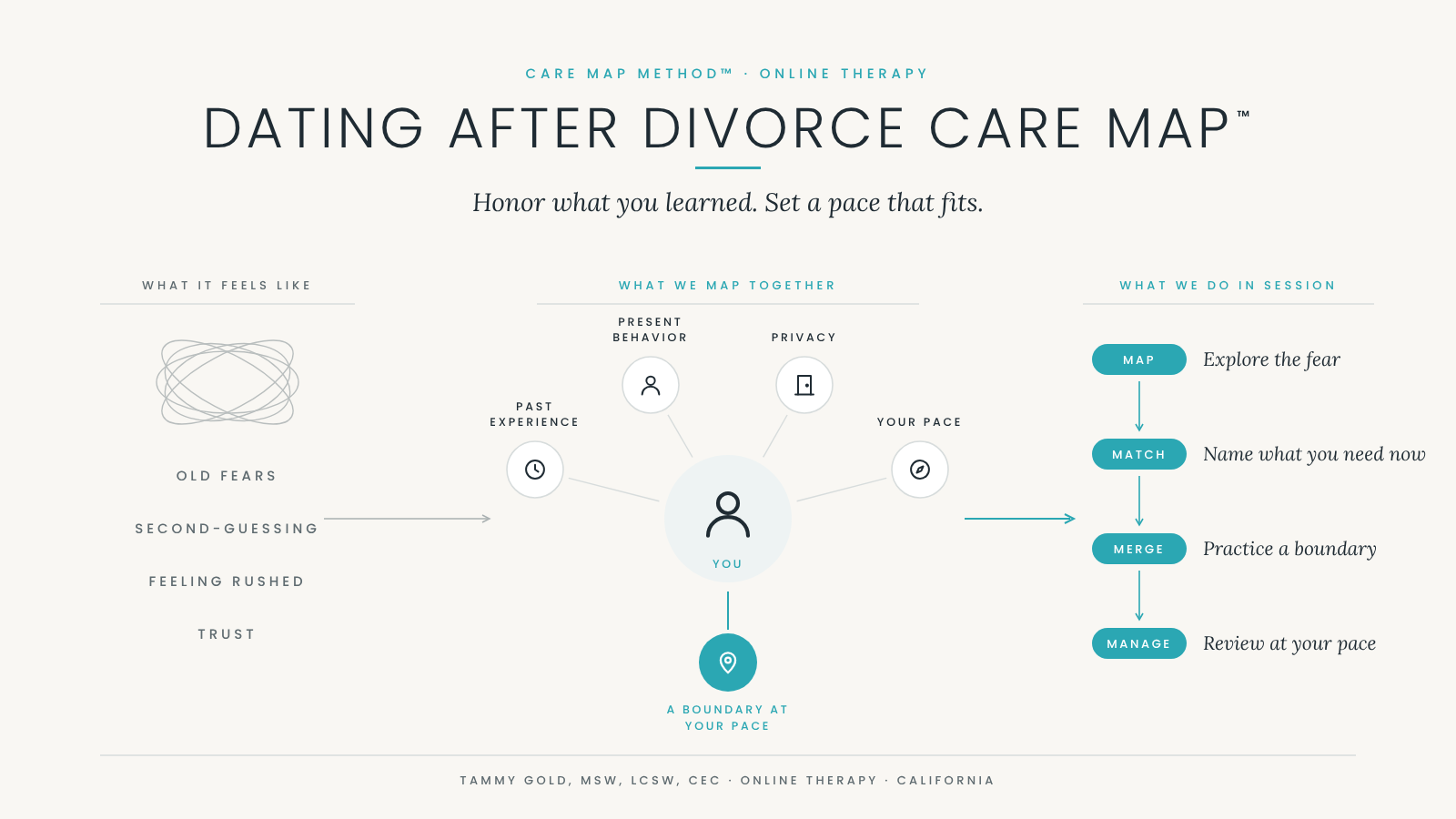
Then we can practice wording that fits your pace, such as, “I am interested in getting to know you, and I am not ready for that step.” We can explore the feelings that arise when you say it and what you want to notice afterward. A next step may be expressing one preference or giving yourself time to decide. Later sessions can examine the experience with curiosity rather than grade the date as a success or failure.
When a new connection brings an old fear
You might notice yourself expecting an argument after expressing a preference, apologizing before asking a question or searching for reassurance that the relationship is secure. We can explore when those responses developed and whether they fit what is happening now. Your past deserves attention without becoming the only explanation for every new experience.
You may also be grieving the life you expected to have, even while feeling interested in someone new. Those feelings can coexist. We can discuss the pressure to appear completely healed and what it would mean to be honest about your pace without sharing more than you want.
Make room for your present responsibilities
Dating may now involve parenting schedules, limited free time or concerns about how much family members should know. We can explore the emotional strain of balancing these responsibilities and how you want to communicate availability. An early goal might be stating a preference before resentment builds or recognizing a situation in which you need more information. Therapy cannot certify that a new partner is trustworthy; it can support your ability to consider what you observe and what you need.
A practical way to understand what is happening
My Care Map Method™ helps us look at Biological, Social, Environmental and Emotional factors alongside clinical assessment. We consider your health and energy, relationships, daily circumstances and emotional experience rather than isolate one difficult moment from the rest of your life. We MAP the need, MATCH appropriate support, MERGE that support into your circumstances and MANAGE the plan as we learn what is useful. This is an organizing framework within individualized therapy, not a promise of a particular result.
What your first session can include
You can bring one situation you want help understanding. We will discuss your concern, relevant history, symptoms, daily functioning and available support. You can tell me what has or has not helped before and what you need to feel comfortable talking. My aim is to offer empathy without judgment and begin exploring a practical next step, while allowing time for assessment. We will decide together whether my approach fits and which goals matter to you. You do not need to arrive knowing the right words or the solution.
About Tammy Gold
I’m Tamara “Tammy” Gold, MSW, LCSW, CEC. I earned my clinical MSW at Columbia University and my BA at the University of Pennsylvania. My work with families includes parenting, caregiving and difficult relationships. I bring empathy without judgment and a practical interest in helping you understand the problem and consider what comes next.
Frequently asked questions
Do I need to be ready for a serious relationship?
No. We can explore what you want and whether dating fits your life now.
Will therapy tell me when I should date?
There is no universal schedule. We can discuss your needs, circumstances and choices.
Can I discuss trust after a difficult marriage?
Yes, within treatment fit. Assessment helps determine whether additional specialized care is needed.
Do you provide dating or matchmaking services?
No. This page describes individual psychotherapy.
Can we discuss the impact on my children?
We can explore your parenting-related distress and choices. Children’s treatment or legal questions need separate appropriate services.
Can I use insurance in California?
Verify exact plan participation, assessed clinical needs and estimated costs through the appropriate active platform.
What if dating is harder than I expected?
We can explore what feels difficult, how it affects daily life and whether your current approach fits your needs. You do not have to force a particular pace.
Can I come if I am not currently dating?
Yes. We can work on your experience of divorce, relationship concerns and goals without requiring you to be using dating apps or seeing someone.
Booking and profile options
Choose a platform that shows current appointments for your physical location in California and your exact insurance plan. Availability and participation can differ across platforms.
Check availability and insurance on Grow Therapy
Check availability and insurance on Alma
Check availability and insurance on Headway
Read my profile or contact me on Psychology Today
Before confirming a visit, check the service, current provider participation, your exact benefits and estimated costs. Coverage depends on your plan and the assessed clinical service; a life event alone does not establish insurance eligibility. You must be physically located where I am authorized to provide care at each session.
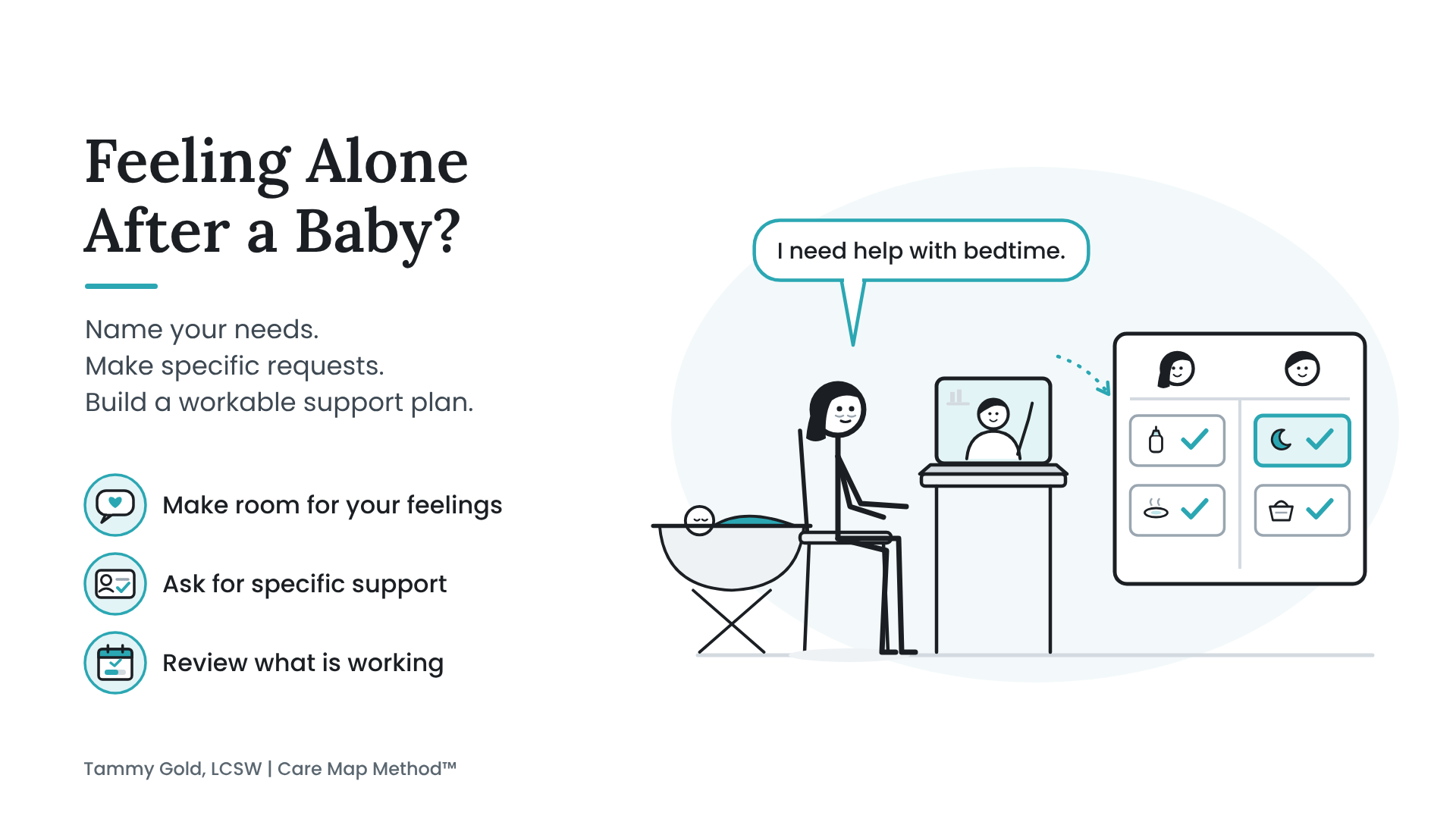
Individual Therapy for Relationship Stress After a Baby in California
Feeling disconnected or resentful after a baby? Explore individual online therapy in California and check Blue Shield of California benefits through Headway.
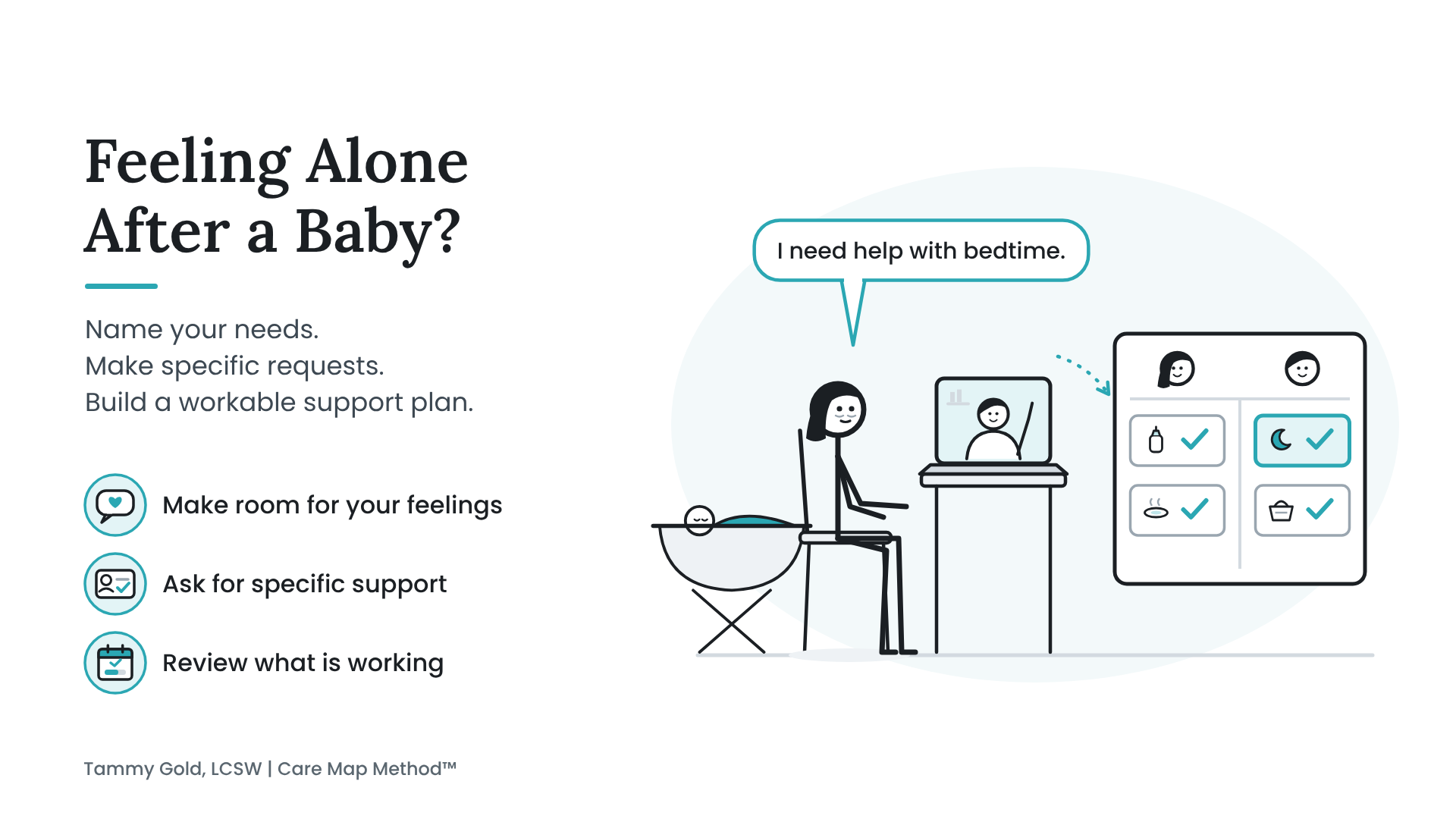
Illustration of new parents discussing support and shared responsibilities after a baby.
You expected life to change after a baby. You may not have expected to feel so alone beside your partner. Small disagreements about feeding, chores, visitors, or sleep can become arguments about whether you matter.
I am Tammy Gold, LCSW. I offer individual online therapy for adults located in California. Blue Shield of California appears on my Headway profile; please check your exact plan and eligibility before booking.
Check insurance and book through Headway
Make room for your own experience
You can love your baby and feel angry, lonely, or overwhelmed. Therapy gives you space to talk about changes in your relationship and identity without having to reassure everyone else first. We can assess your emotional symptoms and how they are affecting daily life, then decide what kind of support fits.
Move from a running argument to a specific request
“You never help” may express a real hurt, but it does not tell the other person what needs to change tonight. We can work on naming the task, the responsibility, and the follow-through you need. A starting sentence might be: “I need you to handle the bedtime routine on these two nights, including getting everything ready.” We can also explore what it means if clear requests repeatedly go unanswered.
Look at the whole picture
The Care Map Method™ helps us Map the emotional and practical strain, Match needs with realistic support, Merge that support into routines and conversations, and Manage adjustments. Biological, Emotional, Social, and Environmental needs all matter: your rest, feelings, support network, and household demands deserve attention.
What we would explore in your first session
We can begin with the moment that feels hardest: evenings, overnight responsibilities, returning to work, or watching your partner relax while you keep track of everything. We would discuss your emotional symptoms, relevant history, and how life has changed since the baby arrived. Your goal might be making a clear request, having space to process resentment, or feeling more like yourself. We can also discuss whether additional medical or mental health support is appropriate for your needs.
Make the invisible work easier to name
It can be difficult to explain why one household task feels exhausting when you are also remembering appointments, tracking supplies, and anticipating the next need. We can identify which parts of a task you carry: noticing it, planning it, doing it, and checking that it happened. In a session, we might practice asking another adult to take responsibility for the whole task. That conversation can make the request more specific and help us understand what happens when responsibility remains uneven.
A practical conversation to bring to therapy
Choose one repeated point of friction and write down what actually happens. For example: “At bedtime I prepare the supplies, do the routine, and clean up afterward. I want to discuss who owns this routine on particular nights.” Add how the situation affects you and what support you would like. We can use this as a starting point, explore your partner’s response, and adapt the request to your circumstances. You do not need to solve the entire division of labor in one conversation.
How we review progress
We can track whether you identify your feelings earlier, ask for support more directly, or recover from disagreements with less rumination. We may also revisit expectations that leave you feeling guilty about resting. If communication tools do not change an ongoing pattern, we can explore your options and support needs. Therapy cannot promise another person’s cooperation, but it can help you understand your experience and choose your next steps.
About Tammy Gold
I am Tamara “Tammy” Gold, MSW, LCSW, CEC, a licensed therapist and certified coach with a clinical MSW from Columbia University. I founded the Care Map Method™ and have more than 20 years of direct work with families. These sessions focus on your individual mental health and treatment goals.
Take the next step
If this concern is affecting your daily life, view my profile to explore fit and current booking options. Check your exact plan and estimated costs before scheduling. You can also read the online therapy booking guide for help choosing a platform.
Check insurance and booking through Headway
Is this therapy for me or for my baby?
This page describes individual therapy for an adult parent. Sessions focus on your mental health, relationships, and adjustment.
Can Blue Shield of California cover these sessions?
Your plan, provider eligibility, and clinical requirements determine coverage. Verify your exact benefits through my Headway profile before booking.
Is this the same as couples counseling?
No. Individual therapy focuses on your treatment. If you want joint sessions, we can discuss fit and check their coverage separately.
Can I attend if my partner does not want therapy?
Yes. These sessions focus on your individual mental health, decisions, and responses. We can explore relationship stress even if your partner is not participating.
Do I need to be a first-time parent?
No. You can seek support after another baby or during a later adjustment in parenting. We would assess your current needs and whether my approach is a good fit.
How do we know whether therapy is helping?
We can choose specific goals together and review changes in your daily experience, communication, and coping. We can adjust the plan when a strategy feels unrealistic or unhelpful.

Therapy for Caregiver Burnout: When Caring for Others Is Affecting Your Mental Health
Caregiving can be an act of love and still become emotionally, physically, and relationally overwhelming. Learn the signs of caregiver burnout, why guilt and resentment develop, and how therapy can help you build a more sustainable plan.
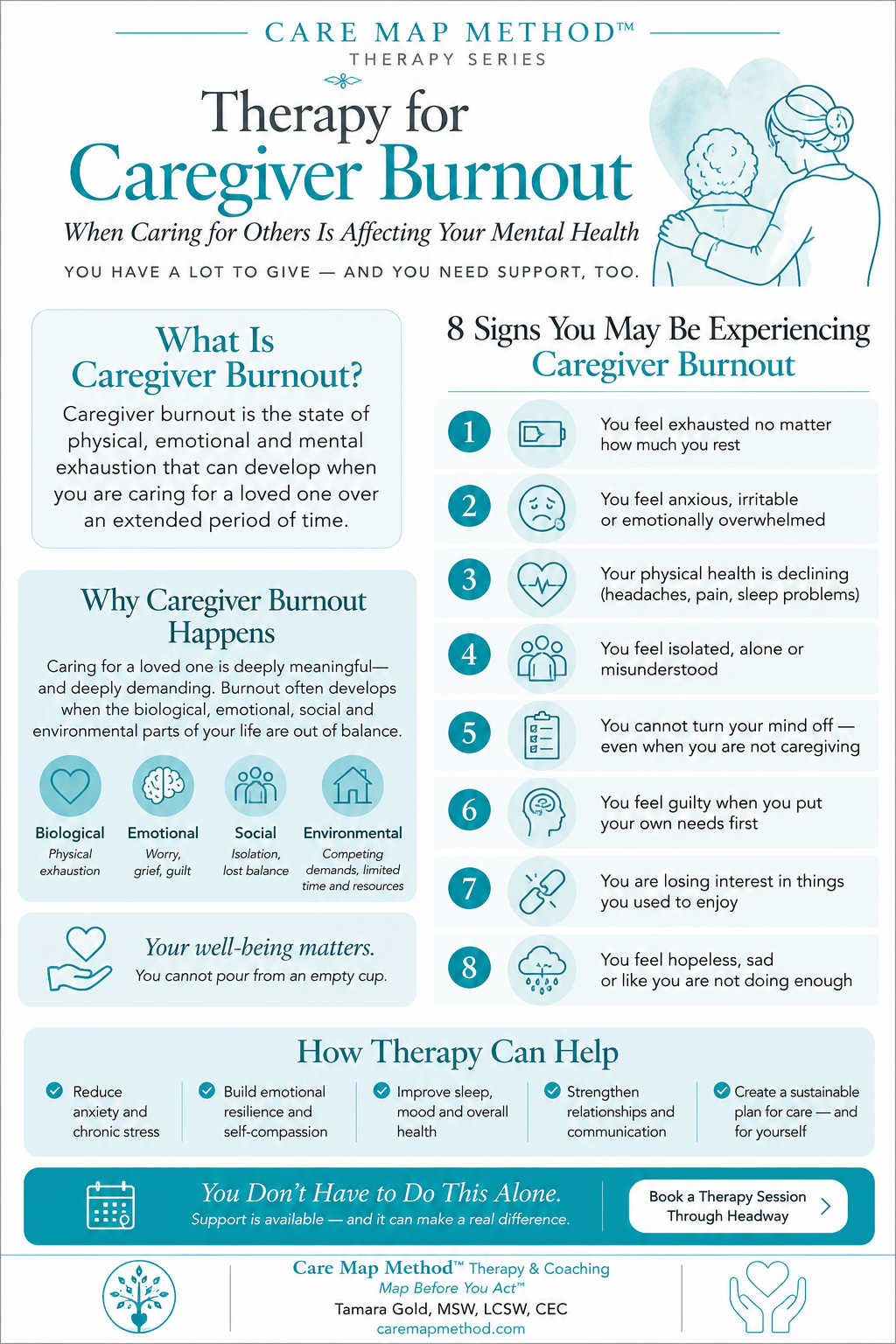
Caregiving Can Be an Act of Love—and Still Become Too Much
Caregiving rarely begins with a formal job description. It may start with one medical appointment, a few groceries, or a promise to “keep an eye on things.” Gradually, you become the person who coordinates medications, answers late-night calls, communicates with physicians, manages family disagreements, researches services, handles emergencies, or worries about what might happen next.
You may love the person you are caring for deeply. You may also feel exhausted, resentful, frightened, irritable, lonely, or trapped. Those feelings can coexist. They do not mean you are uncaring, selfish, or failing. They often mean that your responsibilities have exceeded the emotional, physical, relational, or practical resources available to you.
Caregiver burnout is not simply being tired after a demanding week. It is a pattern of depletion that can affect your mood, sleep, concentration, body, relationships, work, and ability to make decisions. The National Institute on Aging notes that caregivers may be at increased risk for physical and mental health problems, sleep disruption, and chronic health conditions when their own needs repeatedly go unattended.
For many caregivers, therapy becomes the only place where they do not have to be the organizer, problem-solver, peacekeeper, or “strong one.” It can provide room to understand what is happening, reduce guilt, improve boundaries, make clearer decisions, and build a sustainable plan for caring without disappearing inside the role.
What Is Caregiver Burnout?
Caregiver burnout is a state of emotional, mental, and physical exhaustion associated with prolonged caregiving demands and insufficient recovery, support, control, or relief. It can arise while caring for an aging parent, a spouse with chronic illness, a child with medical or behavioral needs, a family member with dementia, or several people across generations.
Burnout does not require round-the-clock hands-on care. A long-distance caregiver may carry constant worry, logistical responsibility, travel demands, financial strain, or guilt. A family member who is not the primary caregiver may still be managing medical decisions, sibling conflict, paperwork, or crises. The burden is not measured only by hours. It is also shaped by unpredictability, emotional intensity, family dynamics, and the sense that there is no safe point at which to step away.
Signs Caregiving May Be Affecting Your Mental Health
Caregiver stress can look different from one person to another. You may be functioning well on the outside while feeling increasingly depleted internally. Common warning signs include:
Feeling emotionally exhausted, overwhelmed, anxious, or constantly “on alert.”
Becoming more impatient, irritable, reactive, or angry than usual.
Having difficulty sleeping, staying asleep, or resting even when you have the opportunity.
Losing interest in activities, friendships, exercise, or routines that once helped you feel like yourself.
Feeling guilty whenever you rest, say no, ask for help, or spend money or time on your own needs.
Experiencing resentment toward the person receiving care, other relatives, professionals, or a partner who seems less involved.
Having trouble concentrating, remembering details, organizing tasks, or making decisions.
Feeling lonely or misunderstood because other people do not see the full extent of what you carry.
Noticing headaches, muscle tension, digestive problems, appetite changes, fatigue, or other stress-related physical symptoms.
Using alcohol, food, work, screens, shopping, or other behaviors to numb or escape the pressure.
Feeling hopeless, emotionally detached, or as though nothing you do will ever be enough.
Important
Burnout is not a moral diagnosis. It is information. Your mind and body may be signaling that the current care system is asking more of you than one person can sustainably provide.
Why Caregivers Often Wait Too Long to Seek Help
Many caregivers normalize a level of distress they would immediately recognize as serious in someone else. They may tell themselves, “This is just what family does,” “Other people have it worse,” or “I can deal with myself after the crisis passes.” But caregiving crises often do not end cleanly. One decision leads to another, and the temporary emergency becomes a long-term way of life.
Caregivers also face practical barriers. Appointments, work demands, childcare, transportation, privacy concerns, and financial pressure can make it difficult to obtain support. Some fear that admitting distress will be interpreted as abandoning the person they love. Others have built an identity around competence and find it uncomfortable to be the one who needs care.
Therapy does not require you to reject your responsibilities. It can help you carry them differently—and decide which responsibilities were never yours alone.
The Care Map Method™ Perspective: Look at the Whole System
Caregiver distress is rarely caused by one thought, one relationship, or one task. I use the Care Map Method™ to examine the whole system through four interconnected areas: Biological, Emotional, Social, and Environmental needs. This helps us identify what is actually driving the overload rather than treating every problem as a personal failure.
BIOLOGICAL
Sleep, health conditions, hormonal changes, pain, nutrition, medication effects, fatigue, and the physical demands of care.
EMOTIONAL
Grief, anxiety, guilt, anger, resentment, anticipatory loss, helplessness, perfectionism, and fear of making the wrong decision.
SOCIAL
Family roles, sibling conflict, marriage stress, isolation, cultural expectations, work demands, and unequal distribution of responsibility.
ENVIRONMENTAL
The home setting, safety risks, finances, transportation, care availability, medical systems, schedules, paperwork, and geographic distance.
Mapping these areas can reveal an important truth: the caregiver may not need to become more resilient; the care system may need more support, clearer expectations, different communication, or a different plan.
The Hidden Emotional Experiences of Caregiving
Anticipatory grief
You may be grieving changes in a parent, spouse, child, or relationship before a death has occurred. You may miss who the person was, the future you expected, or the version of yourself that existed before caregiving became central.
Ambiguous loss
The person you love may still be physically present while memory, personality, independence, communication, or reciprocity has changed. This type of loss can be difficult to explain and difficult for others to recognize.
Guilt
Caregivers often feel guilty for being tired, wanting time away, living at a distance, feeling angry, considering paid care, or being unable to meet every need. Guilt can become a substitute for realistic decision-making.
Resentment
Resentment often signals chronic imbalance, not lack of love. It may point to unsupported labor, unspoken expectations, sibling inequality, financial strain, or boundaries that have repeatedly been crossed.
Identity loss
You may no longer know where caregiving ends and your own life begins. Personal goals, friendships, work, intimacy, and health can gradually move to the margins.
Decision fatigue
Repeated medical, financial, logistical, and family decisions can reduce your ability to think clearly. Even small choices may begin to feel impossible.
How Caregiver Stress Can Affect Relationships
Caregiving does not occur in isolation. It enters marriages, sibling relationships, parent-child dynamics, friendships, and workplaces. Partners may argue about time, money, boundaries, or whose family receives priority. Siblings may revert to old roles: the responsible one, the distant one, the critic, the rescuer, or the person who avoids conflict until a crisis.
Even supportive relationships can become strained when every conversation centers on appointments, emergencies, or difficult decisions. Intimacy may decline. Friends may stop asking because they do not know what to say. Caregivers may withdraw because explaining everything feels exhausting.
Therapy can help distinguish the caregiving problem from the relationship pattern surrounding it. The goal is not to eliminate every disagreement. It is to create clearer roles, more direct communication, realistic expectations, and greater protection for the relationships you want to preserve.
How Therapy Can Help With Caregiver Burnout
Therapy for caregiver burnout is not limited to relaxation techniques. While stress-reduction skills can be useful, caregivers often need a combination of emotional support, practical problem-solving, boundary work, grief processing, communication planning, and decision support.
Name what is happening. Burnout becomes harder to address when everything is described only as “stress.” Therapy helps separate grief, anxiety, anger, guilt, relationship conflict, overload, and practical care problems.
Identify the highest-pressure points. Rather than trying to fix your entire life at once, we can determine which one or two demands are creating the greatest risk or depletion.
Challenge impossible standards. Many caregivers operate under beliefs such as “I should be able to do this alone” or “A good daughter would never place a parent in care.” Therapy can examine whether those standards are humane, accurate, or sustainable.
Build boundaries that fit the situation. A boundary may involve time, money, communication, availability, transportation, living arrangements, or which tasks you can and cannot provide.
Prepare for difficult conversations. Therapy can help you plan what to say to siblings, partners, parents, adult children, employers, physicians, or paid caregivers—especially when emotions are high.
Process grief and mixed emotions. Love, resentment, sadness, relief, fear, and anger may all be present. Therapy offers a place to hold complexity without judgment.
Reconnect with your identity. Caregiving may be an important role, but it does not have to become your entire identity. Therapy can help you protect health, relationships, work, meaning, and future goals.
Create a more sustainable care plan. Emotional insight is important, but caregivers also need concrete next steps. We can map needs, match appropriate support, merge that support into family life, and manage the plan as conditions change.
Practical Steps You Can Begin This Week
These steps are not a substitute for professional or medical care, but they can help you move from vague overwhelm toward clearer action.
1. Write down everything you are carrying
Include visible tasks and invisible mental labor: reminders, research, worry, scheduling, follow-up, conflict management, emotional support, and contingency planning.
2. Circle what only you can do
Some tasks require your legal authority, knowledge, or relationship. Many others may be delegated, shared, automated, delayed, or stopped.
3. Choose one specific request
“I need more help” often produces vague responses. Try: “Can you handle Tuesday transportation for the next four weeks?” or “Can you call these three agencies and compare availability?”
4. Protect one non-caregiving appointment
Schedule one recurring block for your health, therapy, movement, rest, friendship, spiritual life, or another activity that supports your identity.
5. Create a communication rhythm
Instead of responding to multiple family messages all day, consider one weekly update, a shared document, or a designated family call.
6. Plan relief before collapse
The CDC emphasizes consistent breaks and respite. Relief is not something caregivers must earn after becoming ill. It is part of a functional care plan.
7. Tell a healthcare professional that you are a caregiver
Your physician or therapist needs to understand the context affecting your sleep, mood, concentration, and physical symptoms.
When Is It Time to Seek Therapy?
You do not need to wait until you are in crisis. Consider speaking with a therapist when caregiving is consistently affecting your sleep, health, mood, concentration, work, relationship, parenting, or ability to function. Therapy may also be helpful when you are facing a major care decision, recurring family conflict, anticipatory grief, or a transition such as bringing a parent into your home, hiring help, moving a loved one to a facility, or preparing for end-of-life care.
Seek more immediate support if you are experiencing persistent hopelessness, panic, substance misuse, thoughts of self-harm, inability to safely care for yourself or another person, or a situation involving abuse, neglect, or imminent danger. In an emergency, call 911. In the United States, call or text 988 for crisis support.
Online Therapy for Caregiver Burnout in California, New Jersey, and Oregon
I provide virtual therapy to adults, couples, and families located in California, New Jersey, and Oregon. My work is warm, structured, practical, and solution-focused. I help clients navigate caregiver burnout, aging-parent stress, chronic illness, relationship strain, family conflict, parenting pressure, grief, and major life transitions.
Using the Care Map Method™, we look beyond the immediate crisis to understand the biological, emotional, social, and environmental needs affecting the whole family system. Together, we identify what is not working, clarify priorities, develop communication strategies, and create realistic next steps.
Ready to Begin?
View availability, insurance participation, and appointment options through my secure Headway profile. Therapy is available virtually for eligible clients physically located in California, New Jersey, or Oregon.
Book online therapy with Tamara Gold through Headway
Frequently Asked Questions About Caregiver Burnout Therapy
Is caregiver burnout the same as depression?
Not necessarily. Caregiver burnout may involve exhaustion, irritability, emotional detachment, guilt, sleep problems, and reduced functioning. Depression can include persistent sadness, loss of interest, hopelessness, and other symptoms that extend beyond caregiving. They can overlap, and a licensed professional can help assess what you are experiencing.
Can I attend therapy if the person I care for is not in therapy?
Yes. Individual therapy can focus on your stress, grief, boundaries, decisions, relationships, and well-being. The person receiving care does not need to participate.
Can therapy help with sibling conflict over an aging parent?
Yes. Therapy can help you clarify roles, prepare conversations, identify old family patterns, set boundaries, and decide what you are realistically willing and able to do. Family therapy may be appropriate when multiple relatives are willing to participate and are located where the therapist is licensed.
What if I feel guilty taking time for therapy?
Guilt is common among caregivers, but support is not a diversion from caregiving. Protecting your health can improve judgment, communication, and the sustainability of the care you provide.
Does online therapy work for caregiver stress?
Online therapy can be particularly practical for caregivers because it reduces travel and can be accessed privately from an appropriate location. Suitability depends on your needs, safety, technology, and state location at the time of the session.
Do you accept insurance?
Insurance participation and eligibility vary by state and plan. The Headway booking page can show current participating plans and help clients verify benefits and estimated costs before scheduling.
What is the difference between therapy and caregiver coaching?
Therapy addresses mental health symptoms, emotional patterns, grief, relationships, functioning, and clinical concerns. Coaching is generally more focused on planning, education, and implementation. The appropriate service depends on your goals, location, clinical needs, and whether you want to use insurance.
You Are Allowed to Need Care, Too
Caregiving can be meaningful, intimate, and deeply important. It can also be relentless. You do not have to deny the love in order to acknowledge the cost. You do not have to reach complete exhaustion before asking for support. And you do not have to solve every problem alone to be a good caregiver.
A sustainable care plan includes the caregiver. Therapy can help you understand what you are carrying, protect your mental health, communicate more clearly, and make decisions from a place of greater steadiness rather than constant crisis.
Sources and Further Reading
National Institute on Aging — Taking Care of Yourself: Tips for Caregivers
Centers for Disease Control and Prevention — Caring for Yourself When Caring for Another
Centers for Disease Control and Prevention — Steps for Creating and Maintaining a Care Plan
National Institute on Aging — Caregiving Toolkit
What are common signs of caregiver burnout?
Signs may include exhaustion, irritability, resentment, guilt, sleep problems, reduced concentration, withdrawal, health changes, hopelessness, and feeling unable to keep up with care demands.
How can therapy help caregiver burnout?
Therapy can help caregivers process emotions, identify unsustainable demands, set boundaries, communicate with family, ask for help, and develop a more realistic care plan.
Is it normal to feel resentful while caregiving?
Yes. Resentment can develop when responsibilities are excessive, support is limited, boundaries are unclear, or the caregiver’s own needs are repeatedly postponed. Feeling resentment does not mean you do not love the person.
What if my siblings will not help?
Therapy or coaching can help you clarify what you need, prepare a family conversation, define responsibilities, set limits, and decide what you can realistically continue providing.
How do I know when more professional care is needed?
Consider changes in safety, cognition, mobility, medication, nutrition, hygiene, isolation, wandering, falls, caregiver capacity, and whether current arrangements are sustainable.
Can I care for someone without losing myself?
That is a central goal. Sustainable caregiving requires support, boundaries, realistic expectations, shared responsibility where possible, and attention to the caregiver’s health and identity.
What Care Map worksheet pairs with caregiver burnout?
A Caregiver Burnout Snapshot, Family Capacity Assessment, Weekly Care Plan, Boundary Planner, or Biological-Emotional-Social-Environmental Care Map can help organize the situation.
When is caregiver burnout an emergency?
Seek urgent professional help when there is immediate danger, inability to provide safe care, abuse or neglect concerns, severe medical or psychiatric symptoms, or thoughts of harming yourself or someone else.