

Mental Load Therapy in New Jersey
Are you the person who remembers the forms, notices what is running out, and follows up even when somebody else agrees to help? Carrying the family’s mental load can leave you feeling constantly on duty. Online individual therapy in New Jersey offers space to explore the resentment, worry, and exhaustion underneath that experience. We can make the planning work visible, examine what keeps responsibilities falling back on you, and practice a request about ownership of one task from beginning to end. Using Care Map Method, we can also work with perfectionism, difficulty letting go, or guilt about protecting time for yourself. I’m Tammy Gold, LCSW. Together, we can develop goals that fit the support you actually have and review whether the changes you try make a meaningful difference in your daily life.
When everyone relies on you to remember everything
You know which forms are due, what is running out, and who needs a reminder. Even when somebody helps, you are still the one noticing and assigning the work. That constant planning can leave little room to rest. Therapy can help you understand the emotional strain, clarify what needs to change, and practice asking for a different kind of support.
You may feel irritated by “just tell me what to do,” stay awake reviewing tomorrow, or struggle to enjoy time off because you are still monitoring everything. Perhaps you feel guilty for resenting people you love. We can make room for that experience and explore what the current arrangement is doing to your health and relationships.
Check benefits and availability
Name the responsibility beneath the task
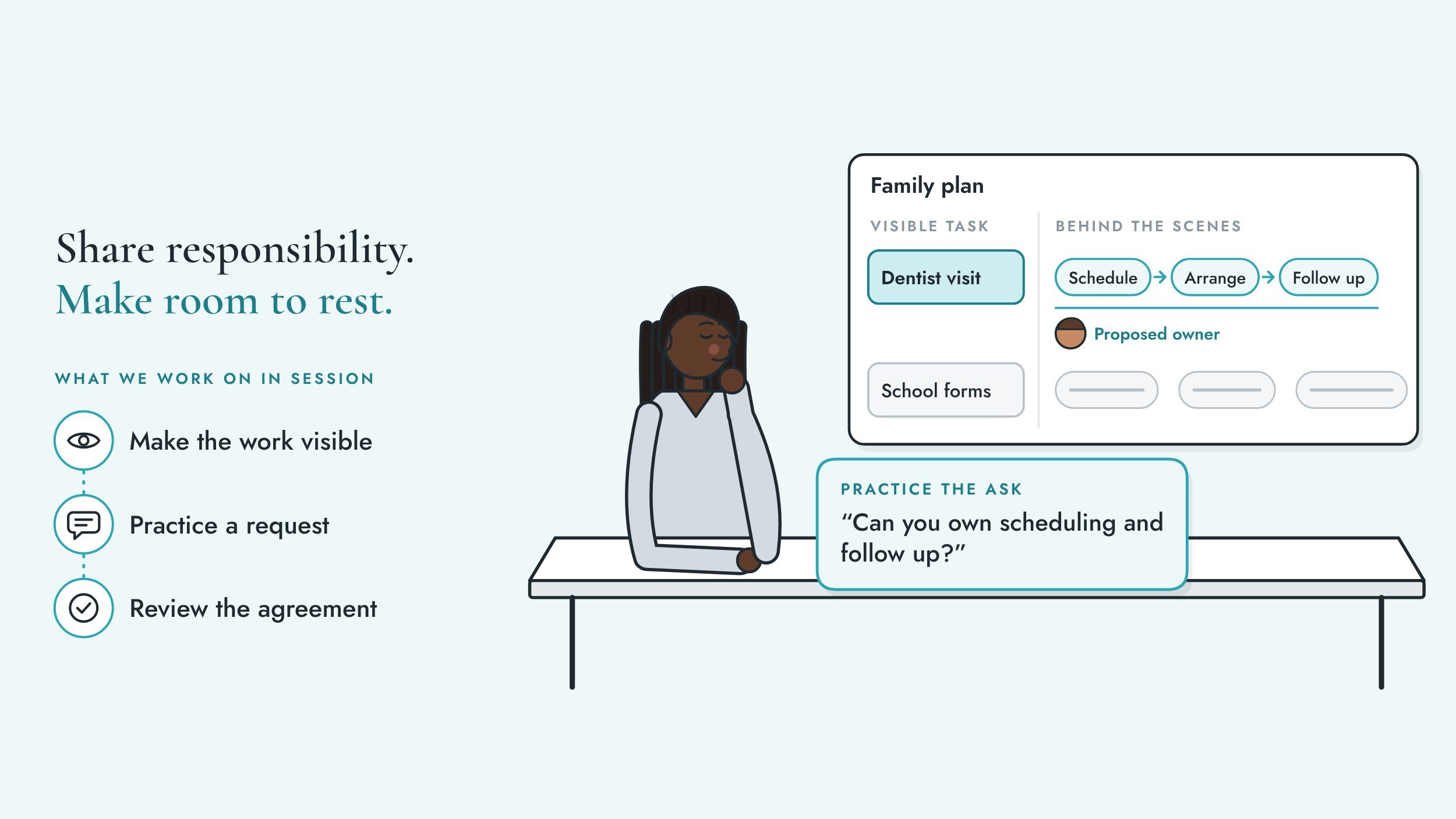
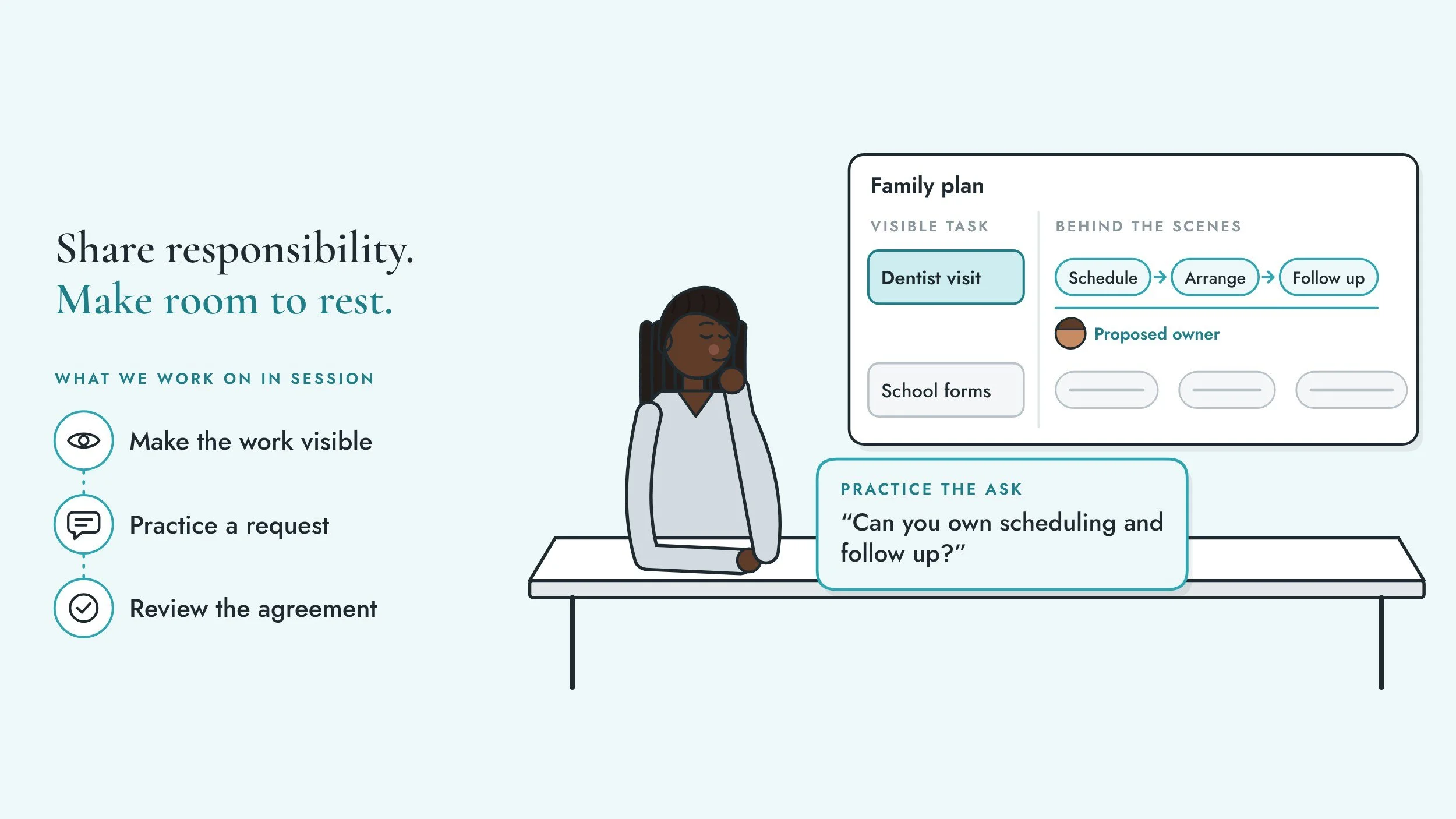
We can distinguish doing a task from noticing, planning, arranging, and following up on it. This helps explain why occasional help may not relieve the pressure. We can look at which responsibilities you hold, which are shared, and where expectations remain unspoken. We also consider whether worry or perfectionism keeps you monitoring tasks even after someone else takes them on.
Practice a request about ownership
A useful conversation may be more specific than “I need more help.” We can rehearse a request about one responsibility from beginning to end. For example, another adult might take ownership of a recurring appointment, including scheduling and follow up. We can consider what a workable agreement looks like and how to discuss differences without turning the conversation into a list of every past disappointment.
Explore resentment and the difficulty of letting go
Resentment may point to an unfair arrangement, an unmet need, or limits you have struggled to express. We can explore those possibilities and what happens when someone does a task differently from you. The work may include tolerating a reasonable difference, renegotiating a responsibility, or recognizing that the support available is not enough and considering your options.
An example of the work
For example, you might bring the recurring conflict over children’s activities. We could identify all the planning involved, separate essential steps from preferences, and prepare a request for one person to own one activity. Afterward, we could review the agreement, your feelings, and any practical barriers.
What progress can look like
Progress might mean making the workload discussable, checking less often, protecting a period of rest, or recognizing an agreement that is not being honored. We work toward changes you can assess in daily life rather than simply asking you to become better at carrying everything.
How Care Map Method supports our work
Map the emotion and trigger. We look at a recent moment and the biological, emotional, social, and environmental pressures around it. The aim is to understand your experience before choosing a response.
Match the need with a strategy. We identify what matters in that moment and select a skill or next step that fits. That might be a clearer request, a pause, a boundary, or space to process a loss.
Merge the skill into daily life. We can rehearse the words and decide when you might use them. Any practice between sessions is chosen together and adjusted to your circumstances.
Manage responses over time. We review what happened, what was difficult, and what needs to change. Therapy includes room for feelings and history as well as practical work.
About Tammy Gold
I’m Tamara “Tammy” Gold, MSW, LCSW, founder of Care Map Method™ and author of Secrets of the Nanny Whisperer. I earned my MSW at Columbia University and my BA at the University of Pennsylvania. My work with families informs a warm, active approach to therapy that makes room for your emotional experience and practical concerns.
Common questions
Is mental load a diagnosis? Mental load describes an experience of ongoing planning and responsibility. It is not by itself a diagnosis. Assessment helps determine your clinical needs and whether insurance-covered psychotherapy is appropriate.
Can I attend if my partner thinks the division is fair? Yes. We can explore your experience and prepare a specific conversation. Individual therapy can support your choices without deciding the full relationship story from one person’s account.
What if I am a single parent? We can work within your actual support network and responsibilities. That may include limits, realistic expectations, emotional support, and requests to people who are available to help.
Will you just tell me to delegate? We will explore what makes change difficult, including unequal participation, limited resources, worry, and practical barriers. Delegation is useful only when there is someone able and willing to take responsibility.
Can I use Aetna in New Jersey? Use my Headway profile to check your exact Aetna plan and estimated costs. Coverage depends on your benefits, network eligibility, and the clinically appropriate service.
How do we choose a starting point? We can begin with the part of the week that drains you most. One recurring responsibility often provides enough detail to understand both the practical problem and its emotional impact.
Take the next step
If this sounds familiar, you can explore online therapy with me while located in New Jersey. Open my Headway profile to check your exact insurance benefits and appointment options. We will discuss your concerns, clinical needs, and goals to determine fit.

My Adult Child Isn't Launching: Boundaries, Money and Family Conflict
When an adult child is struggling to become independent, parents can feel torn between helping and enabling. Housing, money, school, work, motivation and mental health concerns can become recurring sources of conflict, especially when expectations have never been made explicit.

A parent and adult child discussing boundaries, independence and family expectations.
A safe place for support and practical solutions
Therapy can help parents and adult children clarify needs, responsibilities and realistic next steps. We can work on communication, financial and household boundaries, expectations for independence and the emotions underneath repeated arguments. The goal is progress without shame or blame.
My approach is warm, relational and solution-focused. I want therapy to feel like one completely safe place with no judgment, stress, shame or blame. You can unload what you are carrying, better understand yourself and the people around you, name emotions more clearly, and leave with practical ways to move forward. My sole goal is for clients to leave each session feeling better, less alone and more supported.
How I use the Care Map Method™
MAP — Understand the pattern, pressure points, emotions and needs underneath the problem.
MATCH — Identify the support, boundaries, communication and goals that fit your situation.
MERGE — Improve communication and connection among the people and competing needs involved.
MANAGE — Create practical next steps you can use between sessions and adjust as circumstances change.
Using Aetna for online therapy in Oregon
I provide online therapy for clients who are physically located in Oregon at the time of the session. Eligible Aetna members may be able to use insurance for therapy through Headway. Network participation, benefits, deductibles, copays and eligibility vary by individual plan. Please verify your benefits through Headway before booking.
Frequently asked questions
Can therapy help with this even if the other person does not attend?
Yes. Individual therapy can help you understand patterns, regulate reactions, clarify boundaries and change how you respond even when another person is not participating.
Will therapy just be talking about the problem?
No. There is room to talk and feel fully heard, but my approach also emphasizes clinical insight, communication tools, boundaries and practical next steps.
Do you provide online therapy in Oregon?
Yes. I provide telehealth therapy to appropriate clients located in Oregon, subject to scheduling, clinical fit and applicable requirements.
Can I use Aetna for therapy?
Eligible Aetna members may be able to use benefits through Headway. Coverage and out-of-pocket costs vary, so benefits should be verified before booking.
What if I am not sure whether my problem is serious enough for therapy?
You do not need to wait for a crisis. Therapy can be useful when a relationship, transition or recurring stress is taking up too much emotional space or affecting daily life.

When You Feel Lonely in Your Relationship Even Though You Are Still Together
Feeling lonely inside a relationship can be painful and confusing. Online therapy can help California adults understand disconnection, communication patterns and practical ways to move forward. Care Map Method™ uses a structured Map, Match, Merge, Manage approach to turn insight into practical next steps.

Online relationship therapy in California for emotional disconnection, communication problems and recurring conflict; Aetna eligibility varies.
Feeling lonely inside a relationship can be painful and confusing. Online therapy can help California adults understand disconnection, communication patterns, and practical ways to move forward.
You do not have to figure this out alone
Relationship conflict can become consuming when the same interaction repeats and you cannot find a way out of it. You may replay conversations, question your reactions, feel guilty for having needs, or worry that one wrong conversation will make things worse. Therapy can offer a warm, confidential and nonjudgmental space to unpack what is happening without shame, blame or pressure.
My work is active, supportive and solution-focused. We will make room for your feelings, but we will also identify patterns, clarify what you need and develop tangible strategies you can use outside the session. The goal is not simply to talk about the problem; it is to help you understand it and create a workable path forward.
The Care Map Method™: Map • Match • Merge • Manage
MAP — Understand the pattern. Identify triggers, recurring interactions, stressors and the parts of the situation that keep you stuck.
MATCH — Identify needs and goals. Clarify what matters to you, what you can influence and what a healthier outcome would look like.
MERGE — Improve communication and connection. Practice clearer language, boundaries, listening and responses that reduce reactivity and support healthier relationships.
MANAGE — Create practical next steps. Build realistic strategies, routines, agreements and coping tools you can carry into everyday life.
Online therapy and insurance
I provide online therapy for clients located in California. I may participate with Aetna through Headway, depending on the specific plan and my current network participation. Insurance eligibility, benefits, copays, deductibles and coverage vary. Please verify your benefits through Headway before your appointment.
Ready for support and a plan?
If this situation is affecting your mood, relationships, work, sleep or sense of stability, you do not have to wait until it becomes a crisis. You can use my Headway profile to check insurance eligibility and available appointment times. My goal is to provide a safe place to unload what you are carrying while also helping you leave with greater clarity and practical next steps.
FAQ
Can therapy help with relationship conflict even if the other person does not attend?
Yes. Individual therapy can help you understand patterns, regulate your responses, clarify boundaries, prepare difficult conversations and make decisions about how you want to participate in the relationship.
Do you accept Aetna in California?
I may participate with Aetna through Headway for clients located in California. Your specific plan and benefits must be verified before care because eligibility and costs vary.
Is this only a place to talk about the problem?
No. Emotional support is important, but my approach is also structured and practical. We work to identify what is happening, what you need, what can change and what concrete steps you can take next.
What happens in the first session?
We focus on what is bringing you in, the relationships and stressors involved, the patterns you are noticing and the outcome you want. We begin creating a Care Map so you leave with clearer direction rather than feeling that you simply retold the story.
Is online therapy confidential and nonjudgmental?
Therapy is designed to provide a private, supportive clinical space within applicable confidentiality requirements. My style emphasizes warmth, respect and understanding rather than shame, blame or judgment.