Sandwich Generation Stress Therapy
Support for adults simultaneously managing children, aging parents, work, relationships and the invisible emotional load of family caregiving.
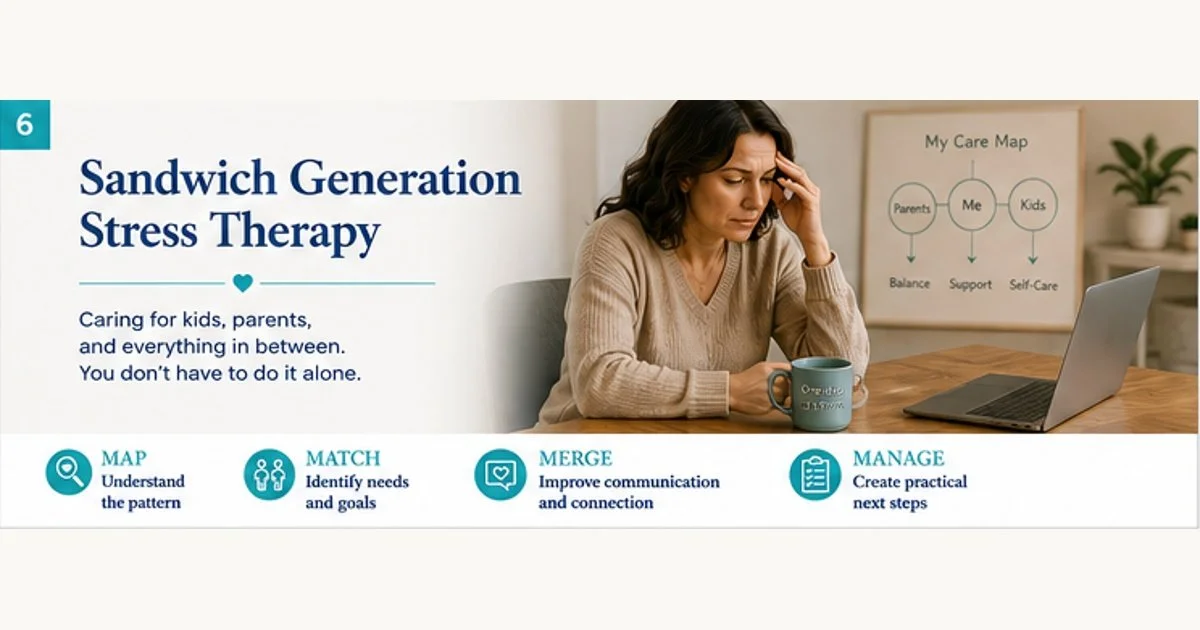
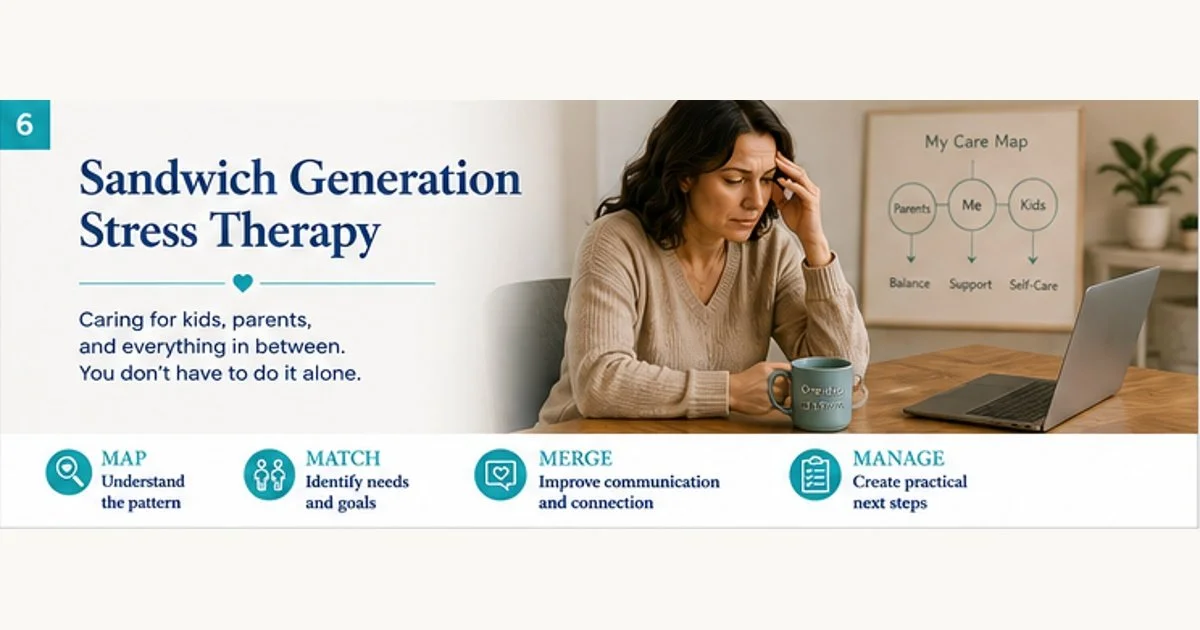
Adult balancing family and caregiving responsibilities, representing therapy for sandwich-generation stress in NJ, CA & Oregon
Therapy for the Sandwich Generation
Being in the sandwich generation can feel like living in permanent triage. Your children may still need emotional, financial, or practical support while your parents need more care, more decisions, and more attention. At the same time, you may be working, managing a household, maintaining a relationship, and trying to remember that you are a person with needs too. Therapy can help you organize the overload and create a way of caring for others that does not require disappearing from your own life.
Check insurance & book online therapy on Psychology Today
When everyone seems to need you at once
The pressure is not only the number of tasks. It is the constant switching of roles: parent, adult child, partner, employee, caregiver, sibling, advocate, scheduler, decision-maker. Each role can carry different expectations, and there may be no point in the day when you feel completely off duty.
Many sandwich-generation adults feel guilty no matter where they put their attention. If you help your parent, you worry about your children. If you focus on your child, you feel you are neglecting your parent. If you take time for yourself, it can feel irresponsible. That cycle can create exhaustion, resentment, anxiety and emotional numbness.
How therapy can help
Therapy can help you identify which responsibilities are truly yours, which ones can be shared, and which expectations may be unrealistic. We can work on boundaries, sibling communication, parenting stress, caregiver guilt, anticipatory grief, relationship strain and the pressure to be the person who always handles everything.
We can also focus on preserving your identity and relationships outside caregiving. The goal is not to optimize every minute of your life. It is to build a more sustainable system where your needs are part of the map rather than an afterthought.
The Care Map Method: Map • Match • Merge • Manage
MAP — Understand the pattern. We map the people who depend on you, the practical responsibilities, emotional stressors, family roles and pressure points.
MATCH — Identify needs and goals. We clarify what each person needs, what you need, what is realistic, and which priorities require attention now versus later.
MERGE — Improve communication and connection. We work on asking for help, setting limits, discussing responsibilities with siblings or partners, and communicating without carrying every conversation alone.
MANAGE — Create practical next steps. We develop routines, boundaries, coping tools and support systems that help you function without staying in constant emergency mode.
You do not have to carry everyone at once
There may never be a period when no one needs you. The therapeutic goal is therefore not to wait until life becomes easy. It is to help you feel more supported, more deliberate, and less consumed by the competing demands around you.
Online therapy and insurance in NJ, CA & Oregon
I provide online psychotherapy for clients who are physically located in states where I am licensed and available to practice. I work with selected insurance plans through Headway. Coverage, eligibility, copays, deductibles and network participation vary by plan and member. Use the Headway booking link to verify benefits before scheduling.
Choose the Oregon, California or New Jersey module from the front of this document and place it here. For the highest-pay strategy, lead with the priority plan(s) for that state while keeping the copy accurate and conditional.
Ready for support and a plan?
If this situation is affecting your mood, sleep, work, relationships or sense of stability, you do not have to wait until it becomes a crisis. Therapy can be a safe, nonjudgmental place to unload what you are carrying while also developing tangible tools and a clearer path forward. Use the Headway link to check insurance eligibility and current appointment availability.
FAQ
What is sandwich-generation stress?
It is the emotional and practical strain that can occur when an adult is simultaneously supporting children and aging parents while managing work, relationships and their own needs.
Can therapy help when I am responsible for both children and parents?
Yes. Therapy can help organize priorities, reduce guilt, strengthen boundaries, improve family communication and address burnout or anxiety.
How can I reduce caregiver resentment and guilt?
We can explore unrealistic responsibility, family roles, unspoken expectations, grief and the difference between caring deeply and doing everything.
Can therapy help with sibling or family conflict?
Yes. Therapy can help you prepare conversations, clarify your own role, set boundaries and respond more intentionally when family members disagree.
How do I book through insurance?
Use the Headway booking link to check current eligibility and benefits for your specific state and plan.

New Parent & Return-to-Work Stress
Returning to work after becoming a parent can bring anxiety, guilt, logistical overload and identity conflict. Therapy can help you navigate the transition with more clarity.

Therapy for New Parent & Return-to-Work Stress
Returning to work after having a baby can feel like several transitions happening at once: separation from your child, childcare decisions, professional expectations, sleep disruption, relationship changes and a new version of your identity. Even when you wanted to return, the reality can bring guilt, anxiety and overwhelm. Therapy can provide a place to process those competing emotions without assuming there is one “right” way to feel.
Check Insurance Eligibility & Book Online Therapy → CHECK ON HEADWAY
What You May Be Dealing With
You feel guilty about leaving your baby or guilty about wanting to work.
Childcare decisions are creating significant anxiety.
You worry you will no longer perform at your previous professional level.
You and your partner disagree about responsibilities or schedules.
Sleep deprivation is affecting your mood and coping.
You feel like two identities are competing rather than coexisting.
You are constantly managing logistics and mental load.
You feel pressure to look as though you have adjusted when you have not.
How Therapy Can Help
Therapy can help you process identity changes, guilt, anxiety, resentment, relationship strain and unrealistic expectations during early parenthood. We can also examine the emotional meaning of childcare decisions, return-to-work fears and the division of labor at home. The goal is not to prescribe one parenting or career choice, but to help you make decisions that fit your values and circumstances.
The Care Map Method™ in Therapy
Care Map Method™ is a structured way to organize the people, needs, stressors and choices involved in a complex real-life situation. In psychotherapy, it is used only as an organizing framework within individualized clinical care—not as a substitute for assessment, diagnosis or treatment planning.
MAP — Identify the emotional, relational, childcare, work and practical pressures surrounding the transition.
MATCH — Choose coping strategies, communication approaches, boundaries and supports that fit your family.
MERGE — Build a workable transition into routines, childcare, work and partnership expectations.
MANAGE — Reassess as the baby, childcare arrangement and work demands change.
Why Work With Tammy Gold
Tammy Gold is a licensed therapist and longtime parenting and childcare expert. Her work with families allows therapy to address both the internal emotional transition to parenthood and the real-world systems—work, childcare and relationships—that shape it.
Insurance & Online Therapy
Online therapy is available for clients located in states where Tammy is licensed and accepting clients. Selected insurance plans are accepted through Headway. Coverage, copays, deductibles, coinsurance and eligibility vary by plan and member.
Use the Headway booking link to check current insurance eligibility and available appointment times. Do not publish contracted reimbursement amounts on the website.
STATE-SPECIFICS
Oregon: Providence Health Plan • Aetna • Regence BlueCross BlueShield of Oregon • Carelon Behavioral Health • Providence Medicare Advantage.
California: Providence Health Plan • Aetna • Carelon Behavioral Health • Anthem Blue Cross California.
New Jersey: Providence Health Plan • Aetna • Carelon Behavioral Health.
Always verify current participation before publishing.
Frequently Asked Questions
Is this postpartum therapy?
Therapy can address emotional stress during the postpartum and new-parent period. If symptoms suggest a condition requiring specialized or additional medical care, appropriate referrals may be discussed.
Can therapy help with childcare anxiety?
Yes. Therapy can explore the fears, guilt and control issues surrounding childcare decisions while helping you distinguish practical concerns from anxiety-driven ones.
Can my partner join?
This page describes individual therapy. Other formats would need to be discussed separately based on clinical appropriateness and availability.
Can therapy help with return-to-work guilt?
Yes. Therapy can help you examine identity, expectations and the meaning you attach to work and caregiving choices.
How do I use insurance?
Use Headway to check current eligibility, expected costs and appointment availability.
You do not have to choose between being a committed parent and having needs, work or an identity of your own. Check insurance eligibility and book online therapy through Headway.
Email: Info@CareMapMethod.com Text: 818.308.1358
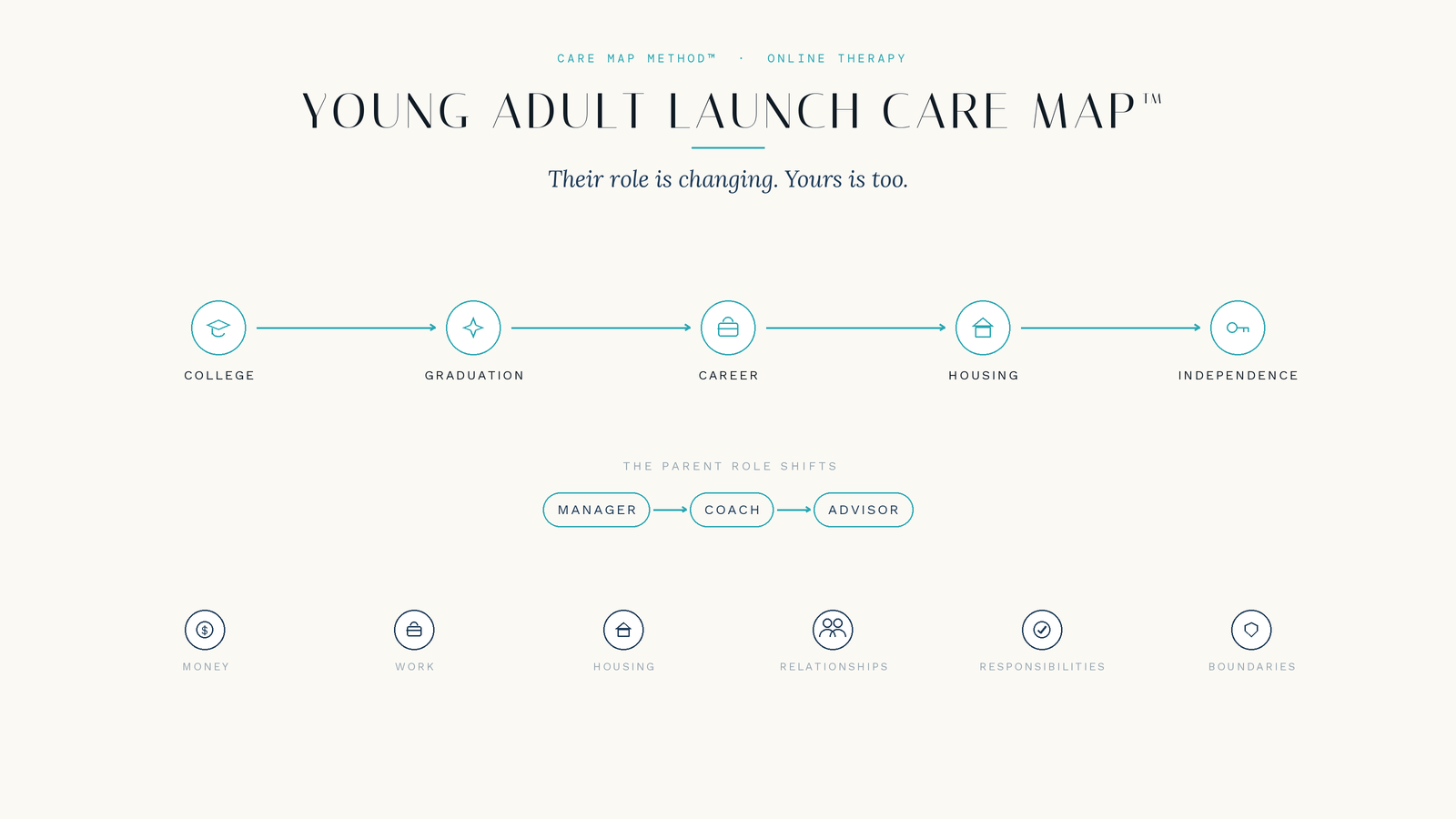
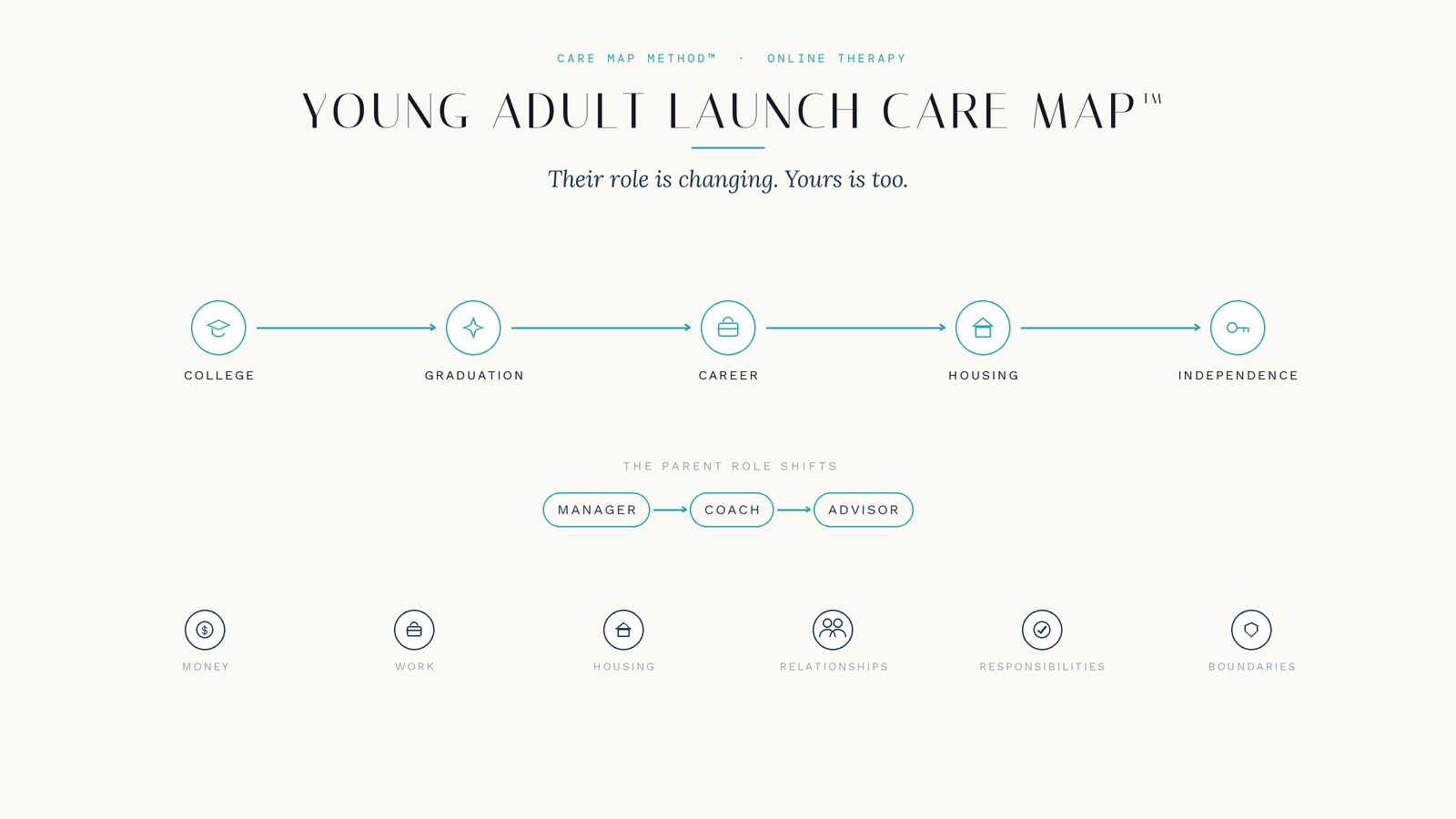
College Launch & Young-Adult Parenting Stress
When a child leaves for college or struggles to launch, parents often face their own identity, anxiety and boundary transition. Therapy can help you adjust your role without disconnecting.
Parent and college-age/young-adult child talking; independence rather than conflict
Therapy for College Launch, Empty-Nest Anxiety & Adult-Child Stress
The transition from actively parenting a child to relating to an emerging adult can be unexpectedly difficult. Some parents feel grief when a child leaves for college. Others feel trapped in constant worry because the young adult is struggling with work, money, housing, school or independence. Therapy can help you adjust your role without abandoning the relationship or managing every outcome.
Check Insurance Eligibility & Book Online Therapy → HEADWAY
What You May Be Dealing With
You are anxious about your child leaving for college or living independently.
You feel lost or empty now that daily parenting has changed.
Your young adult calls you for every decision or crisis.
You and your partner disagree about how much financial or practical support to provide.
You worry that your child is not progressing toward independence.
Attempts to set boundaries lead to guilt or conflict.
You are unsure when helping becomes over-functioning.
Your identity has been organized around parenting for many years.
How Therapy Can Help
Therapy can help parents examine anxiety, grief, control, guilt and identity during the launch stage. We can look at what appropriate support means in your family, how to tolerate your adult child making choices you would not make, and how to set boundaries around money, housing, communication and responsibility without withdrawing emotionally.
The Care Map Method™ in Therapy
Care Map Method™ is a structured way to organize the people, needs, stressors and choices involved in a complex real-life situation. In psychotherapy, it is used only as an organizing framework within individualized clinical care—not as a substitute for assessment, diagnosis or treatment planning.
MAP — Understand the young adult’s developmental stage, your fears, family expectations and current dependency patterns.
MATCH — Identify healthier boundaries, communication and support strategies.
MERGE — Shift the parent role gradually from manager toward coach or advisor where appropriate.
MANAGE — Reassess as the young adult gains skills, encounters setbacks or needs a different kind of support.
Why Work With Tammy Gold
Tammy Gold’s work with families spans early childhood through young adulthood and eldercare. This lifecycle perspective helps parents understand launch not as an abrupt end to parenting, but as a developmental shift in the relationship.
Insurance & Online Therapy
Online therapy is available for clients located in states where Tammy is licensed and accepting clients. Selected insurance plans are accepted through Headway. Coverage, copays, deductibles, coinsurance and eligibility vary by plan and member.
Use the Headway booking link to check current insurance eligibility and available appointment times. Do not publish contracted reimbursement amounts on the website.
STATE-SPECIFIC HELO
Oregon: Providence Health Plan • Aetna • Regence BlueCross BlueShield of Oregon • Carelon Behavioral Health • Providence Medicare Advantage.
California: Providence Health Plan • Aetna • Carelon Behavioral Health • Anthem Blue Cross California.
New Jersey: Providence Health Plan • Aetna • Carelon Behavioral Health.
Always verify current participation before publishing.
Frequently Asked Questions
Is it normal to feel anxious or sad when a child leaves for college?
Yes. Major family transitions can bring grief, uncertainty and identity changes even when the transition is positive.
Can therapy help with an adult child who is not becoming independent?
Therapy can help parents examine boundaries, expectations, enabling patterns, anxiety and communication. It cannot guarantee that an adult child will change.
How do I know if I am helping too much?
Therapy can help you look at whether support is building capability or unintentionally maintaining dependency, while considering the young adult’s actual circumstances.
Can therapy help with empty nest issues?
Yes. Therapy can address grief, identity, relationship changes and the question of what you want your next stage to look like.
Can I use insurance?
Selected plans are accepted through Headway. Check eligibility and expected cost through the booking link.
Your child’s next developmental stage requires a new version of your parent role too. Check insurance eligibility and book online therapy through Headway.
EMAIL INFO@CAREMAPMETHOD.COM TEXT 818.308.1358
Sandwich Generation Stress Therapy
Support for adults simultaneously managing children, aging parents, work, relationships and the invisible emotional load of family caregiving.
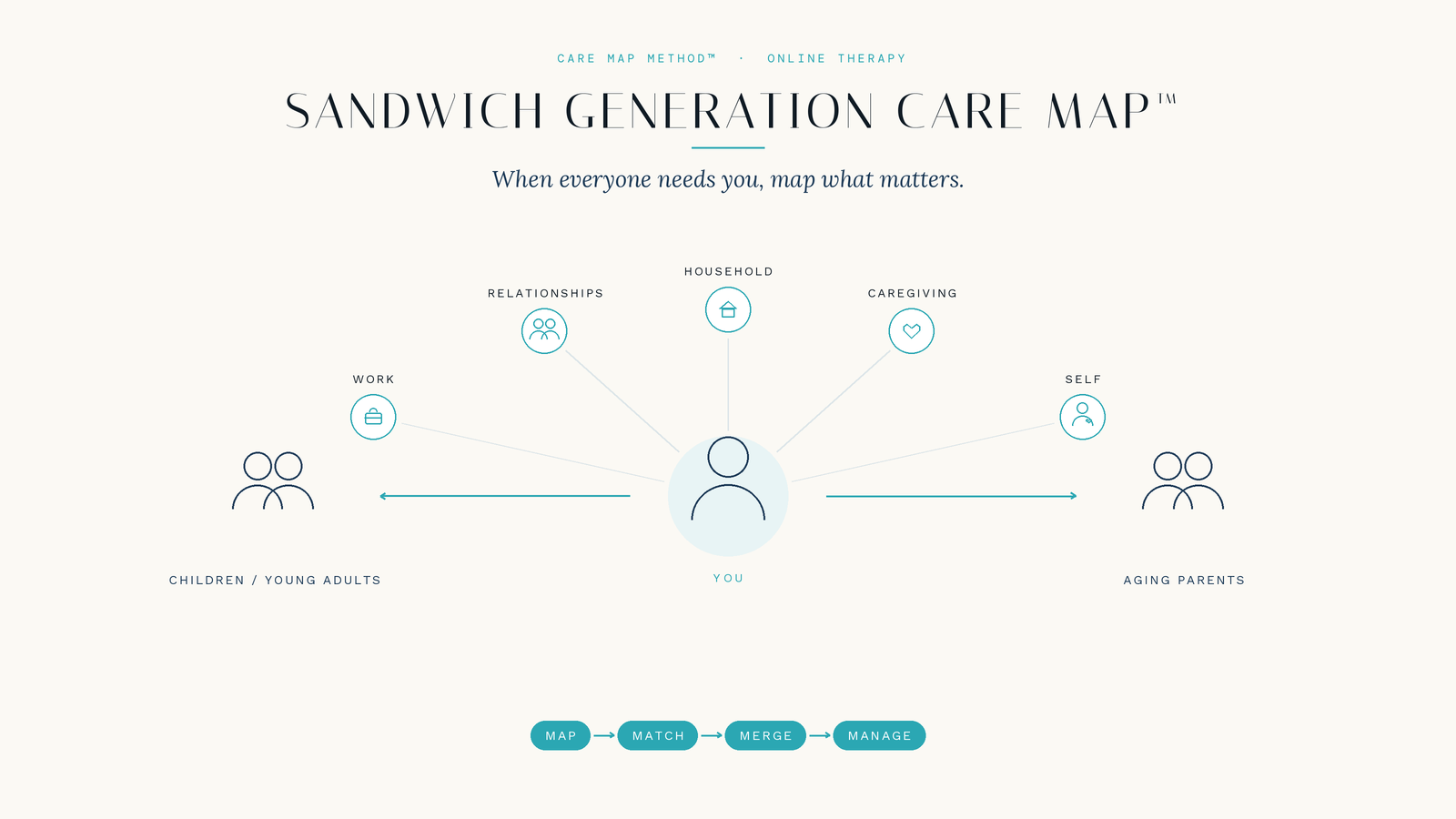
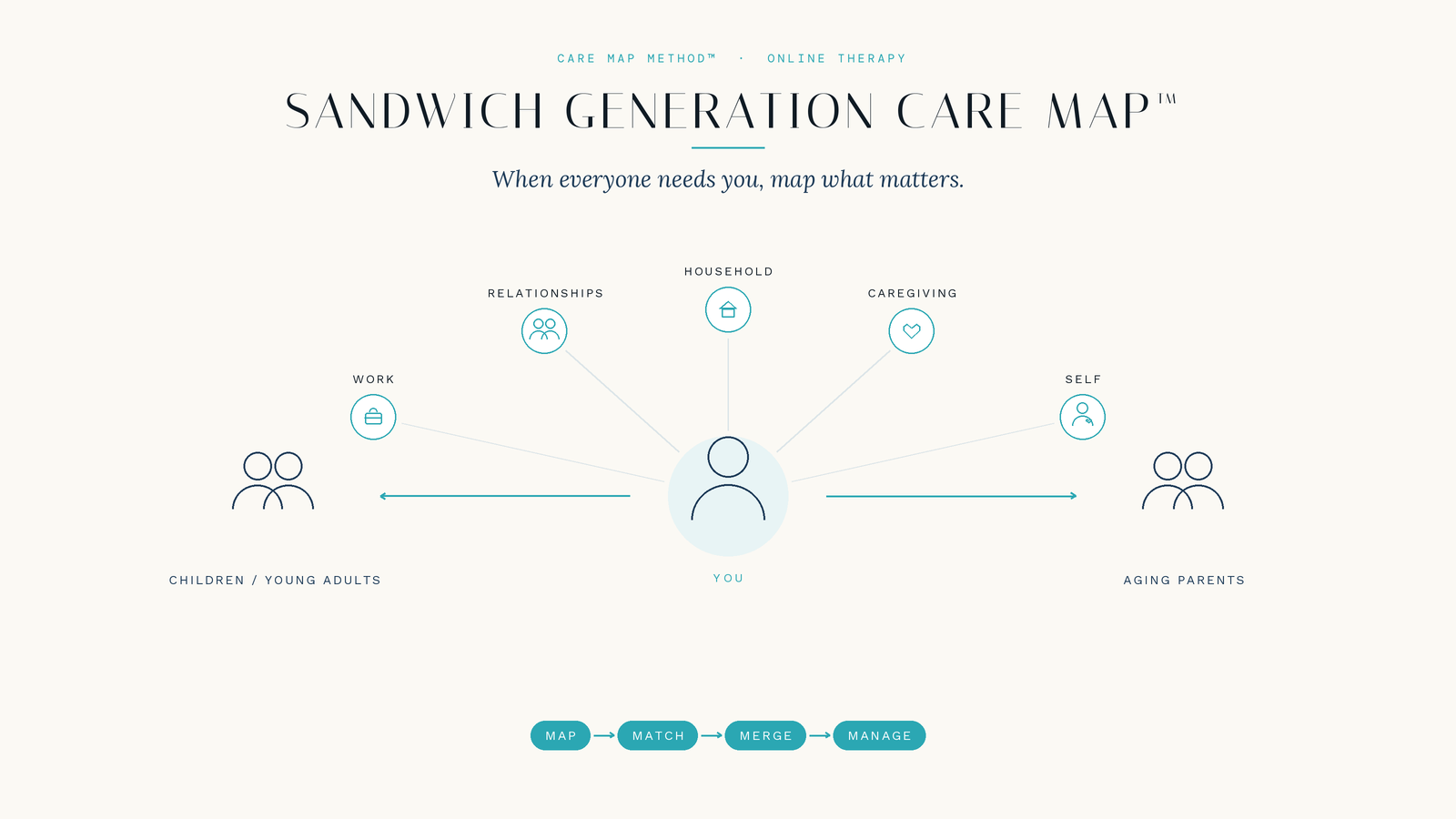
Sandwich Generation Care Map showing competing responsibilities
Therapy for the Sandwich Generation
You may be helping a child with one crisis while answering a call about an aging parent and trying to keep up with work, a relationship and your own responsibilities. The sandwich generation often functions as the family’s coordination center, carrying logistical tasks and emotional worry that other people may not fully see. Therapy can help you find a more sustainable way to live inside competing demands.
Check Insurance Eligibility & Book Online Therapy → ON HEADWAY
What You May Be Dealing With
You are caring for children and aging parents at the same time.
Everyone seems to need you, and there is no time when you are truly off duty.
You feel guilty when you prioritize yourself.
Work is being affected by family responsibilities.
You are irritable, exhausted or emotionally numb.
Your partner or siblings do not seem to understand the amount you are carrying.
You are making decisions for multiple generations at once.
You worry that if you stop managing everything, the system will fall apart.
How Therapy Can Help
Therapy can help you examine over-responsibility, guilt, boundaries, resentment, anxiety and the family roles that keep you in constant management mode. Together, we can look at what is truly yours to carry, what can be delegated, where expectations need to change and how to protect your emotional capacity while remaining connected to the people you care about.
The Care Map Method™ in Therapy
Care Map Method™ is a structured way to organize the people, needs, stressors and choices involved in a complex real-life situation. In psychotherapy, it is used only as an organizing framework within individualized clinical care—not as a substitute for assessment, diagnosis or treatment planning.
MAP — See the full system: children, parents, work, partner, logistics, emotional load and your own needs.
MATCH — Identify boundaries, coping tools, communication strategies and supports for the highest-pressure areas.
MERGE — Put changes into schedules, conversations, caregiving roles and family expectations.
MANAGE — Revisit the plan as children and parents move into new stages.
Why Work With Tammy Gold
Tammy Gold’s work spans parenting, childcare, caregiving and eldercare, giving her a broad family-systems perspective on the pressures unique to the sandwich generation. In therapy, the Care Map Method™ can help clients see competing roles more clearly and reduce the sense that every problem must be solved simultaneously.
Insurance & Online Therapy
Online therapy is available for clients located in states where Tammy is licensed and accepting clients. Selected insurance plans are accepted through Headway. Coverage, copays, deductibles, coinsurance and eligibility vary by plan and member.
Use the Headway booking link to check current insurance eligibility and available appointment times. Do not publish contracted reimbursement amounts on the website.
STATES
Oregon: Providence Health Plan • Aetna • Regence BlueCross BlueShield of Oregon • Carelon Behavioral Health • Providence Medicare Advantage.
California: Providence Health Plan • Aetna • Carelon Behavioral Health • Anthem Blue Cross California.
New Jersey: Providence Health Plan • Aetna • Carelon Behavioral Health.
Always verify current participation before publishing.
Frequently Asked Questions
What is sandwich-generation stress?
It refers to the strain that can occur when an adult is simultaneously supporting children and aging parents while also managing work, relationships and personal responsibilities.
Can therapy help when I am responsible for both children and parents?
Yes. Therapy can address stress, anxiety, guilt, resentment, boundaries and the emotional effects of carrying multiple caregiving roles.
How can I reduce caregiver resentment and guilt?
Therapy can help you examine unrealistic expectations, clarify responsibility, make room for difficult emotions and develop more sustainable boundaries.
Can therapy help with sibling or family conflict?
Individual therapy can help you understand your role in conflict and prepare for clearer communication, even when other family members are not participating.
How do I book through insurance?
Use the Headway link to verify current eligibility, expected costs and available appointments.
Reach Out Today info@CareMapMethod 818.308.1358
Being needed by two generations does not mean you have to disappear in the middle. Check insurance eligibility and book online therapy through Headway.
Caregiver Burnout & Aging-Parent Stress Therapy
Support for the emotional strain of caring for an aging parent, family disagreements, guilt, overwhelm and sandwich-generation pressure.
Therapy for Caregiver Burnout & Aging-Parent Stress
Caring for an aging parent can bring love, responsibility, grief, frustration and constant decision-making into the same day. Many caregivers become the person everyone calls, while still managing work, children, relationships and their own health. Therapy can provide a confidential place to address the emotional burden of caregiving before exhaustion becomes the only way you know how to function.
Check Insurance Eligibility & Book Online Therapy → CLICK HERE FOR HEADWAY
What You May Be Dealing With
You feel responsible for everyone and guilty when you cannot do more.
You are constantly worried about an aging parent’s safety or future.
You and your siblings disagree about care, money, responsibilities or next steps.
Your parent resists help, and every conversation turns into conflict.
Caregiving is affecting your work, marriage, parenting, sleep or health.
You feel resentful and ashamed of feeling resentful.
You are grieving changes in your parent while they are still alive.
You are making major care decisions while emotionally exhausted.
How Therapy Can Help
Caregiver therapy can focus on both the emotional experience and the real-life family system around it. We can look at guilt, anxiety, grief, resentment, over-responsibility and boundary problems while also identifying the relationships and decisions intensifying the stress. Therapy may help you differentiate what you can control from what you cannot, communicate more effectively with family members, and build a more sustainable role for yourself inside the caregiving system.
The Care Map Method™ in Therapy
Care Map Method™ is a structured way to organize the people, needs, stressors and choices involved in a complex real-life situation. In psychotherapy, it is used only as an organizing framework within individualized clinical care—not as a substitute for assessment, diagnosis or treatment planning.
MAP — Organize the caregiving pressures, family roles, emotional triggers and current decisions.
MATCH — Identify coping tools, boundaries, communication strategies and sources of support.
MERGE — Put those changes into daily caregiving, work and family routines.
MANAGE — Reassess as your parent’s needs and family circumstances change.
Why Work With Tammy Gold
Tammy Gold has worked for decades with families navigating caregiving, parenting, relationships and major transitions. Her therapy work integrates a family-systems perspective with the Care Map Method™ to help clients see the full caregiving picture rather than treating each crisis as an isolated event.
Insurance & Online Therapy
Online therapy is available for clients located in states where Tammy is licensed and accepting clients. Selected insurance plans are accepted through Headway. Coverage, copays, deductibles, coinsurance and eligibility vary by plan and member.
Use the Headway booking link to check current insurance eligibility and available appointment times. Do not publish contracted reimbursement amounts on the website.
STATE-SPECIFICS
Oregon: Providence Health Plan • Aetna • Regence BlueCross BlueShield of Oregon • Carelon Behavioral Health • Providence Medicare Advantage.
California: Providence Health Plan • Aetna • Carelon Behavioral Health • Anthem Blue Cross California.
New Jersey: Providence Health Plan • Aetna • Carelon Behavioral Health.
Always verify current participation before publishing.
Frequently Asked Questions
What are signs that caregiver stress is becoming burnout?
Common signs can include chronic exhaustion, irritability, resentment, trouble concentrating, sleep disruption, isolation and feeling that there is never a true break from responsibility. Therapy can help assess how these pressures are affecting you.
Can therapy help with guilt about an aging parent?
Yes. Guilt is common when a parent’s needs exceed what one person can realistically provide. Therapy can help you examine expectations, responsibility, grief and boundaries without dismissing the real care needs involved.
What if siblings disagree about a parent’s care?
Individual therapy can help you understand the family dynamics, regulate your own responses, clarify your role and prepare for more productive conversations. It is not a substitute for legal, medical or formal family mediation when those services are needed.
Can therapy help sandwich-generation caregivers?
Yes. Therapy can focus on the emotional load of simultaneously caring for children, aging parents, a partner, work and yourself.
Can I use insurance for caregiver-stress therapy?
Selected plans are accepted through Headway. Check current eligibility and expected out-of-pocket cost through the booking link.
You can care deeply about your family without carrying every responsibility alone. Check your insurance eligibility and book online therapy through Headway if caregiver stress is beginning to take over your emotional life.
Info@CareMapMethod.com 818.308.1358

Aetna Therapy in New Jersey for Adult Sibling Conflict, Resentment & Family Stress
Online therapy in New Jersey for adult sibling conflict, resentment, family roles and boundaries. Aetna eligibility may be available through Headway.

Aetna therapy in New Jersey for adult sibling conflict, resentment, family roles and healthier boundaries with the Care Map Method.
When Sibling Conflict Follows You Into Adulthood
Adult sibling conflict can instantly reopen old roles. Therapy can help you understand the history without staying trapped in it.
I provide online therapy to clients in New Jersey and participate with select insurance plans through Headway. Aetna eligibility and benefits vary by individual plan and should be verified before scheduling.
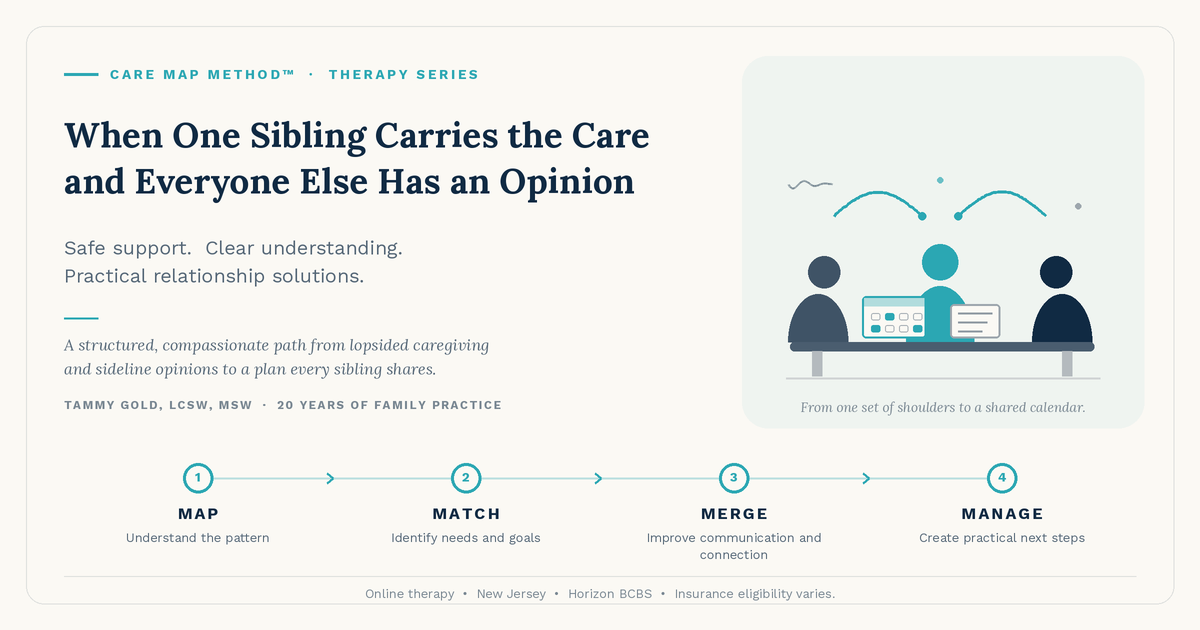
Care Map Method™: MAP → MATCH → MERGE → MANAGE
MAP — identify old family roles, current triggers and unresolved hurt.
MATCH — clarify needs, expectations and appropriate boundaries.
MERGE — improve direct communication and reduce triangulation.
MANAGE — decide what a healthier relationship looks like now.
Sibling conflict is rarely only about the current issue
Arguments about parents, holidays, money, caregiving, inheritance or grandchildren can carry decades of comparison, favoritism and old roles underneath them.
You are allowed to want both peace and connection
Therapy can help you stop getting pulled into the same role you had at age twelve. We identify what belongs to the present and what belongs to the family history.
Build communication that is direct and realistic
We can work on boundary language, difficult conversations, expectations and ways to avoid involving other relatives in the conflict.
A healthier relationship may look different
The goal is not always closeness. Sometimes success means respectful contact, clearer limits, less guilt and more emotional freedom.
Ready for support and a practical plan? If you are located in New Jersey, you can view current availability and verify insurance eligibility through my Headway booking link. I provide a warm, nonjudgmental space focused on understanding the problem and creating real next steps.
Can therapy help adult siblings who are not both attending?
Yes. Individual therapy can help you understand the pattern and change your own responses and boundaries.
Why do sibling fights feel so intense?
They often activate childhood roles, comparison, loyalty and long-standing unmet needs.
Can you help with siblings fighting over aging parents?
Yes. Caregiving roles, responsibility and decision-making are common sources of adult sibling conflict.
Does Aetna cover therapy in New Jersey?
Coverage depends on your plan and eligibility. Verify through Headway.
What if I do not want a close relationship with my sibling?
Therapy can help you define a level of contact and boundaries that protect your wellbeing.
Providence Therapy in New Jersey for Parent–Adult Child Conflict & Family Relationships
New Jersey online therapy for conflict with adult children, family boundaries and communication. Providence eligibility may be available through Headway.
Providence therapy in New Jersey for parent and adult child conflict, boundaries and communication using the Care Map Method.
When You Love Your Adult Child but the Relationship Hurts
Adult children still need parents, but the relationship has to change. Therapy can help families move from criticism, guilt, and control toward boundaries, respect, and connection.
Insurance-safe line: I provide online therapy to clients in New Jersey and participate with select insurance plans through Headway. Providence Health Plan eligibility and benefits vary by individual plan and should be verified before scheduling.
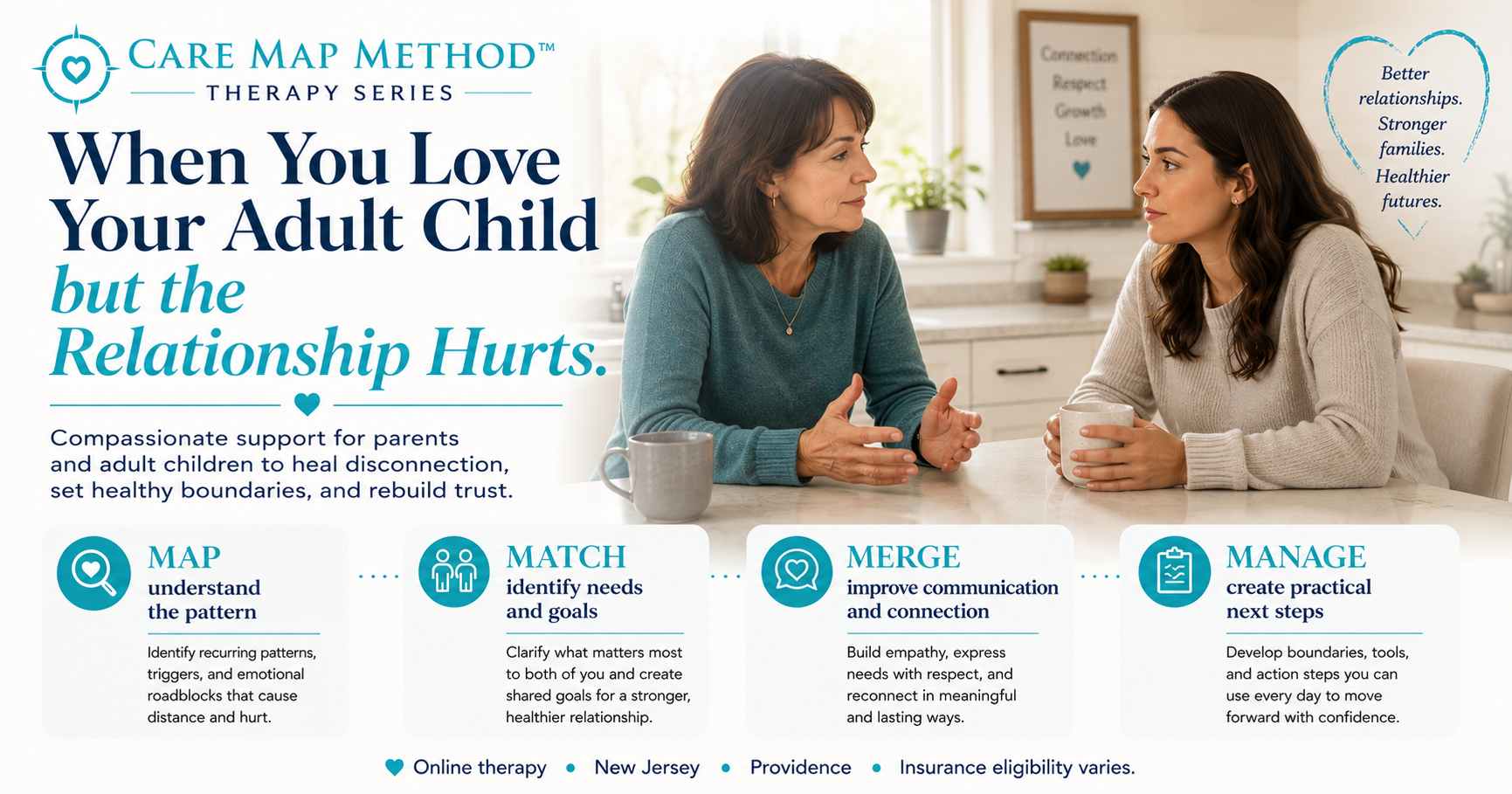
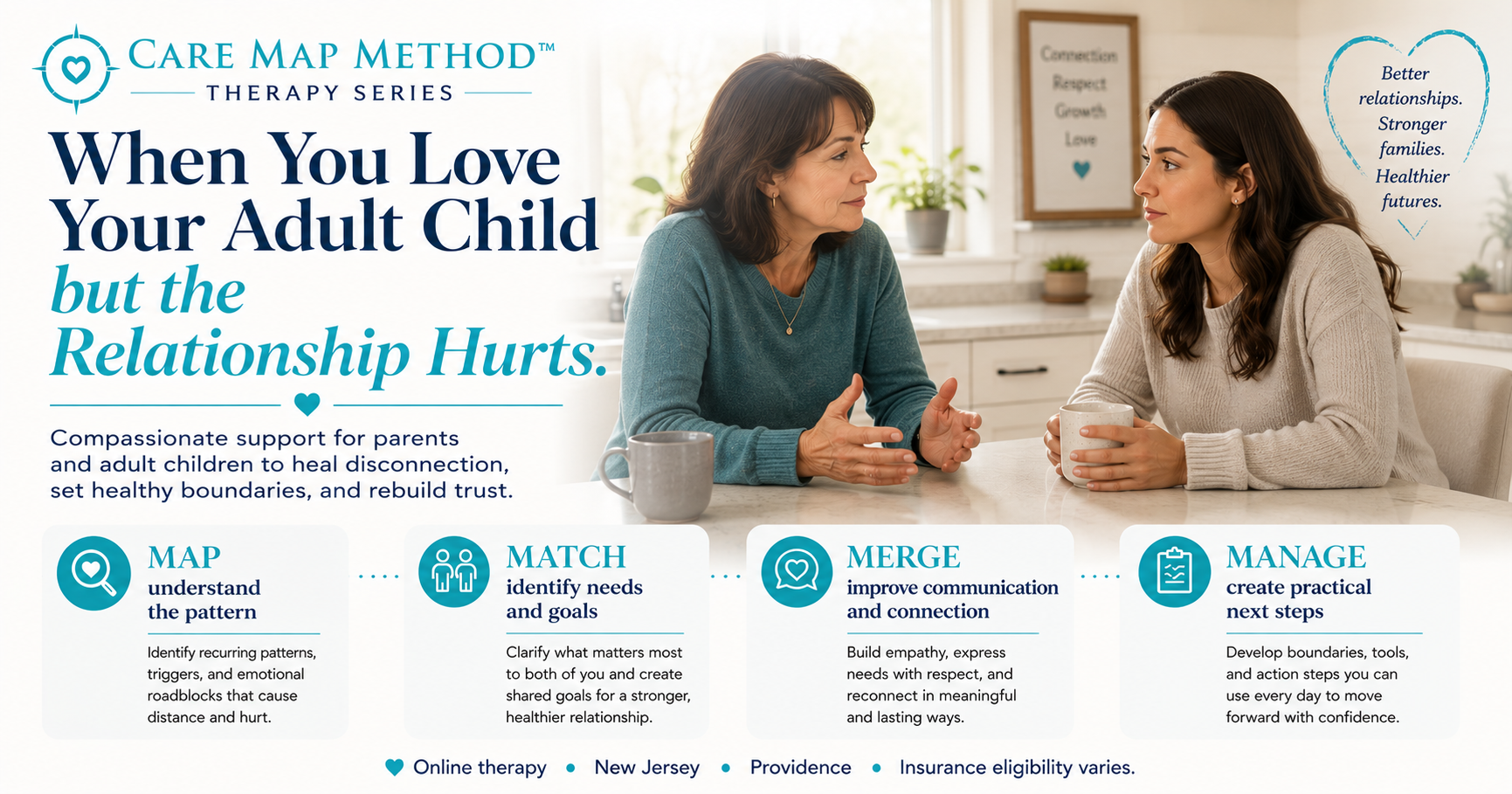
Care Map Method™: MAP → MATCH → MERGE → MANAGE
MAP — identify the repeating family pattern and emotional triggers.
MATCH — clarify each person’s needs, expectations and boundaries.
MERGE — improve communication without overfunctioning or withdrawing.
MANAGE — create realistic agreements and a healthier adult relationship.
The relationship has changed, but the pattern may not have
Conflict with an adult son or daughter can be especially painful because the relationship carries years of history. Parents may feel rejected, worried or disrespected. Adult children may feel criticized, controlled or misunderstood.
Therapy can help without choosing sides
We look at what each person is experiencing, what is being communicated and what is being assumed. The goal is not to prove who is right. It is to reduce the cycle that keeps both sides hurt and defensive.
Boundaries can protect connection
Healthy boundaries are not punishment. They help clarify what you can offer, what you cannot control and how you want to communicate. We can develop language for money, housing, grandchildren, holidays, caregiving and other emotionally loaded topics.
You can begin even if your adult child will not attend
Parents often make meaningful changes by changing how they respond, what they reinforce and how they communicate.
Ready for support and a practical plan? If you are located in New Jersey, you can view current availability and verify insurance eligibility through my Headway booking link. I provide a warm, nonjudgmental space focused on understanding the problem and creating real next steps.
Can therapy help if my adult child will not come?
Yes. Parent-only work can change communication, boundaries and the family pattern.
How do I set boundaries without losing my adult child?
We focus on respectful, specific boundaries and communication that protects both the relationship and your wellbeing.
Can therapy help with estrangement?
Therapy can help you process grief, understand patterns, evaluate contact and communicate thoughtfully when contact is possible.
Does Providence cover therapy in New Jersey?
Eligibility and benefits vary by plan. Verify through Headway before booking.
Can we discuss financial support or living at home?
Yes. These are common areas of parent–adult child conflict and can be addressed directly.
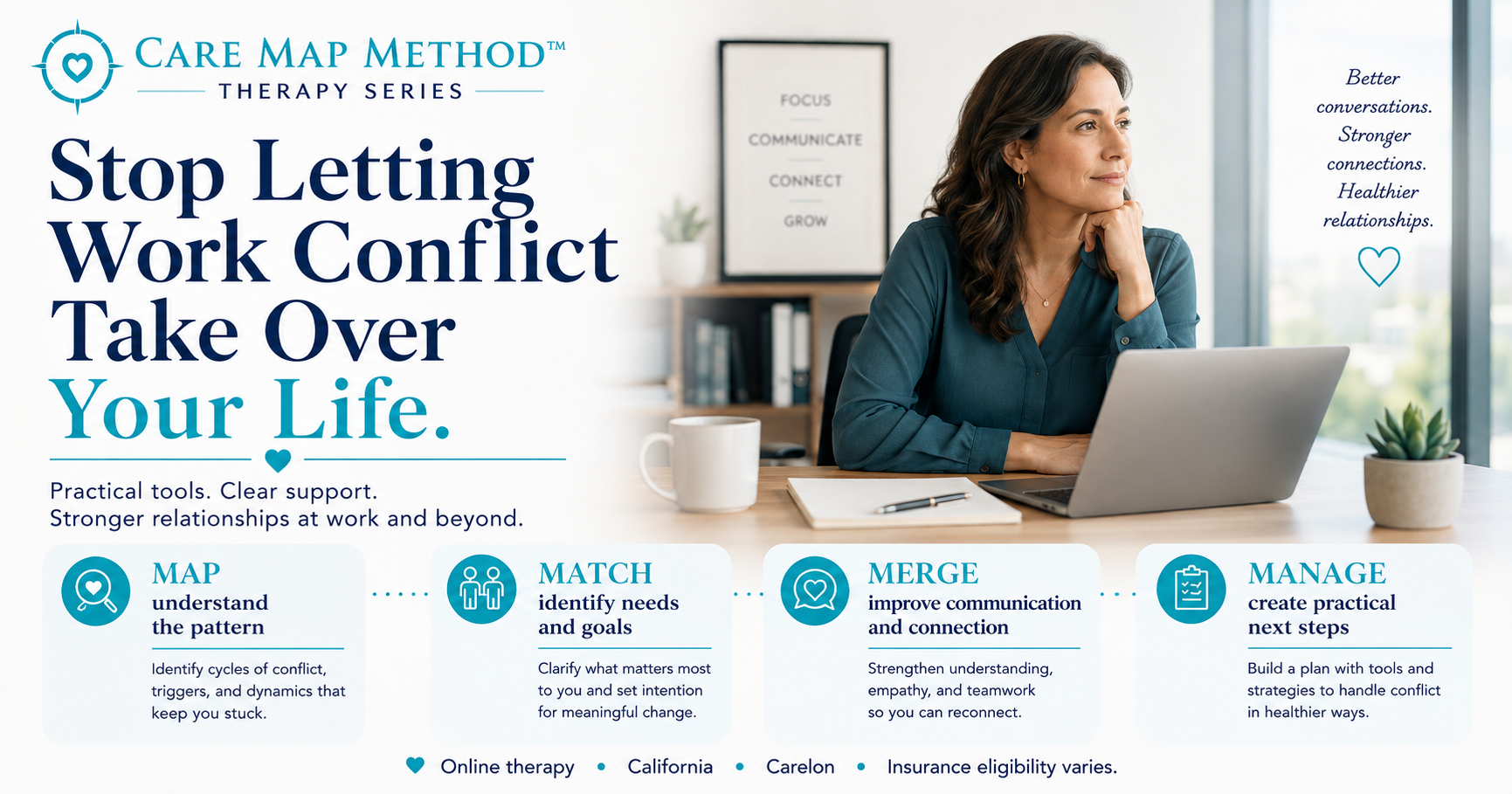
Carelon Therapy in California for a Difficult Boss, Coworker Conflict & Work Stress
Online California therapy for difficult bosses, coworker conflict, work anxiety and boundaries. Carelon eligibility may be available through Headway.
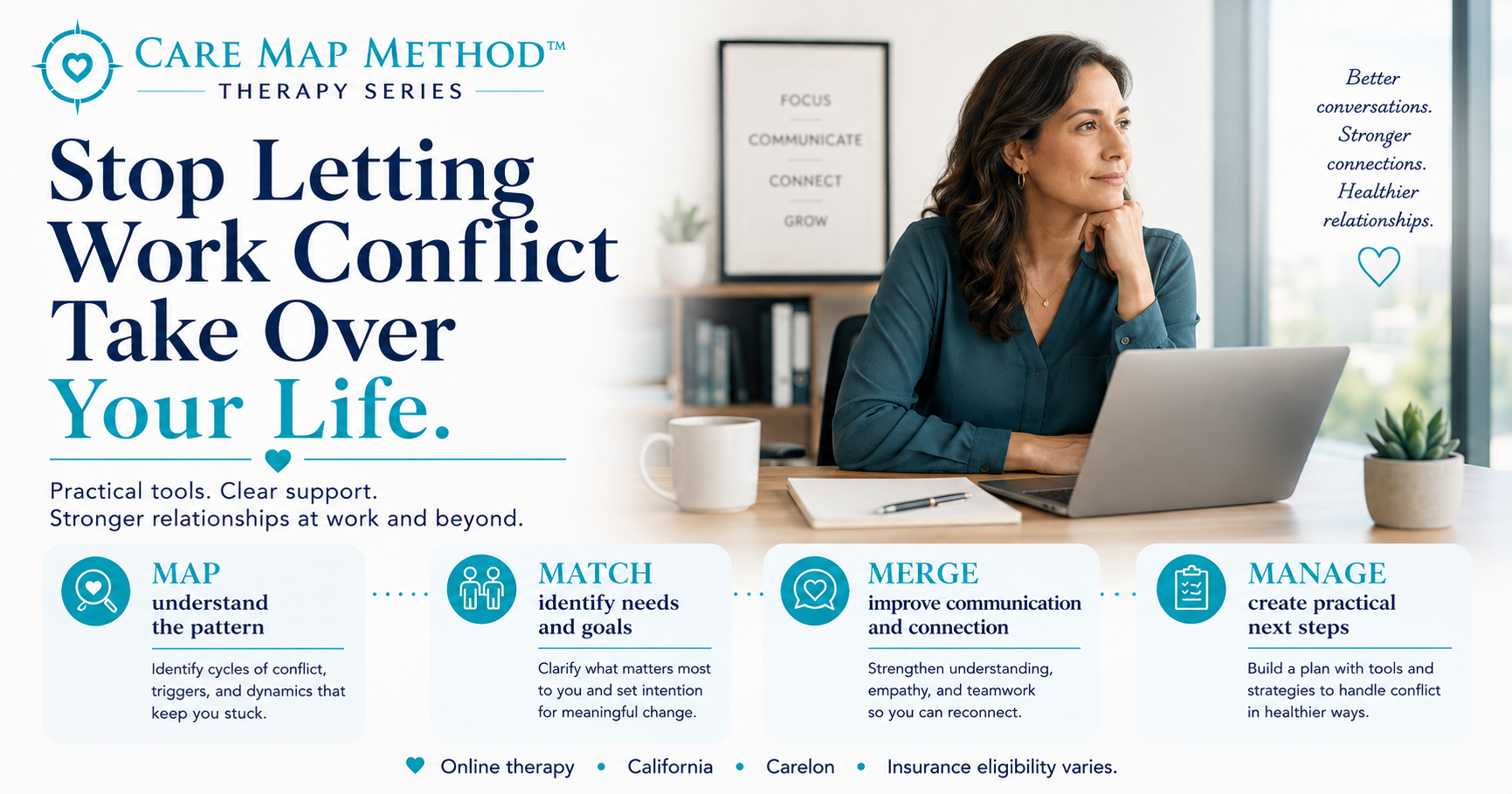
Carelon therapy in California for difficult boss, coworker conflict and work stress, with practical communication and boundary strategies using the Care Map Method.
Stop Letting Work Conflict Take Over Your Life
A difficult boss or coworker can affect your sleep, confidence, family life and mood long after the workday ends. Therapy can help you respond strategically instead of carrying the conflict everywhere.
Insurance-safe line: I provide online therapy to clients in California and participate with select insurance plans through Headway. Carelon eligibility and benefits vary by individual plan and should be verified before scheduling.
Care Map Method™: MAP → MATCH → MERGE → MANAGE
MAP — identify triggers, workplace dynamics and the impact on your wellbeing.
MATCH — clarify goals, boundaries and what is within your control.
MERGE — prepare communication, scripts and healthier responses.
MANAGE — create a practical work strategy and protect your life outside work.
When work follows you home
Workplace conflict can become emotionally consuming. You may replay meetings, worry about the next email, question yourself or take the tension home to your partner and family.
Understand the relationship pattern at work
Sometimes the issue is workload or management. Sometimes it involves communication styles, unclear roles, perfectionism, fear of rejection, people-pleasing or a pattern of reacting strongly to criticism. We map the whole situation rather than assuming the answer is simply “quit.”
Build a strategy
Therapy can help you prepare difficult conversations, set boundaries, regulate your nervous system, decide what deserves a response and determine when repair, escalation or a career change makes sense.
Protect your confidence
The goal is not to make you tolerate an unhealthy workplace. It is to help you think clearly, protect your well-being, and make decisions with confidence rather than panic or anger.
Ready for support and a practical plan? If you are located in California, you can view current availability and verify insurance eligibility through my Headway booking link. I provide a warm, nonjudgmental space focused on understanding the problem and creating real next steps.
Can therapy help with a difficult boss?
Yes. Therapy can help with stress regulation, communication, boundaries, confidence and decision-making.
What if my coworker is the problem, not me?
Therapy does not require you to take responsibility for another person’s behavior. It helps you decide how you want to respond and protect yourself.
Can therapy help me stop thinking about work at night?
Yes. We can develop boundaries, transition routines, and strategies for interrupting rumination.
Does Carelon cover online therapy in California?
Coverage and eligibility vary. Confirm your specific benefits through Headway.
Can you help me decide whether to leave my job?
We can evaluate the emotional, practical and relational factors so you can make a more deliberate decision.
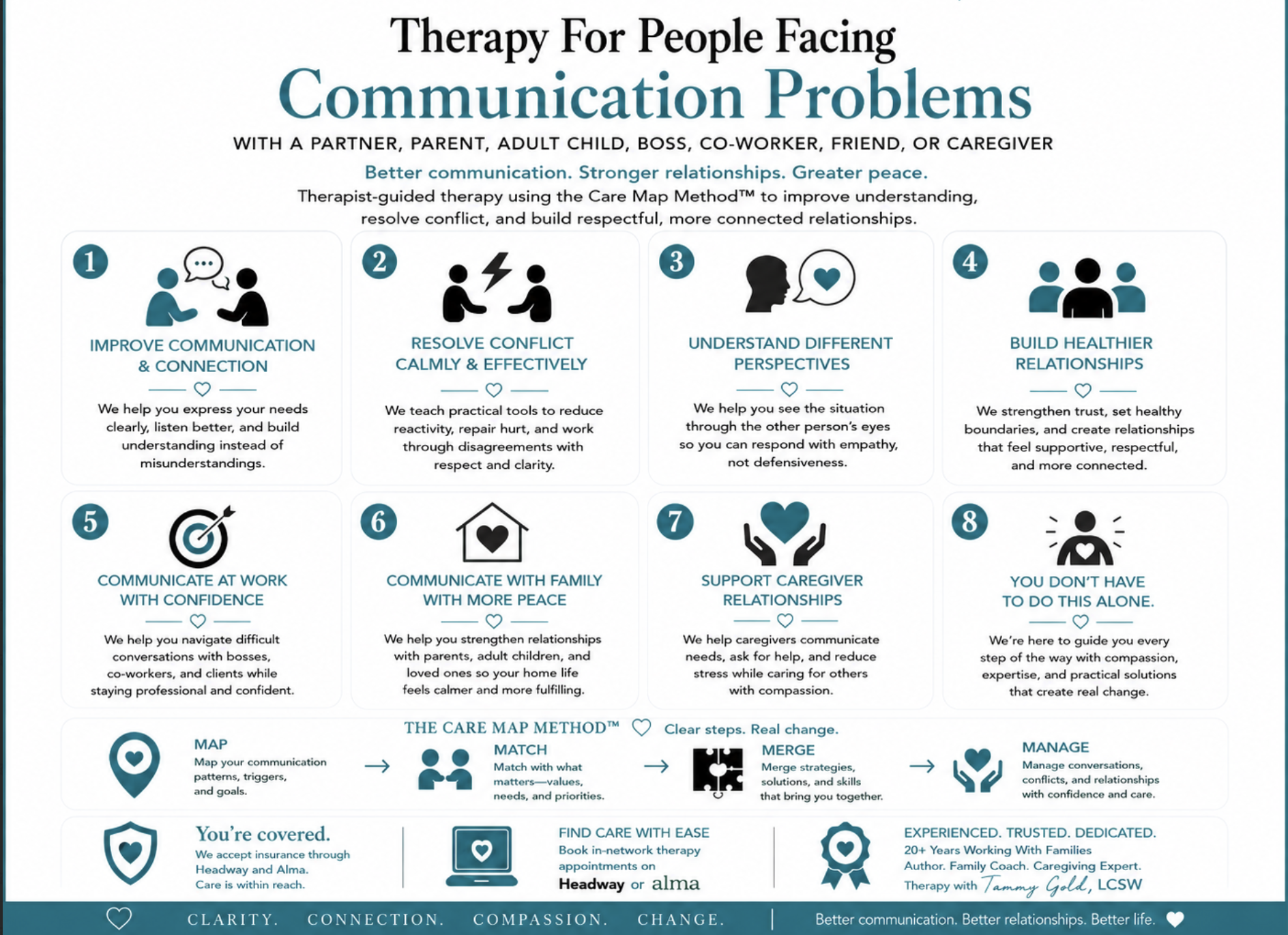
Therapy for Communication Problems With a Partner, Parent, Adult Child, Boss or Caregiver
Therapy for clients struggling to communicate with a partner, parent, adult child, sibling, boss, coworker, nanny, daycare provider, caregiver or senior care professional.
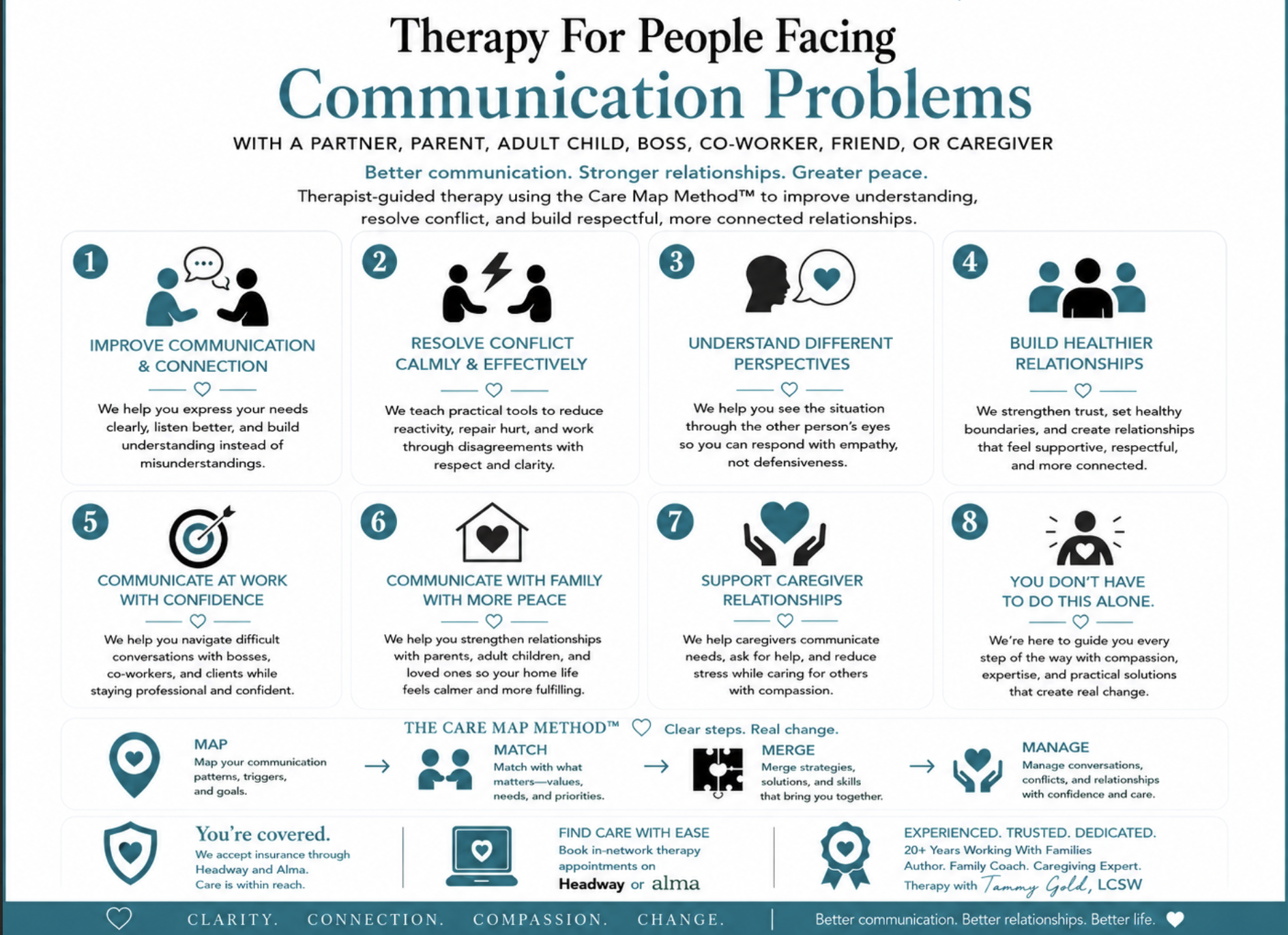
Therapy for Communication Problems With Important People in Your Life
Communication problems can happen in any important relationship: with a partner, child, adult child, parent, sibling, friend, boss, coworker, neighbor, co-parent, nanny, daycare provider, caregiver or senior care professional. When communication breaks down, people often feel misunderstood, defensive, resentful, anxious or emotionally exhausted.
I am Tammy Gold, LCSW. I offer online therapy for clients in California, New Jersey and Oregon. Depending on your plan and eligibility, insurance may be available through Headway or Alma.
My Psychology Today profile links to booking and insurance options through Headway.
When communication becomes stressful
You may know what you feel but not how to say it. You may worry that speaking honestly will create conflict. You may shut down, over-explain, apologize, become reactive or avoid the conversation altogether. Therapy can help you understand the pattern and find more effective words.
The goal is not to make you perfect. The goal is to help you communicate with more clarity, compassion and confidence.
How sessions help
Using the Care Map Method™, we Map what is causing the communication breakdown, Match the needs and triggers underneath it, Merge better language and listening, and Manage boundaries or next steps.
This approach is especially helpful for clients dealing with family conflict, parenting stress, divorce, co-parenting, work stress, caregiver management, childcare situations or eldercare decisions.
Request a session
If you are struggling with communication in an important relationship, visit my Psychology Today profile to request a session. My profile links to booking and insurance options through Headway.
What types of relationship concerns do you help with?
I help clients with couples and marriage concerns, communication problems, parenting stress, family conflict, divorce, co-parenting, adult children, sibling relationships, caregiver stress, workplace relationships, boundaries, and major life transitions.
What makes your approach to relationship therapy different?
My approach combines a warm, supportive, nonjudgmental therapeutic space with a structured process. We use the Care Map Method™ to understand what is driving the problem, identify needs and patterns, strengthen communication, and create practical next steps.
Will therapy be a safe and nonjudgmental space?
Yes. My goal is to provide one place where clients can speak honestly without shame, blame, criticism, or pressure. Clients can unpack feelings, understand patterns, and receive compassionate support and practical guidance.
Is therapy only for couples?
No. Individual therapy can help improve relationships with a spouse, partner, child, parent, sibling, adult child, friend, coworker, boss, caregiver, or other important person—even when that person does not attend therapy.
Do you provide couples counseling?
Yes. Couples work may address repeated arguments, communication problems, emotional disconnection, parenting disagreements, trust, boundaries, divorce decisions, and co-parenting. Insurance coverage for couples or family sessions varies by plan.
What happens during the first therapy session?
We discuss what is bringing you to therapy, what feels most important, what you want to change, and what has or has not helped before. We begin mapping the biological, emotional, social, and environmental factors affecting the situation and identify initial priorities.
Do you only listen, or will I receive practical tools?
Therapy includes emotional support and space to process feelings, but it is also solution-focused. Clients may receive communication tools, scripts, boundary language, reflection questions, relationship strategies, and practical next steps.
Do you offer online therapy?
Yes. Online therapy is available to clients physically located in California, New Jersey, or Oregon at the time of the session.
What insurance plans do you accept?
Insurance availability varies by state, plan, eligibility, and booking platform. Prospective clients should use the booking or insurance-verification link to confirm current coverage before scheduling.
How do I schedule therapy?
Use the Psychology Today or designated booking link on the page to view availability, confirm insurance eligibility, and request a therapy appointment.