
When Is a Relationship Worth Saving? 10 Signs to Consider Before Divorce
Deciding whether to stay in a relationship or leave it is rarely simple.
Most couples do not reach this question because of one disagreement. They arrive there after months—or years—of feeling disconnected, resentful, disappointed, lonely, or emotionally exhausted.
You may still love your partner but no longer feel close to them. You may function well as parents or household managers while feeling more like coworkers than a couple. You may wonder whether the relationship is going through a difficult season or whether something essential has been lost.
The question is often not simply:
“Do I still love this person?”
A more useful question is:
“Is there enough safety, respect, honesty, and willingness here to build something healthier?”
Some relationships can recover from significant disconnection. Others become healthier only after separation. The goal is not to preserve every relationship at any cost. The goal is to understand what is happening clearly enough to make a thoughtful decision rather than reacting only from fear, anger, guilt, or exhaustion.
First: Safety Comes Before Saving the Relationship
Before considering whether a relationship can be repaired, it is important to distinguish ordinary relationship distress from abuse, coercive control, intimidation, or ongoing danger.
Couples counseling may not be appropriate when one partner is afraid to speak honestly, fears retaliation, or is being threatened, monitored, financially controlled, physically harmed, sexually coerced, or isolated from support.
In those circumstances, the priority is not improving communication. The priority is safety, individual support, and informed professional or legal guidance.
A relationship should never be “saved” by requiring one person to tolerate fear, degradation, or harm.
For relationships that are distressed but not unsafe, the following signs can help you evaluate whether meaningful repair may still be possible.
1. Both Partners Are Willing to Look at Their Own Behavior
A relationship has a better chance of healing when both people can ask:
What am I contributing to this pattern?
What do I need to change?
How does my behavior affect my partner?
Am I willing to do something differently?
This does not mean both people are equally responsible for every problem. One partner may have caused greater harm or disengaged more deeply. But repair becomes possible only when each person is willing to take honest responsibility for their own actions.
A relationship tends to remain stuck when one partner believes:
“Everything would be fine if you changed.”
“I have nothing to work on.”
“Your reaction is the real problem, not what I did.”
“You are too sensitive.”
Accountability does not require perfection. It requires the ability to acknowledge impact without immediately becoming defensive, dismissive, or blaming.
A useful question
Can each of you identify at least one meaningful change you personally need to make?
When the answer is yes, there may be something workable to build upon.
2. Respect Still Exists Beneath the Conflict
Couples can disagree intensely and still maintain respect.
Respect means that even during conflict, neither partner regularly humiliates, mocks, threatens, degrades, or intentionally destabilizes the other.
It may look like:
allowing the other person to finish speaking
avoiding insults and character attacks
respecting privacy and boundaries
taking concerns seriously
acknowledging each other’s effort
resisting the urge to punish or retaliate
When respect is present, even inconsistently, it can provide a foundation for repair.
When contempt becomes the dominant tone of the relationship, healing becomes more difficult. Contempt includes eye-rolling, ridicule, sarcasm meant to wound, disgust, superiority, and repeated messages that the other person is fundamentally inadequate.
A relationship may still be repairable if both partners recognize this pattern and are willing to stop it. But if contempt is entrenched and one partner sees no reason to change, the relationship is likely to remain emotionally damaging.
3. You Can Still Remember What Brought You Together
When couples are deeply distressed, the current pain can overshadow the entire history of the relationship.
You may begin to believe:
“We were never happy.”
“Nothing between us was real.”
“We have always been incompatible.”
Sometimes that is true. But often, chronic resentment rewrites the story.
A sign that the relationship may be worth examining more carefully is that both partners can still identify something meaningful that once connected them.
Perhaps you shared:
genuine friendship
affection
humor
physical chemistry
similar values
a strong sense of teamwork
emotional safety
shared dreams
mutual admiration
Past connection alone is not enough to justify staying. However, it can indicate that the relationship once had healthy elements that may not be completely gone.
The more important question is whether those qualities can be rebuilt in the present—not whether they existed years ago.
4. The Main Problems Are Patterns, Not Fundamental Incompatibilities
Many couples become trapped in repetitive interaction cycles.
One partner pursues; the other withdraws.
One criticizes; the other becomes defensive.
One carries the mental load; the other waits to be told what to do.
One seeks emotional closeness; the other focuses on fixing the problem.
Over time, both partners may believe the other person is the problem when the deeper issue is the cycle between them.
For example:
The more one partner demands reassurance, the more the other retreats.
The more the other retreats, the more anxious and demanding the first becomes.
Both feel misunderstood.
Both behave in ways that reinforce the other person’s fear.
Patterns can often be changed when couples learn to identify them early and respond differently.
Fundamental incompatibilities may be harder to resolve. These can include major differences involving:
whether to have children
monogamy
addiction and recovery
financial values
religion
where to live
basic lifestyle expectations
willingness to participate in family life
definitions of commitment
Couples do not need to agree on everything. But some differences require more than improved communication. They require honest decisions about whether both people can live with the reality of the relationship.
5. There Is Still Emotional Responsiveness
Emotional responsiveness means that your partner can recognize when you are hurt, overwhelmed, afraid, or lonely—and responds with some degree of concern.
They may not always respond perfectly. They may become defensive at first. They may need time to regulate themselves. But eventually, they can return and say:
“I understand why that hurt you.”
“I did not realize how alone you felt.”
“I want to do better.”
“I can see why this matters.”
“I am sorry.”
This ability to care about each other’s internal experience is one of the strongest signs that repair may be possible.
A relationship becomes far more difficult to save when one partner consistently responds to vulnerability with:
indifference
ridicule
blame
punishment
avoidance
manipulation
emotional shutdown
Couples do not need to anticipate every need. They do need to care when the other person is suffering.
6. Apologies Lead to Changed Behavior
An apology is meaningful only when it becomes part of a larger repair process.
Healthy repair usually includes:
acknowledging what happened
understanding the impact
taking responsibility
making amends where possible
changing future behavior
Many distressed relationships become trapped in apology cycles:
conflict occurs
one partner apologizes
tension temporarily decreases
nothing changes
the same conflict returns
Repeated apologies without behavioral change can gradually destroy trust.
A relationship may be worth saving when apologies are followed by observable effort.
For example:
A partner who repeatedly failed to communicate begins providing updates consistently.
A partner who dismissed emotional concerns learns to stay present during difficult conversations.
A partner who avoided household responsibilities takes ownership without needing reminders.
A partner who broke trust becomes more transparent and accountable.
Trust is rarely rebuilt through words alone. It is rebuilt through repeated experiences of reliability.
7. Both Partners Are Willing to Be Uncomfortable
Repair is uncomfortable.
It may require discussing betrayal, loneliness, resentment, sex, parenting, money, family boundaries, unequal labor, or years of emotional disconnection.
It may require hearing things you do not want to hear.
It may require tolerating your partner’s pain without immediately explaining your intentions.
It may require changing habits that have protected you emotionally but damaged the relationship.
Couples who recover are not those who avoid discomfort. They are those who learn how to move through it without becoming cruel, controlling, or emotionally absent.
A partner may say they want to save the relationship while refusing to:
attend therapy
discuss the problem
change routines
set boundaries with family
address substance use
examine financial behavior
rebuild trust
make time for the relationship
Wanting the relationship to continue is not the same as being willing to repair it.
8. The Relationship Has More Than One Identity
Some couples become defined entirely by one role:
parents
caregivers
providers
crisis managers
household administrators
business partners
They may function efficiently while losing their identity as a couple.
A relationship may still have potential when both partners want to rebuild parts of the bond that have been neglected.
That may include:
friendship
affection
shared interests
sexuality
humor
emotional intimacy
time without children or caregiving responsibilities
future planning
This does not require recreating the early stage of the relationship. Long-term relationships naturally change. The goal is to build a version of partnership that fits who you are now.
Sometimes couples are not incompatible. They are depleted.
Parenting, work stress, illness, caregiving, grief, financial pressure, and chronic sleep deprivation can make a relationship feel empty even when the underlying bond remains.
Before concluding that love is gone, it can be useful to ask whether the relationship has had enough time, energy, and protection to remain emotionally alive.
9. You Can Imagine a Better Relationship With This Person
Some people remain in relationships because they are afraid to leave, not because they believe the relationship can improve.
Others consider leaving because they want relief from the current pattern, even though they can still imagine a healthier future with their partner.
Try separating these questions:
Do I want this relationship exactly as it is?
Do I believe a healthier version of this relationship is possible?
Is my partner willing and able to help create it?
Am I willing to participate in that work?
What evidence supports my hope?
Hope should be grounded in behavior, not only promises.
If you can imagine a better relationship but your partner repeatedly refuses every opportunity for change, your hope may be attached to potential rather than reality.
If both of you can describe the relationship you want and take concrete steps toward it, that is more meaningful.
10. You Are Seeking Clarity, Not Permission
When people ask whether they should stay or leave, they are sometimes asking someone else to make the decision for them.
A therapist should not simply tell you whether to divorce. The role of therapy is to help you think more clearly, recognize patterns, understand your needs, evaluate risk, communicate honestly, and make a decision that aligns with your values and circumstances.
Discernment-focused work can help couples who are uncertain about the future of the relationship.
The goal may be to decide among three general paths:
continue the relationship as it is
separate or divorce
commit to a defined period of serious repair work
A structured period of repair might include:
individual or couples therapy
communication agreements
specific behavioral changes
transparent expectations
measurable goals
regular check-ins
a timeframe for reassessment
Clarity often comes more easily when the question changes from:
“Should I stay forever?”
to:
“Is there enough here to justify a sincere, structured attempt at repair?”
Signs That Staying May Be Causing More Harm
It is equally important to recognize when the relationship may not be repairable—or when remaining in it may be damaging.
These signs include:
ongoing fear or intimidation
physical, sexual, emotional, or financial abuse
repeated betrayal without accountability
addiction without willingness to seek treatment
chronic lying
coercive control
refusal to participate in repair
repeated humiliation or contempt
manipulation involving children
punishment for expressing needs or boundaries
one partner doing all the emotional work
promises that are never followed by change
No relationship is healthy simply because it remains intact.
Children are not automatically protected by parents staying together. They are more strongly protected by stable, emotionally safe, predictable caregiving environments.
In some families, that is created through reconciliation. In others, it is created through separation.
What Couples Therapy Can—and Cannot—Do
Couples therapy can help partners:
understand destructive patterns
communicate more clearly
rebuild emotional connection
repair trust
negotiate parenting and household responsibilities
address resentment
strengthen boundaries
make thoughtful decisions about the future
Therapy cannot force someone to care, change, tell the truth, or remain committed.
It also cannot erase harm without accountability.
The most productive couples therapy does not focus only on preventing divorce. It helps couples determine whether they can create a relationship that is emotionally sustainable for both people.
Sometimes the outcome is reconciliation.
Sometimes the outcome is a more respectful separation.
Both can represent meaningful progress.
A Relationship Check-In Using the Care Map Method™
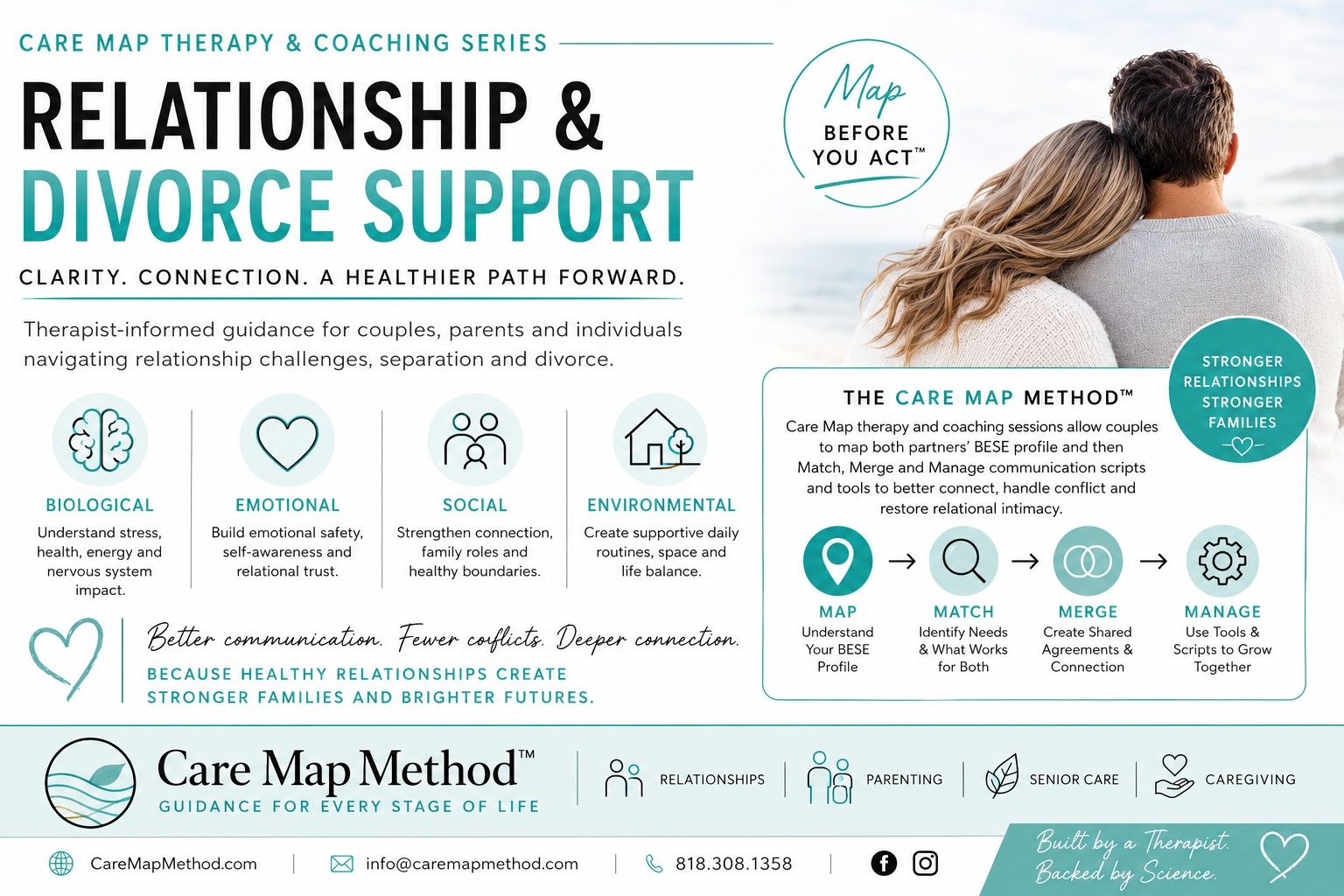
When couples feel overwhelmed, it can help to examine the relationship through four interconnected areas.
Biological
Consider how the relationship is affecting sleep, appetite, energy, physical tension, health symptoms, and your overall stress response.
Ask:
Do I feel constantly activated or depleted?
Is relationship stress affecting my physical health?
Are illness, hormones, sleep loss, medication, or substance use affecting our connection?
Emotional
Consider whether you feel seen, heard, respected, and emotionally safe.
Ask:
Can I express my feelings without being punished?
Do we repair after conflict?
Is there affection, empathy, or warmth left between us?
Social
Consider the relationship’s effect on parenting, friendships, extended family, and community.
Ask:
Have we become isolated?
Are family members or children being pulled into our conflict?
Do we have healthy support outside the relationship?
Environmental
Consider daily life, finances, workload, schedules, caregiving, and the home environment.
Ask:
Is one person carrying most of the mental or practical load?
Do we have any protected time as a couple?
Are external pressures driving much of our disconnection?
Looking at all four areas helps couples avoid reducing a complex relationship problem to a single explanation.
Before Making a Final Decision
You do not need to decide the future of your relationship in the middle of your worst argument.
Whenever possible, create enough emotional and practical stability to think clearly.
That may mean:
pausing repetitive conflict
getting individual support
beginning couples therapy
clarifying immediate boundaries
gathering financial information
addressing urgent health or substance concerns
reducing children’s exposure to conflict
defining what would need to change
You may ultimately decide to stay.
You may decide to leave.
You may decide to spend a specific period of time evaluating whether repair is possible.
The healthiest decision is rarely the one made from panic. It is the one made with the clearest understanding of the relationship as it truly is—not only as it once was or as you wish it could become.
When to Seek Support
You may benefit from therapy when:
you feel emotionally stuck
the same arguments repeat without resolution
you are unsure whether to stay or leave
trust has been damaged
parenting stress is affecting the relationship
caregiving responsibilities are creating resentment
communication has become defensive or hostile
you feel lonely inside the relationship
you want to make a thoughtful decision rather than an impulsive one
Therapy can provide a structured space to understand what is happening, identify what can change, and decide what direction is healthiest.
Tamara Gold, MSW, LCSW, CEC, provides online therapy for adults in California, New Jersey, and Oregon. Her work focuses on relationships, parenting stress, caregiving, anxiety, major life transitions, and family dynamics.
Why do couples keep having the same argument?
Repeated arguments are often maintained by deeper emotional triggers, unmet needs, defensive reactions, assumptions, and communication patterns rather than the surface topic alone.
Can couples therapy help communication?
Yes. Couples therapy can help partners slow down conflict, identify the pattern, hear each other more accurately, communicate needs more clearly, and practice repair.
What if my partner will not attend?
Individual therapy can still help you understand the relationship pattern, regulate your reactions, communicate differently, clarify boundaries, and make more thoughtful decisions.
Is couples therapy only for relationships in crisis?
No. Couples may seek therapy for recurring conflict, disconnection, parenting stress, intimacy concerns, life transitions, premarital preparation, or to strengthen a relationship before problems escalate.
Will the therapist take sides?
The goal is not to declare one partner right and the other wrong. The work focuses on understanding the relationship system, helping both people feel heard, and identifying healthier patterns.
Can therapy help couples affected by parenting stress?
Yes. Parenting can create exhaustion, resentment, role imbalance, disagreement about discipline, and reduced time for connection. Therapy can help couples rebuild teamwork and communication.
What does Map, Match, Merge, and Manage look like for couples?
MAP identifies the conflict cycle. MATCH clarifies each partner’s needs and goals. MERGE builds healthier communication and repair. MANAGE creates tools and agreements that can be used between sessions.
How long does couples therapy take?
The length varies based on the concerns, goals, severity of conflict, participation, and whether there are complicating factors. Some couples seek focused short-term work, while others benefit from longer support.